"Animal City: The Domestication of America" featured on the "Living on Earth" radio show
I don't listen to radio, especially NPR, as much as I would like, because I got into the habit of listening to the radio mostly in a car, and not being particularly car-bound, that means not much radio.
But I was making a dish, Ina Garten's Corn and Avocado Salad, which requires about an hour of chopping, and I turned the radio on to NPR affiliate KCPW, and they were broadcasting the environmental topics show "Living on Earth."
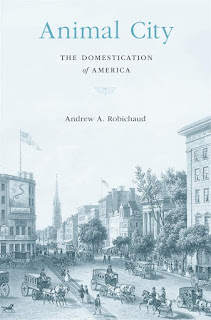 One of the segments was "Animal City: The Domestication of America," featuring Andrew Robichaud, author of the book of the same title, discussing how food animals had once been a key element of cities, dairies which I knew about and "feed lots" which I didn't, and the process of removing those functions first to the outskirts of cities and then out of cities altogether.
It's definitely worth a listen.
It's an important history that still comes up from time to time, because today's zoning regulations typically restrict animals even chickens on residential properties, and forbid even small scale slaughtering and other types of food production, including craft brewing and distillation, even large scale baking, in industrially zoned lands.
This came up last year in Alexandria, Virginia.
Their zoning regulations no longer forbid animal slaughtering and some residents opposed the approval of a small halal poultry operation ("Halal slaughterhouse and shop wins approval from divided council in Alexandria, Va.," Washington Post).

As a small scale operation nothing like a Swift meatpacking plant, many of those concerns were overblown, or not relevant to a discussion on zoning and allowable uses.
In the episode Professor Robichaud mentions an area of San Francisco once called "Butchertown," where animals were kept and slaughtered.
It reminded me of the real life Butchertown district in Louisville, where there is a Swift slaughterhouse/meatpacking plant (still operating today) and the distinct ever present smell of animals, at least when I was there in 2004.
Back when I ran a historic preservation study on the H Street neighborhood, one of the elements covered in the neighborhood history section was how the area had once been on the outskirts of the city, that there were "market gardens," small plots used to grow produce for sale in the city, and abattoirs, slaughterhouses for animals.
Horses. We also discussed a bit why there were stables and carriage houses, and drayage. When leading a walking tour once, someone asked a question about "what happened to all the horseshit?" but I didn't have a good answer.

Issues around "the horse in the city" still comes up in the modern day.
Depending on the city, there may still be horse stables and public access to horse riding. Many police departments also have horse-mounted police units ("Long Legs of the Law : Mounted police units are valued for crowd control and park patrols--but training takes more than horse sense," Los Angeles Times) and there can be complaints about how they are deployed in crowd control.
(In DC, both the US Park Police and the Metropolitan Police Department have mounted police units. The US Capitol Police had such a unit for a brief time, but Congress disbanded the unit over costs.)
Other issues I am familiar with include:
• in cities like New York City, animal rights activists fight the continuation of tourist oriented carriage rides ("In His 5th Year as Mayor, de Blasio Finally Acts on Horse-Carriage Pledge," New York Times). These horses are still stabled in the city.
• in Baltimore, "a-rabbers" sell fruit and vegetables from horse-drawn carts and animal rights activists are opposed as well ("As Baltimore's arabbers become a thing of the past, a photographer aims to preserve the tradition," Baltimore Sun").
• and in some trail planning processes, although more in suburban and exurban areas, it is common to include access to horses alongside pedestrians and cyclists.
Food animals and cities today. And re-legalization of small scale, "backyard" animal husbandry has been an issue for awhile. I call the opportunity to do this with your neighbors "Block supported agriculture." Post columnist Tamar Haspel just wrote about this in the context of the rise in chicken raising as a result of the pandemic ("7 tips for raising backyard chickens, from picking a breed to having an exit strategy").
Seattle may be the most liberal city in the US when it comes to such regulations, whereas many cities aren't interested in going that far, and may or may not be comfortable with chickens. DC is definitely a laggard on that score.
Animal agriculture and land use master planning. Some counties have divided their land uses in ways to permanently protect rural lands. Baltimore County, Maryland was one of the first in the late 1960s. The way they militate against sprawl is to refuse to provide "city water" service to rural areas of the county.
Greater Portland is known for its Urban Growth boundary, although all areas in Oregon are required to urban and rural zones as part of master planning processes.

As rural areas suburbanize there are often conflicts between new residents and extant agriculture operations ("‘Right To Farm’ Laws Allow Ag To Be Stinky And Noisy, But Some Neighbors Cry ‘Fowl’," Colorado Public Radio; "Suburban farms meet opposition as they look to change business," Baltimore Sun; "Beer-fueled fight in Fairfax prompts officials to look at state farming law," Washington Post). Often such disputes end up in court.
Communities with agricultural land typically have an agriculture element within their land use master plans, while cities typically do not. Although this is changing as the interest in Urban Agriculture grows.
(Not related to animals.)
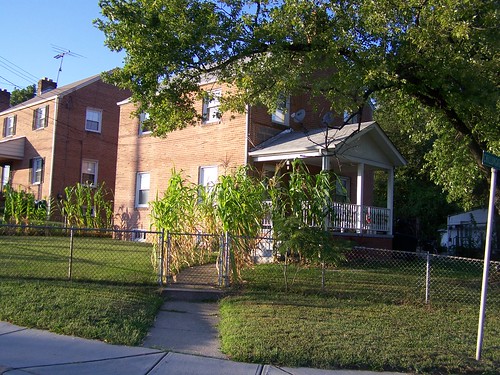
Front yard gardening. Another issue is front yard gardening, which many people consider "messy" and many zoning codes forbid ("The Battlefront in the Front Yard," NYT). But depending on if you have a backyard and whether or not it gets enough sun, it might be the only option people have for growing vegetables.
Related is the concept of the Edible Landscape/Foodscaping. More about this some other time.
Labels: building regulation, food-agriculture-markets, industrial lands, neighborhood planning, urban agriculture, urban history, zoning
posted by Richard Layman @ 3:52 PM&Permanent Link
Follow this blog
8 comments






.jpg)