Rebuilding Place in the Urban Space

"A community’s physical form, rather than its land uses, is its most intrinsic and enduring characteristic." [Katz, EPA] This blog focuses on place and placemaking and all that makes it work--historic preservation, urban design, transportation, asset-based community development, arts & cultural development, commercial district revitalization, tourism & destination development, and quality of life advocacy--along with doses of civic engagement and good governance watchdogging.

Tuesday, March 10, 2026

Soon to be history: The Olive trees of Las Olas Boulevard, Fort Lauderdale

 Apparently, the Black Olive trees linking the median of Las Olas Boulevard are aging, wracked by termites, etc.  But they are beautiful trees.  All will be removed over the next two to three years in favor of the construction of a new road pattern. ("Las Olas tree — doomed by termites — to be chopped down Thursday," "Fort Lauderdale to bid farewell to beloved black olive trees on Las Olas," South Florida Sun-Sentinel).


Photos: Amy Beth Bennett, South Florida Sun-Sentinel.

Shade is a valuable commodity in climate change scenario when temperatures keep climbing.  Especially in the hot climes of Florida.  Photo: Carline Jean, South Florida Sun-Sentinel.

Unlike the majority of the Fort Lauderdale Commissioners, I don't think I would have voted in favor of the destruction.  The median will be eliminated in favor of wider sidewalks ("Famous tree-lined median on Las Olas needs to go, Fort Lauderdale commission agrees" ).

Highway departments don't like such urban design treatments because they see the immobile objects of big trees as hazards if automobile operators lose control and crash. Still they are a distinctive feature that is unduplicated elsewhere ("Take out trees on Las Olas and you’ll turn into Anywhere, USA, critic warns Fort Lauderdale").

Labels: , , , ,

Friday, April 25, 2025

Arbor Day

Some of the articles about Earth Day (4/22/25, usually acknowledged the weekend before or after) focused on acts people can take to make a difference.  

One is planting trees.  Many Earth Day events are organized around tree planting events organized by local and state tree advocacy groups.  

Such groups may be necessary in the face of municipal budget cuts ("LA’s Tree Emergency Goes Beyond Vandalism," Planetizen) and failures by agencies ("Salt Lake City’s Public Lands Department accidentally poisons 200 trees," Salt Lake Tribune) and misguided legislators ("Are trees ‘the enemy?’ Some Utah lawmakers claim overgrown forests suck too much water," SLT).

Arbor Day is held the last Friday in April, as a way to focus on the place and role of trees in our communities.

-- last year's entry, "Arbor Day: Street Trees of Seattle by Taha Ebrahimi | Trees as Cultural Landscape (at the community scale)"

1. Cities and/or neighborhoods as community forests ( Interactive map of many US cities, "Which cities have the most trees? See how yours stacks up," Washington Post).  For years I've suggested that cities, and more recently, maybe neighborhoods, should think of their tree cover as an urban or community arboretum.  

Morton Arboretum in Illinois runs the Arbnet accreditation program, and a few smaller cities have this certification.  DK about any neighborhoods.

Also see "A sequoia forest in Detroit? Plantings to improve air quality and mark Earth Day," AP.

Arborists are turning vacant land on Detroit’s eastside into a small urban forest, not of elms, oaks and red maples indigenous to the city but giant sequoias, the world’s largest trees that can live for thousands of years. .

The project on four lots will not only replace long-standing blight with majestic trees, but could also improve air quality and help preserve the trees that are native to California’s Sierra Nevada, where they are threatened by ever-hotter wildfire.

Detroit is the pilot city

for the Giant Sequoia Filter Forest. The nonprofit Archangel Ancient Tree Archive has donated dozens of sequoia saplings that were planted Tuesday by staff and volunteers from Arboretum Detroit, another nonprofit, to mark Earth Day

TreeCity USA is another Arbor Day Foundation program rewarding cities for their commitment to urban forestry.

Relatedly, while seeing only limited use, SF has an "Green Benefits District," which is a special tax increment financing mechanism that can be used to maintain and improve public spaces.  One is active in the Dogpatch-NW Portrero neighborhood.

Cass Avenue, Mt. Clemens Michigan.

2.  An alternate way to think about local government planning and the role of trees, is treating Streets as linear parks, framed by trees ("Linear parks: Adding value to urban landscape," Question of Cities).  

Before the dominance of the car, streets were treated more as landscapes with plantings, rather than utilitarian spaces.

Similarly, a "parkway" is more about the landscape than a freeway.

3.  Green bonds as a funding source. Likely to dry up during the Trump Administration, this Philadelphia Inquirer article is about the best explanation of how they work, "Longwood Gardens’ $250 million renovation taps increasingly popular ‘green’ bonds."

4.  Fruit trees in the public space.  Not just pretty but a source of food.  But they are messy.  Salt Lake's Green Urban Lunch Box, which has a focus on fruit trees as part of urban food systems, put itself on hiatus because of funding unpredictability.

Sugar maple trees are a source of maple syrup ("Rhode Island Couple Tapping Trees for Syrup," FUN107). 

5. Tree vandalism.  "Vandals chainsaw dozens of trees across downtown L.A.," Los Angeles Times and "Homeless Couple Destroys Young Trees At SF’s Jefferson Square Park," Beyond Chron.  WTF?  The cost of lost trees can be considerable.


A woman walks around a felled tree along South Grand Avenue in downtown Los Angeles on Sunday. (Photos: Carlin Stiehl / Los Angeles Times)


L.A.’s fragile urban canopy was dealt a vicious blow this weekend when a chainsaw-wielding vandal cut down a number of shade trees along South Grand Avenue and other areas of downtown, according to media posts and photos uploaded to Reddit and Instagram. 

-- "Chain-saw-wielding man suspected of felling downtown L.A. trees is arrested," LAT 

6.  Rich people unauthorized cutting of trees to improve the viewshed from their home is a common problem ("Southbury couple says they will pay $600,000 judgement for illegally removing town-owned trees," CT Insider). And developers ("Fort Worth council ‘speaks for the trees’ with tougher fines for clear cutting," Fort Worth Star-Telegram).

Not everyone agrees ("Do cedar trees have more rights than homeowners? Texas lawmakers pushes new bills to remove protections," KXAN/Austin).

Texas lawmakers are taking on cedar allergies during the 89th Legislative Session. Two bills, House Bill 3798 and Senate Bill 1927, aim to prevent a city from prohibiting the removal of an Ashe Juniper tree.

“It’s these liberal urban communities, like the city of Austin, who are trying to put cedar trees over private property rights and over protecting native flora and fauna,” said State Rep. Ellen Troxclair, R-Burnet County.

Also see, about examples in England ("Felled giants expose gaps in tree protection," Guardian).

We should have a system of protection like Toronto, Canada, where virtually all trees, public and private, are automatically protected and any felling requires a licence to be obtained. Where felling is permitted, the bylaws also require new trees to be planted and there are penalties of up to C$100,000 (£54,000) if you contravene the law.

7.  Trees as woke.  The Trump Administration sees planting trees as a verboten DEI initiative (Milwaukee church saw opportunity to plant trees on empty land. Trump team saw DEI effort," USA Today).  Also, grant rescissions by the Trump Administration affect grants to states by the US Forest Service.  The grant was for increasing biodiversity of the tree cover.

8.  With climate change invasive non-native trees are an increasing problem ("Nonnative tree invaders lead to declines in native tree species richness," Proceedings of the National Academy of Sciences.).  Also see "Column: Death to the Bradford pear tree," Daily Tar Heel.

9.  As mentioned in the Earth Day entry.  The Trump Administration intends to Increase cutting of trees in US Forest Service lands ("USDA Opens 59% of Federal Forest for Logging to Manage Fire Risk," Bloomberg).  Plus defunding the agency  and cutting science projects.  Given the increase in the geographic spread and virulence of wildfire, the cuts extend to personnel who respond to wildfires ("‘Crazy’: Forest Service cuts ignite fear, fury over wildfire risks," Politico).  

The Ocean County wildfire covered 8,500 acres and led to about 3,000 residents being evacuated, according to the New Jersey Forest Fire Service. Photo: New Jersey Department of Environmental Protection.

Wildfires in states are an increasing problem ("N.J. wildfire swells to 11,500 acres, could become biggest in two decades," Philadelphia Inquirer).

10.  Revival of wood as a building material in taller buildings ("How wood is making a comeback in construction," U of Utah).

Ascent Tower in Milwaukee is the tallest timber constructed building in the US.

Although there is a "sweet spot" or limit on when it makes sense to use wood and when not to ("Building tall with timber "does not make sense" say experts," Dezeen).

Labels: , , , ,

Monday, April 29, 2024

Arbor Day: Street Trees of Seattle by Taha Ebrahimi | Trees as Cultural Landscape (at the community scale)

Arbor Day was Friday and this is Monday. I'm late.  Although many places don't necessary celebrate Arbor Day on the last Friday of April...

Street Trees of Seattle is an interesting book.  During the pandemic Ms. Ebrahimi went for long walks, began re-connecting and re-looking at the natural world, and began documenting street trees at the neighborhood scale.  

She chose to do this by drawing, and for the purposes of the book, she organized the content by neighborhood, focused on the primary type of tree "dominating" that particular neighborhood, although each section does list other significant trees that are also present.

I am fascinated by the way the book is organized because a book organized in this way could be done for most big cities, although not necessarily focusing on one type of tree within a neighborhood, as a way to help reconnect people to the "natural world" within their community.  

It's also a great way to organize walking tours, like WalkArlington's community walks or Jane's Walks the first weekend of May, exploring communities in honor of Jane Jacobs, or neighborhood history walks, etc.  

Instead of most of these kinds of tours focusing on the built environment, we can do this with trees and other elements of flora.  Obviously, arboreta do this quite a bit within their grounds, e.g., "Garden Highlights Tour" at the Morris Arboretum and Gardens at University of Pennsylvania.

Ebrahimi points out that many of our trees--especially in Seattle where 95% of the original tree cover was milled for wood soon after the founding of the city--are planted by residents--so the "natural world" is in fact not so natural, and that people bring trees from where they were before.

Images from the Ballard Neighborhood section of Street Trees of Seattle


Cherry trees in Ballard.  Photo: Joel Rogers Photography

It means that most of the trees planted in Seattle aren't native to the Pacific Northwest, which presents interesting questions, not only about appropriateness in terms of "natives," but stories about how some of these trees, like the Pacific Sequoia, thrive there, but are failing in their native habitats in response to climate change.  

Trees as place, trees as stories.  She mentioned an article in the New Yorker about apples, "Crunch: Building a Better Apple," and I was reminded of a story I read in a Toronto newspaper about an Italian immigrant who kept a fig tree going in his backyard for decades.  (If you do an Internet search it turns out Italians did this all over North America, planting fig trees as they emigrated.)

For me, I am interested in trees but more formulaically.  I think we need great tree cover in cities.  I like trees for their shade and beauty.  I like fruit trees because they help feed us.  

But from a tree leaf identification standpoint, I can identify just a few trees, maple, oak, willow oak, even though "I have been around trees forever."  I can identify more trees than that but not necessarily by leaf.

When I was a kid, my brother and I planted some maple trees from seedlings we found in our yard or others (the best one, had a "good trunk", I absconded from a neighbor's planting bed--it might have been five inches tall).  Some died and we nursed the others.

That was in the mid 1970s, and now the trees are maybe 50 feet tall--this photo is from 2018, and the trees in question are behind the garage.

But this is a "private tree" in a yard, not a "street tree" which is defined as being in the planting strip between street and sidewalk, and ostensibly is the responsibility of the local government,  

In DC, "proper tree species" are specified for each block in the city, and residents aren't supposed to plant trees in the planting strip, but they do and they aren't necessarily the authorized tree.

Trees as cultural landscape.  It is that kind of story that interests Taha.  Unlike me, she is interested in the story of the tree and its place in the landscape, who planted it and "why".  For example, one tree she learned about was planted as a barter between a family that helped a poorer one heat their house in a particularly cold winter.  The helped family planted a special tree in the neighbor's planting strip.

I realized that what she was talking about is what we might call "Trees as Cultural Landscape" at the neighborhood, district, and/or city-wide scale.  Not just the trees, or trees as objects or elements of the cultural landscape, but the stories behind them. Their historicity.  Also see "In Los Angeles, a Tree With Stories to Tell," The New York Times., which describes a community trying to save a noteworthy tree from being torn down by a developer.

The last piece in my series of articles on gaps in parks master planning is about applying the cultural landscape lens to parks planning ("Gaps in Parks Master Planning: Part Nine | Second stage planning for parks using the cultural landscape framework").  No reason to not extend this concept to street tree planning.  

Still, even though I say I have a formulaic approach to trees, this article in the Washington Post, "Everyone should have a favorite tree. Here’s mine," makes me realize that all of us probably have favorite trees.  

The maple tree is in the back of this photo.  The willow oak was already gone.

E.g., I like flowering trees like DC's crepe myrtles or the redbuds here in Utah, and we were attracted to our DC house, because of two towering trees in our backyard, a maple and a willow oak, whose canopy combined to create a kind of outdoor room that even worked well in the rain.  

Unfortunately now both trees are gone--although I did let willow oaks reseed so we'll see what happens.

Streets/street trees as linear parks.  I first heard this concept expressed by David Barth at a presentation in 2004.

North Columbus Avenue, Galion, Ohio, c. 1920s

Most cities have urban forestry units.  Most cities, at least the big cities, address street tree planning very seriously.  DC does.  And it has the nonprofit Casey Trees planting trees throughout the city, in public spaces and in conjunction with property owners and utility companies, on private property.   And the Metropolitan Washington Council of Governments just set a goal of 50% tree cover for the region ("New tree canopy goal for D.C. area calls on Arlington to get greener," Arlington Now).  

But a city or county tree plan--like the point I made about parks plans and architecture--is formulaic too.  It doesn't get into the stories of how and why of what trees are where and how they contribute to place and the stories of how they became to be planted.

Tree planting initiatives as entry points into greater community involvement.  In Utah, TreeUtah operates similarly to Casey Trees, but they tend to be more focused on planting trees in association with park systems, not just Sugar House Park for which I am on the board, but in city parks like Fairmont--in fact participating in a TreeUtah event there for Earth Day a couple years ago is how I got involved with Friends of Fairmont Park.

Separately, Wasatch Community Gardens is creating an urban orchard in Salt Lake City's westside.

Although one criticism of tree planting initiatives is that it is perhaps even more important to take care of the trees and forests we already have, a point made in today's Los Angeles Times, "Is planting trees on Arbor Day one way we can all fight climate change? Not so much."

Still, I think tree planting initiatives are an important way to get people involved, and has the potential to move them from planting to tree to advocating for forests, for their city to declare their tree cover "a community arboretum" (see below).  To get people beyond the single event of planting a tree, it has to be built into the programming--greening beyond Earth Day.

US Forest Service community involvement and educational publications. Less so now, the US Forest Service had a massive publication program, including items focused on K-12 education and adult learning.

I mention from time to time that I collect ephemera related to urban planning and what I am involved in.  

Earlier this year I acquired an amazing set of materials, developed in the 1950s, although this set was from 1960, promoting advocacy and conservation, produced by the US Forest Service.


Trees can work for the beauty and security of your neighborhood, state, and nation, 

Page 2, Page 3, Page 4

At that time, when women mostly didn't work, the Forest Service had an active communications program with women's and garden clubs that at the time were active across the country.


The NPS History website does have a collection of scans of USFS publications.  But generally not the ones before 1960, which can be pretty cool.  Some of the older ones are findable online.  A good source is the University of Pennsylvania, such as for Forestry Activities: A guide for youth group leaders.

Community/municipal arboreta.  Perhaps the largest city participating as a "community/municipal arboretum" is Newport, Rhode Island ("As city’s first generation of exotic trees die out, Newport Tree Conservancy works to replace them," Newport Daily News).  The program is run by the ArbNet accreditation program, sponsored by Morton Arboretum in Illinois.

Yalecrest, Salt Lake City.

I think more cities should do this as a way to set higher expectations and standards in how they address their tree cover.  Apparently, Bexley, Ohio was the first ("Bexley could be first U.S. city to be declared arboretum," Columbus Dispatch).  A municipal arboretum only includes trees in public spaces.

What about accredited neighborhood arboreta?  I also think it would be neat for neighborhoods, especially in big cities, to consider getting designated as a "neighborhood arboretum," because it is less likely to happen at the scale of the whole city.  

This came up when I was on a walking tour In Salt Lake's  Yalecrest neighborhood a couple years ago.  The guy was talking about the tree cover and he said "you know, we live in a forest,. "  And I started talking to him about the already designated a historic district, would be a great candidate.  

Unlike a community arboretum, depending on the interest of property owners, a neighborhood arboretum could include both public and private trees.

An idea to expand tree identification markers in arboreta.  Street Trees of Seattle has a nice set of references.  But something I haven't seen before is a separate set of references by tree.

It would be neat to include those kinds of references in a QR code as part of the signage markers for individual trees.

Conclusion: Street Trees of Seattle.  For me the key concepts are:
  • a great book if you live in Seattle, a great way to learn about the city and its neighborhoods in a new way
  • the concept of the cultural landscape -- a (tree and trees) not just as an object, but an element of place, with historicity--a story to tell
  • Fascinating way to organize the content by neighborhood
  • as a book its extendable to other cities, especially organized by neighborhood
  • the neighborhood focus is a good way to organize tours to better expose people to flora in the "natural world" of their communities
  • organizing references by tree is a step forward too, and could be incorporated by arboreta into tree identification markers through QR codes

Labels: , , , ,

Friday, April 30, 2021

Arbor Day, Friday April 30th

Today is National Arbor Day, which is celebrated on the last Friday of April.  For a blogger, it's always a good way to write about the value of trees in the urban environment.

The National Tree Benefit Calculator provides data on the economic value of individual trees in terms of storm water, property value, energy savings, air quality, and carbon dioxide capture. 

 According to the US Forest service, cities see an average US$2.25 return each year, for every dollar invested in trees.

From a planning perspective, when it comes to trees there are two "transformational concepts" (in the line of thinking of what I call "transformational projects action plans") that should be incorporated into city and county master plans.

1.  Treating streets as linear parks.  I first heard this expressed by parks planner David Barth in a presentation at the American Planning Association national meeting in DC in 2004.  

Liberty Avenue, Pittsburgh, Strip District

I think it's brilliant.  This concept made it into a few master plans that he worked on, but it hasn't been widespread.

The Parkway approach from the 1920s is still applicable today.

-- Parkways, San Francisco Better Streets
-- Boulevards and Parkways, Seattle Open Space 2100
-- Street Types, Boston Urban Design Manual
-- Parkway Design Guidelines, Denver 

but not just for boulevard-type streets, but "ordinary" streets too.

Some cities have more radical approaches, mostly as one offs.

-- Minneapolis converted the street serving the two block Milwaukee Street Historic District to a non-car space.  Greenway advocates in the city use that as a model for promoting greenways and other approaches to pro-sustainable mobility (photo and article, Terrain).

In Seattle, the street in front of the Belltown Community Center (sadly, no longer in operation) was converted to a pedestrian and community priority space (NACTO article).


If we thought of streets in these ways, in terms of how street aesthetics impact how we see and experience our communities, rather than as merely the way that we move and speed up traffic, we would treat the design of roadsides much differently.

Also see "Extending the Signature Streets concept to Signature Streets and Places."

For example, the "parking strips" fronting roads are usually too narrow to best accommodate the growth of trees.


Salt Lake City has a variety of planting strip widths, narrow, decently sized, and super wide, usually on major arterials.

South Temple Street, Salt Lake City

One way that DC accommodates tree root growth and expansion is by the use of rubberized sidewalks.

1900 block of E. Bryan Avenue, Salt Lake City

Unfortunately, too many public works departments see trees as a maintenance nuisance and prefer to cut them down.

2.  Treating a city's trees collectively as an urban arboretum.  This concept is promoted by the Morton Arboretum in Illinois through their ArbNet accreditation program.  

A few small cities have adopted this approach, but it hasn't been widely adopted. Although many cities have moved tree and "urban forestry" divisions into transportation agencies, with the aim of a more integrated approach.

Perhaps the largest city participating is Newport, Rhode Island ("As city’s first generation of exotic trees die out, Newport Tree Conservancy works to replace them," Newport Daily News).  

Many cities get designation as "Tree City USA" by the Arbor Day Foundation.  But the standards are somewhat minimal:

  • A Tree Board or Department
  • A Tree Care Ordinance
  • A Community Forestry Program With an Annual Budget of at Least $2 Per Capita
  • An Arbor Day Observance and Proclamation

To to my way of thinking, working to get the tree canopy of the entire city as a "municipal arboretum" at the city-wide scale is much more transformational.

You'd think that the various organizations promoting tree planting efforts in their city, such as the Casey Trees initiative in DC, Trees Atlanta, or the Heartland Tree Alliance in Greater Kansas City, would want to move their communities in this direction.

Labels: , , , ,

Thursday, August 27, 2020

Racist segregation, heat waves, trees as carbon sinks, and more creative "solutions" to add tree cover to cities

25 years ago there was a terrible heat wave in Chicago, and hundreds of people died.  Sociology graduate student Eric Klinenberg researched what happened, leading to his book Heat Wave: A Social Autopsy of Disaster in Chicago.

He focused on what he now calls "social infrastructure" and how communities with the same racial and income dynamics but differences in the level of social capital--functioning community organizations and local commercial districts with active retailers, etc.--between them accounted for the differences in death rates.

The New York Times has an aricle, "How Decades of Racist Housing Policy Left Neighborhoods Sweltering," which looks at this phenomenon more generally, reporting on findings linking redlining to heat-related deaths, reduced tree cover, etc., although they didn't discuss social infrastructure. From the article:
On a hot summer’s day, the neighborhood of Gilpin quickly becomes one of the most sweltering parts of Richmond.

There are few trees along the sidewalks to shield people from the sun’s relentless glare. More than 2,000 residents, mostly Black, live in low-income public housing that lacks central air conditioning. Many front yards are paved with concrete, which absorbs and traps heat. The ZIP code has among the highest rates of heat-related ambulance calls in the city.

There are places like Gilpin all across the United States. In cities like Baltimore, Dallas, Denver, Miami, Portland and New York, neighborhoods that are poorer and have more residents of color can be 5 to 20 degrees Fahrenheit hotter in summer than wealthier, whiter parts of the same city.

And there’s growing evidence that this is no coincidence. In the 20th century, local and federal officials, usually white, enacted policies that reinforced racial segregation in cities and diverted investment away from minority neighborhoods in ways that created large disparities in the urban heat environment.
Yes, typically low income neighborhoods didn't get a lot of investment in urban design and placemaking related elements, from quality school and library buildings, to parks and trails ("," Chicago Tribune), to trees and sidewalks.

And this is still a problem today, although the "social urbanism" planning approach is a good way to right the imbalances ("Social urbanism and Baltimore," 2019).

The other day there was an article in the Wall Street Journal about how companies are buying old growth forests for their function as carbon sinks ("Preserving Trees Becomes Big Business, Driven by Emissions Rules").

Reading the article, I was thinking that while it's great these forests won't be clear cut in the future, I couldn't help but ask the question " what about planting more trees now in places that are lacking in trees?" ("Tree planting 'has mind-blowing potential' to tackle climate crisis," Guardian). From the WSJ article:
For much of human history, the way to make money from a tree was to chop it down. Now, with companies rushing to offset their carbon emissions, there is value in leaving them standing.

The good news for trees is that the going rate for intact forests has become competitive with what mills pay for logs in corners of Alaska and Appalachia, the Adirondacks and up toward Acadia. That is spurring landowners to make centurylong conservation deals with fossil-fuel companies, which help the latter comply with regulatory demands to reduce their carbon emissions.

For now, California is the only U.S. state with a so-called cap-and-trade system that aims to reduce greenhouse gasses by making it more expensive over time for firms operating in the state to pollute. Preserving trees is rewarded with carbon-offset credits, a climate-change currency that companies can purchase and apply toward a tiny portion of their tab.

But lately, big energy companies, betting that the idea will spread, are looking to preserve vast tracts of forest beyond what they need for California, as part of a burgeoning, speculative market in so-called voluntary offsets.
It seems to me that investments in forests as carbon sinks ought to be tied to new investments in tree plantings too.

Urban neighborhoods lacking in tree coverage ought to places for such targeted investments.

Absolutely there is a need for equity planning I've argued for many years about social and other infrastructure investments in low income communities as a way to help strengthen those communities and extend opportunity.

I have an outline for equity planning that I need to further develop (I pop into the comments links to programs and concepts I've come across since), but it's basically about investment in all the types of "infrastructure" that a community needs.

-- "An outline for integrated equity planning: concepts and programs," 2017

Labels: , , , , , , ,

Monday, May 18, 2020

It turns out preferencing "male" street trees increases pollen, making allergic reactions worse

I don't have a problem, fortunately, with tree pollen in the Spring, but many people do.  According to the Guardian ("How urban planners' preference for male trees has made your hay fever worse"), this problem has been accentuated by the plantings of certain types of trees over others.

Sadly, some of my favorite trees, such as oaks and maples, are high in pollen.

From the article:
Eight years ago Tom Ogren, a horticulturist, was in Sacramento, California, when he noticed that the ground around the State Capitol building was covered in thick yellow pollen.

Scanning the trees along the street with his binoculars, he saw the trees were all deodar cedars (Cedrus deodara) and all cultivated males.

Naturally, the deodar is monoecious, having both male and female cones growing on the same tree. But cultivation has produced wholly male trees – plants favoured by planners since they have no seeds or pods to drop but only pollen. This was the case at this Sacramento site, Ogren said.

Growers’ breeding of purely male diodar trees had created, said Ogren, “something that doesn’t even exist in nature”. ...

Male trees are often favoured by urban landscape planners as female trees can shed fruit as well as seeds and pods.

Pollen producing trees that are dioecious (with male and female flowers on separate plants) are seen to add to the effect of allergies of city dwellers. ...

Allergenic tree pollen was found to be one of the biggest contributors to hay fever and asthma, and pollen counts have also been rising over the past 15 years.

This health issue is going largely unaddressed despite there being a simple solution: a bigger mix of male and female trees in urban areas.
Ogren has created the Ogren Plant Allergy Scale (OPALS) to guide the development of a tree canopy where pollen production is managed in a manner to be reduced.

The USDA Urban and Community Forest unit uses the scale to help cities in reducing pollen counts ("Building a Low-Allergen Plant Palette," ASLA "The Field" Blog).

Labels: ,

Friday, April 24, 2020

Arbor Day: Friday April 24th, 2020

Past entries include:

-- 2019
-- 2018
-- 2016

DC has the Casey Trees organization, which was funded by a philanthropist to focus on improving the tree environment across the city, not just where the street meets the sidewalk.

Some programs I've come across recently include:

A multifaceted sustainability nonprofit group in the Kansas City area called Bridging The Gap. One of their initiatives is the Heartland Tree Alliance, which promotes tree care and plantings.

The City of Albuquerque has a small sales tax with a fraction dedicated to street improvements, particularly median plantings. It has softened the character of many otherwise wide streets across the city. But it isn't focused on "re-treeing" commercial districts or neighorhoods, although there is a separate Albuquerque NeighborWoods program for neighborhoods.

Trees Atlanta -- similar to Casey Trees.


On the pro-urb list, architect, designer and author Steve Mouzon wrote a great piece about the value of street trees. This is the first part of what he wrote.

Direct Effects of Street Trees


1. Properly placed street trees shade the sidewalk. This can result in a reduction of 20° - 45° in sidewalk temperature, according to Lance Hosey. Sidewalks store a lot of heat due to their mass and then radiate that heat to everything around them, especially including the people walking on them.
Clinton, Oneida County, New York ~ Small Village ~ Historic Village
2. Street trees also shade the people walking on the sidewalk. Walking in the shade versus walking in the sun can easily make a perceived difference of 20° due to solar radiation on your skin.

3. Street trees transpire, meaning that they give off water vapor through evaporation of moisture from their leaves. The misting fans found often in warm climates like South Beach where we lived for 16 years cool people sitting at sidewalk cafes have a similar and more visible effect because you can see the mist whereas you can’t see the water vapor from the trees, even though it cools you almost as well. Evapotranspiration from trees can reduce temperatures around the trees by 2° - 9°, again according to Hosey. This compounds the cooling effect of shading.

4. Street trees are usually considered beautiful by most people in town. And street trees are the only things we install on a streetscape that get bigger and more beautiful over time all on their own. But beauty isn’t the only way they appeal to our senses. “Street trees help you know when you are because of how they behave across the seasons.” ~ Victor Dover

5. Properly placed street trees (between sidewalk & travel lanes) physically protects people walking on the sidewalk because a car is likely to strike a tree before getting to someone walking. Trees near the street also encourage drivers to slow down because no sane driver wants to wrap their car around a tree, as the tree almost always wins. Street trees have been shown to be as effective against speeding as speed cameras, according to The Telegraph.

Baltimore's real estate pricing lags housing value.  But housing prices in areas with parks, squares, and street trees do better.  This house is in the Union Square area.

6. Because street trees are beautiful, they raise the value of the real estate around them if properly selected. On mostly residential streets, their lowest limbs should be above head height; on mostly commercial streets, their lowest limbs should be above the sign band of the adjacent businesses.

As to the value, one street tree on a block raises the value of every house on the block by $2,000 except the house where the street tree is located, the value of which is raised $7,000. If the street is lined with trees, the value of every house is raised by $22,000. This data is from Doug Kelbaugh.

Dan Burden says that while the planting & 3-year maintenance cost of a relatively large-caliper street tree is probably $250 - $600, the lifetime benefits of that tree will be around $90,000. This means that street tree programs can be largely self-financing in all except poor neighborhoods because once people understand this, many will plant their own street trees to jump-start their home appreciation. Beyond the street, studies show home buyers & real estate agents assign 10%-23% of lot value to trees on the lot, according to Kaid Benfield.
20070914 malpruned-c-ficifolia
7. Because street trees are beautiful, they are good indicators of the most-loved parts of town, increasing not only the real estate value, but also the stature of the neighborhood. Recovery of a seriously disinvested place should begin early on with a street tree program because street trees change the perception of the place from a place where nothing is possible to a place where “you never know what good might happen there.”
Rowhouses
When I’m scouting a town I don’t know for possibly shooting a volume for the Catalog of the Most-Loved Places I drive a major street and look down the side streets looking for street trees. Almost without exception, places with lots of street trees are the most-loved neighborhoods in town. No sign of a vibrant, lovable place can be seen from further down the street than a line of street trees. Test this all yourself.

8. Street trees reduce crime. A recent Baltimore study showed that 10% more street trees = 12% less crime. Why this is so is no mystery. More street trees = stronger Walk Appeal = more people walking = more eyes on the street = less crime, as Jane Jacobs said 60 years ago.
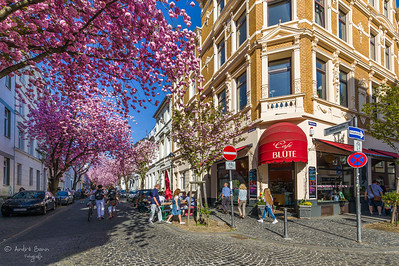
Cafe Blüte
9. Street trees are good for business. Lining streets with street trees leading to a neighborhood center draws customers in to neighborhood businesses from surrounding neighborhoods by elevating Walk Appeal. Jeff Tumlin says that street trees are a critical economic development and sustainability investment. And they’re good for the economy of a neighborhood in general. According to Patrick Kennedy, Every street tree absorbs the first inch of stormwater. They can save billions in stormwater infrastructure across the city.

10. Trees are carbon champions. They continually inhale carbon dioxide and exhale oxygen, while humans and other animals do the opposite. They also sequester carbon within the tree as the tree grows. Plant enough trees, and they will actually absorb all carbon emitted by humans today. That number is currently 1.2 trillion trees.

Unfortunately, humans are going the wrong direction by burning the Amazon and deforesting all over for more cattle farming. But planting street trees would at least be a start in the right direction.

If there are 4 million miles of streets and roads in the US today and street trees were planted 25 feet on center on either side of all of them, that would total almost 1.7 billion trees. That’s a small fraction of 1.2 trillion, but definitely a step in the right direction. Just. Quit. Destroying. What’s. Already. Growing!

Labels: , , , ,

Friday, April 26, 2019

Arbor Day: Friday April 26th

Today is Arbor Day, which is supposed to focus our attention on the value of trees--another good event to build around for an "Earth Week" or "Earth Month."

Many communities do tree planting and other events in association with it. For example, Lake Zurich, Illinois leverages the event for volunteer engagement and clean ups at the city's 32 public parks.

-- Celebrate Arbor Day lists events

The website The Conversation has a piece, "The value of trees: 4 essential readas"

1. Cooling and greening city streets
2. Holding down the Great Plains
3. Improving urban air and water quality
4. Making streets safer

Over the years, wrt trees, two of the biggest ideas "concerning trees" that have shaped my thinking significantly are:

1. At an APA presentation in 2004, Parks Planner David Barth in his then approach of linking City Beautiful and New Urbanism approaches, mentioned as one of three key elements is:
treating streets as linear parks
The Parkway approach from the 1920s is still applicable today.

-- Parkways, San Francisco Better Streets
-- Boulevards and Parkways, Seattle Open Space 2100
-- Street Types, Boston Urban Design Manual
-- Parkway Design Guidelines, Denver

but not just for boulevard-type streets, but "ordinary" streets too.

2. Cities as "municipal arboretums."  Most cities manage street trees via a forestry department that can be located in a variety of different agencies--public works, transportation, utilities, or parks.

Many cities and counties have regulations concerning maintenance and care of trees on public and private property. But they still think about trees more individually rather than as a part of a larger forest.

Under the ArbNet program, the Morton Arboretum in Illinois has developed an arboretum accreditation program for communities.  It aims for the consideration and operation of a community's urban forest as a unit, an open "municipal arboretum."  Cities that are so accredited are Basalt, CO., Bexley, OH,  Oak Park, IL. and Newport, RI ("Bexley could be first U.S. city to be declared arboretum;" Columbus Dispatch).

Other ongoing issues

Economic value of trees/urban forest. There are many reports on the economic value of trees, of both a direct and indirect nature such as this one.  Studies have found that commercial districts with a quality tree canopy are more successful than those without one ("City Trees and Property Values," Arborist News, 2007).

The National Tree Benefit Calculator provides data on the economic value of individual trees in terms of storm water, property value, energy savings, air quality, and carbon dioxide capture.

According to the US Forest service, cities see an average US$2.25 return each year, for every dollar invested in trees.

Save the Elm action by the Sheffield Tree Action Groups.

Trees as an expensive element in maintaining public space.  Unfortunately, because trees can be "expensive" to maintain, bean counters can see trees merely as a hindrance, especially when the environmental benefits aren't taken into consideration.

With that perspective it can be seemingly cheaper to cut trees down. 

This is a problem in Sheffield, England, where the city signed an outsourcing contract for street maintenance with no opportunity for public input concerning the disposition of trees.  The contractor has been aggressively cutting down trees ("Put a price on urban trees – and halt this chainsaw massacre," Guardian).

 I am not doctrinaire in believing that you should never cut a tree down for new types of infrastructure ("Nearly 100 trees may fall in Malden sidewalk project," Boston Globe) , so long as new trees are planted.  In part this is because I grew trees from replanted seedlings on our yard when I was a teen, and I am doing so again now, in part to replace old trees that sadly have died or are dying.  But the maple and oak trees that are growing will replace the oak tree that died and the maple that is dying.  (Although the new oak is not a willow oak, which is the one that we had.)

Watershed maintenance and the potential for wildfire.  Some cities out west are beginning to fund broader watershed maintenance as a way to reduce the risk of water source contamination from wildfire.  Although there are teething problems with the concept when it comes to implementation.

Flagstaff, Arizona is one of a few jurisdictions to look at management of the potential for wildfires as an element of watershed and water quality management. In 2012, they passed a bond issue to pay for mitigation. It was particularly noteworthy because much of the watershed lies outside of the city borders. Santa Fe does this too ("Got water? Thank (and save) a forest," Santa Fe New Mexican).

-- Flagstaff Watershed Protection Project: Home

Labels: , , , ,

Friday, April 27, 2018

Arbor Day

Friday is Arbor Day 2018, and Arbor Day is always a great reason to consider urban forestry issues. Many communities do tree planting and other events in association with it.

For example, Lake Zurich, Illinois leverages the event for volunteer engagement and clean ups at the city's 32 public parks.

I thought this infographic, 52 types of wood and the trees they come from, showing both the tree and the type of finished wood that comes from them was interesting because most of us don't know.

Trees are a fundamental element of a community's "natural" environment and landscape.

With regard to streets and tree cover, I've been influenced by park planner David Barth's recommendation in a presentation I saw many years ago that cities should treat streets as "linear parks."
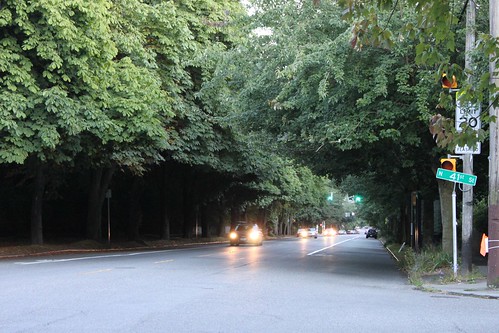
Fremont Ave N & N 42nd St
This thick tree canopy on Fremont Avenue North in Seattle gives the impression that the street is more park like.

Recently, I picked up an old book (published in 1999) about Frederick Law Olmsted, A Clearing in the Distance, by Witold Rybczynski, which I've started reading.  Olmsted was the founder of modern parks planning in the U.S.

The Tree City USA program of the National Arbor Day Foundation is the most widely known of programs that promote sound practices by local jurisdictions.  Washington DC is one of the many thousands of communities that have been designated by the program.

Thinking bigger: Cities as "municipal arboretums."  Most cities manage street trees via a forestry department that can be located in a variety of different agencies--public works, transportation, utilities, or parks.  Many cities and counties have regulations concerning maintenance and care of trees on public and private property. But they still think about trees more individually rather than as a part of a larger forest.

Under the ArbNet program, the Morton Arboretum in Illinois has developed an arboretum accreditation program for communities.  It aims for the consideration and operation of a community's urban forest as a unit, an open "municipal arboretum."  Cities that are so accredited are Basalt, CO., Bexley, OH,  Oak Park, IL. and Newport, RI ("Bexley could be first U.S. city to be declared arboretum;" Columbus Dispatch).

-- The Sustainable Urban Forest: A Step-by-Step Approach

Community forests/forest districts.  Illinois has parks districts, such as the Chicago Parks District.  It also has "forest preserve districts" that are set up like parks districts to preserve and manage community forests.  According to the history webpage of the Forest Preserve District of Cook County, the idea behind the district was to conserve natural landscapes during a period of rapid change.

-- Community Forests International
-- England's Community Forests

Like parks, these days forest preserves grapple with providing programs that attract new audiences.  For example, one forest preserve in Cook County is adding zip lines, in association with a Maryland-based company ("Zip lines coming to Cook County forest preserve," Chicago Tribune).  In an article a few years ago, Chicago Tribune architecture writer opined that "Cook County Forest Preserve District has room to improve," but he is pleased with the trajectory of improvements after many years of the agency being treated as a backwater by the County Government.

The Truckee Meadows Community Forest in Nevada is another example of a "municipal arboretum," but they aren't part of the Arbnet program. From the webpage:
Community forests are important to an area’s quality of life, they are part of the “urban ecosystem.” Imagine what your neighborhood would be like if there weren’t any trees in it. A healthy community forest is an important part of the environmental and economic vitality of cities and towns across the country.

In the Truckee Meadows, our community forest does not occur naturally as it does in the Sierra Nevada or the Pacific Northwest. Much of Nevada is a dry, high-desert ecosystem where few trees grow on their own. Our community forest depends on people planting, caring for, and watering their trees. Sustaining the health and vigor of our region’s tree canopy is the combined responsibility of residents, business owners, nurseries, landscapers, and governments!

The majority of the community forest in the Truckee Meadows is growing in on private lands: in the front and back yards of homes and in common areas managed by homeowner’s associations. We also have trees growing in parking lots, next to shops, businesses and malls, and around our offices and industrial areas. Our public trees are found in parks, along our streets, and lining the Truckee River. This part of the community forest is primarily managed by our municipal governments (Washoe County and the cities of Reno and Sparks), however, residents may care for some of these trees as well. The cities and county require trees and other vegetation be incorporated into new development projects in our community.

The community forest is an important part of our urban infrastructure just like our buildings, streets, sewers, and lights. As such, trees are an investment that requires maintenance. ...
Economic value of trees/urban forest. There are many reports on the economic value of trees, of both a direct and indirect nature such as this one.  Studies have found that commercial districts with a quality tree canopy are more successful than those without one ("City Trees and Property Values," Arborist News, 2007).

The National Tree Benefit Calculator provides data on the economic value of individual trees in terms of storm water, property value, energy savings, air quality, and carbon dioxide capture.

Save the Elm action by the Sheffield Tree Action Groups.

Trees as an expensive element in maintaining public space.  Unfortunately, because trees can be "expensive" to maintain, bean counters can see trees merely as a hindrance, especially when the environmental benefits aren't taken into consideration.

With that perspective it can be seemingly cheaper to cut trees down. 

This is a problem in Sheffield, England, where the city signed an outsourcing contract for street maintenance with no opportunity for public input concerning the disposition of trees.  The contractor has been aggressively cutting down trees ("Put a price on urban trees – and halt this chainsaw massacre," Guardian).

Watershed maintenance and the potential for wildfire.  Some cities out west are beginning to fund broader watershed maintenance as a way to reduce the risk of water source contamination from wildfire.  Although there are teething problems with the concept when it comes to implementation.

Flagstaff, Arizona is one of a few jurisdictions to look at management of the potential for wildfires as an element of watershed and water quality management. In 2012, they passed a bond issue to pay for mitigation. It was particularly noteworthy because much of the watershed lies outside of the city borders. Santa Fe does this too ("Got water? Thank (and save) a forest," Santa Fe New Mexican).

-- Flagstaff Watershed Protection Project: Home

But 8 years later, $10 million turns out to not be enough, even though other property owners are matching this with funds of their own ("Flagstaff watershed protection reason to celebrate," Arizona Daily Sun).

And complications working with other public landowners, especially the US Forest Service, add cost and time to the execution of the plan as well. Plus just because they thin the forests doesn't always mean there's a profitable market for the lumber or sawmills to process it.

Labels: , , , ,