Rebuilding Place in the Urban Space

"A community’s physical form, rather than its land uses, is its most intrinsic and enduring characteristic." [Katz, EPA] This blog focuses on place and placemaking and all that makes it work--historic preservation, urban design, transportation, asset-based community development, arts & cultural development, commercial district revitalization, tourism & destination development, and quality of life advocacy--along with doses of civic engagement and good governance watchdogging.

Tuesday, January 14, 2025

City water outages happen too often

I never did write about Jackson, Mississippi's water crisis a few years, when the water treatment plant failed leaving the city's 150,000 residents high and dry (Jackson Water Crisis, NRDC).  The city is predominately black and the predominately white State Legislature stepped in in what could be considered racist ways ("The Jackson Water Crisis, the Complexity of Environmental Racism," NonProfit Quarterly). From the first citation:

The drinking water system in Jackson, Mississippi, has suffered from serious safety and reliability problems for decades. Residents have endured discolored water, low pressure, oily water, and water with floating particles. Jackson’s water previously had elevated lead levels, and its treatment plants have struggled to properly and consistently filter and disinfect the water. Despite recent attention from federal officials, including a lawsuit filed against the city of Jackson in late 2022, the water system’s problems have not been fully resolved. 

Aging infrastructure and climate change are partial causes, partly an issue of environmental justice ("Jackson water crisis: A legacy of environmental racism?," BBC).

There's no question that many water systems across the country have state of good repair needs far beyond their ability to raise funds to do the improvements.

Richmond, Virginia recently had problems with a flooded water treatment center, leading to supply problems and boil advisories ("Could city workers have stopped flooding at Richmond water treatment plant sooner? State health officials say yes," WRIC TV).

In shades of Flint Michigan, which ended up leaching lead into water after switching water suppliers without updating their chemical treatment formula, Richmond's water department hadn't replaced the part that led to the failure, for many years ("For 8 years, city put off replacement of part that caused water outage," "Read the documents: Problems with Richmond’s waterworks well-known before system collapse," Richmond Times-Dispatch).  From the first article:

Mayor Danny Avula on Thursday afternoon said that, during Monday’s power outage, the switchgear failed to automatically transfer the plant to its primary backup power source. Instead, Avula said, the plant diverted to a secondary, battery-powered source that lasted for only 45 minutes.

Officials also wanted to “replace … the existing controls in the … switchgear,” the records show.

That battery source died before power was restored to the facility, leaving valves stuck open and causing catastrophic flooding. Avula on Thursday said that the switchgear had functioned properly through many previous blackouts, but at the time he could not say, precisely, when the component had last been replaced. The solicitation issued by the city in October 2016, obtained by The Times-Dispatch, shows that officials sought “modification of the existing switchgear” to ensure it could "automatically operate” the facility.

And Prince George's and Montgomery Counties recently had water boil advisories because of an excess of broken water mains and other problems ("Water-use request lifted for Montgomery and Prince George’s counties," Washington Post).

In 2021, the Texas electricity blackouts led to water system failures too, because most didn't have backup power generators ("Texans now face a water crisis after enduring days without power," Texas Tribune).

Conclusions.  (1) a failure to plan; (2) lack of money to replace seriously aged infrastructure; (3) lack of a sense of urgency. (4) climate change.

Labels: , , , ,

Thursday, October 21, 2021

October is National Energy Awareness Month

I didn't know that a number of years ago, the US Department of Energy designated October as National Energy Awareness Month.  

It's particularly appropriate this year given:

  • the need to improve the reliability of the energy grid more generally and increased stress due to the rise in renewable energy sources and electrification of motor vehicles 
  • heat wave related energy blackouts and deaths of people without air conditioning (blog entry)
  • cold wave related energy blackouts, especially in Texas (blog entry)
  • how failures in Texas this past winter led to massive price escalation throughout the Midwest because of natural gas production and distribution
  • big increases in energy prices being likely this winter
  • the seeming failure of energy grid privatization in Puerto Rico ("Who's to blame for Puerto Rico's power crisis? It's complicated, a report shows," NBC News), etc.
We'll see if this time Texas follows the recommendations of the Federal Energy Regulatory Commission concerning system reliability ("Feds call for more regulation of Texas power grid, natural gas industry," Austin American-Statesman).

The UK in particular and Europe more generally faces significant energy price escalation for a variety of reasons: (1) increased demand; (2) a drop off of investment in response to demand declines during the pandemic; (3) teething pains in the transition from fossil fuels to renewable energy sources; (4) fall off in renewable energy production, etc. ("Europe's energy crisis: Continent 'too reliant on gas,' says von der Leyen," Euronews).

(Separately, the UK has a Brexit-induced gasoline shortage, because there aren't enough truck drivers to take fuel to stations.  Although there is plenty of fuel. AP photo.)

For similar reasons, it's expected that energy prices will rise in the US this winter as well ("Home heating costs set to spike this winter amid global energy crunch," Sinclair Television, "U.S. home heating bills expected to surge this winter, EIA says," Reuters).  From Reuters:

Last year energy prices plunged to multi-year lows due to coronavirus demand destruction, particularly natural gas, the most popular U.S. heating fuel, which hit a 25-year-low. 

Depending where people live, the EIA said residential costs will rise to about $11-$14 per thousand cubic feet (mcf) for natural gas, about $2.50-$3.50 per gallon for propane, and $3.39 per gallon for heating oil. 

That compares with last winter's residential costs of around $8-$12 per mcf for natural gas, $1.50-$2.50 per gallon for propane, and $2.55 per gallon for heating oil.

Photo: "Insulate Britain: Who are the protesters and why do they keep blocking roads?," Big Issue.

In response to price rises in the UK, the advocacy group Insulate Britain has been demonstrating by shutting down major freeways ("Who are Insulate Britain and what do they want?," Guardian). 

More recent UK government home energy conservation programs failed and were cancelled ("Green deal scheme did not deliver energy savings, audit finds," Guardian). 

Photographer unknown.

The forthcoming rise in utility bills this winter  re-raises the issue of energy poverty.  

It would be very beneficial to have a massive home energy conservation initiative as part of a "Green New Deal" and President Biden's Build Back Better initiative which is having a hard time making it through Congress between the Republicans and the Democratic-lite Senators Sinema and Manchin.

Sadly, I doubt that energy conservation is much on the mind of Senator Manchin given how he earns millions each year from his investments in coal ("Joe Manchin’s ‘blind trust’ is an utter farce," Philadelphia Inquirer).

Photo: "Coming Up ‘Down the Hill’ On Peoria’s South Side," Belt Magazine.

Earlier in the year, I was shocked at an article in the Washington Post about people in Peoria's South Side neighborhood with monthly utility bills over $1,000 in the winter months, and I was surprised about reporting on how many low income households pay higher utility rates with "deregulation" rather than lower rates.

Energy conservation assistance programs for low income households should be an element of neighborhood improvement programs.  In response, I added "Local neighborhood stabilization programs: Part 5 | Adding energy conservation programs, with the PUSH Buffalo Green Development Zone as a model," which suggests systematic energy conservation programs to address equity and energy poverty programs in low income communities, to my series of articles on creating neighborhood revitalization initiatives ("A once 'wonderful' part of Peoria eroded with blight and crime. Why these residents stayed," Peoria Journal-Star).

It's also a way to provide job opportunities.

But I forgot to mention the importance of trees in addressing summer heat.  The New York Times has a couple of important pieces on inequitable distribution of trees in cities ("Since When Have Trees Existed Only for Rich Americans?" and "Why an East Harlem Street Is 31 Degrees Hotter Than Central Park West") and the contribution to the heat island effect.  

Also see this blog entry and "Boston’s ‘heat islands’ turn lower-income neighborhoods from hot to insufferable," Boston Globe. (Although I remember high income areas of San Francisco being without many trees also, due to small lots and virtually 100% lot coverage by buildings.)

My piece on energy conservation as an element of neighborhood revitalization didn't mention the tree canopy as a way to address summer heat island issues, which will be of increasing importance going forward.  Therefore, tree planting programs should be an element of such programs as well.

The next time I re-write "Local neighborhood stabilization programs: Part 5 | Adding energy conservation programs, with the PUSH Buffalo Green Development Zone as a model" I'll add a section on a massive tree planting program.

Labels: , , , , , , , ,

Thursday, June 17, 2021

Local neighborhood stabilization programs: Part 5 | Adding energy conservation programs, with the PUSH Buffalo Green Development Zone as a model

-- "The need for a "national" neighborhood stabilization program comparable to the Main Street program for commercial districts: Part I (Overall)"
-- "To be successful, local neighborhood stabilization programs need a packaged set of robust remedies: Part 2"
-- "Creating 'community safety partnership neighborhood management programs as a management and mitigation strategy for public nuisance programs: Part 3 (like homeless shelters)"
-- "A case in Gloucester, Massachusetts as an illustration of the need for systematic neighborhood monitoring and stabilization initiatives: Part 4 (the Curcuru Family)"
-- "Local neighborhood stabilization programs: Part 5 | Adding energy conservation programs, with the PUSH Buffalo Green Development Zone as a model," 2021

In August 2020, I wrote a series of pieces about the need for focused neighborhood stabilization and improvement programs, particularly in weak market neighborhoods.  It recommended as a proposed model the reworking of the Main Street commercial district revitalization approach, but for neighborhoods, which the State of Pennsylvania has already done, calling it "Elm Street." 

-- Elm Street program, Pennsylvania Downtown Center
-- Elm Street Managers Handbook
-- Chambersburg Elm Street Neighborhood Plan 

Part 2 discusses packaging a set of remedies, so the programs can act expeditiously. To do that programs need to collect data and information and create maps showing the condition and state of properties, and identify potential solutions, including organizing community volunteer and self help/DIY initiatives such as the "Paint Ypsilanti" initiative that helped residents in the Depot Town neighborhood, when their houses were in need of a new paint job.

Part 3 discussed creating focused "community safety partnership" initiatives to manage and mitigate nuisances, and Part 4 discussed a particular example in Gloucester, Massachusetts involving shaming of a household that needed help in order to maintain their house and property which is large, old, and in need of serious maintenance.

Unfortunately, unlike how the "Main Street" commercial district revitalization program was fostered by the National Trust for Historic Preservation, because they saw it as a way to help preserve historic buildings and towns, there just isn't a good national organization out there set up to take on, develop, and "spread" the Elm Street Approach across the county.

(Note that the Main Street model was developed from an initiative in Corning, New York, which started in 1964!!!!!!, where the town realized that to compete with new shopping malls, they ought to manage their downtown similarly, and they hired a downtown manager.  It still took 15 years from that point to develop the Main Street program.)

Energy efficiency programs to support low income residents.  There's nothing new about energy efficiency programs.  Most states have them.  HUD has programs that support energy efficiency retrofitting for seniors and low income households.  So do the Department of Energy including its Weatherization and Intergovernmental Programs Office and the Environmental Protection Agency.  Even the USDA's Rural Development Program.  There are plenty of examples of nonprofit or social enterprise organizations working in this space.

-- Low-Income Energy Efficiency: A Pathway to Clean, Affordable Energy for All, Environmental Defense Fund
-- "Study Highlights Energy Burden for Households and How Energy Efficiency Can Help," Natural Resources Defense Council
-- ADVANCING ENERGY EFFICIENCY IN DEVELOPING COUNTRIES: Lessons Learned from Low-Income Residential Experiences in Industrialized Countries, National Renewable Energy Laboratory
-- Energy Efficiency for Low Income Households, European Parliament
-- "Low-Income Households Pay A Lot For Energy. Efficiency Can Help Cut Costs," Alliance to Save Energy

El Paso Electric Power plant.

Although it has been getting a renewed focus lately, because energy efficiency is seen as reducing electricity demand enough to take the edge off of load and generation problems resulting from extreme weather such as what happened in Texas in February ("Cold wave: the Texas power debacle disproportionately impacts the less well off") and currently, with hotter temperatures ("Gov. Greg Abbott downplays electric grid concerns as Texans are told to conserve," KXAN-TV).


While it could be a stand-alone piece, since reading some pieces about how Baltimore's low income residents tend to have very expensive electricity plans ("Retail electricity deregulation mostly benefits companies at the expense of consumers" and "Why the Poor in Baltimore Face Such Crushing ‘Energy Burdens’," Inside Climate News) and a terrible story about low income people in Peoria having $4,000+ electricity bills ("OFF THE GRID: A flood of federal aid often fails to reach America’s poorest families," Washington Post), I think a fifth piece should be added to this series, because energy efficiency issues are particularly pressing in low income neighborhoods.

Helping people avoid $4,000+ electricity bills is a way to reduce the financial precariousness of low income households.

Minnesota Power Pyramid of Conservation, residential version

Other reporting.  Since the March piece ("Retail electricity deregulation mostly benefits companies at the expense of consumers") there's been more reporting on this topic, supporting the idea of a renewed emphasis on energy conservation as a strategy to support low income households..  

Low income households use more energy and pay more.  First, a study ("Measuring social equity in urban energy use and interventions using fine-scale data") published in the Proceedings of the National Academy of Sciences finds that low income households and people of color spend significantly greater amounts on energy than higher income households ("Tackling 'Energy Justice' Requires Better Data. These Researchers Are On It," NPR).  From the article:

The researchers found that in low-income communities, homes averaged 25 to 60 percent more energy use per square foot than higher-income neighborhoods. And within all income groups except for the very wealthiest, non-white neighborhoods consistently used more electricity per square foot than mostly-white neighborhoods. The results were even starker during winter and summer heating and cooling seasons.

"This study unpacks income and racial inequality in the energy system within U.S. cities, and gives utilities a way to measure it, so that they can fix the problem," says Ramaswami, a professor of civil and environmental engineering at Princeton University who's the lead investigator and corresponding author of the study. It's part of a larger project funded by the National Science Foundation to promote 'equity first' infrastructure transitions in cities.

This seems to confirm the real world experiences reported in Baltimore and Peoria.

Energy conservation programs don't do a good job reaching low income households.  Second, Yvonne Abraham, a columnist at the Boston Globe, writes ("Energy efficiency is a low-hanging fruit to combat climate change. So why can’t everyone get access to it?") that energy efficiency programs in Massachusetts tend to extraordinarily benefit higher income households, that lower income households need more help, more outreach in order to reap the benefits.  From the article:

Though Mass Save is available to every ratepayer in the Commonwealth, those who live in affluent towns are more likely to take advantage of it: Participation in places like Bolton, Carlisle, and Hingham is up to seven times greater than in Lawrence, Fall River, and New Bedford. 

 “The program as designed works really well for single-family homeowners who have money to spend to make their homes more efficient, and who speak English,” said Eugenia Gibbons, Boston director of climate policy at Health Care Without Harm. For others, not so much. 

 It takes time, trust, and money to participate in Mass Save: time to apply for a visit and to meet with a consultant; trust that the energy utility, which administers the program, is really offering you something for free, with no catch; and money to pay your share of the subsidized insulation and boiler bills. All three are in short supply in places where blue collar workers, immigrants, and renters are concentrated. Language barriers widen the gap...

Those who live in less advantaged places need Mass Save the most: They’re spending as much as 15 percent of their disposable income on energy bills; they tend to live in older, draftier, less energy-efficient housing; and they suffer from poorer air quality and its attendant maladies, including asthma. 

We have to fix this, and not just for the sake of the underserved people who are paying into the system but not getting its benefits, though that is reason enough. Reducing fuel consumption anywhere in the Commonwealth serves everyone: It is crucial to our quality of life, and the planet’s survival.

It turns out a recent effort in the UK to promote energy conservation both as a jobs program and to reduce household energy costs was junked soon into the program because of mismanagement ("UK government scraps green homes grant after six months," Guardian).

This point is similar to those made in Parts 2 and 4 of the series, that there need to be programs packaged to implement and deliver revitalization solutions at the district/neighborhood and household scales, and that the programs need to be very proactive in trying to reach people.  

Not unlike the current issues with vaccination and the reticent, although the issues are subtly different, but also just in the ways the programs are designed.  For example, USA Today reports on success in Minnesota and failures in Michigan, which come down to how the programs were designed ("Michigan bet big on mass vaccine events for COVID-19. It didn’t work out as hoped").

Provide heat pumps?  Third, a piece in the Guardian ("Poorer households in UK should get free heat pumps, say experts") suggests that one way to promote energy efficiency for low income households is to just give people heat pumps.  From the article:

Households on low incomes should be supplied with free heat pumps in order to kickstart the market for low-carbon heating equipment and meet the UK’s climate targets, experts have told the government. 

 Heat pumps can currently cost thousands of pounds to install, but the more that are installed, the faster that cost is likely to come down. They are widely regarded as the best way to replace the UK’s gas boilers and reduce carbon dioxide emissions from homes...

About 14% of the UK’s greenhouse gas emissions come from heating the UK’s poor housing stock, most of which is also draughty and energy inefficient. The group also called for insulation to be made available to people on low incomes.

It reminds me of programs focused on assisting people in transitioning from coal furnaces and ovens to gas and electricity.  Utility firms to this day have programs that finance the purchase of furnaces, etc.

PUSH Buffalo Green Development Zone as a neighborhood revitalization model also. There should be renewed and refocused attention paid to energy conservation programs benefiting low income households.  One example is the PUSH Buffalo community organization's Green Development Zone.  The GDZ is comparable to various "ecovillage" initiatives (I can think of some in DC, Cleveland, and elsewhere) in the 1990s and early 2000s, as a revitalization effort.

It's designed to promote green jobs, equity, to achieve environmental goals, etc.  It's also a way to deliver energy conservation programs in low income neighborhoods (PUSH Buffalo’s Green Development Zone: a Model for New Economy Community Development, Building A “Community Growth Machine”: The Green Development Zone as a Model for a New Neighborhood Economy).

You could argue that the Green Development Zone is:

1.  another way to position a neighborhood-based stabilization and revitalization initiative and deliver programs ("HOW PUSH BUFFALO MODELS HOLISTIC, EQUITABLE AND GREEN COMMUNITY DEVELOPMENT," NCRP)

2.  that can be integrated with the "Elm Street Approach" that the series suggests

3.  with a greater focus on building economic benefits within the neighborhood for the residents (Community Economic Development Handbook: Strategies and Tools to Revitalize Your Neighborhood  by Mihailo Temali, "Lessons from CNN story on Allentown, Pennsylvania,") and 

4.  while building into the program more directly, equity and environmental justice.

Note there are other examples, including the Evergreen Energy Solutions division of Evergreen Cooperatives in Cleveland, which also has a focus on solar energy.

Most states require utilities to provide programming along these lines (Supporting Low-Income Energy Efficiency: A Guide for Utility Regulators, American Council for an Energy Efficient Economy), and that's great, but the idea here is to implement programs at scale in terms of neighborhoods, districts, cities and counties.

Labels: , , , , , , , , ,

Thursday, August 27, 2020

Racist segregation, heat waves, trees as carbon sinks, and more creative "solutions" to add tree cover to cities

25 years ago there was a terrible heat wave in Chicago, and hundreds of people died.  Sociology graduate student Eric Klinenberg researched what happened, leading to his book Heat Wave: A Social Autopsy of Disaster in Chicago.

He focused on what he now calls "social infrastructure" and how communities with the same racial and income dynamics but differences in the level of social capital--functioning community organizations and local commercial districts with active retailers, etc.--between them accounted for the differences in death rates.

The New York Times has an aricle, "How Decades of Racist Housing Policy Left Neighborhoods Sweltering," which looks at this phenomenon more generally, reporting on findings linking redlining to heat-related deaths, reduced tree cover, etc., although they didn't discuss social infrastructure. From the article:
On a hot summer’s day, the neighborhood of Gilpin quickly becomes one of the most sweltering parts of Richmond.

There are few trees along the sidewalks to shield people from the sun’s relentless glare. More than 2,000 residents, mostly Black, live in low-income public housing that lacks central air conditioning. Many front yards are paved with concrete, which absorbs and traps heat. The ZIP code has among the highest rates of heat-related ambulance calls in the city.

There are places like Gilpin all across the United States. In cities like Baltimore, Dallas, Denver, Miami, Portland and New York, neighborhoods that are poorer and have more residents of color can be 5 to 20 degrees Fahrenheit hotter in summer than wealthier, whiter parts of the same city.

And there’s growing evidence that this is no coincidence. In the 20th century, local and federal officials, usually white, enacted policies that reinforced racial segregation in cities and diverted investment away from minority neighborhoods in ways that created large disparities in the urban heat environment.
Yes, typically low income neighborhoods didn't get a lot of investment in urban design and placemaking related elements, from quality school and library buildings, to parks and trails ("," Chicago Tribune), to trees and sidewalks.

And this is still a problem today, although the "social urbanism" planning approach is a good way to right the imbalances ("Social urbanism and Baltimore," 2019).

The other day there was an article in the Wall Street Journal about how companies are buying old growth forests for their function as carbon sinks ("Preserving Trees Becomes Big Business, Driven by Emissions Rules").

Reading the article, I was thinking that while it's great these forests won't be clear cut in the future, I couldn't help but ask the question " what about planting more trees now in places that are lacking in trees?" ("Tree planting 'has mind-blowing potential' to tackle climate crisis," Guardian). From the WSJ article:
For much of human history, the way to make money from a tree was to chop it down. Now, with companies rushing to offset their carbon emissions, there is value in leaving them standing.

The good news for trees is that the going rate for intact forests has become competitive with what mills pay for logs in corners of Alaska and Appalachia, the Adirondacks and up toward Acadia. That is spurring landowners to make centurylong conservation deals with fossil-fuel companies, which help the latter comply with regulatory demands to reduce their carbon emissions.

For now, California is the only U.S. state with a so-called cap-and-trade system that aims to reduce greenhouse gasses by making it more expensive over time for firms operating in the state to pollute. Preserving trees is rewarded with carbon-offset credits, a climate-change currency that companies can purchase and apply toward a tiny portion of their tab.

But lately, big energy companies, betting that the idea will spread, are looking to preserve vast tracts of forest beyond what they need for California, as part of a burgeoning, speculative market in so-called voluntary offsets.
It seems to me that investments in forests as carbon sinks ought to be tied to new investments in tree plantings too.

Urban neighborhoods lacking in tree coverage ought to places for such targeted investments.

Absolutely there is a need for equity planning I've argued for many years about social and other infrastructure investments in low income communities as a way to help strengthen those communities and extend opportunity.

I have an outline for equity planning that I need to further develop (I pop into the comments links to programs and concepts I've come across since), but it's basically about investment in all the types of "infrastructure" that a community needs.

-- "An outline for integrated equity planning: concepts and programs," 2017

Labels: , , , , , , ,

Thursday, April 21, 2016

Earth Day is Friday April 22nd

In the spirit of David Owen's book Green Metropolis, which argues that cities like New York City and the Borough of Manhattan specifically are in fact "environmentally correct" because on a per capita basis, they use a lot less energy and generate less waste, it's worth recapping some urban environmental issues in honor of Earth Day.

Cities and environmental policy.  There is a nice op-ed in Crain's Chicago Business, "9 Pro-business ideas for making Chicago a greener city," on state and local barriers to business-based environmental issues.  It's an interesting list, addressing:
  • Wind power and state policy on renewables and opposition by the local utility
  • Solar energy -- streamlining permitting, standardizing grid connections
  • Energy efficiency -- supporting energy conservation practices, appliance upgrades, energy retrofits, green jobs
  • Public transit -- modernize it
  • Higher-speed rail -- Chicago should be the hub of a Midwest high-speed rail network
  • Great Lakes -- efficient water infrastructure will leverage the competitive advantage of access to water as a source of drinking water and for recreation; suggests that Chicago should be the efficiency leader among the Great Lakes cities
  • Chicago River -- make it fishable and swimmable. Ensure that the Metropolitan Water Reclamation District adopts best practice treatment practices as right now water discharges from their facilities diminish water quality
2.  Local legislative initiatives.  In the past few years many cities and counties have put restrictions on plastic bags.  DC was an early adopter and then the Wall Street Journal suggested the sky would fall in ("Washington D.C.'s Bag Tax Frustrates Many Store Owners"). A year later they admitted it didn't ("Capital Adjusts to Tax on Disposable Bags").  More cities are adopting such laws.  Now they are moving to styrofoam.  DC enacted such a ban last year and it took effect in January.

Dumpster filled with grit, rags, wipes, and other detritus at a water treatment plant in Green Bay. Photo: Evan Siegle/USA TODAY NETWORK-Wisconsin.

But it would be more effective if there could be such policies functioning at a national level, such as for compostable take out containers, and a banning of so-called "flushable wipes" which clog waste water treatment plants, because they don't break down ("Flushable wipes not so flushable," Green Bay Press Gazette).

A few weeks back I wrote ("Reformulating building regulations to promote sustainability") about how building regulations need to be updated to accommodate wastewater recycling and waste diversion in multiunit buildings.


(AP Photo/David J. Phillip). Jose Romero, left, and a fellow resident make their way through floodwaters as they try to reach their flooded apartments Monday, April 18, 2016, in Houston. Storms have dumped more than a foot of rain in the Houston area.

3.  Water is probably the #1 Urban Environmental Issue for 2016.  Given the

- ongoing cost for cities in responding to various EPA water quality mandates

- the drought out West and the various conservation responses especially across California

- the lead in water crisis in Flint, which has brought attention to the many other communities across the country with water system quality problems ("It’s not just a Flint problem: Other U.S. cities are suffering from toxic water," Salon; "US water systems repeatedly exceed federal standard for lead," AP)

- the inauguration of the Combi water treatment and energy production system at DC's Blue Plains Water Treatment Plant

- ongoing problems in many communities from flooding, and massive rain events ("Houston flood control efforts fall behind urban sprawl," ABC25)

- the pursuit of the construction of desalination plants in multiple locations in California--maybe the plant in Carlsbad is furthest along

I would say water is the number one urban environmental issue at the moment.

Interestingly, for the most part Congress seems to have debilitated the ability of the EPA to respond to water issues within states.  Part of the problem in Flint derived from the State being mostly responsible for overseeing intra-state matters, and the State's Department of Environmental Quality bobbled matters terribly.

Shooting a messenger?  On Wednesday, people were charged criminally for their actions ("Workers charged in Flint water crisis 'failed us all,' official says," CNN) but considering one of those charged told his superiors that Flint wasn't ready to change to Flint River water--the people needed more training and the plant needed improvements--I wonder about the investigation process.

4.  Long term, the biggest issue is climate change.  According to a study last fall, climate-change-related sea level changes will impact hundreds of US cities, and of course thousands of cities across the globe ("More than 400 towns and cities in America will be lost to the sea" Telegraph).  According to the article, these cities will be flooded regardless of how much carbon emissions are reduced over the next eight decades:
For millions of Americans, climate change has already passed the point of no return: no matter what action the world tries to take, their cities will be submerged by rising sea levels. Scientists have identified 414 towns and cities in the United States that are guaranteed to eventually be underwater, regardless of how much humans decrease their carbon emissions.

"Historic carbon emissions have already locked in enough future sea level rise to submerge most of the homes in each of several hundred American towns and cities," said a statement on the website of Climate Central, the group who conducted the study.

Published this week in the Proceedings of the National Academy of Sciences journal, the doomsday list has on it the names of major population centres, including Miami and New Orleans.
According to the interactive map, Washington, DC is one of the impacted cities.  Much of the National Mall and the Southwest quadrant will be affected.

And yes, according to studies, our politics and values shape which scientific evidence and the policies that would flow from it we support ("Why we are poles apart on climate change," Nature).

5.  To call greater attention to urban environmental practices, I wish the US would create a program comparable to the European Union's Green Capital program.   The Green Capital program is a competition, economic development and tourism program. It acknowledges cities for their combination of multiple best practices in implementing environmentally sound and forward operating practices.

 Like with the Cultural Capital program, people do visit the Green Capital to learn and see, so it is in part a tourism and economic development initiative.

This year the Green Capital is Lubljana, Slovenia  and next year it's Essen, Germany.  Last year it was Bristol, UK.

Even friendly "competition" can be a motivator to up your game.  Many US cities need to up their game, although cities in states where the state government mandates changes have certain advantages. To the Guardian writing about Bristol, "Is Bristol a worthy Green Capital of Europe or is it all for show," I'd say "yes to both."  And that's ok. From the article:
Perhaps the problem with the Green Capital is that it is viewed as an award for good service rather than an opportunity to develop green initiatives and infrastructure. But Roger Key, a transport planner with his own Bristol-based consultancy, says it’s more about the latter – providing a platform for the city to develop strategic plans for a greener future. Comparing Bristol to last year’s award-holder, Copenhagen, Key says: “They’ve been planning their cycling, rail and bus networks for decades, so the reason you can live there quite happily with no need for a car whatsoever is that they’ve got fantastic infrastructure. And Bristol, I guess, is following on because it has an ambition to become something similar.”
New program for smaller European cities.  Launched in 2015, the EU Environmental Program created a new acknowledgement program, European Green Leaf, for communities under 100,000 residents, to expand the visibility of green practice. The inaugural cities were Mollet del Vallès in Spain and Torres Vedras, Portugal.

There is a website associated with the book Fostering Sustainable Behavior that has a wealth of resources.   There is a great deal of literature on behavioral change concerning the environment, but the last thing I need is a new set of journals to read.

6.  Most communities are creating sustainability plans. People seem to get really engaged by the process in a way that traditional land use and transportation planning doesn't seem to capture.

 Many communities have created Sustainability Commissions made up of interested citizens and professionals to push, prod and guide implementation.

In the past I've argued that DC's Sustainability Plan is more talk than action because on many of the big issues like solid waste interdiction, composting, and urban agriculture the city's initiatives significantly lag the best practices of leading edge cities.

7.  Energy is a big issue always in terms of energy used in heating and cooling buildings (and for transportation).  There is a lot of angst over solar and wind power.  There is a movement by ALEC and others to put restrictions on economic return to solar facilities for putting power into the grid. 

SunEdison ("SunEdison's Collapse Should Change The Course Of The Solar Industry") and other firms have gone bankrupt as the increased supply of cheaper natural gas has changed power generation economics.

 Many cities and public agencies are signing agreements to buy power from wind and solar installations (DC did so last fall,  "Mayor Bowser Announces Groundbreaking Wind Power Purchase Agreement"), putting solar power systems on buildings, etc. ("Cities and Towns Choose Renewables to Save Money," Scientific American).

Last year, DC changed the name of the Department of the Environment to the Department of Energy and the Environment.

Research finds that when residents are given information about how their energy use compares to their peers, they adopt better behaviors ("Peer Pressure is Powerful Motivator in Residential Energy Reduction").

8.  Green jobs haven't quite panned out.  The belief that there is a great opportunity in creating "green jobs" around energy conservation initiatives seems to have been oversold.  A follow up study in New York State looked at this in great detail ("Why a Green Jobs Program Produced So Few Jobs," City Limits) and found that most of the work is captured by existing firms, and conducted by people with a wide range of skills, not necessarily specific to training in energy conservation.

On the other hand, there are plenty of initiatives and new programs.  It's just that these projects are highly capital intensive and require highly skilled workers, making them less of an opportunity for employing the less skilled.

Plus cities can be tough places to locate such businesses, because of the cost of land, lack of space, etc. such as why a hydroponics greenhouse ended up locating in Northern Virginia instead of DC ("Why a bright idea for growing food in the city had to move," Washington Post).  However, DC might be an outlier as most center cities have a surplus of space, especially industrial land.


About 100 Franklin High School students, community activists and union members march in late 2013 to the site of the highly contested incinerator as part of a campaign to stop its construction in Curtis Bay. (Kenneth K. Lam/Baltimore Sun)

9.  Environmental Justice: Waste to Energy Plants and Negative Environmental Impacts.  DC's trash is burned in a waste-to-energy facility in Fairfax County, Virginia.  The Sustainability Plan suggests that the city create its own plant.  Others argue that such plants de-emphasize recycling and waste diversion.

A proposal to build such a plant in Baltimore City was successfully fought off by activists, including now 20-year-old Destiny Watford ("This Baltimore 20-year-old just won a huge international award for taking out a giant trash incinerator," Washington Post) who organized fellow students at Benjamin Franklin High School in a community campaign ("Baltimore Teens Take Out the Trash," In These Times).

10.  Festivals and parks as an opportunity to model better behavior and change behavior.  One big problem with bringing about better environmental practices is the need for people to change how they act.  DC puts recycling containers at big festivals, but they could be more effective if there were "ambassadors" at and around the containers/the festivals to educate people on the change.

The trick though is to get people to adopt and routinize better environmental practices.

At Dolores Park in San Francisco, on weekends they tested a similar kind of recycling diversion as an "Eco Pop Up"  ("Dolores Park's “Eco Pop Up” Deemed Successful," San Francisco Chronicle). From the article:
The eco pop-up, a series of large containers manned by Recology staff on weekends and holidays who help parkgoers sort trash, diverted 68 percent of waste from the park away from landfills this summer, exceeding expectations.

The pilot program was open from noon to 8 p.m. on high-volume days from June to October of 2015. Rec & Park has found that visitors can generate some 7,000 gallons of trash on busy days, and Recology staff helped people leaving the park sort that waste into the appropriate bins to ensure proper disposal. Though glass is banned from all city parks, some of the most widely collected items were glass bottles and plastic containers.

Disposal through the eco pop-up depends on park users taking their garbage with them when they leave the park and dropping it off at the pop-up. To that end, the department launched an educational campaign to encourage visitors not to litter. Rec & Park spokesperson Joey Kahn said the pop-up program and educational campaign have helped reduce the amount of trash in the park.

Labels: , , , ,

Tuesday, March 12, 2013

Takoma Park composting and the glacial process of social and structural change

Today's Post has an article about Takoma Park, Maryland (a small city of with about 17,000 residents, although the city includes not just Old Town which most people are familiar with, but a more sprawling part further out) immediately abutting Northwest DC and their pilot food waste composting program involving 300 households.  See "Coming to a curb near you: Compost collection."

Seattle has been collecting food waste since 2005 as part of the city's composting and waste collection program which began in 1989.  Although the city still encourages backyard composting. 

At this point, we should be less focused on heralding "new" "experiments" with composting food waste and be more focused on why we aren't adopting best or better practices.

Although note that Montgomery County, where Takoma Park is located, has an extensive yard waste diversion program and massively promotes backyard composting.  The Leafgro® organic compost product available locally is produced in part from Montgomery County's leaf collection program.

See the past blog entries "Urban Composting" and "Urban Composting Redux."

2.  The next direction in this kind of practice should be the provision of chipper/shredder services.  (We can only burn in the fireplace so many twigs, branches, and firewood.)

3.  And managing the urban forest also for revenue, although this is happening more in DC in terms of milling wood from fallen trees.

Labels: , , , ,

Tuesday, February 05, 2013

Urban composting redux

I have a constant internal battle about being critical versus being positive about various governmental acts because if I am 5-10 years ahead of the curve on various issues, should I be critical 5 to 10 years after I write something that it finally percolates up to something that the city deals with?

Yesterday's Post has a piece, "Composting efforts gain traction across the United States," about the rise of composting at three levels, by residents individually and through for profit operations like Compost Cab, by businesses such as Safeway Supermarkets, and by the local government, which has allocated $600,000 (!!!!!!!!!!!!!!!!!!!!!!!!!!!!!!!!!!!!!!!!!!!!!!!) to test composting at four urban gardens in DC.

Because the indexing function of Blogger isn't that great, I can't find very easily the earliest instance that I mentioned the importance of composting as a waste management and reduction tool as well the environmental benefits.  I remember coming up with an idea (a bit harebrained) on how to set up block by block collection bins a couple years before that.  But frankly, the idea wasn't that much different from what Montreal started doing in 2010.

I don't think that Montreal's composting program using community garden and park locations cost $600,000 to try to figure out.

I do know that I mentioned the plan by the City of Austin, Texas to achieve zero waste by 2040, in a blog entry in 2007.  I've written about the efforts of the Lower East Side Ecology Center in Manhattan, about how Seattle has done composting since 1989, but only added food waste to the collection system in 2005, and I am pretty sure I've written about Toronto's early failures in composting all types of food waste (they didn't have the right system in place to break down meats and fats), run photos on Montreal's urban gardening compost program, in the context of needing a comprehensive waste reduction plan for the city, etc.

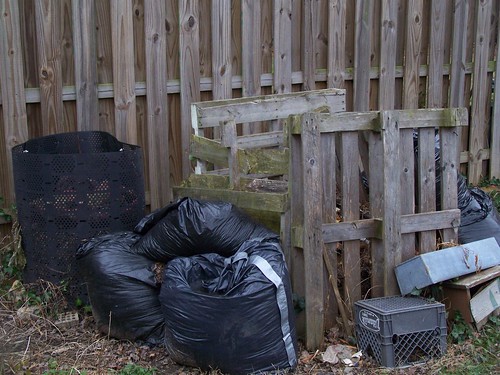
I am not sure how long my household has been composting (since we have a large back yard it's easy for us to do).  Probably since the fall of 2008, using a design made from wood pallets, that we got from the Montgomery County Department of Environmental Protection composting website.

Our regular compost binsLeft: our main compost setup along with bags of leaves in reserve, captured from our lot (and from the neighbors--we lost a tree last year, so we produce fewer leaves).  You cover your inside compost with leaves/grass clippings to build the right environment for breakdown into soil.

I am not a fanatic about turning it.  If you are a fanatic, you can generate usable "soil" within a few weeks.  For us, it takes 12 to 18 months--e.g., stuff we put into a supplementary Montgomery County provided plastic bin (you can get them at the Ag Fair) in 2011 we let sit all of 2012 and I tested it about a month ago and it is now super-prime compost, full of worms (a great sign), etc.

It is incredible what a difference composting makes in terms of trash reduction. Typically we produce about 5 gallons of "trash" each week (which we throw out every couple weeks or so), and a full blue bin's worth of recycling (lots of newspapers and magazines), plus whatever we throw into the compost bin (including leaves and sometimes grass clippings that I filch from neighbors to get the right mix).

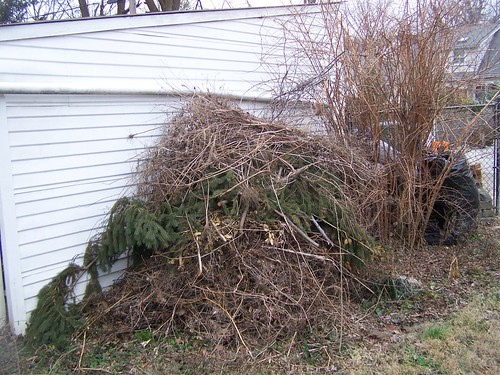
Our loose compost pile for brush and branchesRight: We also have a large loose compost pile for brush and branches.  I still haven't figured out the best option for a chipper/shredder--we don't want to get one that requires gasoline, but the electric ones apparently have some issues too.

There are two of us and the compost pot we have in the kitchen has one gallon capacity.  Including coffee grounds/water (and yes, some spoiled food), we produce between 1-2 gallons of inside compost (plus leaves etc. from the outside) per week.  I don't think I'd want to pay $8/week for someone to "haul it away."

I would aver that studying the composting programs of other jurisdictions including Montreal, Toronto, Seattle, Austin, Portland, and Montgomery County Maryland would be an excellent use of some of that $600,000 and far more useful.

As the Post article stated:

Portland, Ore., by contrast, opted in October 2011 to change its garbage collection program so haulers now take away green waste — including food scraps — once a week, but pick up other trash only once every two weeks. In a single year, the city cut its residential trash load by 40 percent.

A 40% reduction in the residential waste stream is incredible.

On the other hand DC isn't incentivized to reduce the waste stream all that much because as I have pointed out before, currently DC makes a lot of money "selling" its trash ("D.C.'s trash is now Fairfax facility's treasured commodity," Post) to Fairfax County, where it is used as feedstock for a waste-to-energy plant--because with the recession, Fairfax County isn't generating enough trash on its own to feed it.  (All the more reason, along with failures of such plants in places like Harrisburg, Pennsylvania, to not consider creating such a plant in DC, even though the city has allocated money for such a study also.)

Labels: , , , ,

Thursday, January 03, 2013

Ivy City Environmental Justice case: hearing today

Today at 1pm at the DC Courthouse (500 Indiana Avenue NW) in Room 415, the judge hearing this case will take arguments from DC Government asking for a stay of the preliminary injunction on this case, which was brought by EmpowerDC on behalf of residents, opposing the use of a vacant school site in Ivy City as a long term tour bus parking lot.

Ivy City is an odd "neighborhood" in Washington, given that a majority of the neighborhood is made up of industrial uses, including the old Hecht's Warehouse, a building materials yard, warehouses, and buildings that have been converted to clubs or homeless shelters.

Just north of New York Avenue--a major entryway into the city and always full of motor vehicle traffic spewing noise and exhaust in both directions--lie the Northeast Corridor railroad tracks into Union Station and south of West Virginia lies a large cemetery, fronted by industrial uses such as a city vehicle fleet yard.

The industrial-commercial and car dominated landscape here is not going to change any time soon. Also see the 2009 blog entry, "No Big Dig for New York Ave," from City Fix.

A remnant civic asset, the vacant and mouldering Alexander Crummell Elementary School (left, photo by Lydia DePillis, formerly of the Washington City Paper), continues to serve as an anchor and rallying point for the community.

A planning process was conducted for that general area about 8 years ago, and one of the options suggested, to which the community erupted against, would have been to give into the industrial, and resettle the residents.

And afterwards, the city backed off that idea, and went ahead and assembled 70+ vacant properties/lots and built affordable housing there.  What that did is do what I call "designing conflict in" whereas ideally planning is supposed to design conflict out or at least better manage and mitigate conflict resulting from conflicting uses, in this case, residential vs. industrial-commercial.

The planner in me says it's better to make a really hard decision and let the area go fully commercial, that it will always be a substandard somewhat disconnected place to live, even with a Costco down the street, and the alleged coming of a Walmart to the intersection of New York and Montana Avenues.

Be that as it may, EmpowerDC's campaign there, assisting the residents in fighting the use of the Alexander Crummell school site as a tour bus parking lot for Union Station, raises some interesting issues.

I was at first somewhat dismissive of their success in court last month, when a judge ordered the Union Station  Redevelopment Corporation to conduct a Environmental Impact Study (they deliberately underreported the value of the project to avoid triggering the requirement) and that the city erred in ramming the project through (I mean issuing the permits), in part because they didn't provide required notice to the local ANC in terms of their legal right to comment--interesting too the Judge ruled that just printing the notice in the DC Register is inadequate in terms of notification requirements.

But the injunction didn't order the USRC to stop construction and EISs can be gamed.

But, what's interesting is that there is an element of the case that hasn't been widely reported that is in fact quite important, which is probably why the Executive Branch of the DC Government continues to litigate the case vociferously--the judge's ruling focused on DC's laws concerning environmental review.

DC's environmental review requirements, on paper, are much stronger than they have been in terms of their impact on actual practice.  While maybe not as strong as California's Environmental Quality Act process, the DC law leaves the possibility of strong interpretation.

Depending on how this case plays out--which is why the Executive Branch has thrown 11 lawyers into the mix so far--the final rulings in this case could open up and strengthen DC's environmental review process, making it a fulcrum for community organization and potentially successful citizen opposition to various development projects (including the Walmart debacle on Georgia Avenue).  (Although it does require the means to pay for legal assistance, which is still a stumbling block.)

Labels: , , , , ,