Rebuilding Place in the Urban Space

"A community’s physical form, rather than its land uses, is its most intrinsic and enduring characteristic." [Katz, EPA] This blog focuses on place and placemaking and all that makes it work--historic preservation, urban design, transportation, asset-based community development, arts & cultural development, commercial district revitalization, tourism & destination development, and quality of life advocacy--along with doses of civic engagement and good governance watchdogging.

Friday, February 02, 2024

Another way to think about gap analysis/planning

 I joke that I might not be a good planner, but I'm great at gap analysis.  I meant to read this Financial Times column last week, "The secret to finding the best idea ever? First think about the absolute worst  When looking for a business breakthrough, a design innovation, or a flash of artistic insight, it’s smart to think in reverse," but I forgot.

The title puts gap analysis in perspective.  There are so many bad ideas and implementation, how can I not excel at gap analysis?  

But it's also about brainstorming.  People make important, interesting points, or share ideas.  I build on them.  And it's two-way.  People improve and extend ideas I put out there too.

From the article:

Creativity gurus have termed this approach looking for the “worst possible idea”. When looking for a business breakthrough, a design innovation or a flash of artistic insight, it can be hard to think of much when challenged to dream up a good idea. Far easier, less intimidating and more fun to write down a list of terrible ideas, then see what those terrible ideas suggest once you turn them on their heads. 

Sometimes the worst-idea exercise is little more than a warm-up, getting the imaginative sparks flying before the real creative work begins. Sometimes, however, focusing on what makes an idea bad shines the spotlight on what might make an idea good. If the bad idea is to make a product look clumsy and ugly, that suggests it’s worth paying more attention to the product’s elegance and beauty. If the bad idea is to ship the product with bewildering instructions, the good idea is to hire an editor to hone the instructions. 

... So let’s hear it for wilful contrarianism in the search for inspiration. Sometimes looking for a bad idea gets the creative juices flowing. Sometimes a bad idea perfectly highlights what would make an idea good. And sometimes, the bad idea is actually the best idea of all.

Labels: , , , , , ,

Sunday, February 13, 2022

Killing people is seen as a routine outcome, not as an indicator of the need for change: Orange County Sheriff's Department versus Fullerton Police Department

Fullerton Police Department.  Fullerton's police department completely revamped its use of force, training, and other practices after police officers beat Kelly Thomas, a homeless man, to death in July 2011

While the city paid out a big judgement to his family, rather than accept what happened as "an accident," the City of Fullerton evaluated various police processes and changed them, to reduce the likelihood of injury and death in interactions between the police and the public ("Here's how Fullerton police have improved since Kelly Thomas' death." Orange County Register).

The changes in practice were not limited to dealing with homeless people or people in mental distress, but in how all of the city's police officers interact with the public and how they are trained.

The police department has set a goal of being one of the best police departments in the country for its size, and measures its success through annual independent reviews.  From the article:

The study offers a half-dozen recommendations – compared with 59 in its first review – that range from striving to use the least force necessary to more cautious foot pursuits. 

... Four years ago, OIR Group recommended that officers – when safely possible – employ less force by increasing time and distance, using cover and concealment, creating barriers, and calling and waiting for backup.

“The department,” the document says, “has substantially addressed many of the shortcomings we noted in our 2012 report.” 

First, a new training room was built for officers to practice lesser-force techniques. Then, a video-based interactive training system was installed. It offers more than 200 bad-guy scenarios, and each one can be altered with the touch of a screen. 

“These upgrades in training facilities,” the report concludes, “allow trainers to emphasize the importance of tactical alternatives to force, particularly deadly force.” 

The training may be paying off. Citizen complaints have dropped from a high of 36 in 2014 to a low of 24 last year. 

Still, the new report offers new suggestions. They include requiring incident reports to check off threat perception, least-use-of-force efforts, and adherence to reporting policies. 

The process in Fullerton is appears to be a national model, unlike the whitewashes that seem to be happening in most other cities when it comes to evaluating police departments and officers in terms of excessive force and deaths at the hands of police officers.

--  Fullerton Police Department: Audit of Force Reviews and Internal Investigations, August 2016, OIR Group

Orange County Sheriff's Department deputies kill a homeless man in San Clemente, September 2020 ("DA clears deputy who shot and killed homeless Black man in San Clemente," Orange County Register). 

Officers from the homeless liaison unit !!!!!!! confronted a homeless man who was jaywalking.  In the struggle that resulted, they determined he reached for one of the officer's gun, so they shot and killed him.

The DA cleared the officers, saying he was reaching for the gun, but that is disputed.  Amazingly, the DA said that the man wasn't jaywalking (although they said he was crossing against a green light giving them still the reason to stop him).

Process redesign.  It's so obvious the officers in San Clemente mishandled this, and is just as egregious as the actions of the West Valley Utah Police Department in their apprehension and subsequent killing of a man in mental distress, which was documented by the Salt Lake Tribune ("A West Valley City police officer killed a man inside the police department. It was his third shooting") and later featured in a Frontline documentary, "Shots Fired."

It happens over and over and over again because police departments, their "overseers" -- the fact is that true oversight is minimal -- elected officials and the public see such killings as routine, maybe unfortunate, but not as an indicator of process failure.

For example, I argue that the high rate of settlements for police misconduct ought to be seen as an indicator of system failure ("Where is the risk management approach to police misconduct and regularized killings of citizens?," 2020).

Instead, rather than get fired, the West Valley police officer serial killer got a commendation.  And the family just got a settlement "West Valley City settles lawsuit with mother of man shot, killed while handcuffed in police station").

Why is Fullerton's police department such an outlier?  This is something I need to track down.

Labels: , , , , , , ,

Wednesday, December 22, 2021

Why isn't abject failure seen as an indicator for substantive improvement, rather than something to hide? | Nassau County New York police department

Last week, USA Today ran a particularly disturbing story ("Police hid extent of officers' failure before murder"[registration required, or access through a library articles database, but also available through their reporting partner, Newsday, "Hidden file reveals police failed to protect her from violent ex-boyfriend") about how the Nassau County police department's abject failure to take domestic abuse seriously led to the death of a young woman at the age of 24, making her two children orphans.

Police failed to take the perpetrator in custody, even though it was mandated by state law, refused to enforce protection orders, provided perfunctory service and care when called, failed to produce and file mandated "Domestic Incident Reports," and didn't provide protection for Bird even after she was held at gunpoint by the perpetrator.

What's equally disturbing is that the police department has spent the last ten years diligently and notoriously working to prevent from being released the report analyzing the multiple failures by the department.

Instead of hiding the failures, and over time, promoting many of the officers involved, why didn't the department see the findings as an indicator of a necessary need to change and improve?

Although according to Newsday, both the Nassau and Suffolk police departments have improved significantly their response to domestic abuse ("Domestic violence policing on LI has evolved since Bird case, experts say").  The Nassau police department even provides funding to The Safe Center, an independent domestic abuse assistance program

Granted many police departments don't take domestic abuse or threats on women seriously.  That's why Salt Lake Tribune columnist Robert Gehrke argues that Utah universities shouldn't be allowed to have police departments ("Utah needs to disband college police departments now").

About the only instance I've seen of a police department initiating fundamental change after egregious failure is Fullerton, California's police department, where a homeless man was beaten to death ("Here's how Fullerton police have improved since Kelly Thomas' death").  The department was frequently audited by the OIR Group to determine progress and areas where improvements were still needed.

And the kinds of changes, although more focused on processes, by William Bratton in Boston, New York City and Los Angeles, as discussed in his new book The Profession: A Memoir of Community, Race, and the Arc of Policing in America.

But there are exemplary programs across the country, such as in High Point, North Carolina ("How High Point, N.C., Solved Its Domestic Violence Problem," Governing Magazine) and Appleton, Wisconsin ("11 questions that could save a woman's life," Appleton Post-Crescent), where extranormal programs result in significantly fewer incidents.

Instead of hiding the report, why didn't Nassau County elected officials and the police department use the failure as a fulcrum for necessary change?

Why is Fullerton, California such an outlier?

The officers involved were acquitted based on their arguments of this is how they were trained and they had the right (not privilege) to use force on subjects because they were police officers.

While by that time the police department had already fired the officers and disciplined others, clearly they took notice that their professional training and standards were inadequate.  Not just in dealing with the homeless and mentally ill ("4 years after Kelly Thomas death, Fullerton police improve relations with homeless, mentally ill," KPCC/NPR, "Years After Thomas Beating, Fullerton Police Have New Approach to Homeless," Voice of OC) but for everyone the department comes in contact with.

The interesting thing is that police departments are more set up to respond to crime, rather than to suppress crime to begin with.  When departments ignore all the signals and indicators of violence, it makes it almost a certainty that a crime will occur.  

Labels: , , , , ,

Wednesday, June 02, 2021

Closing investigations without resolving them: the Nashville bomber

Photo: DC Fire and Emergency Services.

In 2019, there was a terrible fire at an illegal rooming house on Kennedy Street in DC, killing 2 people.  The thing is that a police officer had responded to an incident there, and reported the conditions to DCRA.  

An inspector went there three times, couldn't get in, so he "closed" the complaint.  He had the legal authority to get a warrant for entry, but he didn't take that step.

It remained unresolved and dangerous.

The inspector was fired for "dereliction of duty" but says it wasn't his fault because he wasn't trained ("DCRA investigator speaks out about fatal Kennedy Street fire: 'People died in that place. It didn't have to happen'," WUSA-TV).

The city came up with a convoluted way to "deal" with this failure, creating a personalized process relying on people, not systems..

I countered saying the solution was simple ("Unresolved versus Closed as a determination in handing City inspection/service matters").

1.  Instead of having police officers call a supervisor who then was supposed to call DCRA, create a category for the complaint in the city's 311 "complaint" system.

2.  Don't allow complaints to be closed without being resolved.

A row of historic buildings damaged by the the detonation of an R.V. packed with explosives in downtown Nashville on Christmas morning.Credit: Alex Kent/Getty Images.

The same thing happened with the Nashville bomber ("Suspect in Christmas Day bombing in Nashville acted alone and was driven by 'paranoia,' FBI says," ).  

A complaint was filed, police went there, never got in, and closed the investigation without doing anything other than knocking on a door once or twice.

A report analyzing what happened said they could do more ("As Nashville Bomber Plotted, Police Investigation Into Warning Sat Dormant," New York Times).  From the article:

But a report released on Wednesday found no documentation of any attempts to reach Mr. Warner after officers knocked on his door and got no response. The report added that the police should have acted more aggressively, keeping closer tabs on Mr. Warner and trying to establish the probable cause needed to search his home. Instead, the case sat open for months, as Mr. Warner stewed in conspiracy theories and plotted the attack.

The report emerged from an inquiry into the police investigation conducted by a panel that included senior officials from the Metropolitan Nashville Police Department and others from outside the agency. The panel concluded that there was “no way to know for sure if the suicide bombing on December 25, 2020, could have been prevented.” Yet it identified ways in which the Police Department had failed to conduct a robust investigation into the earlier warning.... 

... the Police Department began drawing scrutiny as an incident report surfaced showing that a friend of Mr. Warner’s had called the police in distress more than a year earlier. She had told officers that he was building bombs in the R.V. parked beside his house; her lawyer, who also knew Mr. Warner, told the police that he was capable of building explosives.

The officers went to Mr. Warner’s home in August 2019 and tried to follow up, police officials said, but they had no probable cause to search the home or R.V. 

Yet the panel said that the officers should have taken advantage of legal resources available to them to determine probable cause and gone further in pursuing the investigation...  

The report ends with the police department saying they could have done better.

Duh.

Labels: , , , , ,

Tuesday, October 27, 2020

October is Domestic Violence Awareness Month: Reprint "Revisiting intimate partner violence/murder"

October is Domestic Violence Awareness Month.

-- Domestic Violence Awareness Project

Thinking about this in the context of "Defund the police" or at the very least, re-articulating better and more comprehensive responses to community public safety needs, it's worth reprinting this piece from July 2017, which outlines a very specific and focused way to address this problem, in ways that reduce the likelihood of death and the risk to first responders.

High Point, North Carolina's police department, working with other agencies, has created a model program that in the first few years of operation, experienced zero deaths.

Like how I argue for rigorous reviews of pedestrian and bicycle crashes to identify systemic and structural urban design issues, the same goes for crimes:

-- "Increasingly, criminal justice professionals and other practitioners are using a tool that may help reduce the many deaths due to intimate partner homicide. It’s a fatality review.," National Institute of Justice Journal, 2003

Systematic reviews of fatalities, and police-involved fatalities especially, would enable significantly more effective community safety responses than is typical of the current system.

Some cities, like DC, have Deputy Mayors with responsibilities greater than for the police department specifically, including emergency management, emergency communications, and fire and EMS.  But I wonder how many of these positions/offices look at the agencies as parts of a whole focused on "public safety" and organize their efforts accordingly?


In this vein, I wish the book The End of Policing was titled something like "Beyond Policing: Creating a Broader and Better Approach to the Realization of Community Public Safety."

That's a mouthful, and not as punchy, but that's where we need to be moving towards. 

-------------

Original Link, July 22, 2017


The CDC reports that "Half Of All Female Homicide Victims Are Killed By Intimate Partners" (NPR). From the article:

The report was meant to find information that could help prevent such homicides — for example, by focusing programs on women who are at the highest risk of being killed.

For example, the researchers note that patterns of nonlethal domestic violence — referred to as IPV, or intimate partner violence — could be used to prevent homicides.

First responders could assess risk factors for violence to "facilitate immediate safety planning and to connect women with other services, such as crisis intervention and counseling, housing, medical and legal advocacy," the report says.

It happens that I wrote about this last year, in "The state of "broken windows" versus "problem oriented policing" strategies in 2016: Part 1, theory and practice." The article examined the issue, reacting to a speech by noted criminologist Ronald Clarke ("Criminology and the Fundamental Attribution Error").

High Point, North Carolina shows the way forward. From the piece:

Nothing works vs. problem-oriented policing.  I think how we learned the wrong lesson in the 1980s that "nothing works" when the real lesson was that patrol-car-based reactive policing was not effective in reducing crime and that we needed to change how police officer time and related resources were being deployed in order to have significant effect, the same goes with "Broken Windows" versus "Problem-Oriented Policing." ...

"Proving Broken Windows wrong."  Unfortunately, a focus on "proving Broken Windows wrong" has diverted attention from what "Problem-Oriented Policing" got right, that if you want to reduce crime, put your energies in addressing those "situational and opportunity factors" that support criminal activity.

Recently, the Washington City Paper reported ("The Thinned Blue Line") on discontent among DC police officers. 

Frankly, because the labor union has traditionally taken the "management is always wrong" approach for a long time I've had a hard time finding their positions credible.  But maybe the officers and management are both wrong, and the police department focus is not systematic enough when it comes to addressing [and developing] crime reduction strategies in focused ways.

Problem-oriented policing and crimes of violence.  Similarly, a few months back Governing Magazine ran a great piece, "How High Point, N.C., Solved Its Domestic Violence Problem," about the approach a city has taken to reducing "intimate partner violence" in particular murder around domestic violence cases. 

Since High Point developed their program, they have reduced the number of murders in this category to zero.  I think about that every time I see a story on the tv news about domestic violence related murders in the DC area, which are never-ending:

-- "Man Sought After Killing Estranged Wife Outside High School," NBC4
-- "She helped bail him out of jail. Days later, police say, he killed her," Washington Post
-- "Identifying 'Red Flags' Could Prevent Domestic Murders," NBC4

Adopting situational-opportunistic factors approaches to non-property crimes is clearly needed, now.

*With regard to the significant drop in crime experienced in many cities*, what has happened is the "low hanging fruit" opportunities have been harvested and now much more nuanced strategies are required to keep crime and crimes of violence down, as super-predators may be less resistant to simplistic situational strategies, and police departments-cities haven't responded adequately.

* This clause has been edited from the original.

Labels: , , , ,

Monday, May 25, 2020

DC Ward primary election races remind me of my thought that the city needs either more wards or two councilmembers per ward

DC is the nation's only city-state, except that it's not a state.

Although in this case, Congress still has oversight, but for the most part except in areas of policy where political points can be scored, it's benign.  Except for the restriction on the city's ability to tax non-residents, which even prevents the city from taxing professional athletes.

What this means in practical terms is that a State Legislature doesn't control what the city can do, often at the benefit of exurban and rural areas, and the city keeps all of its income and sales tax revenues, thereby having a more balanced set of revenue streams, compared to most other local jurisdictions which are reliant on property taxes.

There are city-states in other countries such as Mexico City and Paris, which are national capitals, and Hamburg in Germany which is an urban state, but not a national capital.

In those cases, these states are no different than other states/departments in the rest of the country.

Generally a city-state is predominately urban, so it doesn't have bifurcated policy and representation divvied up, often in unfair ways, between cities, suburbs, and rural areas.

The Metropolitan Studies Center at Brookings Institution argues that "metropolitan areas" should be the primary way to organize the country at the sub-federal scale, and city-states are one of the best expressions of this idea ("Metropolitan Revolution book review," 2013).

DC is about 60 square miles (1/3 of that is federal land), with more than 700,000 residents.  While it has more residents than some states, it doesn't have voting representation in Congress.

It has an elected mayor and an elected City Council with 13 members -- 4 at large members, a Chairman elected at large, and 8 members each representing a ward.  (And an elected "state" school board which has limited oversight of actual schools.)

By comparison in a typical state, you have a lot more opportunity for holding elected office including seats on local town, city, and county councils, judges and prosecutors, school boards, state representatives and senators, statewide officials like Governor, and federal Representatives and Senators.

The set of Post articles on the primary elections in Ward 2 ("The eight Democratic hopefuls running for Ward 2"), Ward 4 ("In Ward 4 council race, incumbent Brandon T. Todd faces a progressive challenger"), Ward 7 ("Vincent Gray in Ward 7 D.C. Council race faces a long list of challengers"), and Ward 8 ("article to come") where this year even incumbents are facing a fair number of opponents, a number of which whom are worthy of consideration, makes me think of the lost opportunities in having such a restricted number of political representatives.

It could be worth having more Councilmembers, as a way to make politics somewhat more competitive, to provide more opportunities for minority party representation such as Green, Working Families, Socialist Alternative (like in Seattle and Minneapolis) or even Republican.

(Note that many commentators lament that DC lacks political competition.  That's true.  But what they mean is that there aren't Republicans holding office.  But that's not really DC's fault.  The Republican Party has changed and because the city is pretty progressive politically, that doesn't fit with the kinds of Republicans that tend to run these days, who are more out of the wack job side, which is less appealing to urban residents.)

Making DC Council bigger.  The past entry, "Continued musing on restructuring DC's City Council (mostly)" (2013) lists a number of transformational measures for DC City Council and elections.

Summary recommendations

1. Increase the number of wards [or]
2. Increase the number of councilmembers
3. Move the legislature to part-time service and reduced pay
4. Reduce the size of councilmember staff
5. Increase the research capacity of local government
6. Institute term limits for elected officials.
7. Change the date of the primary election to extend the electioneering period.
8. Institute ranked choice voting for local elected officials.
9. Institute additional campaign finance limits for local elections.
10. Create an elected public advocate/ombudsperson.
11. Reconstitute a school board with oversight over pre-K to 12 public education, traditional and charter schools.
12. Build civic capacity and infrastructure.

Such changes are even more relevant today because at the time it was written, DC's population was about 620,000.  Now it's 706,000.  So each ward councilmember today represents 88,000+ residents, when before it was 77,000.

Council districts will be redrawn after this year's Census.  As population has increased in the western side of the city, those districts will shrink in size, while eastern districts will continue to expand westward.

Statehood proposal.  The proposed "Constitution for the State of New Columbia" created in 2016 proposes a 21 member House of Delegates.   It basically proposes a structure comparable to that in my 2013 piece.  8 Legislative districts each with two members, one elected in each two year election cycle, with 4 at large members, two elected in each cycle, and a Speaker of the House elected at large.

There's something to be said for having a unicameral legislature in a small place like DC. But in the current form with 13 members,i t's too easy to pass legislation when you only need 7 votes.

More councilmembers per ward.  One problem with monopoly representation within a ward is that it allows the Councilmember to control much of the political discourse and activity within a ward. 

That's why I suggest that each ward have two councilmembers, each serving a four year term, with a two year overlap. This allows for intra-ward competition and polycentric politics.

If DC went to this format, then I'd recommend an increase in the number of at-large representatives too, from two per election cycle to three for a total of six.

That could be as many 23 Councilmembers including the Chair who generally only votes where there is a tie, which is a lot, but instead of 7 votes you'd need 12 to pass major legislation, and that would be a good thing. Salaries could be reduced some to save a bit of money, which would of course be redirected to having more Council staff.

More wards?
As the city increases in population, shrinking the population of wards by adding to the number could help keep wards more intimate and accessible.

An alternative would be to still have monopoly representation within wards, but to have say 11 or 13 Wards instead of 8.

By adding one more at large representative to each election cycle simultaneously, that would be a Council size of 18 with 11 wards and 20 with 13 wards.

In an 11 ward structure, each Councilmember would represent about 64,000 residents; a 13 ward structure, 54,000 residents.
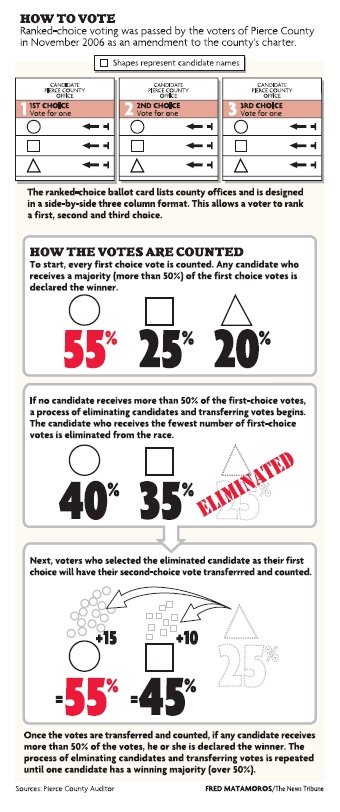
Ranked choice voting graphic, Pierce County Washington

Ranked choice voting.  So many candidates in the ward primary elections is an argument for ranked choice voting ("D.C. Council?s Ward 2 election is a great argument for ranked choice voting," Post).

It's more complicated, but it allows people to indicate first, second, third, etc. choices, and as candidates are eliminated, a more diverse set of candidates can be elected--note that it's possible, not probable.

DC is most likely to elect Democrats to elected office, but the fact is that the candidates vary considerably in terms of their progressiveness, ethics- ness, raceness, etc.

So the ability to rank candidates would help more progressive candidates get elected when a typical election has multiple "good" candidates running and just one "bad" candidate, and the bad candidate has a built in advantage because his/her supporters don't split their votes.

Peirce County, Washington used ranked choice voting for a couple of elections, but it was repealed in 2009.  This diagram is from the Tacoma News-Tribune circa 2008 and is used with permission.  San Francisco started using ranked choice for local elections in 2005.

Civic infrastructure improvements will be the subject of a separate entry.

Labels: , , , , , ,

Sunday, March 15, 2020

Vaccine for me (my country only, the US), not for thee: President Trump edition

Bothell High School, Washington State, digital message signboard "Wash Your Hands!!!"
Northshore School District, which includes Bothell High School north of Seattle, announced it was closing its entire district for up to two weeks.Credit...Lindsey Wasson/Reuters

At some point I'll write about the coronavirus and the implications it raises concerning universal health coverage, public health, public administration, and government competence in the face of an anti-government neoliberal philosophy.

I am flabbergasted that President Trump is trying to buy a German pharmaceutical research firm working on a coronavirus vaccine with the proviso that any vaccine produced would only be for the United States ("Germany tries to halt U.S. interest in firm working on coronavirus vaccine," Reuters; "U.S. Offered ‘Large Sum’ to German Company for Access to Coronavirus Vaccine Research, German Officials Say," New York Times).

It reminds me of the movie, "Head of State" where Chris Rock runs for president (not a great movie).  His opponent is known for the line:

God Bless America.  And no place else.


This from an administration that failed to create a working lab test ("CDC coronavirus testing failure is a national outrage," San Jose Mercury News) and has vaccine research facilities that appear unable to address the current contagion ("Federal vaccine development sites ill-suited to counter covid-19 epidemic," Washington Post).

I'm surprised that Jared Kushner ("Infighting, missteps and a son-in-law hungry for results: Inside the Trump administration’s troubled coronavirus response," Washington Post) didn't reach out to Elizabeth Holmes  ("Elizabeth Holmes' peril: Is Theranos founder facing ruin?," SJMN) for help on the testing side!

Suzanne and I are pretty different.  She has a sour  view of the community side of things, and generally doesn't believe that in bad times people will come together.  I am more optimistic, believing in the potential for community and connection even if it happens so rarely, and our elected officials aren't particularly great when it comes to vision and striving for better.

But in the vein of Suzanne, movies like "Right At Your Door" and "Contagion" challenged my thinking.  Both movies show outcomes and community and herd behavior that are pretty terrifying.

I was joking with her earlier today that the cable channels should be showing these movies on repeat.  Then again, people don't need to get ideas.

It's bad enough that supermarket shelves of toilet paper, rice and beans, and water are stripped bare.  What's wrong with tap water and do you really not have enough toilet paper stocked up otherwise?

PBS has provided open access to the American Experience episode on the "Spanish Flu" epidemic of 1918.  I guess one of the only reasons I know about it is because fiction writer John O'Hara wrote a bunch of stories about it, he being the son of a doctor active during the epidemic and a few decades ago I read a bunch of his books.

Right now, Covid19 disproportionately impacts the elderly.  What happened with "Spanish flu" is that it mutated between the first wave and the second, and became particularly virulent for young adults.

This NYT piece allows you to model various scenarios in dealing with Covid19.

-- "Opinion | How Much Worse the Coronavirus Could Get, in Charts"

Given that our health system has limited slack capacity in hospital beds generally and ICU beds specifically, a large marginal increase in demand in periods of already peak demand will swamp the system. That's what's happening in Italy ("Coronavirus: Italy records 368 new COVID-19 deaths - largest number in a day," SkyNews). To extrapolate, Italy's population is about 20% of the US.

Labels: , , , , , , ,

Wednesday, September 25, 2019

Arlington and Alexandria: Maybe they should just merge

Welcome to Virginia, Interstate 95, Alexandria, VirginiaThe Washington Post reports ("Arlington and Alexandria split in the 1870s. Could Amazon bring them together?") that Arlington and Alexandria are looking to work more closely together on affordable housing and other matters, possibly through the creation of what in California they call "joint powers authorities" or community development corporations to address joint concerns in a substantive way.

While I recommended Montgomery and Prince George's County needed to create a joint community development corporation operating in the Purple Line light rail transit line catchment area, to buy, hold, maintain, fund, and develop affordable housing, along with other urban design and economic development issues ("Creating a transportation development authority in Montgomery and Prince George's County to effectuate placemaking, retail development, and housing programs in association with the Purple Line"), probably Arlington and Alexandria should just merge.

Arlington County has 235,000 residents; Alexandria, 145,000 . Technically Arlington is a county but run as a city.

I've recommended that Baltimore City and County merge ("Opinion: What Baltimore and D.C. can do to start working better together as a region (Baltimore Business Journal op-ed)," 2016).

I think Detroit should merge with a county, but ideally Oakland County but it's located within Wayne County ("One more idea about Detroit: merging not with Wayne County but Oakland County").

I am familiar with city-county mergers in places like Indianapolis, Kansas City, Kansas, Lexington, Louisville, and Macon. In the mid-1800s Philadelphia and San Francisco merged their city and county functions. In the Boston area, counties as political subdivisions don't really exist.

The advocacy group Better Together calls for a merger of the City and County of St. Louis, and other jurisdictional mergers within the county as well.

Whereas these kinds of mergers can be problematic politically, because more conservative outer areas with more population can dominate the core areas which tend to be more politically progressive, Alexandria and Arlington are pretty much the same on the political spectrum, strong Democrat/progressive politics.

But opposition to the idea in St. Louis ("Better Together pulls St. Louis city-county merger proposal," St. Louis Post-Dispatch; Better Together to pull petition on city-county merger," St. Louis Business Journal)  has led the group to pull back its quest to have a statewide vote on the matter in November 2020 and makes clear a lot of time is necessary to build support for such a change, which always requires a vote.

(One of the problems of such initiatives is if they require statewide votes, when the matter only concerns people in the affected jurisdictions.)

So it probably makes sense to start working more closely together, to build the foundations for consideration of a merger later.

Labels: , , , ,

Thursday, September 19, 2019

Unresolved versus Closed as a determination in handing City inspection/service matters

How DC deals with nuisance and unsafe property inspections is in the news because of two deaths resulting from a fire at an illegal rooming house.

 It turns out that months before, after responding to a call, a police officer informed the city's building department of the likely illegality but for various reasons the property was not inspected, because the person assigned to do an inspection couldn't get in, and after the third attempt, instead of seeking a warrant to demand entry, he "closed" the case.

But the case was closed because he wasn't able to take action. Not because it was "resolved." In fact, the matter remained unresolved.

-- "'A failing of the systems': In rowhouse fire, D.C. missed many chances to save lives," Washington Post

Cases that are unresolved shouldn't be deemed closed, they should remain pending, because they are unresolved.


I have written from time to time about this generally, in terms of 311 responses by "the city," performed after I have made calls (or website entries) about problems I've come across, inclding stolen and abandoned cars, broken water pipes, dead animals, broken tree branches, and a loose board on the bike gutter at the foot of the Metropolitan Branch Trail that still hasn't been fixed. (I reported that and something else while scheduling a bulk pickup, which is easier to do on the phone, than online.)

-- DC 311 informational webpage
-- 311 Online

A big problem for a long time is that you get an email notice of "closed" but with no information about what happened.  I wrote about it at some point.

A few years later, after receiving notice with more explanation, I waxed about the change ("Improvements in 311 response: still has a ways to go," 2018) but a commenter made the point that cases are often closed because for whatever reason, the person sent out to check can't find the problem, or because the system still isn't set up super well to deal with certain places, such as on bridges.

(This came up with a call I'd made about a dead animal on the street. The person assigned couldn't find it, so he knocked on our door. It turns out that it had been pushed out of the travel lane into the gutter. So clearly, not every person assigned to a matter may exhibit perserverence and a willingness to investigate a bit.)

The new process devised by the city to deal with such reports by police officers -- immediately notify a particular supervisor who will then liase with the building department is flawed because it still relies on individuals.

What should happen is that the 311 system of problem reporting be extended to include these kinds of notifications of problems.

The 311 system does not include an option for reporting a potentially illegal rooming house.

In 2017, I was somewhat dismissive about the city's touting its use of a grant to fund a center on innovation in public services on "form redesign."

-- "Five new forms: is that all you've got?

It's important, but I realize what would have been more important is a focus on investigating and improving "processes" and how "forms" are the fulcrum that you can use to work and improve the process.

Basically, when I do plans, (1) I look at what are the preferred outcomes; (2) determine whether or not preferred outcomes are generated routinely by present processes; (3) then look "backwards" at the system and process that produces unpreferred outcomes and determine why this is the case; (4) making recommendations for changes in the process so that preferred outcomes can be generated routinely.

For example, dealing with renting out our house legally, that is filing for a business license, finding out what items are necessary to be included in a single family house for health and safety reasons, getting those tasks acoomplished, but also dealing with the various other necessary processes (exemption from rent control, providing certain documents to the tenants to be signed, providing the right forms to the right city agency afterward, is very complicated, often with conflicting information.

Actually, DCRA which has been criticized for the failure to deal with the house that burned, was pretty helpful to us. I went down to the inspection office and met with someone who went over the checklist with me, answered my questions, etc. Unfortunately for us, you have to do certain things when you're renting that you wouldn't have to do if the property is owner occupied (e.g., balustrade around attic stairway, storm windows on all windows for habitable spaces, even the basement) which cost us a few thousand dollars extra that we hadn't counted on.

But because we had that consultation, we knew what we had to do. And because we did everything that the form asked for, even more (extra fire extinguishers) we had no problem with the actual inspection was performed.

But then dealing with filing papers about the exception from rent control, with a different city agency, we got conflicting information, were given forms that one person said we didn't need to file, and another person never mentioned the necessity of particular forms, etc.

Clearly there's a need there for "process improvement" in many areas of activity provided by government agencies, and this is hardly a problem unique to DC.

Recommendations:

1.  More information should be provided to the reportee about the disposition of a matter reported to the city.


2.  The city should change the language marking performance of service calls from "CLOSED" to either "RESOLVED" or "UNRESOLVED."

3.  A process should be developed to further investigate and address matters that remain unresolved in normal response processes.

4.  Evaluate workflow processes on an ongoing basis, changing them as necessary, with the aim of continuous process improvement.

5.  Unify problem reporting systems within the rubric of the 311 system to capture reports of illegal housing matters too.  Require city employees to use the 311 system to report problems*.

*  This reminds me of an incident in Seattle where a bicyclist died because there wasn't warning signage about upcoming stairs ("
City warned of stair hazard before bicyclist died
," Seattle Post-Intelligencer).

It had been reported, but to an individual's voicemail box, not to a general 311-type system.  It's better to rely on systemic processes that capture reports of service outages, problems, and failures, rather than calling individuals -- yes it can work when you reach them, but not if you can't.


====
From a business literature standpoint, the book by Thomas Davenport, Process Innovation: Reengineering Work Through Information Technologyhas been very influential on my thinking.

And Jakob Nielson's writings on "usability." 

But I haven't really read much on UX or "user experience."

Clearly these kinds of approaches need to be adopted by local governments concerning workflow processes and the way they organize their work and generate preferred outcomes.

And not just by people who work in IT.

Labels: , , , , ,

Sunday, August 04, 2019

Repositioning the DC Statehood argument as a way to address structural imbalances in American democracy

One of the most important concepts I ever picked up came from the book Strategic Marketing for Not For Profit Organizations by Armand Lauffer, a social work professor at the University of Michigan.

One of the points made is that organizations have three publics: the input public which provides the resources the fuel what the organization does; the throughput public that does the work, usually staff and volunteers, led by management; and the output public to whom the organization's efforts are directed.

At the time I read this, like many people in Ann Arbor with progressive tendencies, I did door knocking for the Dean Baker for Congress campaign (he has been the co-director of the Center for Economic and Policy Research for decades).  The district spanned from Detroit's western suburbs to Ann Arbor and its environs, and the seat was held by a Republican.

The big issue "for us" was US involvement in El Salvador, something which didn't resonate much in places like Plymouth.

I realized that most of the campaign messages (other than saving Social Security from the predations of Republicans) were for the "throughput public," the campaign workers.  We were the ones that cared about El Salvador, US foreign policy, etc., but those weren't the primary concerns of the voters we were trying to reach.

Statehood for DC yard sign at Civic Fest, Meridian Hill ParkThe DC Statehood effort suffers from the same problem.  It mostly uses the argument that it's unfair and undemocratic for US citizens in the continental United States to not have voting representatives.

This is mostly an argument that satisfies the throughput public, which in this case are the citizen residents of the District of Columbia.

While that is definitely the case, according to a recent national opinion survey by the Gallup Poll, most people in the rest of the United States don't care ("Most Americans say no statehood for the District of Columbia," Washington Post), sometimes making the argument that DC as the national capital "belongs to everybody" and avoid the issue of the lack of voting representation in the House and Senate.

Yes, it's "taxation without representation" which vis a vis the Colonies relationship to Britain, led to the American Revolution.  Yes, DC has more residents than many states.  Yes, DC residents probably pay more federal taxes than received for local functions, although this number is warped by the spending on agencies based here, etc.

The question then is how to make the rest of the US care.

At Civic Fest yesterday, the League of Women Voters had a booth where one of the primary messages was supporting statehood, and they had people on the grounds talking to people aiming to get them to come out to the September 15th Congressional hearing that will cover the issue.

I can take or leave statehood.  It'd be better sure.  But the Republicans don't want two more Democratic Senators.  And so people counter about retrocession to Maryland, where the non-federal part of the city becomes part of Maryland.

But I'd rather have our neither here nor there status as a functioning city-state (like Hamburg or Berlin in Germany, or  Mexico City) where we control our tax revenues completely (excepting federal strictures against a commuter tax), without out-state Maryland legislators "taking our money" and voting down our interests.  (E.g., a planning colleague in Montgomery County says that "MoCo functions as the ATM for the rest of Maryland.")

And I made my opinions known to the LWV volunteers, but we had good discussions, and it made me understand that the DC Statehood argument needs to be repositioned to how DC Statehood benefits the rest of the U.S. and strengthens democracy and political institutions, rather than focus on the benefits to DC residents.

You don't need statehood for DC to be better governed.  For years, I've made the point that for territories to become states, they had to meet certain conditions, and that DC should aim to be "the city on the hill" to prove that "we deserve" statehood.  Many residents counter with the "we deserve our rights" argument, that we shouldn't have to prove anything.

I think the city could be governed so much better.  But one of counter-points made yesterday was that while I have high expectations for what DC ought to be doing, is DC functioning as a polity worse than the nation's states.  To be fair, the answer is no.  Most of them aren't striving to be great either.  And many, by being so ideologically driven on taxes and abortion, are worse.

LWV volunteers then countered with their support of a public campaign financing act that will help to counter "pay to play" funding of candidates.  But frankly, I don't think that will make much difference.  Sure some representatives might be different, but at least the way it's turning out with the coming election in Ward 2, public financing seems to put a lot more money into ward-based campaigns than I ever expected ("Challengers to Jack Evans flex financial muscle under new D.C. public finance law," Washington Post).

More importantly, it's who gets elected and what they do in office, and DC's more grassroots politicians tend to revert to the Growth Machine mean over time.

For ideas on how to improve local governance see:

-- "Revisiting DC's corruption caucus," 2019 (which reprints and updates my broad recommendations for various structural changes, including more wards and two representatives per ward)
-- "Outline for a proposed Ward-focused (DC) Councilmember campaign platform and agenda," 2015
-- "Missing the point on constituent service/discretionary funds available from legislators," 2011 (participatory budgeting)

Still, I think that the LWV successfully countered my point that DC isn't governed so great by pointing out that governance-wise, we are equal to our desired peers.

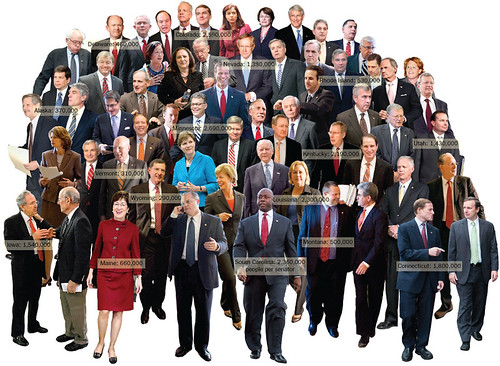
Helping to alter the rural and small state preference-imbalance in the Senate's political representation by adding two Senators ought to be the primary argument.  Since the 2016 Presidential Election where Donald Trump was elected President despite losing the popular vote, besides the imbalance in the Electoral College--because all states have two Senators regardless of population, the same kind of imbalance is present in the Senate, where small states as a group have disproportionate representation:

-- "Senate Power Imbalance Tilts Toward Least-Populous States," Bloomberg Businessweek
-- "By 2040, two-thirds of Americans will be represented by 30 percent of the Senate," Washington Post
-- "The Senate represents states, not people. That's the problem," Vox
-- "The Small State Advantage in the United States Senate," New York Times

According to the New York Times, in an article from 2013, at that point in time, 62 Senators represented but 25% of the US population.

Granted, not all are "conservative," but a fair number are in ways that are deleterious to American democracy, especially in how the Senate over-focuses on small state interests, and under Senate Majority Leader Mitch McConnell, actively aims to damage large state interests, packs the federal courts including the Supreme Court with highly ideologically conservative judges, etc.

62 Senators represent 25% of the US population

Small states benefit disproportionately from federal spending

The point emphasized by LWV volunteer Lesley Tharp is that by adding two Senators from DC, likely always to be Democrats, we will start to right this basic injustice and structural failure in how the Senate is structured.

I think that's a worthy argument.

The small states won't like it.

Definitely Republicans won't like it.

But it's an argument that isn't for the throughput public--DC residents--it's an argument that should resonate with the "output public."

It's for something that will benefit all of us as citizens in what is supposed to be a fair democracy.

And people against this argument will have to acknowledge that they are advocating for an unfair and unjust political system.

Sure, lots of conservatives argue against participatory democracy because the "US is a representative democracy."

But if the structure of representation is biased and flawed, then for the representative democracy to be fair and just and legitimate, structural failures must be addressed.

Statehood for DC, which would add two voting Senators, along with a voting Congressperson, is an important forward step in that direction.

Branding.  A key need then is a great tagline/message.  I have the gist, but it needs (a lot of) work:

Statehood for DC
=
Improving and Refining American Democracy

Labels: , , , , ,

Thursday, July 11, 2019

McKinsey "principles of organizational health" seem to be relevant to creating "value" more generally

From the McKinsey Insights article "The secret ingredient of successful big deals: Organizational health":

Three principles of organizational health, McKinsey Insights


Labels: , , , , ,

Friday, June 21, 2019

Wow: Revisiting DC's Corruption Caucus

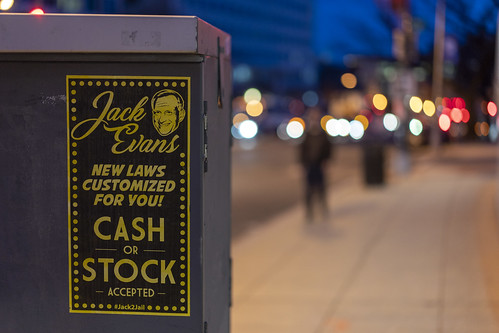
Jack 2 Jail (Connecticut Ave)The Washington Post has been covering the ongoing investigation into ethics violations by DC Councilmember Jack Evans.

The most recent articles report on WMATA's, the area transit agency, investigation of ethics complaints against DC Councilmember Jack Evans, currently the Chairman of the Board.

-- "Jack Evans to resign from Metro board after probe shows he 'kniwingly' violated rules"

It's damning--not so much because of the WMATA ethics committee, which didn't produce a report of its own or write anything down, but because of the investigation that WMATA commissioned.

Evans' actions didn't involve tons of money--maybe $100,000/year in consulting fees--but definitely are replete with multiple glaring conflicts of interests, since the fees were paid by firms that wanted to do business with the transit agency.

Interestingly, Jim Graham, the now deceased and previous DC Councilmember chair of the WMATA board had similar conflicts and had to step down from the board in 2012.

-- "Bringing Jim Graham to account," Washington Post
-- "More legal woes for Metro and Jim Graham," Washington Post
-- Full text of "WMATA board report on Jim Graham", Internet Archive

The difference is that Graham didn't personally benefit, although he tried to steer contracts to benefit campaign donors, but wasn't receiving income for doing so, while Evans received consulting fees directly from clients for whom he tried to help in getting WMATA contracts, without disclosing this.

The ethics charges are what ultimately led to Graham going down to defeat in the 2014 primary election.

These days Evans is facing at least four announced challengers and a recall campaign, although the election isn't until next year. Plus, the FBI has an ongoing investigation.

I figure he probably will decide not to run.  And that more prominent people than the current candidates will enter the race--you know the thing about sharks smelling blood in the water.

(That didn't happen with Graham because the bombshells didn't come out til very close to the primary election, and by that time most people had passed on the opportunity to enter the race, except for Brianne Nadeau.)

Corruption is about systems, not so much about individuals.  This problem derives from how the DC Councilmember job is considered part-time. It creates a structure supportive of conflict of interest.

Evans is hardly the first to work hard at earning outside income from firms that have business with DC Government or other agencies.

In the wake of the issues around Evans, Council is considering legislation to ban most forms of outside income, except for teaching ("Jack Evans scandal revives push to ban outside jobs for DC Council members," Post).

Years ago, blogreader EE shared with us a book published by the World Bank, Corrupt Cities: A Practical Guide to Cure and Prevention and I wrote about it in this 2011 piece, "DC ethics legislation misses the point: focus on what produces corruption as a regular outcome, not monitoring."

While the book focuses on "developing nations," the reality is that corruption in government works the same way where ever it occurs.  As the authors write:
Corruption equals monopoly plus discretion of public officials minus accountability.
My piece listed 9 particular issues (although there are more) with the way things work in DC.  Even though legislation was passed to reduce conflicts, most of the areas I identified as rife with the potential for conflict weren't addressed.

IACA is the International Association of Crime Analysts, and they provide technical assistance and training world-wide.  This particular issue of their alumni magazine focuses on local government and features an interview with one of the authors of the book Corrupt Cities and his work in La Paz, Bolivia.  One quote: "The problem is not corrupt individuals.  It's corrupt systems.

Other ways to restructure certain aspects of DC Council and other areas to increase accountability and "competition." Over the years I've made a bunch of suggestions besides making the job full-time, which if enacted would increase accountability, representation, and make council districts a little less like satrapies.

1.    [This happened] Create an independently elected Attorney General and build the capacity of this office to take control of local prosecution of crime (this responsibility is currently handled by the Federal Government);

2.   Create a public planning and budgeting process for capital improvements, sale of civic assets, and alley closings;

3.   Create a public and transparent process for tax abatement and eminent domain requests (see "Make eminent domain fair for all" from the Boston Globe; the recommendations pertain to both issues);

4.    Increase the number of wards;

5.    Increase the number of councilmembers (thereby making it harder to pass legislation), but also having two representatives for each ward, each elected in a different election cycle;

6.    Move the legislature to part-time service and reduced pay or to full-time service with a slight bump up in pay;

7.   Strengthen the capacity of councilmember staffing;

8.    Increase the research capacity of local government in developing policy and practice;

9.    Institute term limits for elected officials (Council as this already applies to the Mayor);

10.  Change the date of the primary election to extend the electioneering period;

11.  Institute ranked choice voting for local elected officials;

12. Institute additional campaign finance limits for local elections;

13. Create an elected public advocate/ombudsperson/Inspector General (and a civil jury process to investigate government agencies);

14. Reconstitute a school board with oversight over pre-K to 12 public education, traditional and charter schools;

15. Use participatory budgeting methods for appropriating constituent services funds requests and grants to nonprofit organizations ("More on ethics: discretionary funding-constituent funds");

16. Build civic capacity and infrastructure ("Neighborhood planning meta-website);

17. Strengthen the capacity of Advisory Neighborhood Commissions to be better and fairer representatives (""Networked solutions" for some problems with ANCs in DC" and "A neat solution to (some of the) petty corruption in DC government-related civic organizations");

18. Change the planning process to include the production of formal sector and neighborhood comprehensive land use plans ("Planning process failures generally and the upcoming DC Central Library planning process," "Rethinking community planning around maintaining neighborhood civic assets and anchors," and "A key problem in "community" planning: not simultaneously defining community-wide and neighborhood goals and objectives").

19. Various tweaks as needed to planning and zoning processes such as a Big Box Review Ordinance ("Lessons from Walmart's foray into Washington, DC"), community benefits negotiations ("Community benefits agreements revised again" and "What community benefits are supposed to be versus what people think they are about"), and urban design requirements ("New years post #6 -- the crazy thing about U.S. zoning is that it's not designed to maximize overall land value" and "Changing  matter of right zoning regulations for houses to conform to heights  typical within neighborhoods, not the allowable maximum").

Looking at the list, I could come up with some more items, such as creating a "Transportation Commission," using participatory budgeting processes to involve citizens in grant making review, etc.

Wards.  I think that wards should be smaller, meaning a few more councilmembers, and that there should be two representatives per ward, to create intra-ward "competition" and more opportunity for different perspectives.

When I toyed with running for City Council a few years ago, I came up with "Outline for a proposed Ward-focused (DC) Councilmember campaign platform and agenda," which has more focused suggestions for how to represent a Council Ward, including the creation of a center in each ward where a "constituent services office" could be, but also space for community and nonprofit organizations:
Create a “Democracy House," a center for involvement in public and civic life in the ward. If the city provided ward council offices, such a facility could also offer space for community organizations, meeting space, etc., but space would be managed using participatory techniques independently of the Councilmember/Ward office
comparable to the "precinct and ward halls" and social halls that used to exist in the early 1900s in many US cities, but with a decided focus on civic engagement and participatory democracy.

Building civil society and local participation.  #16 concerns building more ways for citizens to participate locally, and opportunities for "do it yourself."

For example, my big complaint about "constituent services" operations in the Mayor and Council offices is that these functions aren't focused on building the capacity of citizens and organizations to represent and act for themselves, but more on creating dependent relationships that promote incumbency.

The participatory budgeting process, where groups of citizens act within ad hoc committees to make decisions about priorities and funding is a way to add more participation to grant making processes.

Other "neighborhood" and association focused programs in cities like Seattle, Calgary, and Minneapolis build the capacity of citizens to take action themselves ("Framingham Massachusetts creates Citizen Participation Officer position").

One element of the offerings of the Seattle Department of Neighborhoods is the People's Academy for Community Engagement, which provides a specific training for two to three cohorts each year.

By contrast, organizations like the Federation of Calgary Communities or the Massachusetts Citizen Planner Training Collaborative have conferences and various trainings throughout the year open to all.

Another great example, although I think it's changed somewhat because the Main Street organization is now separated from the National Trust for Historic Preservation, is the training system that was offered in association with the Main Street commercial district revitalization initiative.  Programs are organized around four thrusts: physical design; business development and maintenance; promoting businesses and the destination; and internal organization and fundraising; and the "Four Point" trainings provided in-depth training on each point.

I did the training four times, some at national trainings, others locally, and I found it valuable each time, because of the different trainers providing different approaches, because I had learned more in the interim and had more experiences to bear, etc.

State Main Street support organizations typically provide this kind of training opportunity.  DC doesn't...  And the Main Street Approach is applicable to other types of organizations and issues.

Planning office trainings for citizens.  While I am not familiar with an agency that does this in the way I suggest below, another model is to have regular training exercises around community planning.

One example is the old "How to Turn A Place Around" workshop by Project for Public Spaces.  (I did this course twice.  An abbreviated version in DC, and once in NYC.)

-- Transforming Cities through Creative Placemaking, PPS presentation

 I think that city planning departments should offer this kind of program annually, moving it around the city, as a way to provide assistance to specific neighborhoods, while serving as a training program for citizens from across the city, in turn they can bring back improved skills to their involvements.

Similar opportunities exist in transportation planning, using workbooks like School Walk and Bike Routes: A Guide for Planning and Improving Walk and Bike to School Options for Students, Main Street: When a Highway Runs Through it, or the Smart Transportation Guidebook as the basis, or materials like the Pedestrian Road Safety Audit guide produced for the Federal Highway Administration.

(When I did the bike and ped plan in Baltimore County, I did do one safe routes to school workshop--on my own time, because my boss didn't approve, and I wanted to do one on trails planning too, but wasn't able to because it wasn't approved.  … and I wanted to have a community meeting on the weekend too, not just during the week at night, to expand the opportunity of people to participate.  Again, that didn't happen...)

Labels: , , , , , ,

Sunday, June 16, 2019

Bicycle Architecture Biennale in Amsterdam: Cool, but it's not just about the architecture, or "building" infrastructure, people need programming to transition to the bike

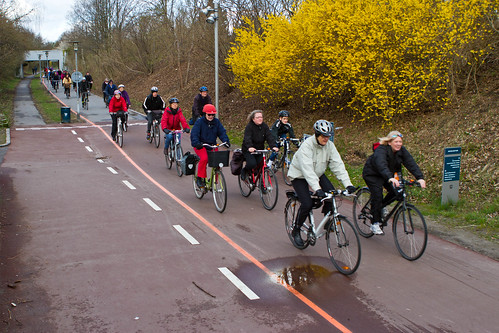
Even in the core of Washington, DC, seeing lots of "schools" of cyclists seems pretty rare.  Photo: bicyclists commuting on U Street, by Jared Soares for the Washington Post, 9/28/2017.

A few stories...

At a transportation public meeting this week in my neighborhood, I was talking to one of the bike planners there about our recognition that it's not that we don't know what to do or what to build, but that elected officials aren't very committed to sustainable mobility, transit, etc., and without their commitment it's hard to do what needs to be done.

We both shared stories about being lectured by citizens about the value of sustainable mobility and I told him that when that happened to me, I stopped the person and I hope gently told him that I knew that already, and that he needed to be lecturing his elected officials.

It wasn't til I worked briefly in county government that I truly understood how constrained government staffers are.  They work within the confines of policy and practice set by elected officials--both legislative and executive.

So then I told him the story of a caravan going to a talk in Baltimore, and how one of the people said "you know, we just have to ask the Dutch transportation engineers how they are able to do what they do."

I said to the guy "they aren't any different, pretty much, from transportation planners here.  The difference is that they have been instructed, in no uncertain terms and without exception, to prioritize biking, walking, and transit overall."
Cycle Super Highways to generate more cyclists in Greater Copenhagen Area
New cycle superhighway in Greater Copenhagen, 2012.  Cycle Embassy Denmark.

That's what's missing.  People think that yep, adding bike, pedestrian, and maybe transit infrastructure is a good thing.  But it's not a priority.   And it's almost always subservient to focusing on facilitating automobile movement and expanding automobile infrastructure.  And if "it costs too much" -- even though rebuilding some busy highway intersections starts costing upwards of $750 million -- it's not a problem to eliminate the bike, pedestrian, and transit improvements "to save money" and focus on the parts of the project for the automobile.

And at a graduation party yesterday (for fifth graders no less, we only had such parties after graduating high school) I was talking to a DC resident who asked if I thought that it is the millennials who are driving the take up of biking.

I said I didn't think so in one respect--the planning and infrastructure development has been going on for awhile.  But yes in terms of being more focused on their smartphones and less on driving, and being more willing in their life stage/life cycle to bike, car share, use taxis/ride hailing, or scooters, than was the case for previous cohorts.

Or I when I was doing work in the bike sharing space, this one guy kept trying to "sell" his bike sharing bike design, which won awards, and I kept making the point that the bike isn't the most important element, it's the design of a complete system, in which the bike is only one component, along with the marketing and promotion of it both to governments and to the end user.

So while I think the second edition of the Bicycle Architecture Biennale in Amsterdam is a cool idea. From the Arch Daily article "Bicycle Architecture Biennale explores how cycling will shape future cities":
Next Architects has curated the second annual Bicycle Architecture Biennale as a showcase of buildings that transform cities through cycling. Opening in Amsterdam, the BAB shows the work of international designers from around the world and explores urban design through social, economic and environmental projects. It was conceived by BYCS as a way to inspire people to imagine new possibilities for human-centric cities.
Bike parking hub with a coffee shop in Delft, The Netherlands.

I don't think that the most important issue in cycling for transportation is "architecting" new types of infrastructure.

Instead I believe the key issues are:

1. Getting elected officials and stakeholders to accept that in certain types of places, biking, walking, and transit and what I call the "Sustainable Mobility Platform" needs to be prioritized over the car.

E.g., to solve congestion Mayor De Blasio thinks that trips by delivery and service vehicles should be reduced. Yes, they should be managed, but such trips support hundreds and thousands of households, whereas a car operated by a single person is for one trip.

2. Resetting funding and work priorities accordingly.

3. Letting these places be prominent outliers in a mobility system otherwise dominated by the car.

This is important.  Most elected officials, especially Republicans in Congress, work very hard to crush and eliminate transportation outliers.

Just think if we had a handful of cities around the US (1) comparable to Copenhagen and Netherlands cities for biking; (2) like Zurich and Melbourne and Brussels for streetcars as an element of the mobility system, Toronto too; (3) a midsized city with a great subway system that people could understand could be relevant to their own communities; (4) great regional railroad systems that operate like the German S-bahn system of suburban railroad services--New York and Chicago are premier, and Boston and Philadelphia are quite good; (5) at least a couple true high speed rail corridors; (6) a state where the passenger railroad network is so good that you could get around the state pretty easily by train; etc.

Yes, there are cities like New York and Boston, San Francisco, and somewhat, DC, where transit is used by a preponderance of users, but still the car is prioritized.

4. Almost more important than infrastructure--because we are building plenty of great cycletracks across DC and other cities that are only minimally used--we need to start focusing on actively and energetically providing support to people to make the transition from driving to biking.

To be fair, in some respects this might be true of the Bicycle Architecture Biennale

Most of the projects they highlight aren't extraordinary.  If you look at the gallery of images for the projects, mostly they are best practice, but not outlandish  It's just most places aren't doing interesting stuff, like a coffee shop as part of a bike parking hub.

Or the Heathrow bicycle hub for employees--they aren't listed--is an outlier not just because it is busy and useful, but because most airports aren't focusing on bicycle transportation as one element of a complete transportation program.

I suppose this bicycle skyway in Xiamen, China is a big deal.  But we already know that you can make a bridge a bit wider to accommodate pedestrians and cyclists.  For example, how there is a bikeway on the 14th Street Bridge over the Potomac River.

If it were a car parking garage with a café in the ground floor, would that be considered an extraordinary example of architecture and design?

Same with lots of car parking at train stations.  That's not extraordinary, but providing bike parking is?

Cities aren't doing interesting stuff because they don't know how, it's because the political interest and support is lacking.  And because in the great scheme of things, not enough people are biking for transportation, which would require a shift in the paradigm.

For a paradigm shift, we need lots of bicyclists.

Along Denmark's first formal cycle superhighway, they have installed air pumps every 1.7 kilometers.

Note that we must concede there are differences in the thoroughness of developing cycling infrastructure in places like Denmark compared to the US.

Imagine building a highway in the US and there not being any gas stations.

Planning for automobility is very thorough in the US.  For other modes, not so much.

Labels: , , , ,