Rebuilding Place in the Urban Space

"A community’s physical form, rather than its land uses, is its most intrinsic and enduring characteristic." [Katz, EPA] This blog focuses on place and placemaking and all that makes it work--historic preservation, urban design, transportation, asset-based community development, arts & cultural development, commercial district revitalization, tourism & destination development, and quality of life advocacy--along with doses of civic engagement and good governance watchdogging.

Wednesday, January 07, 2026

Holy f***: Trump policy kills a woman in Minneapolis

Photo: Mathieu Louis-Rolland, Getty Images.

Protestors in Portland have been making fun of the extreme statements about Portland being out of control by wearing costumes at protests ("Portland’s Theater-of-the-Absurd Protests Reflect the Ridiculousness of Trump’s Lies," The Nation).

There's been a lot written about Trump using the National Guard as a tool to terrorize "Democrat cities" ("Trump’s use of National Guard troops on American streets is bad enough. This could be worse," Rhode Island Current), like Portland, Los Angeles, and Chicago.  

Ostensibly, the troops have been sent to cities “overrun” with crime. Yet data shows that has not been the case. Troops have been sent to largely Democratic-run cities in Democratic-led states.

The case for political theater being the real reason behind the deployment certainly was strengthened when largely Republican Mississippi sent troops to Washington D.C., even though crime in Mississippi cities like Jackson is higher than in D.C. Additionally, there is an even more dangerous purpose to the troop presence — that of normalizing the idea of troops on the streets, a key facet of authoritarian rule.

There are fundamental differences in training and mission between military troops and civilian law enforcement, with troop presence raising the potential for escalation and excessive force, and the erosion of both civil liberties and military readiness.

The Supreme Court recently ruled that the justification used by the Administration was flawed, and ordered them to stop ("Supreme Court rejects Trump’s effort to deploy National Guard in Illinois," SCOTus blog, "The Supreme Court has taken the National Guard away from Donald Trump," Economist).  Separately, as DC is subordinate to the federal government, NG troops are still in the city.

Of the many objections to the entry of federal law enforcement personnel into cities is their lack of training on urban policing, nor in de-escalation.  Armed troops are by definition escalatory.  It doesn't help that the Administration lies about what happens in their various engagements with protestors.

Another objection is that putting such forces in cities provides reputational risk to the military, because it's not what they are supposed to do.  In a way, although a bit different, it's not unlike how the British, during the Revolutionary War, forced residents to billet soldiers, at their own expense.  Here, it's a city being forced to take the brunt of the action by the military.

We know about the Administration's multi-faceted anti-immigrant program ("Protecting The American People Against Invasion" White House) with overtones of White Christian Nationalism ("The wrath of Stephen Miller," Atlantic), which has resulted in the imprisonment and/or deportation of many thousands of people.  It's not uncommon for US citizens to be swept up in the actions, and imprisoned ("We Found That More Than 170 U.S. Citizens Have Been Held by Immigration Agents. They’ve Been Kicked, Dragged and Detained for Days," ProPublica).

Immigration and Customs Enforcement personnel are able to operate in cities independent of the court judgements about the National Guard.

Chicago: A federal immigration enforcement agent points a crowd control weapon at a protester at East 105th Street and South Avenue N in the East Side on Oct. 14. Protesters gathered as U.S. Immigration and Customs Enforcement officers awaited the removal of their vehicle after it crashed during a pursuit.Anthony Vazquez/Sun-Times

And they are armed and aggressive.  Armed, not well trained Guardsman killed protestors at Kent State University in 1970 ("Kent State University marks 55th anniversary of May 4 shootings," Ideastream/NPR) but before that at the Historically Black College, Orangeburg State College in South Carolina, in 1968 where three students were killed ("Feb. 8, 1968: Orangeburg Massacre," Zinn Education Project).

One particularly egregious aggression was the raiding of an apartment building in Chicago ("“I Lost Everything”: Venezuelans Were Rounded Up in a Dramatic Midnight Raid but Never Charged With a Crime," ProPublica, "Stories from the federal siege of Chicago," Chicago Sun-Times).

Community members pray at the scene where a federal agent shot and killed Renee Nicole Good, 37, of the Twin Cities earlier on Portland Avenue in Minneapolis on Wednesday, Jan. 7. (Alex Kormann/The Minnesota Star Tribune)

That's escalated.  Today, we have the killing of an American citizen in Minneapolis ("Eyewitness describes ICE shooting that killed woman in Minneapolis," NBC).

With the director of ICE as part of the operation!

The Boston Globe has a video link of the engagement, and there is no question the ICE agent murdered the driver, a 37 year old woman.  ICE agents too, aren't well trained, for urban incursions.  This is the result.

U.S. Border Patrol Cmdr. Gregory Bovino joins federal agents at the scene of a shooting in Minneapolis on Wednesday, Jan. 7, 2026. (Ellen Schmidt/MinnPost via AP) Ellen Schmidt/AP

Ironically it's 5 years plus one day since the Trump-inspired violent protests at the US Capitol ("Jan. 6 insurrection," Washington Post).  The Administration just put up a webpage lying about what happened ("White House unveils Jan. 6 webpage saying Democrats ‘staged the real insurrection,’ criticizing Capitol Police," The Hill). 

One protestor, Ashlii Babbitt, was shot and killed by a member of the Capitol Police.  She's been made a martyr of the hard right, and under Trump, her family got a payout ("Trump administration to pay nearly $5M in wrongful death lawsuit of Jan. 6 rioter shot by police," Politico).  She was rioting.  Rioting isn't protected speech.  She was a criminal.  Trump also pardoned most of the people found guilty of rioting that day.

A bullet hole is seen in the windshield as law enforcement officers work at the scene of a shooting involving federal law enforcement agents, Wednesday, Jan. 7, 2026, in Minneapolis. Tom Baker/AP

Not the lady in Minneapolis, Renee Nicole Good, she's just dead.  Say her name... ("‘She was an amazing human being’: Mother identifies woman shot, killed by ICE agent," Minneapolis Star-Tribune).

The Administration is justifying the murder ("Live updates: Hundreds protest in Minneapolis after ICE officer kills woman," AP).  Calling the person driving away a "domestic terrorist" ("DHS Secretary Kristi Noem’s comments in wake of woman’s fatal shooting by ICE agent," MST).

“He’s been in situations like this before, and he certainly has been out there and followed his training today,” said Noem at the evening news conference in Minneapolis.

A federal agent sprays a protester with a chemical agent at the scene of a shooting in Minneapolis on Wednesday, Jan. 7, 2026. (Ellen Schmidt/MinnPost via AP) Ellen Schmidt/AP

Noem appeared to reference the same officer when she said that, back in June, he’d been rammed and dragged by an “anti-ICE” motorist.

Emergency medical technicians carry a person on a stretcher at the scene of a shooting in Minneapolis on Wednesday, Jan. 7, 2026. (Ellen Schmidt/MinnPost via AP) Ellen Schmidt/AP

The Republicans in Congress are supine in the face of the Administration's aggressions not just against the Constitution, but of the American People.

You would think this killing would be a moment comparable to when Senator Joe McCarthy's lies were challenged by Joseph Welch, the U.S. Army's chief counsel at one of McCarthy's many hearings about communists in government.  

He said: "Have you no sense of decency, sir, at long last? Have you left no sense of decency?"

That was the moment of McCarthy's downfall.  Were this to be a similar moment.

Sanctioned state violence.  The Trump Administration is one of the most violent in terms of how it deals with citizens and immigrants.  But this is not unique to the nation's history, with raids against "communists" in the 1870s and 1920s, anarchists (1910s), labor unions (1890s-1930), and the treatment of certain immigrant groups throughout history (Chinese, Mexicans, Jews).

But today it seems the US is taking its cues from Hungary and Russia, where the media is controlled and universities are subjugated, and countries like Chile under Pinochet, Saudi Arabia, Egypt, and Israel, China--Israel ("Watched, Tracked, and Targeted Life in Gaza under Israel’s all-encompassing surveillance regime," New York Magazine) and China are probably the most developed surveillance states in the world, more intricate than the Apartheid period of South Africa.  

Trump constantly threatens to stop elections and interfere with elections ("Trump’s Jokes About Canceling Midterm Elections Aren’t So Funny Anymore," Esquire), which is front and center in Erdoğan's regime in Turkey.

Plus there is the prosecution of Trump "opponents" such as James Comey (former director of the FBI) and Letitia Wilson (State Attorney General of New York).

Poland is an example that had degraded in terms of freedoms of citizens but is on a turnaround, with the election as president of Donald Tusk.  So it can be reversed.

It's incredible though that the US has reached this nadir.  I never thought that when I studied Latin America in political science courses in college, that the readings foreshadowed today's United States of America.

Labels: , , , , ,

Tuesday, July 04, 2023

Independence Day and Civic Engagement when Democracy is in crisis

I don't have the energy to write about this in depth.  SCOTUS ("The Supreme Court Has Kicked the Door Wide Open to Jim Crow–Style Bigotry," The Nation), voter suppression, gerrymandering, authoritarian tendencies in the Republican Party, Trump and insurrection, State Legislature preemption of the ability of local government to act ("States Are Silencing the Will of Millions of Voters," New York Times), etc.

Signing of the Declaration of Independence

Yes, to have democracy you need to practice it.  And I believe our civic institutions need to seize on every opportunity to promote substantive civic engagement.  Which isn't easy, is time consuming, is subject to blowback (e.g., the conservative push against school boards) etc.

Margaret Sullivan's column in the Guardian, "On the Fourth of July, a few reasons to feel encouraged about US democracy," quotes a law professor, Asha Rangappa from Yale:

"Get engaged locally,” urged Yale University’s Asha Rangappa told me recently when I interviewed the former FBI agent for my podcast, American Crisis: Can Journalism Save Democracy? That could mean runing for office, signing up to be a poll worker, volunteering at school, participating in the arts. 

Rangappa wants more Americans to “cultivate the habits of democracy”. Those habits are developed when people leave their social-media echo chambers, get out into their communities, and simply talk to each other.

Yep.

Labels: , , , ,

Thursday, March 02, 2023

The Toronto Public Library has launched a new collection featuring books banned, challenged or censored across North America.


-- "It’s never been more important to protect the right to read," Toronto Star

Labels: , , , , ,

Thursday, May 26, 2022

The right to petition to redress grievances (First Amendment) in the face of government inaction

The Seattle Times has a story ("Seattle residents painted their own crosswalk. It didn’t go over well") about how an unidentified group of citizens painted a guerilla crosswalk at a location where they've called for one for years, and where one is supposed to be constructed but still hasn't.  This week, the crosswalk was removed.  

Although it was pointed out that "illegal" crosswalks can be problematic.  From the article:

But Fellows, who works in transportation and supports putting a crosswalk at the intersection, had concerns that this one may create safety issues. “The paint isn’t reflective, there’s no stop signs, there’s no notice to drivers that things are going to be different there,” he said. 

There were likely liability concerns as well, he said. “If you’re a traffic person, you spend half your life in tort claim court.” 

The life span of the crosswalk was roughly eight months. Bergerson with SDOT said it didn’t meet the department’s standards but said the installation of traffic signals should begin this year. “We’re working to get the word out to the public,” he said. It won’t arrive tomorrow, he added. “It just takes some time.” 

 Baum said he wouldn’t have minded its removal if it had been immediately paired with a specific plan for it replacement. Absent that, “even though it’s this sneaky tactical thing, I think taking away something that people feel is an asset to the community is going to rub some people the wrong way,” he said.

I came across a similar article about Los Angeles ("LA removes crosswalks allegedly painted by a secretive group," NPR) and how the city is removing crosswalks created in guerilla events by an organization called Crosswalk Collective LA.

And a couple weeks ago, there was an op-ed in the Washington Post by the Fairfax County (Virginia) Council Chairman, Jeff McKay, saying that people shouldn't protest at the houses of elected and appointed officials, like Supreme Court Justices aiming to overturn Roe v. Wade ("Political change doesn’t happen outside people’s homes").


Demonstrators in support of reproductive rights hold a vigil May 9 outside Supreme Court Justice Samuel A. Alito Jr.'s home in Alexandria. (Evelyn Hockstein/Reuters)

Two of the elements of the First Amendment to the Constitution of the United States are:
the right of the people peaceably to assemble, and to petition the Government for a redress of grievances.
Although I joke that a change.org petition isn't enough, and that people don't think through what particular units of government are empowered to do, or not, and they often mis-direct such petitions and protests.

Listening/Not Listening: What do you do when your voice is ignored?  I joke that when my wife complains that "you don't listen!" I say "I do listen.  I just don't do what you say."

And I make the point in DC grassroots politics a lot of the time when people say "Government/you aren't listening to us", the reality is that "they are listened to, but the government doesn't act on their complaints, because they testify about matters outside the bounds of the enabling ordinances and regulations guiding decision making on the matter.

But when I saw the piece by McKay, the first thing I thought was that people are "emboldened" to take such drastic measures as protesting outside of the house of a Supreme Court Justice when they believe that they have no other choice, that there are no other reasonable means to communicate their concerns.

Not unlike the scene from the movie "Network", where people are encouraged to lean out their windows and yell "I'm mad as hell, and I'm not going to take this anymore."


It's definitely true with the Supreme Court, between the process by which Justices have been appointed by a minoritarian Senate, and how citizens have zero mechanisms for communicating to and with the Court.  

And it's true to an extent that citizens fed up with the seeming lack of action on installing important safety measures in their neighborhoods, like crosswalks, take action out of a sense of frustration and a belief that the city will do nothing or take years and years to do so.

Indicators of the need to change.  In both cases, such acts need to be seen as indicators for action.  That protest outside a house ought to make the person think somewhat about what they're doing and how they might be incredibly isolated and disconnected from the majority of citizens.

The point isn't to criticize the protestors as much as it is to understand why they're protesting (although the public nuisance and personal safety issues that arise do make me see why some people think that such protests are unreasonable).

And seeing citizens paint crosswalks ought to get city transportation agencies more focused on "speedy project delivery" and delivering safety improvements that matter, especially to communities that have ongoing issues with traffic speed, crashes, pedestrian and bicycle deaths, etc.

There was an article in my feed today from Dezeen, "Sensible proposals that are not adopted indicate a failure of design thinking" says commenter," and just responding to the title, is it "the design method" or what or a broader "Democratic Dysfunction."

That government is no longer focused on acting to solve problems, but to prevent action altogether.

But also that there are many elements within law and regulation that operate at cross-purposes.

Related is George Monbiot's concept of the "Pollution Paradox" which posits that the organizations doing "the bad things" are the most motivated to fight changes in policy and regulation that would limit their ability to continue to pollute.

National Environmental Policy Act and reviews and project delays.  There is also environmental review.  It is well intentioned, but can delay projects for years, and is often used as a way to sidetrack projects by opponents.  Somehow there needs to be a balance between environmental review and action.  

For example, a review of dog issues for the Golden National Recreation Area in the SF Bay is over 1,200 pages--for dogs.

Traffic moves on 42nd St. in Midtown Manhattan. (Drew Angerer/Getty Images)

A current example is how the NY MTA has to answer 430 questions from the Federal Highway Administration before it can proceed to the next stage of review for their proposal for congestion pricing in Manhattan ("More delays for NYC congestion pricing as MTA struggles to answer questions from feds," New York Daily News).

In my experience, many times projects are reduced in scope to avoid triggering environmental review, so they won't be delayed, but at the cost of doing a better project.

Labels: , , , ,

Wednesday, May 25, 2022

Guns don't kill people, people kill people: if that's the case, we need to restrict people's access to guns

Was a slogan, coined I think by the NRA, to misdirect attention away from gun control proposals of various sorts.\

If people, not guns, are the problem, then we shouldn't be making it so easy for "people" to buy guns without adequate checks, and to buy assault weapons that are more appropriate for theaters of war.

Many states, including Texas, are legalizing gun carrying without permits being required, limited checks on purchases, limited restrictions on people buying guns who have "issues," few if any restrictions on high capacity weapons, etc.

Yesterday's incident in Uvalde, Texas is beyond horrific, with 19 children and 2 adults dead, killed by a troubled and once bullied 18 year old, who was subsequently killed by law enforcement ("Texas shooting: How a sunny Uvalde school day ended in bloodshed," BBC).

Somehow, he was able to buy two rifles just the day before.

It's insane that people have to worry about being shot when they go to church or temple ("One dead, multiple injuries in Laguna Woods church shooting"), a supermarket ("Gunman Kills 10 at Buffalo Supermarket in Racist Attack," New York Times), shopping center, nightlife district ("3 alleged gang members charged with murder in Sacramento mass shooting," ABC News, "FBI releases final report on investigation into motive behind Dayton mass shooting," WLWT TV), or school ("Victims, parents of Oxford school shooting victims sue school employees," ABC News).

I've been thinking lately, in response to all the incidents of mass shootings, certainly multiple events every week, that we are reaching "peak gun," and there are so many incidents because of "the nexus of guns, perpetrators, and people."

The Second Amendment is supposed to ensure gun access wrt use in "organized [community] militias," not wanton access to guns in ways that reduce public safety rather than enhance it.


Labels: , , , , , , ,

Tuesday, March 23, 2021

A comment on the gun deaths in Boulder, Colorado

10 Dead yesterday, in a shooting at a supermarket in Boulder, Colorado.

A man held a sign for the victims of the mass shooting on Tuesday.
Credit:  Eliza Earle for The New York Times

Ironically, just last week, courts struck down an attempt by the City of Boulder to limit access to automatic guns ("A judge recently blocked Boulder from enforcing its assault-weapon ban," New York Times).  From the article:

Judge Andrew Hartman ruled that under a state law passed in 2003, cities and counties are barred from adopting restrictions on firearms that are otherwise legal under state and federal law, The Denver Post reported. Gun advocates made that argument when they sued to overturn the Boulder bans shortly after they were adopted. 

The judge rejected the city’s arguments that the home-rule provisions of the state constitution gave it the power to adopt the bans as a matter of local concern, and that they were necessary because the state did not regulate such weapons. As of last week, lawyers for the city had not said whether they planned to appeal. 

Given the number of mass shootings in Colorado, you'd think they could have had a reaction more like Australia's ("How Australia All But Ended Gun Violence," Fortune) or New Zealand's ("New Zealand tightens gun laws further in response to mass shooting," Reuters), where after mass shootings, the countries imposed strict limits on guns. Instead, in the US the reaction is to do nothing.

There is a serious disconnect between governments ensuring "public safety" and how modern interpretations of the Second Amendment have allowed for the wanton ownership of guns, especially high powered guns like assault weapons, which have no real public benefit or purpose outside of waging war.

------------------------

Interestingly, while federalism is often touted as supporting innovation by the states, so called "Laboratories of Democracy," with conservative groups like the American Legislative Exchange Council, Club for Growth, other lobbying organizations creating platforms to disseminate and pass conservative legislation ("You elected them to write new laws. They’re letting corporations do it instead," USA Today), and state attorney generals seeing an opportunity to sue the federal government to support political ideology instead of policy ("Republican AGs take blowtorch to Biden agenda," POLITICO), it's difficult for there to be a lot of, let alone any, innovation at the state scale. 

Labels: , , , ,

Sunday, January 31, 2021

DC Attorney General's opinion on the appointment of the US Attorney for DC and DC's rising crime rate

In 2012, I wrote a blog entry about the then new master plan for the Seattle Police Department and what a step forward that was.  I still remember commenter charlie's reaction, that the master plan said very little about addressing crime or reducing the crime rate. 

==========

DC is an unusual jurisdiction for criminal prosecution.  Because it is still the federal district, not an independent state, the US Department of Justice is responsible for the trying of adult criminal cases which in normal circumstances would be tried by the local jurisdiction.

In short, in DC, the US Attorney handles both federal and local crimes.  The DC Attorney General handles the prosecution of juvenile crimes and civil matters more generally.

I favored the creation of an elected Attorney General position in DC as a route to developing the competence of the local office and as a justification for moving towards the devolution of local criminal prosecution to the local government.

-- "Executive Power vs. the will of the people and the DC Attorney General," 2015
-- "US Attorney General Barr's screwing up of the US Attorney's Office in DC as a justification for spinning off local prosecutions," 2020

But I haven't really seen that argument put forth, and something I never considered has happened--that the AG, at least under Karl Racine, seems to have used his office to help forward the election of DC Councilmembers--four of the thirteen worked for the AG before running for office.

The AG has an op-ed in the Washington Post, "President Biden’s choice for U.S. attorney should reflect D.C. values," about how President Biden should take into account the preference of DC citizens as expressed on various issues, when making the appointment for the position.

He mentions issues like hate crimes, and how federal prosecution of gun crimes ups the sentence, and this is counter to what "the people want."

But like how charlie skewered me about my love of the Seattle Police master plan in terms of its failures to address how it would reduce crime, all I could think about when reading this is that violent crime in DC is up, the use of guns in crime is up, shootings are up, and that the murder rate--while down significantly from the peak in the 1990s, when 479  people were murdered in 1991 ("D.C. Touts Lowest Homicide Rate in Nearly 50 Years," NBC4)--and then dropped steadily to a heralded low of 88 in 2012,  has more than doubled eight years later.  Last year's total was 198 murders ("Homicides in D.C. hit 16-year high; shootings also have spiked," Post).

How come AG Karl Racine didn't mention DC's rising crime rate as an issue of concern to local citizens, and its relevance to the choice of a US Attorney for the District of Columbia?

Labels: , , , , ,

Tuesday, October 13, 2020

The reality is that "religious freedom" in the Constitution's Bill of Rights probably doesn't mean what religionists think, from the perspective of "originalism"

I do write about the "establishment clause" and the separation of church and state as outlined in the First Amendment to the Constitution of the United States from time to time, but it's hardly a focus of a blog on urbanism.

I have written about churches in the context of urbanism ("Churches, community, religion and change," original piece, 2012).  And I am a fan of religious architecture and design, especially stained glass.  

Now here in Salt Lake, I am fascinated about how the LDS Church builds churches to anchor neighborhoods, and they are sited to encourage walking to church (I'm not sure many people do), so there is an abundance of churches within neighborhoods.  But like urban churches elsewhere, they are running into having "too many churches" as the city becomes more religiously diverse.

An article in the Salt Lake Deseret News, "What does ‘a wall of separation between Church and State’ mean exactly?," made me think about it anew, based on my experiences in DC, and learning about the early history of the region.  

Pro-religionists focus on the clause "or prohibiting the free exercise thereof," rather than the first clause of the sentence, "Congress shall make no law respecting an establishment of religion."

My interpretation of this section of the First Amendment is that it concerned the forced payment by American households to financially support the Church of England, the "official religion" of Maryland and other Southern colonies and Congregationalism in New England.  Some colonies required payment to the Protestant denomination of their choice.  Only Delaware, New Jersey, Pennsylvania and Rhode Island did not require religious payments.

Although I'm really only familiar with Maryland, because DC was originally part of Maryland, and what is now St. Paul's Episcopal Church on "Rock Creek Church Road," was the official church for that part of what is now DC.

Maryland was originally founded with a doctrine of religious freedom, and the earliest Lords Calvert were Catholic.  Because the Calverts continued to practice the Catholic faith, eventually the Royal Charter was withdrawn from them, in 1689, and the Church of England became the state religion in Maryland.

All householders had to pay a tax to support the operations of the church in their region.  Later the Calverts converted, and in 1699, the Royal Charter was restored.  

Queens Chapel Road in DC and Prince George's County, Maryland is named after the Queen Family (who owned about three square miles of land in what are now the Brookland, Edgewood, and Woodridge neighborhoods), which maintained a hidden chapel to practice their Catholic faith, despite the forced adoption of Anglicanism for the Maryland Colony.  

(We don't know where the chapel was located but it was probably close to origin point of Queens Chapel Road, which is near the intersection of 18th and Irving Streets NE, on the Woodridge side of 18th Street.)

For some time, I've let myself believe that the example of the Queens and Maryland was one of the influences on what became the final wording of the First Amendment.   

Based on my interpretation of those events, I figured that resentment over having to pay to the church, even if you chose not to practice that faith, was a key impetus behind this clause of the First Amendment.  

Not so much the ability to practice religion free of the state, but the ability to not practice religion or a particular religion.  And definitely to not be forced to pay for its maintenance ("Public Funding of Religious Activity in 18th-Century America," Pew Research Center).

OTOH, because the Calverts started out Catholic and understood the problems their practice of an unapproved religion created for them politically and financially vis a vis the King of England, they were more tolerant of other faiths, and in 1649, they facilitated the passage of the Maryland Toleration Act, one of the earliest laws mandating religious tolerance for the practice of other religions.

So you can make the argument that the First Amendment clause about religion is equally about the freedom to practice religion, as much as it is to not practice it.

Donald Trump holds up a Bible during a photo opportunity in front of St John’s Episcopal church on Monday. Photograph: Tom Brenner/Reuters.

Be that as it may, the rise in religionism on the part of conservatives and the frequent involvement of religion-related interpretations in federal lawmaking and interpretation is about religious perspectives superseding the independence of government from religion and vice versa ("Religion and Right-Wing Politics: How Evangelicals Reshaped Elections," New York Times).

The SLDN article makes the point that originally the Constitution ordered the relationship between the federal government and states, and citizens, but that states were not subject to all of its provision.  

Therefore, official religions persisted in some states for some time after the creation of the United States. So the tension of church and state, and yielding authority to either the state or to religion remains.

Labels: , , ,

Monday, October 12, 2020

PBS Documentary: Driving While Black, Tuesday October 13th, 9pm EDT

 -- "Driving While Black: Race, Space, and mobility in America"  From the website:

Chronicling the riveting history and personal experiences – at once liberating and challenging, harrowing and inspiring, deeply revealing and profoundly transforming – of African Americans on the road from the advent of the automobile through the seismic changes of the 1960s and beyond – "Driving While Black" explores the deep background of a recent phrase rooted in realities that have been an indelible part of the African American experience for hundreds of years – told in large part through the stories of the men, women and children who lived through it. 

Drawing on a wealth of recent scholarship – and based on and inspired in large part by Gretchen Sorin’s recently published study of the way the automobile and highways transformed African American life across the 20th century (Driving While Black: African American Travel and the Road to Civil Rights (W.W. Norton, 2020)) – the film examines the history of African Americans on the road from the depths of the Depression to the height of the Civil Rights movement and beyond, exploring along the way the deeply embedded dynamics of race, space and mobility in America during one of the most turbulent and transformative periods in American history.

Civil rights history is intertwined with transportation, because services were segregated throughout the South, with occasional exceptions such as in DC. 

The Montgomery Bus Boycott, the Freedom Riders, protests we don't know about in the early 1900s (Richmond Streetcar Boycott, 1904) are key elements in the fight for African-American Civil Rights in the United States.  A bus strike over fare raises was a key event in the political ascension of Marion Barry, who became a school board member and then mayor of DC.

"Driving While Black" remains an issue today in terms of racialized social control and policing in urban communities. Many police killings of civilians have involved African-Americans being stopped for infractions that might have been ignored had they been white.  See "Philando Castile killing: Officer charged with manslaughter," CNN; "Photo contradicts key claim made by Tulsa police in unarmed black man's fatal shooting," Denver Post.

Labels: , , , ,

Monday, July 20, 2020

US Attorney General Barr's screwing up of the US Attorney's Office in DC as a justification for spinning off local prosecutions

This building houses the US Attorney's Office for DC.

Because DC is a federal district, not a state, the US Attorney's Office, which in other federal prosecution districts (like the Southern District of New York) only handles federal criminal matters, handles local prosecutions of adults.

It's a great training ground for the Department of Justice, but at some level, the office can be disconnected from the local jurisdiction. By contrast, in most other cities the local prosecutor is publicly elected, and therefore, more connected to the issues and concerns of the voting population.

I have written a bunch of entries over the years, in support of creating a locally elected AG, and that office building the justification for the devolution of local prosecution authority to the local AG.

DC has a locally elected AG now, but there doesn't seem to be any traction wrt devolving local adult prosecutions to that office.

-- "Executive Power vs. the will of the people and the DC Attorney General," 2015
-- "Politico Magazine profile of DC AG Karl Racine | + some miscellaneous legal matters," 2019

More recently, the DC US Attorney's Office has been through a lot of turmoil because of Executive Branch interference in the prosecutions of Michael Flynn, Roger Stone, and Paul Manafort and the machinations concerning the appointment of a US Attorney to run the office.

The National Law Journal reports ("Inside the Disharmony at the DC Federal Prosecutor's Office") that there is a great deal of unrest within the office because of this ("A Loss to the Pursuit of Justice': Praise for Roger Stone Prosecutor Who Resigned").

Granted the disharmony is more about the prosecution of federal crimes, and the way the office positions are used to reward political functionaries, who at least under the current administration, tend to have zero experience or connection to DC.

So it's possible that this isn't affecting much the part of the office that does local prosecutions.

But it does provide further justification for splitting off and devolving local matters to the locally elected AG.

=====
The Federal AG should be popularly elected.  Separately, because "law belongs to the people, not the president" for a long time I've argued that the US Attorney General, who heads the Department of Justice, should be popularly elected, separate from the election of the President/Vice President.

The way that President Trump has used the law as a cudgel, and his pardon and suasion capacity to shape "justice" his way is yet another example of why to do this, although my argument about this predates Trump's election.

-- "Yet another example of why the US Attorney General should be popularly elected," 2020
-- "Ideally, the Federal Attorney General would be separately elected," 2017

I suppose knowing about how President Nixon misused the AG's power, and even President Kennedy appointing his brother, are other examples of why some disconnection of the criminal justice function from the President's power would be desirable.

Labels: , , , ,

Wednesday, February 12, 2020

Yet another example of why the US Attorney General should be popularly elected

For more than 10 years, from time to time I write a post recommending that the US Attorney General, head of the Department of Justice, be popularly elected, and that the Department of Justice and its constituent units should be an executive branch agency independent of the President, because "law, fairness, due process, and justice" belong to the people.

There are myriad examples in recent history of the need for an independent attorney general, to act in the breach, in the face of executive branch malfeasance and overreach.

A separation of the justice agency from the rest of the executive branch through popularly electing its head happens in a majority of states, and often at the local level too, with popularly elected "prosecutors" although at the local level, such officials are mostly focused on prosecuting criminals not creating a fair justice system.

Progressive local justice.  The tension between prosecution and justice is why there is a movement about to elect "progressive" local prosecutors, although this agenda is controversial wrt reducing charges, bail, etc. ("Progressives Are Winning DA Races But Face Pushback," Governing Magazine); "Criminal justice: Police, progressive prosecutors battle over reform," USA Today).  From the USA Today article:
Boston-based Suffolk County (Massachusetts) District Attorney Rachael Rollins, the first woman of color to hold a DA post in the state, acknowledges that pushing a reformist agenda “is an uphill slog, but we are deeply committed.”

Rollins, who calls herself “smart on crime,” says a hallmark of the progressive wave is relying “on numbers, not anecdotes.” She is busy hiring “technologists and data experts so we can document all this and show how these policies are making a difference.”
Executive branch/Presidential tampering.  The way that President Trump is tampering with justice, in pardoning people associated with his biddings who have been found guilty of crimes, in appointing a bagman as leader of the agency--William Barr, aiming the agency at investigating his opponents and perceived enemies, and now with the latest happenings in the Roger Stone case, asking the Department of Justice to go easy on him, in the face of previous recommendations by people running the case, is a perfect example of why this split should occur.

The Roger Stone debacle.  The Washington Post ("Trump attacks federal judge, prosecutors in Twitter tirade defending Roger Stone") and other media are reporting on the latest developments in the Roger Stone matter, which is the subject of a twitter thread by the President. From the article:
The timing of Tuesday’s online attack prompted many to accuse Trump, who has a long history mounting public crusades against judges and courts over unfavorable rulings, of attempting to intimidate Jackson and secure a more lenient sentence for Stone. ...

Trump’s fusillade of tweets came shortly after news broke that the Justice Department had overruled the sentencing recommendation for Stone submitted by federal prosecutors, an action that followed Trump blasting the recommendations as too harsh.
This action led the prosecutors handling the case to resign in protest ("Prosecutors quit amid escalating Justice Dept. fight over Roger Stone’s prison term").

Plenty of AGs are happy to tamper.  OTOH, there is no guarantee in this day and age that whoever ran for the office would not be as mendacious as William Barr ("What to do with an attorney general who disdains justice?," op-ed, Washington Post).

But Elliott Richardson, Ramsey Clark ... But definitely in the past, there have been great, honorable people who served as the US Attorney General.

Probably, were this change to be made, I'd also recommend shifting the role of Inspector General within the executive branch agencies too, having them report to the AG as well.

Labels: , , , , ,

Sunday, August 04, 2019

Repositioning the DC Statehood argument as a way to address structural imbalances in American democracy

One of the most important concepts I ever picked up came from the book Strategic Marketing for Not For Profit Organizations by Armand Lauffer, a social work professor at the University of Michigan.

One of the points made is that organizations have three publics: the input public which provides the resources the fuel what the organization does; the throughput public that does the work, usually staff and volunteers, led by management; and the output public to whom the organization's efforts are directed.

At the time I read this, like many people in Ann Arbor with progressive tendencies, I did door knocking for the Dean Baker for Congress campaign (he has been the co-director of the Center for Economic and Policy Research for decades).  The district spanned from Detroit's western suburbs to Ann Arbor and its environs, and the seat was held by a Republican.

The big issue "for us" was US involvement in El Salvador, something which didn't resonate much in places like Plymouth.

I realized that most of the campaign messages (other than saving Social Security from the predations of Republicans) were for the "throughput public," the campaign workers.  We were the ones that cared about El Salvador, US foreign policy, etc., but those weren't the primary concerns of the voters we were trying to reach.

Statehood for DC yard sign at Civic Fest, Meridian Hill ParkThe DC Statehood effort suffers from the same problem.  It mostly uses the argument that it's unfair and undemocratic for US citizens in the continental United States to not have voting representatives.

This is mostly an argument that satisfies the throughput public, which in this case are the citizen residents of the District of Columbia.

While that is definitely the case, according to a recent national opinion survey by the Gallup Poll, most people in the rest of the United States don't care ("Most Americans say no statehood for the District of Columbia," Washington Post), sometimes making the argument that DC as the national capital "belongs to everybody" and avoid the issue of the lack of voting representation in the House and Senate.

Yes, it's "taxation without representation" which vis a vis the Colonies relationship to Britain, led to the American Revolution.  Yes, DC has more residents than many states.  Yes, DC residents probably pay more federal taxes than received for local functions, although this number is warped by the spending on agencies based here, etc.

The question then is how to make the rest of the US care.

At Civic Fest yesterday, the League of Women Voters had a booth where one of the primary messages was supporting statehood, and they had people on the grounds talking to people aiming to get them to come out to the September 15th Congressional hearing that will cover the issue.

I can take or leave statehood.  It'd be better sure.  But the Republicans don't want two more Democratic Senators.  And so people counter about retrocession to Maryland, where the non-federal part of the city becomes part of Maryland.

But I'd rather have our neither here nor there status as a functioning city-state (like Hamburg or Berlin in Germany, or  Mexico City) where we control our tax revenues completely (excepting federal strictures against a commuter tax), without out-state Maryland legislators "taking our money" and voting down our interests.  (E.g., a planning colleague in Montgomery County says that "MoCo functions as the ATM for the rest of Maryland.")

And I made my opinions known to the LWV volunteers, but we had good discussions, and it made me understand that the DC Statehood argument needs to be repositioned to how DC Statehood benefits the rest of the U.S. and strengthens democracy and political institutions, rather than focus on the benefits to DC residents.

You don't need statehood for DC to be better governed.  For years, I've made the point that for territories to become states, they had to meet certain conditions, and that DC should aim to be "the city on the hill" to prove that "we deserve" statehood.  Many residents counter with the "we deserve our rights" argument, that we shouldn't have to prove anything.

I think the city could be governed so much better.  But one of counter-points made yesterday was that while I have high expectations for what DC ought to be doing, is DC functioning as a polity worse than the nation's states.  To be fair, the answer is no.  Most of them aren't striving to be great either.  And many, by being so ideologically driven on taxes and abortion, are worse.

LWV volunteers then countered with their support of a public campaign financing act that will help to counter "pay to play" funding of candidates.  But frankly, I don't think that will make much difference.  Sure some representatives might be different, but at least the way it's turning out with the coming election in Ward 2, public financing seems to put a lot more money into ward-based campaigns than I ever expected ("Challengers to Jack Evans flex financial muscle under new D.C. public finance law," Washington Post).

More importantly, it's who gets elected and what they do in office, and DC's more grassroots politicians tend to revert to the Growth Machine mean over time.

For ideas on how to improve local governance see:

-- "Revisiting DC's corruption caucus," 2019 (which reprints and updates my broad recommendations for various structural changes, including more wards and two representatives per ward)
-- "Outline for a proposed Ward-focused (DC) Councilmember campaign platform and agenda," 2015
-- "Missing the point on constituent service/discretionary funds available from legislators," 2011 (participatory budgeting)

Still, I think that the LWV successfully countered my point that DC isn't governed so great by pointing out that governance-wise, we are equal to our desired peers.

Helping to alter the rural and small state preference-imbalance in the Senate's political representation by adding two Senators ought to be the primary argument.  Since the 2016 Presidential Election where Donald Trump was elected President despite losing the popular vote, besides the imbalance in the Electoral College--because all states have two Senators regardless of population, the same kind of imbalance is present in the Senate, where small states as a group have disproportionate representation:

-- "Senate Power Imbalance Tilts Toward Least-Populous States," Bloomberg Businessweek
-- "By 2040, two-thirds of Americans will be represented by 30 percent of the Senate," Washington Post
-- "The Senate represents states, not people. That's the problem," Vox
-- "The Small State Advantage in the United States Senate," New York Times

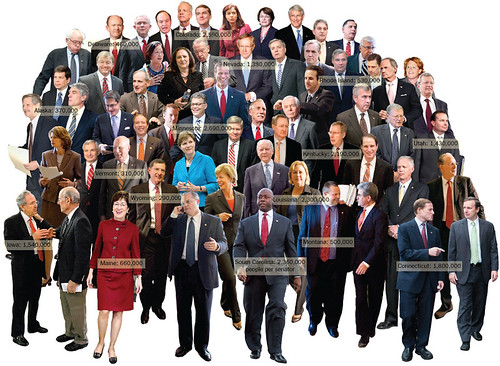
According to the New York Times, in an article from 2013, at that point in time, 62 Senators represented but 25% of the US population.

Granted, not all are "conservative," but a fair number are in ways that are deleterious to American democracy, especially in how the Senate over-focuses on small state interests, and under Senate Majority Leader Mitch McConnell, actively aims to damage large state interests, packs the federal courts including the Supreme Court with highly ideologically conservative judges, etc.

62 Senators represent 25% of the US population

Small states benefit disproportionately from federal spending

The point emphasized by LWV volunteer Lesley Tharp is that by adding two Senators from DC, likely always to be Democrats, we will start to right this basic injustice and structural failure in how the Senate is structured.

I think that's a worthy argument.

The small states won't like it.

Definitely Republicans won't like it.

But it's an argument that isn't for the throughput public--DC residents--it's an argument that should resonate with the "output public."

It's for something that will benefit all of us as citizens in what is supposed to be a fair democracy.

And people against this argument will have to acknowledge that they are advocating for an unfair and unjust political system.

Sure, lots of conservatives argue against participatory democracy because the "US is a representative democracy."

But if the structure of representation is biased and flawed, then for the representative democracy to be fair and just and legitimate, structural failures must be addressed.

Statehood for DC, which would add two voting Senators, along with a voting Congressperson, is an important forward step in that direction.

Branding.  A key need then is a great tagline/message.  I have the gist, but it needs (a lot of) work:

Statehood for DC
=
Improving and Refining American Democracy

Labels: , , , , ,

Thursday, June 27, 2019

Two ways to f*** American democracy courtesy of the US Supreme Court

1. Give fettered power to wealthy and/or corporate interests to provide unlimited funding to political campaigns with almost zero oversight and disclosure requirements.

-- Citizens United vs. the Federal Election Commission

2. Decide that creating unfair and undemocratic geographical representation systems in the House of Representatives is not Unconstitutional.

-- "Supreme Court Says Constitution Does Not Bar Partisan Gerrymandering," New York Times

From the article:
The drafters of the Constitution, Chief Justice John G. Roberts Jr. wrote for the majority, understood that politics would play a role in drawing election districts when they gave the task to state legislatures. Judges, the chief justice said, are not entitled to second-guess lawmakers’ judgments.

“We conclude that partisan gerrymandering claims present political questions beyond the reach of the federal courts,” the chief justice wrote.
Without fairness as a fundamental element of government and the electoral process, you don't have democracy.

And there is no excuse that the US isn't a "direct democracy," that it is "a republic," with "representative democracy." If your representatives are chosen in an unfair manner, there is no trust, and little necessity in protecting the rights of all, including minority interests.

For example,

It's not like you have to watch the "Poldark" television program on PBS, where in the late 1700s, the wealthy could buy lands that automatically conferred a seat in Parliament, to know that such a system is undemocratic.

And of course it's obvious this is a partisan decision, with the conservative justices manipulated onto the Supreme Court by McConnell et al key to the decision.

I think this might be the most disheartening news I have ever heard of as a citizen of the United States.

It's the only reason I'd use an expletive in the title of an entry.

And it does reinforce the point that Professor G. William Domhoff and others make, that fundamentally, US political power is controlled by capital.

-- Who Rules America? website, G. William Domhoff, University of California, Santa Cruz
-- "Testing Theories of American Politics: Elites, Interest Groups, and Average Citizens," Gillens & Page, Perspectives in Politics, 2014
-- "Election shows how gerrymandering is difficult to overcome," Associated Press

Labels: , , ,

Sunday, February 24, 2019

Politico Magazine profile of DC AG Karl Racine | + some miscellaneous legal matters

Written by local journalist Harry Jaffe, co-author of Dream City: Race, Power, and the Decline of Washington, D.C., an important work on DC during the first Barry Administration and a great unintentional discussion of Growth Machine politics, charlie calls our attention to this profile of DC's AG, "Meet the Man Curbing Trump’s Power Without Anyone Noticing."

Karl Racine at a press conference on the Emoluments Clause case.  Photo: Getty Images.

Obviously, I know about the emoluments case, where the DC AG is one of the lead plaintiffs in a case against President Trump concerning (in)direct payments from foreign governments via his property interests, something that is forbidden in the Constitution.

But the article also covers a bunch of items that I didn't know about, including how he has spurred the revitalization of the Democratic Attorneys General Association and the "nationalization" of electing Democratic AGs at the state level, something that the Republican Attorneys General Association had been doing for some time.

From the article:
But while the public has been mesmerized by Trump’s legal troubles, Racine has been quietly building out Democrats’ ability to check his administration at the state level. Without much notice, he’s quietly emerged as perhaps the single most important player in restoring Democratic clout in America’s legal system.

As D.C. attorney general, Racine is leading the ongoing emoluments suit against the president over foreign governments’ allegedly corrupt patronage of the Trump International Hotel in downtown Washington, along with Maryland AG Brian Frosh. As co-chair of DAGA, he has helped coordinate the legal and political strategies behind the lawsuits suing the Trump administration over issues including the separation of children and parents at the Mexican border, upholding the Affordable Care Act and protecting DACA recipients. And more substantial yet, Racine was the architect of one of the least-discussed but most far-reaching results of November’s elections: Democrats winning a majority of the nation’s attorney general positions—an electoral success with far-reaching implications for workers’ rights, immigration, civil rights, consumer protections and the ability to erect a judicial wall against the Trump administration.

And concerning locally-focused agenda items:
n the meantime, he’s managing 300 attorneys as the D.C. AG, focusing on work that is less publicized and more tangible in the lives of Washingtonians. His lawyers have forced landlords to repair substandard buildings, moved 1,723 children out of foster care, and gotten more than $10 million in relief to D.C. consumers. He’s also joined the leadership of the bipartisan National Association of Attorneys General, in line to be president in two years.

Racine says his heart is in reforming juvenile justice and creating pathways to keep kids out of the criminal justice system.
====
Building capacity and justification for local takeover of criminal prosecution?  My thing about the DC AG is the desire for the office to build the capacity to eventually be able to take over local criminal prosecution, which because of DC's status as a federal district, is the only place in the US where the Department of Justice handles this function, whereas in states, it's under the control of the state and localities.  In terms of prosecution, the DC AG handles cases involving children and youth.

-- "DC Attorney General election,"2014
-- "Another wrong judgement by the Washington Post: an elected Attorney General is a good idea and should be supported," 2010
-- "Another reason to support an elected Attorney General in DC," 2009
-- "More democracy as a solution for the need for an independent Attorney General," 2007

Reshaping local criminal prosecution Post-Ferguson and #BlackLivesMatter.  In the post-Ferguson environment there's been a backlash against the carceral state and the criminalization of poverty.  In some jurisdictions, such as Cook County, Illinois ("Prosecutors should create innovation offices to improve justice and public safety," ABA Journal), Philadelphia ("Larry Krasner's Campaign to End Mass Incarceration," New Yorker), new prosecuting attorneys have moved their offices in a different direction.

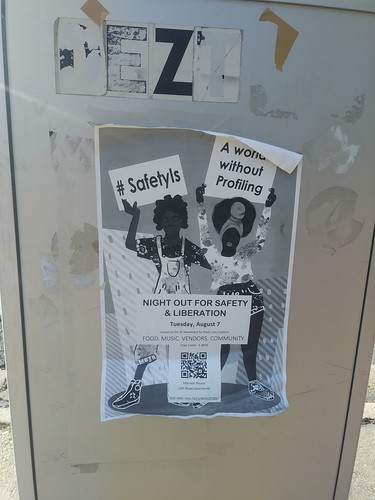
Flyer for "Night Out for Safety and Liberation"DC, #BlackLivesMatter, policing and prosecution.  In DC #BLM hasn't been particularly successful in pushing an anti-prosecution agenda although it's had some victories.

A couple weeks ago, DC announced it would be moving certain gun crimes to the Federal system, to get longer sentences ("U.S. to push D.C. gun cases into federal court as Washington struggles with a 40 percent murder spike," Washington Post).

While activists have complained about this recent move, I've always been struck by how prison sentences in bigger cities like Washington tend to be "more lenient" than those handed down in suburban jurisdictions.

For example, in a case where two DC residents robbed a store owner who had a store in DC but lived in Montgomery County, they committed the crime in MoCo which gave them multi-decade sentences, whereas for other violent crimes they had committed previously but in DC and Prince George's County they received shorter sentences ("2 sentenced to over 35 years in prison each for armed robbery, shooting at Montgomery County home," Fox 5 DC; "Two Men Sentenced for Silver Spring Robbery, Shooting," Bethesda Magazine).

National politics and the US Attorney General: shouldn't the US AG be popularly elected?  Plus, especially under the Trump Administration, because law "belongs to the people," I believe that the US Attorney General position should be popularly elected, with the DOJ as a separate Executive Branch agency.

Labels: , , , ,

Friday, July 20, 2018

The surveillance state in real-time: China and London

I do run stop signs and traffic lights on my bike, called the "Idaho Stop," when there isn't oncoming traffic.

Earlier in the week, the New York Times ran a story about the state of public surveillance technologies in China, "Looking through the eyes of China's surveillance state."

This photo shows an intersection with a digital screen displaying the names and identification numbers of people who were jaywalking.

Caption: A crosswalk in Xiangyang is monitored by cameras linked to facial recognition technology. An outdoor screen displays photos of jaywalkers alongside their names and national identification numbers. Credit: Gilles Sabrié for The New York Times.

This puts the capabilities of surveillance into perspective.

A couple years ago there was an interesting article in the New Yorker ("London's Super-Recognizer Police Force") about taking the utilization of CCTV feeds to a new level in terms of actively identifying and apprehending criminals, rather than merely rely on feeds for after-the-fact identification.

Such technologies and practices are likely to raise important and wrenching issues over privacy and civil rights.

Labels: , , ,

Sunday, May 20, 2018

Quote of the day: wanton death and political inaction | Houston Police Chief Art Acevedo

In the aftermath of the high school shooting in Santa Fe, Texas, which killed 10 and wounded 13, Houston police chief Art Acevedo wrote a Facebook post lamenting political inaction:
“This isn’t a time for prayers, and study and inaction, it’s a time for prayers, action and the asking of God’s forgiveness for our inaction — especially the elected officials that ran to the cameras today, acted in a solemn manner, called for prayers, and will once again do absolutely nothing,” Acevedo wrote Friday on Facebook.

Acevedo wrote that God “hasn’t instructed me to believe that gun-rights are bestowed by him,” and asked people not to write “anything about guns aren’t the problem and there’s little we can do.”
From the Austin American-Statesman article, "SANTA FE SHOOTING: Chief Acevedo says elected officials should ask God’s forgiveness for their inaction."

Labels: , , , ,

Wednesday, July 26, 2017

Ideally, the Federal Attorney General would be separately elected

Changing the structure of the national government is almost impossible given the current conditions, but even in the best of circumstances it's very difficult.

When it comes to "society," we need to distinguish between "the people"/society and "government."  Government is created "by the people" so that we can be organized at the local-regional-state-national scale. 

I argue that law, since it is the way that relations are constructed and mediated between people within society, belongs to the people more than to the "government" ("Executive Power vs. the will of the people and the DC Attorney General," 2015)

It's why I argued that the DC Attorney General should be popularly elected although I am somewhat disappointed by the results thus far.

Elected AGs disconnect "ownership" and more importantly control of the law from the Executive Branch. 

As we can see from the Trump Administration, first in picking such a conservative as Jeff Sessions for Attorney General ("Jeff Sessions Confirmed as Attorney General, Capping Bitter Battle." New York Times), and now Trump's desire for the Justice Department to back off investigating Russian involvement in the 2016 Elections and culpability within the Trump campaign ("(President Trump and Jeff Sessions no longer on speaking terms," AOL), there is value to having "critical distance" between "the Justice Department" and the rest of the government, and this is in keeping with the concept that law, as a basic organizing instrument of society, belongs to the people first, and to elected officials second.

In short, I argue that the Attorney General of the US should be popularly elected, separately from the President.  And the Department of Justice should be under the AG.

Some years ago I mentioned this once at an event held by Ralph Nader, and he understood the value of the suggestion, even if the main speaker did not.

=====
I don't think Jeff Sessions ("Hearing Highlights: Sessions Questioned on Links to Xenophobia," NYT) could have been elected as Attorney General, given the various positions he holds on:

-- civil rights protections
-- voting restrictions
-- asset forfeiture
-- lengthening sentences regardless of case circumstances
-- private operation of prisons
etc.

It would be great for these kinds of matters to be discussed in the context of a campaign every four years.

To help increase voter turnout, I'd have this office be elected in the off-year cycle for national elections, not during the Presidential election cycle.

Labels: , , , , ,

Wednesday, January 25, 2017

Tough public policy issue with mosques: Wahhabism

As someone who believes strongly in the US Bill of Rights and the First Amendment clause that "Congress shall make no law respecting an establishment of religion, or prohibiting the free exercise thereof," I don't believe that governments should get in the way of churches opening or operating as churches. That being said there can be plenty of urban policy issues that then become complex:

- building regulation including historic preservation requirements
- parking accommodations when church congregations become disconnected from the neighborhood in which the church is located
- acquisition of adjoining properties by churches and warehousing/mothballing  practices contributing to neglect/nuisance properties (Shiloh Baptist Church in DC)
- advocacy for voucher programs to fund attendance at church schools
- funding improvements and maintenance of buildings as congregation membership declines
- reuse of properties
- property tax exemptions
- religious symbols (creches etc.) placed in the public space

etc.

I do have a problem when religious organizations seek special treatment, claiming special treatment is in fact "normal treatment," such as through the federal Religious Land Use And Institutionalized Persons Act, which comes up a lot when it comes to land use and building regulation.

Many churches argue that because of the First Amendment, they should be exempt from all laws, or because of RLUIPA that somehow a building regulation is a stricture against practicing religion.  (At the national level this comes up with laws concerning the provision of health care services including abortion, or with pharmacists who refuse to dispense legal drugs associated with abortion, etc.)

In DC this has come up with historic preservation laws and the eventual decision to demolish a landmarked church building ("The Third Church of Christ, Scientist challenge to the DC historic preservation laws" and "The slippery slope of economic hardship arguments to obviate historic preservation protections") as well as with a conservative sect that doesn't believe in graven images, in this case "stained glass windows," and attempted to remove the windows from an existing church building they purchased which is located in the Capitol Hill Historic District (Hepworth Church Decision, Mayor's Agent, DC)

Some Councilmembers--I don't agree--have suggested passing a law giving churches an exemption from the historic preservation laws.

With regard to providing "support" to churches, in the UK, because of how the Anglican religion was the official religion of state, there still exist today on some properties a legal responsibility to fund repairs to church buildings.

Obviously we don't have such requirements in the US.  But there needs to be some mechanism to assist congregations that need help maintaining their properties, when such deterioration has a negative impact on the adjacent neighborhood.

-- Partners for Sacred Spaces is a "non-denominational nonprofit organization focused on caring for and making good use of older and historic religious properties"

And churches, focused on parking and other issues, can become vociferous opponents of neighborhood and urban change.  See the preamble discussion from this reprinted blog entry, "Churches, community, religion and change," on the biking/parking issue, and the rest of the entry for a more general discussion about the changing roles of urban churches.

Other jurisdictions have cases where new churches haven't been approved, denied water connections, etc. And some jurisdictions don't favor new churches because it takes property off the tax rolls, and localities are dependent on property tax revenue for the bulk of their budget.

Islamic facilities have come under increasing scrutiny since 9/11, with opposition in many places, with people fearing the religion's more recent association with terrorism amidst the unending escalating nightmare in the Middle East, sparked by the US invasion of Iraq in 2003.

Still, as religious institutions, they have the right to open, whether or not people practice other faiths.

2. Negative public policy ramifications from the Wahhabi brand of Islam.  But an article in the Washington Post ("A mosque is at the center of a raw debate in the South of France"), about opposition to the creation of a particular mosque in France, outside of Nice, where a brutal terrorist act last summer killed 86 people, raises an interesting point.

The opposition to this mosque comes about because of its association with the Wahhabi version of Islam, which treats non-adherents to that particular sect as apostates and enemies ("Wahhabism: Saudi Time Bomb?," PBS "Frontline").

There is a connection between Wahhabism and many of the people who have committed terrorist acts in Europe especially, but I think also in the US. And the Saudi Arabian government has actively supported the creation of Wahhabism-practicing mosques across Europe.

Leaders of Mosque En-Nour say they don't practice Wahhabism, but opposition centers around how the property was purchased by the Minister of Islamic Affairs of Saudi Arabia, and Saudi Arabia exports Wahhabism.

In the US, the First Amendment is absolute. A church regardless of its teachings can't be restricted. 

But you can see why promotion of the Wahhabi religion would be considered counter to public safety and governments are supposed to protect the safety of the public.

What should be the policy when  a particular religion espouses or supports violence against non-adherents?

Should such practice justify an exception to the First Amendment?

Labels: , , , , ,