Rebuilding Place in the Urban Space

"A community’s physical form, rather than its land uses, is its most intrinsic and enduring characteristic." [Katz, EPA] This blog focuses on place and placemaking and all that makes it work--historic preservation, urban design, transportation, asset-based community development, arts & cultural development, commercial district revitalization, tourism & destination development, and quality of life advocacy--along with doses of civic engagement and good governance watchdogging.

Saturday, July 04, 2026

Fourth of July | US 250th anniversary of the Declaration of Independence

There's far too much going on for me to be able to write something pithy and searing about the state of American Democracy, other than my contribution to a Utah commemoration of the anniversary last week at the opening of the Museum of Utah History.

Below, it's the last of the line of red bars.

There is an article in the Toronto Star, "How does former foreign affairs minister John Manley see America today?," interviewing John Manley, former minister, about Canada's relationship now with the US.  Which has deteriorated in so many ways ("Trump threatens not to renew USMCA as Carney talks trade strategy with premiers," "North American free trade is gone, dead and buried," Toronto Globe & Mail).

It's not very good.  

One example is Trump holding Canada hostage over the new Gordie Howe International Bridge.  Canada paid for it because the US wouldn't contribute and the Detroit-Windsor crossing is key to trade between the two countries, the auto industry, and Canada-Michigan, Canada being Michigan's largest trading power ("For people in Detroit and Windsor, Gordie Howe bridge delay fits a familiar – and frustrating – pattern," "Canada built the Gordie Howe bridge. Trump weaponized it," "Donald Trump can’t open the Strait of Hormuz, so instead he’s blocking the Strait of Detroit," Toronto Globe & Mail).  

The new bridge will correct transportational bottlenecks that result from the current set up.

The owner of the private Ambassador Bridge, which is the major above-ground link between the two nations, but the bridge dumps its traffic into a neighborhood not set up to facilitate very well the movement of the truck traffic towards the freeways, has made lots of donations to Trump ("Trump keeping Gordie Howe bridge closed to help donor, Michigan senate candidate claims in ad," AP).

The Gordie Howe International Bridge in Windsor on Thursday. Canada picked up the tab for the recently-completed bridge, but it still hasn’t opened because Trump doesn’t want it open, writes Tony Keller. Photo: Dax Melmer/The Globe and Mail

From the interview:

How truly democratic is the U.S. today?

We need to remember that every institution has some fragility to it. And that it requires all of us to remain vigilant. Democracy is not something to be taken for granted. It takes work. We have to inform people. We have to educate people. Literacy is a prime requirement in a democracy. We have to preserve the independence of voices that can be critical of what those in power are doing, holding them to account. I think (journalist) Anne Applebaum uses the analogy that we tend to think of democracy like we go to the tape in the kitchen and pour ourselves a glass of water. It’s way more complicated than that. It’s like when we had to go up the hill to the well and pump some water out in order to get a drink. That’s what democracy is. It requires work.

This is so true.  As despondent I am about the state of the nation today, especially how Republicans put party before country, how they have abdicated their responsibility as co-equal members of the Legislative Branch to be lapdogs of the President, how the rule of law is disregarded ("Electing a Federal Attorney General and a Chief Inspector General | Expanding Democracy") and how the conservative majority of the Supreme Court is overtly Republican in many of its rulings, we still have to try to work Democracy, to improve it, to push back against the transgressions.

=======

"American flags are everywhere this weekend. But the symbol has become politicized to a degree unseen before," Boston Globe.

Partisans at each end of the political spectrum use the flag to disparage the patriotism of the other side. Politicians on the right literally wrap themselves in the banner to proclaim their love of country. And protesters on the left wave the flag at mass demonstrations as a rallying cry to protect or expand American rights.

... For many at that time, the flag symbolized a transcendent sense of broad national purpose, even if large swaths of the population still struggled to claim their rights or bitterly criticized the government. This Fourth of July, even flying the flag at home can have political, demographic, and racial overtones.

About 70 percent of Republicans, and 60 percent of Americans ages 60 and older, fly the flag at least during national holidays, according to an April survey by The Associated Press and the National Opinion Research Center at the University of Chicago.

Conversely, about 60 percent of Democrats and independents said they never fly the flag, including about 75 percent of Democrats under 45, the survey showed. In addition, only about 30 percent of Black adults said they ever display the banner.

I'm more with Zohran Mamdani in his speech on Friday ("Zohran Mamdani rebukes Trumpism with pro-immigrant speech for US’s 250th birthday," Guardian). 

“Patriotism has never been about pretending our nation is without flaws,” the New York mayor said. “Patriotism is every act of righteous dissent. It is every march led under the heavy sun. It is every protest held a decade before its time. It is precisely because we love this nation that we will not leave it.”

Labels: , , , , , , , ,

Monday, January 15, 2024

Martin Luther King Day

One of these "months" I will probably finish and publish my entry on "national service" as a way to rebuild the foundations of democracy in the US.  I started before the 2020 election, but excepting Biden's win over Trump, the Republicans did very well, which means that there is little appetite for a communitarian (versus a libertarian) focus and working together and building the means for civic participation.

Martin Luther King Day is being positioned as a Day of Service, which I think is great, but in much of the country the weather isn't very supportive in the middle of January.  

The Embrace sculpture depicts MLK and his wife, hugging.

The Embrace organization associated with the Boston sculpture (which I think is somewhat hideous but seems to be popular) is broadening its mission ("Embrace Boston announces next chapter in its existence," NBC Boston).  From the article:

Launched in 2017 as King Boston, Embrace Boston has also hosted annual conferences and galas, studied inequality in the city and advocated for causes. It was initially under the umbrella of The Boston Foundation, and organizers said Friday that the institutions will continue to be close partners after 

Embrace Boston takes over fundraising and other responsibilities and moves to its own offices. Embrace Boston's mission is to build a radically more equitable city by dismantling structural racism through the arts, culture, community, research and policy. The nonprofit plans to build a National Embrace Center in Roxbury meant to serve as a cultural hub for the Black community.

Twitter photo of a snow engorged football stadium in Buffalo, New York.

Bloomberg reports that volunteerism is down, "Americans Are Volunteering Less Than Ever," but interestingly Buffalo Bills fans are willing to help shovel out Highmark football stadium for tomorrow's playoff game ("Bills ask for help shoveling snow, and their fans are digging it," Washington Post).

From the article:

The Buffalo Bills’ playoff game against the Pittsburgh Steelers will kick off at 4:30 p.m. Eastern time on Monday. But first, the Bills put out a call for snow shovelers after Highmark Stadium in Orchard Park, N.Y., was buried by three feet of lake-effect snow over the weekend, causing the NFL to push the game back one day, from Sunday to Monday. 

Anyone who answered the call got $20 an hour and meals. Helpers were asked to bring their own shovels, though shovels were provided if needed. And though it is taking a herculean effort to clear the stadium of all that snow, a good time has been had by all, it seems.

In terms of "service" and "national service" I think it's a matter of exercise "the muscle" of participation, of creating and supporting opportunities for doing things together, coming together.  Reading an article about the Detroit International Wildlife Refuge ("Q&A: Manager of Detroit River refuge on downriver's 'awesome' wildlife viewing," Detroit News), it mentioned how the Preserve is developing a community engagement plan.  They were kind enough to send the draft to me, although it's in my slush pile to read still.

Having such plans for civic assets that are especially citizen facing: schools; libraries; community centers; recreation centers; parks; is really important if you want to stoke engagement and rebuild democracy.

Martin Luther King Day articles

-- "This MLK Day, I have to speak out on Gaza," Seattle Times
-- "Connecting Civil Rights to Economic Rights," American Prospect
-- "The Left Behind:  The cultural rifts between urban and rural America are a constant of our history. When they also become economic, they become dangerous," American Prospect
-- "Biloxi's Fight to Celebrate Martin Luther King, Bloomberg
-- "The Other Side of MLK Boulevard," Bloomberg
-- "Martin Luther King Jr. Wasn't a Lone Messiah," New York Times

Labels: , ,

Tuesday, July 04, 2023

Independence Day and Civic Engagement when Democracy is in crisis

I don't have the energy to write about this in depth.  SCOTUS ("The Supreme Court Has Kicked the Door Wide Open to Jim Crow–Style Bigotry," The Nation), voter suppression, gerrymandering, authoritarian tendencies in the Republican Party, Trump and insurrection, State Legislature preemption of the ability of local government to act ("States Are Silencing the Will of Millions of Voters," New York Times), etc.

Signing of the Declaration of Independence

Yes, to have democracy you need to practice it.  And I believe our civic institutions need to seize on every opportunity to promote substantive civic engagement.  Which isn't easy, is time consuming, is subject to blowback (e.g., the conservative push against school boards) etc.

Margaret Sullivan's column in the Guardian, "On the Fourth of July, a few reasons to feel encouraged about US democracy," quotes a law professor, Asha Rangappa from Yale:

"Get engaged locally,” urged Yale University’s Asha Rangappa told me recently when I interviewed the former FBI agent for my podcast, American Crisis: Can Journalism Save Democracy? That could mean runing for office, signing up to be a poll worker, volunteering at school, participating in the arts. 

Rangappa wants more Americans to “cultivate the habits of democracy”. Those habits are developed when people leave their social-media echo chambers, get out into their communities, and simply talk to each other.

Yep.

Labels: , , , ,

Monday, April 18, 2022

Building civic engagement systematically: Seattle's Department of Neighborhoods

The Seattle Times has an editorial, "Give a shout out to Seattle’s outstanding neighbors," about the call by the Seattle Department of Neighborhoods for this year's nominations for "outstanding neighbors" which includes both individuals and organizations making exemplary contributions to the quality of life in the city's neighborhoods and communities.  From the article:
Developing a city’s physical infrastructure is a pretty straightforward process. Building a sense of community and shared purpose can be a messier affair. 

But social cohesion can be just as important to a city’s livability as are roads and bridges. That’s why the Seattle Department of Neighborhoods’ annual recognition of outstanding neighbors is so important. It offers ideas and inspiration from the everyday people, businesses and organizations who go out of their way to lift up their neighbors. It’s as close to a blueprint for neighborhood vitality as there is. 

The Department of Neighborhoods helps neighbors connect with each other and city government to develop a stronger sense of place, build neighborhood ties and promote community engagement. It has been celebrating Neighbor Day since Phinney Ridge activist Judith Wood first suggested that the city designate a day to celebrate neighborly bonds back in 1995.

-- Neighbor Day Nominations, Seattle Department of Neighborhoods 

I've written a lot about this agency over the life of the blog, including mentions of the book, Neighbor Power, written by the department's first director, Jim Diers.

What distinguishes the Seattle approach for me is that it is more DIY and oriented to "capacity building" for individuals and organizations in that they can act on their own, albeit within the framework of city programs, grant opportunities, etc.

But they can act on their own, without needing to intercede with the Mayor or Councilmembers.  

By contrast, I think of "neighborhood engagement" programs in most city governments, both for the Executive and Legislative branches, as focused on "incumbency development"--or the reelection of the Mayor or Councilmember--and not on the capacity of citizens and community organizations to act independently.


Similarly, there are two negatives from DC's "community council" system, called Advisory Neighborhood Commissions.  First, by having government-sanctioned councils at the grassroots level, in one sense it creates the belief that "government" is responsible for solving every problem, negating the value of self-help.  Second, ANCs can "cream" off able citizens, who devote their attentions to ANCs, rather than to self-help efforts and/or actions and organizing through independent community organization.

Which is why I argue for capacity building support organizations like Seattle's Department of Neighborhoods and others in Calgary, Minneapolis, San Diego, Massachusetts, Atlanta, etc. ("Framingham Massachusetts creates Citizen Participation Officer position," 2018) .

In this time of national fracturing ("WHY THE PAST 10 YEARS OF AMERICAN LIFE HAVE BEEN UNIQUELY STUPID," The Atlantic--although I think the article has problems), we need to be very much focused on building systems for positive and successful civic engagement.

Leading by Stepping Back: A Guide For City Officials on Building Neighborhood Capacity

The idea would be to engage citizens in the process as much as they would like to be, in planning, oversight, creation of programs in their neighborhoods, etc.

Models would be:

This is especially important because of how political systems now are promoting chaos ("Misinformation on Facebook got six times more clicks than factual news during the 2020 election, study says," Washington Post) and disconnection ("In The Land Of Self Defeat," New York Times), rather than connection.

Note that I have an extended discussion of better integrating citizen/civic engagement into community building and urban and neighborhood revitalization in "St. Louis: what would I recommend for a comprehensive revitalization program? | Part 1: Overview and Theoretical Foundations"."

Republicans in particular are anti-government in general.  Government ultimately is derived from "We, the People."  And i call this anti-government, anti-community attitude "anarcholibertarianism."

The shared experience of doing things together to rebuild, strengthen, and extend community is the only way we can "walk back" from the abyss of disconnection, maybe.

Labels: , , ,

Thursday, January 06, 2022

Anniversary of the insurrection

Sometimes, I've written a series of posts on New Year's Day on particularly important issues. 

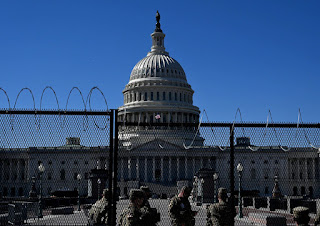
National Guard troops remain in front of the U.S. Capitol, which is surrounded by fencing topped with razor wire, on March 3, 2021. (Katherine Frey/The Washington Post)

This year I didn't have the motivation due to the "Big Lie," the state of democracy generally and Republican authoritarianism ("Republicans closely resemble autocratic parties in Hungary and Turkey – study," Guardian--this article predates the 2020 election and it has only gotten worse), Republican voter suppression legislation in many states, the deposing of objective election officials, Republican success in 2021 elections in Virginia, New Jersey, and Metropolitan New York City, willful refusal to get vaccinated by 30% of the US population, and of course, the 1/6/2021 Insurrection, of which today is the anniversary.

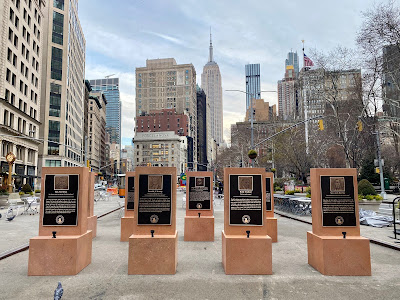
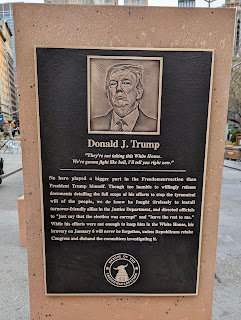
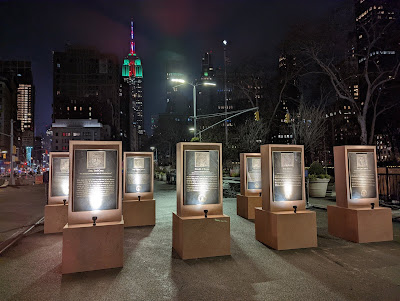
The art installation by "The Daily Show" makes me feel a little better ("'Daily Show' installs 'Heroes of the Freedomsurrection' Jan. 6 monument," The Hill) as does some of the insurrectionists getting prison terms of as much as 5 years.

The installation is up today only, til 11pm EST at 23rd Street and Broadway Avenue in Manhattan.


2. I looked up a source article because it was mentioned in a different story in my newsfeed, about a Teen Vogue article on teens with parents who participated in the Insurrection.  While that articles wasn't particularly scintillating, while looking for it, I came across a different one, "Teen Vogue's Top Features of 2021," listing what they thought were their best articles from last year.

One of those articles, ""Conspirituality" Boomed During the Pandemic, And It Could Have Consequences for the Vaccine Effort," on "conspirituality as linking wellness, conspiracies including QAnon, and anti-vaccination positions is really great, with lots of good links to other articles within it.  

Who would have thought Teen Vogue could be so good?

Labels: ,

Monday, April 05, 2021

Study: Republican control of state government is bad for democracy

Vox reports on a study by a political science professor at the University of Washington, with the findings that state governments run by Republicans restrict democracy and are less well run compared to states run by Democrats.

-- "Laboratories of Democratic Backsliding," Jacob Grumbach, Department of Political Science, University of Washington

That doesn't surprise me.  Minoritarian government benefits from voter suppression and other manipulation, and a party that in general denigrates government ends up performing badly when in power, "proving" that government failures.

Examples include:

Professor Grumbach's extends the work by the Vdem Institute, which looks at how parties function at the national level, to the sub-nation level within the US.  (The Vdem study finds that the US Republican Party is amongst the most authoritarian in the West, "Republicans closely resemble autocratic parties in Hungary and Turkey – study," Guardian.)

From Vox:

The paper, by University of Washington professor Jake Grumbach, constructs a quantitative measure of democratic health at the state level in the US. He looked at all 50 states between 2000 and 2018 to figure out why some states got more democratic over this period and others less. The conclusions were clear: The GOP is the problem. ... 

Grumbach’s State Democracy Index (SDI) is the first attempt to use a V-Dem-style approach to measure the more subtle ailments afflicting democracy in the United States. Metrics include the extent to which a state is gerrymandered at the federal level, whether it permits same-day voter registration, and whether felons are permitted to vote. He also includes criminal justice indicators, like a state’s Black incarceration rate, that are designed to measure state coercion. 

I would add pre-emption as a factor in the index, definitely.

Labels: , ,

Sunday, August 04, 2019

Repositioning the DC Statehood argument as a way to address structural imbalances in American democracy

One of the most important concepts I ever picked up came from the book Strategic Marketing for Not For Profit Organizations by Armand Lauffer, a social work professor at the University of Michigan.

One of the points made is that organizations have three publics: the input public which provides the resources the fuel what the organization does; the throughput public that does the work, usually staff and volunteers, led by management; and the output public to whom the organization's efforts are directed.

At the time I read this, like many people in Ann Arbor with progressive tendencies, I did door knocking for the Dean Baker for Congress campaign (he has been the co-director of the Center for Economic and Policy Research for decades).  The district spanned from Detroit's western suburbs to Ann Arbor and its environs, and the seat was held by a Republican.

The big issue "for us" was US involvement in El Salvador, something which didn't resonate much in places like Plymouth.

I realized that most of the campaign messages (other than saving Social Security from the predations of Republicans) were for the "throughput public," the campaign workers.  We were the ones that cared about El Salvador, US foreign policy, etc., but those weren't the primary concerns of the voters we were trying to reach.

Statehood for DC yard sign at Civic Fest, Meridian Hill ParkThe DC Statehood effort suffers from the same problem.  It mostly uses the argument that it's unfair and undemocratic for US citizens in the continental United States to not have voting representatives.

This is mostly an argument that satisfies the throughput public, which in this case are the citizen residents of the District of Columbia.

While that is definitely the case, according to a recent national opinion survey by the Gallup Poll, most people in the rest of the United States don't care ("Most Americans say no statehood for the District of Columbia," Washington Post), sometimes making the argument that DC as the national capital "belongs to everybody" and avoid the issue of the lack of voting representation in the House and Senate.

Yes, it's "taxation without representation" which vis a vis the Colonies relationship to Britain, led to the American Revolution.  Yes, DC has more residents than many states.  Yes, DC residents probably pay more federal taxes than received for local functions, although this number is warped by the spending on agencies based here, etc.

The question then is how to make the rest of the US care.

At Civic Fest yesterday, the League of Women Voters had a booth where one of the primary messages was supporting statehood, and they had people on the grounds talking to people aiming to get them to come out to the September 15th Congressional hearing that will cover the issue.

I can take or leave statehood.  It'd be better sure.  But the Republicans don't want two more Democratic Senators.  And so people counter about retrocession to Maryland, where the non-federal part of the city becomes part of Maryland.

But I'd rather have our neither here nor there status as a functioning city-state (like Hamburg or Berlin in Germany, or  Mexico City) where we control our tax revenues completely (excepting federal strictures against a commuter tax), without out-state Maryland legislators "taking our money" and voting down our interests.  (E.g., a planning colleague in Montgomery County says that "MoCo functions as the ATM for the rest of Maryland.")

And I made my opinions known to the LWV volunteers, but we had good discussions, and it made me understand that the DC Statehood argument needs to be repositioned to how DC Statehood benefits the rest of the U.S. and strengthens democracy and political institutions, rather than focus on the benefits to DC residents.

You don't need statehood for DC to be better governed.  For years, I've made the point that for territories to become states, they had to meet certain conditions, and that DC should aim to be "the city on the hill" to prove that "we deserve" statehood.  Many residents counter with the "we deserve our rights" argument, that we shouldn't have to prove anything.

I think the city could be governed so much better.  But one of counter-points made yesterday was that while I have high expectations for what DC ought to be doing, is DC functioning as a polity worse than the nation's states.  To be fair, the answer is no.  Most of them aren't striving to be great either.  And many, by being so ideologically driven on taxes and abortion, are worse.

LWV volunteers then countered with their support of a public campaign financing act that will help to counter "pay to play" funding of candidates.  But frankly, I don't think that will make much difference.  Sure some representatives might be different, but at least the way it's turning out with the coming election in Ward 2, public financing seems to put a lot more money into ward-based campaigns than I ever expected ("Challengers to Jack Evans flex financial muscle under new D.C. public finance law," Washington Post).

More importantly, it's who gets elected and what they do in office, and DC's more grassroots politicians tend to revert to the Growth Machine mean over time.

For ideas on how to improve local governance see:

-- "Revisiting DC's corruption caucus," 2019 (which reprints and updates my broad recommendations for various structural changes, including more wards and two representatives per ward)
-- "Outline for a proposed Ward-focused (DC) Councilmember campaign platform and agenda," 2015
-- "Missing the point on constituent service/discretionary funds available from legislators," 2011 (participatory budgeting)

Still, I think that the LWV successfully countered my point that DC isn't governed so great by pointing out that governance-wise, we are equal to our desired peers.

Helping to alter the rural and small state preference-imbalance in the Senate's political representation by adding two Senators ought to be the primary argument.  Since the 2016 Presidential Election where Donald Trump was elected President despite losing the popular vote, besides the imbalance in the Electoral College--because all states have two Senators regardless of population, the same kind of imbalance is present in the Senate, where small states as a group have disproportionate representation:

-- "Senate Power Imbalance Tilts Toward Least-Populous States," Bloomberg Businessweek
-- "By 2040, two-thirds of Americans will be represented by 30 percent of the Senate," Washington Post
-- "The Senate represents states, not people. That's the problem," Vox
-- "The Small State Advantage in the United States Senate," New York Times

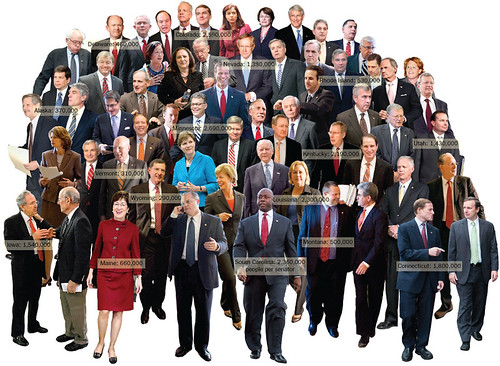
According to the New York Times, in an article from 2013, at that point in time, 62 Senators represented but 25% of the US population.

Granted, not all are "conservative," but a fair number are in ways that are deleterious to American democracy, especially in how the Senate over-focuses on small state interests, and under Senate Majority Leader Mitch McConnell, actively aims to damage large state interests, packs the federal courts including the Supreme Court with highly ideologically conservative judges, etc.

62 Senators represent 25% of the US population

Small states benefit disproportionately from federal spending

The point emphasized by LWV volunteer Lesley Tharp is that by adding two Senators from DC, likely always to be Democrats, we will start to right this basic injustice and structural failure in how the Senate is structured.

I think that's a worthy argument.

The small states won't like it.

Definitely Republicans won't like it.

But it's an argument that isn't for the throughput public--DC residents--it's an argument that should resonate with the "output public."

It's for something that will benefit all of us as citizens in what is supposed to be a fair democracy.

And people against this argument will have to acknowledge that they are advocating for an unfair and unjust political system.

Sure, lots of conservatives argue against participatory democracy because the "US is a representative democracy."

But if the structure of representation is biased and flawed, then for the representative democracy to be fair and just and legitimate, structural failures must be addressed.

Statehood for DC, which would add two voting Senators, along with a voting Congressperson, is an important forward step in that direction.

Branding.  A key need then is a great tagline/message.  I have the gist, but it needs (a lot of) work:

Statehood for DC
=
Improving and Refining American Democracy

Labels: , , , , ,

Saturday, July 04, 2015

The Fourth of July and Social Democracy


There is a nice piece by Professor Harvey J. Kaye of the University of Wisconsin-Green Bay on social democracy, "Social Democracy Is 100% American" on the Bill Moyers website.

It's spurred by a discussion of Bernie Sanders, the social democrat Senator from Vermont who is running for President.

It's worth considering those arguments while we honor the anniversary of the Declaration of Independence and the founding of the United States of America.


Flag, 1954-55 by Jasper Johns.

The Pacific NW Magazine of the Seattle Times has a cover story about protest and the American flag.

-- "Our flag, used as a symbol of pride and protest, tells a lot about who we are"

Labels: , , ,

Wednesday, April 25, 2012

"Nimbyism," urban design, advocacy, and the rule of law in zoning

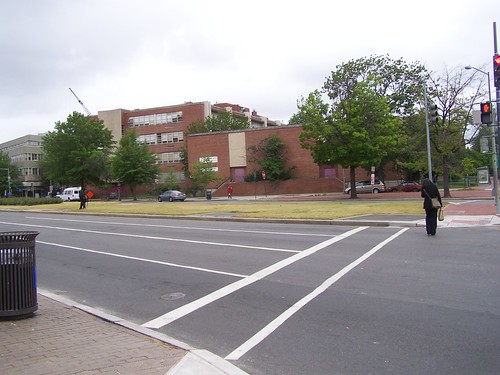
Hine school site, Capitol Hill, DC
Hine school site, Capitol Hill, Washington, DC.

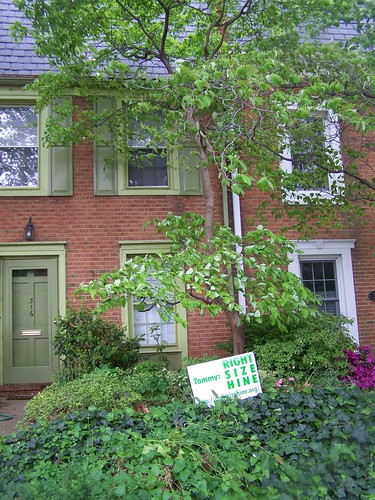
There is a yard sign campaign in the neighborhood around 8th Street and Pennsylvania Avenue SE focused on getting the Ward 6 Councilmember, Tommy Wells, to use his "influence" to get the Zoning Commission to "rightsize" or make a little bit smaller, the new development coming to the Hine School site there.

-- Rightsize Hine website

The campaign raises some tough issues.  Just like how I argued the other day that we need to have more micro-level neighborhood-weighted policies rather than citywide policies as they relate to the sales of alcoholic beverages for later hours or on Sundays--I am not against either, but would argue that not every piece of property zoned commercial is necessarily appropriate for such changes based on the state of the neighborhood--the same goes with building height.
Right size Hine yard sign, 300 block, 8th St. SE
And there is the overarching issue of balancing the needs of the property owner (although some people could argue that the property owner is the city, not the developer, but the city has needs too), versus the interests of impacted property owners versus the interests of other stakeholders, such as property owners in the commercial district, leveraging the investment in the subway system, etc.

Years ago (2003) I wrote a testimony to the DC Dept. of Housing and Community Development which included an extended discussion from the standpoint of urban design of how key intersections--I was referring to 8th and H Street NE specifically, where the Department was funding a one story building--were the right places in commercial districts to have taller buildings, and that city policy should be focused on putting the right sized buildings in the right places.

8th Street and Pennsylvania Avenue SE is such a place because it is a transit crossroads--two of the city's busiest buslines cross here, plus there is blue and orange line subway service at Eastern Market Metro, plus there is the 8th Street SE commercial district, and Eastern Market on 7th Street, along with some retail along the 600 block of Pennsylvania Ave. -- which doesn't work as well because in the L'Enfant design the 600 block in the eastern quadrants is a double-length block, which impinges on the experiential qualities of walkability, although it hasn't been helped by the faulty urban design within newer buildings developed over the past 20+ years.

The arguments on the Rightsize Hine website don't address the urban design and other aspects of the project as much as they make an argument that the size of the development is "too big for a historic district."

I don't think that's an argument.  There are plenty of buildings in historic districts built in part out of old factories, and those sites are considerably larger than the Hine site.  And technically, the redevelopment of the old streetcar barn on the 1400 block of East Capitol Street NE--although technically that site is just a few feet outside of the boundaries of the Capitol Hill historic district--is comparably sized.

So I find the pseudo-argument troubling, but I also find troubling that they are pressuring the Councilmember to extranormally influence the zoning approval process, which is a legal process with rules and processes (and the ability to appeal).

Many cities and counties have land development processes which allow for extraordinary participation by elected officials, and not infrequently, it leads to corruption, such as recent events in Prince George's County, how "Aldermanic privilege" in Chicago means that each Alderman is extraordinarily involved in projects in his/her ward, and that many of the resulting projects "suck" as a result, or the process that Prince George's County is going through to get a casino to National Harbor, which involves the extraordinary interest of the President of the Maryland State Senate.

Extraordinary involvement can be good or bad, but in development matters, it tends to be more likely to be "bad."  And it sets up the stage for unrealizable and mismatched expectations, because a Councilmember isn't supposed to have the authority-suasion power to be "above the law" and in a democracy, it's troubling that citizens are advocating for such.

Labels: , , , , , , , ,

Sunday, February 05, 2012

Civil society, civic engagement, and public life (a continuing discussion)

Dan Reed has a piece in Greater Greater Washington, "Do-it-yourself culture makes our community stronger," about what young people like him call "DIY Culture" but I refer to as "self-help," which is a frequent theme in the blog, about community organizing, neighborhood action, capacity building institutions to strengthen civil society, etc.

So the previous entry on the Super Bowl and the Baltimore Grand Prix quotes from a Baltimore Sun op-ed about how secrecy and an unwillingness to be public may well have doomed the Grand Prix and certainly contributed to the $12 million of losses on the event last fall.

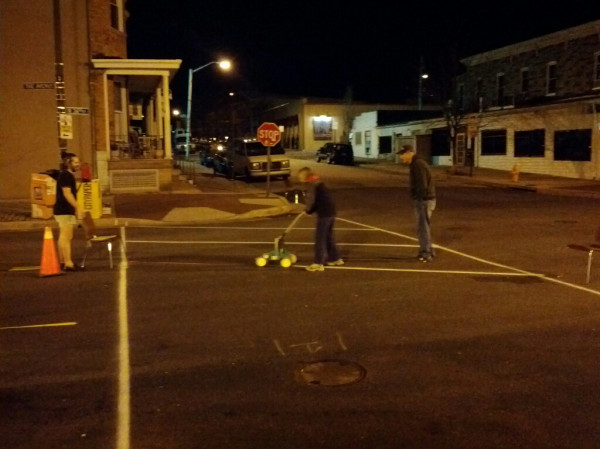
Speaking of "self-help" culture in Baltimore, a group created some guerrilla crosswalks in Hampden, out of the belief that finally, they had waited too long.
Guerrilla crosswalk installation, Hampden, Baltimore
Guerrilla crosswalk installation, Hampden, Baltimore. Photo: Jed Weeks.

Building civic capacity
Friday I met with DC City Council candidate and we were talking about how the city's political and governance culture needs a reboot and a fundamental commitment to small "d" democracy and civic participation, and the weak civic culture and lack of vision generally.

I talked with him about this, and the absolute necessity of capacity building institutions for community organizations, Advisory Neighborhood Commissions, I mentioned "participatory budgeting" while he mentioned the equivalent of "donor advised funds" and the community foundation model as a way to provide grants to nonprofit organizations instead of the somewhat corrupt way that DC does it now, etc.

But I said, what if we did create those kinds of supporting organizations and civic infrastructure and what if the way things happen now continue to happen and he replied that it wouldn't happen, when you build people's capacity and control over their lives, over their participation in local civic affairs, in how civic affairs are conducted and how civil society works, it will function better.

Baltimore City Trails Summit
And that reminded me that last weekend I went to the Baltimore City Trails Summit and there were probably about 80 people there ("Baltimore City bikers look for more recreation, commuting options" from the Baltimore Sun). It was heartening to hear the commitment from the City Parks Commissioner and other city officials, but it was also extremely exciting to learn about the various citizen-initiated projects to bring trails to various places around the city.

Compared to going to meetings about such topics in the DC area, it was "mind-shattering" to see "old people" (people in the 60s and 70s) as key advocates for bringing trails to their neighborhoods, because they see the value in having places to walk and bike (and skateboard and walk your dog and push the baby carriage and rollerblade) that are free of cars.

And how the city and nonprofits use National Trails Day, June 2nd, as a way to organize local events across the city to promote parks and trails in Baltimore.
National Trails Day in Baltimore volunteer form
It's a completely different attitude compared to DC proper, about how to organize, how to leverage resources, how to engage citizens and produce change. "The DC Way" (as opposed to "The Arlington Way") is very much a top-down driven process.

Metropolitan Branch Trail
Speaking of which in terms of local trails and bikeways in the DC region, Montgomery County has decided to delay by 6 years their investments in making key connections for the Metropolitan Branch Trail in the Silver Spring area--the trail when complete and with a connection to the Capital Crescent Trail in Silver Spring makes a kind of horseshoe trail network serving east and west Washington DC from Bethesda and Silver Spring and points in between.

From the Washington Area Bicycle Association:

As our members and supporters know, WABA has worked for decades to help bring about a high-quality trail connection between Silver Spring and downtown DC. The Metropolitan Branch Trail (MBT) can provide this connection, but its progress is threatened.

This year, the budget proposed by the Montgomery County Executive cuts design and construction funding for the county’s portion of the MBT for the next six years. We need the County Council to ensure that these years of effort are not wasted and that the County’s commitments to prioritize the completion of the trail are kept.

Priorities are determined not in empty words, but in budgetary commitments. In this budget the promises to build this trail are broken.

Your opportunity to tell the County Council to return the MBT to the county’s budget is this Tuesday, February 7th at 7pm. Please come and show your support for the trail.

If you are unable to attend in person, CLICK HERE to email the County Council to state your support for the trail and to request that funding be restored.

I can't help but believe that if we had a more engaged citizenry, not unlike the people at the Baltimore City Trails Summit, that it wouldn't be taking more than 30 years--from concept in 1987 to finished trail in 2018--for the Metropolitan Branch Trail to become reality.

CicLAvia logo
CicLAvia/Feet in the Streets (Greater Los Angeles)

Speaking of the need for civic engagement driven strategies to drive Ciclovia/Sunday Streets type programs, where streets are closed as special events for placemaking, biking, walking, and other activities, the City of Pomona seems to have had almost as many people coming to an organizing meeting for creating a Ciclavia program there!, as DC gets to come out to the equivalent event at Fort Dupont in Southeast DC, far away from the city's centers. See "Pomona Hosts a Great CicLAvia Stakeholder Meeting" from the CicLAvia blog.

It's all about the process and commitment to civic engagement.
Pomona_Meeting, Ciclavia
Pomona meeting, CicLAvia.

People Power...

Labels: , , , , , , ,

Wednesday, September 21, 2011

Montreal's "Right of Initiative to Public Consultation"

In Montreal, citizens have the right to petition citywide and/or borough governments to take up an issue. The process requires that 15,000 people, aged 15 or older and resident in Montreal, over a three-month period, sign a petition calling for the creation and implementation of a public consultation process on a particular issue.


A petition is currently being circulated to address urban agriculture issues. See "Bumper crop ... in the city" from the Montreal Gazette. The article is a pretty good discussion of the issues concerning the state of urban agriculture in cities across North America.

Labels: , , , , ,

Friday, February 04, 2011

The highly paid DC City Council and governance and voting systems

Mike DeBonis of the Washington Post beat me to writing about this issue in "Is D.C. overgoverned? Or undergoverned?," which was touched off by a study, City Councils in Philadelphia and Other Major Cities, released by the Pew Charitable Trusts.

There is a lot of concern that in a more economically constrained society, city councils are too large, compared to the days when cities tended to have much greater population. Here and there, cities have reduced the size of their councils. Baltimore did this a few years ago. The lesson is that more councilmembers doesn't always equate to better government.

But the report raised attention in DC because of the fact that DC City Council Members are the second highest paid "local" municipal government legislators in the U.S. From the Post article:

By both measures, the D.C. Council does pretty darn well. Members' average salary of $130,538 is good enough for second place among the 15 big cities surveyed; only Los Angeles pays its members more, $178,000 on average. And the District far outstrips the competition on legislative spending - more than $32 per capita.

But are District residents getting the good government they're paying handsomely for?

Concern is hard to find in the John A. Wilson Building, where council members are quick to point out that the District isn't just another city like Pittsburgh or Phoenix; it assumes functions managed by states and counties in other places.


Yes DC Council Members have state and local legislative responsibilities, which means that the City Council is more than a strict local government body, so getting paid more isn't totally ridiculous. I think that it would have been better to compare DC legislative responsibilities and pay to County Councils in the Maryland and Virginia region. Arlington is much smaller than DC, but each of the other county jurisdictions is larger in terms of both population and size.

In the DC region, Prince George's County Council people make the most, about $96,000 and Montgomery County Council Members make around $94,000. I think they don't get very much support for staff, just a couple people. Part time members of the Arlington County Board make $49,000. Fairfax County Board of Supervisors representatives get $75,000. In each case, the Chairman gets more.

However, just because DC City Council has more expanded responsibilities and has more staff doesn't mean that they necessarily do a better job. I find DC Council's research capacity to be pretty narrow and limited, at least they aren't generating great research and reports about innovative municipal government and how to achieve it. We certainly aren't creating many best practice examples in municipal government nationally. I don't think DC is considered a particularly innovative municipal government.

But it is true that the Pew study, which compared only city governments, ends up being somewhat skewed in terms of the DC side of the study, because of the difference in responsibilities.

DeBonis' column opines about "overgovernment" and "undergovernment." With regard to the former, he makes a great point that didn't occur to me, that because the City Council is (so) small (although it scares me to think of it as getting bigger), it's a lot easier to pass legislation. That you only need 7 votes for a majority, for legislation to pass, while in a state legislature, you need not only for legislation to pass two houses, not one, you also need a lot more votes for legislation to pass in both houses. (Christopher and I discussed this in a comment thread about this op-ed from the New York Times, "Build a Bigger House.")

So DC passes far more legislation in an average year than a comparable state--and I am not always sure we are better off for it.

Interestingly, where I think there is a real dearth in the literature is a more detailed discussion of local government structures, not only for the legislature, but for more specifics about the different ways that local governments have supported citizen participation through bodies or other organizational forms, with either more or less ability to weigh in on issues before government, and with or without some financial heft.

NYC has Community Boards. DC has Advisory Neighborhood Commissions. After the San Fernando Valley secession movement in Los Angeles, they created Neighborhood Councils. Seattle has neighborhood commissions that are corporatist, with representatives from community organizations. Atlanta has Neighborhood Planning Units to address zoning issues, while Minneapolis' Neighborhood Revitalization Program creates a kind of neighborhood development organization structure, with money behind it, and a training infrastructure.

The City of Montreal is actually organized into boroughs or arrondisements in addition to the overall City Council. The Mayor of Ville de Marie is also the mayor of the City, but each borough has its own elected Mayor and Council, and there is a greater diversity of party control throughout the city. (The Plateau-Mont Royal is considered the most "left".) The City has overall responsibility for certain functions, and each borough has control of certain other municipal functions.

The Montreal system is discussed in two blog entries from Mez Dispenser, a Toronto blog, "Borough Councils: One way to give power back to neighbourhoods" and "Should Toronto fight for the right to party" about how the political party system works in Montreal, which currently has three major municipal parties

(Fundamentally DC only has one party, the Democrats, even though there are organized political parties called the Republican Party and the DC Statehood-Green Party, vying for seats in local elections. In the past, these parties have had a representative or two on City Council.)

Then there are capacity development programs such as neighborhood support programs--Seattle's is probably (at least it used to be) the least tainted by politics in that the programs aren't used primarily as a political machine to maintain the Mayor in office. There is the Massachusetts Citizens Planner Training program for planning and zoning commissioners. And Dallas has the Urban Information Library, a special collection of periodicals, books, reports and other resources for interested citizens concerned with local civic affairs.

I'd like to see a good report on this broader issue, not one strictly focused on City Councils, because the issues are broader than that. (DC has other problems with the Home Rule Charter, which is heavily weighted in favor of the Mayor.)

With regard to DC probably the Montreal way is not possible here, and while it scares me to suggest it, probably we ought to add at least one councilmember slot to each ward, so that there would be 16 Ward Councilmembers, two for each ward, each serving a 4 year term, elected on a staggered basis, so that each election, one ward councilmember would be up for election.

Probably 4 more at-large positions should be added as well, because the Council's ward heavy structure of representatives makes ward issues too prominent and parochial as it is, and adding another representative in each ward would further this sometimes sorry fact rather than improve it.

That would make for 24 Councilmembers + the Chair, up from 12 Councilmembers now. That would mean it would be harder to pass legislation, as you'd need at least 13 votes.

At the same time, the salaries should be lowered, maybe even cut in half, and probably the jobs should be made part-time in reality and by salary, with more a more defined (and reduced legislative schedule), and reduced staff.

By reducing the staff, this would reduce the meddling that can occur through constituent service. OTOH, constituent service by legislators is a form of the checks and balances that our governing system promotes, and it's a check against disconnected executive branch government.

So this proposal calls for more legislators but less time legislating. I am not sure what that would mean for office staff. I know that the state legislators in Maryland don't get much money for staff, and they are part time positions.

On the other hand, the one danger in this proposal is making the Council even more narrow minded because DC is so heavily Democratic, and there is something to be said for having more political competition within the local political structure, in order to liven things up and improve the capacity for improvement. Social Darwinism, or the extension of capitalist principles to civil society, argues that more competition makes for better results.

In Greater Greater Washington, Topher Matthews suggested in "DC primaries should be scrapped," that the primary election voting method should be converted to instant runoff voting, a form of proportional voting that allows for support of a greater variety of candidates and party labels.

Note that traveling on the day of the 2008 Presidential election, I discovered that Pierce County, Washington practices a form of proportional voting, called ranked choice voting. I thought that it was overturned afterwards, but I am not sure of the status, as it is still listed as the voting method on the County Elections website.
Ranked choice voting graphic, Pierce County Washington
Ranked choice voting graphic, Pierce County Washington. Printed with the permission of Fred Matamoros, Tacoma News-Tribune.

For local elections, not national elections, there is only one election, not a primary and a general election. What happens is that in the local election, all candidates are on the ballot, and people rank their choices, but they only rank their top three choices.
080925_ranked_choice_ballot, Pierce County Washington
In each round of voting calculation, the person with the fewest votes is eliminated, and their votes are redistributed to the second and third choice candidates still remaining. See "Voters changing their minds on ranked-choice" from the Tacoma News-Tribune. The story explains how the system works as does this webpage from the County Elections office:

-- Ranked Choice Voting in Pierce County
-- More info on Ranked Choice Voting in Pierce County

There's a lot to be said for simplifying the election process in DC, although it wouldn't really save costs, because DC still needs to have a general election every two years for the Congressional Delegate. If those terms were for four years, instead of two, we could save money in such a change. But probably the general election could be run with fewer polling stations, compared to the primary and local election, and this would save some money.

Labels: , , , , , ,

Thursday, January 13, 2011

Building security, the federal city, and disconnecting democracy

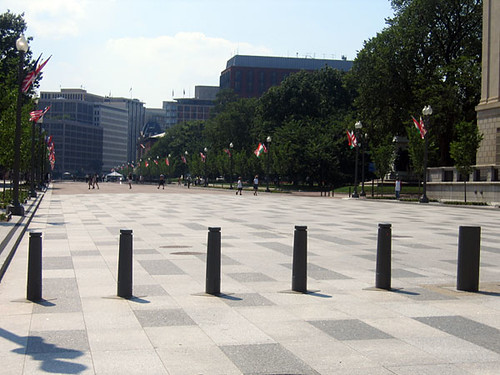
Bollards
Over the years I have written from time to time about federal and local government buildings and security procedures required for getting into those buildings, as well as the ever increasing restrictions on road access to certain areas such as in Capitol Hill (including proposals to shut down 2nd Street to extend the security perimeter for the U.S. Capitol and the Supreme Court) and the White House. (For at least 6 years now, during the State of the Union address, in the last few years, many of the access roads around the U.S. Capitol are blocked off by parking Metrobuses across the intersections, in advance of the speech.)

After Oklahoma City, I do understand and appreciate the likely need for a security perimeter for places like the White House, and I can accept the closing of Pennsylvania Avenue there as a result.

The struggle is how to maintain security for individuals versus places, and what kind of impact does that have on "democracy." If you talk to anyone who works for a Congressperson, if they deal with the phones and letters from constituents, it is not unusual for them to mention "the nuts" or zealots they have to deal with, the people who continually contact them about particular issues, threats, etc.

National Journal Online has a brief article on the subject, “Walled Off Washington: How free can a society be when its elected officials are kept further and further away from those they represent?” in response to the tragedy in Tucson, Arizona, the killing of 6 people, and the shooting of 14 others, including Congresswoman Gabrielle Giffords.

From the article:

Security concerns have transformed Washington, taking a city envisioned as the physical embodiment of the openness of American democracy and turning it into a garrison town that is increasingly inaccessible to the general public. To take one example, tourists visiting Capitol Hill start their trips by passing through a gauntlet of metal detectors and other screening measures in a $621 million visitors center constructed specifically to better protect what is already one of the most heavily guarded areas of the city.

The security creep that's a hallmark of life in today’s Washington has an obvious cause: The nation faces real and continuing threats from both professional terror groups like al-Qaida and homegrown -- and often mentally unbalanced -- solo assailants like Russell Eugene Weston Jr., who killed a pair of Capitol police officers in 1998. Pennsylvania Avenue was closed off in 1995 after Timothy McVeigh used a truck bomb to demolish a federal building in Oklahoma City, killing 168 people. The September 11 terrorist attacks sparked an even larger series of changes, with security personnel building new screening facilities and roadblocks outside buildings ranging from the Washington Monument to the World Bank.

What separates the "nuts" who continually badger Congressional offices, or the neighborhood zealots who can make public meetings incredibly stressful and uncomfortable events (yes, I mean a bunch of people in Brookland, this guy who comes to ANC4B meetings, etc.) from someone like Jared Loughner, who didn't just mutter or make people uncomfortable, but who became a killer?

When I go to other places, I am struck by the differences that may exist with regard to security procedures, for example compared to DC Government buildings, you don't have the same kind of restrictions for municipal buildings in Seattle, but you do in Baltimore County (security screening) but not Baltimore City.

The article makes the point that "the growing distance between elected officials and their constituents adds to the anger and discomfort many Americans feel about the political system."

I think then that there needs to be an increased focus on developing more methods for participation and citizen involvement, as difficult and as trying as this can be in the face of an ever intensifying, professionalizing and more disconnected society.

The other day I came across a report from the Rowntree Foundation on civic participation in the UK, Do policies to promote community participation in governance build social capital?

The report distinguishes between might we might call rote "participating" which is how I feel about about many public meetings and processes, which aren't much more than dog and pony shows designed to be able to satisfy, without substance, public participation requirements, and building social capital and civic capacity. Some of the conclusions of the report are:

The key factor influencing levels of participation in governance was the existing pattern of 'linking' social capital: those already well-connected tend to get better connected.

Community participation tends to be dominated by a small group of insiders who are disproportionately involved in a large number of governance activities.

What social capital is created by opening up governance to community involvement tends to be concentrated in the hands of this small group. There is no guarantee that the wider community feels the benefit of this social capital, because formal governance structures are often not embedded in everyday community life.


The trick then it to redesign government and community engagement processes so that they provide the opportunity for significant substance.

If I ever get a PhD, my dissertation would be about "how to restructure the planning profession around the process of civic engagement and enablement, because land use issues are the matters most likely to engage the average citizen or resident to become involved in local civic affairs."

For the most part, that is what I have advocated for the past 10 years or so, and work to achieve in structured ways through the various discussions in this blog, as well as in the projects I am involved in, and in the planning processes and plans and reports that I manage/write when I do commercial district and sustainable transportation planning projects.

Note that while I think Internet-enabled initiatives and applications can contribute to better processes and widen the sphere of involvement, by no means do I believe that digital democracy is the solution in and of itself.

If you read comments on blogs and online newspaper articles, most are worthless. If you participate in online surveys, contests to pick some worthy project, etc., most are subject to significant manipulation and popularity contests. And town meeting processes using digital devices are usually exercises in restricting and limiting choice and consideration of a wider range of issues.

Rebuilding civic engagement in substantive ways is no easy task.


Labels: , , , ,

Wednesday, November 10, 2010

Transportation "frankness"

Another interesting example of communication comes from Mississippi. On an e-list there is discussion about how the director of the Mississippi Transportation Department, and a member of the AASHTO board of directors, Butch Brown, called Ray LaHood, the U.S. Secretary of Transportation, an a**hole. He backtracked later and said partly his frustration is due to his perception that USDOT is over focused on urban areas, and not enough focused on freight transportation management--removing trucks from freeways would make it easier to accommodate automobiles.

See "Transportation: Leadership an issue" from the Jackson (Mississippi) Clarion-Ledger. From the article:

Brown said he disagrees with LaHood's policies that tend to favor high-speed rail development instead of highways in rural states like Mississippi. He said he apologized. Brown, who is battling cancer, said he also was stressed with dealing with the death of Northern District Transportation Commissioner Bill Minor. ...

I responded in the thread how nothing prevents Mississippi from stepping up itself, and focusing on the issue. Here's what I wrote:

Norfolk Southern has a monster corporate communications campaign on the need for the federal support of freight rail to take trucks off I-95 and I-81.

The CSX double stacking project, that makes it possible to run doublestacked containers from Norfolk to Ohio is another example of this kind of thinking. It rec'd federal support.

http://blog.cleveland.com/business/2008/05/csx_plans_190_million_rail_upg.html

I don't know what publications Butch reads. If he reads _Progressive Railroading_ like I do, he'd see frequent coverage of those issues. I look at Trains Magazine on occasion, it also covers this topic.

I don't know the state of transpo planning in Mississippi, which Butch has more sway over than Ray LaHood. Nothing prevents Butch from stepping up on this issue, as have the members of the I-95 Corridor coalition along the east coast or the members of the I-81 Coalition, which is parallel to I-95 but a bit more inland.

The State of Ohio transportation dept. is updating their state plan and dealing with supply chain transportation issues for key industries located in the state is one of four priority coverage areas.

FWIW, in DC I am a strong advocate of more systematic freight transportation management, including time shifting deliveries to off hours, to reduce the impact of lane blockage in the central business district as well as neighborhood commercial districts.

Clearly, the Mississippi Department of Transportation needs a more robust information support unit, not to mention more expansive planning.

Interestingly, the Jackson Clarion-Ledger article points out that Mississippi has the only elected transportation commissioner in the U.S., and how this ends up creating problems. It is interesting that "more democracy," something for which I advocate, often results in less effective action.

That's because special interests do a better job of capturing these positions, because the most motivated have the most to win and the most to lose, so they pump a lot of money into the campaigns, to better ensure the results they are seeking.

It means that in a place like Mississippi, the likelihood is that the road building coalition will put more money into getting an amenable commissioner, and sustainable transportation proponents are not likely to even make it through the nominating process.

Democracy does have its downsides.

Labels: , , , ,

Tuesday, November 09, 2010

Public goods and the unpublic

The Arizona Republic has a story, "'Tea partyers' oppose changes to Fountain Hills trash collection," about how in Fountain Hills, Arizona, a change in how garbage is being collected -- from five companies to one, and adding recycling to the program -- is being opposed by Tea Party groups as socialism and big brother.

I had been planning to write a long entry about how the current political environment and its paranoid style repudiates the concept of public goods, and the role of government and collective action in organizing and maintaining society, and how as corporate institutions become larger, citizens need to bulk up their resources as countervailing forces, but I don't think I have the energy.

From the article:

Councilwoman Ginny Dickey, who also supported the measure, said she felt that her motivations were especially questioned because she is the only Democratic council member and worked for seven years at the Arizona Department of Environmental Quality.

"It seems counterintuitive, but in order for this proposal to pass, I believe I had to downplay the benefits of recycling," she said. "When ideology prevents rational discussion of a really pretty mundane topic, trash, there is no perspective. Everything is suspect, which paralyzes us."


- Public Goods, from the Concise Encyclopedia of Economics

Labels: , , ,

Saturday, October 16, 2010

Things have changed over 20 years and the DC Republican Party has a long way to go

I have voted for Republicans in DC. For Carole Schwartz for City Council and when she ran against Marion Barry for Mayor, and for Maurice Turner (maybe not the brightest guy in the world) when he ran against Marion Barry for Mayor, because I couldn't in good faith vote for him (ever).

While it is a good thing to have a more competitive democracy, and in the two party system (more are better but that's another issue) that means two parties, it doesn't work very well when one party is completely obstructive, which is the case nationally.

At the local level, we don't have an active Republican Party, and it shows in the quality of the candidates they have running for Council offices in DC, at least for Ward 6. Yes, I would vote for Tommy Wells if I still lived in Ward 6 and I have donated money to his campaign (even if I try not to make direct endorsements for candidates generally in the blog). So you can take this entry with a grain of salt if you like.

In the October Hill Rag, there is an article on the Republican Candidate for Ward 6 Councilmember, Jim DeMartino, and he says some really uninformed things. See "Republican Hopes: Jim DeMartino."

First, I have lived in the city for 23 years (well, a little less, because for a brief period I lived in PG County) and anyone who has lived in the city over the same period of time knows that it has changed, significantly, for the better--that's with the caveat that we need to do more for the impoverished, and that we still have a long way to go in terms of improving municipal government and the quality of the services provided by local government.

Jim DeMartino didn't live north of H Street NE when 30 people were murdered over an 18 month period in the late 1980s. I did. He probably didn't experience many assaults, burglaries, declining commercial districts, continued outmigration of population, and dysfunctional municipal government. I did.

So for him to say:

Asked about Wells’ incumbency, DeMartino replied: “There is so much opportunity that is not being maximized. The leadership is lacking. I do not see any accomplishment. We are in the same situation as twenty years ago. Homelessness has increased. Juvenile crime has increased. Maybe it’s time for another perspective.”

is completely ludicrous.

I'm the first to say that we have so far to strive, but to say something like this makes this candidate completely uncredible.

Then he says that the city has spent $1.5 billion on streetcars and has nothing to show for it.

Um, it won't cost that much, and we haven't spent much money at all, so far, on streetcars. Again, I have significant issues with the quality of the planning for the streetcar system as I have written about quite a bit, but instead of focusing on the real issues, he spouts a typical Republican-like anti-transit statement that is without accuracy.

And he denigrates the "walkability" agenda of Councilmember Wells, because DeMartino lives in the "Capitol Riverfront" district--a created from the ground up tall building community around the Nationals baseball stadium that will take many many more years to come to fruition--and the constructed from the ground up urban renewal like project in Southeast DC doesn't have the amenities he wants -- right now -- even though it is a 20+ year process to build the right kind of environment there.

From the article:

Addressing “livable, walkable,” DeMartino says: “It’s a nice mantra, but there is no substance to it. There is nowhere in my neighborhood where you can walk. I go to CVS for bread and milk. The amenities are not there in every neighborhood. Where I live there are only four new businesses, all restaurants. Bicycles are great but seniors can’t use them nor the disabled.” The Riverfront does lack the promised amenities principally due to the recession and slowdown in development.

Again, he is right that bicycle planning often underserves seniors and the disabled. But it doesn't have to. Instead, he ought to be focusing on how to realize walkability and livability everywhere, for people of all demographic segments, why there are in fact many gaps in our planning regime and approach, and focus on how to make the city better.

Clearly, the Republican Party has a long way to go in DC before it can be considered in any way competitive.

Labels: , , ,