Rebuilding Place in the Urban Space

"A community’s physical form, rather than its land uses, is its most intrinsic and enduring characteristic." [Katz, EPA] This blog focuses on place and placemaking and all that makes it work--historic preservation, urban design, transportation, asset-based community development, arts & cultural development, commercial district revitalization, tourism & destination development, and quality of life advocacy--along with doses of civic engagement and good governance watchdogging.

Monday, February 05, 2024

The UN-Habitat Urban Lab has published “My Neighborhood,” a publication that offers a checklist of urban design principles

aimed at creating more sustainable and resilient cities. Containing actions that are applicable at the neighborhood scale, the guide strives to present an integrated approach that responds to key sectors such as transportation, local urban initiatives, housing, public spaces, utilities, and more.


Principles
-- Compact
-- Connected
-- Inclusive
-- Vibrant
-- Resilient

Associated with it is a "My neighbourhood" card game.

Labels: , , , , ,

Monday, January 29, 2024

"Temporary" uses as a way to foil development: Bruce Monroe Elementary School site, DC | from school to park to housing

Washington City Paper photo.

Like how the Capital Crescent Trail in Montgomery County--created from a railroad spur once delivering coal to a power plant in Georgetown DC, and was always intended for rail service once it was purchased in the late 1980s--was used as a reason to oppose the creation of the Purple Line light rail ("Purple Line opponents hope for last-minute stop to Montgomery Co. trail closure," WTOP radio, 2017), from the outset I said creating a "temporary park" on the site of the old Bruce-Monroe Elementary School--which was intended to be adaptively reused for housing--was a bad idea.

-- "Predictable outcome: people want to make a temporary park permanent as a foil to development," 2015
-- "Be careful when you create "temporary park uses" on sites slated for development, because people will end up advocating against development," 2018

According to DCist, the local courts just rejected an appeal aimed at stopping the conversion to housing ("Appeals Court Affirms Long-Awaited Development Plans At Bruce Monroe Park").  I really like how the poster mis-states the original intention for the site, and of course, positions the use as a "giveaway to developers."  From the article:

First submitted in May 2016, the original proposal for the parcel included a series of apartment buildings on the site of the old Bruce Monroe Elementary School, which was demolished in 2009; those buildings would include a roughly 90-foot tall apartment building, a 60-foot apartment building dedicated to senior housing, and eight townhomes. Those buildings would create 273 units of housing, some of which would have replaced the existing 174 units at Park Morton while it undergoes redevelopment. Some units built at the Bruce Monroe site would be affordable, while others would remain market rate. The mixed-income development will sit at the heart of a rapidly gentrifying area of D.C. that has seen average household income nearly double over the last 25 years. 

D.C.’s zoning commission approved the development plans in 2017, but soon after, a group of neighbors filed a zoning appeal to contest the approval. The group argued that the development plans don’t align with the neighborhood’s existing footprint, and that the buildings would block light and generate unsustainable traffic. The Court of Appeals initially agreed that D.C.’s zoning commission didn’t do enough independent analysis of the project’s potential impact on the neighborhood, arguing that the commission’s approval too closely matched the language used to describe the project by D.C.’s development team. The court asked D.C.’s zoning commission to address seven issues with the development, and the city has worked to respond to the court’s concerns ever since.

And this is why for profit developers are generally unwilling to authorize "temporary" uses on their properties by third parties, because it can help build opposition to the project overall.

Many years ago Dan Malouff, a planner, founder of the website BeyondDC, made the apt observation that people against development will always advocate for parks instead.  This is another example.

Labels: , , , , , ,

Saturday, March 13, 2021

Understanding the DC housing market: demand for urban living, not the construction of new housing, is the driving force

=========
Originally published Friday March 12th, but republished on Saturday March 13th, because of reordering of the list of items, edits and expansions including adding an item to the list, on public housing.
=========

There is an op-ed in the Washington Post, written by DC housing activists, on their belief that building more housing merely fosters gentrification.

-- "D.C.’s build-build-build mind-set results in more gentrification"

From the article:

The past 20 years have made clear that the build-build-build scenario just results in gentrification, the forcing out of Black and Brown residents from D.C., and increased land values that destroy existing affordability without producing replacement affordable housing. In addition, hundreds of acres of public land have been given away or leased at fire-sale prices with all manner of financial incentives thrown in, from gap funding to tax-increment financing to tax abatement, usually for more luxury studios and trophy office space. Far from correcting for these disproved policies, the mayor’s amended Comprehensive Plan provides more of the same.

I didn't do super well at economics in college, because I'm not great at higher math, although I did reasonably well at microeconomics ("economics of the firm").  In any case, I joke that DC housing activists make me out to be a great economist, because they argue that not adding to supply, when demand is greater than supply, leads to lower prices.

(My other joke is about politicians and how politics is often trying to do everything possible to avoid having to acknowledge micro- and macro- economics.)

-- "What people don't get about the DC housing market: supply is much less than demand, so prices keep rising (a/k/a basic economics)," 2017
-- "Will DC's Housing Ever Be Affordable Again? Answer: No," 2016

One of the biggest problems in understanding the housing market is that there are many different elements to it, all happening simultaneously, it's not just one thing.

Levittown suburban housing constructed on Long Island, New York, Single family detached houses, requiring a car to get places: work, school, and home.  Mostly for white people.

But the reality of the last 20 years of the DC housing market is pretty simple.  Since 2000, demand for housing in center cities has increased significantly, compared to the 50+ years after World War 2 when people preferred to live in the suburbs.

-- "Why "gentrification" is visible now... the Diffusion of Innovations Curve of Everett Rogers," 2018

In The Option of Urbanism: Investing in a New American Dream, Chris Leinberger writes that whereas before 2000, 70% of the housing market was focused on the suburbs, today 30% of the housing market is focused on cities, 30% on suburbs, and 40% is satisfied by either type of housing.  

Housing preference trends today mean that potentially 70% of households are interested in center city living, significantly increasing demand and driving up prices. In situations of high demand, people with more money dictate conditions and control the market.

Q Street NW, Georgetown, DC

Displacement did occur some in the last 20 years, as some rental housing was converted to owner occupied, and as prices rose in response to increased demand.  

-- "More about contested spaces--gentrification," 2008

But that's a different phenomenon from what has happened with the addition of new housing.  In DC, building more housing was a response to increased demand, and for the most part*, in DC, it wasn't produced through the replacement of existing occupied housing.

(* The rebuilding of public housing did occur in the 1990s and early 2000s and did result in a decreased number of units, both from making smaller complexes and adding some market rate housing.  That's a different segment of the market.

There are some instances where some apartment buildings, such as Clifton Terrace in Columbia Heights, were converted from low income to high income housing. There are a couple instances of a string of rowhouses being torn down and replaced by apartment buildings. )   

What I've learned in 20 years through close observation of the DC housing market

1.  Strong markets function differently than weak markets.  DC is a strong market.  You can also assess strength of the market at the neighborhood scale.  For the most part, all of NW DC is a strong market, and most of SW (it's so small). NE is a strong market along the Red Line Metrorail, and weaker with distance from the Red Line.  SE is a strong market west of the Anacostia River.

With a couple exceptions, the public safety cost of living east of the river is high and "gentrification pressures" won't fully build until the majority of places in higher demand areas are mostly built out.

(In weak markets, the problem is lack of demand, vacant housing, the need for neighborhood stabilization, and low prices.  Low prices can make it difficult to maintain older houses, because the cost of rehabilitation and maintenance isn't necessarily recaptured in higher value. New buildings are difficult to finance because they won't appraise high enough to cover the costs of new construction.)

2.  The markets for rental and owner occupied housing function differently.

3.  The markets function differently for higher income versus lower income housing segments, for both owner occupied and rental markets.  

For example, Washington Post columnist Catherine Rampell writes, "Rents for the rich are plummeting. Rents for the poor are rising. Why?."  

In short, I'd say, there's always demand for lower priced housing, so it will continually rise in price, while certain exogeneous shocks to the high income market, or overproduction can affect prices, at least in the short and intermediate run.

4.  Proximity to Metrorail transit increases housing demand and pricing.

5.  Increased demand for center city living vis a vis the suburbs has led to higher pricing.  (In 2003, you could still buy a house in the H Street NE neighborhood for under $125,000.  Now houses there cost more than $750,000.)  Into the early 2000s, a small studio in the Cairo Building in Dupont Circle cost less than $100,000. Today the cost is upwards of $400,000--a 373 s.f. unit sold for $270,000+ in 2014.

Because of the rise in demand for center city living, more people with more resources have entered the urban housing market, increasing pricing compared to the period when there was less demand for urban housing and a great number of vacant dwellings as a result of outmigration to the suburbs in the many decades after WWII.

6.  In keeping with residential choice preferences, the greatest demand is for single family housing, especially historic building stock.  Although the addition of multiunit housing stock supports demand for different market segments that hadn't been satisfied by the previously narrow range of housing types.

Blue is zoned for single family rowhouse; pink for single family detached housing.

7.  Most of DC's SFH was built before 1935, when the nation's population was 40% of today's. Based on national population growth, DC has less housing supply relative to demand.

  • US population, 1930: 123.1 million
  • US population, 2020: 331 million
  • DC population, 1930: 486,000
  • DC population, 2020: 693,000

(According to editions of the Statistical Abstract of the United States published in the 1940s, DC's peak population, during the War years, may have been as high as 900,000 although it dropped to 802,500 in the 1950 Census, which is the highest ever official population.)

8. The supply of SFH is relatively fixed.  Demand is greater than supply, and prices rise in response.  

The land dedicated to single family housing is mostly built out.  More housing can't be added, except in odd locations where institutional land is deaccessioned.  By definition the supply of "historic" building stock is fixed, it is comprised of housing built in the past.  Houses built before 1930 comprise the largest stock of historic buildings in DC.

In short, decisions made 90-120 years ago affect today's market.  

9.  As long as demand is greater than supply, even with new additions to supply, housing costs will continue to rise.

This point is not widely understood.  For example, from the article:

The principal failed policy is that building more market-rate residential density will result in adequate affordable replacement units. It hasn’t, and it won’t. Our city’s feeble inclusionary zoning program has produced only 1,000 units in the past decade because typically only 8 to 20 percent of new units are set aside as “affordable.”

The issue in DC's housing market isn't "affordable replacement units."  It's having enough supply to meet demand.  DC's population has increased by about 90,000 from 2010 to 2020--that's 15%.  And it could have increased more had there been available housing units, especially if available at a lower price.

Note that even if not enough, inclusionary zoning adds lower cost housing units to the market, over previously levels.  The problem is the overall rise in demand for housing in DC, which has led to a "precipitous" rise in pricing.  ("Precipitous rises" don't matter if you are well off.  They matter a lot if you aren't.)

10.  Zoning rules created relatively homogeneous zones of residential units, with a limited range of types of units, forcing all segments of the market towards SFH rather than a mix of single family and multiunit housing.  This narrowing of available housing types displaces segments of the market that can't afford but also don't need traditional SFH.

11.  Because until the Great Depression and the growth of the federal government, DC was a relatively small city without much of an industrial base, housing was not built to be particularly dense.  Compare housing built at the time to cities like New York and their tenements and rowhouses, or Pittsburgh, Philadelphia, and Boston, Montreal, etc.

Now that demand for housing is greater, DC's housing stock is small in density, relative to demand, and less able to meet demand, further leading to higher prices.

12.  Household size has decreased, increasing the number of units required to house the same number of people.  (See the concept of "overhousing" and Eric Klinenberg's book Going Solo: The Extraordinary Rise and Surprising Appeal of Living Alone.)

✷ Average household size (US), 1930: 4.11
✷ Average household size (US), 1950: 3.54
✷ Average household size (US), 2010: 2.58
✷ Average household size (DC), 1950: 3.2
✷ Average household size (DC), 2010: 2.11


Now vs. Then: renovated and rehabilitated apartment building at 2nd and T Streets NE, Eckington neighborhood, DC

13.  Because of the cost of land and the extreme difficulty of redeveloping SFH, most new housing constructed is multiunit, and located on commercially zoned land, which is easier to redevelop and can be built to a higher density.

14.  DC's Height Limit, by limiting height of (multiunit residential) buildings restricts the housing supply, increasing prices.

On wide streets buildings can be taller.  But there is no density bonus for buildings close to transit, regardless of the width of the street.

Iowa Apartment Building (condominiums now)
1325 13th Street NW (near Logan Circle)
five blocks to the Shaw or Dupont Circle Metrorail Stations

Fort Totten Square Apartments
5661 3rd Street NE (fronting Riggs Road NE)
three blocks from the Fort Totten Metrorail Station

15. Irrespective of the Height Limit, constructing housing at less than maximum allowable density decreases supply and raises prices, which is an opportunity cost (along with reduced commercial and personal property, income, and sales tax revenue to the city).

The same building was empty and dilapidated in 2007.

16.  New housing is constructed at today's cost of land, labor and materials so it is priced at the top of the market.  Only over long periods of time do "new" additions to supply put downward pressure on prices, as the housing ages and even newer and higher priced housing is constructed and added to supply.

17.  It costs more to rehabilitate "historic housing" to historic standards.  In strong markets like DC or neighborhoods like Georgetown, this increased cost comes back to the bottom line by increased property values.  In weak markets like Baltimore or Cleveland this isn't necessarily the case.

18.  Every generation or so, a house may need serious rehabilitation.  This leads to an upward repricing of housing because it has been "refreshed."  Hopefully, if done through "flipping," the rehabilitation has been executed to a high standard, frequently this isn't the case.

19.  In the rental market, because of the demand-supply mismatch, substandard housing (Class B, C and D) rents for higher prices than would prevail in a weaker market. (This phenomenon of higher prices for less well maintained housing bleeds across the DC border into Prince George's County.)

20.  New rental housing, unless subsidized, is priced at the top of the market because it is built at today's prices.  Volume constraints imposed by the Height Limit and the high cost of land, labor and materials, leads for profit housing developers to focus on the highest income segments of the market.

21.  The demand-supply mismatch also creates pressure to convert smaller and older apartment buildings and complexes to owner occupied housing, which reduces supply in the rental market, leading to increased prices and displacement.

22. Conversion of apartment buildings does extend the range of housing types available in a neighborhood, increasing the opportunity for segments of the market that can afford apartment units, but not traditional SFH units.


23.  There is a lot of talk about the "missing middle" of housing types such as "rowhouses," duplexes, carriage houses, etc.  

-- "Bring Back Missing Middle Housing," AARP
-- Missing Middle Housing website (and book)

DC does have significant amounts of this type of housing.  But because of the demand-supply imbalance, this housing is priced significantly higher than it would be in a community where the demand and supply for housing is closer to being balanced.

24.  Increasing the ability to create carriage houses/alley dwellings, English basements, and attic apartments in existing housing would increase the supply of housing, and make it easier for households to pay off expensive mortgages.  But the cost of creating this housing, in the short run--to do it legally will cost upwards of $200,000 per unit, even with zero cost for land--will add to housing supply, but it won't be "affordable housing."

(In the intermediate run, funding this housing is complicated because mortgage products haven't caught up to the phenomenon of an owned house including rental units.)

-- "Calculating the costs of building an ADU," Building an ADU website/Backyard Revolution book

25.  Current zoning allows small apartment buildings to be increased slightly in size, and rowhouses can be converted into two to three unit "flats."  High demand neighborhoods are seeing an increased number of conversions as a result.  

But the housing won't be cheap.  The acquisition cost of the property is the normal cost for a single family house, plus the cost of conversion, plus the profit percentage, carrying costs, etc.

-- "A short point about why eliminating single family zoning won't result in a rise in "affordable housing" (any time soon)," 2019

A sign in front of 3625 13th Street NW announces the conversion of this single family rowhouse into three separate units.

This four unit small apartment building has been converted into a larger four unit condominium, bythe addition of a third floor ("Two-bedroom, one-bathroom condo in D.C.'s Trinidad lists for $399,000," Washington Post).

26. A more recent phenomenon is the rise of temporary housing rental through Airbnb and other programs.  In strong markets this leads to an increase in rental prices because of the reduction of supply. The impact on the owner occupied market is probably minimal ("When Airbnb Listings in a City Increase, So Do Rent Prices," Harvard Business Review, "What Airbnb really does to a neighborhood," BBC News).

27.  Reducing the supply of public and social housing through rebuilding programs, increased demand for affordable housing, and led to higher prices.  The HUD HOPEVI program of rebuilding public housing but at the same time reducing the total number of units, reducing the size of units making it difficult to accommodate large families, and adding market rate housing to the mix in certain cases reduced the supply of low income/affordable housing, thereby increasing demand and pricing.  

Other low income housing rebuilding programs, such as Sursum Corda and DC's parallel program, New Communities, have similar effects.

This 1999 article from the Washington City Paper, "Dream City," discusses the rebuilding of the Ellen Wilson Dwellings project on Capitol Hill.  The original development had 129 units, the new development 134.  But only 33 units were set aside as affordable, a decrease of 96 units of affordable housing.

Resulting from these programs, low income housing residents have been displaced to Prince George's County, Maryland with especially deleterious effects on that community including a higher rate of murders and crimes, and bankruptcy of the community hospital ("Shouldering the Burden," Suburban Gazette Newspapers, 2003).

-----------------

I'm not being totally fair.  Yes, there is gentrification.   There is no question, using the classic definition, there is gentrification in DC.  Although again, it's a function of increased demand, and new housing construction is a function of increased demand.  

In the argot of urban sociology, neighborhoods are being "reproduced" for higher income segments of the market, as more people of higher income move into a neighborhood, attracted by its location within the center city and relative affordability.  

Neighborhood reproduction = gentrification.  

Yard signs posted in a yard on Peabody Street NW in the Brightwood neighborhood.  
Photo: Perry Stein, Washington Post

But the phenomenon is different in low income neighborhoods than it is in higher income neighborhoods.  In the latter neighborhoods, displacement isn't what's happening so much as people are choosing to cash out.

The velocity of neighborhood reproduction is accelerated through the process of the creation of "one over neighborhoods" -- aspiring homeowners prefer a high profile neighborhood, like Capitol Hill or Dupont Circle, but they can't afford it, so they move into the closest comparable nearby neighborhood that they can afford, in the process also changing that neighborhood's demographics and market for retail and other amenities, to make it more similar to the preferred neighborhood.

-- "Shaw (and Mid City East) as a one-over neighborhood: revitalization, displacement, gentrification as a function of critical mass and timing," 2013

For example, choosing H Street NE or Hill East because they can't afford a house on Capitol Hill, buying in Trinidad because they can't afford H Street NE, Columbia Heights or Shaw because they can't afford Dupont Circle, Petworth because they can't afford Columbia Heights, Brightwood because they can't afford Petworth and Manor Park because they can't afford Takoma DC, Takoma Park, Maryland or Brightwood, etc.

(The one over neighborhood concept was coined by the Live Baltimore resident recruitment program.)

In low income neighborhoods and buildings, people are displaced as the housing is rehabilitated and converted to appeal to higher income segments of the housing market.

But again, because of the significant rise in demand for center city living, prices rose significantly, and this created pressure on low income households, irrespective of the construction of new housing.

Affordability in the face of significant rising demand.  Dealing with affordability is a whole other issue and requires a suite of responses. Some the city has employed, many it has not.  But the biggest issue is that DC is comparatively small and mostly built out.  Supply is comparatively static.

Labels: , , , , , , ,

Saturday, April 11, 2020

Dog Parks and Coffee Shops documentary about gentrification in DC

On one of the NextDoor lists, filmmaker and research scholar Sonya Grier invited people to view her film, "Dog Parks and Coffee Shops," which she co-produced with fellow scholar Vanessa Perry, for free this weekend on Vimeo. (I don't know if the film is always open access.)

They also wrote a journal article, "Dog Parks and Coffee Shops: Faux Diversity and Consumption in Gentrifying Neighborhoods</>," published in the Journal of Public Policy and Marketing IN 2018.

The film was produced in 2014.

Yard signs created by a resident of Peabody Street NW.  "A D.C. resident hopes these yard signs can save his neighborhood from gentrifiers," Washington Post.

It focuses on demographic changes in three DC neighborhoods: U Street/Shaw; Columbia Heights; and Petworth.

 It's an interesting and provocative take on the community changes even if I think it starts from a false premise, that (paraphrased) "DC was a majority African-American city and now it isn't."

It's true DC was majority African-American, but only since the acceleration of white flight in 1954, with the desegregation of the school system in September 1954 after the Supreme Court ruling in Brown vs. Board of Education (man, we are far from those kinds of decisions by the Supreme Court!).

Later, the 1968 riots further increased outmigration

"Dog Parks and Coffee Shops" features extended interviews with three professors: Easten Law, intercultural communications at American University; Sabiyha Prince, anthropology, independent scholar; and Gregory Squires, sociology, George Washington University; as well as residents from the neighborhoods.

I definitely want to read Dr. Price's book, African Americans and gentrification in Washington, D.C. : race, class and social justice in the nation's capital.

There are some great comments by the many residents, including one who sums up the changes as "greater diversity, but still separate" communities.

I think that's definitely true.  The issue is how does one create community with people of such differences in income, race, and class.

In my own case, I believe it comes from shared experiences and actions.

Some of the people, including Dr. Prince, talk about the way the city was when they first were here, which was around the same time I came to the city, in 1987.  Dr. Prince describes Columbia Heights as a mix of all types of people, including professionals.

But I think if there was a kind of solidarity then (and let me tell you, in more troubled areas, it was different) it was over the fact that by and large, cities had been abandoned and the only people who lived there either had no other choices or wanted to (e.g., I chose to live in the city because I didn't want to live in the suburbs).

People came together across race, class, and income boundaries through neighborhood organizing around common concerns -- drug markets and crime; development; commercial district improvement; and other issues.

Once cities became "trendy" and people became displaced as those people with more money bought property, those old community ties began to unravel as new, higher income residents had little cause to join together with "legacy" residents to fix things, as things seemed to be better and didn't need fixing (except for the schools, given that crime and murder where it is a real problem tends to be in poorer neighborhoods outside of the frame of reference of newer residents).

One of the reasons that gentrification as an area of study is complicated, at least in DC, is because it is simultaneously associated with voluntary out-migration, as many African-American middle class households have moved to the suburbs in search of the American Dream of larger properties.

That is why Prince George's County, Maryland is majority black today which has been the case since 1990, and Charles County, Maryland is moving in that direction (it's 50% white, 40% black now)--demographers joke that Charles County is becoming a suburb not of DC but of Prince George's County.

I still remember opening up the Sunday New York Times Magazine in 1992, to read the cover story on Prince George's County, "The New Black Suburbs."

Without in-migration of new, largely non-blacks, DC's population would have continued to drop, rather than increased over the past 10 years.

Another thing is that while the film focuses on the racial changes in the city, and maybe this is just 'cause I'm white, it doesn't focus enough on the reality that income and wealth is the most important element, even more than race.

Plenty of white people who chose to live in the city when it was not trendy can't afford to buy houses that cost $800,000+.

BUT ALL IN ALL, "Dog Parks and Coffee Shops" is worth 40 minutes of your time.

Past blog entries on this topic include:

-- "The nature of high value ("strong") residential real estate markets," 2017; which discusses the supergentrification thesis of Loretta Lees and the concept of "capital deepening" of David Ley
-- "Exogenous market forces impact DC's housing market," 2012
-- "Applying the supergentrification thesis to San Francisco, Santa Monica, and other cities experiencing hyper-demand," 2014
-- "More about contested spaces -- gentrification," 2008 -- this is based on writings dating to 2002
-- "Is gentrification a racial or economic class issue?," 2015
-- "So much of the writing about gentrification is worthless," 2014

Labels: , , , ,

Wednesday, September 25, 2019

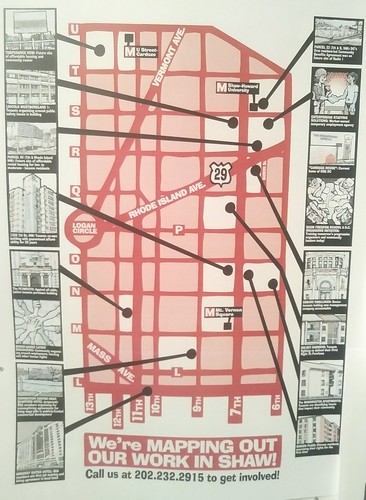
One more thing about the Washington Post article on gentrification/displacement in the Shaw neighborhood

Years ago I had met with a graduate student, and she was talking about how her advisor argued that the Shaw area was resistant to gentrification, because of various community organizing and community organization initiatives.

Two groups that come to mind are Jubilee Housing and the Manna Community Development Corporation (now called One DC).

Right to the City exhibit, Anacostia Community Museum
A c. 1980s? flyer about Manna initiatives in Shaw, from the "Right to the City" exhibit.

Key to Washington's urban revival was the creation of the Metrorail subway system, although the system's recent decline has significantly reduced usage.

While it is true that the Shaw area is home to some fascinating housing-related community organizing initiatives -- which you can learn about at the Right to the City exhibit at the Anacostia Community Museum, which reopens in October -- I disagreed that it was successfully resistant to change, making the point that it was merely a function of the attractiveness of the area in the context of the "regional residential choice landscape" and more specifically, the fact that the Metrorail line serving the area -- the Green Line -- opened last. of all the originally planned lines.

-- "Shaw (and Mid City East) as a one-over neighborhood: revitalization, displacement, gentrification as a function of critical mass and timing," 2013

The way "revitalization" works is that people live in the most desirable places first.  They choose to live in adjacent areas when they can't afford to live in the primary area.

The Live Baltimore resident recruitment effort calls this phenomenon "the one-over neighborhood."

Shaw was only seemingly resistant to change.  It's central location meant that change was only a matter of time.

Because the priming actions, in particular, putting in Metrorail service, the Green Line, set the stage for revitalization.

A few years ago, the Capitol Riverfront BID, served by the Navy Yard station on the Green Line, funded a market and economic analysis study of the Green Line, and published an update as well.

-- GreenPrint of Growth, 2012, Capitol Riverfront BID
-- GreenPrint of Growth 2.0, 2017, Capitol Riverfront BID

Over time, as demand remains high, large swathes of the city become what urban sociologists call "reproduced" and "the reproduction of space."

This process has been happening full force in Shaw for some time, with new construction of condominiums on U Street, 14th Street, and wherever land has been available.

As fallow sites get (re)developed and the inventory of land is depleted, other developers shift to existing properties.

To prevent displacement, long ago there should have been a program to buy, hold, and manage properties to maintain permanent affordability.

Labels: , , , ,

Thursday, October 18, 2018

Be careful when you create "temporary park uses" on sites slated for development, because people will end up advocating against development

Photo from the ParkView DC blog.

In 2009, DC demolished the Bruce-Monroe Elementary School, with plans to redevelop the site, at the key intersection of Georgia Avenue and Irving Street, into some sort of mixed use project, mostly housing.

To revitalize in a post-streetcar world, the Georgia Avenue corridor needs more population to enliven the otherwise disinvested retail buildings that line the Avenue.

 While parks are a fine use, they aren't categorically the "highest and best use" everywhere and in every situation, including at key intersections along corridors.

In the interim the then City Councilmember got the city to make over the site into a "temporary" park.

At the time, I was skeptical, because like with how trails advocates tend to be against attempts to revert what were once rails back to transit, such as in Chevy Chase, Maryland vis a vis the Purple Line Light Rail project, years later when the development is ready to move forward, people will instead advocate for the continuation of the park use.

That's been happening with the Bruce-Monroe site for quite awhile.  I wrote about it in 2015, "Predictable outcome: people want to make a temporary park permanent as a foil to development," but it's come up again.

The lessons are obvious.  And it makes you realize why developers leave sites boarded up for long periods, because it's ultimately easier and less problematic than if you offer temporary uses.

This is an email from the Columbia_Heights e-list:

Friends, Allies, and Neighbors,

If you are opposed to the deeply flawed and illegal giveaway of public land and the destructive over-development planned for Bruce Monroe Community Park, please consider the following:

----------------
We ask you to make your voice heard. Tell the DC Council that you oppose the destruction of Bruce Monroe Community Park. Tell them that it’s not okay to violate DC zoning laws and give away public land to enrich developers at the expense of our community. Please take 3 minutes before 10/18/18 to email DC Council to save our community. Use this link to send them an email:

DC Council has scheduled a
hearing on 10/22/18. We need you to tell the DC Council that you remain in opposition to the development and that you want them to postpone any decision to extend the Bruce Monroe Disposition agreement until the Court of Appeals makes a decision. The irrevocably-flawed development plan is currently under review by the Court of Appeals because the development plan violates the city’s own zoning rules. We support affordable housing, but with smart development that fulfills the needs of the community.

Where things stand:

Two years ago, neighbors like you fought the plan by testifying in front of the City Council and the Zoning Commission. Despite this large-scale opposition, the Council and the Zoning Commission voted to move the plan forward. Since that time a group of neighbors petitioned the DC Court of Appeals to Review the Zoning Commission order to develop the Bruce Monroe site according to the plans outlined in Zoning Order ZC16-11. They filed a pro se brief in February 2018 by making the following main points:
  • The Zoning Commission’s decision was fatally flawed–it completely disregards the input from community groups and neighbors, and violated the City’s own policy.
  • The proposed buildings are way too big for this community, and the Zoning Commission’s order is inconsistent with the law. 
  • The impacts of the development were never studied, as required by Urban Planning best practices and the law. The development team and city officials declined to consider the impacts on public safety, infrastructure, and other city services and utilities. These failures are a disservice to our community AND to the Public Housing residents whom the project claims to benefit. 
  • The Zoning Commission claims that the benefits of the project outweigh the impacts- but how can that be, when they never even studied those impacts!

The developer’s and other’s responses to these indisputable arguments fall well short of explaining away the Zoning Commissions failures. Instead they fall back on their old tired arguments: that the neighbors who want to have a reasonably-sized development that preserves irreplaceable and much needed green space in the city are against affordable housing. As you know, this is a false argument. We support truly affordable housing that fulfills all the needs of all of the members of our community which includes our neighbors and friends at Park Morton. We believe that a smart development plan that actually adheres to the City’s own rules AND takes input from the community– rather than blindly agreeing to developers– is the way to proceed. The DC Council needs to know that letting developers push through their own profit-driven ideas against the wishes of the community is not okay!

Our case is strong, and it is our hope that the City Council knows this too. The issue of the Bruce Monroe site will come before them again in a few weeks as they have to make a decision on whether to extend the Bruce Monroe Disposition agreement. Please use this link to make your voice heard!

Thank you for your help.
The neighbors of Bruce Monroe Community Park
Thank you,
David Bobeck
700 Block Irving
Friends of Bruce Monroe Park

Our Appeals Court Brief Opposing the Destruction of Bruce Monroe Park
Our Reply Brief to the Developers and the Zoning Commission
Our Joint Appendix (all the documents referred to in the briefs)

Labels: , , , , , ,

Sunday, June 25, 2017

As "out" groups become mainstream, place-based institutions and affinities are at risk

The Toronto Star has an article, "As the queer community spreads out, can the gay village remain vital?," about the potential decline of the city's Gay Village, as the LGBTQ community becomes more accepted and people feel less need to live in gay-specific neighborhoods to be safe and accepted. (This has been an issue in DC and other cities for a long time.)

Although the article also mentions cohort-specific issues, that the older Gay community may be less conscious of difference when it comes to transgender identifications. From the article:
Like many young LGBT Torontonians, Rosenberg-Lee lives and works in the west end, and he travels to the gay village very rarely, either to attend social events during Pride month in June, or to access transgender specific resources at the 519 community centre or the Sherbourne Health Centre. If these opportunities ceased to exist, he’s fairly certain he wouldn’t visit the village at all.

This is the dissonant truth about Toronto’s gay village. For at least a decade, a lot of young queer life in Toronto has coalesced outside the village proper, in smaller bars along Queen St. W. and Dundas St. W., or in Kensington Market, Parkdale, and Leslieville.

Even though Church St. between Wellesley and Carlton — a colourful strip of bars and clubs offering drag performances and trivia nights — still remains the heart of the city’s gay village and a popular address of LGBT tourism in Canada, it is not necessarily the heart of LGBT activity in the city.
Similarly, I commented on a neighborhood e-list awhile back about the discussion of issues around the "black" Douglas Memorial United Methodist Church on H Street NE as the neighborhood whitens ("Pastors Part Ways After Partnership Between Black and White Congregations Dissolves," Washington City Paper).

The irony of that case is that when the neighborhood became majority black in the 1950s, the then white church had to change its focus to remain relevant in a changing neighborhood.  Now the black church faces change as the neighborhood changes again.

... I was at a conference yesterday where one of the presenters does research on the impact of changing communities ("gentrification") on black churches.

Yes there is impact.  No the impact is not particularly new, even if it remains wrenching to the people and institutions facing change.

But to me these issues are no different from how "mainline" churches have declined in cities as ethnic groups--e.g., Polish Catholics, Lithuanian Catholics, German Catholics, Irish Catholics in Pittsburgh all had their own specific churches, which were place-based, and as people assimilated and moved to de-ethnicized communities those churches declined (see "Churches, community, religion and change").

Most churches follow their congregation as the members move outward (e.g., synagogues especially--first they moved further out into the city's outskirts, and oftentimes later out of the city entirely, as members moved further outward and no longer had residential connections within the city).

These are issues of what the "Chicago School of Sociology" called "ecological succession" as it related to neighborhood, community, and urban change, although then they argued that as people became better off they moved farther away from the center categorically, and as they left, they were replaced by new immigrants who then re-started the same kind of process.

From the Encyclopedia of Chicago article, "Chicago Studied: Social Scientists and Their City":

A second subtheme concerned the changes such succession implied in community institutions. In the 1930s, Samuel C. Kincheloe studied church succession, and Everett Hughes studied the real-estate board. In the 1950s, Morris Janowitz published his study of the community press. Later students were to study hospitals, jails, and cultural institutions. Again and again, the theme was underscored. Community institutions were both stakes and actors in the continuous ebb and flow of ethnic groups.

Labels: , , , , ,

Tuesday, September 13, 2016

Presentation, new publication Staying Put in a Gentrifying City: A Panel Discussion on the Tenants Opportunity to Purchase Act, September 29th

Limited seating...  From the American University School of International Service and the Metropolitan Policy Center


Please join our esteemed panel for a discussion on the Tenant Opportunity to Purchase Act (TOPA) as examined through Carolyn Gallaher's new book, The Politics of Staying Put: Condo Conversion and Tenant Right-to-Buy in Washington, DC.

Carolyn Gallaher, Associate Professor, American University, SIS; Author, Staying Put: Condo Conversion and Tenant Right-to-Buy in Washington, DC

Blake Biles, Retired Partner, Arnold & Porter; Board Member, Neighborhood Legal Services Program

Jim Graham, Former DC Councilmember, Ward 1

George Derek Musgrove, Associate Professor, University of Maryland Baltimore Campus

Moderated by:
Derek Hyra, Associate Professor, Department of Public Administration and Policy; Director, Metropolitan Policy Center, American University


=====
-- AU webpage describing the book
-- Washingtonian Interview with Professor Gallaher


Labels: , , , ,

Wednesday, December 30, 2015

Predictable outcome: people want to make a temporary park permanent as a foil to development

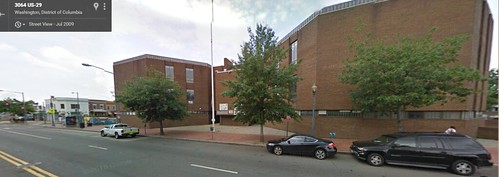
Bruce-Monroe Elementary School, 2009I think the school might have been an open classroom school.  This design has been proven to be an ineffective way to organize an elementary school.  Google Street View Image, 2009.

I never wrote about it, but back when then Councilmember Jim Graham in Ward 1 was a leading proponent of both tearing down the deaccessioned Bruce-Monroe Elementary School ("Georgia Avenue School Demolished for Mixed-Use Project" DCMUD, 2009) at Georgia Avenue and Irving Street NW and replacing it with a "temporary park" I figured that down the road there would be great opposition to converting the property back to buildings.

Bruce-Monroe Park, image from the Park View DC blog.

The original plan was to rebuild the school.  In the interim, students were shifted to the Park View Elementary School, a few blocks away.

While parks are a fine use, they aren't categorically the "highest and best use" everywhere and in every situation, including at key intersections along corridors.

From the standpoint of improving Georgia Avenue NW a 5-mile long corridor starting at U Street NW and ending at the DC-Maryland line in Montgomery County, it'd be better to add housing at that location, especially because the site is within one-half mile of the Georgia Avenue-Petworth Metro Station, and just a little further than that from the Columbia Heights Metro Station.

It would be in keeping with other multiunit housing development in the area ("Four condo buildings bring burst of redevelopment to District’s Park View," Washington Post).

The Washington Post reported on Monday ("D.C. residents: Plan to replace public housing will jeopardize popular park") that residents are opposing using the site for affordable housing in association with the replacement of the Park Morton housing project ("Renovations, Neighborhood Reviving Park Monroe," Washington Post, 2003).

Ironically, residents seem to have forgotten their earlier anger over the city's reneging on what they thought was an agreement to rebuild the school ("Community feels the pinch of school closing," A City Divided blog; "Unkept promises on a DC grade school," Washington Post).

A long time ago, local planner and blogger Dan Malouff made a comment on this blog (the comment is lost to an old blog comment system) that was very insightful.  He made the point that maybe people don't want parks, but they'll always advocate for parks in face of development alternatives, to ward off development of any kind.

Community garden advocates at a rally on Tuesday on the plaza of City Hall. Credit William Alatriste for the New York Times.

2.  It's often the same with community gardens ("In Community Gardens, a New Weed?," New York Times).

I got in an argument about a similar situation in DC ("Shouldn't places near subway stations, in intensely urban places, be urban?"). although the original comment thread is also lost to the ether.

3.  And rails to trails, for example by the "Friends of the Capital Crescent Trail" organization in Montgomery County, Maryland. Probably most of the members of the group prefer no trail to a trail, but prefer a trail ("park") to having a light rail line in what they see as their backyards, but until the late 1980s had been a freight railroad line delivering coal to a DC electricity generation plant.

====
Note that I am not saying I am against parks, community gardens, or trails.  Parks, community gardens, and trails (shared use paths) are critical elements in placemaking and complete systems of parks, cultural, and transportation assets.

I am saying that trails can co-exist with transit, and that depending on the circumstances, it'd be better  in some situations to have housing rather than a park or community garden.

This is another instance of needing to be very clear about purpose and the long term objectives of the use of space.  And processes in place to assist in making choices and decisions within constraints and conflicting goals and objectives.

Labels: , , , , , ,

Thursday, July 09, 2015

Is gentrification a racial or economic class issue?

I thought the classic definition of the term is when lower income people are pushed out by higher income people.  This is tricky generally, because it makes the argument in terms of a fixed point in time that cuts out a big part of the story.  In other words, neighborhoods that are seen as low income now were higher income before suburban outmigration and white flight.

But that's not even the issue.  Too often, people use the word "gentrification" when they mean "change," which is a point I made not quite 10 years ago ("One reason why I think the Gentrification word is over- and mis-used"):
when people use the word gentrification, they really mean change. Change is not merely "white or black." It is multi-faceted. And there is no question that it is difficult.
That piece was spurred in part by African-Americans opposing acknowledging and celebrating an influx of Ethiopians into their area of Shaw.

Also see ""More about Contested Space--Gentrification."

Milfred Ellis views Brightwood as a base for middle class African Americans. Ellis has put signs in his yards opposing the rapid changes. (Amanda Voisard/For the Washington Post)

And that's relevant to the discussion sparked by the Washington Post article, "A D.C. resident hopes these yard signs can save his neighborhood from gentrifiers," which highlights the protest against "gentrification" by an older African-American man living in Brightwood--I guess a few blocks away from me, but I live in Manor Park.

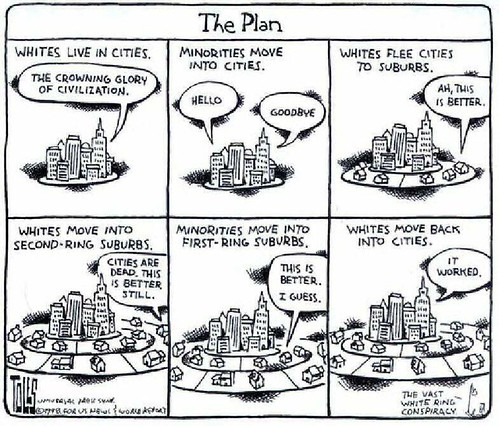
Is replacing one black middle class household with a white or Hispanic or mixed race middle class household gentrification?  Some people do call it "The Plan," in the case of DC, a concerted effort to dechocolatize "Chocolate City."

Tom Toles on Gentrification, 1998

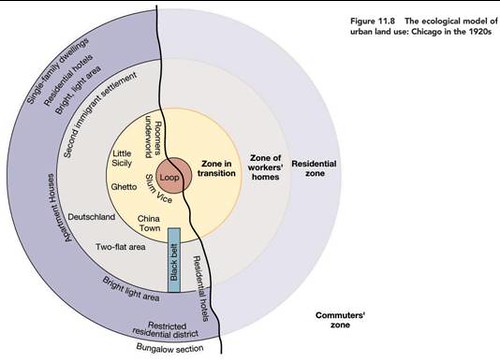
There is no question that the the theory of "ecological succession" is relevant.

This theory, as laid out by the "Chicago School of Sociology" in the 1920s, opined that the wealthy always moved outward, were replaced by strivers, who in turn, as they experienced success, followed the wealthy, and were replaced by a new group of strivers to begin the process anew, while the core was always inhabited by the poorest.
Ecological succession model, Chicago sociology
It may well be that this migration path was specific to the US at a certain time, given certain conditions (urban manufacturing, lack of pollution controls, high rates of immigration, etc.), but was not a universal condition.

It has only been since the late 1980s that urban sociology acknowledged to a great extent that there could be inward migration of high income households back to center city.  But that has been a European pattern all along.

I've written quite a bit about how these kinds of migration patterns have impacted and shape the city but it's worth repeating.  Specifically with regard to Ward 4:

1.  Mostly Ward 4 has been "middle class" for the past eight or more decades since it was first developed.  First it was middle class, striving, and upper class whites (the upper classes living in big houses here and there across Upper Northwest, especially in Takoma Park, just over the DC line, where they could take the train to get to their "city jobs").

2.  As the city grew in population in response to the growth of the federal government, especially during the Depression, more government workers and striving blacks moved to the parts of the Ward that segregation allowed.

3.  With suburban outmigration and white flight in the 1950s, the white middle class mostly but not entirely moved out of the Ward.  (For example, it happens that I worked the 2000 Census in the area I ended up living in, and was surprised to come across many houses that had been occupied by white families for decades.  It happens that our house has "always" been occupied by whites since it was built in 1929.)

4.  These households were replaced by middle class households who happened to be African-American.

5.  With aging out and suburban outmigration--especially to Prince George's and Charles County in Maryland, but throughout the metropolitan area--and more recently a return to Southern homesteads ("Why African-Americans are moving back to the South," Christian Science Monitor) on the part of African-American households, houses have been "abandoned" and in turn have been replaced by white, Hispanic, and mixed-race middle class and striving households.

6.  If whites, Hispanics, and mixed race households did not replace the African-American households that left, the Ward would have significantly lost population, especially in the last 10 years.

I don't think that's gentrification, but it is change.

This kind of neighborhood change is worthy of a discussion, even protest.  But it's not "gentrification" and to use the term "gentrification" to describe what's happening is a misnomer.

Basically the issue is that younger African-American middle class households generally are not interested in living in many in-city neighborhoods.  I wrote about this in 2006:

- Commerz in the 'hood... (aka "Commerce as the engine of urbanism")
- Commerz in the 'hood, part two
- Commerz in the 'hood, part three- Commerce dans de quartier de la ville, partie quatre

with follow up in 2012:

- More on Commerz in the 'hood
- Commerz in the 'hood revisited: Asian slurs edition

and last year:

- So much of the writing about gentrification is worthless

Maybe it's because they see it as tired, where their aunts, uncles and grandparents lived.  Maybe it's because they want to move to someplace more exciting, given that this is a "bedroom community" without much of a "nightlife."

I can understand the sentiment, if living right in the mix is what's on their mind because here you have to travel a few miles to U Street or Adams-Morgan or H Street for "excitement."

Whatever it is, I think the signs are cool.

Labels: , , , ,

Tuesday, May 05, 2015

Even more on commerz in the 'hood

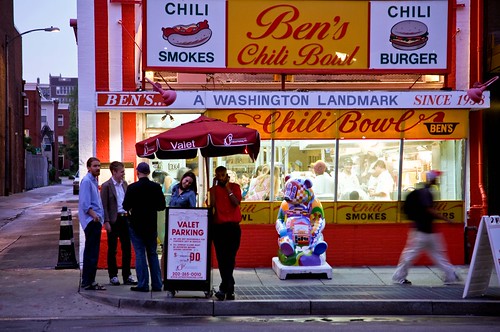
Ben's Chili ValetFlickr photo of the original Ben's Chili Bowl on U Street NW by Edward Hoover.

The Washington Post seems to believe that the impact of "gentrification" on business operations is a new impact, judging by the article "The Ben's Chili Bowl model for outlasting segregation," which says in part:
"One of the hidden stories of displacement is that it affects businesses and not just residents," says Calvin Gladney, a real estate developer and consultant who works with cities and neighborhoods on urban revitalization projects.

We talk a lot about how how people can be uprooted and priced out of their homes when a neighborhood like U Street transforms over time around $2,000-a-month apartments and high-priced gastropubs. But long-entrenched businesses get nudged out, too, overwhelmed by rising commercial rents or by new residents looking to buy things they don't sell.

Gladney counters that the displacement of businesses doesn't have to be inevitable, and Ben's Chili Bowl is the centerpiece of his case. Of course, every hairdresser or corner store in town won't benefit from cameos by Barack Obama or scenes in the Pelican Brief. But the Chili Bowl has made a few other savvy moves that are replicable, starting with that turkey burger.
Maybe Ben's is in fact unique and worth writing about, because they are expanding to new locations, and fundamentally, they aren't changing what they're offering very much.

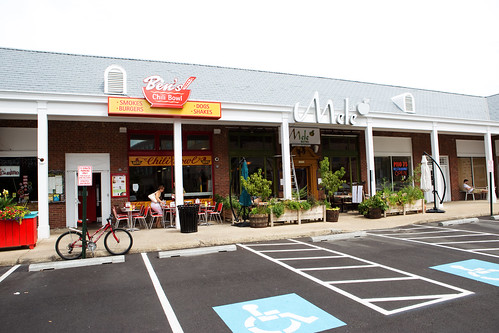
IMG_0439_2 layersFlickr photo of the Ben's Chili Bowl on Wilson Blvd. in Arlington County, Virginia.  The location is decidedly not in a traditional black neighborhood.

What they are doing is selling black authenticity as defined by chili dogs and chili cheese fries.

But that's still a form of polishing and refashioning their identity and selling it on new terms to new audiences and in areas that aren't necessarily black communities either now or historically.

(Note that Ben's hasn't been all smooth sailing.  A venture in the city-owned Reeves Center at 14th and U Streets lost lots of money and hundreds of thousands of dollars in unpaid rent.)

Retail businesses being impacted by changing demographics is something I've been dealing with and/or writing about for 10 years at least.  I wrote a series of pieces in 2006:

Commerz in the 'hood... (aka "Commerce as the engine of urbanism")
Commerz in the 'hood, part two
Commerz in the 'hood, part three
Commerce dans de quartier de la ville, partie quatre (this is about how businesses in a neighborhood in Paris changed their approach as the neighborhood changed)

Ironically, many of these pieces were in response to what I thought were facile Post articles.

Back then, it was a constant frustration to try to get businesses to rethink their business model, operations, and concept, in response to new and different customer segments.

Instead, proprietors typically criticized the new customer base.  (Note this isn't unique to DC.  I led a tour of public markets in Baltimore in 2005, and the working class vendors in Cross Street Market in Federal Hill denigrated the new higher income residents of the neighborhood.  Those residents, rather than deal with being demeaned, shopped at Whole Foods.)

Sign on the front door of Jak & Co. Hairdressers in Bloomingdale cities gentrification as a reason for the business closings its doors. (Perry Stein/The Washington Post)

In fact, this came up in a different Post article from April, "After 50 years, a D.C. store will close 'due to gentrification," where the business proprietor blamed their closure on "gentrification" and the property owner "asking for market rate rents."

But the reality is that their business remained the same and in the same place while their customer base moved on.  And now there is demand for the space from new tenants willing to pay higher rents.

Just as in the early 1960's, Ourisman Chevrolet moved from H Street NE to Marlow Heights in Prince George's County, following their customer base as it relocated, to stay in business, businesses must constantly grow and change and adapt to remain open.

But back in my Main Street commercial district revitalization days there were some changing businesses that stood out like Modern Liquors at 9th and M Streets NW ("A Liquor Store Makes It Back From Skid Row," Washington Post, 2006), two Korean-owned corner stores on the 400 block of East Capitol Street, and Lee Flowers ("NW Businesses Fear Skyrocketing Taxes Will Push Them Out," Washington Post, 2005) on U Street NW.

And some businesses fail, not so much because they aren't supported, but because there is a disconnect between their location, customer demographics, sales volume potential, and what they offer, such as the failure of the Culture Shop in the Takoma neighborhood of DC ("Struggling to Give D.C.'s Takoma Park a Shop All Its Own," Washington Post, 2007).

My sense was that as cool as Culture Shop was, it was in the wrong location.  Had it been located on U Street (but the proprietors lived in the Takoma area), it likely would have been much more successful.

These days, the Post and the Washington City Paper are publishing pieces about new and unique stores and restaurants like Upshur Books, the new Union Kitchen Grocery ("Union Kitchen Grocery promises more than an everyday corner store," Washington Post, 2015), Glen's Garden Market ("Glen's Garden Market launches dinner among the dry goods," Washington Post, 2014), Maketto on H Street, Broad Branch Market, the Red Hen restaurant, etc.  But the idea is the same--as demographics and opportunities and density changes, so do the activities and business plans and operations of smart business proprietors.

It's an ongoing process.

In 2012, I did two follow up pieces in response to new developments:

More on Commerz in the 'hood
- Commerz in the 'hood revisited: Asian slurs edition.

From the latter piece:

This comes up because of the lighting up of the media because of Councilman Marion Barry's complaint about Asian-American owned businesses in his ward/poor areas of the city as "We’ve got to do something about these Asians coming in, opening up businesses, those dirty shops. They ought to go, I’ll just say that right now, you know. But we need African-American businesspeople to be able to take their places, too," according to WRC-TV and recounted in "Marion Barry apologizes for anti-Asian remarks" in the Post. But the apology included this:
But Barry renewed his critique of Asian-owned businesses: “Let me make it clear, I’m not castigating any group of people. I’m not doing anything except trying to have a renaissance of our community and get some respect. A number of these restaurants serve high caloric food, bad food, et cetera, but the more important thing, they don’t participate in the community. . . . That’s what I object to, I don’t care who it is. “ 
Asked why he singled out Asians in his remarks, Barry said, “Because that’s reality. Who owns these little restaurants? Who owns them? You know, Asians. . .Ninety percent of all the small restaurants in Ward 8, at least.” It is difficult to verify that claim.
African-American resentment about Asian-owned businesses is nothing new. People ought to remember the boycotts in the 1980s over such businesses in New York City. See this piece, "Review/Television; The Boycotting of a Korean Grocery in Brooklyn" from the New York Times about an episode of the tv news show, "48 Hours," on the topic. It even made it in as a recurring theme on episodes of the television show "Hill Street Blues," which ran from 1981 to 1987.

... The issue is important but we need to look at what's going on. First, it's not like African-Americans haven't owned stores in neighborhoods, but there has been a long period, co-incident with the outmigration of middle-class African-Americans from the inner city, where they sold their businesses.

Second, it's true that stores in inner-city neighborhoods, especially those extremely impoverished, can be second-rate.

It's a function of low profits, partly because of low revenues, but also because of "shrink," the impact of theft of goods--which is why some stores have everything, not just the clerk, but the stock also, behind plexiglass.

It's also a function of a higher incidence of robbery, some of which results in death. The number of stories in the Post over the past 24+ years that I've lived in the city about robberies of stores resulting in the deaths of clerks/owners etc. are far too many to be able to count off the top of my head.

----

Last summer, I came across a book on the topic, Civility in the City: Blacks, Jews, and Koreans in Urban America, by Jennifer Lee, a professor at UC Irvine.

She worked in family owned businesses in impoverished communities while growing up, and then again while doing research for her dissertation.  I wish I had found the book much earlier.

The book is well-done, not only for its insights in the interactions between Asian business owners and workers and their African-American customers, but also for the discussion of how poorly capitalized and micro businesses operate generally, pre-crowdfunding community fundraising techniques within the Korean-American community, and the extranormal stresses on the business that come from operating in impoverished communities.

Also see "In the produce aisle, solidarity for Korean grocers, New York Times.

Labels: , , , , , , ,

Monday, April 13, 2015

One hidden element of the revitalization of Pittsburgh's East Liberty neighborhood

The East Liberty neighborhood in Pittsburgh is an interesting urban revitalization case study.

First, it was one of many examples from around the country of using urban renewal to make over and "improve" a neighborhood.  Like most examples of urban renewal, it failed, culminating in the demolition of much of the housing that had been built less than 30 years before and a search for a new solution.

Second, a lot of people in the revitalization world use East Liberty as an example of how distressed areas can attract high quality retailers  ("What drives East Liberty's revitalization efforts?," Pittsburgh Post-Gazette , "A Neighborhood's Comeback," Wall Street Journal).

But the opening there of a wide variety of quality retailers (Whole Foods, Trader Joe's, Borders--now closed, Target, etc.) happened only because the area is adjacent to two of Pittsburgh's most successful neighborhoods--Squirrel Hill and Shadyside--and in those locations there isn't any available land for large scale commercial development.  (As an aside, because of this, Shadyside is one of the only retail districts with a fair amount of second floor retail.  This is an example I've been meaning to write about as relevant to 8th Street SE in Capitol Hill, DC.)

What was appealing wasn't East Liberty per se, but available land and proximity.  Few other distressed neighborhoods possess this combination of development attractiveness, which makes East Liberty an outlier that's hard to generalize from.    

The East Liberty busway isn't particular attractive and is an example of the failure to consider the importance of transit infrastructure as an element of civic architecture and placemaking.  Wikipedia photo.

Third, Pittsburgh has some of the nation's first bus rapid transit lines, which opened in the 1980s, including service from East Liberty--you can get Downtown by bus in under 15 minutes, but for the most part, these lines never sparked ancillary development or residential recruitment.

(And like most bus rapid transit lines, ridership projections never met expectations, although to be fair, they were introduced when Pittsburgh was at its worst economically--as the steel industry was failing.)

But as retail has improved and the Penn Avenue Arts Initiative to the west continues to plug along attracting "creatives," arts anchors like the Pittsburgh Glass Works, and funky retail and restaurants, the East Liberty neighborhood is improving in its own right.

Ridding a neighborhood of crime by buying crime-ridden properties.  It turns out this has been sparked in large part because of a real estate strategy developed by the neighborhood community development corporation, East Liberty Development Inc. which focused on buying out slumlords and and converting problem properties that had been nodes for crime and disorder.

The Pittsburgh Post-Gazette reported ("How did East Liberty become safer? Buying out homes that housed criminals") on this, referencing a study of the program (East Liberty Crime Data Analysis), conducted by a consulting firm, Numeritics, based in the district. From the article:
A map of East Liberty in 2008 shows Negley Avenue running down the length of a curious red blotch between Penn Avenue and East Liberty Boulevard.  By 2012, the red blotch had dimmed to yellow. The change signified a 49 percent drop in the incidence of crime. 
The blotch had covered much of the old residential neighborhood, including Hays, North St. Clair, Mellon and Euclid streets. In the mid-2000s, Eric Jester, then the housing development manager for East Liberty Development Inc., said his and nearby streets were “a steady drumbeat of nonsense. Not just gunfire but street fights, people screaming, hookers propositioning your dinner guests.” He said an identifiable number of properties had reduced quality of life to “an existential threat.” 
“We called the police, but as soon as the police left it started up again,” he said. “We tried code enforcement, we tried yelling, we tried shaming. 
“We finally decided it’s probably better if we owned the properties.” The result of ELDI’s strategic purchase of 200 units from slumlords between 2008 and 2012 is the subject of a 23-page report, released recently by the data analysis firm Numeritics, that reframes East Liberty’s narrative of transformation. ... 
Through the 2000s, ELDI was buying, renovating and replacing properties for mixed-income buyers, but it intensified its efforts in 2008, going after property owners who allowed criminal behavior as long as tenants didn’t complain about lax maintenance.
ELDI’s acquisition of both large and small apartment buildings led to renovations and the hiring of effective property managers and off-duty police officers. At the same time, ELDI kept the same racial composition and low rents, Numeritics reported
According to the report, ELDI acquired about 3% of the residential properties, and according to crime hot spot theory, in problem neighborhoods 3% of properties generate 50% of the crime. While the neighborhood is experiencing rising demand for residential properties and increased prices, there is still plenty of affordable housing.

Safety + location + retail as a winning revitalization combo.  In any case, the redevelopment of the area as a hotbed for retail, and the housing rehabilitation program by ELDI has brought stability to the neighborhood, and it is now in fact, a great example of revitalization ("East Liberty becomes a vibrant community," P-G).

Fundamental to the improvement, as commenter charlie would say, has been to get public safety under control.

One of the people quoted in the article mentions how they used to call 911 all the time, and a couple years ago realized that they had stopped calling because they didn't need to any more.  For example, one of the apartment buildings that ELDI owns and manages now has experienced a 75% drop in incidents.

Ridding a neighborhood of problems by buying and fixing problem properties is a strategy that's extendable.

Labels: , , , , , , ,