Rebuilding Place in the Urban Space

"A community’s physical form, rather than its land uses, is its most intrinsic and enduring characteristic." [Katz, EPA] This blog focuses on place and placemaking and all that makes it work--historic preservation, urban design, transportation, asset-based community development, arts & cultural development, commercial district revitalization, tourism & destination development, and quality of life advocacy--along with doses of civic engagement and good governance watchdogging.

Wednesday, July 23, 2025

New interpretation of courtyard housing in Chicago says F.U. to the street

Courtyard housing is a home-y type where instead of houses on either side of a block facing the street, there is sidewalk and somewhat communal public space, open to the neighborhood in which it's embedded.  Apartments use the type too, organized as a horseshoe around communal space.  

Ross Chapin's Pocket Neighborhoods is about the type, and it's beautifully written.

It would be considered "missing middle housing," but I think that's somewhat of a mis-classification.  Or at least, I think the communal/non-street elements are more important to focus on.

It's more of group oriented housing development rather than a focus on single occupant dwellings as 

Design-wise, except for it being apartments and a locked entry way, the set up of the apartment building on the tv show Melrose Place is similar, except the pool functions the common space.  This building reintroduced us to courtyard housing.


Pre-war apartment buildings often used this physical design without a focus on developing communal elements of the space.

Salt Lake has a bunch of good SFH examples, including Boulevard Gardens.  I just saw "a new to me" one on 800 East.


Crain's Chicago Business has a story,"Architects' redesign of a Chicago classic becoming reality in the West Side," about how two architectural firms have created a modern version.  The exterior, butt ugly, has no charm, and it's perpendicular to the street so that the courtyard is disconnected and focused only on the residents within.  There isn't much charm.  I can't imagine there's much communal activity in the space.  They miss the point on what community and connectedness mean.


Labels: , , ,

Sunday, February 16, 2025

Wall Street Journal article "How Zoning Ruined the Housing Market in Blue-State America"

While there is no question that "legacy" residents tend to disfavor changes to their neighborhoods, including the addition of housing, and that's worthy of criticism, there are a number of other arguments that anti-zoning advocates espouse which are facile.

1.  Most residential housing in center cities was built before 1940, when the US population was 132,164,569.  Today's population is about 311,000,000, an increase of 2.35x.

2.  And many of those cities--not the rowhouse dominated cities--didn't use land very efficiently.  For example the rowhouse type common to Mid-Atlantic cities, packs a lot more units into a typical block, maybe 32 single family detached houses versus 64-72 rowhouses.

Neighborhoods built later use land even more inefficiently, with almost uniformly large(r) lot development--until the 1980s when land costs rose.  Our house lot in Salt Lake City could easily accommodate 4 rowhouses instead of one ranch style house.

3.  Furthermore, the average household size is shrinking, requiring more housing to house the same number of residents.

4.  Today land is a lot more expensive making "American Dream" style houses--detached homes with a yard--unrealistic in center cities and inner ring suburbs.

5.  But a significant number of people still want an American Dream style house, not the multiunit apartments now being built in cities.   This forces them to move much further out, where property is relatively cheaper.

6.  Related to (2) inefficient use of land, owner occupied housing is almost impossible to re-assemble in order to build new housing with more units on the same amount of land.  I am familiar with only a couple examples, one in Fairfax County, Virginia in the late 1980s, the 200 block of K Street NE in Washington, DC, but that block was zoned half industrial to begin with, making land consolidation much easier, and a block in Ann Arbor near the Michigan Stadium ("Land Use intensification in Ann Arbor," 2022).

7.  One key flaw of zoning is that it tends to be pretty homogeneous in intent, in that single family detached housing is in one zone, attached housing in another, multiunit in a third, when in pre 1940 times it was common, at least in the core of the center city, to include apartment buildings in the mix, mostly small but of varying sizes--bigger in the core.

Armistra Apartments, Salt Lake.  Photo: Jonathan Mauer.

8.  It doesn't help that zoning rules also militated against carriage houses/accessory dwelling units, English basements, etc.  E.g., my DC block of 32 detached houses could accommodate almost that many carriage type houses.

Architects Melissa Shin, with dog Maya, and Amanda Shin enjoy the outdoor area in front of the ADU affectionately called “Mouse House.” (Ricardo DeAratanha / Los Angeles Times)

9.  Salt Lake City is interesting in that on residential arterials and corners of blocks, it's common to have duplex/triplex housing, and buildings with even more units depending on lot size.  

This type of housing, along with rowhouses, is often referred to as "middle housing" in that it is smaller than the larger SFH.

So this expands the variety of housing demographics able to be accommodated with different housing types.  E.g. a single tenant doesn't necessarily need a large house.

Another type of this housing is courtyard housing.  Salt Lake has a couple great examples including Boulevard Gardens.  A beautifully written book on creating modern courtyard housing is Pocket Neighborhoods by Ross Chapin.

====

Click on the image for the full article.  Alternatively: link


As the article describes, it is absolutely true that segregated neighborhoods were a desired outcome from zoning.  

The author of the piece, Yoni Appelbaum, has written Stuck: How the Privileged and the Propertied Broke the Engine of American Opportunity, from which this is excerpted.  The book will be released by the end of the month.

For example, in the 1920s, parts of Upper Northwest DC were zoned against rowhouses, then the city's predominant housing type, to reduce the opportunity for racial mixing.

This isn't a blue-red state phenomenon per se.  The fact is that "red states" building more housing today is more a matter of timing than anything else, they are beneficiaries of having lots of land to develop still, because their growth has occurred after 1950.  And-- in response to demand for workers by the defense industry --the Sunbelt was really the Gun Belt (e.g., Anne Markusen).

One sign of this is how production home builders, such as Kaufman and Broad, originally based in Detroit, moved to Los Angeles.

Conclusion.  We are stuck.  Unless people gladly change their preferences to multiunit housing, it will be impossible to provide housing in central places, people will have to move further and further out from the core.

While zoning is one of the issues, market conditions (cost of land in particular) and people's housing preferences are the dominant forces.

Note that the movement to change single family zoning classes to include duplexes, and sometimes triplexes and quadraplexes as a matter of right could change the equation on this ("Planning Board recommends changes to allow more housing options in single-family home zones," Bethesda Magazine, "The YIMBY movement has a major win in Cambridge, even as many neighbors cry foul," Boston Globe), but only over very long periods of time.  Studies so far show that about 3% of housing tenure forms change per year in such situations, and that's pushed forward by the most motivated.

Mostly, individual property owners don't have the expertise to do this themselves, and will likely sell to developers to do so.  Whether or not properties sell at a premium to a straight up SFH house will be interesting to watch.

Labels: , , , ,

Saturday, January 15, 2022

Op-Ed in Washington Post about preserving affordable housing in the Purple Line corridor (Department of Duh)

There is an op ed, "Maryland must do more to preserve housing around the Purple Line," in the Washington Post by David Bowers of the Enterprise Community Partners--one of the nation's leading affordable housing constructors and advocates--about the need to preserve affordable housing in the swath of Montgomery and Prince George's Counties that will be served by the Purple Line light rail because new transit will lead to housing price appreciation.  

From the article:

When construction on the Purple Line began in 2017, the Purple Line Corridor Coalition, a multi-sector group, estimated that 17,000 affordable homes in the line’s vicinity were at risk of being lost to market forces. Rent increases will lead to displacement; 47 percent of all renters in the area around the Purple Line are already rent-burdened, meaning they pay more than 30 percent of their monthly income in rent. They can’t afford to pay more.

The concerns about housing appreciation due to better transit access from new projects aren't new.  

It's been an issue in the Langley Park community for more than 10 years ("In Langley Park, Purple Line brings promise, and fears, of change," 2011; "Along the Purple Line, worries that new transit will bring higher rents," 2021, Washington Post) and was raised in the Columbia Pike community of Arlington when they were considering streetcar service there ("Columbia Pike housing, transit questioned," 2012, Washington Post).

And those concerns are logical based on the experience in the region with Metrorail and how it has led to significant price appreciation, especially in core neighborhoods in Washington, DC and Arlington County, Virginia, even if it took a couple decades and longer to become visible.

One example is how the addition of the NoMA Red Line infill station in 2004 led to a significant increased in demand for housing north of H Street NE.  Since then housing prices have increased by 6x to 10x.

Express newspaper, 2012.

For what it's worth, I first suggested that Montgomery and Prince George's Counties go in on a community development corporation to address this in a brief blog entry in 2009.  

Relatedly in 2012, "Time + improvements in transit infrastructure = increased housing values."

Then in response to two conferences organized by the Purple Line Coalition in 2014, I wrote two pieces about this ("Purple line planning in suburban Maryland as an opportunity to integrate place and people focused initiatives into delivery of new transit systems" and "Quick follow up to the Purple Line piece about creating a Transportation Renewal District and selling bonds to fund equitable development").  

At the time, I talked about this with a member of the Montgomery County Planning Board, and he said it wasn't an issue of concern with the chair, because the chair couldn't see such a response being adopted, so why bother?

In 2017, I updated the post a wee bit and included it in the Purple Line series of articles about how to respond to and leverage the Purple Line as an addition to the Washington metropolitan transit network.

-- "PL #6: Creating a transportation development authority in Montgomery and Prince George's County to effectuate placemaking, retail development, and housing programs in association with the Purple Line"

Now that the Purple Line is going to be delivered 4+ years late, Maryland gets a little more time, but not much.  The places that are likely to be good locations for market rate housing are already being developed ("Suburban Maryland Purple Line light rail as an already successful economic development driver," 2020).

Amenities at the Chevy Chase Lake development will include a swimming pool, outdoor grills, co-working spaces, a wine room, a game room, a library, a bar and a fitness center. (Imerza)

For example, in Chevy Chase, new development is underway to leverage its location to the coming Purple Line ("New apartments leasing in Chevy Chase Lake in Montgomery County," Washington Post).  From the article:

Three residential developments are slated to be part of the Chevy Chase Lake development in Montgomery County, Md., designed to be a walkable mixed-use community with a town center and access to the Capital Crescent Trail. The development is adjacent to Connecticut Avenue and the planned Purple Line transit system, which will provide an east-west connection between Montgomery and Prince George’s counties.

My idea was that among its activities, the Bi-County CDC would help to fund, buy, operate and hold affordable housing in the corridor, including buying existing properties and adding more housing to them. 

Note also I was intrigued how Seattle was considering this issue wrt the Martin Luther King Corridor and the forthcoming addition of light rail there ("MLK Way: More than a highway or a piece of the next grand plan, it's home," Seattle Times).  I blogged about it in 2005.

And I was impressed by a proactive community development housing production initiative in Greater Phoenix in association with the light rail program there ("Light rail housing fund spurs 15 projects in metro Phoenix" and "Why you don't see more vacant lots along light-rail route," Arizona Republic).

How much time is necessary to respond to an obvious situation?

======

I find the affordable housing "argument" frustrating, because the problem is obvious--not enough housing--and the solution is obvious--build more.

But it costs money and requires government action is counter to the neo liberal argument that the market will solve every problem and government is ineffectual.

After reading an article about a project in Long Beach, California, I looked up Mercy Housing, a multi-state CDC focused on AH production, and this is on their website:

Nationwide, there are only 31 affordable units for every 100 extremely low income renters. In no state can a full-time minimum wage worker afford a one-bedroom or a two-bedroom rental unit at Fair Market Rent. 2.5 million children are homeless each year in the U.S. These sobering numbers are only a few of the many illustrating our country’s dire need for affordable housing.

These statistics couldn't be more clear.  There is great demand for affordable housing.  But if you want more affordable housing, you have to build it and it won't be produced by the for profit real estate development community, at least not without subsidy.

FWIW, the chapter on housing in Jumping the Abyss: Marriner S. Eccles and the New Deal, 1933–1940 is must reading.  The way that the housing market was restructured in the 1930s has set the stage of the US housing market ever since.  

Even then it was understood that housing for the lowest income segments would have to be subsidized.  But the "bias" or preference of policy makers was in favor of private housing production and not providing subsidies.  

Even though various legislation authorized affordable housing production, it was a very small part of New Deal housing measures.  And after a time, active government involvement in affordable housing was forbidden, and severe restrictions on what could be produced and for how much were also imposed, making production of high quality affordable housing increasingly difficult.

Today's piece by Philadelphia Inquirer urban design columnist Inga Saffron, "The Philadelphia Inquirer: The city desperately needs more public housing. There’s a perfect site in West Philadelphia," is equally illuminating.

She points out that since the Clinton Administration, public housing policy has focused on reducing the number of low income housing units, adding market rate housing to AH developments, lessening a focus on providing housing for the lowest income segments, and limiting new production.  From the article:

The real crisis in Philadelphia is poverty. Even as the city’s economy has rebounded over the last two decades, launching a building boom that has shined up blighted neighborhoods, its poverty rate has grown steadily worse. Almost a quarter of city residents struggle to pay for food and housing — 65,000 more than in 2000. No matter how many houses Philadelphia’s private developers build, those low-income residents will never be able to afford the rent. ...

Why doesn’t PHA just build more apartments? The short answer is that the federal government has drastically reduced funding to the nation’s housing authorities over the last three decades and imposed strict limits on new construction through the Faircloth Amendment. Things got so bad here that PHA closed its waiting list to new applications (except for seniors and the disabled) in 2013. The situation isn’t unique to Philadelphia: Today, there are 200,000 fewer public housing units available nationally than during the Clinton era.

So yes, as poverty and housing prices have increased, not just in Philadelphia, but nationally we have:

  1. reduced the number of low income housing units; 
  2. restricted construction of new low income housing units; and 
  3. reduced the amount of money available to public housing authorities.

And we wonder why there is an AH supply problem?, while conveniently blaming "greedy developers."

Labels: , , , , , , ,

Wednesday, January 12, 2022

I don't think this guy has a lot of experience with new construction

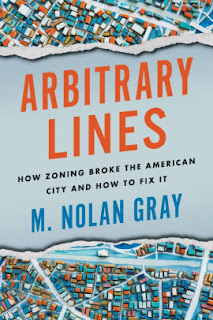
M. Nolan Gray is a writer and PhD student in planning at UCLA.  He has a piece in the Atlantic, "Noisy and Unsafe: Stop Fetishizing Old Homes," with the subhead "Whatever your aesthetic preferences, new construction is better on nearly every conceivable measure," criticizing "old housing."  

It's not an anti-preservation piece per se, but he argues that new construction is better than old construction.  The impetus for the article is that his 1958 apartment building in Los Angeles is noisy.

I'd say, based on my experiences in "new" housing, that is, houses and multiunit buildings constructed  after1960, and houses built before 1930, he isn't correct.  Most older buildings were constructed to last, weren't constructed primarily out of a desire to minimize cost.

WRT noise, that meant thick walls.  Etc.

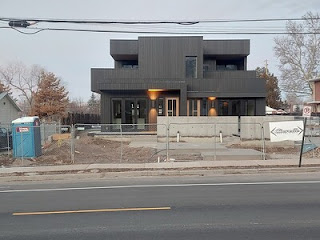
This weird looking house has been under construction for a couple years now.  It's on 2100 East in Salt Lake City.

Plus, so much of new housing, either single family housing or multiunit, is ugly.

Poor construction is a problem of the ages, today and in the past, and yes many places are inadequately insulated, which is an element of noise suppression.  But for many types of building materials, in particular wood (lumber), fixtures, and appliances, older is better--wrt appliances, analog often works better and definitely can last decades longer ("How Long Do Appliances and Parts of Your Home Last?," This Old House).

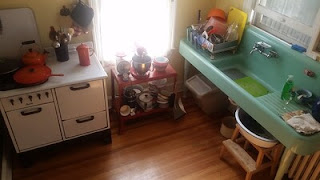
Kitchen sink from mid-1920s, oven from the 1930s, although it needs repair as hinges failed in late 2018.

New materials aren't designed to last.  Our 1929 house still has functioning fixtures from when it was built (kitchen sink and bathtub), and windows.  The 1960s Kenmore washer and dryer were still functioning when we had to move.  (The tenants broke the washer.  Had we still lived there, it probably would still be in service.  The washer had original fill hoses for more than 50 years.)

The oven lasted about 80 years, but the hinges broke and repair was expensive (so we kept the oven to fix in the future and got a new one).

The windows that were replaced by the previous owner sometime in the last 20+ years are all failing.  The 90+ year old windows for the most part are fine (or have been fixed so they can last another 90 years).

M. Nolan Gray is a "market urbanist"-- that is someone who supports cities but favors "the market" over urban or "government" planning, has authored at least one book on zoning as the scourge of the city.  

Granted zoning has many problems, but people are too quick to blame "government" for the problems, when many of those problems were created by private sector influence on government policy, the reality of how "the market" works for property, especially housing, and resident opposition to change of any kind("not in my backyard" or nimbyism) .

The problems are heightened by a different kind of planning failure, but one that nimbyism refuses to acknowledge, that today's population is significantly higher than it was when most zoning codes were developed in the 1950s, and is higher than when most traditional cities were built out, so there isn't nearly enough extant housing relative to today's demand. 

US Population

1930 -- 123 million
1940 -- 132 million
1950 -- 151 million
1960 -- 180 million
2020 -- 337 million

Those problems are accentuated by the fact that today almost 50% of US households are one person, further increasing demand relative to earlier periods.

I do need to read the book.  But...

The zoning problem is a dependent variable.  The independent variable is the failure to acknowledge and address that population increases need to be met with more housing supply, along with the simultaneous failure to adequately provide funding for housing for the segment of the housing market that can't afford market-rate housing.

-- "Understanding the DC housing market: demand for urban living, not the construction of new housing, is the driving force," 2021

I am not super "math-y," but the recent exponential frothiness in the housing market has to do with reaching a kind of tipping point in many markets, when the amount of vacant housing relative to supply is minimal, less than 5%.

Besides the fact that today's housing is built at today's costs for land, labor and materials, so additions to supply today only lead to price slackening over multi-decade periods of time, as long as demand remains greater than supply even with new additions to supply, prices won't drop.

Labels: , , , , , ,

Saturday, August 07, 2021

Strong real estate markets, lack of supply have extranormal negative effects on low income households: confirmation by research

This isn't news exactly.  In the blog for years we've discussed how the strong residential real estate market has many effects, including (1) a repricing upward of Class B, C and D housing and (2) persistent demand for sub-standard housing, allowing property owners to stint on maintenance ("Understanding the DC housing market: demand for urban living, not the construction of new housing, is the driving force").

19. In the rental market, because of the demand-supply mismatch, substandard housing (Class B, C and D) rents for higher prices than would prevail in a weaker market. (This phenomenon of higher prices for less well maintained housing bleeds across the DC border into Prince George's County.)

Illustrating this fact, NPR reports ("Housing Conditions In This Low-Income Neighborhood Pushed Tenants To Sue The Landlord") in Prince George's County Maryland, that predominately Latino low-income tenants, with the support of CASA de Maryland, are suing the property owner and managers of the Bedford Station and Victoria Station apartments in Langley Park, for lack of maintenance.  

Comparatively speaking, PGC doesn't have a particularly robust set of tenant protections.  

In the past, there was a neighborhood stabilization program under previous County Executive Rushern Baker, called the Transforming Neighborhoods Initiative, and it included the Langley Park area.  I don't know what the status is of that program under his successor.  But Langley Park and additional neighborhoods were removed from the program, switched to a community led initiative rather than the more top-down TNI program, which shifted its focus to the most distressed communities in the program.

The NPR article mentions a journal article, "Do the Poor Pay More for Housing? Exploitation, Profit, and Risk in Rental Markets," published in the American Journal of Sociology (124:4, 2019), detailing the effects of strong housing markets on low income households.  The research results discussed in the article confirms my hypothesis as laid out in Item 19 above.  From the article:

This article examines tenant exploitation and landlord profit margins within residential rental markets. Defining exploitation as being overcharged relative to the market value of a property, the authors find exploitation of tenants to be highest in poor neighborhoods. Landlords in poor neighborhoods also extract higher profits from housing units. Property values and tax burdens are considerably lower in depressed residential areas, but rents are not. Because landlords operating in poor communities face more risks, they hedge their position by raising rents on all tenants, carrying the weight of social structure into price. Since losses are rare, landlords typically realize the surplus risk charge as higher profits. Promoting a relational approach to the analysis of inequality, this study demonstrates how the market strategies of landlords contribute to high rent burdens in low-income neighborhoods.

Code enforcement.  While often used as a displacement mechanism, some communities use regular inspections of rental properties as a mechanism for ensuring quality maintenance.  In Prince George's County, the incorporated city of Hyattsville does this, although I don't know if it is done every year, upon renewal of the rental license.

Upping code enforcement requirements on rental properties in the unincorporated sections of PGC would be an important tenant protection mechanism. 

Inequality in sociology and planning.  The journal article is devastating in its discussion of inequality as an area of study in sociology. 

It quotes extensively from a review by famed sociologist Arthur Stinchcombe of the book Inequality by Jencks et al.  Stinchcombe criticized the book for focusing on inequality as a failing of individuals as opposed to the result from power differentials between the well off and the impoverished, and class.

This schism -- personal failings versus power differentials -- shapes how inequality is addressed to this day in policy differences between Republicans and Democrats, the idea of the "deserving poor," and discussions of "structural racism," "multi-generational poverty," and investments in people or place versus people and place.

-- "Equity planning: an update," 2020
-- "St. Louis: what would I recommend for a comprehensive revitalization program? | Part 1: Overview and Theoretical Foundations," 2021
-- "St. Louis: what would I recommend for a comprehensive revitalization program? | Part 2: Implementation Approach and Levers" (forthcoming)


Labels: , , , , ,

Saturday, June 12, 2021

Boulevard Gardens pedestrianized block in Salt Lake City

I've mentioned the book Pocket Neighborhoods by Ross Chapin, which is a beautifully written book about "courtyard housing," old and new.  

Such housing is rare, even though it has been constructed in various places certainly since the 1920s.

A kind of example is how Minneapolis pedestrianized the street for the two block Milwaukee Street Historic District in the late 1970s, or how "Exposition Boulevard" facing Audubon Park in New Orleans is a sidewalk faced by houses.

I happened upon an example in Salt Lake City.  I was cycling on the sidewalk and I probably wouldn't have noticed if I were on the street or driving,  (I hadn't noticed before and I've been on that block a bunch of times.)

It's called Boulevard Gardens, it was constructed in 1929, with 23 houses (one lot was never built upon).  I didn't check out the rear of the houses, apparently there are still some original garages extant.  Boulevard Gardens is historically designated, and was built as an early example of a "suburb" although these days it's decidedly in Salt Lake City's core ("Salt Lake City’s ‘street without a street’ is a 90-year-old hidden gem —one that homeowners and historians hope to preserve," Salt Lake Tribune).


There is another example in Salt Lake, although the housing was not for the middle class,  It's utilitarian and small, most likely  for railroad workers as it is down the street from the old Denver and Rio Grande Western Railroad passenger station.  

The one story rowhouses are part of the La France Apartments "complex," fronted by 3-story tenements ("RESIDENTS SHOW OFF A FORGOTTEN WAY OF LIFE," Salt Lake Deseret News).  The buildings are scheduled to be demolished as part of a redevelopment project spearheaded by the Greek Church, which abuts and owns the buildings ("Massive new development would give Salt Lake City an upscale Greek Town," Salt Lake Tribune).

La France Apartment Rowhouses.  Photo: Leah Hogsten, Salt Lake Tribune.


While the Church states that it will offer the same number of affordable units in the new building, there are no plans to preserve the buildings, which are truly unique, not just in Salt Lake City, but nationally, as an example of this type of housing.

Like the case of the Redwood Drive In in West Valley City--Utah's fastest growing city, which may end up becoming larger in population than Salt Lake City ("Cultural master plans and Drive in theaters?"), this is a tough call from an urban planning standpoint.  The planner side of me says it's an acceptable loss, the historic preservation side says absolute no to demolition, because the property is so unique and distinctly relevant to SLC's urban residential and industrial history.  

Because the property is so unique, I would choose to save the property at some cost to density.

Interestingly, while there are extant examples all around the country, this particular urban design form was never widely adopted.

Milwaukee Avenue, Minneapolis


Exposition Boulevard.  The houses have garages or other access from the side or rear, and may have two different "front entries" one for the sidewalk, the other for vehicles.


Labels: , , , ,

Monday, March 22, 2021

Active initiative in Edina, Minnesota to preserve affordable single family houses | But why not build triple deckers?


KARE-TV reports ("Edina launches pilot program to save affordable homes from teardown") that Edina, a high demand suburb of Minneapolis, has instituted a program aimed at reducing teardowns, which replace smaller, older, more affordable houses, with what some call "McMansions," which are much larger, more expensive houses, often ersatz when compared to the size and architectural style of houses when the neighborhood was first built.

According to this article, Edina and a neighborhood in Minneapolis are the two hottest markets for teardowns in Greater Minneapolis (in the past in the DC area, Arlington and Chevy Chase in Montgomery County have been particularly hot markets for teardowns).

From the KARE-TV article:

Citywide since 2008, nearly 1,000 Edina homes have been demolished – roughly eight percent of the city’s single-family homes. The average value of Edina's teardowns: $421,420 The average value of the homes built in their place: $1,165,786. That’s an increase of increase of 177%. “It's something just so out of whack,” Ruth says.

There is an opportunity cost involved in two ways, either positive or negative, depending on your perspective.  First, teardowns up-price the housing in a community, reducing affordability.  On the other hand, when a local government is reliant on property tax for the bulk of its operating revenue, this process increases the property tax revenue stream.

In either case, teardowns are a form of "reproduction of space" that leads to significant community changes.

-- Edina Neighbors for Affordable Housing

Edina launched as a pilot a "Housing Preservation Program" focused not on historic preservation per se, but on the preservation of housing affordability (that's what "housing preservation" means in the public and social housing field too, not historic preservation).

Working with the West Hennepin Affordable Housing Land Trust, Edina will use funds generated from developer proffers and community development block grants to buy the houses.

From the article:

The city mailed more than 1,000 post cards asking the question, “Do you want to sell your home but not for a teardown?” The city ... make[s] funds available to buy a limited number of houses for their appraised values to assure those homes remain intact and with families needing more affordable options. “This is not a moratorium at all on teardowns,” Stephanie Hawkinson, Edina’s affordable housing development manager, says. “We are not mandating that anyone sells their home to us. We're just providing them with a choice.”

It will be interesting to see how this works, how much funding they have, and whether or not sellers are willing to sell to the city initiative, instead of extracting a somewhat higher price from the for profit real estate development market. 

Multiple units as an another alternative?  One of the forces "generating" teardowns is large lot size.  The lots appear to be large and can accommodate multiple families just as easily as a large house. Another way to increase housing access would be to allow "multiple unit" housing types on these lots.

I would say duplexes are "too small" given the rise in demand for housing given the constant increase in population.  So build triplexes and larger units ("Massachusetts Triple Deckers as "Missing Middle Housing" -- triplexes").

Minneapolis has changed its "single family zoning" so that duplexes and triplexes are "matter of right" as well ("How Minneapolis Freed Itself From the Stranglehold of Single-Family Homes," POLITICO).  

My criticism is that relying on individual property owners to take the initiative means that it will take decades to see much effect ("A short point about why eliminating single family zoning won't result in a rise in "affordable housing" (any time soon)").

This Boston double triple decker, now four separate units, rather than six, is for sale for $1.4 million.

By contrast, creating an active housing conversion/building program comparable to the Edina program would be a way to generate a greater number of units more quickly.

Although in the short run, it won't yield housing that is newly affordable without subsidy, because it is built at current costs for land, labor, and materials. 

Labels: , , , , , , , , ,

Thursday, February 13, 2020

Slumlording in Akron, Ohio

Lower quality units rent at higher prices when supply is constrained.  Commenter Charlie has pointed out in the past that one problem with demand being greater than supply in housing is that non-premier and substandard units rent for higher prices than they should warrant, because people have little choice.

Lower quality units in weak markets are often rented to desperate tenants, who then are bullied to not complain for fear of eviction.  There is a kind of opposite problem too.  Desperate people will live in terrible quality housing because avaricious landlords will rent it to people below market prices, because they can't afford better housing.

But then tenants are in a bad position, because if they complain about the quality of the unit, even if not up to code, they face the threat of eviction.

OTOH, I do have a wee bit of sympathy for the property owner, because unless they are long time owners, they've bought dilapidated properties, which are expensive to fix, especially when rent revenue is low, and property taxes are comparatively high given the value of the property.  (Weak market cities tend to have high property taxes in a desperate attempt to raise the revenues necessary to pay for municipal services and operations.  E.g., we just spent a lot !! of money to get our house "up to code" to be able to rent it out, and it was in decent condition.)

Renter Anthony Williams gently lifts the hood over the stove as he talks about how it fell while his son was cooking in the dilapidated home he rents on Tuesday Jan. 28, 2020 in Akron.  MIKE CARDEW / AKRON BEACON JOURNAL

An Akron Beacon-Journal article ("Tenant hits 'slumlord' in the pocketbook") goes into great detail on such a slumlord, who also games his property taxes, figuring he can make more money by not paying taxes, although now the County is on to him, and is targeting his properties for code and tax enforcement.

It's worth a read.

One tenant has one upped the landlord through a housing court action, so his rent is being escrowed because the landlord hasn't cured building code violations. 

Interestingly, when the Summit County Land Bank has taken over properties with tenants, as a result of property tax foreclosure actions, they take great pains to sell the property to the tenant.

Receivership.  Ohio has a strong housing receivership statute, which allows nonprofits to take over properties and "cure" notorious nuisances.  When a property is fixed, the housing court can extinguish liens and debts on the property, and award ownership to the nonprofit, which then sells the property.

I wonder why Summit County and/or Akron aren't using this tool.

Labels: , , , , ,

Wednesday, February 12, 2020

Moms 4 Housing in Oakland California raise the concept of tenant right to purchase laws

One of the things about "capital" is that well funded operators are situated to take advantage of downturns.

Reproducing at scale single family housing for the rental market.  With the last recession, in a quantum change for the single family housing market, large well funded Wall Street operators like Blackstone bought thousands of foreclosed houses and started renting them out ("Blackstone cashes out on Invitation Homes," HousingWire).

This shouldn't be a surprise.  Large organizations like banks would rather sell chunks of their portfolio in one fell swoop, to other larger operators, rather than one by one to individuals.

While some companies rehabilitate these properties and eventually sell them off, many do not and a significant tranche of this housing has been shifted to the rental market permanently.

Image from The Intercept article "OAKLAND’S MOMS 4 HOUSING WERE EVICTED BY A GIANT CORPORATION THAT RUNS NATIONAL HOME-FLIPPING OPERATION."

But another phenomenon within the national market for real estate property and financing is the creation of firms that flip single family properties--buy properties, fix them up (either well or badly), and sell them--usually contributing to a resetting of the pricing within the subdistrict.

They've also created a system to enable small real estate investors to invest in properties outside of their local area, both in terms of fixing and selling properties, and also in managing properties, which makes it much easier for out-of-market investors to own such properties ("Startups Reshape Home Investing," Wall Street Journal, 1/8/20).

One such firm is Wedgewood Properties ("Examining Wedgewood: A Look at the Home-Flipping Giant in Battle with Homeless Mothers," NBC San Francisco).

Moms 4 Housing.  In Oakland California the activist group Moms 4 Housing shifted the debate ("When Cops Evicted These Moms, the Housing Conversation Changed," Yes Magazine).  A couple of homeless families decided to squat in a house that had been vacant for many years.  From the article:
The house had sat vacant for several years. Walker and a woman named Sameerah Karim and their children moved into the house in November 2019. The two longtime Oaklanders were homeless and thought it made more sense for them and their families to live there than to leave it empty.

They call themselves Moms 4 Housing. During their occupation, they cleaned up the home. Community members donated furniture. They were later joined in the home by two more Black homeless mothers named Tolani King and Misty Cross.

The occupation was always about more than just putting a roof over their heads. It was also a campaign to call attention to the role housing speculation was playing in Oakland’s gentrification, displacement, and homelessness crisis.

The house on Magnolia Street had been bought for $501,000 in August by Wedgewood Properties, one of Oakland’s most prolific home flippers. The San Francisco Chronicle reported that Wedgewood had rehabbed and sold about 160 homes there in the past nine years.
While they were evicted, attention brought to the case means that they might get to go back to the house, as the city is negotiating with the property owner to sell to the Oakland Community Land Trust, which would then sell or rent the house to the Moms 4 Housing, with an easement on the property maintaining its affordability.  From the article:
In exchange for the lower-than-market sale price, CLT buyers who later move out agree to also sell the home at a below-market rate to income-qualified buyers. The owners are able to build some wealth off their home’s equity, but less than they likely would if they’d been able to buy a market-price home. Even with less equity, CLT supporters say, the model still gives lower-income residents access to stable housing and wealth generation they likely wouldn’t have otherwise in a high-cost market such as the Bay Area.
AU Professor Carolyn Gallaher authored a book, The Politics of Staying Put: Condo Conversion and Tenant Right-to-Buy in Washington, DC, on the DC Act. (Interview with the author in Washingtonian Magazine.)

Tenant right to purchase on sale clause legislation being considered.  Like how DC has a Tenant Opportunity to Purchase Act (TOPA) act to give tenants the right of first refusal to buy a property when its sold, Oakland and other Bay Area communities are now considering passage of similar laws ("Moms 4 Housing-inspired policy could shake up Oakland real estate market," San Jose Mercury News).

Although more recently DC changed the TOPA law, so it no longer pertains to single family dwellings, only multiunit properties.

DC isn't a place where private equity has assembled a large portfolio of single family housing.  In places where that is the case, TOPA-type laws should not except single family housing from the mix, although individually owned properties probably should be exempt, unless a tenant has lived there "for a long time".

Labels: , , , , , ,

Wednesday, January 22, 2020

Historic Filipinotown, Los Angeles, as another example of real estate capital-driven arbitrage

In the same vein as the recent blog entry on the Parkdale neighborhood of Toronto, "'Real estate capital reproduction of space' in the Parkdale neighborhood of Toronto," the Los Angeles Times has an article ("As Historic Filipinotown gentrifies, imagining a different future") about gentrification in the Historic Filipinotown district, which historically had not experienced significant demographic change.

One of the interesting things pointed out in the article is how buildings under rent control actually represent a significant opportunity to increase rents, provided that expensive renovations are made.  From the article:
Surrounded by more expensive housing markets, Historic Filipinotown is one of the last places in central Los Angeles where cooks, housekeepers, Uber drivers and new immigrants can afford to live. Alumit’s mother, a nurse, and his father, a security guard, saved everything they had to buy a home here in 1978. The neighborhood’s median income of about $26,700 is about 40% of the county’s median, and about 95% of residents are renters.

But Historic Filipinotown’s affordability is also the source of its vulnerability. According to an analysis by the UCLA Law Review, about 620 buildings in the area are subject to rent control laws, which makes the properties more tempting to buyers because the potential profits from raising rent would be much higher.
I thought that was a very interesting point. It's not uncommon for improvements in rent controlled buildings to lag, because of the complicated regulatory process, especially if the buildings are locally owned.

But large companies with access to cheap capital see such buildings as an opportunity to rapidly increase rents if wholesale improvements are made.

See the Curbed LA articles:

-- "657 rent-controlled apartments stripped from LA’s rental market in three months," 2019
-- "Tenants sue Historic Filipinotown apartment building owner for harassment," 2017

======
Interestingly, looking up the mentioned UCLA Law Review article, it turns out that the school organized a "clinic/class" on "Gentrification, Displacement, and Dispossession":
In Spring of 2018, a seminar at UCLA School of Law brought together a group of graduate students and law students to trace the current manifestations of the U.S. property law system to its historical origins. From it emerged this collection of pieces, in which students, professors, and practitioners examine the present-day effects of gentrification, displacement, and dispossession in and surrounding Los Angeles.
What a useful class!  Granted plenty of law schools offer legal clinic programs, which provide a lot of help to people within the served communities.  But law schools turn out a lot of scholarship too that is applicable to local situations, but rarely is this knowledge stream tapped.

Here's the full set of articles:

-- "Dispatches from the Other Side of Development" by K-Sue Park
-- "Living Poor in the Affluent City" by Scott L. Cummings
-- "Los Angeles, Displacement, and the Rise of Airbnb" by Alex Scott
-- ">Losing Historic Filipinotown by Ysabel Jurado
-- "Dialectic Episode: Reclaiming Land Use Law: Using People Power to Guide Development" Dialectic hosts Sunjana Supekar and Jason Lawler talk with Doug Smith, Ysabel Jurado, and Joe Donlin about the role of community planning in combating gentrification in Los Angeles.
-- "Protecting Mobile Homes as Affordable Housing" by Soham Dhesi
-- "The Limits of Land Reform: A Comment on Community Land Trusts" by Daniel Foster
-- "Public Land for Public Good: How Community Groups Are Influencing the Disposition of Public Land to Help Address the Affordable Housing Crisis" by Katie McKeon & Doug Smith
-- "Local Control of Land and Water Resources: Rethinking California’s Eminent Domain Standard" by Mia Lattanzi
-- "From Chavez Ravine to Inglewood: How Stadiums Facilitate Displacement in Los Angeles" by Laylaa Abdul-Khabir
-- "We Shall Not Be Moved: Practitioners' Perspectives on Law and Organizing in Response to California's Housing Crisis" by Tyler Anderson, Terra Graziani & Kyle Nelson


Labels: , , , , ,

Thursday, October 03, 2019

Rent control laws should be paired with laws that boost new housing construction, especially housing not aimed at the highest income segments

The article in yesterday's Washington Post, "Housing advocates push for more aggressive rent-control measures in D.C.," reminds me of something I've been thinking about since coverage about rent control initiatives in California ("How California's tenants won statewide rent control," Capital & Main), Oregon ("Rent Control Is Now The Law In Oregon," Oregon Public Broadcasting), and an update of the law in New York City ("Landmark Deal Reached on Rent Protections for Tenants in N.Y.," New York Times).

From the Post article:
The District’s rent-control law, which sets the rate at which rents can be raised by property owners, will lapse Dec. 31, 2020. Last month, all 14 members of the D.C. Council signed on to support an amendment to the 1985 law that would extend it an additional 10 years — to Dec. 31, 2030.

But a coalition of 17 groups that include labor unions, religious congregations and community organizations fears that in a city with some of the highest rates of gentrification and displacement in the nation, extending a 34-year-old law without making substantive changes will fall short of residents’ needs.

The group unveiled its political platform Wednesday in front of an apartment building on Hamilton Street NW, where activists said tenants were subject to 30 percent rent hikes after a new building owner sought to offset the costs of repairs and renovations.
(The DC Tenants Union doesn't seem to have a webpage at the moment, so I can't find a list of the platform for the "Renters Rights Campaign.")

Or how, the Trump Administration proposes tying transit system funding to local land policies favoring intensification ("New Bill Would Tie Federal Transit Funding to Local Zoning," Reason Foundation).

To me, the justification for rent control comes from the fact that residents tend to be against intensification and new housing construction in many different ways and this is reflected in planning, zoning, and building regulations, all of which combine to reduce the supply of housing.

Property owners are the intended and unintended beneficiaries from restrictions on housing supply. Housing values appreciate extranormally as do rents.

So rent control regulations are a reasonable constraint on what during past wars were called "excess profits" -- that is, much higher than normal profits resulting from extraordinary circumstances.  Then, such profits were taxed at very high rates.

WRT rents, instead of extranormal taxes on profits, price controls have been introduced.

But now I am starting to think that in return for the legalization by states of the creation and imposition of local rent control regulations (property interests try to get laws passed at the state level which preclude local rent control), localities should have to agree to reduce restrictions on adding to the housing supply.

From the LA Times article "Rent control helps, but it can't fix California's housing crisis":
But rent control is no panacea for the housing crisis because it does not create new units.  It should be considered along with other policies such as housing vouchers, relaxation of zoning laws to spur construction and better public transportation infrastructure. Mandatory inclusionary zoning ... is another strategy worth exploring.
Because ideally, there wouldn't be a need for price controls, because the housing supply and housing demand would be roughly balanced.

Of course, in places where demand is extra normal and even with fewer regulations and restrictions housing supply is constrained, price controls may still be necessary.

=======
Separately, the Center for American Progress has a campaign on legal representation for tenants in eviction proceedings.

-- "A Right to Counsel Is a Right to a Fighting Chance: The Importance of Legal Representation in Eviction Proceedings," article
-- Full report

Labels: , , , , ,

Wednesday, September 25, 2019

One more thing about the Washington Post article on gentrification/displacement in the Shaw neighborhood

Years ago I had met with a graduate student, and she was talking about how her advisor argued that the Shaw area was resistant to gentrification, because of various community organizing and community organization initiatives.

Two groups that come to mind are Jubilee Housing and the Manna Community Development Corporation (now called One DC).

Right to the City exhibit, Anacostia Community Museum
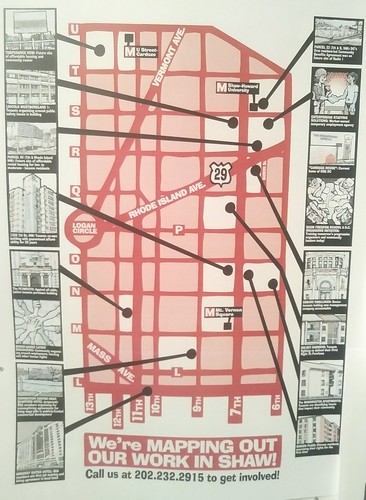
A c. 1980s? flyer about Manna initiatives in Shaw, from the "Right to the City" exhibit.

Key to Washington's urban revival was the creation of the Metrorail subway system, although the system's recent decline has significantly reduced usage.

While it is true that the Shaw area is home to some fascinating housing-related community organizing initiatives -- which you can learn about at the Right to the City exhibit at the Anacostia Community Museum, which reopens in October -- I disagreed that it was successfully resistant to change, making the point that it was merely a function of the attractiveness of the area in the context of the "regional residential choice landscape" and more specifically, the fact that the Metrorail line serving the area -- the Green Line -- opened last. of all the originally planned lines.

-- "Shaw (and Mid City East) as a one-over neighborhood: revitalization, displacement, gentrification as a function of critical mass and timing," 2013

The way "revitalization" works is that people live in the most desirable places first.  They choose to live in adjacent areas when they can't afford to live in the primary area.

The Live Baltimore resident recruitment effort calls this phenomenon "the one-over neighborhood."

Shaw was only seemingly resistant to change.  It's central location meant that change was only a matter of time.

Because the priming actions, in particular, putting in Metrorail service, the Green Line, set the stage for revitalization.

A few years ago, the Capitol Riverfront BID, served by the Navy Yard station on the Green Line, funded a market and economic analysis study of the Green Line, and published an update as well.

-- GreenPrint of Growth, 2012, Capitol Riverfront BID
-- GreenPrint of Growth 2.0, 2017, Capitol Riverfront BID

Over time, as demand remains high, large swathes of the city become what urban sociologists call "reproduced" and "the reproduction of space."

This process has been happening full force in Shaw for some time, with new construction of condominiums on U Street, 14th Street, and wherever land has been available.

As fallow sites get (re)developed and the inventory of land is depleted, other developers shift to existing properties.

To prevent displacement, long ago there should have been a program to buy, hold, and manage properties to maintain permanent affordability.

Labels: , , , ,

The Washington Post article on displacement in Shaw

It's a heartbreaking article ("D.C.'s gentrification is pushing black people out Shaw").

1829 13th Street NW is a relatively new build--it looks like it dates to the 1960s--in the midst of a great deal of historic housing, with nearby rowhouses worth between $1 and $2 million.

Sanathera Price  has lived at 1829 13th Street NW for 40 years, works for the Social Security Administration, knows her neighbors, etc.

But being in the core of the city, with living in DC now being a popular choice after many decades when it wasn't, properties that once were "affordable" are being upgraded for tenants or owners who can pay a lot more.

Gentrification.  DC has become "gentrified" because there is a greater demand to live here than there is housing supply to accommodate all the people who want to live here.

Why the addition of new housing doesn't reduce prices.  The reason that the addition of new housing isn't slackening prices is not just because (1) by definition new housing is constructed at today's cost of labor, land, and materials, (2) it's also because demand is still greater than supply even with the new additions to supply.

So people with more money bid up and successfully bid for and purchase the housing that exists. In a market economy, people with more money win out. It's not a secret.

Displacement.  For a long time displacement wasn't a big issue in DC, because much of the housing turnover was with the renovation of properties that had been vacant for decades (see "More about contested spaces--gentrification," 2004-2006) that's no longer the case.

How to respond.  To maintain a variety of income groups as residents in the face of a hyper strong real estate market there are two things that need to be done.

1. Build more housing.

2. Protect the affordable housing that exists.

WRT (1) we're not building enough housing. Relatedly, the opportunity costs in lost build out capacity, often in ways that would still be pretty low density, are incredible. Thousands and thousands of units aren't built.

That creates the velocity for displacement, because the inability to meet demand means that Class B and Class C housing is upgraded and sold or rented to higher income residents.

(2) There aren't systematic mechanisms for buying, holding, and maintaining affordable housing at scale. And mostly I mean multiunit dwellings. There are two elements. One is buying buildings, like that apartment building featured in the Post article on Sunday about Shaw.

Once a for profit developer buys a property low in a market that is strong, eventually it will be converted. So the agreement the tenants had ultimately didn't matter.

In my writings about culture matters and planning, where the issues are comparable, I write about "Buy(ing) the M* F* Building Already."

If you're whining about change and displacement and not creating the mechanisms to address the problem in a structural way, you're wasting your time, my time, and everyone else's.

So there needs to be a social housing entity that buys these properties.
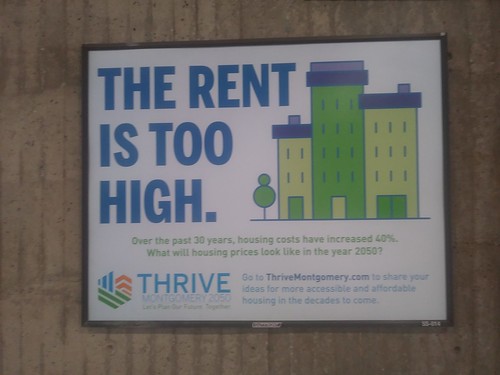
The rent is too high.  Billboard in the Silver Spring Metrorail Station.  Thrive MontgomeryOrganizations like Jubilee do this, but they probably aren't super active acquirers in the way and scale that I am thinking about.

The second thing is community land trusts. I know some have been created in the city, but they are far too late to the game to make much difference.

And the only real successful urban land trust I know about, in Roxbury, Boston, only has about 200 units of housing in their CLT after 25 years. To me that's pretty insignificant.

Other ways to add to the housing supplyADUs.  There should be massive support of the creation of accessory dwellings in the places where they can be developed at scale (both separate units and basement units).

The thing is that it's still expensive to develop such units, as much as $200,000, and the payoff period is 15 years or more, so people have to be altruistically motivated to do so.  Or you can provide incentives and mechanisms for building such units at scale.  In Portland, Oregon, Dweller is a for profit construction organization that focuses on ADUs. 

Two floors being added to an apartment building off Kennedy Street NW (maybe on 9th Street)Intensifying smaller properties into larger properties (e.g., 3 story apartment buildings on Fort Totten Drive could become 6 story buildings).

The building pictured at left, I think is at 9th and Kennedy Streets NW. 

I don't have a problem with intensification, I just want the building facades to be quality, e.g., if the building is brick, the new part should be brick also.

But surgical projects like these could add a lot of housing units.

Single Room Occupancy Housing to deal with the "homeless crisis." It's not clear how many units we have in the city, formally, but it's likely less than 1000 (So Others Might Eat has more than 600 units, but they never returned my calls when I wanted to write about it).

-- "One of the "solutions" to the crisis of homelessness is a lot more SRO housing," 2017

Opportunity costs for not building to reasonable density.  Plenty of buildings aren't built larger either because of zoning restrictions or placation of opposition to development.

The Willow + Maple Apartments are about three blocks from the Takoma Metrorail Station.  Even one more floor would have added 40 units.

And we're not talking skyscrapers.  We're talking two-story buildings that could be four-story.  Four- or five-story buildings that could be six- or seven-stories (like at Fort Totten Metro).

But this comes at a great cost.  Fewer units mean housing costs more.  Fewer units means DC makes less revenue in terms of personal income and sales taxes, property taxes, and commercial income taxes for rented buildings.  It means fewer people to support local commercial districts.  Fewer eyes on the street, etc.

But mostly, it means higher priced housing and more displacement.

Creating implementation organizations to do this at scale: community development corporations.  DC relies on for profit develoeprs to build housing, alongside mostly small community housing organizations.

WRT the Purple Line light rail program and its likely negative impact on maintaining housing affordability in communities like Langley Park, stating that PG and Montgomery Counties needed to create a community development corporation tasked with the responsibility of buying, holding, developing, and funding the maintenance of affordable housing (and other stuff too).

-- "Creating a transportation development authority in Montgomery and Prince George's County to effectuate placemaking, retail development, and housing programs in association with the Purple Line," 2017

The same goes with housing policy in DC. You need implementation organizations that can do it.

Integrating social housing in large scale redevelopment programs.  In writing about revitalization and housing planning initiatives in Europe, I learned that in cities like Helsinki, when they do master planning, from the outset they carve out sites within the project that are allocated to social housing organizations for the creation of new housing that is 100% affordable and complementary to the sites that are allocated to the creation of market rate housing.

One of the things I wanted to try to do was to create a bid team for the redevelopment project at the Armed Forces Retirement Home, to do just that.  But the likelihood of pulling that off was low.  Not just getting for profit developers together, but getting them to agree to give up some of the parcels to social housing.

It's the kind of thing DC should have done with the redevelopment program for Walter Reed, and the Hebrew Home for the Aging on Spring Street NW.

(Although I was super impressed that Empower DC pulled together a team to bid on the Alexander Crummell School site in Ivy City. It was a shame that they did not win.)

Building affordable units in otherwise market rate projects isn't enough.  We need some buildings in such situations that are 100% affordable. And similarly, many city owned properties need to be used for 100% affordable projects.  Maybe not all of them, but definitely more than none.

Tampa, because they don't have enough money to renovate their public housing, is doing some site redevelopment in a similar fashion, but in reverse, allocating space to market rate housing, and using the money for renovation of social housing. (This has been proposed in NYC too, and people are not in favor.)  But they aren't reducing the number of units that already exist, and they are building more social housing units.


Conclusion.  The biggest thing I've learned being involved in this stuff for not quite 20 years is that you need robust plans in place before market interest changes significantly, not after.

It's not like people don't know what best practice is.

Why it's not being effectuated in DC is another issue. Although DC does a bunch of things that help. The Housing Trust Fund, the law that allows tenants of apartment buildings to organize and buy the property if it is put up for sale, etc.

But the scale and velocity of the "problem" is significantly greater than the organizational mechanisms available to address it.

As long as we rely on the market to be the primary developer and operator of housing, we'll continue to be in the position we are in.

Labels: , , , , ,