Rebuilding Place in the Urban Space

"A community’s physical form, rather than its land uses, is its most intrinsic and enduring characteristic." [Katz, EPA] This blog focuses on place and placemaking and all that makes it work--historic preservation, urban design, transportation, asset-based community development, arts & cultural development, commercial district revitalization, tourism & destination development, and quality of life advocacy--along with doses of civic engagement and good governance watchdogging.

Wednesday, January 22, 2020

Historic Filipinotown, Los Angeles, as another example of real estate capital-driven arbitrage

In the same vein as the recent blog entry on the Parkdale neighborhood of Toronto, "'Real estate capital reproduction of space' in the Parkdale neighborhood of Toronto," the Los Angeles Times has an article ("As Historic Filipinotown gentrifies, imagining a different future") about gentrification in the Historic Filipinotown district, which historically had not experienced significant demographic change.

One of the interesting things pointed out in the article is how buildings under rent control actually represent a significant opportunity to increase rents, provided that expensive renovations are made.  From the article:
Surrounded by more expensive housing markets, Historic Filipinotown is one of the last places in central Los Angeles where cooks, housekeepers, Uber drivers and new immigrants can afford to live. Alumit’s mother, a nurse, and his father, a security guard, saved everything they had to buy a home here in 1978. The neighborhood’s median income of about $26,700 is about 40% of the county’s median, and about 95% of residents are renters.

But Historic Filipinotown’s affordability is also the source of its vulnerability. According to an analysis by the UCLA Law Review, about 620 buildings in the area are subject to rent control laws, which makes the properties more tempting to buyers because the potential profits from raising rent would be much higher.
I thought that was a very interesting point. It's not uncommon for improvements in rent controlled buildings to lag, because of the complicated regulatory process, especially if the buildings are locally owned.

But large companies with access to cheap capital see such buildings as an opportunity to rapidly increase rents if wholesale improvements are made.

See the Curbed LA articles:

-- "657 rent-controlled apartments stripped from LA’s rental market in three months," 2019
-- "Tenants sue Historic Filipinotown apartment building owner for harassment," 2017

======
Interestingly, looking up the mentioned UCLA Law Review article, it turns out that the school organized a "clinic/class" on "Gentrification, Displacement, and Dispossession":
In Spring of 2018, a seminar at UCLA School of Law brought together a group of graduate students and law students to trace the current manifestations of the U.S. property law system to its historical origins. From it emerged this collection of pieces, in which students, professors, and practitioners examine the present-day effects of gentrification, displacement, and dispossession in and surrounding Los Angeles.
What a useful class!  Granted plenty of law schools offer legal clinic programs, which provide a lot of help to people within the served communities.  But law schools turn out a lot of scholarship too that is applicable to local situations, but rarely is this knowledge stream tapped.

Here's the full set of articles:

-- "Dispatches from the Other Side of Development" by K-Sue Park
-- "Living Poor in the Affluent City" by Scott L. Cummings
-- "Los Angeles, Displacement, and the Rise of Airbnb" by Alex Scott
-- ">Losing Historic Filipinotown by Ysabel Jurado
-- "Dialectic Episode: Reclaiming Land Use Law: Using People Power to Guide Development" Dialectic hosts Sunjana Supekar and Jason Lawler talk with Doug Smith, Ysabel Jurado, and Joe Donlin about the role of community planning in combating gentrification in Los Angeles.
-- "Protecting Mobile Homes as Affordable Housing" by Soham Dhesi
-- "The Limits of Land Reform: A Comment on Community Land Trusts" by Daniel Foster
-- "Public Land for Public Good: How Community Groups Are Influencing the Disposition of Public Land to Help Address the Affordable Housing Crisis" by Katie McKeon & Doug Smith
-- "Local Control of Land and Water Resources: Rethinking California’s Eminent Domain Standard" by Mia Lattanzi
-- "From Chavez Ravine to Inglewood: How Stadiums Facilitate Displacement in Los Angeles" by Laylaa Abdul-Khabir
-- "We Shall Not Be Moved: Practitioners' Perspectives on Law and Organizing in Response to California's Housing Crisis" by Tyler Anderson, Terra Graziani & Kyle Nelson


Labels: , , , , ,

Thursday, January 16, 2020

"Real estate capital reproduction of space" in the Parkdale neighborhood of Toronto

-- "reproduction of space," urban sociology

Instagram image, davin.craig.

The Guardian has an article about "the gentrification" of the Parkdale neighborhood of Toronto ("'My Parkdale is gone': how gentrification reached the one place that seemed immune"), but I don't think the word "gentrification" adequately describes the process.

Basically, the neighborhood became identified as an opportunity for the international/national real estate ownership, management, and development, acknowledged as an economically significant  "node" or "submarket" within the system of international real estate capital. From the article:
But the lively streetscape here masks a threat to what could very well be the last island of diversity in a city swamped by the flood waters of global capital. Huge international real estate investment firms have embedded themselves in Parkdale’s urban fabric, buying dozens of apartment towers and thousands of rental units. Residents claim that threats, intimidation, rampant eviction notices and strategic neglect have become common. So too have tenant protests and rent strikes, where slick corporate offices find themselves occupied by hundreds of angry tenants demanding redress. ...

“There goes another community center,” quipped the Instagram account @parkdalelife about an infamous all-night McDonald’s being demolished to make way for a 700-plus unit luxury condo building, leeringly named “XO.” It was just the kind of hipster fatalism that infects neighbourhoods in the grips of late-stage gentrification.
That's a much bigger and more significant phenomenon than the "property value reproduction process" referred to as gentrification, which can be more of a ground up movement, where people see the value in place and location and the opportunity for property value appreciation.

Capital reproduction is on a much bigger scale.

On a much smaller basis, this kind of capital reproduction is what happened with the commercial district section of the H Street NE neighborhood in Washington DC ("H Street NE Commercial District Revitalization | H Street Festival" and "360 Apartment building + Giant Supermarket vs. a BP gas station, which would you choose?") where I was a co-founder of a neighborhood revitalization effort that so far has resulted in more than $1 billion in development either completed or underway (many other parallel efforts contributed to this).

But when I started I was pretty much a rube and outside of reading business sections of newspapers and magazines for 30+ years, I didn't have a fine-grained understanding of how things work.

Once the city released the revitalization plan for the neighborhood, recognizing that DC was a node within the international system of real estate capital*, national brokerage firms like Marcus & Millichap went in and inventoried every property, every opportunity, and put it in a database available to clients (that's what the real estate information firm CoStar does too).

Community anger is strong and has resulted in a number of protests and campaigns. Photograph: Rene Johnston/Toronto Star via Getty Images.

Once it was mapped and opportunities identified, it became much easier to redevelop.

But the difference in scale between Parkdale and H Street is significant.  Parkdale is bigger, denser--35,000 residents and a planning regime that allows for very large buildings, which DC does not-- and has dozens if not hundreds of very large buildings.

By contrast, H Street NE's opportunities are much smaller.  Still significant, especially at the scale of the neighborhood, district/submarket, and city, but by comparison to Parkdale, much smaller.

* In DC, outside of the center city and a few other submarkets, mostly development is a matter of regional players, not national or international players.

Parkdale has attracted big firms from Europe.  From the article:
... Akelius, the Swedish real estate juggernaut with some $8bn in global assets settled its gaze on Toronto in 2011, Parkdale was a low-income immigrant neighbourhood. But it was no longer a bleak urban sinkhole. Thanks to the Tibetan community, and the hipster incursion that the Tibetans’ stabilising presence had drawn, it was an opportunity.

In 2012, the firm started acquiring mid and high rise concrete slab apartment buildings in Toronto; by 2016, it had amassed 37, and more than 3,000 apartment units. ...

Akelius had already developed a successful business model in Sweden, Germany and the UK: identify neighbourhoods adjacent to fully gentrified districts – like Kreuzberg, a longstanding haven for Berlin’s Turkish population – and exploit the undercapitalization of its rental housing.
A Parkdale apartment building owned by MetCapital.  Image from the Toronto Star article "Parkdale rent strike over repairs, above-guideline increases ends with tenants declaring victory."

That's one firm. At this point, the entire H Street market for apartments might total around 3,000 units.  From "Akelius stocking up on Toronto and Montreal apartments":
Akelius Canada is a subsidiary of Sweden’s Akelius Residential Property AB, which was founded in 1994 and owns more than 51,000 properties valued at around $9 billion in Sweden, Canada, Germany and the United Kingdom.
The article describes the trajectory of change in Parkdale, how because it was outside the city center, and dealing with the aftermath of deindustrialization and the impact on the micro property market, it wasn't seen as a place where "gentrification" would really occur. From the article:
Gentrification, on the surface, seemed less of a threat than an impossibility. As the rest of Toronto surged upward in the early 2000s, Parkdale was forever “up and coming” – real estate code for a litany of social ills – and a target for only the heartiest of speculators. Some did come, sprucing up half a block here, a cluster of houses there, but Toronto’s real estate boom left Parkdale’s intractable poverty largely intact.
But the reality is that less than 4 miles from Toronto's downtown, in one of the nation's top two property markets, in a city that is a node in the international system of real estate capital, with large scale opportunities for portfolio investment, it was only a matter of time, as better placed development and acquisition opportunities in the primary market were absorbed.

Interestingly, because the scale is different, with large apartments, there is also the opportunity for tenant organizing, and Parkdale residents are protesting changes, and at least in terms of legally too large rent increases, they are having some effect, assisted in part by the neighborhood-based Parkdale Community and Legal Services nonprofit legal aid clinic.

But the article also discusses a nascent community land trust effort, which is too little too late. And maybe Toronto and Canada don't have community development corporations the same way that we do in the US. CDCs could have purchased properties in order to maintain permanent affordability.  (Not that CDCs do a lot of this in the US either.)

Then again, Toronto has found the need to provide assistance to "tower buildings" in terms of rehab support and other technical assistance to maintain the viability of such buildings as they are.

-- "The long term potentially negative aspects of condominium buildings as a dominant housing form in cities," 2016

Labels: , , , ,

Sunday, March 04, 2018

BTMFBA Chronicles: Seattle coffee shop raises money to buy its building

In writing comments on the DC Cultural Plan draft, while the survey of current conditions wasn't particularly detailed, it was surprisingly direct about the reality of DC's high value real estate environment making it difficult for arts organizations and low paid artists to compete for space for working and living.

Given that excepting extraordinary events, building prices only go up, they don't fall, the recommendations for action in the Cultural Plan aren't particularly direct and come up short.  Typical of many final planning documents produced by the office, you don't get any sense of urgency that not only is action required, that now is the time to act.

For example, in reading about the history of the BART transit system, they had an early director who always made the point that "the cheapest time to build transit is now because costs of land, labor and materials only go up."

I have some writings that get directly to the point concerning facilities and spaces for arts and culture: buy the f* building.

-- "BTMFBA: the best way to ward off artist or retail displacement is to buy the building
-- "BTMFBA revisited: nonprofits and facilities planning and acquisition"
-- "BTMFBA: artists and Los Angeles"
-- "When BTMFBA isn't enough: keeping civic assets public through cy pres review

In terms of making a direct and obvious recommendation about the necessity of buying buildings (and in the case of artist/workforce housing, building it), and creating "culturally-focused" community development corporations to do so, the DC Cultural Plan fails as there is no such recommendation.

The West Seattle blog reports ("'It is a home. It is YOUR home’: C & P Coffee announces it’s raised the money ‘to purchase and preserve the coffee house’") on how C&P Coffee, faced with their landlord's putting the building up for sale, managed to organize a successful crowd funding campaign through GoFundMe and is buying the building.

Model leases?  Another element of this from a learning standpoint is that somehow C&P had a clause in their lease giving them the right of first refusal to purchase the property. In fact, the property owner had accepted another offer, but the coffee shop was able to assert their contractual rights and buy the property.

I don't know if there is a document out there recommending master lease clauses designed to best protect the interests of independent retailers, arts organizations, and other nonprofits.

There should be. I know that Maryland has the Maryland Volunteer Lawyers for the Arts organization and it's worth checking in with them to see.

Labels: , , , , , , , ,

Thursday, November 02, 2017

BTMFBA: artists and Los Angeles

BTMFBA = Buy the M*t*er F****** Building Already

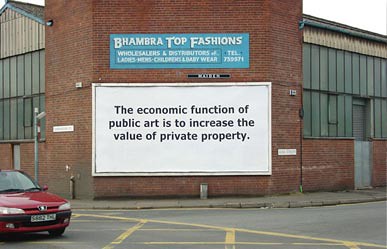
Hewitt & Jordan - The Economic Function.jpg
The Economic Function, by Hewitt & Jordan, Billboard text at the corner of Corporation Street & Alma Street, Sheffield S3. 6 April - 20 April 2004.

The work 'The economic function of public art is to increase the value of private property' sets out to question the function of art in the public realm within the economic regeneration of post industrial cities. The image will accompany a text in a journal by Public Art Forum to be published later this year.

This work is the second part of a commission for Public Art Forum. It completes the project 'I Won an Artist in a Raffle' where Hewitt & Jordan presented themselves as a prize to the delegates at the Public Art Forum conference held in London in April 2003. This work is for Allia Ali a project assistant at commissions East who won Hewitt & Jordan in the raffle.


There is the long held trope that artists help to stabilize and rebrand declining and disinvested areas, only to get displaced as the areas become improved and more suitable for people not willing to put up with crime and other problems (Loft Living: Culture and Capital in Urban Change - Sharon Zukin).

It's true.  But it's also the way that market capitalism works.  And artists aren't particularly unique, just a different form of immigrant, like Somalis in Minneapolis, Vietnamese in Clarendon, Arlington County, Virginia, or Latinos in DC's First Ward, and comparable to how other disenfranchised groups, gays too such as in the Logan Circle area of DC, ended up in areas that at the time had low housing demand and therefore, even if only comparatively, low cost housing.

Because market economies tend not to value the production of cultural, social, and public goods, people who choose to make such goods tend to not make a lot of money.  So if a neighborhood becomes a valued choice, it is pre-ordained that people who make less money will lose out to people who make more money.

Tired of seeing articles about "artists" getting displaced, because the articles say the same thing over and over and over, I wrote "BTMFBA: the best way to ward off artist or retail displacement is to buy the building," (and "The song remains the same: DC's continued failures in cultural planning"), making the point that what artists, arts disciplines, and independent retailers need are "community development corporations" focused on buying and retaining properties for artists, arts uses, and retail uses.

It's a follow up to the 2009 piece, "Arts, culture districts, and revitalization" which discusses arts-based revitalization, the difference between arts as production versus arts as consumption, and the argument that artistic disciplines need to produce their own comprehensive plans, rather than expect real estate developers to do it for them.

It comes up again because Hyperallergic, the arts e-letter and website, has an article, "Facing Displacement, Artists Host an “Eviction Parade” in Los Angeles," about what I think is a cool action by the Los Angeles Tenants Union, an "open studios" tour of artists soon-to-be evicted, because they can't pay rising rents.

Eviction Parade
Saturday
5:00 PM - 6:30 PM
Japanese American Cultural & Community Center
244 S. San Pedro Street
Downtown Los Angeles


From the webpage:

ALMLA: Artists’ Loft Museum Los Angeles celebrates the history of long-time artist-tenants who have been and are currently being displaced and evicted on the east side of Downtown Los Angeles, in an area now branded by real estate developers as the Arts District. We will celebrate, march, banner, float and parade from the Isamu Noguchi courtyard in Little Tokyo to ALMLA and 800 Traction, two of the earliest permitted Artist-in-Residence sites currently challenging their displacement and eviction from the neighborhood that capitalizes on their name. At 5pm we will depart from the Noguchi courtyard at JACCC, walk down 2nd Street to Alameda Street, and then south to ALMLA at 454 Seaton Street #1. Mounted at ALMLA is a retrospective of the work of 40 artists who have lived or worked there over the past 16 years. The museum is still occupied by long-time artist-tenants, and their five studios will be open for the event. After a brief pitstop at ALMLA, we will parade to 800 Traction for the finale, which includes a group show of young artists who are working with the senior citizen artist-tenants who are being evicted after 20-34 years of living at 800 Traction.
Also see "At the Artists' Loft Museum, Longtime Arts District Residents Are Refusing to Be Erased," LA Weekly.

But sponsors of the eviction parade such as the Philip and Muriel Berman Foundation and the Wilhelm Family Foundation would have a lot more impact if they would buy, hold and maintain properties containing live-work studios, workspaces, and arts spaces, while offering permanently affordable rents.

It's the rare demonstration that gets commercial property owners to back off.  That being said, it's a creative idea--the "parade"--which will bring attention to the issue. 

But it's hard to organize and finance a community development corporation quickly, so unless someone like Eli Broad or David Geffen is willing to step in--and these two stalwarts of the LA arts community are focused on supporting high culture arts presenting organizations--it's hard to see a path for effective practice that will stop the evictions.

According to the Eviction Parade webpage:
The parade is part of this year’s Common Field Convening, a four-day event that brings together hundreds of arts organizations to explore the field of artist-run and artist-focused spaces and projects. It will directly follow a panel discussion on Evictions, Artists and Displacement, featuring Parker, Nancy Uyemura of 800 Traction, artist Robby Herbst, artist and curator Dulce Soledad Ibarra, and writer Julian Smith-Newman.
I would hope there would be a session on creating CDCs to buy, hold, and operate properties. Such a program doesn't seem to be on the program schedule of the Common Field Convening conference, which starts today.

Arts property initiatives tend to be focused on arts organizations and spaces, not on artist residences and live-work spaces.  Still there are analogous examples of buying, developing, and holding multi-faceted properties for cultural and social uses by nonprofits, including some housing initiatives:

-- Playhouse Square in Cleveland ("PlayhouseSquare stars in its own real estate revival," Cleveland Plain Dealer)
-- Pittsburgh Cultural Trust (Pittsburgh Cultural Trust maintains diverse real estate portfolio to support arts," Pittsburgh Post-Gazette; "How the Arts Drove Pittsburgh's Revitalization," The Atlantic)
-- Gordon Square Arts District, Cleveland ("The Gordon Square Arts District finishes its $30 million capital campaign - and launches a new master plan," Cleveland Plain Dealer)
-- Penn Avenue Arts Initiative, Pittsburgh ("A Transformed Penn Avenue," Pittsburgh Magazine)
-- Creative Alliance at the Patterson, Baltimore
-- Seawall Development's creation of housing for teachers in Baltimore is now being exported to other cities (("A Baltimore Tin Can Plant Transformed into a Community Hub," Metropolis Magazine; "Union Mill development goes to the head of the class," Baltimore Sun)
-- Jubilee Housing of Baltimore ("Tax credits for affordable housing fund homes for artists," Baltimore Sun
-- SEMAEST in Paris. According to Next Paris ("Opération Vital'Quartier: pour le commerce de proximité à Paris!") so far the initiative has supported 372 businesses in more than 500,000 s.f. of space.
-- ArtSpace is a national organization that works with local organizations to develop artist housing, although they aren't always focused on building the capacity of local nonprofits and artistic disciplines in the places where they build housing
-- and the groups that are members of the Nonprofit Centers Network do similar work, creating "shared spaces" for nonprofits, which have similar needs, but may not be arts organizations ("BTMFBA revisited: nonprofits and facilities planning and acquisition")
-- Fourth Arts Block in Manhattan's Lower East Side

Also see "The quest for community-run commercial space," UrbanOmnibus.

Labels: , , , , , , , ,

Tuesday, March 24, 2015

Historic Preservation Tuesday: Historic preservation and public history: whose history is history anyway?

========
This is a reprint from March 31st, 2009.  Slight edits...
========

There is no question that many people don't understand historic preservation of the "every day" -- preservation of neighborhoods -- in the same way that they understand the preservation of buildings, sites, and places that relate in some way to what we might call "the grand forces of history."

Remember that I call preservation of "every day" history the nexus of place, architecture and people (history).

The same kind of movement has happened in the discipline of history (historical studies) and the development of the subfield of "public history." According to the National Council of Public History, in the webpage What is Public History?:
Over the years as the field has evolved there have been numerous definitions of public history. Recently the NCPH Board of Directors described public history as “a movement, methodology, and approach that promotes the collaborative study and practice of history; its practitioners embrace a mission to make their special insights accessible and useful to the public.”
Public history is "where historians and their various publics collaborate in trying to make the past useful to the public." (See article below). That is, public history is the conceptualization and practice of historical activities with one’s public audience foremost in mind. It generally takes place in settings beyond the traditional classroom. Its practitioners often see themselves as mediators on the one hand between the academic practice of history and non-academics and on the other between the various interests in society that seek to create historical understanding.
For me, the difference is communicated very clearly through two different newspaper articles. This morning's Post reports the obituary of Theresa Brown, the "Theresa F. Brown Dies at 86; Advocate for Preserving Historic D.C. Neighborhood" -- but the headline in the paper is better "Tenacious Protector of LeDroit Park."

She led the effort to stabilize and improve the LeDroit Park neighborhood of Washington, DC, one that had been home to the city's "upper crust" African-Americans for many decades, but had declined along with other neighborhoods in the city due to population loss and then the impact of the riots.

From the article:
Hammered by the 1968 riots and the flight of both residents and businesses, LeDroit Park took on a shabby appearance. Homes were left vacant, drug dealers moved in, and Howard University's expansion ate away at the edges of the area. Mrs. Brown, who worked for the old Chesapeake and Potomac Telephone Co. and was one of the first black women hired for its Baltimore office, told whoever asked that although she couldn't afford to live in the best neighborhood, she could work to make her own neighborhood the best. So she set to it.
She formed the LeDroit Park Preservation Society and began educating residents about their area's history. The tree-lined streets and landscaped traffic circles remained, as did 50 of the original 64 large homes, featuring beautiful tile roofs and gingerbread trim, expansive chimneys, iron grillwork, solid wood porch columns, bay windows and high ceilings.
In 1974, the neighborhood became an officially registered historic district. Some of her neighbors thought it silly, Mrs. Brown told The Washington Post in 2001. "I didn't care what the neighbors thought," she said. "There weren't enough of them to get in my way. I just kept going."
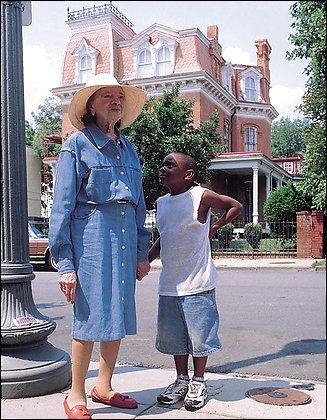
Theresa F. Brown, LeDroit Park
Theresa F. Brown poses with a child in her beloved LeDroit Park, a neighborhood filled with history. (By James Kenah)

I feel a kinship with Theresa Brown because we both got involved in our neighborhoods in the face of disinvestment, and in searching for strategies for improvement, we came to understand the value of historic preservation as the foundation of successful urban revitalization.

I met her in 2002, at the Annual Meeting of the National Trust for Historic Preservation, which was held in Cleveland. The year before, she received an award from the Trust, as a "Pioneer Preservationist."

I had talked to her on the phone once in 2001, when I was desperately seeking insight on how to present and portray the value of historic preservation in the H Street NE neighborhood.

I had applied for a grant on behalf of the Near Northeast Citizens group to begin a survey of the neighborhood. But opposition developed (at the time, I didn't realize that the opposition had been organized by supporters of the H Street Community Development Corporation, which did not favor preservation-based strategies). (She sent me on to her protege, Alan Rogers, who was very helpful.)

No to Landmark Districting
Amanda Rivkin for The New York Times. Some residents say the East Village is not as significant as other city landmark districts.

Then, there is an article in the New York Times, "Challenge to Landmark Law Worries Preservationists," which discusses how Carol Mrowka is suing the City of Chicago, because she believes "her neighborhood isn't a landmark."  From the article:
Carol Mrowka considers her East Village neighborhood here attractive, comfortable — and ordinary. So when the city deemed the area an official landmark, Ms. Mrowka found it absurd and went to court. 
“Sure, it’s a nice neighborhood,” said Ms. Mrowka, a real estate agent who moved 12 years ago to the neighborhood, north and west of the Loop, with its cottages and small, flat buildings that were home to immigrants in the late 1800s. “The basic style of the buildings is pretty, but this is not a landmark.”
I didn't know about this suit until the article, but it would be pretty simple to lay out the argumentation in favor of the designation of neighborhoods as landmarks.

bungalows in Chicago
Simple bungalows in Chicago. Woodstock Institute photo.

And it is no surprise that "real estate" interests are fighting preservation, just as they did in the H Street neighborhood. Especially given that Chicago laws are very loose in terms of allowing teardowns of traditional buildings, and replacement with condos.

Preservation Chicago has called attention to this by including neighborhoods on its year to year lists of threats to preservation, the Pilsen Neighborhood in 2006, and the Sheffield Historic District in 2005.

And the Chicago Tribune has two incredible series of articles on how business interests run roughshod over preservation and neighborhood livability in the city, see "Neighborhoods for Sale" and "Squandered Heritage."  [Active links to "Squandered Heritage" are in the right sidebar.  "Neighborhoods for Sale" still works.]

But it does communicate very well this dilemma over what is and isn't history.

I think too often that people learned in school that history (and the process of research and writing also) is something that is not part of us, that we aren't part of history and we don't make history

That in a nutshell encapsulates the difference in approach to what historic preservation and history is and could or should be. History of "other people" vs. history of the every day, but history of the every day that explains and informs the history of urban development, and the creation and maintenance of neighborhoods, of transportation, of metropolitan regions, of architecture, of municipalities, etc.

And of course, we have the same dissension over this dichotomy in Washington. In fact, opposition to the survey effort in the H Street neighborhood in 2001 was an early instance of the kind of opposition we see as a matter of course in DC today, in places like Tenleytown (Armsleigh Park), Brookland, Chevy Chase, and Lanier Heights.

In the same vein as how do you record and recognize history, today's Seattle Times reports that "Jimi Hendrix childhood home torn down."  One issue with "house museums" is that there generally isn't the interest and demand as well as the ongoing funds to maintain a "preserved" house, once it has been "saved."

Also see "'Uncle Tom's Cabin' Will Open to Visitors" from the Washington Post, about the preservation of a building in Montgomery County that was thought to be the place that inspired the book Uncle Tom's Cabin., [but it turned out that wasn't the case ("Turns out $1M 'real' Uncle Tom's cabin isn't the real one." USA Today).]

Or I remember when real estate interests put Brookland's Ralph Bunche house on the market at a price at least higher by $500,000-$800,000 than what the house would be worth as a place to live in... but the "exchange value" of the price difference in this case wasn't intended to go towards preserving history, but to the pockets of the sellers. (They weren't able to sell it at that price.)

Tough issues.

Labels: , , , ,