Rebuilding Place in the Urban Space

"A community’s physical form, rather than its land uses, is its most intrinsic and enduring characteristic." [Katz, EPA] This blog focuses on place and placemaking and all that makes it work--historic preservation, urban design, transportation, asset-based community development, arts & cultural development, commercial district revitalization, tourism & destination development, and quality of life advocacy--along with doses of civic engagement and good governance watchdogging.

Wednesday, February 12, 2020

Moms 4 Housing in Oakland California raise the concept of tenant right to purchase laws

One of the things about "capital" is that well funded operators are situated to take advantage of downturns.

Reproducing at scale single family housing for the rental market.  With the last recession, in a quantum change for the single family housing market, large well funded Wall Street operators like Blackstone bought thousands of foreclosed houses and started renting them out ("Blackstone cashes out on Invitation Homes," HousingWire).

This shouldn't be a surprise.  Large organizations like banks would rather sell chunks of their portfolio in one fell swoop, to other larger operators, rather than one by one to individuals.

While some companies rehabilitate these properties and eventually sell them off, many do not and a significant tranche of this housing has been shifted to the rental market permanently.

Image from The Intercept article "OAKLAND’S MOMS 4 HOUSING WERE EVICTED BY A GIANT CORPORATION THAT RUNS NATIONAL HOME-FLIPPING OPERATION."

But another phenomenon within the national market for real estate property and financing is the creation of firms that flip single family properties--buy properties, fix them up (either well or badly), and sell them--usually contributing to a resetting of the pricing within the subdistrict.

They've also created a system to enable small real estate investors to invest in properties outside of their local area, both in terms of fixing and selling properties, and also in managing properties, which makes it much easier for out-of-market investors to own such properties ("Startups Reshape Home Investing," Wall Street Journal, 1/8/20).

One such firm is Wedgewood Properties ("Examining Wedgewood: A Look at the Home-Flipping Giant in Battle with Homeless Mothers," NBC San Francisco).

Moms 4 Housing.  In Oakland California the activist group Moms 4 Housing shifted the debate ("When Cops Evicted These Moms, the Housing Conversation Changed," Yes Magazine).  A couple of homeless families decided to squat in a house that had been vacant for many years.  From the article:
The house had sat vacant for several years. Walker and a woman named Sameerah Karim and their children moved into the house in November 2019. The two longtime Oaklanders were homeless and thought it made more sense for them and their families to live there than to leave it empty.

They call themselves Moms 4 Housing. During their occupation, they cleaned up the home. Community members donated furniture. They were later joined in the home by two more Black homeless mothers named Tolani King and Misty Cross.

The occupation was always about more than just putting a roof over their heads. It was also a campaign to call attention to the role housing speculation was playing in Oakland’s gentrification, displacement, and homelessness crisis.

The house on Magnolia Street had been bought for $501,000 in August by Wedgewood Properties, one of Oakland’s most prolific home flippers. The San Francisco Chronicle reported that Wedgewood had rehabbed and sold about 160 homes there in the past nine years.
While they were evicted, attention brought to the case means that they might get to go back to the house, as the city is negotiating with the property owner to sell to the Oakland Community Land Trust, which would then sell or rent the house to the Moms 4 Housing, with an easement on the property maintaining its affordability.  From the article:
In exchange for the lower-than-market sale price, CLT buyers who later move out agree to also sell the home at a below-market rate to income-qualified buyers. The owners are able to build some wealth off their home’s equity, but less than they likely would if they’d been able to buy a market-price home. Even with less equity, CLT supporters say, the model still gives lower-income residents access to stable housing and wealth generation they likely wouldn’t have otherwise in a high-cost market such as the Bay Area.
AU Professor Carolyn Gallaher authored a book, The Politics of Staying Put: Condo Conversion and Tenant Right-to-Buy in Washington, DC, on the DC Act. (Interview with the author in Washingtonian Magazine.)

Tenant right to purchase on sale clause legislation being considered.  Like how DC has a Tenant Opportunity to Purchase Act (TOPA) act to give tenants the right of first refusal to buy a property when its sold, Oakland and other Bay Area communities are now considering passage of similar laws ("Moms 4 Housing-inspired policy could shake up Oakland real estate market," San Jose Mercury News).

Although more recently DC changed the TOPA law, so it no longer pertains to single family dwellings, only multiunit properties.

DC isn't a place where private equity has assembled a large portfolio of single family housing.  In places where that is the case, TOPA-type laws should not except single family housing from the mix, although individually owned properties probably should be exempt, unless a tenant has lived there "for a long time".

Labels: , , , , , ,

Sunday, February 02, 2020

University of Maryland proposes a "socially conscious" real estate program

According to The Diamondback, the student newspaper ("A proposed UMD real estate major aims for a socially conscious approach to development"). From the article:
Most real estate development education is focused just on the business, finance and investment side, and when one gets out into the industry, one finds that there’s really a lot more to real estate than just the finance part,” said Donald Linebaugh, interim dean of the architecture, planning and preservation school.

To address real estate’s many disciplines, students within the major must take nine elective credits unrelated to finance. The courses will cover a variety of subjects, including politics, communication and public policy.

Students will graduate with an understanding of historic preservation and urban planning — two areas that can clash with real estate development in large cities like Washington, D.C., Linebaugh said.

Teaching students to consider the impact of development at the community level, Linebaugh said, would help ease tensions between developers and urban planners. In addition, he said the approach would fulfill the school’s “quadruple bottom line”: building developments that are well-financed, socially and environmentally responsible and artfully designed.

“To be done in a way that improves communities, that makes better places,” Linebaugh said, “real estate really needs to be an integrated practice.”
Good luck.

cf. "The Need for Alternatives to the Nineteen Standard Real Estate Product Types," Christopher Leinberger, Places Journal 17:2 (2005)

As Leinberger said in an interview:
“Financiers like to finance commodities...”

I joke that the more I learn about real estate development the more I become an intellectual Marxist. But while Marxism, in its focus on "capital" is great at understanding why things work the way they do, it's not so great for coming up with "solutions" in the context of capitalism.

A socially responsible real estate degree might include a couple of classes and more case studies on social housing, urban revitalization, preservation tax credits, and on housing in Singapore and Vienna, but it's not likely to change the fact that the financing and production system for real estate is global, and that certain neighborhoods, districts, and cities are integrated into that global system, and are impacted in ways that local policy, practice and actors have a difficult time countering.

For example, I just wrote about this in the context of the Parkdale neighborhood of Toronto (""Real estate capital reproduction of space" in the Parkdale neighborhood of Toronto") and LA's Filipinotown ("Historic Filipinotown, Los Angeles, as another example of real estate capital-driven arbitrage") and in the past about DC ("Exogenous market forces impact DC's housing market"), San Francisco ("Applying the super-gentrification thesis to San Francisco, Santa Monica, and other cities experiencing hyper-demand"), and culture spaces ("Dateline Los Angeles: BTMFBA & Transformational Projects Action Planning & arts-related community development corporations as an implementation mechanism to own property") among others.

Also see:

-- "Meet Wall Street's Rent Collector," Wall Street Journal
-- "Centuries-old Grosvenor Group deepens West Coast CRE roots," Real Estate News Exchange
-- "The 19 Building Types That Caused the Recession," CityLab

Labels: , , ,

Wednesday, January 22, 2020

Historic Filipinotown, Los Angeles, as another example of real estate capital-driven arbitrage

In the same vein as the recent blog entry on the Parkdale neighborhood of Toronto, "'Real estate capital reproduction of space' in the Parkdale neighborhood of Toronto," the Los Angeles Times has an article ("As Historic Filipinotown gentrifies, imagining a different future") about gentrification in the Historic Filipinotown district, which historically had not experienced significant demographic change.

One of the interesting things pointed out in the article is how buildings under rent control actually represent a significant opportunity to increase rents, provided that expensive renovations are made.  From the article:
Surrounded by more expensive housing markets, Historic Filipinotown is one of the last places in central Los Angeles where cooks, housekeepers, Uber drivers and new immigrants can afford to live. Alumit’s mother, a nurse, and his father, a security guard, saved everything they had to buy a home here in 1978. The neighborhood’s median income of about $26,700 is about 40% of the county’s median, and about 95% of residents are renters.

But Historic Filipinotown’s affordability is also the source of its vulnerability. According to an analysis by the UCLA Law Review, about 620 buildings in the area are subject to rent control laws, which makes the properties more tempting to buyers because the potential profits from raising rent would be much higher.
I thought that was a very interesting point. It's not uncommon for improvements in rent controlled buildings to lag, because of the complicated regulatory process, especially if the buildings are locally owned.

But large companies with access to cheap capital see such buildings as an opportunity to rapidly increase rents if wholesale improvements are made.

See the Curbed LA articles:

-- "657 rent-controlled apartments stripped from LA’s rental market in three months," 2019
-- "Tenants sue Historic Filipinotown apartment building owner for harassment," 2017

======
Interestingly, looking up the mentioned UCLA Law Review article, it turns out that the school organized a "clinic/class" on "Gentrification, Displacement, and Dispossession":
In Spring of 2018, a seminar at UCLA School of Law brought together a group of graduate students and law students to trace the current manifestations of the U.S. property law system to its historical origins. From it emerged this collection of pieces, in which students, professors, and practitioners examine the present-day effects of gentrification, displacement, and dispossession in and surrounding Los Angeles.
What a useful class!  Granted plenty of law schools offer legal clinic programs, which provide a lot of help to people within the served communities.  But law schools turn out a lot of scholarship too that is applicable to local situations, but rarely is this knowledge stream tapped.

Here's the full set of articles:

-- "Dispatches from the Other Side of Development" by K-Sue Park
-- "Living Poor in the Affluent City" by Scott L. Cummings
-- "Los Angeles, Displacement, and the Rise of Airbnb" by Alex Scott
-- ">Losing Historic Filipinotown by Ysabel Jurado
-- "Dialectic Episode: Reclaiming Land Use Law: Using People Power to Guide Development" Dialectic hosts Sunjana Supekar and Jason Lawler talk with Doug Smith, Ysabel Jurado, and Joe Donlin about the role of community planning in combating gentrification in Los Angeles.
-- "Protecting Mobile Homes as Affordable Housing" by Soham Dhesi
-- "The Limits of Land Reform: A Comment on Community Land Trusts" by Daniel Foster
-- "Public Land for Public Good: How Community Groups Are Influencing the Disposition of Public Land to Help Address the Affordable Housing Crisis" by Katie McKeon & Doug Smith
-- "Local Control of Land and Water Resources: Rethinking California’s Eminent Domain Standard" by Mia Lattanzi
-- "From Chavez Ravine to Inglewood: How Stadiums Facilitate Displacement in Los Angeles" by Laylaa Abdul-Khabir
-- "We Shall Not Be Moved: Practitioners' Perspectives on Law and Organizing in Response to California's Housing Crisis" by Tyler Anderson, Terra Graziani & Kyle Nelson


Labels: , , , , ,

Thursday, January 16, 2020

"Real estate capital reproduction of space" in the Parkdale neighborhood of Toronto

-- "reproduction of space," urban sociology

Instagram image, davin.craig.

The Guardian has an article about "the gentrification" of the Parkdale neighborhood of Toronto ("'My Parkdale is gone': how gentrification reached the one place that seemed immune"), but I don't think the word "gentrification" adequately describes the process.

Basically, the neighborhood became identified as an opportunity for the international/national real estate ownership, management, and development, acknowledged as an economically significant  "node" or "submarket" within the system of international real estate capital. From the article:
But the lively streetscape here masks a threat to what could very well be the last island of diversity in a city swamped by the flood waters of global capital. Huge international real estate investment firms have embedded themselves in Parkdale’s urban fabric, buying dozens of apartment towers and thousands of rental units. Residents claim that threats, intimidation, rampant eviction notices and strategic neglect have become common. So too have tenant protests and rent strikes, where slick corporate offices find themselves occupied by hundreds of angry tenants demanding redress. ...

“There goes another community center,” quipped the Instagram account @parkdalelife about an infamous all-night McDonald’s being demolished to make way for a 700-plus unit luxury condo building, leeringly named “XO.” It was just the kind of hipster fatalism that infects neighbourhoods in the grips of late-stage gentrification.
That's a much bigger and more significant phenomenon than the "property value reproduction process" referred to as gentrification, which can be more of a ground up movement, where people see the value in place and location and the opportunity for property value appreciation.

Capital reproduction is on a much bigger scale.

On a much smaller basis, this kind of capital reproduction is what happened with the commercial district section of the H Street NE neighborhood in Washington DC ("H Street NE Commercial District Revitalization | H Street Festival" and "360 Apartment building + Giant Supermarket vs. a BP gas station, which would you choose?") where I was a co-founder of a neighborhood revitalization effort that so far has resulted in more than $1 billion in development either completed or underway (many other parallel efforts contributed to this).

But when I started I was pretty much a rube and outside of reading business sections of newspapers and magazines for 30+ years, I didn't have a fine-grained understanding of how things work.

Once the city released the revitalization plan for the neighborhood, recognizing that DC was a node within the international system of real estate capital*, national brokerage firms like Marcus & Millichap went in and inventoried every property, every opportunity, and put it in a database available to clients (that's what the real estate information firm CoStar does too).

Community anger is strong and has resulted in a number of protests and campaigns. Photograph: Rene Johnston/Toronto Star via Getty Images.

Once it was mapped and opportunities identified, it became much easier to redevelop.

But the difference in scale between Parkdale and H Street is significant.  Parkdale is bigger, denser--35,000 residents and a planning regime that allows for very large buildings, which DC does not-- and has dozens if not hundreds of very large buildings.

By contrast, H Street NE's opportunities are much smaller.  Still significant, especially at the scale of the neighborhood, district/submarket, and city, but by comparison to Parkdale, much smaller.

* In DC, outside of the center city and a few other submarkets, mostly development is a matter of regional players, not national or international players.

Parkdale has attracted big firms from Europe.  From the article:
... Akelius, the Swedish real estate juggernaut with some $8bn in global assets settled its gaze on Toronto in 2011, Parkdale was a low-income immigrant neighbourhood. But it was no longer a bleak urban sinkhole. Thanks to the Tibetan community, and the hipster incursion that the Tibetans’ stabilising presence had drawn, it was an opportunity.

In 2012, the firm started acquiring mid and high rise concrete slab apartment buildings in Toronto; by 2016, it had amassed 37, and more than 3,000 apartment units. ...

Akelius had already developed a successful business model in Sweden, Germany and the UK: identify neighbourhoods adjacent to fully gentrified districts – like Kreuzberg, a longstanding haven for Berlin’s Turkish population – and exploit the undercapitalization of its rental housing.
A Parkdale apartment building owned by MetCapital.  Image from the Toronto Star article "Parkdale rent strike over repairs, above-guideline increases ends with tenants declaring victory."

That's one firm. At this point, the entire H Street market for apartments might total around 3,000 units.  From "Akelius stocking up on Toronto and Montreal apartments":
Akelius Canada is a subsidiary of Sweden’s Akelius Residential Property AB, which was founded in 1994 and owns more than 51,000 properties valued at around $9 billion in Sweden, Canada, Germany and the United Kingdom.
The article describes the trajectory of change in Parkdale, how because it was outside the city center, and dealing with the aftermath of deindustrialization and the impact on the micro property market, it wasn't seen as a place where "gentrification" would really occur. From the article:
Gentrification, on the surface, seemed less of a threat than an impossibility. As the rest of Toronto surged upward in the early 2000s, Parkdale was forever “up and coming” – real estate code for a litany of social ills – and a target for only the heartiest of speculators. Some did come, sprucing up half a block here, a cluster of houses there, but Toronto’s real estate boom left Parkdale’s intractable poverty largely intact.
But the reality is that less than 4 miles from Toronto's downtown, in one of the nation's top two property markets, in a city that is a node in the international system of real estate capital, with large scale opportunities for portfolio investment, it was only a matter of time, as better placed development and acquisition opportunities in the primary market were absorbed.

Interestingly, because the scale is different, with large apartments, there is also the opportunity for tenant organizing, and Parkdale residents are protesting changes, and at least in terms of legally too large rent increases, they are having some effect, assisted in part by the neighborhood-based Parkdale Community and Legal Services nonprofit legal aid clinic.

But the article also discusses a nascent community land trust effort, which is too little too late. And maybe Toronto and Canada don't have community development corporations the same way that we do in the US. CDCs could have purchased properties in order to maintain permanent affordability.  (Not that CDCs do a lot of this in the US either.)

Then again, Toronto has found the need to provide assistance to "tower buildings" in terms of rehab support and other technical assistance to maintain the viability of such buildings as they are.

-- "The long term potentially negative aspects of condominium buildings as a dominant housing form in cities," 2016

Labels: , , , ,

Friday, December 11, 2015

Placemaking investments by developers are usually about positive economic returns

The Post has an article ("Washington’s top real estate developer is painting murals in your neighborhood. Is it art or marketing? Or both?") wondering if a real estate developer is funding murals around a property to lure tenants.

Of course they are.

That's what capitalism is all about.

Placemaking for the most part is "an amenity" just like a rooftop deck that makes a property more attractive relative to other properties.

Developers will invest in such amenities as long as the marginal economic return from the investment is positive.  If it is not, they won't make the investment/spend the money.

For the most part, these are "business decisions," not decisions based on noneconomic phenomenon such as "values," although that isn't entirely true.  Portfolio investors understand that investments in the property that make it more attractive pay off in increasing returns over the long time.  Still...

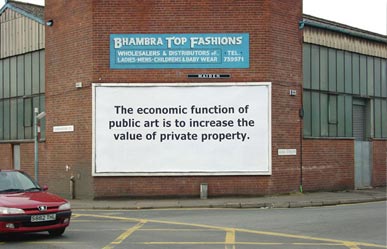
Hewitt & Jordan - The Economic Function.jpgThe Economic Function, Billboard text at the corner of Corporation Street & Alma Street, Sheffield S3. 6 April - 20 April 2004. 

The work 'The economic function of public art is to increase the value of private property' sets out to question the function of art in the public realm within the economic regeneration of post industrial cities. The image will accompany a text in a journal by Public Art Forum to be published later this year. This work is the second part of a commission for Public Art Forum by Hewitt & Jordan.

Also see:

-- "Arts, culture districts, and revitalization
-- "Integrating citizen residents into "business" improvement districts" - this piece discusses "business improvement districts" and how resident interests are under-represented within such organizations, which have de facto control of public space matters in many mixed use districts

Note also that in Greensboro in NovemberJack Becker, founder of Forecast Public Art, a nonprofit addressing public art matters, and publisher of the superlative journal, Public Art Review, lectured on "the complex role of public art."

His talk is online, but I haven't had a chance to watch it yet.

Labels: , , , ,

Wednesday, January 02, 2013

Avis to buy Zipcar

Screen image, Iphone application for ZipcarGiven the success of car sharing in the DC-area, with Flexcar, later acquired by Zipcar, and Zipcar, plus the more recent entry of car sharing operations by Enterprise and Hertz into DC, plus the even more recent entry of the one-way car sharing service, Car2Go, DC must be a hotbed of carsharing in the U.S.

The one thing we don't have in DC is a nonprofit car sharing organization like they do in San Francisco, City Car Share, Philly Car Share in Philadelphia or  in Montreal, Communauto.  The disadvantage that nonprofit car share organizations have is having to raise capital for purchasing vehicles, especially when they have to replace the original fleet.

So that Avis, a major car rental company, is purchasing Zipcar, is quite interesting in what it communicates about car usage as an application or service (see writings on "product service systems" among other things).

See the Associated Press story, "Avis buying Zipcar in deal worth nearly $500M."  Also see "Why the 49% premium Avis paid for Zipcar is a bargain" from Quartz, "Zipcar and the Death of Entrepreneurship" from LinkedIn and "Zipcar: Entrepreneurial Genius, Public-Company Failure" from the Wall Street Journal. (Thanks to Notions Capital for the heads up on the latter articles.)

Note that while I know you can use Zipcars in other North American cities, I didn't realize that they have coverage in some UK cities including London and Barcelona through their acquisition of Avancar (press release).  And apparently the same Zipcar infrastructure works between the systems.  Of course, I've yet to test it out.

I don't think there will be many changes.  The article suggests that the Avis fleet can be used by Zipcar members during peak demand periods.  I don't expect that will happen any time soon as it will require a variety of changes to how Avis manages their cars, plus most of their car rental locations are not in those kinds of places where car share members are likely to be living.

-----
WRT the articles by Dennis Berman about "the death of entrepreneurship," this is an issue, but not in the way that he thinks, at least not to me. The problem has to do with scale and operating in multiple cities and scales. It's a similar process to how in many markets (especially in retail and increasing in retail development, at least in the major metropolitan areas) local operators have been supplanted by national firms. In select markets that are more engaged as part of the global economy, such as the real estate market in major cities like NYC, DC, San Francisco, Seattle, Los Angeles, etc., international developers and financiers may trump even national actors.

It becomes very difficult for comparatively small companies to operate in multiple cities and get access to the necessary capital to build and expand their business. (This by the way is an issue faced by my own business, BicyclePASS. I know how we can position ourselves to be a major force nationally. Capital is a key element in our ability to expand. And patient capital--because in start up phases you lose money, you don't make money--is especially hard to find.)

Labels: , , , , ,