Rebuilding Place in the Urban Space

"A community’s physical form, rather than its land uses, is its most intrinsic and enduring characteristic." [Katz, EPA] This blog focuses on place and placemaking and all that makes it work--historic preservation, urban design, transportation, asset-based community development, arts & cultural development, commercial district revitalization, tourism & destination development, and quality of life advocacy--along with doses of civic engagement and good governance watchdogging.

Wednesday, May 27, 2026

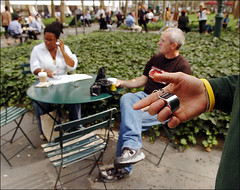
Lady in a seating area off the main lobby at the Sun Valley Resort, Ketchum, Idaho

She's in her 80s.  

Her husband was significantly older and died 10+ years ago.  She's obviously kept spry by doing things in town, she had walking sticks and said she hikes and skis.

Besides telling us about the happy hour specials and setting at Hotel Lamplight, she had stories to tell.

She lived in San Francisco's Haight Asbury district in the 1960s.  Got her PhD in British Literature.  Married her husband because he was a Brit.  

Loves skiing.  They would leave Sun Valley every year for two weeks in Switzerland.

Before all that, she volunteered for the voting rights registration campaigns in the South.  She knew Martin Luther King, Jr.  She said he was handsome but too short to sleep with.

Labels:

Saturday, February 21, 2026

Does the US need a set of national urban parks? | Revisiting a comment from 2019

I bring this up because reading "backfile" articles about architecture and parks in the Toronto Globe and Mail, there is this year old article, "What Canada’s only national urban park can teach us about accessible, eco-friendly design." 

The Rouge National Urban Park is 30 minutes outside of Toronto, and is transit accessible ("One of the largest urban parks in North America is in Toronto and you can get there for free"), unlike most of the Canadian national parks in rural areas. (Or many US national parks and related federal park-type facilities.)

It's a single park unit, not an amalgamation of sites like an NPS National Recreation Area spanning multiple sites in an area like SF, Boston, Long Island, New York or outside Atlanta.

(WRT access issues and DC area national parks, see "A gap in planning across agencies: Prioritizing park access for pedestrians, bicyclists and transit users compared to motor vehicle access" and "Revisiting: Access to Theodore Roosevelt Island, a national park in Washington, DC.")

Nor is it a National Heritage Area which typically isn't urban-focused specifically, they are focused on a large region and interpreting it thematically, such as the Rivers of Steel NHA for Greater Pittsburgh (although the one in Baltimore is; Boston has a National Historical Park including many different sites), but an area of historic interested spread out in a region of many hundreds of square miles. (In the Detroit area there is even an (inter)national wildlife refuge along both the US and Canadian sides of the Detroit River.

(Separately, I've argued DC should manage itself as a heritage area, whether or not it is federally designated as such.  See "A unified National Park Service Visitor Center for DC (and the region).")

Toronto as seen in the distance from Rouge National Urban Park.

The article makes the point that the Canadian Park Service wants to develop other urban parks.  From the article:

Dubbed the “people’s park,” RNUP is currently Canada’s only national urban park. But not for long. To connect more urban dwellers to nature, the federal government committed $130-million in 2021 to establish more of them across the country – looking at cities such as Windsor, Ont., Edmonton and St. John’s, with the aim of creating six by 2025 and a total of 15 by 2030. Parks Canada believes that creating these parks will improve resident well-being, air and water quality and commemorate Indigenous knowledge and culture. The government also recently announced RNUP’s expansion, scrapping plans for an airport in Pickering in favour of adding to the park’s footprint.

As RNUP expands and new urban national parks take shape, the question of how these spaces should look and function becomes more important. Planners and designers are grappling with how to balance ecological health, accessibility and public use, while also considering the role of beauty and aesthetics.

On the long ago entry, "Defining National Park Service installations in DC as locally or nationally serving" (2019), Ed Drozd made the point that there ought to be a systematic provision of "national" parks throughout the country:

First, in re whether locally serving, thinking about it, I wonder what should be the goal of the National Park Service. Clearly part should be iconic areas. But, I do think selected locally serving areas, whether National Parks or National Historic Parks, might be important as well. Not just as outreach between the NPS and most people, but also to connect people to history and/or environment.

Part first amended: my wife lives near the Cuyahoga Valley National Park (full National Park) between Akron and Cleveland. I've been in it, and have been underwhelmed compared to, say, Acadia or Glacier, but it is truly lovely and can connect people to the environment like few other places in the area can.

But, why there but not places in NJ where I grew up? Granted there are National Historic Parks, but those are tied to history. However, in the grand scheme of things, perhaps it doesn't matter because of the programming.

If we think about this in terms of spreading the wealth of national parks beyond the signature parks, as far as urban parks go, there are a bunch of NPS installations, mostly historic site based, some "national recreation areas" like around Boston, SF, Long Island, etc.  They do have an urban program, or at least they did before Trump.

In a follow up comment I was in agreement, but now I am not so sure.  DC has a lot of national park sites, big and small, but the Park Service hasn't been that great about taking care of them, partially because they have a big portfolio, a backlog of maintenance, and because they aren't set up well to deal with urban parks.

Even though they produced a couple decent reports on how to do it, the Urban Agenda Call to Action Initiative more generally, and wrt DC specifically, the Small Parks Management Strategies document (report).

Cracked and broken tiles mar the appearance of Welcome Park, a plaza dedicated to telling the story of William Penn’s vision for the city. Tom Gralish / Philadelphia Inquirer.

And resource deficiencies aren't just a problem in DC, they are especially a problem at Philadelphia's Independence National Historical Park ("Large granite ‘join or die’ sculpture is among Independence Park improvements that still need funding," "Independence Park is ‘woefully behind’ for 2026 and in ‘grave need of resources,’ stakeholders say," "A Much-Needed Makeover: How Philadelphia’s Independence National Historical Park is getting ready for America’s 250th birthday," "More bikes and pedestrians, fewer cars: A $100M rethink of Philly’s historical district," Philadelphia Inquirer

-- Independence National Historical Park: Long-Range Interpretive Plan, National Park Service (2007)

A display describing the lives of enslaved people on the site where one of George Washington's homes once stood in Independence National Historical Park. Tom Gralish / Philadelphia Inquirer.

This is irrespective of the recent problems over historic interpretation ("The slavery exhibits at the President’s House are starting to be restored by the National Park Service," "Trump’s attempts to hide the unpleasant truths about our actual history are the real disparagement," PI) at the President's House and the Trump Administration's desire to whitewash over "minority" elements, especially "hurtful" history, as part of the good and bad of the national story.

What about networking existing urban parks?  Now, and I might be biased because I am on the board of an urban park (granted it's 1/6 the size of Central Park in NYC), and knowing also that there are extensive networks of state parks in addition to the large park inventories typical in major cities, that maybe like how within Montreal, they have a set of parks they refer to as Network of Large Parks, some more urban and sculpted, others more natural, that instead, somehow we think of these park systems as networks, and promote and support them that way.

Parks People, the parks advocacy group in Canada, has created such a network there ("Park People launches first-of-its-kind network for Canada’s large urban parks").  Of course in the US there is the Trust for Public Land, an advocacy and consulting group--with an urban parks unit, and various national and state professional associations.  But judging from what I know about parks in Salt Lake City and County, state parks or natural resources agencies don't work that closely to help local and county park systems in terms of a network.

Still a role for the Park Service (and other federal agencies).  There is still a place for NPS in terms of linking various federally controlled sites through National Recreation Areas, Urban National Heritage AreasBoston's National Historical Park, historic sites and landmarks, and other resources.  There's talk in Southern California of designating some of the beaches a national par ("Parks service says federal control of local beaches could spur new, protections, conservation efforts and economic activity," Santa Monica Daily Press).

But like as opined in the above-cited blog entry, there needs to be a strong interpretational, historic, and cultural resources framework for determining why such parks and sites should be designated as federal.  

And new systems need to be built that better gather public input on these facilities, especially for places treated as more like public parks--ordinarily the Park Service is pretty distant from local input.

Which is why I recommend that local parks master plans also provide guidance wrt federal, state, and county parks within their boundaries.  Some planners say, we don't have any authority so why bother.  My counter is without guidance from us we guarantee we're not considered ("Federal shutdown as another example of why local jurisdictions should have more robust contingency and master planning processes," 2013).

And, there needs to be money appropriated to deal with additional responsibilities for new federally designated parks, rather than merely add to the current $10+ billion backlog in maintenance.

That doesn't even mention US Forests which may be located on the outskirts of urban areas such as in Los Angeles and the Uintah-Wasatch-Cache National Forest outside of Salt Lake.  The Forest Service has been underbudgeted for years, which has led to mergers of forests covering often disparate areas.

Labels: , , , , , , , , ,

Monday, December 01, 2025

The historical antecedents of rail-based transit oriented development

Today, many transit "nerds" lament how countries like Japan have amazing railroad stations replete with stores and other amenities, or that MTR in Hong Kong is an active developer and a significant amount of their annual revenue comes from property leasing, not just rider fares.

What the nerds fail to recognize is that for that to work, you need incredible passenger volumes.  "Small" stations in Tokyo have at least 100,000 riders per day, allowing the creation of great places that are also attractive to non-train users.

Even in the US, Grand Central Station and Penn Station aren't great places for retail ("MTA struggles to fix the dead mall under New York City," Crain's New York Business) despite their relatively high volumes of riders.  

The food hall at Grand Central Station in better days.

Other cities, even DC or Philadelphia or Los Angeles, with grand stations have a difficult time as well.  Smaller places have no real chance.

That being said, subway systems like DC's have been quite good at fostering economic development, even though it can take decades for the effects to fully play out.  One success in particular has been the infill New York Avenue Station ("NoMa: the neighborhood transit built," Urban Land).

But the reality is that most of the areas served by Metrorail in DC's core, both commercial districts and neighborhoods, have significantly improved in the almost 50 years since the system began opening.

 And because government agencies aren't especially good at entrepreneurship, most of the direct benefits have been reaped by real estate developers, although cities benefit from the tax revenues they generate.

A thread on Reddit got me to thinking about the antecedents that laid the foundation for today what we call transit oriented development.

Before trains there were the waterways--rivers, oceans, ports, canals--and bumpy roads that weren't a network.  Before electricity, water was also used as a form of power for industrial operations in particular "mills."  Lowell, Massachusetts created a set of canals so that flowing water could power all sorts of industry. 

Erie Canal.

Before railroads, George Washington thought what became Washington, DC would become an excellent location for commerce, by developing the C&O Canal to provide access to the nation's interior.  But canals took a long time to dig, especially when they were dug by hand. 

Railroads ended up overtaking canals for the primacy of commerce--although barge traffic is still significant today in some places--because they could serve locations beyond proximity to a river.

Freight Train services facilitated industrial development, transporting raw materials to plants for reproduction into final products, transporting finished goods, agricultural products, etc.  

Food companies trading at the national scale developed in response to railroad-based transportation created the foundation of the mass market of the US as a whole, rather than goods being produced and traded more regionally, because of the high cost to get goods to market before train service existed.  

E.g., instead of just a handful of stove manufacturers or battery makers today, most big cities had their own firms, because of the expense of shipping super heavy items.

In time, passenger railroad services helped to develop cities more generally, but also "suburbs," more bucolic places in a metropolitan area not too long a trip from "the city." An astute conductor for the New York Central Railroad recognized he had repeat riders "to the city," and proposed a reduced rate to ride, "commuted" from the regular rate.  It spawned the term "commuter."

The streetcar, in various iterations, facilitated residential development outside of the core of center cities, which were pretty much developed.  These are referred to as "streetcar suburbs" by the academics (Streetcar Suburbs: the Process of Growth in Boston, 1870-1900).

In the DC area, Chevy Chase is a classic streetcar suburb.  Takoma Park is a classic railroad suburb (Chevy Chase: A Home Suburb for the Nation's Capital).

Within the city, outer areas from the central core, like Mt. Pleasant or H Street NE were opened up to development by streetcar services.

Business districts around train stations.  For both passenger railroad stations and termination points for the streetcars, usually a small commercial district developed, focused on the sale of convenience goods, often times the area around the station may have had tenements, apartments, boarding houses, etc., in part serving railroad workers, but also providing lower cost housing.  

This was true at two different scales, the areas around city train terminals, and the stations serving suburban and rural communities.

Grand Central Station.  According to the Smithsonian Magazine, "New York’s Grand Central Terminal Helped Provide the Blueprint for American Cities. It Happened by Accident."  Trains serving the city ran on the surface, using coal powered locomotives.  It was dirty and grimy.  

Grand Central Station as the first example of Station Area Planning.  Terrible train crashes resulting in multiple deaths led the New York Central Railroad to create a new station, where the yard and tracks serving it were undergrounded, leading to a newly constructed grand station.  To pay for it, they built a deck over the railyard, and then leased those spaces to developers of office buildings, hotels, and other commercial establishments.

The station, bringing together multiple train lines, led to the concept of the "Union Station" or Terminal served by multiple railroads, rather than each firm ending service at its own station.  (Chicago today is a great example of that form of service, as some of the stations predating Union Station still exist.)

Still, creating Union Stations was hard because railroads competing and didn't want to lose what they thought of as their competitive advantage.

Grand Central Station as a civic monument.  The Station is also notable for harnessing the architecture and design around the station as a civic monument and anchor of the city.  Special attention was paid to the design of the station in all aspects, including entryways, waiting areas, retail services including food, and travel to and from the platform--GCS is far superior to Penn Station when it comes to "herding" passengers on and off the trains.

The Santa Fe Railroad versus the Transcontinental Railroad.  President Lincoln initiated the transcontinental railroad project as a national building exercise, linking east to west.  Union Pacific Railroad, from Omaha, and Central Pacific, from Sacramento, met in Utah, creating a nationally serving freight and passenger rail service by connecting to eastern railroads.

But the transcontinental railroad had/has a problem.  It served the northern and upper central parts of the West, which are underpopulated, although still with plenty of business for railroads. But not as much business compared to other areas.

The privately created Santa Fe Railroad, serving the southern and lower central parts of the West, was much better positioned to facilitate and take advantage of commerce ("How the Santa Fe Railroad Changed America Forever," Smithsonian Magazine, "The Entrance of the Santa Fé Railroad into California⁠," Pacific Historical Review).  

Astutely, the company created cities at prominent locations served by the railroad, pairing them with economic development programs (most all the railroads did a form of this) and marketing the areas to future residents ("Santa Fe Railroad Built Empire," Los Angeles Herald-Express), "Railroads and Real Estate - The Pacific Land Improvement Company," Orange County Historyland) and tourists.

The large scale Western National Parks drew millions of tourists arriving by train 

A parallel firm, The Fred Harvey Company, working with the railroad, developed hotels and restaurants along the line, and in the national parks.  The park concessionaire firm Xanterra, has its foundation in the Harvey Companies.

Extension of the Santa Fe to Chicago further facilitated the development of rail-based commerce.  Montgomery Ward created the first large scale retail catalog operation in Chicago, leveraging access to the railroads meeting there, serving all parts of the country.  Etc.

Brightline Florida and modern TOD.  Is a new private passenger railroad service between South Florida and Orlando, home to Disney World.  They intend to extend service to Tampa and possibly at some point, Jacksonville.  

I argue the reason they can make it privately, maybe--right now they are losing tons of money--is because tourists arriving in Orlando don't need a car once they are at Disney World.  

Rendering of a future train-served Downtown in Stuart, Florida.

Anyway, they claim to be driven by real estate development as a significant source of future revenue.

I'm somewhat doubtful, although development is happening at their stations, because of the relatively low usage of the train, plus the fact that station locations don't necessarily lend themselves to development the way they might in Japan or Hong Kong, or even in Downtown DC.


Ironically, the State of Florida is a classic example of antecedent TOD as it was opened up to development by Henry Flagler, a founder of Standard Oil, and his creation of the Florida East Coast Railway (Henry Flagler: The Astonishing Life and Times of the Visionary Robber Baron Who Founded Florida).

Although, like other transit infrastructure projects, its creation is having a positive effect on the residential real estate market too ("Home price boom along Brightline train route in Florida," New York Post).

Labels: , , , ,

Monday, September 15, 2025

Heritage Open Days in the UK: September 12-21 | California Open Days: September


I've written about the Heritage Open Day program a bunch over the years.  

In England for awhile, the program first began in France in the 1980s ("celebrating open heritage through heritage open days," Town and Country Planning).  

Wales and Scotland have separate programs.

Since then, many cities in North America such as Toronto, New York City, Boston, and Pittsburgh have taken up the idea, usually for a weekend or a week.  Convening groups include preservation, architecture, and/or city tourism offices.

I think most cities should do this as a way to promote the breadth of cultural resources they have, and as a a marketing tool.

====== From a 2019 blog entry:

22.  Create an annual city-wide "Doors Open" event for DC's local cultural institutions.  

"Doors Open" events were pioneered in Europe, and are when a community's culture organizations band together to provide a coordinated schedule of events, usually over a weekend, where people get free access to various cultural sites and events, many of which are not normally open to the public.

In North America, Doors Open Toronto is probably the biggest.  The Toronto Star even publishes an event guide. (2011 Doors Open Toronto Guide)

But Open House New York Weekend  is increasingly a big deal.  Pittsburgh created one, Doors Open Pittsburgh.

In DC the Dupont-Kalorama Museums Consortium has had a district-specific Doors Open event for many years, as do the art galleries on Upper Wisconsin Avenue in Georgetown, but including the participation of AU's Katzen Center for the Arts and the Kreeger Museum.  It's not exactly the same, but Georgetown Glow, an outdoor sculpture walk in December and January is growing into a great event.

Let's do this for the whole city.
=====

This page from the Beverley brochure discusses the use of brick in what are now historic buildings (in the UK they call this heritage preservation or conservation).

This week is Heritage Open Days in the UK.  Events include infrastructure, museums, gardens, estates, and a wide range of other types of buildings including house tours and sites that are not normally open to the public, like the Athenaeum in Liverpool, and arts and crafts studio tours.

I haven't delved into the website that much, but the Beverley Civic Society (a historic preservation group started in 1961) has been a long time participant.

Their 44-page brochure for the events is quite informative.  A model of great information provision.

California.  Held on weekends, California also has a statewide Open Doors event sponsored by the state historic preservation group.  It's not free.  A $20 pass is offered, providing entrance to 75 different sites.

====

They're big on evaluation and continuous improvement.  From "Norwich Heritage Open Days Event Evaluation Report" (Norwich Economic and Regeneration Trust):


Labels: , , ,

Thursday, May 01, 2025

63 things to do during National Historic Preservation Month

Over the years, originally inspired by a "what you can do" list by Preservation Action Council of San Jose, I've developed a four-part series on what people can do to "celebrate" National Preservation Month.  There are 60 items across the posts, ranging from visiting a historic district to watching a film in a historic theater.

Rather than reprint them in full--recognize that some of the links in previous pieces may be out of date--here are the entries.

-- "May is Historic Preservation Month: 60 ways to celebrate | Part 1: Cultural Heritage Tourism (1-19)," (2019)

1.  Resources for Cultural Heritage Tourism Travel. Magazines like Southern Living, Yankee and Sunset.  Bookstores.  Visitor Centers.  Historic preservation organizations.  Local chapters of the American Institute of Architects, and sometimes the American Society of Landscape Architects.  When traveling, library special collections.

2. Stay at a historic hotel in the city or a bed and breakfast located in a historic district. For example, the Tabard Inn in the Dupont Circle Historic District is one of the most romantic places in the city to have weekend brunch--out on the patio, during the spring, summer, and fall.

3.  When you visit other places, check out how they deal with historic preservation matters, and share that learning when you come back. For example, every fall, Pasadena Heritage sponsors Craftsman Weekend, in honor of its bungalow heritage.

4. Don't forget to check out traditional commercial districts, antique shops, other stores, cinemas, theaters, concert halls, restaurants, historic cemeteries, etc. as a regular part of your travel itinerary.

5. Check out a historic library building/Central Library.  Another great place to learn about a community when you're traveling is the main library.  Some of the buildings are historic, others more recently are majestic new construction buildings very much worth visiting.  .

6. Visit historic sites.  Many people visit historic sites when traveling.  Across the United States, ("The shortest route to America's 49603 historic sites," Washington Post) there are almost 90,000 places listed on the National Register of Historic Places.

7. Go see a museum exhibit relevant to urban history, even if it's on a seemingly broader topic. When people travel, and "consume" locally available museums, usually people's trips start and end with the local arts museum.

8.  Walking and building tours.  Many communities have organized walking tours for historic areas. Some print booklets for self-guided tours, many places have smartphone tour apps, and cities often have historic marker and trails programs.

9. Bicycle touring.  Bikes are a great way to cover a lot of ground more quickly.  And it's less tiring to bike than it is to walk.  Many cities have bike rental operations (there is a loosely affiliated group called "Bike and Roll" operating in many cities).  And some hotels and B&Bs make bicycles available to their guests.  (There are even apps for renting bikes directly from individuals, like Spinlister, which can be cheaper than the bike rental places.)

10.  Transit as a way to get around.  While not many cities in the US do this, many European cities set up or promote specific transit services as a way to tour parts of the city, usually a set of tourist-oriented attractions in the core ("Travel around the city by tram," Visit Helsinki).

If you're already familiar with how to use transit, it usually isn't hard to figure out how to use another transit system.  If you don't regularly ride transit, likely people will be happy to help you.

11.  When we travel, we like to visit house museums.  For example, the Woodford Mansion in Philadelphia is really cool, and Savannah has many different house museums that you can visit, the most notorious being the Mercer-Williams House.  Most cities have at least one.  Los Angeles has just reopened the Hollyhock House.

12. Arguably, "antiquing" which for me includes ephemera, can be a form of historical/historic preservation-related research and is deserving of a separate entry.

While traveling, you may wish to check out reclaimed building materials stores too.  You'll probably have to do some digging to find such organizations, but offhand I know there are such places in New York City, DC (Suburban Maryland), Baltimore, Pittsburgh, Minneapolis, Detroit, York and Scranton, Pennsylvania, etc., plus the various Re:stores run by local affiliates of Habitat for Humanity.

13.  Visit a historic railroad station, bus terminal and/or a transportation museum.   There are many fabulous extant railroad stations, many no longer in use, in so many cities.2013 was the 100th anniversary of Grand Central Station in New York City, and in Chicago, Denver, and Los Angeles new master planning and/or construction improvement projects for stations in those cities are underway.

14. Visit a streetcar museum.   Many communities have streetcar/transit museums such as the Baltimore Streetcar Museum and the National Capital Trolley Museum  in Montgomery County, Maryland in this area.  So try to ride a historic streetcar as well.

15.  Ride a streetcar system in active service. Some places run heritage streetcars in active service.  Everyone knows about the streetcars in New Orleans (and that system continues to expand in bits and pieces).

16. Tour a historic trail, road, railroad, canal, park network, or parkway/greenway.

17.  Garden Tourism. Garden tourism has two different strands.

18. Ride a passenger rail train.  Ride a passenger railroad (commuter) train.  In the DC region, that means MARC or VRE.  In Greater New York, New Jersey, Philadelphia (SEPTA), Chicago, and Boston (as well as Toronto and Montreal), Southern California, Northern California and elsewhere commuter railroads provide passenger rail services once provided by private railroad companies.

19. Visit a national or state park. DC, for obvious reasons, has many nationally owned parks, the system of Fort Circle Parks works to preserve the forts built during the Civil War to protect the city from Confederate invasion. Fort Stevens, hidden behind a church on Georgia Avenue, around Quackenbos Street NW, was attacked by Confederate forces, and President Lincoln was up there and watched. Up Georgia Avenue a bit, close to Walter Reed Hospital, is a somewhat forlorn and neglected battlefield cemetery and monument honoring soldiers who died at the battle at Fort Stevens.

20. Take a boat trip on a local river.  Many cities have water-based tours or smaller scale water taxi systems.  Boston, Seattle, New York City, and San Francisco have working passenger ferry systems. The Staten Island Ferry is working transit that's free.

-- "May is Historic Preservation Month: 60 ways to celebrate | Part 2: Explore your community (20-36)," (2019)

21. Explore an older area of your community that you don't know. Go on a neighborhood or building tour. Check out a talk (not all of them cost money) at the National Building Museum.

Or just walk around a neighborhood with housing built before 1930.  Walking here and there around the core of Takoma Park, Maryland, we always come across attractive and unique houses.

22.  Many preservation groups sponsor neighborhood house tours.  On the first Sunday of May, Historic Takoma Park (DC and Maryland) has their annual house tour.

23.  Follow the path of a Heritage Trail such as one of the many "produced" by CulturalTourismDC in DC.

24. Shop at stores in commercial districts that are historically designated: i.e., Cleveland Park; Georgetown; Capitol Hill; Dupont Circle in DC, but there are so many across the country.
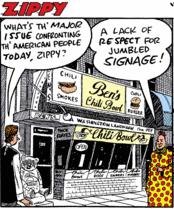
Frame, Zippy the Pinhead by Bill Griffith, Ben's Chili Bowl25. Eat in a restaurant in a historic building/historic district. Now 60+ years old, Ben's Chili Bowl is one of the few remaining restaurants in the city that is many decades old.  .. Readers have pointed out that Martin's Tavern in Georgetown and Cafe Mozart, a German restaurant downtown, are much older.

26. See a movie in a historic cinema building. There aren't many historic cinemas in DC proper any more, but the Uptown Theater in Cleveland Park is one.

27.  See a production in a "legitimate" historic theatre or concert hall.  You have many choices in the DC area such as the Warner, the National, the Studio Theatre, the Lincoln Theatre, the Shakespeare Theatre at the Landsburgh, the Atlas Performing Arts Center (which utilized federal historic preservation tax credits to pay for a portion of the building's rehabilitation), or the DAR Concert Hall.

28.  Even if you're an atheist, it can be fun to visit a historic church building, including checking out their stained glass windows (I am a big fan of stained glass).

29. Shop at a historic public food market. Eastern Market is DC's last remaining public food market building, built in 1873.  (Union Market is privately owned, and was constructed in the 1970s.)

30. Visit a historic cemetery. In DC, we have the Congressional Cemetery or the Rock Creek Church Cemetery at St. Paul's Episcopal Church, among others.  Brooklyn's Greenwood Cemetery is a standout.  Some cemeteries offer tours.

31. Check out an exhibit at a local history museum or historic site, such as at the Anacostia Community Museum or the Historical Society of Washington or one of the other house museums and historic sites in the city and region.

32. Walk the historic grounds of a local college or university.  In DC, Catholic University, Trinity, Georgetown, Howard, and Gallaudet have beautiful grounds and buildings.  Kendall Green at Gallaudet was designed by Frederick Law Olmsted.

33. Check out a monument or memorial in your community and learn more about it. We can't preserve what we don't understand or appreciate.

34. Visit a historic railroad or bus station, such as DC's Union Station. Designed by Daniel Burnham, it's an incredible example of the City Beautiful architectural movement. Check out chapters from Bill Wright's dissertation on Union Station. He's a great writer!

Railroad stations tend to be grand while older bus stations tend to be gnarly, which is an interesting commentary on the place of these respective modes in transportation history and practice.

35. Check out a historic library building.  Many cities have great library buildings that now qualify as historic.  A number of DC's libraries were built with support from the Carnegie Foundation (Northeast, Southeast, the old Carnegie Library downtown, Takoma, and Mount Pleasant, which is particularly gorgeous) as were more than 2,000 other libraries elsewhere in the US.

36. Take a boat trip on a local river.  The pontoon boat tours of the Anacostia River leaving from the Bladensburg Waterfront Park (in Prince George's County) dip into DC.  Many cities have water-based tours or smaller scale water taxi systems as well.

37. Explore historic preservation matters in your region, beyond the borders of your community.

-- "May is Historic Preservation Month: 60 ways to celebrate | Part 3: Learn and Get Involved (37-52)," (2019)

38. Learn about the history of your community. For example, for DC, read Dream City: Race, Power, and the Decline of Washington, D.C., 1964 -1994 and Between Justice and Beauty, and more.

39. Become a member of your citywide/countywide/regional preservation organizations such as the DC Preservation League, the Municipal Arts Society in New York City, Baltimore Preservation, Historic Districts Council in New York City, Cleveland Restoration Society, Preservation Resource Center of New Orleans, Landmark Society of Western New York (which serves Rochester, among other places), etc.  I am a big fan of the Chicago Bungalow Association.

40.  Before you get too involved, you might want to take the time to read your city, county, or state historic preservation plan.  This will educate you about preservation issues in your area.  (Although generally such plans are pretty positive, and don't go into enough detail about the "threats" nor do they outline ways to address "opportunities" in a process design approach.)

41. Learn about why historic preservation is important, in and of itself, as well as a urban revitalization strategy. The reason I am a strong supporter of preservation is that I have come to believe that it is the only approach to economically sustainable neighborhood and commercial district revitalization that works for the long haul.


42. Join a neighborhood/local preservation group, such as in DC the Capitol Hill Restoration SocietyHistoric Takoma, or Historic Mount Pleasant).

43.  Nationally, you can join the National Trust for Historic Preservation while you're at it. If you join, you can visit NT owned sites and affiliate organization museums at a discount/free, get discounts at Historic Hotels, and discounts on products you purchase.

44.  Preservation Action is a 501(c)4 advocacy group that advocates for specific legislation and is also a membership group.  Their "Preservation Advocacy Week" is held in March, where members lobby Members of Congress for legislation favorable to preservation.

45.  At the state level, most states have statewide preservation organizations.  In the DC-VA-MD area, that means Preservation Maryland and Preservation Virginia/Association for the Preservation of Virginia Antiquities, as well as the DC Preservation League.  Many sponsor annual or bi-annual conferences, journals, and other provide other resources.

46. Volunteer/1. Get involved in a preservation issue in your neighborhood or the city-county at large, which could include attending meetings of your local historic district/preservation commission, which in DC is the Historic Preservation Review Board, or working on a particular project affecting your neighborhood or city.

47. Volunteer/2, in a traditional commercial district revitalization initiative, at a history museum, or for a historic site.  A "division of the preservation movement" is the Main Street commercial district revitalization program, which links economic development with historic preservation focused on the revival of local commercial districts and downtowns in smaller communities.

48.  Volunteer/3, at a history museum, a historic park or at a historic site.  Museums and historic sites are always looking for volunteers, as our most park systems, including the National Park Service.  Many docents at sites and museums are volunteers.

-- Volunteer in Parks program, National Park Service

49. Work to preserve historic schools as schools.  The DC Public School system has an archives and museum that is also a meeting center, Sumner School, at 17th and M Streets NW.

50. Another way to learn a lot but very quickly is to attend a preservation conference such as the annual meeting of the National Trust for Historic Preservation (this year it's in Denver starting October 10th) and the National Main Street conference, which was held in Seattle in March, some sessions materials are available).

51. Check out the history resources at your local library or a specialized collection such as in DC at the Washingtoniana Collection at the Martin Luther King Central Library or the Peabody collection at the Georgetown Branch, the Kiplinger Library at the Historical Society of Washington, the Jewish Historical Society, or the Moorland-Spingarn Collection at Howard University.  Many city libraries have history collections.

52. Read a historic district brochure (or historic building or district nomination form).  In DC, they are available online or in hard copy at the Historic Preservation Office.  Many communities produce and publish these kinds of publications.  Two of the best I've ever read is one on Jefferson County Indiana including Madison (One of the first Main Street communities) and Hanover, and the other on the Kansas City public market, called City Market.  Both lay out their respective histories chronologically but thematically.

53.  I am a big fan of reading the design guidelines publications produced for cities or neighborhood historic districts, which describe local historic districts, such as those from Montgomery County MarylandRichmond, VirginiaRoanoke, Virginia, and the Philadelphia Rowhouse Manual.  The Roanoke Virginia Residential Pattern Book is a stand out!

54.  Listen to a preservation focused podcast.  Podcasts--"radio shows" are a new addition to preservation-based media.  Preservation Maryland produces a great series, PreserveCast, which is worth checking out.

-- "May is Historic Preservation Month: 60 ways to celebrate | Part 4: Preservation At Home (53-60)," (2019)

55. If you own "an old house," and want to learn more about historically sympathetic renovation, why not subscribe to relevant magazines such as Old House JournalOld House InteriorsAmerican BungalowThis Old HouseFine Homebuilding, etc.

56.  Publications on maintenance of historic houses.  

57.  Books to guide renovation.  

58.  Parts and appliance resources.  There are companies that specialize in "historic" parts.  For example, DEA Bathroom Machineries specialize in bathrooms, especially historic sinks.

59.  Most big cities have architectural salvage stores, for example in the DC area, it's Community Forklift.  In Baltimore, Loading Dock is a non-profit while Second Chance is a for profit.

60.  Workshops and expos.  It would be logical to have "Preservation Expos" during Preservation Month but it doesn't seem to be the case.  Historic Chicago Bungalow Association holds workshops most months, and has building expos too, from time to time.

61.  Activities for and with children.  If you have children in your life, how about doing an activity with them that is architecture-preservation related?

62. Television programming.  There are some HGTV/DIY network shows that are sympathetic to historic preservation, although the bulk of the shows are not.  Even the heralded "Fixer Upper," even if they renovate vacant houses, tends to homogenize the interior of a house into a gargantuan "open concept" house with a massive kitchen. 

But shows like "Rehab Attic," to some extent "Stone House Revival," and "American Rehab: Charleston" generally are pretty empathetic on historic preservation and can be a great source of ideas.  Lately I've been enamored by "Restored," featuring Brett Waterman working on houses in Riverside County, California.

Obviously, "This Old House," on PBS is the grand-daddy of all shows.  In my opinion, it's great for historic architecture and detailing, but the program tends to be more about supersizing houses, but doing a great job while you're doing so.  And they seem to let it slide when homeowners make decisions that somewhat cavalierly rip out historic elements in favor of modernization.

63.  Researching the history of your house.  There are people who will research this for you, but many city libraries have usable information and even may offer seminars on how to go about this.  Census records are one place, but more current records aren't accessible.

-- How to Research the History of Your House | This Old House
-- Internet Public LibraryResearch the History of Your House
-- Houses - The National Archives

Labels: , , , , , ,

Monday, March 03, 2025

Women's History Month and urban planning

==========

This is a reprint from 2020.  For the most part, links have not been checked.

==========


March is Women's History Month and Sunday March 8th is International Women's Day 2020.

Women as planners and architects. From the standpoint of labor within the urban planning profession, on the land use planning side women make up a larger and larger proportion of the planning workforce, although directorships of government planning agencies tend to be dominated by men.

-- "Jane Jacobs and the Power of Women Planners," CityLab

Although maybe the DC area is an exception given that plenty of articles opine about the need for more women in the profession ("Urban Planning Needs More Women," Rooflines).

There are major exceptions, for example Jennifer Keesmaat was the planning director for the City of Toronto, Ellen McCarthy and Harriet Tregoning were directors of planning in DC, and Amanda Burden was the Planning Commissioner for the City of New York ("Social Planner," New York Magazine) while Janette Sadik-Khan was the Transportation Commissioner.  Sadik-Khan was succeeded by Polly Trachtenberg.

The transportation profession tends to be dominated by men still, as it is heavily engineering based, but that is changing too. 

Increasingly, women are being chosen as transportation directors leading city agencies, for example in Pittsburgh, DC's former associate director of transportation planning, Karina Ricks, leads that agency.  Philadelphia, Portland, and New York City among others.

There aren't too many women running the largest transit agencies, although plenty of women are in high positions in those agencies, and hold positions across the profession.  

Southern California's Metrolink has appointed a woman as CEO ("Metrolink Board Names Stephanie Wiggins as Chief Executive Officer").  The interim director of NYC Subways is Sarah Feinberg.  A woman briefly headed up Sound Transit in Seattle.

In the face of many prominent women, the architecture profession remains dominated by men ("Challenged to change their industries' faces," Daily Journal of Commerce; "Where are the women in architecture?," Austin American-Statesman).  The landscape architecture field has plenty of women practitioners.   

However, according to the AIA, now 50% of students in architecture programs are women, and the organization is now sponsoring an annual Women's Leadership Summit, which this year is in June in Miami.

One of the special interest sections of the American Planning Association is Planning and Women and the Women's Transportation Seminar is a professional development organization for women working in the transportation field.

Women and the history of the planning profession.  One of the strands from which the planning profession in the US was birthed was out of women-initiated "good government" and "good places" initiatives in a time when women still didn't have the right to vote.

(2020 is the 100th anniversary of Women's Suffrage winning the right to vote in the US, which was realized through the passage of the 19th Amendment to the US Constitution.)

Women's civic and garden clubs were major actors in local civic affairs, including urban design (as beautification sometimes) until the 1960s at least.

Land use planning and architecture.  Some argue that the principles of land use planning are designed to favor men ("If women built cities, what would our urban landscape look like," Guardian).  From the article:
In a classic 1980 essay called What Would a Non-sexist City Be Like?, the American urbanist Dolores Hayden called for centres that would “transcend traditional definitions of home, neighbourhood, city and workplace”. Since then, others have taken up the argument that a woman-friendly city would be more porous, the divisions between home and work less rigid, so that domestic work is acknowledged as a productive activity, and carers (of children, disabled relatives and older people) are less excluded from economic life. In any case, such divisions are often artificial, with women in developing-world cities undertaking economic activity that has too often been ignored.
-- "Female-Friendly Cities: Rethinking the Patriarchy of Urban Planning," Ms. Magazine
-- "Women's Place: Urban Planning, Housing Design, and WorkFamily Balance," Fordham Law Review
-- "Women in the Urban Environment," Signs Vol. 5, No. 3, Supplement. Women and the American City (Spring, 1980), pp. S188-S214

The presence of women as an indicator of safety in the public space.  For years I have been strongly influenced by points made in writings about safety in public spaces and how the number of women out and about can be seen as an indicator of success or failure.  John King, urban design writer for the San Francisco Chronicle wrote about this ("Great architecture, clean streets, culture -- it must be Minneapolis") in discussing Minneapolis as an example of his ten principles about how to make cities great:
Women know best. The first night in Minneapolis, I dined at Cafe Brenda on walleye and wild rice, which, with blueberry muffins, constitute the trifecta of local cuisine. A stroll past sleepy blocks of warehouses evolving from red-light district to residential neighborhood led me to the banks of the Mississippi. Walking along grassy parkland toward the Falls of St. Anthony, I had the place to myself -- except for one woman jogging casually past me toward the horizon.

When a city feels safe enough that a woman jogs along, alone, at dusk ... somebody is doing something right."
The presence of women as an indicator of what works and what doesn't in managing public spaces ha been discussed over the years in various writings on New York City's Bryant Park.

The New York Times  New York Region  Image.jpgKeith Bedford for The New York Times. A man and a woman: Minding the gender gap in Bryant Park.

From the 2005 New York Times article "Splendor in the Grass":
It was lunchtime at Bryant Park, and thousands of office workers were gathered beneath the emerald veil of trees. Ever since the park was renovated 13 years ago, it has been a remarkable space, and one of its most remarkable aspects is that the number of men and women is about equal, a balance that is carefully monitored as a barometer of the park's health. In 1980, when the space was rife with drug dealers and other scurrilous sorts, the ratio of men to women was about 9 to 1, said Dan Biederman, president of the Bryant Park Restoration Corporation.

But when the park reopened in 1992, the comfort level of women was seen as key to its resurgence, which is why the park's designers paid special attention to accouterments that appeal to women, like bathrooms with full-length mirrors, kiosk food and flowerbeds.

These days, the male-to-female ratio is just about even. And with this balance comes the possibility of triangulation, which Mr. Biederman defines with scientific precision as the tendency of an external stimulus to prompt strangers to interact. "If there's enough triangulation from things in the park," he said, "then people who don't know each other will break down and talk to each other."
Transit, women and safety.  Around the world women are harassed, even killed, in transit, India being particularly notorious.  In a number of places, women-only taxi services have been created to provide safe transit.

For example, SheTaxis, a women-focused taxi service in Greater New York City, modeled after the service in Mexico City ("Mexico launches fleet of pink cabs - driven by women, for women," New York Daily News) which was launched in 2009, launched in 2014 ("New Service Offers Taxis Exclusively for Women," New York Times).

But overall in the US, such services haven't fared too well.

SeeJaneGo, a ride hailing service catering to women, operating in Orange County, California, shuttered in 2018 ("See Jane Go, a ride-hailing service for women, by women, says farewell," Orange County Register).

In response to public safety issues, Mexico City has dedicated cars on its subway system for women although similar cars in Beijing don't seem to be working too well ("China's Women-Only Subway Cars, Where Men Rush In," New York Times), although such cars have existed in Tokyo since 1912 ("I used the women-only train carriages in Tokyo, for good reason – and I'd welcome them in the UK too," Independent).

Professor Anastasia Loukaitou-Sideris of UCLA has authored a number of papers on bus stop safety. Many transit agencies have introduced anti-harassment programs.

-- Hollaback! is an organization that addresses street harassment issues
-- Hot Spots of Bus Stop Crime, Prof. Anastasia Loukaitou-Sideris, UCLA
-- Geography of Transit Crime, Loukaitou-Sideris et al., UCLA
-- Transit Security: A Description of Problems and Countermeasures, FTA

Restroom equity.  One long standing issue is restroom access.  Women tend to take longer to use restroom facilities (men can stand for some of their needs, taking less space, while women need stalls), but in public buildings like sports facilities, train stations, airports, and convention centers, more restroom facilities for women tend to not be provided.  Some cities and states have been changing laws to address this ("'Potty Parity': Equal Wait Time for Men's and Women's Restrooms," Time Magazine).

Cover image: Wheels of Change: How Women Rode the Bicycle to Freedom (With a Few Flat Tires Along the Way), by Sue Macy.

Women and bicycling.  There are many initiatives around promoting bicycle use by women.  One of the earliest was by the Association of Pedestrian and Bicycle Professionals (Women Cycling Project).   Now many local and state bicycle and alternative transportation organizations have women access initiatives.

The Race Pace chain of bicycle shops in Greater Baltimore has had for many years a sub-store called Bella Bikes dedicated to women's cycling, within their Ellicott City location.   More bike shops are adding this kind of offering.

Women and political power. While there is no doubt that men are a majority of the holders of elected office at all levels across the United States ("Why Does the US Still Have So Few Women in Office?," The Nation), increasingly, women are winning elections for mayor in cities around the country.  DC's Muriel Bowser is one such example, but there are many others, including Houston, Salt Lake City, and in 2017, Seattle and Montreal.  More and more women are being elected to City Councils, etc.

Post the Trump victory, many more women are running for political office at all levels ("A year after the Women's March, a record number of women are running for office, will they win?," Washington Post; "More Than Twice As Many Women Are Running For Congress In 2018 Compared With 2016," NPR).

And a signpost of this movement was the midterm national election, where a great number of women of a diversity of race and politics were elected to the U.S. House of Representatives, although generally this was more a case of Democratic Party members over Republicans ("Banner Year for Female Candidates Doesn't Extend to Republican Party," New York Times).

Gender budgeting.  In 2017, the Economist ran a provocative editorial, "Why governments should introduce gender budgeting," building on an earlier article, "Why national budgets need to take gender into account."

From the editorial:
At its simplest, gender budgeting sets out to quantify how policies affect women and men differently (see article). That seemingly trivial step converts exhortation about treating women fairly into the coin of government: costs and benefits, and investments and returns. You don’t have to be a feminist to recognise, as Austria did, that the numbers show how lowering income tax on second earners will encourage women to join the labour force, boosting growth and tax revenues. Or that cuts to programmes designed to reduce domestic violence would be a false economy, because they would cost so much in medical treatment and lost workdays.

As well as identifying opportunities and errors, gender budgeting brings women’s issues right to the heart of government, the ministry of finance. Governments routinely bat away sensible policies that lack a champion when the money is handed out. But if judgments about what makes sense for women (and the general good) are being formed within the finance ministry itself, then the battle is half-won.
By not looking at the differential impacts of policy in terms of gender, bias is structured into outcomes.

-- "This Is What a Feminist Country Looks Like," New York Times
-- A Feminist Government, Government of Sweden

Labels: , , , , ,

Monday, February 24, 2025

February is African-American History Month: Urban planning history -- the attempt to make Roxbury a separate city from Boston

I was surprised to come across a Boston Globe article ("Roxbury, Mattapan, and parts of Jamaica Plain could have become a separate Black majority city. Here’s what happened") on a de-annexation proposal for Boston, where the predominately Black areas would create their own city called Mandela.  

Also see 

-- "Separatist City’: The Mandela, Massachusetts (Roxbury) Movement and the Politics of Incorporation, Self-Determination, and Community Control, 1986–1988," Trotter Review
-- "Africa in Boston: A Critical Analysis of Mandela, Massachusetts," libcom
-- "Black neighborhoods becoming Black cities: Group empowerment, local control and the implications of being darker than brown," Harvard Civil Rights- Civil Liberties Law Review, 1988

Greater Atlanta. More recently, in Greater Atlanta, there has been a "create your own city" movement to separate blacks and whites, by selectively incorporating county lands ("The Incorporation of New Cities Has Increased Racial Segregation in Metro Atlanta," JCHS, "Suburbs, Inc.: Exploring Municipal Incorporation as a Mechanism of Racial and Economic Exclusion in Suburban Communities," Russell Sage Foundation Journal of the Social Sciences).  This continues with a proposal to calve off the Buckhead District ("Georgia senators reject Buckhead efforts to leave Atlanta," AP).  

Schools.  Similarly, in Shelby County, Tennessee, which created a consolidated city-county school district, white residents began breaking off and creating their own school districts ("Merger of Memphis and County School Districts Revives Race and Class Challenges," New York Times, "Back to the future: A new school district secession movement is gaining steam," Washington Post).

Mandela versus electing Black leaders.  While the Roxbury initiative was voted on, twice, it didn't pass ("Separatist City of ‘Mandela’ : Boston Voting on Proposal to Let Black Areas Secede," Los Angeles Times).  From the Globe article:

The Mandela referendum was defeated overwhelmingly that year and lost again at the polls two years later. Yet the underlying idea behind the movement — to place decision-making power and resources in the Black community’s own hands — survives nearly 40 years later. As voters in those same neighborhoods have worked over the years to choose candidates they feel are most suited to transform Black Boston, the issues of disinvestment, inequality, and underrepresentation that Mandela hoped to address have still been top of mind. ...

The proponents’ asks focused on giving Black people decision-making power. They wanted hard-earned taxpayer dollars to funnel back into these neighborhoods, and not other parts of Boston with more historic investment. They wanted to control development. They wanted better outcomes for students in Boston Public Schools, which was dominated by kids of color. And they wanted full political representation from their blocks, not just the few Black firsts that had penetrated Boston City Hall in the years prior. 

 “It was about ownership,” said Kambon, director of the Black Community Information Center in Roxbury. “We want to control our own destiny. We have the resources and the people power to make it happen.”

Black leaders, black city, no change?  I was thinking about this in terms of how many center cities around that time, majority Black, were starting to become Black led, although this was another 5-8 years after Roxbury.  And how Black elected leadership didn't make a lot of difference to urban outcomes compared to their more recent white predecessors.

Detroit, Cleveland, Chicago (in the 1980s), Washington, DC, Los Angeles were among the cities electing Black mayors.  And Atlanta.

A point in the book Black Social Capital: The Politics of School Reform in Baltimore, 1986-1999 about Black "takeover of public school boards" is pretty apt, that Blacks could get control only once resources for improvement were pretty much dissipated.  The federal government stopped giving extra money to cities, as their needs were increasing.

Atlanta: the city too busy to hate ("How Atlanta became the 'city too busy to hate'," Yahoo).  The difference in success between Atlanta and the others was likely because at the time Atlanta was a growing city, while the others were shrinking.  

Labels: , , , , , ,