Rebuilding Place in the Urban Space

"A community’s physical form, rather than its land uses, is its most intrinsic and enduring characteristic." [Katz, EPA] This blog focuses on place and placemaking and all that makes it work--historic preservation, urban design, transportation, asset-based community development, arts & cultural development, commercial district revitalization, tourism & destination development, and quality of life advocacy--along with doses of civic engagement and good governance watchdogging.

Thursday, January 23, 2025

Reflecting on past hope in "reforming" federal cabinet agencies to better focus on urban and rural planning and economic development needs

Seeing an article ("Trump's HUD pick, Scott Turner, faces questions on the Hill: Trump nominee to lead HUD says the agency is failing in its mission," NPR) about the confirmation hearings for Scott Turner as the Secretary of the Department Housing and Urban Development, reminded me about all the "good ideas" I had for the Obama Administration in reconfiguring certain agencies to better focus on urban and rural matters.

Given all the financial needs for cities, Turner argues that there is enough money already in HUD's budget, that it needs to be used better.  And he advocates for the continued promotion of Opportunity Zones which are special tax credit investment districts ("I figured out why Opportunity Zones won't amount to much: no planning," 2019, "Opportunity Zones and revitalization planning," 2021).

====================

From "How will Obama relate to the District?,"  11/6/2008 (some edits)

I am not really excited by the Obama "Office of Urban Policy." As I wrote before, I'd rather see a reconfiguring of HUD around Cities, Regions and Urban Ecology (sustainability), merging in some parts of the EPA and DOE smart growth operations, local and regional Economic Development aspects of the Dept. of Commerce, and an urban-regional transportation section that would be a joint agency of the US DOT and the new Dept. of Cities, Regions, and Urban Ecology.

Similarly, I would redefine the Dept. of Agriculture as the Dept. of Agriculture, Rural Development, and Sustainability, and refigure the departments some. Parts of the Dept. of Interior would be merged into it. I don't know how to deal with the National Park Service, probably I would create a Department of Culture, Tourism (from the Dept. of Commerce), Humanities and Arts that would take that function and others. And the Dept. of Education needs to be repositioned and rebranded as well towards lifelong learning and knowledge development and realization.

At the local level, I argue that planning and zoning is supposed to be about improving quality of life first, foremost, and always. Similarly, on the regional-state-national-global dimensions, that is what government is supposed to or at least ought to do.

We need to repattern our government agencies at all levels in terms of their being focused on and achieving these missions.

===========

From "The federal government and cities," 7/28/2008

Professor Sudhir Venkatesh of Columbia University has an op-ed in the New York Times, about the Dept. of Housing and Urban Development, entitled "To Fight Poverty, Tear Down HUD." He says that HUD is focused on cities, and that metropolitan regions and connections between cities are more important.

I would say that HUD has two missions that aren't necessarily congruent. One focuses on developing housing for poor people. The other is on urban development and revitalization.

The belief in the field is that these missions are in one and the same. But I think it's fair to say that improving housing for poor people didn't improve cities.

At the library today I happened onto a monograph series from the Society of Economic Anthropology. One of the collections is entitled "Economic Analysis Beyond the Local System."

I thought about the aptness of that title in terms of what I think about and discuss in terms of thinking and addressing local issues on the different scales of local-neighborhood, local-city, and even local-region, although for the most part I think about this within the city, so that I think about this mostly in terms of how neighborhood planning processes fail to engage with and acknowledge citywide needs and concerns simultaneously.

But this idea of analysis beyond the local system is key to understanding urban issues and urban poverty and urban growth, as well as the relationship between municipalities and other levels of government be they local such as with counties, regional such as with metropolitan planning organizations, states, or the federal government.

Getting back to Prof. Venkatesh's article, cities need to be innovative and energetic (see the writings of Richard Florida, Charles Landry, even Edward Glaeser, among others) and the last thing a government agency, especially at the federal level, is concerned with is innovation.

One of the ways that HUD could be better is if it too focused on "indicative planning" or building the capacity for vision. The UK planning agencies produce memos and reports, ranging from "Planning Policy Guidance" memos, to incredible reports such as Living Places: Cleaner, Safer, Greener, as well as the work done by organizations such as the Commission for Architecture and the Built Environment and English Partnerships.

I don't really feel as if we have an equivalent set of planning guidance and stretching and pushing and striving in a similar fashion here in the United States.

If HUD published PPG memos on linking land use and transportation planning, shifting from an automobility planning paradigm, the link between density and livability as well as transit success, building a local economy, foodways and urban agriculture, eliminating free parking, accessibility planning linking land use and transportation infrastructure in land use decision-making, rebuilding a system of railroad-based transportation, etc., we would be far better ahead than we are now.

=======

While I mentioned transit, I didn't mention it enough.  Transit cities are more wealthy than automobile-dependent cities.  Rural areas with transit access--trains, inter-city bus, airlines--are better connected and more wealthy than areas without such access.

Transit as a primary mode should be promoted as an economic development augur.

In cities especially, modern streetcars are performing that function.

-- "DC and streetcars #4: from the standpoint of stoking real estate development, the line is incredibly successful and it isn't even in service yet, and now that development is extending eastward past 15th Street," 2015

Labels: , , , , , ,

Monday, October 10, 2022

October is National Community Planning Month

 -- National Community Planning Month, American Planning Association

For a number of years during National Community Planning Month, the APA ran an awards program, Great Places in America, featuring great streets, neighborhoods, and other types of places across the country.  It's a great "case study" list of examples to think about in terms of urban design and placemaking in your own community.

Exhibits on local planning history. Gothamist reports that there's an exhibit on NYC's urban planning history at Grand Central Station ("New exhibit in Grand Central Terminal tells NYC's history through urban planning").  It's about the Regional Plan Association, a citizens stakeholder organization that has weighed in on regional planning issues since the 1920s.  

They are known for every so often--10-15 years or so--in producing a wide ranging regional plan vision. I frequently mention one of the volumes from the Second Regional Plan, Urban Design Manhattan, which has given me lots of insight in thinking about vertical and horizontal mobility in cities.  (I found it at an estate sale in NW DC,)

That seems like a great idea, and there ought to be a kind of permanent or at least traveling exhibit across the city, as a way to educate citizens about planning issues in the city at large and in their neighborhoods.

Many years ago I saw a great exhibit in NYC on Jane Jabobs and urban renewal at the Municipal Arts Society.  

And the Museum of the City of New York has a permanent exhibit on activism in the city, and some of the issues are planning related ("Local history museums and critical analysis opportunities for communities," 2014).  

And I remember a great exhibit years ago at the Brooklyn Historical Society on neighborhood renewal initiatives in the 1970s, with conflicting approaches.

Also a pop up history exhibit on Coney Island by an advocacy group there.

In DC, the Anacostia Community Museum had a great exhibit called "Right to the City," featuring six different neighborhoods.

In general, I like going to city history museums which generally cover planning related issues too. Museums in Richmond, Virginia, Pittsburgh, and Montreal are standouts.  Professor Schweiterman's exhibit Terminal Town, based on his book on the city's passenger terminals across all modes.  I saw part of it at Chicago's Union Station.

Including a section on local planning history in master/comprehensive plans.  When I first got involved in revitalization, I remember reading an update to the Baltimore Master Plan and there being a chapter on the city's planning history.  I thought it was "constrained" in that it was all positive, not particularly critical about the city's urban renewal phase, but I was still impressed by its inclusion, which is rare.

Labels: , , , ,

Tuesday, September 08, 2020

Public notice yard signs, Salt Lake City

One obvious way to engage the public is with yard signs.  In zoning and alcohol licensing matters there are public notice placarding requirements.  But most cities allow for these to be posted in ways where they are inaccessible or incredibly cryptic, so they are almost nonsensical.

I also realized that the notices should also list potential remedies, or ways that citizens can act.  E.g., without a process to stop a demolition, having placard requirements barely registers ("More on the need for stricter anti-demolition regulations in DC, 2009, "To be successful, local neighborhood stabilization programs need a packaged set of robust remedies," 2020).

When I did the bike and pedestrian plan in Baltimore County, I asked for approval to create and post yard signs throughout the planning district, to ask for public comment and participation, but it was denied.

That's why I find the use of public notice yard signs in Salt Lake City to be so interesting ("Salt Lake City planning department mails notices to all households about participating in specific planning processes"). They do it exactly how I think it should be done.

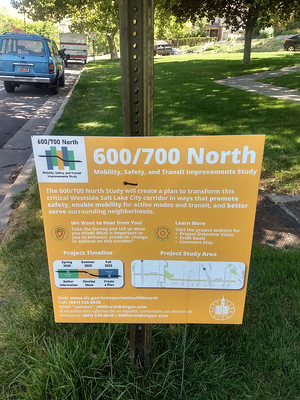
This sign was placed on a street where the City Department of Transportation is planning a variety of upgrades.
Yard sign about a transportation corridor planning initiative, seeking public comment, Salt Lake City

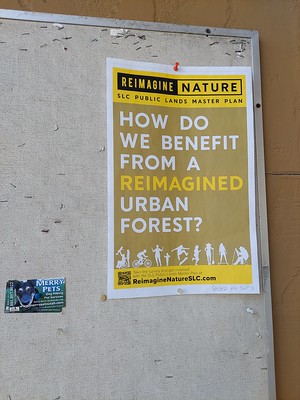
The Parks and Public Lands Department has put up yard signs in most every park and open space that they manage across the city, which is more than 100 sites. They've also sprayed sidewalk notices proximate to in-street medians and boulevards.
Public notice signage, Warm Springs Park, Salt Lake City Parks and Public Lands agency master planning process

Public notice signage, Salt Lake City Parks and Public Lands agency master planning process

And use the same signage for flyers.
Public notice signage, Salt Lake City Parks and Public Lands agency master planning process
Posted at a specialty market.

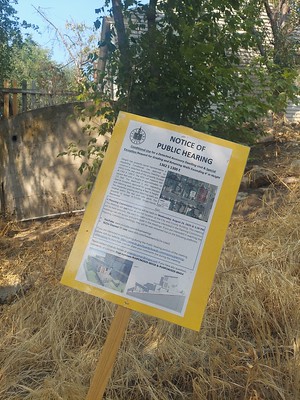
And the building regulation/zoning signage requirements seem to require understandable language, instead of gobbledegook.
Public notice sign, zoning matter, Salt Lake City

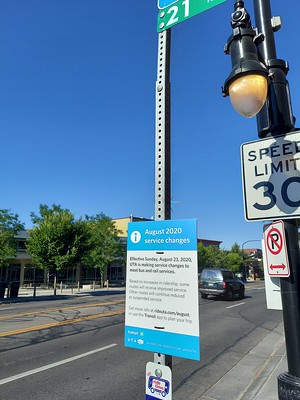
Separately, the Utah Transit Agency puts "yard signs" at every bus stop to announce service changes, that are general or specific to the route, such as temporary bus signs.  By comparison, DC area transit agencies generally handle this pretty poorly.  It can take years just to update bus stops with current schedule information.
Utah Transit Agency service change sign at bus stop

Corrugated plastic sign from the UTA (Utah Transit Agency) outlining service improvements on the 21 Bus line

Labels: , , , ,

Friday, June 21, 2019

I figured out why Opportunity Zones won't amount to much: no planning

I have been struggling with writing about "Opportunity Zones" in the almost two years since the tax credit program was included in the Trump-Ryan-McConnell tax cuts for the wealthy.

There have been a variety of federal initiatives over the decades to deal with economically distressed areas, from the original Urban Renewal programs dating to the late 1940s and early 1950s, to "Empowerment Zones" to "New Markets Tax Credits", the EB-5 Visa program to attract foreign investment in return for a green card, and now the Opportunity Zones, which in return for a ten year investment, will let rich people avoid paying capital gains taxes.

There are plenty of articles about the program and all the great results it will have, and real estate funds are being created, etc.  And some suggesting negatives ("The Trump administration said these tax breaks would help distressed communities. Who's actually being helped?," Washington Post).

But based on Empowerment Zones and EB-5 especially, my expectations are pretty minimal.

Great destinations start off with a planThis image is from the presentation "The 20 Ingredients of an Outstanding Destination" by Roger Brooks International.

The biggest reason is that the interest is being driven by the investors and real estate funds and consultants, not the communities.

The program was designed to help investors first, communities second.

A current discussion about this on the pro-urb e-list helped me zero in on why I expect the program to end up not accomplishing all that much.

There aren't requirements for community revitalization plans to direct Opportunity Zone investment. 

Besides being involved in the creation of a revitalization plan for the H Street NE neighborhood in 2002-2003, and the development of two Main Street commercial district revitalization programs in DC, reading the HHyattsville Community Legacy Revitalization Plan around that time, which had an appendix of action items, which was then pretty new for planning documents created in the DC area, really helped me learn about the importance of planning.  (The Hyattsville Plan was updated in 2010.)

Of course, Jane Jacobs' writings about the flaws in urban renewal programs culminated in Death and Life of Great American Cities was another influence as were Cities Back from the Edge and Changing Places, more books and other resource documents from plans and manuals to journal articles.

Here's what I wrote on the listserv:
I haven't been able to get a planning job in DC because of my odd resume, lack of a planning degree (I will finally take the AICP exam) and mostly because it seems like planning agencies have been reshaped to "always be positive."

By contrast I got my start in revitalization planning, and in revitalization you have to be honest about weaknesses, and creative and innovative because likely you are seriously resource constrained. Revitalization planning is about directness ("one of my core competencies") and elected and appointed officials in my experience don't like that too much, especially when directness is out of sorts with "received wisdom."

Anyway, speaking of the importance of planning, another line I have is that an RFP isn't a plan.  
Rather than expect respondents to plan for you, especially when it comes to public good outcomes, it's better to set priorities with a master plan (at whatever scale) and then issue the RFP. (DC too frequently releases RFPs without plans already in place.)

So to better direct funds and to achieve positive outcomes for the community, rather than just to avoid taxes on capital gains, the Opportunity Zone program should require revitalization plans be set for each zone.

Granted, given my concerns about the problems in planning and how scopes too often are constrained to eliminate creativity, I'm not saying having plans in place would necessarily fix the problems with the Opportunity Zone program, but it would likely make a difference.

FWIW, a few years ago I was commissioned to write a series of articles about culture based revitalization in 7 cities in Europe, and based on what I learned about revitalization initiatives in Bilbao, Dublin, and Liverpool, I came up with six elements of " best practice revitalization:

I have appended those points at the end of the entry. Since those c. 2013-2014 writings, I have extended this framework into what I now call "transformational projects action planning."

-- "(Big Hairy) Projects Action Plan(s) as an element of Comprehensive/Master Plans," 2017
-- "Why can't the "Bilbao Effect" be reproduced? | Bilbao as an example of Transformational Projects Action Planning," 2017
-- "Downtown Edmonton cultural facilities development as an example of "Transformational Projects Action Planning" 2018
-- "Minneapolis Super Bowl: Urban Revitalization and Transformational Projects Action Planning,"
-- "What would be a "Transformational Projects Action Plan" for DC's cultural ecosystem," 2019

The basic idea is that a master plan should include a set of big, hairy audacious projects (like "big hairy audacious goals") to spur revitalization and community improvement in a substantive way.

TPAPs should be implemented at multiple scales:

(1) city/county wide as part of a master plan;
(2) within functional elements of a master plan such as transportation, housing, or economic development; and
(3) within a specific project (e.g., how do we make this particular library or transit station or park or neighborhood "great"?).

DHCD sign, Florida Avenue NW 
The six components of a successful broad ranging revitalization program. In writing about the various efforts, I drew the conclusion that successful revitalization programs, especially in those cities that were working to overturn serious disadvantages, were comprised of these elements: 
  • A commitment to the development and production of a broad, comprehensive, visionary, and detailed revitalization plan/s (Bilbao, Hamburg, Liverpool); 
  • the creation of innovative and successful implementation organizations, with representatives from the public sector and private firms, to carry out the program. Typically, the organizations have some distance from the local government so that the plan and program aren't subject to the vicissitudes of changing political administrations, parties and representatives (Bilbao, Hamburg, Liverpool, Helsinki); 
  • strong accountability mechanisms that ensure that the critical distance provided by semi-independent implementation organizations isn't taken advantage of in terms of deleterious actions (for example Dublin's Temple Bar Cultural Trust was amazingly successful but over time became somewhat disconnected from local government and spent money somewhat injudiciously, even though they generated their own revenues--this came to a head during the economic downturn and the organization was widely criticized; in response the City Council decided to fold the TBCT and incorporate it into the city government structure, which may have negative ramifications for continued program effectiveness as its revenues get siphoned off and political priorities of elected officials shift elsewhere); 
  • funding to realize the plan, usually a combination of local, regional, state, and national sources, and in Europe, "structural adjustment" and other programmatic funding from the European Regional Development Fund and related programs is also available (Hamburg, as a city-state, has extra-normal access to funds beyond what may normally be available to the average city); 
  • integrated branding and marketing programs to support the realization of the plan (Hamburg, Vienna, Liverpool, Bilbao, Dublin); 
  • flexibility and a willingness to take advantage of serendipitous events and opportunities and integrate new projects into the overall planning and implementation framework (examples include Bilbao's "acquisition" of a branch of the Guggenheim Museum and the creation of a light rail system to complement its new subway system, Liverpool City Council's agreement with a developer to create the Liverpool One mixed use retail, office, and residential development in parallel to the regeneration plan and the hosting of the Capital of Culture program in 2008, and how multifaceted arts centers were developed in otherwise vacated properties rented out cheaply by their owners in Dublin, Helsinki, and Marseille).

Labels: , , , ,

Wow: Revisiting DC's Corruption Caucus

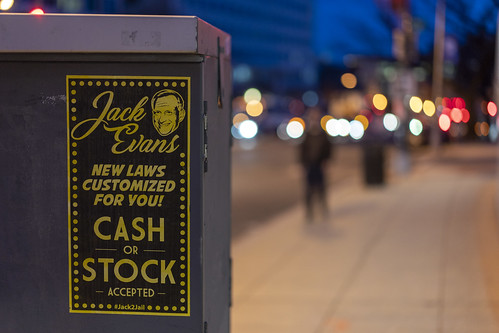
Jack 2 Jail (Connecticut Ave)The Washington Post has been covering the ongoing investigation into ethics violations by DC Councilmember Jack Evans.

The most recent articles report on WMATA's, the area transit agency, investigation of ethics complaints against DC Councilmember Jack Evans, currently the Chairman of the Board.

-- "Jack Evans to resign from Metro board after probe shows he 'kniwingly' violated rules"

It's damning--not so much because of the WMATA ethics committee, which didn't produce a report of its own or write anything down, but because of the investigation that WMATA commissioned.

Evans' actions didn't involve tons of money--maybe $100,000/year in consulting fees--but definitely are replete with multiple glaring conflicts of interests, since the fees were paid by firms that wanted to do business with the transit agency.

Interestingly, Jim Graham, the now deceased and previous DC Councilmember chair of the WMATA board had similar conflicts and had to step down from the board in 2012.

-- "Bringing Jim Graham to account," Washington Post
-- "More legal woes for Metro and Jim Graham," Washington Post
-- Full text of "WMATA board report on Jim Graham", Internet Archive

The difference is that Graham didn't personally benefit, although he tried to steer contracts to benefit campaign donors, but wasn't receiving income for doing so, while Evans received consulting fees directly from clients for whom he tried to help in getting WMATA contracts, without disclosing this.

The ethics charges are what ultimately led to Graham going down to defeat in the 2014 primary election.

These days Evans is facing at least four announced challengers and a recall campaign, although the election isn't until next year. Plus, the FBI has an ongoing investigation.

I figure he probably will decide not to run.  And that more prominent people than the current candidates will enter the race--you know the thing about sharks smelling blood in the water.

(That didn't happen with Graham because the bombshells didn't come out til very close to the primary election, and by that time most people had passed on the opportunity to enter the race, except for Brianne Nadeau.)

Corruption is about systems, not so much about individuals.  This problem derives from how the DC Councilmember job is considered part-time. It creates a structure supportive of conflict of interest.

Evans is hardly the first to work hard at earning outside income from firms that have business with DC Government or other agencies.

In the wake of the issues around Evans, Council is considering legislation to ban most forms of outside income, except for teaching ("Jack Evans scandal revives push to ban outside jobs for DC Council members," Post).

Years ago, blogreader EE shared with us a book published by the World Bank, Corrupt Cities: A Practical Guide to Cure and Prevention and I wrote about it in this 2011 piece, "DC ethics legislation misses the point: focus on what produces corruption as a regular outcome, not monitoring."

While the book focuses on "developing nations," the reality is that corruption in government works the same way where ever it occurs.  As the authors write:
Corruption equals monopoly plus discretion of public officials minus accountability.
My piece listed 9 particular issues (although there are more) with the way things work in DC.  Even though legislation was passed to reduce conflicts, most of the areas I identified as rife with the potential for conflict weren't addressed.

IACA is the International Association of Crime Analysts, and they provide technical assistance and training world-wide.  This particular issue of their alumni magazine focuses on local government and features an interview with one of the authors of the book Corrupt Cities and his work in La Paz, Bolivia.  One quote: "The problem is not corrupt individuals.  It's corrupt systems.

Other ways to restructure certain aspects of DC Council and other areas to increase accountability and "competition." Over the years I've made a bunch of suggestions besides making the job full-time, which if enacted would increase accountability, representation, and make council districts a little less like satrapies.

1.    [This happened] Create an independently elected Attorney General and build the capacity of this office to take control of local prosecution of crime (this responsibility is currently handled by the Federal Government);

2.   Create a public planning and budgeting process for capital improvements, sale of civic assets, and alley closings;

3.   Create a public and transparent process for tax abatement and eminent domain requests (see "Make eminent domain fair for all" from the Boston Globe; the recommendations pertain to both issues);

4.    Increase the number of wards;

5.    Increase the number of councilmembers (thereby making it harder to pass legislation), but also having two representatives for each ward, each elected in a different election cycle;

6.    Move the legislature to part-time service and reduced pay or to full-time service with a slight bump up in pay;

7.   Strengthen the capacity of councilmember staffing;

8.    Increase the research capacity of local government in developing policy and practice;

9.    Institute term limits for elected officials (Council as this already applies to the Mayor);

10.  Change the date of the primary election to extend the electioneering period;

11.  Institute ranked choice voting for local elected officials;

12. Institute additional campaign finance limits for local elections;

13. Create an elected public advocate/ombudsperson/Inspector General (and a civil jury process to investigate government agencies);

14. Reconstitute a school board with oversight over pre-K to 12 public education, traditional and charter schools;

15. Use participatory budgeting methods for appropriating constituent services funds requests and grants to nonprofit organizations ("More on ethics: discretionary funding-constituent funds");

16. Build civic capacity and infrastructure ("Neighborhood planning meta-website);

17. Strengthen the capacity of Advisory Neighborhood Commissions to be better and fairer representatives (""Networked solutions" for some problems with ANCs in DC" and "A neat solution to (some of the) petty corruption in DC government-related civic organizations");

18. Change the planning process to include the production of formal sector and neighborhood comprehensive land use plans ("Planning process failures generally and the upcoming DC Central Library planning process," "Rethinking community planning around maintaining neighborhood civic assets and anchors," and "A key problem in "community" planning: not simultaneously defining community-wide and neighborhood goals and objectives").

19. Various tweaks as needed to planning and zoning processes such as a Big Box Review Ordinance ("Lessons from Walmart's foray into Washington, DC"), community benefits negotiations ("Community benefits agreements revised again" and "What community benefits are supposed to be versus what people think they are about"), and urban design requirements ("New years post #6 -- the crazy thing about U.S. zoning is that it's not designed to maximize overall land value" and "Changing  matter of right zoning regulations for houses to conform to heights  typical within neighborhoods, not the allowable maximum").

Looking at the list, I could come up with some more items, such as creating a "Transportation Commission," using participatory budgeting processes to involve citizens in grant making review, etc.

Wards.  I think that wards should be smaller, meaning a few more councilmembers, and that there should be two representatives per ward, to create intra-ward "competition" and more opportunity for different perspectives.

When I toyed with running for City Council a few years ago, I came up with "Outline for a proposed Ward-focused (DC) Councilmember campaign platform and agenda," which has more focused suggestions for how to represent a Council Ward, including the creation of a center in each ward where a "constituent services office" could be, but also space for community and nonprofit organizations:
Create a “Democracy House," a center for involvement in public and civic life in the ward. If the city provided ward council offices, such a facility could also offer space for community organizations, meeting space, etc., but space would be managed using participatory techniques independently of the Councilmember/Ward office
comparable to the "precinct and ward halls" and social halls that used to exist in the early 1900s in many US cities, but with a decided focus on civic engagement and participatory democracy.

Building civil society and local participation.  #16 concerns building more ways for citizens to participate locally, and opportunities for "do it yourself."

For example, my big complaint about "constituent services" operations in the Mayor and Council offices is that these functions aren't focused on building the capacity of citizens and organizations to represent and act for themselves, but more on creating dependent relationships that promote incumbency.

The participatory budgeting process, where groups of citizens act within ad hoc committees to make decisions about priorities and funding is a way to add more participation to grant making processes.

Other "neighborhood" and association focused programs in cities like Seattle, Calgary, and Minneapolis build the capacity of citizens to take action themselves ("Framingham Massachusetts creates Citizen Participation Officer position").

One element of the offerings of the Seattle Department of Neighborhoods is the People's Academy for Community Engagement, which provides a specific training for two to three cohorts each year.

By contrast, organizations like the Federation of Calgary Communities or the Massachusetts Citizen Planner Training Collaborative have conferences and various trainings throughout the year open to all.

Another great example, although I think it's changed somewhat because the Main Street organization is now separated from the National Trust for Historic Preservation, is the training system that was offered in association with the Main Street commercial district revitalization initiative.  Programs are organized around four thrusts: physical design; business development and maintenance; promoting businesses and the destination; and internal organization and fundraising; and the "Four Point" trainings provided in-depth training on each point.

I did the training four times, some at national trainings, others locally, and I found it valuable each time, because of the different trainers providing different approaches, because I had learned more in the interim and had more experiences to bear, etc.

State Main Street support organizations typically provide this kind of training opportunity.  DC doesn't...  And the Main Street Approach is applicable to other types of organizations and issues.

Planning office trainings for citizens.  While I am not familiar with an agency that does this in the way I suggest below, another model is to have regular training exercises around community planning.

One example is the old "How to Turn A Place Around" workshop by Project for Public Spaces.  (I did this course twice.  An abbreviated version in DC, and once in NYC.)

-- Transforming Cities through Creative Placemaking, PPS presentation

 I think that city planning departments should offer this kind of program annually, moving it around the city, as a way to provide assistance to specific neighborhoods, while serving as a training program for citizens from across the city, in turn they can bring back improved skills to their involvements.

Similar opportunities exist in transportation planning, using workbooks like School Walk and Bike Routes: A Guide for Planning and Improving Walk and Bike to School Options for Students, Main Street: When a Highway Runs Through it, or the Smart Transportation Guidebook as the basis, or materials like the Pedestrian Road Safety Audit guide produced for the Federal Highway Administration.

(When I did the bike and ped plan in Baltimore County, I did do one safe routes to school workshop--on my own time, because my boss didn't approve, and I wanted to do one on trails planning too, but wasn't able to because it wasn't approved.  … and I wanted to have a community meeting on the weekend too, not just during the week at night, to expand the opportunity of people to participate.  Again, that didn't happen...)

Labels: , , , , , ,