Rebuilding Place in the Urban Space

"A community’s physical form, rather than its land uses, is its most intrinsic and enduring characteristic." [Katz, EPA] This blog focuses on place and placemaking and all that makes it work--historic preservation, urban design, transportation, asset-based community development, arts & cultural development, commercial district revitalization, tourism & destination development, and quality of life advocacy--along with doses of civic engagement and good governance watchdogging.

Tuesday, October 21, 2025

October is National Community Planning Month | Thirteen characteristics of walkable neighborhoods | Characteristics of great places

The CNU Public Square article, "Thirteen characteristics of walkable neighborhoods," reminds me that this month is National Community Planning Month, which I have been remiss in writing about.  

Years ago, the American Planning Association used NCPM as a way to bring attention to best practice urban design and public spaces neighborhoods and cities.  They stopped doing that awhile ago.  I think that was a mistake because you can never have too many examples of what's good in the midst of a planning paradigm that produces a lot more bad.

 I wrote some pieces, with the intent to write more.  

-- "National Community Planning Month: Schools as neighborhood anchors," 2022
-- "Community Planning Month and Transportation," 2022
-- "Planning books to read for National Community Planning Month," 2020
-- "October as National Community Planning Month (and "defund the police")," 2020
-- "Community planning, capitalism, and housing/real estate development," 2020

Ridge Avenue in Roxborough, Philadelphia.  One side is historic small commercial buildings.  On the other side is a new, modern design, apartment building with ground floor retail.

Given the previous entry, "BTMFBA + programs to lease the properties to local businesses | Philadelphia," definitely an article on best practice in commercial district revitalization is in order.  I do have a series:

-- "Basic planning building blocks for urban commercial district revitalization programs that most cities haven't packaged: Part 1 | The first six," (2020)
-- "Basic planning building blocks for urban commercial district revitalization programs that most cities haven't packaged: Part 2 |  A neighborhood identity and marketing toolkit (kit of parts)," (2020)
-- "Basic planning building blocks for urban commercial district revitalization programs that most cities haven't packaged: Part 3 | The overarching approach: destination development/branding and identity, layering and daypart planning," (2020)
-- "Basic planning building blocks for "community" revitalization programs that most cities haven't packaged: Part 4 | Place evaluation tools," (2020)

Boise has a great program to support neighborhood identity development and community building.

This series is on neighborhood revitalization:

-- "The need for a "national" neighborhood stabilization program comparable to the Main Street program for commercial districts: Part I (Overall)," 2020
-- "To be successful, local neighborhood stabilization programs need a packaged set of robust remedies: Part 2" 2020
-- "Creating 'community safety partnership neighborhood management programs as a management and mitigation strategy for public nuisance programs: Part 3 (like homeless shelters)" 2020
-- "A case in Gloucester, Massachusetts as an illustration of the need for systematic neighborhood monitoring and stabilization initiatives: Part 4 (the Curcuru Family)" 2020
-- "Local neighborhood stabilization programs: Part 5 | Adding energy conservation programs, with the PUSH Buffalo Green Development Zone as a model," 2021

But frankly, the blog is full of thousands of entries that are related to best practice in community planning.

The CNU article about walkability is more about technical conditions, less so about people:

1. The neighborhood is the increment of planning. A single freestanding neighborhood is a village. 

I make this point in the entry, "National Community Planning Month: Schools as neighborhood anchors," which builds on writing back to 2011, but urban planning isn't really set up that way.

2. The neighborhood is limited in size to a 5-minute walk (0.25 miles, 400 meters) from edge to center, where the needs of daily life are available. 

From the standpoint of how retail is organized, this isn't practical.  More like a mile, probably more.

3. Neighborhood streets are in an interconnected network, allowing multiple routes to destinations. 

This is a basic precept from Jane Jacobs Death and Life of the Great American City (1961).

4. Neighborhood streets are spatially defined by buildings. Neighborhoods are nested together to make a town or city.  

Neal Street NE, DC.  

5. Neighborhood buildings are diverse in function but compatible in terms of size and configuration on the lot. 

I often quote Stephen Semes' point on neighborhood buildings comprising an "architecture of the ensemble."  New modern buildings often contrast terribly in terms of the ensemble.

6. The civic buildings of a neighborhood are located in important areas, for example, attached to squares. 

This one is tough.  The civic buildings and structures of a community tend to be a library, elementary school, maybe a transit station.  Schools aren't centrally located in this way.  

Mt. Pleasant DC's plaza is focused around an old streetcar turnaround.  The nearest library is a few blocks away, same with schools.  Although I do think when possible neighborhood libraries should be sited in this way.  Idea Store branch libraries in the Tower Hamlets borough of London are sited like this.

I will say that the Salt Lake City and County libraries don't do this very well, and often the building facade isn't permeable and doesn't connect to the street.

A plaza function may be provided rather than as a primary space, adjacent to a library or transit station.  

I do think if there are neighborhood centers, this kind of space needs to be built in.

7. Neighborhood open space is defined rather than amorphous. 

Parks, pocket parks, plazas, etc.

8. Everyone living in a neighborhood has independence of movement, since activities of daily life are within walking distance.

Ideally yes.  As we get old, it's harder to walk.  I have a heart condition and I walked 2+ miles today after a serious workout yesterday, and it was very hard.  Plus, I didn't have to walk back, I got picked up (a grocery store trip).

9. Reduced auto trips means less traffic and lower costs. 

10. Human-scale streets and squares provide opportunity for social interaction. 

11. Transit is made feasible by providing sufficient density near transit stops. 

12. There is a full range of housing types and workplaces, allowing age and economic integration.  

13. Civic buildings and spaces encourage democratic initiatives

Other lists of characteristics of great places to live or visit

Dan Burden has his own list, "How Can I Find and Help Build a Walkable Community?":

  1. Intact Town Centers
  2. Residential densities, mixed income, mixed use
  3. Public Space
  4. Universal Design
  5. Key Streets are Speed Controlled
  6. Streets, Trails are well linked
  7. Design is properly scaled
  8. Town is designed for people
  9. Town is thinking small
  10. In Walkable communities there are many people walking
  11. The Town and Neighborhoods have a vision
  12. Decision Makers are Visionary, Communicative, and Forward Thinking
Astoria.

Kyle Ezell's Get Urban: The complete guide to Urban Living is out of print, but the book makes a great point that you can find good urbanism in towns that aren't necessarily the largest US cities like NYC or Boston, that most places, Omaha or Tulsa, college towns, secondary cities in metropolitan area--like Royal Oak and Birmingham in Oakland County, or the Grosse Pointes in Wayne County, abutting Detroit--have some areas of great urbanism.  

We were recently in Astoria, Oregon, but didn't get to spend much time there due to a crotchety MIL, and the Downtown at its Sunday Farmer's Market, was hopping.

"The 20 Ingredients of an Outstanding Destination" by Roger Brooks International:

  1. They begin with a plan.
  2. They defined a strong brand and retail focus.
  3. They orchestrated recruitment of “critical mass” or “clustering.”
  4. They each have anchor tenants.
  5. Lease agreements included defined operating hours and days.
  6. People living and/or staying downtown.
  7. Pioneers with patient money were convinced to invest.
  8. They started with just one or two blocks - “demonstration project.”
  9. Solving the parking dilemma.
  10. Public washrooms.
  11. Development of gathering places.
  12. Creation of good first impressions: Community Gateways.
  13. Design, fabrication & installation of a wayfinding system.
  14. A good first impression: downtown or district gateways.
  15. 20/20 signage: retail signage rules & regulations.
  16. Sidewalk cafes and intimate surroundings.
  17. They invested heavily in retai beautification.
  18. They provide activities and entertainment: bring downtown to life!
  19. They gave downtown districts a name.
  20. The marketing is experiential: focus on activities, not buildings.

The Project for Public Spaces Place Game and How to Turn a Place Around workshop but focused on the overall place.

Creating Great Places/Destinations

My own "Revisiting factors influencing housing purchase," which lists access to amenities as a factor in deciding where to purchase a house.

Labels: , , , , ,

Monday, May 22, 2023

Park Advisory Boards in Los Angeles

I am on the board of an independent park in Salt Lake City, well not that independent, as it is jointly owned by the city and county, but the land trust format means that the park has an opportunity for citizen oversight and input that is greater than the typical park.

It's comparable to parks conservancies which usually are independent organizations that have a contract with a city or county to run a park, comparable to a business improvement district.  The Central Park Conservancy and the Bryant Park Conservancy are premier examples of this form of park management.

The next level is a "Friends of the Park" organization.  Salt Lake has a few, but not one for every park, and the parks that have them, this provides an opportunity for residents to have more input and two-way communications about parks matters.  I participate in one such group because I want the various facilities in the nearby parks to mine to be coordinated, to reduce duplication, etc.

Note that rather than requiring separately incorporated friends groups for each park (or library), I suggest that an overarching group be created for a community, for all the parks (or libraries), with affinity groups for each park, but with overall administration and funds management rested in the master group.  Salt Lake doesn't do this for parks, but it does for libraries.  Park Pride in Atlanta is an overarching group, but there still might be separately incorporated friends groups for large parks.

I was thinking about this and the fact that most parks do not have this kind of opportunity for citizen input and oversight.  Who do you call when there is a problem, how do you create a program for your local park?

In Baltimore County, in the 1970s, as a budget move, they fired all the parks and recreation personnel responsible for programming.  They created a system of parks and/or recreation councils for specific or groups of parks and recreation facilities.  These councils are staffed by citizens who raise the funds for programming.

I think that's interesting, but I do think it's unfair that wealthy areas can raise lots of funds, while low income areas cannot   The County should have a system to step in and provide additional funding for communities unable to raise much in the way of funding.

And the County should have developed a system for technical training and capacity building for the people involved in parks and recreation councils, because we can be assured that most people involved aren't planners, and are unfamiliar with best practices in parks and recreation.

Plus, while anyone can organize anything, most people's interests are centered around team sports, so other forms of outdoor activities, such as biking or walking, tend to be ignored.  (For example, separately, I argue that bike cooperatives should be offered space in recreation centers.)


It happens that while I've been thinking about this, I was in Los Angeles, and while at the Highland Park Recreation Center, looking at their information board, I noticed a flyer seeking members for park advisory boards.

I doubt the City Recreation and Parks department does an annual conference, comparable to Atlanta's Park Pride organization, but they do publish a handbook for members.

I'm hoping to get an annual parks and recreation capacity building conference off the ground here in Salt Lake, within a couple years, hopefully.

Labels: , , , , ,

Friday, April 22, 2022

Earth Day, Saturday April 23rd

 Some communities create an Earth Week or Earth Month, not just an Earth Day.

In the DC area, one of my favorite activities is the GreenFest sponsored by Montgomery County, Maryland and this year held at Brookside Gardens.  It's a model for something I want to try to create here in Salt Lake, hopefully as soon as next year, in conjunction with my participation as a board member of Sugar House Park.

Oil dependence and transit.  WRT Earth Day issues, given the rise in oil prices as a result of uncertainty in the market created by Russia's invasion of Ukraine, there have been various articles with suggestions on what to do.  Interestingly, the International Energy Agency suggests consuming less (A 10-Point Plan to Cut Oil Use).

By contrast the Washington Post editorialized for more production ("Another energy crisis is here. The U.S. must be realistic about what’s next."), albeit for other steps as well.

-- "Oil dependence | The US as a Petro-state and gasoholic | and war," 2022

And while some states and legislators are calling for a gas tax holiday ("As states consider gas tax holidays, don't expect big savings," CNBC), Germany is making public transit practically free, charging €9/month, when a pass for transit in the core of Hamburg is normally €72/month , although they are also reducing gas taxes ("Germany unveils measures to tackle high energy prices," Die Welt).

The reality is that with the sprawl land use paradigm, it's difficult to substitute transit for driving, because it many instances, transit service doesn't measure up--it doesn't go where you need to go at all, or it takes an incredibly long time to get there, plus the distance to the final destination may be considerable.

As blog commenter charlie once said "transit's killer app is saving time and money" (paraphrased).  If it doesn't save time, and in fact costs a lot more time, people won't use it.

Transit also has great opportunity from electrification, as coastal states could generate the bulk of their electricity from off shore wind turbines and tide-based energy generation, and this energy could be used to fuel buses and trains.

2.  Cities aren't necessarily green but they are environmentally superior to suburban sprawl.  Cities use less energy than suburbs, for transport and household fueling, compared to the suburbs, even though they import goods and services, especially food.

This is discussed in the Green Metropolis argument by David Owen, first in an article in the New Yorker, and later in book form.

-- Green Metropolis: Why Living Smaller, Living Closer, And Driving Less Are The Keys To Sustainability

3.  Other environmental issues to think about:

Big Oil obfuscates about climate change.  Not that we should be surprised, but PBS Frontline has a three-part documentary on the subject ("The Guardian: ‘What we now know … they lied’: how big oil companies betrayed us all," Guardian). The first episode ran Tuesday.

Lithium recycling.  "Lithium costs a lot of money—so why aren’t we recycling lithium batteries?," Ars Technica

Household Energy Poverty. "People are struggling to pay their energy bills – here’s a simple idea that could help," Guardian.  Makes an interesting point that you could index the price of household fuels, providing a basic amount for free, and charging more, indexing price, with a rise in consumption.

"Green" Hydrogen as an alternative to gasoline and diesel fuel.  "Forget passenger cars, here’s where hydrogen make sense in transport," Ars Technica.  There's a lot of talk about green hydrogen.  It doesn't make sense for cars, but could for long distance trucking and maybe transit.

Ethanol.  To cut prices, the US has authorized a greater percentage of ethanol in the gasoline mix ("The Biden administration gives a green light to a fuel that could be even dirtier than regular gas," The Verge).  It's also not particularly good for the environment.

In the US, ethanol is made from corn, so it's not particularly energy efficient, and it raises food prices.  But corn and ethanol producers like it and it has led to an increase in incomes for corn farmers.  If the US made ethanol from waste feedstocks like in Brazil, it would be a different story from an efficiency standpoint.  There sugar cane waste is the primary feedstock.

Ethanol production in the US should be ended, but it's ensconced in the political system of the Midwest so it's pretty untouchable ("Stop the ethanol madness," Atlantic).

Parley's Creek in Sugar House Park, Salt Lake City.  Most of Salt Lake's water supply comes from snowmelt runoff from the Wasatch Mountains.

Drought. Moving from DC--tons of rain--to Salt Lake/Utah has really made me see the impact of drought, resulting from less snowfall and rain, which likely is the result of climate change.  

Some communities have stopped issuing building permits because they couldn't guarantee water supply.  Places with high rainfall and water supplies likely will have greater advantages in terms of economic and population growth going forward.

Drought and agriculture.  Over time, just because there is no other choice, water conservation will have to be a significant priority.  Eventually, it will have to include making choices about agriculture in terms of water use.  For example, Utah's greatest consumer of water is agriculture, and their primary crop is alfalfa--feed for animals--that is sold to China.  It doesn't make sense to dedicate most of the state's scarce water resources to China.

Electric cars.  Are about the environment, sort of, but not about "living smaller, living closer, and driving less."  It's a form of what I call "Next Generation Asphalt Nation" (there is a book titled Asphalt Nation by Jane Holtz).

Photo from "Shell to acquire UK’s biggest electric car charging network," The Driven.

Charging points in rowhouse neighborhoods.  But I have to say one issue I haven't thought enough about is that of providing access to high quality, safe charging infrastructure in rowhouse neighborhoods, many of which don't have on-site parking.  

I know London has been installing charging stations on light poles ("Powering ahead: six new ways to charge an electric car," Guardian), but you have to figure a way to move the cars once they are charged, so that others can use them.

The Guardian article also covers hubs in urban parking structures, installing charging infrastructure at the curbside in curbs and in street furniture (Connected Kerb), and in "street cabinets" used by cable television companies.

Hmm, while most communities are eliminating individual parking meters in favor of parking meter pay stations and numbering slots, parking meter infrastructure could be a way to deliver charging points.

Geothermal opportunities in abandoned fossil fuel wells.  Old oil and natural gas wells can be entry points for geothermal energy generation ("Clean energy is buried at the bottom of abandoned oil wells," Vox).

Labels: , , , , ,

Thursday, February 27, 2020

Basic planning building blocks for "community" revitalization programs that most cities haven't packaged: Part 4 | Place evaluation tools

=====
This is an update of a piece from 2007, which I decided to incorporate into this series

-- "Basic planning building blocks for urban commercial district revitalization programs that most cities haven't packaged: Part 1 | The first six"
-- "Basic planning building blocks for urban commercial district revitalization programs that most cities haven't packaged: Part 2 |  A neighborhood identity and marketing toolkit (kit of parts)"
-- "Basic planning building blocks for urban commercial district revitalization programs that most cities haven't packaged: Part 3 | The overarching approach: destination development/branding and identity, layering and daypart planning"
-- "Basic planning building blocks for "community" revitalization programs that most cities haven't packaged: Part 4 | Place evaluation tools"

=========
I mention from time to time my belief that neighborhoods should create their own plans, or at least, develop a systematic understanding of their places, in order to be proactive.

Here are some survey forms and tools that structure how I think about and approach assessing purposes.
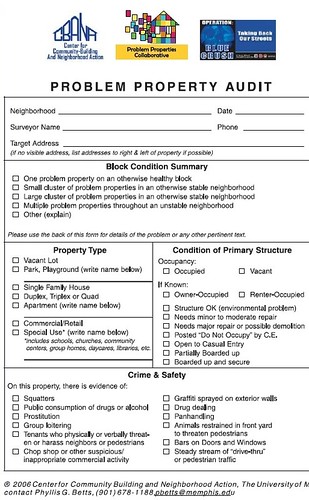
Problem Property Audit, page 1 - University of Memphis

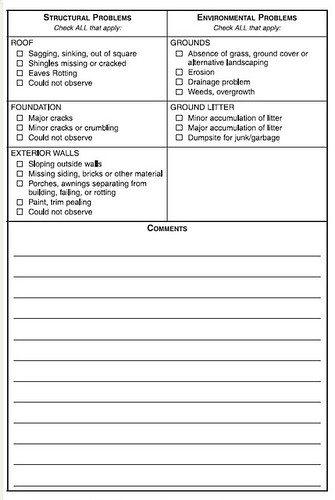
Problem Property Audit, page 2 - University of Memphis

Place assessment tools

1. The Problem property audit form pictured above was created by researchers at the University of Memphis to evaluate declining neighborhoods.  It's not online any more.  There are probably other ones out there.

2. NYC Business Improvement District Needs Survey

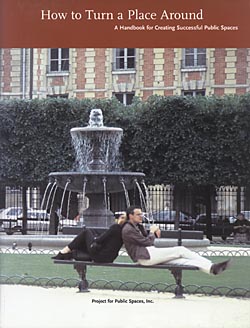
3.  The Project for Public Spaces Place Game, which they have used with individual businesses in a commercial district corridor in places like Littleton, New Hampshire.  It's a fundamental tool in the PPS manual, How to Turn a Place Around, which has been recently updated in a second edition.  I highly recommend the book, and sometime this year will write up a review.

Combining the NYC form + the Place Game approach business-by-business should be a basic requirement at the outset of creating commercial district revitalization programs.

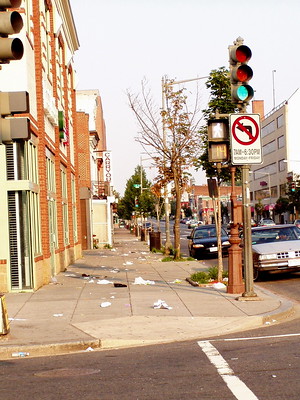
4. Litter Survey Form from Keep Australia Beautiful (adding a couple things makes this an excellent overall public space evaluation tool -- gum and other markings on sidewalks, graffiti--on street signs and buildings, and signs posted in the public space).  I find this tool more detailed than similar items from US-based organizations.
721-727 H Street NE, Washington, DC
5. Open space survey tools such as the Community Gardening Survey Form from the Garden Mosaics program at Cornell University.

Assessing the quality of development proposals

6. Urban Design Evaluation Tool & Glossary of Terms from the Design Advocacy Center (Philadelphia)

7. Community Design Assessment: A Citizens' Planning Guide from the National Trust for Historic Preservation.  Sadly, NTHP, believing no one reads anymore, discontinued their publication program.  They had a deep catalog of worthwhile manuals and books on all topics of preservation.  It was a criminal decision.

Fortunately I took a photo of the survey form.
Community Design Assessment Data Sheet

Placemaking/Destination Development/Tourism Assessment

8.  Dan Burden's "How Can I Find and Help Build a Walkable Community" and "The 20 Ingredients of an Outstanding Destination" by Roger Brooks International, and the PPS Place Game and How to Turn a Place Around but focused on the overall place.

Creating Great Places/Destinations
Creating Great Places/Destinations, Project for Public Spaces.

9.  While updating this piece, I came across a great resource called the Placemaking Assessment Tool produced by Michigan State University Land Policy Institute.  It distinguishes between four types of placemaking: standard; tactical; creative; and strategic, and provides two different assessment tools (one for the first three; one for the fourth), which are quite detailed and remind me of

10.  the out of print Tourism Destination Assessment Workbook from the Nova Scotia Department of Tourism.  Back when I first wrote this piece, I thought it was a great way to shape my thinking about destination development.  There are many other such examples that aren't out of print, including the various worksheets in Nova Scotia's updated Community Tourism Planning Guide.

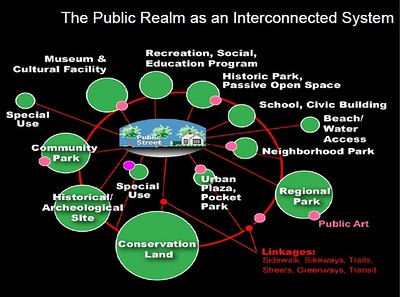
11.  David Barth.  I heard him speak first in 2004 and it really influenced me.  Then he was trying to marry the best of parks planning principles, New Urbanism, and certain City Beautiful concepts in what he called "City Revival."  Later I came across a presentation on the "integrated public realm framework" that propelled and illustrated my thinking about civic assets as networks.

Public Realm as an Interconnected system, Slide from presentation, Leadership and the Role of Parks and Recreation in the New Economy, David Barth

Now he focuses on "High Performance Public Spaces: A Tool for Building More Resilient and Sustainable Communities" (ASLA The Field blog).  Grouped in terms of economic, environmental, and social return, the evaluation tool looks at 25 elements to determine how well spaces can perform.

12. John King is the urban design writer for the San Francisco Chronicle. In 2005, he wrote "Great architecture, clean streets, culture -- it must be Minneapolis," listing ten elements of great cities:

1. Street life thrives if you give it a chance.
2. Convenience isn't nearly as convenient as it seems.
3. The more [things to do] the merrier.
4. Culture adds spice.
5. Narrow streets are better than wide ones.
6. Play up the local angles.
7. Good architecture is good architecture, no matter the style.
8. Change is good.
9. Cleanliness counts.
10. Women know best.

Transportation Resources
(I didn't include transportation planning tools in the original list)

13.  There are many including Pedestrian Road Safety Audit Guidelines and Prompt Lists, Pedestrian Safety Guide and Countermeasure Selection System and Bicycle Safety Guide and Countermeasure Selection System, all produced with the support of the Federal Highway Safety Administration.

14. School Walk and Bike Routes: A Guide for Planning and Improving Walk and Bike to School Options for Students, Washington State DOT.  Making places great for walking and biking to school makes them great for everyone else.

15. Main Street: When a Highway Runs Through It, Oregon State DOT

16. Smart Transportation Guidebook: Planning and Designing Highways and Streets that Support Sustainable and Livable Communities, Delaware Valley Regional Planning Commission

17.  This doesn't look at transit stations, just bus stops, Transit Waiting Environments (out of print).  Network Rail has produced a good manual for rail station planning that is applicable, Station Design Principles. And this SEPTA guide, Modern Trolley Station Design Guide. My written reviews as blog entries of the Silver Spring and Takoma Langley Crossroads Transit Centers provides an excellent framework, if I say so myself.

My own approach to evaluating residential and commercial districts

The other "tool" I use is based on work done for HUD in the 1970s, and used by most jurisdictions around the country. In a way it's pretty basic, you assess neighborhoods based on whether the neighborhoods are:

1. Healthy
2. Transitioning
3. Emerging
4. Distressed.

I think the researchers contracted by HUD came up with 5 categories. Philadelphia uses 6. DC 4--although they don't necessarily use the same terms to classify neighborhoods. Charles Buki uses 3 categories.  Basically the difference in the number of rungs on the ladder depends on whether you break the basic four rungs into "high"--transitioning to the next rung, and "low" differentiations within each rung category.  So you can have as many as 8, with high and low in each.

I think this works at the scale of the neighborhood and district, for example you can compare a large neighborhood in a big city to the Downtown of a smaller city, etc.

But, you need to do three other things alongside this, which most places (including DC) don't do:

1. Evaluate separately and simultaneously the commercial district and the residential parts of the neighborhood -- your ability to move the commercial district up the ladder is dependent on the density and economic capacity of the residents.

Typically commercial districts lag residential areas.  So when investment is put into the commercial district in these situations, the improvement can be seemingly quick.

And past community development strategies--building better housing for poor people--didn't improve the commercial district, because for the most part the micro-economy of the area remained unchanged (see the Community Economic Development Handbook by Temali).

2. You can also use the general criteria to evaluate places block-by-block as well, to help develop more focused strategies for specific needs.

3. Overall, cities should develop differential policies for places based on this criteria, both at the district and block scales.

Point (3) is crucial and the cause of most failures in government policies and programs. By creating one size fits all programs, and not really understanding the nuances and details of a place, and the levers at your disposal, failure is much more likely.

E.g., emerging and distressed commercial districts aren't likely ready for street furniture, and need more assistance in developing organizational capacity, compared to healthy districts, or those in later stages of transition. Similarly, it's much harder to move distressed commercial districts up the ladder when the residential neighborhood is also distressed.
Imagine Your Business Name Here, Martin Luther King Ave. SE, Washington, DC
And speaking of credit, Rachel MacCleery, the then Ward 6 Transportation Planner (now at ULI), and I figured this out together, that commercial districts and residential areas need to be separately and simultaneously evaluated, in order to figure out the likelihood of success.

We were trying to figure out why the investment in streetscape improvement "worked so quickly" on Barracks Row -- 8th Street SE. Most people don't really understand that the success there isn't merely a function of the investment, but in the overall condition and economic capacity of the greater neighborhood (within which the investment was made).
People out on a Sunday on 8th Street SE, Barracks Row
Because much of the property in our commercial districts has absentee ownership, improvement in commercial districts tends to lag improving residential areas, unlike the impact of residential improvement on other building owners (see Building Neighborhood Confidence and Understanding Neighborhood Change both by Rolf Goetze, for more insight into this process).

Labels: , , , , ,

Thursday, April 06, 2017

Montgomery County Green Fest, Saturday May 6th

Flyer for the Montgomery County Green Fest, Saturday May 6th

I am a strong proponent for such events, because they are great for community and capacity building, learning, and information sharing.

There is a lot of tension in Montgomery County between "East County and West County" and "Up County and Down County."

This event grew out of an event created originally by the City of Takoma Park.  And last year the Green Fest was in Takoma Park still.  Takoma Park is decidedly Down County and I guess East County.

Gaithersburg is Up County and West County, but sadly, takes about two hours to get to by transit... and at 20 miles away, about 5 miles longer than I am typically willing to bicycle for a "meeting."

I guess I could take Metro and Ride On there and bike back...

Labels: , ,

Thursday, February 06, 2014

Special service organizations like conservancies vs. public sector operation

Photos below all from Bryant Park in late November 2012.

The New York Times has a column, "Parks Department Takes a Seat Behind Nonprofit Conservancies," about the fact that the NYC Parks Department is barely funded and takes a back seat to the nonprofits that manage the city's big parks such as Central Park, Prospect Park, and Bryant Park.

Those organizations raise millions of dollars each year--some as donations, some, depending on the organization as an add-on fee to property taxes--and for all intents and purposes "own," manage and operate the parks.

The point of this is to provide "more service" to a community-civic asset than the city could normally provide based on general tax revenues.  The idea is threefold, that (1) the "special service districts" (which include business improvement districts) provide the level of service that area stakeholders want, (2) reduce the cost to the general fund by paying for the operations directly; (3) and allow the city to divert the monies that would be spent to other areas not able to raise special funding.

In NYC, this is complicated by the fact that the city is underfunding the parks department generally.   So the spaces that have nonprofit operator-managers get high quality service, and the areas lacking equivalent organizations get very little.

Special service organizations managing publicly-owned space raise important issues:

1.  How the public, which owns the underlying civic asset, is engaged in decision-making;

2.  That differentiated areas not able to raise additional funding get less or no service;

3.  Equity issues that result from this disparity raise concerns about 14th Amendment violations ("equal protection under the law").

I have written about this with regard to business improvement districts.  See "NoMA revisited: business planning to develop community" and "Neighborhood commercial district revitalization in DC."

In my writings on community benefits agreements ("Community benefits agreements (revised)"), it was suggested that a certain percentage of awards could be directed to a fund to provide benefits to areas lacking the same kinds of monetizable opportunities.

Should the well-off public space nonprofits tithe a portion of their funding stream to support less well-off organizations?

State Senator Daniel L. Squadron proposes that "the wealthiest conservancies tithe 20% of the dollars they raise" to be used at "the less-well-endowed parks. ("Can a Tree Grow in the Bronx?," New York Times). Also see "A Radical Proposal For City Parks, and Philanthropy" from the New Yorker.  Parks advocates have fought the proposal ("Parks advocates tear into a de Blasio-backed parks proposal," Capital New York).

From the New Yorker article:
The alarm is understandable. The proposal does constitute a radical challenge to the philanthropic status quo. But there’s another reason why Squadron’s idea has troubled this community. It probes the uneasy relationship between philanthropy and inequality, an uneasiness that is as much a part of America’s philanthropic tradition as the celebrations of its voluntarism.
I agree that there is an issue of equity that should be addressed, and it is especially troubling that the parks advocates for the well-off areas express minimal for the underserved areas.  Also see "Public parks are becoming gardens of private wealth" from the Financial Times.

A necessary step in any case: creating a capacity development infrastructure for parks (and  community) groups

Squadron's legislation calls for the creation of a "Neighborhood Parks Alliance" to assist those parks that lack special organizations ("New York Senator Proposes Neighborhood Parks Alliance," WNET).  This is exactly the right way to go.  The point is not to limit success of those areas that can succeed, but to step in and provide assistance and capacity building to those communities that lack the right resources.

Another place I've come across where this is an issue is in Baltimore County with the recreation department.  For budgetary reasons, in the 1970s the department stopped providing programming, meaning that they could cut staff and save a lot of money.

These responsibilities were devolved to interested residents, implemented by creating a set of "Recreation and Parks Councils" to fund and offer programming for specific facilities, set up within specific sub-districts of the County (there are 40 parks and recreation councils covering the county).

In the well-off areas of the county, these organizations raise $2+ million each year and the centers (maintenance and construction is still provided by the County) offer a great deal of programming.  In less well-off areas, a Rec. Council might raise $15,000 in a good year. 

What the Baltimore County Rec. and Parks Department hasn't done is stepped in and built a capacity development and support infrastructure to provide training in parks, recreation, fundraising, and program development issues. 

(They also haven't provided additional financial support to the underfunded communities.)

This would help everyone, but also would begin to right the equity issues that are now unaddressed.

NYC has done this for business improvement districts, offering a great deal of capacity development and program assistance.

-- NYC Small Business Services
-- starting a BUSINESS IMPROVEMENT DISTRICT a step-by-step guide

Another example is the Park Pride organization in Atlanta, which supports all the parks and open spaces in the city, and has an annual conference at the end of March that always offers a great array of sessions.

There are other examples of capacity building infrastructure programs to assist community organizations.  The since ended Neighborhood Revitalization Program in Minneapolis was a great example--it provided training and support to community organizations allocating money on neighborhood projects derived from a tax increment financing program.

Conclusion.  While the 20% charge might be too much, Senator Squadron's legislation is leading to a necessary discussion of the issues raised by a kind of privatization of the management of public space and the differentiated level of services that result, accentuating already existing social and economic disparities. 

Step in with funding as needed.  And when necessary, the government budget should be used to step in and provide financial support to provide services in the communities that aren't able to self-fund.

The existence of nonprofit management organizations at high profile parks shouldn't be used to reduce funding to government agencies serving those areas not managed by such entities, which is the case in NYC.

Provide oversight and intervene when necessary.  Sometimes local community groups become crazy and the city needs to step in.  See "An example of a big problem with nonprofit organizations: who runs the show?"

Provide capacity building systems.  And regardless, agencies should step in and build the capacity development infrastructure that is necessary for all such organizations to be successful and is required in we want to reduce and eliminate the service and other disparities that currently exist.

Make organizing groups easier.  The past entry "'Networked solutions' for some problems with ANCs in DC," discusses creating a master friends organization for parks, not unlike Park Pride, that takes on general responsibilities, as a framework for the creation of individual park friends groups, without their having to each be separately incorporated.

Labels: , , , , , , ,

Wednesday, July 10, 2013

Summer film series: DC Housing for All

I am impressed that the DC Housing for All campaign is sponsoring a summer film series, "Summer in the City: A documentary series exploring gentrification and urban renewal," showing some key films in the field.

Although I have always hesitated wanting to show "Holding Ground" here because it highlights how the organization featured in the film received eminent domain authority over vacant property in their neighborhood, and I was afraid that DC's community development organizations would use this as justification to seek similar authority.  In any case, the book Streets of Hope, about the organization, the Dudley Street Neighborhood Initiative, is well worth reading, and proves you can run a community development corporation as a participatory democracy.

Southwest Remembered
Tuesday, July 16 at 6:00 PM
Martin Luther King Library: 901 G St NW
The history of urban renewal in Southwest Washington, DC.

Flag Wars
Tuesday, July 23 at 6:00 PM
Martin Luther King Library: 901 G St NW
Tensions rise in a community in Columbus, Ohio, when gay and lesbian white homebuyers move into a working-class black neighborhood.

Holding Ground
Tuesday, August 6 at 6:00 PM
Martin Luther King Library: 901 G St NW
The story of the Dudley Street Neighborhood Initiative. In 1985, African-American, Latino, Cape Verdean, and European-American residents in Roxbury, MA united to revitalize their community.

Boom: The Sound of Eviction
Tuesday, August 20 at 6:00 PM
CNHED: 1432 U Street NW
Like DC today, when the dot-com industry was booming in California, it made it hard for existing low-income residents to stay in San Francisco and Oakland.

-----
They aren't showing "Downside UP," which is about arts-related revitalization in North Adams, Massachusetts.

Labels: , , ,

Tuesday, September 11, 2012

Interesting article on how constituent service provision by legislators reduces the likelihood of systemic change

The Sunday Review section of the New York Times had an interesting article about Congress, "A Congress for the Many, or the Few?," government oversight, and the role of constituent services--Congressional offices stepping in and interceding on behalf of constituents with various federal agencies to rectify issues, problems, and requests--and how this is dysfunctional.  From the article:

For the country, what government workers call “constituent services” — really the meddling of representatives in the business of executive agencies — is a sign of federal dysfunction, and one with consequences. Congress, arguably the most powerful branch of government, seems to have given up on the main thing the Constitution authorizes it to do: pass laws.

Instead, it is busy helping Americans one at a time, an impractical and outrageously expensive operation, which is not only a kind of favoritism masquerading as compassion, but a thumb in the eye of the Constitution, with its much admired blueprint for separation of powers.

The authors of the Constitution were clear: Congress would make the laws, and the executive branch would see that they were carried out. Instead, a vast constituent-services machine, likely costing billions of dollars a year, is letting Congress micro-, not macro-manage, the executive branch. 


I have definitely felt this way about constituent services by Councilmembers (and even the Executive Branch) in DC. 

First, constituent service functions are used as a way to solidify the power of elected officials, rather than to build the capacity of citizens and civic organizations to solve their own problems. 

Second, Councilmember offices typically focus on solving individual problems rather than dealing with issues in a structured, systematic way so that outcomes are improved overall, across the city, rather than in a single instance. 

In other words, unlike say the City's Service Request System, where reported problems are collated and presumably analyzed for patterns and structural-outcome issues in a systematic way, the constituent services approach is a kludge.

The happened in my neighborhood a couple months ago.  A resident bordering the Takoma Recreation Center complained about loud amplified music and proposed that music be banned. 

I replied that rather than banning music, how about deal with the level of amplification.  I did a bit of research, found that the permitting process in other jurisdictions dealt with amplification in very specific ways, with limits on how loud the amplification could be, as measured at the border of the park.

Meanwhile the Councilmember's office replied that they'd deal with the citizen and the park manager directly and "work something out."

I was incensed because if this a recurring problem, (1) when the personnel change, the "solution" will be lost and need to be re-visited and (2) if this is a systemic problem, the opportunity is lost to address the problem so that all parks have the same policy, procedures, and practices in ways that balance the sometimes competing needs of park users and residents while improving outcomes and the performance of DC government agencies.

It turns out there are DPR regulations, including Sec. 4.6 on amplified sound, with a limit of 60 decibels, although the regulations do not indicated from which point it is to be measured.

 -- DC DPR permit request form (which does have a question on whether or not amplified sound is anticipated)

-- City of Boise Special Event permit application

----
Then again, speaking of self-reliance, in an aside at a hearing, I once asked a Council staff person for the last name of one of her colleagues, which I had temporarily forgotten.  She then helpfully offered that I could look it up on the office website, that I could use the Internet for research.

I got so pissed.  I asked her if she was going to instruct me on how to do research?  I was pissed because while the Councilmember always complimented me in public and at hearings, her staff kept her on lockdown in terms of my access to her--I could never get a meeting.  That just felt like one more diss that I wasn't willing to let pass.

Labels: , , , , , ,

Wednesday, April 11, 2012

Marketing resident attraction/Re-positioning neighborhood revitalization practice

In an entry yesterday about neighborhood festivals as an element of neighborhood planning and economic development, I commented that how DC elected officials organize "neighborhood services" is more about political consideration than it is about neighborhood improvement.

Basically the idea is that a true "Department of Neighborhood Services" would focus on building the capacity of citizens and organizations to help themselves and their neighborhood, rather than infantilizing them, and making them dependent on "the government" to fix every little thing. But that there would be plans, programs, systems, etc., to help stabilize, maintain, and improve neighborhoods.

We don't do this in DC.

(A related point I make is that neighborhood-based schools are a fundamental element of strong neighborhoods and should be a centerpiece in planning, and not the sole responsibility of school systems. See "Rethinking community planning around maintaining neighborhood civic assets and anchors.")
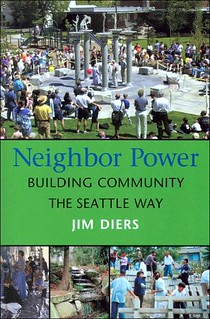
Neighbor Power by Jim Diers
There is a fair amount written about building neighborhood capacity. One book, although I have a problem or two with it, is the book Neighbor Power: Building Community the Seattle Way by Jim Diers. Generally there is the approach of the Asset-Based Community Development Institute and the organization's various publications, such as City-Sponsored Community Building: Savannah’s Grants for Blocks Story which describes an approach not unlike the one spearheaded by Jim Diers in Seattle.

I write from time to time about Live Baltimore, the national best practice example of focused residential attraction to Baltimore City, through marketing and the provision of various incentives.
By marketing, I mean that they promote living in the city generally, but focus the resources on specific neighborhoods needing more assistance, through frequent events in neighborhoods across the city.

But it isn't a solely top-down phenomenon. The services and promotions are provided for the most part by volunteers, coordinated and supported by the relatively small staff of the Live Baltimore organization.
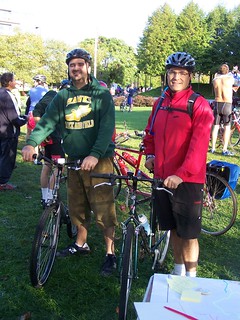
Chris Merriam and Stu Sirota
Chris Merriam and Stu Sirota at BikeMaryland's Tour de Port in 2009.

Each year they have two major events, one focused on neighborhoods in the western part of the city and the other focused on eastern neighborhoods. This year's Spring events focus on West Baltimore and they have a number of programs scheduled:

• On Wednesday, April 11, Live Baltimore will pop up smack dab in the middle of downtown for a rooftop cocktail party in Pigtown. Close to everything, this area will highlight Pigtown along with Barre Circle, Hollins Market, Ridgely’s Delight and Union Square.

• On Wednesday, April 18 homebuyers will be introduced to the Northwestern areas of Medfield, Remington, Reservoir Hill and Wyman Park at a dessert happy hour hosted in Hampden, home to a bevy of eclectic art galleries, restaurants and boutiques.

• On Wednesday, April 25, Live Baltimore will pop up in Glen for a backyard barbeque to spotlight the Cheswolde, Cross Country, Fallstaff and Mount Washington communities of single-family homes, spacious yards and tree-lined streets.

and the first bike tour of multiple neighborhoods (Hampden, Medfield, Remington, Reservoir Hill, Wyman Park), led by an acquaintance-colleague, Chris Merriam, who has organized a bike promotion advocacy group, BikeMore, for Baltimore City.

The thrust of Live Baltimore is a perfect example of the kind of neighborhood improvement activity that can be coordinated through a Department of Neighborhoods--resident attraction to neighborhoods that need assistance with such. Obviously, DC neighborhoods like Dupont Circle or Chevy Chase or Georgetown or Inner Capitol Hill don't need assistance, the regular market works just fine. But other areas of the city aren't so lucky, and they need some help.

From a Live Baltimore press release:

In recent years Live Baltimore has become known for their bi-annual Buying into Baltimore events. Buying into Baltimore West in May and Buying into Baltimore East in September help potential homebuyers divide and conquer the city’s real estate opportunities while offering an incentive worth $4,000. A homebuyer must go under contract within 90 days of the Buying into Baltimore event. This incentive, like all Baltimore City homebuying incentives available, requires a buyer to earn a Homeownership Counseling Certificate. This process is simple; homebuyers need to attend one group counseling session and one individual counseling session. Live Baltimore hosts two group counseling sessions, led by city-certified counselors prior to the Buying into Baltimore events.

“As the experts on Baltimore City living, we go through a checklist of sorts to determine what neighborhoods are on the brink of being discovered, what sort of lifestyle they offer and then we use our resources to connect homebuyers with the neighborhoods that match the lifestyle they’re seeking” explained Steven Gondol, Live Baltimore’s Executive Director. “We look into the area’s home sales which should be stable if not increasing; is there a neighborhood association or voice that takes care of the community; last but not least we also look for a desirable main street feel with walkable access to shopping, entertainment and dining options.” Live Baltimore has carefully selected the most promising communities on the West side of town to highlight during their pop-up events this April, giving homebuyers a chance to mingle with potential neighbors, learn more about the home-buying process and get a feel for life in these areas.


Recently, DC provided some incentive payments to encourage people to live near transit. But that should be incentive enough, although the idea of financial assistance is to make the housing more affordable, since housing near transit usually costs more. See "Washington, D.C. Offers $12,000 to People Who Move Near Work" from Good Magazine.

But where DC needs to focus its scarce resources is on promoting resident attraction in those neighborhoods where extra normal assistance is required on an ongoing basis.

DC did do a "City Living" Expo in 2003, but it was a one-off event that was never repeated. And more neighborhood-focused programs have never been developed.

Creating a "Department of Neighborhood Services" focused on true neighborhood (residential and commercial, although for the most part these programs tend to focus on residential issues, because other programs tend to support commercial revitalization) is a way to do develop and deliver programming and support systematically, support that focuses resources where they are most needed, while building the capacity of residents and organizations to be effective.

Labels: , , , ,

Sunday, March 18, 2012

Montgomery County Schools Superintendent Josh Starr's book club is a model for cities

Image of Montgomery County Schools Superintendent Joshua Starr's first televised book club from MCPS.

(Yes, I know that DC Councilmember Tommy Wells has a book club too.)

For years I've suggested in the "one city reads the same book" programs that books about urban design-placemaking need to be read, something like Roberta Gratz's Cities Back from the Edge: New Life for Downtown--I recommend this book a lot as the "if you're only going to read one book, read this one" because it is comparatively easy to grasp and covers a lot of ground when it comes to urban revitalization--so that more residents would become more familiar with how cities ought to be functioning, what the problems are, what best practices are, etc., instead of asserting how things should be done without having the right paradigms in place.

For a counter-perspective, see "Agenda 21: plot or paranoia" from the Richmond Times-Dispatch), which discusses various anti-planning efforts in the Richmond area, out of a belief that sustainable development is a plot by the United Nations to control the world.

So I am super-impressed by Montgomery County Schools Superintendent Josh Starr's book club, where he has listed books that have influenced his beliefs and approaches to K-12 education, and has organized a reading club so to speak, which is televised on the school system's educational tv channel. See "Schools chief's novel methods: Montgomery superintendent's first book club reveals his philosophy and personality" from the Washington Post.

This is important for two reasons:

1. If we do believe in substantive democracy, participatory democracy, empowered participation and civic engagement, then we have to build capacity development opportunities in order to realize it. (Related to yesterday's entry regarding the point that to build an engaged populace, people have to have opportunities to be engaged and shape their world.) This is one such activity.

2. Agency leaders and elected officials need to set the tone of their efforts as being knowledge-based, rather than half-as***.

I mention this because of DC Governance, and how many agencies don't seem to have a coherent and best practice approach to what they do in terms of how they operate--that's especially true of the so-called reform effort in DC Public Schools.

Labels: , , , , ,

Tuesday, February 14, 2012

15th Annual Maryland State Bicycle Symposium February 22, 2012

The annual conference, sponsored by BikeMaryland, and conducted in association with the opportunity for lobbying State of Maryland Representatives and Senators on bicycle and sustainable transportation issues is next week and it looks to have an amazing schedule of presentations that I am really sorry that I have to miss.

Wednesday, February 22, 2012; 8:30 a.m. to 4:30 p.m.
Miller Senate Building in the President's Conference Center
11 Bladen Street, Annapolis, MD 21401

Click here to rsvp - write "rsvp symposium" in the subject line. Include your name, organization, title and email address in the body.

Partial list of presenters include:
• Alex Obriecht, Bike Maryland Board President
• Carol Silldorff, Bike Maryland Executive Director
• Gregory I Slater, Director, Office of Planning and Preliminary Engineering. Presentation: Funding Opportunities in Maryland
• Chris Eatough, BikeArlington Program Manager, Capital Bikeshare Management and Marketing. Presentation: Keys to Success and Experiences of Capital Bikeshare
• Heather Strassberger, AICP, Bicycle, Pedestrian & Human Services Transportation Planner, Baltimore Metropolitan Council. Presentation: Regional transportation planning: opportunities for funding
• Various distinguished legislators including Delegate Cardin, Chair of Bicycle Caucus and Delegate Malone.
Michael Sonnenfeld, Bike Maryland Board Member. Presentation: Bike Maryland’s Legislative Agenda
• Dave Love, PhD, Project Director at the Johns Hopkins Center for a Livable Future and on the faculty at Johns Hopkins Bloomberg School of Public Health. Presentation: How Close is 3 Feet? One Bicycle Commuter's Video Diary
• Katie Gore and Marla Streb, Bike Maryland Bike-MINDED Program Coordinators. Presentation: Being Bike-MINDED
• Michael E. Jackson, State Director of Bicycle and Pedestrian Access, MDOT. Presentation: The Maryland Bicycle and Pedestrian Advisory Committee / Maryland’s New Bike Share Program
• Bill Nesper, Director, Bicycle Friendly America Program, League of American Bicyclists. Presentation: Bicycle Friendly Maryland
• Nate Evans, Bicycle & Pedestrian Planner, Baltimore Department of Transportation. Presentation: Bike Advocacy - An Inside Job
• Rebecca Dougherty Goldman, Research & Performance Metrics Manager, Office of Tourism Development, Maryland Department of Business & Economic Development. Presentation: Cycle Maryland Survey – Who, What, Why, Where, and How
• Peter C. Moe, Section Chief, Program Advisory Section, Maryland State Highway Administration, Presentation: Maryland’s Bicycle Awareness Campaign
• William Atkinson, Maryland Department of Planning, Western Maryland Regional Office, Regional Planner, Presentation: Trails and Economic Development

Labels: , , , ,

Wednesday, November 02, 2011

More stuff to do: #2, Washington DC Historical Studies conference

Tomorrow, Friday, Saturday, and a Sunday bus tour

Labels: , , , , ,

More stuff to do: #1 Washington Area Bicycle Association "regional summit"

(While I don't think the topics are that relevant--at least for the most part, they aren't the most important issues right now--to a conference on "regional" bike issues--which will be the subject of another entry at some point) Tomorrow, there is a regional summit on biking issues, which will be held in Arlington County.

Labels: , , ,

Friday, April 30, 2010

Historic Preservation 101/201 Program, free to DC ANC commissioners


Line drawing of a rowhouse
Originally uploaded by rllayman
From email:

DC Preservation League invites you to attend our Historic Preservation 101/201 training to be held Friday morning, May 7, at the Kellogg Conference Center on the campus of Gallaudet University.

With the support of the Department of Consumer & Regulatory Affairs this is our third year of providing a program that introduces the background, opportunities and protections of historic preservation in Washington DC. Most of you represent neighborhoods that include older building that if not designated historic, may have the potential to be. This is a great opportunity to join us to review the programs and processes that can affect historic properties throughout our city. We are pleased to waive the $60 tuition for you as an ANC commissioner if you register by May 5. We look forward to seeing you.

Historic Preservation 101/201
Friday, May 7th
9:00am to 12:00pm
Gallaudet University
Kellogg Conference Center
800 Florida Avenue, NE

Join DCPL and speakers from the DC Historic Preservation Office and the L’Enfant Trust for educational sessions that overview historic preservation in Washington.

Historic Preservation 101 provides a brief history of the DC historic preservation movement, advice on how to navigate historic district requirements, and tips on historic preservation funding, and the value of façade easements.

This year, DCPL is pleased to offer a new session, Historic Preservation 201. This program delves deeper into the process of designating historic landmarks and districts, renovation of a historic property, the historic preservation review process and integrating historic resources with new construction.

Labels: , ,

Tuesday, April 20, 2010

Project for Public Spaces does Cause-related marketing with Urban Outfitters

How to Turn A Place Around
From Project for Public Spaces via email:

Urban Outfitters Announces Earth Week Fundraiser to Benefit PPS

We're excited to announce that PPS has been chosen as a beneficiary of a week-long Earth Day fundraiser at Urban Outfitters, a store which carries clothing, accessories, books, and apartment wares for young women and men. Starting today, April 19, through Sunday, April 25, in all 140 participating stores throughout the country, Urban Outfitters will make a small donation to PPS for every person who declines to take a shopping bag with their purchase.

We plan to use this donation to support research on how to create multi-use destinations. These busy, vibrant squares, streets, markets, and waterfronts cluster uses together and reduce our dependency on transportation, opening the way to a greener future. Understanding why these places work (and what makes them fail) is the first step towards making cities everywhere more sustainable.

http://besenretail.files.wordpress.com/2010/03/uo.jpg

Image from Blogging with Besen Retail.

Labels: , ,

Saturday, January 30, 2010

Civil society, participatory democracy and Advisory Neighborhood Commissions

http://www.us-coin-values-advisor.com/images/Bill-of-Rights-stamp.jpg
Text of the first amendment of the Constitution of the United States:

Congress shall make no law respecting an establishment of religion, or prohibiting the free exercise thereof; or abridging the freedom of speech, or of the press; or the right of the people peaceably to assemble, and to petition the Government for a redress of grievances.

Organizing independent of government, and civil society is partly about the ability "to petition the Government for a redress of grievances."
-------
On the ANC6A list, there is a robust discussion in response to a proposal to seek donations from entities that often have business before Advisory Neighborhood Commission 6A. In DC, Advisory Neighborhood Commissions are bodies that have "great weight"--are consulted--on matters before DC government agencies, especially planning, zoning, historic preservation, certain building regulation matters, and alcoholic beverage sales. Commissioners are elected from districts containing about 1,800 residents, and there are something like 39 ANCs in the city, ranging from 3 to 15 members depending on the size of the commission. I have written about these organizations quite a bit over the years.

Here's my response to the thread (which I am not reprinting):

One of the things I used to say, after having become involved in the neighborhood in earnest around 2000, is that the great thing about the neighborhood from the perspective of developers and other interests is that people sell themselves for so little. One of my lines was "That you get $50 for a block party, and you're owned for life..."

That was based on my experience dealing with what we might call "legacy leadership" in the "near northeast" area centered around JO Wilson School.

Maybe you're all more sophisticated now...

It sure was frustrating back then, figuring out how the community mores were and functioned, identifying the real problems, and working to change them.

WRT block parties and such, the one criticism that I have of ANCs is more theoretical, irrespective of the incredible work that the post-2002 redistricted ANC6A has accomplished through the incredible efforts of so many people, both elected commissioners and nonelected volunteers, is that to my way of thinking, the one problem with ANCs is that they end up "governmentalizing" civil society at the most grassroots levels.

You don't need an elected neighborhood government to organize and collect money for block parties do you? ANCs end up capturing and diverting most of the best of the local leadership into government, and thinking that all problems are solvable and addressable by government, and the idea of "self-help" and independent involvement becomes somewhat crippled as a result.

ANCs end up capturing most of that energy and diverting what would normally be independent actions into the functions of "government." (Yes, I have functioned as and am more comfortable as an outsider, although I am a kind of "inside outsider" who works alongside govt. and in the community. I never ran for ANC, although I served on the 6C Planning and Zoning Committee from 2003-2005 and worked on many initiatives involving ANC commissioners [including Main Street revitalization and neighborhood historic preservation efforts], and from time to time I provided free consulting behind the scenes on particular issues--I don't really have the luxury of doing that now. And by the way, who wants to take over from me the hstreetdc and northside_dc and anc6c listservs?)

Why aren't there many independent, organized, and functioning neighborhood groups outside of the "elected" "government" of the ANCs?

A healthy functioning participating civil society has a robust number of independent groups and a great number and variety of social, cultural, and civic organizations.

I think that's not exactly dangerous, but it isn't a healthy sign of democracy. This idea of sponsored block parties and soliciting donations by the ANC is but one example.

This is the libertarian side of my left progressivism coming out.

Labels: , , , ,