Rebuilding Place in the Urban Space

"A community’s physical form, rather than its land uses, is its most intrinsic and enduring characteristic." [Katz, EPA] This blog focuses on place and placemaking and all that makes it work--historic preservation, urban design, transportation, asset-based community development, arts & cultural development, commercial district revitalization, tourism & destination development, and quality of life advocacy--along with doses of civic engagement and good governance watchdogging.

Wednesday, September 25, 2019

The Washington Post article on displacement in Shaw

It's a heartbreaking article ("D.C.'s gentrification is pushing black people out Shaw").

1829 13th Street NW is a relatively new build--it looks like it dates to the 1960s--in the midst of a great deal of historic housing, with nearby rowhouses worth between $1 and $2 million.

Sanathera Price  has lived at 1829 13th Street NW for 40 years, works for the Social Security Administration, knows her neighbors, etc.

But being in the core of the city, with living in DC now being a popular choice after many decades when it wasn't, properties that once were "affordable" are being upgraded for tenants or owners who can pay a lot more.

Gentrification.  DC has become "gentrified" because there is a greater demand to live here than there is housing supply to accommodate all the people who want to live here.

Why the addition of new housing doesn't reduce prices.  The reason that the addition of new housing isn't slackening prices is not just because (1) by definition new housing is constructed at today's cost of labor, land, and materials, (2) it's also because demand is still greater than supply even with the new additions to supply.

So people with more money bid up and successfully bid for and purchase the housing that exists. In a market economy, people with more money win out. It's not a secret.

Displacement.  For a long time displacement wasn't a big issue in DC, because much of the housing turnover was with the renovation of properties that had been vacant for decades (see "More about contested spaces--gentrification," 2004-2006) that's no longer the case.

How to respond.  To maintain a variety of income groups as residents in the face of a hyper strong real estate market there are two things that need to be done.

1. Build more housing.

2. Protect the affordable housing that exists.

WRT (1) we're not building enough housing. Relatedly, the opportunity costs in lost build out capacity, often in ways that would still be pretty low density, are incredible. Thousands and thousands of units aren't built.

That creates the velocity for displacement, because the inability to meet demand means that Class B and Class C housing is upgraded and sold or rented to higher income residents.

(2) There aren't systematic mechanisms for buying, holding, and maintaining affordable housing at scale. And mostly I mean multiunit dwellings. There are two elements. One is buying buildings, like that apartment building featured in the Post article on Sunday about Shaw.

Once a for profit developer buys a property low in a market that is strong, eventually it will be converted. So the agreement the tenants had ultimately didn't matter.

In my writings about culture matters and planning, where the issues are comparable, I write about "Buy(ing) the M* F* Building Already."

If you're whining about change and displacement and not creating the mechanisms to address the problem in a structural way, you're wasting your time, my time, and everyone else's.

So there needs to be a social housing entity that buys these properties.
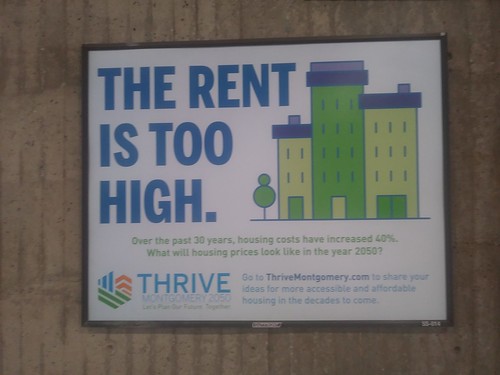
The rent is too high.  Billboard in the Silver Spring Metrorail Station.  Thrive MontgomeryOrganizations like Jubilee do this, but they probably aren't super active acquirers in the way and scale that I am thinking about.

The second thing is community land trusts. I know some have been created in the city, but they are far too late to the game to make much difference.

And the only real successful urban land trust I know about, in Roxbury, Boston, only has about 200 units of housing in their CLT after 25 years. To me that's pretty insignificant.

Other ways to add to the housing supplyADUs.  There should be massive support of the creation of accessory dwellings in the places where they can be developed at scale (both separate units and basement units).

The thing is that it's still expensive to develop such units, as much as $200,000, and the payoff period is 15 years or more, so people have to be altruistically motivated to do so.  Or you can provide incentives and mechanisms for building such units at scale.  In Portland, Oregon, Dweller is a for profit construction organization that focuses on ADUs. 

Two floors being added to an apartment building off Kennedy Street NW (maybe on 9th Street)Intensifying smaller properties into larger properties (e.g., 3 story apartment buildings on Fort Totten Drive could become 6 story buildings).

The building pictured at left, I think is at 9th and Kennedy Streets NW. 

I don't have a problem with intensification, I just want the building facades to be quality, e.g., if the building is brick, the new part should be brick also.

But surgical projects like these could add a lot of housing units.

Single Room Occupancy Housing to deal with the "homeless crisis." It's not clear how many units we have in the city, formally, but it's likely less than 1000 (So Others Might Eat has more than 600 units, but they never returned my calls when I wanted to write about it).

-- "One of the "solutions" to the crisis of homelessness is a lot more SRO housing," 2017

Opportunity costs for not building to reasonable density.  Plenty of buildings aren't built larger either because of zoning restrictions or placation of opposition to development.

The Willow + Maple Apartments are about three blocks from the Takoma Metrorail Station.  Even one more floor would have added 40 units.

And we're not talking skyscrapers.  We're talking two-story buildings that could be four-story.  Four- or five-story buildings that could be six- or seven-stories (like at Fort Totten Metro).

But this comes at a great cost.  Fewer units mean housing costs more.  Fewer units means DC makes less revenue in terms of personal income and sales taxes, property taxes, and commercial income taxes for rented buildings.  It means fewer people to support local commercial districts.  Fewer eyes on the street, etc.

But mostly, it means higher priced housing and more displacement.

Creating implementation organizations to do this at scale: community development corporations.  DC relies on for profit develoeprs to build housing, alongside mostly small community housing organizations.

WRT the Purple Line light rail program and its likely negative impact on maintaining housing affordability in communities like Langley Park, stating that PG and Montgomery Counties needed to create a community development corporation tasked with the responsibility of buying, holding, developing, and funding the maintenance of affordable housing (and other stuff too).

-- "Creating a transportation development authority in Montgomery and Prince George's County to effectuate placemaking, retail development, and housing programs in association with the Purple Line," 2017

The same goes with housing policy in DC. You need implementation organizations that can do it.

Integrating social housing in large scale redevelopment programs.  In writing about revitalization and housing planning initiatives in Europe, I learned that in cities like Helsinki, when they do master planning, from the outset they carve out sites within the project that are allocated to social housing organizations for the creation of new housing that is 100% affordable and complementary to the sites that are allocated to the creation of market rate housing.

One of the things I wanted to try to do was to create a bid team for the redevelopment project at the Armed Forces Retirement Home, to do just that.  But the likelihood of pulling that off was low.  Not just getting for profit developers together, but getting them to agree to give up some of the parcels to social housing.

It's the kind of thing DC should have done with the redevelopment program for Walter Reed, and the Hebrew Home for the Aging on Spring Street NW.

(Although I was super impressed that Empower DC pulled together a team to bid on the Alexander Crummell School site in Ivy City. It was a shame that they did not win.)

Building affordable units in otherwise market rate projects isn't enough.  We need some buildings in such situations that are 100% affordable. And similarly, many city owned properties need to be used for 100% affordable projects.  Maybe not all of them, but definitely more than none.

Tampa, because they don't have enough money to renovate their public housing, is doing some site redevelopment in a similar fashion, but in reverse, allocating space to market rate housing, and using the money for renovation of social housing. (This has been proposed in NYC too, and people are not in favor.)  But they aren't reducing the number of units that already exist, and they are building more social housing units.


Conclusion.  The biggest thing I've learned being involved in this stuff for not quite 20 years is that you need robust plans in place before market interest changes significantly, not after.

It's not like people don't know what best practice is.

Why it's not being effectuated in DC is another issue. Although DC does a bunch of things that help. The Housing Trust Fund, the law that allows tenants of apartment buildings to organize and buy the property if it is put up for sale, etc.

But the scale and velocity of the "problem" is significantly greater than the organizational mechanisms available to address it.

As long as we rely on the market to be the primary developer and operator of housing, we'll continue to be in the position we are in.

Labels: , , , , ,

Wednesday, April 11, 2012

Marketing resident attraction/Re-positioning neighborhood revitalization practice

In an entry yesterday about neighborhood festivals as an element of neighborhood planning and economic development, I commented that how DC elected officials organize "neighborhood services" is more about political consideration than it is about neighborhood improvement.

Basically the idea is that a true "Department of Neighborhood Services" would focus on building the capacity of citizens and organizations to help themselves and their neighborhood, rather than infantilizing them, and making them dependent on "the government" to fix every little thing. But that there would be plans, programs, systems, etc., to help stabilize, maintain, and improve neighborhoods.

We don't do this in DC.

(A related point I make is that neighborhood-based schools are a fundamental element of strong neighborhoods and should be a centerpiece in planning, and not the sole responsibility of school systems. See "Rethinking community planning around maintaining neighborhood civic assets and anchors.")
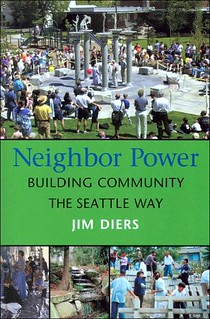
Neighbor Power by Jim Diers
There is a fair amount written about building neighborhood capacity. One book, although I have a problem or two with it, is the book Neighbor Power: Building Community the Seattle Way by Jim Diers. Generally there is the approach of the Asset-Based Community Development Institute and the organization's various publications, such as City-Sponsored Community Building: Savannah’s Grants for Blocks Story which describes an approach not unlike the one spearheaded by Jim Diers in Seattle.

I write from time to time about Live Baltimore, the national best practice example of focused residential attraction to Baltimore City, through marketing and the provision of various incentives.
By marketing, I mean that they promote living in the city generally, but focus the resources on specific neighborhoods needing more assistance, through frequent events in neighborhoods across the city.

But it isn't a solely top-down phenomenon. The services and promotions are provided for the most part by volunteers, coordinated and supported by the relatively small staff of the Live Baltimore organization.
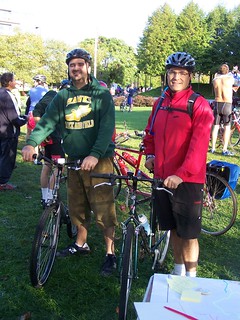
Chris Merriam and Stu Sirota
Chris Merriam and Stu Sirota at BikeMaryland's Tour de Port in 2009.

Each year they have two major events, one focused on neighborhoods in the western part of the city and the other focused on eastern neighborhoods. This year's Spring events focus on West Baltimore and they have a number of programs scheduled:

• On Wednesday, April 11, Live Baltimore will pop up smack dab in the middle of downtown for a rooftop cocktail party in Pigtown. Close to everything, this area will highlight Pigtown along with Barre Circle, Hollins Market, Ridgely’s Delight and Union Square.

• On Wednesday, April 18 homebuyers will be introduced to the Northwestern areas of Medfield, Remington, Reservoir Hill and Wyman Park at a dessert happy hour hosted in Hampden, home to a bevy of eclectic art galleries, restaurants and boutiques.

• On Wednesday, April 25, Live Baltimore will pop up in Glen for a backyard barbeque to spotlight the Cheswolde, Cross Country, Fallstaff and Mount Washington communities of single-family homes, spacious yards and tree-lined streets.

and the first bike tour of multiple neighborhoods (Hampden, Medfield, Remington, Reservoir Hill, Wyman Park), led by an acquaintance-colleague, Chris Merriam, who has organized a bike promotion advocacy group, BikeMore, for Baltimore City.

The thrust of Live Baltimore is a perfect example of the kind of neighborhood improvement activity that can be coordinated through a Department of Neighborhoods--resident attraction to neighborhoods that need assistance with such. Obviously, DC neighborhoods like Dupont Circle or Chevy Chase or Georgetown or Inner Capitol Hill don't need assistance, the regular market works just fine. But other areas of the city aren't so lucky, and they need some help.

From a Live Baltimore press release:

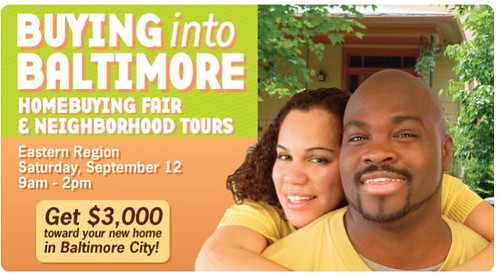
In recent years Live Baltimore has become known for their bi-annual Buying into Baltimore events. Buying into Baltimore West in May and Buying into Baltimore East in September help potential homebuyers divide and conquer the city’s real estate opportunities while offering an incentive worth $4,000. A homebuyer must go under contract within 90 days of the Buying into Baltimore event. This incentive, like all Baltimore City homebuying incentives available, requires a buyer to earn a Homeownership Counseling Certificate. This process is simple; homebuyers need to attend one group counseling session and one individual counseling session. Live Baltimore hosts two group counseling sessions, led by city-certified counselors prior to the Buying into Baltimore events.

“As the experts on Baltimore City living, we go through a checklist of sorts to determine what neighborhoods are on the brink of being discovered, what sort of lifestyle they offer and then we use our resources to connect homebuyers with the neighborhoods that match the lifestyle they’re seeking” explained Steven Gondol, Live Baltimore’s Executive Director. “We look into the area’s home sales which should be stable if not increasing; is there a neighborhood association or voice that takes care of the community; last but not least we also look for a desirable main street feel with walkable access to shopping, entertainment and dining options.” Live Baltimore has carefully selected the most promising communities on the West side of town to highlight during their pop-up events this April, giving homebuyers a chance to mingle with potential neighbors, learn more about the home-buying process and get a feel for life in these areas.


Recently, DC provided some incentive payments to encourage people to live near transit. But that should be incentive enough, although the idea of financial assistance is to make the housing more affordable, since housing near transit usually costs more. See "Washington, D.C. Offers $12,000 to People Who Move Near Work" from Good Magazine.

But where DC needs to focus its scarce resources is on promoting resident attraction in those neighborhoods where extra normal assistance is required on an ongoing basis.

DC did do a "City Living" Expo in 2003, but it was a one-off event that was never repeated. And more neighborhood-focused programs have never been developed.

Creating a "Department of Neighborhood Services" focused on true neighborhood (residential and commercial, although for the most part these programs tend to focus on residential issues, because other programs tend to support commercial revitalization) is a way to do develop and deliver programming and support systematically, support that focuses resources where they are most needed, while building the capacity of residents and organizations to be effective.

Labels: , , , ,

Thursday, January 27, 2011

Rethinking the best way for urban apartment buildings to support biking

Washcycle calls our attention to an article in the Gazette, "College Park officials ready to back new housing project: Project to bring apartments and retail could break ground in fall," about how the new Domain College Park 256 unit apartment project agreed to pay for a 7 dock bicycle station with 4 bikes.

I'm not sure how much it will cost for the compromise decision. The 11 bicycle + station setup that was originally requested cost $54,000.

I don't think that itty bitty bike sharing stations are the best way to integrate bicycle accommodation into large mulitunit apartment and condominium buildings, at least in more urban settings.

First, WABA made an excellent point in their comments to the DC Zoning Commission on bicycle parking, that according to the 2001 National Household Travel Survey there are 0.86 bikes per household. It seems clear that a fractional requirement of 0.75 bicycle parking spaces per unit will not meet current demand (although it would be helpful to have DC-specific data). (See this Washcycle entry for more.)

Second, therefore building regulations should require that one or two bicycle parking spaces be provided per unit, depending on the expected population of the building, and depending on the "urbanness" of the location--e.g., apartment buildings in the core of the city should have higher requirements than places in outlying parts of the city, and this concept of providing greater numbers of bicycle parking spaces for buildings in settings where bicycles are likely to used should be extended regionally.

Third, of course the parking should be secure (locked with secure entry only for those people with bikes), to be congruent with best practices in bicycle parking, which distinguish between the needs of short term parkers (visitors/customers) vs. long term parkers (residents/employees).

See the Toronto Guidelines for the Design and Management of Bicycle Parking for more detailed guidelines for long term parking (bike cages and indoor bicycle rooms).
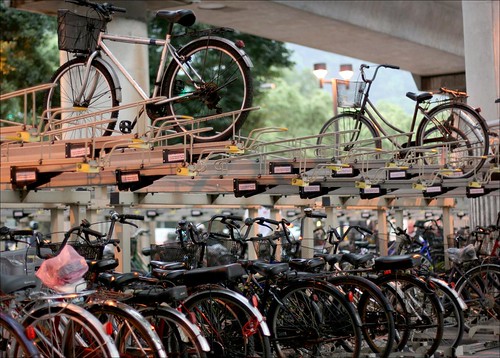
two tier bicycle racks
Flickr photo of two tier bicycle racks by hey-gem

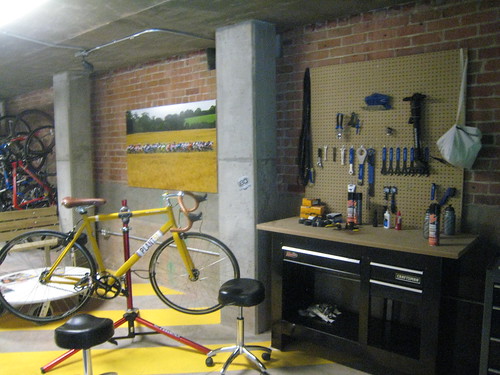
Finally, it would be nice if buildings looked at the provision of bicycle support as a premium amenity, comparable to the Bicycle Kitchen facility in the Plant51 housing development in San Jose, California.
Plant 51 · Bicycle Kitchen
Flickr photo of the Plant51 Bicycle Kitchen repair set up by Jimmy-Lin

I think we can look to the methods for providing support for bicycling on college campuses for guidance with regard to apartment buildings. There are five different methods that I've come across (in addition to having a bike shop/repair facility on campus, programming, bike parking, bike lanes and other bicycle infrastructure, ideally a bicycle and pedestrian coordinator, etc.):

1. Give students a free bike (with some conditions) as a transportation demand management strategy designed to reduce automobile traffic, parking demand, and the space required to park cars(Ripon College Velorution program)

2. Bike library -- you can go to the Rec. center and check a bike out. But it requires labor and space and can only be done when the center is open. This is more for casual and recreational use rather than transportational use.

3. Rental by the term. At North Central College, for $30/term, you can rent a bike and you get a lock and helmet too. And depending on the program, free repairs. This is for TDM purposes and limits the amount of program management and labor demands imposed by the bike library.

4. Discounted purchase programs like the Fuji University program by Fuji Bicycles, which is in place at many universities including Michigan State, Emory University, Temple University, and Brigham Young University. With this kind of program, not unlike discounted software pricing made available to students, the university doesn't have to worry about anything, it's taken care of by the local Fuji bicycle dealer.

5. Bikesharing programs. Just like the traditional bicycle programs, but with different equipment and university support, such as the Zotz bicycle sharing program at UC Irvine. The problem with bikesharing programs is that they are capital, managerially and operationally intensive, and need a high density of stations to provide a useful and usable service profile.

Some hotels (Starwood W Hotel webpage, "Europe on Two Borrowed Wheels" from the New York Times), office buildings (see "Property Funds See the Value in Being Green" from the New York Times), and an apartment building in Tokyo ("Residents of the Muji village can take advantage of free Muji bikes," photo from the Independent) have bicycle programs, either for free as an amenity or for a small charge.

I think with the Domain College Park apartment project, with 256 units targeting upscale residents, that the City of College Park, instead of getting a one-time donation of $54,000 for an 11 bicycle sharing station (even though they settled for a 4 bike, 7 dock station), should have instead required the provision of secure, protected parking for at least 400 bicycles (with a provision for expansion depending on demand), and the offering of a program of a rental bicycle program comparable to how the Term rental program works at North Central College. For $5 or $10/month, the tenant can get a bike and a lock and a space to park in the secure bicycle parking station.

For about $60,000, you could buy at least 100 bicycles, 100 locks, and pay for most of the set up cost for a secure parking facility for 400 bicycles. That would end up supporting active bicycle use far more than one 11 bike sharing station.

This type of program should be promoted as part of more comprehensive transportation demand management protocols created as part of the development review and approval process for construction of new multiunit housing proposals.

But then College Park needs to complement this with increased bicycle infrastructure and programming, and extend comparable requirements to other new buildings being constructed there.
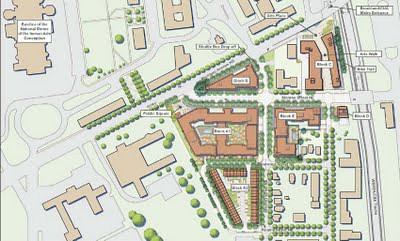
Site plan, Brookland-Catholic University development by the Abdo Development Company
The Brookland Station site plan by the Abdo Company, for the former "south campus" of Catholic University. The site abuts the Metropolitan Branch Trail and the Brookland subway station on the red line. This is a perfect location for an apartment building to position its marketing program around sustainable transportation and proximity to the city's first shared use path, and support the provision of high quality bicycle parking and other programming on the site.

Labels: , , , ,

Thursday, August 05, 2010

Retire to Tennessee program

http://retiretennessee.org/images/logo2.png
Another thing I learned from an article (it also came up in a separate business meeting) is that the State of Tennessee has an active program, Retire Tennessee, to attract retirees as new residents because of the relatively temperate weather. Although I will say it gets very hot there in the summer, at least it did earlier this week. See "Former Council chairwoman to lead Choose Chattanooga" from the Chattanooga Times Free Press.

Very interesting. This is an issue with center cities too. People interested in relocating to cities are either younger or older. The older types look to condominiums and similar housing options as light maintenance, and they appreciate being closer to amenities, and not having to rely on an automobile to get around, because walking, transit, and bicycling are efficient and effective options.

And it's smart for the state, because the people have disposable income, and presumably less of a call on local infrastructure (i.e., schools).

Labels:

Tuesday, December 29, 2009

Report on exhibiting at the City Living Expo, 2003

This is from the email archives of the H Street Main Street organization, 10/27/2003. I mentioned that Expo recently, which was a center city promotion event sponsored by the Williams Administration. This is the "after-action" report, with the removal of the first paragraph thanking most of the volunteers. It's probably worth doing an event like this for the city every couple years. This ended up being a "one and done" event, but the city ought not to rest on its laurels. It must constantly tout (and extend) its advantages and benefits vis-a-vis other locations in the region.
-----------
Alan and Amira were especially great--they brought their "new" baby Amina, who probably was the best advertisement for the neighborhood that there could be. They came back again on Sunday and pitched in for 3 more hours each, in addition to the 2 on Saturday. THANK YOU EVERYONE. One of the reasons our booth was always so full was because our volunteers were so great.

Kevin pulled together some great display materials--a powerpoint presentation featuring highlights of the neighborhood and some "ads" that we will be using in our "Talk About H Street" campaign. The ads highlight the assets of the neighborhood. He also created a handout with more information and our website contact information. We supplemented the display with pages from the Strategic Development Plan, the DC Marketing Center piece, the July "Talk About H Street" ad, the pieces on cluster 25 and 23 from the Office of Planning, and some stuff from WMATA about buses and the subway.

We looked at our participation as "Talking about H Street" as well as "Talking about the greater H Street neighborhood." We said that there are four reasons to consider our neighborhood -- diversity, historic housing stock, close-in location, and great transportation assets. Along with a revitalizing commercial district and good opportunities to buy.

Our Main Street program matters to them, because a vibrant neighborhood needs a great commercial district with great amenities. Many of their questions were about living in the neighborhood. Many people had questions about the plans for H Street's commercial revitalization.

I am not sure what I expected. Some people were curious suburbanites without much commitment to the city. Many had lived in the city. Others were looking for affordable options. Many people, younger and older, were interested in condominiums -- low maintenance. Others wanted more rental options.

We distributed 1,000 or more of the general info sheet. More than 100 (and less than 200) asked for additional information about various topics. Some people want to volunteer.

Living. People wanted to know about available housing. (edited)

Because "good buys" are rare finds in the western part of the neighborhood we were encouraging people to consider the eastern part of the neighborhood. That's why we ended up adding information on the Trinidad area (Cluster 23 brochure) to our booth. [note that originally I used to say that the H Street neighborhood had five competitive advantages. The fifth was relatively inexpensive and well-located housing.]

THE QUESTIONS PEOPLE ASKED REALLY MADE ME CHANGE MY THINKING ABOUT TWO THINGS. I always write that "diversity of housing types" is important and necessary to the neighborhood, especially in terms of reducing displacement, but I didn't really know what that meant until we started getting questions on Saturday...

First, people kept asking about condominiums. I explained that this is coming but we are working on some zoning changes to make this happen. We need to work with the property owners on the 200 and 300 blocks of H Street to make sure this happens. It should also shape the development of the BP site. The land that we have available is too precious to waste. And as everyone knows we need more residents to strengthen the neighborhood ane more customers for the commercial district.

Second, it means that over the long term we (HSMS) really need to work on some of these broader housing issues as they relate to revitalization of the greater neighborhood and the strengthening of the H Street retail trade area.

We need to develop a position statement on housing issues in the broader neighborhood. We need to monitor developments that are in our trade area, developments that we might not ordinarily monitor, because they are in Wards 5 or 7. This should be linked to the encouragement of transit-oriented development associated with the proposed light rail developments along H Street/Benning Road and Florida Avenue.

(We probably need to develop a position statement about light rail as well. Personally I think it should be encouraged, and on an accelerated timetable. The paper on the www.apta.com website called "Bring Back the Streetcars" indicates that a 4-6 year timetable is not out of the question.

It makes sense to coordinate this with the streetscape improvement program. Fixed-rail transit investments generate great economic returns. It will vastly benefit the H Street commercial district. It should be no surprise that the H Street commercial district began declining once streetcars were removed from the corridor...)

It means that we need to weigh in on projects such as the Clark Realty development on Bladensburg on the old Sears site. Maybe they need more density. It means we need to advocate for housing above Hechinger Mall (like Kevin and I have been saying for years.) It means we need to look at the northern parking lots of RFK (problematic because they are owned by the federal government? which are wasted. Condominiums could be developed here, along with maintaining quality public space so that the Open Air Farmers Market would not be displaced. Etc.

We also need to work on inclusionary zoning and related incentives to ensure that affordable housing is required, as well as to ensure quality design. (WRT design, don't think it doesn't matter. The Pritzker condominums at 400 Mass Ave. NW are much more attractive than the condos at 5th and Massachusetts by Paradigm, and that is because the latter development used office building style window glass instead of the residential style windows of the former.

Similarly, the new apartment building on the 1000 block of New Jersey Avenue NW is pretty utilitarian. Incentives should have been provided to get them to include balconies and other design features that would have softwened the facade and made the building look more inviting.)

(Note that the newest housing in the greater neighborhood -- 800 block of 10th St., Wylie Court, and the development across from Hechinger Mall -- is all pretty utilitarian and cheap looking and really denigrates the overall aesthetic of the neighborhood's architectural style and sense of place.)

Also,
we need to make up a sheet about the residential living opportunities in the neighborhood, comparable to the sheets that the DC Marketing Center has developed for the H Street commercial district (as well as others throughout the city). Similarly, we need to add a "residential house photo tour" to the hstreetdc.com website.

Logistics.
When we exhibit next year I think we need to have 3 people in the booth at all times. Saturday was the busiest day. At times there were 15-20 or more people in the booth. We also need to take a map of the entire city, because many people need that in order to put the neighborhood in context. We should either wear tee-shirts or have nametags that identify us (oops). We should also sell our tee shirts and tote bags (this will be in the workplan for next year).

Adams-Morgan had a raffle and got a lot of names entered. But I don't think that is a good idea because you get mostly names of people who want a prize, not people that really care about your neighborhood.

Labels: , , ,

Friday, August 21, 2009

Money for relocating to DC (resident attraction)

is discussed in this Examiner article, "D.C. considers luring new residents with cash," in which I am quoted. From the article:

The District's lead agency on the environment is proposing to dole out $3,000 to people who work in D.C. as an incentive to relocate from their suburban homes into the city, where their commute would demand less energy. ...

On a smaller scale is the proposed Live Near Your Work program, a $90,000 pilot for about 30 District workers. The D.C. government and participating employers would offer grants up to $3,000 eachto prospective homebuyers or renters who are eyeing a move into the city.

"The biggest driver of how much energy somebody uses is where they live," said George Hawkins, DDOE director. "We're trying to get people to live closer to where they work. It's not a lot of money, but it's something we want to pilot to see how it goes."

I think that for different reasons than saving energy, that DC should consider creating a local tax credit program to attract residents to the city, above and beyond which is provided by the federal government, currently $8,000 available nationally, normally there is a $5,000 federal tax credit exclusively available to first time homebuyers locating in DC.
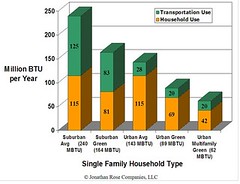
Energy consumption: Suburban Sprawl vs. Green Urban

It's true that DC residents are likely to use less energy, but it isn't a lock. Still, new residents to the city pay income taxes to the city, shop locally and generate sales tax revenues, if they own property they pay property taxes, and if we work it right, they ride transit, generating more ridership and revenue for transit, making more frequent service more realistic.

I would propose a local tax credit for buying a house/condo in DC of up to $10,000, in three tranches:

$3,000 -- for moving to and buying in DC

$3,000 -- an additional payment if by moving to DC you also get rid of at least one car (e.g., a household goes from two cars to one or from one car to none)

$4,000 -- to move to a neighborhood targeted for revitalization and preferably with present or future planned fixed rail service improvement (i.e., especially to neighborhoods that will be served by streetcars)

In the current system, people get the tax credit regardless of where they choose to live. Frankly, you don't need inducements to consider living in Georgetown, but you do when it comes to Deanwood or Trinidad.

A program like this, which isn't all that much different from Baltimore's LiveBaltimore program, which provides incentive payments for residents moving to targeted neighborhoods (additional incentives are available, i.e., Baltimore's Healthy Neighborhoods program also provides special financing for people choosing to live in neighborhoods targeted for improvement).
Live Baltimore promotion
But a program targeting revitalization energy to the neighborhoods that need it most makes much more sense. (Note: I know that some people would call this forced gentrification.)

But why shouldn't center cities provide credits to help attract new residents?

Labels: ,