Rebuilding Place in the Urban Space

"A community’s physical form, rather than its land uses, is its most intrinsic and enduring characteristic." [Katz, EPA] This blog focuses on place and placemaking and all that makes it work--historic preservation, urban design, transportation, asset-based community development, arts & cultural development, commercial district revitalization, tourism & destination development, and quality of life advocacy--along with doses of civic engagement and good governance watchdogging.

Friday, May 01, 2026

National Bicycle Month | Rennes, France: a national model

May is National Bicycle Month.  I always try to do some entries then.  Sometimes I am more successful than others.  Here goes the first.

============

Years ago I did what I consider to have been at the time a best practice bicycle plan for a suburb, Baltimore County, in Maryland.  I wrote about the process here ("Best practice bicycle planning for suburban settings using the "action planning" method," 2010).  

Some of the key elements were: (1) creating a county-wide bicycle route network; (2) secure bicycle parking; and (3) support facilities such as repair services.  

 Plus bicycle wayfinding and map systems, teaching people how to commute and opportunities to try out biking without having to buy all the equipment first ("Revisiting assistance programs to get people biking: 26 programs"), and community promotion.

Sure we all know about cities in the Netherlands and Copenhagen as being best practice for bicycle ridership as a high proportion of total trips traveled, but many places in the US have a hard time grappling with best practice examples from large cities.

I wonder if Rennes, France is a model that is more graspable.  

Covid helped to push policies forward as people were less willing to be corralled on buses.  The city has best practice secure bicycle parking--free at transit stations and in conurbations, and for €40 per year for special bicycle garages in neighborhoods, a protected bicycle lane network in the city and suburbs, the Express Bike Network, "Reseau  Express Vélo." 

Bicycle sharing called LE vélo STAR that can be bundled with transit, and with options besides standard bikes--electric bikes, electric assist cargo bikes, and "longtail" bikes with a backseat child carrier--trailer and child seat rentals, etc.  

Of course, like most of these systems, at a certain price per year it makes sense to buy your own.  But it does offload security and parking costs.

Plus, repair cafes with both bike and food services, and community repair support through the area's bicycle promotion group.

Best practice bike parking in Rennes, France ("Rennes: The metropolitan area is trying out residential bicycle parking to combat theft," 20 Minutes).  It's branded C-Park, for the municipal parking system, which also offers the bike parking services (car sharing and EV charging too).

The news was announced discreetly, during a routine discussion on pricing for the new parking facilities at Hôtel-Dieu and La Courrouze. Adopted unanimously, the proposal put forward by Matthieu Theurier is nonetheless eagerly awaited by thousands of cyclists , particularly those living in apartments. In the second half of the year, four residential bicycle parking facilities will be created in the Breton capital.

Offered by subscription, these bike boxes will be installed in place of car parking spaces to provide a storage solution for cyclists who do not have a garage or a secure place to park their bikes. "The law requires co-owned properties to have a bike garage. But in reality, we know that this is not always possible. We wanted to offer a secure option for residents who don't have one," explains Matthieu Theurier, Vice-President of Rennes Métropole for Mobility.

... Access to these parking spaces will be possible through a paid subscription offered by Citedia via the Korrigo card. On Thursday evening, a rate of 40 euros per year was unanimously adopted by the Rennes Métropole council to launch this trial in the second half of 2022. "C-Parks like the one at the train station are free and will remain so . We will offer 500 additional spaces along the route of metro line B. But we needed a complementary offering," concluded Matthieu Theurier.

Metropolitan bike route network, Rennes ("In 2022, the Rennes metropolitan area's express bike network will move to the high plateau," Ouest France, "Express bike network in Rennes: these three towns are less than 20 minutes apart," Le Telegramme).  From the latter

The number of cyclists is already booming in Rennes, with a 50% increase in the city over the past four years, Valérie Faucheux, Deputy Mayor of Rennes in charge of mobility, told us . This is despite some users' concerns about road safety. The Express Bike Network helps to increase their sense of security on the sections concerned, since the deployment is "accompanied by appropriate signage to ensure the legibility and identification of these cycle routes: road markings with a white bicycle and blue chevrons, and directional signs."

Repair stands and air pumps (inflation stations).  The Rennes area uses participatory budgeting processes where citizens come together and prioritize items and issues which they want local government to fund.  

The network of repair stations is growing as a result of this program ("Even more bike repair and inflation stations!").

(I will say that in my experience in the US, these often get vandalized, and cities aren't good on keeping them in good repair.  It's one reason why I suggest they be placed outside transit stations, where they can be better monitored.  Plus, with electricity connections, you can also have air compressors for pumps.

Bike washing.  Not in Rennes, but there's a free bike washing station in the Avoriaz ski resort community, called Hakken, produced by a company called Wintersteiger, which even has a US branch in Utah.  They brand the equipment as Veloclean.

Repair cafes and a community bike shop (bike hubs) ("Cycle paths, repair workshops…: Rennes, the new cycling Eldorado?" "A Café Citron before getting back in the saddle?," "In Petite Rennes, "assisted self-repair" for cyclists on a budget," "At Ta grand-mère à vélo, a coffee while you study," OW).

Repair shops are flourishing With the increasing number of cyclists, bike repair workshops of all kinds are springing up: traditional or community-based, repair cafes where you can have a drink or a bite to eat while your bike is being serviced, and even self-service repair workshops. Like the Petite Rennes association, which has just opened a 250 m² open-access workshop in La Courrouze, where you can get free advice and, if needed, assistance (only parts, new or used, are charged).

Best practice bicycle promotion:  Bike House and Mobile Bike House (also (Destination Rennes).

When I was with a small group of sadly undercapitalized folks trying to sell bicycle sharing systems, I came up with the idea of a front end Bicycle Center promoting biking, tourism, cafe, etc., modeled in part on the headquarters for VeloQuebec in Montreal, with the bike repair support facility for the bike sharing system as the back end. 

Rennes' bike sharing does that, as part of the region's commitment to sustainable mobility .  From the webpage:

The Rennes 2020 Cycling Plan aims to develop cycling throughout the metropolitan area. The objective is a 20% market share. It relies on four main levers: speed reduction, network improvement, service enhancement, and cycling promotion . The Maison du Vélo (Bike House) plays a key role in this initiative.

Opened in November 2017, the Maison du vélo (Bike House) moved to its new premises on Place de la Gare in Rennes in October 2020. It offers a wide range of services for cyclists, both residents of the Rennes metropolitan area and those just passing through. It has become the go-to place for cycling information within the metropolitan area.

Electric bike rentals, a self-repair workshop, bike marking to combat theft, a cycling school, conferences, exhibitions… The program of activities is co-developed with various partners: associations, bike shops, Destination Rennes, and road safety organizations. A true hub for activities and information dedicated to cycling, the Maison du Vélo (Bike House) is also a permanent space for meetings, advice, prevention, and training on cycling.

They collaborate with area bike-related groups, and using a transit bus specially outfitted, the mobile bike house takes the services on the road, promoting bike sharing subscriptions and other programs ("What can be found in the mobile bike house that travels around the Rennes metropolitan area?," OF).

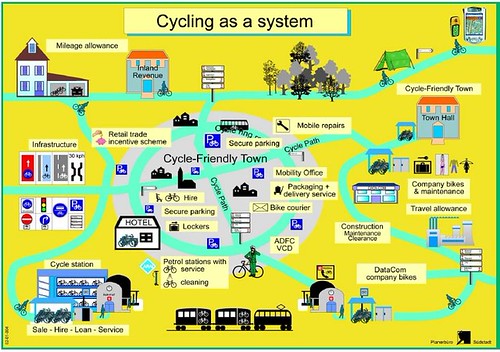
Conclusion: Cycling as a System. These examples show the value in having such services in house, rather than contracting them out, which allows for integration.  For example, a municipal parking system provides an enterprise platform that can also support bicycle parking and car sharing.

The Metropolitan government can provide services like a metropolitan scale bike path network and the Bike House and the Mobile Bike House, which over the course of the year, stops in most of the region's 43 individual jurisdictions.

Rennes the city can build its bike path network and provide other supports, centering and backstopping regional efforts.

It's a focus on creating a bicycle mobility system equal to the system that supports automobility, along the lines suggested in a past German Federal Bicycle Plan, from where this graphic is derived.

Toronto's parking system runs bike sharing, but they took it over once it was on the verge of failing. 

I've suggested that government parking systems could be the backbone of a metropolitan scale system of secure bike parking ("Bike to Work Day as an opportunity to assess the state of bicycle planning: Part 2, building a network of bike facilities at the regional scale").  That the expense of e-bikes means secure parking is necessary to support widescale use ("If you're going to promote electric bikes at scale, there needs to be complementary investment in secure bicycle parking and charging").  

(Baltimore uses its parking garage revenue to support free transit on the Baltimore Circulator bus program.)

A number of cities have bits and pieces of this, but as my writings over the years indicate, an integrated system is way better.

Labels: , , , , , ,

Thursday, October 09, 2025

DC Strategic Bike Plan and survey

 -- Strategic Bike Plan webpage

(Since we still have our house in Ward 4, I felt justified in answering.) The survey is interesting because it's qualitative--asking questions which require written answers--rather than the usually rote-ness of multiple choice quantitative questions.

I forgot to mention e bikes as a game changer--I've come around this, getting more people to bike who wouldn't before, and/or to commute longer distances.

What about bike share?  The other thing there wasn't a place for is to ask questions of your own.  I think there needs to be serious research about "the overnight success of bike share"--not really, I'm joking.  It has taken 15 years, but now each month seems to have more bike trips than the year before.  

Why did this happen?  Expansion of the system?  I don't think so, it's hard a large number of stations to begin with.  Expansion to other communities?  I don't know, are there a lot of city-to-city bike share trips.  Just seeing it in action and testing it out?  I do think adding electric bicycles is one reason why use has increased, even if the pricing is by the minute, not by the trip.

The two big things I mentioned.

1.  Needing to be more focused on assisting people in making the transition to cycling for transportation.

-- "Revisiting assistance programs to get people biking: 26 programs," 2024

2.  The need for a secure network of bicycle parking, especially with the rise in use of expensive cargo bikes and electric bikes.

-- "Another mention of the idea of creating a network of metropolitan scale secure bicycle parking facilities," 2019


The question that wasn't asked: About equity and the provision of biking infrastructure in the low income areas of the city
.  I actually get worked up about this.  I've argued with black community organizers about the value of biking to work, and they think bikes are toys not to be taken seriously.  

Plus, bike infrastructure has been positioned as a tool of whitey/gentrification.  Which has made take up harder.

Years ago I criticized a study that said since blacks didn't want the biking infrastructure it shouldn't be built.

-- "Urg: bad studies don't push the discourse or policy forward | biking in low income communities (in DC) edition," 2014

To me that's dumb, because the point of planning isn't really choice so much as it is optimality.  For reasons of health, economics, access to jobs, and joy, biking can be a lot more optimal and cheaper than transit, and of course, driving (not to mention the difficulty and cost of parking).

Anyway, there is writing out there implying that less infrastructure in black neighborhoods is a plot ("Bike lane distribution in DC is unequal. DDOT’s new bicycling plan could help," Greater Greater Washington).  It isn't.

FWIW, I plan to write about this, based on reading a couple books looking at equity issues in transportation (Reclaiming the Road: Mobility Justice beyond Complete Streets)and cycling (Cyclescapes of the Unequal City: Bicycle Infrastructure and Uneven Development).

As the now deceased professor Donald Shoup used to stay, it's best to help people who are already helping themselves.  It's a losing proposition to try to "force" infrastructure on people who claim they don't want it.  Sadly, that means they screw themselves.  That's been true in DC with both streetcar service and cycling infrastructure.

Labels: , , , , ,

Wednesday, September 27, 2023

Biking to Work Isn't Gaining Any Ground in the US | Bloomberg Opinion

 -- article

Duh.  In an environment where more than 90% of US trips are conducted in part by the automobile, for people to cycle instead, especially in the face of attitudes that treat biking as a toy, they need assistance to do so.

Very little such assistance is provided.

Therefore, people don't bike.  

I do have a piece on this, "Revisiting assistance programs to get people biking: 18 programs."  It's ready for a slight update because I have a couple more items.

We spent 60+ years building a system of automobility.  

We need to build a similar system for biking.  

Bicycle Traffic as a system, diagram, German National Bicycle Plan, 2002-2012

It doesn't need to take 60 years.  But it does need to be purposive.  Right now, few cities are doing much that is substantive to directly assist people in transitioning to biking.

With one exception.  Vouchers and tax credits to buy electric bikes.  

But as I point out, that creates a need for higher quality, secure bicycle parking, and there's no movement on that ("If you're going to promote electric bikes at scale, there needs to be complementary investment in secure bicycle parking and charging").

Many argue that electric bikes can be a game changer.  That they can substitute for a car for many trips.  But without assistance in transitioning to biking, and without creating a complementary secure parking and charging infrastructure, it will likely bump up against existing barriers to take up, along the lines of the Rogers diffusion curve, and will remain stuck in the early adopter phase.

Labels: , , , ,

Thursday, September 21, 2023

If you're going to promote electric bikes at scale, there needs to be complementary investment in secure bicycle parking and charging

 One of the biggest hindrances to electric vehicle adoption is the need for access to charging.  Say what you will about gasoline, but it's easy and fast to fill up, and there are scads of gasoline stations.

One of the biggest problems with cycling take up, besides the fact that it's slower, so longer trips are less likely to be capturable--even so, 64% of all US trips are 7 miles or less--is secure bicycle parking.  Sure there is bicycle parking, but most of it isn't secure.

Bicycle Traffic as a system, diagram, German National Bicycle Plan, 2002-2012.  Image.

I suggested a system for secure bicycle parking operating at the metropolitan scale a few years ago, based in part on the Parkiteer model in Melbourne.  It's more imperative with the focus on electric biking.

-- "Bike to Work Day as an opportunity to assess the state of bicycle planning: Part 2, building a network of bike facilities at the regional scale," 2017

Many communities, including DC ("D.C. plans to use e-bike subsidies to cut car trips," Washington Post), are creating incentive programs for electric bikes, and compared to gasoline cars versus electric cars, which all in all aren't that much different when it comes to substantive effect, switching trips to bicycles from cars makes a real difference ("The Environmental Impact of Bikes and E bikes," Environmental Protection).  

Note that most communities are providing larger credits based on income, to provide an equity element.

That matters for cheap bicycles when that's all you have to get around, that matters for expensive bicycles, and it really matters for electric bicycles, which can cost $3,000 or more.  Lack of secure parking is a real problem.

And just like there needs to be electric charging for cars, the same will go for bikes.  (I know that for the park I'm on the board of, I've been looking into this.)

This kind of bicycle parking won't cut it.

Full bike racks during a game between the Tampa Bay Rays and the Washington Nationals at Nationals Park this year. (John McDonnell/The Washington Post)

Labels: , , , , ,

Tuesday, June 29, 2021

Special event bicycle parking and the Chicago Cubs

Twitter photo by Jim_barista.

I mention from time to time that the Chicago Cubs baseball team appears to be one of the only sports teams required to do transportation demand management planning as part of their zoning and occupancy permit requirements with the city.

-- "Framework of characteristics that support successful community development in association with the development of professional sports facilities" (section on transportation)

And I have written about secure bike parking organized at the metropolitan scale ("Another mention of the idea of creating a network of metropolitan scale secure bicycle parking facilities"), special event bike parking and bike share.  

Often, bike share operations will set up special valet parking and corrals to hold the bikes (Cabi DC).

That being said, even though the Cubs don't control Divvy, the bike share program in Chicago, they may want to work with them to offer valet parking/corrals to better handle game day needs ("Behold this Divvy bike mountain near Wrigley Field after a full-capacity Cubs game," Chicago Sun-Times).

(Also as an element of creating "bicycle friendly business districts.")

=======

And crime, in Chicago "Divvy bike gangs" have car jacked people and stolen bicycles.  I haven't looked into this more deeply.  I wonder if the GPS can help identify the miscreants (provided they aren't using the bikes illegally, so would be unidentifiable).

Labels: , , , , , ,

Friday, September 13, 2019

World's largest bicycle parking facility at Utrecht Central Station in the Netherlands

Photo from Bicycle Dutch.

Nigel, our correspondent from New Zealand, calls our attention to an article in Dezeen, "World's biggest bicycle park built below Utecht train station," about the completion of phase three of the bicycle parking facility at the main train station in Utrecht, Netherlands.

It provides space for 12,656 bikes, including 1,000 rental bikes and a bike repair shop.

This video shows more of the facility. How there are separate facilities for bikes with baskets or child seats; how there are two levels to the racks, and digital indicators of availability, extending to information about the upper versus the lower racks, just like in the most advanced car parking garages in the US. There isn't space for cargo bikes, but there is a nearby facility provided to accommodate cargo bikes.

Different levels connect to the train platforms, the train station, or the outdoor plaza.


The cost per space was about $2,550.  By contrast, in the US, it costs from $20,000 to $30,000 per space to build an above-ground car parking garage.  And it can be more for below-grade facilities.

Out and about last weekend, when the weather was pretty nice, I saw a lot of people bicycling (and using e-scooters and now the mopeds from Revel and Razor), and it seems like the use of the Capital Bikeshare system is higher too.

But this merely emphasizes my point that more resources need to be put into assisting people in transitioning to bicycling as a primary form of transportation.

-- "Eight "mutual assistance programs" that can build support for biking as transportation on the part of low income communities

Infrastructure (defined as lanes, cycle tracks, trails, etc., as opposed to facilities like maps, kiosks, bike shops, bike repair facilities, bicycle parking, air for tires, etc.), obviously, is key, but it's not enough to induce mass take up of biking for every day transportational use.

Adding infrastructure does increase biking amongst people who are particularly logical and driven by information.  But most people are not like that.

The Utrecht bicycle parking facility is a great example of how many elements are necessary to create a(n) (eco)system that supports "cycling as traffic"/"Cycling as a system"
Bicycle Traffic as a system, diagram, German National Bicycle Plan, 2002-2012

Labels: , , , ,

Friday, February 22, 2019

Another mention of the idea of creating a network of metropolitan scale secure bicycle parking facilities

Another example of the need for a wide range of better bicycle parking options

One of the many hindrances to taking up biking for transportation in a regularized fashion is the lack of quality bicycle parking facilities, especially of a secure nature.

This is from entries that have been codified over the past couple years. And builds from the concept of creating a system that supports regularized travel by bicycle, as illustrated by this graphic from a past German national bicycle plan.
Bicycle Traffic as a system, diagram, German National Bicycle Plan, 2002-2012

Create a city-wide and metropolitan-wide system of protected bike parking that is easy to use. The Parkiteer system in Victoria State/Melbourne, Australia is the model ("Bike to Work Day as an opportunity to assess the state of bicycle planning: Part 2, building a network of bike facilities at the regional scale").

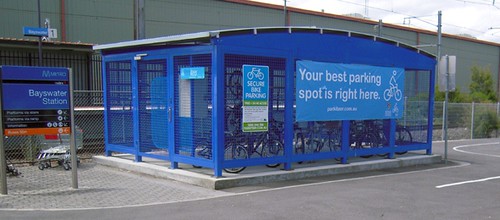
Centered on Melbourne, the Parkiteer system is a network of 90+ secure bicycle parking cages at railroad and transit stations.  While many European, Asian, and South American cities provide similar types of bike cages, Parkiteer is different in that each cage is a node in a common network, rather than each a free standing facility with different membership and entry access systems.

Bayswater Station, Melbourne, Parkiteer Bicycle Parking Cage

I am suggesting the creation of a networked secure bike parking system covering the DC and Baltimore metropolitan areas, one that isn't transit agency/jurisdiction specific, but functional without respect to agency or jurisdiction (like how you can use the SmarTrip/CharmCard across transit agencies, even though technically, the card program is run by WMATA), including:
  • key activity centers, not just transit stations;
  • use city and county parking structures as opportunities for providing high quality protected bike parking.  For example, With the opening of the Purple Line, parking authorities in Montgomery and Prince George's should commit to participating;
  • provide such facilities in dense neighborhoods like Columbia Heights DC, where apartment buildings constructed before 1950 typically don't have parking garages;
  • rather than focus exclusively on bike cages like the Parkiteer program, work to employ a wide variety of high quality secure bicycle parking options designed according to the location's conditions, opportunities, and potential for the most cost-effective installation;
The way the Parkiteer program works is that "members" pay a one-time $50 fee for a key fob which allows them to open the access control device.  They can use any of the Parkiteer sites across the network.  There is no daily use fee for parking.

Ideally, a wide variety of high quality parking options would be employed, not just the "cages" used in the Parkiteer program
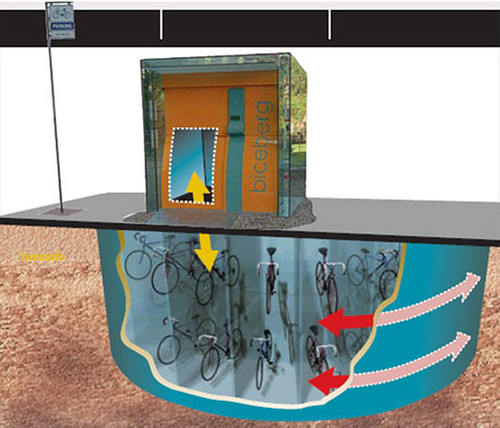
.Biceberg underground bicycle parking
The Biceberg underground bicycle parking system works with an above-ground kiosk.


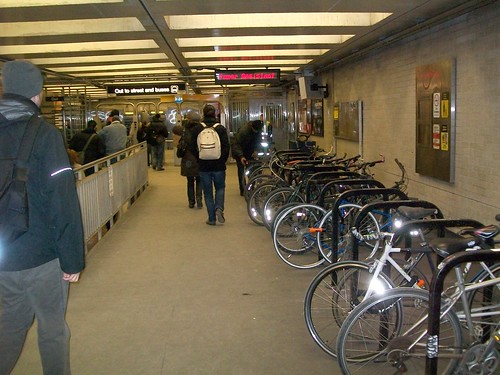
Interior bicycle racks, Logan Square station, blue line subway, Chicago
At the Logan Square CTA station in Chicago, protected bike parking is available within the station, behind the fare gates, in interstitial space.

Note that the Biceberg has the capacity of 23, 46, 69, or 92 bikes, depending on the underground configuration (each unit of 23 equals the cubic feet of one parking space), while the bike cages used in the Parkiteer program have a capacity of 30.  Plus, it seems that the Parkiteer program's cages are pretty expensive.

In any case there are a variety of spaces (indoors, garages, underground options, etc.) that should be utilized for such a program.

Underground options would be important to incorporate in high density urban neighborhoods, where buildings constructed 100 years ago or more tend to not have spaces that work for conversion to convenient bicycle parking.

There are some proto examples here and there, but they don't operate on the scale or approach of  Parkiteer.  Santa Ana, California has a few bike shelters in its Downtown that are accessed by paying members.  Indianapolis had a similar system called Indiana Bike Port but the program has been discontinued.

Complement a metropolitan-scale bicycle parking system with bike/mobility hubs.  In the SF Bay area and in Los Angeles County the transit agencies have a number of bike hubs, although membership is facility specific.

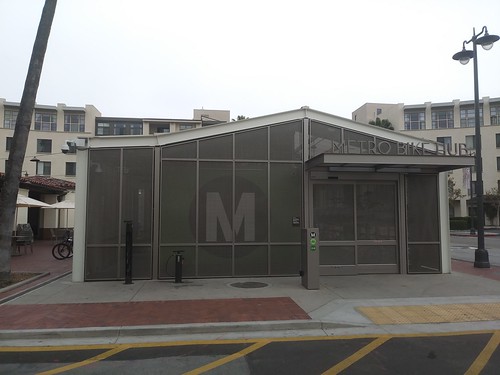
In Los Angeles, bike hubs--with repair and other services--sometimes are paired with secure bicycle parking facilities, such as at LA Union Station.

LA Metro bicycle hub, Union Station, Loa Angeles
Bike Hub side of the secure parking facility at LA Union Station.

LA Metro bicycle hub, Union Station, Loa Angeles
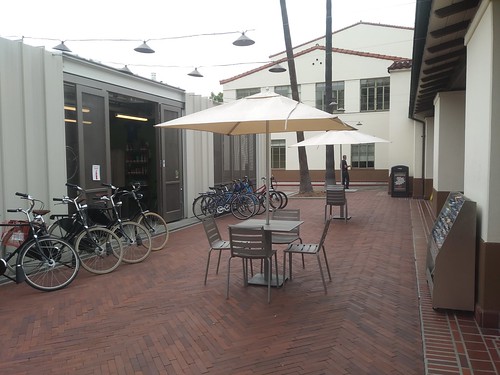
They offer longer term bike rental, have a rack of tourism information (but not good info on local bicycle routes and infrastructure), a patio area for sitting, etc.

LA Metro bicycle hub, Union Station, Loa Angeles

The thing is that from a profit standpoint, it can be tough for these facilities to work out financially, because the demand for bicycle sales etc. can be low.  Providing free or severely low rent, working with nonprofit bike co-ops, etc. could be other options.

I also like the idea of positioning these facilities as "lifestyle stores" promoting sustainable mobility as a way to rebrand transit sales and information centers ("LimeBike and "scooter lifestyle stores" as an example of forward marketing for sustainable mobility").

I argue that major transit stations ("Takoma Langley Crossroads Transit Center: a critical evaluation"), airports ("Why not a bicycle hub at National Airport?, focused on capturing worker trips but open to all"), and major districts should have such facilities.
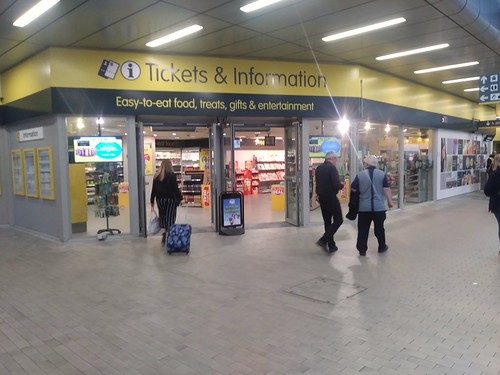
Merseyrail Liverpool transit ticket office


The Bike Center in Santa Monica is a good example of such a center serving a commercial district. They get reduced rent on the ground floor of a parking garage, but otherwise it isn't part of a city transportation initiative.  They offer a membership program with access to secure parking, showers, lockers and towel service.

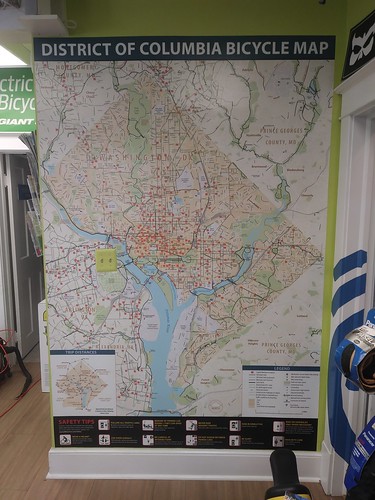
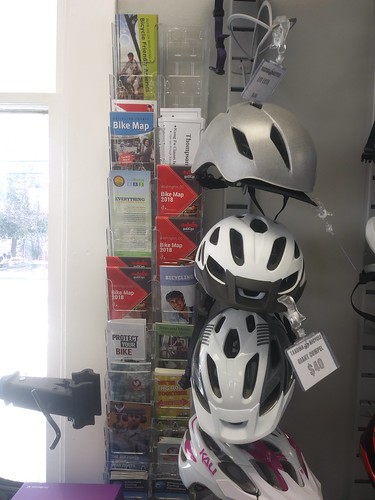
Mobility hubs need to provide/display comprehensive information on bikeways.  The Takoma Bicycle Shop has a large poster size copy of the DC Bicycle Map on one of its walls.  This kind of treatment needs to be more widespread, especially at transit hubs.  The Takoma Bike Shop also has information racks with area bicycle maps and other information.  It's not fully comprehensive, but much further ahead of most other bike shops.
Large copy of Washington DC Bicycle Map posted on a wall of the Takoma Bicycle Shop, Takoma Park, Maryland

Bicycle map information rack, Takoma Bicycle Shop, Takoma Park, Maryland

Labels: , ,

Monday, August 06, 2018

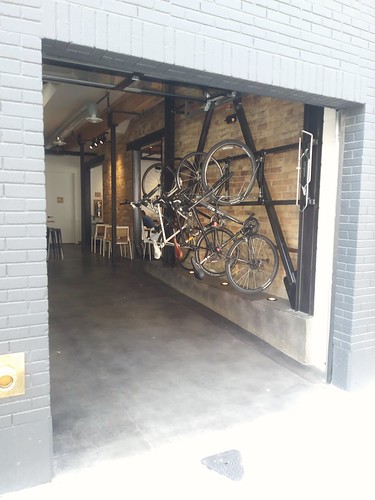
Indoor bicycle racks at for profit coffee shop

Indoor bicycle parking at Campos Coffee Roastery and Kitchen, Salt Lake City

Elsewhere in Salt Lake City, the Harmon's City Creek Supermarket also has a couple of indoor bicycle parking spots, but they aren't particularly easy to use or so prominently placed. (This particular supermarket branch is a design award winner in the industry, very much oriented to serving the center city market in a way decidedly different from suburban stores.)

Labels: , ,

Wednesday, April 18, 2018

Maybe New York City just needs to invest in public secure bike parking (re: dockless bike sharing)

Lower ManhattanCrain's New York Business reports ("12 bike-share companies bid to serve non–Citi Bike neighborhoods: City unveils list of dockless operators vying for pilot program") that many firms are bidding to offer dockless bike share--big known firms and small ones too (including one from this area).

I don't really understand the business model for dockless bike share. I mean I do. If you can get someone to pay $1/ride 4x/day that's $120/month from one user. If you can get four people per bike, that's $480/month. The bikes don't cost that much, etc.

Depending on the nature of where you conduct most of your trips, bike share can make a lot of sense in terms of offloading the cost of owning a bike in terms of maintenance, security, and storage. That's easily worth the $75 to $150/year it costs to use bike share in major cities.

But charging 5x or more than traditional bike share for the privilege of making money for the corporation owning the system, that I don't understand.

Suzanne coined the term "paying for the process."

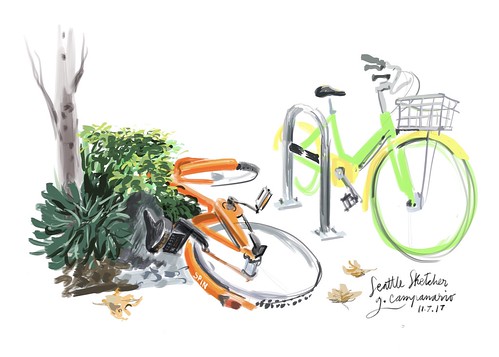
Dockless in SeattleThe reason that governments are receptive is because unlike traditional bike share, companies, at least at this stage of the venture capital and business development process, are willing and eager to bear all the costs, so the cities don't have to spend any money on it.

They can feel good about it, so long as they don't ask the question whether or not it's a good deal for the user.  (Not having to pay for anything is why universities are interested.)

But the mistake is believing that the reason that people aren't biking for transportation is because of lack of access to bikes.

Sure, many people don't own bikes, but they could if they were motivated to do so. Access isn't the issue, it's willingness to bike for transportation on an almost daily basis.

In the US, with a land use and mobility planning paradigm firmly centered upon automobility most people look at bikes as toys and riding them as strictly recreational.

Even with dockless, my sense is that most of the users are "casual" users not regular cyclists, and many of the rides are recreational.

That's fine--recreational riding--but is it enough to build a successful business around it? Probably not.

You just don't see that many people biking to make sense of there being multiple competitive services for dockless bike share.

It reminds me more of the "gold rush" days at the start of the creation of railroads or interurbans--many competitive systems were announced, but most failed, and those systems that had at least some track either were abandoned or consolidated.

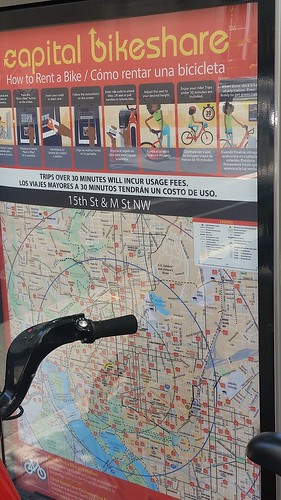
New Capital Bikeshare map kiosk shows bikesheds in 5 minute increments, and pictograms about the processNew Capital Bikeshare map kiosk shows bikesheds in 5 minute increments, and pictograms about the process

But if many of your trips are outside of the bikeshare mobility shed, it makes sense to have your own bike.

Hell, a couple weeks ago I bought a used bike for $100 and he included a helmet, lock, and basket.

Still, it's possible to buy a new bike for less than $400 (some credit unions even provide loans) and the cost to maintain a bike is probably about $150/year, more if you get a lot of flat tires.

I mention bike parking because no community in the US has a network of secure bike parking comparable to the Parkiteer network in Greater Melbourne.

Probably if NYC focused on creating high quality bike parking, using models from the Netherlands--of secure, indoor, often underground parking-- so that the costs to store and secure bikes are lower, more people might consider biking for transportation on a regular basis.

-- "New bike parking facility at Maastricht train station in the Netherlands reminds me of the need to create high profile bike hubs in the US"

Parkiteer bicycle parking network, Greater Melbourne
So far there are more than 100 Parkiteer bike cages operational, with more added eacy year.

===
Last week, Uber bought Jump, the e-bike dockless startup for $100 million. Given that the bikes alone cost $24 million (12,000 bikes @ $2,000) that's a decent return for the creators.

Note that the Transit Cooperative Research Program just released a report on Public Transit and Bike Sharing (registration required to download).

Labels: , , , ,

Tuesday, January 30, 2018

New bike parking facility at Maastricht train station in the Netherlands reminds me of the need to create high profile bike hubs in the US

In October, based on the example at Heathrow Airport, I wrote a piece, "Why not a bicycle hub at National Airport?," suggesting that there is a great opportunity to create a high profile bike hub at National Airport in Northern Virginia, which is adjacent to the Mount Vernon bicycle trail.

I wrote similar pieces in 2015/2016, including comments on the Environmental Impact Study for DC's Union Station's expansion, making the point that Union Station should have a high profile set of bicycle accommodations, far beyond what is available in the current small bike station facility ("D.C. Bike Shelter Gives Commuters A Ticket To Ride," NPR), in part because Union Station is owned by the Federal Railroad Administration and this site could serve as a demonstration project for creating the kinds of bike support facilities at train stations that are common in Europe (e.g., the Cycle Hub program in the UK).

-- National Cycle-Rail Awards, Rail Delivery Group
-- Cycle Facilities at Interchanges, EU
-- Leeds Cyclepoint, Ned Railways

British cycle resources are "more relevant" to the US case than are those from Northern Europe, where cycling take up is significantly higher, whereas US and UK cycling rates are comparable.  That being said, the UK has a big program of adding high quality, protected and secure bicycle parking to train stations, while the US does not.

The EU publication, Cycle Facilities at Interchanges, is particularly good and the kind of "guidance" we need in the US, although I would argue that the issue isn't just cycle facilities, but a broader and more complete approach to sustainable mobility facilities more generally (along the lines of what I discussed in reviews of the Silver Spring Transit Center and the Takoma Langley Crossroads Transit Center).

The cycle point at Leeds Station


The Bicycle Dutch blog alerts us to the grand opening of one such facility, "New underground bicycle parking facility in Maastricht" (pictured).
Maastricht train station bicycle parking

From the blog entry:
It has room to park 3,000 bicycles, 5.5 metres under the station square. It is guarded, has a repair service and parking your bicycle is free for the first 24 hours.

That total number also includes 100 rental bicycles of the OV-Fiets scheme and the special places for bicycles of types that wouldn’t fit in a rack. There is room for 80 such “extraordinary bicycles”; cargo bikes, tandems, bicycles with baskets or the heavy e-bikes. The Maastricht facility has a completely separated room for 40 mopeds or scooters, which is not something you often see in other facilities.

The first 24 hours of parking are free. This has become the norm in the Netherlands at railway stations. After that initial day parking a bicycle costs €1.25 per day. If you plan to park your bicycle for longer periods, an annual subscription might be more attractive, at €75,00 per year. You check your bicycle in by swiping your public transport chip card. If you don’t have such a card you can buy an anonymous one for €7.50, that you can then always use. You check out with the people who are guarding the facility. The same people who can also do repairs and take care of the rental bicycles. The parking fee for cargo bikes and mopeds is €2.50 per day and €150,00 for a one-year subscription.
Maastricht train station bicycle parking

Think of a "travellator" as a stepless escalator.
This facility is open daily. In the morning from 15 minutes before the first train leaves Maastricht, until late in the night, 15 minutes after the last train arrived. The closing hour is a bit dynamic. When the train is delayed, this facility stays open until 15 minutes after the actual arrival time of the last train that day. These opening times mean that the garage really only closes for a little under 4 hours of the night during the week.

Two 30-metre-long travelators (one going down and one going up) give an easy access to the parking garage at 5.5 metres below the surface. The purpose of this garage was to increase the amount of available bicycle parking racks. A second aim was give the station area a “quality impulse”. In other words, to get the sea of bicycles, that were parked in front of the station up to now, out of sight.
Granted, today we don't have demand for such a large bicycle parking facility in the US, let alone DC, but to promote multi-modalism and sustainable mobility, and given that the expansions of Union Station are expected to accommodate growth for the next 100 years, it makes sense to think more grandly about this element of the station, and build a facility on the scale of those in Europe, even if they aren't nearly as big.

Except for the indoor facility, the outdoor bicycle parking at the Union Station is sub-standard, it's not particularly secure or protected and one main area also serves as an ersatz smoking lounge, which sucks.
Outdoor bicycle parking at Washington DC Union Station
Outdoor bicycle parking on the west side of the station (the parking on the east side of the station is more visible, and in better condition, but still is not secure nor protected from the weather).

Labels: , , , , , ,

Monday, October 09, 2017

Why not a bicycle hub at National Airport?, focused on capturing worker trips but open to all

Image from Bike the Gap.

National Airport in Arlington County, Virginia is unusual for a large active airport in that it is in the core of the Washington metropolitan area, only 5 miles from Downtown DC and is bikeable from many points across the area--and is well  served by the Mount Vernon Trail, one of the area's foundational long-distance serving bikeways, connecting Alexandria, Arlington, and DC, with a connection to the Capital Crescent Trail and Suburban Maryland.

It has just been announced that bike share stations will be added to the Airport ("Capital bikeshare gears up for another expansion," Washington Post).

While that's a nice step, we need to be looking more comprehensively at sustainable mobility services and the area's airports more comprehensively, something I've argued for a long time:

-- "Night moves: the need for more night time (and weekend) transit service, especially when the subway is closed," 2013
-- "More on airport-related transit/transit for visitors," 2013
-- "More on transportation to the DC area airports," 2013

Besides general recommendations in the cited entries that also pertain to National Airport, specific suggestions I've made are specifically for National Airport:

(1) have bus service for when the Metrorail subway doesn't run, ideally integrated into a larger Nite Owl bus network ("Slight revisiting of the issue of overnight transit service: San Francisco," 2016

(2) set up a program to accommodate Car2Go one way car sharing, the way that Montreal's Trudeau Airport does ("Car2Go agreement with Montreal's Trudeau Airport could be a model for other jurisdictions") --the airport accommodates Uber and other similar services now ("The popularity of Uber, Lyft boosts airport revenue, but there are trade offs," Washington Post), why not car share?

(3) take responsibility for integrating ground transportation connections between the Crystal City railroad station and the airport ("A brief comment on ground transportation at National Airport vis a vis VRE rail service"), the way that BWI Airport serves the nearby railroad station.

I've probably mentioned that the bike accommodations at National Airport are paltry, one lone rack not up to best practice next to a distant administration building, even though the Airport abuts the Mount Vernon Trail.
Leaving the Airport
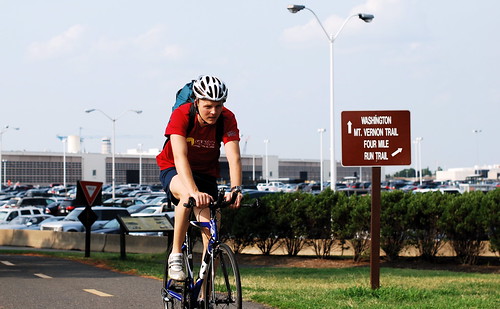
Photo by M.V. Jantzen of a cyclist on the Mount Vernon Trail abutting National Airport.

But in an e-discussion with Nigel, my correspondent from New Zealand, we've been talking about airport transportation connections. 

I suggested it would be useful to have a set of case studies on best practices for sustainable mobility comparable to an old Volpe Transportation Center study on urban tourist transportation systems.

One of the things I do look at from time to time is how well or how poorly airport websites provide information on sustainable ground transportation options, and so I was looking at the Heathrow Airport website, and discovered its webpages on ground transportation are superb, probably the best I've come across.

WRT bicycling, as part of the discussion of bicycle parking, it offhandedly mentions the Heathrow Cycle Hub, without discussing it.

According to Cycling Weekly ("Heathrow Cycle Hub a success"), the Heathrow Cycle Hub is a multi-faceted facility aimed at encouraging airport workers to cycle to and from work, while also providing services for airport users.  From the article:
... in 2011 Heathrow became the first airport in the UK to offer its 76,000 employees a cycle to work scheme and their own onsite bike shop. And in the two years it has been open, there’s been a 45 per cent increase in Heathrow employees cycling to work, with around 570 doing so every day. ...

Inside there’s a workshop and retail space open all day and manned by full-time, fully trained bike experts. Heathrow employees can sign up to the hub for free and get 10 per cent discount on products in the shop, free bike servicing, free maintenance classes and bikeability training. There’s even an emergency call-out available for anyone that has a breakdown in the airport. ...

Heathrow has been striving to improve sustainable travel for the last decade. In 2002, a car share commuter scheme for employees was launched. Heathrow also effectively exists in its own London travel zone, where bus transport in the airport and surrounds is free.
I remember an e-conversation years ago with someone from the University of California Institute for Transportation Studies who mentioned that dealing with airport worker travel to and from work was a major opportunity for shifting people to sustainable modes.

Heathrow Airport demonstrates how to do so, not just in having superior transit connections (subway, bus, railroad service), but also providing support for car sharing, car pooling, and cycling.

Since the launch of the Bike Hub, the airport has appointed a staff member to focus on employee bike transportation ("Healthrow appoints cycling officer to get local staff riding to work," Road.cc) and is advocating for better cycleway connections to the Airport.  The CW article discussed creating an airport area cycling map, but I don't know if that has been carried out.

National Airport, being so close to Downtown and other population centers, would be a natural for such a program in the US -- as would La Guardia Airport in Queens, O'Hare and Midway Airports in Chicago, Newark International Airport, Logan Airport in Boston, among others.

====
In future coverage of necessary steps to build the system for cycling at the metropolitan and regional scales ("Bike to Work Day as an opportunity to assess the state of bicycle planning"), I will add airport bike hubs as an item.

Of course, it goes without saying that secure bike parking at National Airport should be part of a metropolitan and regional secure bike parking network, as suggested in item #5 of the BTWD entry, modeled after the Greater Melbourne Parkiteer bicycle parking network.

Cycle Hubs, like the one at Heathrow, those in the LA MTA system ("A parking garage for bicycles just opened at El Monte Bus Station," San Gabriel Valley Tribune) and other places need to be integrated into such a system, which is item #8 in the BWTD entry.

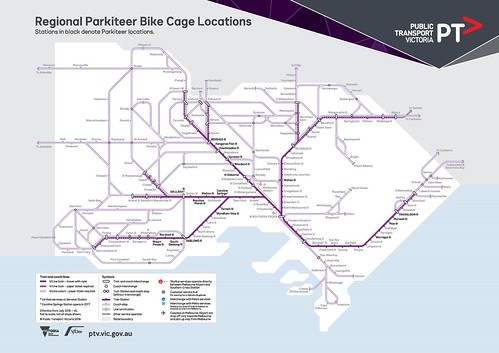
Melbourne, which is a world class best practice example of integrated sustainable mobility services, has a Parkiteer station at the public transit station serving Melbourne Airport, as indicated on the map below. Separately, the Airport provides bike parking too.
Parkiteer bicycle parking network, Greater Melbourne

Labels: , , , , , ,

Monday, April 10, 2017

Design forward bike parking is nice, but secure parking is better

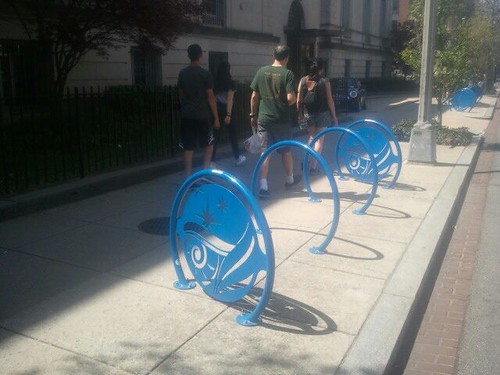
For a few months, I've meant to blog about seeing more "design forward" bike parking ("Best (or at least better) practices in bike parking and bicycle facilities implementation," 2011), especially in the U Street NW area.  But then in the area last Friday, I noticed a high rate of vandalism on many of the bikes parked on such racks on U Street between 7th and 9th Streets.

Design forward bike parking at the northwest corner of 13th and U Streets NW, Washington, DC

Design forward bike parking isn't necessary any more secure than regular bike parking, U Street between 7th and 9th Streets in the Shaw neighborhood of DC
Design forward bike parking isn't necessary any more secure than regular bike parking, west side of the 700 block of U Street NW in the Shaw neighborhood.

Secure parking options are very limited in DC, except in office buildings and apartment buildings.  In each case, such parking isn't normally available to visitors.

Even so, a lot of interior bike parking may be secure from the elements but can still be insecure from theft, depending on the quality of the installation, whether or not it is accessible only by key or card access, insecure access to parking ramps, etc.

Design forward bike parking at the Carnegie Institute of Washington, 1500 block of P Street NW, Washington, DC

Labels: , , , , , ,

Thursday, April 06, 2017

17 bike racks at the Silver Spring Metrorail Station demonstrate that would be a good place to put in a Biceberg kiosk-based bike parking system

17 bike racks at the Silver Spring Metrorail Station demonstrate that would be a good place to put in a Biceberg kiosk-based bike parking system

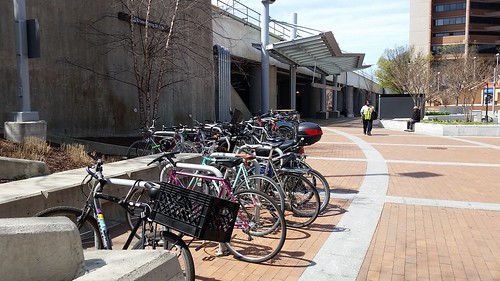
Each bike rack accommodates 2 bikes, so this is parking for 34 bikes. Not quite all of the slots were used yesterday afternoon when I took this photo. But bike parking at many stations like this one are well used. And lots of bike indicate greater demand.

(Note that the station has other sections for bike parking on the west side of the south side entrance to the station, and adjacent to the north side entrance to the station, across Colesville Road.  I haven't counted the spaces in those sections.  Generally the west side parking isn't highly used as that station entrance is less well used so the parking is less secure.  The north side parking is more highly used, but the lighting and use conditions there are also suboptimal.  By contrast the parking pictured is highly visible and well lit by natural lighting during the day, and well enough lit at night.)

In terms of a comprehensive bike parking agenda, I advocate four elements:

1. More

2. Better, meaning more secure options, protection from theft definitely, and ideally, from bad weather too.

3. Use of innovative solutions to expand parking options (including in dense neighborhoods of multiunit housing where there is usually limited or no parking, for cars or bicycles, on the premises)

4. Creating a cross-jurisdictional high quality bike parking network, modeled after the Parkiteer program in Greater Melbourne and Victoria State in Australia. Users pay a $50 deposit for a key card, which entitles them to use any of the facilities, of which there are now more than 90.

One such innovative solution is the Spanish Biceberg product.  It works with an underground "cavern" or locker with an above-ground kiosk. It can be as big as four underground modules. Each module accommodates 23 bikes and takes about the same amount of cubic space as one car parking space.

A four-module Biceberg at this location would almost triple the amount of available bike parking, with the added value of it being highly secure and protected from the elements, not to mention using underground space, rather than a large amount of surface space which is required by "bike cages."
Biceberg underground bicycle parking

Labels: , , , ,