Rebuilding Place in the Urban Space

"A community’s physical form, rather than its land uses, is its most intrinsic and enduring characteristic." [Katz, EPA] This blog focuses on place and placemaking and all that makes it work--historic preservation, urban design, transportation, asset-based community development, arts & cultural development, commercial district revitalization, tourism & destination development, and quality of life advocacy--along with doses of civic engagement and good governance watchdogging.

Friday, August 28, 2026

Hourcar and the Minnesota State Fair

Hourcar is a nonprofit car share organization serving Minneapolis and St. Paul, Minnesota.  It's a rare non profit organization in the field that has survived--many of the initial firms sold themselves to for profit providers around the time that they needed to raise funds for the first wholesale replacement of the original fleet of cars as they aged.

The Minnesota State Fair works with vendors to provide a unique food and drink program.   Branding focuses on the Fair more than the individual firm, at least with cups for beer.

Judging by all the articles in the Minneapolis Star-Tribune (especially about food and drink, like this article about Pyres Brewing, "Pryes Brewing is going big at the 2026 Minnesota State Fair. Here’s why."), the Minnesota State Fair is a big deal.  This year, instead of providing a special drop off area for cars at the Fair, they're encouraging people to use special drop offs set up at the parking lots that are staging points for free transit shuttles to the fair.

That makes more sense than warehousing individual cars at the Fair.

Labels: , , , ,

Tuesday, March 10, 2026

Three ways to put additional checks on professional sports facilities after a contract is signed

The arena is pictured towards the bottom right of the photograph, as a round building.

1.  Conditional Use Permit.  Madison Square Garden has a conditional use permit to operate an arena on top of Penn Station.  

The original term was 50 years.  The permit was renewed for 10 years in 2013.  MSG asked for a permanent permit before its expire in 2023.  This obtains from the Zoning Regulations Section 74-41.

Stakeholders want MSG to accede to new developments in and around Penn Station to make it function better as a railroad passenger station.  This would include land transfers and other acts.  MSG hasn't been cooperative.  The station's location on top of multiple railroad and subway lines means that a majority of its patrons use transit to get there.

Because of MSG's recalcitrance about redevelopment, the most recent renewal was only for five years to put pressure on them to participate ("Five-Year Madison Square Garden Permit Inflates Pressure to Play Ball," The City).

In any case, a conditional use permit provides the opportunity to renegotiate elements of the original agreement, in line with current conditions.

Photo: Danielle Parhizkaran / The Boston Globe.

Annual license.  A provision in the State of Massachusetts code provides that arenas and stadiums are licensed annually for the program they present.  The World Cup is a modification.

The license gives the locality extraordinary opportunity to manage and mitigate elements of the operations of the stadium and its effect on the community.

Much to the chagrin of Kraft Enterprises.  Annual license.  The town of Foxborough, Massachusetts refuses to agree to a license for the soccer World Cup until they receive the money they requested for police and other security measures that would have to be provided by the town ("The $90-a-month Foxborough Select Board members taking on FIFA’s Goliath," Boston Globe).  

Kraft Enterprises pays for security costs for football, concerts, and other large events held at the stadium complex.

Kraft Enterprises and FIFA are up in arms about this ("Boston’s World Cup games still in doubt after funding shortfall proposal rejected," The Athletic).  Foxborough hasn't budged.  From the CBS News story "World Cup security update: Foxboro "shocked and dismayed" by Kraft Group's latest statement on funding":

The town insists that FIFA and Boston 26 pay the $7.8 million security bill upfront ahead of the matches, but the organizations have said that they will reimburse the town, or that the equipment they need for security will be available by June 1.

... “The Town’s public safety team has spent thousands of hours in conjunction with regional, state and federal partners to develop a comprehensive security plan. While the total cost for such services is a microscopic fraction of the revenue that the events will generate, the Town has been met, at every turn, with resistance from the Kraft Group and other event organizers.

“That such entities may have miscalculated the cost of hosting the World Cup is not a reason to compromise on event security. The Town cannot and will not finance the Kraft Group’s losses by sacrificing public safety.”

It turns out that Kraft Enterprises operates Gillette Stadium in part through an annual license wrt the number of events, and other conditions.  It can be modified during the year, e.g. to add a concert to the list of events, etc.  From the license agreement:

In accordance with Massachusetts General Laws Chapter 140, Section 183A, Chapter 136, Section 4, Chapter 140, $181, and Chapter 229, Section 6 of the Code of the Town ofFoxborough (the “Governing Law") the Board of Selectmen of the Town of Foxborough (the "Board") licenses Kraft Sports and Entertainment LLC and its affiliates (collectively "KSE") to conduct live entertainment and sporting events at the premises controlled by KSE inside Gillette Stadium, including activity in the parking areas and plazas surrounding the Stadium that is incidental to events being held inside it, subject to the following terms.

El Paso claims President Donald Trump's political campaign owes more than half a million dollars for police and public safety services from a February campaign rally. REUTERS/Leah Millis.

An aside: Trump and his rallies.  The license approach is interesting.  

If cities had used such a process for dealing with Trump rallies for his election/re-election, they wouldn't have been stiffed ("Cities seek more than $750K in unpaid bills for Trump campaign events since 2016," NBC, "Why the Trump campaign won’t pay police bills," Center for Public Integrity).  From the CPI:

That depends on who you ask. The cities are adamant Trump should pay up. But in many of these cases, there are no signed contracts between the municipal governments and the Trump campaign. The cities dispatched police officers to secure Trump’s events because they believe public safety required it — and the U.S. Secret Service asked for it.

Transportation demand management plans. In "Framework of characteristics that support successful community development in association with the development of professional sports facilities" (2021) one of the sections is on transportation, with examples.  

Most contracts between a locality and the sports team don't have detailed requirements for transportation planning, and the contracts can't really be changed after the fact.

The Washington Wizards and Capitals have an informal agreement to pay for Metrorail service after the system closes, if games go late.  But this doesn't extend to playoffs.  The Washington Nationals baseball team has no similar agreement, formal or informal.

OTOH, the Chicago Cubs are required to have a transportation demand management plan, and it has been tweaked for improvements over time.  The codified document is difficult to find.  The 2018 Cubs Neighborhood Report describes the traffic measures on pages 1-6, including remote parking, shuttles, bicycle valet services, and a focus on CTA rail transit.

The 161st Street Subway Station is directly across from Yankee Stadium.

The Barclays Arena/Brooklyn Nets have a TDM requirement.  Yankee Stadium has a more informal agreement, with possibilities outlined in the environmental impact statement, but it has no public parking lots or garages, and most people arrive by subway and CitiField (NY Mets).  MTA provides extra express subway railroad trains on game days.

Meadowlands Stadium in New Jersey has the Meadowlands District Transportation Plan 2045, but it doesn't always work ("‘Mass-Transit Super Bowl’ Hits Some Rough Patches in Moving Fans," New York Times).

Other arenas that have investments in transit, including free transit fares to and from games and non-sports related concerts include Chase Arena (Golden State Warriors), Climate Change Arena (Seattle Kraken), and Talking Stick Arena (Phoenix Suns).

Other teams have contributed to transit stations and other facilities. Facilities in Australia even include extensive special bus and train services, including for concerts ("Transperth transit (Perth, Western Australia) provides free transit to certain events, like the Red Hot Chili Peppers concert on 2/12/2023," "Perth traffic: TransPerth offers range of travel options for Ed Sheeran concert attendees," Perth Now).

Some casinos too.  While not a sports team, the Springfield Massachusetts MGM Casino was required to create a TDM plan too, although they call it a Traffic Mitigation Plan.  

They complement public transit ("Despite Low Ridership, Springfield's Casino-Funded Bus Service Keeps Moving," WBUR/NPR) with special shuttle transit services ("MGM Springfield launches new shuttle service to Connecticut," Fox61)..  

Springfield doesn't have the same array of transit services as the casino in Everett (next paragraph) so it makes sense that the primary focus is on vehicular transit.

There is also a TDM plan for the Wynn Casino in Everett, although some complain that it maximizes the benefits to the casino, and doesn't work to extend transportation infrastructure improvements beyond the casino site ("New transit links could transform Everett’s access to Boston," Boston Globe).  A soccer stadium will be constructed proximate to the site as well.

However, the state is interfering with these programs to capture the revenues otherwise diverted from the state budget ("‘It couldn’t come at a worse time’: Legislature strips casino mitigation funds amid municipal budget woes," CommonWealth Beacon).

Labels: , , , , , , , ,

Thursday, January 23, 2025

SEPTA to offer free rides after the National Football Conference championship game

Featuring the Washington Commanders and the Philadelphia Eagles.  The only reason I am following this game (besides my interest in teams and the business, management, economics, and societal impacts) is with the first Trump Administration I started reading more sports stories as a way to escape thinking about some of the bad political things happening.  

Going to the University of Michigan, where big team sports are big, and seeing people get in fights when Michigan lost, turned me off big time sports.  As I used to say "whether or not they win or lose, I still have to take my finals.

======

In the annals of sports related and mega events transportation demand management as discussed in myriad blog entries, with a summary at the end, SEPTA, the transit agency for Philadelphia, is offering free transit after Sunday's game, but just on the Broad Street Line.

The free rides will be sponsored by the betting website Draft Kings.


Train wrap promoting the Philadelphia Eagles.
Transportation
  • how people travel to events: automobiles vs. transit--if automobiles are the primary way people get to events, then large amounts of parking usually in surface lots needs to be provided, making it difficult to foster ancillary development because of lack of land and poor quality of the visual environment, whereas if transit is the primary mode, then more land around a facility can be developed in ways that leverage the proximity of the arena. 
  • locating stadiums and arenas in high-capacity transit locations: e.g., Madison Square Garden, Barclays Center, and Capital One Arena are served by multiple transit lines, whereas most stadiums and arenas are sited in locations that have single line transit service.
  • transit capacity: subway transit has much greater capacity than light rail, and depending on the schedule, railroad passenger service.  Buses have less capacity too, but depending on the nature of the event, many can be deployed.  Promising high quality service when transit modes lack the throughput and capacity to deliver (e.g., World Cup soccer in Dallas, Super Bowl at Meadowlands Stadium in New Jersey) creates serious problems.
  • transportation demand management requirements as part of the contract/certificate of occupancy/use permit: some teams have TDM plan requirements, in particular the Chicago Cubs, most don't. Some teams provide a great deal of information or support for sustainable mobility, most don't.  Some teams pay for transit services.  At least some of the time (the Washington Wizards and Washington Capitals) sports teams may pay toward service extended beyond normal hours when games go late, most don't (Washington Nationals).  More sports facilities in cities are adding bike valets and/or secure bike parking facilities.
Slide from a study on the Barclays Center arena, Brooklyn, 2013
  • Free transit with ticket:  Events at the Talking Stick Arena (Phoenix), Chase Center (San Francisco), Climate Pledge Arena (Seattle), and sports events at the University of Utah in Salt Lake City include certain types of free transit access for ticket holders. University of Utah and the Climate Pledge Arena have the most extensive agreements.  Through funding from teams and landowners, the transit station serving Pittsburgh baseball and football stadiums is included in the light rail transit system's "free fare zone," called the North Shore Connector. While it wasn't put into practice, in 2014 in negotiations for a new arena, the transit authority in Sacramento proposed providing Sacramento Kings ticket holders with "free transit" in return for certain subsidies. 
  • transportation demand management plans should set targets for each mode, with a focus on trips by sustainable mobility.  This was an element of the contract with the Barclays Center (Brooklyn Nets).
  • transportation demand management plans should require annual surveying on how people get to events to measure the success of shifting trips to sustainable modes: do fans arrive on foot; by bike; car--gas or electric; car pool; taxi/ride hailing; bus; light rail; etc. (This is an element of the contract with the Climate Pledge Arena/Seattle Kraken hockey team.)
Commuting statistics collected by a local business in Portland, Oregon
  • secure bike parking facilities should be required for in-city sports facilities.
  • special marketing initiatives. Some passenger rail lines provide special game day service for sports events and a wide range of marketing programs (Metrolink, Caltrain, New York MTA).  
  • parking taxes to support community improvements: years ago a neighborhood association in the Hill District of Pittsburgh suggested creating a parking tax that would go towards funding local community projects as a mitigation program ("A dollar a car for the Hill," Hill District Consensus Group).   A parking tax should be assessed in any case.  (Similarly, the BART system has an add on fee for airport trips.)

New York City's arenas and to some extent some baseball stadiums, the Capital One Arena in DC, Wrigley Field in Chicago, and Oracle Park in San Francisco are particularly noteworthy examples of sports facilities well connected by transit, where a majority of attendees get to and from the facility on transit.

As mentioned, some sports teams (and other groups) have paid towards transit stations serving their facilities.  Newer agreements include the New England Patriots ("Commuter rail service to Foxboro to start in October," Quincy Patriot-Ledger, and the New York Islanders ("Islanders arena project at Belmont Park now includes new LIRR station," Newsday).

Labels: , , , , , ,

Monday, January 20, 2025

1953 Presidential Inauguration edition of Transit News, the weekly newsletter of Capital Transit, the then transit operator

Recently, I managed to find some great ephemera.  The WMATA annual report for 1976 when Metrorail first began operating, and two issues of Transit News, the above-cited one, as well as the 1949 issue that explained the service changes resulting from the abandonment of the 10/12 streetcars on H Street-Benning Road to Rosslyn.

Also see "Should transit on inauguration day be free (Reprint)."


I quote from Peter Muller's paper, "Transportation and Urban Form: Stages in the Spatial Evolution of the American Metropolis," *Geography of Urban Transportation), all the time.  This back panel dovetails with the four stages of urban form that he discusses: Walking City; Streetcar City; Recreational Auto Era; and Metropolitan City.  The DC area was a few years away from developing its freeway network.

Labels: , , , , ,

Tuesday, January 14, 2025

Should transit on inauguration day be free (Reprint)

I wish I could score one of these special MetroCards.  This is likely one of the only times Trump's picture will feature in this blog.

Trying not to think about the coming presidency of Donald Trump, but this Washington Post article, "D.C. prepares for more than 200,000 inauguration visitors — and protesters," and others ("WMATA Inauguration service information," WMATA) reminded me.  And that it's worth revisiting this past blog entry, "Should transit on Inauguration Day be free? (Reprint),"

Note that this year, 2025: some stations will be closed within the National Mall area, and service will start at 4 am but "Everyone over the age of 5 needs a SmarTrip card to enter and exit stations"--which as I discuss below creates a throughput problem of great proportion.  

On the other hand, if there will be a maximum of 250,000 attendees, it won't be much of a problem to accommodate them.

========

The original post was from January 2, 2013, about 3 weeks before the Inauguration for President Obama's second term. 

The first Inauguration in 2009 was probably the absolute peak of success for WMATA, with more than one million subway riders that day--and it was about 6 months before the terrible crash at Fort Totten which killed nine people.

The latter, along with the opening of the Silver Line, seem to be the key events in marking the decline of the WMATA system in terms of service, operations, and ridership declines.

While WMATA probably can't successfully carry that many people today, it was a high point in the system's history and the points made below still pertain.

In short, I argue that for transportation demand and system management goals, transit in the DC area should be free on Inauguration Day.

Note that I considered listing this in the previous entry, but I don't think this should be paid for by the local jurisdictions and the transit agencies. Instead the cost should be covered by the Presidential Inauguration Committee.

The entry is edited slightly from the original.

======

Many transit authorities--San Francisco, Minneapolis, Madison, Reno, Long Beach, Edmonton, Milwaukee (paid for by Miller Beer, which was based in that city for decades), Calgary to mention a few--provide free transit during the night and into the wee hours of New Year's Eve, the idea being that it's better that people ride transit than drive drunk.

(This is separate from "Sober Ride" initiatives, such as in the DC region, where on New Year's Eve, inebriated patrons can get free taxi rides--up to $30.)

Seeing this piece in the Post, "Tour bus operators fret that passengers may have a hike to presidential inauguration," about procedures for charter bus management during the Inauguration, thinking about witnessing charter bus drop off for other "special events" at outlying stations such as in Greenbelt, and thinking about yesterday, makes me wonder if as part of special event management:

Perhaps transit service on the WMATA system should be free the day of the Inauguration Parade?, in this case Monday January 21st, 2013.

This would speed throughput, increase safety (in 2009 crowds exceeded the capacity of some stations and to move people through station managers just opened the gates and let people in for free--see "Mall east of 14th St. reaches capacity," this piece lists hour by hour rider counts for the subway up to 11am, from WTOP, the after action report from MWCOG, and comments in this Post article "Metro Ridership Tops 1 Million, Shattering Record"), and minimize confusion.  (Also see "Metro approves expanded Inauguration Day  service, fees" from the Post.)

The system isn't really designed to move through hundreds of thousands of people in a relatively short time window--mechanical chokepoints at fare machines and fare gates slow operations significantly--especially when a bulk of the riders are unfamiliar with using transit.

So don't charge individuals (and charge the Inauguration Committee to cover the lost revenue) in order to reduce the crush on the system by not having to use those trip-slowing mechanical components.

Making transit free on Inauguration Day will speed throughput, which is a desirable benefit in terms of facilitating mobility and reducing "friction."

Farecard machines, Union Station
Transit Throughput Delays 

1.  Buying farecards.   In 2009 we left town to be away from Inauguration madness--although the madness didn't really makes it way up to where we live--and at the Priory Inn in Pittsburgh, we were talking to some people on their way to DC for the Inauguration.

I said the biggest thing they should do is have the guy's daughter (who lived somewhere in Northern Virginia) buy them loaded transit passes, because the biggest delay in getting on is dealing with people buying transit tickets, and being flummoxed trying to figure out how to use the fare machine(s).

I don't know what the throughput is per hour for the fare machines, but it can't be much better than 1.5 people/minute.

That's with (uncrumpled) cash.  It's even slower when using credit cards.

I joke that the blue machines--where you are supposed to indicate how much money you want on a card--which are more difficult to use, draw the inexperienced like moths to light.  And they are the only machines that take credit cards.

Protestors at Greenbelt stationLeft: Greenbelt Station on the day of a protest, full of people being dropped off by tour buses, and being shepherded to Downtown DC via the Metro (2005).

2.  Getting through faregates.  The gates open and close for each patron.  The throughput per gate is just a few people per minute.

3.  Congested station entryways (foyers).  Station foyers in many stations are small, and the combination of lines at the farecard machines and lines at the fare gates can overcrowd the stations very quickly.

4.  Paying when entering a bus.  Similarly, delays on buses mount with long lines, and each person having to pay upon entry, either with cash or with a Smart Card.  Paying transit fares in cash on the bus will significantly slow movement of the bus--and it costs at least 6 cents/second to operate a bus.


Mobility planning for special events in the National Capital (demonstrations and other events on the National Mall)

Note that special event mobility planning for events held on the National Mall is in need of a reboot.

See "A broken record on transportation demand management planning, this time with regard to special events."  But in that blog entry, from 2010, I didn't suggest free transit as a way to cope.

Right: crowd waiting for buses (because of a subway system breakdown).

SF MUNI:  Free transit on agency's 100th anniversary. Note that I am probably being influenced by how SF MUNI didn't charge for transit on their 100th anniversary.  See "Free Muni for…everyone…for a day" from the San Francisco Chronicle.

Free transit on bad air days.  Also, places with strict Air Quality Management requirements often provide free transit on days when air quality is particularly poor, as a way to discourage driving (although I doubt that providing free transit on those days shifts that many people from driving).  More recently, Paris has been forced to do this in an attempt to address air quality ("Paris makes all public transport free in battle against 'worst air pollution for 10 years': Temporary measures also include allowing only cars with odd-numbered licence plates to use roads," Independent; "Madrid's Bold New Pollution Plan: Ban Cars and Make Transit Free," CityLab).

There are some special event transportation planning resources out there, but even they may be insufficiently creative.

-- Special Event Transportation Service Planning and Operations Strategies for Transit
-- for the road network, National Cooperative Highway Research Program (NCHRP) Synthesis 309: Transportation Planning and Management for Special Events
-- Managing Travel for Planned Special Events (FHWA training course)
-- National Special Security Events: Transportation Planning for Planned Special Events

The mess on the National Mall after the Inauguration of Barack ObamaLeft: JANUARY 20, 2009: Spectators sit in trash and debris along the National Mall after the inauguration of Barack Obama as the 44th president of the United States of America January 20, 2009 in Washington, DC. Obama became the first African-American to be sworn in as president in the history of the United States. (Photo by Robert Nickelsberg/Getty Images)

The latter report specifically discusses Presidential Inaugurations, and with the Inauguration of President Obama in 2009, for the first time the Federal Government made some funds available to local jurisdictions for costs, including transit-related, incurred as a result of supporting the event. From the report:

For example, Congress allocated funding to state and local agencies in Virginia following the 56th Presidential Inauguration of Barack Obama, for security (police, fire), transportation (transit buses), and other services (environmental services, parks and cultural resources, and human services). In the event that Congress appropriates funds to reimburse agencies for their NSSE costs, detailed documentation of that cost data will be necessary. The January 20, 2009, inauguration of President Barack Obama used NSSE funding of $15 million for “emergency planning and security costs.”

Additionally, for the same inauguration, then President George W. Bush declared a state of emergency for the District of Columbia, which authorized the federal government to reimburse the District for emergency preparedness activities and expenditures that exceeded $15 million.

BUT, the report does not suggest providing free transit as a way to reduce congestion, speed transit throughput, and manage crowds.

MWCOG after action report

Although the report did mention that some stations closed the entryways due to platform overcrowding, the report didn't significantly review WMATA experiences as reported in the media and comments on articles in social media.  The report doesn't state that at some stations operators opened the faregates to reduce overcrowding as the lines bunched up, and it didn't identify systematically various chokepoints and bottlenecks within transit system processes including those listed above.

And while the report didn't comment on general throughput issues with regard to WMATA inside stations and buses, it does suggest not charging for parking at transit stations, as a way to increase station throughput and to reduce traffic congestion waiting to get through the entry gates.  (On special event days, it would be useful to have signage providing real-time data on parking space availability.)

Conclusion

1.  Don't charge for transit on the day of the Presidential Inauguration, let there be free transit for the day.

2.  Still charge for parking at transit stations, as free parking would just fill up fast anyway and more quickly (witness what happened at stations near the Redskins Stadium before WMATA started charging for weekend parking at those stations).  But plan to manage the road congestion and somehow provide some real-time information about parking availability at those stations.

3.  And for that day only, have the capacity to accept cash for parking at transit stations.

(Ideally, WMATA could have real-time parking availability information systems, but the reality is that except for a couple times each year, there isn't financial justification for providing this kind of system.)

4.  While this entry focuses on WMATA, free transit service should also be provided on that day by DC Circulator, RideOn, DASH, ART, The Bus (PG County), and Fairfax Connector.  Again, it should be paid for by the Presidential Inauguration Committee and/or the Federal Government.

Labels: , , , , ,

Thursday, October 05, 2023

Washington NFL team inks agreement with Metrorail to provide late night post game service: for one game? Or for all of them?

Most sports teams don't have transportation demand management requirements ("Framework of characteristics that support successful community development in association with the development of professional sports facilities").  

That's the case for the DC area teams.  The Washington Nationals baseball team has refused to pay for late night transit service when games run late.  With a few exceptions, the Washington Wizards basketball team and the Washington Capitals hockey team have paid for late night transit service when games run late.

The Daniel Snyder managed Washington Commanders (nee Redskins, and Washington Football Team) never were interested in paying extra, pretty much force people to drive, make walking to the stadium from nearby Metrorail stations very difficult.

But now the Commanders aren't owned by Snyder.  And the new ownership has inked a 5 year promotional agreement with WMATA ("Commanders team with Metro for late-night service after Bears game Thursday," Washington Post).

Which interestingly includes the potential for late night transit service after Thursday night's game.

We don't know if that includes similar arrangements for other night games that go late in the future.

If it does--again, we don't know--it is a big step forward for TDM and special event planning in the DC area.

It's unfortunate the author of the piece didn't ask about this in terms of the future.

=====

Some teams, if not required, have set up extraordinary transportation demand management relationships, involving free transit access to and from games.

-- "Seattle, All Star Baseball Game, free transit throughout the city and metropolitan area," 2023
-- "Transperth transit (Perth, Western Australia) provides free transit to certain events, like the Red Hot Chili Peppers concert on 2/12/2023," 2023
-- "Seattle Kraken expansion hockey team sets new standard for transit benefits in transportation demand management: free transit with ticket,"
-- "Sadly, DC won't show so well during the Baseball All-Star Game," 2018

Labels: , , , , , ,

Tuesday, July 11, 2023

Seattle, All Star Baseball Game, free transit throughout the city and metropolitan area

 Just the other day, "Desperate times sometimes lead to a more marketing-oriented guise: WMATA/Metrorail | Bonus: WMATA's financial crisis," discussed special event transportation, and how WMATA in DC provided free transit starting the evening of July 4th, to facilitate movement to and from fireworks displays.

Yesterday and today are the primary days of activities around the Baseball All Star Game, which this year is in Seattle.  According to The Center Square ("Seattle public transit free Monday and Tuesday for MLB All Star game"):

This fare-free period applies to the following services in the region; 

  • Access Paratransit 
  • King County Water Taxi, Metro and RapidRide Buses
  • Metro Flex on-demand Services 
  • Sound Transit Link light rail 
  • Seattle Streetcars 
  • Kitsap Transit Buses 
  • Kitsap Fast Ferry
Notably excluded from the free fare period for the region are Pierce Transit, Community Transit, and the Seattle Center Monorail, which will continue to charge riders on July 10 and 11.

In February, Utah Transit Authority provided free transit days around the NBA All Star Game, and for an outdoor music festival in May. 


Labels: , , , , , ,

Tuesday, July 04, 2023

Desperate times sometimes lead to a more marketing-oriented guise: WMATA/Metrorail | Bonus: WMATA's financial crisis

First, in the early years of the blog I wrote a lot of pieces about transit marketing and doing a better job of it.  Now a goodly amount of that is encapsulated in "Branding's (NOT) all you need for transit" (2018), but old pieces like "Making Transit Sexy" (2005), make the point too, less sophisticatedly.

Second, during the 2008 crash, I got an email from an activist in response to all the budget and service cuts faced by transit systems.  She said, why can't transit systems be like the system in Rochester, New York ("Creativity Helps Rochester's Transit System Turn a Profit," New York Times), which gets a significant amount of financial support from institutions, who recognize the impact of transit on their organizational community.  That money provides a base level of support independent of fare revenues and government appropriations.

My response was you don't develop such relationships in crisis, but when times are good, and hopefully, those relationships and funding streams can survive exogenous shocks.

WMATA is in financial crisis because of the decline of transit ridership due to telecommuting ("Metro says funding increase needed to avoid catastrophic cuts," Washington Post) but also its financing structure ("Next Stop: Fiscal Cliff  | Inherent Flaws in Metro's Funding Model Are Steering It Right Into A Financial Crisis," Washington Business Journal -- note that I disagree with some of the major points made in the article).  

WMATA's been in organizational crisis for almost 15 years, and even without that crisis, I argued in 2009 before the train crash that it needed to rebuild the metropolitan consensus on transit, which needed to be rebuilt anyway because it was about 40 years after the initial development of the system ("Getting WMATA out of crisis: a continuation of a multi-year problem that keeps getting worse, not better," 2015).

As revenues have dropped because of the service crisis, WMATA has finally introduced a variety of fare innovations.  They still pale compared to systems like London Underground and Melbourne, but for the DC area, they are a step forward.

I was shocked to read in today's Post that this evening, starting at 5pm, Metrorail and Metrobus will be free, to support people going to and from the fireworks.  From the article:

Metro rides are free after 5 p.m. Tuesday 

Officials suggest taking Metro to get to the Mall. Starting at 5 p.m. on the 4th, Metro will offer free transit to access celebrations throughout the D.C. area. The waived fare will be in effect until the rail system closes at midnight, but applies to all rail, bus and paratransit services. Customers will not need a SmarTrip card during those seven hours. The agency will begin increasing service after 4 p.m. to accommodate crowds. 

Officials say the increased service is meant to mitigate some delays and detours near the Mall that are expected because of road closures. Red Line trains will operate every six minutes, while Blue, Orange and Silver line trains will arrive every 12 minutes. Trains on the Green and Yellow lines will arrive every eight minutes from open to close. 

“Metro will be celebrating Independence Day the best way we can — by providing frequent service to help customers get to the festivities around the region and back home safely,” Metro General Manager Randy Clarke said in a statement.

That's not unlike what I've suggested for the Inauguration ("Should transit on Inauguration Day be free?," 2013/2016) and other super special events ("Washington Cherry Blossom Festival and event transit," 2023).

It's probably too little too late.

All the pundits say the biggest problem is the lack of a regularized funding source, like property tax or sales tax ("DC area transit commission board member thinks he has a brilliant idea on how to fund Metrorail: sales taxes," 2022; "Metrolinx Toronto: 25 potential tools to fund transit-transportation infrastructure," 2013).  And absolutely that it is a key issue.  

But like 2008 and the example of Rochester New York transit, the time to create a regularized funding stream for WMATA was in the late 1970s and early 1980s when the system was opening and expanding and ran great.  Crisis is a crappy time to ask for money, especially when your service quality is declining.

Note that every transit system in the country pretty much has the same problem of loss of revenues.  Few systems have recovered more than 50% of their pre-covid ridership.  

California just provided a big bailout to SF MUNI and BART as an example.  But the DC area's funding for transit is split between three states and each has different motivations, making doing the right thing difficult.

From "DC area transit commission board member thinks he has a brilliant idea on how to fund Metrorail: sales taxes":

1.  Crisis is a bad time to ask for money.  

2.  The three jurisdictions controlling WMATA, Maryland, Virginia, and DC, disagree on the purpose of transit.  

3. The best time to ask for regularized funding is when you're successful.  

Rebuilding the regional consensus about transit.

Transit financing

My solution: Step 1: creating a regional transport association.

Step 2: Separate planning from budgeting.  

Step 3: Fix the Funding.  Yep, it needs to be done, but not just for Metrorail, for all of the regional transit services. 

Step 4: WRT WMATA, declare force majeure, and contract out operation of the heavy rail system to Hong Kong's MTR.  Start over.  

Step 5: Reconfigure bus service in the metropolitan area.

Labels: , , , , , ,

Sunday, May 14, 2023

UTA Free Transit for 3-day Kilby Block Party outdoor music festival + transportation planning requirements for concert facilities

 =====

I re-dated this entry because I forgot to add the last section on transportation demand management planning requirements for concert venues.

=====

There is a big outdoor concert in Salt Lake, sponsored by a local music venue, Kilby Court.  The event is three days at the Fairgrounds, and is called the Kilby Block Party.  It features some big bands.

I wrote how the transit agency in Perth provided free transit to the Red Hot Chili Peppers concert, as a form of transportation demand management.  (Melbourne did too, but without complementary services, and their services paled by comparison to Perth.)

-- "Transperth transit (Perth, Western Australia) provides free transit to certain events, like the Red Hot Chili Peppers concert on 2/12/2023"

That entry discusses how a few arenas in the US in Phoenix, San Francisco, and Seattle also provide free transit to ticketholders of most events.

The Utah Transit Authority is pretty good on providing free transit in association with certain events such as the NBA All Star Game, and the Mormon General Conference, as well as in association with all University of Utah sporting events.  I don't know how much those organizations pay, if any, for this privilege.  

I presume they do, since the Salt Lake Bees minor league baseball team and the Utah Jazz NBA team don't have free transit ("The good and the bad of getting around by Utah Transit," City Weekly) even though they are served by Trax light rail.  Which is why I say that such TDM requiremens should be in the City land use and transportation plans.

Anyway, UTA provides free transit to the Kilby Block Party.

Pretty cool.

======

I forgot to include this section.  A lot of concert facilities locate in a manner disconnected from transit.  For example, the Red Rocks Amphitheatre in Denver, and it doesn't even have bus service ("New proposal aims to bring public transit to Red Rocks Amphitheater: Bus service could make world-class facility much more accessible to locals and visitors," ABC7 Denver), the USANA Amphitheatre in Suburban Sandy, Utah, and the Red Butte Amphitheater which is part of the University of Utah campus, and the Jiffy Lube Live Pavilion in Exurban Northern Virginia--went there once, and never again, or Wolf Trap, run by the National Park Service--for years it was far from Metrorail, now it's within 4 miles of a station and there is a shuttle bus service for $5 round trip. Merriweather Post Pavilion in Suburban Baltimore had never had a decent transit connection.  Etc.

OTOH, there are concert venues that are Metrorail accessible, for example Barclays Center in Brooklyn and Madison Square Garden in Manhattan, New York City or the Verizon Center in DC, which are on top of multiple transit lines and have a fair amount of transit use.

Some arenas take this a step further.  Ticketed music events at Talking Stick Arena in Phoenix, Chase Center in San Francisco, and the Climate Pledge Arena in Seattle include free transit (except ferry).  

Using the Dutch land use and transportation planning paradigm requiring putting high demand transportation uses in places with high frequency transit, it should be a minimum requirement that concert facilities have high quality transit service, in terms of metropolitan land use and transportation planning.

-- "The ABC location policy in the Netherlands: ‘The right business at the right place’

Labels: , , , , , ,

Wednesday, February 15, 2023

Transperth transit (Perth, Western Australia) provides free transit to certain events, like the Red Hot Chili Peppers concert on 2/12/2023

Flyer on a UTA bus.

In the US, arenas in Phoenix, Seattle, and San Francisco include free transit for ticketed events, not just for sports teams but concerts too ("Seattle Kraken expansion hockey team sets new standard for transit benefits in transportation demand management: free transit with ticket").  It depends on the agreement for how many transit services/modes are covered.  For Seattle it's all but ferry service.

The baseball and football stadiums in Pittsburgh are in a special free transit zone that was initially supported by the teams, but now is paid by a parking structure company and a casino.

University of Utah sports events include transit service in the tickets, and this week, with the NBA All Star Game in Salt Lake City, Utah Transit Authority transit services are free ("UTA offering zero fare, extended hours for NBA All-Star weekend,"KSL-TV) with some 24 hour service and expanded service.

That's pretty cool, although last year, the entire month of February was free transit on UTA.

This ad was in a Reddit thread.  

It's already gone from the Transperth website because the concert was on Sunday.  

By contrast, apparently Public Transport Victoria (Melbourne) promoted transit to their concert too, but didn't provide expanded services and there were serious problems ("‘Awful planning’: Unofficial Red Hot Chili Peppers concert after-party lifts commuter spirit," News.com).

But looking at the authority's special events page, a number of future concerts at a variety of venues also have free transit service.

Transperth also offers the "Suburban Event Bus Network" to provide extended service after events end, which few US transit systems offer.

Optus Stadium, where the Chili Peppers played, has a nice webpage on transportation options.  It's pretty much better than any such page I've come across in the US. 

More communities need to build special event transportation into their planning and contractual agreements for stadiums and arenas, not just for sports events, but also for concerts and other ticketed events. 

Parking around Miller Park stadium in Milwaukee.  Photo via Milwaukee Business Journal.

A number of transit authorities do provide special transit service for sports events and sometimes concerts, but it isn't free.

A number of arenas and stadiums are well located for transit service, and as a result may have more than 50% of total trips to and from the facility realized by transit, which significantly reduces the negative effect of trip demand.

Labels: , , , , , ,

Thursday, October 21, 2021

Seattle Kraken expansion hockey team sets new standard for transit benefits in transportation demand management: free transit with ticket

This 2004 photo by San Francisco Chronicle photographer Mike Kepika, of people using MUNI transit to get to a San Francisco Giants baseball game, has left a lasting impression on the value of  the importance of convenient transit access to sports venues.

In "Framework of characteristics that support successful community development in association with the development of professional sports facilities" one of the sections is on transportation demand management and the leveraging of transit to and from sports events.  

Ideally, your ticket would automatically include access to transit.  It turns out that Professor Donald Shoup wrote about this last year too, "Hate Stadium Parking and Game-Day Traffic? An Idea," although I've been writing about it since the outset of the blog in 2005.  He calls it "transit validation."

Few communities require that teams do this.  I recommend that in cases where the locality or state provides significant funding towards the team's arena or stadium, that they obtain TDM requirements in the contract when they have the leverage to do so.   

And even if cities don't fund the facility, they should still require TDM as part of land use and transportation planning anyway, that it should be a condition/requirement of the use.

Twitter photo by Ryan J. Allen, 2019.  See "Baseball World Series in DC #3: Five lessons for transit."

In the DC area, the Washington Nationals baseball team and the Washington Football Team refuse to participate in an arrangement with the local transit system to ensure that the system remains open if the games run late--that just provides access to the system, not free transit.  

The Washington Capitals hockey team and the Washington Wizards basketball team do participate in such arrangements.

When the Nationals put notices on their scoreboard that the Metrorail station will close, people boo the transit system, not the team for not doing transportation demand management planning and user experience planning to ensure that fans will still have access to the system for late games.

Here and there across the country, there are best practice examples, although free transit is pretty rare.  

Sometimes best practice is fortuitous because of the decision to locate the sports facility at a transit station, for example that Madison Square Garden in Manhattan or the Barclays Center in Brooklyn are right on top of major transit centers, or that transit systems like Metrolink in Southern California run promotions, or teams pay towards transit station access improvements.

Until now, the four best examples of "transit validation" that I know of are:

(1) In Salt Lake City, University of Utah sports events--the ticket functions as a transit pass for the UTA system; 

(2) the Golden State Warriors basketball team in San Francisco has an arrangement with the city-specific MUNI system for free transit, although it doesn't include access to the regional BART heavy rail system;  

(3) tickets to events at the Talking Stick Arena in Phoenix, not just the Suns basketball games but also events that are ticketed by Ticketmaster include free transit access on the regional transit system--bus and light rail--automatically.  

(I don't claim this is a full list, it's just the ones that I know).  

(4) This one is a little different.  Various entities pay to extend the Pittsburgh center city "free fare" zone to include the football and baseball stadiums (and a casino) on the North Side, across the river from Downtown .  Separately, the PPG Paints Arena for the Penguins hockey team is located Downtown in the free fare zone, although the nearest station is about three blocks away.

(5) Now the new Seattle Kraken hockey team needs to be added to this reasonably exclusive list. 

This week is the grand opening of the team's new Climate Pledge Arena, with the first game on Saturday and concerts Tuesday (two days ago) and Friday.

The team's tickets cover access to Link Light Rail, the Seattle Monorail, which connects to Seattle Center from the nearest light rail station at Westlake Center, and the King County Metro bus system.   (It doesn't cover the ferry system.)  

Like in Phoenix, it appears that concerts at Climate Pledge Arena will include free transit access ("Getting to Climate Pledge Arena 101: Prepare to ditch the car," KIRO-radio), but I haven't been able to absolutely confirm it.

To facilitate this, the team owner paid for upgrades to the Monorail ticket gates, adding gates and other improvements so that the Monorail is now part of the regional Orca transit farecard media system.  Light rail users can transfer to the Monorail to complete their trip to the arena.  

And two weeks ago, the Link Light rail system in Seattle opened the Northgate extension, with three new stations and travel time from Northgate Station to Westlake Station of only 14 minutes, making the transit benefit more convenient to a greater number of area residents.

Rather than drive in, fans from beyond the Northgate station, like residents of Snohomish County, are encouraged to drive to and park at Northgate Station, and take transit the rest of the way.  (The Climate Pledge Arena app also includes the ability to reserve expensive parking spots.)

The same deal will apply to the Seattle Storm women's basketball team.  The same firm that owns the hockey team bought the Seattle Storm WNBA team.  And according to the app, next year's Seattle Storm tickets will include the same level of transit benefits.

Coordinated transportation improvements in association with new infrastructure/ Transformational Projects Action Planning. In my series on the Maryland Purple Line light rail program ("Revisiting the Purple Line (series) and a more complete program of complementary improvements to the transit network"), and later with the concept of Transformational Projects Action Planning ("Why can't the "Bilbao Effect" be reproduced? | Bilbao as an example of Transformational Projects Action Planning") I make the point that to bring about greater success, new infrastructure like light rail (or by extension, a new hockey team and completely renovated arena) should be complemented with a program of coordinated transit improvements across the system simultaneously.

The Seattle Kraken and the Climate Pledge Arena are a good example of that, in the inclusion of transit benefits with tickets, the opening of the Northgate light rail extension just before the start of the hockey season, improvements to the Monorail so that it is now part of the regional Orca fare media system, and other walking and bike improvements in the Seattle Center area, in advance of the opening, including protected bike lanes, new connections, and secure bike parking ("New travel options: walk, bike, roll, or take transit to the new Climate Pledge Arena in Uptown!," Seattle DOT).

SDOT graphic

Annual TDM survey requirement.  In an interesting wrinkle, the contract with the Climate Pledge Arena requires annual surveying on how people get to events to measure the success of shifting trips to sustainable modes: do fans arrive on foot; by bike; car--gas or electric; car pool; taxi/ride hailing; bus; light rail; etc.  

Labels: , , , , , ,

Tuesday, June 29, 2021

Special event bicycle parking and the Chicago Cubs

Twitter photo by Jim_barista.

I mention from time to time that the Chicago Cubs baseball team appears to be one of the only sports teams required to do transportation demand management planning as part of their zoning and occupancy permit requirements with the city.

-- "Framework of characteristics that support successful community development in association with the development of professional sports facilities" (section on transportation)

And I have written about secure bike parking organized at the metropolitan scale ("Another mention of the idea of creating a network of metropolitan scale secure bicycle parking facilities"), special event bike parking and bike share.  

Often, bike share operations will set up special valet parking and corrals to hold the bikes (Cabi DC).

That being said, even though the Cubs don't control Divvy, the bike share program in Chicago, they may want to work with them to offer valet parking/corrals to better handle game day needs ("Behold this Divvy bike mountain near Wrigley Field after a full-capacity Cubs game," Chicago Sun-Times).

(Also as an element of creating "bicycle friendly business districts.")

=======

And crime, in Chicago "Divvy bike gangs" have car jacked people and stolen bicycles.  I haven't looked into this more deeply.  I wonder if the GPS can help identify the miscreants (provided they aren't using the bikes illegally, so would be unidentifiable).

Labels: , , , , , ,

Wednesday, June 20, 2018

Sports business update

1.  Women's basketball: do they play in arenas that are too large?  Reading an article recently about how the New York Liberty women's basketball team moved from the very large Madison Square Garden to a much smaller venue in Westchester County made me realize that one of the problems with the WNBA is that because they were created by the very successful NBA and franchises were originally owned by existing men's teams they played in the NBA arenas, which are very large, and created mis-matched expectations for their ability to draw patrons.

-- "The Liberty, in Transition, Make a New Home in the Suburbs," New York Times
-- "The Liberty Try to Make Westchester Feel Like Home," New York Times

Rightsizing the arenas for the patronage that the teams can realistically draw makes sense. And in that same vein, then it makes sense for the new Washington Wizards practice facility to serve as the home court for the Washington Mystics women's team. From the second article:
What constitutes a proper environment for women’s basketball? The Liberty are searching for that answer as they attempt to create a professional sports atmosphere in a facility that has a sliver of the resources and reputation of Madison Square Garden, their previous home. …

When a buyer was not found by February, the Liberty were relocated to Westchester, in a building that is not ideally laid out to accommodate basketball. That is evident from the limited sightlines from the upper deck and from the elevated wooden stage and maroon curtains behind one of the baskets, a platform usually used for concerts or judging local cat shows.

The game-day trek is difficult for longtime fans like Maria Patterson, who bought Liberty ticket plans for 20 of their first 21 seasons. Traveling to the home opener via bus and then Metro North train from Manhattan took Patterson about two hours, including public transportation delays. From Grand Central, the travel time is supposed to be around 35 minutes.

Patterson spent the second half standing in the upper deck because she couldn’t see the entire court from her seat. …

Keia Clarke, the Liberty’s chief operating officer, said one of the reasons Westchester was chosen was that it presented a more feasible long-term business model for the franchise.

“I feel playing in a smaller arena presents us an opportunity,” Clarke said. “Playing in an N.B.A.-sized building is a challenge in itself. Even when we had dynamic nights and it was loud and strong, you get this sense it wasn’t 20,000 people.”
Although it appears that the change for the New York Liberty is not optimal, and is an indicator that the current owner is no longer interested in working for the team's success.

2.  Although where these arenas are placed matters: transportation demand management.  The new Mystics facility is on one subway line, with incredibly poor road connections to the metropolitan area.  And obviously, the Westchester site is poorly located vis a vis the current fanbase for the Liberty women's basketball team.

This is out of sorts with the point made in a recent San Gabriel Valley Tribune article about stadiums, arenas, and other entertainment facilities being placed at transit nodes.  From the article:
More entertainment and sporting venues are starting to be built near train or bus stations or certainly with future public transportation plans and expansions in mind. The all-new Banc of California Stadium, located in Exposition Park next to the Los Angeles Memorial Coliseum, home to the Los Angeles Rams and USC Trojans football teams, is also a short walk away from public transportation with the Los Angeles Metro Expo Line being just a quick venture through the Rose Garden. The Expo Lines can be easily accessed by patrons coming into the Los Angeles Union Station via train.

FivePoint Amphitheatre, the temporary 12,000-capacity venue that opened next to the Orange County Great Park last year, is less than 500 steps from the Irvine station where the Amtrak Pacific Surfliner provides extended hours for concertgoers coming from Los Angeles and San Diego with several other major city stops other stops in between.

“It has been one of our priorities to partner with some of the great destinations and venues along our route,” says Michael Litschi, Amtrak Pacific Surfliner managing deputy. “There are a lot of venues in cities that are extremely walkable from the train stations and we want to offer people a unique experience on the train to get to some of those destinations and to be free of the stress that people experience while they’re stuck in traffic or running late because of traffic.”
By contrast, Madison Square Garden in Manhattan, Barclays Center in Brooklyn, and Capital One Arena in DC are all built on top of high capacity (multi-line) transit stations.
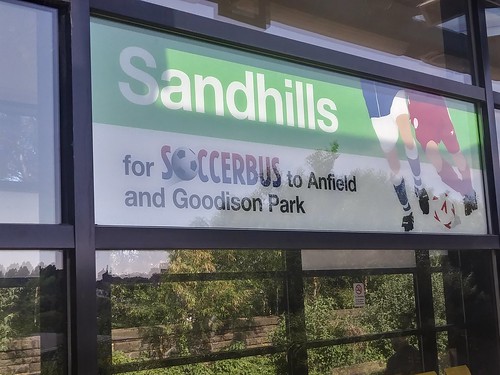
Sign promoting the Soccerbus service at the Merseyrail Sandhills stationI learned that in Liverpool, Merseyrail, which has a train station within a couple miles of stadiums for both Liverpool and Everton soccer teams, has a special bus service called Soccerbus, which provides connections from the Sandfields station to the respective stadiums.  The bus ticket can be added to a train ticket.

3.  Setting expansion teams up for success instead of failure: the Las Vegas Golden Knights.  Similarly, the success of the Las Vegas Golden Knights hockey expansion team reaching the Stanley Cup finals their very first year communicates something important about "setting up for success" and building fan interest and team financial success.

Mostly, new teams pay massive fees to join a league ("Cost of NHL expansion team goes from $2 million to $500 million," Las Vegas Review-Journal; NHL expanding to Las Vegas, and it only cost $875 million," Harrisburg Patriot-News) and then they get screwed in terms of acquiring decent players at the outset, despite paying hundreds of millions of dollars to join. The attitude was that being able to join such an exclusive group was the prize, and that success would come later, if at all.

This generally consigns the team to years of middling success, making it hard to draw fans and develop a sustainable business in terms of the local audience, although they get "subsidized" by television and other revenues.

In creating the Golden Knights, the National Hockey League created an expansion draft process that protected a limited number of players, roughly 10-12, when teams have a 23-member squad.

This allowed the Golden Knights to draft decent players or create trading opportunities by developing deals to not go after particular players who were still coveted by their teams, but unprotected ("How the Vegas Golden Knights became the best NHL expansion team in 50 years," Toronto Globe & Mail; "How Vegas Golden Knights became a success in first season," Detroit Free Press), no one expected them to go all the way.

Knowledgeable experts also attribute their success to the salary cap, which makes it hard for winning teams to keep all of their core players and teams can't pay the highest salaries to all of their players, they need a mix of lower and higher paid players to get under the cap.

4.  Investing in the experience around attending the game.  The Golden Knights also took special event programming to a new level ("Las Vegas has fallen in love with Golden Knights," Washington Times); "5 reasons Vegas Golden Knights hockey at T Mobile Arena is a must see," AXS), something that other teams may or may not be doing.

The Washington Redskins, which generally have looked at the fans as ATMs and nothing more, have begun to realize that with attendance dropping and their desire to get public funding for a new stadium, that they have to focus on improving the game day experience ("Redskins end their season ticket wait list, which they once claimed had 200,000 names," Washington Post), while teams like the Baltimore Ravens are lowering concession prices ("Can the Baltimore Ravens win back fans with cheaper stadium food?," Post).

Out of my point that by default cities/states that subsidize stadiums and arenas become part of a "public-private partnership," the more that the team alienates fans, the lesser the return on investment received by the locality.  But localities have little leverage with teams, even when providing free financing, tax concessions and other subsidies.

5.  Big tax break for North Carolina professional sports team in the offing?  Teams often get the use of land owned by government for negligible rents.  But they may have to pay property taxes on the value of the land, since it is not being used for a public purpose.  This is pretty typical when governments still own the underlying land but "rent it out" for a for profit use.  But a North Carolina legislator wants to exempt teams from having to pay the property taxes " ("Carolina Panthers, Charlotte Knights could get big tax breaks on land around stadiums," Charlotte Observer).
Matthews Republican Rep. Bill Brawley told fellow lawmakers the team is “paying significant property tax on property they do not own" ...
"We’re saying this is tax-exempt property, leave them alone,” Brawley said in a committee hearing Tuesday. Brawley couldn't be reached for more information Wednesday.

The bill would exempt leaseholds for stadiums. The leaseholds are currently taxed as intangible real property. Intangibles are non-physical assets such as stocks and bonds or, in this case, leaseholds. The state’s intangibles tax was repealed in 1994.

The Knights paid $171,156 last year on the value of the land they lease for BB&T Ballpark, valued at $12.5 million.

Tax records show the Panthers paid $357,166 in 2017 property taxes on the land they lease. Those taxes are separate from the $1.8 million in property taxes the team paid on the value of Bank of America Stadium, a building that the team owns. 
This is typical of the giveaways to professional sports teams.

Yes, they don't own it, but they use it. And property taxes are one of the costs of using property.

6.  Why didn't the Washington Capitals pay for late hours for Metrorail during the playoffs?  Monumental Sports, the firm that owns the Washington Wizards basketball team and the Washington Capitals hockey team is notable for its commitment to transportation demand management, in that they have a standing agreement to pay WMATA to stay open later, if a game goes late.  But apparently this agreement isn't in place for playoffs.

In round 2, Uber sponsored late night service for one game ("Uber to sponsor late|night Metro service Monday for Game 6," WTOP-radio). Comcast paid for Stanley Cup Game 4 extended hours ("Sponsor pays Metro to close later for Stanley Cup game 4," WUSA9). Although the team itself paid for extended hours for the watch party at the Capital One Arena for Game 5 ("Metro partnership with Monumental Sports will keep trains running," WMATA).

Note that the Washington Nationals baseball team refuses to sign a similar agreement, even though they get sweetheart rent on a stadium that cost the public $600 million to build.

7.  WMATA is producing a special Caps MetroCardDetails.  During the series, a couple of Caps players, T.J. Oshie and Matt Niskanen, rode Metrorail to Game 4

This is pretty smart from a marketing standpoint ("Metro Promises Commemorative SmarTrip Card If Caps Win Cup," NBC4).

Ridership was up because of the games, a watch party when the team played and won Game 5 in Las Vegas, and the subsequent winners parade, for which WMATA was a sponsor ("Capitals winning run helps Metro's image and ridership," WUSA9).

8.  Baseball expansion.  There's talk of expanding Major League Baseball to 32 teams, with teams possibly located in Portland and Montreal, which had a team until 2005, when the team moved to DC ("Expansion Could Trigger Realignment, Longer Postseason," Baseball America).  This could result in a shortening of the regular season to accommodate a longer post-season.

I think it would be cool if Monterrey in Mexico could get a team, but I guess that's not in the cards right now ("MLB expansion? These cities in U.S. and abroad make sense," Sports Illustrated). To me it doesn't make sense to put a team back in a city where baseball already failed. OTOH, the team was owned by a "bad owner," and that can make a difference.

Labels: , , ,