Rebuilding Place in the Urban Space

"A community’s physical form, rather than its land uses, is its most intrinsic and enduring characteristic." [Katz, EPA] This blog focuses on place and placemaking and all that makes it work--historic preservation, urban design, transportation, asset-based community development, arts & cultural development, commercial district revitalization, tourism & destination development, and quality of life advocacy--along with doses of civic engagement and good governance watchdogging.

Monday, January 20, 2025

1953 Presidential Inauguration edition of Transit News, the weekly newsletter of Capital Transit, the then transit operator

Recently, I managed to find some great ephemera.  The WMATA annual report for 1976 when Metrorail first began operating, and two issues of Transit News, the above-cited one, as well as the 1949 issue that explained the service changes resulting from the abandonment of the 10/12 streetcars on H Street-Benning Road to Rosslyn.

Also see "Should transit on inauguration day be free (Reprint)."


I quote from Peter Muller's paper, "Transportation and Urban Form: Stages in the Spatial Evolution of the American Metropolis," *Geography of Urban Transportation), all the time.  This back panel dovetails with the four stages of urban form that he discusses: Walking City; Streetcar City; Recreational Auto Era; and Metropolitan City.  The DC area was a few years away from developing its freeway network.

Labels: , , , , ,

Tuesday, January 14, 2025

Should transit on inauguration day be free (Reprint)

I wish I could score one of these special MetroCards.  This is likely one of the only times Trump's picture will feature in this blog.

Trying not to think about the coming presidency of Donald Trump, but this Washington Post article, "D.C. prepares for more than 200,000 inauguration visitors — and protesters," and others ("WMATA Inauguration service information," WMATA) reminded me.  And that it's worth revisiting this past blog entry, "Should transit on Inauguration Day be free? (Reprint),"

Note that this year, 2025: some stations will be closed within the National Mall area, and service will start at 4 am but "Everyone over the age of 5 needs a SmarTrip card to enter and exit stations"--which as I discuss below creates a throughput problem of great proportion.  

On the other hand, if there will be a maximum of 250,000 attendees, it won't be much of a problem to accommodate them.

========

The original post was from January 2, 2013, about 3 weeks before the Inauguration for President Obama's second term. 

The first Inauguration in 2009 was probably the absolute peak of success for WMATA, with more than one million subway riders that day--and it was about 6 months before the terrible crash at Fort Totten which killed nine people.

The latter, along with the opening of the Silver Line, seem to be the key events in marking the decline of the WMATA system in terms of service, operations, and ridership declines.

While WMATA probably can't successfully carry that many people today, it was a high point in the system's history and the points made below still pertain.

In short, I argue that for transportation demand and system management goals, transit in the DC area should be free on Inauguration Day.

Note that I considered listing this in the previous entry, but I don't think this should be paid for by the local jurisdictions and the transit agencies. Instead the cost should be covered by the Presidential Inauguration Committee.

The entry is edited slightly from the original.

======

Many transit authorities--San Francisco, Minneapolis, Madison, Reno, Long Beach, Edmonton, Milwaukee (paid for by Miller Beer, which was based in that city for decades), Calgary to mention a few--provide free transit during the night and into the wee hours of New Year's Eve, the idea being that it's better that people ride transit than drive drunk.

(This is separate from "Sober Ride" initiatives, such as in the DC region, where on New Year's Eve, inebriated patrons can get free taxi rides--up to $30.)

Seeing this piece in the Post, "Tour bus operators fret that passengers may have a hike to presidential inauguration," about procedures for charter bus management during the Inauguration, thinking about witnessing charter bus drop off for other "special events" at outlying stations such as in Greenbelt, and thinking about yesterday, makes me wonder if as part of special event management:

Perhaps transit service on the WMATA system should be free the day of the Inauguration Parade?, in this case Monday January 21st, 2013.

This would speed throughput, increase safety (in 2009 crowds exceeded the capacity of some stations and to move people through station managers just opened the gates and let people in for free--see "Mall east of 14th St. reaches capacity," this piece lists hour by hour rider counts for the subway up to 11am, from WTOP, the after action report from MWCOG, and comments in this Post article "Metro Ridership Tops 1 Million, Shattering Record"), and minimize confusion.  (Also see "Metro approves expanded Inauguration Day  service, fees" from the Post.)

The system isn't really designed to move through hundreds of thousands of people in a relatively short time window--mechanical chokepoints at fare machines and fare gates slow operations significantly--especially when a bulk of the riders are unfamiliar with using transit.

So don't charge individuals (and charge the Inauguration Committee to cover the lost revenue) in order to reduce the crush on the system by not having to use those trip-slowing mechanical components.

Making transit free on Inauguration Day will speed throughput, which is a desirable benefit in terms of facilitating mobility and reducing "friction."

Farecard machines, Union Station
Transit Throughput Delays 

1.  Buying farecards.   In 2009 we left town to be away from Inauguration madness--although the madness didn't really makes it way up to where we live--and at the Priory Inn in Pittsburgh, we were talking to some people on their way to DC for the Inauguration.

I said the biggest thing they should do is have the guy's daughter (who lived somewhere in Northern Virginia) buy them loaded transit passes, because the biggest delay in getting on is dealing with people buying transit tickets, and being flummoxed trying to figure out how to use the fare machine(s).

I don't know what the throughput is per hour for the fare machines, but it can't be much better than 1.5 people/minute.

That's with (uncrumpled) cash.  It's even slower when using credit cards.

I joke that the blue machines--where you are supposed to indicate how much money you want on a card--which are more difficult to use, draw the inexperienced like moths to light.  And they are the only machines that take credit cards.

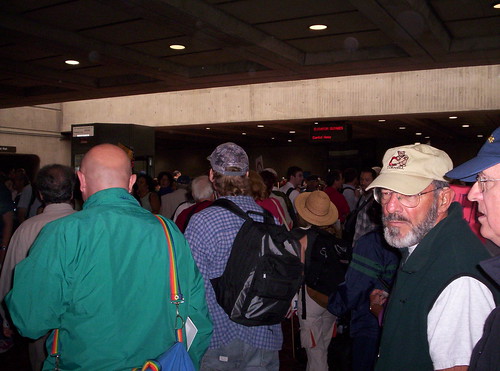
Protestors at Greenbelt stationLeft: Greenbelt Station on the day of a protest, full of people being dropped off by tour buses, and being shepherded to Downtown DC via the Metro (2005).

2.  Getting through faregates.  The gates open and close for each patron.  The throughput per gate is just a few people per minute.

3.  Congested station entryways (foyers).  Station foyers in many stations are small, and the combination of lines at the farecard machines and lines at the fare gates can overcrowd the stations very quickly.

4.  Paying when entering a bus.  Similarly, delays on buses mount with long lines, and each person having to pay upon entry, either with cash or with a Smart Card.  Paying transit fares in cash on the bus will significantly slow movement of the bus--and it costs at least 6 cents/second to operate a bus.


Mobility planning for special events in the National Capital (demonstrations and other events on the National Mall)

Note that special event mobility planning for events held on the National Mall is in need of a reboot.

See "A broken record on transportation demand management planning, this time with regard to special events."  But in that blog entry, from 2010, I didn't suggest free transit as a way to cope.

Right: crowd waiting for buses (because of a subway system breakdown).

SF MUNI:  Free transit on agency's 100th anniversary. Note that I am probably being influenced by how SF MUNI didn't charge for transit on their 100th anniversary.  See "Free Muni for…everyone…for a day" from the San Francisco Chronicle.

Free transit on bad air days.  Also, places with strict Air Quality Management requirements often provide free transit on days when air quality is particularly poor, as a way to discourage driving (although I doubt that providing free transit on those days shifts that many people from driving).  More recently, Paris has been forced to do this in an attempt to address air quality ("Paris makes all public transport free in battle against 'worst air pollution for 10 years': Temporary measures also include allowing only cars with odd-numbered licence plates to use roads," Independent; "Madrid's Bold New Pollution Plan: Ban Cars and Make Transit Free," CityLab).

There are some special event transportation planning resources out there, but even they may be insufficiently creative.

-- Special Event Transportation Service Planning and Operations Strategies for Transit
-- for the road network, National Cooperative Highway Research Program (NCHRP) Synthesis 309: Transportation Planning and Management for Special Events
-- Managing Travel for Planned Special Events (FHWA training course)
-- National Special Security Events: Transportation Planning for Planned Special Events

The mess on the National Mall after the Inauguration of Barack ObamaLeft: JANUARY 20, 2009: Spectators sit in trash and debris along the National Mall after the inauguration of Barack Obama as the 44th president of the United States of America January 20, 2009 in Washington, DC. Obama became the first African-American to be sworn in as president in the history of the United States. (Photo by Robert Nickelsberg/Getty Images)

The latter report specifically discusses Presidential Inaugurations, and with the Inauguration of President Obama in 2009, for the first time the Federal Government made some funds available to local jurisdictions for costs, including transit-related, incurred as a result of supporting the event. From the report:

For example, Congress allocated funding to state and local agencies in Virginia following the 56th Presidential Inauguration of Barack Obama, for security (police, fire), transportation (transit buses), and other services (environmental services, parks and cultural resources, and human services). In the event that Congress appropriates funds to reimburse agencies for their NSSE costs, detailed documentation of that cost data will be necessary. The January 20, 2009, inauguration of President Barack Obama used NSSE funding of $15 million for “emergency planning and security costs.”

Additionally, for the same inauguration, then President George W. Bush declared a state of emergency for the District of Columbia, which authorized the federal government to reimburse the District for emergency preparedness activities and expenditures that exceeded $15 million.

BUT, the report does not suggest providing free transit as a way to reduce congestion, speed transit throughput, and manage crowds.

MWCOG after action report

Although the report did mention that some stations closed the entryways due to platform overcrowding, the report didn't significantly review WMATA experiences as reported in the media and comments on articles in social media.  The report doesn't state that at some stations operators opened the faregates to reduce overcrowding as the lines bunched up, and it didn't identify systematically various chokepoints and bottlenecks within transit system processes including those listed above.

And while the report didn't comment on general throughput issues with regard to WMATA inside stations and buses, it does suggest not charging for parking at transit stations, as a way to increase station throughput and to reduce traffic congestion waiting to get through the entry gates.  (On special event days, it would be useful to have signage providing real-time data on parking space availability.)

Conclusion

1.  Don't charge for transit on the day of the Presidential Inauguration, let there be free transit for the day.

2.  Still charge for parking at transit stations, as free parking would just fill up fast anyway and more quickly (witness what happened at stations near the Redskins Stadium before WMATA started charging for weekend parking at those stations).  But plan to manage the road congestion and somehow provide some real-time information about parking availability at those stations.

3.  And for that day only, have the capacity to accept cash for parking at transit stations.

(Ideally, WMATA could have real-time parking availability information systems, but the reality is that except for a couple times each year, there isn't financial justification for providing this kind of system.)

4.  While this entry focuses on WMATA, free transit service should also be provided on that day by DC Circulator, RideOn, DASH, ART, The Bus (PG County), and Fairfax Connector.  Again, it should be paid for by the Presidential Inauguration Committee and/or the Federal Government.

Labels: , , , , ,

Thursday, April 18, 2024

What should the program for a Transportation Management District look like?

So for almost 20 years, I've suggested DC create TMDs, based on the concept of what Montgomery County Maryland does for its business districts but also what are sometimes called "Transportation Management Associations" like the one that covers Potomac Yard in Arlington/Alexandria (FAST Potomac Yard) or the Robinson District in Suburban Pittsburgh (Airport Corridor Transportation Association).  There are tons of these organizations across the country.

-- "Parking districts vs. transportation/urban management districts: Part one, Bethesda," 2015
-- "Parking districts vs. transportation/urban management districts: Part two, Takoma DC/Takoma Park Maryland," 2015
-- "Parking districts vs. transportation/urban management districts: Part three, jitneys/shuttles/delivery and the tertiary transit network," 2015
-- "Transportation demand management requirements for large developments and the MGM National Harbor Casino as an example of why this is absolutely necessary," 2015

Note that DC has created a MID, a "mobility innovation district" to support an electric shuttle in the Southwest Business Improvement District.  And they had "parking innovation districts" for awhile, but they were idiosyncratic, not systematic, and had many restrictions.  

A TMD is the way to go, focusing on everything, not just parking, which is more typical.  The famed Don Shoup approach in Anaheim includes revenue from parking meters, parking structures, and parking tickets as part of the business improvement district (I hope they are investing in the kinds of programs listed below).

At the time, my focus was trying to create a shared parking scenario, and to invest in sustainable mobility.  Often places have "lots of" parking, but it's spread out across multiple properties, and they don't coordinate. So people spend most of their time complaining about lack of parking.

-- "Testimony on parking policy in DC," 2012

It happens that Salt Lake has the potential for a TMD, in the Sugar House business district which is mixed use commercial and taller multiunit housing, as well as for the residential neighborhood which is across the street and mostly single family housing, not so much to coordinate commuter traffic and throughput, but to encourage sustainable mobility in response to the surgical addition of significant density, the existence of a streetcar and bus service, etc. 

This came up in an email discussion a few weeks ago, and I started listing what I thought should be the elements of an ideal TMD program.

Transportation Demand Management programming

The reality is, especially in a place like Salt Lake, most people drive.  The issue is two-fold, dealing with nonresidents working in or visiting the district, and with residents in their trips outside of the district and within the district.

Photo: Leah Hogsten, Salt Lake Tribune.  While this might not be dense for a much bigger city, Sugar House is becoming the densest SLC neighborhood outside of downtown, especially along the Trax light rail line.

But Sugar House is intensifying, the area is served by multiple bus routes traveling east-west and north-south, as well as a (minimally used) streetcar service which connects to the light rail line further west.  

Note that the streetcar has been particularly useful in stoking development ("Streetcar through Sugar House and South Salt Lake has spurred up to $2B in economic growth," Salt Lake Tribune), which contributes to density, which helps to build the foundation for shifting more trips to sustainable modes.

The best way to do this is to put out a survey on people's travel behavior, for the businesses, the residents of multiunit buildings, and the residents of single family and small apartment buildings.  In serious TDM programs there are people ready to help individual clients make the shift.

One thing the downtown district did in Columbus, Ohio is give all the workers free transit passes as a traffic management strategy ("Columbus Shows What Free Bus Passes Can Do for Ridership," Columbus Dispatch, "Free bus passes for workers: Columbus's big idea to relieve a congested downtown," Guardian).  

The program, by a different organization, has also been extended to the Short North neighborhood ("Free Bus Passes Coming Back for Short North Workers and Residents," Columbus Underground).

I would think that such a program should be encouraged for workers, and it should be offered promotionally for the residents of multiunit buildings, especially along the streetcar route, to get them to experiment with transit.

The Tribune article asks the question of whether or not the streetcar is contributing to traffic reduction.  I'd say definitely not, the ridership is abysmal.  But that is partially the result of expecting changes to "trickle down" rather than working to make the change in purposeful ways.

Promoting biking, walking, and other sustainable modes is another element of TDM.

Coordinating Parking/Developing a shared parking scenario

One of the big problems with capitalism is every property does its own thing.  Ideally there would be a shared parking scenario so people would park once, and go to multiple places, without worrying that their car will be towed.  Ideally this is complemented by district wide valet systems where you can drop your car off at one location but get the car at another location.  

This is discussed in the links above.  Two examples are the Chestnut Hill Parking Foundation in Philadelphia, which coordinates off street parking, and College Park, Maryland, where a number of shopping centers gave their rights to the city to manage the parking lots, as a way to discourage all day parking by commuter students.  The lots are metered, the city collects the revenue, and maintains the lots.  And in many "neighborhood commercial districts" across the country, the city will maintain off street parking comparably.  

Arlington and Montgomery Counties provide parking structures in certain districts, and these are usually paid parking but not always (e.g., pay in Silver Spring but not Bethesda).

Intra-district shuttle systems

Item # 5 in "Creating a Silver Spring "Sustainable Mobility District" | Part 2: Program items 1 - 9," discusses how to implement an integrated parking-shuttle system in Silver Spring, Maryland.

This is an example of what I call tertiary transit ("Intra-neighborhood (tertiary) transit revisited because of new San Diego service," 2016), focused on movement within a neighborhood district, although mostly it's done in tourist areas and downtowns ("Low cost electric shuttle services debuts in Lake Worth Beach and Boynton Beach" Palm Beach Post, "Looser rules on transit tax bringing ‘Freebee’ shuttles to cities. Is Uber next?," Miami Herald, Long Beach, California, "FRED, San Diego's subsidized shuttle, will give free rides Downtown for another year," San Diego Union Tribune, "They're like Uber but free new electric shuttles are popping up all over South Florida," Fort Lauderdale Sun-Sentinel), and using vans and small buses, to from and to transit stations ("It was very fast’: A shuttle service starts free rides from this Tri-Rail station," Sun-Sentinel).

The Turkish bus firm Karsan produces a 16 passenger electric bus which would also work but is bigger ("What Kind of Big Impact Will a New Minibus Have on North America’s Small Bus Market?," Mass Transit Magazine).  

The idea is that intra-district transportation, especially by SFH residents, could be shifted to shuttles rather than by car.  Go to the grocery store, bring back your purchases, without driving.  Go out to dinner, you don't have to drive.  Get to and from the transit station, you don't have to drive.

Getty Images photo of buses in London.

Marketing Transit. Besides the general TDM approach, utilize other methods to promote transit. 

I hadn't thought about it, but maybe SLC is ripe for the double deck bus approach ("Making bus service sexy and more equitable," 2012) for rebranding and repositioning of bus service as sexy, even though the ridership numbers wouldn't justify it otherwise. 

The route on 2100 South would be a great place to start.

-- Marketing in the Transit Environment, National Rural Transit Assistance Project
-- Best practice guide #5: Public transport | Citizens requirements, Hi-Trans, EU
-- Marketing your transit agency: a step by step getting started guide, TripSpark
-- "Public Transit Marketing 101: Why and How Public Transit Agencies Need to Market," Agora, 2012

The Times has an article, "Could Better Buses Fix Your Commute?," on improving bus service.  It's not particularly scintillating, and one of the points, dedicated bus lanes, won't work in Salt Lake because ridership is so small it doesn't justify it.

UTA does do different liveries for BRT.  Maybe they could do an exciting one for 2100 South.  I think a Roy Lichtenstein influenced livery, or the Multiplicity branding from Luxembourg would work.


Above: Multiplicity bus.  Below: Roy Lichtenstein did do a painting of VW microbuses.

Campaigns, especially focused on workers and the multiunit buildings, are in order.  

Arlington County requires transportation information kiosks for multiunit and public buildings, like libraries.  A TMD should create the same for its district.  The Palo Alto school district has safe routes to school maps posted in building foyers, which is another strategy.  Surprisingly, a Walmart in DC had a map posted similar to Palo Alto's.


Creative treatments of bus and streetcar shelters--my point is that shelters are marketing touchpoints for transit.  An exciting livery for the streetcar, which is super boring.  Work with UTA to support free transit days.  Etc.

Salt Lake Streetcar reminds me of the little girl next door saying:
"boring, boring, boring boring."

Marketing Biking

Salt Like is doing a nice job putting in dedicated cycle tracks.  Sugar House has some on Highland Drive, by Fairmont Park on 900 East, is adding more cycle tracks on 1300 East and other streets.  

Cycle tracks are proven to qualm safety concerns and increase the number of cyclists.  

There are also some trails in the neighborhood, including along the streetcar line.  Bike parking is pretty abysmal.  

There are at least two bicycle shops, one dedicated to e-bikes.  And there are some bike sharing stations, with an expansion coming.  There aren't many free air pumps or bike stands.  I don't know if some apartment buildings have high quality bike parking.  

The journal article "Making Cycling Irresistible," inspired my own blog entry in 2008,  "Ideas for Making Cycling Irresistible in DC."  Besides investing in better facilities, and Sugar House has some trails, traffic calmed streets, bike sharing stations, and bicycle boulevards,  

-- I argue that there needs to be real assistance programs in helping people transition to a bike for transportation, this entry, "Revisiting assistance programs to get people biking: 18 programs," lists a number of ways to do it.  One of the methods lends bikes, helmets, and locks, so people can try biking without having to pay for it up front.

-- Electric bicycles are maybe a quantum leap forward in getting people willing to commute longer distances by bike, plus they have significant environmental benefits over cars. E-bike promotion through voucher-based discounts, as some communities are doing, including Salt Lake, might be worth doing by TMDs.

-- There should be a program to promote high quality secure bicycle parking in large apartment buildings.

-- Bicycle sharing is expanding.  I've suggested a special parks focused concept with stations at Sugar House Park, Allen Park, Westminster University, Fairmont Park, Highland High School and other locations, including along the streetcar line and in the abutting City of South Salt Lake up to the Central Pointe station.  Ideally we could get a sponsor so that trips starting and ending in parks can be free. 

-- also special tours and occasional promotions to encourage people to use bike share.

-- There needs to be a system of secure bicycle parking, especially with the adoption of more expensive electric bikes.  Bike theft is a problem in Salt Lake. Currently, bicycle parking quality is pretty hit or miss.  Much, even at public facilities, doesn't meet the most basic standards of the Association of Pedestrian and Bicycle Professionals.  

I've argued for creating such a network at the metropolitan scale ("May is National Bike Month too: Part 1 -- a good time to assess planning and programming").  No reason to not start by creating such a network in Sugar House.  It could include high quality air pumps and bike stands as accessories.  (At the very least, the library and post office could have them.) 

-- Some places have Bicycle-Friendly business districts programs and ride to shop days, which should be offered (Case Studies: Bicycle Friendly Business Districts, League of American Bicyclists).  In Denmark, Ikea stores have borrow-able cargo bikes.  Is that something to promote at the local supermarket?  Or to develop a community-based delivery service using bikes.

E.g., it bugs me that supermarkets offer free gas points based on sales, but nothing for people who walk or bike or use transit.

-- Regularly scheduled community bicycle rides are a way to get people out and biking.  I am always amazed seeing photos from Open Streets events, and I wonder, how come I don't see that many bicycles out in the community ordinarily?

-- Produce a brochure promoting biking in the greater neighborhood.  Like the old bikeways brochure produced by the Silver Spring Maryland urban district.

-- Bicycle shops in the area are more oriented to recreational bicycling.  Work with shops to better support biking for transportation. (E.g., I got pissed at the bike shop on 2100 South, when--because I am old--they suggested a cruiser bike.  Cruisers are totally unusable for real transportation.) Install mobility kiosks at their stores.  Maybe wall maps of the area bike routes, like at the Takoma Park shop in Maryland.  Or a brewpub in Pocatello.

-- Annual Urban Mobility/Biking Expo during Bike Month.  There are various forms.  Years ago, Arlington County, Virginia used to sponsor a sustainable mobility expo.  The UTA transit agency in Salt Lake City a Bike Expo.  Berlin has an annual Urban Mobility Day ("Berlin’s Urban Mobility Day showcases E-Mobility and new Apps," Urban Transport Magazine), and some colleges have Bike Weeks ("This week is Bike Week at the University of Utah").  NYC sponsors(ed?) a Bike Expo in association with the 5 Boro Ride, which had more than 100 exhibitors and 50,000 attendees in 2014.  Richmond hosted a Bike Expo in association with the UCI Race.

The TMD should sponsor at least two.  One in September when school starts with Westminster University and Highland High School as primary targets.  And one during Bike Month.  Such an activity should be a key event during National Bike Month, in every major metropolitan area.

Although major colleges should have a Bike Week/Bike Expo event during the first few weeks of the Fall Semester.  And for K-12 schools, 

-- During Bike Month, support "Bike to Work" Day.

-- There's talk about doing an Open Streets event at Sugar House Park.  A TMD should be a lead partner.  Open Streets events could also be held on Sugarmont Avenue, along the streetcar line and adjacent to Fairmont Park.

-- consider misters on the S Line Trail for hot summers.

-- map signage for bicycle trails and routes (we're adding the first such signs in the area to Sugar House Park).

Marketing Walking 

The blog entry, "Planning for place/urban design/neighborhoods versus planning for transportation modes: new 17th Street NW bike lanes | Walkable community planning versus "pedestrian" planning," suggests planning for walkable communities versus "improving pedestrian conditions."  

Some cities like Boston, Denver and Seattle have active pro-walking groups which are a model for improving places, technical assistance, and advocacy.

-- In Arlington County, WalkArlington does community walks.  Sometimes they're led by the elected official for that district.  Sometimes they are in parks or commercial districts, or cover history, etc.

-- improve sidewalks and street conditions along sidewalks.  Salt Lake is hot in the summer.  Maybe have misters.  More trees for shade.  Etc.

-- address lighting at night and in the early hours, especially an issue in winter.  Sugar House's main commercial streets do have light poles with "car lighting" and lower lights placed to light sidewalks for pedestrians.  But probably this can be expanded.

Safe Routes to Schools/TDM for schools.  Not typically part of a TMD, but increasingly traffic is generated in the morning and afternoon by parents dropping off/picking up students after school. 

Cars lined up to pick up students at a school in Reading, Pennsylvania.  Reading Eagle photo.

Apparently it can be quite gnarly ("Tantrums and Turf Wars: The School Car Line Is Chaos," Wall Street Journal).  All the reason to include it in TMDs.  Plus improvements to the walking and biking environment for children also helps neighborhoods simultaneously.

-- "Why isn't walking/biking to school programming an option in Suburban Omaha | Inadequacies in school transportation planning," 2022
-- School Walk and Bike Routes: A Guide for Planning and Improving Walk and Bike to School Options for Students
-- Safe Routes to School program, Washington State
-- City of Tacoma SRTS program, including SRTS Action Plan.  

-- Like with a TMD, the approach at a school should be the creation of a transportation demand management plan for teachers and staff, and students/parents.  

In 2009, I was able to spend half a day at Stoneleigh Elementary School in Baltimore County Maryland on International Walk to School Day.  They had a very sophisticated approach.  I've heard a school in Oxnard, California does something similar.  But it's rare.  What's needed is a school-based full scale TDM plan dealing with cars, buses, and kids on foot.

-- While SRTS is oriented to elementary schools, some districts like Palo Alto, do it across K-12.  In Boulder, Colorado, certain schools with SRTS programs have 50% or more mode split of kids coming to school by sustainable means.

-- organize "Walking School Buses" and "Bicycle School Buses" for each school in the TMD.

-- Promote International Bike and Walk to School Day which is October 6th, or the US one, when the dates differ.

-- schools need high quality secure bicycle, scooter, and skateboard parking too.  Showers and lockers in schools can encourage teachers and staff to bike to school instead of drive.

-- lighting is also an issue in mornings, evenings--especially as school buildings are used more in the evenings, and in the winter

Public space maintenance including public spaces like plazas, trees, and public art/Aesthetic qualities of transportation infrastructure.  A lot of communities dependent on the car have pretty ugly roads.  And by default, this is the environment that defines the community.  

In "Extending the "Signature Streets" concept to "Signature Streets and Spaces"," I argue for a focused approach to improve these aesthetic conditions and to address all modes.  Ed McMahon, now of Urban Land Institute, has made this point for decades.

Like business improvement districts, TMDs could take more responsibility for public space design and maintenance than is currently the case.  I suppose my model here is half a transportation district, half business and neighborhood promotion.

One thing would be to promote public art lighting of the freeway underpasses.  But also expanding the tree cover, providing and clearing trash cans.  Here a big thing is medians, and too often they don't have plantings.  Which yes, are tough to maintain, but add a lot of aesthetic value when they are.  Lighting is also an issue of public space maintenance as well.

Light Channels, Bill FitzGibbons, San Antonio.


Public art crosswalk by Carlos Cruz-Diez commissioned by the Broad Museum, Los Angeles.

Provision of wayfinding and identity systems ("Basic planning building blocks for urban commercial district revitalization programs that most cities haven't packaged: Part 2 | A neighborhood identity and marketing toolkit (kit of parts)").   

Salt Lake has a couple different systems which can be integrated.  Basically there are two scales, for pedestrians and for cars, with identity signs for civic spaces like parks.  Nothing for transit.  And there are some monument signs identifying the district.  Downtown they also have map signs.

Map and historic interpretation signage should be added to the system.  And business district brochures focused on the independent businesses.  

Boise has a great identity system for neighborhoods, which could be adapted for Salt Lake's residential areas.

Newcastle's Ride and Walk wayfinding brochure, also made available as signage, is a model too.

Traffic calming.  Salt Lake already has a best practice program called Livable Streets, and they are implementing it across the city.  A separate citizen initiated project by a friend is interesting because rather than focus on one street in Sugar House, it addresses multiple streets simultaneously.  

In those communities where there aren't good programs, a TMD could step up.  For example, the Memphis Medical District Collaborative created a Streetscape Lookbook to shape the look of the streetscape and road network.

Car sharing. Car sharing works in certain conditions ("Car sharing and integrated sustainable mobility planning," 2013, "Another example of DC's failures in transportation planning: carsharing," 2011, "When the one over neighborhood is in the county next door, and housing prices have been in the tank: Mount Rainer, Maryland," 2016, section on car sharing).  While it won't work across Salt Lake, it could potentially work in Sugar House and maybe Central City/Downtown.  (And don't muck it up with EV requirements.  That adds complexity and seems to have doomed many programs.)

It's worth exploring providing it, perhaps on a nonprofit basis, to discourage car ownership and promote sustainable mobility, while still providing access to cars as necessary.  

Hoboken, New Jersey has been particularly successful (""Car-sharing program finds home in crowded Hoboken":," AP) as has been DC.  Those places and their successes alongside the many failures prove that the necessary preconditions are very specific, although I do think Sugar House could pull it off.  But the mode split for transit, walking, and biking has to increase simultaneously.

EV charging.  I'm going to put EV charging as an issue, but I wouldn't say the TMD should install it per se, because management and maintenance is a problem, but it should actively encourage its provision in larger commercial properties, in multiunit housing buildings, parking structures, maybe at certain public facilities, etc.  

TMDs could regularly inspect such facilities (and inspect secure bike parking, air pumps, repair stands too) to ensure that they are working and to take the necessary steps to make them work when they aren't.

Planning and advocacy.  Goes without saying.  The TMD should be planning all these elements, and advocating for improvements as needed.

Roads.  Of course, most TMDs focus on roads, and they need to be treated as a network in the context of the subdistrict, and in terms of coordination with various local, state, and federal transportation agencies.

Labels: , , , , , ,

Saturday, November 10, 2018

Unshared parking

One of the problems of financialization of real estate as well as outsourcing is the disconnect that can occur between different functions of a property. 

This happens a lot with the parking function, which tends to be outsourced to an independent firm specializing in parking. 

Such firms only operate according to the dictates of the contract and are more concerned about maximizing profits, not about managing parking as a resource that supports the economic activity of the firms located in and around the building.

This is the case with a matter I am dealing with on Capitol Hill, related to Eastern Market, the city's public market.  In a meeting, one of the people was going on about how "they should care because the customers of the building's tenants also use the parking" and I countered that in all likelihood, the parking function is "jobbed out" to a different firm--she scoffed but of course it turned out I was right.

Some customers were confused by the signs in the Stansted retail park near Stansted. Photograph: Martin Godwin for the Guardian.

The Guardian has a story ("Is this Britain’s most ridiculous parking fine?") about this in London, where properties adjacent to Stansted Airport seemingly have a shared parking lot, but don't, and the parking contractor has put in an array of CCTV cameras so that they can "fine" transgressors to the tune of £60, because they park in the lot of one firm but go instead to an adjacent tenant.

This angers the customers of the businesses, but the businesses in turn are renters also, and don't have any input into the master agreement between the property owner and the parking manager. The parking manager is not incentivized to manage the parking in a way that benefits customers.  (Another example is the City of Chicago's long term lease of parking structures and street meters to private investors, who again, are interested in maximizing economic return, not contributing to the public good.)

There are many similar examples. Every few years this comes up in Bethesda in Montgomery County, where people park in a place like a bank or a business that is closed, and then get towed/ticketed by managers of the lot ("Predatory Towing Continues In Downtown Bethesda," Bethesda Magazine).

And the Wharf district in DC should have created an underground parking structure unified across all the properties, but because some buildings have different ownership that isn't possible. But had it been done that way, all the motor vehicle traffic could have been captured on the perimeter of the property, and the interior could have been exclusively pedestrian.  See "Multiblock Underground Shared Parking" from Urban Land Magazine.

When I first learned about the concept of "shared parking" about 12 years ago, it was revelatory   ("Onsite Parking: The Scourge of America's Commercial Districts," Planetizen).

-- "What is shared parking?," International Transportation and Development Institute

Now it just upsets me that virtually zero progress has been made.

-- "Parking districts vs. transportation/urban management districts: Part one, Bethesda" (2015)
-- "Parking districts vs. transportation/urban management districts: Part two, Takoma DC/Takoma Park Maryland" (2015)
-- "Reston Town Center parking issue as a "planning failure" by the private sector" (2017)
-- "Testimony on parking policy in DC" (2012)
-- "Municipal taxes and fees #2: parking" (2010)
-- "The High Cost of Free Parking" (2005)

Labels: , , , ,

Monday, October 08, 2018

Perhaps Rockville Pike's mobility solution is a "transit mall," not BRT | Introducing the PikeRide concept

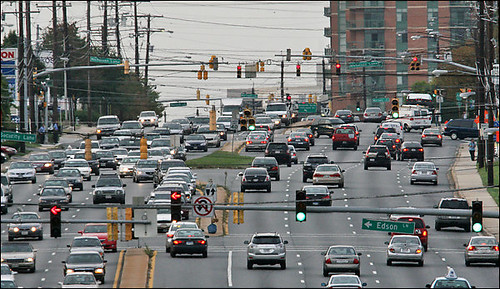
Wisconsin Avenue/Rockville Pike in Montgomery County Maryland is a classic example of a traffic engorged suburban arterial.

I frequently use this Washington Post photo to illustrate the problem.  The street is lined by all types of uses including office buildings and residences, but is best known for its many shopping centers and retail stores, most with parking in front.

Most of the lots are not interconnected, so people hop and skip by car along the Pike to accomplish their trips, making many separate little trips along the way.
Rockville Pike, looking north, which Montgomery planners want to transform into a network of urban villages.
Rockville Pike, looking north, which Montgomery planners want to transform into a network of urban villages.  Washington Post photo by Bill O'Leary.

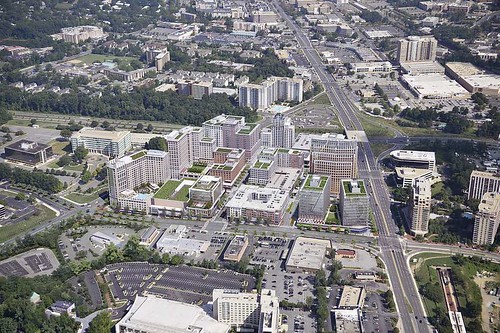
Aerial, Rockville Pike, Montgomery County Maryland

About ten years ago, developers and planners worked out a land use repatterning in the "North Bethesda/White Flint" area, aiming to move from superblocks and parking-fronted shopping centers to smaller blocks, a more robust street grid, buildings at the streetfront with structured parking, and mixed use developments including a fair amount of housing, along with a rebuilt street and streetscape that serves multiple modes and doesn't focus strictly on automobility.

-- Friends of White Flint

From a "smart growth"/new urbanism perspective, this is one of the more interesting attempts at "urbanizing" suburbia anywhere in the US ("Makeover Seeks to Tame Rockville Pike in Maryland," New York Times, 2010). Currently, the Pike & Rose redevelopment on the site of a previously existing parking-fronted shopping center is the foremost example of this new paradigm.

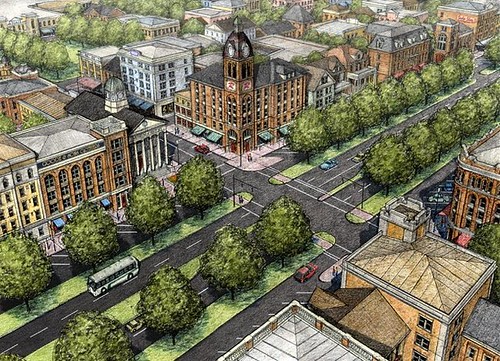
A revisioned Rockville Pike, Montgomery County, Maryland
Transforming Rockville Pike, Montgomery's commercial spine, into a tree-lined boulevard, with more open space and greenery, is a priority of Montgomery County planners. Although political leaders and residents support the change, obstacles such as cost remain. The redesign will allow residents to work, dine and shop within blocks of their high-rise apartments in an ultra-urban setting, to stitch residential and retail areas together. Image: Maryland-National Capital Park and Planning Commission.


The corridor is served by four Metrorail transit stations--Grosvenor (which serves the Strathmore Music Center), White Flint, Twinbrook, and Rockville, over a 4.6 mile distance--and there are proposals to add a MARC commuter rail station to the White Flint/now called "Pike District" area, to complement the existing MARC station at Rockville.

The White Flint initiative to repattern the sub/urban design, streetscape, mobility, and placemaking qualities of the district has a twin in the Rockville Town Center program (article from Terrain), in the core of the city near the Metrorail station.  One of the anchors of the development is a county library and adjacent arts center, and a well used and programmed public square.
rockville-town-square

Bus rapid transit on Rockville Pike.  Separately, Montgomery County's Department of Transportation is moving a bus rapid transit program forward.  Rockville Pike is one of the proposed corridors and will be a key element of the network.

Last year, the department's RideOn bus system introduced a limited stop bus service along the Pike, called RideOn Extra, to provide a faster ride over longer distance trips.


But I have written pieces in the past criticizing how BRT has been promoted for Rockville Pike,  making the point that videos promoting the concept laid out the service as being able to serve families making multiple stops over relatively short distances ("schlepping multiple kids, stroller and packages on and off the bus"), between destinations along the Pike--mostly various shopping centers, but also housing, supermarkets, etc.

Taking an "intra-district" approach to transit mobility.  BRT service as conceptualized is about fast transit making a relatively few number of stops over long distances.  It's a form of express bus service.  But on Rockville Pike, there are probably 3-8 significant destinations per mile counting both sides of the street, so it isn't well suited to limited stop service.

Separately I have tried to come to grips with differentiating "circulator" and streetcar programs from the standpoint of "intra-district" versus inter-district transit service.

-- "Modern streetcars are transportation projects, not merely economic development augurs: but intra-district not inter-city services," 2017

In other words getting around within a concentrated area of a destination versus getting to and from that concentrated area from multiple points in a metropolitan area.  (Unfortunately, a lot of commentary mixes up the two purposes.)

Examples of intra-district service include bus circulators, streetcars, and "people movers."
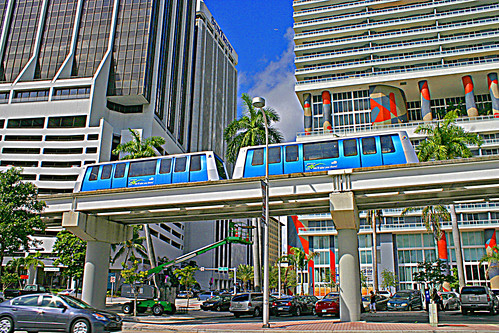
Buildings in Downtown Miami
Miami People Mover.

Travel to Downtown Washington and Downtown Baltimore are good examples of this.  In both places, the respective city has created core-focused "circulator" bus programs to move people around within the core, which the inter-jurisdictional bus routes and subway lines bringing people to the district aren't set up to do.

Transit malls.  In other cities, a variant of this kind of service is provided by creating a bus or transit mall to concentrate the routes and services.  Nicollet Mall in Minneapolis and the 16th Street Mall in Denver are the foremost examples.

In Minneapolis, the Nicollet Mall is served by multiple bus lines but also has a free intra-district transit bus.  In Denver, 16th Street Mall is a pedestrian and transit mall, with the primary transit service being the free MallRide buses.
Denver transportation
Denver MallRide.  Transportation for America photo.

Why not treat Rockville Pike as a "transit mall" and create a PikeRide bus service to support  intra-district trips.  Granted the distance between Grosvenor and Rockville Metrorail stations is 4.6 miles, and Denver's 16th Street Mall is 1.25 miles, but the way to reduce intra-district traffic may be to adopt the circulator/Denver MallRide concept separate from BRT, which has a different purpose.

You could call it PikeRide, although that's what they call bus service on Columbia Pike in Arlington County, Virginia.  The (Rockville)PikeRide would be a free circulator, just like the Denver MallRide.

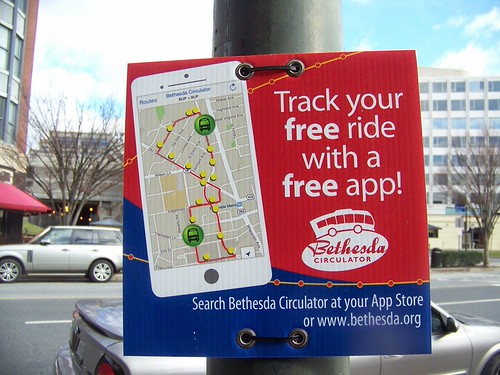
Elsewhere in Montgomery County the county supports similar kinds of services.  The County supports a free circulator bus in Silver Spring, and the Bethesda Urban Partnership business improvement district supports a free circulator bus there.
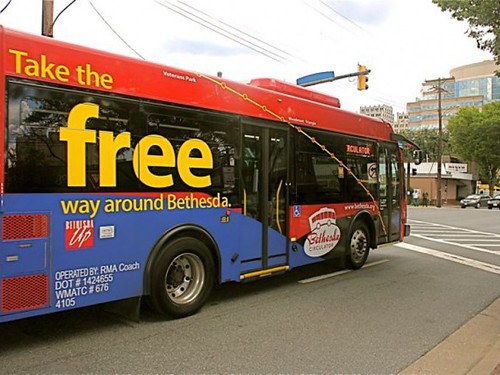
Free Bethesda Circulator Bus
Free Bethesda Circulator Bus.

Arlington County's Columbia Pike bus network as a model.  The transit network concept for Columbia Pike is similar to what I am proposing for Rockville Pike.  There they have three levels of service--limited stop (like the new RideOn Extra); regular service with more stops, but fewer stops than the local service, which stops at many more locations along the corridor.  Except that (Rockville)PikeRide would be free, and the Columbia PikeRide service is not.


This WMATA map of the PikeRide transit network shows how the different bus lines combine to provide high frequency service in the core of the Columbia Pike corridor.

That's the basic idea for the Rockville Pike concept, but focusing on the development of an intra-district bus service through a dedicated circulator, which would also complement the Metrorail stations, which aren't so great at supporting trips within the district, as opposed to trips getting to and from the district.

Complementing transit service with package delivery? I still can't get over that video promoting BRT on Rockville Pike.

Even with a free hop on/hop off bus service--and figure that the highest use would be between the White Flint mall and Metrorail area and somewhere between Twinbrook and Rockville Metrorail stations--carrying lots of packages on and off buses is likely to be inconvenient.

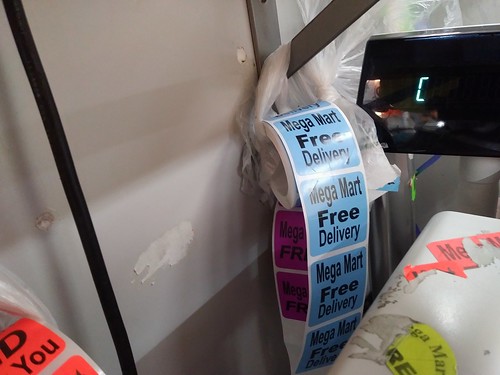
MegaMart Latino supermarket offers free delivery for purchases over $50Separately, a delivery service could be created, where people who spend a certain amount can get the packages delivered to home--figuring this would be offered within a couple miles distance on either side of the Pike.  (As an example, the area's Megamart Latino supermarket chain offers a free trip home to customers so long as they purchase at least $50.)

But this presupposes that people get to the district by transit, and likely many of the people will come by car.  A concierge type package pick up service could be another option to serve people using cars to get to and from Rockville Pike's shopping and entertainment district.

Pay for it by creating a transportation management district.  Baltimore has a parking tax which it uses to fund the Circulator.  Montgomery has created "parking districts" in various locations, although I argue they should be repositioned as "transportation management districts."

-- "Parking districts vs. transportation/urban management districts: Part one, Bethesda," 2015

A TMD could be created for Rockville Pike, which would support the free PikeRide transit service and potentially a package delivery program.
Promotional sign for Bethesda Circulator bus app

Developers will need to get on board with the concept of "shared parking."  One wrinkle is "walk off" parkers--people who park in one shopping center but then go off to another without moving their car.

Ideally, all of the property owners can be made to understand that they need to conceptualize the parking as "shared resources" for the entire commercial district, supported by the PikeRide free transit service, and accept that people will move between destinations without moving their cars.

Marketing, marketing, marketing.  To make this work, lots and lots and lots and lots of social marketing interventions will be required. Huge amounts of time and energy will have to be directed to the users/various modes in this corridor, to assist people in making the change.

From a transit industry standpoint, successfully launching and operating this kind of bus service in the suburban context could be as transformational as the White Flint land use changes are to suburban land use paradigms.


Interestingly, with the move to cashless fares on the Georgia Avenue Rte. 79, WMATA plastered the corridor with information about it, and actually placed outreach workers at various bus stop locations along the corridor, especially key transfer points such as Georgia and New Hampshire Avenues.

That will have to be done here too.

Typically, transit marketing programs in the DC region haven't always been that great.  For a service like this to work and become transformational, a great deal of attention to marketing planning and execution will have to be made.

-- "Marketing and Branding for Bus Rapid Transit ," Urban Transportation Showcase Program, Government of Canada
-- "Creating and executing the York Region Transit 2002 Marketing Plan," Interkom (I need to track down the actual document)
-- From Here to There: A Creative Guide to Making Public Transport the Way to Go, World Resources Institute
-- "Orange County Ride the Bus campaign," Celtis Ventures Inc.
-- PikeRide: Creating a successful product image, WMATA
-- "Branding Albuquerque Rapid Transit," Studio Hill Design Ltd.

Labels: , , , , ,

Friday, November 17, 2017

Revisiting stories: FRED Downtown shuttle in San Diego

David Aragon, an operation manager and one of the drivers for Free Ride Everywhere Downtown (FRED) waits at a local apartment building for his next pick up in the downtown area. (Nelvin C. Cepeda / San Diego Union-Tribune).


(2014)

I've written about the FRED e-shuttle in Downtown San Diego as an example of creating intra-district shuttle services as a component of the "sustainable mobility platform."

More recently, I mentioned FRED in my discussion on making Fenton Street in Silver Spring a prioritized sustainable mobility corridor, within item #5, "PL #5: Creating a Silver Spring "Sustainable Mobility District" | Part 2: Program items 1 - 9," as a part of shifting Fenton Street to a sustainable mobility corridor and removing street parking by better leveraging the thousands of spaces in parking garages along the corridor.

Apparently, the FRED service, just over two years old, is quite successful and will be expanded ("Free Ride shuttle: Riders getting "busy" signal but help on way with extra funding," San Diego Union-Tribune).

From the article:
San Diego will spend up to $5.7 million over five years to help New York-based The Free Ride put more all-electric shuttles on downtown streets. The money comes from revenue from parking meters and public garages downtown. The original five-year budget was $2 million.

By 2020, there should be 30 FRED shuttles on the road, up from today’s 17. The funding includes upgrading a dozen existing cars to a longer-running lithium ion battery. ...

It landed in San Diego in July 2014 with five shuttles financed totally by the billboards they displayed while offering free rides around downtown. Around the same time, San Diego downtown stakeholders were looking for a shuttle system for the business district. The Free Ride was chosen and launched a beefed-up presence in August 2016.
Strengthen branding?  Although I will say that as a transportation/mobility service, branding is an important element of the program. 

Having the vehicles serve mostly as moving advertisements diminishes the ability to brand the service as a key mobility service within the Downtown San Diego district.

But maybe the fact that they are a small and very distinguishable vehicle regardless is enough.

Labels: , , , ,