Rebuilding Place in the Urban Space

"A community’s physical form, rather than its land uses, is its most intrinsic and enduring characteristic." [Katz, EPA] This blog focuses on place and placemaking and all that makes it work--historic preservation, urban design, transportation, asset-based community development, arts & cultural development, commercial district revitalization, tourism & destination development, and quality of life advocacy--along with doses of civic engagement and good governance watchdogging.

Saturday, November 10, 2018

Unshared parking

One of the problems of financialization of real estate as well as outsourcing is the disconnect that can occur between different functions of a property. 

This happens a lot with the parking function, which tends to be outsourced to an independent firm specializing in parking. 

Such firms only operate according to the dictates of the contract and are more concerned about maximizing profits, not about managing parking as a resource that supports the economic activity of the firms located in and around the building.

This is the case with a matter I am dealing with on Capitol Hill, related to Eastern Market, the city's public market.  In a meeting, one of the people was going on about how "they should care because the customers of the building's tenants also use the parking" and I countered that in all likelihood, the parking function is "jobbed out" to a different firm--she scoffed but of course it turned out I was right.

Some customers were confused by the signs in the Stansted retail park near Stansted. Photograph: Martin Godwin for the Guardian.

The Guardian has a story ("Is this Britain’s most ridiculous parking fine?") about this in London, where properties adjacent to Stansted Airport seemingly have a shared parking lot, but don't, and the parking contractor has put in an array of CCTV cameras so that they can "fine" transgressors to the tune of £60, because they park in the lot of one firm but go instead to an adjacent tenant.

This angers the customers of the businesses, but the businesses in turn are renters also, and don't have any input into the master agreement between the property owner and the parking manager. The parking manager is not incentivized to manage the parking in a way that benefits customers.  (Another example is the City of Chicago's long term lease of parking structures and street meters to private investors, who again, are interested in maximizing economic return, not contributing to the public good.)

There are many similar examples. Every few years this comes up in Bethesda in Montgomery County, where people park in a place like a bank or a business that is closed, and then get towed/ticketed by managers of the lot ("Predatory Towing Continues In Downtown Bethesda," Bethesda Magazine).

And the Wharf district in DC should have created an underground parking structure unified across all the properties, but because some buildings have different ownership that isn't possible. But had it been done that way, all the motor vehicle traffic could have been captured on the perimeter of the property, and the interior could have been exclusively pedestrian.  See "Multiblock Underground Shared Parking" from Urban Land Magazine.

When I first learned about the concept of "shared parking" about 12 years ago, it was revelatory   ("Onsite Parking: The Scourge of America's Commercial Districts," Planetizen).

-- "What is shared parking?," International Transportation and Development Institute

Now it just upsets me that virtually zero progress has been made.

-- "Parking districts vs. transportation/urban management districts: Part one, Bethesda" (2015)
-- "Parking districts vs. transportation/urban management districts: Part two, Takoma DC/Takoma Park Maryland" (2015)
-- "Reston Town Center parking issue as a "planning failure" by the private sector" (2017)
-- "Testimony on parking policy in DC" (2012)
-- "Municipal taxes and fees #2: parking" (2010)
-- "The High Cost of Free Parking" (2005)

Labels: , , , ,

Saturday, August 04, 2012

More fundamental rethinking of the organization and provision of school districts is in order in hard pressed communities

I moved to Washington, DC in 1987.  Previously I had lived in the Detroit area for my entire life.  In Michigan, school districts are formed at the city-town-township level.

In Maryland and for much of Virginia, school districts are organized at the scale of the county.  So the school districts are much bigger, but at the same time they draw on the entire taxing capacity of the county, rather than the vagaries of individual communities, some of which are small, some of which are big, some of which are wealthy and some of which are poor.

So in Michigan, Pontiac schools have financial (and other) issues, and until recently, Bloomfield, Birmingham, and West Bloomfield school districts do very well.  But on a county by county basis, there tend to be great disparities.

While in Maryland, thngs aren't necessarily supra-better--there are still outcome disparities on racial and ethnic grounds--for the most part, students are on an even playing field at the county level.
Detroit, Hamtramack, Highland Park map
Not so in Michigan.  So yesterday's Wall Street Journal has a story about Highland Park, "Michigan City Outsources All of Its Schools," and how they are outsourcing their schools to a charter school company.  I've written about Highland Park's being an economic basket case before ("Urban decay and sprawl: one community's gain at the expense of another's").

The city, along with Hamtramack, is completely enveloped by Detroit.  It's just a couple square miles in size.  Historically the city had been financially successful, because Ford and Chrysler had major operations there, and the city assessed an income tax on people working in the city. So it didn't matter that the residential part of the city didn't carry its weight financially. But now, neither Ford nor Chrysler have significant operations there and the city is destitute, and the lack of economies of scale in various agencies of the government is just one more intractable problem that even outsourcing can't fix.

A couple years ago, the Mayor of Memphis executed an interesting stratagem not available to cities in Michigan.  He dissolved the city of Memphis school district, which is forcing its consolidation with the Shelby County School System ("Merger of Memphis and County School Districts Revives Challenges" from the New York Times).  It is supposed to take place next year.

Of course the battle isn't over, just this past week, as a number of cities in Shelby County passed referenda allowing the creation of school districts at the city level, allowing these communities to withdraw from the soon to be consolidated into one City-County School system ("School systems for 6 Memphis suburbs approved," AP story).  From the AP story:

Voters in the six municipalities want their own schools to avoid the merger between the larger, struggling, majority-black Memphis school system and the smaller, more successful, majority-white Shelby County district.

But the vote is being challenged in court by the Shelby County Commission, which is concerned that the breakaway could undermine the merger.

The municipalities, which have a total population of about 171,000, have been part of Shelby County Schools but wanted to break away before the consolidation, set for 2013. Voters in the six suburbs also approved a property tax increase to help pay for the schools.

Supporters of the individual school systems say they want complete control of their own schools and believe academic performance will suffer if included in a combined system with 150,000 students. Proponents also note that state statistics show that Memphis City Schools perform at a lower level than the county's schools.

But opponents have charged that the municipalities want to avoid the merger on racial grounds.


Just as various local governments, cities and counties and townships and various special purpose districts are beginning to consolidate services in an attempt to cut costs while minimizing drops in service quality, the issue of how schooling is provided can't be overlooked.  (In New Jersey, Gov. Christie is forcing the merger of special districts, including school. See, from NJ Spotlight, New Jersey Gets Serious About Sharing Core Services.")

Labels: , , , , , , ,

Thursday, September 04, 2008

Privatization, outsourcing, and the government

I have to admit, there are things that a government agency may not do as well as a private business, which has the concern about profits and competition as motivators to be responsive. Not that it always works. There can be a complacency when there isn't much competition or with a particular way of doing business that may have been successful for a long time.

But because of hurricanes, again people are pointing out the success of Walmart in distributing needed products, distribution that can work better than FEMA or state agencies.

The reality is that this is a no brainer. Walmart's core competency, their entire business model, rests on premier logistics, distribution systems, and supply chain management. They do this every hour of every day. They have to be good at it. If they aren't, Target or other companies will take advantage of their missteps.

Post-disaster supply chain management by FEMA just isn't that robust. It likely won't ever be, because compared to a 24/7/365 global supply chain (likely to become less global as transportation costs increase due to increases in oil prices), it isn't called upon to perform often enough. Frankly, even the military's distribution, logistics, and supply chain management systems are impacted by needing appropriations etc. from Congress (i.e., the problem with needing to "armor-up Humvees to protect from IEDs and lags in getting money and equipment).

Maybe it should be contracted out.

Similarly, I had an e-talk with a colleague in Cincinnati, who questioned my support of streetcars wrt their consideration there. She said, "are they all that important if it's just a matter of getting white people to ride, when they won't ride the bus?"

So I started talking about choice riders etc.

But later I was thinking about this in terms of how transit service is conceptualized. Is public transit supposed to be a service of last resort for people who don't own cars? Or is public transit supposed to be a system to enhance mobility by reducing the need and demand for automobiles, supporting urban economic development, reducing traffic and congestion, and getting _very large numbers of_ people to places effectively and efficiently.

For a lot of places, government provision of services are focused on providing service to people without other choices.

Maybe that inalterably impacts how service is provided?

Anyway, a couple weeks ago I had the tv on and came across the very tail end of an episode from a couple years ago of Gordon Ramsey's Kitchen Nightmares. The last couple images of the show showed buses from the Brighton & Hove transit system. One had a "shop local" message on the back of the bus. The other, I'm not sure, but I think it was about late night service hours for the bus system.

So I looked up photos of B&H buses on the web and found out a few things:

1. Buses are painted for specific routes.
2. With route numbers, and information on primary destinations along the route, and frequency of service.
3. They have a nice campaign for marketing riding the bus.
4. The system is privately owned, although it does receive public subsidies. (This is typical of the provision of bus service in the UK, and was typical of certain types of transit service in the U.S. for many years, until by the 1970s most privately owned public transit systems finally went bankrupt.)

But I wonder if because they are a privately owned system, they have a greater orientation to customer service and marketing, because it helps them make more money (and reduces the amount of money needed for subsidy)?

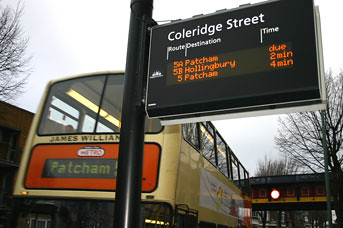
Real time bus information sign, Brighton & Hove, UK by you.
Real-time bus information signs.

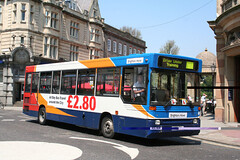
Brighton_M95WBW Mike Penn
Promotion of all day rider passes.

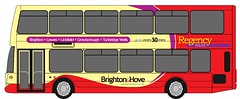
Brighton_and_Hove_Regency_Route_Scania_OmniDekka
Painting scheme is bus-specific, listing primary destinations and service frequency. (Note that I know that the 38B Ballston-Rosslyn-DC Metrobus does this too, although not service frequency, and so does the Potomac Yards Metrobus, maybe the 9A, as does the Downtown Circulator.)

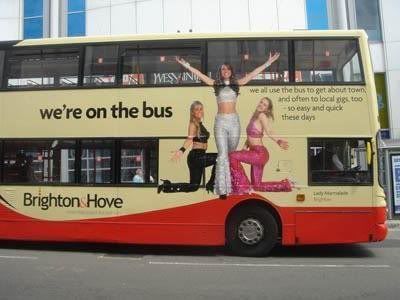
http://i194.photobucket.com/albums/z3/coryk8/LadyMarmaladeontheBus.jpg
Local band, Lady Marmalade, featured in the "I ride the bus" campaign.

Labels: , , ,