Rebuilding Place in the Urban Space

"A community’s physical form, rather than its land uses, is its most intrinsic and enduring characteristic." [Katz, EPA] This blog focuses on place and placemaking and all that makes it work--historic preservation, urban design, transportation, asset-based community development, arts & cultural development, commercial district revitalization, tourism & destination development, and quality of life advocacy--along with doses of civic engagement and good governance watchdogging.

Friday, October 24, 2025

Bombs and bake sales

Remember the line about advocacy against the Vietnam War and the military:

"It will be a great day when our schools get all the money they need and the Air Force has to hold a bake sale to buy a bomber".

It looks like that day has come.

-- "Pentagon accepts $130 million donation to help pay the military during the government shutdown," Associated Press

The Pentagon confirmed Friday that it has accepted an anonymous $130 million gift to help pay members of the military during the government shutdown, raising ethical questions after President Donald Trump had announced that a friend had offered the gift to defray any shortfalls. 

While large and unusual, the gift amounts to a small contribution toward the billions needed to cover service member paychecks. The Trump administration told Congress last week that it used $6.5 billion to make payroll. The next payday is coming within the week, and it is unclear if the administration will again move money around to ensure the military does not go without compensation.

“That’s what I call a patriot,” Trump said during a White House event Thursday when he disclosed the payment from the donor. The president declined to name the person, whom he called “a friend of mine,” saying the man didn’t want the recognition.

-- "US army taps private equity groups to help fund $150bn revamp," Financial Times

The US army has asked private equity groups including Apollo, Carlyle, KKR and Cerberus to pitch “meaty” strategic projects to help the service fund a $150bn infrastructure overhaul.

Driscoll told the Financial Times he gathered the private investors to say, “‘Hey, here are all the assets we have in our arsenals and our depots that we are underutilising . . . What are those types of deals where we can work with you and invite you in?’”

... The proposals mark the latest example of the Trump administration’s efforts to work with the $13tn private capital industry — and an unprecedented effort to enlist some of Wall Street’s biggest investors directly in US national security. 

Driscoll added the projects could include data centres and rare earth processing facilities, and could involve the federal government swapping land for computer processing power or output from rare earth processing.

Labels: ,

Wednesday, November 17, 2021

Property tax exemptions and local hospitals: the Tower Health example

Photo: Ben Hasty, Reading Eagle.

Reading, Pennsylvania-based Tower Health, which started with Reading Hospital but like most hospitals grew into a larger network, including a misguided attempt to expand into Philadelphia and its suburbs by buying a set of community hospitals from a for profit hospital firm, which has been a financial disaster ("Tower Health records massive loss on St. Chris and other hospitals it bought in Philadelphia region," "Tower is selling Chestnut Hill Hospital, closing Jennersville, as it digs out from massive losses," Philadelphia Inquirer), is also dealing with a series of property tax cases.

When the hospitals were owned by a for profit firm, they weren't eligible for a tax exemption.  That changed when Tower Health, ostensibly a nonprofit, purchased them, costing localities including school districts a significant amount of tax revenue.

Chester County challenged the tax exemption for three hospitals which Tower Health is now selling or closing, while Montgomery County challenged the tax exemption for Pottstown Hospital, which is still operating ("Tower Health fights for its tax-exempt status, and local governments are watching," Reading Eagle).

The Chester County court ruled that Tower's exemptions were unjustified, although Tower is challenging the ruling, while Montgomery County's ruling was the opposite.

One of the points made in the Chester County case was that the hospital system doesn't really function much differently from a for profit hospital chain in that funds are redirected to the parent, and that the hospitals don't provide all that much free care for charity patients, merely provide care to people who have Medicaid or Medicare coverage anyway.  The judge relied on these points in making the decision.

The Montgomery case was based on compensation and incentives being based on for profit hospital metrics and were significantly out of line for nonprofits.

Separately I came across an article ("Sanford reports $65 million in payouts to former executives," Sioux Falls Business) about the "tie off" compensation being provided to the former CEO of South Dakota based Sanford Health which has multiple facilities in South Dakota and surrounding states, but as far afield as California.  

It's $46 million!!!!!!!!!!!!!!

Sanford Health is a nonprofit.

This definitely reiterates the point made by Montgomery County, Pennsylvania in its challenge of the property tax exemption for Pottstown Hospital.

2.  Payments in lieu of taxes/PILOTs.  Cities tend to have a preponderance of nonprofit institutions with property tax exemptions, which has a serious impact on municipal finance.  Some nonprofit institutions make an annual payment to cities to cover some of the costs that they impose.  

-- Payments in Lieu of Taxes: Balancing Municipal and Nonprofit Interests, Lincoln Land Institute
-- "PAYMENTS IN LIEU OF TROUBLE: NONPROFIT PILOTS AS EXTORTION OR EFFICIENT PUBLIC FINANCE?," NYU Environmental Law Journal

But most officials complain that the payments generally come nowhere near compensating communities for costs incurred.

3.  Not all nonprofits may be tax exempt when it comes to property.  Generally, state law dictates whether or not nonprofits are entitled to property tax exemptions.  In most states it's categorical and an exemption is provided automatically.

By contrast, in DC, to receive a property tax exemption, the organization has to provide a high degree of service within the city, to the city.  For example, national trade associations or think tanks (Heritage Foundation, etc.) generally are deemed to not provide services to DC residents proper, so they aren't entitled to a property tax exemption.

It would be reasonable to create a "table of authorities" on the criteria for which nonprofits are entitled or not entitled to property tax exemptions, by use category/type of organization, for example hospitals, universities, etc.

The analogy would be how nonprofits can be taxed on "unrelated business income" which is generated by activities not related to the nonprofit purpose.

Labels: , , , , , , ,

Monday, July 19, 2021

Privatization and water/environmental degradation in England

In the US, a number of water agencies have been privatized over the past couple decades, as local governments, strapped for cash, can't afford the increased costs of environmental protection and new regulations.  Privatization usually comes with significantly increased rates ("Towns sell their public water systems — and come to regret it," Washington Post; "Privatizing Our Public Water Supply," American Prospect).

One of the fears of President Biden's push for infrastructure spending is that it will be associated with privatization ("Wall Street Sees Big Wish Granted in Biden’s Infrastructure Deal," Bloomberg).

British papers reported on a recent fine of a private water firm in England, where rather than investing in improvements in sewage treatment, they just released sewage into the waters ("‘The sea was milky white’: how the Southern Water sewage scandal unfolded," Guardian).  In the process, this destroyed the East Coast shellfish industry.

It's a £90 million fine, but not likely to make much difference ("Why are England’s water companies pumping out a tide of sewage? Because they can," Guardian).  

Two other elements that created the "playing field" where noncompliance is supported:

1.  the UK Environment Agency has had its budget cut by about 2/3 -- not unlike the Trump's Administration destruction of the EPA ("The Trump Administration Is Reversing Nearly 100 Environmental Rules. Here’s the Full List.," New York Times) -- and it was minimal to begin with, £120 million.

-- "Cutbacks stopping vital work on river pollution and floods in England," Guardian


2. Rather than investigate sewage discharges, the Conservatives shifted to "self-reporting"  ("Water firms discharged raw sewage into English waters 400,000 times last year," Guardian).

Kind of like Nancy Reagan ("How to use the presidency to get $1 million in free designer clothes, a lesson from Nancy Reagan," Timeline) or Leona Helmsley failing to report gifts or taxes.  

Of course, the treatment facilities under-report.

In the US, it would be possible to sue the companies for additional damages under other laws.  Certainly, the shellfish industry ought to be able to sue Southern Water for how their practices destroyed their industry?  But I guess not.

Rivercide.  Separately, Guardian columnist George Monbiot has produced a live documentary on the impact of privatization on the water quality of England's rivers.  In short, "not good."  ("Livestreamed documentary Rivercide to unmask UK’s water polluters")


Externalities/spillover costs.  The funny thing is that "spillover costs" are one of the first things you learn in introductory economics.  

Costs of production not borne by the firm but passed on to society (e.g. pollution), are known as spillover or external costs, or negative externalities. The government must reallocate resources away from areas where spillover costs exist and toward areas where spillover benefits are large (e.g. health and education).

It's amazing that conservative politicians, in their zeal to make things easy for business, forget that very basic lesson about how businesses are incentivized to push such costs off onto other parties.

Labels: , , , , ,

Monday, October 21, 2019

Comments by the (Federal) "Made in America" Outdoor Recreation Advisory Committee to improve national parks

The Associated Press calls our attention ("Proposal seeks to modernize campgrounds at national parks") to recommendations by the US Department of Interior's Outdoor Recreation Advisory Committee to improve the campgrounds. From the article:
... an advisory committee created under former Interior Secretary Ryan Zinke that has been looking at ways for private businesses to operate on public lands.

The vice chairman of the Outdoor Recreation Advisory Committee, Derrick Crandall, said many campgrounds don't meet visitors' expectations. Allowing the private sector to run them would free up park staff for interpretation, safety needs or other visitor services, he said.

Redesigning some campgrounds, and adding running water, tent and cabin rentals, food trucks, extended family sites and Wi-Fi at select parks also could boost revenue and encourage more people to stay overnight, the committee said.

"We're basically suggesting that would be a way to improve overall camping experiences," Crandall said. "Are we talking about pricing people out of national parks through this? Not at all."

The Interior Department isn't obligated to enact the recommendations but has said it doesn't have the money to modernize the more than 1,420 campgrounds in its system nor does every campground need upgrades.

"Once the report is reviewed, we'll respond accordingly," department spokesman Nicholas Goodwin said.
-- Recommendations for actions to expand and improve recreational opportunities and access to public lands and waters administered by the U.S. Department of the
Interior (Department), "Made in America" Outdoor Recreation Advisory Committee, National Park Service

The committee was convened by the former Secretary, Ryan Zinke, and because the recommendations focus on how the private sector can offer paid for services at parks, there has been fear that this is about privatization of the parks.

National Park "Service"
Critical analysis of National Parks Service management of parks and sites in Greater DC and other urban areas.  While much of my criticism about park service operations has focused on urban park needs, and how they differ from the big national parks, and how in the DC area in particular, many parks and sites are run by the Park Service, but really serve decidedly local interests and should be devolved to local parks authorities, it is the case that the big "traditional" parks have issues too.

-- "Defining National Park Service installations in DC as locally or nationally serving," 2019
-- "Yes, the National Park Service shouldn't be paying to maintain major commuter roads and bridges in the DC area," 2019
-- "Another example of the need to do comprehensive parks, recreation and civic assets planning at multiple scales, including neighborhoods like Columbia Heights," 2019
-- "Federal shutdown as another example of why local jurisdictions should have more robust contingency and master planning processes," 2013
-- "Contingency planning in parks planning: Montgomery County Maryland edition," 2013

The underlying issues are the same for big and urban parks.  The same issue of underfunding. The same issue of difficulties in being innovative and flexible because of time consuming and difficult planning requirements and processes, the need to have Congress approve changes minor and major, etc.

Privatization?  While I don't have a problem with private sector concessionaires, I do have a problem with exclusivity, or contracting with one master concessionaire for a park, because that is a different way of constraining the ability to innovate.

Combine master concessionaire agreements plus cumbersome federal regulations--so at a community festival in a DC park that is NPS-controlled, you can't have for profit business vendors exhibiting unless they are the concessionaire, so that means no local restaurants, not car sharing or micromobility vendors with booths, etc., even if the uses are "public spirited" but for profit.

Photo from the Fresno Bee article, "Yosemite landmarks change names, visitors shake heads: ‘It’s a crazy situation."

Who owns the intellectual property associated with national parks?  Plus, concessionaires can be very "corporate" and out for their own interests and against the parks, such as the issue with the concessionaire trademarking park brands in California ("The corporate grab behind the Yosemite trademark clash," Los Angeles Times).

The thing to remember is that corporations "aren't your friends."  They make decisions on business criteria and don't care much about "values" and "norms."

But as the author of the LA Times makes clear, the federal government hasn't been such a great manager of the intellectual property of parks and public lands either?

Conclusion.  Park management, amenities, and private versus federal delivery of services are matters that still need to be addressed and perhaps this set of recommendations from the Outdoor Recreation Advisory Committee is the first foray.

 NPS will have to make a posting for comments at some point, etc., and that is a way to provide other responses.

But it would have been better to start out with a more broad brushed planning initiative, where this element was but one component.

Labels: , , ,

Sunday, March 10, 2019

UK local governments selling off public assets in face of austerity-driven budget cuts

I have mentioned from time to time how local governments in the UK have been devastated by cuts to their budgets by the national government, justified by austerity, or the non-Keynesian approach to macroeconomic fiscal policy focused on reducing government expenditures and deficits rather than expanding the economy in the face of economic downturns.

Arguably, a justification for austerity derives from neoliberalism and its ideological position that government action and spending is always inferior to the market.

From the Guardian article "Neoliberalism's 'trade not aid' approach to development ignored past lessons: Neoliberal development policy was radical and abstract, but its uncompromising approach proved dangerous in the real world":
Neoliberalism is often used today as shorthand for any idea that is pro-market and anti-government intervention, but it is actually more specific than this. Above all, it is the harnessing of such policies to support the interests of big business, transnational corporations and finance. It seeks not so much a free market, therefore, as a market free for powerful interests.
Similarly, the flip side of this is a focus on outsourcing government functions to the private sector and private financing, both of which have been shown to be more expensive and often less successful than if these functions were handled by government.

-- "Failure of outsourcing in Great Britain," 2018
-- "How part-privatising the UK probation system backfired," Financial Times

UK austerity is also in the news, with claims that cuts in budgets for policing have contributed to a rise in crime more generally ("UK Police Are Stretched by Austerity," New York Times) and more recently, knife crime ("K Knife Crime Rises. Are Budget Cuts to Blame?," NYT).

UK local governments have experienced cuts in budgets up to 60% and that combined with the double whammy of also being financially responsible for elder care, this has driven many governments to bankruptcy, but also selling off property.

The problem is exacerbated by restrictions on local taxation, especially taxation of residential property, which is undertaxed.

The Guardian reports ("Great British sell-off: how desperate councils sold £9.1bn of public assets") on a study of this phenomenon conducted by the Bureau for Investigative Journalism and HuffPost UK.

The article discusses putting up various civic assets up for sale such as the Stretford Public Hall in Trafford and the Moseley Road Baths in Birmingham.

Both these buildings ended up being taken over by community nonprofit initiatives, with support from the nonprofit Locality and their Save Our Space campaign. From the article:
“Part of the problem is a lot of councils don’t have policies in place to think about alternatives to selling off properties to the private sector,” says Tony Armstrong, Locality’s CEO. “Councils are under a huge amount of pressure, and we definitely sympathise with them, but when they look at plugging these budget holes in the short term, once they’ve done that, they can’t do it again - and these places are lost forever.”

In a period of austerity, non-profit making services are “just seen as a drain”, Armstrong says.

“It probably sounds like jargon, but we talk about this concept of ‘social infrastructure’. It’s common sense really, but what brings communities together is the common experiences that we share, and a big part of that is the tangible, physical places where we get together.”
Also see these past Guardian articles:

-- "These squares are our squares: be angry about the privatisation of public space," 2017
-- "Britain's cash-strapped councils and the great Civic Centre sell-off," 2017
-- "Councils forced to sell off parks, buildings and art to fund basic services," 2018
-- "In the frame: two radically different plans for civic art collections," 2019

This is an issue for local government in the US, not so much with public buildings and park space, although it does happen, but with services and infrastructure, such as Chicago's disastrous long term lease deals for its public parking structures and parking meters. The city was driven to make a fast deal because they needed money to plug a $2 billion budget deficit.

-- "Financial engineering for municipalities," 2011
-- "A lesson to cities that they need to be very careful when leasing assets to public private "partnerships"," 2012
-- "Chicago's ongoing debacles: parking and governance," 2013

This also comes up with outsourcing and similar kinds of deals concerning speed cameras, parking meter revenue collection, etc.

At the federal level, outsourcing is a big deal, and hyper problematic, from the management of "camps" to house undocumented immigrants ("Are US immigrant child detention centers "concentration camps"?," Quartz) to privatized prisons (Private Prisons in the United States, The Sentencing Project)

Labels: , , , , , , ,

Tuesday, March 20, 2018

Privatizing (Dulles and National) Airports

With the Trump Administration "focus" on infrastructure, one of the ways the Administration aims to "raise money" (although the program as proposed would actually reduce the amount of federal spending overall on infrastructure, compared to current levels) is by selling assets.

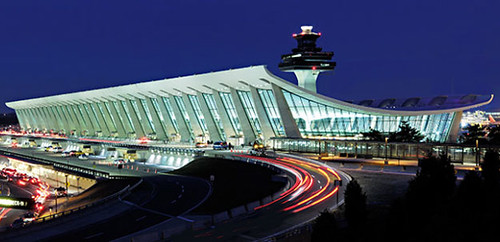
US Airways taxis in the nation's capitolAn op-ed ("Trump is right: Privatize Reagan National and Dulles International Airports") in the Washington Post over the weekend supports that idea as it relates to two of the region's airports, both located in Virginia, National Airport right outside of DC, and Dulles Airport, focused on international travel, and about 30 miles from DC in Loudoun County.

The article doesn't say much, just that it's good to privatize, with the claim that privately owned airports are better.  Note that some airports are privately managed but still publicly owned, the article doesn't discuss this as an option.

The article says very little, other than that management and operation is better, about good and bad examples.

Arguably, from an asset management standpoint ("We are all asset managers now") this makes sense to generate money as well as to put the assets in the hands of entities that can do a better job of maximizing utility and outcomes, when the federal government in this case is a somewhat distant manager.

-- Considering and Evaluating Airport Privatization, report 66, Airports Cooperative Research Program
-- Airport Improvement Magazine (yes, I subscribe)

Dulles Airport postcard, frontOTOH, practically speaking, the airports aren't really managed by the federal government, but a locally controlled entity, the Metropolitan Washington Airports Authority.

Although separate from the ultimate control being held by the Feds, this entity too can be disconnected from providing the best service.

Still, what to do?

Three questions:  It's important to separate out:
  • the management question
  • from the privatization question
  • and the revenues from asset sales question.
There are two very interesting articles that discuss serious limits to successful privatization of airports, in how privatization, at least in how it's carried out, definitely may not serve the public interest.

1.  At JFK decentralized operation doesn't work very well outside of normal circumstances.  While the airport remains owned by the public through the Port Authority of New York and New Jersey, the authority has been busy getting out of the business of running the airport, outsourcing operations on a terminal by terminal basis ("Reinventing the Port Authority," City Journal, 1996).

Passengers waded through a sea of bags from delayed flights at Terminal 4 at Kennedy International Airport on Sunday. Credit Yana Paskova for The New York Times.


Recent failures in managing storm effects at Kennedy Airport (""Cascading failures" strand thousands at flooded, frigid JFK," CBS News) were dissected by the New York Times in a comparison of JFK to Logan Airport in Boston ("How Boston's Airport Bounced Back From the Storm That Crippled JFK"). 

The latter airport is owned and managed by a state authority, with a serious focus on operational success, and daily management meetings led by the director, and a focus on building cooperation and a focus on outcomes on the part of otherwise competitive entities.

By contrast, various privatization efforts at JFK have balkanized operations between many different entities running different terminals, and the Port Authority, which still owns the airport, hasn't stepped in and executed the kind of heavy hand of coordination that is held by Massport.

So when the least bit goes wrong at JFK, operations can quickly degenerate to catastrophic levels, when faced with similar events at Logan, the airport manages reasonably fine.

Still, that came with a great deal of effort.  According to previous coverage, Massport had been a cesspool of patronage ("Change Ahead for Troubled Boston Airport Agency," 2001) but over time, the management priority for the airport shifted to a focus on high quality operations.

2.  Heathrow privatization: great economic returns for the owners at the expense of airport users. The London Times has a damning expose of Heathrow under private operation, "Heathrow: the cash machine with an airport attached." 

Because it is regulated somewhat like a utility, with a profit level based on the size of its "regulatory asset base" which is based on capital investment and expenditure, the airport is incentivized to waste money. 

Profits are made through a capitation fee on each passenger, currently about £20 per arrival and departure. The airport is lightly regulated with little substantive oversight from the UK government. Various construction projects are significantly more expensive compared to other airports. From the article:
... a report buried on the CAA’s website gives a critique of Heathrow’s efficiency versus other international airports. The comparison of a number of leading hubs by PA Consulting showed that Heathrow spends £15.78 per passenger on operations. Only Tokyo’s Narita airport spends more. Earnings per passenger are well above all its peers, too, except for Hong Kong.
While Heathrow has only paid £30 million in taxes on earnings since 2006, it has paid £3 billion in dividends over the same period.  Last year the airport paid a dividend of £325 million.

Other problems with US airports and the federal government: transit connections.  Unfortunately, current regulations do not allow passenger facility fees to be used to pay for connections to existing public transit systems.  As a result, in many communities the local transit system is not well integrated into airports, or at least, when the connections are made, the airport does not pay towards the cost.

Note that there is an interesting article from 2013 in CityLab, "Why Don't More U.S. Airports Connect to Amtrak?," about the connection between Amtrak service and airports and a GAO report on the subject, which doesn't find great demand for such connections.  I don't doubt that's true, because it misses the point: better connections to airports are required within regions, and most Amtrak service is multi-state and very long distance. From the article:

But the barriers outlined by GAO are significant. Generally speaking, U.S. metro areas are less dense and farther apart than those in Europe, making intercity rail service more difficult to manage. The combination of relatively cheap gas and a long history of highway building makes travel to and from an airport by car a very viable option. Limited federal funding — with no single source dedicated exclusively to air-rail projects — is also a significant obstacle.

But plenty of areas, including DC-Baltimore, have regional railroad and/or transit systems that provide connections to local airports, even if the connection might require some ground transportation -- National Airport, BWI, Philadelphia, Newark, Logan, O'Hare -- and with transit National Airport, Newark, JFK, Hopkins in Cleveland, Portland, SF, Seattle, Denver, O'Hare, Minneapolis, come to mind too, among others.

-- "Revisiting stories: ground transportation at airports (DCA/Logan)"
-- "Airports and public transit access: O'Hare Airport and the proposed fast connection from Downtown Chicago"
-- "Do tax incentives pay off? : Illinois; Tennessee; Rosslyn + "The Airport Access Factor""

Point on scenario planning and the possibility of selling the airports. One of the points I make about broad range planning, and note that the regional transportation planning entity here doesn't have a plan for the airports, and in the past I've suggested that the DC and Baltimore planning organizations could do some joint airport planning, is that when you have a plan in place, you can plan for contingencies, including the scenario of the selling off of the Dulles and National Airports. With a plan, you can have a course of action to react, to even be proactive.

The DC region and to some extent the State of Virginia, which does have a Department of Aviation, and where the two airports are located, is not so positioned.

Conclusion.  It's reasonable to consider the ownership structure of National and Dulles Airports.  But privatization doesn't necessary benefit the public as much as it does the private owners, who are incentivized to charge the public as much as it can.

Although in this region, the fact that BWI would remain publicly owned could be a check on untoward business acts.

The DC Metropolitan Planning Organization/Metropolitan Washington County of Governments and the Virginia Department of Aviation ought to get cracking on regional airport planning and scenario planning concerning privatization.

Labels: , , , , ,

Sunday, February 04, 2018

Failure of outsourcing in Great Britain

Because the UK was the first mover in pushing a neoliberal approach to politics, governance, and government operation first under PM Thatcher but then later under Labor PM Blair, it's interesting it is running into real problems.

-- the railroads aren't running that great--although this has been an issue for a long time, see "The privatization of public utilities can be a disaster" International Herald Tribune, 2001), some of the private operators require or have received bailouts

-- and the fares are high 3x to 5x higher than on the continent or compared to the cost of US commuter rail services ("Only a third of rail commuters think fares are value for money," Guardian)

-- water bills are a lot higher under privatization as are corporate profits but quality of services hasn't improved ("Privatised water costs consumers £2.3bn more a year, study says," Financial Times)

-- heads of outsourcing operations make a lot more money to run these businesses than would the equivalent personnel in the public sector

-- local governments are outsourcing many operations out of a desperate need to reduce costs (because their budgets have been reduced by as much as 50% by the national government) with many problems and the destruction of the value of public goods

-- one big outsourcing company, Carillion, just declared bankruptcy and another isn't doing too well ("It's not just Carillion. The whole privatisation myth has been exposed," Guardian)

-- private financing (the Blair government's "Private Financing Initiative") costs a lot more than if the government were to fund projects directly ("PFI discredited by cost, complexity, and inflexibility," Financial Times) -- note that what the British call PFI we call "Public-Private Partnerships"
-- etc.

-- "The Observer view on outsourcing public services"
-- past blog entry, "Public-private partnerships aren't 'partnerships' but contractual relationships"
-- Out of Contract: Time to move on from the ‘love in’ with outsourcing and PFI, Smith Institute (UK)
-- "After Carillion and Capita, is PFI itself on the critical list?," Financial Times

Note that there is a definitional difference between privatization and outsourcing, and the UK situation is somewhat different from the US, because at the time of Margaret Thatcher's rise many UK corporations were owned by the government and for various reasons, they were not managed and operated well and were uncompetitive.

Still, when you have the country's leading financial newspaper editorializing against elements of privatization and private financing of government infrastructure, clearly something is wrong with privatization and private financing, at least at how it is practiced in Britain.

withens-avenue-hillsborough, tree cutting, sheffieldTrees in Sheffield before and after outsourcing.  Photo: Sheffield Tree Action Groups.

The UK situation is also different at the local level, where local government budgets have been decimated and so governments outsource operations in ways that end up being very deleterious, such as with public space maintenance and clear cutting of trees in Sheffield by the private operator (Look to Sheffield: this is how state and corporate power subverts democracy," Guardian).

A real problem in the UK is that when local governments outsource services they seem to cede away the legal right for public input into operation of services by and for the public.

Sure, in the US various privatized toll roads have gone bankrupt, but for the most part third party corporations are fully able to construct buildings or operate services.

And the US has always been big on contracting out operations anyway.  For example, federal laboratories are run by various corporations or universities, IT systems have been run by third parties for decades (for all of Ross Perot's talk about what a great independent businessman he was, EDS was heavily reliant on government contracts).

Governing Magazine seems to be somewhat skeptical of the likely success of All Aboard Florida, the nation's first major private railroad passenger rail service to launch in decades ("All Aboard? The Uncertain Future of America's First Privately Built Railroad in Decades").

What I think is important to be concerned with is the concept of public goods, and whether or not privatization diminishes their value.

Similarly, the neoliberal approach denigrates the value of government generally and government provided services specifically in favor of "the market," but the reality is that there is a difference between "the market," "competition," and sound management and operation of service delivery.

From the Guardian article "Neoliberalism's 'trade not aid' approach to development ignored past lessons: Neoliberal development policy was radical and abstract, but its uncompromising approach proved dangerous in the real world":
Neoliberalism is often used today as shorthand for any idea that is pro-market and anti-government intervention, but it is actually more specific than this. Above all, it is the harnessing of such policies to support the interests of big business, transnational corporations and finance. It seeks not so much a free market, therefore, as a market free for powerful interests.
The private sector, by definition, isn't necessarily the best provider anyway. Some companies are run well and are responsive to customers. Others aren't. And just like transit agencies, they often satisfice service and breadth in the face of budget cutbacks. 

And yes, some government agencies do a great job providing services, while others don't.  This can be about disconnection, labor capture, or other reasons, including corruption ("The Tax Divide" series on the property tax assessment office in Cook County, Illinois, and "A Cook County property tax study has been delayed: How convenient for Berrios," Chicago Tribune).

Labels: , , , , ,

Thursday, November 02, 2017

Public-private "partnerships" aren't partnerships but contractual relationships

I've written about this before, but it always bears repeating, especially as situations come up that illustrate the problems with so-called "public private partnerships," where governments contract with the private sector for financing, construction, and service operation.

To me, a "partnership" allows for flexibility and "continuous process improvement" oriented to achieving better outcomes.

On the other hand, a contract specifies the requirements and outcomes very specifically with no opportunities for change.

There are many examples of where the public benefit and opportunity is short-changed, because cities (1) sign exclusive contracts; (2) which often don't include provisions for revision based on changes in technology or circumstances; (3) often sign contracts that favor the for profit "partner" because as the counter party, for profits usually have more experience, expertise, and significantly greater resources, especially legal resources.

I have also discussed how shifting management of public spaces to allied nonprofits like business improvement districts has the potential to diminish democracy because typically the corporate structures of the nonprofit management entities don't include independent citizen representatives ("Testimony on adding residential buildings as paying members of business improvement districts in Downtown DC").

In response to the Sheffield situation discussed below, George Monbiot, writing in the Guardian ("Look to Sheffield: this is how state and corporate power subverts democracy") makes the point that contracting with third parties creates significant problems for democracy:

... in place of the old bureaucracy, it has created a state-corporate system more oppressive and intrusive than anything governments produced in the social democratic era. The hybrid nature of this system, protected from challenge by commercial confidentiality, property rights and civil law, places it beyond the reach of democracy.

The intermingling of state and corporate power allows corporations to harness the resources and protection of the state, and the state to hide behind its corporate partners. A classic example is the private finance initiative: a programme developed in the UK by the Conservatives but greatly expanded by Tony Blair and Gordon Brown. Under PFI, private companies finance and deliver public goods that governments would otherwise have provided.

We were told it would produce better services at lower cost, but the contracts have repeatedly put corporate demands ahead of public need. The debts afflicting hospitals and other parts of the public sector, as they are forced to keep paying for services they neither want nor need, were both foreseeable and foreseen.
I have also written about how private entities managing seemingly public spaces often need to engage in public planning processes when instituting changes, but typically they do not do so, such as in Reston, Virginia and Boston Properties' debacle in introducing paid parking ("Reston Town Center parking issue as a planning failure by the private sector").

Besides the obvious failures of Chicago in negotiating parking structure and parking meter operation ("Chicago's ongoing debacles: parking and governance") and DC's bus shelter contract--which wasn't terrible but in retrospect has a number of gaps--here are some current examples:

1.  Purple Line Light Rail, Suburban Maryland.  The design-build-operate contract between the State of Maryland and the Purple Line Partners consortium is very specific.  PLP is committed to only doing what's in the contract.  So projects that can better leverage the new transit infrastructure for other improvements across the transit network along with increasing and receiving more quickly economic development benefits are off the table.

withens-avenue-hillsborough, tree cutting, sheffield
Before and after:  Withens Avenue, Hillsborough neighborhood of Sheffield.  Photo: Sheffield Tree Action Groups.

2.  Sheffield, UK Public Space Maintenance Contract will result in the loss of thousands of trees.  In Sheffield, the local government signed a contract with Amey, a unit of the Spanish infrastructure firm Ferrovial, to maintain streets and public spaces.

In an extremely conservative evaluation of the risks present in the public space, conducted after the contract was signed, the firm determined that more than 6,000 trees needed to come down "because various individual trees contribute to unsafe conditions."  They've been taking them down, despite the reality that they aren't threats to public safety and despite the value of trees not only as an element of public space, but as a positive contributor to public health in terms of air quality effects.

According to Monbiot:
But, the council tells me, “alternative engineering solutions … are not funded within the contract”. So they cannot be applied, regardless of any cost savings, and regardless of common sense. The terms of the contract were locked in for 25 years in 2012, and cannot be changed. It specifies that the trees must be felled, so down they must come.

Nor can there be meaningful engagement with local people – that, too, would stand outside the terms of the contract. The council has claimed that the issue is too big and too contentious for a public consultation to handle. In a democratic system, big and contentious are generally considered to be reasons for consultation.
Such contracts need opt-out clauses and opportunities for public consultation. And I think, at least in the US system, because of the way the tree cutting is nonsensical, it would be challengeable in the US Courts.

Trolley buses are significantly quieter than diesel and hybrid diesel buses.  In some cities, like San Francisco, trolley buses enable service over steep grades that traditional engine-powered buses can't climb.

3.   Wellington, New Zealand to dump electric trolley bus system.  I wouldn't know about this except for e-correspondence with Nigel, who lives in New Zealand. 

There the problem derived from splitting up responsibility for the system into three separate tranches: bus service; electricity generation; and catenary infrastructure--putting the responsibility for maintaining the catenary on the local government, separating this from the revenue stream deriving from transit service.

Now that the catenary needs to be upgraded, the local government doesn't want to spend the money, despite sustainability concerns, they respond that they can use electric buses instead.

-- "Wellington's trolley buses take last ride after Transport Minister says he won't save them

An interactive kiosk that Civiq installed in the lobby of Miami-Dade’s County Hall, home to the busiest Metrorail station in the county. Miami Herald photo.

4.  Conflict between bus shelter operator Outfront Media and kiosk operator Civiq in Miami over installing kiosks next to bus shelters, competing for advertising. Bus shelter operation is the means for advertising companies to "deliver" eyeballs to advertisers by utilizing shelter walls for advertising display. 

Typically the contracts between a local government or transit agency provide "free" bus shelters in return for the ability to place advertising within the shelters.  Usually the contracts require exclusivity for the bus shelter/street furniture provider--in some contracts the company only provides bus shelters Clear Channel/Adshel), while other firms (such as Cemusa and JCDecauz) may provide bike shelters, news-stands, kiosks, and even bicycle sharing systems as part of a broader array of street furniture offerings.

Also some companies, to induce cities to sign contracts to allow for digital advertising, which allows for "putting more ads in the same amount of physical space," offered much higher revenue splits than were typical of analog-based advertising contracts ("Electronic billboards attractive to cities," San Diego Union-Tribune).

In Miami, Outfront Media (they also have the contract for advertising within the WMATA transit system) has the bus shelter contract, which until now, included the exclusive ability to put advertising in the public space--that is, property controlled by local government.  Civiq, one of a number of companies developing digital kiosks, got a contract to put kiosks at bus shelters.  The kiosks will provide information on transit schedules, local attractions, and include Wi-Fi points, paid for by sales of advertising.

Outfront says you choose: either the bus shelters stay and the kiosks go or vice versa ("Stay dry or stay online? At bus stops, it’s free Wi-Fi versus shelters," Miami Herald).

(Note that likely a similar conflict could occur in DC, if the smart kiosk operator  manages to get design approvals for their project, "Washington D.C. digital kiosks and sensors to harvest wealth of urban data," Architects Newspaper.)

Interestingly, the conflict also crosses jurisdictions, the City of Miami and Miami-Dade County for one. The Civiq contract is with the county.  The company needs to negotiate separate agreements with each city. (In the DC metropolitan area, each jurisdiction is separately responsible for bus shelters.)

======
Separately, there is interesting coverage about failures in the development of the tram system in Edinburgh, Scotland. 

Former city councilor Gordon Mackensie testified that (1) city governments and councilors often lack the expertise to properly handle, construct, and oversee such projects; (2) when problems occur, political parties can be more focused on using failures to criticize and demean the party in power (e.g., "John Carson and Gordon Mackenzie: Is it time to Ditch the trams?," Scotsman, 2011), rather than focus on achieving the best possible public outcome.
Edinburgh Trams
The Edinburgh Tram system was delivered five years late, over budget, and with a shorter route than planned.

Mackenzie suggests that in Scotland (as in Ireland) perhaps a national authority should be responsible for handling such projects ("Tram inquiry: Council shouldn't have led such a complex project," Edinburgh Evening News).  That even a city government as large as Edinburgh didn't have enough countervailing power to be able to function as an equal party vis a vis the construction company building the system.

In the US context, I've suggested that perhaps metropolitan-scale authorities should take on such projects, although we have had plenty of contract management failures at all levels of government--local; regional; state; multi-state; and national--across the country.

Labels: , , , , ,

Tuesday, June 27, 2017

Answering the question: How will Lyft Shuttle change public transit?

Posed by the Los Angelees public radio station KPCC, in response to the launch of a "private bus" by Lyft ("How will Lyft Shuttle change public transit?").

The answer is: not much.

If bus transit were profitable, the private sector would already be doing it -- see for example the history of why "transit" became "public transit" as the public sector took over previously private transit services, which were no longer operable without subsidy, as the nature of the market especially competition from the automobile as well as the decreased profitability as land use and population deconcentrated or "spread out."

See the more recent failures of Bridg ("Lessons from the collapse of Bridj: Quality counts, but transportation also requires subsidies," CommonWealth Magazine) and the premium bus service that Marc Andreesen and others tried to launch in San Francisco ("Behind the Failure of Leap Transit's Gentrified Buses in San Francisco," New York Times).

There are only so many people going to the same destinations to make it worthwhile to spend lots of money on expensive bus vehicles, etc.

From the CityLab article "Leap Transit is Dead, Long Live Public Transit":
The start-up mindset is especially problematic for private transit ventures because there’s no way to make loads of money charging bus prices for taxi services—at least, not the type of profit that conjures Justin Timberlake’s line in The Social Network that a million dollars isn’t cool, but a billion is. There’s a reason taxis cost a lot more than buses: they provide a personal chauffeur who follows a customized route. And there’s a reason it takes public funding to keep transit systems afloat. A taxi ride at a bus price won’t pencil out unless you find a revolutionary way to connect riders and rides or artificially undercut your own prices to boost volume—and even Uber, which has done both these things better than anyone, is considered by transportation experts to be severely overvalued.

Written by James Aloisi, a former Secretary of Transportation for the State of Massachusetts, the CommonWealth Magazine article is definitely worth a read for the insights it offers on innovation in transportation in the context of the role of the public sector.

Labels: , , , ,

Tuesday, March 25, 2014

Silver Line delays: maybe the real lesson is that contracting out construction to the private sector doesn't always work so well

WMATA photo of the station entrance for the Tysons Corner Station of the forthcoming Silver Line extension in Fairfax County, Virginia.

The Washington Post editorialized yesterday, "The Silver Line’s long, hard slog," about delays in opening the Silver Line subway extension, attributing the problems to the project being overseen by the Metropolitan Washington Airports Authority.

But that's somewhat facile.  It's more about not having WMATA run the project.

Path dependent decision one: picking the private sector, not WMATA, to build the Silver Line.  The State of Virginia made the decision to not have WMATA, the transportation authority in the DC Metropolitan region responsible for the operating (and original construction of the) Metrorail subway system, handle the design, engineering, and construction of the Silver Line extension.

Instead, it was to be done by a "public private partnership," led by the private sector.
Path dependent decision two: not providing direct funding for the project, but instead using revenues from the Dulles Toll Road, including increasing prices.  The State of Virginia didn't want to come up with funding for the local match, and they figured out that the revenue from the Dulles Toll Road serving Dulles Airport (owned and operated by the MWAA) could be harnessed to provide the bulk of funding for the local match. 

So the State of Virginia shifted ownership of the Dulles Toll Road to the MWAA.  And made MWAA the primary public actor responsible for the construction of the Silver Line, which after construction, would be turned over to WMATA for operation and integration into the Metrorail system.

-- "Governor Kaine Announces Partnership With Metropolitan Washington Airports Authority for Dulles Corridor," press release, MWAA, 2006

The real problem was the State of Virginia's choice to side-step WMATA, which had lots of experience managing subway rail system construction.  Whether or not MWAA was the right actor, clearly, going that way to avoid for the most part direct WMATA involvement in the construction of the line, was likely a mistake, not to mention how much it angers Dulles Toll Road users, because tolls have risen considerably to pay for the Silver Line.

What people call "public private partnerships" aren't really partnerships, as much as they are financing deals.

-- "The hidden price of public-private partnerships," Toronto Globe & Mail

Likely it would have been better for WMATA to run this project.  Instead, WMATA was forced to eliminate for the most part their construction division, after Virginia decided to go its own way on the Silver Line.  (Another example of failed "public private construction partnerships" would be the Silver Spring Transit Center...)

Too bad the Post didn't editorialize about that.

Even though they ran articles about it in 2003...

-- "Metro Construction Projects Creak to Halt; Economic, Political Changes Cancel Expansion Plans, Spur Job Cuts, Early Retirements," Lyndsey Layton. Washington Post, July 13, 2003. pg. C.01.

Labels: , , ,

Wednesday, November 13, 2013

Understanding Hong Kong's Transit system and the limited comparability to the US

Matt Yglesias has a piece, "Great Mass Transit Doesn't Have to Cost a Fortune," in Slate about his trip to Asia (I'm jealous) and his experience with transit there, comparing the mass transit system in the Washington Metro to Hong Kong.

While I think he is absolutely right that the way we do system development and contracting in the USA ends up making transit of all types very expensive (a point made very well by Steven Smith in a couple of Forbes pieces I think, or at least one, "NYC Officials Take Notice of Astronomical Subway Construction Costs") there are some key differences that make the systems structurally different in ways that make comparison not so easy. 

1.  The Hong Kong transit system (MTR) only runs the heavy rail system (supplemented with a small feeder bus network) not the surface transit system (trams and buses), and doesn't have to provide paratransit services, which are required by the US Federal Transit Administration, and are increasingly costly for most US transit agencies.

Image of an MTR platform during rush hour in Hong Kong, from Half an ABC blog.

2.  The system covers a dense city and enjoys high ridership, with "crush densities"--the willingness of riders to ride packed in/in close proximity almost double compared to the US, making it much more profitable to carry riders than it is in the US.  (This is a similar issue with comparisons of BRT system success in South America vs. North America--the average transit vehicle in such systems in South America carry double the number of riders than systems here, using the same types of vehicles.)

3.  The Hong Kong heavy rail system is an active developer of station sites, retaining the property that increases in value because of transit adjacency, developing this property, actively managing the property, and getting the lease revenue that results ("A glance at Hong Kong MTR’s retail results," West North).

My understanding is that half the revenue of the system comes from property lease revenue.

By contrast, in the US, most of the financial benefit of transit adjacency ends up being reaped by the private sector ("The Unique Genius of Hong Kong's Public Transportation System," The Atlantic).


The real lesson is that in a dense city where driving a motor vehicle is very difficult, an extensive heavy rail transit system can be run profitably.  In the US, most city regions are sprawled out and residential and commercial areas are widely dispersed, making the provision of profitable transit almost impossible.

That being said, the MTR system is managed much better than most systems in the US, although it is newer than the biggest systems in the US and therefore less costly to operate, aided by not having to pay US wages.

For more on MTR, see this blog entry, "Exporting success from Hong Kong's MTR," from City Block.

Note that it isn't that the situations aren't comparable, but the structural conditions are significantly different, which explains why transit can be profitable in Hong Kong and a loss leader in most North American cities.

Labels: , , ,

Tuesday, September 17, 2013

The only financial solution for the US Postal Service: giving the USPS to the worker pension and insurance funds

I have written about the Post Office quite a bit.  It's an important institution because it's the only federal government agency that operates in every community.  Post offices are federal outposts and community centers. 

But in the 1970s the US Postal Service was sort of privatized.  It was promulgated that the service had to be financially self-sufficient and that no federal funds would be provided to the agency.  But Congress retained oversight, and the various postal worker unions are strong supporters of those Congresspeople sitting on the various oversight committees.  USPS managers argue that frequently, Congressional oversight and the Postal Rate Commission tie their hands in terms of making economically sound business decisions.

In "Rethinking community planning around maintaining neighborhood civic assets and anchors" (and in "Historic preservation aspects of US Post Office downsizing") I argued that the community building element of the post office function is something that local communities should consider "subsidizing," because the USPS receives no federal funds.  Somehow a subsidy may need to be found in order to maintain post offices in those communities where the day to day "revenues" of the office are below the cost of running the facility.  (Although I have also argued that post offices could become entrepreneurial workspaces too, see "Post offices reconceptualized as small business support centers.")

This 1907 postcard (dated by information on the front) has a "Takoma Park" DC post mark.  Before consolidation, it was common for smaller towns and postal stations within larger cities to have their own postmarks.

With all the financial strictures on the USPS plus the ongoing problem of a fall off in mail volume--I saw an ad somewhere stating that a 20% reduction in mailing utility bill payments would result in X% reduction of something or other.

There are 150 million US households (roughly); 20% is 30 million.  x 12 bills = 360 million mailed letters in one year that are foregone, for a loss of revenue totaling $165.6 million.  That adds up.

In the Kodak bankruptcy, to release claims from the British Kodak workers pension fund, Kodak gave to the pension fund its US document imaging business.

Similarly, in the bankruptcies of Chrysler and GM, the insurance responsibilities were hived off into a separate trust and funded in part by newly issued corporate stock (e.g., "Report: UAW trust to get 17.5% of GM shares," from ABC News).

Last week, Royal Mail, the postal service in the UK, announced plans to privatize, and a stock offering is imminent.  They announced that 10% of the stock will be given to the workers, likely to stave off opposition to the privatization.  (Postal services on the continent privatized many years ago.)   According to this story "Royal Mail privatisation - the key questions answered" in the Guardian, the stock given to each employee will be worth about $3,000.

Maybe the USPS should be fully privatized, but with ownership vested fully in the various worker pension and insurance funds, in order to cover the financial liability for those funds.  It would be interesting to see how the fund managers would manage the "company" going forward in order to cover the obligations.

Likely it would mean job losses, which is why the British postal workers oppose privatization.

---------
Note that the reason the Post Office is in dire financial straits is that Congress has required the agency to prefund the next 75 years of pensions, requiring huge annual payments that exceed revenues.  Someone who is more cynical and a better observer than I pointed out that this was done deliberately, in order to break the unions.

Labels: , , , , , ,

Wednesday, April 03, 2013

Silver Spring Transit Center as an example of the perils of privatization

I'm writing an analysis of a project right now, and a point I make is that the first organization can't expect the simultaneous planning efforts of the two other major players to necessarily represent the first organization's interests at the expense of their own.

There has been a lot written about the debacle of the Silver Spring Transit Center in Silver Spring, Maryland, so much that I am not going to discuss it in depth here.

The station is designed to be intermodal, and to provide a structure (but modeled more after a parking structure than a grand railroad station) to provide bus service connections to the adjacent subway station, along with improved rail, bus, and inter-city bus connections (Greyhound, etc.) with a connection to the Metropolitan Branch Trail-Capital Crescent Trail for walking and biking (but no allied bike station on-site).

Problems with the station's construction (detailed in this Post article "Silver Spring Transit Center's inspectors ran poor concrete tests, report says") ended up being the result of design failures that went undetected, improper construction, and failures in the inspection and certification process--at least four parties, Parsons Brinkerhoff, the architect for the project, Foulger-Pratt, the construction manager, the concrete provider, and Robert Balter Company, the inspection firm, are all likely to end up paying out big dollars for the failures, even if Foulger-Pratt is trying to declaim their responsibilities for the debacle ("Foulger-Pratt 'disturbed' by county behavior" and "Contractor on troubled transit center blames Montgomery County officials" from the Post).

While it's typical for local governments to contract out the design and construction of buildings and structures, this doesn't usually extend to the inspection of a building, although it's not out of the question, if the structure is not one that is typically constructed in a community.

For all the talk about the benefits of capitalism, be it market democracy, neoliberalism ("March of the neoiberals" from the Guardian), or "democratic capitalism" ("The Empirical Kids" from the New York Times) at the end of the day, it's a bad idea to expect the market and the service providers to be focused on representing the client's interest at the expense of their own interest.

This is a good example of why relying on "competition" and "the market" isn't always a good strategy (see "Montgomery approves $7.5 million more for transit center" from the Post).

And why giving contracts to local firms like Foulger-Pratt, who are unaccustomed to building transit facilities, might be a bad idea also.

The County is getting a lot of criticism for what happened, but at the same time, officials get lots of push in terms of market-based "solutions" and supporting local business.

Too often, public-private "partnerships" are not partnerships at all.

Labels: , , , , , ,

Tuesday, February 26, 2013

As a for profit industry, prisons must be pretty good

If the correctional facilities operating company Geo Group is paying Florida Atlantic University for the naming rights for the university's football stadium.

See "FAU sells stadium naming rights to for-profit prison operator" from USA Today and "A Company That Runs Prisons Will Have Its Name on a Stadium" from the New York Times.  The school gets $500,000 year for the next 12 years from the deal.

If that doesn't call into question naming rights, privatization, the public realm, civitas, etc., I don't know what does. And of course, it has. See "Students and activists protest the GEO Group's stadium naming rights" from University Press, the FAU student publication.

cf. "Pennsylvania rocked by 'jailing kids for cash' scandal" from CNN and "At a Halfway House, Bedlam Reigns" from the New York Times.

Labels: , ,

Saturday, August 04, 2012

More fundamental rethinking of the organization and provision of school districts is in order in hard pressed communities

I moved to Washington, DC in 1987.  Previously I had lived in the Detroit area for my entire life.  In Michigan, school districts are formed at the city-town-township level.

In Maryland and for much of Virginia, school districts are organized at the scale of the county.  So the school districts are much bigger, but at the same time they draw on the entire taxing capacity of the county, rather than the vagaries of individual communities, some of which are small, some of which are big, some of which are wealthy and some of which are poor.

So in Michigan, Pontiac schools have financial (and other) issues, and until recently, Bloomfield, Birmingham, and West Bloomfield school districts do very well.  But on a county by county basis, there tend to be great disparities.

While in Maryland, thngs aren't necessarily supra-better--there are still outcome disparities on racial and ethnic grounds--for the most part, students are on an even playing field at the county level.
Detroit, Hamtramack, Highland Park map
Not so in Michigan.  So yesterday's Wall Street Journal has a story about Highland Park, "Michigan City Outsources All of Its Schools," and how they are outsourcing their schools to a charter school company.  I've written about Highland Park's being an economic basket case before ("Urban decay and sprawl: one community's gain at the expense of another's").

The city, along with Hamtramack, is completely enveloped by Detroit.  It's just a couple square miles in size.  Historically the city had been financially successful, because Ford and Chrysler had major operations there, and the city assessed an income tax on people working in the city. So it didn't matter that the residential part of the city didn't carry its weight financially. But now, neither Ford nor Chrysler have significant operations there and the city is destitute, and the lack of economies of scale in various agencies of the government is just one more intractable problem that even outsourcing can't fix.

A couple years ago, the Mayor of Memphis executed an interesting stratagem not available to cities in Michigan.  He dissolved the city of Memphis school district, which is forcing its consolidation with the Shelby County School System ("Merger of Memphis and County School Districts Revives Challenges" from the New York Times).  It is supposed to take place next year.

Of course the battle isn't over, just this past week, as a number of cities in Shelby County passed referenda allowing the creation of school districts at the city level, allowing these communities to withdraw from the soon to be consolidated into one City-County School system ("School systems for 6 Memphis suburbs approved," AP story).  From the AP story:

Voters in the six municipalities want their own schools to avoid the merger between the larger, struggling, majority-black Memphis school system and the smaller, more successful, majority-white Shelby County district.

But the vote is being challenged in court by the Shelby County Commission, which is concerned that the breakaway could undermine the merger.

The municipalities, which have a total population of about 171,000, have been part of Shelby County Schools but wanted to break away before the consolidation, set for 2013. Voters in the six suburbs also approved a property tax increase to help pay for the schools.

Supporters of the individual school systems say they want complete control of their own schools and believe academic performance will suffer if included in a combined system with 150,000 students. Proponents also note that state statistics show that Memphis City Schools perform at a lower level than the county's schools.

But opponents have charged that the municipalities want to avoid the merger on racial grounds.


Just as various local governments, cities and counties and townships and various special purpose districts are beginning to consolidate services in an attempt to cut costs while minimizing drops in service quality, the issue of how schooling is provided can't be overlooked.  (In New Jersey, Gov. Christie is forcing the merger of special districts, including school. See, from NJ Spotlight, New Jersey Gets Serious About Sharing Core Services.")

Labels: , , , , , , ,

Friday, May 25, 2012

Heritage Foundation op-ed against California high speed rail

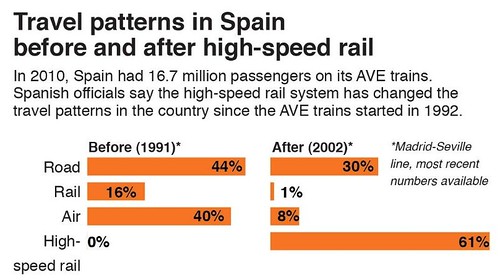
Impact of high speed rail service in Spain
Impact of high speed rail service in Spain, California Watch graphic.

Three things that people often fail to properly distinguish in discussions of government spending:

(1) this year's budget, what it comprises, and how it's paid for;
(2) the difference between program (current) spending and investment in capital improvements (paid for now, but with multi-decade return on investment)
(3) the various funding sources (federal, state, etc.) and mandates for different programs.

I think it's fair to say that Emily Goff of the Heritage Foundation mis-represents all three, plus reasons for privatization of rail transit in Japan and the United Kingdom, in the Orange County Register op-ed "State can't afford 'free' rail money" to support an anti-rail argument.

The State of California is projected to have a $16 billion deficit this year (and she uses this number to imply that California is far more mismanaged than JPMorgan despite that firm's announcement of multi-billion dollar hedging losses, which is completely irrelevant to the article--I think Jamie Dimon would be in over his head managing a state government) which is the result of many reasons, some due to restrictions on the ability to tax, and others due, yes, to the disconnect between new economic realities and the conditions under which old program commitments and contracts were made--some things do need to change, to better fit reduced economic circumstances (a/k/a "you can't have your cake and eat it too" especially if you aren't willing to pay for the cake).

But the investment in high speed rail will have a multi-decade payback, and whether or not California makes this investment, it won't have any impact on the state's current account projected deficit for FY13--the high speed rail project will be funded in part by bond money and in part by federal funds.


  • Chris Nash, University of Leeds, on wider economic benefits of high-speed rail [PDF]
  • Gines de Rus, University of Las Palmas, on economic effects of high-speed rail [PDF]
  • Roger Vickerman, University of Kent, on research into economic benefits of high-speed rail/transportation investments [PDF]
  • Gines de Rus, University of Las Palmas, on benefit-cost analysis of high-speed rail [PDF]

  • Two other problems with the piece:
    1.  Her statements about "privatization" of rail in Japan and the United Kingdom are misleading (but are deliberate, to make the point that "the government" shouldn't be making this kind of investment).

    The main reason that rail is private in Japan is that it's profitable, although this in part has to do with how Japanese land use practices maintain dense centers and focus on maintaining investment in cities, and how the rail companies are able to monetize development opportunities in association with the rail system (like how rail transit systems were first created in the US in fact).  

    None of this is mentioned in the piece.  Actually, this sets the stage for an interesting conservative argument in favor of privately run transit systems--by coordinating land use and transportation policy, promoting mixed use development, and eliminating subsidies of sprawl and the automobile, rail transit service could be successfully privatized (but still there would have to be government support for the infrastructure probably) because the ridership volumes would be significantly higher.

    As long as the competition to transit is deeply subsidized, which it is, it's impossible for transit to function as a privately owned service or without subsidies of its own.

    In the UK, rail was privatized for political and ideological reasons, not for business reasons, and for the most part, rail service has suffered for it.  Certainly, compared to continental Europe, for the most part, UK rail service does not measure up.  See this 2001 piece from the International Herald Tribune, "Why privatization of public utilities can be a disaster," which discusses the UK rail experience.

    Transit doesn't have to be a government service inherently.  But as long as land use decisions are not made in an integrated fashion with transportation planning decisions and motor vehicle use is significantly subsidized in many ways (the cost of roads, the cost of gasoline, public and environmental health impacts, the cost of military forces stationed overseas, etc.), and the majority of the economic benefits of transit access are gained by other economic interests, privatization of transit doesn't work--it's why transit services had to be taken over by the government. 

    2. The new trope going around in conservative circles, related to the general emphasis on "state's rights" and the sentiment that the federal government is incapable of doing anything right, is that transportation planning and infrastructure investment is "increasingly Washington-centered," that "bureaucrats make decisions about projects hundreds of miles away," and that states "know their transportation priorities much better than Washington."  These are all quotes from the Goff piece.

    While there is some truth to the point that decisions can be disconnected, at another level the completely ignores the necessity of national planning for transportation.  This is from a past blog entry:

    Speaking of exercise, my  thinking about transportation planning generally occurs at five scales:

    1. International -- connections between countries.

    2. National -- anchors of a national transportation system, current anchors are the Interstate Highway system, the freight railroad system, and airplane travel. We do not have a national passenger railroad network presently.

    3. Regional --connections between states or two or more metropolitan areas in a state -- for the most part these don't exist for public transit, except for passenger rail service, but do routinely exist for freight railroad service, airplane travel, and the Interstate highway system, which in turn supports inter-city motor coach (bus) service.

    Railroad passenger service with regional scale includes Amtrak's Northeast Corridor railroad passenger service, along with the Amtrak Cascades service from Portland Oregon to Seattle and Vancouver BC, and the Capitol Corridor in California.  Passenger service provided by local rail systems in the New York-Pennsylvania-New Jersey-Delaware region, Illinois-Indiana, serving Chicago, in Southern California, and between Maryland/West Virginia/DC are other examples.

    4. Metropolitan -- transit systems like the WMATA subway and bus system in the Washington metropolitan area or the combined railroad, subway, bus, and waterborne transit services in the NYC or Boston metropolitan areas are examples of transit provided at the scale of a metropolitan area, with one major central city at the core.

    5. Sub-metropolitan transit systems (in the DC region, locally provided services such as RideOn in Montgomery County Maryland or the Downtown Circulator in DC are examples of services within the subnetwork category of the Metropolitan Transit Network).
    --------------------------
    At the state level, transportation budgeting tends to be dominated by road building interests and rural interests, so monies are spent on roads, not on making decisions focused on optimizing the use of the most efficient transportation modes.

    And transportation planning is not solely a local responsibility although at the end of the day, infrastructure is built and maintained locally. 

    Transportation infrastructure is a system that is designed to be integrated, to connect the entire country, to serve a variety of needs, especially freight transportation.

    Even the vagaries of local politics and gerrymandering of political districts and sprawl and its negative impact on center cities, the local political environment is focused not on optimizing transportation efficiency, but on maintaining the automobile-focused status quo.

    The Heritage Foundation knows this, which is why it uses the bogeyman of the "federal government" to pressure politicians to push the control of federal transportation monies to the state level.

    Finally, the reality is that high-speed rail is a 21st century public investment in California's (and ideally the nation's) future, just as the creation of transcontinental railroad service in the 1860s united the country and laid the foundation for a century of incredible success--economic growth, the development of a mass internal US market, consolidation of the nation, tremendous wealth creation--high-speed rail can reset the mobility and economic paradigm for California for the next five decades, not unlike how high speed rail service is changing Spain.  See "Spain's high-speed rail system offers lessons for California" from the Fresno Bee/California Watch.  

    It is tragic that such a strong ideological bent focused on negativizing federal, state, and local government activities is being justified to support a failure to invest in the future of the nation.

    I don't understand why progressives have such a difficult time making counter arguments (except for the fact of misfeasance in so many instances, from the war in Iraq to government corruption, which I suppose can be hard to counter, especially when the conservatives are so quick to provide excuses for massive business failure, i.e., JPMorgan's failure in London or BP's oil spill in the Gulf of Mexico, etc.)

    Labels: , , , , , ,