Rebuilding Place in the Urban Space

"A community’s physical form, rather than its land uses, is its most intrinsic and enduring characteristic." [Katz, EPA] This blog focuses on place and placemaking and all that makes it work--historic preservation, urban design, transportation, asset-based community development, arts & cultural development, commercial district revitalization, tourism & destination development, and quality of life advocacy--along with doses of civic engagement and good governance watchdogging.

Friday, October 02, 2020

Reprint: Rethinking community planning around maintaining neighborhood civic assets and anchors (July 2011)


In honor of National Community Planing Month, I am reprinting this entry from 2011.   

Social infrastructure is essential to successful neighborhoods
.  Note that a few months ago,    I finally read Palaces of the People: How Social Infrastructure Can Help Fight Inequality, Polarization, and the Decline of Civic Life by Eric Klinenberg, which discusses the importance of "social infrastructure" on community success and resilience.

His research finds that communities with more social infrastructure--community associations, outwardly focused churches, civic assets like libraries, functioning commercial districts, etc.--function better overall and in times of stress (heat waves, storms and hurricanes, etc.) and this is true regardless of overall economic status of particular neighborhoods.

=============
(Subheads and one graphic added.)

Schools as building blocks of successful neighborhoods.  I have written about refocusing land use planning around maintenance of key civic assets within neighborhoods recently in the context of schools planning ("One way in which community planning is completely backwards" and "Missing the most important point about Clifton School closure in Fairfax County") where I argue that: 

Schools are fundamental anchors which build and maintain quality neighborhoods and communities. Therefore to maintain communities we need to maintain the schools located within them. This comes up again with schools, as according to the Examiner, "Montgomery schools officials reconsider site selection." 

From the article: 
"The process is broken," said Shannon Hamm, a 27-year county resident. "Citizens in the area need to be included in the selection process, not just afterward, because neighbors care about what happens in their neighborhood."   Planning board Chairwoman Francoise Carrie said she was "very distressed to learn second- or third-hand that the school system had identified one of our parks as a new school site." 

... Song and colleagues explained that the selection committee considers environmental impacts, utilities, car and pedestrian access, acquisition costs, and more when choosing sites. The joint taskforce between the schools and the parks department will discuss solutions at a committee meeting in the fall, then present to the full school board in the early winter. 
How is it that the Planning Board and other planning bodies other than the School System aren't involved in this process from the beginning? When your choices are constrained and your options limited, the only way to make hard choices (sometimes you do have to choose between a park and a school) with some modicum of civility is through public participation. 


I use this diagram from parks planner David Barth to illustrate the concept of an integrated network of civic assets.

Post offices as an essential civic asset.  It's also an issue with other civic assets such as post offices as well, considering that the US Postal Service yesterday announced plans to close as many as 3,653 locations. See "Post office closures: What happens if a town has no post office?" from the Christian Science Monitor. 

Granted, most of the proposed closures in DC are in federal buildings--although in my neighborhood two additional post offices are recommended for closure, including where I got my passport. 

Cross-subsidizing civic assets to support strong communities.  

The issue involved here, from a planning perspective, is the maintenance of community institutions as building blocks for neighborhoods and sustainable transportation systems. 

My point is that maintaining healthy neighborhoods is too important a task to have only the school system be responsible for schools planning. 

And therefore I make the point that if the costs for running a neighborhood school are greater than the system average, then it is reasonable to "subsidize" the school's costs from non-school funding sources. The same goes for post offices. 

Arguably, the USPS shouldn't have to bear the full costs of running a "community" post office, and the possibility of providing support from other funding streams should be available.  To reduce costs, co-location in other civic space ought to be an option available to the USPS. 

Seattle and co-location of civic functions.  Seattle is one of many municipalities that has an active co-location policy, where district court offices, public utility payment counters, neighborhood liaison offices, and libraries are often combined into one facility. 

From the City of Seattle 2004-2009 Adopted Capital Improvement Program:  
Project Identification:  Potential development projects were identified after a professional assessment of service and facilities deficiencies, considerable community dialogue, and staff input. Criteria used include: the ability of existing facilities to handle current and projected use; citizen input; conformance with basic library standards; geographic equity; compatibility with neighborhood planning; and opportunities for co-location with other agencies. 
(Note the point on geographic equity.) 

Because the USPS is subject to so much federal oversight and involvement in their operations (in good and usually bad ways in terms of cost-effectiveness), the ability to be innovative in terms of this question isn't really an option, because it is too difficult to raise the question, especially in the current political and economic environment, where local and state budgets are particularly hard pressed. 

In any case, refocusing how we do urban-community-neighborhood-schools planning towards maintaining community quality and value of place is clearly necessary. 

Walking and biking networks as neighborhood infrastructure.  And that includes biking and walking plans, which should discuss this issue and frequently do not. I guess the only plan that comes to mind with this kind of idea (although there are many amazing Pedestrian Plans out there, such as Minneapolis') is the Toronto Walking Strategy. From the plan:
The aim of the Walking Strategy is to build a physical and cultural environment that supports and encourages walking, including vibrant streets, parks, public squares and neighbourhoods where people will choose to walk more often. By envisioning a city where high-quality walking environments are seamlessly integrated with public transit, cycling and other sustainable modes of travel, the Strategy sets out a plan that will produce tangible environmental, health and social benefits for residents and visitors to Toronto.
Another good example is the Feet First advocacy group in Seattle. I only know of them through their online materials, which I think are amazing, but if you look at their approach, it is about maintaining and extending the qualities of strong neighborhoods through the promotion of sustainable transportation, particularly walking. 

Planning with neighborhoods and placemaking at the center.  The Toronto Walking Strategy, Feet First's pro-walking-pro-neighborhood agenda, and Seattle's co-location strategy for civic assets are the kinds of examples that support community planning from the standpoint of placemaking and quality of life and the maintenance of particular types of civic assets as anchoring institutions within such a broad strategy. 

That's the kind of approach that needs to be built more directly and overtly into our planning documents and government operation practices overall.

Labels: , , , , , , ,

Monday, January 20, 2014

A campaign to ban "night time" postal deliveries is misguided

In November, a postal worker was killed in Prince George's County while delivering mail in the evening ("U.S. Postal Service worker fatally shot in MD," ).  So according to today's tv news programs, the National Association of Postal Workers will be conducting a protest--it's Martin Luther King Jr. Day--to ban delivery of mail at night.

For one, a decrease in staff has led to more mail being delivered later--my mail is often delivered later in the day/early in the evening.

Second, such a reflexive ban isn't necessary because of all the places where crime isn't an issue.

Third, what about banning mail in the daytime?, because that's when most crimes against postal workers are perpetrated.  After all, there was a stabbing of a postal worker in Twinbrook in 2008, in the early afternoon ("Postal Worker Stabbed While Delivering Mail in Rockville," Washington Post).  (I understand this is a function of when most workers are working not so much the time they are working.)

Fourth, in areas of known criminal activity, from a risk management standpoint, it can make sense to limit mail delivery to day light.  Focus.

Labels: ,

Tuesday, September 17, 2013

The only financial solution for the US Postal Service: giving the USPS to the worker pension and insurance funds

I have written about the Post Office quite a bit.  It's an important institution because it's the only federal government agency that operates in every community.  Post offices are federal outposts and community centers. 

But in the 1970s the US Postal Service was sort of privatized.  It was promulgated that the service had to be financially self-sufficient and that no federal funds would be provided to the agency.  But Congress retained oversight, and the various postal worker unions are strong supporters of those Congresspeople sitting on the various oversight committees.  USPS managers argue that frequently, Congressional oversight and the Postal Rate Commission tie their hands in terms of making economically sound business decisions.

In "Rethinking community planning around maintaining neighborhood civic assets and anchors" (and in "Historic preservation aspects of US Post Office downsizing") I argued that the community building element of the post office function is something that local communities should consider "subsidizing," because the USPS receives no federal funds.  Somehow a subsidy may need to be found in order to maintain post offices in those communities where the day to day "revenues" of the office are below the cost of running the facility.  (Although I have also argued that post offices could become entrepreneurial workspaces too, see "Post offices reconceptualized as small business support centers.")

This 1907 postcard (dated by information on the front) has a "Takoma Park" DC post mark.  Before consolidation, it was common for smaller towns and postal stations within larger cities to have their own postmarks.

With all the financial strictures on the USPS plus the ongoing problem of a fall off in mail volume--I saw an ad somewhere stating that a 20% reduction in mailing utility bill payments would result in X% reduction of something or other.

There are 150 million US households (roughly); 20% is 30 million.  x 12 bills = 360 million mailed letters in one year that are foregone, for a loss of revenue totaling $165.6 million.  That adds up.

In the Kodak bankruptcy, to release claims from the British Kodak workers pension fund, Kodak gave to the pension fund its US document imaging business.

Similarly, in the bankruptcies of Chrysler and GM, the insurance responsibilities were hived off into a separate trust and funded in part by newly issued corporate stock (e.g., "Report: UAW trust to get 17.5% of GM shares," from ABC News).

Last week, Royal Mail, the postal service in the UK, announced plans to privatize, and a stock offering is imminent.  They announced that 10% of the stock will be given to the workers, likely to stave off opposition to the privatization.  (Postal services on the continent privatized many years ago.)   According to this story "Royal Mail privatisation - the key questions answered" in the Guardian, the stock given to each employee will be worth about $3,000.

Maybe the USPS should be fully privatized, but with ownership vested fully in the various worker pension and insurance funds, in order to cover the financial liability for those funds.  It would be interesting to see how the fund managers would manage the "company" going forward in order to cover the obligations.

Likely it would mean job losses, which is why the British postal workers oppose privatization.

---------
Note that the reason the Post Office is in dire financial straits is that Congress has required the agency to prefund the next 75 years of pensions, requiring huge annual payments that exceed revenues.  Someone who is more cynical and a better observer than I pointed out that this was done deliberately, in order to break the unions.

Labels: , , , , , ,

Thursday, August 01, 2013

Urban design and changes to post office delivery methods

The latest proposal for "reforming" the US Postal Service and reducing costs includes ending door-to-door delivery of mail, by creating "cluster mailboxes."

-- Our Plan - Saving the Postal Service, House of Representatives Committee on Oversight and Government Reform
-- "Door-to-Door Mail Delivery on Chopping Block,"  CBS News

Cluster delivery has been the method of delivery for a long time in newly constructed suburban subdivisions.

However, while the figure of 80 cents per day per household was bandied about as the cost of providing mail delivery, I imagine that is an average, that it is cheaper to provide door-to-door service in dense neighborhoods and more expensive in less dense neighborhoods.

Although not according to the CBS News article, which says that the cost of delivery to city households is $353/year, almost $75 more than the cost to suburban/rural households.

But doing suburban-style cluster mailboxes in the city would be a disaster.

Although it is possible to have decent looking "street furniture" integrated into the cityscape that wouldn't be terrible.

I also think that modifying a British style phone booth could work.

In any case, addressing this issue now is paramount, or at least figuring out what these proposals mean to cities.

2.  Also, as a revenue generating measure, it would be possible to add some large boxes to these urban-appropriate cluster boxes for use by package services like FedEx and UPS (the general problem was discussed here, "City transportation departments need to set up innovation units") on a fee basis.  The use fee could go to USPS.

3.  Concerning the separate issue of closing post offices, the National Trust for Historic Preservation has a blog entry with 10 steps for advocacy campaigns focused on saving local offices.

-- "10 Ways to Fight for Your Local Post Office," PreservationNation Blog

Labels: , , ,

Sunday, March 24, 2013

Historic preservation aspects of US Post Office downsizing

“The Postal Service is the most visible and ubiquitous federal institution in America. … The daily visits that citizens make to local post offices have shaped the development pattern of many towns. Business districts have grown up around post offices, allowing postal customers to shop, dine, and take care of other needs in one convenient area."

– from "Public Buildings Should Set the Standard," by Edward McMahon, in the Winter 2001 issue of the Planning Commissioners Journal.

--------------------

USA Today has an article, "Parceling out old post offices," about how the US Postal Service is selling off facilities to raise cash, in the face of their financial problems.  From the article:

Municipalities have purchased some post offices in an attempt to keep them open. In Boone, N.C., the town's planning department will set up shop in the downtown post office after the Town Council agreed to buy the 73-year-old building for $1million, said Bill Bailey, Boone's planning director. In turn, the town leased a portion of the building back to the Postal Service to keep the post office running.

Of the 31,300 Postal Service branches across the nation, about 8,900 are owned by the government, and the rest are leased.

The website Save the Post Office is a resource for groups working to preserve post office buildings in their home communities.

I have written in the past about the Post Office building's role in presenting the face of the federal government in local communities, and how this needs to be taken into account when planning service and changes to facilities and functions. See "Rethinking community planning around maintaining neighborhood civic assets and anchors."

And this piece suggests that one way for the USPS to maintain relevance for post office facilities in the face of a reduction of the use of mail services would be to refocus the spaces as places to support local entrepreneurship as co-working spaces. See "Post offices reconceptualized as small business support centers"

That being said, I do understand the desire on the USPS to rightsize facilities and functions, not just to generate cash to use for pension obligations, but to reduce their costs. The pieces above suggested co-location of post office facilities with local government facilities as a way to provide service at lower cost.

But that doesn't get at the desire to save (historic preservation) the remarkable buildings that many Post Office buildings are, either or both inside (some facilities have great murals and other public art) and outside.

This has actually been an issue going on for decades in terms of another dimension, the closure of post office facilities in Downtowns and traditional shopping districts in favor of facilities designed to support automobility.

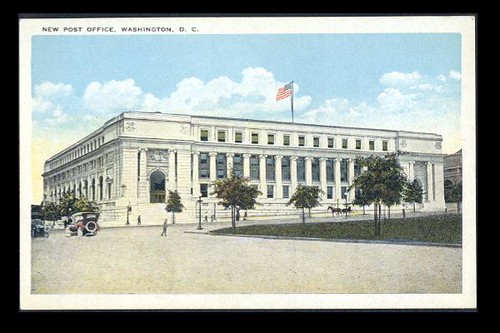
National Capitol Post Office building (next to Union Station)In Washington, DC, three large old post office buildings have been adaptively reused, although 1 of the 3 attempts thus far has been unsuccessful. The early 1800s main post office building is now Hotel Monaco. The building had been empty for many years previous to that use.

The next now Old Post Office building on Pennsylvania Avenue has been used as a retail and office facility but not successfully. It's slated to become a hotel.

In the 1980s, the Main Post Office building (postcard image above) next to Union Station (which has been supplanted by the construction of a new main post office a few miles north, constructed in an industrial area) became a mixed use facility, with a much smaller post office, and with a restaurant, offices (for the Bureau of Labor Statistics), and a new postal museum sponsored by the USPS in association with the Smithsonian Institution.

And since then, the USPS has sold off some sites for redevelopment, such as in Arlington County, Virginia ("Major Office Development Coming to Clarendon" from Arlington Now) and Silver Spring Maryland ("Residential units to replace Silver Spring post office" from the Gazette).

In fact, the Post Office in DC's Georgetown neighborhood, which once served as a customs house as well, when Georgetown functioned as an international port (which is why the building is particularly imposing), has been sold recently as well ("Georgetown post office set to be sold" from the Washington Business Journal").

Image from the Georgetowner article, "Postal Service Sells Georgetown Post Office to EastBanc."

Labels: , , , , , ,

Tuesday, February 12, 2013

Urban outmigration and the deaccessioning of civic infrastructure: Chicago

Left: a church and school building in Ukrainian Village, Chicago, was put up for option with a minimum bid of $1 million.

This is a subject that is not news.

As residents move out of communities to new communities and population shrinks, the amount of civic infrastructure-schools and other public buildings built by the local government to serve the population, as well as religious facilities serving neighborhoods and communities--churches and schools in particular, present in a community is greater than the need.

As buildings and programs are closed, neighborhoods can be further destabilized.  And empty properties contribute to further disinvestment.

This is an issue in Chicago, as the Chicago Public Schools look to close schools, after already closing schools over the past decade, and as church schools have closed in response to similar conditions.  See "As CPS mulls school closings, study finds city already has plenty of vacant school buildings" from the Chicago Sun-Times.

From the article:

As the Chicago Public Schools system prepares to shutter more schools, a study released Monday concluded that Chicago is already awash in vacant school property for sale, with 24 shuttered CPS sites on the market plus about as many old Catholic schools for sale or lease.

Most of Chicago’s vacant schools have been so for more than 10 years, and the longer schools are empty, the harder it is to sell them, according to the report released by the Pew Charitable Trust ahead of massive school actions expected soon in several major American cities.

“The challenge of finding new uses for old buildings is daunting, and the downside of letting them sit idle can be significant,” according to “Shuttered Public Schools: The Struggle to Bring Old Buildings New Life.”

Philadelphia is expected to close 37 schools by year’s end; Washington, D.C., wants to close more than a dozen.

Note that I do argue, in "Rethinking community planning around maintaining neighborhood civic assets and anchors" that in order to maintain functioning neighborhoods, a basic level of civic services, including high quality neighborhood schools, does need to be provided.

In shrinking communities though, other neighborhood stabilization initiatives need to be adopted as well, focused on attracting additional residents. Some program initiatives that serve as good models are:

-- Health Neighborhoods Initiative, Baltimore
-- Live Baltimore resident recruitment program
-- Vital Neighborhoods Initiative, Philadelphia Preservation Alliance
-- State of Pennsylvania Elm Street Program
-- Community Economic Development Handbook
-- Building Strong Neighbourhoods initiative and the Action for Neighbourhood Change program, United Way of Toronto

With regard to the Pew report, see:

-- "Philadelphia and Other Big Cities Struggle to Find Uses for Closed Schools," Pew Charitable Trusts
-- Shuttered Public Schools: The Struggle to Bring Old Buildings New Life
-- Closing Public Schools in Philadelphia: Lessons from Six Urban Districts


This is the school building attached to the vacant church.  Panoramio photo by Istanoy.

Labels: , , , , , , ,

Thursday, June 28, 2012

Post offices reconceptualized as small business support centers

Post office boxes, Websterville, VermontPhoto:  Becky Sweeney picks up a package at the post office on Wednesday, May 9, 2012 in Websterville, Vt. The post office was on the list of rural offices to be closed in Vermont. Bending to strong public opposition, the nearly bankrupt U.S. Postal Service on Wednesday backed off a plan to close thousands of rural post offices after May 15 and proposed keeping them open, but with shorter operating hours.(AP Photo/Toby Talbot)

In April at a "temporary urbanism" event at 14th and Colorado NW that I still haven't gotten around to writing about, one of the volunteers and I were talking about his business being located in a small space there on Colorado Avenue, and his need to be close to his bank and ideally a post office, because of mailing needs and various other related activities.

So it got me thinking about how to reposition post offices to be business centers, even shared office type spaces, to make them more relevant in the 21st century as people use email more and more instead of the mail (but not for packages and documents that need to be signed).

But think about how UPS services were integrated into the company now called the UPS Store but was once called Mailboxes Etc. or how Kinkos (now FedExOffice) is "the branch office" for so many people needing access to printing and computing services.

Co-working spaces extend this idea by adding access to conference rooms, coffee, etc., like the co-working spaces at the Third Ward cooperative space in Brooklyn.  But there are many other examples of co-working spaces around the country.  See the co-working webpage at Deskmag and the feature on 16 different co-working spaces around the country from Inc. Magazine.

Post offices could do that too. (And I've wondered why Staples or FedExOffice hasn't tested the idea either.)

Gangplank
Right: Chris Gallegos photo of the Gangplank co-working space in Chandler, Arizona.


But it won't ever happen because the Post Office is seen as a "government service" and the way that the post office workers unions control the Congressional committees with oversight over the USPS make it almost impossible that the organization could reposition.  The "government" and "Congress" is the last place you go to for innovation and branding prowess.

How do we make Post Offices relevant in the 21st Century.

Also see "Post Offices Join List Of Nation's 'Most Endangered Historic Places" from NPR and "Historic Post Offices" from Comcast.

Labels: , , , , , ,

Wednesday, July 27, 2011

Rethinking community planning around maintaining neighborhood civic assets and anchors

One way to go green is to refocus planning on viable, healthy, sustainable neighborhoods where people can conduct many of their day-to-day activities on foot, by bike, or on public transit. (Image: Go Green Forever stamps, produced by the US Postal Service in 2011.)

I have written about refocusing land use planning around maintenance of key civic assets within neighborhoods recently in the context of schools planning ("One way in which community planning is completely backwards" and "Missing the most important point about Clifton School closure in Fairfax County") where I argue that:

Schools are fundamental anchors which build and maintain quality neighborhoods and communities. Therefore to maintain communities we need to maintain the schools located within them.

This comes up again with schools, as according to the Examiner, "Montgomery schools officials reconsider site selection." From the article:

"The process is broken," said Shannon Hamm, a 27-year county resident. "Citizens in the area need to be included in the selection process, not just afterward, because neighbors care about what happens in their neighborhood." Planning board Chairwoman Francoise Carrie said she was "very distressed to learn second- or third-hand that the school system had identified one of our parks as a new school site." ...

Song and colleagues explained that the selection committee considers environmental impacts, utilities, car and pedestrian access, acquisition costs, and more when choosing sites. The joint taskforce between the schools and the parks department will discuss solutions at a committee meeting in the fall, then present to the full school board in the early winter.


How is it that the Planning Board and other planning bodies other than the School System aren't involved in this process from the beginning? When your choices are constrained and your options limited, the only way to make hard choices (sometimes you do have to choose between a park and a school) with some modicum of civility is through public participation.

It's also an issue with other civic assets such as post offices as well, considering that the US Postal Service yesterday announced plans to close as many as 3,653 locations. See "Post office closures: What happens if a town has no post office?" and "Post office cuts: Is your post office on the list?" from the Christian Science Monitor.

Granted, most of the proposed closures in DC are in federal buildings--although in my neighborhood two additional post offices are recommended for closure, including where I got my passport.

The issue involved here, from a planning perspective, is the maintenance of community institutions as building blocks for neighborhoods and sustainable transportation systems.

My point is that maintaining healthy neighborhoods is too important a task to have only the school system be responsible for schools planning. And therefore I make the point that if the costs for running a neighborhood school are greater than the system average, then it is reasonable to "subsidize" the school's costs from non-school funding sources.

The same goes for post offices. Arguably, the USPS shouldn't have to bear the full costs of running a "community" post office, and the possibility of providing support from other funding streams should be available. To reduce costs, co-location in other civic space ought to be an option available to the USPS.

Seattle is one of many municipalities that has an active co-location policy, where district court offices, public utility payment counters, neighborhood liaison offices, and libraries are often combined into one facility. From the City of Seattle 2004-2009 Adopted Capital Improvement Program:

Project Identification: Potential development projects were identified after a professional assessment of service and facilities deficiencies, considerable community dialogue, and staff input. Criteria used include: the ability of
existing facilities to handle current and projected use; citizen input; conformance with basic library standards; geographic equity; compatibility with neighborhood planning; and opportunities for co-location with other agencies.


(Note the point on geographic equity.)

Because the USPS is subject to so much federal oversight and involvement in their operations (in good and usually bad ways in terms of cost-effectiveness), the ability to be innovative in terms of this question isn't really an option, because it is too difficult to raise the question, especially in the current political and economic environment, where local and state budgets are particularly hard pressed.

In any case, refocusing how we do urban-community-neighborhood-schools planning towards maintaining community quality and value of place is clearly necessary.

And that includes biking and walking plans, which should discuss this issue and frequently do not. I guess the only plan that comes to mind with this kind of idea (although there are many amazing Ped. Plans out there, such as Minneapolis') is the Toronto Walking Strategy. From the plan:

The aim of the Walking Strategy is to build a physical and cultural environment that supports and encourages walking, including vibrant streets, parks, public squares and neighbourhoods where people will choose to walk more often. By envisioning a city where high-quality walking environments are seamlessly integrated with public transit, cycling and other sustainable modes of travel, the Strategy sets out a plan that will produce tangible environmental, health and social benefits for residents and visitors to Toronto.

Another good example is the Feet First advocacy group in Seattle. I only know of them through their online materials, which I think are amazing, but if you look at their approach, it is about maintaining and extending the qualities of strong neighborhoods through the promotion of sustainable transportation, particularly walking.

The Toronto Walking Strategy, Feet First's pro-walking-pro-neighborhood agenda, and Seattle's co-location strategy for civic assets are the kinds of examples that support community planning from the standpoint of placemaking and quality of life and the maintenance of particular types of civic assets as anchoring institutions within such a broad strategy.

That's the kind of approach that needs to be built more directly and overtly into our planning documents and government operation practices overall.

Labels: , , , , , , ,