Rebuilding Place in the Urban Space

"A community’s physical form, rather than its land uses, is its most intrinsic and enduring characteristic." [Katz, EPA] This blog focuses on place and placemaking and all that makes it work--historic preservation, urban design, transportation, asset-based community development, arts & cultural development, commercial district revitalization, tourism & destination development, and quality of life advocacy--along with doses of civic engagement and good governance watchdogging.

Thursday, June 04, 2020

Innovation infrastructure as an element of community economic development: BioSpaces; TechShops; Maker Spaces; Arts spaces

The response to the pandemic has engendered a wide variety of "innovative responses" by people, businesses, and nonprofits, to address gaps of all sorts--lack of personal protection equipment, food, access to cultural resources, schooling, etc., which has been a surprise compared to a general "hardening of the arteries" when it comes to the ability of organizations to respond and transform.

-- "Innovation in Response to the COVID-19 Pandemic Crisis," Academic Medicine
-- "FDA Oversight Emerges For Additive Manufacturing," Forbes
-- "How 7 local businesses are pivoting to PPE production," Boston Globe
-- "7 Weird And Unexpected Business Pivots During The Coronavirus Pandemic," Forbes

Jane Jacobs and Urban Innovation. In Death and Life of the Great American City, JJ argues that "a large stock of old buildings" is one of the four key requirements for healthy cities, because old buildings, paid off and with low running costs, offer cheap rent, and startups (and artists) are fostered by low cost space.  This argument was extended in her second book, The Economy of Cities.

Note that JJ didn't anticipate that there would be a serious disconnect between supply and demand of space in cities and that even old buildings would end up being significantly repriced upward in strong market cities.

Space and facilities as infrastructure for innovation. My arts-based revitalization writings ("Arts, culture districts, and revitalization"), citing John Montgomery's crucial distinction between arts as consumption and arts as production, reference a publication by the Creative City Network of Canada, Cultural Infrastructure: An Integral Component of Canadian Communities, which provides a framework categorizing the types of spaces and facilities that artists and arts organization need to have a functioning arts production system.

Using that framework, I argue that within cultural planning, space needs for artistic disciplines must be differentiated, and that we should endeavor to ensure the availability of the variety of spaces needed to support a healthy and functioning local arts ecosystem.

Best practice discipline-specific arts center examples include Baltimore Clayworks,  London Sculpture Works, UK, Pittsburgh Glassworks, Podcast Garage, Boston, Pyramid Arts Center (printing) in Hyattsville, Maryland, and The Writing Center in Bethesda Maryland

Multidisciplinary examples include BRIC House in Brooklyn, Cabelfactory in Helsinki, GoggleWorks in Reading, Pennsylvania, La Friche in Marseille, and Symphony Space in NYC.

Hackerspaces as infrastructure for innovation.  One type of space not included in the CCNC Cultural Infrastructure framework are hackerspaces.  The framework needs to be extended outward from the arts, for innovative business, various creative endeavors, nonprofits, etc., to provide spaces, technical assistance, and access to specialized equipment.

Hackerspaces are non profit, community run spaces where people with a common interest and a need for specialized equipment, such as computing, machining, technology, digital media, and science can have access to workspaces, equipment, and meeting and collaboration spaces.  Training, classes, talks and other programming may be offered.

The types of spaces and range of equipment vary.  Universities often have such spaces, although access is typically limited to people affiliated with the school.  These days, "maker spaces" in public libraries are in vogue, with some interesting resources, from 3D printers to sewing machines, but not highly technical equipment.

Woodworking.  An early example is the creation of woodworking clubs, which have a wide variety of specialized equipment.  People can become members and be certified and then able to work with specialized machinery.

People like me without that kind of interest or skill can usually take pieces to such places to be worked on, at a reasonable cost. For example, I didn't have the equipment to do a precise cut for butcher block kitchen counters.  So we took the counter to Woodworkers Club of Rockville and they did the cuts.

Community Kitchen.  As a way to support local food production and business development, the Appalachian Center for Economic Networks created a food production kitchen with a food safety manager and other technical assistance programming to support local business development around agriculture.

Other places have developed similar operations, including La Cocina in San Francisco ("What Are Food Incubators and Do They Create Viable Businesses?," Eater), which is focused on supporting immigrants and Spice Kitchen Incubator in Salt Lake City, which is focused on job training and business development.

In DC, Union Kitchen operates similarly but on a for profit basis ("Food Entrepreneurs Have Much to Weigh Before Tying Their Fates to Union Kitchen's Accelerator," Washington City Paper).

Business Incubators.  On the economic development side, business support organizations and/or government agencies or universities create incubators to support business development.  There are various types, depending on the area and what business specializations a community might have.

Incubators sponsored by economic development organizations usually offer other technical assistance and programming.  One distinctive element is that business incubators usually have an "up and out" approach, putting a limit on the amount of time a business can be housed at low rents.

There can be for profit variants.

-- InBIA: Global Network of Entrepreneurial Ecosystem Builders

BioCurious Lab.

BioSpaces.  This entry is sparked because a recent issue of New Yorker Magazine has an article ("The Rogue Experimenters") about hackerspaces or "community labs" for biology, such as the Baltimore Underground Science Space, which has lab equipment, storage freezers, and a PCR machine to duplicate DNA.

The article discusses the DIY-bio movement, which even includes an effort to create nonprofit insulin production, because of increasingly high cost of insulin sold by traditional pharmaceutical companies. e-NABLE is a 3D printer-supported network of volunteers creating low cost or no cost prosthetics.

-- Just One Giant Lab network
-- GenSpace, Brooklyn
-- BioCurious, Santa Clara, California
-- Counter Culture Labs, Oakland, California
-- Harlem BioSpace

Photo by Leonard Ortiz, in This Village is Orange County's first building dedicated to housing nonprofits," >Orange County Register.

Nonprofit Centers Network.  NCN supports shared facilities for nonprofit organizations ("BTMFBA revisited: nonprofits and facilities planning and acquisition," 2016). In Philadelphia, Cultureworks provides space, back office support, and other technical assistance and support to nonprofit cultural organizations.

For profit attempts

Third Ward/Brooklyn and Philadelphia.  Third Ward was an for profit attempt at a broader type of maker space, with equipment beyond wood, and a combination of a co-working space.  But the reality is that there isn't tons of profit in such facilities (cf. WeWork), and investors looking for quick returns end up pushing such facilities to bankruptcy.  That's what happened to Third Ward ("What happened to Third Ward," New York Observer).

Philadelphia Sculpture Gym.  Technically was a for profit too, but more like a community facility including a gallery. It had a wood shop, metal shop, jewelry shop, forging area, ceramics area and a mold making and casting area.

But the owner decided to sell the building and there wasn't a system in Philadelphia able to assist the organization in moving, especially to equally cheap space (they were paying about $4/s.f.) and the organization folded ("A FOND FAREWELL TO THE PHILADELPHIA SCULPTURE GYM," Knight Foundation).

Shepard Test Stand, TechShop Arlington.

TechShop.  Like Third Ward, TechShop was a for profit maker space.  Started in the Silicon Valley, it expanded across the country, stoked by venture capital.

But after a few years, it failed also ("Sad but not a surprise: bankruptcy and shutdown of TechShop MakerSpace chain." 2017 blog entry).

Shared Office Spaces/WeWork. One way to address the need for lower cost space but providing greater opportunities for networking ("agglomeration economies") are shared work spaces like WeWork or business incubators, where participants pay a fee for access to shared space and business equipment (printers, etc.), meeting rooms, a mailbox (ideally with a more distinguished address), etc.

For Profit Business Incubators.  Venture capitalists, property owners seeking active uses for their spaces, and others create business incubators too.

And like with TechShop and Third Ward some fail, like 1776 in DC ("Why 1776 is closing its original incubator location, and thoughts on its future in DC," Technical.ly).  For communities focused on community economic development, nonprofit approaches may work better.

Conclusion.

(1) Community economic development planning needs to include the creation and maintenance of "hackerspaces" as an element within facilities and entrepreneurship development planning.

(2) Hackerspaces need to be included in cultural facilities planning frameworks like that of the Creative City Network of Canada.

(3)  Frequent examples of failure of for profit maker space type ventures demonstrate that expecting such facilities to be wildly profitable are unrealisttic.  A nonprofit approach may work best.

(4) If for profit hackerspaces/incubators exist, they should be monitored and like in the case of TechShop or Philadelphia Sculpture Gym, scenarios for stepping in to ensure continued organizational existence should be developed.

(5)  In high cost markets, the primary need isn't "start up" space per se, it's relatively permanent--or at least long term--access to lower cost space and equipment.  Community development corporations could be an avenue for creating and maintaining making spaces within a broader network of spaces and capacities.

(6) A focus on incubation as a start up initiative may be too limiting.  To me, too many people are focused on helping people "start up" organization be they for profit or nonprofit, when the longer term need is for maintenance.  People focused on creating incubators offering short term space miss the point.

The same goes for "up and out" approaches to business incubation.  Artificially short time limits on participation may be unrealistic and more flexible approaches are required.

Labels: , , , , , , ,

Wednesday, November 15, 2017

Sad but not a surprise: bankruptcy and shutdown of TechShop MakerSpace chain

In my piece, "Arts, culture districts, and revitalization" I argued that cultural infrastructure is comprised of at least five elements:

- Place;
- Space and facilities;
- Artists;
- Cultural organizations and support networks;
- Cultural-creative businesses;

and we should differentiate between hard (buildings/the physical), squishy (organizations) and soft (people) infrastructure. These five elements—place, space, artists, organizations, and businesses—are the components of cultural clusters or cultural quarters.

I said that artists/artistic disciplines needed to create their own plans (in association with cultural planners) and it was essential for such plans to include a facilities and space element, and I used the Creative City Network of Canada thought paper, Cultural Infrastructure: An Integral Component of Canadian Communities as a starting point.

The paper outlines six types of creative space, and four of the six: multi-use hubs; incubators; multi-sector convergence projects; and production habitats; are anchors, a set of either cross-disciplinary or discipline-specific facilities and programs that support the development of art, artists, partnerships, networking, connections, and cultural production.

Building the capacity of artists and organizations through these types of investment supports local economic and community building objectives, and improves the likelihood of success for all types of cultural initiatives. There are many examples of these types of facilities across North America, although no one community has developed a full set across disciplines.


The CEO of TechShop authored a book, The Maker Movement Manifesto: Rules for Innovation in the New World of Crafters, Hackers, and Tinkerers (article).

While I haven't exactly thought through this in all the elements in terms of supporting innovation and business development in the context of "building a local economy" ("Naturally occurring innovation districts | Technology districts and the tech sector," 2014), maker type spaces are an element, as are collaborative workspaces like WeWork, and business incubators of various sorts.

Until the opening of the TechShop in Crystal City a couple years ago, the only one that I really knew of in the area is the Woodworkers Club in Rockville. I'm not a woodworker, but when we were installing a new kitchen in 2008, we took the butcher block counter top there to be cut, because we needed a highly precise cut that a typical radial saw couldn't necessarily produce. They've managed to stay open for 21 years.

While no one reasonable (cf. Artisphere in Arlington County) would expect these kinds of spaces to be wildly profitable, because the modern maker movement is a spinoff of the digital economy, people had different expectations concerning large scale maker spaces.

The very cool Third Ward project in Brooklyn (and for a time in Philadelphia) went belly up pretty quickly ("Why Did 3rd Ward Close?," Observer), because "investors" were looking for quick returns.

As reported by the Washington Business Journal ("TechShop to declare bankruptcy, shuts down suddenly") it seems that a similar problem has developed for TechShop, a digital and analog makerspace with ten locations across the country, including in Crystal City.

-- TechShop history document

When a sort of nonprofit but technically for profit space in Philadelphia, Philadelphia Sculpture Gym shut down a couple years ago, I lamented that the Philadelphia nonprofit and arts community didn't step in to ensure its continuation, unlike how the Baltimore arts community rallied and saved Baltimore Clayworks, after its board had voted to shut down; "Baltimore Clayworks to reopen with new board, old debt," Baltimore Sun).

Note that libraries have been getting into the maker space movement, but the spaces tend to be pretty simple compared to a TechShop, with a 3D printer or two and some graphic design software applications and workstations but probably not CAD and related software. According to the WBJ, the TechShop is pretty elaborate:
With more than $1 million in equipment and software and up to 70 classes each week, TechShop gave access to industrial equipment too expensive for many people and early-stage businesses, for $150 per month or $1,650 for the year. The 22,000-square-foot Crystal City location, with 2016 revenue of nearly $1.5 million and a goal of 20 percent year-over-year growth in 2017, opened in April 2014 and had 700 members.
But I can't see how gross revenue of $1.5 million is nearly enough to run such a facility, let alone provide economic returns to investors.

Shepard Test Stand, TechShop Arlington.

While it is common for city and county economic development agencies to create and support "business incubators" of various types ("Where entrepreneurs work: Inside D.C.'s business incubators," Washington Post), such agencies ought to begin thinking about creating and operating larger scale maker spaces like the equivalent of TechShop, to help foster business development and innovation within the local business and research ecosystem, as a capacity building element of business infrastructure and entrepreneurship development.

Such facilities can help to brand communities as pro-"maker". 

Recommendation.  Ideally, the Arlington County Economic Development agency and the Crystal City Business Improvement District could step in and possibly acquire the assets of the Crystal City branch of TechShop, and continue the operation as an element of the county's commitment to supporting local business development.  From the WBJ article:
The company’s site also links to a form for individuals, organizations or institutions interested in acquiring its assets or one of its locations.
Baring action by Arlington County, another jurisdiction should swoop in, buy all the equipment, and set up a similar operation.

In DC, I'd consider doing that at the Walter Reed campus, Howard University, Catholic University, or at the St. Elizabeths East Campus, as a way to seed its redevelopment.

In Silver Spring, it could be something the County could do with Montgomery College (see item #16, "Positioning Silver Spring as an innovation district and/or an Ecodistrict," "PL #5: Creating a Silver Spring "Sustainable Mobility District" | Part 3: Program items 10-18").

In New Carrollton, it would be a way to seed a new direction for that Prince George's County city ("Setting the stage for the Purple Line light rail line to be an overwhelming success: Part 4 | Making over New Carrollton as a transit-centric urban center and Prince George's County's "New Downtown"").

Etc.

Labels: , , , , ,

Sunday, March 24, 2013

Historic preservation aspects of US Post Office downsizing

“The Postal Service is the most visible and ubiquitous federal institution in America. … The daily visits that citizens make to local post offices have shaped the development pattern of many towns. Business districts have grown up around post offices, allowing postal customers to shop, dine, and take care of other needs in one convenient area."

– from "Public Buildings Should Set the Standard," by Edward McMahon, in the Winter 2001 issue of the Planning Commissioners Journal.

--------------------

USA Today has an article, "Parceling out old post offices," about how the US Postal Service is selling off facilities to raise cash, in the face of their financial problems.  From the article:

Municipalities have purchased some post offices in an attempt to keep them open. In Boone, N.C., the town's planning department will set up shop in the downtown post office after the Town Council agreed to buy the 73-year-old building for $1million, said Bill Bailey, Boone's planning director. In turn, the town leased a portion of the building back to the Postal Service to keep the post office running.

Of the 31,300 Postal Service branches across the nation, about 8,900 are owned by the government, and the rest are leased.

The website Save the Post Office is a resource for groups working to preserve post office buildings in their home communities.

I have written in the past about the Post Office building's role in presenting the face of the federal government in local communities, and how this needs to be taken into account when planning service and changes to facilities and functions. See "Rethinking community planning around maintaining neighborhood civic assets and anchors."

And this piece suggests that one way for the USPS to maintain relevance for post office facilities in the face of a reduction of the use of mail services would be to refocus the spaces as places to support local entrepreneurship as co-working spaces. See "Post offices reconceptualized as small business support centers"

That being said, I do understand the desire on the USPS to rightsize facilities and functions, not just to generate cash to use for pension obligations, but to reduce their costs. The pieces above suggested co-location of post office facilities with local government facilities as a way to provide service at lower cost.

But that doesn't get at the desire to save (historic preservation) the remarkable buildings that many Post Office buildings are, either or both inside (some facilities have great murals and other public art) and outside.

This has actually been an issue going on for decades in terms of another dimension, the closure of post office facilities in Downtowns and traditional shopping districts in favor of facilities designed to support automobility.

National Capitol Post Office building (next to Union Station)In Washington, DC, three large old post office buildings have been adaptively reused, although 1 of the 3 attempts thus far has been unsuccessful. The early 1800s main post office building is now Hotel Monaco. The building had been empty for many years previous to that use.

The next now Old Post Office building on Pennsylvania Avenue has been used as a retail and office facility but not successfully. It's slated to become a hotel.

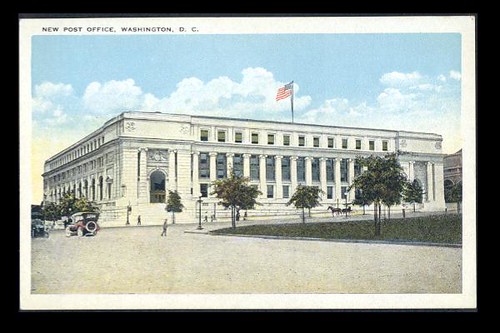
In the 1980s, the Main Post Office building (postcard image above) next to Union Station (which has been supplanted by the construction of a new main post office a few miles north, constructed in an industrial area) became a mixed use facility, with a much smaller post office, and with a restaurant, offices (for the Bureau of Labor Statistics), and a new postal museum sponsored by the USPS in association with the Smithsonian Institution.

And since then, the USPS has sold off some sites for redevelopment, such as in Arlington County, Virginia ("Major Office Development Coming to Clarendon" from Arlington Now) and Silver Spring Maryland ("Residential units to replace Silver Spring post office" from the Gazette).

In fact, the Post Office in DC's Georgetown neighborhood, which once served as a customs house as well, when Georgetown functioned as an international port (which is why the building is particularly imposing), has been sold recently as well ("Georgetown post office set to be sold" from the Washington Business Journal").

Image from the Georgetowner article, "Postal Service Sells Georgetown Post Office to EastBanc."

Labels: , , , , , ,

Thursday, June 28, 2012

Post offices reconceptualized as small business support centers

Post office boxes, Websterville, VermontPhoto:  Becky Sweeney picks up a package at the post office on Wednesday, May 9, 2012 in Websterville, Vt. The post office was on the list of rural offices to be closed in Vermont. Bending to strong public opposition, the nearly bankrupt U.S. Postal Service on Wednesday backed off a plan to close thousands of rural post offices after May 15 and proposed keeping them open, but with shorter operating hours.(AP Photo/Toby Talbot)

In April at a "temporary urbanism" event at 14th and Colorado NW that I still haven't gotten around to writing about, one of the volunteers and I were talking about his business being located in a small space there on Colorado Avenue, and his need to be close to his bank and ideally a post office, because of mailing needs and various other related activities.

So it got me thinking about how to reposition post offices to be business centers, even shared office type spaces, to make them more relevant in the 21st century as people use email more and more instead of the mail (but not for packages and documents that need to be signed).

But think about how UPS services were integrated into the company now called the UPS Store but was once called Mailboxes Etc. or how Kinkos (now FedExOffice) is "the branch office" for so many people needing access to printing and computing services.

Co-working spaces extend this idea by adding access to conference rooms, coffee, etc., like the co-working spaces at the Third Ward cooperative space in Brooklyn.  But there are many other examples of co-working spaces around the country.  See the co-working webpage at Deskmag and the feature on 16 different co-working spaces around the country from Inc. Magazine.

Post offices could do that too. (And I've wondered why Staples or FedExOffice hasn't tested the idea either.)

Gangplank
Right: Chris Gallegos photo of the Gangplank co-working space in Chandler, Arizona.


But it won't ever happen because the Post Office is seen as a "government service" and the way that the post office workers unions control the Congressional committees with oversight over the USPS make it almost impossible that the organization could reposition.  The "government" and "Congress" is the last place you go to for innovation and branding prowess.

How do we make Post Offices relevant in the 21st Century.

Also see "Post Offices Join List Of Nation's 'Most Endangered Historic Places" from NPR and "Historic Post Offices" from Comcast.

Labels: , , , , , ,

Tuesday, June 14, 2011

Fostering entrepreneurship

This is an issue that matters nationally and locally. Jane Jacobs' second (Economy of Cities) and third (Cities and the Wealth of Nations) books address the role of cities in creating wealth. Her point in Death and Life of Great American Cities about one of the four key factors in a successful city being "a large stock of old buildings" wasn't laid out out of a sense about historic preservation but because paid-off old buildings cost less to rent and therefore help to incubate innovation.

In Reclaiming Our Cities and Towns: Better Living With Less Traffic, David Engwicht makes the points that cities exist to facilitate exchange of all types--commerce, ideas, social connection, etc.--while at the same time minimizing the need to travel to do so.

And Mihalio Temali's Community Economic Development Handbook is an attempt to re-position "community development" which as a movement has mostly focused on building better housing for poor people towards rebuilding local economies more broadly, by focusing on microenterprise development and commercial district revitalization.

The latest issue of Democracy: A Journal of Ideas reports on a recent symposium on a progressive agenda for supporting entrepreneurship:

From the Ground Up: Fostering Entrepreneurship

The intrepid entrepreneur striking out on his own has always been an essential part of America’s image of itself. Pulling himself up by his bootstraps—or setting up her e-business on a laptop in a coffee shop—the self-made individual is the engine that drives the American economy.

This is even truer in times of economic crisis. According to one study, more than half of Fortune 500 companies were founded during a recession or bear market. Moreover, new firms tend to be where new jobs come from. On average, one-year-old companies add nearly three million new jobs in their first year, while existing firms lose one million jobs per year.

Washington has started to pay attention. The Obama Administration has pushed forward some major changes aimed at boosting entrepreneurs, from low-interest loans to tax breaks for startup companies to training for veterans who want to start businesses. Policy-makers continue to focus on measures that would encourage the growth of entrepreneurs.

But there is much more that can be—that needs to be—done. The United States faces not just the challenge of digging itself out of a very deep hole. We also have to contend with economies that are catching up to our lead. All over the world—China, India, Brazil, and elsewhere—entrepreneurs are springing up. We might think of entrepreneurial vitality as an especially American trait, but it is a trait we are starting to see in others too. Faced with tougher competition, we need to replenish our supply of ideas, lest we lose our status as the world’s great seedbed for entrepreneurs.

Progressives have an important role to play in this mission. Government has been an important partner to entrepreneurs over the course of American history. From the railroads to DARPA’s invention of the Internet, government has been vital in opening up new opportunities for self-made Americans. But government restraint has also been crucial to entrepreneurial booms of past years. Striking that right balance, between a helpful public sector and an unobtrusive one, will be essential to the future of the American entrepreneur.

This symposium, assembled with the generous support of the Ewing Marion Kauffman Foundation, seeks to advance a progressive agenda for entrepreneurship. We have brought together some of the finest minds on the economy, entrepreneurship, and public policy to discuss cutting-edge ideas on how to promote a progressive vision of entrepreneurship.

Leading off the symposium is William Galston of the Brookings Institution and Democracy’s editorial committee. Galston jumps into the ongoing conversation between progressives and entrepreneurship advocates, laying out the issues that separate the two sides—but also the commonalities on which a productive and enduring relationship can be built.

Next is a piece on immigration reform by Vivek Wadhwa. One of our leading thinkers on immigration and innovation, Wadhwa warns that immigrant students and young entrepreneurs are increasingly deciding not to stay in the United States but to pursue their dreams back home. He argues for the central importance of immigrants to American entrepreneurship, and calls for bold reforms in our immigration policy to ensure that the world’s best minds will continue to want to plant roots here in America.

When we think of entrepreneurship and innovation, we think of clusters: Silicon Valley, Route 128, the Research Triangle. Maryann Feldman of the University of North Carolina at Chapel Hill looks at the conditions under which clusters grow, and what government can—and can’t—do to encourage them.

On minority entrepreneurship, we have enlisted Thomas “Danny” Boston, economist from Georgia Tech. Boston argues that minority-owned businesses should be an integral part of any plan for economic resurgence, and suggests some ideas on how we can cultivate them.

Finally, Amy Rosen, the president and CEO of Network for Teaching Entrepreneurship, examines the education sector and asks what we might do to instill the entrepreneurial spirit in young Americans. We think she has some terrific ideas on education and curriculum reform.

Progressives have a proud history of promoting entrepreneurship, from facing down big corporations that seek to stifle competition to providing the public tools necessary to encourage the strivers who power our economy. As the economy enters uncharted waters, a progressive vision for entrepreneurship is essential if we are to steer America in the right direction. We hope this symposium offers a good starting point for the conversations that we need to have to achieve that vision.

From the Ground Up: Fostering Entrepreneurship

Progressive Entrepreneurship: A Work in Progress by William Galston

Our Best Imports: Keeping Immigrant Innovators Here by Vivek Wadhwa

Location, Location, Location: Creating Innovation Clusters by Maryann Feldman

Minority Report: Expanding Opportunity for All by Thomas “Danny” Boston

Life Lessons: Educating the Next Entrepreneurs by Amy Rosen

This work was funded by the Ewing Marion Kauffman Foundation. The contents of this publication are solely the responsibility of Democracy: A Journal of Ideas.

Labels: , ,

Wednesday, May 04, 2011

Building the infrastructure/support network for food entrepreneurialism

The Toronto Star has a story, "New food market would be on the sly," about the development of an underground food market there, modeled after one in San Francisco ("Renegade San Francisco Underground Market" from the New York Times).

This allows people to sell food they make at home, which isn't legal, because food safety regulations require that food items sold to the public be produced in commercial grade kitchens, under the supervision of a person certified to know food safety procedures.

Given that food-borne illnesses are in fact a significant problem, these kinds of requirements aren't unreasonable, to protect the public health. E.g., I spent my junior high and high school years in Oakland County, Michigan, and a restaurant there, Trini & Carmen's suffered a botulism outbreak from using home prepared products in their kitchen, and people died.

The way to "solve" the problem is to develop more commercial grade community kitchens as a technology so to speak to support food entrepreneurialism. There are many such operations across the county, starting with one of the first modern ones in Athens, Ohio, the Food Manufacturing & Commercial Kitchen Facility, managed by the Appalachian Center for Economic Networks. The organization publishes a how to guide.

But there are many others across the country, in places like San Francisco, New York, Columbus, Ohio, etc.

I have argued for a long time that such operations need to be incorporated into public markets such as Eastern Market in DC (or the Florida Market in DC, which is privately owned), as a way for these types of facilities to become more integrated into regional foodways, food security, and food production networks.

A variant of a community kitchen are the family food preparation franchise operations (called "meal assembly"), such as Let's Dish, which are set up for people to come in and cook a week's worth of food items at one time.

There is no reason that people wanting to participate in an Underground Market couldn't collectively prepare their items in such facilities, which by the way, would likely further their ability to move on up into full-scale businesses, because these facilities usually provide a wide variety of training programs and technical assistance for business development.

-----
Note that the idea of figuring out what type of "infrastructure" exists and a typology for various types of infrastructure has been developed for the cultural field by the Creative City Network of Canada. These concepts need to be extended into other sectors, such as food production.

Labels: , ,

Thursday, August 05, 2010

Interesting public art leadership training program

Today's Post has a story, "Kennedy Center's Michael Kaiser hit the road for 50-state 'Arts in Crisis' tour," about the Kennedy Center arts organization promotion and development initiative. From the sidebar, "A sense of direction: Michael Kaiser's advice during his 'Arts in Crisis' tour":

In his book "The Art of the Turnaround," and on his 50-state "Arts in Crisis" tour, Michael M. Kaiser espouses some guidelines for economic recovery and stability in the arts. Among them:

-- Do not reduce programming. Trim behind the scenes on discretionary items, such as staff travel.

-- Plan ahead for four or five years, and then let the public know what's on the drawing board so it will be clear that the organization plans to be around.
-- Planning should be done by both large and small groups.
-- Develop collaborations with local artistic groups, museums and schools.
-- Find and train entrepreneurial managers.
-- Develop new streams of revenue.
-- Make the board members ambassadors for the work being presented, as well as fundraisers.

I do say in response that what is really needed is arts and culture plans for communities, including a focus on arts production and development. This is something that Arts USA is doing in the US (Institute for Community Development and the Arts), and there are many such initiatives in Canada (cultural planning and cultural mapping toolkits).

In the paper/presentation I gave last summer to a dramaturgs organization ("Art, culture districts, and revitalization"), I wrote:

1. Create your own discipline-specific cultural plan

Many communities have cultural plans. Usually these are broad documents covering many issues including facilities, funding, disciplines, education, and community building. Some cities may have sub-plans within their cultural plan for facilities or public art. Seattle and Chicago are discussing the creation of framework plans to support the music industry within their communities. But it appears that no city has developed what we might call a “theater plan.” Not New York City, where Broadway is central to the city’s identity and to tourism and where the theater industry is a key component of the region’s creative industry. Not Chicago, which is known for the most thriving theater scene between the coasts, ranging from neighborhood and repertory productions to “national” plays and musicals at Downtown theaters.

The plans must be multifaceted, and address the needs of artists and cultural organizations, not just the economic or community building concerns of various constituencies. And, the plans must focus on matters concerning cultural production equally with the promotion of cultural consumption, arts-oriented tourism, etc.

Write a theater plan for your community.

2. Come up with a sustainable facilities plan for your community

Part of your theater plan should include a sub-plan on facilities. Communities should develop holistic facilities plans that maximize use and revenues, and reduce overall costs, especially the demand for rent, so that arts organizations can achieve a relatively sustainable cost basis.

Washington, DC and nearby Arlington County in Virginia have two very different methods for supporting arts organizations. Arlington prefers to support a wide variety of organizations, and chooses to develop government-owned or controlled space in ways that support cultural initiatives in addition to other objectives. The County provides space (at low or no cost), access to a shared costume shop, and the use of a costume library to many theater organizations. The county has developed some facilities, including the Shirlington Library, which includes the Signature Theatre Company, and the Thomas Jefferson Middle School, which contains a large auditorium supporting a resident theater company and other productions, in ways that most communities do not. Arlington calls this approach their “Arts Incubator.”[3]

DC provides money to organizations for the acquisition or rehabilitation of facilities, but not in the context of a broader cultural plan focused on consensus priorities. In the past few years, many of the organizations that have received this support, including the Source Theater and the Lincoln Theater, have either ceased operations or have been pushed to the brink of financial solvency. In the broader cultural program, certain arts anchors have been pushed out of the city in favor of the baseball stadium, while other organizations, depending on their relationship with the Executive or Legislative Branches of Government, enjoy preferential earmarks. These grants are made without regard to a vetted set of priorities or through an open and competitive grant process.

3. Create anchoring institutions

Artists, advocates, and organizations need to build their capacity to plan, organize, develop, and execute. Markusen and Johnson[4] found that the arts best contribute to regional economic and social development when there are “dedicated centers where artists can learn, network, get and give feedback, exhibit, perform, and share space and equipment. “

In their paper on creative infrastructure[5], the Creative City Network of Canada outlines six types of creative space, and four of the six: multi-use hubs; incubators; multi-sector convergence projects; and production habitats; are anchors, a set of either cross-disciplinary or discipline-specific facilities and programs that support the development of art, artists, partnerships, networking, connections, and cultural production.

Building the capacity of artists and organizations through these types of investment supports local economic and community building objectives, and improves the likelihood of success for all types of cultural initiatives.

There are many examples of these types of facilities across North America (just not in DC) that serve as examples that you can consider for your own communities.

4. Networking

In addition to artistic centers and anchors—support and capacity development entities—arts organizations need to engage in some rethinking about how to work together to develop the arts community as a component of the community’s cultural infrastructure and as a force to represent artists and artist organizational interests in land use, capital investment, public finance, cultural, tourism, education, and other local policy matters.

Another matter to consider is whether or not organizations can share and maximize the value of audiences. What best practice examples of arts marketing and membership can be adapted to your community, both for individual organizations as well as to build the success and identity of the theater community as a whole?

-----------------
I doubt that creating that kind of program is part of the new Ilead program in Chattanooga (see "Program fuses business, creative concepts" from the Chattanooga Times Free Press), but you gotta start somewhere. From the article:

Bridge Consulting International, Hunter Museum of American Art and University of Tennessee at Chattanooga’s College of Business have teamed up to create iLead, a two-day series that will fuse art and business concepts.

“The curriculum is really to encourage critical thinking and awaken and develop leadership skills,” said Mike Owens, assistant dean of graduate programs at UTC. “And through the use of art objects, I think that’s an interesting way to do it. I’ve never seen anything done that way.”

Several UTC faculty members will serve as guest speakers during the series, and Owens said the business school will advertise the opportunity to its graduate and undergraduate alumni.

The curriculum was developed by Bridge Consulting, and the Hunter Museum will host the series.

Labels: , , ,

Monday, July 28, 2008

Social Compact in the news

Ironically, I wrote the email below to an e-list on asset-based community development last week, not knowing about this article, "A new look finds wealth in inner city," in the Los Angeles Times.

Another problem with a focus on chains is where the money ends up going. While data on the impact varies a little, generally the amount bandied about is that a chain store has a multiplier impact of 14 cents for each dollar spent there, while for a locally owned store, more than 50 cents of every dollar spent in the store recirculates in the local economy.
----------------
I end up not being super impressed with their work, not that it isn't great in terms of their ability to drill down and discover people/data. See this paper by Scott Bernstein of the Center for Neighborhood from the late 1990s: Using The Hidden Assets of America's Communities & Regions to Ensure Sustainable Communities. This paper spawned the kind of analysis employed by Social Compact.

The issue isn't that there are 5 poor people living in a house instead of 2 people. The issue is how do we rebuild urban commercial districts given an incredibly concentrated retail industry, one that for the most part is "chained up," that chains have little interest in urban areas, particularly underserved/poor areas.

To me, the issue is rebuilding the local economy at the neighborhood level (also see Community Economic Development Handbook by Temali).

And this brings up issues of entrepreneurship development, capital formation, capacity building, etc. Anyway, there is someone who says that the phrase "information is power" is only half right, that "information is _potential_ power." The issue is how to utilize the info.

How do we convert the information from potential into power? It happens that this is the big thing that I am dealing with in my work, and is something that for the most part I am not writing about in the blog, because it is the formulation phase. I am working with another consultant on this. Hope to have an integrated framework laid out by the end of the year, although part of it will be delivered within a report to a commercial district in Pittsburgh, and in a community on Maryland's Eastern Shore, and we are talking about it at a conference in Vermont in October.

Labels: ,

Another way to build supportive foundations for the development of independent businesses and entrepreneurship

Andrew calls our attention to this article from the Los Angeles Times, "TechShop: Where do-it-yourself inventors do R&D," subtitled "Silicon Valley workshop offers tools to an innovative community."

From the article:

By offering affordable access to otherwise out-of-reach tools, TechShop is lowering start-up costs and providing a commons for previously isolated minds. It's a place where "makers" -- as members of the do-it-yourself movement are known -- can make such products as water-cooled stacks of computer servers and remote-controlled robots that do videoconferencing.

It's doing for physical goods what Kinko's did for printed products, said David Pescovitz, a research director at the Institute for the Future, a forecasting group in Menlo Park. "TechShop has the potential to be the service bureau to the maker culture," he said. The atelier occupies a maze-like 15,000-square-foot warehouse near Stanford University. Twelve work tables fill the main space. Rooms are designated individually for activities such as painting, foam molding and neon production.

Since opening in October 2006, TechShop has attracted 300 members, each paying $100 a month for hands-on access to the sophisticated tools. The operation also sells supplies and charges for classes.
TechShop
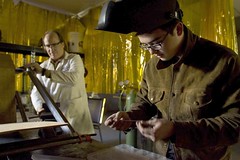
Randi Lynn Beach, For The Times. Former Hewlett-Packard engineer Chris Tacklind, left, works with Daniel Fukuba in TechShop's welding lab. Jim Newton, the man behind TechShop, wants to expand the concept to 50 sites in five years.

Labels: , ,

Rebuilding the support and capital network and structure for independent retail businesses

The Post has an article in the Sunday paper on crowdsourcing as a way to create desired independent businesses, in "Online, a Community Gathers to Concoct A Neighborhood Eatery." I'm not sure that would work exactly, and it's big on using the idea of "crowdsourcing" to make something old new and sexy.

The real issue is how to you deal with the very difficult issues of creating a business plan, creating a business concept, creating a robust business system for your business so that it will succeed, finding capital, creating and executing a marketing plan, etc.

If I asked you to do all at once, except for the most atypical of people, you would be paralyzed, "crowdsourcing" or building a business network and support system is a way for people to come together to seed new retail businesses.

Below is something I wrote about this more broadly, focusing on capital formation issues, in November 2005.
------------------------------
(This is something I have been meaning to write about for some time, but it's also sparked in part by Brian Miller's response to the entry on "Inner city's inner strengths mined.")

One of the problems in creating independent businesses is that the scale of chain competitors is so large that it is hard to compete on the same playing field. One way to address this is to specialize and be small, such as a cookbook and gardening bookstore or a mystery bookstore, but it can be difficult to succeed in small markets.

Acquisitions help Handleman grow - 10-30-05.jpg
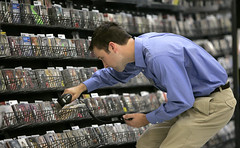
Handleman Company Sales Representative Matthew Bashioum of Troy manages CD inventory at Wal-Mart store 2873 at 2001 W. Maple Rd. in Troy, Friday morning, 10/28/05. (Todd McInturf/The Detroit News).

Leased departments. In the old days, department and discount stores (Kmart, Korvettes, etc.) didn't run all of their departments in a store. They had what they called "leased departments," which were leased to and stocked and managed by third party companies such as Handleman, which had a very close relationship with Kmart Corporation for decades. Typically book and jewelry departments in large department stores were run by separate companies and often still, branded cosmetics counters may be run by the Cosmetic Manufacturer. This model still has legs...

Silver Spring Books in Silver Spring is actually managed differently than depicted in some of the George Pelecanos books. It's run as a type of business cooperative. Three separate owners of the store own bookshelves, stock them with books, and spend two days/week running the store. Each book is tagged by the owner so that accounts are properly settled. While each owner has a specialty, they can stock and sell any type of book. What customers see is a bookstore with breadth, whereas the three owners individually could not likely provide such breadth, by working together in a way that is invisible to customers, each must provide only 1/3 of the amount of money necessary to outfit and stock a bookstore.

Similarly, there is an antiques store on Antiques Row in Kensington, Maryland that rents individual rooms to different proprietors. There is one clerk and cash register, but this way a much greater breadth of inventory can be offered. The Hoopla gift store on Barracks Row on 8th Street SE does the same thing.

Finally, there is the example of Belvedere Square in Baltimore. This is a "market" that is privately run. Just like a public market like Lexington Market or Eastern Market, each "stall" is privately owned and managed.

The difference is that Belvedere Square is something like an upscale Dean and Deluca. Not in that it is one store, with leased departments. At Belvedere Square there are 11 different stores, ranging from Atwater's Breads and Soups, Ceriello Fine Foods, to the Grand Cru wine shop.
Atwater's, Belvedere Square
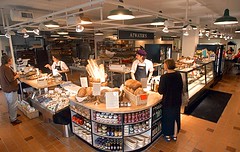
Customers peruse the selection of great breads at Atwater's in the Belvedere Square Market.(Sun photo by Doug Kapustin)

While you can rip on this as just more "gentrification," think about it. You're trying to attract a supermarket to your community. Few independent business people can muster the money required to outfit a 15,000-30,000 square foot singly-branded supermarket (this requires upwards of $2.5 million). But you can probably find a number of different entrepreneurs to run their own sections, from produce to meats and poultries. One of the shops made fresh orange juice right before your eyes. The only thing the array of stores is missing at Belvedere Square is a dry goods section.
Ploughboy Soups, Belvedere Square
Customers get homemade soups from Ploughboy Soups in the Belvedere Square Market.(Sun photo by Jed Kirschbaum)

Here is a way to reduce the amount of capital needed to open a "supermarket," while providing entrepreneurship opportunities and a great retail experience--"retailtainment"--besides. (At the same time, it sets higher expectations for customer experiences that most of the stalls in Baltimore's six public markets aren't meeting...

Cross Street Market is a cool public market, in the heart of the most successful neighborhood commercial district in Baltimore, Federal Hill. But the vendors in the market are having a difficult time changing to meet the needs of new customers (Cross Street Market is a couple buildings down from a Vespa dealership...) and the upper income residents of the area are shopping instead at the Whole Foods Market that is 1.5 miles away.

Labels: ,

Friday, May 30, 2008

Politics and Prose/bad DC business climate Update


Politics and Prose
Originally uploaded by katmere
Sue H writes:

Follow-up: Looks like Winstead didn't drop the dime on P&P.

Struck by the "Apparently" in P&P's nastygram, I emailed them yesterday to ask whether they knew Winstead had complained or whether they were just assuming that's what happened. No answer.

So this morning, I emailed Winstead (whom I don't know) to ask. He says no -- he never complained. He didn't see any violation (bench didn't even appear to be in public space -- it's very close to the building) but that DDOT must have measured and found one.

Labels: , , ,

Thursday, April 17, 2008

Government contracting and small business development

Big organizations, be they government or private sector, generally contract with big organizations. Certainly in the private sector, the issue is reducing the number of vendors overall, having massive contracts covering a nation's worth of sites, etc. (E.g., Trammell Crow, the real estate management and development firm, has a contract to maintain and manage the property of Bank of America, including all their individual branches nationwide.)

Yesterday's Post has an article, "Big Name, Big Deeds Fall Short in D.C. Contract Bid," about the inability of a local organization, which doesn't yet have a track record in vehicle fleet management, to get the contract to manage the Police Department fleet. The company thought that their local connections should have meant that their bid should have been considered.

Big governments could assist the ability of smaller businesses to be competitive for contracts such as these, if they broke the contracts up into smaller pieces, but that would counter the trend of big organizations contracting with ever bigger organizations.

An example would be if the city were to contract out trash collection. If you make it a city wide contract, likely only the biggest firms in the U.S., and there are only a couple, would be able to make a credible bid.

But if you broke up the contract by Ward (there are 8 wards in the city), or quadrants (4, although the SW quadrant is microsized), you provide the opportunity for much smaller companies to make credible proposals, and to be able to execute the contract at high standards.

This is how you build up smaller businesses, and provide a framework within which they are able to grow.

Labels: ,

Monday, August 13, 2007

An obvious business development program for many center cities

From the Pacific Business Times via the Biz Journals website:

New HCC program teaches business of music

Honolulu Community College will offer a new program this fall on the business of music. The new program, Music and Entertainment Learning Experience, will start with introductory courses on music and the recording business. Eventually, the program will cover artist creativity, entertainment business expertise and technical production skills.

The program is in partnership with the Mike Curb College of Entertainment and Music Business at Belmont University in Nashville. Courses will be taught by HCC faculty and via live distance-learning methods by Belmont faculty.

"Hawaii has a plethora of musical talent, but the talent needs the business and professional support base to grow musically," said Ramsey Pedersen, chancellor of Honolulu Community College, in a statement. "Our goal is to have [the program] open doors for our local talent and eventually bring worldwide recognition to music that is created in Hawaii."

The program is funded by grants from the state Department of Business, Economic Development and Tourism and the U.S. Department of Education, as well as a start-up budget provided by the state.
-------
Also see "Artist, promote thyself: Thanks to new Web businesses, musicians can reach a bigger audience -- and keep more of the profits for themselves," from the Boston Globe.

Labels: ,

Monday, April 30, 2007

Focused development of arts-based businesses in the UK

This article, "Artist who's stirring up a storm," from the Dewsbury Today newspaper in the UK has a link to a cultural development agency, Loca, that sounds pretty interesting.

From the website:

Loca is a cultural development agency with a specialist arts-and-regeneration focus, working in Kirklees, West Yorkshire, to:

• promote creative activities in local communities
• support artists and small businesses in the creative industries
• use arts in community consultation and local regeneration


we work with:

• organisations, agencies and services who work with local communities
• individual artists, craftspeople, designers, performers and musicians wanting support to start up or develop their business
• community groups who want to find new ways of tackling an issue or getting their message across
• local arts and cultural groups

Labels: , ,

Tuesday, November 01, 2005

Nurturing independent businesses through creatively reducing capital requirements

(This is something I have been meaning to write about for some time, but it's also sparked in part by Brian Miller's response to the entry on "Inner city's inner strengths mined.")

One of the problems in creating independent businesses is that the scale of chain competitors is so large that it is hard to compete on the same playing field. One way to address this is to specialize and be small, such as a cookbook and gardening bookstore or a mystery bookstore, but it can be difficult to succeed in small markets.

Acquisitions help Handleman grow - 10-30-05.jpg
Handleman Company Sales Representative Matthew Bashioum of Troy manages CD inventory at Wal-Mart store 2873 at 2001 W. Maple Rd. in Troy, Friday morning, 10/28/05. (Todd McInturf/The Detroit News).

Leased departments. In the old days, department and discount stores (Kmart, Korvettes, etc.) didn't run all of their departments in a store. They had what they called "leased departments," which were leased to and stocked and managed by third party companies such as Handleman, which had a very close relationship with Kmart Corporation for decades. Typically book and jewelry departments in large department stores were run by separate companies and often still, branded cosmetics counters may be run by the Cosmetic Manufacturer. This model still has legs...

Silver Spring Books in Silver Spring is actually managed differently than depicted in some of the George Pelecanos books. It's run as a type of business cooperative. Three separate owners of the store own bookshelves, stock them with books, and spend two days/week running the store. Each book is tagged by the owner so that accounts are properly settled. While each owner has a specialty, they can stock and sell any type of book. What customers see is a bookstore with breadth, whereas the three owners individually could not likely provide such breadth, by working together in a way that is invisible to customers, each must provide only 1/3 of the amount of money necessary to outfit and stock a bookstore.

Similarly, there is an antiques store on Antiques Row in Kensington, Maryland that rents individual rooms to different proprietors. There is one clerk and cash register, but this way a much greater breadth of inventory can be offered. The Hoopla gift store on Barracks Row on 8th Street SE does the same thing.

Finally, there is the example of Belvedere Square in Baltimore. This is a "market" that is privately run. Just like a public market like Lexington Market or Eastern Market, each "stall" is privately owned and managed.

The difference is that Belvedere Square is something like an upscale Dean and Deluca. Not in that it is one store, with leased departments. At Belvedere Square there are 11 different stores, ranging from Atwater's Breads and Soups, Ceriello Fine Foods, to the Grand Cru wine shop.
Atwater's, Belvedere Square
Customers peruse the selection of great breads at Atwater's in the Belvedere Square Market.(Sun photo by Doug Kapustin)

While you can rip on this as just more "gentrification," think about it. You're trying to attract a supermarket to your community. Few independent business people can muster the money required to outfit a 15,000-30,000 square foot singly-branded supermarket (this requires upwards of $2.5 million). But you can probably find a number of different entrepreneurs to run their own sections, from produce to meats and poultries. One of the shops made fresh orange juice right before your eyes. The only thing the array of stores is missing at Belvedere Square is a dry goods section.
Ploughboy Soups, Belvedere Square
Customers get homemade soups from Ploughboy Soups in the Belvedere Square Market.(Sun photo by Jed Kirschbaum)

Here is a way to reduce the amount of capital needed to open a "supermarket," while providing entrepreneurship opportunities and a great retail experience--"retailtainment"--besides. (At the same time, it sets higher expectations for customer experiences that most of the stalls in Baltimore's six public markets aren't meeting...

Cross Street Market is a cool public market, in the heart of the most successful neighborhood commercial district in Baltimore, Federal Hill. But the vendors in the market are having a difficult time changing to meet the needs of new customers (Cross Street Market is a couple buildings down from a Vespa dealership...) and the upper income residents of the area are shopping instead at the Whole Foods Market that is 1.5 miles away.

Labels: