Rebuilding Place in the Urban Space

"A community’s physical form, rather than its land uses, is its most intrinsic and enduring characteristic." [Katz, EPA] This blog focuses on place and placemaking and all that makes it work--historic preservation, urban design, transportation, asset-based community development, arts & cultural development, commercial district revitalization, tourism & destination development, and quality of life advocacy--along with doses of civic engagement and good governance watchdogging.

Saturday, February 13, 2016

In 2009 I wrote that WMATA's regulatory oversight needed to be significantly improved, US DOT says the same in 2016

After the Fort Totten crash in 2009, which resulted in 9 deaths and many injuries, reported first by the Frederick News-Post, it was determined that the crash resulted from the inter-mixing of signaling equipment from different vendors--the equipment wasn't guaranteed for inter-operability.

It turns out that decades before, the BART system in the San Francisco Bay region had similar problems, but because of safety regulation by the California Public Utilities Commission, it was addressed, and redundant safety controls were implemented within the signaling system.

The Post also reported on the Tri-State Safety Committee, a regulatory body with no enforcement authority, which was created by DC, Maryland, and Virginia to oversee Metrorail.

In 2009, I suggested that to build accountability into the regulatory and oversight process for Metrorail, DC, Maryland, and Virginia merely had to come together and invest regulatory authority into the TSSC.

See "Missing the real issue about WMATA," July 27, 2009, and "Will nine deaths lead to a better governance, oversight, and management system for WMATA? Or not?," August 11, 2009.

They didn't.  And earlier this week, the US Department of Transportation said it would begin withholding a portion of funding to WMATA until the lack of regulatory oversight was corrected ("Federal funding for D.C., Va., Md. at risk due to lack of progress on Metro oversight," Washington Post).

From this week's Post article:
Late last year, Foxx transferred safety oversight of Metro’s rail operations to the FTA with the understanding that it would be temporary — until the three jurisdictions could develop a compact to create an oversight agency. The move was made after federal officials determined that the agency charged with the task, the Tri-State Oversight Committee (TOC), was woefully inadequate for the job.

But Foxx said federal officials recently learned from the Metropolitan Washington Council of Governments that the jurisdictions “do not expect to pursue final legislative action in 2016” to establish a safety oversight agency.

“This news was unexpected and disappointing,” Foxx wrote in the letter. ...

Some of the region’s leaders said Monday that they are taking steps to move Metro to a culture of safety but that they, too, are frustrated with the situation — and with the U.S. Transportation Department for pointing the finger at the District, Maryland and Virginia when the federal government also has a seat at the table to help solve Metro’s problems.

“While the nation awaits the FTA’s rules on state safety oversight entities, [the Washington Metropolitan Area Transit Authority] has an oversight structure in their board of directors where the federal government can actually be helpful,” Bowser spokesman Michael Czin said. “Unfortunately, the federal government’s appointees, including the previous chairman, were obstacles to reform in 2015.”
As discussed in the reprints below, these issues date most recently to 2009, but clearly had been present earlier, and long before the Federal Government received the authority to appoint board members in 2010 ("GSA Appoints Director and Alternate Director to Metro Board," press release), and in any case, it is DC, Maryland and Virginia that are empowered to act to cure the defect of lack of regulatory oversight at the state/multi-state scale, not the federal government, which only stepped in recently because of a failure to act by the states in the face of continuing problems.

-- State Safety Oversight Program, Federal Transit Administration
-- Rail Transit Safety Action Plan, Federal Transit Administration, 2006.  From the document:

Top Ten Priorities
The following priorities have been identified for FTA’s Safety Action Plan:
• Priority Number 1: Reducing Collisions with Other Vehicles
• Priority Number 2: Reducing Collisions with Pedestrians and Trespassers
• Priority Number 3: Improving Compliance with Operating and Maintenance Rules
• Priority Number 4: Reducing the Impacts of Fatigue on Transit Workers
• Priority Number 5: Reducing Unsafe Acts by Passengers in Transit Stations
• Priority Number 6: Improving Safety of Transit Workers
• Priority Number 7: Improving Safety for Passengers with Disabilities
• Priority Number 8: Removing Debris from Tracks and Stations
• Priority Number 9: Improving Emergency Response Procedures
• Priority Number 10: Improving Safety Data Acquisition and Analysis

======
Reprint from Will nine deaths lead to a better governance, oversight, and management system for WMATA? Or not?, August 11, 2009

A few weeks ago I wrote an entry commenting that the focus on WMATA not having a dedicated funding stream misses the real point about overall governance, management, and oversight.

The fact that BART in the San Francisco Bay region is overseen by the California Public Utilities Commission, while WMATA has no real regulatory oversight is troubling.

The Post editorializes about this today, in "Unsafe, Unaware, Unscrutinized: Is Metro's lack of effective oversight contributing to its safety problems," in response to Sunday's article about the equivalent of a voluntary oversight board with no authority, the Tri-State Oversight Committee, in the Sunday paper, "Subway Safety Panel Foiled by Constraints: 12-Year-Old Oversight Committee Has Little Influence."

It might not be so bad if absolute excellence was demanded throughout the organization. It's not.

I think it's clear that getting rid of the engineering and construction people (partly in 2003, and then after the current General Manager came on board, see "Metro to Cut Construction Staff to Help Close Budget Gap" from March 2007 and "Improved Safety and Service Are Focus of Reorganization, Chief Says" from April 2007, from the Post) likely has removed a level of expertise within the organization concerning rail operations.

Recent failures in the S-Bahn system in Berlin--none of the failures led to casualties!!!!--resulted in wholesale change in the management of the transit system. See "Safety Issues Ground Hundreds Of Berlin S-Bahn Trains" from the German radio network NDR. From the story:
The executive management of S-Bahn Berlin was asked to resign this past week: included among the casualties are Tobias Heinemann (chief officer), Thomas Prechtl (head of finance), Olaf Hagenauer (personal director) and just recently hired technical director Peter Büsing.

Allegedly the company ignored a safety directive issued by the EBA, the German equivalent of the U.S. [Federal Railroad Administration], after the May 1st incident in Berlin-Kaulsdorf station. The EBA required that the company perform a repetitive inspection of all wheels of similar design as the failed wheel every seven days. The company assured the EBA that it would comply with the new safety directive, but an audit by the EBA on the 29th of June determined that the company had mostly ignored the safety directive.
The problems with WMATA have led Maryland's MTA to back off from saying that the Purple Line would be integrated into the WMATA transit system and managed and operated by WMATA after it is constructed. See the Dr. Gridlock column from Sunday, "Purple Line and Metro: Will They Work Together?," versus the letter from then Maryland Secretary of Transportation Porcari to the Town of Chevy Chase from May 2008 , which stated:
2. The fare and transfer policy for this corridor has not yet been established. The MTA views the Purple Line and Metrorail system as part of an overall system of transit service in the Washington area. Future policies, should the Purple Line be constructed, are expected to reflect that view and include the use of modern fare collections methods such as Smartcards. Therefore, the report’s assertion regarding full transit fares for both systems in calculating the cost of a transfer is a policy decision that cannot be assumed;
which can be construed to imply that WMATA would end up integrating this light rail line into its transit system, comparable to how after the Dulles corridor (Silver Line) extension is constructed not by WMATA but by the State of Virginia it will be integrated into the WMATA subway system.

Not now, or at least not while WMATA's management capabilities are called into question. (And remember the concerns expressed by the Federal Transit Administration over the expansion of the system via the Silver Line, versus WMATA focusing on current operations, "Feds Slam Dulles Rail Project" from the Dr. Gridlock Get There blog.)

=======
Reprint: Missing the real issue about WMATA, July 27, 2009

The Washington Post editorialized, in "A Broken Metro‎," once again about how all of the Washington Metropolitan Area Transit Authority's problems have to do with the lack of a dedicated funding stream.

Nothing could be further from the truth, as the newspaper's own reporting ought to be communicating to us.

Here are the issues with WMATA:

- general vision and leadership
- the governance structure (members appointed to the board by the various jurisdictions that are members of the WMATA Compact--but too many of them have overly constrained worldviews about what they are doing and who they truly represent)
- the lack of a real system of regulatory oversight*
- funding of current operational deficits**
- funding of capital improvements***
- management of the organization
- operation of the organization
- how the organization treats and serves riders.

* The article in the Post about how BART has a redundant train control system to ensure that all trains are accounted for on the system at all times off-handedly mentioned that BART is under the oversight of the California Public Utilities Commission. See "Sister Transit System Took Steps to Counter Hazard: BART Saw Circuit Problem At Center of Metro Probe."

From the article:
Shortly after BART started operating in 1972, it installed a backup system. Initial tests of the main train protection system failed to detect the presence of a train in a few instances, according to Mike Healey, a longtime BART spokesman who retired in 2005. A subsequent 1972 BART accident involving a train that mistakenly received a command to double its speed instead of slowing down, sending the train off track and into a parking lot, was the catalyst "to have some redundancy to back up the primary train protection system," Healey said...

Willard Wattenburg, an electrical engineer and inventor retired from the University of California at Berkeley, said intermittent failures were frequent on BART in the early 1970s. Wattenburg analyzed BART's initial design for the California Public Utilities Commission, which regulates transit systems, and crafted some corrections. BART officials at the time said the failures were flukes, but regulators insisted on the design changes.
This used to be the case for the old streetcar system, which was overseen by the DC Public Service Commission.

There needs to be a joint [regulatory] commission, with appointees from DC, MD, and VA, to oversee the system and ensure that it meets the highest operational[-safety] standards.

** Dedicated funding is important but is more focused on managing annual operating budgets. The cost of providing transit is greater than farebox and other revenues. Therefore, funds are provided by the member jurisdictions of the WMATA "Compact" to make up the difference.

*** While the annual appropriations include some money for capital improvements, it's never enough, especially when it comes to system expansion, or replacing large amounts of rolling stock.

Dedicated funding gets at just a little bit of the issues that are in play with WMATA generally.

We can argue that the accident is an indicator of a far bigger systems failure than the circuit system.

That's what we should be coming to realize as we are learning about the systematic failures of this system and the neglect of dealing with it--something that predates General Manager John Catoe.

See "Investigators: Metro equipment at crash problematic for 18 months," "Investigators examining glitches around system" AND ESPECIALLY THIS STORY "Metro operator: Recent crash failure echoes 2005 near-miss" from the Examiner.

Labels: , , , , , , ,

Saturday, October 10, 2015

Federal Transit Administration's stepping in to regulate the safety elements of WMATA mark of a failure in regulatory oversight by DC, Maryland, and Virginia

WMATA, the Washington Metropolitan Area Transit Authority, operator of Metrorail heavy rail transit service service DC and its suburbs in Virginia and Maryland, has fallen through the cracks in terms of regulatory oversight.

The Metrorail crash in 2009 demonstrated that the somewhat voluntary "Tri-State Oversight Committee," didn't have enough authority given to it by the respective states to be able to command WMATA to act on its recommendations (see ""Subway Safety Panel Foiled by Constraints: 12-Year-Old Oversight Committee Has Little Influence.," Washington Post, 2009).

NTSB recommends FRA be given oversight authority over WMATA.  In the face of multiple safety failures in the system over the past 18 months, the National Transportation Safety Board recommended that the Federal Railroad Administration be given the authority to regulate WMATA ("NTSB wants feds to take of D.C. Metro system," USA Today), even though it isn't a traditional railroad, because the Federal Transit Administration isn't set up to provide day-in, day-out regulatory oversight of individual transit systems.

USDOT steps in because DC-Maryland-Virginia failed to provide adequate oversight.  The USDOT rejected that recommendation, and instead announced on Friday that the USDOT/FTA would provide regulatory oversight ("Federal agency to supervise Metro safety," Washington Post).

In the old days, state regulatory authorities oversaw transit systems.  In the days when transit systems were privately owned, state-based regulatory authorities regulated these firms.  These agencies, usually called "Public Service Commissions," regulated all "utilities," not just electricity, telephone, and natural gas, but transit as well (not railroads, which were regulated by the Interstate Commerce Commission).

This authority wasn't limited to regulating pricing of service, but included safety matters also.

Today, most of these agencies no longer regulate transit systems in a substantive way, because transit agencies are public agencies for the most part, and are regulated in part by the Federal Transit Administration and the Federal Railroad Administration.


Damage from the arcing incident in the tunnel near L'Enfant Plaza Station. NTSB photo.

But that was a fault of the states failing to put forward the right regulations, authority, and oversight structures.

California Public Utilities Commission never gave up responsibility for regulating local transit systems.  California's Public Utilities Commission never gave up its authority to regulate transit systems, and while the operation of transit systems in California hasn't been problem free, it happens that some of the problems resulting in death on the WMATA system have been avoided by the Bay Area Rapid Transit system (BART), because of the level of oversight provided by CPUC.

I wrote about the regulatory system in CPUC vs. the DC-Maryland-Virginia area nine times in 2009, after the Fort Totten crash, which resulted in 899 fatalities, and turned out to have been the result of inter-mixing signaling equipment from different firms, a problem that WMATA was warned about by the firm that provided the system's initial set of signaling equipment.

-- Another example that something "unique" isn't necessarily "exceptional"
-- Missing the real issue about WMATA
-- Will nine deaths lead to a better governance, oversight, and management system for WMATA? Or not?
-- The webpage of the California Public Utilities Commission oversight of rail transit systems
-- Oversight is necessary for business and government
-- Federal safety regulation of local transit systems

Passengers react on Monday, Jan. 12, 2015 afternoon as smoke filled a Metro train in a tunnel outside the L’Enfant Plaza Metro station. One person died from smoke inhalation and the failure to quickly evacuate the passengers. (Photo by Saleh Damiger)

WMATA had experienced multiple failures with this equipment before the fatal crash, although in each previous situation, train operators avoided catastrophe by stopping the train short of a crash.

Because no fatalities resulted from those incidents, the problem was discounted, treated as an anomaly, rather than inherent within the system.

DC-Maryland-Virginia failed to address their regulatory responsibilities for WMATA.  Using the California Public Utilities Commission as an example of national best practice, in the various posts from 2009, I wrote something like this:
In our region, I would recommend that DC, Maryland and Virginia set up a supra-regulatory committee as a joint venture, one that operates within the utilities oversight body of each jurisdiction, tasked with the regulation of rail transit systems. That would mean subway and light rail in Baltimore, passenger railroad services in Maryland and Virginia, heavy, light rail, and streetcar service in Metropolitan Washington, and light rail in Hampton Roads in Virginia.
DC, Maryland, and Virginia had 6 years to act on this. They didn't.

Given the continued failures, the USDOT/FTA was forced to step in.

Labels: , , , , , , ,

Tuesday, September 01, 2015

Could a corrupt political system be a legitimate defense when a city sues a contractor for winning a contract through bribery?

========
An anonymous contributor alerted me to this Bloomberg Businesswek article, published yesterday, "Stop bribery by legalizing it." So this article is being republished with a new time.
========


Chicago is known for its "pay-to-play" culture, capricious and arbitrary land development approval system (Chicago Tribune article on aldermanic privilege, "Neighborhoods for sale"), various examples of misuse of funds for private benefit (e.g., the "Hired Truck" scandal), and poor decision-making concerning contracting such as the long term lease deals of their parking meter system and city-owned public parking structures, where the city left at least $1 billion on the table in the favor of the lessees ("Chicago's ongoing debacles: parking and governance" and "A lesson to cities that they need to be very careful when leasing assets to public private "partnerships"").

In one particular case, where a commercial property owner sued for not being able to develop because they refused to pay off an alderman, the court ruled that clearly this system was in fact legal because it is ensconced in how the city operates concerning land use.

Anyway, the City of Chicago is one of the plaintiffs suing a red light camera firm--since fired--which got the contract to operate in the city because of bribes.  See the Chicago Tribune article "Chicago sues red light camera firm for $300 million."

The city is suing for the amount they paid out to the company, about $134 million, and are seeking punitive damages, which increases the total amount they are seeking.

Granted the contract was let during the Daley Administration, but I think the defendants could argue that while what they did was wrong, that's the way things work in Chicago.

Which of course is not a legal defense likely to win.

But in any case, it doesn't seem "fair" for companies forced to be corrupt to participate in a political system being penalized by the creators and maintainers of the corrupt system for doing what was expeccted of them.

-- "The system of corruption: when you don't understand "systems", of corruption or anything else, you don't understand outcomes"
-- "The travelogue of the world's Corrupt Cities includes DC, what does that say about us?"

From the description of the book Corrupt Cities: A Practical Guide to Cure and Prevention:
Corrupt Cities is a practical guide to assist in the diagnosis, investigation and prevention of various kinds of corruption. Bringing together both a conceptual and practical framework, the publication is designed for citizens and public officials, especially at the municipal level. The approach presented discourages more controls, more laws and more bureaucracy, while focusing on systematic corruption and its preventive measures. It encourages consideration of the economic costs of corruption, rather than moral or ethical factors, as the driving force behind anti-corruption efforts. It also emphasizes that "fighting corruption should not be considered an end in itself, but an orienting principle for reforming urban administration."
The arguments put forth are supported by examples of anti-corruption strategies, particularly from Hong Kong and La Paz. The publication also includes practical tips to adapt these strategies to difficult scenarios, for example, in cities/communities characterized by political indifference, bureaucratic inertia, and where citizen support may exist but is yet to be mobilized.
Ironically, coming back on the plane I was talking with a college student sitting next to me. She is studying business, at a university in Michigan. I opined that there is something to be said for "competition" in government, given how the oligopolistic "Democratic" control of municipal government in DC leads to terrible behaviors and actions. I didn't even know about this most recent example that decisively proves my point.

Labels: , , , , ,

Wednesday, July 22, 2015

Structuring community benefits agreements

(I have been really busy with a possible project and creating a detailed proposal for it.  We'll see where it goes.  But it definitely kept me from blogging.)

I have written a bunch in the past about community benefits agreements and how in DC, a relatively undefined framework for types of benefits, with the exception of added affordable housing in return for a density benefit, allows developers to not provide very much.

-- Community benefits agreements revised (again)
-- What community benefits are supposed to be versus what people think they are about
-- Community benefits agreements and energy considerations


And lack of good process allows many different actors to take part in negotiations in ways that diffuses impact.

Not to mention a lack of a good framework means that there is too little focus on realizing extranormal long term (structural) benefits.

I was reading a Montgomery County plan and it referenced that jurisdiction's public benefits process associated with special development considerations.  It's outlined in Division 4.7, Optional Method Public Benefits, in the new (2014) Montgomery County Zoning Code, on page 4-96.

All jurisdictions should create a comparable process.  And include in district, sector and neighborhood plans a section on community consensus priorities in order to help shape and accelerate the process.

A.  Major Public Facility

B. Transit Proximity

C. Connectivity and Mobility
1. Advance Dedication
2. Minimum Parking
3. Neighborhood Services
4. Public Parking
5. Through-Block Connection
6. Transit Access Improvement
7. Streetscape Improvement
8. Trip Mitigation
9. Way Finding

D. Diversity of Uses and Activities
1. Adaptive Buildings
2. Care Centers
3. Dwelling Unit Mix
4. Enhanced Accessibility for the Disabled
5. Live/Work
6. Moderately Priced Dwelling Units
7. Small Business Opportunity

E. Quality Building and Site Design
1. Architectural Elevations
2. Exceptional Design
3. Historic Resource Protection
4. Public Art
5. Public Open Space
6. Structured Parking
7. Tower Step-Back

F. Protection and Enhancement of the Natural Environment
1. Building Lot Terminations
2. Cool Roof
3. Energy Conservation and Generation
4. Habitat Preservation and Restoration
5. Recycling Facility Plan
6. Transferable Development Rights
7. Tree Canopy
8. Vegetated Area
9. Vegetated Roof
10. Vegetated Wall

G. Building Reuse

Labels: , , , , , , , , ,

Saturday, January 04, 2014

New Year's Post #3: an illustration of the decline of the federal role in DC's real estate market (at least right now)

There is a great op-ed, "Listening to the Founding Fathers" by conservative Washington Post columnist Michael Gerson discussing the dominance of conservative discourse by "no government" (my term) positions, that there is no appropriate role for federal government in society.

It's reasonable to have different opinions and attitudes about the role and especially the size of government in our society.  But true conservatives ("liberals" in the old terminology) weren't against government and saw a role for the provision of public goods in the context of a market economy. 

As I have mentioned a bunch of times over the past year, the dominance of the US House of Representatives by the Republicans and especially by Tea Party types has brought much of local federal government-related real estate development to a standstill, outside of deals that fit within the standard pricing parameter that don't require extra-normal review or participation by Congress.

It means that the National Science Foundation wasn't in a position to get approval to pay higher lease rates to stay in Arlington--so they are moving to Alexandria. 

It means that the original plan to create a Homeland Security campus at the west campus of the St. Elizabeth's complex in Southeast DC continues to stumble along, as approval of agency projects other than the original project to put the Coast Guard headquarters there don't seem to move forward ("GSA priming pump for round two at St. Elizabeths," Washington Business Journal).

I missed this piece, "Consumer bureau headquarters renovation plan gets GOP flak," which ran in the Los Angeles Times, about how the Consumer Financial Protection Bureau, a financial regulatory agency, can't get the appropriations it needs to renovate its aging facilities because Congresspeople against regulation of the financial industry see this as a way to hamper the agency's activities.  From the article:
The 35-year-old building would be renovated to include a state-of-the-art public lobby with "interactive kiosks and 21st century learning centers," Sen. Elizabeth Warren (D-Mass.), then a White House aide who headed the consumer bureau's organizing, said at the time.

But nearly three years later, the bureau's seven-story home remains just another drab concrete-and-glass Washington office building — stuck in the mid-20th century.  ...  The $95-million cost of the renovation has become the latest rallying cry for Republicans still trying to restrict the bureau's power and alter its structure under the 2010 Dodd-Frank financial reform law that created it.

"This is simply an egregious example of waste and Washington  bureaucrats living a life much different than an average American," Rep. Patrick McHenry (R-N.C.) said of the renovation costs. "It shows a complete disregard for the taxpayer."
The reality is that it's just a construction project, and probably not all that outlandish.

The FBI, because its need is apparent and great, is able to move forward with a new building program.  But I wonder how much of this is because the stated requirements for the move eliminate DC from contention, meaning that Virginia or Maryland will benefit from the move, and this is seen as an acceptable benefit, allowing the project to move forward.

Although the FBI leaving the city, at least downtown, will be a financial gain ("If FBI moves, D.C. would net millions," Washington Business Journal).  Locating it elsewhere in the city (e.g., the past blog entry "More on Barry Farm (vs. Poplar Point) as a new location for the FBI") might have been a different story.

Labels: , , , , , ,

Friday, November 22, 2013

DC Government at-will employees need protections to tell the truth

Today's Post reports ("US Park Police Chief Teresa Chambers announces her retirement") on the retirement of US Park Police Chief Teresa Chambers, who had been fired by the Bush Administration for publicly stating that post-9/11 her department lacked the resources to protect all the federal installations under her purview, given the increased threat from terrorism.  After many years of legal action, she was able to return to her job.

Yesterday's Post has an op-ed column, "Egypt looks for a path toward democracy," about Egypt's stumbling path towards democracy and the recent action by the ruling military government to remove comedian from television after he made some jokes about the state of politics in Egypt.

Earlier in the week, in "The trope about the benefit of "Telling truth to power is mostly" is mostly B.S.: DC edition," I wrote about how Mayor Gray fired William White, the DC Insurance Commissioner, for criticizing a policy action by President Obama, aimed at quelling criticisms of the Affordable Care Act, but the action will occur in a manner that it makes it harder for the state insurance exchanges to function.

That blog entry also mentioned how in 2012, Mayor Gray similarly fired another agency head, Christophe Tulou, then of the Department of Environment, for communicating concerns about DC policy direction to the EPA.

While I understand that agency heads serve at the pleasure of the Mayor and are "at-will" employees, I don't believe that they should lack job protections for telling the truth, even if the truth is something that the Mayor doesn't want to hear or perceives as "embarrassing" (also see "killing the messenger").

The Mayor of a local government ought not to be allowed to restrict truth telling amongst high level personnel and to countenance the restriction of vital communications to the citizens and relevant stakeholders.

Regular government employees have some protections for telling the truth, because section one of the 14th Amendment of the US Constitution holds that state (and indirectly, local) governments have to uphold the Constitution, and this includes the First Amendment concerning freedom of speech.

Note that many people do not understand that "freedom of speech" is a right between the citizens and government, it is not a right between citizens and their place of work--unless their place of work happens to be a federal, state, or local government agency.

Labels: , , , , , , , ,

Tuesday, April 09, 2013

Some developments in electioneering and governance

1.  Takoma Park, Maryland, a small city in Montgomery County, Maryland that borders DC, has proposed lowering the voting age to 16.  See "Takoma Park considers lowering voting age," "Takoma Park smartly trying to lower voting age to 16" (editorial) from the Gazette.

From the editorial:

Takoma Park, known for its progressive and sometimes quirky ways, is considering taking an extra, historic step toward voting inclusiveness. The city might let 16-year-olds vote in municipal elections, when council members and the mayor are chosen. Rob Richie, FairVote’s executive director, said Takoma Park would be the first in the country to adopt a 16-year-old voting age. ...

For Takoma Park, this is part of a series of proposed election-related charter amendments that will be the subject of a public hearing April 8.

I'm fine probably with 16 year olds voting.  But there are so many other issues with local government and elections that lowering the age of enfranchisement doesn't address.

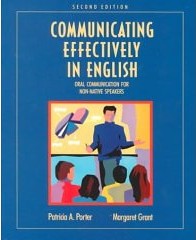
Communicating Effectively in EnglishThe ESL textbook Communicating Effectively in English is actually a wonderful primer about how to go about being an active and involved citizen.

2.  Suburban jurisdictions in Prince George's County suggest that they should switch from 2-year terms to 4-year terms for Council, and the Gazette editorializes in favor, "Longer terms make sense for Prince George’s municipalities."

Although I think those municipalities ought to consider changing their election cycle like Rockville is thinking about.  Spring elections get incredibly low turnout.  Councilpeople are elected with fewer than 200 votes.

3.  The City of Rockville is going through some charter review and a number of changes are proposed.  Recommended changes are having elections simultaneous with national elections, lengthening the term of office to four years, adding two seats (from four) to the City Council, and a variety of process changes for voting.

4.  Speaking of DC's Home Rule Charter, DC City Council candidate Matthew Frumin suggests  since 2023 is the 50th anniversary of the passage of the DC Home Rule Act, that the run up to this anniversary is a good time to reflect on the success and failures of Home Rule and provides the impetus to suggest and make changes.

I think that's a very interesting point, although I'd hate to have to wait 10 years or more to bring about necessary changes.

5.  In Chicago, a study from the University of Illinois at Chicago finds that Mayor Rahm Emanuel has tighter control over the Chicago City Council than his predecessor, Richard Daley Jr.  See "Study: Emanuel has firmer control over City Council than Daley did" from the Chicago Sun-Times. From the article:

After analyzing 30 divided rolls calls in the nearly two years since Emanuel took office, University of Illinois at Chicago researchers concluded that Emanuel has enjoyed more iron-fisted control over the council than former mayors Richard M. Daley, Richard J. Daley or Ed Kelly, the Democratic machine co-founder.

Twenty-one aldermen supported the mayor’s programs 100 percent of the time, while 18 others were more than 90 percent in lock-step.

There have been no shortage of controversies — ranging from speed cameras, police station and mental health clinic closings to the mayor’s Infrastructure Trust and his plan to nearly double water and sewer fees.

But only seven of the 30 issues drew six or more dissenting votes. Emanuel’s average level of support on all of the divided roll calls was 93 percent, compared to 83 percent during Richard J. Daley’s first two years in office and Kelly’s 88 percent.

-- The report: Continuing the Rubber Stamp City Council

6.  Apparently, some of the Chicago Politics studies by the Department of Political Science at UIC was started originally in association with a group called Developing Government Accountability to the People, although both websites don't seem to have been updated very recently.  Some interesting resources are still on the websites.

Labels: , , , , ,

Saturday, September 10, 2011

"Good" government in Texas means not investing in risk management

While this is not about "urbanism" per se, the issue of government priorities is one of the areas covered by the blog.

From "Politics of fighting wildfires: Did Rick Perry's Texas do enough on its own?:
Wildfires have taxed the capabilities of Texas to the limit, forcing Gov. Rick Perry, who has slashed firefighting budgets, to press President Obama for millions in federal aid
" in the Christian Science Monitor:

“Because so many fires are burning across the state, our resources are spread pretty thin,” Texas Lt. Gov. David Dewhurst said in a statement. “That's why we need the federal government to step up to the plate immediately.”

Gov. Rick Perry, currently the frontrunner among GOP presidential candidates, has been forced to press President Obama for more than $50 million in federal aid. At the same time, he defends the state's decision to slash by 74 percent the funding for the volunteer fire departments who do most of the work, and to cut the Texas Forest Service's budget by 34 percent, down to its 2008 level.

Money from the state's rainy day fund will be used to fund the current wildfire fighting efforts, Governor Perry says. State legislators will have to reconcile the costs later. The fires are costing the state about $1.5 million a day, 75 percent of which could be recouped from Washington.


It's not like the conditions that "promote" wildfires go away by government fiat and budget reduction...

It does remind me of DC Councilmember Jim Graham's statement in the New York Times that rather than increase water and sewerage rates to cover the cost of deteriorating infrastructure and new requirements for stormwater collection from the EPA, the infrastructure should be "reformed".

From "Saving U.S. Water and Sewer Systems Would Be Costly":

“Subway systems need repairs, and so do roads, but you don’t see fares or tolls skyrocketing,” D.C. city council member Jim Graham said at a February 2010 meeting, according to the New York Times. “Providing inexpensive, reliable water is a fundamental obligation of government. If they can’t do that, they need to reform themselves, instead of just charging more.” Hawkins disagrees, pointing out that increased mandates from the EPA and a 300-year pipe replacement system make investment a moral imperative.

A free lunch goes only so far. Eventually, the bill comes due.

Labels: , , , , ,

Tuesday, June 07, 2011

DC Governance is looking pretty ugly these days

book cover, Corrupt Cities: A Practical Guide to Cure and Prevention by Robert Klitgaard, H. Lindsey Parris

1. Allegations that the Mayor's campaign paid someone to keep running, and hired lots of cronies/children for jobs. See "From behind his shades, Sulaimon Brown talks to council" from the Post.

2. Conflict of interest with regard to online gaming on the part of At-Large Councilman Michael Brown. See "Gambling man " from the Post.

3. The "smooth ride" desire on the part of the Council Chairman. See "Kwame Brown's SUV saga continues " from the Post.

4. The alleged misuse of funds to the tune of more than $300,000 by Ward 5 City Councilman Harry Thomas, Jr. See "D.C. attorney general: Thomas diverted funds " from the Post. How is that different from the graft that gets former Prince George's County Executive Jack Johnson a long stay in prison? (See "The rise and fall of Jack B. Johnson " from the Post.)

I have always thought that with the campaign for DC Statehood, that local government officials would want to demonstrate a high capacity for quality in governance and ethics, but that doesn't seem to be on the agenda.

Pretty scary.

------
Also see "Dream City: Race, Power, and the Decline of Washington, D.C., 1964 to 1994," the book review from the Washington Monthly, and "City as a Growth Machine: Toward a Political Economy of Place" from the American Journal of Sociology (1976).

Labels: , , , , ,

Sunday, June 05, 2011

Missing the most significant point: DC City Council potential for conflict of interest

The Post's lead editorial today is about Michael Brown, a lawyer-lobbyist who also is a City Councilman. The editorial, "Michael Brown, gambling man," makes the point that Brown was advocating for online gaming as a Councilmember, ostensibly to increase the city's tax revenues, but the fact is that the firm he was working for at the time has an extensive gaming practice, and would likely benefit if DC becomes another venue where gaming is legal.

The editorial goes on and on about this.

From the article:

Mr. Brown left Edwards Angell in January for what he said was “a better offer” at the Madison Group, a lobbying and consulting firm. At Edwards Angell, his title was senior public policy adviser in the government relations department, for which he says he was paid in the vicinity of $240,000 in 2010. When we asked what he did, he told us he lobbied Congress and the White House on behalf of a variety of clients whom he would not name. When we subsequently asked why we could not find any lobbying disclosure forms filed with the House of Representatives for him in 2010, he said lobbying is a loose term that includes “information gathering” and “strategy.” Mr. Brown disclosed his 2010 earnings in the annual filing of outside income that the Office of Campaign Finance required to be filed by May 15; rules don’t require disclosure of the source of income, but when we asked Mr. Brown named Edwards Angell.

In our discussions with Mr. Brown, he stressed his care in keeping his private duties separate from his public responsibilities. Initially he told us that he had not consulted with any D.C. officials about the ethics of sponsoring the gaming legislation but had cleared the activity internally with Edwards Angell. After we called the firm, a spokesman gave us this statement: “With respect to Michael Brown’s activities as a member of the DC Council, we maintained a strict boundary between the firm’s professional endeavors and Mr. Brown’s activities — as is the case with all of our professionals’ outside activities. Firm management was thus unaware in 2010 of Mr. Brown’s intent to sponsor legislation legalizing online gaming in the District.” Mr. Brown called us back and said that, after consulting with his former colleagues at Edwards Angell, he realized he had “misspoken” on that question.

The real issue is that DC City Council positions, which pay $130,538 per year (see "D.C. Council members bring in second-highest salaries among big cities" from the Examiner), are considered "part time" jobs, so that the Councilmembers are allowed to have other jobs. Those that do tend to work for firms which have a great number of interests involving the laws and regulations of the DC Government.

By deeming the jobs part-time, they are structurally set up to create conflicts of interest, because the firms most likely to hire DC Councilmembers for "part-time" work are likely to want to influence, directly or indirectly, how DC government operates and legislates.

End the jobs of Councilmembers as being part-time, and some (not all of course, as special interests are special interests) of the potential for conflict of interest will be reduced significantly.
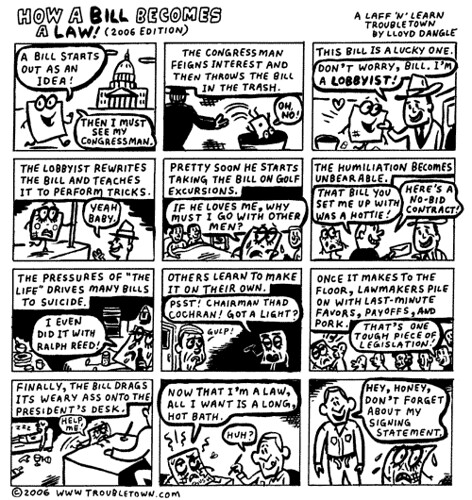
How a bill becomes law
How a bill becomes law. Llyod Dangle, Troubletown cartoon.

Labels: , , , , ,

Tuesday, April 05, 2011

Probably the DC Government Inspector General position should be popularly elected as well

In the most recent election, there was a ballot referendum calling for making the DC Attorney General position popularly elected. I supported this referendum, although I had suggested having the position come up for election in the so called "off cycle" when the ballot doesn't have the Mayor on the ballot, and that's not how the referendum was worded.

The referendum passed, and therefore effective with the 2014 election, the Attorney General will be popularly elected.

(FWIW, I believe that the Attorney General of the United States should also be popularly elected. One wrinkle in DC is that the federal government still controls the prosecution of adult crimes, so that here, the DC Attorney General focuses on a variety of public protection issues, and the prosecution of juvenile crime. Delegate Norton is advocating that the federal government yield to DC the authority to prosecute adult crimes. However, I feel that can come as a hopefully successful track record is developed for the locally elected AG.)

Given the problems of independence that an Inspector General seems to have in DC (see "DC inspector general plays lap dog to corrupt pols") from the Examiner) with regard to local government, maybe this position should be popularly elected as well.

From the article:

The IG's ineffectiveness here begs a more serious question: Even if Willoughby had been able to investigate the Sulaimon Brown case, would anything have happened? The answer, from many law enforcement officials, past and present, is in doubt.

"If you want to bury something," one former District legal official told me, "send it over there. Willoughby is not a prosecutorial type, not an investigator. When he gets in a political thicket, he's not willing to stick his neck out."

Labels: , , , , ,

Monday, April 04, 2011

Taxi medallions as a grant of wealth

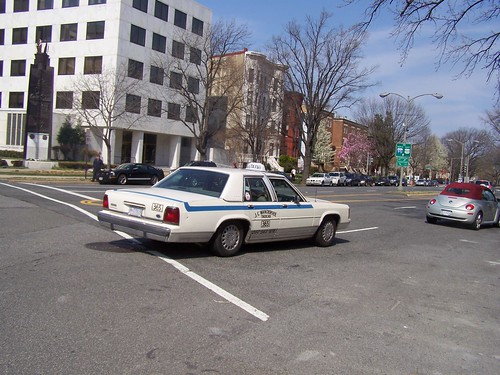
DC taxicab, Constitution Ave. at 2nd Street NE, NE corner

The Washington Business Journal ran a piece, "Bill would completely overhaul D.C. cab industry," about legislation put forward by Councilmembers Graham, Thomas, and M. Brown to create a system of taxi medallions in DC.

This is a really bad move and hopefully, it will not be passed into law.

The current system merely requires a taxi license for the driver ($125/year) and a license for the taxi business ($475). And most importantly, there isn't an artificial limit set on the number of licenses and vehicles that can be operated.

Now, this creates some problems because there are probably more licensed taxis in the city than can be maintained in an economically viable fashion, and that is despite the fact that outlying areas of the city suffer from inadequate taxi service. In theory, if you have a quality vehicle, get it painted, get a business license, etc., and set up the business, which will cost some money sure, you can get into the taxi business for $475, plus an annual license fee.

NYC and other places have restrictions on the number of licenses that can be issued. Therefore, a "medallion" is treated as a form of privately owned property and becomes quite valuable and is a high-priced asset that is sold for a great deal of money. See "Driver competition hot as NYC taxi medallions hit $766000" from USA Today.

But it is not the city that makes the money from medallion sales, it is the "owner" of the license--and in reality this license is a privilege (not a right) granted by government.

Basically, the law as proposed restricts the number of licenses to 4,000, and it would convert the license from something that is a privilege to a saleable asset. And the winner of the value from this asset would not be the City (and the citizens), but the recipients of the licenses.

This bill is designed to produce wealth out of thin air for the taxicab industry and is a form of political entrepreneurialism--business which benefits from political decisionmaking--that should not be supported.

Sam Staley of the Reason Foundation wrote an op-ed about this which appeared in yesterday's Post, "What cab medallions would cost D.C."

This by the way is yet another example of the City Council trying to legislate transportation policy rather than encouraging the creation of a master transportation plan, which to my way of thinking, ought to include taxi policy as an element. Although again, it is more about making taxicab company owners extra-wealthy, than it is about anything for DC Government or DC residents.

Labels: , , , ,

Friday, February 04, 2011

Post editorial on the PG County Council and ethics

A blogger-activist life is complicated, because you are constantly boundary spanning, and not everything you do is written about in a blog or on twitter (which I don't do anyway). Sometimes I write pieces critical of how government works at the executive branch or legislative branch level. Sometimes I criticize newspapers for what they write.

But you always walk a delicate line between being perceived as being "critical", personally critical, or providing reasoned "criticism" and "critical analysis."

A lot of people have a hard time seeing the difference, any criticism, reasoned or not, is seen as negative and unproductive.

Since the point of activism isn't to be unproductive, you have to constantly walk the line between public criticism/critical analysis such as a blog entry or an op-ed in a local newspaper vs. pushing the right thing privately, in emails to various people, including journalists, when you think they've written something that misses the point.

In the previous newspaper coverage about Prince George's County Council and ethical challenges, I ended up sending a lot of emails to journalists, because I thought their analyses were pretty constrained, that they didn't understand the problems are evidenced in how the system of development and contract approvals is organized in ways that promote self-interested involvement and that this has to change if you want to have fundamental improvements concerning ethics.

So I was really pleased to see today's Post editorial, "Why block ethics reform?," and this specifically:

Still, the new council is fighting Mr. Baker's ethical reforms in the name of its own precious prerogatives - exactly the prerogatives that helped saddle the county with the abysmal regional and national image it suffers from today.

One of Mr. Baker's proposals would end the insidious practice whereby individual council members can halt proposed development projects in their districts at the 11th hour, extract unspecified concessions and then be assured that the full council will rubber-stamp the outcome. This procedure has been an open invitation for abuse and corruption.

Not only that, but it is virtually unheard of in other local governments in Maryland, where the policy is to leave the details of development projects - curbs, gutters, building materials and the like - to planning boards and planning professionals. This is wise policy, precisely so that politically inspired mischief by elected officials, and the potential for abuse, are minimized.


It's not exactly true, other county councils in Maryland have the ability to get overinvolved in such matters as well, but none is as base as the process in Prince George's County, which had been the subject of past blog entries (such as "The system of corruption: when you don't understand "systems", of corruption or anything else, you don't understand outcomes") and other missives.
book cover, Corrupt Cities: A Practical Guide to Cure and Prevention by Robert Klitgaard, H. Lindsey Parris

Labels: , , , , , ,

Wednesday, January 12, 2011

Musings on New York's mayors

New York Magazine has a couple interesting articles. "Bloomberg’s Blind Spot" discusses the blinders that often accompany technocracy and various governmental failures under Mayor Bloomberg. From the article:

Each of us has a blind spot, a hole in our vision where the light-gathering retina connects to the optic nerve. Politicians have other kinds of blind spots—pet projects, favored benefactors—and, in a bureaucracy as large as New York’s, they can breed trouble. Ed Koch started programs that were then used by Democratic Party bosses for patronage hires; 100,000 fraudulent welfare recipients took advantage of John Lindsay’s faith in the War on Poverty.

As a partyless billionaire who pays for his own campaigns, Mayor Bloomberg has no obligations to doctrine or donors, but he has a different kind of failing—a failing that’s just enabled one of the largest scandals of his administration, with four consultants arrested for allegedly misappropriating almost $80 million from the CityTime program to digitize the municipal payroll. And in a way, the project fits an established Bloombergian pattern: ambitious restructuring efforts whose technocratic idealism gives way to old-fashioned unsupervised governmental inefficiency.


Interestingly, I think that DC's Mayor Williams had an element of the same idealism which got him into trouble as well. Mayor Williams expected his agency appointees to employ technocratic idealism and carry out improvements, without his always defining how they should do it (not unlike the article in Food & Wine about cooking from recipes as technical documents versus "recipes" as guides--"Become an Intuitive Cook: Thomas Keller's Cooking Lessons"). Many times, they didn't go about their work the way he intended.

The second article, "The Greatest Mayor: “How Would Dinkins Have Done, Had He Come After Giuliani?” Being a larger-than-life character helps. But so does keeping the streets plowed," is a roundtable discussion to determine "the best mayor of New York City," although it focuses only from pre-WWII (Fiorello LaGuardia) to the present. It's an interesting read.

Labels: , , , , , ,

Tuesday, November 23, 2010

A better list of opportunities for corruption within government

Last week I wrote an entry, "Corruption: DC vs. Maryland jurisdictions," in response to reports of corruption in Prince George's County, Maryland and a local columnist's response that things in DC weren't so bad after all. I went on to put together a list, which after reading other articles in the Post about liquor license issues in PG County ("Liquor, politics mingle easily in Pr. George's"), and about grant-related embezzlement in Virginia ("Theft raises questions about use and safety of tobacco settlement money") that I guess it's worth expanding, and creating a more comprehensive list of issue areas within elected government, where the ability to manipulate the system needs to be constrained to reduce opportunities to be unethical.

The first entry listed:

- tax abatement requests, which are initiated not through a defined public process, but directly by City Council members;

- sale of DC Government owned property;

- definition and provision of "community benefits" related to "planned unit developments;"

- use of eminent domain authority,; and

- contracting.

To these items need to be added:

- licensing, especially liquor licenses and taxicabs (legislated restrictions on taxi licenses is an area where corrupt practices have been uncovered in DC, but not with liquor licenses because the number of licenses that can be issued is not restricted, except for preponderance rules in particular commercial districts), as well as other types of businesses in other jurisdictions such as auto repair;

- earmarks for nonprofit organizations (this has been a problem in DC, but could be easily corrected by the creation of an open and transparent grant funding process);

- relatedly are granting processes that can be manipulated (the aforementioned Virginia project is one, but PG had another example of manipulating the process of granting "community benefits" monies derived from the National Harbor development) when there isn't a defined, open, and transparent process in place; and

- new laws which require new regulatory limitations on certain businesses to the benefit of other businesses.

Labels: , , , ,

Wednesday, November 17, 2010

Corruption: DC vs. Maryland jurisdictions

In response to the corruption scandal in Prince George's County, Maryland, where the County Executive and his wife (recently elected to County Council) were arrested by the FBI over bribes (see the editorial from the Washington Post, "Cleaning up Prince George's"), Harry Jaffe in the Examiner, "Corruption charges in P.G. shine light on the District," is right that corruption isn't necessarily as bad in DC as it can be in Maryland but typically, he doesn't really explain why this is so, and doesn't discuss the instances of where there are serious problems in DC with regard to corrupt or unethical practices, because the right controls aren't in place.

Not to mention that Jaffe glibly calls misuse and direction of contracts to the favored and connected by Mayor Fenty not a problem even though investigation found that prices for services in the contract were marked up significantly to the city over the actual cost, and that except for the profits, the actual work performed was mostly by other entities. Also see the past blog entries, "The good, the bad, and the ugly: the way "business" gets done by government in DC" and "DC's culture of corruption."

As Molotch explains in "City as a Growth Machine: Toward a Political Economy of Place":

A city and, more generally, any locality, is conceived as the areal expression of the interests of some land-based elite. Such an elite is seen to profit through the increasing intensification of the land use of the area in which its members hold a common interest. An elite competes with other land-based elites in an effort to have growth-inducing resources invested within its own area as opposed to that of another. Governmental authority, at the local and nonlocal levels, is utilized to assist in achieving this growth at the expense of competing localities. Conditions of community life are largely a consequence of the social, economic, and political forces embodied in this growth machine.

What that means in practical terms is that in typical jurisdictions, real estate development is the most important business there is.

Historian Burton W. Folsom discussed what he terms political entrepreneurs and market entrepreneurs in his book, The Myth of the Robber Barons: A New Look at the Rise of Big Business in America, about the "robber barons."

According to an opinion piece "Bring Back the Robber Barons: There's a big difference between entrepreneurs who make a fortune in the market, and those who do so by gaming the government" from the Wall Street Journal:

Market entrepreneurs like Rockefeller, Vanderbilt and Hill built businesses on product and price. Hill was the railroad magnate who finished his transcontinental line without a public land grant. Rockefeller took on and beat the world's dominant oil power at the time, Russia. Rockefeller innovated his way to energy primacy for the U.S.

Political entrepreneurs, by contrast, made money back then by gaming the political system. Steamship builder Robert Fulton acquired a 30-year monopoly on Hudson River steamship traffic from, no surprise, the New York legislature. Cornelius Vanderbilt, with the slogan "New Jersey must be free," broke Fulton's government-granted monopoly.


When you have defined procedures guiding what can be done or not with regard to real estate development, you have a situation that favors rules-based "market" entrepreneurs. But when big chunks of your development procedures are undefined, "political" entrepreneurs are favored, and the conditions for graft are multiplied.

In DC, proposals for large scale rezoning, approvals of what are called planned unit developments, and similar projects follow defined procedures that come under the purview of the Zoning Commission, which is a legal body separate from the City Council or the Mayor.

In most Maryland jurisdictions, large scale rezoning proposals (supporting intensified development) including "planned unit developments," are initiated and/or approved not by an independent planning commission, but by the County Council.

Obviously, political entrepreneurs are favored in such a scheme and graft and corruption is a real problem.

This also happens at the state level in Maryland, where legislators can hold up things needed by agencies to get what they want. E.g., a very corrupt auto repair business in PG County was able to maintain its license because the local Senator made it very difficult for the particular state agency to withdraw the license. Similar, Sen. Currie is facing corruption charges with regard to his work for Shoppers Food Warehouse in getting disproportionate benefits with regard to state highway-related work and alcoholic beverage licenses.

Now, there are areas of DC planning and zoning regulations and other government activities that are inadequately defined, and opportunities for skullduggery, if not absolute graft or corruption, occur regularly. These areas include:

- tax abatement requests, which are initiated not through a defined public process, but directly by City Council members -- one such problem came up with regard to a proposed permanent tax abatement for Union Station (see the past blog entry "Tax breaks, developers, etc. and Union Station, DC");

- sale of DC Government owned property and the various debacles in the West End with regard to the sale of the library and now the sale of Stevens Elementary are examples of that;

- definition and provision of "community benefits" related to "planned unit developments." Because the process isn't well defined (see the past blog entry "Community Benefits Agreements") in terms of creating a public process and defining a direct monetary value of the benefits, deals behind "closed doors" are typical and impropriety is not out of the question (e.g., the allegations of impropriety with regard to Councilmember Thomas and a group controlled by him receiving community benefits monies from a developer after the developer's project was approved--although note, always, after a project is approved is when community benefits are actually given and received);

- use of eminent domain authority, which require City Council approval, but can be initiated by Council (a la the Florida Market debacle, see the past blog entry "An aha! moment about why DC Government is "problematic""). This entry also cites the very good Boston Globe article, "Make eminent domain fair for all;" and

- contracting. There are significant problems with contracting in DC, but there are review procedures, and there is a bit less (but it isn't gone completely) shenanigans with regard to the letting of contracts for goods and services, compared to other jurisdictions (e.g., the pay to play problem with government leases in Prince George's County, as discussed in the Washington Post editorial, "Pay to Play in Prince George's").

Labels: , , , ,

Saturday, October 16, 2010

Another wrong judgement by the Washington Post: an elected Attorney General is a good idea and should be supported

I was pleased to see last year that Councilman Phil Mendelson put forward legislation to have the DC Attorney General (whose role is more circumscribed than the typical position elsewhere, as both local and federal criminal acts in the city are prosecuted by the Federal District Attorney's Office, which is the only instance nationally where this is the case) elected by the people, rather than serve as a position appointed by the Mayor.

From Wikipedia:
In the federal government of the United States, the Attorney General is a member of the Cabinet and as head of the Department of Justice is the top law enforcement officer and lawyer for the government. The attorney general may need to be distinguished from the Solicitor General, a high Justice Department official with the responsibility of representing the government before the Supreme Court. In cases of exceptional importance, however, the Attorney General may choose to represent the government himself or herself to the Supreme Court.
The individual U.S. states and territories, as well as the Federal capital of Washington, D.C. also have attorneys general with similar responsibilities. The majority of state attorneys general are chosen by popular election, as opposed to the U.S. Attorney General who is a presidential appointee.
If you read social psychology, there is a research thread on what is called boundary spanning, people whose place/position in life requires them to serve multiple constituencies simultaneously.

As Peter Nickles has proven, serving as Attorney General, it is very easy for the AG to serve the Executive Branch and politics, while underserving the simultaneous role of the Attorney General for representing and serving the people.

See "Bond between D.C. mayor and city's attorney general has grown stronger through the years" from the Post and "Vincent Gray Calls For AG Peter Nickles To Resign" from the Washington City Paper. A quote from Vincent Gray is in the City Paper article:

"'Two years ago, I voted to confirm Peter Nickles as Attorney General, with a belief and trust that he would put the interests of the people first, as required by D.C. law. There is no question about the fact that the Attorney General’s client is the District of Columbia, not the Mayor. That’s what the Office of the General Counsel to the Mayor is for. The Attorney General is supposed to be the people’s lawyer.
Unfortunately, it’s become increasingly clear that Peter Nickles not only sees himself as the Mayor’s lawyer, but also as the Mayor’s political hatchet man, and enabler of the Mayor’s cronyism. His politicization of the office is inappropriate at best, and illegal at worst. And by protecting the Mayor’s cronies, he has put the interest of the Mayor squarely ahead of the interest of his actual client. He has betrayed the public trust too many times to be an effective public advocate. Mayor Fenty should relieve him of his duties immediately.'"
But the Post, for the most part, has been advocating positions that limit and restrict democracy. I have argued before that the reason for this is that the Post has done investigative journalism for years about DC and Prince George's County transgressions and for the most part nothing happens. So they've become fed up and the editorial page promulgates positions that favor democratic authoritarianism.

Such is the case with today's editorial: "A referendum to reject : The case against an elected D.C. attorney general."

The argument is pretty specious, that the people running for office would have to raise a lot of money, and it would make them subject to special interests.

While this is in fact an issue, the reality is that for the most part Attorneys General in other "states" are more activist and involved in representing the people, taking up consumer fraud, the people's interest in nonprofit management of organizations, and other issues.

The AG position is one of the most prestigious in all of government, and it is likely that good people would vie for the job and would balance the sometimes conflicting roles of representing government and representing "the people."

-- National Association of Attorneys General

Once again, the Post is wrong.

Vote in favor of creating an elected Attorney General in the District of Columbia.
-------
Note that for a few years, I have also advocated that the U.S. Attorney General also be elected separately, rather than appointed by the President with confirmation by the Senate. Again, the Department of Justice ought to have two masters, the people, and the Executive Branch.

Labels: , , , , ,

Sunday, September 12, 2010

Municipal administration quote of the day: wastewater treatment

From "Lake Wales commission says no to Main Street funding" in the Lake Wales (FL) News-Chief:

The city's 24-year-old wastewater treatment plant is halfway through its expected life of 50-67 years. In the past, to keep budgets and sewer fees low, the city did not budget to fund maintenance on the system.

Now the plant needs to be upgraded in its capacity. Among the projects needed are a capacity improvement to move it from 1.9 million gallons per day to 2.1 million, as well as constructing facilities designed to treat wastewater from the Crooked Lake Park sewer system, which is being ordered by the Department of Environmental Protection.

Plant refurbishments are on the State Revolving Fund low interest loan program. Total funding approved by the state is $3.4 million, of which $1.96 million will be allocated to rehabilitate the treatment plant.

Not funding maintenance ends up being very costly in the longer term, and probably doesn't really save any money.

Although this does remind me of how DC Councilmember Jim Graham thinks that crumbling sewer pipes and the conversion of a combined overflow stormwater and sewage piping system to separate systems can happen through "reform" and not through increased funding. See "Toxic Waters: Saving U.S. Water and Sewer Systems Would Be Costly" from the New York Times.

And in Chattanooga, an unsuccessful recall effort was raised against the Mayor, in large part due to large increases in stormwater and sewage fees to fund improvements required by federal regulation. See "Littlefield still effective, some observers say" from the Chattanooga Times Free Press.

Labels: , , , ,

Tuesday, August 24, 2010

Quote of the Day: "The key is we've got to get out of this parochial mind-set."

-- Councilwoman Sharon Wolcott, City of Surprise, Arizona

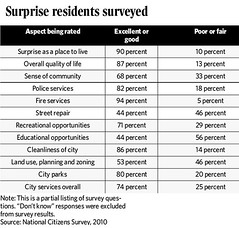
It turns out that there is an instrument called the National Citizens Survey, developed in association with the International City/County Management Association, that communities can use to measure citizen perception of the quality of life within their communities, conducting a needs assessment. And they can compare the results to other communities.

The Arizona Republic has a story "Survey: Surprise residents want better transit, more retail" on the results in Surprise.
National Citizens Survey, Surprise, Arizona

Labels: , , , , ,

Tuesday, July 27, 2010

Nothing new in NTSB hearing on WMATA, crash

At least according to the various press (e.g., "NTSB faults circuit in Metro crash" from the Post) and blog reports. I wrote the reprinted blog entry below on July 27th, 2009. It could have stressed safety issues more strongly, but this statement:

We can argue that the accident is an indicator of a far bigger systems failure than the circuit system.

is pretty strong as it is.

Missing the real issue about WMATA

The Washington Post editorialized, in "A Broken Metro‎," once again about how all of the Washington Metropolitan Area Transit Authority's problems have to do with the lack of a dedicated funding stream.

Nothing could be further from the truth, as the newspaper's own reporting ought to be communicating to us.

Here are the issues with WMATA:

- general vision and leadership
- the governance structure (members appointed to the board by the various jurisdictions that are members of the WMATA Compact--but too many of them have overly constrained worldviews about what they are doing and who they truly represent)
- the lack of a real system of regulatory oversight*
- funding of current operational deficits**
- funding of capital improvements***
- management of the organization
- operation of the organization
- how the organization treats and serves riders.

* The article in the Post about how BART has a redundant train control system to ensure that all trains are accounted for on the system at all times off-handedly mentioned that BART is under the oversight of the California Public Utilities Commission. See "Sister Transit System Took Steps to Counter Hazard: BART Saw Circuit Problem At Center of Metro Probe."

From the article:

Shortly after BART started operating in 1972, it installed a backup system. Initial tests of the main train protection system failed to detect the presence of a train in a few instances, according to Mike Healey, a longtime BART spokesman who retired in 2005. A subsequent 1972 BART accident involving a train that mistakenly received a command to double its speed instead of slowing down, sending the train off track and into a parking lot, was the catalyst "to have some redundancy to back up the primary train protection system," Healey said...

Willard Wattenburg, an electrical engineer and inventor retired from the University of California at Berkeley, said intermittent failures were frequent on BART in the early 1970s. Wattenburg analyzed BART's initial design for the California Public Utilities Commission, which regulates transit systems, and crafted some corrections. BART officials at the time said the failures were flukes, but regulators insisted on the design changes. .

This used to be the case for the old streetcar system, which was overseen by the DC Public Service Commission.

There needs to be a joint regulatory commission, with appointees from DC, MD, and VA, to oversee the system and ensure that it meets the highest operational standards.

** Dedicated funding is important but is more focused on managing annual operating budgets. The cost of providing transit is greater than farebox and other revenues. Therefore, funds are provided by the member jurisdictions of the WMATA "Compact" to make up the difference.

*** While the annual appropriations include some money for capital improvements, it's never enough, especially when it comes to system expansion, or replacing large amounts of rolling stock.

Dedicated funding gets at just a little bit of the issues that are in play with WMATA generally.

We can argue that the accident is an indicator of a far bigger systems failure than the circuit system.

That's what we should be coming to realize as we are learning about the systematic failures of this system and the neglect of dealing with it--something that predates General Manager John Catoe.

See "Investigators: Metro equipment at crash problematic for 18 months," "Investigators examining glitches around system" AND ESPECIALLY THIS STORY "Metro operator: Recent crash failure echoes 2005 near-miss" from the Examiner.

Labels: , , , , , ,