Rebuilding Place in the Urban Space

"A community’s physical form, rather than its land uses, is its most intrinsic and enduring characteristic." [Katz, EPA] This blog focuses on place and placemaking and all that makes it work--historic preservation, urban design, transportation, asset-based community development, arts & cultural development, commercial district revitalization, tourism & destination development, and quality of life advocacy--along with doses of civic engagement and good governance watchdogging.

Saturday, February 21, 2026

DC Metrorail transit ridership by station, daily boardings

WMATA and other transit agencies make data available about ridership for rail systems and bus lines.  

It would be easy for them to also produce it as a matter of course like in the graphic below.  

Similarly, such data could be presented by bus stop for bus lines.

Having such data easily presented makes it a lot easier to have discussions about transit stations and bus stops, whether or not bus stops could be cut in order to speed service, and what stations to invest in to improve user experience and increase ridership.


Labels: , , , ,

Friday, October 28, 2016

Maryland MTA interview about public communications

Listening to this Transportation Radio interview with Paul Comfort, CEO of Maryland Transit Administration makes me believe that maybe WMATA hired the wrong transportation executive from Maryland.

Mr. Comfort has a background in radio and broadcasting and is much clued into the value of media and public communications. MTA got a license for a low power FM station to use for MTA public communications and they have a bunch of other initiatives.

 He also expressed the desire to integrate all forms of transit into the CharmCard (a specially branded version of the WMATA SmarTrip card, so that DC and Baltimore area transit systems all use the same fare media--CharmCards work on the DC area transit systems and SmarTrip cards work in Greater Baltimore), including train service, something I discussed in "One big idea: Getting MARC and Metrorail to integrate fares, stations, and marketing systems, using London Overground as an example."

-- Maryland Transit Administration

Labels: , , , ,

Saturday, February 13, 2016

In 2009 I wrote that WMATA's regulatory oversight needed to be significantly improved, US DOT says the same in 2016

After the Fort Totten crash in 2009, which resulted in 9 deaths and many injuries, reported first by the Frederick News-Post, it was determined that the crash resulted from the inter-mixing of signaling equipment from different vendors--the equipment wasn't guaranteed for inter-operability.

It turns out that decades before, the BART system in the San Francisco Bay region had similar problems, but because of safety regulation by the California Public Utilities Commission, it was addressed, and redundant safety controls were implemented within the signaling system.

The Post also reported on the Tri-State Safety Committee, a regulatory body with no enforcement authority, which was created by DC, Maryland, and Virginia to oversee Metrorail.

In 2009, I suggested that to build accountability into the regulatory and oversight process for Metrorail, DC, Maryland, and Virginia merely had to come together and invest regulatory authority into the TSSC.

See "Missing the real issue about WMATA," July 27, 2009, and "Will nine deaths lead to a better governance, oversight, and management system for WMATA? Or not?," August 11, 2009.

They didn't.  And earlier this week, the US Department of Transportation said it would begin withholding a portion of funding to WMATA until the lack of regulatory oversight was corrected ("Federal funding for D.C., Va., Md. at risk due to lack of progress on Metro oversight," Washington Post).

From this week's Post article:
Late last year, Foxx transferred safety oversight of Metro’s rail operations to the FTA with the understanding that it would be temporary — until the three jurisdictions could develop a compact to create an oversight agency. The move was made after federal officials determined that the agency charged with the task, the Tri-State Oversight Committee (TOC), was woefully inadequate for the job.

But Foxx said federal officials recently learned from the Metropolitan Washington Council of Governments that the jurisdictions “do not expect to pursue final legislative action in 2016” to establish a safety oversight agency.

“This news was unexpected and disappointing,” Foxx wrote in the letter. ...

Some of the region’s leaders said Monday that they are taking steps to move Metro to a culture of safety but that they, too, are frustrated with the situation — and with the U.S. Transportation Department for pointing the finger at the District, Maryland and Virginia when the federal government also has a seat at the table to help solve Metro’s problems.

“While the nation awaits the FTA’s rules on state safety oversight entities, [the Washington Metropolitan Area Transit Authority] has an oversight structure in their board of directors where the federal government can actually be helpful,” Bowser spokesman Michael Czin said. “Unfortunately, the federal government’s appointees, including the previous chairman, were obstacles to reform in 2015.”
As discussed in the reprints below, these issues date most recently to 2009, but clearly had been present earlier, and long before the Federal Government received the authority to appoint board members in 2010 ("GSA Appoints Director and Alternate Director to Metro Board," press release), and in any case, it is DC, Maryland and Virginia that are empowered to act to cure the defect of lack of regulatory oversight at the state/multi-state scale, not the federal government, which only stepped in recently because of a failure to act by the states in the face of continuing problems.

-- State Safety Oversight Program, Federal Transit Administration
-- Rail Transit Safety Action Plan, Federal Transit Administration, 2006.  From the document:

Top Ten Priorities
The following priorities have been identified for FTA’s Safety Action Plan:
• Priority Number 1: Reducing Collisions with Other Vehicles
• Priority Number 2: Reducing Collisions with Pedestrians and Trespassers
• Priority Number 3: Improving Compliance with Operating and Maintenance Rules
• Priority Number 4: Reducing the Impacts of Fatigue on Transit Workers
• Priority Number 5: Reducing Unsafe Acts by Passengers in Transit Stations
• Priority Number 6: Improving Safety of Transit Workers
• Priority Number 7: Improving Safety for Passengers with Disabilities
• Priority Number 8: Removing Debris from Tracks and Stations
• Priority Number 9: Improving Emergency Response Procedures
• Priority Number 10: Improving Safety Data Acquisition and Analysis

======
Reprint from Will nine deaths lead to a better governance, oversight, and management system for WMATA? Or not?, August 11, 2009

A few weeks ago I wrote an entry commenting that the focus on WMATA not having a dedicated funding stream misses the real point about overall governance, management, and oversight.

The fact that BART in the San Francisco Bay region is overseen by the California Public Utilities Commission, while WMATA has no real regulatory oversight is troubling.

The Post editorializes about this today, in "Unsafe, Unaware, Unscrutinized: Is Metro's lack of effective oversight contributing to its safety problems," in response to Sunday's article about the equivalent of a voluntary oversight board with no authority, the Tri-State Oversight Committee, in the Sunday paper, "Subway Safety Panel Foiled by Constraints: 12-Year-Old Oversight Committee Has Little Influence."

It might not be so bad if absolute excellence was demanded throughout the organization. It's not.

I think it's clear that getting rid of the engineering and construction people (partly in 2003, and then after the current General Manager came on board, see "Metro to Cut Construction Staff to Help Close Budget Gap" from March 2007 and "Improved Safety and Service Are Focus of Reorganization, Chief Says" from April 2007, from the Post) likely has removed a level of expertise within the organization concerning rail operations.

Recent failures in the S-Bahn system in Berlin--none of the failures led to casualties!!!!--resulted in wholesale change in the management of the transit system. See "Safety Issues Ground Hundreds Of Berlin S-Bahn Trains" from the German radio network NDR. From the story:
The executive management of S-Bahn Berlin was asked to resign this past week: included among the casualties are Tobias Heinemann (chief officer), Thomas Prechtl (head of finance), Olaf Hagenauer (personal director) and just recently hired technical director Peter Büsing.

Allegedly the company ignored a safety directive issued by the EBA, the German equivalent of the U.S. [Federal Railroad Administration], after the May 1st incident in Berlin-Kaulsdorf station. The EBA required that the company perform a repetitive inspection of all wheels of similar design as the failed wheel every seven days. The company assured the EBA that it would comply with the new safety directive, but an audit by the EBA on the 29th of June determined that the company had mostly ignored the safety directive.
The problems with WMATA have led Maryland's MTA to back off from saying that the Purple Line would be integrated into the WMATA transit system and managed and operated by WMATA after it is constructed. See the Dr. Gridlock column from Sunday, "Purple Line and Metro: Will They Work Together?," versus the letter from then Maryland Secretary of Transportation Porcari to the Town of Chevy Chase from May 2008 , which stated:
2. The fare and transfer policy for this corridor has not yet been established. The MTA views the Purple Line and Metrorail system as part of an overall system of transit service in the Washington area. Future policies, should the Purple Line be constructed, are expected to reflect that view and include the use of modern fare collections methods such as Smartcards. Therefore, the report’s assertion regarding full transit fares for both systems in calculating the cost of a transfer is a policy decision that cannot be assumed;
which can be construed to imply that WMATA would end up integrating this light rail line into its transit system, comparable to how after the Dulles corridor (Silver Line) extension is constructed not by WMATA but by the State of Virginia it will be integrated into the WMATA subway system.

Not now, or at least not while WMATA's management capabilities are called into question. (And remember the concerns expressed by the Federal Transit Administration over the expansion of the system via the Silver Line, versus WMATA focusing on current operations, "Feds Slam Dulles Rail Project" from the Dr. Gridlock Get There blog.)

=======
Reprint: Missing the real issue about WMATA, July 27, 2009

The Washington Post editorialized, in "A Broken Metro‎," once again about how all of the Washington Metropolitan Area Transit Authority's problems have to do with the lack of a dedicated funding stream.

Nothing could be further from the truth, as the newspaper's own reporting ought to be communicating to us.

Here are the issues with WMATA:

- general vision and leadership
- the governance structure (members appointed to the board by the various jurisdictions that are members of the WMATA Compact--but too many of them have overly constrained worldviews about what they are doing and who they truly represent)
- the lack of a real system of regulatory oversight*
- funding of current operational deficits**
- funding of capital improvements***
- management of the organization
- operation of the organization
- how the organization treats and serves riders.

* The article in the Post about how BART has a redundant train control system to ensure that all trains are accounted for on the system at all times off-handedly mentioned that BART is under the oversight of the California Public Utilities Commission. See "Sister Transit System Took Steps to Counter Hazard: BART Saw Circuit Problem At Center of Metro Probe."

From the article:
Shortly after BART started operating in 1972, it installed a backup system. Initial tests of the main train protection system failed to detect the presence of a train in a few instances, according to Mike Healey, a longtime BART spokesman who retired in 2005. A subsequent 1972 BART accident involving a train that mistakenly received a command to double its speed instead of slowing down, sending the train off track and into a parking lot, was the catalyst "to have some redundancy to back up the primary train protection system," Healey said...

Willard Wattenburg, an electrical engineer and inventor retired from the University of California at Berkeley, said intermittent failures were frequent on BART in the early 1970s. Wattenburg analyzed BART's initial design for the California Public Utilities Commission, which regulates transit systems, and crafted some corrections. BART officials at the time said the failures were flukes, but regulators insisted on the design changes.
This used to be the case for the old streetcar system, which was overseen by the DC Public Service Commission.

There needs to be a joint [regulatory] commission, with appointees from DC, MD, and VA, to oversee the system and ensure that it meets the highest operational[-safety] standards.

** Dedicated funding is important but is more focused on managing annual operating budgets. The cost of providing transit is greater than farebox and other revenues. Therefore, funds are provided by the member jurisdictions of the WMATA "Compact" to make up the difference.

*** While the annual appropriations include some money for capital improvements, it's never enough, especially when it comes to system expansion, or replacing large amounts of rolling stock.

Dedicated funding gets at just a little bit of the issues that are in play with WMATA generally.

We can argue that the accident is an indicator of a far bigger systems failure than the circuit system.

That's what we should be coming to realize as we are learning about the systematic failures of this system and the neglect of dealing with it--something that predates General Manager John Catoe.

See "Investigators: Metro equipment at crash problematic for 18 months," "Investigators examining glitches around system" AND ESPECIALLY THIS STORY "Metro operator: Recent crash failure echoes 2005 near-miss" from the Examiner.

Labels: , , , , , , ,

Saturday, October 10, 2015

Federal Transit Administration's stepping in to regulate the safety elements of WMATA mark of a failure in regulatory oversight by DC, Maryland, and Virginia

WMATA, the Washington Metropolitan Area Transit Authority, operator of Metrorail heavy rail transit service service DC and its suburbs in Virginia and Maryland, has fallen through the cracks in terms of regulatory oversight.

The Metrorail crash in 2009 demonstrated that the somewhat voluntary "Tri-State Oversight Committee," didn't have enough authority given to it by the respective states to be able to command WMATA to act on its recommendations (see ""Subway Safety Panel Foiled by Constraints: 12-Year-Old Oversight Committee Has Little Influence.," Washington Post, 2009).

NTSB recommends FRA be given oversight authority over WMATA.  In the face of multiple safety failures in the system over the past 18 months, the National Transportation Safety Board recommended that the Federal Railroad Administration be given the authority to regulate WMATA ("NTSB wants feds to take of D.C. Metro system," USA Today), even though it isn't a traditional railroad, because the Federal Transit Administration isn't set up to provide day-in, day-out regulatory oversight of individual transit systems.

USDOT steps in because DC-Maryland-Virginia failed to provide adequate oversight.  The USDOT rejected that recommendation, and instead announced on Friday that the USDOT/FTA would provide regulatory oversight ("Federal agency to supervise Metro safety," Washington Post).

In the old days, state regulatory authorities oversaw transit systems.  In the days when transit systems were privately owned, state-based regulatory authorities regulated these firms.  These agencies, usually called "Public Service Commissions," regulated all "utilities," not just electricity, telephone, and natural gas, but transit as well (not railroads, which were regulated by the Interstate Commerce Commission).

This authority wasn't limited to regulating pricing of service, but included safety matters also.

Today, most of these agencies no longer regulate transit systems in a substantive way, because transit agencies are public agencies for the most part, and are regulated in part by the Federal Transit Administration and the Federal Railroad Administration.


Damage from the arcing incident in the tunnel near L'Enfant Plaza Station. NTSB photo.

But that was a fault of the states failing to put forward the right regulations, authority, and oversight structures.

California Public Utilities Commission never gave up responsibility for regulating local transit systems.  California's Public Utilities Commission never gave up its authority to regulate transit systems, and while the operation of transit systems in California hasn't been problem free, it happens that some of the problems resulting in death on the WMATA system have been avoided by the Bay Area Rapid Transit system (BART), because of the level of oversight provided by CPUC.

I wrote about the regulatory system in CPUC vs. the DC-Maryland-Virginia area nine times in 2009, after the Fort Totten crash, which resulted in 899 fatalities, and turned out to have been the result of inter-mixing signaling equipment from different firms, a problem that WMATA was warned about by the firm that provided the system's initial set of signaling equipment.

-- Another example that something "unique" isn't necessarily "exceptional"
-- Missing the real issue about WMATA
-- Will nine deaths lead to a better governance, oversight, and management system for WMATA? Or not?
-- The webpage of the California Public Utilities Commission oversight of rail transit systems
-- Oversight is necessary for business and government
-- Federal safety regulation of local transit systems

Passengers react on Monday, Jan. 12, 2015 afternoon as smoke filled a Metro train in a tunnel outside the L’Enfant Plaza Metro station. One person died from smoke inhalation and the failure to quickly evacuate the passengers. (Photo by Saleh Damiger)

WMATA had experienced multiple failures with this equipment before the fatal crash, although in each previous situation, train operators avoided catastrophe by stopping the train short of a crash.

Because no fatalities resulted from those incidents, the problem was discounted, treated as an anomaly, rather than inherent within the system.

DC-Maryland-Virginia failed to address their regulatory responsibilities for WMATA.  Using the California Public Utilities Commission as an example of national best practice, in the various posts from 2009, I wrote something like this:
In our region, I would recommend that DC, Maryland and Virginia set up a supra-regulatory committee as a joint venture, one that operates within the utilities oversight body of each jurisdiction, tasked with the regulation of rail transit systems. That would mean subway and light rail in Baltimore, passenger railroad services in Maryland and Virginia, heavy, light rail, and streetcar service in Metropolitan Washington, and light rail in Hampton Roads in Virginia.
DC, Maryland, and Virginia had 6 years to act on this. They didn't.

Given the continued failures, the USDOT/FTA was forced to step in.

Labels: , , , , , , ,

Thursday, July 26, 2012

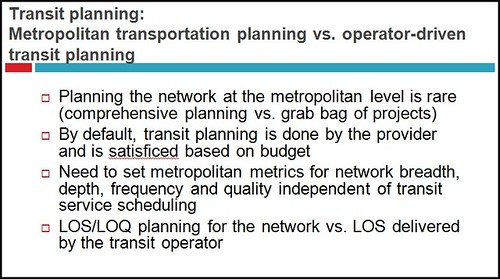
Metropolitan mass transit planning: more thoughts

Slide, Metropolitan Mass Transit Planning: Towards a Hierarchical and Conceptual Framework
I wrote about this yesterday in the context of a Post article on Saturday about late night demand increasing for bus service on certain DC routes.  Today's Post has a follow up article, "DC officials call for improved late-night bus service." about the WMATA Board's response.

From the article:

Metro is being urged to improve its late-night bus service in the District after a report that service-industry workers heading home after 10 p.m. are often left behind by overcrowded buses.

D.C. Council member Muriel Bowser, the city’s representative on the Washington Metropolitan Area Transit Authority’s Board of Directors, said she has asked transit officials to better monitor the bus schedules and add longer buses to the 16th Street routes, the city’s most crowded after 7 p.m.

Tom Downs, a vice chairman on the board, said the overcrowding, unreliable schedules and bus bunching on the routes reflect increasing demand for service systemwide.

“It is not just this corridor in the evening. We are having significant growth in bus ridership, and we need to know where and how and why that is happening, and we need to know how to respond to that over the next couple of years,” Downs said in an interview.

He said he has asked Metro to analyze where ridership is increasing and to hold focus groups. For the 16th Street buses, Downs said that in addition to expanded route monitoring and longer buses, he wants Metro to consider starting some northbound buses at P Street NW.

My first response is that this isn't what the Board should be doing, almost micro-managing, but they are right to step in, because of the continued failure to increase service. But that this isn't being done anyway, or at least the information isn't being acted upon, is an indicator of more serious problems.

In my presentation on Metropolitan Mass Transit Planning: Towards a Hierarchical and Conceptual Framework I make the point that standards and metrics and the general plan for network breadth, depth, level of quality and level of service need to be set by metropolitan transportation planning organizations independent of the transit operator.

At the same time, checks/evaluations on level of service, level of quality, etc., shouldn't be only conducted by the service provider, or at least, without the information being communicated to the metropolitan and jurisdictional transportation planners.

Basically, another point I'd add to that presentation is that part of the checks and balances should include regular LOS evaluation surveys/studies that are conducted by the metropolitan and jurisdictional transportation planning authorities independent of the transit operator.

Obviously, WMATA knows about the problem, they just haven't been dealing with it.  By conducting the surveys of service quality and demand independently, it creates a more open environment focused on meeting the demand and standards.

Labels: ,

Thursday, July 28, 2011

Arizona Republic argues that deconcentrated transit system in Greater Phoenix costs money in adminstration that could be better spent on service

See the article, "Phoenix-area bus, light-rail cuts avoidable, analysis shows," and the editorial, "Opinion: Southeast Valley should lead transit unification talks."

From the article:

When the Valley's economy was unraveling in 2008, transit service was an early casualty.

Three years of cuts ensued. Dozens of bus lines were eliminated, rerouted or truncated. Wait times grew, and fares shot up on buses and light rail.

Some of those transit cuts, and the resulting hardship for many riders, might have been averted if the Valley's transit network were run by a single unified agency, an Arizona Republic analysis indicates. Unified transit systems are common among fast-growing Western cities.

As it is, in Maricopa County, 11 local transit agencies provide bus and rail service, creating redundant costs in administrative personnel and contracted services such as bus operations and security.

At $70 million a year, administrative costs make up nearly a quarter of the system's total operating costs, making the Valley the third most top-heavy region in the country, according to data from federal and local agencies. Some local leaders believe those costs can be cut and are talking favorably of an eventual merger of transit agencies.

--------
The transit web
The Valley's transit system is dizzingly complex. The 109 bus and rail routes and Dial-A-Ride areas are operated under 14 different contracts, each with one or more funding agencies, mainly cities; an operator, and a contracting entity. Funding agencies aren't shown below, but an example of the pattern is Veolia Tempe's contract to run 19 routes. Some routes are funded by Tempe, Arizona State University or the Regional Public Transportation Authority, and others by various combinations of Tempe, RPTA, Phoenix, Chandler, Gilbert, Scottsdale, Mesa and the Gila River Indian Community.

Contracting bodies/Operators/Routes or areas El Mirage El Mirage 1
Glendale Glendale 3
Metro LRT Metro LRT 1
Peoria Peoria 1
Phoenix First Transit 14
Phoenix MV Transportation 2
Phoenix Veolia Phoenix 31
RPTA Ajo Transportation 1
RPTA Valu Trans 7
RPTA Veolia RPTA 24
Scottsdale Dunn Transportation 3
Surprise Surprise 1
Tempe Veolia Tempe 19
Tolleson Tolleson 1

Source: Regional Public Transportation Authority, Arizona Republic research


-----
The DC area has two types of service, "regional" bus and subway service provided by WMATA and paid by various jurisdictions, and local bus service provided by various jurisdictions and usually contracted out to non-union organizations. Probably the communities don't spend as much on administration compared to Phoenix area jurisdictions.

Labels: , , ,

Tuesday, December 14, 2010

Being more open about transit complaints as a customer service technique

In the summer I criticized the transit union, which is supposed to represent members first and foremost, not the customers of the transit system, for protecting union members at the expense of the riding public--when bus operators commit crimes and the like and are still on the job. See "When the union label may be terrifying: transit edition". Recently, GGW made a similar point, "Public unions need to stop defending the bad apples."

And I was a bit critical, in "3 kinds of lies: lies, damn lies, and statistics" of the Washington Examiner in how it reported on Montgomery County's communication of the calls made to its service center, because of how it reported on the fact that the most complaints of any county service had to do with the bus service, while failing to report that the bus service is the most widely used county service, with 29+ million trips/year, putting 1,551 complaints over 4.5 months in perspective.

On the other hand, dealing with complaints and reporting on them regularly, and there being consequences for failure to do the right thing can be a method for putting pressure on unionized employees to serve the public better.

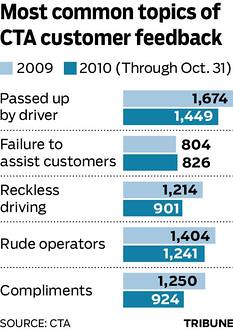
The Chicago Tribune ran a story, "CTA bus driver models customer service: Drivers' attitudes can brighten, ruin commute," on an exemplary bus driver--and hey, I think that driving a public transit bus is one of the toughest jobs around in terms of driving a big, heavy vehicle, in heavy traffic, often on narrow roads, on complicated routes, with the responsibility for the people on the bus, and dealing with people, some of whom can be very unruly--and also ran a graphic on customer feedback/complaints given to the Chicago Transit Authority.
Customer feedback/complaints, Chicago Transit Authority
The Tribune story also mentioned how one bus driver made the mistake of skipping the stop of the reporter, who complained and asked the CTA to review video from the on-board camera to prove that the driver deliberately skipped the stop. The driver was reprimanded.

WMATA, as a "suasion" technique, ought to put this information up on the website and regularly update it, just like DC's Department of Transportation's fancy Transportation Access Portal.

And at the same time we have to recognize that serving 1.2+ million riders daily, there are going to be problems, service can't be perfect (even with only 1% error that would be 12,000 problems each day).

Labels: ,

Monday, August 30, 2010

Here's the job description we don't have at MWCOG or WMATA

MWCOG = the Metropolitan Washington Council of Governments. The Transportation Planning Board of the COG is the "metropolitan planning organization" for the purposes of federal transporation planning and regional coordination.

WMATA = the Washington Metropolitan Area Transportation Authority. It runs the metropolitan area subway system and bus services.

The closest organization in the region to this kind of job description is Arlington Transportation Partners, the contracting organization that handles most of Arlington County's transportation management functions, in association with various agencies and people who do work directly for Arlington County and are "government employees."

====================================

DIRECTOR OF INNOVATION

Salary Range: $136,941 to $171,176

Metrolinx, an agency of the Government of Ontario, is realizing its vision to bring about an integrated, traveller-focused, multi-modal transportation system that enhances prosperity, sustainability and quality of life for the GTHA region.

To support this, Metrolinx has identified innovation as a core corporate value and is looking for a unique and experienced individual to work with a team of diverse professionals in the transportation, planning, finance and sustainable development disciplines to identify, develop, incubate and champion innovative ideas, concepts and best practices needed to meet Metrolinx’s short and long-term goals. Reporting to the Vice President of Policy and Planning, this management executive will work collaboratively with all Metrolinx business areas, including GO Transit, an operating division, and public and private sector transportation leadership to identify future lines of business at both the strategic and tactical levels.

As the Director of Innovation, you will be responsible for:

  • Researching, evaluating, and filtering ideas and concepts including those from senior management, and working closely with all business areas to use new and existing customer insights to advance the corporate value of innovation.
  • Identifying policies, internal processes, and external services for improved modal integration, efficiency and alignment with The Big Move and overall corporate mission, vision, goals and values
  • Developing and directing research focused on transportation innovation and making improvements to the traveler experience.
  • Developing the business case model to support innovative ideas from incubation to independence
  • Overseeing senior stakeholder forums made up of diverse public and private sector interests to remain current and ahead of the curve.
  • Bringing a diverse perspective to the field of transportation, to grasp issues, opportunities and roadblocks and subsequently utilizing your range of knowledge and political acuity to minimize barriers and to maximize opportunities.
  • Integrating potential innovations with Metrolinx’s “The Big Move” plan, the GO 2020 strategic plan and the overall needs of travellers throughout the GTHA.
Qualifications: Completion of a post-graduate university degree in Planning, Engineering, Business Administration or Public Policy or any combination of education, training, and experience deemed equivalent. Minimum ten (10) years experience in the development of corporate strategy or project management in the transportation and/or urban planning fields that includes direct exposure to, or demonstrated working knowledge of;

· Developing and fostering innovation in policy, procedures and services.

· Managing / Directing high profile and highly complex projects that are organic and require the ability to adapt to changing goals and direction.

· Directing and managing cross-functional corporate teams, and multi-disciplinary consultant contracts.

· Integrating a diverse portfolio of issues into actionable directives.

· Generating and testing hypotheses, and incubating ideas.

· Leading by empowering others to innovate and continuously improve.

· Superior interpersonal communication skills (written, oral, and listening) and extremely strong presentation skills for public audiences and senior public officials.

· Greater Toronto and Hamilton Area planning and socio-political issues (rural, suburban, and urban) that have the potential to impact the success of Metrolinx and its operating division GO Transit.

· Diplomatic personal conduct in highly sensitive and / or political environments, with the ability to negotiate and foster a climate of openness and transparency.

Resumes must be received by the Human Resources Office, Metrolinx, 20 Bay Street, Suite 600, Toronto, M5J 2W3, email: humanresources@metrolinx.com no later than September 15, 2010, quoting File Number 10-220.

Labels: , ,

Tuesday, July 27, 2010

Nothing new in NTSB hearing on WMATA, crash

At least according to the various press (e.g., "NTSB faults circuit in Metro crash" from the Post) and blog reports. I wrote the reprinted blog entry below on July 27th, 2009. It could have stressed safety issues more strongly, but this statement:

We can argue that the accident is an indicator of a far bigger systems failure than the circuit system.

is pretty strong as it is.

Missing the real issue about WMATA

The Washington Post editorialized, in "A Broken Metro‎," once again about how all of the Washington Metropolitan Area Transit Authority's problems have to do with the lack of a dedicated funding stream.

Nothing could be further from the truth, as the newspaper's own reporting ought to be communicating to us.

Here are the issues with WMATA:

- general vision and leadership
- the governance structure (members appointed to the board by the various jurisdictions that are members of the WMATA Compact--but too many of them have overly constrained worldviews about what they are doing and who they truly represent)
- the lack of a real system of regulatory oversight*
- funding of current operational deficits**
- funding of capital improvements***
- management of the organization
- operation of the organization
- how the organization treats and serves riders.

* The article in the Post about how BART has a redundant train control system to ensure that all trains are accounted for on the system at all times off-handedly mentioned that BART is under the oversight of the California Public Utilities Commission. See "Sister Transit System Took Steps to Counter Hazard: BART Saw Circuit Problem At Center of Metro Probe."

From the article:

Shortly after BART started operating in 1972, it installed a backup system. Initial tests of the main train protection system failed to detect the presence of a train in a few instances, according to Mike Healey, a longtime BART spokesman who retired in 2005. A subsequent 1972 BART accident involving a train that mistakenly received a command to double its speed instead of slowing down, sending the train off track and into a parking lot, was the catalyst "to have some redundancy to back up the primary train protection system," Healey said...

Willard Wattenburg, an electrical engineer and inventor retired from the University of California at Berkeley, said intermittent failures were frequent on BART in the early 1970s. Wattenburg analyzed BART's initial design for the California Public Utilities Commission, which regulates transit systems, and crafted some corrections. BART officials at the time said the failures were flukes, but regulators insisted on the design changes. .

This used to be the case for the old streetcar system, which was overseen by the DC Public Service Commission.

There needs to be a joint regulatory commission, with appointees from DC, MD, and VA, to oversee the system and ensure that it meets the highest operational standards.

** Dedicated funding is important but is more focused on managing annual operating budgets. The cost of providing transit is greater than farebox and other revenues. Therefore, funds are provided by the member jurisdictions of the WMATA "Compact" to make up the difference.

*** While the annual appropriations include some money for capital improvements, it's never enough, especially when it comes to system expansion, or replacing large amounts of rolling stock.

Dedicated funding gets at just a little bit of the issues that are in play with WMATA generally.

We can argue that the accident is an indicator of a far bigger systems failure than the circuit system.

That's what we should be coming to realize as we are learning about the systematic failures of this system and the neglect of dealing with it--something that predates General Manager John Catoe.

See "Investigators: Metro equipment at crash problematic for 18 months," "Investigators examining glitches around system" AND ESPECIALLY THIS STORY "Metro operator: Recent crash failure echoes 2005 near-miss" from the Examiner.

Labels: , , , , , ,

Friday, June 18, 2010

When the union label may be terrifying: transit edition

I don't favor union bashing--my problem with unions is the same problem I have with any large organization, the problem that Robert Michels describes in the classic text in political science, Political Parties, which argues (according to Wikipedia) that:

all forms of organization, regardless of how democratic or autocratic they may be at the start, will eventually and inevitably develop into oligarchies. The reasons for this are the technical indispensability of leadership, the tendency of the leaders to organize themselves and to consolidate their interests; the gratitude of the led towards the leaders, and the general immobility and passivity of the masses.

What this means mostly is that the organization becomes internally and self-focused. In the case of organizations like transit systems, it sets up a management vs. labor dialectic that boxes out the riders, the customers of the service.

While I don't know the details of the decisions--riders aren't "parties" we don't have standing concerning personnel matters--I find it very troubling that WMATA has to rehire two bus drivers it fired. See "Bus drivers fired for misconduct return to Metro" from the Examiner.

I can understand the decision, maybe, with regard to the bus driver in the accident that killed someone. Maybe it wasn't his fault--even though the investigation said it likely was. I didn't read the accident report, maybe there are mitigating circumstances. But I can't see any justification for rehiring a bus driver who got out of his bus, assaulted someone -- "because I thought it was funny" -- and then continued on his merry way.

I don't see how such behavior should be supported by the transit workers union or an arbitrator.

Aren't bus drivers really working for the riders?

Who wants someone like that driving me around?

From the article:

"Neither of these incidents should have ever happened," Metro spokeswoman Lisa Farbstein said. The agency stands behind its decisions to fire the drivers, but Farbstein said Metro does not believe it has legal grounds to overturn the arbitrators' rulings.

Still, the agency and the union are at odds over whether the driver involved in the deadly wreck should be allowed to return behind the wheel. The union is fighting for him to get his job back, as specified in the binding arbitration ruling.

"The decision was very definitive," said Jackie Jeter, president of the Amalgamated Transit Union Local 689. "The authority does not have authority to do whatever they want to do."

------

That being said, I think that the job of being a bus driver is one of the hardest jobs out there. I wouldn't be good at it. The driver has to deal with riders who can be a problem, as well as a lot of traffic, and the need to move in and out of traffic constantly.

Constant training is necessary sure. But so is constant vigilance. People who are a threat to others shouldn't have the job.

Labels: ,

Wednesday, January 20, 2010

New York regional transportation authority report on better service

From Metro Magazine:

Cost cutting and affordable service improvements are cited as two main goals for the New York Metropolitan Transportation Authority (MTA) in Chairman/CEO Jay H. Walder's report of his first 100 days on the job.

The enormous improvement in the MTA's transportation network over the past 25 years is recognized in the report, however, it also acknowledges that in many areas the MTA has fallen behind comparable transit systems around the world. All of the report's observations are set in the context of the ongoing economic crisis and its impact on the MTA.

The report identifies overhauling the way the MTA does business to cut costs and ensure that every dollar is being used as effectively as possible and finding affordable ways to make progress on service improvements despite the economic situation, as two main goals for the MTA.

The MTA is the product of mergers between dozens of former transportation companies, said the report, but steps were never taken to eliminate redundancies and find savings. By operating the MTA as one company — instead of multiple silos — significant cost reduction can be achieved, said Walder. .

Nearly 90 percent of MTA employees are focused on service delivery, so this area must also be targeted for sufficient cost reduction, including eliminating some overtime and amending work rules that make it difficult to utilize new technology or streamline processes, according to the report.

The report targets five areas for fast, visible, affordable improvements:

  • Faster bus service
  • Telling customers when to expect the next train or bus
  • Bringing Toll Collection into the 21st Century
  • Making new fare technology work for customers
  • Improving subway stations and service change information

"Making every dollar count — that's the only way we can restore the MTA's credibility and continue improving service in difficult times," Walder said. "I grew up here and started my career at the MTA, so I know how fundamental the transit system is to our daily lives. Today we established high goals for the MTA in a difficult time, but we must succeed."

The full report is available, along with a video, on the MTA's new Website.

Labels: , , ,

Friday, January 15, 2010

4 years ago I thought the biggest problem for WMATA leadership was lack of external focus

I don't believe that today. Sure, lack of a solid external-outward focus on customer service is key, but it's but a kernal of the full and entire problem.

I wrote this as part of a comment to a GGW entry:

... WMATA's issues are far more serious than you make out in this entry. I wish the issue were primarily one of customer service.

That is an issue, sure.

But the fundamental issues are leadership, management, funding, operations, and long range planning, and the difference between metropolitan transit planning generally (supra-planning beyond WMATA) as well as WMATA transit operations specifically.

Not being externally focused on the transit users makes each one of these issues even more difficult.

It's the same issues as the Redskins and coaching. Can a great coach function in a dysfunctional organizational and management system and generate great outcomes--winning seasons, playoff participation, league and Super Bowl championships? I aver no. So smart managers who understand no win situations--or at least situations that are very difficult to change--might stay away. ...

----------

In 2005, well that was the year that things came crashing down for then WMATA General Manager Richard White, who was felt to be out of touch especially with the external communication functions of the job.

Face it. Of all the government jobs in the region, the WMATA job is the absolute hardest. You are judged and evaluated every day on how the system runs--by over one million people each day. This is much closer oversight than any other public official faces, including the Mayor of Washington or any of the County Executives in the region.

Yet at the same time you have to make sure that the employees are doing the right things, and you have to manage upwards both vis-a-vis the board of directors, but also with the jurisdictions that comprise the WMATA Compact, because they are providing the bulk of the funding for the system, along with the Federal Government--not just in terms of the Federal Transit Administration and the US Department of Transportation, which provides funding for capital improvements and regulatory oversight, but Congress too and the rest of the Executive Branch, because they are all based here in Washington and use the system (or their staffers do) and they hear about it, and occasionally grandstand.

Below is something I wrote 1/12/2006, about 4 years ago, and it reflects the problems then, which are partly the same, but definitely different, today.

More on Metro and rethinking transit marketing

Oddly enough, Dan Tangherlini was in line ahead of me at Starbucks, so I was likely the first person to congratulate him today. Not being a "real journalist" I wasn't up to grilling him about his intentions. And I didn't have my camera with me either...

But in the vein of the "may you live in interesting times" Chinese blessing/curse, I did hand him the Examiner and pointed out today's Sprawl and Crawl column, written before Richard White's resignation, about the difficulty of the job, that by and large White has done a decent job, and over-involvement of the Board of Directors in day-to-day operations.

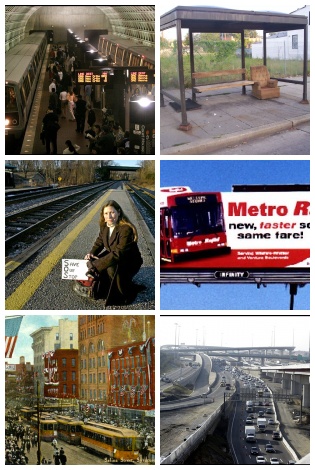
It does make me further think about my "dream" of re-writing (or producing a new version) of the textbook Marketing Public Transit, perhaps with these images on the cover:
My creation
Mosaic created with FD's Flickr Toys.

One of the ways I would structure the text is along the lines of the input, throughput, and output publics framework laid out by Armand Lauffer in his textbook Marketing for Not-For-Profit Organizations. I discussed this in a previous blog entry, "Making Transit Sexy."

Transit marketing must be reconceptualized along the lines of this framework.

One problem with WMATA, and these problems start at the top, is a tin ear in terms of listening and relating to the public. They need to rethink their public communications efforts, and develop different kinds of campaigns according to the type of public they are attempting to reach.

Anyone who took expository writing in school remembers those lessons about "defining your audience." The one problem with those classes is we didn't learn about how to categorize audiences more specifically. For nonprofit and government organizations, Lauffer's work is particularly useful in this regard.
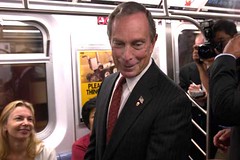
Mayor Bloomberg on the subway
Like Mayor Bloomberg, Dan Tangherlini rides public transportation.

Richard White didn't have much of a public persona, although he dealt mostly with high-level businesspeople and other government public officials. Since elected officials comprise a majority of the WMATA Board, and they are responsible, nominally, to the public, even appointed officials in high-profile government agencies perhaps need to consider how "public communications" activities are an increasingly important part of their job... if they want to keep their job (on the other hand, look what happened to David Gunn of Amtrak...).

At the same time, marketing isn't really about "selling" only what you want to sell. It is about responding to the market(s) and segments, leading market(s), and often balancing conflicting objectives (such as elected officials that want to keep taxes low, citizens who want more transit, and operations personnel who are looking for more financial support to maintain deteriorating infrastructure).

Public transportation systems have to sell use as well as funding, since farebox revenue only covers a portion of current operations, and nothing towards expansion (and WMATA is the number one transit system in the U.S. in the percentage of farebox revenue collected). Funding has to be sold to non-users as well as users, and of course, to public officials.

It's a tough job in any community, particularly this one [deleted].

Labels: , ,

#2 on WMATA, Catoe Resignation

These past entries from June to November concern the broad issue of WMATA management and oversight.

- Will nine deaths lead to a better governance, oversight, and management system for WMATA? Or not?
- The webpage of the California Public Utilities Commission oversight of rail transit systems
- WMATA and transit marketing vs. crisis communications
- (Not) Understanding Government
- Oversight is necessary for business and government

This is what I wrote on July 27th:

Missing the real issue about WMATA

The Washington Post editorialized, in "A Broken Metro‎," once again about how all of the Washington Metropolitan Area Transit Authority's problems have to do with the lack of a dedicated funding stream.

Nothing could be further from the truth, as the newspaper's own reporting ought to be communicating to us.

Here are the issues with WMATA:

- general vision and leadership
- the governance structure (members appointed to the board by the various jurisdictions that are members of the WMATA Compact--but too many of them have overly constrained worldviews about what they are doing and who they truly represent)
- the lack of a real system of regulatory oversight*
- funding of current operational deficits**
- funding of capital improvements***
- management of the organization
- operation of the organization
- how the organization treats and serves riders.

* The article in the Post about how BART has a redundant train control system to ensure that all trains are accounted for on the system at all times off-handedly mentioned that BART is under the oversight of the California Public Utilities Commission. See "Sister Transit System Took Steps to Counter Hazard: BART Saw Circuit Problem At Center of Metro Probe."

From the article:

Shortly after BART started operating in 1972, it installed a backup system. Initial tests of the main train protection system failed to detect the presence of a train in a few instances, according to Mike Healey, a longtime BART spokesman who retired in 2005. A subsequent 1972 BART accident involving a train that mistakenly received a command to double its speed instead of slowing down, sending the train off track and into a parking lot, was the catalyst "to have some redundancy to back up the primary train protection system," Healey said...

Willard Wattenburg, an electrical engineer and inventor retired from the University of California at Berkeley, said intermittent failures were frequent on BART in the early 1970s. Wattenburg analyzed BART's initial design for the California Public Utilities Commission, which regulates transit systems, and crafted some corrections. BART officials at the time said the failures were flukes, but regulators insisted on the design changes. .

This used to be the case for the old streetcar system, which was overseen by the DC Public Service Commission.

There needs to be a joint regulatory commission, with appointees from DC, MD, and VA, to oversee the system and ensure that it meets the highest operational standards.

** Dedicated funding is important but is more focused on managing annual operating budgets. The cost of providing transit is greater than farebox and other revenues. Therefore, funds are provided by the member jurisdictions of the WMATA "Compact" to make up the difference.

*** While the annual appropriations include some money for capital improvements, it's never enough, especially when it comes to system expansion, or replacing large amounts of rolling stock.

Dedicated funding gets at just a little bit of the issues that are in play with WMATA generally.

We can argue that the accident is an indicator of a far bigger systems failure than the circuit system.

That's what we should be coming to realize as we are learning about the systematic failures of this system and the neglect of dealing with it--something that predates General Manager John Catoe.

See "Investigators: Metro equipment at crash problematic for 18 months," "Investigators examining glitches around system" AND ESPECIALLY THIS STORY "Metro operator: Recent crash failure echoes 2005 near-miss" from the Examiner.

Labels: , , , , , ,

Tuesday, October 20, 2009

Bad transit planning or is it bad transit marketing?

As much hype as Dallas gets about the success of their light rail system, it's a relative thing. Not that many people use it and the throughput capacity isn't very significant. A heavy rail system, like the DC subway system, can run close to 40,000/track/hour, depending on the configuration. By comparison, some of the lines in Dallas have a maximum capacity of 4,000 people per hour per track.

Of course, it means you have to have a lot of equipment and personnel to be able to satisfy maximum (peak) demand. And normal rush hour demand can be exceeded by true crush levels, such as for a Presidential Inauguration or particular events.

It's why I have argued before that people who say the marginal cost of adding riders = zero are wrong, because they aren't considering how much equipment and personnel have to be bought or hired to run the base system at peak usage, plus they aren't taking into account the extra cost of building the system to be able to handle peak ridership.

This comes up because the Dallas Light Rail system had a massive public relations and operations failure over the weekend, in terms of providing service for a football game. See "DART knew limits of Green Line for Texas-OU but promoted it anyway" from the Dallas Morning News.

(cf. "Sound Transit and Sounders: Why isn't public transit ready after games?" and " Soccer Fans Encouraged to Arrive Early for Wednesday's match" from the Seattle Times, and this letter to the editor in the Montgomery County editions of the Gazette, "Where's public transportation when we need it?" about the failure to provide shuttle bus services to the US Open golf tournament)

From the article:

Long before the overcrowded rail cars began backing up on DART tracks Saturday, the transit agency knew that it could never handle more than a fraction of the crowd expected for the sold-out Texas-OU game that drew nearly 100,000 fans.

And yet, for weeks leading up to the game, it continued to promote the new Green Line as the best route to Fair Park, despite the likelihood of huge crowds. ...

Dallas Area Rapid Transit President Gary Thomas conceded Monday that the agency simply was not prepared for the crush of football fans and other fairgoers who overwhelmed the rail system on Saturday. Many fans endured trips of longer than three hours and arrived at the Cotton Bowl after halftime or even later.

"Obviously, the demand was a whole lot larger than we expected," Thomas said. "I am certainly apologetic for those riders who didn't get to where they were going in a time frame they felt was appropriate." ...

But this much DART did know: Under the best of circumstances, the agency can't deliver more than about 4,000 passengers per hour to Fair Park. Even with jam-packed trains stopping there every five minutes, with standing passengers overflowing the aisles, each two-car configuration would typically carry about 350 passengers.

DART said 36 trains were scheduled to arrive at Fair Park between 8 and 11 a.m., though it is not sure how many actually arrived due to delays on the tracks. But had every train arrived on time and been full, that would have provided rides for only about 12,000 fans.

No exact figures were available for service during those hours, though DART said that its entire light rail network provided passengers about 40,000 round trips Saturday, about 25,000 more than a typical Saturday. ...

Still, Lyons said the agency was right to advertise the Green Line as the best route to Fair Park, despite the obvious limitations of its rail cars.

"Based on the things we knew – that we would have a lot of people wanting to ride – and based on our experience throughout every day of the fair when we had good service – it was still the right thing to do, to tell people that [the Green Line] is the best way for people to get to Fair Park," he said.

The Dallas light rail system ought to have better planners and marketers than they seem to have. Or, as the title of a column in the Toronto Star puts it, "A 'world-class' transit system? Fat chance, unless we pay up."

But the big thing is to manage expectations in ways that are conscious of your constraints and your ability to satisfy the expectations you build.

Also see the past blog entries "More on Metro and rethinking transit marketing" and "Making Transit Sexy."

Labels: , ,

Saturday, October 03, 2009

Transportation planning, transit fares, and the DC region

Today's Post has a piece, "Transportation Policies Have Miles to Go and Not Much Time," by Roger Lewis, writer of the "Shaping the City" column in the real estate section. From the title you can see it's on transportation, featuring discussion of a conference last month.

His column is on big picture issues.

We can link the big picture to the local picture. Despite the DC's region pretty good transit system, we have many issues.

In the previous blog entry, I quoted from an article in Crosscut about transportation planning in Seattle, "The coming Metro Transit cuts are a rare opportunity."

But I didn't quote the parts of the article that I think are most relevant to the issues in DC. First, he discusses how the City of Bellevue is piloting a new transportation demand management model that links transportation supply and demand at peak periods. From the article:

In short, the model asks, “How much peak capacity will the planned development require?” and, “How much peak capacity will the transportation system provide?” The answers to these questions can be time-phased, and commitments can be required of local and regional agencies to provide the planned capacity.

The last question includes all modes of transportation: vehicles, transit, bikes, pedestrians, etc. Consequently, regional plans can be connected to local plans by defining these capacities, and regional agencies can be held accountable for providing committed services. The predictability of permitting under these models will provide certainly to investors, making centers more attractive investments. In all, the focus of concurrency policy on a centers strategy creates a virtuous circle for transit: Plan to implement service connecting centers, thereby making centers more attractive investment opportunities, and then investment occurs in centers, thus making them better transit markets and ridership grows.

This is the basis of transportation demand management as well as leveraging the economic power and value of transportation. (And I am definitely going to have to learn about what they are doing in Bellevue.)

That leads in the second area in which the article makes important points about decisions about "service cuts."

I mentioned recently that just about every transit system in the U.S. faces severe budget difficulties because of how the economic downturn has impacted virtually all of the funding streams that typically fund local transit. See this blog entry for discussion of this in the context of the DC region, "Transit heights and lows."

The WMATA Board's mandate that service cuts should be the primary mode for dealing with budget shortfalls is short-sighted and flies in the face of the reality that transit works in the DC region, it works well, and for many communities within the region, especially within the City of Washington proper, it is the foundation of the city's economic competitive advantage and the primary reason for comparative advantages within the region (irrespective of being the headquarters city for the federal government) because mobility within the city--at least on transit--is relatively efficient.

Fred Jarrett, the author of the piece in the Crosscut, is a Washington State Senator and a former Boeing official, and he is knowledgeable! He writes this about how the Metro King County Transit system should look at transit planning generally and service cuts within the context of overall success. From the article:

The philosophy being urged here is for immediate budget cuts to be made surgically and strategically. They should be informed by the twin goals of putting buses where they work and where we want them to work. Design decisions must be tied to performance standards. Standards for those markets where buses work should focus on gaining peak market shares. Accordingly, our transit planners and managers should be held accountable for setting and achieving higher targets in these key markets.

Meanwhile, standards for those markets where we want transit to work in should be tied to specific commitments by cities and other public agencies to measurable concurrency decisions.

All service cuts should be based on these standards: Service should not be taken from markets where transit has a competitive advantage or from urban centers where committed development plans give transit a competitive advantage. The economic downturn should be used to make the tough decisions to rethink transit’s route structure, for both Metro and Sound Transit, saving and re-designing strategic routes, while also excising those not meeting or not yet meeting standards.

King County must also reform the management and accountability systems for transit. Focus should move to peak market share, cost-per-mile and cost-per-passenger. Overhead must become a specific focus for cost reduction, but improving the efficiency across all operations based on the quality, timeliness, and cost of the results of each transit team is the only way to systemically begin the continuous improvement in transit services. Finally, the results must be transparent, with targets and performance published routinely, so customers and taxpayers can see improvement.

Note this point, which deserves emphasis:

Service should not be taken from markets where transit has a competitive advantage or from urban centers where committed development plans give transit a competitive advantage.

If transit has a competitive advantage, then service cuts should be considered only as a last resort.

Nobody wants fare increases, but I would rather see fare increases than service cuts. Besides, WMATA's fare structure (except for the distance based charging for rail) is relatively cheap compared to most other major transit systems in the U.S. By mandating service cuts without serious consideration of what transit means overall to the city and the region, the WMATA Board is failing the region. This is a leadership failure of unparalleled proportions

This point also deserves re-emphasis:

King County must also reform the management and accountability systems for transit. Focus should move to peak market share, cost-per-mile and cost-per-passenger.


The same philosophy of management and measurement of the effectiveness of transit and what to fund (especially for local transit funding decisions by local authorities such as the DC City Council with regard to the DC Circulator) needs to be adopted locally by WMATA and by DC (I don't know about how the other local transportation entities are doing their planning, I hope they are doing it with this method).

To cut service in areas where transit is used in order to continue to fund transit that is flashy but isn't used would be a travesty.

Labels: , , , , , ,

Thursday, September 10, 2009

Oversight is necessary for business and government

Many organizations work to take advantage of circumstances in ways that can be deleterious to the public interest. This is true regardless of whether or not they are for profit or nonprofit organizations, and whether or not they have bad (greed) or good intentions (not causing delays to transit service), etc.

Yesterday's Post has two articles relevant to the necessity of oversight. The first is a report, "SEC's Madoff Probe Botched by Inexperience," of the Inspector General's review of the Securities and Exchange Commission's failure to identify the Bernard Madoff fraud despite many warnings. From the article:

In the final words of the report, Kotz provides this answer: "The conduct of the [SEC Madoff] examinations and investigations was similar in that they were generally conducted by inexperienced personnel, not planned adequately, and were too limited in scope. While examiners and investigators discovered suspicious information and evidence and caught Madoff in contradictions and inconsistencies, they either disregarded these concerns or relied inappropriately upon Madoff's representations and documentation in dismissing them. Further, the SEC examiners and investigators failed to understand the complexities of Madoff's trading and the importance of verifying his returns with independent third-parties."

"Inexperience" is a word found repeatedly in the report.

"Because of the Enforcement staff's inexperience and lack of understanding of equity and options trading, they did not appreciate that Madoff was unable to provide a logical explanation for his incredibly consistent returns," is one of many such findings.

The focus on inexperience says more about the incompetence of managers than it does about the performance of staffers. This and many other situations Kotz describes cries out for an explanation -- why didn't supervisors assemble better-trained, more well-rounded teams for this probe? "Junior examiners were overmatched in their interactions with Madoff," according to the report.

It's why we have regulation. But regulation won't work if the regulators are out of their depth, if their skill set is disconnected from truly understanding how the field is supposed to work.

2. Yesterday the Post editorialized about the need for a better regulatory and oversight system for the WMATA transit system, in "The End of 'Trust Us' at Metro: The transit agency needs vigorous oversight -- not the pretend variety. The Post has been editorializing about this for awhile (and so have I, see "Missing the real issue about WMATA").

As the Post pointed out in an article in July, "Sister Transit System Took Steps to Counter Hazard: BART Saw Circuit Problem At Center of Metro Probe," in California the Public Utilities Commission has regulatory oversight of the local transit systems in the state, with special requirements for fixed rail transit systems.

Oversight for WMATA is complicated by the fact that the system operates in three separate "states" (two states--Maryland and Virginia--and one hybrid, DC).

But creating a hybrid regulatory commission as a joint body of each of the three Each Public Service Commissions to handle oversight of WMATA seems workable. Multistate commissions are rare but exist. And it is necessary.

It's not that the people at WMATA are mendacious. They made decisions that they thought were in the best interest of customers in the present--speeding up trains and reducing delays, while not recognizing the potentially catastrophic impact of these decisions in the future, because failing to fully understand, investigate, and cure safety and other system failures ended up killing 9 people and injuring 70.

Independent oversight is a good thing.

See these past blog entries:

-- Will nine deaths lead to a better governance, oversight, and management system for WMATA? Or not?
-- The webpage of the California Public Utilities Commission oversight of rail transit systems
-- WMATA and transit marketing vs. crisis communications

Labels: , , , , , ,

Tuesday, August 11, 2009

The webpage of the California Public Utilities Commission oversight of rail transit systems

Rail Transit Systems. From the webpage:

The PUC's Rail Transit Safety Section is responsible for overseeing the safety of public transit guideways. The Commission's program ensures that transit agencies have and follow system safety programs that integrate safety in all facets of transit system operations. Every three years staff audits the transit agencies on the agencies' adherence to the system safety programs. Commission staff also review the design of new systems and system extensions, work with transit agencies to mitigate safety hazards, inspect construction to ensure conformance with applicable standards, and audit the safety certification practices of transit systems. Commission staff oversee the safety of operations, including accident investigations and resolution of safety related complaints.)

The following Commission General Orders (GO) pertain to light rail systems:

  • GO 26-D: Clearances on railroads and street railroads as to side and overhead structures, parallel tracks and crossings
  • GO 95: Overhead electric line construction
  • GO 118: Construction, reconstruction and maintenance of walkways and control, of vegetation adjacent to railroad tracks
  • GO 143-B: Design, construction and operation of light rail transit systems
  • GO 164-D: Regulations governing state safety oversight of rail fixed guideway systems
There is nothing to prevent DC, Maryland, and Virginia for jointly creating a commission structure to do this, under the current structure of utility regulation.

The key is providing the oversight structure and appropriations necessary to create and staff the unit.

At the same time, the board of WMATA needs to be upgraded too. Local political officials with short term considerations generally focused on keeping fares down and minimizing the amount of money allocated to the transit system may not be the best people to represent the needs and requirements of the transit system independent of the local political structure.
-----
Thanks to Christopher for this, based on our e-conversation related to this article from the San Francisco Chronicle, "Muni on the spot over safety in wake of crashes." He writes:

... So if there was a failure of the local board on safety CPUC would be the ultimate voice. But Muni is the responsibility of the Board of Supervisors. Similarly BART is the responsibility of its own elected board. Remember also that BART is regional -- like Metro -- while Muni only operates within the City/County of San Francisco with small trips to ease connections into San Mateo.

Why in the 1970s CPUC ordered that safety change? I can't be sure. Perhaps. An investigation was ordered -- the system was brand new at that point. It happened right before or right after revenue service began.

Never in any time I lived in California did CPUC step in to look at problems at BART, but there wasn't an accident in the 6 years I lived in California on BART.

In the early 00s, Muni specifically was restructured after system wide failures to not be the responsibility of the Mayor's office, but to live within the SFMTA and be overseen by Board of Supes.

Either way, had their been accidents of the type that WMATA has experienced -- I think the board of supervisors would have demanded that at the very least questions be answered in front of them.

So there are really multiple pieces of oversight.

Labels: , , , , , ,

Will nine deaths lead to a better governance, oversight, and management system for WMATA? Or not?

SAFETY FIRST GREEN PATCH

A few weeks ago I wrote an entry commenting that the focus on WMATA not having a dedicated funding stream misses the real point about overall governance, management, and oversight.

The fact that BART in the San Francisco Bay region is overseen by the California Public Utilities Commission, while WMATA has no real regulatory oversight is troubling.

The Post editorializes about this today, in "Unsafe, Unaware, Unscrutinized: Is Metro's lack of effective oversight contributing to its safety problems," in response to Sunday's article about the equivalent of a voluntary oversight board with no authority, the Tri-State Oversight Committee, in the Sunday paper, "Subway Safety Panel Foiled by Constraints: 12-Year-Old Oversight Committee Has Little Influence."

It might not be so bad if absolute excellence was demanded throughout the organization. It's not.

I think it's clear that getting rid of the engineering and construction people (partly in 2003, and then after the current General Manager came on board, see "Metro to Cut Construction Staff to Help Close Budget Gap" from March 2007 and "Improved Safety and Service Are Focus of Reorganization, Chief Says" from April 2007, from the Post) likely has removed a level of expertise within the organization concerning rail operations.

Recent failures in the S-Bahn system in Berlin--none of the failures led to casualties!!!!--resulted in wholesale change in the management of the transit system. See "Safety Issues Ground Hundreds Of Berlin S-Bahn Trains" from the German radio network NDR. From the story:

The executive management of S-Bahn Berlin was asked to resign this past week: included among the casualties are Tobias Heinemann (chief officer), Thomas Prechtl (head of finance), Olaf Hagenauer (personal director) and just recently hired technical director Peter Büsing.

Allegedly the company ignored a safety directive issued by the EBA, the German equivalent of the U.S. FRA, after the May 1st incident in Berlin-Kaulsdorf station. The EBA required that the company perform a repetitive inspection of all wheels of similar design as the failed wheel every seven days. The company assured the EBA that it would comply with the new safety directive, but an audit by the EBA on the 29th of June determined that the company had mostly ignored the safety directive.

The problems with WMATA have led Maryland's MTA to back off from saying that the Purple Line would be integrated into the WMATA transit system and managed and operated by WMATA after it is constructed. See the Dr. Gridlock column from Sunday, "Purple Line and Metro: Will They Work Together?," versus the letter from then Maryland Secretary of Transportation Porcari to the Town of Chevy Chase from May 2008 , which stated:

2. The fare and transfer policy for this corridor has not yet been established. The MTA views the Purple Line and Metrorail system as part of an overall system of transit service in the Washington area. Future policies, should the Purple Line be constructed, are expected to reflect that view and include the use of modern fare collections methods such as Smartcards. Therefore, the report’s assertion regarding full transit fares for both systems in calculating the cost of a transfer is a policy decision that cannot be assumed;

which can be construed to imply that WMATA would end up integrating this light rail line into its transit system, comparable to how after the Dulles corridor (Silver Line) extension is constructed not by WMATA but by the State of Virginia it will be integrated into the WMATA subway system.

Not now, or at least not while WMATA's management capabilities are called into question. (And remember the concerns expressed by the Federal Transit Administration over the expansion of the system via the Silver Line, versus WMATA focusing on current operations, "Feds Slam Dulles Rail Project" from the Dr. Gridlock Get There blog.)

This is what I wrote on July 27th:

Missing the real issue about WMATA

The Washington Post editorialized, in "A Broken Metro‎," once again about how all of the Washington Metropolitan Area Transit Authority's problems have to do with the lack of a dedicated funding stream.

Nothing could be further from the truth, as the newspaper's own reporting ought to be communicating to us.

Here are the issues with WMATA:

- general vision and leadership
- the governance structure (members appointed to the board by the various jurisdictions that are members of the WMATA Compact--but too many of them have overly constrained worldviews about what they are doing and who they truly represent)
- the lack of a real system of regulatory oversight*
- funding of current operational deficits**
- funding of capital improvements***
- management of the organization
- operation of the organization
- how the organization treats and serves riders.

* The article in the Post about how BART has a redundant train control system to ensure that all trains are accounted for on the system at all times off-handedly mentioned that BART is under the oversight of the California Public Utilities Commission. See "Sister Transit System Took Steps to Counter Hazard: BART Saw Circuit Problem At Center of Metro Probe."

From the article:

Shortly after BART started operating in 1972, it installed a backup system. Initial tests of the main train protection system failed to detect the presence of a train in a few instances, according to Mike Healey, a longtime BART spokesman who retired in 2005. A subsequent 1972 BART accident involving a train that mistakenly received a command to double its speed instead of slowing down, sending the train off track and into a parking lot, was the catalyst "to have some redundancy to back up the primary train protection system," Healey said...

Willard Wattenburg, an electrical engineer and inventor retired from the University of California at Berkeley, said intermittent failures were frequent on BART in the early 1970s. Wattenburg analyzed BART's initial design for the California Public Utilities Commission, which regulates transit systems, and crafted some corrections. BART officials at the time said the failures were flukes, but regulators insisted on the design changes. .

This used to be the case for the old streetcar system, which was overseen by the DC Public Service Commission.

There needs to be a joint commission, with appointees from DC, MD, and VA, to oversee the system and ensure that it meets the highest operational standards.

** Dedicated funding is important but is more focused on managing annual operating budgets. The cost of providing transit is greater than farebox and other revenues. Therefore, funds are provided by the member jurisdictions of the WMATA "Compact" to make up the difference.

*** While the annual appropriations include some money for capital improvements, it's never enough, especially when it comes to system expansion, or replacing large amounts of rolling stock.

Dedicated funding gets at just a little bit of the issues that are in play with WMATA generally.

We can argue that the accident is an indicator of a far bigger systems failure than the circuit system.

That's what we should be coming to realize as we are learning about the systematic failures of this system and the neglect of dealing with it--something that predates General Manager John Catoe.

See "Investigators: Metro equipment at crash problematic for 18 months," "Investigators examining glitches around system" AND ESPECIALLY THIS STORY "Metro operator: Recent crash failure echoes 2005 near-miss" from the Examiner.

Labels: , , , , , ,