Rebuilding Place in the Urban Space

"A community’s physical form, rather than its land uses, is its most intrinsic and enduring characteristic." [Katz, EPA] This blog focuses on place and placemaking and all that makes it work--historic preservation, urban design, transportation, asset-based community development, arts & cultural development, commercial district revitalization, tourism & destination development, and quality of life advocacy--along with doses of civic engagement and good governance watchdogging.

Thursday, June 10, 2021

National Trust for Historic Preservation: 2021 Endangered properties list

 (It makes no sense to me that the National Trust for Historic Preservation releases its list of the "most endangered properties" in June, when National Preservation Month is in May.  2021 Blog entry.)

The National Trust for Historic Preservation released its annual list of most endangered properties last week.  This year each of the properties highlighted has to do with "people of color." 

While I think that's great, and as usual, all of the properties listed have interesting, important histories that are deserving of protection, I don't think NTHP adequately leverages the public media and communications aspect of the list to draw attention to "structural issues present that make preservation more difficult."

By contrast, Preservation Chicago, in their annual "Chicago 7" list of endangered properties, often features at least one example that illustrates a systemic issue, such as lack of teardown protections for heritage properties, etc.

For me, there are a bunch of issues.

1.  Conservative state legislatures that preempt of the creation of local historic districts. 

2.  Which is related to the rise of the property rights argument, and making it more difficult to designate properties or districts as historic, through the imposition of difficult rules, etc. 

3.  Lack of local protection legislation in general.  People get all hung up about being listed on the National Register of Historic Places, but that only provides protection against federal action, not against anything else--especially private owners or local governments.

4.  Weak local laws, such as lacking protections against demolition, legislative or executive preemption,, etc.

5.  Teardowns and the failure to have design review requirements to maintain the architectural integrity of what are rapidly diminishing attractive places.

6.  Lack of revolving funds and other monetary sources at the ready to respond to threats to historic properties.

7.  Local government officials being more interested in new development rather than the protection of particularly remarkable historic resources.

Etc.

See:

-- "Without remedies there's nothing you can do: historic preservation in Chicago and DC," 2014
-- "Historic Preservation Tuesday: Saving buildings vs. the right to petition to redress grievances," 2015
-- "Preservation advocacy may be more successful when companies are vulnerable to public pressure: Baltimore County vs. Fairfax County, Virginia vs. Robbinsdale, Minnesota," 2016

=====

Utah Theater, formerly the Pantages theater, and part of a circuit of similar theaters in the Northwest.

In Salt Lake Ciy, the government is giving a historic theater to a developer for the site--after the building is demolished--to be incorporated into a tall apartment building ("With plans for a new downtown park, city moves closer to giving derelict Utah Theater to developers for demolition," Salt Lake Tribune).  It's true that the Downtown is home to other large performing arts facilities in preserved theaters.  But this building the Pantages is pretty amazing, at least before it was denuded of many of its distinguished features.

Tacoma

However, the city of Tacoma, Washington has preserved its Pantages theater ("Here’s a sneak peek inside Tacoma’s renovated Pantages Theater," Tacoma News-Tribune), which demonstrates just how remarkable the potential and opportunity remains with the theater in Salt Lake.  It now operates as part of Tacoma Arts Live, an arts presentation and revitalization initiative ("Tacoma Arts Live Releases Impact Report," South Sound Business).

Interestingly, apparently there is a mechanism that citizens can challenge the decision of the Salt Lake City Council, in a referendum, and there is an effort underway to do so.  Apparently it was not successful in getting on the ballot ("Movie buff chains himself to Utah Theater in last-ditch bid to save it from demolition," Salt Lake Tribune).

When places already have similar buildings preserved, sometimes it's hard to convince elected officials that it's worth preserving additional buildings.  To them, one or a couple is enough, three or more is too many, or unnecessary.

Labels: , , , ,

Monday, May 03, 2021

DC Comprehensive Plan revision: 2021

The Washington Post has an article ("D.C. is working on a futuristic plan: Less parking, taller buildings and a transformed city") about the likely approval of an update to the DC Comprehensive Land Use Plan.  The article focuses on how it promotes smart growth, the construction of new housing to allow for the city's population to grow, and sustainable mobility, that is, less of a focus on the automobile to get around.

From the article:

Touching on everything from schools to parks to theaters to bike lanes, the Comprehensive Plan is a sprawling document that gets renewed every several years. The set of amendments proposed by Mayor Muriel E. Bowser (D), now being edited by the D.C. Council, reveal the potential for major changes meant to alleviate the city’s housing shortage, among other concerns, and prepare for a future shaped by climate change. 

If the vision is carried out, it could turn D.C. into a place where fewer people drive cars, more pavement used for parking shifts to outdoor restaurant seating, and some people even pay a toll to drive downtown. 

The plan envisions a city where Metro stations are public gathering places, apartment buildings have stoops where people congregate, and taller buildings abut older single-family houses. The amendments, which the council will vote on at two meetings this month before the bill heads to Bowser’s desk for final approval, allow for significantly more housing construction, especially along major corridors west of Rock Creek Park.

Obviously, I favor those kinds of policies, and frankly, those policies are in the existing plan, but sometimes in an unclear way.

But the fact is that the update process has been terribly flawed and in fact, undemocratic. 

The problem with the process is that it was supposed to be an amendment cycle, not a full update, and there was a very limited and perfunctory public engagement process.

-- "DC Comprehensive Plan Update," 2020

Then, after comments were received they said "oh, instead we're going to update the plan in its entirety." 

There were some Council hearings, but not much of a public process, definitely nothing like what happened in the 2004-2006 cycle, where there were dozens and dozens of meetings, multiple hearings, a set of planning documents to set a foundation for thinking about the process and changes, etc.

-- Vision Policy Papers, 2004, for the DC Comprehensive Plan Update Process 

Granted even if there had been a much more robust public process this time, a goodly number of people would oppose the density changes, which with no change to the height limit, aren't all that significant. 

My complaint after the 2006 cycle is that there was never a post approval couple year road show to build consensus on what the plan meant in practice -- pro growth and anti growth people had very different readings from the same paragraphs. 

So the reaction today is no surprise because the process is a repetition of earlier mistakes. 

The zoning revision followed the 2006 plan and that was a 7+ year process (interminable) with plenty of gaps too. 

Overall, I argued the city should have adopted a framework comparable to the Nashville Community Character Manual, where it's clear that most residential areas remain relatively unchanged in not threatened by massive change. The city considered the NCCM approach but decided it was too radical for people to absorb and accept. 

-- "Right size development protest sign (Takoma)," 2014

My joke is I might be a s***** planner but I'm great at gap analysis and DC provides so many gap examples in planning that give me so many opportunities to think transformationally. (Even when I'm "stale" in coming up with new ideas and concepts, I'm way better than the average planner or elected official in DC...)

From the discussion in the article, it seems as if even with the various changes, there are still substantive gaps.

But that shouldn't be a surprise when there aren't multiple interpretations provided of the existing plan, and its "strengths, weaknesses, opportunities and threats."

Plans should include a chapter on local planning history.  Years ago, when I first got involved in this, I was intrigued about how the then process for Baltimore's land use master plan update include a chapter on the city's planning history.  Granted it was pretty upbeat, especially about urban renewal, but it provided a baseline understanding.  (Plans need similar chapters on transportation planning history too.)

Plans should include a chapter on urban economics.  Similarly, I think most master plans fail by not including an upfront chapter on urban economics and the revenue produced by different types of land uses, what is called "tax yield per acre."  Generally mixed use compact development has a much greater return, and lower costs to service, compared to more traditional sprawl forms of residential and commercial development.

-- "Sarasota's Smart Growth Dividend," Planning Magazine 
"DENSITY PAYS: Add increased tax revenues to the long list of benefits from density, Sightline Institute

People want the world but they don't want to pay for it.  By explaining how funding and financing a city works, maybe people would better appreciate the various tradeoffs and constraints that go into land use and transportation decision making.

================

This graphic from the Nashville Community Character Manual is for "transect zone 4" (T4), which is the density scale and urban form of the neighborhood around the Takoma Metrorail station  It has 8 sub-zones, and the plan sets "community character priorities" which are set at the neighborhood/block levels and are defined through the "intent" category. 

The manual defines three different intents, which can be used in various combinations: 
  • preserve -- keep pretty much as is 
  • enhance -- improve quality of life/improve areas on an as needed basis and in response to new conditions 
  • create -- construct new buildings and complete places

Excepting ADUs (accessory dwelling units), of say 200 blocks in my greater neighborhood, only about 12--at the Metro and in the commercial district--plus 8-10 additional blocks along the railroad tracks that are zoned industrial, are subject to any intensification at all.

And that's pretty typical of the city.  Change is directed to the central business district (which the city extends as far as Union Station/NoMA on the east and the South Capitol Corridor on the south), and commercial districts and areas around transit stations.  

While for the most part, residentially zoned areas don't change much at all.

Labels: , , ,

Sunday, September 13, 2020

Government public communications is increasingly controlled by top elected officials

A couple days ago it was reported that political appointees to the public communications unit of the Centers for Disease Control shaped messaging to be more about supporting President Trump and less about the science of the coronavirus ("Trump ally who sought to change CDC Covid reports claims he was fighting 'deep state'," Guardian).

Also there is the matter of the appointment of to head of the US Agency for Global Media (formerly known as the US Information Agency, and parent of various US external communications programs like Radio Free Europe) and the anti-journalist/journalism acts that have followed ("CEO Of US Agency For Global Media Under Fire," NPR).

Artists and volunteers painting a mural at Chambers Park in Annapolis, to call attention to the Black Lives Matter movement and the killing  of Breonna Taylor by police in Louisville, Kentucky.  Photo: Paul Gillespie, Annapolis Capital-Gazette.

And the Washington Post has a story ("Md. officials wanted Black leaders not to use the term ‘police brutality.’ They resisted.") about how in Maryland, the Governor's Office of Community Initiatives ordered the Commission on African American History and Culture and the Banneker-Douglass Museum of African American to not use the term "police brutality" in association with a press release about the painting of a mural in Chambers Park, Annapolis, honoring Breonna Taylor, who was killed by Louisville (Kentucky) Police in a botched raid. From the article:
The commission’s chair, Tamara Wilson, said an official from the Governor’s Office of Community Initiatives, which oversees the commission and the museum, told her not to use “police brutality.” But Wilson declined to provide additional details.

Both the office of Gov. Larry Hogan (R) and the community initiatives office said there is no blanket ban on the term “police brutality,” which was included in a recent Baltimore Sun editorial column co-written by Sam Abed, Hogan’s secretary of the Department of Juvenile Services.

But Hogan spokeswoman Shareese Churchill acknowledged that the phrase was removed from the museum’s July 3 news release about a Breonna Taylor mural and replaced with the term “systemic racism.” Churchill said the change was made because the latter “is more of an umbrella term, a broader term, intended to strengthen the message.”
But as journalists ought to know, this is nothing new, and has been a pronounced phenomenon with government public communications for the past 15 or more years.

The George W. Bush Administration created a unit in the State Department for "public diplomacy" out of the belief that opponents to US actions in the Mideast didn't understand properly what the US was doing ("Speeding the Strange Death of American Public Diplomacy: The George H. W. Bush Administration and the U.S. Information Agency," Diplomatic History, 2010).

In DC's local government, each succeeding mayoral administration tightens the screws a little harder on public communications.  When I first started active involvement in local affairs, each agency pretty much controlled its own PR.  With the election of Adrian Fenty, the Mayor's office began to take control of the public communications activities of each agency.  Each mayor to follow has taken this further.

And when I worked briefly for Baltimore County government, I learned that all press releases from agencies, on various projects, had to be coordinated with, approved, and released by the County Executive's Office and the public communications staff there.

This is true, increasingly, throughout government.  Democrats and Republicans.  Conservatives and Labour and the Scottish National Party, the various parties in Germany, etc.

A more visible and recent example is with Boris Johnson as Prime Minister of the UK ("The dangers of No.10’s attempt to take back control of government communications," Institute for Government; "UK civil servants fear press office centralisation could 'undermine democracy'," Guardian).

And yes, it's a problem, because political goals and objectives shape what is communicated and what is said, too often in ways that is misleading.

-- "Public Relations and Propaganda: Restrictions on Executive Agency Activities," Congressional Research Service, 2005
-- "How the American government is trying to control what you think," Washington Post, 2015 (This is a Republican criticism of the Obama Administration, I wonder what they say about the Trump Administration...)
-- "Political Control Over Public Communications by Government Scientists," Harvard Law School Working Paper No. 17-44)
-- "Can Government Public Communications Elicit Undue Trust? Exploring the Interaction between Symbols and Substantive Information in Communications," Journal of Public Administration Research and Theory, 2020
-- "Why does the right keep pretending the left runs Britain?," Guardian

But Republicans are definitely worse on the science side. This goes back to Gingrich and his shutdown of the Congressional Office of Technology Assessment ("Some things are beyond understanding (well, not really)"). He knew that facts would get in the way of the things he wanted to do.

And the Trump Administration takes the problem to new heights.

Social media.  Especially with social media, Twitter, manipulation of video to show opponents in a false and misleading light ("Another fake Nancy Pelosi video goes viral on Facebook," CNN), alt right media, etc.

-- "The age of Twitter: Donald J. Trump and the politics of debasement," Critical Studies in Media Communication, 2017
-- "‘Very good chance’ democracy is doomed in America, says Haidt," The Australian
-- "Social Media Is Warping Democracy," The Atlantic.

Labels: , , , ,

Tuesday, May 08, 2018

Free electrical repairs to St. Louis homeowners in need, by unionized electrical workers and contractors

A faulty wire (top) and an outlet that were taken out of a home during repairs on the 3200 block of North Taylor Avenue Saturday, April 28, 2018, in St. Louis. The upgrades, which came at no cost to the homeowners, were part of an effort by 150 electricians from the IBEW Local 1 and 40 contractors from the St. Louis chapter of the National Electrical Contractors Association. Photo by Nikos Frazier, St. Louis Post-Dispatch.

The National Electric Contractors Association called my attention to this St. Louis Post Dispatch article, "50 houses get free electrical repairs, thanks to St. Louis area union and contractors." From the article:
On Saturday, 50 houses got a jolt of electrical repairs that included new ceiling fans, panels, grounded outlets and motion lights.

The upgrades, which came at no cost to the homeowners, were the work of 150 electricians from the International Brotherhood of Electrical Workers Local 1, and 40 contractors from the St. Louis chapter of the National Electrical Contractors Association.

The workers met at their union hall early Saturday and fanned out through St. Louis and into St. Louis County to homes owned by people who can’t afford such repairs, and most of whom are elderly.

The volunteer work was through the Electrical Connection. It’s a partnership of the two organizations that says it has donated labor and more than $850,000 in materials to improve more than 500 homes for low-income, disabled and elderly St. Louisans in the last 15 years.
This program is comparable to the work of the organization Rebuilding Together, which repairs houses, or what are called "Housing Services" programs.

I think this effort by the "Electrical Connection" campaign is interesting and important because for so long conservatives and industrialists ("Richard Uihlein: Meet the GOP megadonor setting the tone for GOP primary races," Washington Post) have beat up on and excoriated unions.  And the size of the unionized work force has been in decline for decades.

This is a way to show bothers how unions can and do benefit, others both directly and indirectly.

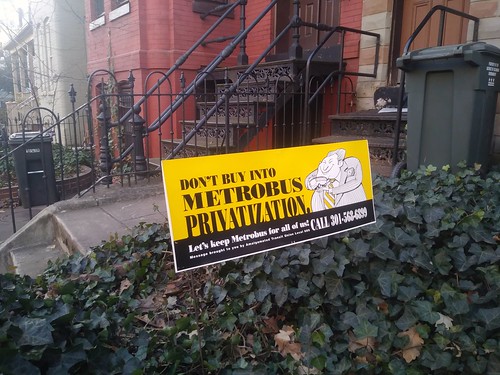
The local transit union is concerned about the potential of Metrobus (WMATA) privatizationIt's something I think about a lot about transit workers, who tend be unionized. In customer facing roles, many transit workers are amazing. But also many are not.

And I always find it funny that transit unions ask for our support when it comes to their contracts, while often as workers serving riders they do stuff that shows minimal respect for the transit rider ("It's a bad idea to treat customers badly and then turn around and ask for their support: transit union workers edition," 2013).

Labels: ,

Saturday, March 03, 2018

Some really good marketing videos that are models of city and/or transit promotion

1.  The American Institute of Architects online video promoting their upcoming 2018 national conference in New York City June 21-23, is a model for a punchy community tourism promotion video.


2.  Similarly, the DC Lottery video is way better than the videos produced by the city agency tasked with promoting the city.


I've been meaning to mention the DC Lottery "Neighborhoods" scratch off cards.  We can argue about the value of a lottery and how most of the players lose out, but promoting various DC neighborhoods (e.g., Capitol Hill) and landmarks on various series of tickets is a good idea.  Plus, in the "losers" drawing, the winner will get $500,000 towards the purchase of a house, which is a great promotional idea.

The program has been promoted through bus livery ads, in various ways in Union Station, and in other venues.  I don't know if the video ad has run on broadcast or cable television, or just online.

3.  Although to be fair, the DC Cool campaign seems to leave me cold ("Washington, DC Launches Yearlong Marketing Campaign with 'DC Cool'," press release).  This older Destination DC ad is better (but still pales against the DC Lottery ad).


4.  Transit agencies generally aren't at the forefront of marketing excellence, in print or broadcast formats.  Frankly, there aren't even a lot of examples of television ads for transit agencies, because commercial media time is so expensive.

But last night I saw an ad (probably via FIOS, and it was on a cable channel, not an over the air broadcast station) for WMATA's new promise that if your train is delayed 15 minutes or more you get a free ride automatically credited to your SmarTrip card, and I thought it was excellent.

-- WMATA Rush Hour Promise webpage

The only thing is, I thought I remembered a man's voice in the ad, and this one features a woman's voice.  I think there are different ads.


Labels: , , , , ,

Friday, October 28, 2016

Maryland MTA interview about public communications

Listening to this Transportation Radio interview with Paul Comfort, CEO of Maryland Transit Administration makes me believe that maybe WMATA hired the wrong transportation executive from Maryland.

Mr. Comfort has a background in radio and broadcasting and is much clued into the value of media and public communications. MTA got a license for a low power FM station to use for MTA public communications and they have a bunch of other initiatives.

 He also expressed the desire to integrate all forms of transit into the CharmCard (a specially branded version of the WMATA SmarTrip card, so that DC and Baltimore area transit systems all use the same fare media--CharmCards work on the DC area transit systems and SmarTrip cards work in Greater Baltimore), including train service, something I discussed in "One big idea: Getting MARC and Metrorail to integrate fares, stations, and marketing systems, using London Overground as an example."

-- Maryland Transit Administration

Labels: , , , ,

Wednesday, December 10, 2014

Maybe the ideal solution for the Silver Spring Transit Center would be to start over

While decrepit today, in its heyday, Detroit's Michigan Central Railroad Station and (18 story) office building was quite majestic.  We aren't building train station complexes like that today.

The Silver Spring Transit Center is nothing short of a debacle ("Cost of Silver Spring Transit Center repairs jumps another $21 million," Washington Post), with construction defects delaying the facility's opening by at least 18 months and drastically escalating the cost, which will be around $150 million.

The SSTC will be a multimodal facility, linking the subway, MARC commuter railroad services, Metrobus, RideOn bus service, intercity bus services, and connections to the Capital Crescent and Metropolitan Branch bicycle trails (but not a bikestation), plus a connection to the proposed Purple Line light rail system which will run east from Bethesda in Montgomery County west to New Carrollton in Prince George's County ("Go big or go home: Prince George's County needs to think big and consider better revitalization examples for New Carrollton).

Washington Post photo of the SSTC by Yue Wu.

Not even getting into all the construction problems, but from the standpoint of civic architecture and urban revitalization ("Transit, stations and placemaking: transit stations as gateways and entrypoints into neighborhoods"), the Silver Spring Transit Center is a serious disappointment.

A failure.

Rather than enhance the architectural, identity, and gateway elements of Silver Spring, instead it is butt ugly, a parking structure on steroids--a terribly missed opportunity to create a grand transit center modeled on the way and harkening back to the period when grand transit facilities--railroad stations--were constructed as urban centerpieces.

Nothing other than lack of vision and a concern for quality prevented Montgomery County from designing "a grand facility" and supporting it with commercial space on the site.

Recently, Anaheim, California ("Gleaming new transportation hub reflects OC's embrace of public transit," Los Angeles Times; "Anaheim's new ARTIC: Icon or eyesore?," Orange County Register) and Rochester, New York ("Touring Rochester's shiny new transit center," Rochester Democrat & Chronicle) opened new multimodal stations that provide a different example.

The Anaheim station was created as a display of noteworthy architecture, while the Rochester Transit Center isn't particularly beautiful on the outside, it still looks better than the SSTC.

Rochester.  The station in Rochester took a long time and had issues ("Learn from mistakes with transit center," RDC), not in construction, but originally the plan was to do a mixed use project with other revenue generating commercial space, but the economics of doing so were not favorable.

Rochester's commercial real estate market has been battered by the decline of Kodak and Xerox, the city's two biggest corporations which once employed many tens of thousands of workers.

Images from the Rochester Democrat & Chronicle.

The station cost $50 million to build and was tied up for decades in squabbling between Republicans and Democrats (Democrats opposed it because former Republican Senator D'Amato came up with seed money).

It's 87,000 square feet and provides indoor waiting areas for riders, not unlike how an inter-city bus terminal is set up, with "gates" where passengers board.  The station has an integrated bus arrival and departure information system.

They aren't providing wi-fi services, don't have restaurants (they direct patrons to nearby businesses) and it's unclear what accommodations are provided for bicycle parking.

Interior of the new Rochester New York Downtown Transit Station.  Image from the transit authority.

Anaheim.  With a grand opening this weekend, and in operation for the past week, the new ARTIC, or Anaheim Regional Transportation Intermodal Center, was built by the Orange County Transportation Authority for the city, as a replacement for the city's existing train station, and integrates bus and other mobility services.  The station will have a number of restaurants and retail shops.

A 120-foot-tall glass wall makes up the entrance of the Anaheim Regional Transportation Intermodal Center. The building has an LED light system that cost effectively allows for the building to be lit at night. Rendering by HOK.

Unlike the SSTC, the ARTIC was designed to project a strong image and identity for the city, which is best known as the home of Disneyland, and secondarily as the home of the Anaheim Ducks professional hockey team.

The 68,000 square foot structure cost $105 million to build, but other costs pushed the total project cost to $190 million, mostly paid for by the transit system, and the intent is for retail rent revenues to cover the annual operations, which will be the responsibility of the City of Anaheim.

The interior of the ARTIC looks like it will be much more interesting than that of the Silver Spring Transit Center, based on this rendering from HOK.  

The idea is that the station would serve as a terminal for high speed rail.  Present-day expectations are for about 8,000 riders to pass through the station each day, using Metrolink, Amtrak (the Pacific Surfliner is a kick-butt regional transit service that is much nicer than the Amtrak regional service in the Northeast corridor), local and regional bus service, inter-city bus, and taxis.

ARTIC at night, lit by a changeable array of LED lights.

The station also has enhanced bike parking, free wi-fi service throughout the complex, and phone stations with extra electric charging capabilities.

Conclusion.  When you're spending more than $100 million on transit infrastructure, you might as well make it attractive rather than utilitarian and ordinary, so that the project will have more and a greater number of benefits to the community beyond providing a roof for transit riders.

The Buffalo Central Terminal was built as the Depression started, and the 17 story office building never did that well financially (similarly the Michigan Central Station was not built in the central business district so there was limited demand for office space in that otherwise majestic station).  But the building looks great.

Labels: , , , , , ,

Wednesday, May 14, 2014

Increased control by the executive branch of any and all external communication by employees

This has been an issue for some time.  In DC, under the Fenty Administration, many of the agencies lost their public information officers, and communications came out of the mayor's office.  This has continued under Mayor Gray, when the director of the Department of the Environment and the Insurance Commissioner were fired because of external communications that the administration didn't like.

I learned this in my brief experience working for government in Baltimore County, when my press releases and certain external communications were handled by the County Executive's press people.

But it's a problem "everywhere," especially because officials don't like counter-information, criticism, etc.  WBEZ Radio in Chicago just ran a story, "Chicago principals say they operate under 'gag order'," about how principals of Chicago schools have a gag order imposed by the Emanuel Administration and some have been reprimanded for speaking out.

This is one of the downsides of Mayoral control of school agencies.  But it's a problem in any case.

"At-will" employees are always at risk of losing their jobs when they don't toe the line. That's why I argued in this past blog entry, "DC Government at-will employees need protections to tell the truth," that local government deserve protections so that they can tell the truth without losing their jobs.

Labels: , , , ,

Friday, September 13, 2013

Transit, stations, and placemaking: stations as entrypoints into neighborhoods

----------------
Note that the introduction and the conclusion have been significantly expanded since this entry was first published.  Hence the change in the publishing date.
----------------

I have been meaning to write about this issue again since I got back from Seattle, but GGW beat me to the punch, with their entry, "Metro stations should be more individual."
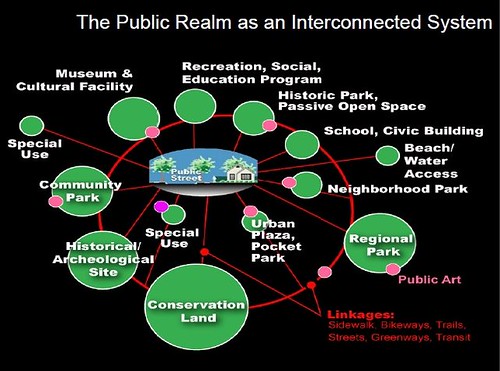
Public Realm as an Interconnected system, Slide from presentation, Leadership and the Role of Parks and Recreation in the New Economy, David BarthAlthough my take is broader and more comprehensive, I agree that Metro stations need to be more grounded in place and that the subway system and its stations need more "localization."

Right: graphic showing the concept of the integrated public realm framework.  David Barth and Carlos Perez, AECOM.

The ideas derive from the concept of an "integrated public realm" (a concept developed by parks planner David Barth) and are captured in this entry, "Arlington County's bus shelters and a public realm framework of quality" plus more generally in the entry "Transit and placemaking," a piece from 2011 which jumps off from issues around the NoMA Station ("NoMA revisited: business planning to develop community") and the suggestion--too late it can't happen because of defects in DC's design and planning regime--of repositioning the ground floor of the NoMA station and the adjacent walkway to an arcade-like environment.

Transit systems are civic architecture, not just conveyances

We should recognize that a transit agency's primary function is to move people--it's a conveyance--while acknowledging the civic role in this function and leveraging stations and stops not just as connection points where riders enter and exit transit vehicles, but that in turn, stations and stops are civic places too, even if that element of transit infrastructure often has been ignored.

In the early part of the last century it was typical for there to be postcards of railroad stations, and these cards communicated the importance and prominence of stations as entrypoints into the city as well as the station's role of bringing people together.

The message on the back of this 1910 postcard of Washington's Union Station is what attracted me to the card , which is otherwise "just one more postcard":  "This is the first thing we hit when we arrived."

Even if local transit systems for the most part aren't fronted by such grand buildings as Union Station in DC, or Grand Central Station in New York City, the 30th Street Station in Philadelphia, etc., today's transit authorities accomplish important functions and are vital to a community and key to local economic development.

-- Hagley Museum Railroad Station Digital Archives
-- Railroad Station Home Page, postcards

The DC subway system was designed to take suburban residents to their jobs in the city

The transit infrastructure was never intended to build and strengthen neighborhoods, nor to enhance the specific places where stations were constructed. It was designed to get suburban commuters into the city to work, and back home in the evening.
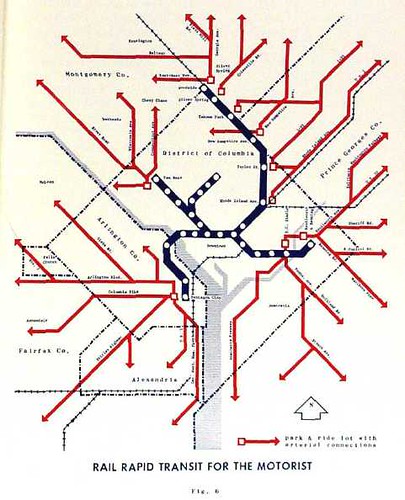
One of the plans for the Washington Subway, 1965
1965 planning map for the Washington subway system.  Note the legend: "Rapid Rail Transit for the Motorist."

Transit stations are the "crossroads" of a neighborhood

What is complicated for a transit agency is that the "meaning" the stations possess isn't solely focused on the transit function and connection.

Stations and stops have meaning within a city or county at multiple scales depending on the nature of the connection: block; neighborhood; neighborhood commercial district; major activity or employment center; district/sector; city; county; metropolitan area; and region.

For the most part, people are concerned with a station or stop in the context of their neighborhood/district.  Stations--railroad, subway, light rail, and maybe streetcars (and some cities have higher level bus-oriented stations too, DC specifically does not)--are the places where  neighborhood and the transit system intersect and come together.  So the station takes on a "crossroads" function, and becomes a neighborhood level public square.

Transit stations in neighborhoods end up being the single most visited public place in that community--more than a post office, library, or school.  

Right: the old streetcar waiting station on 14th Street NW at Colorado Avenue NW.  Wikipedia photo.

But right now, you can't even put in a bulletin board about community events in a Metro Station. On the other hand, station grounds aren't parks either, and a community (this is an issue in Takoma now) shouldn't expect that WMATA manage stations as public parks.

The transit agency has no control over the "meaning" of a station as a key element of a neighborhood's public realm, but they do have a responsibility to acknowledge this role, and should work to satisfy some of those expressed needs that communities have with regard to the station's role as a key civic place and community crossroads.
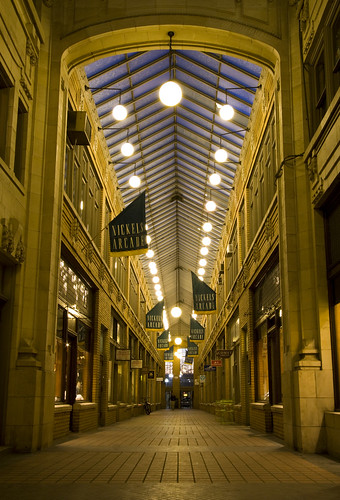
Nickels ArcadeTransit infrastructure as branding and other functions

Wouldn't it be cool if the walkway next to NoMA station had been conceptualized as an arcade?  Left: Nickels Arcade, Ann Arbor.  Flickr photo by FarzinPhoto.

My writing on this topic has focused on transit infrastructure, marketing, and wayfinding in terms of bus stops (my blog entry "Making bus service sexy and more equitable," and these influences, the out-of-print report from Cleveland, Transit Waiting Environments, plus the EMBARQ report, From Here to There: A creative guide to making public transport the way to go) which state that stations and stops are key for two reasons:


Right: graphic from the Wall Street Journal on the amenities associated with the implementation of high quality bus rapid transit services.

1.  Transit infrastructure brands transit: through design, condition, quality, and maintenance, they communicate whether or not a communicate values transit and sustainable mobility, or merely considers transit service to be a social service for the poor.  Modern BRT systems, such as in Cleveland or the York Region of Toronto execute this idea the best.  See "Better bus (rapid transit) service revisited".

2.  Transit stops and stations are key marketing touchpoints: bus stops and shelters not only communicate that transit exists and is available, they provide information that people can use, whether or not they are at the stop.   In general, the opportunity to leverage Metro subway stations to market transit and/or sustainable mobility is mostly wasted.

But this argument continues to expand into a more complete framework:
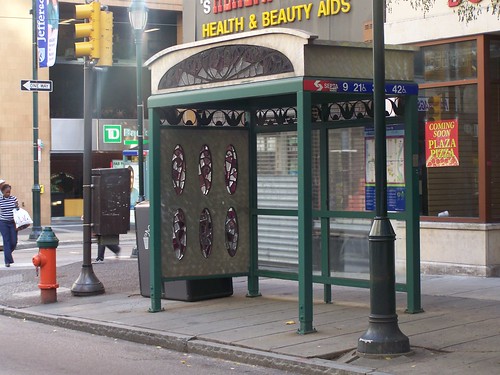
Stained glass bus shelter, Philadelphia3.  Transit stops and stations should better integrate within neighborhoods: since 2006, with the commencement of planning for the implementation of the DC bus shelter contract with Clear Channel, I have made the point that transit shelters can also be utilized and better connected to neighborhoods, through the incorporation of historical information, and/or artistic elements, and/or neighborhood information, and/or retail district information.

Note that most neighborhoods don't have the resources to put information into the bus shelters.  The business improvement districts tend to do this, but I think Adams Morgan BID does the best job locally, although I have to say that the Mount Pleasant merchants group has just introduced similar signage that is even better.


In Baltimore, the MTA does a decent job of providing information within bus shelters.  And the Walnut Street bus shelters in Philadelphia are specifically arty (pictured above).

4.  Transit stops and stations should, when practical, interpret and present transportation-transit history:  the Center City District in Philadelphia does this, and here and there transit systems elsewhere do it to.  Baltimore MTA has interpretational signage in old trolley waiting stations on Charles Street and in Catonsville, and along the light rail.

The transit authority in Lancaster, PA has great interpretive information presented at their main bus station in Downtown.  Back in 2005, Tri-Met in Portland had history panels posted in buses, comparable to ad panels.  The Silver Line "BRT" in Boston has an extensive system of interpretation kiosks.

The F Line heritage streetcar line in San Francisco has history panels for each streetcar posted in a manner comparable to what I remember from Portland.  Etc.

Right: transit history interpretation sign in Lancaster, PA. 

Note that the DC Heritage Trails cultural interpretation signage program includes transit history as part of their presentations on neighborhood history.

And I think that DC could do a great job of providing historical interpretation panels in the existing trolley waiting-turnaround stations on Connecticut Avenue NW and 14th Street NW. 
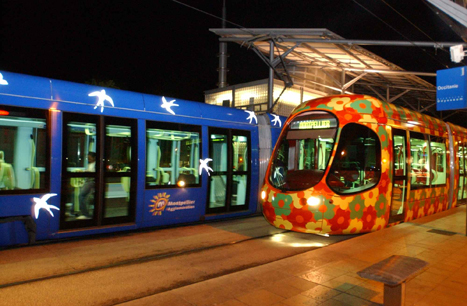
Montpellier France trams, livery design by Christian Lacroix
5.  Transit vehicles can be an element of city/urban design and branding (extending the first point that transit infrastructure brands transit): Montpellier, France, which positions itself as a city committed to being design forward, had Christian Lacroix design the livery of its light rail vehicles ("Design as a city branding strategy").

Right: Image from the website of the local government, the Agglomeration of Montpellier, France.

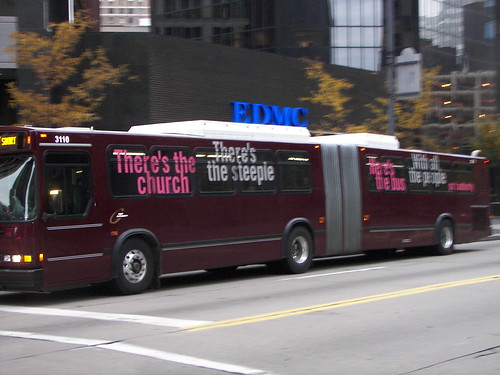
6.  Transit vehicles can be an element of transit marketing: the Pittsburgh bus system probably does the best job of putting messages on buses that promote transit.  But other systems do this as well.  MTA in Baltimore has a great bus with a more "urban-market" message of "Rollin' with MTA."
Port Authority Bus, Pittsburgh
Left:  Port Authority Bus, Pittsburgh, with this ad message:  "There's the church, with the steeple.  Here's the bus, with all the people," making the point that buses carry a lot of people.

WMATA and revisiting transit and placemaking

And with the hullaballoo about WMATA's imperious destruction of independent plantings at the Dupont Circle station ("Metro threatens Phantom Planter with arrest if he tends his Dupont Circle station flowers," "Metro rips out Phantom Planter's flowers at Dupont Circle station" Post), complaints about WMATA's implementing of some interior changes at the Bethesda Station, to make the station more usable, especially in terms of lighting ("Metro Chooses Bethesda Station To Test Future Design Concepts," WUSA-TV), and the negative response by some historic preservation interests ("Past is present: Metro's historic ride" op-ed by the director of the DC Preservation League in the Washington Business Journal), plus my observation of some Sound Transit practices and their contrasting approach of making light rail stations entrypoints to neighborhoods, I thought it would be worth revisiting the topic.
-----
Note I do understand some serious WMATA concerns with regard to safety liability with regard to the plantings at Dupont Circle.

Image of the Henry Docter planting project at Dupont Circle from NBC Washington.

The key issue is that architecturally, the WMATA system evinces all the problems I excoriate in writing about starchitecture.

For the most part, such buildings are more like art and sculpture and the site and building design purposely disconnects and holds at arms length the community and the built environment that lies beyond the lot lines.

-- Docomo webpage on the architectural design of the WMATA system
-- the section of this WMATA case study on architecture covers the issues too, from Metro Cincinnati

Yes, Harry Weese designed the station interiors to be very specific and with a design consistent across the system, with vaulted tunnels, etc. ("Harry Weese, 83, Designer Of Metro System in Washington," obituary, Washington Post).  But the stations were never designed to connect to and enhance neighborhoods or the community outside of the station.  Inside, despite the vaulting they are dark, the concrete looks dingy, etc.

Still, this self-referential internally-focused architectural attitude shapes WMATA's placemaking culture to this day.  In short, there isn't much of a placemaking culture, a recognition that transit stops and stations have a role to play in quality of life.

(Note however with regard to bus stops, except for bus stops on WMATA station sites, bus stop sites are controlled by the local jurisdictions, not WMATA.)

Light Rail Bridge ~ Explored~The light rail bridge in Tempe, Arizona has an architectural lighting treatment.  Flickr photo by Bogmol-Ron.

For example the canopy program for WMATA subway stations could have incorporated site- and neighborhood-specific artistic elements but doesn't.  (I am in the process of writing a proposal to incorporate architectural lighting elements into these canopies.)

But there are other missing elements.
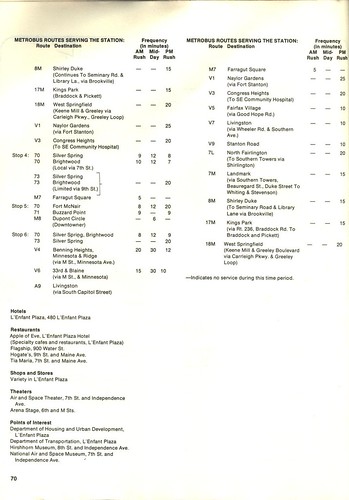
Metro (WMATA) Ride Guide, 1978, L'Enfant Plaza Station Map, page 2 (p. 70)Right: this page from the 1978 WMATA Ride Guide for L'Enfant Plaza Metro Station lists area businesses.

For example, there aren't community information boards at Metro Stations.  Maps at Metro stations don't denote community commercial districts--it's seen as promoting for profit businesses, even though they do show strip shopping centers (but not individual businesses) on station maps in the suburbs. (WMATA doesn't list supermarkets on bus and rail maps either.  Pittsburgh does.)

For the most part, Metro doesn't allow vendors to set up on station grounds (partly this is because the spaces are constrained and they are concerned about unsafe conditions) which can be a placemaking element.  Retail, when potentially viable, hasn't been integrated into stations.  WMATA bus shelters on station grounds don't incorporate advertising, which reduces revenue available for upgrading the bus shelter experience.

Another element is that WMATA could better monetize air rights above station entrances in dense areas, which would provide better conditions upon exiting the station, and potentially could support community uses.  But that is a topic for another entry.

I was shocked that people were shocked that WMATA wasn't supportive of guerrilla gardening at Dupont Circle. WMATA is very much a bureaucratic government organization shaped in very specific ways.  Plus union contracts make it almost impossible for "volunteers" to provide "services" to the system that would otherwise be accomplished by paid workers.  Bottom-up initiatives of any sort are pretty much discouraged.

Sound Transit.  While I didn't take many photos of their light rail stations, there is no question that the Seattle system's light rail stations are more purposefully designed to integrate the transit system and its infrastructure to the neighborhoods in which stations are located.  They are not quite but almost welcome centers to the neighborhoods.

(By contrast STM in Montreal does allow market stores and garden stores to be placed on the grounds of Metro stations.  And in Mont Royal, there is a visitor center on the grounds of the station, but it is not part of the station entrance, it is a separate structure.)

Like the suggestion in the GGW entry, the Sound Transit stations incorporate site-specific art, although it is not as gutsy as the public art program run by Tri-Met in Portland (see "When people don't have experiences, site visits are the way to go") as executed on the Interstate/Yellow Line.

And while not perfect, there is clearly a desire to connect and integrate each station within the neighborhood and its built environment, in support of neighborhood revitalization efforts (the latter has happened for the most part independently of concerted WMATA efforts within DC, with the exception of Petworth, where WMATA sold part of the station property for an apartment complex, and this project has accelerated revitalization on Georgia Avenue in significant ways).

Where this was most evident was at a light rail station under construction on Capitol Hill in Seattle.  From the bus, I had seen "a mural" painted on the fences of a construction site, but didn't think very much about it.

Later, I walked through the area and was able to examine the site in much greater detail.

I was truly surprised to discover that the various art and cultural history interpretation projects displayed on the walls were part of the light rail construction site.  It was authorized and encouraged by Sound Transit!  I don't think this would ever happen with WMATA.

Conclusion

Not reaping the value of transit infrastructure in placemaking and revitalization significantly reduces the ROI (return on investment) and multiplicative development power that a transit network can provide--as proven by the success of transit-oriented and transit-adjacent development in DC and Arlington County--which in many respects has been happenstance in DC and more purposefully achieved in Arlington.

I do believe that if we begin to define overtly the civic role of transit infrastructure in terms of architecture, connection, and the public realm, than it becomes easier for a transit authority to acknowledge its importance and incorporate achievement of civic functions within the organization's planning goals and objectives.

At the same time we have to recognize that the foremost function of a transit agency is its role as a mover of people to and from various places around the metropolitan area.

To finance the incorporation of civic functions within transit infrastructure, especially stations, perhaps non-transit fund sources are required.

Left: image by Jared Angle of the Silver Spring Transit Center.  From the WAMU-Radio story "Leggett Remains 'Optimistic' About Silver Spring Transit Center."

At the same time, localities have to acknowledge that transit infrastructure has broader roles, as branding, as community crossroads, and they shouldn't try to value engineer and cheapen every possible element of it, in particular how it looks.

A good example is the Silver Spring Transit Center.  Irrespective of all the construction defects and the contentious process involved in trying to fix them ("Foulger-Pratt: county fixes for Silver Spring transit center ill advised," Gazette), the station was never designed to be very attractive.  It's just a big ugly parking garage for buses.

But some cities, Staunton, Virginia (parking garage, left), Lancaster, Pennsylvania, and others to make their public parking structures attractive.

Also, the Red Rose Transit Authority in Lancaster County, Pennsylvania created the Queen Street Station, which is also much more attractive than a typical bus station.

On the other hand, the Lancaster station accommodates significantly less bus traffic than is required in Silver Spring, so it is much easier for them to lessen negative impacts (buses are big and noisy) and take on a smaller footprint.

Still, it is unfortunate that Montgomery County didn't take more care to make the Transit Center more attractive, commensurate with its role as key civic architectural element of one of the county's major conurbations. 

With regard to WMATA, in order for things to change, we have to better articulate what the issues are.  This entry is a step forward toward such a discussion.

Sound Transit Photos

King County Metro doesn't have advertising in bus shelters.  But they do allow the shelters to incorporate locally produced art.  Often the drawings are related to the neighborhood in which the shelter is located.  In addition the glass panels of the shelters have an artistic treatment.
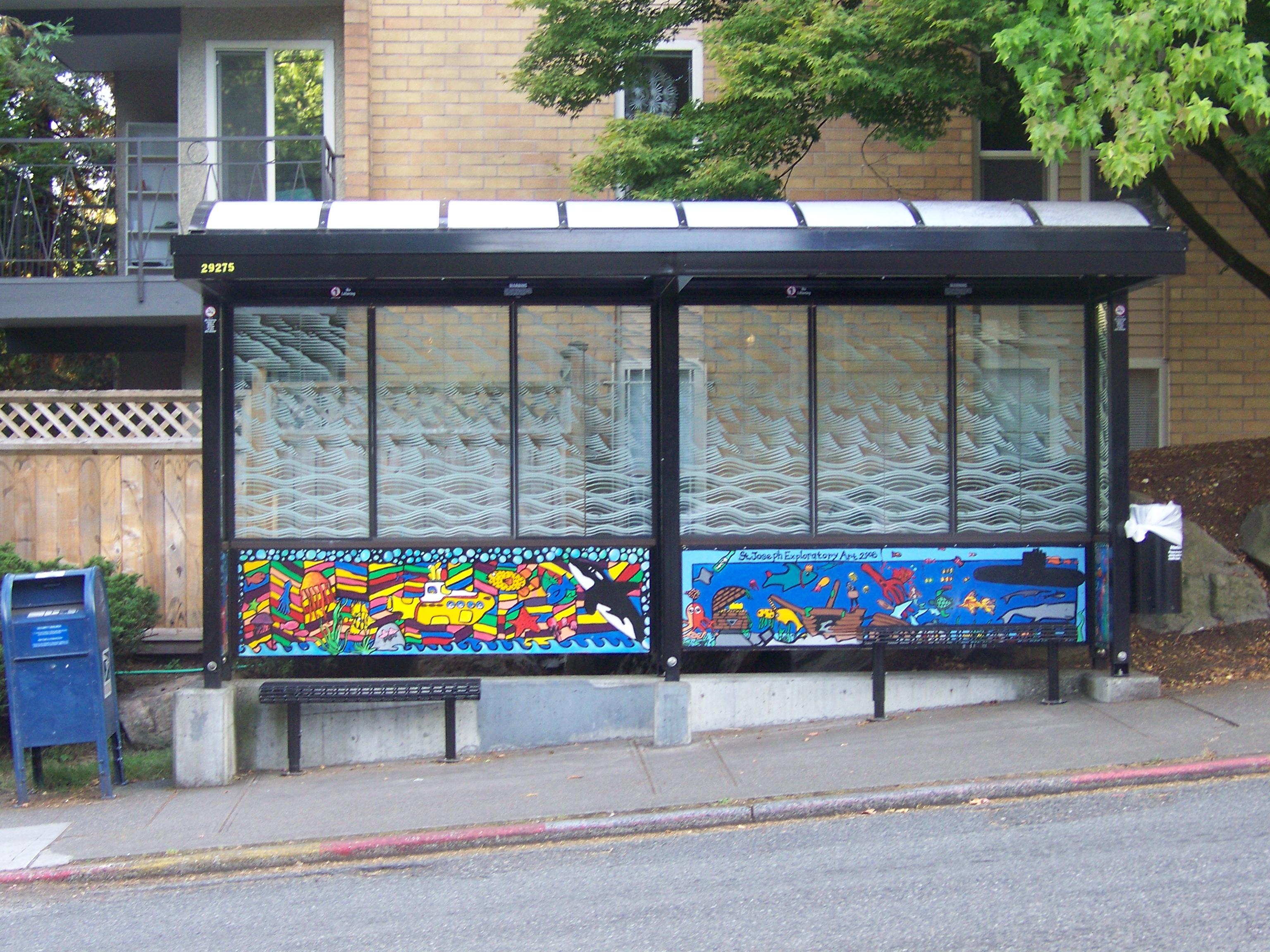
Capitol Hill, Seattle bus shelter with local art, King County Metro transit

Exterior, Beacon Hill Light Rail Station, Seattle.  The bus shelter incorporates public art.  Artistic panel stamping is visible in the sidewalk.  Guidons reflect a textile theme, which is incorporated in an art work on the station walls, and were based on textiles provided by area residents during the station design process.
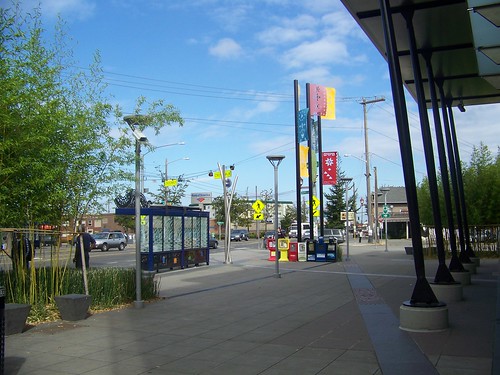
Public art and bus shelter,  Beacon Hill Station, Sound Transit light rail

The Beacon Hill Station also has site-specific plantings.  (cf. the Dupont Circle Station debacle.)  Granted they are maintained by the transit authority.
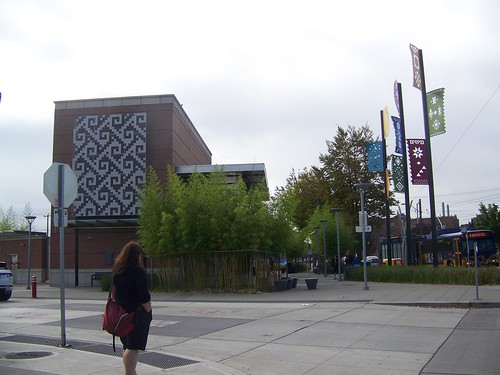
Beacon Hill Station, Sound Transit light rail, public art, plantings

While this tourist wayfinding kiosk in Seattle was not produced by Sound Transit, this kiosk has also been installed at some light rail stations, providing information to tourists.  (MTA's light rail stations in Baltimore no longer have accurate area maps posted at the stations.)
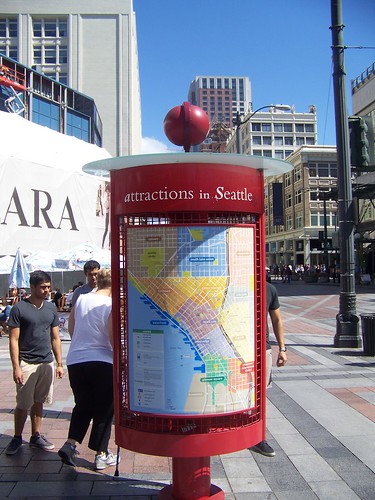
Attractions wayfinding map, Downtown Seattle

Mural on construction walls at the Capitol Hill light rail station site.  It's not even the most arresting of the murals painted there, but I can't seem to find/maybe I deleted the photo of the most astonishing of the murals.
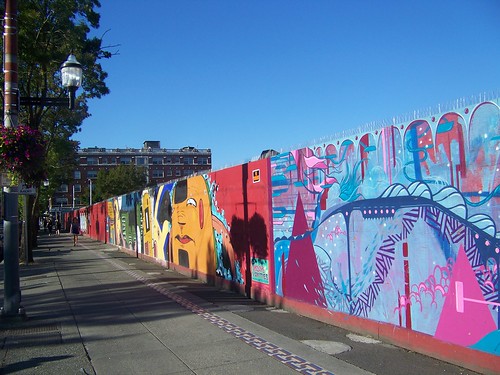
Murals on construction walls, Capitol Hill Station site, Sound Transit light rail, Seattle

A mural element listing qualities that Seattleites identify with.
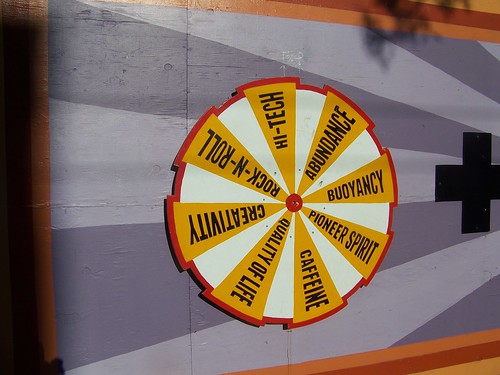
Mural, Capitol Hill Station site, Sound Transit light rail, Seattle

Panels on the neighborhood's history and Seattle's development over time, at the Capitol Hill light rail construction site.
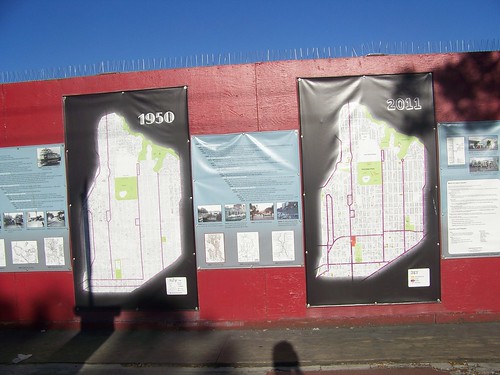
Historic-cultural information, Capitol Hill Station site, Sound Transit light rail, Seattle

One construction mitigation tactic is the support of a local information website, and advertising its existence in a panel on the construction site wall.
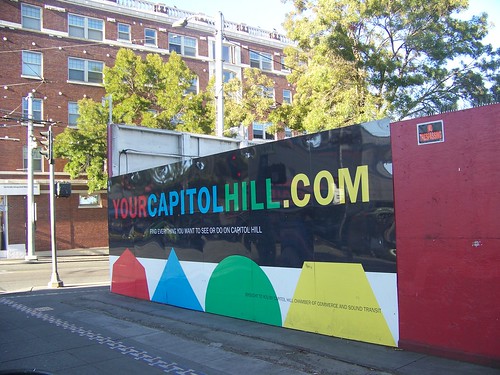
YourCapitolHill.Com sign, Capitol Hill Station site, Sound Transit light rail, Seattle

Ironically, given the recent WMATA experience with plantings, one of the exhibits on the construction walls explains how to use wooden pallets to do vertical gardening.
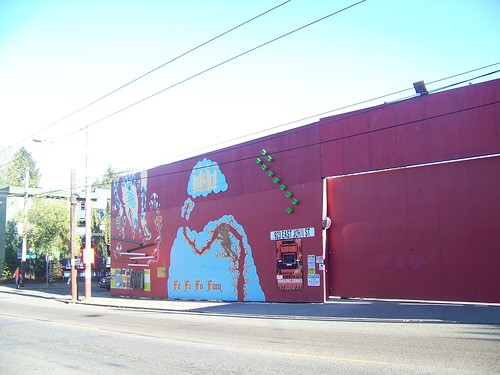
Murals and art installations, Capitol Hill Station site, Sound Transit light rail, Seattle

Note that Sound Transit's logo is imprinted on the information panels.
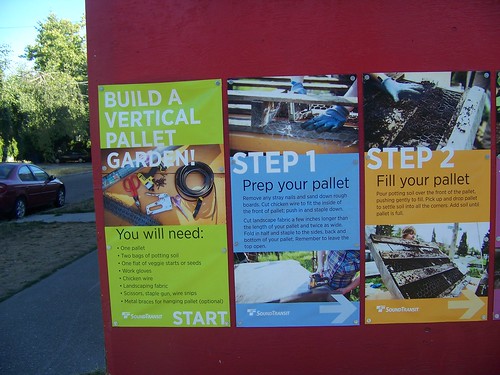
Art presentation on vertical planting, Capitol Hill Station site, Sound Transit light rail, Seattle


Labels: , , , , , ,

Thursday, September 12, 2013

Development hearings: public notice postings in Seattle

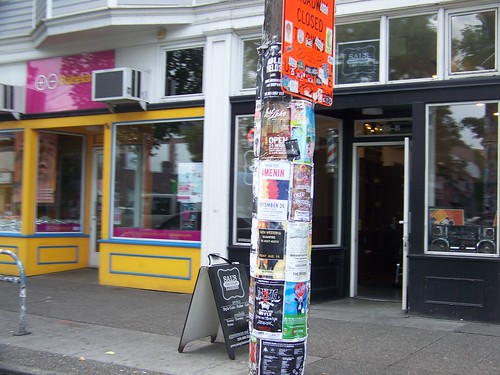
One of the great things about DC in the core is that utilities are underground, which means that there aren't "telephone" poles on the street. However, in Seattle, utility poles function as a media presentation method. 
Telephone/utility pole in Seattle, plastered with posters
Not unlike how kiosks do on the University of Michigan campus in Ann Arbor, or how in DC movie posters are often plastered on vacant storefronts on streets like Georgia Avenue NW.  (There is a kiosk at 18th Street and Columbia Road NW in Adams Morgan where such posters are similarly displayed.)

But in Seattle, in key neighborhood commercial districts, it seems as if every telephone pole is so adorned.

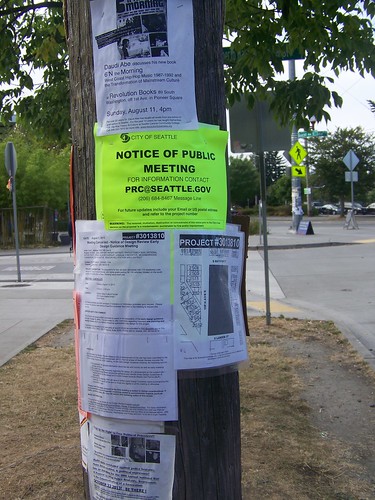
And the Seattle Planning Department respects and employs this method too, to post public notices in places other than on specific buildings, about upcoming zoning and development review hearings.
Seattle Planning Department posts development hearing notices in public places

This isn't the only potential method. Other cities, including Seattle, but Montgomery County does it too, use big signs, in language that people can understand. DC's system of public notices is more circumspect. (Again, related to the previous post, a community information board at subway stations could be used to display this kind of information.)

Labels: , , , , ,

Friday, September 04, 2009

Damned if you do, damned if you don't

WMATA ad in the Express, on subway closures, 9/3/2009
Back page ad in the Express, 9/3/2009.

The hullaballoo over the under-promoted closure of the yellow and blue subway lines between Pentagon and National Airport stations this weekend is interesting because for those of us on the red line, we experienced this for two weekends in August. (On this weekend's closure, see "Board Raps Metro Over Holiday Closure Notice " and "'Next Time Around, We'll Do It Better' : Metro Aims to Avoid Future Closure Flaps" from the Post.)

Hey, I missed initial notice of the red line closure myself, and we ended up taking one of the "express" buses from Union Station to Takoma. But the impact of that closure, a break in the line, had to be much more significant than what will happen this weekend. And there is no question that WMATA throws a lot of buses into these shuttle efforts.

While these kinds of closures for maintenance should be announced far earlier in advance for people to plan, with signs in all the stations for at least one week in advance, some people won't end up knowing until that day, when their plans go awry.

Signs in all the stations on the system with advance announcements would definitely be a step forward.

Ads that week in the Examiner and the Express aren't probably that helpful because hundreds of thousands of people don't bother to read these papers, even if they are distributed at subway stations.

And at least the maintenance is being done during relatively low use periods, although this wasn't necessarily the case with one of the days that the red line was "broken" last month.

Labels: , , ,