Rebuilding Place in the Urban Space

"A community’s physical form, rather than its land uses, is its most intrinsic and enduring characteristic." [Katz, EPA] This blog focuses on place and placemaking and all that makes it work--historic preservation, urban design, transportation, asset-based community development, arts & cultural development, commercial district revitalization, tourism & destination development, and quality of life advocacy--along with doses of civic engagement and good governance watchdogging.

Friday, July 19, 2013

Piling on City Council for Walmart

DC recently passed legislation forcing large big box retailers to pay higher wages. The bill is focused on Walmart, which has plans for 6 stores in the city, but the legislation applies to other stores as well. Three of the stores are underway and the stores not currently being built would not be, according to Walmart, if the law is upheld.

Now I wasn't in favor of the law because it was misdirected. I prefer to see the city pass a comprehensive big box review ordinance that would focus on urban form, development, and other elements.

Left: Walmart was a sponsor of last September's H Street Festival and at their booth they were gathering names of supporters for their entry into the city.

What gets me about the campaign by Walmart, and now I understand why they have been organizing continuously since they began the process (see "If you don't know urban political theory, it's likely that you don't understand local land use: St. Louis: DC; etc."), in order to be able to ward off efforts such as this, is that "the other side" hasn't been articulate about Walmart's two biggest weaknesses.

1. In virtually every consumer satisfaction study, on every element except price*, they are ranked very low (see "Who's right about Wal-Mart's customer satisfaction?" from MSN Money).

2. The way that Walmart treats non-managerial staff is horrid, horrid, horrid, at least according to this series of articles from Gawker (e.g., "Life at Wal-mart, Vol. 3: Welcome to Hell").  Also see "Wal-Mart Relies On Taxpayers To Subsidize Low Wages" from Business Insider.

3.  Related to both customer satisfaction and labor treatment-management, Wal-mart's primary priority is managing for stock price, and in the face of sales drops they have been continuing to cut labor, about 50 people per store.  This has resulted in highly significant levels of "out-of-stocks" on the weekends ("Customers Flee Wal-Mart Empty Shelves for Target, Costco" from Bloomberg).

Why would we want to roll out a red carpet for such a company's entry into DC?

Anyway, Walmart continues to gather support, according to this article, "Major retailers urge Gray veto of living wage bill, threaten to table expansion plans," from the Washington Business Journal. From the article:

A half-dozen major retailers have signed a letter to D.C. Mayor Vincent Gray urging him to veto the large retailer living wage bill, threatening to "revisit" expansion plans if the legislation is enacted.

Here's the irony about this statement. Walgreen's and Autozone stores are small, they will never be subject to the legislation. Macy's is not likely to ever open a second store in DC, maybe a Bloomingdales, but probably not. Neither Target nor Home Depot is likely to open a second store in DC. Lowe's has been listed as coming to the city, probably, to a development on New York Avenue.

And the companies are not in the business of wanting to ever help Walmart.

But the companies must be so against local regulations concerning labor relations and wages that they would join forces, with concern that such regulations could end up being extended to other types of businesses.

I even saw an on-air broadcast editorial in favor of Walmart on the wage bill issue, on Fox5 (WTTG-TV).  I've never seen them do an on-air broadcast editorial--maybe they do them all the time and I just am never watching at the right time? 

Walmart plays very hard ball, as I wrote about last year, about how they successfully got a big box review ordinance overturned in San Diego, and I expect they are likely to win on this issue in DC.

* There is a report from Zenith Management Consulting, How To Exploit Wal-Mart's Weaknesses, that makes the point that the reality is that only 20% of the products that Walmart sells are significantly less than the prices at other retailers.

But they use these products as a way to shape a consumer's overall impression about Walmart as always being the lowest priced store.  From the piece:

• Wal-Mart’s business model is not really low-price, it is creating perceptions that
prices are lower than they really are.
• All retail customers have five core needs that must be met.
• Low prices matter more to consumers because they think Wal-Mart’s are so much lower.
• Consumers forgive Wal-Mart’s poor quality, service, and convenience because they think Wal-Mart’s prices are so low.
Consumers who shop at Wal-Mart become caught in a self-reinforcing loop that makes them keep shopping there.
• Wal-Mart’s buying practices injure its vendors.
• Wal-Mart actually serves well only one stakeholder group: shareholders.
• Wal-Mart’s great weakness is that it serves poorly four out of five stakeholders.
• Wal-Mart is so successful nonetheless because it creates perceptions that it is actually serving all its stakeholders well.
• The only way to recapture market share from Wal-Mart is to interfere with the
mis-perceptions.
• This cannot be done by individual organizations, but must involve groups of
organizations acting together.
 --
Walmart's total sales include 55% grocery sales ("Walmart's Grocery Segment Accounts for 55% of U.S. Sales" from Retail Leader; "Wal-Mart Fattens Up On Poor America With 25% Of U.S. Grocery Sales" from Forbes).  And because people eat every day, food purchases drive a lot of store traffic.

One of the company's campaigns is price comparisons ("Walmart Gets a Boost From Local Price-Comparison Ads" from Advertising Age), which they have been running in this market.  The ads typically cherry pick products for the comparison and they go head-to-head with the company that they are most likely to compete with--in this case, Giant Supermarkets.

In some other markets, supermarkets like Publix ("Publix swats back in Walmart price war" from the Tampa Tribune) and HEB ("H-E-B beats Wal-Mart on advertised claim of big savings" from the Houston Chronicle) have successfully run counter-advertising ("interfering with the mis-perceptions") that has led Walmart to back off on the campaign in those markets, because these companies can successfully compete.

Labels: , , , , , ,

Wednesday, June 12, 2013

The reason why Walmart is committed to a store that is part of a mixed use project at 1st and New Jersey Avenue NW in Washington DC

Because elsewhere in the building, the company will be housing its Washington, DC-based lobbying operation.

They want to show that they are "urban."  Even though only 2 of the 6 DC Walmarts will be in vertical mixed use projects.

Because "seeing is believing," Walmart will have the upper hand with elected officials vis-a-vis local communities, when the company says it is committed to fitting in to urban locations.

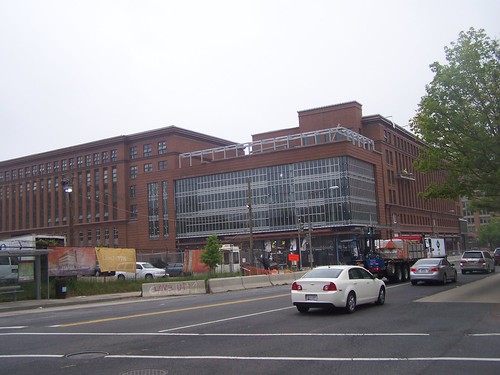
The building under construction at 1st and New Jersey Avenue NW, Washington DC
the new mixed use building, including a Walmart, at 1st and New Jersey Avenue NW

Labels: , , , , ,

Saturday, January 29, 2011

"Learning" the wrong lesson is always dangerous and contributes to failure

20+ years ago I worked for the Center for Science for the Public Interest on publishing and communications. One of the first projects I worked on was the compilation and publication of a short booklet on the presence of a potential carcinogen in alcoholic beverages, and promoted it through a press release and subsequent press mentions. We sold a few thousand copies, which was pretty good.

While I thought of the publication as a policy document, about what FDA and BATF weren't doing, comparing them to the actions of the Canadian health authorities, etc., the report also had a list of various alcoholic beverages and the test results, for maybe 1,000+ items (I don't remember the number).

The reality is that the booklet sold as a kind of "self-help" report. People didn't care about the policy. They wanted to know if alcoholic beverages that they bought contained the potential carcinogen.

I had to learn the real reason why people bought the publication, in order to better understand the market for health information, and from that experience (the point about what the report really was about in the eyes of the purchaser was made by the then newsletter editor, we were talking over the lunchroom table), I began to build a framework for understanding CSPI's position in niche publishing.

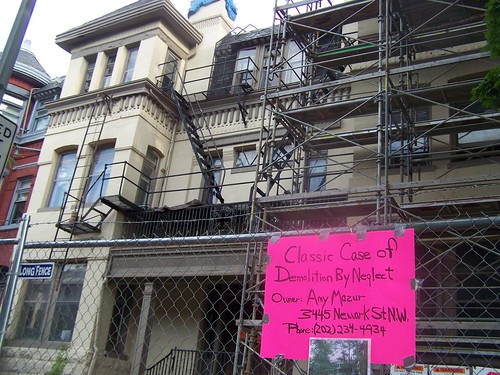
2. Similarly, a little more than one year ago, I ran into a fairly well known older politico type (an unsuccessful Council candidate who now has a well paying job for DC Government) and he commented about an entry I had written about a Dupont Circle historic preservation battle about a property and its "demolition by neglect."
1841 16th Street NW, Demolition by Neglect

He says, "you know why they won, don't you? I said, "you tell me." "Because they protested." (There was a protest. I don't have photos. It was covered in GGW I think.)

"No," I said. "They won because it's a designated neighborhood, so they have legal protections in place, so that when they protested, there were remedies and actions that could be taken to get them the result that they want." I then countered with an example in the Eckington neighborhood, where an 1880s (?) farmhouse had been demolished, when it too could have been rehabilitated, had the legal requirements been in place.

People don't seem to understand that when the law backs you, you can win. When it doesn't, it's very difficult to succeed, especially when your opponents are well financed.

3. This is relevant because of the Walmart issue. A lot of people think they can protest and through the "will of the people" (e.g., "we shall overcome") that Walmart can be vanquished, especially because this week, Walmart backed down on their plans to build a store on a Civil War battlefield (see "Wal-Mart drops Orange County battlefield store plans" and "Battlefield Walmart issue heads to court" from the Richmond Times-Dispatch).

I patiently tried to explain that this was a zoning issue. That people with standing (residents within a certain distance, with the support of the National Trust for Historic Preservation) sued the County to overturn the decision, based on the argument that the decisionmaking process was faulty. Note that the group didn't oppose Walmart generally, just their plans for that particular site.

As the case went to trial, Walmart backed down, and withdrew their plans for the site. From the first article:

"We just felt it was the right thing to do," said William C. Wertz, a spokesman for the Arkansas retailer. He said the company would seek another location in Orange County and compensate the county for its expenses in defending its decision to approve the store.

An industry analyst said Wal-Mart's decision was based on "practical business reasons" and harks back to founder Sam Walton's credo that Wal-Mart should never build a store where it isn't wanted.

Burt P. Flickinger III of Strategic Resource Group said it is rare for Wal-Mart to back away from a store once it has researched a location and settled on a site. But they may have wanted to avoid a continuing public relations hit at a time of disappointing sales and increased competition. "To the company's credit they decided to do something different," said Flickinger, who said he is a Wal-Mart shareholder.


Some people say again, it's because of the will of the people.

I think instead that the opponents had a good case, and rather than lose in court, especially because people weren't opposing Walmart's presence in the county, just on that particular site, they withdrew, because Walmart doesn't want to lose public and prominent battles, because that further arms opponents elsewhere.

Again, know what is going on, and understand it, before immediately deciding that something that happened somewhere, without really understanding what happened, bolsters your position.

4. Again, another Walmart example is the recent announcement by Walmart that they will be improving the healthful aspects of their foods ("Wal-Mart Plans to Make Its House Brand Healthier" from the New York Times).

I saw some article somewhere that asked why would Walmart actually follow through and implement what they said on this issue, because Walmart is known to be under ethical on labor issues, such as the case about systematic discrimination against women ("Lawyers Warned Wal-Mart of Risks Years Before Bias Suit" from the New York Times).

I responded that the writer missed the point. Walmart doesn't make "ethical" decisions. They make "business" decisions. Walmart made a business decision to improve the nutritional quality of their foods for business reasons -- to improve their competitive position, for public relations value, to build relationships with the First Lady, to increase sales. They will follow through.

Similarly, it was a "business" decision to reduce labor costs, hence allegedly discriminatory treatment of women.

The decisions were consistent, both are decisions about how to conduct their business, nothing more, nothing less.

Labels: , , , ,

Friday, September 04, 2009

Damned if you do, damned if you don't

WMATA ad in the Express, on subway closures, 9/3/2009
Back page ad in the Express, 9/3/2009.

The hullaballoo over the under-promoted closure of the yellow and blue subway lines between Pentagon and National Airport stations this weekend is interesting because for those of us on the red line, we experienced this for two weekends in August. (On this weekend's closure, see "Board Raps Metro Over Holiday Closure Notice " and "'Next Time Around, We'll Do It Better' : Metro Aims to Avoid Future Closure Flaps" from the Post.)

Hey, I missed initial notice of the red line closure myself, and we ended up taking one of the "express" buses from Union Station to Takoma. But the impact of that closure, a break in the line, had to be much more significant than what will happen this weekend. And there is no question that WMATA throws a lot of buses into these shuttle efforts.

While these kinds of closures for maintenance should be announced far earlier in advance for people to plan, with signs in all the stations for at least one week in advance, some people won't end up knowing until that day, when their plans go awry.

Signs in all the stations on the system with advance announcements would definitely be a step forward.

Ads that week in the Examiner and the Express aren't probably that helpful because hundreds of thousands of people don't bother to read these papers, even if they are distributed at subway stations.

And at least the maintenance is being done during relatively low use periods, although this wasn't necessarily the case with one of the days that the red line was "broken" last month.

Labels: , , ,