Rebuilding Place in the Urban Space

"A community’s physical form, rather than its land uses, is its most intrinsic and enduring characteristic." [Katz, EPA] This blog focuses on place and placemaking and all that makes it work--historic preservation, urban design, transportation, asset-based community development, arts & cultural development, commercial district revitalization, tourism & destination development, and quality of life advocacy--along with doses of civic engagement and good governance watchdogging.

Wednesday, June 12, 2013

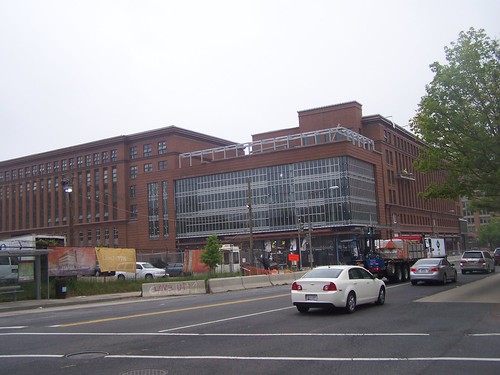
The reason why Walmart is committed to a store that is part of a mixed use project at 1st and New Jersey Avenue NW in Washington DC

Because elsewhere in the building, the company will be housing its Washington, DC-based lobbying operation.

They want to show that they are "urban."  Even though only 2 of the 6 DC Walmarts will be in vertical mixed use projects.

Because "seeing is believing," Walmart will have the upper hand with elected officials vis-a-vis local communities, when the company says it is committed to fitting in to urban locations.

The building under construction at 1st and New Jersey Avenue NW, Washington DC
the new mixed use building, including a Walmart, at 1st and New Jersey Avenue NW

Labels: , , , , ,

Wednesday, April 24, 2013

Separated uses can make sense in some situations

A big plank of libertarian thinking is that land use regulation is bad, that property owners ought to be able to proceed unfettered.  That means that you can put a gas station next to a house, or a school next to a fertilizer plant, even if it isn't a good idea.

Mostly, office, retail and residential can be mixed.  Universities and clean research facilities too.  Maybe even nuclear processing facilities ("Toronto residents shocked by local uranium facility" from the Toronto Star).

Probably not power plants, because the emissions have negative health impacts on some (this is an issue in DC, with a power generation plant owned by the US Congress, see "Use of coal in Capitol plant draws protesters" from the Washington Times").

Even hospitals, although their sprawling nature ("Gazette) and the fact that the high pitched sirens of ambulances going to emergency rooms can be piercing and negative in the context of "quiet enjoyment" of residential living.


But it's not a good idea to put housing and schools by fertilizer plants, chemical plants, and other "dirty" and dangerous industrial uses, as the West, Texas fertilizer plant explosion indicates.

Image from Daily Kos


And minimal and dis-coordinated regulation doesn't help (not unlike the same problem with delegating the regulation of so-called compounding pharmacies to the states).

 See "Fertilizer-Storage Risk Is Often Overlooked" and "Deadly Explosion Prompts Fresh Look at Regulation" from the Wall Street Journal.

Labels: , ,

Sunday, December 04, 2011

Role of the civic in local land use planning, building regulation and public space

As a continuation of the arguments in the recent blog entry "The DC Central Library, the Civic identity and the public realm," which was produced in response to the DC Public Library's planning initiative designed to promote the idea that the Martin Luther King Central library downtown could also incorporate for-rent at market rates commercial office space--justified to pay for the building's necessary renovations and improvements--I have been thinking about the waterfront revitalization effort in Alexandria, Virginia, and then the Los Angeles Times has an interesting opinion piece about when advertising is too much in the public space, "Billboards and parks don't mix; Yes, L.A. needs new revenue: But its people need open spaces to play and relax, free from ads," which is also relevant to the Washington City Paper piece, "Not in My Condo's Backyard!."

The Washington Post has run a number of articles about planning for revitalization of the Alexandria waterfront. (The Post also has a financial interest in this, in that their old newsprint warehouse is slated for redevelopment. They have disclosed this in their reporting, although their financial interest likely slowed coverage of the issue in earlier stages.)

Basically, the City proposes a plan heavy on commercial activity ("In Old Town, planners look to the future with sensitivity to the past"). A resident group proposes more park and civic activity ("Alexandria asked to ban waterfront high-rise hotels" Citizens for an Alternative Alexandria Waterfront Plan) and the city says that the resident plan won't generate enough revenue to pay for improvements ("City officials reject alternative Alexandria waterfront plan").

There are many reasons to promote change at the waterfront in Alexandria. In part, there isn't much public access to it. The city needs more property tax revenue. And there are fears that the new mixed use development "National Harbor," across the river in Prince George's County, will siphon off customers-patrons, so there is a felt need to respond with improvements to Alexandria's competitive positioning and offer.

A letter to the editor in the Friday Post, "A compromise plan for the Alexandria waterfront" ends its argument with this point:

There are those who believe Old Town must compete with National Harbor, but Old Town is not National Harbor. There are many National Harbors around the country; there is only one Old Town. We should stick to our knitting. This is our time to stand up so that, generations from now, there will still be an Old Town Alexandria.

That's an important point, that communities need to figure out what their competitive advantages are and strengthen them, rather than degrade them.

(Note too that the Anacostia Community Museum has a waterfronts revitalization study initiative going on currently.)

One "problem" with a waterfront being completely "parked" is that if the waterfront is located some distance from the community's commercial and residential areas, the waterfront becomes kind of disconnected from the community. I feel that way about much of the Potomac River waterfront as it lies within DC--because it is on the absolute western edge of the city, it lies far away from most of the residential and commercial precincts of the city, and residents don't get over their very much.

On the other hand, much of the Lake Michigan waterfront in Chicago is completely parked, although the design is more active than passive, including various civic attractions (museums, Navy Pier, etc.) and bike and walking paths, and because much of the Lake Michigan Waterfront is close to downtown or neighborhoods, and there are many entry points, their, the waterfront is actively used.

But these days, communities are pretty much broke and unable to fund grand civic visions, ventures, and ideas, so instead they look to integrate commercial activities into various initiatives--waterfront, park, neighborhoods, downtowns--to pay for revitalization programs and other activities.

This week's Current newspaper lead editorial is in favor of co-locating commercial office space into an expanded MLK Library.

I understand that in a society that no longer reveres the role of the civic and civil society there is a belief that commercial activity is somehow better and more exalted than government activities.

But at the very least, I would expect that certain anchor type civic assets should be maintained in a manner that promotes civil society and the place of local government within the activity of a community.

Certainly the main branch of the public library, along with the City Hall, and the courts buildings, would have to be considered key buildings/civic assets to be held inviolate from "mixing" substantively with commercial activities.

I mention the library because the issue of how a community should reuse/ integrate/ revitalize its civic assets--be they waterfronts or libraries--and the question of "how much is enough" in terms of community/civic uses vs. commercial uses, is an issue fully relevant to DC in terms of both the management of historic assets and the management of community-civic assets more generally.

The LA Times opinion piece, while focused on advertising, starkly defines the issue as a city up for bid versus a community out of touch with today's opportunities:

Los Angeles' civic argument over billboards covers many nuanced positions and attitudes, but stripped to the bare essentials, it often seems to come down to these two competing worldviews:

One side sees Los Angeles as a city up for bid. It sees advertisers ready to cover every public space with garish billboards -- lighted, digitized, turning every commute to work and every drive to the grocery store into a succession of pitches for movies, cut-rate cognac and liposuction.

It sees city officials only too happy to accept campaign donations from sign companies, and only too eager to return the favor by presenting a city full of captive consumers. It sees a concerted effort by commercial interests and elected officials to sell Los Angeles on the cheap as one giant billboard ...

The other side sees Los Angeles as a city strangled by an outmoded self-image of quiet bedroom neighborhoods, a city of aging fussbudget suburbanites unhappy with a younger, hipper population of more recent arrivals from Eastern states and a multitude of nations, people who carry with them a different notion of urban sophistication. It sees a city squandering its potential as the world's entertainment and communications capital, as well as its opportunity to reap the financial benefits of a huge audience of car and bus commuters. And it sees a city with failing streets, cracked sidewalks and breaking pipes whose residents complain about decline yet won't tax themselves to raise the money needed to put things back together -- but who will scold elected officials for not finding enough new alternative revenue sources.


The desperation for money and expedience and the limited options makes public officials much more willing to do "public-private partnerships" that commodify public space and/or lease out civic assets on the cheap, for what seems like a large upfront payment, even though this comes at a huge long term cost.

Labels: , , , , , , , ,

Saturday, November 19, 2011

The DC Central Library, the Civic identity and the public realm

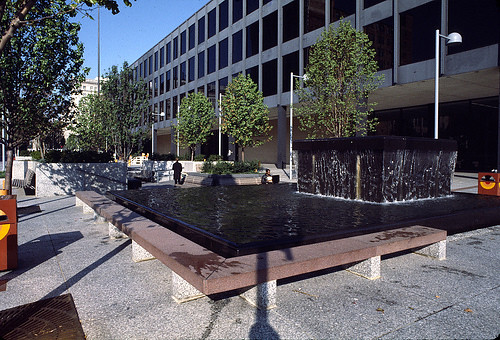
Pedestrian mall, Martin Luther King Library, DC
DC's Martin Luther King Library back in the day...

Is a trying issue because the building was designed to be an office building, not a library, and it was designed in a way that would be very expensive to maintain, in a manner that local governments aren't typically capable of managing, not unlike the failure of the City of Tampa to maintain a famed open space designed by landscape architect Dan Kiley (see "The Life and Death of a Masterpiece: What went wrong with a 1988 park by the late Dan Kiley, and what can we learn from its imminent demolition?" from Landscape Architecture).

Even though the North Carolina National Bank Plaza was designed by a master, masters don't always create practical projects. From the article:
From modern masterpiece of landscape architecture to ruin, from a public/private civic asset to a blight on downtown Tampa, how did this place devolve? That there was a major failure of maintenance is not in doubt. But was inappropriate design also a factor? Were the park's hardscape features—pools, canal, runnels, fountains—overdesigned? Given the site conditions, were the plantings too dense or the wrong species? Did they require an unreasonable amount of maintenance? Was responsibility for maintenance vague, divided, or unspecified? Was the park too ambitious for downtown Tampa? Was it doomed from the outset because of constraints imposed by its location? Or by inevitable changes that would follow in a city in need of revitalization? And who is to blame for failure: the designers, their clients, the city, or all three?
In the case of the Kiley park in Tampa (also see "Renowned architect restores Tampa's famed Kiley Gardens" from the St. Petersburg Times), all of these problems--overambitious design, problems with execution, problems with maintenance, and the role of the public realm and the civic in increasingly privatized spaces--come up in the consideration of DC's Central Library.

The presentation yesterday by the ULI panel (Powerpoint, "Can the Martin Luther King Library be shared?" by Mike DeBonis of the Washington Post and "Panel suggests options for reviving MLK library" in today's Post) was fine, but for people who have been involved in the issue of the library for awhile, what the ULI panel thought of as "the beginning of a conversation" is in fact 11 years into the conversation, and like the terms of the engagement for the ULI panel, too often this conversation has been one-sided, amongst the DC Library Board of Trustees and their fellow Growth Machine friends and stakeholders, and not so much with "the community."


The one thing I learned from the presentation yesterday is that the ULI engagement was kind of a setup. The reason that the library has made the statement that it only needs 225,000 square feet, is that the Library building as it is now is larger than that, and has the capability of being expanded further, by adding floors.

This sets up a scenario for either selling the building, and "rightsizing" in a new library or for expanding the library but renting a considerable amount of space to rent paying tenants and in all likelihood the tenants would be trade associations, law firms, and the like--the typical tenants in DC's downtown office buildings today.

Sure people in the audience thought that co-locating nonprofit and arts tenants might make sense, but those kinds of tenants can't pay market rental prices ($50 to $75/square foot).

Unlike what I say in my quote in the Post article:

“You got the Verizon Center, you have the museums . . . you have the convention center. There is this renewed energy — continued energy — and why shouldn’t we say that the civic is important, not just the commercial?”­­

I actually am torn about the building. I don't know if it can be cost-effectively renovated and made great, although the Kent Cooper proposal avers that it can be.

But I do believe that the Central Library should be downtown and why not at that site? '

Today the Library is surrounded by an increasingly vibrant downtown, its location is now a prime one, across the street from two Smithsonian Museums and near the Verizon Center, and within a few blocks are more than two dozen other cultural assets, ranging from the Carnegie Building and the Goethe Institut and the German-American Heritage Museum, waning Chinese assets in "Chinablock," to the National Building Museum, two different facilities for the Shakespeare Theatre, the Spy Museum, etc.

This area is now the city's premiere cultural district once again, although we don't have a master plan for it (as a model I am thinking of the plan and program of the Pittsburgh Cultural Trust and their management of cultural facilities in Downtown Pittsburgh).

(Note though as a cultural district it needs to be managed in a concerted way, more than just through the Arts on Foot Festival every year.)

Why shouldn't the DC Central Library, with a great program, and extended hours even beyond 9 pm, be located in that district, right where it is today? (The Bibliotheque and Archives Nationales in Montreal is closed on Mondays, but open from 10am to 10pm Tuesday through Friday, and from 10am to 6pm on Saturday and Sunday.)

The issue does come down to what is the role of civic in the city.

Today, most of the focus is on maximizing the revenue value of each square foot of land and development rights, especially in Downtown, the central business business district, which is one of the strongest commercial real estate markets in the world--it's a focus on commerce and profit, not civic life.

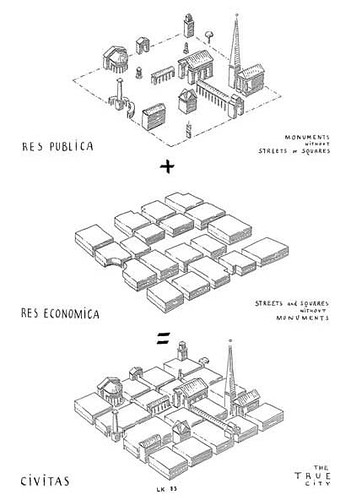
Architect and author Leon Krier (see the Architecture of Community, article by Howard Blackson on the book) writes about how the city ("civitas") is the combination of the public ("Res publica") and the commercial ("Res economica"), but that a civitas cannot exist if the city overfocuses on one sector at the expense of the other.
Krier-Heirarchy: Res Publica + Res Economica = Civitas

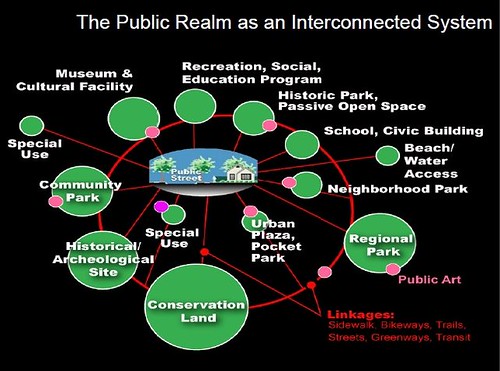
Similarly, David Barth's writings about park and civic planning considers civic assets to be the fundamental building blocks of quality of life in the community.
Public Realm as an Interconnected system, Slide from presentation, Leadership and the Role of Parks and Recreation in the New Economy, David Barth

What are the most important public-civic buildings in a community?

Thinking about the City Beautiful Movement, which was a focused program using architecture and design to build civic identity, it's important to ask ourselves what have been considered, historically, to be the most important civic buildings and spaces within a community.

Also see "Public Buildings Keep our Town Centers Alive" and "Libraries at the heart of our communities," both from Planning Commissioners Journal.

This list isn't absolute, but in any case, the main library either comes second or third, and is one of the most highly used buildings within a community ("Libraries love everyone" by Sarah Sugden, downloadable pdf):

1. City Hall

2. Courthouse

3. Library

4. Railroad station (privately owned but decidedly a public building. Airports have since replaced this building as a central one, but at the same time since airports aren't located within communities anymore but far outside of them, these facilities don't have the same kind of force in civic identity that railroad stations--located in the heart of the city--once did)

5. Public auditorium/Civic Center

6. Arts Museum

7. Signature public park

8. Baseball stadium (usually privately owned but a public building in terms of substance)

9. Public Market

We also have to include the most common federal building typically located within a community:

10. the Post Office and/or Customs House

and depending on the size of the community:

11. Federal Court building

Religious buildings (churches and cathedrals) and school buildings are also key buildings defining community at both the scale of the city overall as well as within neighborhoods. Branch libraries and parks have this function as well.

Key commercial buildings defining civic identity and the importance, prominence and centrality of commerce within a community include the main department stores, movie theaters, the central business district generally, the tallest buildings specifically, the major banking institutions and the commercial buildings of leading companies based in the community, the local newspaper, etc.

It is a fair question to ask of ourselves, isn't the role of the central library within our community important and key to civic life, and therefore shouldn't this building remain at the core of the city, in the center of the city?

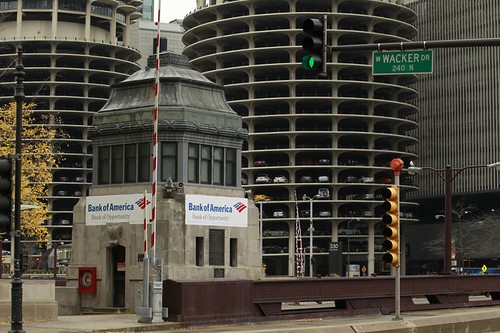
And like Blair Kamin's lament ("New ads on the Wabash Avenue Bridge: Avert your eyes; at least they'll be gone in a month" in the Chicago Tribune) of how cheaply the city is willing to sell access to its public buildings and structures--this advertisement on the Wabash Avenue Bridge in Chicago cost Bank of America $4,500, are we so financially destitute that we have to integrate commercial office space into the central library of our city?
Bank of America advertisement on the Wabash Avenue Bridge, Chicago

Maybe the library system is right that main branches are shrinking across the country, but if that is the case, it's not true of the country's major cities (NYC, Los Angeles, Chicago, Boston, etc.), which are the cities that DC, although it is only the 24th largest city in the U.S. in terms of population, usually compares itself to and measures and benchmarks its public functions and activities against.

Syracuse does want to rent out some of its city hall that it doesn't use to make some needed cash. See "Syracuse sets new policy for city hall rental," from the Syracuse Post-Standard. DC is small, although bigger than Syracuse. In any case, Syracuse doesn't set the standard to which DC claims to aspire.

In the country's major cities, the central library isn't a building where the space is shared with commercial tenants. The library is seen as an important and central function in and of itself.

And it does seem a reasonable question to ask, when the Mayor and other elected officials jet off to Tampa, in preparation of a proposal to give a practice facility to the region's professional football team, how should we be spending the city's money, and isn't maintaining a prominent central library one of the most important places where this money should be spent?

Labels: , , , , , ,

Friday, March 27, 2009

No area municipality does it better: Arlington County extracting mixed primary use benefits from publicly supported facilities

The obituary of Tom Newman in today's Post ("Arlington Official Pushed for Ice Complex")states:

A lifelong hockey fan and player, he spearheaded the county's efforts to build a pair of skating rinks on top of a parking garage, eight stories above the Ballston business district at North Glebe Road and North Randolph Street. They are the only full-size ice hockey rinks inside the Capital Beltway in Northern Virginia.

The $42 million project was completed in late 2006. Since then, the Capitals have used the facility, called the Kettler Capitals Iceplex, as the team office and practice site. They had previously practiced in Anne Arundel County. "It's the finest practice facility in the NHL," Capitals General Manager George McPhee told The Washington Post in 2006.

The Ballston complex also houses the front office of the Washington Mystics WNBA team. When the Capitals are not practicing, the twin rinks are used by the hockey teams of Georgetown and George Washington universities, six high schools and several youth leagues.

Imagine, a sports facility built for a professional hockey team that also supports another professional sports team, and college, high school, and youth league hockey when the facility is not in use by the Washington Capitals.

That's a form of what Jane Jacobs called "mixed primary use" at least in my book.

Rest in Peace Mr. Newman. Your creative efforts will be remembered and will continue to be appreciated.

------
From "Who wears Jane Jacobs’s mantle in today’s New York? " in the Downtown Express, on last year's (or was it the year before?) Jane Jacobs exhibit at the Municipal Arts Society:

Four conditions, Jacobs argues, are indispensable for exuberant diversity in a city’s streets and districts. First, mixed primary uses. A city’s internal parts (basically its neighborhoods) must serve more than one primary function, and ensure that people go outdoors on different schedules. Second, most blocks must be short, with frequent opportunities to turn corners, run into people, vary a route, etc. Third, streets must mingle buildings of various ages. And fourth, there must be a sufficiently dense concentration of people, including residents, for various purposes.

I argue that the "mixed primary use" concept needs to be applied not just to areas ("districts") but to municipal capital improvements planning. For example, shouldn't a senior wellness center be combined with a recreation center, and better utilize and leverage the municipal investment in the facility for as many hours in the day as possible?

Or how about putting in an expanded "gym" at the Thomas Jefferson Junior High School in Arlington, a gym that has an indoor track and exhibition capabilities that can be used for the entire county, not just the students in the school?

Or having a theater and theater company attached to a branch library (Shirlington), etc.

Even Takoma Park combines a community center, city library, and city hall into one (expanded from time to time) facility.

Etc.

Labels: , , , ,

Tuesday, March 10, 2009

You can honor people without vastly overstating the facts or going over the top


mci center gamenight
Originally uploaded by kmf164

(Flickr image of MCI Center by by kmf164.)

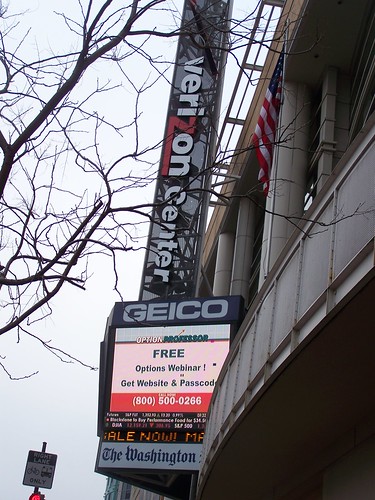
Yes, Verizon Center contributed significantly to the revitalization of the "East End" of Downtown. But it is by no means all due to Abe Pollin, despite the encomium to him in today's Post, "Pollin Has Always Seen the Potential," by sports columnist Mike Wise.

Call the area "Pollin Quarter," after the owner? Please. That's as bad as calling the entertainment part of H Street NE "the Atlas District" or the neighborhood south of Florida "SoFlo" when Florida Avenue is otherwise not a distinguishing characteristic that significantly defines the neighborhood.

One of the reasons that 7th Street NW is successful is that it is the longest stretch of historic buildings remaining extant downtown, that simultaneously maintain the historic rhythm of storefronts.

It also matters that there are other anchors in the area (a/k/a critical mass or layering), especially the Smithsonian Museums.

The Jaleo Restaurant helped revitalize 7th Street NW long before the Verizon Center was on the scene. And since people eat every day you can't understate the significance of this restaurant as well as the other restaurants opened by the same company in the Penn Quarter.

And why is it that most of the retail/restaurant businesses actually located within Verizon Center have failed over the years?

Another problem is that the events are scheduled early, which "encourages" people to go directly to the Arena after work, and not spend money in area restaurants and stores before the game, but instead spend such dollars in the Arena. So the kind of spillover benefits that in the old days could happen in the area around a sports facility (think Wrigleyville in Chicago or the area around Fenley Park in Boston) but doesn't necessarily happen (most baseball and football stadiums) don't happen for the most part, except for events held on Fridays--people will stay out later after the game--or Saturdays--people will stay out later after the game and/or go out beforehand.

I do think that the Verizon Center succeeds in part for reasons similar to how Madison Square Garden is in the heart of the city and well served by transit in New York City.

Outdoor video screen at the Verizon Center
Yes, I admit that the Verizon Center helps bring about "sampling" of the city by suburbanites and others who go to the game.

But the housing in the area, other retail (which largely isn't supported by attendees of events held in Verizon Center), and other attractions also contribute, and they contribute for far more days of the year and far more hours each day than events held inside of "that building."

Not to mention that development would have happened in the East End, to some extent, anyway, because of the elimination of any substantive land inventory available for redevelopment in the rest of the "Downtown."

Also see these past blog entries on the same topic:

-- MCI Arena as a way to re-engage suburbanites (11/2005)
-- Did MCI Center really miraculously improve DC's east end? (12/2005). If you read any of these entries, read this one

-- An interesting look back in time: Transformation in revitalization (9/2006)
-- Layering, location, and business failure as an indicator (12/2006)
-- Linkage + Complexity (11/2007)

One interesting thing about the Washington Times is that it appears as if they have assigned Tim Lemke, who used to report on business issues for the paper, to cover business-related sports issues. His articles are good. The Post needs someone to cover the same kind of beat. Tom Boswell does a decent job with sports-business issues, but he doesn't write about them all that often.

See Lemke's blog, "SportsBiz - Sports Business Commentary - Washington Times." And these articles from the Post, "Verizon Center Ticket Tax to Rise to 10%," "Verizon Center Operator Presents Case for D.C. Aid," and "Verizon Center To Prohibit Fans Bringing in Food."

Enough with the hagiography.
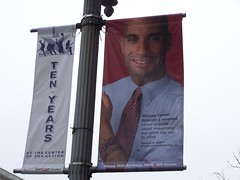
Banners for the Verizon Center anniversary, depicting Mayor Fenty

Labels: , , , , ,

Friday, December 05, 2008

Speaking of the Purple Line

It's been a couple days since the presentation at the Brookings Institution (see "Greening The Suburbs" for another report), and I have been mulling over my response. Maryland's Secretary of Transportation John Porcari was great. Montgomery County Councilmember Marc Elrich was surprisingly troubling, and Chris Leinberger was Chris Leinberger, tautly focused on urbanism and the link to transportation, development economics, and investment.

Porcari pointed out many problems with the Federal funding system for local transit projects:

(1) the agency focuses on saying no so they don't have to come up with funding--this is called the New Starts process, but many call it the "No Starts" process;

(2) it only focuses on the cost to open, not the cost to maintain, and fails to take into account decisionmaking that should support a system built to survive for more than 100 years (he made a good point about short term thinking for the DC area subway system and how that constrains capacity today or increases costs, and can't be undone without spending billions and billions of dollars, or how a bus lasts 10-15 years but a subway car up to 40 years, and how each bus needs a driver, etc.). In other words the FTA scoring system doesn't focus on the lifecycle cost of the system. Over time, fixed rail is cheaper, and has higher ridership, and lasts longer.

(3) the ridership projection method is very conservative;

(4) not to mention that the scoring system doesn't take into account very much other factors such as economic development and livability.

This is important because Councilmember Elrich figures that the Environmental Impact Statement for the Purple Line says that the high cost light rail scenario will only generate a little more ridership than the high cost bus rapid transit system, but cost 1/2, and that by going with bus, you could build the other transit system that Montgomery County wants, the Corridor Cities Transitway.

Another thing discussed some in the back and forth of the session is "bus rapid transit." BRT works great in dedicated systems in places where passengers are willing to tolerate extremely high "crush loads" and with relatively low personnel costs. In other words, BRT works great in South America.

BRT supports road building, so the highway lobby isn't against it. But the reality is that in the U.S., people won't tolerate the bus loads that they have in Latin America. In other words, at most you might have 80-90 people on a 60 foot articulated bus in DC, but in Curitiba, Bogota, or Santiago, it's twice that.

Plus, bus infrastructure, at least in the U.S. doesn't generate the kind of transit adjacent development that occurs with rail transit. The likely reality is that over time, rail ridership will grow significantly, and bus transit will not. As Leinberger pointed out, middle class people don't like riding buses. If you want to get people out of their cars, a bus-based transit system won't do it. By providing rail-based solutions, we provide a better transit system for everyone, especially those who are transit-dependent, and make automobile diversion far more likely.

Now, Elrich and others mentioned the Euclid Avenue BRT Corridor in Cleveland, which is getting some transit adjacent investment. But that really is a special case. That is the main old business corridor in the city and it has been the backbone of reinvestment in Downtown for about 20 years (Theater District, Jacobs Field, Cleveland State University, dozens and dozens of building conversions for housing). The BRT isn't a cause of a lot of this. (Just like MCI Center isn't the only reason that the Central Business District is moving east in DC, it's also because of the dissipation of land inventory suitable for development in the old core of the Downtown.)

The only real bus rapid transit I've ridden in the U.S. is in Pittsburgh (I saw the Wilshire BRT route in Los Angeles but didn't get a chance to ride it). It's awesome. From East Liberty to Downtown, on a dedicated busway (former streetcar right of way) it flies. But there is little argument that this busway system has generated little significant transit-adjacent investment over the more than 25 years Pittsburgh BRT has been in existence. (And the investment occuring in East Liberty today is a result mostly of the lack of any developable land inventory in the very successful and adjacent Shadyside district.)

BRT is promoted by the Federal Transit Administration because they don't want to pay for fixed-rail systems. End of story. (More about an aspect of this in the next blog entry.)

I know this is long already but I had three major reactions in response to both Elrich and Leinberger.

1. My elucidation of the concept of the regional transit network as a set of subnetworks doesn't seem to shape how elected and appointed officials and other stakeholders think about transit in their localities and in the region. (My concept extends the one laid out by Arlington County within their Master Transportation Plan.)

See "The DC Transit Network." I am really gonna have to write a journal article about this.

2. Relatedly then, creating the Purple Line is the beginning of refiguring next generation transit within MoCo and PG, not the end point. Just as Montgomery County reshaped the RideOn bus system to provide service to subway stations from neighborhoods, the transit system within the county will have to be reshaped in response to the addition of the light rail system.

Part of the way to do this kind of planning is through my transitshed-mobilityshed concept ("Updating the mobilityshed concept") which is more expansive in thinking than the mobility hub concept. (Another journal article topic.)

In October 2006, I made a presentation to the Action Committee for Transit on thinking about next generation transit in Montgomery County. I guess I will put it up on slideshare over the weekend. I only gave it once (but I significantly expanded and revised it after the meeting).

For example, speaking of rethinking, DC and Takoma Park could create a streetcar line (this idea was sparked in part by Ken F.) from Walter Reed to Takoma Metro and beyond Takoma Metro out Carroll to the station at University Boulevard and down the light rail line (streetcars and light rail can be interoperable) to the Langley Crossroads Purple Line Station and back up New Hampshire Avenue. This will link all of Takoma's commercial districts and provide direct rail service to the federal campus at Walter Reed, link Columbia Union College, etc.
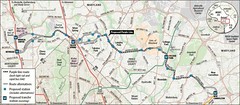
Purple Line map
And speaking of more things to do, you have to create Transportation Management Districts, Transportation Demand Management, and multiple mode planning NOW (bike station at Langley Crossroads? and one should have been put in maybe at PG Plaza Metro..., etc.), not after the Purple Line opens! Then the system will be adequately leveraged and car trips reduced.

3. The ability to capture the value of transit adjacency is fully dependent on urban design and intensity of land use. One comment that Councilmember Elrich made is (paraphrased) "if transit is so great for economic development, why do the areas around most subway stations in PG County suck?"

The answer isn't that complicated. It has to do with the structure of land use. You can say the same within DC or Montgomery County, depending on your definition of "suck" (a word that Mr. Elrch did not use).

For example, Dupont Circle vs. Van Ness vs. Fort Totten vs. Union Station in DC shows that small blocks, a variety of building sizes, mixed uses, walking-based communities have much better success integrating and leveraging the value of transit.

Leinberger called the Green Line the next Red Line in terms of its impact. I don't agree with him fully because most of the stations do not have Walking City-Transit City era urban design, which makes it difficult to leverage the value of the transit. Even Petworth is tough beyond the immediate area around the Metro station, because the blocks are long and the intensity of residential development is relatively low. Fort Totten really shows this. And then by building stuff that looks so junky, it's not likely to change.

Takoma is an interesting contrast to Fort Totten. While some of the infill residential construction looks great and some doesn't, there is already an albeit small commercial core, some restaurants and other amenities exist and more are coming as residential density increases. But for the most part, the Greater Takoma area has an urban form more conducive to walking and transit. It's not perfect, but it's better than Fort Totten, and this will only increase over time.

But PG, other than further intensity of land use at the PG Plaza station, hasn't been able to leverage the value of transit because the stations are mostly placed in areas where they are disconnected from other uses, especially residential, not connected to it, and they don't evince "urban" design, but suburban, car-centric land use planning.

Anyway, Leinberger says that in advance of opening a transit system, you should have station area plans, covering 100-300 acres around the station, allowing for more intensive development. For the most part, I agree with him, but I think that examples thus far demonstrate the necessity of a fine grained urban design program for these station area plans.

Labels: , , ,

Thursday, November 20, 2008

Disagreements within the Growth Machine...

The Growth Machine thesis from urban sociology posits that despite seeming differences, at the heart, the local political-economic elite is united around a growth (real estate development) agenda focused on intensification of land use and increases in property values. See "Neil Albert keeps the RFPs coming, but can he deliver" from the Washington Business Journal to understand the pro-development focus of the Fenty Administration.

In DC, the Federal City Council is the primary actor "governing coalition" (using the term not from Growth Machine theory but the political science theory of the Urban Regime, which I think is a bit better at explaining how the local political-economic elite functions and governs) along with the Greater Washington Board of Trade and the DC Chamber of Commerce. The FCC includes all the universities and other players, and the big developers. It was co-founded by the then publisher of the Washington Post (local media is absolutely dependent on local development for continued success).

John Hill is the current executive director of the Federal City Council. (He was the director of the Financial Control Board during that economic bad time of the city's bankruptcy in the 1990s.) Recently, he was removed by the current regime (Fenty Administration) from the board of the DC Children and Youth Investment Trust. See "Appointments Spark Hearings " from the Washington Post. I "wondered" what that was about, maybe just an element of "meet the new boss, same as the old boss" as Mayor Fenty opens up these kinds of slots to younger-new but still connected people.

The Tenley Library-Janney School redevelopment issue is a debacle. Recently, the Mayor announced a joint development agreement for the site. The community and certain Councilmembers did not agree as written in the DC Wire Washington Post blog, "Kwame Brown and Cheh Team Up For Tenley."

Now the Library System, where John Hill is still the chairman of the board, has announced plans to go ahead with a rebuilding of the library independent of the joint development agreement.

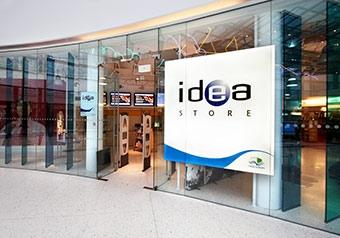
Granted, this is an instance where most every actor acting is wrong, especially the Library System where I think most of the board members should be removed, probably the director too, because they aren't interested in making libraries work better for communities and the 21st century as much as they think they are (even with the recent hiring of David Adjaye, architect of the paradigm breaking Idea Stores in the Tower Hamlet borough of London, see "An Architect For the Books" from the Washington Post).
Idea Store Whitechapel
Hip Idea Store library branch in Whitechapel.

I wonder what this says about the success of the governing coalition of the Growth Machine and its organizing agenda (another UR term).

From the DC Library Renaissance Project:

Library Board Ignores Mayor on Tenley Library, Directs Chief Librarian to Proceed with Construction

Washington DC -- November 19, 2008 – President of the Board of Library Trustees John Hill tonight revealed that his board has instructed Chief Librarian Ginnie Cooper to proceed with construction documents for a standalone library at Tenley. This comes in spite of Mayor Adrian Fenty’s selection earlier this summer of developer LCOR to incorporate the library into a mixed use project there.

The Mayor’s project involves the joint development of a library, Janney Elementary School, 170 units of housing and retail, as well as underground parking. A preliminary plan ignited neighborhood opposition when it was first floated several years ago. Since then, opposition has grown.

Ward 3 Council member Mary Cheh, who had initially sought the mayor’s support for the public private partnership to build the library as part of the mixed use project, recently reversed her position. Last month Cheh made public a letter to the Mayor urging him to drop the partnership and support DCPL’s standalone library.

The surprise announcement to ignore the Mayor’s plan came at a bi-monthly meeting of the Trustees at the Lamond Riggs Library on South Dakota Avenue NE serving Wards Four and Five. When one disbelieving Tenley resident asked if Deputy Mayor for Economic Development Neil Albert had been told, Hill responded that it was “not necessary. We are an independent board and can move forward.”

Since hiring Chief Librarian Ginnie Cooper two and a half years ago, the Trustees maintained that they would begin construction this fall on the Tenley library and three others. They laid out what they termed a “dual track” strategy, which included working with the neighborhood to plan a standalone library while remaining open to explore the possibilities of the public private partnership. Numerous meetings with development partner LCOR have not yielded a satisfactory plan for the library in the mixed use project.

Members of the Tenley community in attendance thanked the Trustees for keeping their promise to move quickly to rebuild the Tenley library. Trustee Bonnie Cohen deferred all credit for the decision to the leadership of John Hill.

--------------------
Note that I am in favor of mixed use redevelopment of civic sites, although mixed use doesn't have to mean public and private, it can mean mixed agency use too.

I don't know enough about the parameters of the Tenley-Janney site to know which way I should come down. HOWEVER, just as I would likely get rid of Michelle Rhee and hire someone like Andres Alonso, superintendent in Baltimore, or Anthony Alvarado (see Making Schools Work with Hedrick Smith . District-Wide Reform) or Kathleen Cashin (see "Bucking School Reform, a Leader Gets Results," from the New York Times), I WOULD FIRE THE LIBRARY BOARD OF TRUSTEES AND THE DIRECTOR AND RESTART THE LIBRARY PLANNING PROCESS, WHICH BEFORE WAS NEVER ADEQUATELY VETTED.

Speaking of having a Planning Commission in the City. If a Planning Commission only has purview over the Office of Planning and not the planning activities of the other agencies, especially the Department of Transportation, the Public Libraries, the Schools, the Department of Parks and Recreation, the Fire and Emergency Services Department, and health and wellness planning, even Public Works, THEN IT IS ALMOST WORTHLESS.

The debacle within the Public Library system, not to mention the Public School system, is a case in point.

Labels: , , ,

Sunday, September 07, 2008

Retail oriented to transit (and walkers) has different requirements than automobile-centric retail

There is an opinion piece by Jeff Paterson, director of corporate solutions and consulting for real estate brokerage Colliers Turley Martin Tucker, in the Minneapolis-St. Paul Business Journal, "‘Convenience’ retail in for overhaul," that makes this point. It's pretty basic but worth repeating in its entirety because most people don't get it.

What will “convenience” stores look like in five years? What about 10? Some forward-thinking strategists at SuperAmerica, Holiday Stationstores, Kwik Trip or Oasis Markets had better be rethinking their prototype store model because the convenience retail landscape is going to be changing very dramatically and very quickly.

People coming by car to buy gas? Not likely! Store locations chosen to be convenient to the motoring public? Irrelevant! Highway accessibility? Old hat! In the years ahead, automobile traffic volume exposure, at least in urban areas, will not necessarily be the driving force behind convenience-retail siting decisions. Determining where station stops will be along transit corridors will be “the key to the castle” for convenience retailers.

Surely some innovative planners at the convenience-retail chains must have come to the realization by now that the new transit world will call for a different type of store model.

Picture the following scenario: Mr. or Mrs. suburban Anoka pulls into the parking structure adjacent to the train station along the Northstar Commuter Rail Corridor in Anoka. It is 6:50 a.m. He or she has 10 minutes to complete some errands and buy some essential sundries before boarding the 7 a.m. train headed for downtown Minneapolis. He or she can buy coffee, a breakfast sandwich and a newspaper before boarding the train.

If there is extra time, the same transit rider could drop off dry cleaning to be picked up later, leave the car at the nearby “convenience auto” stop for a wash and an oil change and deposit the toddlers at day care or pre-school.

The transit commute home in the evening presents more possibilities. How about a take-away, prepared food counter where a broasted chicken or take ’n bake pizza could be secured for the evening meal or a “mini-fitness” workout locker room?

Of course, the challenge with these “transit station marketplaces” is attracting customers and patrons during the midday hours when the train volume and passenger traffic will be at their low point. The station markets and retail concepts will have to be designed and formatted in such a way to attract that midday customer who may not be a transit rider. One lesson that has been gleaned from successful transit-oriented development projects in other cities is that the mere introduction of a train and its passengers does not guarantee that a transit-oriented development project will be successful. There has to be some grain of demand/supply imbalance already present in the local market to inspire development. The train can amplify and influence the tenant mix, design and intensity of a transit market that was needed by the local neighborhood under any circumstances.

Real estate developers, retailers and service providers must be thinking creatively about the best way to serve the transit public in the decades ahead. It will be a different landscape where the corner convenience store so accessible to the motoring public and whose primary raison d’etre was the sale of gas will become a dinosaur.

------------
I think that the author discounts how much retailers are wedded to traditional paradigms. Center cities have had this problem for a long time. See these past blog entries for more on the topic:

-- Store siting decisions
-- Why the future of urban retail isn't chains
-- (Why aren't people) Learning from Jane Jacobs
-- (Why aren't people) Learning from Jane Jacobs revisited.

Labels: , , , , , ,

Wednesday, August 27, 2008

Now that's mixed use

The Gazette reports on library planning for Silver Spring, in "Adults, teens discuss wish list for library." According to the article:

The proposed library would be at the corner of Wayne Avenue and Fenton and Bonifant streets. The 66,000-square-foot site will most likely feature the multi-story library, affordable housing units and a station for the Purple Line, which is slated to run through the property.

A public transit station and a public library and... Impressive.

Meanwhile, DC just can't seem to figure out how to make mixed use, and the achievement of multiple objectives from one piece of property, a reality.

MontCo isn't perfect. They aren't putting a bicycle station in the Sarbanes Silver Spring "Transit" Center, although they are providing connections to bicycle trails.

Labels: , , , , ,

Thursday, July 17, 2008

burbtalk

I think it's fair to say that everybody wants the same thing--nice places to live--but we disagree on (1) what it means to be a nice place and (2) how to get there, meaning driving vs. other modes.

Just Up the Pike disagrees with my characterization of Silver Spring as a commodified urban renewal like place in "still sick: how to grow an old town in no time," discussing how people hang and do things and that it is an active vibrant place (yes, even I went to one of the open air AFI films a few weeks ago, although we left after awhile because we were bored).

And the automobile centric paradigm that marks the suburbs is another point on which we disagree. Generally, the distances between places in suburbs like Montgomery County make transit, walking, and bicycling time inefficient, although there can be exceptions, places within the broad region that are walkable communities (parts of Silver Spring, Wheaton, Rockville, and Bethesda qualify, among others).

Yes I think places like Bethesda Row and the new Rockville Town Center are well done (no photos to upload, but I checked it out a wee bit a few weeks ago, including the library) they just seem so antiseptic, corporate and commodified. But how can we expect people to not favor such environments, when for the most part, that's all they know (some time, watch George Lucas' first film, THX-1138 and think about its architecture--a mix of malls and airport terminals)?

Maryland Politics Watch, in "Wheaton: Ready, Aim, Aim, Aim," and Just Up the Pike, in "panel recommends town square, library move for downtown wheaton," cover the latest redevelopment planning exercise for Wheaton. These kinds of reports are always useful to read, regardless of the community they address. And if you read the report or skim the entries, it's clear that these planners also say the same kinds of things that I'd say or Dan would.

Also see these reports from the Urban Land Institute:

-- Reinventing Suburban Business Districts
--
Reinventing America's Suburban Strips
-- Ten Steps for Developing Successful Town Centers
-- Ten Steps for Rethinking the Mall

and the city version:

-- Ten Steps for Rebuilding Neighborhood Retail.

Also see my take on places like Silver Spring in "Lifestyle Centers vs. Traditional Commercial Districts: Imitation, Authenticity and the Public Realm" from the Smart Growth Around America newsletter (12/2006).

Labels: , , , ,

Friday, June 27, 2008

Excluded from Library Deal: NE Community to Hold “Let Benning Decide” Rally

As Beyond DC said in a post about the Federal Transit Administration, "with friends like these, who needs enemies," the same goes for urban design and mixed use vis-a-vis the DC Public Library system. A rare instance of significant community buy-in to a mixed use project gets quashed by the Growth Machine, which you would think would be clued into the need for better facilities accomplishing multiple objectives simultaneously.

From Robin Diener, DC Library Renaissance Project, 202/387-8030:

District Library Dynamos, a grassroots citywide library advocacy organization, will sponsor a rally to protest a decision by Trustees of the DC Public Library (DCPL) -- led by John Hill, Chairman of the Federal City Council -- to reject a proposal for a new library in Benning that would meet the needs of a community that suffers from the city’s lowest literacy rates, highest drop out rates, and steep digital divide.

At a special six-hour long Saturday hearing on April 19th convened by DC Council Library Committee Chairman Harry Thomas, the Benning community learned trustees had turned down a deal that included a land swap, a cash payment, and a library larger than DCPL has currently planned. Members of the local Benning Library Dynamo group seek a full public exploration of the possibilities and to be included in the final decision.

Trustees were informed, last July, of the sale to City Interests of land adjacent to the Benning Library -- just as DCPL was embarking on the long delayed process of library redesign (2004 designs were tossed out by the trustees in 2005). Throughout the redesign process, residents heard only vague answers to their repeated questions about the status of the shopping center development which they feared could overwhelm a new library.

-- See video of Benning community questions about location

Dissatisfaction with the public input process has been simmering in Ward 7, since ANC commissioners there brought suit to require DCPL to follow the law regarding ANC notice and great weight provisions.

-- See video of Trustees meeting where Benning residents speak out

WHEN: Saturday June 28, 2008 at 12 noon
WHERE: 3935 Benning Road, NE
site of the demolished Benning Neighborhood Library

Labels: , ,

Friday, May 16, 2008

A central library as a grand place

Music practice rooms at the Harold Washington Library, Chicago
Musicians will get out from behind closed practice-room doors and onto the concert stage today at the Harold Washington Library. (Rich Hein/Sun-Times)

The Harold Washington Library in Chicago has music practice rooms. See "Musicians come out of their rooms for library concert," from the Chicago Sun-Times.

The never properly vetted DC Library plan (Which doesn't appear to be online anymore) didn't reach very far in calling for expanded services and capabilities at the Central Library.

One of the reasons I was against the grand plan for building a new library is that the new library as planned didn't seem all that grand.

Many people had great suggestions during the various "listening sessions" where citizens spoke but weren't likely listened too, certainly the Library Master Plan never changed. I remember at a session I attended, having an excellent auditorium space was suggested, just one of many ideas. (Have you ever been to the auditorium at the Sackler Museum or the National Gallery?)

And the DC Government has never done a good job about advocating for appropriately mixed use public spaces, including libraries. The Hollywood library in Portland is a good example. And now the DC Public Library system isn't really open to proper consideration of mixed use proposals, and they are riling up local library activists to oppose them. This, when properly done, a library can be part of an excellent mixed use project, and in ways that strengthen the overall project as well as the library.

Labels: , , ,

Saturday, March 29, 2008

Shop while you wait for the doctor

A mall is being redeveloped in Nashville, with the second floor being leased to the Vanderbilt Hospital Medical Group. From "100 Oaks mall redevelopment draws new retail, restaurants," in the Nashville Business Journal:

Vanderbilt offices will be on the second floor. The first floor will be retail. Patients can carry beepers and be paged for their appointment while they shop.

Labels: ,

Monday, February 25, 2008

The five word answer to why it is so difficult to revitalize neighborhood commercial districts in DC

We don't have enough people.
-------------
Here's something I wrote this weekend in an email thread on urban transit systems:

... I was thinking that I neglected to mention the most important thing, which I just took for granted. And that is urban design + density. Typically, it's easy to knock "next generation transit" systems because they are attempts to put the genie back in the bottle. [Added -- next generation transit systems are those like BART, MARTA, WMATA etc. that were built in the 1960s and 1970s. Urban design refers to the grid pattern of relatively small blocks that typifies the L'Enfant City.]
123.11_McClelland_DC_Map.jpg
Since the dominant development pattern in the U.S. is deconcentration and a much greater per capita use of space in all metropolitan regions, it's almost impossible for new transit systems to repattern development, except on very long time frames, even if TOD and other pro-transit policies are in place (i.e., keeping commercial development in the core, reducing or eliminating free parking, etc.)

When transit competes against free parking, and people's failure to adequately account for sunk cost in computing trip costs, often transit doesn't appear to be an equivalently sound economic choice. (Peter Newman's work on the economic value of transit in terms of building wealth at the regional level is a good counter to this kind of thinking.)

But when you live in a place with enough density (and DC is just barely on the cusp of having enough density, most residents think there is too much and the sad reality is that most places don't have enough people to support neighborhood-based amenities especially retail, which is why neighborhood commercial district revitalization is so hard even so) you can support relatively frequent transit services, and with complementary development practices, and livability, you see how it works. [emphasis added]

That being said it took more than 20 years for the pieces to come together in the core of DC, I mean 20 years after most of the system was built out in the core.
Cities in Full by Steve Belmont
And I mention the core, because the one thing only that I have probably ever thought of that Steve Belmont in Cities in Full didn't already write is this:

Belmont justly criticizes the other problem with next generation transit systems is that they are about polycentricity, not recentralization, and he criticizes the WMATA system for being polycentric, and not having much success in terms of densification in the outer suburbs (not Arlington).

Belmont's absolutely right.
WMATA polycentric rail system -- Belmont
Figure from Cities in Full.

But he doesn't take into account that at the core of DC, the WMATA system functions monocentrically, almost like the MUNI system in SF vis-a-vis BART. There you have great transit, more density, more neighborhood amenities. That's why almost every one of those neighborhoods has revitalized or is well on the way, and that is despite the relative under-density (most DC rowhouses are two stories).
Subway stations at the core of the city of Washington
Subway stations at the core of the city of Washington.

Labels: , ,

Tuesday, February 19, 2008

Supermarkets

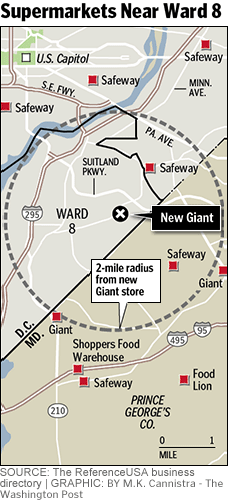
1. I had a letter in the Washington Business Journal in response to the article "Food Desert" making the point that people do have access to supermarkets, but often over the DC-Maryland line, but that such access still needs to be considered.
Signs of Change Line the Shelves - washingtonpost.com.gif
Washington Post graphic.

2. The new Congress Heights retail development, which includes a Giant Supermarket, is single use development, just like the Rhode Island Place development in Ward 5. See "Long-Awaited Ward 8 Giant Opens This Week" from the Express blog and "Signs of Change Line the Shelves," subtitled "Grocery Arrives In Reviving Ward" from the Post.

3. I mention this because Shawn calls our attention to this article from the Post, about losing grocery stores in Brooklyn due to redevelopment, "Groceries Grow Elusive For Many in New York City," subtitled "With Rents Soaring, Stores Are Being Demolished for Condos."

This is the flipside of the problem in DC. See we waste land. Single use development doesn't work well in cities. Mixed use does. There is nothing to prevent supermarkets from being redeveloped on the ground floor, with housing above in Brooklyn or in DC.

But a quick solution, would be to require a conditional use permit to redevelop a grocery store. That would allow the Planning Office to require mixed use and maintain the supermarket use. Hey give a bunch of tax incentives, abatements on the housing part, and it becomes financially doable.

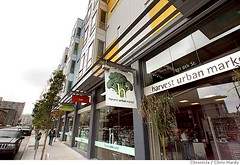
See this article from the San Francisco Chronicle, about the Harvest Urban Market on the ground floor of an affordable housing development in San Franscisco, "A SOMA complex with a coffee shop and lively mural proves that affordable housing doesn't have to be ugly housing."
Harvest Urban Market
SF Chronicle photo.

Labels: , , ,

Wednesday, December 05, 2007

The real estate market replicates commodity, not community

I swear earlier in the year I read a piece by the economist John Kay, where he made the point that capitalism isn't so much about the purity of the unseen hand and market forces, rather that the market replicates things that are good at replicating. (I can't find it now.)

This piece from the Boston Globe (found via the Progressive Review) "Last call: Why the gay bars of Boston are disappearing, and what it says about the future of city life," discusses the loss of "third places" and the kinds of amenities that make city life attractive.

From the article:

But as a wide range of gay bars dwindles to a handful of survivors - and the city's diners, indie bookstores, and dive bars yield to high rents and shifting patterns of commerce - that air is becoming the province of an increasingly narrow set of people....

Businesses like bookstores, video stores, and gay bars can no longer afford to occupy valuable real estate when their goods or services are more easily and cheaply delivered electronically. As these businesses disappear from Boston streets, they're usually replaced by more profitable land uses, such as office towers and high-end restaurants. The result is a variant of the "tragedy of the commons": Hotels, condo complexes, and other upscale businesses market themselves as part of a vibrant city, but they can also make it more difficult to maintain that vibrancy. (The ground floors of new office and housing buildings are often reserved for retail use, but CVS and other chain stores usually snap up the space.) These high-end businesses attract new residents and consumers to urban neighborhoods, but when they aren't balanced by other types of economic activity, the result can be a sterile streetscape rather than a diverse ecosystem.

There are many factors going on here. While I am not sure I fully agree with the author's conclusions, there is no question that as cities again become high demand places, less profitable uses get crowded out, and the city becomes less interesting and more placeless.

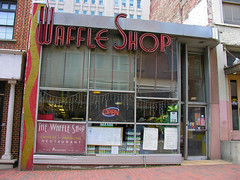
Downtown DC is a perfect example of this, as the last truly original independent restaurant downtown, Waffle Shop, gets deconstructed and removed from its location on 10th Street NW and relocated to 6th Street and New York Avenue NW.
Waffle Shop
Flickr photo by Otavio DC.

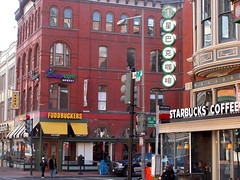
Chinatown Fuddruckers and Starbucks
Flickr photo by Kennedy Smith.

In fact, when I first came to DC I didn't understand why for the most part there weren't diners and the other kinds of places I associated with city life, why was it that McDonald's seemed to be the largest purveyor of breakfast in the city?

This is related to a comment I made yesterday at Chris Leinberger's talk. The Brookings Institution released the results of a study on walkable urbanism, including the point that about 1/3 of the market wants it, 1/3 doesn't, and 1/3 doesn't care either way, but in any case, there isn't enough "product" (not their word) to satisfy the present and latent demand. See the AP story "Wash. Leads Metro Areas in Walkability" and the study, Footloose and Fancy Free: A Field Survey of Walkable Urban Places in the Top 30 U.S. Metropolitan Areas.

Some colleagues were taken aback by the study, because many places that we know are walkable aren't listed. This is so for at least two reasons.

First, they focused on places that provide regionally attractive retail and commercial space. This knocks out many places like Capitol Hill or Cleveland Park because for the most part they are neighborhood serving (I know that Cleveland Park with a theater and restaurants is a kind of {"regional" destination for Ward 3 neighborhoods but the general point remains.)

Second, they focused on places that have the potential for adding a great amount of infill construction of housing, retail, and office, and/or with the potential for redevelopment. This means that places like NoMa rated highly, and neighborhoods like Capitol Hill or Cleveland Park wouldn't qualify.

Professor Leinberger is known for a classic paper, "The Need for Alternatives to the Nineteen Standard Real Estate Product Types," from Places Journal, about the standardization of the primary real estate products produced by developers--product types oriented to the suburbs, not traditional center cities and more urbanized, walkable places. From the standpoint of political economy, this explains the commodification (as well as the systematization of real estate development around regionally, nationallly, and internationally significant actors as opposed to small, local one-off or otherwise small developers) of the industry, especially around financing.

His new book is about rebuilding the development system for walkable places, and he spent a lot of time in his presentation yesterday showing how suburban land use practices were optimized and subsidized, but also the demand for urban living, and the primary land use development product types for the future:

1. Downtowns (Central Business Districts)
2. Downtown adjacent (places like Dupont Circle)
3. Suburban Town Centers (Bethesda)
4. Suburban redevelopment (Ballston, Friendship Heights)
5. Suburban greenfield (Reston)

The problem is that this revitalization will be led by developers, and their motivation isn't creating walkable interesting places, but about profit maximization. They will invest in building quality places so long as the marginal returns are positive.

And the problem with reproducing these spaces is that small buildings get demolished and the land assembled into plots for superbuildings, and superbuildings beget superblocks. Superblocks are anti-pedestrian.

Arlington is the big example of success in this realm. Arlington has been successful with transit oriented development.

But I think we can agree, despite their best efforts, that the quality of the space in terms of the experience, is more akin to downtown DC than it is to Dupont Circle. The one major exception is Clarendon, because of the small number of traditional buildings that still exist, and the uses that populate these buildings such as Clarendon Ballroom and cool restaurants. On the other hand, much of Clarendon is being reproduced into "urban lifestyle center" real estate product rented to national chains.
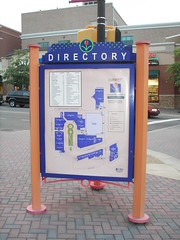
Directory to Market Commons, Clarendon
Directory for Market Commons, an infill "lifestyle center" with chain retail (and across the street from a Cheesecake Factory.)
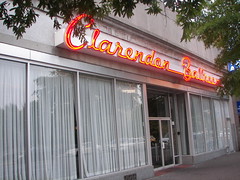
Clarendon Ballroom
And Ballston and Virginia Square and Courthouse and Rosslyn aren't necessarily great places for walkability and interestingness.
Virginia Square Metro entrance
Virginia Square Metro entrance. Arlington County photo.

It's enough to want to make me go out and immediately read David Harvey and Henri Lefebvre...
Northern edge, side street, Clarendon

Labels: , , , , , ,

Tuesday, December 04, 2007

Old models for mixed use: train tracks through a Bangkok Market

Labels: ,

Thursday, September 27, 2007

The principle of mixed primary uses

In Death and Life of Great American Cities, Jacobs writes about Pittsburgh's Oakland district to explain the point of mixed primary uses. She said that if the arts institutions were located downtown (now they are by the way) then parking structures used by office workers during the day could be used by arts patrons at night, thereby not requiring specific investment in the creation of parking lots dedicated to a single use, as required for the Carnegie institutions in Oakland.

The Austin American-Statesman reports, in "Austin considers entering the parking business: City would build and own garages, primarily downtown," (registration required for article access) that the City of Austin is considering the creation of a parking authority which would build and operate public parking structures. Laudably, they would dedicate the revenue stream not just to parking for cars, but would support investment in other transportation modes as well.

But here is the real problem. From the article:

"There are tens of thousands of parking spaces downtown that don't get used after hours even as we have remarkable demand after hours," Wynn said.

If you deal with that first, maybe you don't need to spend a couple hundred million dollars on parking structures to begin with.

Labels: , , , ,

Saturday, September 01, 2007

More faulty comparisons

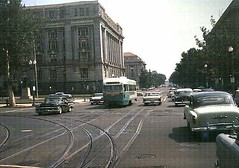
14th Street NW, 1959
Constitution Avenue? around 14th Street NW, 1959. Photo from Dave's Railpix.

Earlier in the week I wrote about some bad data analysis in the Examiner. It was a story about poverty statistics from the Census. First, it compared DC, a city, to states. On that basis, DC is the most impoverished state in the country. But when you compare DC to other center cities, it's not anywhere near the top 10.

Second, the story compared blacks and whites on a gross basis, even though to be fair, this has to be considered by income tranche.

Anyway....

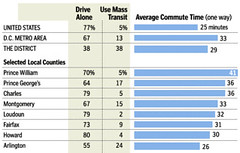
Sam Staley of the Reason Foundation (a pro-sprawl libertarian organization) has an op-ed in the Examiner, "Transit passengers face longer commutes than drivers," that makes the point that drivers in the Washington region have shorter commutes than transit riders. But as the Post reported earlier in the year, commuters in Washington DC and Arlington have commuting times at or around the national average. (Speaking of incorrect data analysis, this doesn't exactly answer the point that Staley raises...)
Daily Misery Has a Number Commute 2nd-Longest in U.S.
Post Graphic. Census data.

The point really is that you have to look at this at the micro-level of jurisdiction. For transit to be efficient, it works best in a compact development scenario. I ride a bike to work, and it takes me less than 15 minutes to get to work. (More if I stop to pick up trash on the way...)

But how people get to work isn't always just about the commute. I can't imagine driving in traffic to and from work every day--even for 26 minutes...
Graphic in the Washington Post about commuting behavior in the region
DC's population is increasing, but the number of people who get to work by driving alone has decreased significantly. Image from the Washington Post.

The issue is really about what transportation researchers call "accessibility," or the proximity and density of destinations. If a place has more desireable places in close proximity, then you spend less time travelling between them. That's the whole point of compact and mixed use development.

So what if it takes people from Loudoun or Spotsylvania Counties a long time to get to work. They made their choices. As did I. I can bike to work, to school, to meetings, to the grocery store, etc. Now I can't carry as much (e.g., I have to figure out how to transport a case of bottled beer on my bike--or do I take the bus?). It's all about choice, isn't it, which is what the libertarians would say anyway. We are just advocating for the viable choice of the compactly developed, mixed use, non-automobile centric center city.

Another issue of course is the jobs-housing balance. From the standpoint of the center city, we need to build the skills level of DC residents so that more people within the city can work in the city, and won't have to travel too far outside the city for work, further reducing commuting times, and increasing the likelihood of transit use.
14th Street NW in the evening
14th Street NW in the evening. This is not the way for me...

Labels: , , , , ,