Rebuilding Place in the Urban Space

"A community’s physical form, rather than its land uses, is its most intrinsic and enduring characteristic." [Katz, EPA] This blog focuses on place and placemaking and all that makes it work--historic preservation, urban design, transportation, asset-based community development, arts & cultural development, commercial district revitalization, tourism & destination development, and quality of life advocacy--along with doses of civic engagement and good governance watchdogging.

Saturday, June 04, 2022

Quantum change in technologies can change industrial agglomeration economies, business and sector organization, location etc. | Electric vehicles

One of the things that has struck me about the introduction of the electric car is how it is transforming the automobile manufacturing industry which has been clustered in Michigan and the Midwest after the initial period of experimentation and development in the early 1900s, although some manufacturing was always distributed around the country such as in New Jersey, Maryland, Missouri, New York, California, etc.

But in the 1980s, increasingly companies, especially non-US based manufacturers, began opening plants in the South, because it is more difficult for successful labor organization of the workers at those plants, therefore generating lower labor costs.  In the 1990s, seeking even lower labor costs, firms moved more production to Mexico as well. 

Increasingly, engineering and design functions are developing in Southern locations, especially when the companies are outside of the traditional Big 3 firms ("Driving force: San Antonio picks up speed in auto industry," San Antonio Express-News).  From the article:

The shift to automotive research and development could make San Antonio a hub for high-wage jobs in zero-carbon transportation in the years ahead, city officials say. DeLorean said its San Antonio employees will earn, on average, about $140,000 annually. 

“The long-term play is to get more of the value-added work. So when you see Navistar coming here, they didn’t just bring a truck factory, they brought their engineering plant,” Marquez said. “That’s what our county strategy has been from the beginning.”

The onset of the electric car has created a similar kind of exogenous shock, with Tesla having plants in California and Texas, Rivan opening a plant in Georgia, states like Oklahoma are vying for plants ("What to know about Oklahoma's embrace of the electric vehicle industry," Daily Oklahoman), and distributing development, design, and engineering functions away from the Midwest, etc.

The Detroit News has an interesting article about GM and how its president, Mark Reuss (son of a former GM president also) remains committed to keeping Michigan and the Midwest as central locations for the production of electric vehicles, rather than moving elsewhere.  

-- "Mark Reuss kept GM investing in Michigan, Detroit to build EV future here"

Transportation costs.  An article in the New Yorker about logistics said that with the rise of the container, shipping costs dropped from almost $6 per ton to 16 cents ("When Shipping Containers Sink in the Drink").  That's why firms became free to move manufacturing overseas.

If the rise in the cost of energy and the difficulty of having enough truck drivers persists, along with other supply chain and logistics problems, it could well be that moving automobile manufacturing outside of its traditional areas could be costly in terms of sourcing parts, etc.

Political costs: legacy versus new industries | Fossil fuels versus green energy industries. Another thing is that by moving plants into Republican states, they can be subject to more criticism and opposition, which may be fomented by businesses committed to a fossil fuel based economy ("The pollution paradox," Guardian).   And what I call the intra-national "Petro State" effect, where states like Texas and Oklahoma promote pro-fossil fuel policies.

For example, Governor Kemp of Georgia has been criticized for providing tax incentives to Rivian ("Rivian electric car plant blasted by foes at Georgia meeting," AP).  (The Economist argues that such lobbying helps countries like China, who are more focused on developing new technologies and industries rather than saving old ones. See "China’s plans for the electrified, autonomous and shared future of the car.")

But what will happen to states like Texas and Oklahoma as electric vehicle related firms rise in importance?  Will the states have to be more "fair" about representing multiple sets of interests?  Probably not, fossil fuels in the short run are far more important economically to the economies of those states.

Labels: , , , , , , ,

Tuesday, July 18, 2017

Trump's quest to renegotiate NAFTA might be comparable to Brexit

The reality of "Brexit" is that the UK's economy is integrally tied to Europe, and "getting out" of the EU and the old Common Market is disadvantageous in many ways.  With manufacturing it involves the fact that most companies have tightly integrated supply chains that cross borders.

President Trump has initiated renegotiation of the North American Free Trade Agreement because he believes it is disfavorable to the US ("Trump administration unveils goals in renegotiating NAFTA," Washington Post).

Comparable to how most UK newspapers weren't and aren't all that honest about the UK's place in Europe--the wealthy and conservative newspaper owners favored Brexit so as a result so did the coverage of their newspapers--I think that we might get better coverage of this issue from Canadian and Mexican newspapers.  Not because the US papers are dishonest, but because NAFTA might matter more to the counterparties, and this is reflected in media coverage and the depth of reporting.

For example, this article, "Canada has a secret weapon in the coming NAFTA talks" from the Toronto Globe and Mail is far more detailed than the Washington Post article cited above.

Also see the TGM article, "What the US wants from NAFTA talks." (Although the Post has more detailed follow up coverage.)

El Universal, a major daily in Mexico City, has extensive coverage, including "Canadá y México conversarán sobre renegociación del TLCAN."

======
I finally read the book A Prayer for the City, the story of Ed Rendell's mayoralty in Philadelphia, from 1991-1999, although the book covers the period up to early 1997.  The reality is that most of what Mayor Rendell had to deal with was the closure of much of the city's manufacturing base, including the Philadelphia Navy Yard, which had 8,000 direct employees.

One of the stories the book recounts is a meeting with Kraft, the firm that bought Breyer's Ice Cream, a firm founded in Philadelphia.  Because of various lines of ice cream business, the company had far more manufacturing capacity than demand, and the Philadelphia plant was the oldest and least efficient, with multiple floors, while newer plants were one story and had less congested transportation connections. 

Kraft wasn't interested in incentives to keep the plant open, they would have wanted a new plant on a single floor, but they had no need for one.  Had Philadelphia given them incentives, it would have been $60 million or more, for 50 jobs.

As the TGM article makes clear, while US manufacturing employment has dropped significantly, manufacturing output has not because of continuous and significant capital investment in automation and digitization, abetted by the fact that as long as interest rates are so low, it's cheaper to invest in capital than in labor.

In short, mass production is "mass" in terms of output, but not in terms of labor requirements and a source of employment.

Thinking about US manufacturing is more complicated by the fact that more firms are not US owned are major producers.

For example, auto output by Ford, GM, and Chrysler has dropped, but plants owned by BMW, Honda, Nissan, Toyota, and Mercedes and other firms have been added to the mix so that overall production is not down.

This has changed the geography and organization of various manufacturing sectors so that the South is a more significant center of production compared to the past, when the North/Midwest was the nation's "Industrial Heartland."

-- Industry Week magazine

Labels:

Friday, May 26, 2017

The so-called myth that cities are growing when suburbs are still growing more

The other day, the New York Times ran a story, "Return to Cities an Urban Legend, Mostly," making the point that despite all the talk of population growth in the cities, more people are moving to and more growth is happening "in the suburbs."

I think this story misses very important points, a kind of "burying the lede."

Suburbs make up a much greater proportion of a metropolitan area's land mass and population.  It should be obvious that as metropolitan areas continue to grow, more people live in suburbs. It should be clear why this is so. Compared to the entire land mass and population of a metropolitan area, the formal center city, such as Washington, Baltimore, Boston, New York City, etc., is but a small proportion of a metropolitan area's total population and land mass.

For example, the DC metropolitan area has a population of about 6 million.  Less than 15% of this population is located in DC. DC comprises about 1.5% of the total land area of the metropolitan area (less when you take into account how much of the land is controlled by the federal government and not subject to development). Given these facts, it's unlikely that the city could capture a majority of population and economic growth.

New York City is part of a three-state metropolitan area greater than 13,000 square miles. The total population of the metro is slightly more than 20 million. New York City has about 8.5 million residents, in an area a cotch larger than 300 square miles.

What is significant first is that center cities are dense, with a large population in a small area. DC is about 60 square miles and has about 680,000 residents. The suburbs Fairfax County, Virginia and Montgomery County, Maryland are each about 400 square miles in size, and each has about 1.1 million residents. Each is about 6.5x larger than DC physically, with less than twice the population.

What is significant second, is rather than a story of center city shrinkage--which was the case from the 1950s to around 2000--there is a renewed interest in living and working in center cities, and center cities are capturing more residents and more business than they had previously. Since roughly 2000, there has been a change in demand for urban living.  It's marginal, but significant enough to demonstrate significant "relative" levels of population in-migration, new construction especially of multiunit housing, etc.

Much of this in-migration has been centered upon downtowns or the "central business district," which has shifted from a unidimensional office canyon active only in the daytime to a mixed use district including a significant proportion of multiunit housing and night-time districts supported in large part by residents.

-- Downtown Living, Lincoln Institute of Land Policy, 2002
-- Who Lives Downtown, Brookings Institution, 2005

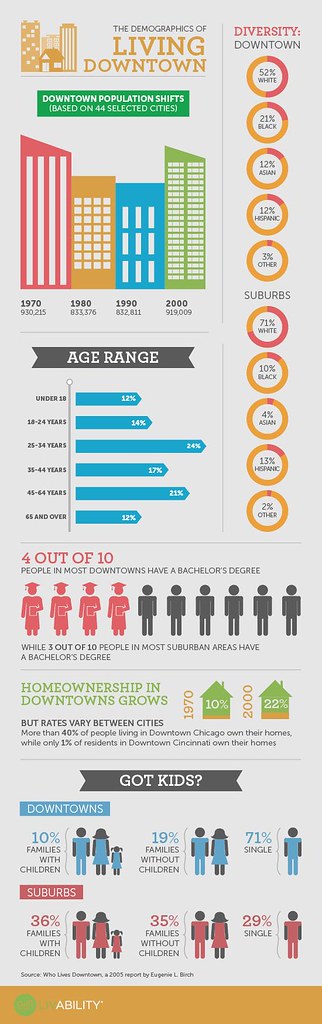
Downtown Living Infographic

This is true for most major cities, Chicago being an exception in terms of experiencing population shrinkage, but growth in terms of business headquarters capture.

Baltimore too is an exception, which is why I have suggested that Baltimore City and Baltimore County re-merge--they de-merged in 1851--becoming the nation's seventh largest city ("Baltimore Business Journal).

Interestingly, in DC specifically, we have been less successful than other cities like Boston or Chicago, in capturing large businesses relocating from the suburbs. E.g., Hilton moved from California to Tysons, and Choice and Marriott stayed in the suburbs with their moves/announced moves. A large Nestle division is moving from California to Rosslyn, not DC. (Although Caterpillar recently announced a move from Peoria to Deerfield, not Chicago proper, because they want easy airport access).  Etc.

The suburbs are intensifying too.  The NYT article does make a crucial point, that suburbs are moving to a newer stage of development that is confusingly also called "urbanization" in the academic study of land use.

The phenomenon called the "edge city" 30 years ago is moving to a new stage that is moving towards greater accommodation of transit and walking, more focused on developing placemaking qualities, and somewhat less automobile-centric.

This is demonstrated within the suburbs in how the "intensifying areas" are succeeding in terms of adding population and business activity, the more disconnected and car-dependent areas of these places are languishing.

 The fact is that the market is bifurcating along the lines of concentration vs. disconnection. See "Continued Strength In Suburban Office Markets Dispels Myths, Bisnow versus "Big foreclosure suit ensnares suburban office, industrial buildings," Crain's Chicago Business. I have written about this in terms of the Fairfax County market, which is going through "reproduction of space" as a result of the Silver Line subway refocusing development in the Tysons-Reston Corridor.

With opposition.  Although intensification in the suburbs is accompanied by a great deal of angst, as suburban residents often believe that suburban intensification is somehow a kind of repudiation of the "suburban ideal."  See "End of free parking is the last straw for some Reston residents" and "In downtown Bethesda, residents and county debate whether more height is right," Washington Post, and "Reston: On a Collision Course," Connection Newspapers.

Suburban growth accompanied by growth in poverty and demand for aging services.  Just as suburbs continue to capture "more growth," as suburbs mature they are capturing more poverty ("Suburbs and the New American Poverty," Atlantic).

When the original "unique selling proposition" of the suburbs was how center cities functioned as a metropolitan area's "poverty sink" with a disproportionate share of the region's poor, and the demand for social services to serve them. I used to call that reality a type of "quality of life subsidy" to the suburbs, one dumped on the cities, but now there is a turnabout.

-- Confronting Suburban Poverty website
-- Build a Better Burb website
-- First Suburbs Consortium, Greater Cleveland

Similarly, as people age, suburbs are forced to meet a greater demand for aging services, with limited financial means to address the need ("Aging in the American Suburbs: A Changing Population," Aging Well Magazine.

Center city proponents need to be conversant with the nuances.  In any case, there are many ways to look at this issue, and proponents of center city primacy must be able to discuss the objective and subjective elements of the argument.  A particularly good argument is presented by Steve Belmont in Cities in Full, which argues for "recentralizing growth" on the center city.  And in some respects, that is what is occurring, with a lot of opposition from states, suburbs, and Republican legislators.

I have argued for a long time ("DC as a suburban agenda dominated city") that the people most traditionally active in local civic affairs in DC came to the fore during the period of the shrinking city when the priority was staunching outmigration and stabilizing neighborhoods in the face of trends that did not favor urban living.

Now that the city has the opportunity to grow in terms of population and business activity, people may need a different skill set and attitude, and also concern themselves with satisfying future residents, not just current residents, based on events and experiences solely from the past.

The digital economy renews the value of "agglomeration economies" Reading Richard Florida's new book, The New Urban Crisis, I wouldn't claim that this point was made as directly as it should have been, but it spurred me to think about how with changes in economic and social conditions in terms of the impact of digitalization and globalization, "agglomeration economies" have again become increasingly important.

"Agglomeration economies" is a fundamental concept from urban economics. The Geography of Transportation webpage at Hofstra University defines them thusly:

Agglomeration economies are a powerful force that help explain the advantages of the "clustering effect" of many activities ranging from retailing to transport terminals. There are three major categories of agglomeration economies:

Urbanization economies. Benefits derived from the agglomeration of population, namely common infrastructures (e.g. utilities or public transit), the availability and diversity of labor and market size;

Industrialization economies. Benefits derived from the agglomeration of industrial activities, such as being their respective suppliers or customers. This favors the emergence of industrial clusters;

Localization economies. Benefits derived from the agglomeration of a set of activities near a specific facility, let it be a transport terminal (logistics parks), a seat of government (lobbying, consulting, law) or a large university (technology parks).:
The job market and the world economy is much more competitive and operates much faster, making agglomeration or "clustering" valuable again when in the post-war period through the first decade of the 21st century, automobile-centric land use and transportation development paradigms allowed automobility to trump the clustering value of place/location.

Transportation and agglomeration economies.  Transportation efficiencies have always been the primary factor in the development of cities, starting with how most cities developed as ports on oceans, lakes, and rivers.

For example, wheat was milled close to where it was produced (Minneapolis-St. Paul) because of the cost of transportation.  Heavy appliances like stoves and bathtubs were manufactured locally because they were "too heavy" to transport cheaply to other markets, etc.

The development of an integrated railroad system meant that businesses could transcend constraints on their ability to do business imposed by the difficulty and cost of transporting goods, and led to the creation of a unified national market and the consolidation of various industries.

Mills could locate far from where wheat was grown and no longer did every city need its own manufacturing plant for appliances.

It still wasn't perfect, because railroads didn't charge a flat rate for transportation of goods, they charged on the basis of the value of the product, so there was still a reticence to ship long distances goods that were particularly expensive.

The road network enabled--for a long time but not indefinitely--automobile transportation to trump the value of agglomeration.  The creation of a ubiquitous and integrated road network serving local, metropolitan, regional, multi-state and national markets supported the rise of a deconcentrated land use and transportation planning paradigm, where uses are separated, and people mostly use a personally-owned automobile to get from place to place.

Cheap cars, cheap gas, the "open road" and plenty of free parking enabled the outward spread of commerce from center cities to the arterials and freeways of the suburbs with the creation of strip shopping centers, shopping malls, and business districts off freeways.

The carrying capacity of the road network is fixed.  This works, at the cost of owning and maintaining a car, building and maintaining the road network, and at the economic, military, and environmental costs of a fossil-fuel based mobility network.

But it stops working when any of those factors/conditions change substantively, including the "carrying capacity" of the road network.

Richard Florida argues that as metropolitan areas reach a population of 5 to 6 million, an automobile-centric mobility network has decreasing marginal returns.  (I believe that the writings of Newman and Kenworthy make a similar point.)

There is a line in the Jacobs book Nature of  Economies, when she responds to a question of "Why aren't there enough roads?" with the response, "You're asking the wrong question.  The right question is 'why are there so many cars?'"

Cities long ago recognized that the carrying capacity of the road network wasn't great enough to satisfy the various mobility and exchange needs of the cities and developed robust transit systems. According to a book review of David Engwicht's Reclaiming our cities and towns: better living through less traffic:
Engwicht maintains that cities were originally created as places for people to come together to trade goods and stories. A city, by definition, can be seen as a concentration of exchange opportunities. Cars get in the way of these exchanges in several ways. They drive people out of public spaces and create inhospitable environments for social interaction because of noise, fumes, and the barrier effects of the stream of traffic. Furthermore, they eliminate what he calls the "spontaneous" exchange — the unplanned encounter — thereby depriving cities of their essential spontaneity and life.

Traffic also sets into motion a wide range of self-reinforcing inefficiencies, according to Engwicht. Cars require roads, which require space, which require urban expansion, which requires more travel, which in turn requires more space.
Conclusion:  The need to reposition economic development and governance systems around metropolitan areas.  The issue isn't whether or not cities are growing faster than the suburbs but is the economic value of the metropolitan area and the necessity of strong center cities as thriving anchors of these places.

This is the general argument of the Center for Metropolitan Studies at the Brookings Institution, that "metropolitan areas" -- that is center cities and the suburbs combined -- should be seen as the primary building blocks of the national economy and that US political and governance systems should be reformulated to recognize and support this reality.

Brookings laid these arguments out in the book Metropolitan Revolution.

See my review and also "Resurging cities, resurging metros, the impoverished and the Metropolitan Revolution (continued)" and "States, economic development, and sub-state/metropolitan area political restructuring."

In the meantime, the Trump Administration is doing all it can to screw cities in terms of proposals to defund transit, housing programs, health insurance programs, other poverty programs, etc.

And the DC area specifically, as the Trump Administration proposes significantly less money than is required to build new facilities for agencies such as the FBI and the Department of Homeland Security.

Labels: , , , , , , , ,

Tuesday, June 25, 2013

Resurging cities, resurging metros, the impoverished and the Metropolitan Revolution (continued)

1.  Urbanophile (mentioned in the book whereas this blog was not) has just run a review of The Metropolitan Revolution, and Aaron Renn makes many good points that I didn't necessarily raise or emphasize.  Three points that stand out for me are:

•  In a globally connected and competitive economy, even thriving cities (like New York City) cannot rely on their ability to attract talent, they have to secure the means of production and produce it too.  From his review:

The most notable thing here in my view is that New York believes it has to be in the tech talent production business. NYC has traditionally been the ultimate talent attractor. They didn’t need to worry about producing the world’s top talent because it would seek them out. Silicon Valley and most tech hubs rely on this kind of talent attraction for their supply. By setting up a tech talent factory in town, however, NYC is saying that they don’t think they can meet their tech industry ambitions solely through hoovering up outsiders. They need to be in the production business as well. I’m not sure what Jim Russell thinks of this, but he’s often claimed that the era of prosperity on an attraction model is waning in a more convergent world (i.e., where tech & talent are becoming more decentralized). NYC seems to be responding to this reality.

• The difference between a stagnant and a growing metropolitan economy is a focus on  export markets.

I acknowledged this in my piece. Aaron indicates (what globalization means to non-global cities) that there is a greater role for government and NGO involvement in shaping this reality than I did.

Of course, Germany's mittelstand companies are a different example of the same concept of small companies being globally significant producers. (See "Extreme Focus and the Success of Germany's Mittelstand" from the Harvard Business Review and "Engines of Growth" from the Wall Street Journal.)  And it's why I think it comes down to business-to-business interaction.

What is interesting and I didn't mention it in my review is how this is counter to older themes of how to foster regional and national economic development.  Jane Jacobs, in Economy of Cities, and my remembrance of the concept of "import-substitution industrialization" from political science studies of Latin America, focused on fostering industrial growth by producing those items that had been purchased from foreign sources.

And this touches on something that was in the discussion thread of my review, how I have a difficult time with the arguments of economist Robert Fogel, over whether or not railroads were a significant driver of US economic development.

Fogel argued that wagons and barges were substitutes so railroads didn't contribute all that much to economic growth, while I counter that railroads were essential to the creation of one large, national, and integrated market economy in the US, which could not have developed otherwise.  It was certainly a lot easier and cheaper (as difficult and as expensive as it was) to build a railroad network than it was to build an integrated network of rivers and canals.

During what Henry Luce called "The American Century," US companies could be very successful focusing only on the US market.  In other countries, to be successful, companies had to be export focused (like the Mittelstand) because their markets were comparatively small, and this positioned those companies to be more successful when the field of economic activity is global rather than national.

In short, for some time, at least the largest US companies have been playing catch up, and many smaller companies too have begun to refocus their efforts on export markets.  E.g., I came across this article while I was traveling, "Exports mean jobs, in any language" from the Minneapolis Star-Tribune, which illustrates the point, as does this piece also from the MST, "Minnesota to open trade office in Germany," not that the latter is particularly unique anymore.

• And while I emphasized it a lot, you can't emphasize enough how cities for the most part are screwed (I mean constrained) by state action and the actions of other communities within a metropolitan area.  An example in the DC region is how the State of Virginia's politics foster anti-metropolitan policies vis-a-vis Northern Virginia (see )

Frankly, it's the source of the reservation I have with the argument that going forward, "Metropolitan Areas are coming together".

It's easier to do when the suburbs feel superior, it's harder when the center city becomes more competitive.

And suburbs are no longer able to take their economic superiority for granted, as various trends that favor cities have begun to achieve critical mass and have become not just noticeable but un-ignorable ("The Future of the American City" from the Financial Times), such as

- city population growth vis-a-vis suburbs ("Population Growth Accelerates in Large Cities from Governing Magazine)
- location of successful businesses in city locations ("Google exploring move to West Loop" from Crain's Chicago Business)
- and relocation to the center city of business operations formerly located in the suburbs ("Mortgage lender Quicken bets on downtown Detroit's revival" from Reuters)
- the rise of suburban poverty ("Poverty finds the suburbs" from the Boston Globe").

As a result, suburban communities will be less inclined to be willing to join in with center cities and develop and work on achieving a consensus agenda.  Aaron mentions some examples of this behavior from Greater Denver and Greater Cleveland.

This reminds me of my brief experience working for Baltimore County Government a couple years ago.  I thought Baltimore County wasn't striving--they are mostly content comparing themselves to Baltimore City, which has been on a downward spiral for 50+ years, and thereby judging as wildly successful most any of the County's economic initiatives.

But if local elites instead chose to reference and benchmark the County against the most successful counties in the Baltimore-Washington region and the US more generally, it would be found wanting.  Going forward, to be successful on a national basis, Baltimore County and many other communities need to reset their expectations, goals, and standards for achievement.

In Washington, where DC is no longer the metropolitan area's basket case (well, not in terms of government corruption, but that's another blog entry) it's almost impossible to get the suburbs to work with the city in substantive ways.

So while I want to believe in the metropolitan imperative, the jury's still out.

2.  Aaron also calls our attention to Kaid Benfield's review ("Two very different views of the condition of American cities"), which pairs a review of The Metropolitan Revolutions book with the discussion of a report, State of the City: 5 Trends Impacting America’s Cities, published by the Living Cities consortium.  From Kaid's review:

Here are the five trends detailed in the report:

• Fiscal strain is causing city governments to reduce services and scale back capital investment.
• Failing infrastructure is inhibiting economic growth, sustainability and overall mobility of goods, people, and information.
• Stagnant educational outcomes have implications for talent production, attraction and matching to jobs.
• The changing economic landscape is creating unemployment and shifting centers of job creation.
• The collapse of the housing market and the tightening of the rental market are creating material pressure on household economics and the health of communities.

In other words, where Katz and Bradley see excitement, innovation, leadership, and economic recovery, Living Cities sees declining city services, crumbling infrastructure, a failing educational system, unemployment, and struggling households. ...

The report observes that many of the challenges faced by cites and their lower-income residents are due to or profoundly influenced by large social and economic forces, and are so fundamental that new, more systemic approaches are needed to achieve reform.


They are both right. Recentralization (a la Belmont's Cities in Full) trends centered around quality of life and urban design, form and mobility network characteristics more typical of center cities favor cities, but long term favoring of suburban development and financial strictures on cities make it tough on cities.

Kaid's review and the Living City report definitely deserve our review and consideration.

Still, as far as addressing the need to integrate the impoverished into exchange networks and the market economy, again I will mention the Houston case study from TMR. The Neighborhood Centers Inc. organization is not bringing the city and suburbs together, but it does have an interesting approach to economic integration and capacity building for the economically disadvantaged, and this kind of approach is typically missing in local, regional, state, and national planning.  If you believe that in the global economy, we have to utilize all of our potential human capital, it's an example worthy of further consideration.

3.  And not every city/metropolitan area is well-positioned to take advantage of metropolitan trends either (Aaron says to focus on the top 50 Metros).  I argue that cities on the East and West Coast along with cities connected to extractive industries--for example, Houston as the center for the US oil and chemical industry, is well-positioned to be successful without many of the qualities of otherwise resurging "old cities" because as oil production increases and the cost and therefore the revenue rises, they will continue to benefit--are best positioned for these trends.

I think (although it's yet another book I need to read) that the argument in Meredith Whitney's new book Fate of the States, that coastal cities aren't well-positioned, and states between the coasts are, is based on the increasing importance of extractive industries in the global economy, but misses those elements of the knowledge and applied science-based economy that are favored by coastal location.  See "Mapping out the state of the future," from USA Today.  From the article:

In Fate of the States, Whitney argues that a "new map of prosperity'' is emerging in the wake of the bust, with jobs moving away from the coasts and toward 17 ''central corridor'' states in the Midwest and Mountain West.

Using statistics mostly covering years from 2007 to 2011, she argues these states are outperforming the U.S. because leaders elsewhere are hamstrung by public-employee pensions and other commitments that housing-boom states made in flush times.

Although there is no question, like the points raised by the Living City report, that cities have plenty of issues to address, and that success in the global economy going forward is hardly a cake walk.

And in the constrained economic environment faced by governments, we are going to have to be parsimonious and ensure that every dollar we spend accomplishes multiple objectives.

Labels: , , , , ,

Thursday, June 20, 2013

Metropolitan Revolution (book review)

Bruce Katz and Jennifer Bradley of the Metropolitan Policy Program at the Brookings Institution have authored The Metropolitan Revolution: How Cities and Metros are Fixing our Broken Politics and Fragile Economy.

They presented last night and hopefully there will be other chances to hear them speak on the topic.

My general recommendation: buy and read the book

It's well argued, well-written, has great examples, a good set of citations, and makes the case for why metropolitan areas need to work together to be successful competitors within the landscape of an economy that has reorganized on a global scale.

How the book is organized

The book organizes its argument through an introduction, four case studies, chapters on reorganizing knowledge and production networks through the creation of "innovation districts" and the creation of global trading networks organized at the scale of metropolitan areas (not unlike the Hanseatic League), a discussion on the need to reorder relationships between the federal government, states, and metropolitan areas, a summation ("Metros as the New Sovereign") and a five point guide to how regions can start off the rebooting process ("A Revolution Realized").

How I summarize the book's argument

- Metropolitan regions, anchored by center cities, are the primary economic engines of nations--in the US the top 100 metros comprise 12% of the country's land, 67% of the population, and 75% of the nation's Gross Domestic Product;

- Success in the global economy is based on networks of connectedness, collaboration, and flexibility--enabled in large part by mobile computing applications and infrastructure--rather than being generated by internally focused corporations walled off and willfully disconnected from broader practice networks (the failure of the Detroit-based US automobile industry is an example);

- and will be realized and measured through export-driven exchange;

- Center cities and their suburbs are inextricably linked, they either rise or fall together;

- National politics is broken, the federal government isn't focused on developing and fostering economic activity in substantive ways, and even if it were, the money isn't there to do so (well it could be, just by  limiting the mortgage interest tax deduction);

- Nor are states organized to support metropolitan-scale economic integration and political collaboration;

- So metropolitan areas are mostly on their own and must develop, implement, and manage new forms of collaboration across traditional political boundaries--cities, towns, counties, and other special districts--to realize and leverage their core competencies and place-shaped and -specific opportunities;

- Innovation districts, linking institutions, businesses, firms and other stakeholders in place-based and spatial terms, are a transformative method for organizing these globally-spanning knowledge and production networks in spatial terms;

- To realize export-driven growth and exchange, all human capital within our communities will have to be leveraged, and immigrants and immigrant networks (the book did not reference Arrival City by Doug Saunders here and should have) position metros to be able to develop knowledge and production networks that span hemispheres.

But that isn't exactly how they lay out the argument.  One key element is somewhat undeveloped.  While the book discusses the necessity of reorganizing local economies at the metropolitan scale rather than at the level of an individual city or town, the key elements usually are located in the center city--anchoring districts, businesses, and institutions, especially universities--organized in what urban economists call "clusters".

Because these districts, called "innovation districts" and described in  the book's best chapter, are the building blocks of economic development and growth, it means that the center city is still the driving force of the "Metropolitan Revolution" even if cities are seen to have been outspanned by the suburbs in terms of population growth and the relocation of a significant number of commercial enterprises to suburban locations.

(Actually the Washington, DC region, because of how knowledge and production networks have developed around the suburban locations of the Department of Defense, located in Northern Virginia, or the National Institutes of Health, the National Institute of Science and Technology, and the Food and Drug Administration, based in Maryland, is an exception to this observation.)

The case study chapters illustrate elements of the argument, but only one chapter, on Cleveland, presents a complete example of the "Metropolitan Revolution" argument, illustrating the development of systems of collaboration, organization and economic development at the metropolitan scale.  Denver almost gets there,  but not necessarily on the economic development dimension, at least according to the chapter as presented.  That being said, the other case studies, on Houston/Harris County and New York City, are still compelling.

Some of the best cases are smaller sections within the chapters on innovation districts (Detroit) and trading networks linking metropolitan areas (Portland, Oregon and Asian cities; Miami and São Paulo) across the globe.

Case studies

The New York City chapter explores the city's recognition that they need to reorient their economy away from certain types of non-value added financial services to focus on knowledge- and engineering-intensive production industries by strengthening the city's position in applied science-related elements of these fields, such as health care, fashion, digital media, information technology, biotechnology, etc.

To anchor applied sciences, the city created a competition for the development of a new engineering university focused on knowledge creation, technology transfer, and the creation of new businesses, to anchor knowledge and production networks in the selected fields..  A team led by Cornell and Israel Institute of Technology, Technion, won the competition. 

This chapter illustrates the need to refocus local economies on value-added investment and production and creating the infrastructure necessary to achieve it.  But the example doesn't illustrate reordering and collaboration at the metropolitan scale--the Cornell/Technion school, while connected to practice networks across the globe, is an in-city focused-institution.

I think of this chapter more as an illustration of how innovation districts typically are more likely to be present in center cities.  It will be interesting to see how the Cornell/Technion school reproduces and impacts production and knowledge networks within the Metropolitan New York region over time.

Similarly, the chapter on Houston isn't about metropolitan scale collaborative systems so much as it is about a truly unique nonprofit social services organization, Neighborhood Centers, Inc., that operates at the metropolitan scale.  That fact alone is worthy of a case study.

NCI uses what I think of as the "asset based community development" model--although they use a different theoretical approach, called affirmative inquiry--applied to social services.  The organization, which grew out of the settlement house movement, has transformed coincident with the great demographic changes that Greater Houston has undergone over the past 50 years--while Caucasians are still the majority of the county's population, by 2020 the population is likely to be equally split between Caucasians and people of color.

The organization operates at the scale of Harris County (just under 1,800 square miles in size, of which the county seat, the City of Houston, comprises not quite 600 square miles, and a total population of 4.1 million), has a $275 million annual budget, operates a wide variety of programs with a myriad set of funding sources, has built internal organizational development capacity and competence, and continues to develop and expand a set of multifaceted service centers that successfully serve impoverished populations, especially immigrants, helping them to become integrated and connected within their communities and the local economy.

The chapter is important because it shows how to provide affirmative and comprehensive programming (they even have credit unions at some of their centers) that re/integrates the impoverished into the local economy, fostering both poverty reduction and  human capital development, which in turn supports metropolitan-scale economic development.  (Note that Toronto's United Way has developed in parallel a similar kind of neighborhood improvement initiative).

The Greater Denver chapter covers the evolution of the relationship between the center city and the  suburban cities and counties over the past 40 years, and the transformation of the relationship from acrimony--starting with a successful fight by the counties to ward off annexation threats by the City of Denver--to collaboration--creation of a new international airport in what had been an outlying county, allowing for the annexation of this property to Denver; the creation of a regional sales tax to fund cultural assets mostly located in Denver; a plan and funding system for the development of a regional light rail transit system (FasTracks), the creation of a regional business recruiting entity; and the organizational infrastructure, such as the Metro Mayors Consortium, that acts as the glue that fosters and supports these relationships.

It's definitely a model for how metropolitan areas can and should work together.  I do wonder if it's an outlier as an example, because for the most part the Denver region is economically successful and has doubled in population since 1960, whereas other metros discussed (Detroit, Cleveland) or not (Pittsburgh) tend to have not grown or have shrunk in population over the same period.

The Cleveland story is quite interesting.  Touched off by a sobering series of articles about the economic decline of the city and region in the Cleveland Plain Dealer ("A Quiet Crisis") area foundations began to reconsider their role and how to best focus regional attention and resources on economic redevelopment in the face of deindustrialization and a shrinking population.

(Note that while not discussed, in the face of shrinking resources in the community development arena, in the late 1990s, Cleveland foundations created an accountability and measurement system for community development corporations in the city, "forcing" the merger of many groups into a smaller set of more focused outcomes-oriented organizations.  This had to have been foundational in terms of the later effort.)

The foundations have created funding pools, metropolitan-scale economic development initiatives, and have worked to align these programs with other complementary and supportive state and federal initiatives.  And in those sectors where economic development initiatives have focused, the region is adding jobs and businesses at rates greater than the nation as a whole.

Although I do think this is an illustration of a weak market element that I call "a desperate willingness to experiment because you have no other choices."  Because on a relative basis, both the city and suburbs and other center cities within the region (Canton, Youngstown, Akron) were all experiencing decline, there was less a sense that revitalization is a zero sum game, where suburban jurisdictions could still thrive without the center city being successful--although the medical institutions (especially the Cleveland Clinic) and universities located in the center city are in fact key elements in the metropolitan area's improvement strategy.

Innovation Districts

I thought the chapter on Innovation Districts was the most interesting.  The argument updates the "agglomeration economies" argument from urban economics in terms of how clusters in one place connect to other locations within the network of clusters through virtual and physical networks of knowledge development, production, logistics, and transportation, and how the spatial organization of clusters is changing too, where urban design and buildings support connection and the value of proximity, rather than separation.

The chapter states:

Our open, innovative economy increasingly craves proximity and extols integration, which allow knowledge to be transferred easily and seamlessly between, within, and across clusters, firms, workers, and supporting institutions, thereby enabling the creation of new ideas that fuel even greater economic activity and growth. ...  The vanguard of these megatrends is largely found not at the city or metropolitan scale write large but in smaller enclaves ... Innovation districts cluster and connect leading-edge anchor institutions and cutting-edge innovative firms with supporting and spin-off companies, business incubators, mixed-use housing, office and retail and twenty-first-century amenities and transport.

I have written about this general concept, although not using the fabulous phase "innovation district" in terms of the arts ("Art, culture districts, and revitalization") especially with regard to arts as production, research-based inquiry anchored by the presence of the National Science Foundation in Arlington, Virginia ("The state of Arlington County Virginia's commercial real estate market: 2012 and the future"), and the MaRS Discovery District in Toronto ("Interesting planning initiatives/research in Toronto").

A Global Network of Trading Cities

This chapter makes the argument that trade is between businesses and regions more than it is between nations.  I don't fully buy the argument, because really trade is between producers and customers, but the reality is that in the 21st Century economy, center cities and metropolitan areas and smaller businesses not typically focused on foreign markets can't wait for federal or state governments to step in and build up their relationships with markets and actors in other countries.

The chapter makes the point that the scale of the economy in the 21st Century is global, and that foreign sales tend to be more profitable compared to sales to other customers within the own-country market, and that to be capture more income, metropolitan areas need to reorganize, refocus, and scale differently to achieve success.

This chapter works as a call to action to metropolitan political and economic elites to refocus on enabling their regions to be able to compete at the global scale.

While reading the chapter, I was thinking of the recent obituaries for Nobel Prize winning economist Robert Fogel ("Robert W. Fogel, Nobel-Winning Economist Dies at 86" from the New York Times).  He linked economic history and econometrics in his work and his first claim to fame was the counter-intuitive argument that railroads weren't key to the economic growth of the United States, that canals and wagons could have substituted for railroad-based freight transportation.

Now I haven't read the book, but I have a hard time with his argument because the importance of the railroads to US economic development was not merely that it was faster to ship wheat from North Dakota to Minneapolis.  It was that by shipping wheat to Minneapolis, it could be milled and then shipped to the rest of the country cheaply and quickly.  Before that most markets were local.

Sure you could ship strawberries in a wagon, but with a railroad car you could ship strawberries to big markets, rather than just to the next town.    Or (and there are negative repercussions from the changes too), there were stove manufacturers located all over the country, because it was too expensive to ship heavy stoves long distances.

It was in how the railroads enabled the creation of an integrated market economy across an entire continent, and in turn how this advance reshaped the organization, scale, and productive capacity of American manufacturing.

This chapter carries this argument to the next level, to the scale of the globe.

Metros as the New Sovereign/A Revolution Realized

As mentioned above the "New Sovereign" chapter discusses how the relationship between cities, metropolitan regions, states, and the federal government doesn't work very well in terms of foster successful participation in the globally networked economy.

The chapter on realizing the revolution lists five steps to begin the process of metropolitan reorientation:

1.  Build your network;
2.  Set your vision;
3.  Identify and implement game changing initiatives;
4.  Bankroll the revolution;
5.  Sustain the gain.

And then discusses elements necessary to spreading the concept across metropolitan areas.

Some issues

The book maybe is more a call to action and not so much the kind of bone-crushing elucidation and discussion of the kind I am wont to write myself in overly blog entries.  So that likely accounts for the failure to include more case studies, stories, and contrasting examples.  I do aver that contrasting examples ("what doesn't work or hasn't worked as well") strengthen arguments.

That being said, the references and footnotes are particularly helpful and offer support to various additional lines of inquiry.

As far as other examples are concerned, I'd offer Pittsburgh as a good example of how innovation districts, core competencies, and educational institutions can be harnessed to staunch leakage, even if it doesn't lead to a reproduction of the local economy at the metropolitan-wide scale.  Also, Pittsburgh has a similar example to that of Denver in the creation of a regional funding mechanism for arts and culture institutions.

Or Oklahoma City passed a bond issue to self-fund infrastructure improvements to the central business district and city that will assist in the rebranding and repositioning of the city as a place to do business and live.

The chapter on innovation districts could have had more examples on the reduced spillover benefit of closed industrial research and development systems such as how AnnaLee Saxenian contrasts the impact of the earlier generation of Route 128-based technology firms outside of Boston versus the comparatively open development culture in California's Silicon Valley.  The book's discussion of MIT's initiatives and success in Cambridge proper is more an example of the approach of that region's second generation of business development.  Did they change purposefully, or just because MIT owned a bunch of land in Cambridge and wanted to harness its value?  (Probably the latter, but that's still important to know, as it reiterates the importance of center city location.)

Or how the closed campuses of the National Institutes of Health and the Food and Drug Administration in Montgomery County, Maryland haven't led to the same intensity of biotechnology spinoff and industrial and economic development compared to clusters in San Diego, Boston, or San Francisco.

Similarly, the work on arts districts and creative production such as by John Montgomery (The New Wealth of Nations) can be mined also.  And there are others.

I would have liked to see more defined lists and discussion of the kind of soft infrastructure and support mechanisms, especially financing vehicles such as infrastructure banks, that metropolitan areas ought to have access to in their practice toolbox, to assist in their process of repositioning.

There are plenty of examples, examples that work (Bank of North Dakota) and others that don't operate all that well across a metropolitan area and are the fount of tradeoffs made on a political basis (the Port Authority of New York and New Jersey).  Port authorities, the kinds of regional parks and cultural assets funding mechanisms (Chicago Parks District, the SCAF in Denver, RAD in Allegheny County, Pennsylvania, the Huron-Clinton Metroparks millage in Greater Detroit, etc.), and transit authorities, etc. are examples of other support and development institutions.

Similarly, jurisdictions across Metropolitan Minneapolis share a portion of their property tax revenues to militate against the practice of jurisdictions poaching businesses from each other, to boost their local income (this is a real problem in the DC region, with Arlington County and Alexandria are very much focused on recruiting DC-based federal agencies and businesses to their cities, although with high rents in the city and a great number of suburban-living employees, it's not like they have to work that hard at it--I joke that their main business recruitment strategy is to answer the phone).

Plus Portland, Oregon actually has a Metro Government (although maybe it functions more like a County Commission with the addition of the MPO) or how certain Metropolitan Planning Organizations, the Minneapolis entity in particular, do true metropolitan-scale planning and may run transit systems and other infrastructure (the MPO in Minneapolis also runs the water and sewer authority).

Does the merger of center cities and counties (Indianapolis, Nashville, Louisville, Lexington) assist in the development of this metropolitan concept and revolution?  And even how historically some cities became reorganized politically as combined city-counties and whether or not that is working out today (Philadelphia and San Francisco are leading examples).  Although maybe the city-county element is a bit off topic.

The book mentions the lack of a national freight transportation plan.  I think I have written about that a few times myself.  In the meantime, most of the ports on the east coast (Miami, Jacksonville, Savannah, Charleston, Norfolk, Baltimore, New York, New Jersey, etc.) are clamoring for federal monies to dredge and deepen their waters, to accommodate the massive container ships that will be able to sail through the soon-to-be deeper Panama Canal.  We can't afford to simultaneously expand all of these ports and it doesn't make business sense either.

Some discussion of how to coordinate the Metropolitan Revolution across state lines would be useful.  New York City (New Jersey, upper New York State, Connecticut), Boston (Rhode Island, Maine and Connecticut), Philadelphia (New Jersey), Washington, DC (Maryland, Virginia), and Chicago (Indiana, Wisconsin) come to mind but there may be others as well.

Of course, the issue of border towns linking nations is worth considering too.

I am thinking of our border with Mexico mostly, such as Tijuana in Baja California, and the cross-border town arrangements in Texas between Mexican cities (such as El Paso and Ciudad Juarez), but the relationship between Detroit and Windsor, Ontario and the relationship between Buffalo and the Toronto-Hamilton Metropolitan Area is equally significant.

At a different scale, Ecotrust Institute in Seattle promotes the "Salmon Nation" linking Oregon and Washington States, and parts of Idaho and California as well as Canada's Province of British Columbia in one large bioregion.

... maybe cross-national metropolitan economic development is a book in itself.

Labels: , , , , ,

Wednesday, April 24, 2013

Separated uses can make sense in some situations

A big plank of libertarian thinking is that land use regulation is bad, that property owners ought to be able to proceed unfettered.  That means that you can put a gas station next to a house, or a school next to a fertilizer plant, even if it isn't a good idea.

Mostly, office, retail and residential can be mixed.  Universities and clean research facilities too.  Maybe even nuclear processing facilities ("Toronto residents shocked by local uranium facility" from the Toronto Star).

Probably not power plants, because the emissions have negative health impacts on some (this is an issue in DC, with a power generation plant owned by the US Congress, see "Use of coal in Capitol plant draws protesters" from the Washington Times").

Even hospitals, although their sprawling nature ("Gazette) and the fact that the high pitched sirens of ambulances going to emergency rooms can be piercing and negative in the context of "quiet enjoyment" of residential living.


But it's not a good idea to put housing and schools by fertilizer plants, chemical plants, and other "dirty" and dangerous industrial uses, as the West, Texas fertilizer plant explosion indicates.

Image from Daily Kos


And minimal and dis-coordinated regulation doesn't help (not unlike the same problem with delegating the regulation of so-called compounding pharmacies to the states).

 See "Fertilizer-Storage Risk Is Often Overlooked" and "Deadly Explosion Prompts Fresh Look at Regulation" from the Wall Street Journal.

Labels: , ,

Saturday, February 23, 2013

Another video on the Toronto Streetcar system from the transit workers: transit as an urban industry

Back during the initial streetcar study in DC (DC Transit Futures), I made the point that if DC were to (re)develop streetcars to the extent discussed, then we could work to even develop streetcar manufacturing facilities, not unlike what happened in New Orleans, when they created a manufacturing plant there to construct the streetcars for the then new Canal Street line.  See the past blog entry, "DC as a center of streetcar manufacturing excellence?"

As importantly, in the context of industrial jobs, other than construction and building maintenance (plumbing, electrical, etc.), transit--maintaining the vehicles--is one of the only major industrial/craft industries left in "the city."  For example, in DC with WMATA ("Metro"), you have diesel engine mechanics for buses, track maintenance people, etc.

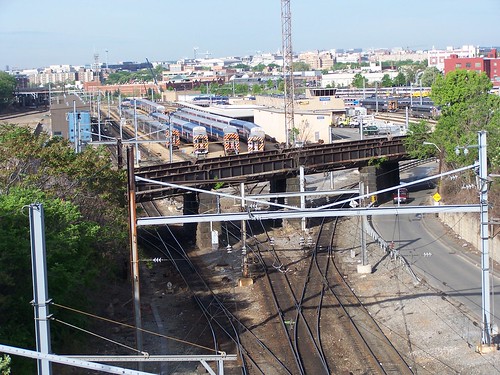
Looking into the Amtrak Maintenance FaciltyLeft: looking into the Amtrak maintenance facility in the Ivy City Yard from a nearby street overpass.

Similarly, DC needs to think of Amtrak as a local industry, because many locomotive engineers and other "industrial" workers involved in the running of the Amtrak passenger rail service are based here.  See "Commuter Railroads and Amtrak."

Anyway, the Toronto Transit Maintenance Workers have another great video (they are worried about their jobs refurbishing streetcars being outsourced) about the Toronto Streetcar "Lifecycle Enhancement Project," which completely restores and rebuilds streetcar vehicles on a 5 year cycle, to maintain their useful life.

Granted the union workers take all the credit for this, when of course, it is equally a management initiative and commitment.  Nevertheless, the video is well done and shows the various sections of the Hillside Maintenance Shops involved in the 5-week process of rebuilding the car.

It's a well done video.  (Too often such videos are not.)

Labels: , , ,