Rebuilding Place in the Urban Space

"A community’s physical form, rather than its land uses, is its most intrinsic and enduring characteristic." [Katz, EPA] This blog focuses on place and placemaking and all that makes it work--historic preservation, urban design, transportation, asset-based community development, arts & cultural development, commercial district revitalization, tourism & destination development, and quality of life advocacy--along with doses of civic engagement and good governance watchdogging.

Tuesday, July 16, 2013

Trial balloons in the Washington Post and Dulles Airport as an aerotropolis

The first place I saw the concept of a casino at National Harbor in Prince George's County being publicly outlined was in a column by Robert McCartney of the Washington Post  in a January 2012 column, "Make picks in these '12 predictions."

At that time, Prince George's County residents had already voted to not allow casinos in the county.  By November, a state-wide referendum was passed that expanded casino gambling beyond slots and adding PG County as a place for a casino to locate.

Last week, Washington Post columnist Robert McCartney wrote a column suggested the roadway network in the metropolitan area could be expanded as a way to reduce congestion, if done intelligently.  One of the projects he mentioned is the proposed Bi-County Parkway, which would mostly enable new development, even though his column was about congestion reduction.

I wrote about the general thrust of his column here, "Weak discourse on "congestion" by Washington Post columnist."

But then on Sunday, there is a big piece in the Post about how the Metropolitan Washington Airports Authority has big big plans to enable development on land that they own on and around the Dulles Airport, to generate revenue.  See  "Could the Bi-County Parkway revive Dulles International Airport?"  From the article:

Dulles International Airport has seen a tough few years. Fewer passengers are flying into and out of the airport’s iconic terminal. Less cargo is moving across its tarmac. And with the global economy still sputtering, there’s no telling when the airport’s fortunes will turn around.

A solution, some Virginia officials say, is the long-debated Bi-County Parkway, a proposed road between Prince William and Loudoun counties that could serve as a new conduit for people and cargo passing through Dulles. Proponents say it would spur business development by offering a vital north-south link to the airport, giving businesses easy access to an international gateway.

With thousand of acres of undeveloped land and a Metrorail connection that the Metropolitan Washington Airports Authority aims to open in 2018, authority officials hope to build new facilities — perhaps offices and another hotel — on airport property to generate additional revenue. On the land around the airport’s runways, MWAA officials say new buildings to house cargo, including units that could store flowers, pharmaceuticals and other perishables, could boost the airport’s bottom line. They point to a soon-to-be built United Airlines maintenance hangar as an example of the airport’s potential to bring in more jobs and tax revenue.

Again, it's as if the column last week was a trial balloon.

I can't knock the MWAA or Prince William and Loudoun Counties for wanting more development, because ultimately that's what generates revenues for their respective entities.  Dulles Airport's passenger and cargo traffic has been dropping, and they want to boost it.

But it doesn't bode well for "smart growth."  Or maybe it does, just on a relative, not an absolute basis.

Also see:

- "More on transportation to the DC area airports"
- "Aerotropoli and rethinking the scale of mobility networks in the context of a global economy"
- "Aerotropoli"

Graphic from Washington Post on passenger and cargo volume and the proposed route of the Bi-County Parkway.

Labels: , , , , , ,

Saturday, February 23, 2013

Another video on the Toronto Streetcar system from the transit workers: transit as an urban industry

Back during the initial streetcar study in DC (DC Transit Futures), I made the point that if DC were to (re)develop streetcars to the extent discussed, then we could work to even develop streetcar manufacturing facilities, not unlike what happened in New Orleans, when they created a manufacturing plant there to construct the streetcars for the then new Canal Street line.  See the past blog entry, "DC as a center of streetcar manufacturing excellence?"

As importantly, in the context of industrial jobs, other than construction and building maintenance (plumbing, electrical, etc.), transit--maintaining the vehicles--is one of the only major industrial/craft industries left in "the city."  For example, in DC with WMATA ("Metro"), you have diesel engine mechanics for buses, track maintenance people, etc.

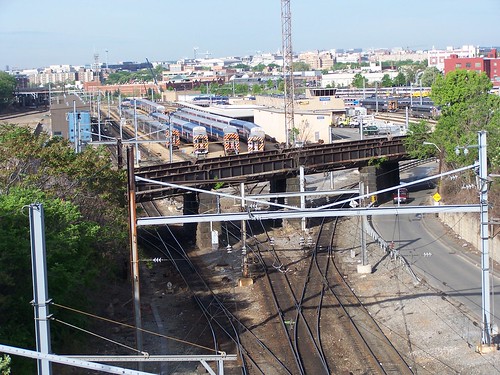
Looking into the Amtrak Maintenance FaciltyLeft: looking into the Amtrak maintenance facility in the Ivy City Yard from a nearby street overpass.

Similarly, DC needs to think of Amtrak as a local industry, because many locomotive engineers and other "industrial" workers involved in the running of the Amtrak passenger rail service are based here.  See "Commuter Railroads and Amtrak."

Anyway, the Toronto Transit Maintenance Workers have another great video (they are worried about their jobs refurbishing streetcars being outsourced) about the Toronto Streetcar "Lifecycle Enhancement Project," which completely restores and rebuilds streetcar vehicles on a 5 year cycle, to maintain their useful life.

Granted the union workers take all the credit for this, when of course, it is equally a management initiative and commitment.  Nevertheless, the video is well done and shows the various sections of the Hillside Maintenance Shops involved in the 5-week process of rebuilding the car.

It's a well done video.  (Too often such videos are not.)

Labels: , , ,

Sunday, September 04, 2011

Chicago examples that small/craft industry is still relevant to urban policy and employment

Two articles in the Chicago Sun-Times, "Alternative energy companies grow jobs, presence in Chicago area," and "Technology replaces brawn in Ravenswood corridor," discuss the presence of small industry in Chicago.

The first article is about small scale alternative energy industry in Illinois, not battery production for large scale car manufacturing but various energy saving technologies, such as geothermal power, and is drawn from this report, Clean Energy Supply Chain Reports: Wind, Solar & Geothermal (Illinois), released by the Environmental Law and Policy Center.

Chicago proper has about 5/12 of the region's wind, solar and geothermal technology companies, 86 companies, employing about 2,500 people.

The second article discusses how Chicago's Ravenswood industrial corridor is repositioning to support smaller, what we might call "craft" industrial operations, comparable to what I described is happening in the Central Eastside Industrial District in Portland. From the article:

The Ravenswood corridor has evolved into an informal technology incubator, as web-development startups sit side-by-side with fast-growing, established companies such as Guaranteed Rate, dubbed the Google of the mortgage industry, and NogginLabs, a custom-learning software developer.
The former industrial corridor, running along North Ravenswood, from Wellington to Peterson, sports redeveloped commercial space designed for entrepreneurs and companies whose work cultures require large, open loft spaces.

Joe Hayes, whose Hayes Properties is headquartered in the former Manz printing company building at 4043 N. Ravenswood, owns 750,000 square feet of commercial space in the corridor.

“No one had converted these industrial buildings to work for small, modern companies,” said Hayes, whose firm has reroofed, sandblasted and reconfigured the clock-towered warehouse-like plants into high-ceilinged, sunlit-filled, exposed-brick-walled and hardwood-floored lofts.

Technology-based companies occupy about one-third of Hayes’ holdings and employ about 450 people, based on average employees per square foot.


What would be useful is to have comparable data to that of Portland on the number of businesses and jobs in the corridor.

Labels: , , , , ,

Saturday, September 03, 2011

Industrial policy, manufacturing, and industrially zoned land are different issues

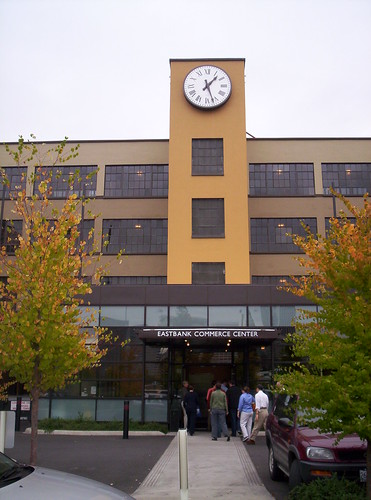
East Bank Commerce Center

Market Urbanism has a post on the failure of an electric battery company as an example of failed "industrial policy" and then goes on to discuss manufacturing in cities and industrially-zoned land in the same entry. See "Obama’s sprawl-promoting industrial policy: electric cars."

(I'd have probably just written a comment there but for some reason my Flash or other program isn't functioning and I can't write comments on my own blog and others depending on what commenting programs they use, like disqus).

The three separate issues are mixed up and conflated in the post which makes the discussion unuseful or noncontributing. (A fourth issue is a different kind of "industrial policy," supporting craft manufacturing at the local level.)

Plus, the electric battery thing yes is an example of supporting sprawl. Obviously. It's nothing new and nothing surprising. E.g., it reminds me of a post I wrote in 2005 about a different industrial policy supporting hydrogen energy for cars. I titled the post "Asphalt Nation: Next generation." Electric cars are merely Next Generation Asphalt Nation 3.0.

1. We can agree to disagree about industrial policy. Industrial policy, that is, supporting manufacturing and business development as part of national economic development, isn't a bad thing necessarily. Where it gets confusing is in the support of specific types of businesses and specific businesses vs. general support of industrial activity.

Support of new business is risky even in the best of circumstances. But I agree with Market Urbanism that when entrepreneurialism and the ability to get money is more about "who you know" (political entrepreneurialism) than the value of your ideas and technologies, that's a real problem. And note, speaking of political entrepreneurialism apparently this is a big problem with Gov. Rick Perry's "state industrial policy" in Texas, where the well-connected benefit disproportionately from such programs.

There are all kinds of f*ed up industrial policies now, ranging from agricultural subsidies to special oil depletion subsidies for oil companies, special tax treatment for ethanol production, which comes at the expense of higher food prices, that weird tax deduction paper manufacturers get for using a production byproduct that they use for fuel anyway as some sort of sustainable energy, to the mortgage interest tax deduction on houses, which drives both sprawl and the housing industry, to the special tax treatment of earnings by hedge funds, which supports the "industry" of "financial engineering." Battery manufacturing is just one more thing.

1b. Distinguishing between supporting specific companies and more general industrial policy

But I was really struck by something that I read in an interview with Alan Mullaly, the Chairman of Ford Motor ("Ford CEO sees good outlook for U.S., hot prospects abroad" from USA Today)

Q: You say this is a real manufacturing story. A lot of people worry, with India and China growing the way they are, what does the U.S. manufacture? Do you have any ideas in terms of creating new jobs in this country, not just for the auto sector, but throughout manufacturing?

A: We have to make manufacturing a priority. Seventy percent of all the research and development investment in the U.S. is associated with manufacturing. It's the foundation of everything associated with the economy. Everything needs to be looked at through that lens. How do we create an environment that allows manufacturing and business to grow? Our tax policies, our trade policies, our education policies, everything that we do needs to be looked at through the lens of competitive manufacturing worldwide, competing with the best in the world, and growing our economy.


This point, about treating manufacturing right in terms of tax, trade, and education policies really matters, because even at a reduced rate, manufacturing does matter in terms of economic competitiveness, balance of payments, and employment.

2. Anyway, then comes up in the entry the issue of manufacturing in cities. This isn't the issue that it appears.

Most large manufacturing no longer occurs in major cities and there is no campaign that I am aware of that is trying to change that.

Not that communities don't continue to recruit manufacturers interested in locating in the U.S. and/or expanding operations. It's just that the manufacturing companies, at least large operations, no longer construct comparatively compact multi-story buildings for their operations.

Instead, they tend to create large sprawling one story facilities over many acres. Therefore, they tend to locate on large pieces of land that aren't typically present in urban cores, even if for whatever reason the land happens to be located in the city, technically.

For example, in Chattanooga, which because it is a large enough city, had a large parcel of land (a former ammunition manufacturing complex) which they have been able to use for an industrial park for a VW plant ("Looking for public industrial park space in Chattanooga") and they have been fortunate in that Alstom is expanding operations that already exist on the waterfront.

But these aren't the kind of old time multi-story manufacturing buildings near waterfronts and in city industrial neighborhoods, cheek by jowl with neighborhoods and served by streetcars. That kind of manufacturing doesn't really exist anymore. (Although the Alstom plant is on the waterfront in Chattanooga, but not within a neighborhood, and not immediately proximate to downtown.)

3. The issue of maintaining some land as "industrial zoned" is another issue entirely.

The issue isn't preserving this kind of land for "manufacturing", especially for "large plants" or for "industrial policy political entrepreneurial operations" as much as it is for supporting what economic planners call PDR uses.

PDR stands for production, distribution, and repair and includes warehouses, auto repair, bus garages for transit authorities, and yes, manufacturing.

The Market Urbanism entry asks to look at the DC industrial lands study. But that is a function of the writer's own willingness to find and read the report. There are dozens of such reports on cities at this link, including DC's study.


I happened to be really impacted by a presentation I saw on this topic by the San Francisco Dept. of Planning at the American Planning Association meeting in DC in 2005. Of course, New York City has similar issues with regard to Brooklyn, and even the Garment District in Manhattan (see "Looking to the fashion district’s future" from Crains New York Business and this webpage on the Garment District issue from the Municipal Arts Society and "Long Live the Industrial City" from Wilson Quarterly). Baltimore did a similar study etc.

The point that the San Franciscans made, and this is an issue in DC to some extent, is that because SF has limited ways into the city that are significantly constrained (bridges especially), displacing PDR uses to East Bay like Oakland would increase traffic congestion, not to mention the employment and other impacts.

DC has less than 3 square miles of industrially zoned land.

Another problem, which DC refuses to deal with, is that the zoning regulation allows for schools and churches as matter of right use in this land category. Because these types of institutions can pay for land at prices higher than the economically viable use of operating businesses, plus they don't have to pay property taxes, PDR uses get outbid and displaced.

(I filed a proposed amendment to the Comp. Plan in 2009 to address this, but it was rejected.)

4. In terms of the "P" or production side of PDR for craft-based businesses, Portland has modified its zoning classification of industrial land to limit non-commercial users from using industrial zoned land in the "Central Eastside Industrial District). (Their report is in the above list. I happened to tour this area at the National Trust for Historic Preservation national conference in 2005) And it is focused on preserving this kind of use in order to support the development of artisan businesses, such as software, furniture, and clothing manufacturers, albeit in smaller quantities.

This is the basis of "creative" industrial production of usable goods, usually smaller production runs.

Portland's Central Eastside Industrial District comprises 681 acres. There are 1,122 businesses and 17,000 jobs there, about 25 jobs/acre.

The Portland example demonstrates how having this kind of industrially zoned land--which in DC is in danger of being fully converted to housing, churches, and schools--is important to the local economy, which in DC ought not to be comprised exclusively of government agencies, trade associations and law firms, if you want the "local" economy to be resilient and able to face change.

----
The issue of the right kinds of economic, financial, tax, land use and other policies to support this kind of business development and maintenance is deserving of consideration in its own right, and not being linked to other issues, like automobility and automobile electrification.

Labels: , , , , ,

Friday, August 05, 2011

Is abject failure necessary for a community and organizations to be able to rebuild?

Most people who know stuff know that in the 1980s and 1990s, the U.S. steel industry went through a wrenching reinvention, costing hundreds of thousands of jobs, as steel production became an industry organized on a global scale, and production shifted from a mass production method to a system focused on shorter runs and specialty products. See "The Role of Management in the Decline of the American Steel Industry" from the journal Business and Economic History (1996).

All the time while the big producers were failing, smaller companies like Nucor, with a different business model and system for production, succeeded.

The automobile industry and the related unions couldn't have been unaware of the failure of the steel industry, as changes in both industries impacted the other.

I guess that was a dry run, but ignored, for Detroit. Not to mention that in 1979, John DeLorean wrote a brilliant book about the failings of the automobile industry, On a Clear Day You Can See General Motors. Or even an article in the Economist ten years later, "On a clear day you can still see General Motors" which looked at the continued failures of the company and the industry. DeLorean's book had a huge impact on me in terms of approaching organizational development and institutional change.

Maybe you have to hit rock bottom before you become willing to change, willing to innovate?

It shouldn't have to be that way, and it might just be a factor of the different kind of innovation ecologies that exist between industries that develop as large, mass production oriented companies vs. industries that come out of a more startup, bottom-up culture like the difference between technology clusters along Route 128 in Massachusetts vs. Silicon Alley in California as described by AnnaLee Saxenian in Regional Advantage: Culture and Competition in Silicon Valley and Route 128

I joke that some cities develop "a desperate willingness to experiment because they have no other choice" and finally, Detroit has reached that point.

As The Doors sang in "Been Down So Long":

Well, I've been down so Goddamn long
That it looks like up to me
Well, I've been down so very damn long
That it looks like up to me
Yeah, why don't one you people
C'mon and set me free

Last night, I watched the Planet Green cable network's mini-series, "Detroit in Overdrive," a three-part program about Detroit's revival, which repeats on Monday August 8th.

I found about half of the running time of the programs relevant to the stated purpose of the program.

Showing automobile design students at Center for Creative Studies wasn't relevant, neither was traveling to and touring a GM plant in Grand Blanc, Michigan, which is 61 miles away from Detroit, and Genesee County isn't even considered part of the "metropolitan statistical area" that the Bureau of Census considers to be the Detroit Metropolitan area. Undoubtedly these segments were to please GM, the sponsor of the programs.

Most of all the "arts" stuff that was featured was about community building.

But this stuff was interesting:

• Joe Faris, a past contestant on Project Runway, working with a manufacturer of "clothes" for manufacturing robots to produce jeans;

• maybe Kid Rock's production of craft beer at some unidentified brewery;

• the Woodbridge Records kids, who aren't all that different from indie, start-up music labels elsewhere, but at least they get their vinyl records manufactured in their home city which is unlikely for most other indie labels;

• how urban agriculture programs in the city are also selling their products to restaurants and vendors, and at Eastern Market, Detroit's public market and food wholesale distribution center;

• the studios and artists and craftspeople in the Russell Industrial Center;

• how the University of Michigan has a "Detroit Partnership" day which gets more than 1,300 students (mostly students of privileged backgrounds) into the city for a day of volunteerism (they never did that when I went to UM);

• how the Center for Creative Studies, a college of design based in Detroit, and long known for its automobile design programs, has a social activism product design class, and in that class, Veronika Scott created a coat for the homeless that can be manufactured in the city as a jobs development and health initiative (the coat ends up being made of Tyvek after 5 attempts using other materials failed, and it can serve as a sleeping bag too) -- CNN story on Veronika Scott.

But I don't think the series convinced me that there is an overarching understanding of what happened to the city and why, including the negative power of segregation and racism ("Detroit's distress: A Q + A with Thomas J. Sugrue" from the Newark Star-Ledger--Professor Sugrue has written many books about Detroit's decline).

The episodes were more focused on cheerleading and showcasing what we might call the gritty determination of heoric peoples. None of the "experts" interviewed during the course of the program came from institutions outside of Detroit and its suburbs.

I don't think anyone searching for guidance on how to revitalize their weak market neighborhoods would get a fair amount of "overarching" insight from the programs, although the stories and ideas are interesting and some of the projects are really great.

Labels: , , , , , , ,

Tuesday, February 15, 2011

Aerotropoli

Taoyuan Aerotopolis
The plan for the Taoyuan Aerotopolis doesn't look all that different from the land uses surrounding the BWI Airport in Anne Arundel County, Maryland.

Someone sent to an e-list I am on, the Metropolis book review of a book on aerotropolises, "Quick-Fix Urbanism." The review of the book, Aerotropolis: The Way We’ll Live Next, is critical, as am I. An aerotropolis is a district developed around an airport. It mostly refers to the development of industry around an airport.

While there are some instances where this makes a lot of sense, particularly in how firms located around the Louisville airport to be close to UPS's air hub or around the Memphis airport, to be close to FedEx's hub--for example, the reason that Zappos online shoe store ships its products next day mostly, is because UPS handles their logistics from a facility adjacent to their Louisville air hub--there may not be a lot of legs to the concept.

Rather it makes sense to better leverage the airports you already have. Certainly, in the context of the DC-Baltimore region, there is more industry located around the BWI Airport, while there isn't so much located around National Airport, given it is located within an urban area of office buildings and residential areas. The same was true of the Detroit-Wayne County Metropolitan Airport--while that region doesn't have multiple large airports, the location of the airport supports industry proximate to the airport etc.

One of the problems with aerotropoli is that they are just another example of the seemingly next big thing. 130 years a similarly breathless account would have been written proximity to ports and rivers. 100 years ago, what mattered was proximity to railroads, ports, and rivers. For the last 60 years, proximity to Interstate highways has trumped access to railroads, ports (except for those well positioned to take advantage of container-based shipping), and rivers.

If the peak oil hypothesis is to be believed, developing industrial economic development strategies based on airports is probably not a sustainable strategy, but then that's typically the case of single use development strategies anyway.

Interestingly, the first of the seven rules to a sustainable city posited by Patrick Condon in his talk yesterday at the National Building Museum, is on restoring the streetcar city. Similarly, for long distance transportation, ships, barges, and railroads tend to be the cheapest and (relatively) greenest forms of transportation (of course ships tend to be big environmental polluters, although some ports are implementing electricity hookups for use while ships are in ports, so they don't have to use fuel to run their engines to power the ship's systems).

Labels: , , , ,