Rebuilding Place in the Urban Space

"A community’s physical form, rather than its land uses, is its most intrinsic and enduring characteristic." [Katz, EPA] This blog focuses on place and placemaking and all that makes it work--historic preservation, urban design, transportation, asset-based community development, arts & cultural development, commercial district revitalization, tourism & destination development, and quality of life advocacy--along with doses of civic engagement and good governance watchdogging.

Sunday, November 16, 2014

The impact of rising sea levels: Poquoson, Virginia

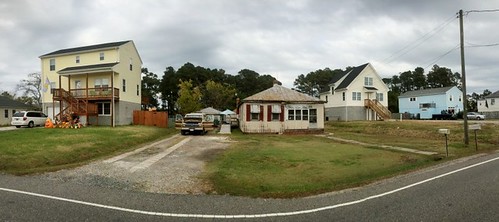
The Norfolk Virginian-Pilot has an article ("Poquoson takes action to outpace rising sea levels") about what one seaside community in the Norfolk region is doing to address rising sea levels.  Thus far, about 1/10 of the community's housing stock has added concrete block foundations to put the main house out-of-reach from flooding.  Even so, in the long run, the community might have to be abandoned, as it is only 4 to 7 feet above sea level.
House raised up on cinder blocks as flood protection, Pouoson, VA
Photo: Stephen Katz, Norfolk Virginian-Pilot.

More communities will have to address the reality of climate change (e.g., "Flooding from storm surge would threaten D.C. infrastructure" and "Daily flooding might get Congress to act against climate change," Washington Post; "NC Considers Making Sea Level Rise Illegal," Scientific American) going forward.

Labels: , ,

Tuesday, July 16, 2013

Trial balloons in the Washington Post and Dulles Airport as an aerotropolis

The first place I saw the concept of a casino at National Harbor in Prince George's County being publicly outlined was in a column by Robert McCartney of the Washington Post  in a January 2012 column, "Make picks in these '12 predictions."

At that time, Prince George's County residents had already voted to not allow casinos in the county.  By November, a state-wide referendum was passed that expanded casino gambling beyond slots and adding PG County as a place for a casino to locate.

Last week, Washington Post columnist Robert McCartney wrote a column suggested the roadway network in the metropolitan area could be expanded as a way to reduce congestion, if done intelligently.  One of the projects he mentioned is the proposed Bi-County Parkway, which would mostly enable new development, even though his column was about congestion reduction.

I wrote about the general thrust of his column here, "Weak discourse on "congestion" by Washington Post columnist."

But then on Sunday, there is a big piece in the Post about how the Metropolitan Washington Airports Authority has big big plans to enable development on land that they own on and around the Dulles Airport, to generate revenue.  See  "Could the Bi-County Parkway revive Dulles International Airport?"  From the article:

Dulles International Airport has seen a tough few years. Fewer passengers are flying into and out of the airport’s iconic terminal. Less cargo is moving across its tarmac. And with the global economy still sputtering, there’s no telling when the airport’s fortunes will turn around.

A solution, some Virginia officials say, is the long-debated Bi-County Parkway, a proposed road between Prince William and Loudoun counties that could serve as a new conduit for people and cargo passing through Dulles. Proponents say it would spur business development by offering a vital north-south link to the airport, giving businesses easy access to an international gateway.

With thousand of acres of undeveloped land and a Metrorail connection that the Metropolitan Washington Airports Authority aims to open in 2018, authority officials hope to build new facilities — perhaps offices and another hotel — on airport property to generate additional revenue. On the land around the airport’s runways, MWAA officials say new buildings to house cargo, including units that could store flowers, pharmaceuticals and other perishables, could boost the airport’s bottom line. They point to a soon-to-be built United Airlines maintenance hangar as an example of the airport’s potential to bring in more jobs and tax revenue.

Again, it's as if the column last week was a trial balloon.

I can't knock the MWAA or Prince William and Loudoun Counties for wanting more development, because ultimately that's what generates revenues for their respective entities.  Dulles Airport's passenger and cargo traffic has been dropping, and they want to boost it.

But it doesn't bode well for "smart growth."  Or maybe it does, just on a relative, not an absolute basis.

Also see:

- "More on transportation to the DC area airports"
- "Aerotropoli and rethinking the scale of mobility networks in the context of a global economy"
- "Aerotropoli"

Graphic from Washington Post on passenger and cargo volume and the proposed route of the Bi-County Parkway.

Labels: , , , , , ,

Monday, July 02, 2012

More severe weather and electrical power outages

BETHESDA, MD - JULY 1:  A Pepco employee works to stabilize power lines damaged in a massive storm that swept through the region Friday night, July 1, 2012 in Bethesda, Maryland. Although crews are at work repairing systems, there are still almost a million people in the greater Washington, DC area without power.Getty Images logoGETTY IMAGES 1 DAY AGOBETHESDA, MD - JULY 1: A Pepco employee works to stabilize power lines damaged in a massive storm that swept through the region Friday night, July 1, 2012 in Bethesda, Maryland. Although crews are at work repairing systems, there are still almost a million people in the greater Washington, DC area without power.

While people like Virginia Attorney General Ken Cuccinelli continue to argue against the existence of the phenomenon of "global warming," it appears that "storm events" are becoming "more violent," although there is no question that this could be a cycle.

Still, in my experience, rain storms in DC are much worse, on a more regular basis, from microbursts to derechos, compared to Michigan, where I grew up, although that could be a weather cycle issue admittedly.

-------------------------
Updated: today's Post has a story on the issue, "Storm rekindles questions about ‘undergrounding’ power lines," with some data about reliability and costs.
-------------------------

The "derecho" windstorm-thunderstorm was particularly violent in upper Northwest DC and many trees and power lines were down, traffic signals were (and are still) out and in the greater region, at the height of the problem one million households were without power.  Now PEPCO, the company active in DC and the Maryland suburbs, says that they can't guarantee everything will be fixed until Friday.

Now, for the most part, my particular household--even though Ward 4 has been hit hard--is fine.  We experienced less than one minute of power outage.  But half of the houses on our block, but behind us on Peabody Street, have been out of electricity since the storm (our next door neighbors saw the transformer blow, I didn't).

The Post has a story about people in Chevy Chase ("In Chevy Chase, the haves and have-nots") and sharing access to electric power from neighbors with to neighbors without.

On our block, we have a kind of "intimate anonymity"--I recognize our alley side neighbors well enough to wave when we see them, but I don't know them, I only talk to them a couple times/year.  We don't have a block club.  We know our neighbors on either side of us the best (and we are lucky, both households are totally awesome).

We'd probably offer electricity if asked, although we'd worry about the strength of our 80 year old house's electrical system, which occasionally trips circuit breakers as it is--and it would be about 200 feet from our electric box to the rear of the houses on the back side of our black.

Why not underground more electrical infrastructure?

From a "planning" standpoint, which is what this blog is about, the increased severity of weather and the resultant widespread power outages raises the issue of electrical infrastructure and how to provide the service.

In DC, in the so-called L'Enfant City, wire infrastructure is not allowed to be placed in the visible public space on face blocks, so electric lines are underground.  While not perfect and there are still outages in places like Capitol Hill from time to time, for the most part, the area doesn't haven't to worry about the impact of severe weather on their electric service.

There is the general issue of needing to upgrade infrastructure that is decades old and needs to be upgraded with increases in restaurants, apartment and condominium buildings, streetcars, etc.

Utility companies aren't incentivized to spend more money on more reliable distribution infrastructure to households and businesses

Still, I can't claim there is a better argument for more undergrounding of electrical distribution infrastructure than the current problems resulting from the most recent storm.

Electric utilities--Pepco is not exceptional in this--don't like to underground their infrastructure because it costs more and is harder to fix.  On the other hand, underground electrical infrastructure is generally much more reliable and less subject to outages.

What is the economic cost of 1 million households and businesses without power?

Reduced availability of slack and/or redundant resources to maintain infrastructure


I am not going to criticize Pepco and other firms for the fact that they just don't have crews and equipment waiting around on the off chance there will be a problem.  This is why they have mutual assistance agreements with other utility companies.  

But the basic problem is that in a world where there is increasingly "less financial slack" to have redundant assets--people and equipment--but instead to operate "lean" in every way, there is little allowance in the "supply chain" for responses to catastrophic events.  Instead, the only response is chaos-stoppage and eventually restarting as the system "reboots" after days or weeks of rebuilding and reconstruction (cf. the impact of the tsunami on the Japanese manufacturing sectors has been immense, even including a slow down in the provision of new subway cars to the WMATA system).

Because for the most part electric utilities are not responsible for the economic losses to customers that result from storms, this cost is not monetized, so the utility companies aren't "incentivized" to underground more of their infrastructure.

Clearly that needs to change.


Undergrounding would help save trees


More undergrounding would cut down on those complaints about Pepco butchering the tree infrastructure as well ("Pepco's Aggressive Tree Cutting" from the Montgomery Countryside Alliance), if more of the system in high population areas, was re-installed underground.


Image: Palisades Citizens Association.  (I bet these days they are complaining about power outages.)

Municipal/local government ownership and maintenance of electric distribution infrastructure as an option

Montgomery County Councilman Roger Berliner responded to other power outages by suggesting that the County purchase and operate the electricity distribution system, with the idea that without a profit motive, instead the "profits" could be directed to better maintenance and system improvements.  He was roundly criticized by business interests for this proposal, but I think in many respects, he was right.  See the past blog entries "Press piling on Montgomery County's utility dreams" and "More on utilities owned by local governments."

Although while there are many examples of superlative municipal and government-owned utilities, there are also many examples of horrid, corrupt, inefficient operation as well.

Then again, I guess you could say the same about the "investor-owned" utility companies as well.

Labels: , , , , , , , ,

Sunday, February 12, 2012

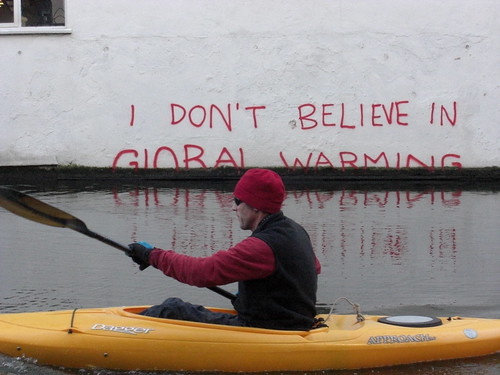
"Sometimes Jesus is trying to f* me over": climate change edition

BANKSY -  GLOBAL WARMING
Banksy graffiti, Regent Canal, London. Flickr image by John19701970.

The title is a quote from someone I worked with at the Center for Science in the Public Interest, circa 1989.

But poor Jesus gets blamed or used for all sorts of nefarious purposes, including denying climate change.

From An Evangelical Declaration on Global Warming by the Cornwall Alliance:

WHAT WE BELIEVE
1. We believe Earth and its ecosystems—created by God’s intelligent design and infinite power and sustained by His faithful providence —are robust, resilient, self-regulating, and self-correcting, admirably suited for human flourishing, and displaying His glory. Earth’s climate system is no exception. Recent global warming is one of many natural cycles of warming and cooling in geologic history.

2. We believe abundant, affordable energy is indispensable to human flourishing, particularly to societies which are rising out of abject poverty and the high rates of disease and premature death that accompany it. With present technologies, fossil and nuclear fuels are indispensable if energy is to be abundant and affordable.

3. We believe mandatory reductions in carbon dioxide and other greenhouse gas emissions, achievable mainly by greatly reduced use of fossil fuels, will greatly increase the price of energy and harm economies.

4. We believe such policies will harm the poor more than others because the poor spend a higher percentage of their income on energy and desperately need economic growth to rise out of poverty and overcome its miseries.

WHAT WE DENY
1. We deny that Earth and its ecosystems are the fragile and unstable products of chance, and particularly that Earth’s climate system is vulnerable to dangerous alteration because of minuscule changes in atmospheric chemistry. Recent warming was neither abnormally large nor abnormally rapid. There is no convincing scientific evidence that human contribution to greenhouse gases is causing dangerous global warming.

2. We deny that alternative, renewable fuels can, with present or near-term technology, replace fossil and nuclear fuels, either wholly or in significant part, to provide the abundant, affordable energy necessary to sustain prosperous economies or overcome poverty. [they have a point here]

3. We deny that carbon dioxide—essential to all plant growth—is a pollutant. Reducing greenhouse gases cannot achieve significant reductions in future global temperatures, and the costs of the policies would far exceed the benefits.

4. We deny that such policies, which amount to a regressive tax, comply with the Biblical requirement of protecting the poor from harm and oppression.

A CALL TO ACTION
In light of these facts,

1. We call on our fellow Christians to practice creation stewardship out of Biblical conviction, adoration for our Creator, and love for our fellow man—especially the poor.

2. We call on Christian leaders to understand the truth about climate change and embrace Biblical thinking, sound science, and careful economic analysis in creation stewardship.

3. We call on political leaders to adopt policies that protect human liberty, make energy more affordable, and free the poor to rise out of poverty, while abandoning fruitless, indeed harmful policies to control global temperature.

Labels: , , , ,

Tuesday, February 15, 2011

Aerotropoli

Taoyuan Aerotopolis
The plan for the Taoyuan Aerotopolis doesn't look all that different from the land uses surrounding the BWI Airport in Anne Arundel County, Maryland.

Someone sent to an e-list I am on, the Metropolis book review of a book on aerotropolises, "Quick-Fix Urbanism." The review of the book, Aerotropolis: The Way We’ll Live Next, is critical, as am I. An aerotropolis is a district developed around an airport. It mostly refers to the development of industry around an airport.

While there are some instances where this makes a lot of sense, particularly in how firms located around the Louisville airport to be close to UPS's air hub or around the Memphis airport, to be close to FedEx's hub--for example, the reason that Zappos online shoe store ships its products next day mostly, is because UPS handles their logistics from a facility adjacent to their Louisville air hub--there may not be a lot of legs to the concept.

Rather it makes sense to better leverage the airports you already have. Certainly, in the context of the DC-Baltimore region, there is more industry located around the BWI Airport, while there isn't so much located around National Airport, given it is located within an urban area of office buildings and residential areas. The same was true of the Detroit-Wayne County Metropolitan Airport--while that region doesn't have multiple large airports, the location of the airport supports industry proximate to the airport etc.

One of the problems with aerotropoli is that they are just another example of the seemingly next big thing. 130 years a similarly breathless account would have been written proximity to ports and rivers. 100 years ago, what mattered was proximity to railroads, ports, and rivers. For the last 60 years, proximity to Interstate highways has trumped access to railroads, ports (except for those well positioned to take advantage of container-based shipping), and rivers.

If the peak oil hypothesis is to be believed, developing industrial economic development strategies based on airports is probably not a sustainable strategy, but then that's typically the case of single use development strategies anyway.

Interestingly, the first of the seven rules to a sustainable city posited by Patrick Condon in his talk yesterday at the National Building Museum, is on restoring the streetcar city. Similarly, for long distance transportation, ships, barges, and railroads tend to be the cheapest and (relatively) greenest forms of transportation (of course ships tend to be big environmental polluters, although some ports are implementing electricity hookups for use while ships are in ports, so they don't have to use fuel to run their engines to power the ship's systems).

Labels: , , , ,

Saturday, January 16, 2010

Coastal cities at risk from global warming

While I know that this issue is seemingly obvious, most people don't think about it much. Around the world, many major cities, especially the oldest cities, were built adjacent to water, because boats and ships were the primary means of transportation across long distances. Imagine the impact on cities like New York, Chicago, Detroit, Boston, New Orleans, Miami, Los Angeles, Seattle, etc., from rises in the sea level as the polar ice caps melt.

The Guardian reports, "British coastal cities threatened by rising sea 'must transform themselves': Hull and Portsmouth could be dramatically remodelled, suggests report" on one such study, Facing up to Rising Sea Levels. Retreat? Defence? Attack?, looking at the potential impact on cities in the UK. From the article:

The report, Facing up to Rising Sea Levels. Retreat? Defence? Attack?, suggests swaths of Hull and Portsmouth's city centres could be allowed to flood over the next 100 years and large parts of the populations moved out.

In a model that explores managed retreat from the coast in some areas, Hull's historic city centre would be limited to an island reached by bridges and Venetian-style water taxis, while in Portsmouth large parts of Portsea island would be given back to the sea while new "hillside living" developments would be built on densely packed hillside terraces, akin to the towns of Italy's Amalfi coast. "The scenarios we have created are extreme, but it is an extreme threat we are facing," said Ruth Reed, Riba president. "Approximately 10 million people live in flood-risk areas in England and Wales, with 2.6m properties directly at risk of flooding."

Other options include building out into rising waters using piers and platforms to create new habitable space – a strategy known as "attack". In Hull this could involve floating disused oil rigs up the Humber and reusing them for offices, homes and university buildings, while in Portsmouth two-storey piers could be built with the lower tier used for traffic and the top tier used for pedestrian space.

The DC-Maryland-Virginia region would be greatly impacted by rise in sea levels, as would all the cities and counties along the seaboard -- the Atlantic Ocean, Gulf of Mexico, Pacific Ocean, and the area around the Great Lakes in the Midwest could possibly be impacted as well.

"Climate politics" are truly local if you live close to the ocean.

Labels: ,