Rebuilding Place in the Urban Space

"A community’s physical form, rather than its land uses, is its most intrinsic and enduring characteristic." [Katz, EPA] This blog focuses on place and placemaking and all that makes it work--historic preservation, urban design, transportation, asset-based community development, arts & cultural development, commercial district revitalization, tourism & destination development, and quality of life advocacy--along with doses of civic engagement and good governance watchdogging.

Monday, January 13, 2020

New York Times article on community decline associated with loss of work

Comparable to the New York Times Magazine cover story last year on Baltimore ("Tragedy of Baltimore"), Nicholas Kristof and Sheryl WuDunn just published a powerful article in the New York Times about the decline of Kristof's boyhood home community of Yamhill in Southern Oregon, "Who Killed the Knapp Family?"

Apparently the article is an excerpt from a new book, Tightrope: Americans Reaching for Hope (review).

They point out that deindustrialized cities are rural areas share common characteristics. "When Work Disappears" people and communities break.

And the US has a very weak social support network, so such decline isn't staunched.

In the last few weeks there was reporting on a study that found in communities where manufacturing plants closed, drug use was up ("Auto plant closures tied to surge in opioid overdose deaths," Reuters)
.

This shouldn't be news.  When I was in college I worked for a time at the University's Survey Research Center, and one of the studies we did was on the impact on health from the loss of work and health insurance coverage.  It was grim talking to those people...

====
I have only come across work about "the precariat" in the last couple years.

But with the backlash against "globalization," I've come to realize that the real problem is the failure to provide systems of support to communities and individuals that lose out to globalization -- health care, access to quality education and work retraining programs, economic development programs, etc.

As Robert Reich says, it's not like corporations are out to help communities or countries, just their shareholders ("American firms aren't beholden to America – but that's news to Trump," Guardian).

Instead, the US cuts health care, food stamps, unemployment support, etc. (As does Britain, and this was a major factor in the Brexit vote, as people were convinced to blame the European Union for the Conservative Party's austerity program.)

Investment is social infrastructure such as health care, "social urbanism" ("Social urbanism and Baltimore," 2019), rural development, is the necessary response.

But a problem with rural development is that people and communities can be very hard to help, because the idea that government can be helpful is ideologically oppositional to the conservative political narrative. From the New York Times article "In the Land of Self-Defeat":
His comment reflected a worldview that is becoming ever more deeply ingrained in the white people who remain in rural America — Washington politicians are spending money that they shouldn’t be. In 2016, shortly after Mr. Trump’s victory, Katherine J. Cramer, a political scientist at the University of Wisconsin-Madison, summed up the attitudes she observed after years of studying rural Americans: “The way these folks described the world to me, their basic concern was that people like them, in places like theirs, were overlooked and disrespected,” she wrote in Vox, explaining that her subjects considered “racial minorities on welfare” as well as “lazy urban professionals” working desk jobs to be undeserving of state and federal dollars. People like my neighbors hate that the government is spending money on those who don’t look like them and don’t live like them — but what I’ve learned since I came home is that they remain opposed even when they themselves stand to benefit.
The article discusses community opposition to a library in Rural Arkansas.

Also see the New Yorker article, "Arlie Russell Hochschild's View of Small-Town Decay and Support for Trump" which discusses the book Strangers in their Own Land, a study of the Tea Party movement and conservative support for Trump and the Republican Party.

Also see "An outline for integrated equity planning" (2017) and the comments, which lists other best practices not compiled in the original piece, as I come across them.

Labels: , , , , ,

Tuesday, July 16, 2013

Trial balloons in the Washington Post and Dulles Airport as an aerotropolis

The first place I saw the concept of a casino at National Harbor in Prince George's County being publicly outlined was in a column by Robert McCartney of the Washington Post  in a January 2012 column, "Make picks in these '12 predictions."

At that time, Prince George's County residents had already voted to not allow casinos in the county.  By November, a state-wide referendum was passed that expanded casino gambling beyond slots and adding PG County as a place for a casino to locate.

Last week, Washington Post columnist Robert McCartney wrote a column suggested the roadway network in the metropolitan area could be expanded as a way to reduce congestion, if done intelligently.  One of the projects he mentioned is the proposed Bi-County Parkway, which would mostly enable new development, even though his column was about congestion reduction.

I wrote about the general thrust of his column here, "Weak discourse on "congestion" by Washington Post columnist."

But then on Sunday, there is a big piece in the Post about how the Metropolitan Washington Airports Authority has big big plans to enable development on land that they own on and around the Dulles Airport, to generate revenue.  See  "Could the Bi-County Parkway revive Dulles International Airport?"  From the article:

Dulles International Airport has seen a tough few years. Fewer passengers are flying into and out of the airport’s iconic terminal. Less cargo is moving across its tarmac. And with the global economy still sputtering, there’s no telling when the airport’s fortunes will turn around.

A solution, some Virginia officials say, is the long-debated Bi-County Parkway, a proposed road between Prince William and Loudoun counties that could serve as a new conduit for people and cargo passing through Dulles. Proponents say it would spur business development by offering a vital north-south link to the airport, giving businesses easy access to an international gateway.

With thousand of acres of undeveloped land and a Metrorail connection that the Metropolitan Washington Airports Authority aims to open in 2018, authority officials hope to build new facilities — perhaps offices and another hotel — on airport property to generate additional revenue. On the land around the airport’s runways, MWAA officials say new buildings to house cargo, including units that could store flowers, pharmaceuticals and other perishables, could boost the airport’s bottom line. They point to a soon-to-be built United Airlines maintenance hangar as an example of the airport’s potential to bring in more jobs and tax revenue.

Again, it's as if the column last week was a trial balloon.

I can't knock the MWAA or Prince William and Loudoun Counties for wanting more development, because ultimately that's what generates revenues for their respective entities.  Dulles Airport's passenger and cargo traffic has been dropping, and they want to boost it.

But it doesn't bode well for "smart growth."  Or maybe it does, just on a relative, not an absolute basis.

Also see:

- "More on transportation to the DC area airports"
- "Aerotropoli and rethinking the scale of mobility networks in the context of a global economy"
- "Aerotropoli"

Graphic from Washington Post on passenger and cargo volume and the proposed route of the Bi-County Parkway.

Labels: , , , , , ,

Sunday, January 06, 2013

Aerotropoli and rethinking the scale of mobility networks in the context of a global economy

Late in 2011 when there was a lot of coverage of the idea of aerotropolises--places built around airports--I didn't really pay it much mind, because it didn't seem all that new, given how Ross Perot Jr. had begun doing something like that more than wo decades ago around the Fort Worth Alliance Airport and making it the first "industrially-oriented airport" (New York Times article), the impact of FedEx and UPS air delivery systems and the development of logistics-related businesses in and around their respective major hub airports in Memphis and Louisville, etc. ("UPS Worldport: a logistics case study").

See "Aerotropolis: A New Model for Cities?" from Streetsblog.

But then, I don't get out of the country much, certainly not to places like Dubai or Singapore or Hong Kong or Songdo, South Korea, even if I read about the globe-trotting exploits of Tyler Brûlé in his weekend column in the Life and Arts section of the Weekend edition of the Financial Times.

The article in today's Washington Post travel section, "Songdo, South Korea: The city that could change the way we travel," on the Songdo aerotropolis makes me realize that I just wasn't thinking about the issue at the right scale.

From the article:

What is an aerotropolis? At its simplest, it’s a city built around an airport. Instead of sticking an airport on the outskirts of an existing city, building a city around the airport allows for faster movement of goods and people. And as Greg Lindsay, co-author of “Aerotropolis: The Way We’ll Live Next,” argues, in the era of globalization, efficiency is paramount. Lindsay believes that the old real-estate rule of “location, location, location” is being swapped for the new rule of “accessibility, accessibility, accessibility.”

“Cities have always formed around transportation — ports and harbors and then train stations,” says Lindsay, pointing to Boston, New York and Chicago as examples. “Air travel is the only way to connect globally, and now, more frequently, cities will grow around airports.” ...

While Songdo’s status as a sustainable city certainly helped in its successful bid to house the Green Climate Fund, so did its proximity to Incheon International Airport. “You land at the airport and there’s a convention center, a hotel, a golf course,” says Lindsay. “Business travelers already live out of conference hotels; now you’re seeing conference cities. You still go to Seoul if you have leisure time, but this is the hyper-efficient movement of people. This is taking the scale of business travel to the extreme.”

Even though I mostly write about planning of transportation and mobility at the regional/multi-state, metropolitan and sub-metropolitan (suburban and center city) scales, in this entry "Second iteration, idealized national network for high speed railpassenger service" I did discuss planning for transportation modes at national and international scales.  But mostly I don't think about mobility at that scale.

Aerotropoli and at least in terms of providing international travel connections via airports (e.g. how airports within the largest metropolitan areas end up specializing some on international vs. domestic travel) is planning at the international scale.

This is about accommodating global commerce and the people are engaged in it. Seoul doesn't matter as a place to visit as much as it matters to go to South Korea to conduct business, and only business.

The Travel article on Songo as an aerotroplis is worth a read and is another example of why reading travel sections of newspapers (and travel magazines) is an important element of keeping yourself up-to-date on mobility and cultural planning.

Labels: , ,

Thursday, November 17, 2011

Why the US, local, and global economic future may be more perilous than we think

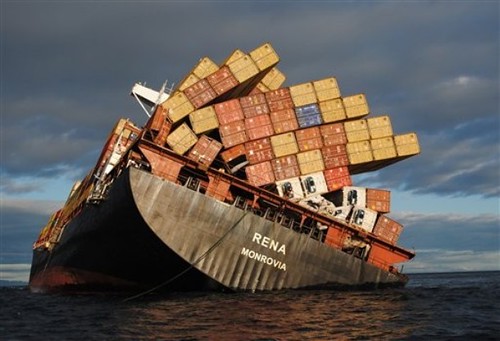
New Zealand Grounded Ship, container ship
In this photo released by Maritime New Zealand, the Rena, grounded on the Astrolabe reef 14 miles (22 kilometers) from Tauranga Harbour on New Zealand's North Island, is seen Thursday, Oct. 20, 2011. After a three-day break due to bad weather and rough seas, the agency Maritime New Zealand says nine salvage workers reboarded the Rena and resumed pumping oil Thursday afternoon. The ship has been stuck on the Astrolabe reef near Tauranga harbor since Oct. 5 and has spilled about 350 tons of oil into the ocean.

-- Chinese TV Host Says Regime Nearly Bankrupt from the Epoch Times

I hadn't really thought of it so much, but the Chinese expansion bubble has been driven by the same kinds of factors that led to an economic bubble in the US--overbuilding, financial engineering, cheap credit, and as a special case, manufacturing expansion driven by selling cheap stuff to North American and European markets.

As the North American and European markets continue to experience recession/depression, demand will continue to drop. Relatedly, increases in cost of energy means that a bit more manufacturing is being relocated back to the US because of rises in transportation costs cancelling some of the cost benefits from lower production costs ("Bringing Manufacturing back to the United States" from Area Development Online).

So if China can't continue to run an export driven economy based on selling stuff to overseas markets, thereby generating massive funds surpluses which have in turn been used to prop up foreign markets through loans and currency purchases, what happens then?

Labels: , , ,

Friday, August 05, 2011

Is abject failure necessary for a community and organizations to be able to rebuild?

Most people who know stuff know that in the 1980s and 1990s, the U.S. steel industry went through a wrenching reinvention, costing hundreds of thousands of jobs, as steel production became an industry organized on a global scale, and production shifted from a mass production method to a system focused on shorter runs and specialty products. See "The Role of Management in the Decline of the American Steel Industry" from the journal Business and Economic History (1996).

All the time while the big producers were failing, smaller companies like Nucor, with a different business model and system for production, succeeded.

The automobile industry and the related unions couldn't have been unaware of the failure of the steel industry, as changes in both industries impacted the other.

I guess that was a dry run, but ignored, for Detroit. Not to mention that in 1979, John DeLorean wrote a brilliant book about the failings of the automobile industry, On a Clear Day You Can See General Motors. Or even an article in the Economist ten years later, "On a clear day you can still see General Motors" which looked at the continued failures of the company and the industry. DeLorean's book had a huge impact on me in terms of approaching organizational development and institutional change.

Maybe you have to hit rock bottom before you become willing to change, willing to innovate?

It shouldn't have to be that way, and it might just be a factor of the different kind of innovation ecologies that exist between industries that develop as large, mass production oriented companies vs. industries that come out of a more startup, bottom-up culture like the difference between technology clusters along Route 128 in Massachusetts vs. Silicon Alley in California as described by AnnaLee Saxenian in Regional Advantage: Culture and Competition in Silicon Valley and Route 128

I joke that some cities develop "a desperate willingness to experiment because they have no other choice" and finally, Detroit has reached that point.

As The Doors sang in "Been Down So Long":

Well, I've been down so Goddamn long
That it looks like up to me
Well, I've been down so very damn long
That it looks like up to me
Yeah, why don't one you people
C'mon and set me free

Last night, I watched the Planet Green cable network's mini-series, "Detroit in Overdrive," a three-part program about Detroit's revival, which repeats on Monday August 8th.

I found about half of the running time of the programs relevant to the stated purpose of the program.

Showing automobile design students at Center for Creative Studies wasn't relevant, neither was traveling to and touring a GM plant in Grand Blanc, Michigan, which is 61 miles away from Detroit, and Genesee County isn't even considered part of the "metropolitan statistical area" that the Bureau of Census considers to be the Detroit Metropolitan area. Undoubtedly these segments were to please GM, the sponsor of the programs.

Most of all the "arts" stuff that was featured was about community building.

But this stuff was interesting:

• Joe Faris, a past contestant on Project Runway, working with a manufacturer of "clothes" for manufacturing robots to produce jeans;

• maybe Kid Rock's production of craft beer at some unidentified brewery;

• the Woodbridge Records kids, who aren't all that different from indie, start-up music labels elsewhere, but at least they get their vinyl records manufactured in their home city which is unlikely for most other indie labels;

• how urban agriculture programs in the city are also selling their products to restaurants and vendors, and at Eastern Market, Detroit's public market and food wholesale distribution center;

• the studios and artists and craftspeople in the Russell Industrial Center;

• how the University of Michigan has a "Detroit Partnership" day which gets more than 1,300 students (mostly students of privileged backgrounds) into the city for a day of volunteerism (they never did that when I went to UM);

• how the Center for Creative Studies, a college of design based in Detroit, and long known for its automobile design programs, has a social activism product design class, and in that class, Veronika Scott created a coat for the homeless that can be manufactured in the city as a jobs development and health initiative (the coat ends up being made of Tyvek after 5 attempts using other materials failed, and it can serve as a sleeping bag too) -- CNN story on Veronika Scott.

But I don't think the series convinced me that there is an overarching understanding of what happened to the city and why, including the negative power of segregation and racism ("Detroit's distress: A Q + A with Thomas J. Sugrue" from the Newark Star-Ledger--Professor Sugrue has written many books about Detroit's decline).

The episodes were more focused on cheerleading and showcasing what we might call the gritty determination of heoric peoples. None of the "experts" interviewed during the course of the program came from institutions outside of Detroit and its suburbs.

I don't think anyone searching for guidance on how to revitalize their weak market neighborhoods would get a fair amount of "overarching" insight from the programs, although the stories and ideas are interesting and some of the projects are really great.

Labels: , , , , , , ,

Thursday, June 02, 2011

Creative destruction and the American Economy

When you are in the middle of a paradigm change you have a hard time seeing it. Today's Post has a front page story on the sputtering American economy, "Discouraging news on the economy," which indicates that policy makers don't understand what's going on.

1. We are continuing to de-emphasize manufacturing in our economy.

2. But the manufacturing we have is increasingly capital and knowledge intensive, meaning that fewer people are needed to build more stuff.

3. We were overbuilt in retail and failures of many companies ranging from Circuit City to Linens n' Things to regional department store chains have cut jobs.

4. People funded overconsumption ("Retailers report muted sales in May as shoppers face bad weather, worry over rising prices " AP story) through using their houses as a bank and constantly rising home prices enabled refinancing and cashing out equity, which for most regions of the United States ("12 cities reach lowest levels in 4 years; home prices rising only in DC, Seattle " AP story) no longer exists, so consumption is down.

5. And most importantly, every time we go through a recession, companies that were on the cusp of failing due to changing business models actually do fail.

6. Especially if they can't continue to raise funds and financing (a/k/a "credit crunch") to operate their businesses.

7. Although new businesses continue to develop and open and with time, will add employment.

E.g., I was drawn into an online discussion about the economic potential of the waterfront in Cambridge, Maryland because there is an RFP out by the Maryland Port Administration and because I did a commercial district revitalization framework plan for the community.

One of the people criticized the points I made saying that I didn't care about maintaining maritime-related industry. Hey, I have no problem with maintaining and developing maritime-related industries, the problem is that it too is a shrinking industrial sector.

Shipbuilding firms are failing (although I think this initiative, the North Coast Marine Manufacturing Alliance, in the northern US is interesting, although it focuses on leisure crafts, not big ships like the shipyard in Philadelphia that goes in and out of success). Aquaculture is somewhat successful but doesn't require a lot of labor--there is an oyster farming operation in Dorchester County now--but even Phillips seafood sources most of its crab from Asia these days, and overharvesting of crabs, pollution, etc., has decimated the fishing-oyster-crabbing industries in the Chesapeake Bay anyway.

That's reality. And acting otherwise doesn't help anyone.

The same goes for the restructuring of the American economy more generally. Especially given that it is gasoline-dependent, and because of increased global demand, prices are trending upwards.

Labels: , ,

Tuesday, February 15, 2011

Aerotropoli

Taoyuan Aerotopolis
The plan for the Taoyuan Aerotopolis doesn't look all that different from the land uses surrounding the BWI Airport in Anne Arundel County, Maryland.

Someone sent to an e-list I am on, the Metropolis book review of a book on aerotropolises, "Quick-Fix Urbanism." The review of the book, Aerotropolis: The Way We’ll Live Next, is critical, as am I. An aerotropolis is a district developed around an airport. It mostly refers to the development of industry around an airport.

While there are some instances where this makes a lot of sense, particularly in how firms located around the Louisville airport to be close to UPS's air hub or around the Memphis airport, to be close to FedEx's hub--for example, the reason that Zappos online shoe store ships its products next day mostly, is because UPS handles their logistics from a facility adjacent to their Louisville air hub--there may not be a lot of legs to the concept.

Rather it makes sense to better leverage the airports you already have. Certainly, in the context of the DC-Baltimore region, there is more industry located around the BWI Airport, while there isn't so much located around National Airport, given it is located within an urban area of office buildings and residential areas. The same was true of the Detroit-Wayne County Metropolitan Airport--while that region doesn't have multiple large airports, the location of the airport supports industry proximate to the airport etc.

One of the problems with aerotropoli is that they are just another example of the seemingly next big thing. 130 years a similarly breathless account would have been written proximity to ports and rivers. 100 years ago, what mattered was proximity to railroads, ports, and rivers. For the last 60 years, proximity to Interstate highways has trumped access to railroads, ports (except for those well positioned to take advantage of container-based shipping), and rivers.

If the peak oil hypothesis is to be believed, developing industrial economic development strategies based on airports is probably not a sustainable strategy, but then that's typically the case of single use development strategies anyway.

Interestingly, the first of the seven rules to a sustainable city posited by Patrick Condon in his talk yesterday at the National Building Museum, is on restoring the streetcar city. Similarly, for long distance transportation, ships, barges, and railroads tend to be the cheapest and (relatively) greenest forms of transportation (of course ships tend to be big environmental polluters, although some ports are implementing electricity hookups for use while ships are in ports, so they don't have to use fuel to run their engines to power the ship's systems).

Labels: , , , ,

Wednesday, August 25, 2010

Understanding national government through the lens of Growth Machine and Urban Regime theories

It's frustrating for me to read the "local" newspaper's coverage, in this case the Washington Post, of structural failure in organizations for a couple reasons. First, they don't seem to have an understanding of how organizations work generally. Relatedly, they don't understand that organizations are systems and have processes to produce their output(s).

I rail about this all the time and won't repeat myself here, too much. Basically, journalists focus on individuals and have a kind of bias that the "system" (which they don't understand) "works" and when it doesn't it's an aberration that has been corrected and will not occur again.

The former director of the media watchdog FAIR (Fairness and Accuracy in Reporting) describes this as the "bias of the center" and it is discussed in this article, "Propaganda from the middle of the road: the centrist ideology of the news media," which was published in 1989, and which I still remember, because of importance of the concepts it discussed.

While Jeff Cohen was talking (this was a speech originally) about reporting on national and international politics, the trope is relevant to local news reporting too.

Second, newspapers and journalists for the most part fail to think about the intersection of politics and business and how it works in practical terms.

Regular readers are probably bored about my constant mention of the Growth Machine and the Urban Regime. From "A superb lesson in DC "growth machine" politics from Loose Lips (Washington City Paper)":

... the Growth Machine thesis, first laid out by sociologist Harvey Molotch, in the seminal article, City as a Growth Machine: Toward a Political Economy of Place. From the abstract:

A city and, more generally, any locality, is conceived as the areal expression of the interests of some land-based elite. Such an elite is seen to profit through the increasing intensification of the land use of the area in which its members hold a common interest. An elite competes with other land-based elites in an effort to have growth-inducing resources invested within its own area as opposed to that of another. Governmental authority, at the local and nonlocal levels, is utilized to assist in achieving this growth at the expense of competing localities. Conditions of community life are largely a consequence of the social, economic, and political forces embodied in this growth machine.

Political scientist Clarence Stone, a professor at University of Maryland has a competing thesis, that of the "urban regime." I don't think these theories are competing so much as different sides of the same coin. "Growth Machine" theory explains the motivation of "the land-based elite," and "urban regime" theory explains in detail how the land-based elite operates and functions.

Professor Stone was kind enough to send me his recent paper, "Now What? The continuing evolution of Urban Regime analysis," from 2005. He writes:

An urban regime can be preliminarily defined as the informal arrangements through which a locality is governed (Stone 1989). Because governance is about sustained efforts, it is important to think in agenda terms rather than about stand-alone issues. By agenda I mean the set of challenges which policy makers accord priority. A concern with agendas takes us away from focusing on short-term controversies and instead directs attention to continuing efforts and the level of weight they carry in the political life of a community. Rather than treating issues as if they are disconnected, a governance perspective calls for considering how any given issue fits into a flow of decisions and actions. This approach enlarges the scope of what is being analyzed, looking at the forest not a particular tree here or there. (emphasis added, in this paragraph and below)

In discussing Atlanta, Stone writes: "Land use, transportation, and housing formed an interrelated agenda that the city's major economic interests were keen to advance;" and

By looking closely at the policy role of business leaders and how their position in the civic structure of a community enabled that role, he identified connections between Atlanta's governing coalition and the resources it brought to bear, and on to the scheme of cooperation that made this informal system work. In his own way, Hunter had identified the key elements in an urban regime – governing coalition, agenda, resources, and mode of cooperation. These elements could be brought into the next debate about analyzing local politics, a debate about structural determinism.

Extending the Growth Machine and Urban Regime Concepts to the National Arena

The reality is that things function similarly at the national level of government too. It's just that the Growth Machine is not organized in terms of place. Instead, it's organized by "capital" and business sector, and "the governing coalition"is made up of business people and their representatives, elected officials, and government workers and appointees. This coalition focuses the regulatory structure on managing the regulatory function in ways that maximize business success and profits by minimizing regulatory cost and rules and regulations.

The tension is between representing the people, what Foglesong in Planning the Capitalist City calls the "democracy" contradiction, and representing the interests of capital, what Foglesong called "the property contradiction" in terms of local urban planning and zoning practice, and what in this context I would call the "capital" contradiction.

As industrial sectors have been reorganized on a global scale and the extra-normal profits that used to be generated by oligarchic and monopolistic participants in home markets once relatively free of competitors from outside the home country have dissipated, industries have worked to significantly reduce costs and eliminate slack costs, ranging from labor to the cost of complying with rules and regulations.

To make profits in a hypercompetitive arena, many companies choose to take significant risks as well in terms of the health and safety of their operations figuring that either they will luck out and things won't go catastrophic, or that they can afford the cost if it does. (see Union Carbide and Bhopal, BP and its refinery in Texas, BP and drilling in the Gulf of Mexico, GE and the Love Canal, GE and its practices with its appliance division, that peanut processor that went out of business due to contamination, mining disasters in Appalachia, etc.)

Industrial companies do this through trade associations and big lobbying budgets, and through the revolving door of people working for government then working for industry then working for government (e.g., Dick Cheney and oil industry policy, his sojourns in government bridged by working for Halliburton, the oil services firm).

So while the Washington Post believes that its expose of the U.S. Department of the Interior's branch which "regulated and promoted"--which yes is a contradiction that should have been fixed a long time ago-- the oil exploration and production industry is so significant that it deserves to be the top story of today's edition, for me it says very little that I don't already know. See "Lessons from oil agency's ties."

How is this any different from the so-called "iron triangle" described by political scientists in the 1970s with regard to policymaking (see this entry from Wikipedia, from which this image is also taken). Or the concerns that President Eisenhower raised about the growth of the military-industrial complex?

The real issue is the linking of politicians, government agencies and workers, and capital as organized by industrial sector or issue group as the governing coalition or "Growth Machine" that sets a common agenda and system for working together and provides the resources in people, money, and legal representation necessary to make it all happen.

What happened with the Minerals Management Service happens with virtually every federal government agency. Hey editors of the Washington Post, did you notice yesterday's front page article about the egg recall? ("Most eggs produced by a few firms : Safety inspections fall through cracks as industry consolidates ") Do you think this is a systematic problem with industry as it is organized in the United States or just happenstance, a number of freakish coincidences?

Labels: , , , , ,