Rebuilding Place in the Urban Space

"A community’s physical form, rather than its land uses, is its most intrinsic and enduring characteristic." [Katz, EPA] This blog focuses on place and placemaking and all that makes it work--historic preservation, urban design, transportation, asset-based community development, arts & cultural development, commercial district revitalization, tourism & destination development, and quality of life advocacy--along with doses of civic engagement and good governance watchdogging.

Wednesday, July 22, 2026

Chicago Transit Authority makes it easy for people and businesses to set up a digital screen feed of transit information

Some places do this.  Some places did this but didn't keep the application updated.  Others implement it at least in transit stations and bus stops with real-time updated signage screens too.  But many people are still driven to create their own displays, because the local transit agency doesn't provide such an application.

Chicago Transit Authority does. (Brochures webpage.)  I argue these are forms of media developed by government agencies, but they often aren't thinking that way.  Event notices and other information can be delivered by similar systems.


Labels: , ,

Thursday, April 09, 2026

(Every Day Should Be) Local News Day

Local News Day is today.  

It's sponsored by various modes of community-serving media.  

There should be scads of participants--metropolitan newspapers, community newspapers, public radio and public television programs, I guess local television station news, although it tends to not be in depth, and digital only news sources.

There aren't that many member newsrooms so far.

======

-- "Inside the crisis facing local TV news" (2026)
-- "Davis Kennedy, a one time force in local community newspapers, dies at 87" (2026)
-- "Washington City Paper community media project" (2026)
-- "Another media tragedy: The Pittsburgh Post-Gazette is shutting down" (2026)
-- "New Jersey loses largest published newspaper: Newark Star-Ledger" (2025)
-- "Newspaper acquisition as an element of a conservative agenda" (2024)
-- "The impact of local radio news in England" (2022)
-- "Newspapers as public media: WBEZ, radio, an NPR affiliate, to merge with the Chicago Sun-Times" (2022)
-- "Louisville Courier-Journal mobile newsroom initiative and Salt Lake Tribune Innovations Lab" (2022)
-- "Orange County Register coronavirus tracker graphic is a great model" (2021)
-- "Local music used to define communities: today with radio chains and national music distribution systems, not so much" (2021)
-- "Newspapers, community media, and knowledge about and engagement in civic affairs" (2020)
-- "Revisiting community radio" (2020)
-- "Thinking anew about supporting community radio" (2019)
-- "Culture planning and radio: local music, local content vs. delivery nodes for a national network" (2019)
-- "One more blow against community media: Washington Post drops Thursday "county" news special sections" (2017)
-- "The ongoing tragedy of dying print media, the latest being community newspapers in Montgomery and Prince George's Counties, Maryland" (2015)
-- "Grassroots communications capability in the city" (2015)
-- "Protest as Civic Engagement and the role of the media" (2007)

Labels: , , , , ,

Tuesday, March 24, 2026

Inside the crisis facing local TV news

At one point, local television news was a major money maker and one of the reasons behind the decline of newspapers.  Mostly local tv news was what I called "murders, fires, accidents, sports, and weather" with a sprinkling of news and feature stories on events in the metropolitan area.

But as television news supplanted local newspapers, cable specialization--channels dedicated to sports and weather--took away some of the key content, and later the Internet and streaming.  

It took a couple decades for Internet technology to be robust enough to deliver streaming video with as good or better production values, and depending on the investment in the product, competitive news with more depth, but it's happened.  Ratings (audience viewership) have dropped in response.

The finances of television news are tough too.  Great during election years in competitive states so lots of political ads.  But the main source of local advertising, car dealerships, has declined some too, as individual car dealerships get rolled up into massive car dealership firms.  

(Two of the largest dealership groups are based in Utah.  One, Larry H. Miller, was subsumed into the Asbury Auto Group, which after some sell offs, still has 150+ dealerships.)

One response has been industry consolidation.  The US Government has continually relaxed antitrust and competition concerns, so that a single firm can control multiple stations in one market.  And the station chains have consolidated, as restrictions on how much national audience they could cover have been relaxed.- 

The Los Angeles Times reports on this story, "Inside the crisis facing local TV news: Layoffs, consolidation and shrinking ratings."

  • Longtime local TV anchors, including KTLA’s Mark Kriski and others, are being laid off as parent company Nexstar Media Group cuts staff across its stations nationwide. 
  • Streaming now accounts for half of all viewing, pulling ad dollars and audiences away from traditional TV and forcing stations to cut costs. 
  • TV station owners are pushing to consolidate and investing in cheaper streaming news formats to adapt to changing viewer habits.
And:
Broadcast TV stations have long had the highest profit margins in the media business. But the financial model that sustained that growth has steadily eroded in recent years. Streaming — which now accounts for more than 40% of all viewing — has pulled consumers away from traditional TV, putting pressure on outlets to control costs so they can remain financially viable.

More than 2,000 TV stations nationwide still provide a vital role in communities, delivering as much as 12 hours a day in programming, live sports and local news to every household in the U.S. But they are now faced with an aging audience that isn’t being replaced by younger viewers who prefer streaming platforms and social media.

“It used to be that people would grow into the news habits of their parents, and now they’re not,” said Andrew Heyward, a former president of CBS News who now advises local TV stations. “The next generation of consumers are never going to run home to watch the newscast at 5, 6, 10 or 11.”

 As an advocate, you used to be able to get historic preservation (Uline Arena) and bike matters (planning sessions when I ran a bike and ped plan process in Baltimore County) on television and in community newspapers.  Now, in most places, community newspapers are gone, the "big" Metropolitan paper is a ghost, and television news broadcasts are being trimmed back.

It's a bad time for mass communication.

Labels: , , ,

Thursday, February 05, 2026

No news is bad news: Washington Post dying | Seattle Times business columnist Jon Talton dies

Yesterday, the Washington Post laid off 300 workers, including the sports desk ("The Washington Post’s sports desk is gone. It’s the latest blow to American sports journalism," Boston Globe) and most of the remaining reporters working in the local news "Metro" section.

There had been reports for about a week that this was going to happen.

That big story ("Washington Post cuts a third of its staff in a blow to a legendary news brand," AP) is not reflected on the front page of today's paper.

After a promising start with ownership by Jeff Bezos of Amazon, and a significant rise in digital subscriptions with its coverage of the first Trump Administration, the paper hit a bit of slump. 

But the slump took on the force of an out of control roller coaster when Bezos killed the endorsement of Kamala Harris for President ("Over 200,000 subscribers flee 'Washington Post' after Bezos blocks Harris endorsement," NPR).  

And last year's evisceration of a left leaning editorial page section ("The Exodus from the Washington Post," Columbia Journalism Review, "Washington Post’s turnaround on its opinion pages is returning journalism to its partisan roots − but without the principles," Conversation) replacing it with conservative hacks writing about Bezos concerns about "personal freedom" and "free markets."

Hundreds of thousands of subscribers cancelled ("How Jeff Bezos Brought Down the Washington Post," New Yorker, "The Washington Post Is Dying a Death of Despair," Atlantic).

Considering Trump's attacks on both personal freedom and free markets, he could have kept the old stable of writers.

These days, Bezos is more interested in protecting his business interests vis a vis the world of crony capitalism pushed forward by Trump.  

Such investments include donations to Trump's inauguration and to the new East Wing of the White House monstrosity, as well as funding a documentary about Melania Trump in the period up to the inauguration--it hasn't played well to critics ("He made a joke on his theater’s marquee, then Amazon pulled the ‘Melania’ movie," Seattle Times).  

And debilitating the Post ("Jeff Bezos Killed the Washington Post," Slate, "Jeff Bezos’ mass layoffs at the Washington Post a ‘case study in near-instant, self-inflicted brand destruction,’ former editor says," Fortune).

Alternatives that won't happen.  One sell the paper to someone more inclined to respect its history and purpose.  Two, Margaret Sullivan suggests creating a nonprofit to take the paper over (" Is Jeff Bezos going to destroy the Washington Post? It sure looks like it," Guardian), with a big stake from Bezos, the way papers in Philadelphia and Salt Lake have been converted to nonprofits in this era of declining newspaper profits.

Ironically, I'd reach out to Lord Rothermere in the UK, publisher of the Daily Mail, which is looking to buy the Daily Telegraph, the Tory Party standby after that paper suffered various ownership debacles.  While most of the Daily Mail papers are conservative, they do still own a piece of the Evening Standard, which is not ("Move over, Murdoch: will Lord Rothermere be Britain’s most powerful media mogul?," Guardian).

Three, when Murdoch bought the Wall Street Journal he created a small news section on New York City, aimed at prying readers away from the New York Times.  The NYT has a strong readership in print and digitally within the Washington region.  Maybe they could publish a zoned section with local sports, metropolitan news, and editorials.

I wish self important billionaires like Tom Steyer wouldn't waste their money on stupid political campaigns.  How about funding a printed and digital US edition of the Guardian, based in DC?

Jon Talton, business columnist, Seattle Times dies ("Jon Talton, Seattle Times business columnist and author, dies at 69").  

He wrote about the regional economy, which reminds me that the Post hasn't had someone on that beat since Stephen Pearlstein left to teach at George Mason University.

He wrote about downtown, Boeing, of course the various IT businesses there, in particular Amazon and Microsoft, and how local politics intersected with business. About relevant national economic issues, population density, immigration, etc.

An important voice is lost, and his body of work is a demonstration of the value of solid local reporting and reporting-based opinion to an knowledgeable community.

Labels:

Friday, January 09, 2026

Washington City Paper community media project

The Washington City Paper, the area's alternative weekly, stopped publishing in print in 2022 ("Staff And Locals React To End Of Washington City Paper Print Edition," DCist), but is still active online.  

(Many alternative papers across the country have shut down post covid, because during covid they weren't able to get entertainment-related advertising because people couldn't go out, and the financial impact was too much.)

Working with Humanities DC, the WCP sponsors a Community Journalism Program, "a 14-week course that teaches D.C. residents journalistic knowledge and skills as they report a local story."  Finished stories are often run by the "paper" albeit online. Applications are due Sunday, Jan. 11.

I think this is a great program that more newspapers, "regular ones" and alternative weeklies, should do.

I never had an article run in the WCP, but I did get a few letters to the editor published, and was mentioned from time to time in articles about historic preservation and transportation.

======

I consider the Washington City Paper one of my key teachers about urbanism and city governance.  When I first moved to the city in 1987, they ran a column by Mark Jenkins and Bill Rice called "Cityscapes," about urban architecture and urbanism.  I read it avidly (along with the "Shaping the City" column in the Washington Post, "Death of former Washington Post columnist Roger Lewis").

A Jenkins cover story in December 1987 was the first time I read about the concept of the "Purple Line" circumferential transit line--at the time it was proposed it was to be heavy rail--connecting all the end points of the various legs of the Metrorail lines--running through suburban Maryland and Virginia.

The current Purple Line under construction is light rail, not heavy rail, and will serve a small part of the proposed full line, from Bethesda in Montgomery County to New Carrollton in Prince George's County.

The paper ran so many cover stories that taught me so much about local politics.  I can think of stories on the schools, maintenance versus capital funding for key systems in DC buildings like heating and cooling systems, how the "Growth Machine" manipulated the zoning process, crony capitalism and using nonprofits as personal piggybanks by John Ray, a former Councilmember and his cronies, etc.

Plus the Loose Lips weekly column about the ins and outs of DC Government.

Note that much of the City Paper has been digitized and is available within the Washingtonia Collection on local history at the MLK Library in Downtown CD.

============

The paper was bought a few years ago by local private equity maven Mark Ein as a community spirited venture ("Mark Ein Talks About Buying Washington City Paper," ) without a focus on profits.  

Ein, who will not have a daily role at the paper, is the paper’s fifth owner in the last decade and has taken steps to make his stewardship of the long-troubled weekly* as benevolent as possible.

... In fact, Ein counts City Paper as one of what he calls his “community investments,” not his “day job, for-profit” investments. That said, he plans to assemble a team that can help the paper solve the revenue shortfalls caused by collapses in classified and display advertising. Untethered optimism, I note to him, has been a problem with some of City Paper‘s recent owners. “We’re all going into this with our eyes wide open,” he says. All his advisers “have a lot of ideas about alternative revenue sources. We’re not expecting it to be profitable in the short term.”

The dude is rich.  So to me, rather than get all the messages on articles about donations, I wonder why he can't put a little more money in.  Although I'm glad the media outlet still exists.

Labels: , ,

Another media tragedy: The Pittsburgh Post-Gazette is shutting down

 So reports the Philadelphia Inquirer.

I wrote to the Heinz Endowment, and the PBS and NPR affiliates in Pittsburgh, suggesting that the work together to acquire and continue to operate the paper.

Comparable to how WBEZ-FM/NPR took over the Chicago Sun-Times ("Chicago Public Media Announces Its Acquisition of the Chicago Sun-Times,").

And when the Kresge Foundation led a funding round during the City of Detroit's bankruptcy, to keep the collections of the city museum, the Detroit Institute of Arts, intact ("Charities commit $330m to help save Detroit's art from being sold in bailout," Guardian).

The Kresge initiative was necessary because the DIA had never been incorporated as an organization separate from the City of Detroit.  

Instead, the Museum was a department/agency of the city, like the police department.  So its assets were at play during the bankruptcy.

Also a couple weeks ago, the Atlanta Journal-Constitution stopped printing a paper (the Newark Star-Ledger did this a year ago or so), going to online only.

The book “News Hole: The Demise of Local Journalism and Political Engagement, discusses how enhancing local news media strengthens public involvement.

Newspapers are key to awareness about local happenings and are a key element in whether or not people participate in local civic affairs.  

In my opinion, the Pittsburgh Post-Gazette is a very good local paper, with strong coverage on land use issues, the arts, public health, etc. I try to go through the back file of local news articles at least once/month.

And I frequently write entries in response to PPG articles such as:

-- "Wednesday, October 19, 2022 It's not the age of the housing stock, but the ability of property owners to maintain it: Disinvestment in Pittsburgh," 2022
-- "Big Ideas for a Better Pittsburgh | and a point about world class cities," 2025
-- "Pittsburgh developer backs down on opposition to ticket fee for concerts, to be used for area improvements," 2023
-- "NBA All Star Game in Salt Lake, economic development hype | Pittsburgh Post-Gazette on the Pirates baseball team economics," 2023

Newspapers and community engagement

-- "How Local Newspapers Support Public Awareness and Community Engagement," Hornet Newspaper
-- Civic Engagement Strongly Tied to Local News Habits, Pew Research Center
-- "Rebuilding local news fosters civic engagement," American Journalism Project

According to the Hornet, newspapers:

  • Provide access to information
  • Hold public officials and corporations accountable
  • Provide a voice for the local community
  • Strengthen community identity
  • Improve community life by fostering participation
=====
The recent history of the paper is interesting.  It's owned by a small company, Block Communications, with papers in Toledo and Pittsburgh.  I think the original Block used to be an agent for the Hearst Newspapers Group back in the day, buying newspapers.

Pittsburgh used to have two papers, the Press owned by E.W. Scripps, and the PPG.  They ran together on a joint operating group basis, where the Press ran the business operations and printing, with two separate editorial staffs.  But then there was a strike in 1992.

Scripps decided to scrap their paper.   And Block Communications took over the business operations and kept the paper running.

The paper was seen as liberal, but then John Block took over as publisher and he is conservative.  This created problems and the newspaper has been under a strike by journalists for more than a year ("A newsroom tirade and a controversial hire: tension rises at Pittsburgh newspaper," CNN, 2019, "The Pittsburgh Post-Gazette says it will close. Race and politics have been tearing it apart for years," MediaNation).

Despite its recent turmoil, they've been putting out a quality, informative product.

Labels: , , ,

Saturday, August 02, 2025

Despite what Trump and Fox News says, cities are pretty good places to live

 About Seattle, "A Seattle visitor’s guide:  Riots, bad drivers, the big dark and overrated Dick’s burgers. Locals and experts tell the truth,." Seattle Times.

Josh Cruz, 38, head of marketing for a small software company, moved here from St. Petersburg, Fla., with his partner. Cruz belonged to a group of fans of the Tampa Bay Lightning hockey team. “One of the first literal responses I got from a conservative colleague was, ‘What are you gonna do there? Join antifa?’

“I took it to mean he watched too much Fox News,” Cruz says about his fellow hockey fan. He says his mom also asked about the protests that were portrayed as riots. “I told her the news focuses on one group of three people as the night ended, (who) did one stupid thing,” he says.

... Jeff Asher, co-founder of the firm, says, “From a crime perspective, Seattle is just like any major city. If crime is your main concern, then you shouldn’t be visiting any major American city.”

Friends and neighbors were in Portland recently it's fine, which is probably why housing prices are high ("Buying a Home in Portland Is More Expensive Than You Think") Wall Street Journal).

High demand for housing in Forest Hill Queens ("Home Buyers Are Paying Millions to Experience the ‘Fairy Tale’ of Forest Hills," Wall Street Journal).

SF isn't a cesspool.

Trump and his LA military incursions were a way to satisfy his base ("Newsom Slams Trump For ‘Brazen Abuse of Power’ as L.A. Mayor Imposes Curfew," New York Times), not based on reality ("Trump wants to 'liberate' Los Angeles, residents say 'no thanks'," Reuters), and the National Guard and Marine troops he sent there have left ("More than 1,000 National Guard troops leaving L.A. Newsom says Trump’s ‘political theater backfired’," Los Angeles Times), "Marines Will Begin Withdrawing From Los Angeles," New York Times).  

The "rioting" was limited to a couple blocks of demonstrations, with riot police and Trump's federal police and troops escalating the situation.

Although yes, Seattle, SF and Portland reached progressive overreach in the early 2020s, and the electorate dialed back, voting a bit more to the center than to the left.  This is particularly evident in Seattle.

In SF, a Levi Strauss heir connected to the business community won the mayoralty.  And the super progressive prosecutor was recalled out as crime climbed.

OTOH, also in Boston, the Downtown housing market is stagnant ("As housing prices in Mass. soar, they’ve remained stagnant in downtown Boston. Here’s what that means for the city").

It's so obvious on article comments that are negative on particular cities that the writer has no real experience with cities.  The same with Fox News and of course Trump ("‘Cesspools,’ ‘Hellholes’ and ‘Beautiful Places’: How Trump Describes the U.S.," New York Times, "Trump keeps brutalizing immigrants because he's failing at everything else," USA Today), "The politics of fear," New Yorker).

Fox trumps up crime in cities before elections especially and it probably had an effect in increasing the number of Republican House members from New York State ("Crime coverage on Fox News halved once US midterms were over," Guardian).


=====

In Boston's election for mayor, Josh Kraft, of the New England Patriots and a conservative, is running, figuring he had a chance like Daniel Lurie in SF.  His polling is terrible ("Can the Josh Kraft campaign be saved?," Boston Globe).

Labels: , , , , , , ,

Wednesday, February 26, 2025

A sad day for the Washington Post and Washington DC

As Jeff Bezos, owner of Amazon and of the Washington Post, announces the op-ed pages will shift to coverage on "freedom of markets" and "personal liberties"   ("Post owner Bezos announces shift in opinions section," Post, "Washington Post opinion editor departs as Bezos pushes to promote ‘personal liberties and free markets’," Guardian).

While I think it'll likely be "Wall Street Journal-lite"), it is a sad diminishment of the range of opinions offered by the paper.  It's not like I can read George Will or his politically leaning colleagues because of their arguments, but I never minded that they took up space on the pages.

With all the talk about disinformation and misinformation and the need for reliable sources of information, it's sad that the Post is throwing in with this dis- and mis-informatives, as an under-information or incomplete-information provider.  

It's not that you can't write about personal liberties and freedom of markets.  But you're telling an incomplete story if you avoid discussion of real discrimination, minoritarian rule, etc., as well as the need for regulation of markets to reduce the chance for overreach and economic collapse.

It's a long way from what the Graham Family thought were the strengths of Bezos digital knowledge in a future that was and is very uncertain for newspapers ("A Newspaper, and a Legacy, Reordered," New York Times).

From the Washington Post article, "The sale of The Washington Post: How the unthinkable choice became the clear path:"

Washington Post publisher Katharine Weymouth presented her uncle, company chief executive Donald E. Graham, with a once-unthinkable choice at a lunch meeting at downtown Washington's Bombay Club late last year. The paper was facing the like­lihood of a seventh straight year of declines in revenue, with one preliminary budget estimate showing the possibility of $40 million in losses for 2013. And despite years of heavy investment in new digital offerings, there was little sign that robust profits were about to return, she reported.

That left three choices, Weymouth told Graham. The family could continue presiding over the gradual decline of the newspaper they loved. They could move more aggressively to cut the paper’s staff more deeply than ever, hoping that they could return The Post to sustained profitability by sacrificing its longtime excellence.

Or they could sell, cutting ties to one of America’s iconic news organizations after four generations of family control in the hopes that The Post could thrive again under a new, deep-pocketed, civic-minded owner.

... Several factors allowed the deal to come together with relative speed. They included a long-standing friendship between Bezos and Graham, 68, an executive steeped in traditional newspaper publishing who had become a respected elder for a newer generation of tech magnates. Bezos was among the most successful of those, and the two men had on several occasions traded insights on their businesses.

“The Post is his baby,” Weymouth said of Graham. “He was not going to give his baby to anybody who he thought would not care for it properly.”

Looks like the baby got sold to a serial killer ("Post endorsement controversy sparks staff resignations, protests ," The Hill).

Then again, significant change was predicted, it just took 11 years to see how bad it could be ("No Change? Jeff Bezos Will Turn the Washington Post Upside Down," MediaShift).  First on the list, although actually much later:

So what can we expect to change within the next five years and why? Here are some reasonable assumptions:

The editorial policies, the coverage and the content will reflect the interests and ideologies of the owner. For the U.S. government’s hometown newspaper, that’s something to really be aware of.

Labels: , , , , ,

Tuesday, February 04, 2025

New Jersey loses largest published newspaper: Newark Star-Ledger

The last edition ("A tribute to The Star-Ledger’s legacy in print").

Advance Publications, a national chain of newspapers that likely was the first to reduce the number of issues published per week--in New Orleans at the Times-Picayune, which led to new competition from the Baton Rouge Advocate--yesterday stopped publication of the Newark Star-Ledger--once one of the largest circulation newspapers in the US and other publications elsewhere in New Jersey, and ceased publication of the Jersey (City) Journal entirely.

First newspapers lost critical advertising dollars as more businesses chained up and independent business declined.  Online sites like Craigslist took the classified advertising market.  And people started switching their news consumption to online sources, and stopped subscribing to local newspapers.  It didn't help that with declines in revenue came cutbacks in personnel and reduction in news coverage ("Here's why newspapers are reducing print days," Cardinal News, "Internet Crushes Traditional Media: From Print to Digital," Census).

The decision was announced at the end of October, and took effect February 2nd.

They will further the shift to digital, at NJ.com.  They claim they have more digital subscribers than print subscribers at the end, and they do publish quite a bit.

A couple of Gannett's New Jersey papers, including the Bergen Record, will still be publishing in print.  I wonder if they intend to expand their area of news coverage to more parts of the state? ("The Star-Ledger to cease publication of print newspapers in February").

NJ.com will still produce a facsimile of a printed Star-Ledger that digital subscribers can download or read online.  I don't know if this will extend to some of the others.

While digital publication is way better than nothing, it doesn't fully substitute for print.  Civic participation drops in places without newspapers ("How the disappearance of local news hurts civic engagement," PBS, "Local news has long provided a vital civic bond. Can we afford to let it disappear?," Harvard).

Newspaper issues of The Star-Ledger, The Times of Trenton, the South Jersey Times and The Express-Times of Easton, from 2014.  Mel Evans/AP Photo. "A Digital Future for New Jersey News"," Newsweek.

I know for me personally, it means that I find out less about local events like talks, those by community organizations, etc.  Digital sources do not substitute.

And when I travel, I like to read the local newspaper to find out what to do.  Increasingly, that's impossible.

Labels: , , ,

Tuesday, March 05, 2024

Television station license challenges: Fox, Sinclair

 For a few years I suggested that Fox terrestrial broadcast licenses be challenged, based on the idea that the way they run Fox cable assets are counter to the public interest, making them unworthy of the privilege of using the public airwaves ("Australian Broadcasting Corporation documentary on the Murdoch media empire and Trump".).  Fox cable television programming is severely unbalanced ("Why a Fox News pundit may not have heard bad news about Trump," Washington Post).

Finally, the license in Philadelphia is being challenged ("Fox Television station license being challenged in Philadelphia, on character grounds").  I attempted a submission myself, but the docket for FCC comments is pretty unwieldly and I never finished.

Sinclair Television ("Sinclair’s recipe for TV news: Crime, homelessness, illegal drugs," Washington Post) licenses should be similarly challenged.  From the article:

Every year, local television news stations owned by Sinclair Broadcasting conduct short surveys among viewers to help guide the year’s coverage. A key question in each poll, according to David Smith, the company’s executive chairman: “What are you most afraid of?”

... The answers are evident in Sinclair’s programming. Crime, homelessness, illegal drug use, failing schools and other societal ills have long been core elements of local TV news coverage. But on Sinclair’s growing nationwide roster of stations, the editorial focus reflects Smith’s conservative views and plays on its audience’s fears that America’s cities are falling apart, according to media observers, Smith associates, and current and former staffers who spoke on the condition of anonymity to discuss internal company matters. 

... Sinclair’s local network of 185 stations across the country makes it an influential player in shaping the views of millions of Americans, especially at a time when local newspapers are rapidly being gutted — or closed altogether. 

As Sinclair increasingly fills the void, it offers its viewers a perspective that aligns with Trump’s oft-stated opinion that America’s cities, especially those run by Democratic politicians, are dangerous and dysfunctional. “Sinclair stations deliver messages that appeal to older, White, suburban audiences, and they play up crime stories in a way that is disproportionate to their statistical presence,” said Anne Nelson, a journalist and author of “Shadow Network: Media, Money and the Secret Hub of the Radical Right.” 

All of it is fearmongering and feeds into a racialized view of cities.” Sinclair’s large network of local stations tends to cover societal problems in similar ways, experts say. A 2019 study by researchers at Stanford and Emory universities showed that a Sinclair acquisition of local stations resulted in “substantial increases in coverage of national politics at the expense of local politics” and “a significant rightward shift in the ideological slant of coverage.” 

Nelson, who has spent decades studying conservative media and political propaganda, said that local TV news reports traditionally cover local crime stories, but Sinclair’s programming does it “more than usual, and with a particular message.” She said that the lack of local papers has changed the role of local TV news. 

Sinclair’s large network of local stations tends to cover societal problems in similar ways, experts say. A 2019 study by researchers at Stanford and Emory universities showed that a Sinclair acquisition of local stations resulted in “substantial increases in coverage of national politics at the expense of local politics” and “a significant rightward shift in the ideological slant of coverage.”

-- "Local News and National Politics," American Political Science Review

Labels: , , ,

Wednesday, January 17, 2024

Newspaper acquisition as an element of a conservative agenda

 Nothing new here, really.  It's been an issue since the beginning of newspapers.  And sometimes there are progressives involved (like New York City's PM newspaper in the 1940s).

The Baltimore Sun has just been acquired by the Chairman of the Sinclair Media Group ("Baltimore Sun Media sold to Maryland business leader," Sun), which is a national chain of conservative oriented television changes where they "force" individual stations to carry particularly slanted conservative stories, and a conservative media show, Sheryl Atkisson ("Local television station news: Scripps WCPO in Cincinnati vs. Sinclair Broadcasting Corp." 2018).

He's already criticized the current paper ("New Baltimore Sun owner insults staff, says paper should mimic Fox45," Baltimore Banner).  The Baltimore Banner is an online media source, owned by Stewart Bainum, who created Choice Hotels and an assisted living group, and was an elected official.  He attempted to buy the paper a few years ago but was unsuccessful.

Like people before him who crashed and burned, he says that more local coverage will spur more subscriptions and interest.  The fact is with the Internet, printed newspaper subscriptions have dropped by 75%.  Combined with the decline in local and national advertising, printed newspapers are a shadow of what they once were.

The sale includes the Capital Gazette of Annapolis, as well as local weekly newspapers in Greater Baltimore.

2.  In Alabama, to shape discourse on utility regulation, Alabama Power has created a news service ("How an Alabama utility wields influence by financing news," Guardian).  As newspapers reduce staff, such articles are increasingly run as is, despite the potential slant.

Plus the company bought the Birmingham Times, a newspaper focused on the black community.  From the article:

What’s happening in Alabama is an example of how special interests have taken advantage of the diminishing reach and influence of shrinking mainstream newsrooms in the US. In their place have sprung up fake “pink slime” news sites operated by political interests; a utility that secretly created news outlets to attack its critics; and a Florida publisher who accepts payments for positive coverage. 

This investigation into power companies infiltrating local media follows Floodlight’s revelation earlier this month about how utilities wield influence among civil rights groups. 

In the last decade, nearly a dozen local reporters and editors were hired to staff the two Alabama news outlets. A Floodlight review of the content since the utility founded the Alabama News Center in 2015 shows it publishes overwhelmingly positive stories about the power company. 

Coverage of the utility by the Birmingham Times, which was funded with money from Alabama Power’s charitable arm the Alabama Power Foundation, consists of reprinted stories from the News Center and the utility’s own press releases.

When I worked at Center for Science in the Public Interest decades ago, it published two reports, Marketing Booze to Blacks and Marketing Disease to Hispanics, focused on how corporate advertising especially by tobacco and alcohol products companies in minority media was used to push an anti-health agenda.

====

Separately, the Washington Post is cutting staff which disproportionately is affecting coverage of local news ("Introducing Out of Ink," Washington City Paper).  In the past few years, the paper eliminated the special zoned weekly local news sections ("One more blow against community media: Washington Post drops Thursday "county" news special sections," 2017) and shut down the independent from the paper suburban weekly chain it owned ("The ongoing tragedy of dying print media, the latest being community newspapers in Montgomery and Prince George's Counties, Maryland," 2015).

The paper continues to focus on online subscriptions, which is fine, but a national and international audience doesn't care much about regionally-relevant local news. Since online subscribers have shrunk during the Biden presidency, the paper is short of money.

Labels: , , ,

Monday, September 04, 2023

Fox Television station license being challenged in Philadelphia, on character grounds

 I've argued for years that Fox television station licenses should be challenged on character and fitness grounds, because of the way the company runs Fox cable operations. 

-- "Australian Broadcasting Corporation documentary on the Murdoch media empire and Trump," 2021
-- "Part 2 of the Australian Broadcasting Corporation documentary on the Murdoch media empire and Trump," 2021

In the 1980s, RKO General lost their broadcast licenses first because a separate part of the corporation was found guilty of criminal behavior, and later because of multiple fitness failures on the part of RKO.

Now, the only license up for renewal until 2028, in Philadelphia, is being challenged by the Media and Democracy Project ("FCC allows for public comment on petition to deny Fox 29′s broadcast license," Philadelphia Inquirer).

Public comments are being accepted, and I'm working on my submission.  There isn't a final deadline date listed.

Labels: , , ,

Thursday, September 29, 2022

The impact of local radio news in England

 I have written a bunch about the chaining up of local radio and how the stations have been standardized with little in the way of local music or personalities.  I haven't mentioned this in terms of "local news" or "local content" in commercial radio, because it's been so long since the average station has offered any, with the exception of the usually one station in each market that maintains an exclusive focus on news, like WTOP in the Washington DC area.

Of course, public radio is an exception.

-- "Culture planning and radio: local music, local content vs. delivery nodes for a national network," 2019
-- "Thinking anew about supporting community radio," 2019
-- "Revisiting community radio," 2020
-- "Local music used to define communities: today with radio chains and national music distribution systems, not so much,"  2021
-- "Newspapers, community media, and knowledge about and engagement in civic affairs," 2020
-- "Newspapers as public media: WBEZ, radio, an NPR affiliate, to merge with the Chicago Sun-Times," 2022

The founder of Clear Channel Communications died recently ("L. Lowry Mays, builder of radio empire, dies at 87," Washington Post).  His entry into the radio business led to the massive consolidation in the industry that we see today.

This was complemented by massive deregulation of the industry and the elimination of much in the way of local content and news requirements. 

The UK is in financial meltdown because of bad fiscal decision making, and there, the BBC's local news radio outlets very occasionally get time with the UK Prime Minister.  This week there was one of those go-arounds, and apparently the local journalists got in some good questions that weren't mediated by deference ("Disastrous Liz Truss interviews show BBC local radio still packs a punch," Guardian).

From the article:

When it was announced that Liz Truss would break her silence on the collapse of the pound by appearing on local radio stations, there was mockery from some London-based journalists who felt she should have given an interview to a national news outlet.

Instead, it was BBC Leeds’s breakfast show that helped shift the price of UK government debt, as traders tuned in and realised the prime minister was sticking to her economic plan. As presenter Rima Ahmed put it to the prime minister: “Where’ve you been?”

Radio Kent put it in more stark terms, with one listener asking Truss: “Are you ashamed of what you have done? ...

The prime minister’s rapid-fire set of eight short interviews with BBC radio stations in an hour produced more news than often emerges from a single slot on Radio 4’s Today programme.

One benefit that local radio journalists have over reporters who deal with Downing Street on a daily basis is that they have no incentive to hold back. They are unlikely to have the prime minister on their programme as a regular guest and there is no need to have the complicated ongoing relationships with Downing Street communications staff. Instead they have the chance to ask a handful of questions and try to make their name – and represent the views of their listeners.

It's a pretty rare practice.  I can't imagine top elected officials in the US deigning to spend much time, even five minutes, with a local NPR affiliate, unscripted--leaving themselves vulnerable to real questioning.

=====

Professor Robert McChesney's writings focus on how to insert democracy into American media.

-- Telecommunications, Mass Media, & Democracy: The Battle for Control of U.S. Broadcasting, 1928-1935

Labels: , , , , ,

Monday, September 12, 2022

Louisville Courier-Journal mobile newsroom initiative and Salt Lake Tribune Innovations Lab

 I was reading an article about a failed shopping mall, and caught this at the end of the article:

MEET THE EDITORS NIGHT IN OKOLONA 

Courier Journal reporters are working from the South Central Regional Library weekdays in September as part of its mobile newsroom. We'd love to meet with you, and we invite you to meet the editors of The Courier Journal at 6:30 p.m. Tuesday at Meet the Editors Night at the library, 7300 Jefferson Blvd.

As part of this program, they're spending three weeks basing their "mobile newsroom" in a library in the Okolona district in the outlying county section of Louisville-Jefferson County (the city and county merged in 2003).

From "Why The Courier Journal is bringing its newsroom to your neighborhood":

Here’s the truth.

Everyone doesn’t have the same access to The Courier Journal.

There are people who are more connected and more comfortable reaching out to a reporter or an editor. People who know someone on staff or share something in common with them or just know how to get our attention.

There also are certain communities that get a lot of news coverage, particularly those that are booming with development — new stores, restaurants or subdivisions. Other neighborhoods get little media attention. Residents there are less likely to contact The Courier Journal or feel a connection to our staff.

We want to change that. So we are bringing our newsroom to you.

Interesting.

A different kind of concept is by the Salt Lake Tribune, which has created the "Innovation Lab" to communicate about best practice ideas and approaches to problems in the community. 

I wouldn't argue that it's absolutely scintillating, but the SLT, which is now a nonprofit, does focus on serious issues that the Mormon Church owned paper, the Deseret News, does not, from police killings, to misuse of police information by Brigham Young University, to development issues, the Great Salt Lake, the water crisis and drought, etc.

The effect is hindered by the fact that they now only publish two print editions per week, but it is still great coverage.

... it's still very important.  I was reading an article about a Ponzi scheme in San Diego involving a woman named Gina Champion-Cain, and the story ("The Charismatic Developer and the Ponzi Scheme That Suckered San Diego") suggested that part of the reason that she got away with it for so long was that her rise was simultaneous to a severe downsizing of the local newspaper, the San Diego Union-Tribune, which included a reduction in investigative reporting.

Newspapers and similar media matter.

-- "One more blow against community media: Washington Post drops Thursday "county" news special sections," 2017
-- "DC's community newspaper weekly, the Northwest Current, goes out of business," 2019
-- "Staff And Locals React To End Of Washington City Paper Print Edition," DCist, 2022
-- "Newspapers as public media: WBEZ, radio, an NPR affiliate, to merge with the Chicago Sun-Times," 2022
-- "Newspapers, community media, and knowledge about and engagement in civic affairs," 2020

Labels: , , , , ,

Saturday, January 22, 2022

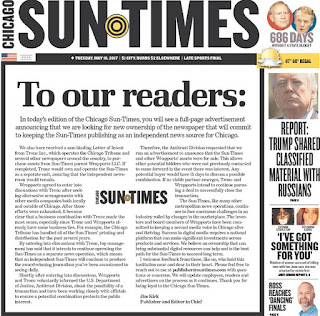
Newspapers as public media: WBEZ, radio, an NPR affiliate, to merge with the Chicago Sun-Times

Newspapers have been crushed by the Internet, the migration of classified advertising to Craigslist, the migration of display advertising to other venues, decline in subscriptions with the migration to online news gathering, reading, and social media, the rise of new digital advertising networks, etc.

The decline in newspaper readership has had a significant negative impact on civic life.

-- "Newspapers, community media, and knowledge about and engagement in civic affairs," 2020

In response, private equity has bought many newspapers, split off assets from newspapers like buildings and other property, television stations, etc., that once had helped support newspapers financially.  

Over the past 20 years, many newspapers, especially community newspapers, have shuttered or severely reduced their staffs and the number of articles they run, especially when it comes to local coverage.

The decline of newspaper media groups even hurt the ability of the Newseum news museum in DC to build its endowment, leading to (hopefully a somewhat temporary) demise ("What the Fall of the Newseum Says About News, and Museums," Bloomberg).

A number of metropolitan newspapers have reduced their publishing schedule to less than seven days.  A number of Advance Newspapers only publish three days/week.  In Salt Lake, the Deseret News and Tribune each moved to a weekend only edition, although the Tribune recently added a Wednesday edition, complemented by daily digital newspaper publication and expanded digital operations.  In New Orleans, such a reduction led to the eventual demise of the Times-Picayune in favor of a 7 day/week New Orleans edition of the Baton Rouge Advocate.

A number of digital only news reporting entities have been created in response to this decline.  Some are for profit, some are nonprofit.

Nonprofit options 

1.  For decades, the Tampa Bay Times (previously the St. Petersburg Times) has been owned by a nonprofit institute.  

2.  A few years ago, the Philadelphia Inquirer was acquired by a local group and then donated to the Lenfest Institute for Journalism.

3.  Recently, the Salt Lake Tribune converted from a for profit to a nonprofit.   

4.  A group of NPR stations acquired online for profit digital operations, such as DCist in DC, acquired by WAMU-FM, and Gothamist in NYC by WNYC-FM, adding them to their radio newsrooms.

5.  And now WBEZ-FM in Chicago is merging with the tabloid newspaper, the Chicago Sun-Times ("In Chicago, a public radio station comes to the rescue of the Sun-Times newspaper," Washington Post).

Many public television and public radio groups have redefined as "public media" or "community media" organizations, and in many communities like San Francisco or Salt Lake, the main public radio and PBS stations are often merged into one unified group.

Adding newspapers and digital newsrooms to the mix might be the next step, although running a newspaper, especially one that publishes every day is a lot more expensive and not so profitable, especially with massive declines in circulation.

The Sun-Times has struggled over the past decades and went through some hedge fund ownership debacles.  One thing that kept it going was the development of a suburban network of weekly and six daily newspapers, like the Southtown Economist.  But they were sold off to the Chicago Tribune a few years ago, making the enterprise financially weaker ("Sun-Times’ parent company sells suburban newspapers to Tribune," Sun-Times).

Labels: , , , , ,

Monday, August 30, 2021

Part 2 of the Australian Broadcasting Corporation documentary on the Murdoch media empire and Trump

As mentioned in last week's blog entry, "Australian Broadcasting Corporation documentary on the Murdoch media empire and Trump," the "Four Corners" long form news program of Australian Broadcasting Corporation has done a two part program on Fox News in the US.  

The first episode broadcast a week ago Monday, the second episode this Monday.

Fox News is relevant to Australia not just because of the fact that US politics have impact world-wide, but because Rupert Murdoch and his News Corporation began in Australia, and the impact of the company as a conservative news force is world-wide, but especially pronounced in Australia, the UK, and the US.

The first episode is pretty good.  

Although the reporting is not necessarily "news" to those of us in the US dealing with the issue of Fox "News" and its force in conservative politics, but discloses new details about how the turn to the hard right caused a split in the family, leading James Murdoch to leave the company altogether because he couldn't abide by the channel's place as a Republican and Trump propaganda feed and he had no ability to influence changes.

The family split also led Murdoch to sell many of its studio and non-sports cable television assets to Disney ("Disney officially owns 21st Century Fox," NPR), while still keeping the Fox News and Fox Business cable channels and the terrestrial network and television stations. (The Fox regional sports networks were sold separately to Sinclair Broadcasting, itself an avowedly conservative force.)

The second Four Corners" episode focuses on how Fox News has been all in on the "Big Lie" promoted by Trump that he won the election, which has been used by Republican state legislatures and governors across the country to pass a wide variety of voter suppression measures.

-- "Fox and the Big Lie: How the network promoted Donald Trump’s propaganda and helped destabilise democracy in America," episode two, "Four Corners," Australian Broadcasting Corporation

Murdoch newspapers in Australia have been all in on denigrating ABC and "Four Corners," allegedly based on "news value," not as a concerted campaign by the company, such as these articles from the Australian newspaper, which is roughly equivalent to the New York Times or Toronto Globe & Mail as a national organ ("The ABC’s big lie and the madness of Four Corners" and "Four Corners ‘fails’ basic reporting: Fox News"). 

Living this here in the US, the first episode seemed plenty accurate to me.  And the News Corporation articles defending Fox News seem fatuous.  From the article:

The ABC’s flagship current affairs program, Four Corners, has bizarrely claimed that the Fox News network “undermined the American democratic system” — simply by reporting Donald Trump’s public statements in the aftermath of the US election last November.

... But the 50-minute episode on Monday night was beset by unverified claims, glaring omissions of fact and a confused narrative that at times seemed to favour the censorship of news reporting. 

At times, Ferguson adopted a sneering tone toward the 74 million Americans who supported Trump, suggesting they were incapable of thinking for themselves. 

“They didn’t reach these conclusions on their own. There’s plenty of propaganda to feed their beliefs. But former Fox News insiders level blame at the powerful organisation they worked for,” Ferguson said.

The problem of course comes down to "reporting" that treats claims as equal, reports what "one side" says, without acknowledging whether or not what they say is true ("Why the Republicans' Big Lie works so well: A sociopathic party, and a damaged country," Salon, "Our democracy is under attack. Washington journalists must stop covering it like politics as usual," Washington Post).  

Fox News is a megaphone for Republicans who lie ("prevaricate") and it amplifies lies to the point where people think the lies are true ("Trumpists live in an alternate reality — but they believe in it, and that's terrifying," Salon).

Note that the first blog entry made the argument that on "fitness" grounds, Fox's television stations licenses ought to be subject to license challenges over their use of the "public's airwaves" the same way that many years ago, RKO's station licenses were similarly and successfully challenged.

Labels: , , ,

Wednesday, August 25, 2021

Australian Broadcasting Corporation documentary on the Murdoch media empire and Trump

According to the Guardian ("Murdoch empire strikes back at ABC’s documentary on Fox News’ championing of Trump"), the Murdoch media empire is furiously challenging the ABC documentary on the links between Murdoch and former President Trump ("Murdoch’s Fox News issues ABC with legal threat over ‘Four Corners’ Trump episode," Sydney Morning Herald).  

Certainly, we are familiar with the decline of Fox "News" and the Fox Business Channel into "Trumpmania" and conspiracy mongering.

Surprisingly, the documentary, on the ABC show "Four Corners" is available online to people outside of Australia, which is often rare, because of restrictions on broadcasting rights in other countries.  I definitely will watch it.

-- "Fox and the Big Lie: How the network promoted Donald Trump’s propaganda and helped destabilise democracy in America" (video)

In the UK, because of News Corporation newspapers hacking of personal telephones for "scoops", the company was deemed unfit to pursue full ownership of British Sky Broadcasting ("News Corp pulls out of BSkyB bid," Guardian).  Eventually, they sold their interest to the US-based Comcast Corporation.

I am not a lawyer, and am not really an advocate anymore (more a writer), but I argue on similar grounds, Fox television's terrestrial broadcast licenses ought to be able to be challenged, based on their poor stewardship of the cable television news assets and their failure to be "fair and balanced".

-- "60% of Fox News facts are really lies," Politifact, 2015
-- "Dominion Voting Systems Files $1.6 Billion Defamation Lawsuit Against Fox News," NPR
-- "A Rigorous Scientific Look Into The 'Fox News Effect'," Quora
-- "Misinformation During A Pandemic," University of Chicago

In the 1960s-1990s, the conglomerate RKO owned television and radio stations.  The corporation was found guilty of illegal activity in another subsidiary, and advocates used that conviction to successfully make the case that RKO was unfit to operate the over the air television station, and its use of the public's airwaves, in Boston.  Over time, they lost more licenses on similar grounds ("RKO General Is stripped of 3 TV Licenses," Washington Post, 1980, and then all of them for a different transgression.

This is the precedent that I think should be used to begin challenging Fox's tv station licenses, which are the root of the company's wealth and power in the United States.

Fox owns 18 stations directly, branded as Fox Television, 10 stations which broadcast "My Network Television" and one independent station.

These stations are in:

  • Atlanta
  • Austin, Texas
  • Chicago
  • Dallas
  • Detroit
  • Houston
  • Los Angeles
  • Milwaukee
  • Minneapolis
  • New York City
  • Ocala
  • Orlando
  • Philadephia
  • Phoenix
  • San Francisco
  • Seattle
  • Tampa
  • Washington, DC
The stations in Chicago, Los Angeles, New York City, and Washington are the crown jewels of the network.

=======
Murdoch's purchase of Metromedia Broadcasting and its stations in key markets, paying billions for NFL television rights, and using both assets to create the Fox television network and brand was brilliant.

Labels: , , ,

Saturday, April 10, 2021

Orange County Register coronavirus tracker graphic is a great model

Showing the value of local media in communicating locally important information, the newspaper is focused on only the one county, but it's a big county in population, more than 3 million residents.

It's also a decent example, in the vein of the work on graphical illustration of information by Edward Tufte, showing the power of multimedia to communicate.


Labels: , , , , ,

Wednesday, January 13, 2021

I didn't realize Blair Kamin retired as architecture critic for the Chicago Tribune

Blair Kamin received the 1999 Pulitzer Prize for Criticism and the webpage includes a number of his articles including a 1998 series on public space issues concerning the Chicago waterfront.

He's retiring from the Chicago Tribune "Tribune architecture critic Blair Kamin reflects on 28 years of reviewing Chicago’s wonders and blunders, and why such coverage should continue," taking a buyout from the company's venture capital owners ("Chicago Tribune's Pulitzer Prize-winning architecture critic exits," Crain's Chicago Business).

From the article: 

Whether or not you agreed with what I wrote was never the point. My aim was to open your eyes to, and raise your expectations for, the inescapable art of architecture, which does more than any other art to shape how we live. 

So I treated buildings not simply as architectural objects or technological marvels, but also as vessels of human possibility. Above all, my role was to serve as a watchdog, unafraid to bark — and, if necessary, bite — when developers and architects schemed to wreak havoc on the cityscape. 

This was a conversation between you and me, the critic and the readers, and I was often inspired by how you responded. 

Some of you engaged me to talk architecture at spots ranging from the Art Institute to the Belmont Avenue “L” station to O’Hare’s security gates. Many of you wrote letters and emails to express how much you appreciate that the Tribune remains one of the few American newspapers that still covers architecture on a regular basis.

About 20 years ago, when I first started getting involved earnestly in local civic affairs, in particular urban revitalization, newspapers weren't quite the basket case they are now although it was on the horizon, and many newspapers had architecture and/or urban design critics writing weekly or more frequently, along with business beat writers covering development and real estate, art critics writing about museums and culture, and too rarely, good writers on the transportation beat.


I owe a debt to those many writers, including Robert Campbell at the Boston Globe, Blair Kamin at the Chicago Tribune, Whitney Gould at the Milwaukee Journal Sentinel (deceased), Christopher Hume at the Toronto Star, John King at the San Francisco Chronicle and Inga Saffron at the Philadelphia Inquirer, Edwin Heathcote at the Financial Times , Ed Gunts at the Baltimore Sun, (I wasn't enamored of Benjamin Forgey at the Washington Post), Christopher Hawthorne (now working for the City of Los Angeles) and Christopher Knight at the Los Angeles Times, Steve Litt of the Cleveland Plain Dealer, various writers at the Toronto Globe and Mail, Ada Louise Huxtable (deceased) and Michael Lewis at the Wall Street Journal, and others, for helping to educate me about architecture, urban design, cities, and culture.  

-- "Robert Campbell and Inga Saffron win Vincent Scully Prize for architectural criticism," Boston Globe

Similarly, even though it was many years before I put my toe in the water and got involved, in the late 1980s and into the early 1990s, I read the urban design columns by Mark Jenkins in the Washington City Paper.  It helped prepare me for later.

On the architecture and urban design side, Campbell, King, Lewis, Litt and Saffron are still writing.  

Most of them are not, and when they retired in most cases, they weren't replaced. 

This is a great loss for communities, because these writers and coverage of architecture and urban design helps to raise the bar for quality, and attention to how real estate development works, and provides people with a vocabulary they can use when interacting with elected and appointed officials and their fellow citizens.

The Post's Philip Kennicott writes about architecture and the arts--this is the most recent, "Trump decreed that we should worship classical architecture. Then his supporters defiled the Capitol," but not multiple times per week the way that Blair Kamin did or John King, Steven Litt, and Inga Saffron do.

-- 

Labels: , , , , ,

Sunday, July 19, 2020

Newspapers, community media, and knowledge about and engagement in civic affairs

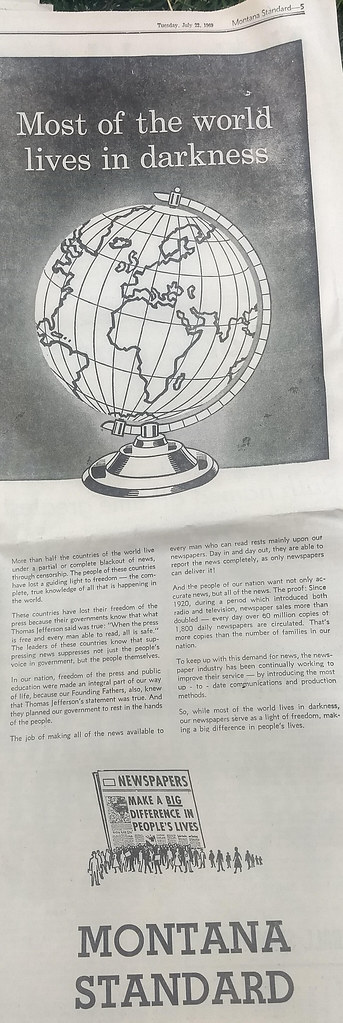
Newspaper image ad about the value of newspapers, Montana Standard, 7/22/1969
Newspaper image ad about the value of newspapers, Montana Standard, 7/22/1969.

A friend's mother died, and she spent a couple weeks cleaning out her house.  Among her finds were some newspaper sections and clippings relating to Apollo 11's landing on the moon, on July 20th, 1969--tomorrow will be the 51st anniversary.

When I look at old newspapers, usually I am equally interested in the ads as much, if not more than the articles.  Because back then, ads were often local (stores, opening of new real estate developments, etc.) and the ads provide a different way of accessing history.

(Although you can always usually find at least one particularly interesting article in any newspaper.)

The above ad was what was called an "image ad," in this case about the value of newspapers and a free press.  (Back in the day of mass media magazines like Time, Life, and the Saturday Evening Post, companies and trade associations frequently ran such ads.)

I thought it was particularly poignant given all the press coverage about Ghosting the News: Local Journalism and the Crisis of American Democracy, the new book by Margaret Sullivan, the media columnist for the Washington Post.

Most of her career was spent at the Buffalo News, a once large metropolitan newspaper that boasted a circulation of over 300,000.  She was the editor in chief of the paper for almost two decades.

I have a bunch of entries about the value of media and civic engagement and knowledge about civic affairs.

-- "One more blow against community media: Washington Post drops Thursday "county" news special sections," 2017
-- "The ongoing tragedy of dying print media, the latest being community newspapers in Montgomery and Prince George's Counties, Maryland," 2015
-- "Voting vs. civic participation | elections vs. governance," 2016
-- "Revisiting community radio," 2020
-- "End of the year articles: decline of local newspapers," 2019
-- "A brief comment on the connection between newspapers and civic affairs with the offer by a vulture hedge fund to purchase Gannett Newspapers," 2017
-- "Grassroots communications capability in the city," 2005
-- "Protest as Civic Engagement and the role of the media," 2007
-- "DC's community newspaper weekly, the Northwest Current, goes out of business," 2019

Within media, there is a big difference between television news, which is how a majority of people now get "their local news", and news from a newspaper -- although either is more likely to be via computer or phone.

Most communities used to have metropolitan newspapers serving the entire area, newspapers like the Chicago Tribune or Detroit Free Press, but they were complemented by smaller daily newspapers in outer areas of the region, like the Oakland Press and Royal Oak Tribune in Oakland County, Michigan and the Macomb Daily in Macomb County.

Of course, at one time these regions were usually served by at least two major metropolitan newspapers--the Buffalo News competed with the Buffalo Courier-Express, the Philadelphia Inquirer with the Philadelphia Bulletin, etc. and some bigger cities had more than two.

Often, the way this was done was that there was a morning paper, like the Washington Post or the Detroit Free Press, and another delivered in the afternoon, called the evening newspaper, like the Washington Star or the Detroit News.

The rise of two car households--before people took transit to and from work and often read the "evening newspaper" on the commute trip home, and television evening news broadcasts killed the afternoon newspaper.

(In the earlier part of the 20th century these areas typically had even more newspapers, but they consolidated consolidated over time.  E.g., Detroit had three newspapers, but the Detroit News bought the Detroit Times, Washington had four newspapers but the Post bought the Times-Herald, and this led the Star to purchase the Daily News.)

In turn even smaller community newspapers, published once or twice each week, such as the Troy Eccentric serving Troy, Michigan or the Redford Record, serving Redford Township and the nearby neighborhoods in Detroit, in Wayne County, served even smaller slices of a metropolitan area.

Community newspapers have even more problems than the big newspapers.  In many areas the big paper acquired these networks, although many remained independent.  But they are rapidly going out of business too.

Local television doesn't focus on the day-in, day-out coverage of local and state government actions, as much as it does on murders, gruesome car accidents, fires, and the weather.  It is said that one page of a newspaper provides more news than a 30 minute local tv broadcast.

One exception that I wrote about is WCPO-TV in Cincinnati, which has a digital news site that is superb.  But the company had its roots in newspapers, which influenced the development of this operation, which is more of a one-off flagship effort, rather than being ported to other television stations in the Scripps group.

-- "Local television station news: Scripps WCPO in Cincinnati vs. Sinclair Broadcasting Corp.," 2018

Note that some PBS stations in a couple big markets like Chicago and New York City do daily newscasts that are locally focused, and many PBS stations have weekly programs on area civic affairs as well as other area-focused informational programming (Outdoor Maryland, Direct Connection, This is Utah, etc.).

Public radio too is an increasing source of local news, complementing national radio programs like "Morning Edition."  And both PBS and NPR stations often have more extensive online news websites.

But especially in the last 10 years, but steadily since the invention of the web browser and as importantly, the development of digital advertising networks, first Craigslist, which decimated classified advertising revenues, and then the capture of the equivalent of display advertising by Google and Facebook, newspapers have crashed economically.  Advertising provided most of the revenue, and it has dried up.

There are other reasons for this too, in particular the chaining up of consumer facing businesses--not just retailers, but also banks, etc.--and the consolidation of these businesses within sectors.  For example, Macy's is the primary and only department store in many areas today, whereas before places had multiple firms all advertising in the local paper.  Most places don't have local banks, and they sure aren't giving away toasters to get your account, necessitating a newspaper ad.  Etc.

Newspapers haven't quite gone out of business, but they have significantly shed staff, become much smaller, and cover a lot less news, and in many smaller regions, the main newspaper no longer publishes a print edition every day, going down to maybe 3 days/week.  Many papers no longer have bureaus across a region or state, an office covering the state government, located in the state capital, etc.  (And many have shed foreign bureaus and Washington bureaus.)

Not only has the movement to the Internet changed media economics, at the same time, the explosion of online content, especially more entertainment-related, has led to a bifurcated environment, where many people no longer consume much in the way of local news, or because the Internet allows for easy consumption of media content from all over--the Guardian or Financial Times from the UK or the Toronto Globe and Mail from Canada, and the New York Times, Washington Post, and the Wall Street Journal in the US--"local" newspapers are losing out to national or international newspapers, for national and international news, and people just aren't consuming local news at all.

Besides the national- and international-ization of news sources, there is also the rise of digital native media, many of the nationally-oriented sources with a decidedly left or right bent, and many of these "sources" have limited fealty to facts, instead leading with ideology.

There has been an explosion of local news websites too, like Public Source in Greater Pittsburgh or DC Line in the DC area, often with philanthropic support.   Others that are supported by local advertising.  But it's hard to scale as well.

Oh, alternative weeklies have been crushed as well--a big source of revenue had been personal ads, which shifted to the web as well.  And many have gone out of business.

One of the pieces about Sullivan's book made a fascinating point as an example about the decline of local newspapers--in circulation and reach, relevance, and coverage--using the story of Representative Chris Collins, a Republican Congressman from the Buffalo area.  He was the first elected official in Congress to endorse Trump.

-- "Goodbye to the Hometown Paper," Washington Post

Later he was indicted for insider trading, and at first was going to resign, but then he decided to still run for reelection.  (He won, but after he was found guilty, he resigned.)  It turns out that most of the people in the congressional district didn't even know that Collins was indicted, and because of the lack of reach by local media, especially newspapers, Collins was successful in labeling it as "fake news."

The Washington Post subscription slogan for a long time was "if you don't get it, you don't get it" meaning you don't know what's going on.

While there an explosion in how much there is to know and what you can know, there is a simultaneous inward explosion in the reduction of people who care to know.

It's amazing that an elected official could get reelected because people don't even know he is indicted.

Labels: , , , , ,