Rebuilding Place in the Urban Space

"A community’s physical form, rather than its land uses, is its most intrinsic and enduring characteristic." [Katz, EPA] This blog focuses on place and placemaking and all that makes it work--historic preservation, urban design, transportation, asset-based community development, arts & cultural development, commercial district revitalization, tourism & destination development, and quality of life advocacy--along with doses of civic engagement and good governance watchdogging.

Thursday, April 09, 2026

(Every Day Should Be) Local News Day

Local News Day is today.  

It's sponsored by various modes of community-serving media.  

There should be scads of participants--metropolitan newspapers, community newspapers, public radio and public television programs, I guess local television station news, although it tends to not be in depth, and digital only news sources.

There aren't that many member newsrooms so far.

======

-- "Inside the crisis facing local TV news" (2026)
-- "Davis Kennedy, a one time force in local community newspapers, dies at 87" (2026)
-- "Washington City Paper community media project" (2026)
-- "Another media tragedy: The Pittsburgh Post-Gazette is shutting down" (2026)
-- "New Jersey loses largest published newspaper: Newark Star-Ledger" (2025)
-- "Newspaper acquisition as an element of a conservative agenda" (2024)
-- "The impact of local radio news in England" (2022)
-- "Newspapers as public media: WBEZ, radio, an NPR affiliate, to merge with the Chicago Sun-Times" (2022)
-- "Louisville Courier-Journal mobile newsroom initiative and Salt Lake Tribune Innovations Lab" (2022)
-- "Orange County Register coronavirus tracker graphic is a great model" (2021)
-- "Local music used to define communities: today with radio chains and national music distribution systems, not so much" (2021)
-- "Newspapers, community media, and knowledge about and engagement in civic affairs" (2020)
-- "Revisiting community radio" (2020)
-- "Thinking anew about supporting community radio" (2019)
-- "Culture planning and radio: local music, local content vs. delivery nodes for a national network" (2019)
-- "One more blow against community media: Washington Post drops Thursday "county" news special sections" (2017)
-- "The ongoing tragedy of dying print media, the latest being community newspapers in Montgomery and Prince George's Counties, Maryland" (2015)
-- "Grassroots communications capability in the city" (2015)
-- "Protest as Civic Engagement and the role of the media" (2007)

Labels: , , , , ,

Friday, March 13, 2026

Davis Kennedy, a one time force in local community newspapers, dies at 87

-- "Davis Kennedy, former publisher who pioneered growth of Gazette papers, dies at 87," Baltimore Banner

Most recently, Davis ran the Current newspapers, which published a number of free weekly newspapers, with neighborhood-focused editions in Northwest DC, with Georgetown Current as the flagship, and for awhile a Capitol Hill Current.

I had a bunch of op eds in some of the papers.  Community newspapers at this scale were great at covering the kind of "minutiae" that would never make the big paper unless there was a scandal.  Community council meetings, more detailed coverage of City Council and Executive Branch dealings related to the neighborhood, real estate matters, business openings, and lots of ads. 

Sub-city newspapers rely on independent businesses as primary advertisers, car dealers, and at one time had a strong revenue base in classified ads.

With the shift of print media to online, and the decline of local businesses, sub-city newspaper revenues dried up, and the Current Newspapers shut down in 2019 ("DC's community newspaper weekly, the Northwest Current, goes out of business").

From the Post article:

Former managing editor Chris Kain recalls the early 2000s as boom times for the Current, with page counts reaching as high as 56 for standard issues and 84 for special editions.

Until the coverage of that, I didn't know he was responsible for the expansion of the Gazette Newspapers, which covered a good swath of Maryland with sub-county editions for Frederick, Carroll, Montgomery and Prince George's Counties--and the Fairfax County Times.

But it began with his purchase of the Gaithersburg Gazette in 1981.

When I lived briefly in PG County, I read it, and they had a newspaper box at Takoma Station--in DC but on the border with Montgomery County--so I read that edition too.  I tried to read multiple editions.

They also published an official paper intended for legal notices for Maryland State Government, distributed and giving them presence in Annapolis.  

There was a vending box outside Tastee Diner in Silver Spring, and I happened to pick up a copy in 2003 when they published a masterful investigative impact on Prince George's County crime and housing, "Shouldering the Burden," a response to the downsizing of DC's public housing complexes through the HOPEVI federal housing reconstruction program, which added market rate units at the expense of subsidized units.

The Washington Post acquired them, and as advertising dried up--the papers were distributed for free also--they figured they'd save money to use elsewhere by shutting them down in 2015.  But there was no new money available, the papers ran based on the revenue collected for advertising.  

These shut down in 2015, before Current Newspapers. These free weeklies marketed as a group to get advertising inserts from big box stores.  Kennedy said when the Gazette Newspapers shut down, advertisers stopped their insert program, because they wanted the multi-county coverage, not just DC.  He said this was the final financial blow to the Current, leading to the shutdown four years later.

Labels: , ,

Wednesday, February 26, 2025

A sad day for the Washington Post and Washington DC

As Jeff Bezos, owner of Amazon and of the Washington Post, announces the op-ed pages will shift to coverage on "freedom of markets" and "personal liberties"   ("Post owner Bezos announces shift in opinions section," Post, "Washington Post opinion editor departs as Bezos pushes to promote ‘personal liberties and free markets’," Guardian).

While I think it'll likely be "Wall Street Journal-lite"), it is a sad diminishment of the range of opinions offered by the paper.  It's not like I can read George Will or his politically leaning colleagues because of their arguments, but I never minded that they took up space on the pages.

With all the talk about disinformation and misinformation and the need for reliable sources of information, it's sad that the Post is throwing in with this dis- and mis-informatives, as an under-information or incomplete-information provider.  

It's not that you can't write about personal liberties and freedom of markets.  But you're telling an incomplete story if you avoid discussion of real discrimination, minoritarian rule, etc., as well as the need for regulation of markets to reduce the chance for overreach and economic collapse.

It's a long way from what the Graham Family thought were the strengths of Bezos digital knowledge in a future that was and is very uncertain for newspapers ("A Newspaper, and a Legacy, Reordered," New York Times).

From the Washington Post article, "The sale of The Washington Post: How the unthinkable choice became the clear path:"

Washington Post publisher Katharine Weymouth presented her uncle, company chief executive Donald E. Graham, with a once-unthinkable choice at a lunch meeting at downtown Washington's Bombay Club late last year. The paper was facing the like­lihood of a seventh straight year of declines in revenue, with one preliminary budget estimate showing the possibility of $40 million in losses for 2013. And despite years of heavy investment in new digital offerings, there was little sign that robust profits were about to return, she reported.

That left three choices, Weymouth told Graham. The family could continue presiding over the gradual decline of the newspaper they loved. They could move more aggressively to cut the paper’s staff more deeply than ever, hoping that they could return The Post to sustained profitability by sacrificing its longtime excellence.

Or they could sell, cutting ties to one of America’s iconic news organizations after four generations of family control in the hopes that The Post could thrive again under a new, deep-pocketed, civic-minded owner.

... Several factors allowed the deal to come together with relative speed. They included a long-standing friendship between Bezos and Graham, 68, an executive steeped in traditional newspaper publishing who had become a respected elder for a newer generation of tech magnates. Bezos was among the most successful of those, and the two men had on several occasions traded insights on their businesses.

“The Post is his baby,” Weymouth said of Graham. “He was not going to give his baby to anybody who he thought would not care for it properly.”

Looks like the baby got sold to a serial killer ("Post endorsement controversy sparks staff resignations, protests ," The Hill).

Then again, significant change was predicted, it just took 11 years to see how bad it could be ("No Change? Jeff Bezos Will Turn the Washington Post Upside Down," MediaShift).  First on the list, although actually much later:

So what can we expect to change within the next five years and why? Here are some reasonable assumptions:

The editorial policies, the coverage and the content will reflect the interests and ideologies of the owner. For the U.S. government’s hometown newspaper, that’s something to really be aware of.

Labels: , , , , ,

Thursday, September 29, 2022

The impact of local radio news in England

 I have written a bunch about the chaining up of local radio and how the stations have been standardized with little in the way of local music or personalities.  I haven't mentioned this in terms of "local news" or "local content" in commercial radio, because it's been so long since the average station has offered any, with the exception of the usually one station in each market that maintains an exclusive focus on news, like WTOP in the Washington DC area.

Of course, public radio is an exception.

-- "Culture planning and radio: local music, local content vs. delivery nodes for a national network," 2019
-- "Thinking anew about supporting community radio," 2019
-- "Revisiting community radio," 2020
-- "Local music used to define communities: today with radio chains and national music distribution systems, not so much,"  2021
-- "Newspapers, community media, and knowledge about and engagement in civic affairs," 2020
-- "Newspapers as public media: WBEZ, radio, an NPR affiliate, to merge with the Chicago Sun-Times," 2022

The founder of Clear Channel Communications died recently ("L. Lowry Mays, builder of radio empire, dies at 87," Washington Post).  His entry into the radio business led to the massive consolidation in the industry that we see today.

This was complemented by massive deregulation of the industry and the elimination of much in the way of local content and news requirements. 

The UK is in financial meltdown because of bad fiscal decision making, and there, the BBC's local news radio outlets very occasionally get time with the UK Prime Minister.  This week there was one of those go-arounds, and apparently the local journalists got in some good questions that weren't mediated by deference ("Disastrous Liz Truss interviews show BBC local radio still packs a punch," Guardian).

From the article:

When it was announced that Liz Truss would break her silence on the collapse of the pound by appearing on local radio stations, there was mockery from some London-based journalists who felt she should have given an interview to a national news outlet.

Instead, it was BBC Leeds’s breakfast show that helped shift the price of UK government debt, as traders tuned in and realised the prime minister was sticking to her economic plan. As presenter Rima Ahmed put it to the prime minister: “Where’ve you been?”

Radio Kent put it in more stark terms, with one listener asking Truss: “Are you ashamed of what you have done? ...

The prime minister’s rapid-fire set of eight short interviews with BBC radio stations in an hour produced more news than often emerges from a single slot on Radio 4’s Today programme.

One benefit that local radio journalists have over reporters who deal with Downing Street on a daily basis is that they have no incentive to hold back. They are unlikely to have the prime minister on their programme as a regular guest and there is no need to have the complicated ongoing relationships with Downing Street communications staff. Instead they have the chance to ask a handful of questions and try to make their name – and represent the views of their listeners.

It's a pretty rare practice.  I can't imagine top elected officials in the US deigning to spend much time, even five minutes, with a local NPR affiliate, unscripted--leaving themselves vulnerable to real questioning.

=====

Professor Robert McChesney's writings focus on how to insert democracy into American media.

-- Telecommunications, Mass Media, & Democracy: The Battle for Control of U.S. Broadcasting, 1928-1935

Labels: , , , , ,

Monday, September 12, 2022

Louisville Courier-Journal mobile newsroom initiative and Salt Lake Tribune Innovations Lab

 I was reading an article about a failed shopping mall, and caught this at the end of the article:

MEET THE EDITORS NIGHT IN OKOLONA 

Courier Journal reporters are working from the South Central Regional Library weekdays in September as part of its mobile newsroom. We'd love to meet with you, and we invite you to meet the editors of The Courier Journal at 6:30 p.m. Tuesday at Meet the Editors Night at the library, 7300 Jefferson Blvd.

As part of this program, they're spending three weeks basing their "mobile newsroom" in a library in the Okolona district in the outlying county section of Louisville-Jefferson County (the city and county merged in 2003).

From "Why The Courier Journal is bringing its newsroom to your neighborhood":

Here’s the truth.

Everyone doesn’t have the same access to The Courier Journal.

There are people who are more connected and more comfortable reaching out to a reporter or an editor. People who know someone on staff or share something in common with them or just know how to get our attention.

There also are certain communities that get a lot of news coverage, particularly those that are booming with development — new stores, restaurants or subdivisions. Other neighborhoods get little media attention. Residents there are less likely to contact The Courier Journal or feel a connection to our staff.

We want to change that. So we are bringing our newsroom to you.

Interesting.

A different kind of concept is by the Salt Lake Tribune, which has created the "Innovation Lab" to communicate about best practice ideas and approaches to problems in the community. 

I wouldn't argue that it's absolutely scintillating, but the SLT, which is now a nonprofit, does focus on serious issues that the Mormon Church owned paper, the Deseret News, does not, from police killings, to misuse of police information by Brigham Young University, to development issues, the Great Salt Lake, the water crisis and drought, etc.

The effect is hindered by the fact that they now only publish two print editions per week, but it is still great coverage.

... it's still very important.  I was reading an article about a Ponzi scheme in San Diego involving a woman named Gina Champion-Cain, and the story ("The Charismatic Developer and the Ponzi Scheme That Suckered San Diego") suggested that part of the reason that she got away with it for so long was that her rise was simultaneous to a severe downsizing of the local newspaper, the San Diego Union-Tribune, which included a reduction in investigative reporting.

Newspapers and similar media matter.

-- "One more blow against community media: Washington Post drops Thursday "county" news special sections," 2017
-- "DC's community newspaper weekly, the Northwest Current, goes out of business," 2019
-- "Staff And Locals React To End Of Washington City Paper Print Edition," DCist, 2022
-- "Newspapers as public media: WBEZ, radio, an NPR affiliate, to merge with the Chicago Sun-Times," 2022
-- "Newspapers, community media, and knowledge about and engagement in civic affairs," 2020

Labels: , , , , ,

Saturday, January 22, 2022

Newspapers as public media: WBEZ, radio, an NPR affiliate, to merge with the Chicago Sun-Times

Newspapers have been crushed by the Internet, the migration of classified advertising to Craigslist, the migration of display advertising to other venues, decline in subscriptions with the migration to online news gathering, reading, and social media, the rise of new digital advertising networks, etc.

The decline in newspaper readership has had a significant negative impact on civic life.

-- "Newspapers, community media, and knowledge about and engagement in civic affairs," 2020

In response, private equity has bought many newspapers, split off assets from newspapers like buildings and other property, television stations, etc., that once had helped support newspapers financially.  

Over the past 20 years, many newspapers, especially community newspapers, have shuttered or severely reduced their staffs and the number of articles they run, especially when it comes to local coverage.

The decline of newspaper media groups even hurt the ability of the Newseum news museum in DC to build its endowment, leading to (hopefully a somewhat temporary) demise ("What the Fall of the Newseum Says About News, and Museums," Bloomberg).

A number of metropolitan newspapers have reduced their publishing schedule to less than seven days.  A number of Advance Newspapers only publish three days/week.  In Salt Lake, the Deseret News and Tribune each moved to a weekend only edition, although the Tribune recently added a Wednesday edition, complemented by daily digital newspaper publication and expanded digital operations.  In New Orleans, such a reduction led to the eventual demise of the Times-Picayune in favor of a 7 day/week New Orleans edition of the Baton Rouge Advocate.

A number of digital only news reporting entities have been created in response to this decline.  Some are for profit, some are nonprofit.

Nonprofit options 

1.  For decades, the Tampa Bay Times (previously the St. Petersburg Times) has been owned by a nonprofit institute.  

2.  A few years ago, the Philadelphia Inquirer was acquired by a local group and then donated to the Lenfest Institute for Journalism.

3.  Recently, the Salt Lake Tribune converted from a for profit to a nonprofit.   

4.  A group of NPR stations acquired online for profit digital operations, such as DCist in DC, acquired by WAMU-FM, and Gothamist in NYC by WNYC-FM, adding them to their radio newsrooms.

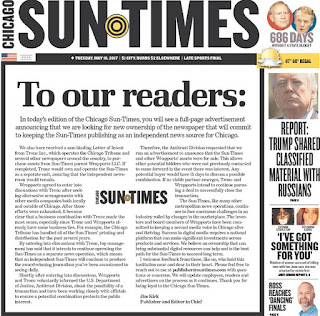
5.  And now WBEZ-FM in Chicago is merging with the tabloid newspaper, the Chicago Sun-Times ("In Chicago, a public radio station comes to the rescue of the Sun-Times newspaper," Washington Post).

Many public television and public radio groups have redefined as "public media" or "community media" organizations, and in many communities like San Francisco or Salt Lake, the main public radio and PBS stations are often merged into one unified group.

Adding newspapers and digital newsrooms to the mix might be the next step, although running a newspaper, especially one that publishes every day is a lot more expensive and not so profitable, especially with massive declines in circulation.

The Sun-Times has struggled over the past decades and went through some hedge fund ownership debacles.  One thing that kept it going was the development of a suburban network of weekly and six daily newspapers, like the Southtown Economist.  But they were sold off to the Chicago Tribune a few years ago, making the enterprise financially weaker ("Sun-Times’ parent company sells suburban newspapers to Tribune," Sun-Times).

Labels: , , , , ,

Wednesday, January 13, 2021

I didn't realize Blair Kamin retired as architecture critic for the Chicago Tribune

Blair Kamin received the 1999 Pulitzer Prize for Criticism and the webpage includes a number of his articles including a 1998 series on public space issues concerning the Chicago waterfront.

He's retiring from the Chicago Tribune "Tribune architecture critic Blair Kamin reflects on 28 years of reviewing Chicago’s wonders and blunders, and why such coverage should continue," taking a buyout from the company's venture capital owners ("Chicago Tribune's Pulitzer Prize-winning architecture critic exits," Crain's Chicago Business).

From the article: 

Whether or not you agreed with what I wrote was never the point. My aim was to open your eyes to, and raise your expectations for, the inescapable art of architecture, which does more than any other art to shape how we live. 

So I treated buildings not simply as architectural objects or technological marvels, but also as vessels of human possibility. Above all, my role was to serve as a watchdog, unafraid to bark — and, if necessary, bite — when developers and architects schemed to wreak havoc on the cityscape. 

This was a conversation between you and me, the critic and the readers, and I was often inspired by how you responded. 

Some of you engaged me to talk architecture at spots ranging from the Art Institute to the Belmont Avenue “L” station to O’Hare’s security gates. Many of you wrote letters and emails to express how much you appreciate that the Tribune remains one of the few American newspapers that still covers architecture on a regular basis.

About 20 years ago, when I first started getting involved earnestly in local civic affairs, in particular urban revitalization, newspapers weren't quite the basket case they are now although it was on the horizon, and many newspapers had architecture and/or urban design critics writing weekly or more frequently, along with business beat writers covering development and real estate, art critics writing about museums and culture, and too rarely, good writers on the transportation beat.


I owe a debt to those many writers, including Robert Campbell at the Boston Globe, Blair Kamin at the Chicago Tribune, Whitney Gould at the Milwaukee Journal Sentinel (deceased), Christopher Hume at the Toronto Star, John King at the San Francisco Chronicle and Inga Saffron at the Philadelphia Inquirer, Edwin Heathcote at the Financial Times , Ed Gunts at the Baltimore Sun, (I wasn't enamored of Benjamin Forgey at the Washington Post), Christopher Hawthorne (now working for the City of Los Angeles) and Christopher Knight at the Los Angeles Times, Steve Litt of the Cleveland Plain Dealer, various writers at the Toronto Globe and Mail, Ada Louise Huxtable (deceased) and Michael Lewis at the Wall Street Journal, and others, for helping to educate me about architecture, urban design, cities, and culture.  

-- "Robert Campbell and Inga Saffron win Vincent Scully Prize for architectural criticism," Boston Globe

Similarly, even though it was many years before I put my toe in the water and got involved, in the late 1980s and into the early 1990s, I read the urban design columns by Mark Jenkins in the Washington City Paper.  It helped prepare me for later.

On the architecture and urban design side, Campbell, King, Lewis, Litt and Saffron are still writing.  

Most of them are not, and when they retired in most cases, they weren't replaced. 

This is a great loss for communities, because these writers and coverage of architecture and urban design helps to raise the bar for quality, and attention to how real estate development works, and provides people with a vocabulary they can use when interacting with elected and appointed officials and their fellow citizens.

The Post's Philip Kennicott writes about architecture and the arts--this is the most recent, "Trump decreed that we should worship classical architecture. Then his supporters defiled the Capitol," but not multiple times per week the way that Blair Kamin did or John King, Steven Litt, and Inga Saffron do.

-- 

Labels: , , , , ,

Sunday, July 19, 2020

Newspapers, community media, and knowledge about and engagement in civic affairs

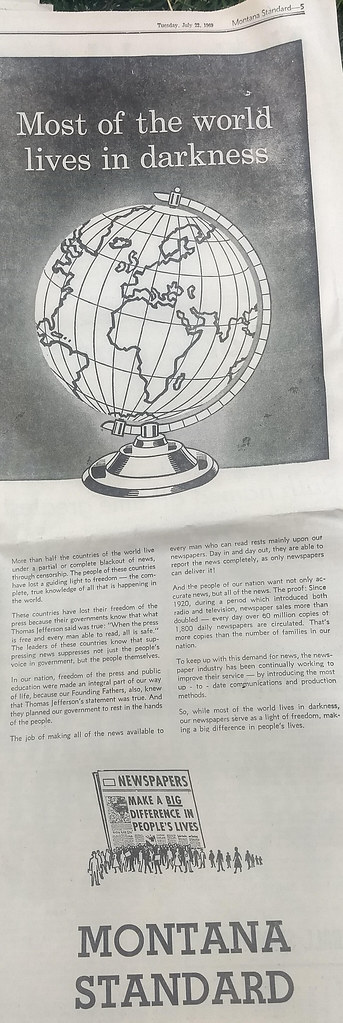
Newspaper image ad about the value of newspapers, Montana Standard, 7/22/1969
Newspaper image ad about the value of newspapers, Montana Standard, 7/22/1969.

A friend's mother died, and she spent a couple weeks cleaning out her house.  Among her finds were some newspaper sections and clippings relating to Apollo 11's landing on the moon, on July 20th, 1969--tomorrow will be the 51st anniversary.

When I look at old newspapers, usually I am equally interested in the ads as much, if not more than the articles.  Because back then, ads were often local (stores, opening of new real estate developments, etc.) and the ads provide a different way of accessing history.

(Although you can always usually find at least one particularly interesting article in any newspaper.)

The above ad was what was called an "image ad," in this case about the value of newspapers and a free press.  (Back in the day of mass media magazines like Time, Life, and the Saturday Evening Post, companies and trade associations frequently ran such ads.)

I thought it was particularly poignant given all the press coverage about Ghosting the News: Local Journalism and the Crisis of American Democracy, the new book by Margaret Sullivan, the media columnist for the Washington Post.

Most of her career was spent at the Buffalo News, a once large metropolitan newspaper that boasted a circulation of over 300,000.  She was the editor in chief of the paper for almost two decades.

I have a bunch of entries about the value of media and civic engagement and knowledge about civic affairs.

-- "One more blow against community media: Washington Post drops Thursday "county" news special sections," 2017
-- "The ongoing tragedy of dying print media, the latest being community newspapers in Montgomery and Prince George's Counties, Maryland," 2015
-- "Voting vs. civic participation | elections vs. governance," 2016
-- "Revisiting community radio," 2020
-- "End of the year articles: decline of local newspapers," 2019
-- "A brief comment on the connection between newspapers and civic affairs with the offer by a vulture hedge fund to purchase Gannett Newspapers," 2017
-- "Grassroots communications capability in the city," 2005
-- "Protest as Civic Engagement and the role of the media," 2007
-- "DC's community newspaper weekly, the Northwest Current, goes out of business," 2019

Within media, there is a big difference between television news, which is how a majority of people now get "their local news", and news from a newspaper -- although either is more likely to be via computer or phone.

Most communities used to have metropolitan newspapers serving the entire area, newspapers like the Chicago Tribune or Detroit Free Press, but they were complemented by smaller daily newspapers in outer areas of the region, like the Oakland Press and Royal Oak Tribune in Oakland County, Michigan and the Macomb Daily in Macomb County.

Of course, at one time these regions were usually served by at least two major metropolitan newspapers--the Buffalo News competed with the Buffalo Courier-Express, the Philadelphia Inquirer with the Philadelphia Bulletin, etc. and some bigger cities had more than two.

Often, the way this was done was that there was a morning paper, like the Washington Post or the Detroit Free Press, and another delivered in the afternoon, called the evening newspaper, like the Washington Star or the Detroit News.

The rise of two car households--before people took transit to and from work and often read the "evening newspaper" on the commute trip home, and television evening news broadcasts killed the afternoon newspaper.

(In the earlier part of the 20th century these areas typically had even more newspapers, but they consolidated consolidated over time.  E.g., Detroit had three newspapers, but the Detroit News bought the Detroit Times, Washington had four newspapers but the Post bought the Times-Herald, and this led the Star to purchase the Daily News.)

In turn even smaller community newspapers, published once or twice each week, such as the Troy Eccentric serving Troy, Michigan or the Redford Record, serving Redford Township and the nearby neighborhoods in Detroit, in Wayne County, served even smaller slices of a metropolitan area.

Community newspapers have even more problems than the big newspapers.  In many areas the big paper acquired these networks, although many remained independent.  But they are rapidly going out of business too.

Local television doesn't focus on the day-in, day-out coverage of local and state government actions, as much as it does on murders, gruesome car accidents, fires, and the weather.  It is said that one page of a newspaper provides more news than a 30 minute local tv broadcast.

One exception that I wrote about is WCPO-TV in Cincinnati, which has a digital news site that is superb.  But the company had its roots in newspapers, which influenced the development of this operation, which is more of a one-off flagship effort, rather than being ported to other television stations in the Scripps group.

-- "Local television station news: Scripps WCPO in Cincinnati vs. Sinclair Broadcasting Corp.," 2018

Note that some PBS stations in a couple big markets like Chicago and New York City do daily newscasts that are locally focused, and many PBS stations have weekly programs on area civic affairs as well as other area-focused informational programming (Outdoor Maryland, Direct Connection, This is Utah, etc.).

Public radio too is an increasing source of local news, complementing national radio programs like "Morning Edition."  And both PBS and NPR stations often have more extensive online news websites.

But especially in the last 10 years, but steadily since the invention of the web browser and as importantly, the development of digital advertising networks, first Craigslist, which decimated classified advertising revenues, and then the capture of the equivalent of display advertising by Google and Facebook, newspapers have crashed economically.  Advertising provided most of the revenue, and it has dried up.

There are other reasons for this too, in particular the chaining up of consumer facing businesses--not just retailers, but also banks, etc.--and the consolidation of these businesses within sectors.  For example, Macy's is the primary and only department store in many areas today, whereas before places had multiple firms all advertising in the local paper.  Most places don't have local banks, and they sure aren't giving away toasters to get your account, necessitating a newspaper ad.  Etc.

Newspapers haven't quite gone out of business, but they have significantly shed staff, become much smaller, and cover a lot less news, and in many smaller regions, the main newspaper no longer publishes a print edition every day, going down to maybe 3 days/week.  Many papers no longer have bureaus across a region or state, an office covering the state government, located in the state capital, etc.  (And many have shed foreign bureaus and Washington bureaus.)

Not only has the movement to the Internet changed media economics, at the same time, the explosion of online content, especially more entertainment-related, has led to a bifurcated environment, where many people no longer consume much in the way of local news, or because the Internet allows for easy consumption of media content from all over--the Guardian or Financial Times from the UK or the Toronto Globe and Mail from Canada, and the New York Times, Washington Post, and the Wall Street Journal in the US--"local" newspapers are losing out to national or international newspapers, for national and international news, and people just aren't consuming local news at all.

Besides the national- and international-ization of news sources, there is also the rise of digital native media, many of the nationally-oriented sources with a decidedly left or right bent, and many of these "sources" have limited fealty to facts, instead leading with ideology.

There has been an explosion of local news websites too, like Public Source in Greater Pittsburgh or DC Line in the DC area, often with philanthropic support.   Others that are supported by local advertising.  But it's hard to scale as well.

Oh, alternative weeklies have been crushed as well--a big source of revenue had been personal ads, which shifted to the web as well.  And many have gone out of business.

One of the pieces about Sullivan's book made a fascinating point as an example about the decline of local newspapers--in circulation and reach, relevance, and coverage--using the story of Representative Chris Collins, a Republican Congressman from the Buffalo area.  He was the first elected official in Congress to endorse Trump.

-- "Goodbye to the Hometown Paper," Washington Post

Later he was indicted for insider trading, and at first was going to resign, but then he decided to still run for reelection.  (He won, but after he was found guilty, he resigned.)  It turns out that most of the people in the congressional district didn't even know that Collins was indicted, and because of the lack of reach by local media, especially newspapers, Collins was successful in labeling it as "fake news."

The Washington Post subscription slogan for a long time was "if you don't get it, you don't get it" meaning you don't know what's going on.

While there an explosion in how much there is to know and what you can know, there is a simultaneous inward explosion in the reduction of people who care to know.

It's amazing that an elected official could get reelected because people don't even know he is indicted.

Labels: , , , , ,