Rebuilding Place in the Urban Space

"A community’s physical form, rather than its land uses, is its most intrinsic and enduring characteristic." [Katz, EPA] This blog focuses on place and placemaking and all that makes it work--historic preservation, urban design, transportation, asset-based community development, arts & cultural development, commercial district revitalization, tourism & destination development, and quality of life advocacy--along with doses of civic engagement and good governance watchdogging.

Wednesday, February 26, 2025

A sad day for the Washington Post and Washington DC

As Jeff Bezos, owner of Amazon and of the Washington Post, announces the op-ed pages will shift to coverage on "freedom of markets" and "personal liberties"   ("Post owner Bezos announces shift in opinions section," Post, "Washington Post opinion editor departs as Bezos pushes to promote ‘personal liberties and free markets’," Guardian).

While I think it'll likely be "Wall Street Journal-lite"), it is a sad diminishment of the range of opinions offered by the paper.  It's not like I can read George Will or his politically leaning colleagues because of their arguments, but I never minded that they took up space on the pages.

With all the talk about disinformation and misinformation and the need for reliable sources of information, it's sad that the Post is throwing in with this dis- and mis-informatives, as an under-information or incomplete-information provider.  

It's not that you can't write about personal liberties and freedom of markets.  But you're telling an incomplete story if you avoid discussion of real discrimination, minoritarian rule, etc., as well as the need for regulation of markets to reduce the chance for overreach and economic collapse.

It's a long way from what the Graham Family thought were the strengths of Bezos digital knowledge in a future that was and is very uncertain for newspapers ("A Newspaper, and a Legacy, Reordered," New York Times).

From the Washington Post article, "The sale of The Washington Post: How the unthinkable choice became the clear path:"

Washington Post publisher Katharine Weymouth presented her uncle, company chief executive Donald E. Graham, with a once-unthinkable choice at a lunch meeting at downtown Washington's Bombay Club late last year. The paper was facing the like­lihood of a seventh straight year of declines in revenue, with one preliminary budget estimate showing the possibility of $40 million in losses for 2013. And despite years of heavy investment in new digital offerings, there was little sign that robust profits were about to return, she reported.

That left three choices, Weymouth told Graham. The family could continue presiding over the gradual decline of the newspaper they loved. They could move more aggressively to cut the paper’s staff more deeply than ever, hoping that they could return The Post to sustained profitability by sacrificing its longtime excellence.

Or they could sell, cutting ties to one of America’s iconic news organizations after four generations of family control in the hopes that The Post could thrive again under a new, deep-pocketed, civic-minded owner.

... Several factors allowed the deal to come together with relative speed. They included a long-standing friendship between Bezos and Graham, 68, an executive steeped in traditional newspaper publishing who had become a respected elder for a newer generation of tech magnates. Bezos was among the most successful of those, and the two men had on several occasions traded insights on their businesses.

“The Post is his baby,” Weymouth said of Graham. “He was not going to give his baby to anybody who he thought would not care for it properly.”

Looks like the baby got sold to a serial killer ("Post endorsement controversy sparks staff resignations, protests ," The Hill).

Then again, significant change was predicted, it just took 11 years to see how bad it could be ("No Change? Jeff Bezos Will Turn the Washington Post Upside Down," MediaShift).  First on the list, although actually much later:

So what can we expect to change within the next five years and why? Here are some reasonable assumptions:

The editorial policies, the coverage and the content will reflect the interests and ideologies of the owner. For the U.S. government’s hometown newspaper, that’s something to really be aware of.

Labels: , , , , ,

Friday, April 03, 2020

Is Navy Captain Brett Crozier the US version of China's Dr. Li Wenliang?

Captain Brett Crozier helmed the USS Theodore Roosevelt, an aircraft carrier with about 4,000 personnel.  Currently docked in Guam, the ship is being ravaged by the coronavirus.  He sent a letter to his command, stating forcefully that personnel needed to be off-boarded and quarantined.  The letter was leaked to the press.  Probably that spurred the Navy to act, but at the same time Crozier was relieved of command ("Navy relieves captain who raised alarm about coronavirus," NBC News) because:
... he sent the letter over "non-secure unclassified email" to a "broad array of people" rather than up the chain of command.

"I have no doubt in my mind that Captain Crozier did what he thought was in the best interest of the safety and well-being of his crew," Modly said. "Unfortunately, it did the opposite. It unnecessarily raised the alarm of the families of our sailors and Marines with no plans to address those concerns."

Modly insisted the that decision was his alone. He praised Crozier but said he had concluded that the captain "allowed the complexity of the challenge of the COVID breakout on the ship to overwhelm his ability to act professionally."
It seems similar to the case of Dr. Li Wenliang in Wuhan, who alerted colleagues to the existence of what is now called Covid-19.  He was questioned by the police and ordered to retract his statements.

He later died from the virus. 

Afterwards the state asserted he was a martyr, while on social media, Chinese people said he was a hero yes, but a victim of the state ("Chinese doctor who tried to raise alarm on coronavirus in Wuhan dies on ‘front line’ of medical fight," Washington Post; "Li Wenliang’s death is a new crisis for China’s rulers," Economist).

An article in The Nation avers "How Trump Is Going to Get Away With a Pandemic."

Given the Administration's propensity to lie and all the problems required to manage the president ("Trump has handled the coronavirus the way he handles everything: Like a toddler," Washington Post), this seems pretty likely.

Labels: , , ,

Monday, July 10, 2017

Bicycling information systems for bikeways

I've written about ideas to create community information networks--digital (see item #10, here, "PL #5: Creating a Silver Spring "Sustainable Mobility District" | Part 3: Program items 10-18 ) and analog--at the city and sub-city scale.

And I've suggested that bicycle route signage use branding and identity systems (see also the Better Bikeways signage project by Joseph Prichard and "Greater Knoxville Greenway signage project"), including map signage and signs with URLs/contact information for bikeway planning.

Dealing currently with the creation of cycletrack infrastructure in the Greater Takoma area because I sit on the neighborhood "Public Works and Infrastructure" Committee, I have been thinking about incorporating (1) community information boards; (2) murals; and (3) underpass lighting as part of the planning and construction process. 

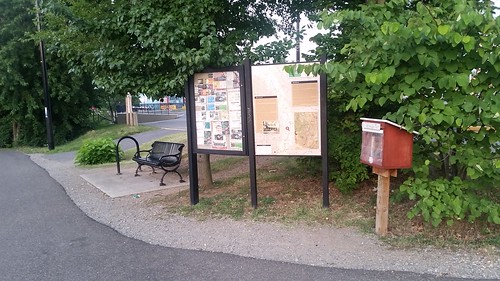
There is a community information board (and a Little Free Library) at the Rhode Island Metrorail Station "trailhead" on the Metropolitan Branch Trail, and a neighborhood association occasionally posts yard sign meeting notices at the R Street "trailhead," but these are exceptions.
Map sign, bulletin board and Little Free Library at the Rhode Island Avenue pedestrian bridge trailhead, Metropolitan Branch Trail
I think this is the only bulletin board placed on a DC bike trail.

This weekend I noticed that the "Bike to the Beach" fundraising event posted signs promoting the event on various trails and cycletracks throughout the city.  I thought that was pretty smart, a well-targeted way to reach potential participants.

It reinforced the idea of the need for more systematic delivery of cycling-related information along bikeways, besides counters, and maybe digital information systems can be integrated into bike counter kiosks as one method.

A feed could be created as part of local and metropolitan bicycle planning, besides government agencies, it could include info from bicycle organizations and publications like the regional Spokes Magazine for the bicycling community, even ads (to help fund it).

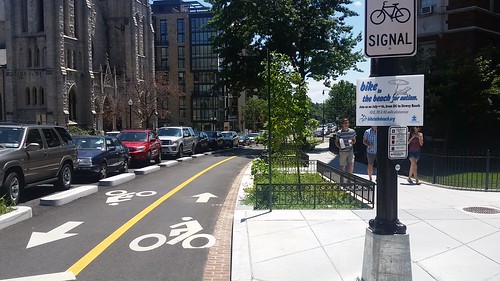
15th Street Cycletrack between V and W Streets
15th Street Cycletrack between V and W Streets NW

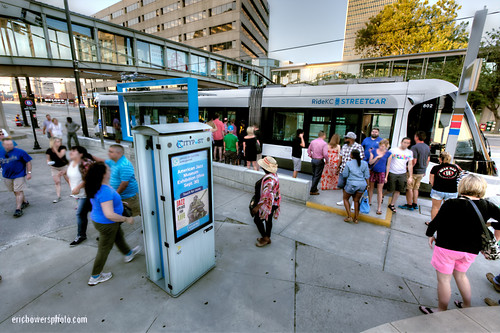
Kansas City Streetcar Stop with Smart City Post Kiosks
Kansas City Streetcar Stop with Smart City Post Kiosks.  Flickr photo by Eric Bowers.

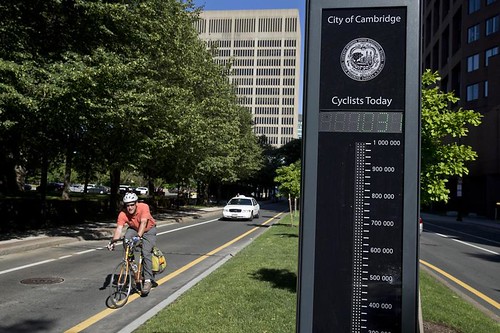
Bicycle counter, Cambridge, Massachusetts
Bicycle counter, Broadway Street, Cambridge, Massachusetts.  Photo by Michael Lee, Boston Globe.  Why not make this a kiosk incorporating biking related notices and information?

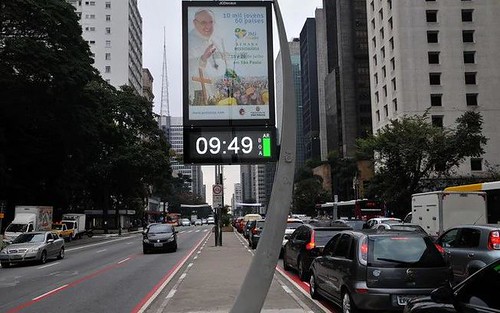
I noticed from images that on a cycletrack in Sao Paulo they have digital advertising kiosks.
Digital ad signage on Avenida Paulist ciclovia/cycletrack, Sao Paulo
Digital ad signage on Avenida Paulist ciclovia/cycletrack, Sao Paulo.

Labels: , , , ,

Wednesday, December 08, 2010

DC is #51! (on tax subsidy disclosure)

Good Jobs First released a study comparing the 50 states plus the District of Columbia on online disclosure of information concerning companies receiving state and local tax breaks, cash grants and other subsidies for job creation. From the press release:

• Thirty-seven states provide online recipient disclosure for at least one key subsidy program.
• Based on our scoring system, the states with the best averages across their programs are: Illinois (82), Wisconsin (71), North Carolina (69) and Ohio (66).
• Thirteen states and the District of Columbia currently have no disclosure at all, although one of those states, Massachusetts, is slated to come online as enacted legislation takes effect. All our scoring is based on what was available online as of November 26, 2010.
• Since 2005, half a dozen states have enacted legislation mandating subsidy recipient reporting in one or more program, the most recent being Massachusetts. Several other states have moved toward transparency through administrative action alone.
• Four states provide recipient reporting for all the key programs we examined: Missouri, North Carolina, Ohio, and Wisconsin.
• Of the 245 programs we examined, 104 of them (42 percent) have online recipient reporting.


Maryland tied for 18th ("Maryland ranks poorly for tracking tax breaks" from the Baltimore Business Journal and Virginia tied for 25th.

DC and 13 other states have no requirements for disclosure.

-- full report
-- press release
-- DC appendices

Too often the city gets credit for online initiatives like website redesign and various Web 2.0 applications, while substantive failures to provide information (like this) more generally, or respond to FOIAs, isn't discussed all that much.

Labels: , , ,

Friday, June 27, 2008

Web design in government

Is it just me or is this website (NYC Department of Transportation) better than this website (DC Department of Transportation)? To make it clear I define "better" as "more attractive," "easier to use," and "easier to read."

I did talk to DC's CTO a couple weeks ago at a meeting, and mentioned to him my concern that the DC Government website's focus on commonality of design and presentation across all of the agencies makes it difficult to deliver different experiences to different audiences, reducing the overall effectiveness of the government at the expense of a common design on the website.

He mentioned that the DC Government website is undergoing a major redesign and should relaunch in the fall.

Labels: ,

Saturday, April 19, 2008

Montgomery County Planning Department blog

The Montgomery County division of the Maryland National Capital Park and Planning Commission has created a blog, The Home Stretch, devoted to "the Housing Policy Element of the General [land use] Plan" for the County.

The site includes downloads of past "Excellence in Planning" sessions sponsored by the Planning Department. It happens that the sessions, always with great speakers, seem to be scheduled so that I can never make them.

Check out:

-- Carrying Coals to Newcastle: How USA's Best Housing Policies Might Get Better
-- With or Without Design Review
-- Housing Policy Element of the General Plan.

Arlington County, as we know, also does a great job with the web on its transportation side. Check out the CommuterPage and the Commuter Page blog.

I wish that DC Government would get away from the idea of one master website design and tight control over the interface and specific way that information is communicated within the web.

First, agencies have different audiences. As I write ad infinitum, Lauffer wrote that nonprofits have three publics:

-- the input public provides resources;
-- the throughput public does the work (staff, advocates, fellow travelers);
-- the output public is to whom the agency's work is directed.

Different publics have different needs. You can't fit all those needs into one specific and regimented system of information architecture and display. DCG proves it.

Compare the DC DDOT website to the San Francicso Municipal Transportation Agency or to Transport for London. Granted, the other agencies have both transit delivery and broader transportation functions. But they provide information by transportation mode for both the output, input, and throughput publics. But the focus is on the end user (transit rider, pedestrian, bicyclist) interested in getting around. It's the rare person (like me) who wants to find all the reports and publications and news releases...

Labels: , , ,

Friday, August 10, 2007

Speaking of Web 2.0 and mobile communications technologies

The Blog de Viajes lists this book as one to read. More for the impossibly long list of books to read...

MOBILE TECHNOLOGIES OF THE CITY (Networked Cities)
Many aspects of economic and social life are increasingly conducted "on the move" or away from "home." Modern technologies make it possible to be mobile and connected at the same time. Mobile communications technologies are playing an increasingly important part in the world today. At the same time urban transportation and surveillance systems are also being rebuilt and updated. Notions of mobility are changing and influencing patterns of movement, co-presence, social exclusion and security across many urban contexts.

In Mobile Technologies of the City Mimi Sheller and John Urry bring together a carefully selected group of innovative case studies which trace the emergence both of the new socio-technical practices of the city and of a new theoretical paradigm for mobilities research. The case studies on Vienna, Liverpool, Bristol, London, Tokyo, Paris, Los Angeles and Hong Kong, range across media, including guidebooks, web sites, train schedules, WI-FI, cinema, mobile phones, and mobile gaming, encompassing infrastructures such as road and rail systems, airline networks and hubs, internet routers and wireless "hot spots." The case studies also focus on urban sites including streets, train platforms, bus stops, airports, internet cafes, park-benches and cars.

Mobile Technologies of the City contributes new theoretical perspectives on mobility, communication and security in a world full of easily available access to physical mobilities and communication technologies

Labels: , ,

The Government needs to get with Web 2.0

This article in the New York Times, "In a Crisis, Subway Riders Get Little Guidance," discusses how the NYC subway system lacks good information systems to deliver messages about problems, and that the website gets overwhelmed when problems occur.

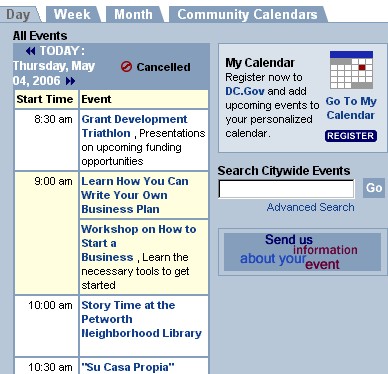
Last year, I suggested that the DC Government set up its calendaring system so that other websites could feed it too--just as how the Google or Upcoming Calendars work. See "An idea to make the DC.gov Calendar more widely available."
Partial screenshot, DC Government Calendar
Feed me...

Similarly, the WMATA trip planner could be fed to other websites in the same fashion. (I suggested this to WMATA last year also.)

And the same with notices about system status.

This accomplishes multiple objectives: greater spread of information, usage, and redundancy.

Labels: ,