Rebuilding Place in the Urban Space

"A community’s physical form, rather than its land uses, is its most intrinsic and enduring characteristic." [Katz, EPA] This blog focuses on place and placemaking and all that makes it work--historic preservation, urban design, transportation, asset-based community development, arts & cultural development, commercial district revitalization, tourism & destination development, and quality of life advocacy--along with doses of civic engagement and good governance watchdogging.

Sunday, May 18, 2025

Costly failures in the mental health system | Chicago Sun-Times

The Chicago Sun-Times has a six part series of article on structural failure in the provision of mental health care in Illinois, which often has dire consequences:

To try to understand the reasons behind a spate of shocking crimes in downtown Chicago between 2021 and 2024, the Chicago Sun-Times examined four unprovoked killings and two nonfatal attacks, including a bizarre assault on a flight attendant from Mexico. Most of the attacks happened during the day. The victims: people who were just going about their lives. I 
n each case, the people charged — three who’ve been convicted — had a history of serious mental illness or delusional behavior and had drifted in and out of jails and hospitals, sometimes for decades, their conditions never regularly treated. 
Reporters pored over thousands of pages of police reports and court records, went to court hearings for a year for those who were charged, and interviewed family members, mental health experts, law enforcement authorities and government officials. 
What emerged most clearly from this reporting is that there is no system in Chicago to identify — let alone to help — the small percentage of severely mentally ill and violent people who commit these crimes. In each of these cases, it was only when they have been accused of murder or some other terrible crime that they were put on regular mental health medication — a finding that experts say is troubling but not surprising.

I realize in my series of articles on a more ideal health and wellness care system, there needs to be a separate article on mental health care, which is both a health and wellness care issue, as well as one of public safety.


========

"Failure to treat, failure to project," main homepage, Chicago Sun-Times series on mental health care issues


From article 5:
  • There’s no single entity overseeing the mental health care system in Chicago. That means, for instance, that homeless patients discharged from private hospitals might be given a bottle of medication and told to follow up at a clinic without what experts say should be a “warm handoff” to a treatment provider.
  • Even though people experiencing homelessness and severe mental illness are more likely to become victims than perpetrators of crime, a small but visible number of them repeatedly cycles through the criminal legal system.
  • With only about 1,200 state psychiatric beds in Illinois, he says more funding for community mental health would allow people who don’t need 24/7 hospitalization to leave state mental hospitals — meaning hospital spots could go to people in even greater need.
  • But replacing long stays at state mental hospitals like the one in Elgin with comprehensive outpatient treatment would require a radical shift in thinking — away from retribution and toward treatment aimed at reducing suffering.
  • It also would require supporting mechanisms that largely don’t exist, like providing housing for homeless people who have severe mental illness so they can be reached by medical and social service providers.
  • “If the person who doesn’t get decent services commits a crime, now we have a crime victim, and that’s a cost,” he says. “And we have the cost of prosecuting her or him, and that’s a cost. And who’s paying for that?”
  • Illinois spent an average of $49,271 on each person in prison in 2024, far more expensive than the cost of so-called wraparound services to keep people in treatment. The two biggest Chicago social service providers pegged these intensive services at $15,000 to $35,000 per client per year, depending on the person’s needs — which is as much as 70% less expensive than incarceration.
  • Ideally, Antholt says, when mentally ill people are arrested, they’d get help before their release with housing, employment, disability services and mental health treatment, which currently exist in “very siloed” systems.
  • ... He says the “magic bullet” for solving the problem is a “very good use of resources up front instead of very expensive institutionalization” because “the cost of prison and jails and hospitals and ERs is very expensive, and we can’t afford this in the long run.”
  • ... She says that, when she went to the Elgin hospital to ask about her missing brother, she was told, “ ‘Oh, we’re not responsible. Once he’s released, our responsibility is just to drop them off. We don’t have to walk them into the actual shelter.’ ”
Some exemplary programs 

Nonprofit providers say they’re doing their best to keep people healthy and out of the criminal legal system. 
Some, including the largest in Chicago, Thresholds, run “Assertive Community Treatment,” or ACT, teams, providing intensive wraparound services to people with severe mental illness. The teams meet people as they’re being discharged from hospitals and take them home, get their prescriptions filled, make sure they have food, connect them with psychiatrists and work out immediate transportation needs.

Labels: , , , , , ,

Tuesday, April 15, 2025

The new Cedar Hill Regional Hospital opens in Southeast DC

Aneathia Brown, 25, poses for a portrait with her daughter Angel, 4, outside of Cedar Hill Regional Medical Center GW Health in Southeast Washington on April 15. (Craig Hudson/For the Washington Post)

See "When minutes matter: A community finally gets the trauma center it needs," Washington Post.

Planning for the new hospital there led me to write a series of articles and follow ups on how the city could do a lot more than merely open a rote hospital.  Although one of the architectural firms involved begs to differ with my take ("Cedar Hill Regional Medical Center GW Health: A model for community-centered-healthcare design/," HOK)

One of the examples I mentioned of a facility proposal offering more to the community, is St. Anthony Hospital in Chicago, which just moved forward on creating a hospital campus with a variety of community serving facilities ("St. Anthony finally moves forward on building new hospital in Little Village," Crain's Chicago Business, "Saint Anthony plans big for southwest Chicago campus," Catholic Health WorldSt. Anthony Community Health Needs Assessment).

From the second article:

Besides the hospital, the campus will have affordable housing, an outpatient clinic, educational centers for children and adults, a recreation center, athletics fields and green space, a venue for private events and retail shops. 

The building site is 1.5 miles from the 126-year-old Saint Anthony Hospital, a Catholic nonprofit facility unaffiliated with a larger system. The new campus and the existing hospital are in a section of the city largely populated by working-class or impoverished families, many of them Black, Hispanic or Asian and many of them immigrants.

... The size and plans for the Focal Point campus grew in the many years since it was first envisioned. Medaglia and Sifuentes say that is a result of input from residents of the surrounding neighborhoods. At forums that Saint Anthony hosted about the project, residents said they wanted not just quality health care but childcare, programs to keep kids off the streets, vocational training and more.

"That's how we realized that the initial 11 acres that the city was going to sell us was really not enough," Medaglia says. It also became clear that those programs couldn't be financed on hospital revenue alone, which comes mostly from Medicaid and other public insurance programs. 

I outlined a similar program for some facilities in Salt Lake County ("Hospitals as urban anchors/revitalization levers, not usually, but with great potential to serve communities in important ways: Examples are two forthcoming projects by Intermountain Health and University of Utah Health").  

WRT Intermountain in Downtown, the city's planning processes gave them no leverage to try to do anything.  For example, I suggested that the needs to be replaced Central City Recreation Center could be incorporated.

Profits versus community grants.  Some of the comments on this Post article, "Residents welcome new hospital in Southeast D.C.: ‘We need this’," criticized DC for picking a for profit hospital chain, Universal Health Services, to run the Cedar Hill.  I would have felt the same way before my myriad hospital stays, but my primary hospital is run by HCA, and they do okay.  Although they drop services that are in need, like nutrition counseling and diabetes management, that aren't profitable.

HCA doesn't do much in the way of benevolence.  Making a profit is key and that is repatriated to headquarters.

An interesting element of the St. Anthony project is that they say they will direct "profits" to community grants.

Seeding grassroots programs Once the campus is in full operation, Medaglia says the financial plan shows it will generate $7 million more than needed to cover costs every year. He adds that the extra funds will be awarded in grants to not-for-profit organizations serving the surrounding community. 

Sifuentes says that is one way the campus will be transformational to the approximately 440,000 people who live within its service area. The grants will be a reliable source of funding for the many church and community organizations that address food and housing insecurity and other social issues that affect health and well-being.

Labels: , , , , ,

Friday, January 05, 2024

Big omission in blog series on advance hospital/health and wellness planning, public health planning: addiction services

The Denver Post has just published a four-part series on the cost of alcohol-related deaths in the state.

From the article:
Part 1: Colorado alcohol deaths surged 60% in 4 years, but there’s been no public outcry or push to save lives Coloradans die from the effects of alcohol at one of the highest rates in the country, but, in comparison to fentanyl, the state’s reaction has been a shrug. Legislators haven’t seriously considered measures to discourage drinking, and voters expanded access to alcohol in grocery stores. 

Part 2: Colorado has some of the lowest alcohol taxes and highest drinking deaths. That’s no coincidence, experts say. Experts say raising state alcohol taxes also would make more money available for programs aimed at preventing unhealthy drinking and to enforce the state’s liquor laws. Currently, the department charged with regulating Colorado’s alcohol outlets can’t afford to fill all its open positions. 

Part 3: Beer and wine became more widely available in Colorado even as drinking deaths rose. Five years ago, a workgroup tasked with finding ways to reduce Colorado’s rate of drinking-related deaths issued a simple recommendation: cut back on when and where people can buy alcohol. Since then, however, the state has only expanded access to alcohol.

Part 4: Alcohol addiction treatment is available in Colorado, but people struggle to get the help they need. Despite the availability of addiction programs, people who are concerned about their own drinking or a loved one’s don’t always know where to turn. Treatment options may not meet patients’ preferences, aren’t easily accessible in certain parts of the state, or don’t necessarily accept all forms of insurance, including Medicare and Medicaid. 

From the first article:

Alcohol killed 1,547 people statewide in 2022 — fewer than the 1,799 who died of overdoses. 

This table from the first article lists the leading causes of death in Colorado as of 2022.  It didn't list the 387 murders, nor 754 traffic fatalities statewide that year.

We think of murder rates as high, and yet traffic- related deaths tend to be much higher.  

But these numbers are significantly eclipsed by addiction related deaths, and deaths from disease, including chronic health conditions.

One of the interesting points in the first article is how alcohol increases inflammation, and inflammation is an accelerator of many health problems.  Inflammation over all isn't countered by the benefits of antioxidants in wine.

In the article on addiction services, it took me a long time to recognize and they don't exactly emphasize it, is that failure is part of the process, that it likely takes people more than one attempt to succeed.  

The article discusses how health insurance is supposed to cover addiction treatment equal to other elements, and when in-network services aren't available, people are supposed to have insurance cover out of network services.  It also discusses how traditional 12-step and similar programs don't work for a lot of people, and prescription drug support that can reduce cravings often isn't available.

====
In 2017 I wrote a bunch of articles, and then some follow ups, on broader health, wellness and public health planning and programming that could be integrated into a hospital complex and more broadly across the community, given DC's commitment to build a new hospital to replace the United Medical Center (formerly Greater Southwest Hospital) in Ward 7, "East of the River."  

Oh, DC isn't really doing this, although the city does have a good commitment to health insurance coverage access, and support for community health clinics.  In addition the city is adding more clinics, I can't remember exactly how, to Wards 7 and 8.  Some are affiliated with the new hospital ("Mayor Bowser Celebrates the Topping Out of Cedar Hill Regional Medical Center GW Health on the St. Elizabeths East Campus," press release).


In 2020, with onset of covid I wrote two related articles about gaps in the original series in terms of disaster planning, including pandemics/epidemics and public health:


And there are two articles relevant to the second article on creating a graduate health and biotechnology research initiative:


And one last year, applying these concepts to two hospital projects in Salt Lake City and West Valley City here in Utah.

DC is worse than Colorado  |  Writing biases reflect "lived experience": failure to mention the need for expanded addiction treatment services as a public health measure.  I drink very little, especially now, and I don't use illegal drugs.  E.g., I haven't touched marijuana in about 30 years.  

So it's unfortunate, given that DC's overdose deaths and alcohol deaths in DC are actually worse than Colorado, the focus of the Denver Post series--if Colorado had DC's rate of alcohol deaths, it would be close to 2,100 deaths, almost 50% higher that it is, that I didn't mention specialized and expanded addiction treatment services as part of a broader health, wellness, and public health approach for what is now being called the Cedar Hill Regional Medical Center.  

Sure part of that is captured indirectly in how the series focuses on addressing chronic medical conditions.  But it's also ironic in that my first DC job was for a public health related group, which had an alcohol policies project, and for awhile a program on Hispanic health which included a focus on tobacco consumption.  (For the most part the group didn't focus on tobacco because it was and is covered so well by other organizations.)

Since all those articles, I do update them with relevant programs and information I come across in the comments, and addiction treatment programs were mentioned there.  But it's a major oversight in a city like DC, where addiction is high, for example 461 opioid-related overdose deaths in 2022.  With a minimum estimated number of 311 alcohol-related deaths, based on the imputed rate by an NIH related institute and the total adult population.  Colorado has an adult population 6.67x greater than that of DC.

In the next iteration of the main article, e.g., the last iteration was on Utah, I will be sure to add addiction treatment services to the main set of programs.

=====
An article in the Guardian mentions public health as an economic development lever  ("his article is more than 11 months old Without health there is no wealth. Why do so few governments understand this?"), in an article on the failures of the National Health Service there to keep up with demand, especially as Tory austerity has resulted in significantly poorer health outcomes and premature deaths on the part of a significant proportion of the population ("Austerity blamed for life expectancy stalling for first time in century") even before covid.

Labels: , , , , ,

Thursday, March 30, 2023

Hospitals as urban anchors/revitalization levers, not usually, but with great potential to serve communities in important ways: Examples are two forthcoming projects by Intermountain Health and University of Utah Health

I have an extensive series of pieces about how DC could have used the reconstruction of a hospital East of the River to create a world class community and public health centric hospital with a complementary medical education and biotechnology research and development initiative.  

-- "Ordinary versus Extraordinary Planning around the rebuilding of the United Medical Center in Southeast Washington DC | Part One: Rearticulating the system of health and wellness care East of the River," 2018
-- "Part Two: Creating a graduate health and biotechnology research initiative on the St. Elizabeths campus," 2018
-- "Part three: the potential for donations around an expanded program," 2018
-- "Update on DC's plans to build a new United Medical Center," 2018

I argue that "a building" isn't enough, you have to have a plan to address health inequities in innovative and novel ways.  Plan + program + building.  

And ideally, a "transformational projects action plan" approach to boot.

This set of articles is a bit broader, more about integrating health and wellness planning and hospitals.

-- "Health planning vs. hospital planning redux," 2006
-- "Piling on the hospital issue," 2006
-- "An opportunity for rethinking health and wellness care in the District of Columbia," 2006
-- "Speaking of rethinking how to offer "public services" and medical care," 2007
-- "Community Health Improvement Planning," 2019
-- "A glaring illustration of the need for comprehensive health and wellness planning in DC: Providence Hospital," 2018
-- "More communities need to integrate health care and public health programming: Prince George's County, DC, etc.," 2020
-- "Rush Medical Center (Chicago) clues us into a gap in state and regional health care planning: planning for disaster and epidemic response," 2020

Even though DC has failed to think big about the new East of the River hospital, that doesn't mean these concepts can't be applied elsewhere.

Salt Lake.  Both Intermountain Health ("Intermountain Health says it wants planned urban hospital to be 'an anchor' in Salt Lake City," KSL-TV) and University of Utah Health ("Here’s the latest on that big hospital coming to WVC — and why it differs from other U. centers," Salt Lake Tribune) are building new hospitals, the former in Central Salt Lake City, the latter in West Valley City to the west of Salt Lake.

The Intermountain hospital will replace a neighborhood-embedded hospital a couple miles away that isn't centrally located and is hard to get to.  The WVC facility for Utah Health will be its first foray into a secondary facility that functions as a hospital.  While they have lots of clinics in the region, Utah Health hasn't bought other hospitals throughout the state the way that other university-affiliated health care systems have in other states.

Both say they want the facilities to be community centric, good neighbors, contribute to the community, etc.  Utah Health say they want the WVC facility to promote jobs and educational opportunities for the Valley's west side.  From the second article:

The goals of the future hospital, he said, are to provide meaningful economic impact to the west side by employing residents who live near the facility, and to improve the health of a city that faces lower life expectancy and higher rates of serious conditions compared with the overall county.

The $800 million complex at 3750 S. 5600 West also represents a chance, Randall said, for the U. to dramatically diversify its workforce.

“If we’re going to have societal impact,” he said, “we have to be engaged in the communities and help them achieve their desires and dreams.”

Revitalization effect, not much.  Financial and employment engines, yes.  The thing is that hospitals, except when they are embedded in neighborhoods--and that's with a big maybe--don't have a lot to offer to revitalization efforts.  Their main effects are financial and as large employers. 

Hospitals are internally focused.  Workers don't have time to eat or shop off campus.  Both patients and visitors are focused on the task at hand, not spending time off campus.  The buildings are big, with lots of employees.  They aren't permeable.  There can be a lot of parking.

I became more focused on this when I was doing some consulting in Pittsburgh.  Allegheny Hospital is a big player in the Northside neighborhood, and West Penn Hospital, affiliated with Allegheny, is located on the main street of the Bloomfield commercial district.  

At the time the Children's Hospital of Pittsburgh was building a new facility in Lawrenceville and everyone was touting its potential for revitalization benefits ("Big move: The new Children's Hospital already has an impact," Pittsburgh Post-Gazette).

But neither the Northside and Bloomfield facilities contributed spillover benefits to business district or neighborhood improvement in substantive ways, at least as customer generators.  And UPMC CHOP is located away from Lawrenceville's commercial centers.

Architecture is tough when you design for the car.  Inga Saffron of the Philadelphia Inquirer makes the point that because hospital planning is in large part focused on accommodating cars in parking, etc., providing high quality people spaces within a hospital complex becomes very difficult ("Penn’s new hospital belatedly recognizes pedestrian space is a public health issue").

Relatedly, in 2008, Saffron wrote that the city's newest hospital building was designed for the suburbs, not the city ("Penn got a trophy, not a triumph, in hospital design").  From the article:

After all the promises we heard about how the Perelman Center for Advanced Medicine would bring order to the university's congested hospital district and help forge a more pedestrian-friendly environment, it's hugely disappointing to see that the results are no better than any of the previous trophy medical buildings along Civic Center Boulevard. The Big Driveway rules again.

Perhaps the architects, Rafael Vinoly and Perkins Eastman, were under the mistaken impression they were designing for a suburban office park, rather than a busy West Philadelphia corner. Looking at their contorted hybrid, which pairs a banal low-rise, ribbon-window structure with a towering cube of slick glass, you have the feeling you're witnessing the architectural equivalent of a car crash.

If the screech of incompatible materials and forms isn't dissonant enough, just try walking up to the front door. Instead of a gracious, approachable welcome, we get curlicues of driveway ramps and "Don't Go There"-style planting beds. Pedestrians will have to play dodgeball with cars as they make their way past the building.

Transit adjacency is a plus for employee transportation.  One reason to locate hospitals at high capacity transit stations, is because of there being so many employees. But I haven't seen a good transportation demand management study of hospital workers trip to work.  (In the DC area, the Coalition for Smart Growth was a big proponent of the new Prince George's County Hospital being located at the Largo Metrorail Station, which it was.  But I argued all along that while that was important, it wouldn't have the revitalization impact they touted.)

University of Utah Hospitals have two light rail stops, but the complementary university bus shuttle system needs to be more tightly integrated, at least for the medical campus, to make it easier, especially for patients, to get to health facilities located some distance away from the transit stations.

HealthLine in Cleveland.

In Cleveland, health institutions supported the development of the HealthLine (the name was chosen based on financial sponsorship), a bus rapid transit line serving a number of neighborhoods, including the University Circle district and Cleveland Clinic and the University Hospital system and Downtown.

Hospitals can be strong supporters of community development efforts, but it has to be designed into the program from the outset.  FWIW, Allegheny Hospital in particular is a best practice example in their support of local community development corporations, providing grants to staff towards housing purchases near the hospital, which extends to West Penn in Bloomfield, etc.  

In Philadelphia, Frankford Hospital and Penn Hospitals contribute to local business improvement districts, Penn being a major player in the University City District there.

And some hospitals are refocusing some of their purchasing on local businesses, thereby strengthening the local economy ("When a Steady Paycheck Is Good Medicine" New York Times).

Nationwide Children's Hospital in Columbus ("When a Hospital Plays Housing Developer," CityLab) is leading a neighborhood revitalization effort, probably out of necessity, to preserve the value of its location and the willingness of people with choices to continue to patronize them. 

MetroHealth in Cleveland is doing something similar ("MetroHealth’s new $759 million Glick Center opens Nov. 5, signaling a new era of healthcare," Cleveland Plain Dealer).  They call it "hospital in a park" but Inga Saffron might differ?

In August [2022], the hospital system opened its affordable housing project Vía Sana in Cleveland’s Clark-Fulton neighborhood. Vía Sana – meaning “healthy way” in Spanish -- is the first $15 million investment in MetroHealth’s $60 million mixed-use development aimed at improving both the physical and economic health of the community adjacent to its main campus. ...

Construction of the new $140 million outpatient care facility and administrative building, called the Apex Project, began last year. delivers on MetroHealth’s promise to turn its main campus into a “hospital in a park” and to create a more welcoming neighborhood. The Apex Project includes renovation of the hospital’s Rammelkamp Center for Education and Research and a 700-car parking garage for patients and visitors.

A couple hospitals, like Bon Secours in Baltimore have developed housing to support out-of-hospital patient care and healthy communities.

The potential exception: hospitals that are more neighborhood-embedded.  The current LDS Hospital is in The Avenues neighborhood, less well connected to the city at large.  Theoretically, because it is neighborhood embedded, it could provide more neighborhood-focused services, but I don't think it does.

St. Anthony Hospital, Chicago has proposed (they haven't actually done it) a new hospital in a low income area, Lawndale, with community facilities like wellness and recreation facilities built into the campus

From "Chicago safety-net hospitals face uncertain future amid changes to health care system: Area has 20 safety-net hospitals, which are a stop-gap medical system for the poor" in the Chicago Tribune:

When now-CEO Guy Medaglia arrived as a consultant in 2007, the 151-bed hospital was losing millions of dollars annually. Medaglia was tasked by its then owner, Ascension Health, with closing or selling it.

Instead, he emboldened the hospital's board to break away from the chain in 2009 and become independent.  Despite that commercial insurance covers fewer than 1 percent of its patients, St. Anthony has posted operating income nearly every year since.

St. Anthony embarked on its turnaround after assessing the needs of its community and tailoring its services to match. It now functions as a de facto community hub, teaching language classes and hosting courses for people studying to take high-school equivalency tests. It also added health services like dialysis and occupational health and expanded its infusion, pediatric and maternal centers.

"If you're doing what the community needs, you become very valuable to them," Medaglia said. "And to continue to serve them, you really have to think out of the box. You have to think: What can we do that's different, that can service this community at a lower cost and higher quality?"

St. Anthony is pushing forward with plans to build a 1 million-square-foot commercial development at 31st Street and Kedzie Avenue anchored by a 100-bed replacement hospital.

The $430 million Focal Point [Community Campus] development is slated to be built on 11 acres acquired from the city for $1 by a nonprofit affiliated with St. Anthony. The complex is set to include two schools, retail stores, a child-care center, an indoor recreation facility and an athletic field.

How to make a hospital a hub.  The point about the hospital as a community hub makes more sense in a neighborhood where the hospital is more integral and central and where they aim to develop and strengthen hub opportunities.  

The new Intermountain Hospital on the edge of Salt Lake's downtown won't be part of a residential area, but it could offer specialty urban health care programming.  Similarly the University of Utah West Valley Hospital could take its cue from St. Anthony and other programs listed below.

Potential urban health functions at Intermountain. Here are some examples that Intermountain could consider incorporating as a way to provide specially focused services to urban populations.

Church Health, Memphis.  Rather than from a hospital setting like what St. Anthony intends in Chicago, Church Health, an organization founded by churches, provides care to the uninsured in a clinic setting, although they have a comparable and expansive mission.

Services include medical, dental ("Church Health dentists improve patients' smiles, life prospects," Memphis Commercial Appeal), eye, family care and pediatrics, behavioral health, physical therapy, and pharmacy. 

Last year it moved into a consolidated facility of 150,000 s.f.  ("Just what Church Health will do with all its Midtown buildings," MCA; "Church Health Center rebrands in preparation for Crosstown Concourse move," Memphis Business Journal; "Holistic Healthcare for Medically Uninsured: The Church Health Center of Memphis," Ethnicity & Disease Journal).

Wellness programs, also delivered off-site to local churches, include a 25,000 s.f. YMCA facility ("New Church Health Center YMCA opens in Crosstown," MCA) adjacent to the consolidated clinics at Crosstown Concourse Center in Downtown Memphis, which is the adaptive reuse of a former Sears Department Store and catalog distribution center, and a food and nutrition program ("Church Health's Memphis Teaching Kitchen Promotes Healthy Bodies and Communities," Parade Magazine).

HealthOnBroadway: El Rio Community Health Center and Tucson Medical Center.  HealthOn Tucson is a joint program of the community health program and the city's major medical hospital ("New downtown Tucson health clinic offers a different patient experience," Arizona Daily Star).

Not unlike "urgent care clinics" and clinic operations in pharmacies like Walgreen's and CVS, their first venture is the creation of a community wellness and "emergency care center" on Broadway Avenue in Downtown Tucson.  The facility is open six days/week, most nights til 9 pm, and is highly visible. According to the article, these are innovations implemented in the center:

-- high quality and modern design (Photos: BWS Architects)
-- self check-in
-- "Dialogue rooms" where people can talk to health care providers without being in an exam room
-- on site classes, including a conference room that doubles as an exercise room
-- health coaches
-- online appointment booking, including the use of virtual applications functioning like telemedicine
-- hours beyond office hours.

But the facility is more than just a place to drop in for a flu shot, as they have a broader focus on working with the patient over time such as with health coaches, offering free wellness programming, etc. 

University of Houston College of Medicine Direct Primary Care Clinic ("Monthly subscription for low-cost healthcare is now available through University of Houston clinic," KHOU-TV).  This clinic is offering low cost basic health care access to people who couldn't otherwise afford it, for $60 per month.
Houston has the highest rate of uninsured residents in the nation, according to a press release from UH.

Startup costs for the pilot clinic were funded by a $1 million gift from The Cullen Trust for Health Care.

In Fort Worth, Texas ("His insulin would have been $1,000 per month. At Fort Worth hospital, he pays $10," Fort Worth Star-Telegram) the Texas Resources Hospital system has a program operating in 9 hospitals, to provide focused care of chronic health conditions for the uninsured.  

The initiative, the Healthy Education Lifestyles Program, offers low-cost health care to anyone 18 and older who is uninsured and has diabetes, hypertension, high cholesterol or congestive heart failure. For $10 a month, patients get a monthly check-up from a nurse or other health care provider, education on how to manage their disease, and help navigating the complex health system to find prescriptions that are affordable.

Continuum of care programs (relevant to both).  "Penn receives record $125 million to offer free tuition to nurse practitioners to work in underserved communities." Philadelphia Inquirer.

Jackson County Michigan has a "community integrated paramedicine" program where EMS personnel are utilized as a way to provide "continuity of care" between hospital release and home, with the aim of increasing care compliance and reducing readmissions.  Regions Hospital in Minnesota also has a community paramedicine program.

Potential community hub functions at West Valley: Social determinants of health.   The basic idea is addressing what are called the "social determinants of health" ("An Effective Way to Tackle the Social Causes of Poor Health," Harvard Business Review).  According to the St. David's Healthcare system in Austin, Texas:

20% of health care outcomes to do with access to care; the other 80% dependent on family structure, where you live, access to food, parks, etc.

I don't know much about the West Valley City location that University Health is building on.  But through the University Neighborhood Partners program ("University of Utah University Neighborhood Partners program and community revitalization in West side Salt Lake City/County") the University of Utah is focusing on that part of the Valley.

I do think that they should study carefully the St. Anthony Focal Point Community Campus initiative.  And there are other examples listed below.  These kinds of programs could be great components of a community health outreach initiative on the west side.

 
Latino Health Access, Orange County, California.   Focused on providing health care to the Latino community, which has traditionally been underserved, the organization focuses on education, prevention and participation, training a cadre--many thousands over the years--of paraprofessionals and volunteers working in and already part of the community, to deliver health education, focused on chronic diseases, such as diabetes.

The organization was featured in a four-part HBO documentary “The Weight of the Nation,” on addressing obesity.

The organization sponsors an annual health walk, has built a park and community center in an impoverished neighborhood that lacked such facilities ("Residents Bring First-Ever Park to California’s 92701 Zip Code," Salud America!), and the organization's main clinic has a community room with space for exercise classes, fitness equipment, and space, a "Youth Room," for adolescents.

LHA has published a workbook, Recruiting the Heart, Training the Brain: The Work of Latino Health Access, discussing what they do, how they built the organization, and their care model.

Other programs.  As part of medical school programming, Columbia University has opened the "Community Wellness Center" in Upper Manhattan which provides health services, and some free services, and also "trains residents of Harlem and the surrounding area to serve as community health advocates."

But outside of certain screenings, like for blood pressure and cholesterol, they don't provide medical services.

Share Cancer Support, a Manhattan-based breast- and ovarian-cancer nonprofit, has an African-American Ambassador program providing education and training sessions in communities of color ("A cancer survivor does outreach in communities of color," Crain's New York Business)

3rd Street Youth Center and Clinic in the Bayview Hunters Point neighborhood, San Francisco, offers an interesting ladder of programming to develop youth self-knowledge about health issues.  And a year long program involving various institutions introducing youth to health careers.

Mental Health Center of Denver in the Park Hill neighborhood will marry a family health clinic with farm and greenhouse. The overall redevelopment of a shopping center site includes senior housing, affordable housing, and a family health clinic. The Mental Health clinic will include a community space, community gym facility, teaching kitchen, and dental clinic also ("Community input shaped new mental health clinic in Denver’s Park Hill," Denver Post).

Community engagement facilities.  The University of Maryland Baltimore, a health-focused campus, built a 20,000 s.f. community engagement center in the neighborhood adjacent to its campus ("UMB breaks ground on community center in West Baltimore," Baltimore Business Journal).  From the article:

Programs offered at the new center will include workforce training, a legal clinic, weekly markets with fresh fruits and vegetables, computer access and exercise and yoga classes.

The expanded center will add a new UMB Health Alliance, a faculty and student-led program that will focus on preventative health education for asthma, hypertension, diabetes and mental health. It will also offer academic programs for middle and high school students and house UMB's Police Athletics-Activities League for youth.

Athletic fields are being installed as part of a new health campus in Greater Pittsburgh ("Allegheny Health Network serves notice to its rivals with Coraopolis athletic, outpatient center," PPG).

Sure Start and similar initiativesSure Start centers in the UK have been decimated by the Conservatives, but were created to provide extra services to impoverished families preceding childbirth til 4 years of age ("Sure Start saved NHS millions," Guardian).   

A Boston Globe article, "The ‘fourth trimester’ and plight of new mothers during a pandemic," calls this period the "fourth trimester." 

The Sisters in Birth clinic in Jackson Mississippi, focused on assisting women of color in pregnancy, as black mothers die nearly 3x more often than whites of pregnancy related causes ("Sisters in Birth, Standing by Expecting Mothers," Jackson Free Press).

From the Pittsburgh Post-Gazette story, "Allegheny Health Network launches new effort to tackle Black infant mortality":

In Pittsburgh, Black infants are more than four times as likely than white babies to die before they reach their first birthday.

This grim gap is the reason for a new initiative launched by Allegheny Health Network called First Steps and Beyond. The program aims to monitor the health and well-being of African American parents and their babies through the first year of life by expanding prenatal, perinatal, birthing and fatherhood services to residents. In doing so, it hopes to slash infant mortality of Black babies by at least 28% over the next five years.
Separately, "Leeds only major UK city to see a drop in child obesity," Guardian.  It's attributed to the HENRY program: Health, Exercise, Nutrition for the Really Young.

Finland has a best practice program wrt childhood obesity ("The Fit Children of Seinäjoki," Der Spiegel). 

Reading room.  The Salt Lake County Library system runs a library "reading room" in the South Main Public Health Clinic in Salt Lake City, which serves a predominately low income population. A big element of the service is providing free books to children ("Clinic's reading room making a big difference for low-income kids," KSL-TV)

Some library systems have special health and wellness collections.  Why not create one as part of a community-serving hospital? 

Teaching Kitchens.  The Teaching Kitchen Collaborative supports hospitals and public health clinics offering nutrition and cooking programming.  Boston Hospital has a Teaching Kitchen ("At Boston Medical Center, cooking classes aim to restore health after addiction," AP).

The ProMedica health system in Toledo (1) created the Ebeid Institute for Population Health as a way to serve underserved communities and (2) on the ground floor of the building created a 65000 s.f. "Market on the Green" nonprofit supermarket. A hospital nutritionist does programming, cooking glasses and store tours.  (3) there is a Financial Opportunity Center program too, GED classes, etc.

The workforce development program of Ebeid is integrated with the staffing program for the supermarket.

CVS Health Hub concept.  According to Drug Store News ("CVS Health debuts first Health Hub Location"):

During a ribbon-cutting event at the company's HealthHUB location at 687 Johnson Ferry Rd. in Marietta, Ga. the community celebrated the new, innovative store format that features a broader range of health care services to help patients better manage chronic conditions, more products and services focused on overall health and wellness, and personalized care.

Labels: , , , , ,

Monday, January 24, 2022

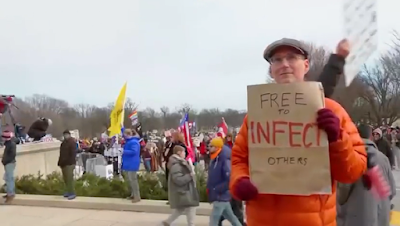
At the end of the day, this is what anti-vaxxing is all about


This is a screen grab from a Reuters video on Sunday's anti-vaccination protest in Washington, DC, on Sunday January 23, 2022 (video embedded within this article, "Anti-vaccine activists march in D.C. — a city that mandates coronavirus vaccination — to protest mandates," Washington Post).

I am unable to fathom how vaccination became a political issue and one of individual libertarianism.  Government's duty to protect the public health is one of the most basic functions of government.

I call the attitude of this protester "anarcholibertarianism" -- it joins anarchism, neoliberalism (pro market, anti government), and libertarianism not into a philosophy, but an attitude.

I hate to admit that recently I finally downloaded the Reddit app just so I could read r/HermanCainAward postings--people who filled their social media feeds with anti-vax, pro-conservative, anti-Democrat memes who then come down with covid and eventually die.

It's incredibly ironic to me that people believe they have "more control" from not being vaccinated, when in fact this makes them more vulnerable to sickness, health problems, and death.

For all the people who say -- "only 2% of people with covid die," what about the 25% of survivors who end up with long term medical conditions that they didn't have before, and the higher rate of death within one year of "recovery."

In "the old days" it was common for center city hospitals to have more than 1,000 patient beds.  Granted it's not in the center city, but the new PG Hospital in Largo -- the University of Maryland Medical Services Capital Region Medical Center -- has 205 beds.

No health planner would have ever believed that 30% of the population would willingly choose to not be vaccinated in the face of a major public health threat, leading to a severe capacity strain on the part of hospitals that have spent the past three decades getting smaller--downsizing--in terms of the total number of hospital beds and ICU capacity.

The only silver lining in the needless deaths are the culling effects ("U.S. Covid Deaths Get Even Redder," New York Times).  

It's one of the few times when there are severe consequences for bad decision making and poor risk analysis and management.

Labels: , ,

Friday, July 09, 2021

Maps showing Covid deaths associated with the failure to vaccinate and the decline of the Christian Right


CDC, July 2, 2021


I don't have much empathy for people who don't want the vaccine (cf., "Heidi Larson, Vaccine Anthropologist," New Yorker).  Given that greater than 95% of the deaths and hospitalizations from covid now are amongst the unvaccinated, I can't think of a stronger message or indicator of the "self help" benefits of vaccination.

Although I do have a newer appreciation for people saying they won't get vaccinated because it was developed so fast.  I am participating in a Phase 3 vaccine trial for another disease, and the Phase 3 period for the study is three years.  That being said, the technology and science of the successful covid vaccines have been in development for many years, so it's not as simple as "you need a lot of time."

I wasn't really understanding the hoax stuff either (e.g., "South Dakota nurse says some patients deny COVID-19 is real, even as they die from it," Nexstar, and "Their neighbors called covid-19 a hoax. Can these ICU nurses forgive them?," Washington Post), but a piece by NYT columnist Michelle Goldberg, "The Christian Right Is in Decline, and It’s Taking America With It," has given me a lot of insight into this.

I was reading a different article ("A horn-wearing ‘shaman.’ A cowboy evangelist. For some, the Capitol attack was a kind of Christian revolt," Post) which equated the right wing religious fervor around Trump, Qanon, etc. as an indicator of a time of religious fervence, not unlike the period where "new" religions like Mormonism were created in the 1830s.   From the article:

Many forces contributed to the attack on the Capitol, including Trump’s false claims of electoral victory and American anger with institutions. But part of the mix, say experts on American religion, is the fact that the country is in a period when institutional religion is breaking apart, becoming more individualized and more disconnected from denominations, theological credentials and oversight. 

That has created room for what Yale University sociologist Phil Gorski calls a religious “melee, a free for all.” 

“There have been these periods of breakdowns and ferment and reinvention in the past, and every indication is we’re in the middle of one of those now,” he said. “Such moments are periods of opportunity and creativity but also of danger and violence.” 

Some scholars see this era as a spiritually fertile period, like the ones that produced Pentecostalism or Mormonism. Others worry about religious illiteracy and the lack of supervision over everything from theological pronouncements to financial practices.

The Goldberg piece extends this thinking and it reminded me of a pretty insightful paper I wrote as a sophomore in college, comparing the rise of hasidism in Poland in the 1600s in response to pogroms with how the Islam religion remained the one area that opponents to the Shah of Iran could organize within in.  The only major social or cultural institution that the Shah had not challenged was religion, making it a vehicle for change and challenge against the state.  Like how hasidism was more fantastical, Islam in Iran became more forceful, angry, and zealotric.

Evangelical Christianity is on the decline according to research cited by Goldberg.  She contrasts that to the relatively recent time, during the Bush Administration, when it was at its height, and the reaction to social and cultural changes challenging traditional forms of religion has been deep.

At the same time, plenty of people are maintaining their religiosity but disconnecting from more traditional church institutions, removing "guardrails" and peer pressure that can influence their behavior.  From the Post:

Pauline Bauer, Stephen Baker and Jenna Ryan were among the thousands who descended on the Capitol in protest of what they falsely called a stolen election, including some who saw themselves engaged in a spiritual war. For many, their religious beliefs were not tied to any specific church or denomination — leaders of major denominations and megachurches, and even President Donald Trump’s faith advisers, were absent that day. For such people, their faith is individualistic, largely free of structures, rules or the approval of clergy.

Vaccination is just one more element caught up in the decline of the Christian right.

Labels: , , ,

Sunday, July 04, 2021

Vaccination misses Fourth of July goal

Tee shirt for sale by Zolucky (in a variety of colors).

I'm unfortunately not particularly empathetic to people with vaccine hesitation (cf. "Heidi Larson, Vaccine Anthropologist," New Yorker).  As Jim Justice, West Virginia's Republican Governor, said today, people not getting the vaccine are entering themselves into a "death lottery."

On an article about this in the Washington Post, a likely conservative commented, "what about Democrats who are unvaccinated."  I said "we're unhappy about it, we don't want them to die, we still think they are stupid."

And then I started thinking that someone needs to redo the David Bowie song, "Young Americans," with vaccination-related lyrics and retitle it "Dumb Americans."

One of President Biden's goals upon taking office was to have 70% of adults vaccinated by today.  He/the US won't be making that goal ("White House concedes US won't hit Biden's 70% vaccination goal by July 4," ABC News).

Interestingly, now in most places, over 95% of hospitalizations and 99% of deaths from covid are amongst people who are unvaccinated ("More than 99% of recent COVID deaths in US involve unvaccinated people, a 'sad and tragic' situation, Fauci says," USA Today).

Since a big thread of "American individualism" is about self-help (and the same goes with religion -- "God helps those who help themselves"), again, I have a difficult time being sympathetic or empathetic to people who willingly avoid getting vaccinated.

Maybe instead of the "Star Spangled Banner," the new American anthem should be "Dumb Americans."

Although an easier Bowie song for re-writing the lyrics on this topic would be "Fascination" as "Vaccination." (Revisions in italics.)

Sing along to the song with the revised lyrics and it sounds pretty good.

Got to get it

Every time I feel vaccination
I just can't stand still, I've got to get it
Every time I think of what you pulled me through, dear
Vaccination moves sweeping near me
Still I take ya

Vaccination
(Sure 'nuff) vaccination
(Makes a part of me) makes a part of me
(Can a heart beat) can a heart beat
(Live without fever) live without fever?
(Raging inside of me?)
(Vaccination) vaccination
(Oh, yeah) oh yeah
(Saves a part of me) saves a part of me
(I can help me) I can help me
(I've got to take it) got to take it
(Every time, ooh)
Vaccination comes around
(Ooh, oo, ooh)

your soul is calling
Like when I'm walking
Seems that everywhere I turn
I hope you're waiting for me
I know that people think
That I'm a little crazy
Ohh, better health is fun
I think I like vaccination
Still, tick

vaccination
(Sure 'nuff) ooh
(Makes a part of me) come on, come on, come on, come on
(Can a heart beat) can a heart beat
(Living without fever) living without fever?
(Raging inside of me?)
(Vaccination) vaccination
(Oh, yeah) oh yeah
(Makes a part of me) come on, come on
(I can help me) I can help me
(I've got to get it) got to get it
(Every time, ooh) every time
Vaccination comes around
(Ooh, oo, ooh)

sure 'nuff
(Sure 'nuff) makes a part of me
(Makes a part of me) can a heartbeat
(Can a heart beat) living without fever
(Live without fever) raging
(Raging inside of me?) vaccination
(Vaccinationvaccination
(Oh, yeah) vaccination
(Takes a part of me) vaccination makes a part of me
(I can't help it) fascination
(I've got to get it) got to get it
(Every time, ooh) every time
Vaccination comes around
Come around (ooh, oo, ooh) come around
(Vaccination)
Vaccination, vaccination, sure 'nuff
Vaccination makes a part of me, yeah yeah
Can a heartbeat (vaccination) live without fever (yeah yeah)
Raging inside of me, vaccination, yeah yeah
Oh yeah (vaccination), vaccination, yeah yeah

Oh yeah, oh yeah (yeah yeah), oh yeah, (vaccination) makes a part of me
I can help it, I can help it (yeah yeah)
You've got to take it, every time (yeah yeah), vaccination comes around (yeah yeah)
Vaccination comes around

Vaccination
Makes a part of me
Can a heart beat live without fever, raging inside of me
Vaccination makes a part of me, I can help it

Got to take it, every time, every time, every time, got to take it

Labels:

Monday, June 07, 2021

University of Maryland could seed a complementary biotechnology and medical education initiative in Prince George's County

I have an extensive series of pieces about how DC could have used the reconstruction of a hospital East of the River to create a complementary medical education and biotechnology research and development initiative.  (It was based on a proposal I first wrote for the Walter Reed Campus in Northwest DC, but it was too late in the process and DC had no willingness to reconsider its very dull program for the site.)

-- "Ordinary versus Extraordinary Planning around the rebuilding of the United Medical Center in Southeast Washington DC | Part One: Rearticulating the system of health and wellness care East of the River," 2018
-- "Part Two: Creating a graduate health and biotechnology research initiative on the St. Elizabeths campus," 2018
-- "Part three: the potential for donations around an expanded program," 2018
-- "Update on DC's plans to build a new United Medical Center," 2018

Even though DC has failed to think big about the new East of the River hospital, that doesn't mean it can't be applied elsewhere.

With covid, I wrote a follow up piece mentioning the new University of Maryland Medical System hospital in Largo, how it's unlikely they are taking advantage of the opportunities for innovation in health care delivery and that were they to do so, incorporating public health initiatives would be in order.

-- "More communities need to integrate health care and public health programming: Prince George's County, DC, etc.," 2020

(The comment sections of the articles have a number of follow up citations of interesting, relevant programs and information that I have come across since writing the original pieces.)

But while writing the earlier piece today, "The East-West Divide | DC area regional economic development: anchors and where they are placed matter + airports | But military spending matters the most,"  it occurred to me that the University of Maryland College Park/UMMS could do what I suggested with the former Walter Reed Army Hospital Campus in Northwest DC or the United Medical Center in Southeast DC, for the new hospital campus in Largo in Prince George's County, which is part of the "east side" of the region that lags economically.

It turns out that the newly constructed hospital is opening this week ("Long-awaited new hospital in Prince George’s to open this week," Washington Post).  From the article:
The University of Maryland Capital Region Medical Center, located near the Largo Town Center Metro station, originally was scheduled to open in 2017. But construction was delayed for years because of clashes about funding and the hospital’s size. The 620,000-square-foot, glass-paneled facility will replace the 75-year-old Prince George’s Hospital Center in Cheverly, which will transfer its patients this weekend.  ...

County officials are pushing for the hospital to anchor the creation of a bustling downtown Largo, where they are moving government buildings and actively recruiting businesses. They also want the hospital to compete with neighboring jurisdictions for top-flight medical talent, and to attract patients from Prince George’s who currently seek treatment outside the county. 

“What the hospital means for Prince Georgians, from a health-care perspective and from an economic development perspective, is that it begins the healing process,” said Prince George’s County Council member Derrick Leon Davis (D-District 6). “There’s a sense of pride . . . but also a sense that more is to come.”
FWIW, Largo's urban design is not downtown-focused at all, but very automobile-centric and the lots are very much hermetically developed in a way that is disconnected.  (Besides, I've already argued that Prince George's County should build its "downtown" out of New Carrollton, "Setting the stage for the Purple Line light rail line to be an overwhelming success: Part 4 | Making over New Carrollton as a transit-centric urban center and Prince George's County's "New Downtown".")

Plus, hospitals turn out to not be great anchors for commercial districts and spillover, because staff pretty much are given no time to leave the campus.  That being said, hospitals in Philadelphia have provided financial support to business improvement districts, and many hospitals (at least the ones that aren't broke) have provided mortgage assistance to staffers choosing to live in the neighborhood around the hospital.

The stakeholders are right on one dimension, Largo has lots of build out capacity.  Land is underutilized.  There is plenty of room in the area to add medical education and research facilities.  AND to change the urban design pattern.  I'd focus on that rather than "creating a downtown."

The UC San Francisco campus is focused on advanced medical education.  It was originally the "San Francisco medical campus" of Berkeley, but has been independent of Berkeley since 1964.

No reason that UMCP couldn't develop a health campus at Largo.  Probably University of Maryland Baltimore would see this as competitive but I see it as more complementary.  

And frankly, UMB could run the proposed PG County medical campus as they already have functioning medical, dentistry, pharmacy, and nursing schools.  College Park has only one health related school, in public health, but also Agriculture and Engineering.

As discussed in the original series, there is a significant projected shortage of physicians, especially primary care physicians, and with the failures in dealing with covid, ideally the country will begin to reinvest in public health.  And College Park is a step ahead, having a public health school already.

Creating a University of Maryland medical education and biotechnology research campus in Prince George's County would create a Maryland biotechnology triangle connecting Montgomery County (NIH, NIST, for profit biotechnology and pharmaceutical companies), Baltimore (JHU, University of Maryland Baltimore, biotech firms), and Prince George's County.

Photo: Robb Hill, via the Washington Post.

Note that from the "build it and they will come" approach to economic development [I should start using that as an index term], elected officials argue that by default the hospital will correct health inequities.  

... Many Democrats said that view didn't take into consideration the lack of medical infrastructure in Prince George’s, where residents disproportionately suffer from conditions such as heart disease and diabetes and there are far fewer physicians and hospital beds per capita than in neighboring jurisdictions. The county has 0.75 hospital beds per 1,000 residents, for example, compared to 1.47 in Montgomery County, 1.47 in Fairfax County and 3.42 in the District. 

Davis, who began pushing for a hospital in Largo when he was elected in 2011, said he still thinks the hospital should have more beds. He said he hopes that state officials support an expansion in coming years after seeing the toll of the coronavirus pandemic on the majority Black jurisdiction, which had the highest per capita case and death rates in the region. 

“Nationwide, covid highlighted the fact that there are significant disparities in health care for Black and Brown Americans . . . this hospital is going to be part of that recovery,” said former Prince George’s County executive Rushern L. Baker III (D), whose administration signed a memorandum of understanding with the University of Maryland Medical System in 2011 that led to the construction of the hospital.

I argue that building something isn't enough, you have to have a plan to address the inequities in innovative and novel ways.  Plan + building.  And ideally, a "transformational projects action plan" approach to boot.  

That's what the previous articles are about.  Also see:

-- "Health planning vs. hospital planning redux," 2006
-- "Piling on the hospital issue," 2006
-- "An opportunity for rethinking health and wellness care in the District of Columbia," 2006
-- "Speaking of rethinking how to offer "public services" and medical care," 2007
-- "Community Health Improvement Planning," 2019
-- "A glaring illustration of the need for comprehensive health and wellness planning in DC: Providence Hospital," 2018
-- "Rush Medical Center (Chicago) clues us into a gap in state and regional health care planning: planning for disaster and epidemic response," 2020

=====

In the original Walter Reed campus proposal, we proposed the development of health related graduate schools in conjunction with the Washington Adventist University in Takoma Park and the Royal College of Surgeons in Dublin, which has opened medical schools in other countries.

The Adventists have an advanced medical campus in Southern California, Loma Linda University, which has schools of medicine, dentistry, nursing, public health, allied health professions, and pharmacy.

Like how the Texas Medical Center in Houston has multiple medical and health-related schools from different institutions, like Baylor and the University of Texas Health Science Center, there's no reason to limit it to just one.

Labels: , , , , , , ,

Monday, January 04, 2021

New Year's 2021 Post #1: The pandemic

======

Re-dated from Saturday January 2nd to Monday January 4th, because of the addition of a new online New Yorker article, "What the San Francisco Bay Area Can Teach Us About Fighting a Pandemic," focused on the response of the San Francisco Bay area, and how long term commitment to funding public health, engagement of the UCSF medical campus in ongoing public health efforts, and experience that grew out of the response to the AIDs epidemic, in dealing with at risk segments of the population, were drawn on to make for a relatively exemplary response.

SF has 900,000 residents and 189 deaths from covid.  The 8+ million eight county Bay Area metropolitan area has fewer than 3,000 deaths from covid, which is about one-third of the overall US death rate from covid.

Additional comments interspersed below.

======

Over the past decade, on many New Year's Days, I've written one or more posts, looking back with hope going forward.  For example:

-- 2016
-- "New Year's Post #3: More thinking on "return on investment" from different types of sports facilities and DC, and an Olympics in DC," 2015
-- "New Year's Post #1: Defining mediocrity up and the 2014 elections in DC," 2014

This year, it'll be more a set of pieces over the course of the next week.

Magazine long form writing on important issues.  When I was in England in 2018, during that time the London Review of Books published a full issue "article," The Tower," on 2017's Grenfell Tower disaster, where a fire killed 70 people and injured many more, and illustrated organizational and regulatory failures which contributed to the catastrophe.  

I picked up a copy but it was so overwhelming I never got through the article.

New Yorker's "The Plague Year".  In the US, the New Yorker has been known for its support of similar long form writing.  Pieces by John McPhee or the first publishing of John Hershey's Hiroshima, on the impact of the atomic bomb's dropping on that city.  And others.

Coronavirus Christmas ornament.

The current issue has a 40 page article on the pandemic, "The Plague Year: the mistakes and struggles behind America's coronavirus tragedy" by Lawrence Wright.  

We got the issue yesterday, I picked it up today, and spent the last couple hours reading it.  

I've touched on the pandemic in occasional writings since March:

-- "Rush Medical Center (Chicago) clues us into a gap in state and regional health care planning: planning for disaster and epidemic response"
--"More communities need to integrate health care and public health programming: Prince George's County, DC, etc."
-- "Blaming the victim vs. blaming the system: Federal officials blame pandemic deaths on poor health practices of individuals"
-- "How far has Brand America fallen? The US as a failed state"
-- "Memorial Day musing | Repositioning failure as success: pandemic; urban revitalization; voter suppression"
-- "Planning for winter outdoors in the wake of coronavirus"
-- "No we're not in this together: it should be obvious that people and places with more resources fare better,"
--"Coronavirus series in the Financial Times and the failures and successes of governance"

My primary interest is in systems and the quality of decision making, and what pandemic response communicates about needed changes to the health care "system."  WRT decision making, it's about how the quality of decision making has declined, that even in noncrisis situations a lot of people make bad decisions, and in crisis, few people are good at rising to the occasion.

This has definitely been proven the case as it relates to the pandemic.

The New Yorker article doesn't necessarily break anything new, but it's amazing that the author, was able to provide that kind of overarching coverage, reminding us of so many elements that are easily forgotten in the tsunami of news and reporting about the pandemic over the course of the year.  Like I'd forgotten about the soldier's home in Holyoke, Massachusetts, and the 75 deaths there.  And I had even written about it.

-- "Not that I want to defend management failure and unnecessary death, but that was an outcome determined by a corrupt system"

A different New Yorker article, "What the San Francisco Bay Area Can Teach Us About Fighting a Pandemic" discusses how SF's largest "old age home" is owned by the city and run by the public health department.  By contrast to the Holyoke operation, SF neither stints on funding nor staff (who are well paid) and the facility is run by the city public health department.  They managed the covid response excellent, and extended this approach to other nursing homes in the city (and area), resulting in relatively few nursing home related covid deaths, whereas nationally nursing home deaths comprise 40% of the total.

My thoughts about the pandemic and what the response should be have mostly been covered in earlier pieces.  And given the virulent disagreement between progressives and conservatives about health care, the idea of "Medicare for All" ("Medicare for All: What Is It and How Will It Work?," healthline), and the role of government more generally, I don't see much changing, despite the catastrophic failure of the federal government in addressing the pandemic.

The New Yorker article closes discussing the two elements that differentiated countries in their response to the coronavirus.  First, experience with pandemics and therefore a willingness to not think the coronavirus was just a bad flu, but something novel and deathly serious.

The second was the quality of decision making and management of the response.  For example, Wright contrasts successful nations like Taiwan to the US, but also within the US, states like South Dakota and Vermont.  Both have Republican governors.  But while SD is known for its laissez faire approach and rapidly rising infection and death rates, Vermont was an early actor applying best practice public health measures.  If all the US had the same death rate as Vermont, there would be fewer than 90,000 deaths, instead of 350,000 and climbing.

But at the very least, this should happen.  

1.  Change health insurance to health and wellness care.  Like I outlined in "More communities need to integrate health care and public health programming: Prince George's County, DC, etc.," which is an extension of the series on what DC should do when rebuilding the United Medical Center East of the River.  While they'll be doing one or two out of the many dozens of innovative ideas I suggested, mostly it's a missed opportunity at the cost of hundreds of millions of dollars.

2.  Relatedly, when building new hospitals, ensure there are pandemic preparedness facilities incorporated into the facility. ("Rush Medical Center (Chicago) clues us into a gap in state and regional health care planning: planning for disaster and epidemic response")

3.  Integrate public health measures, including the repositioning of the US public health system along the lines of how the US Agriculture Extension program is set up, linking federal agencies and research units with colleges of agriculture in every state, and "county extension units" providing technical assistance ("More communities need to integrate health care and public health programming: Prince George's County, DC, etc.").

The New Yorker article, "What the San Francisco Bay Area Can Teach Us About Fighting a Pandemic" discusses at length the public health response in San Francisco and the Bay Area, and how long term investment in public health systems there were leveraged to address covid.  The area's death rate is 1/3 that of the US as a whole.  NYC's death rate is 134x greater than SF.

The way that SF has continued to invest in public health, do great outreach, and engage the local university into the process is a model that should be adopted nationally.

4.  Address failures in urban and rural hospital economics, by taking over failing hospitals and keeping them in operation/Medical deserts I mentioned this in "What should a domestic Marshall Plan/21st Century New Deal look like?".  A model would be in the UK's railroad franchising system, where the state has the ability to take over franchises when run poorly or there is no bidder.

This is a problem in cities like Chicago and Philadelphia, and also many rural areas ("States with the most rural hospitals at risk of closing," North Platte Telegraph).  It's continued through the pandemic, when we need more health care options, not fewer.

There have been lots of problems with the Veterans Administration hospital network, because it's been underfunded and negatively impacted by neoliberalist approaches to government, and special interests trying to carve off part of the business of medical care ("The VA Is Privatizing Veterans’ Health Care While Launching a Campaign to Deny It," American Prospect).  

But in the 1990s and into the early 2000s it had been fixed and was considered a national best practice example of the potential for government provided care ("The Veterans Health Administration: An American Success Story?," Millbank Quarterly: A Journal of Population Health and Health Policy, 2007).

The first VA hospital I was ever conscious of was the one in Allen Park, Michigan.

The model of a successful, nonprivatized VA could be a model, and extended to operate hospitals that would otherwise go out of business in rural and urban areas.

5.  A public health and wellness approach would help us better address social determinants of health, disparities in outcomes and equity ("Covid-19 has shown us that good health is not just down to biology," Guardian; "Social Inequities Explain Racial Gaps in Pandemic, Studies Find," New York Times). 

I mentioned this in the Marshall Plan piece and it permeates the entries on the UMC, community health ("Community Health Improvement Planning"), on equity planning, and those cited above.

The New Yorker article, "What the San Francisco Bay Area Can Teach Us About Fighting a Pandemic" is particularly relevant to this discussion.  The SF Bay experience is that by far the people with the greatest risk for covid were "special populations," workers in food service and health care, primarily Latino and black, living in crowded conditions, without the means to take off work if sick, and not able to adequately quarantine if required.  The public health response addressed all those elements in creative, systematic ways.

6.  Creating a federal equity planning initiative.  Earlier this year, the Federal Office of Management and Budget banned training programs related to equity ("OMB calls critical race theory ‘divisive, un-American,’ orders agencies to cease training," Federal News Network).  The New Yorker article discusses Dr. Ebony Hilton, an anesthesiologist at the University of Virginia.  Last year, she and two colleagues wrote to the Biden Administration calling for the creation of a "Department of Equity" to address such matters.

While I don't think such a cabinet level agency would ever be approved as long as the Republicans control at least one branch of Congress, creating a formal equity initiative within the President's Office, the way that the Obama Administration created an Office of Urban Affairs to provide an Executive Office focus on urban issues.

At the city level, more places, like Toronto, are adding an "equity lens" to their policy, programming, and budgeting.  A similar approach applies a "women's lens" ("Gender Lens on the Budget," NFAW) or "children's lens" ("Assessing the Impact of economic trends on children," UNICEF) to policy and budgeting.

7.  We're going to have to figure out senior/nursing care and add it to a health care for all program.  Seniors have been disproportionately impacted by the pandemic.  People older than 70 are particularly at risk and have much higher death rates ("The plight of nursing home residents in a pandemic," Harvard Health Letter).

Various reports ("How government incentives shaped the nursing home business — and left it vulnerable to a pandemic," Washington Post; "Long-Term Care Policy after Covid-19 — Solving the Nursing Home Crisis," New England Journal of Medicine; "This Is Why Nursing Homes Failed So Badly," New York Times, not that they are really news, demonstrate that the nursing care industry stints on health care to increase profits.  This is true for for profit firms, and can be true even for nonprofits.  For example, a rural Utah hospital has purchased nursing homes throughout the state and uses the profits from them to subsidize losses at the main hospital.

By contrast, San Francisco's city run "old age home" is a model example of what happens when care is not stinted.  From the New Yorker article, "What the San Francisco Bay Area Can Teach Us About Fighting a Pandemic": 

Laguna Honda is by most measures the biggest skilled-nursing facility, or S.N.F., in the United States. It usually houses seven hundred and twenty residents, who are cared for by seventeen hundred staff members—as many people as one might find in all the S.N.F.s in a midsize American city. In January, therefore, when San Francisco began preparing for the coronavirus, it did so with one remarkable advantage: an unusually large proportion of its nursing-home residents lived in a facility owned and operated by the San Francisco Department of Public Health. 
Nursing homes vary widely in quality, and studies have found that a few factors combined can predict the level of care they provide. Size is important: facilities larger than a hundred beds tend to be harder to oversee and more prone to outbreaks. The percentage of patients on Medicaid is another indicator: because Medicaid reimburses care providers at lower rates than Medicare does, facilities that rely on it seek to cut costs. More than half of American nursing homes are owned by chains, and these tend to be worse than nonprofit, smaller for-profit, and government-run facilities. (Having been purchased by private-equity firms, many are under intense pressure to slash budgets.) But the most crucial determinant of quality is probably nurse staffing. Higher staffing levels, especially of registered nurses, or R.N.s, are consistently associated with significant improvements in care, while for lower levels the reverse is true.

Ironically, people live longer because of declines in tobacco use and other health care improvements such as cardiac care.  But before, smoking would kill off people before they got old enough to exhibit dementia and related ailments.  And taking care of people with dementia is hard and costly.

Labels: , , , , ,