Rebuilding Place in the Urban Space

"A community’s physical form, rather than its land uses, is its most intrinsic and enduring characteristic." [Katz, EPA] This blog focuses on place and placemaking and all that makes it work--historic preservation, urban design, transportation, asset-based community development, arts & cultural development, commercial district revitalization, tourism & destination development, and quality of life advocacy--along with doses of civic engagement and good governance watchdogging.

Tuesday, March 24, 2026

Inside the crisis facing local TV news

At one point, local television news was a major money maker and one of the reasons behind the decline of newspapers.  Mostly local tv news was what I called "murders, fires, accidents, sports, and weather" with a sprinkling of news and feature stories on events in the metropolitan area.

But as television news supplanted local newspapers, cable specialization--channels dedicated to sports and weather--took away some of the key content, and later the Internet and streaming.  

It took a couple decades for Internet technology to be robust enough to deliver streaming video with as good or better production values, and depending on the investment in the product, competitive news with more depth, but it's happened.  Ratings (audience viewership) have dropped in response.

The finances of television news are tough too.  Great during election years in competitive states so lots of political ads.  But the main source of local advertising, car dealerships, has declined some too, as individual car dealerships get rolled up into massive car dealership firms.  

(Two of the largest dealership groups are based in Utah.  One, Larry H. Miller, was subsumed into the Asbury Auto Group, which after some sell offs, still has 150+ dealerships.)

One response has been industry consolidation.  The US Government has continually relaxed antitrust and competition concerns, so that a single firm can control multiple stations in one market.  And the station chains have consolidated, as restrictions on how much national audience they could cover have been relaxed.- 

The Los Angeles Times reports on this story, "Inside the crisis facing local TV news: Layoffs, consolidation and shrinking ratings."

  • Longtime local TV anchors, including KTLA’s Mark Kriski and others, are being laid off as parent company Nexstar Media Group cuts staff across its stations nationwide. 
  • Streaming now accounts for half of all viewing, pulling ad dollars and audiences away from traditional TV and forcing stations to cut costs. 
  • TV station owners are pushing to consolidate and investing in cheaper streaming news formats to adapt to changing viewer habits.
And:
Broadcast TV stations have long had the highest profit margins in the media business. But the financial model that sustained that growth has steadily eroded in recent years. Streaming — which now accounts for more than 40% of all viewing — has pulled consumers away from traditional TV, putting pressure on outlets to control costs so they can remain financially viable.

More than 2,000 TV stations nationwide still provide a vital role in communities, delivering as much as 12 hours a day in programming, live sports and local news to every household in the U.S. But they are now faced with an aging audience that isn’t being replaced by younger viewers who prefer streaming platforms and social media.

“It used to be that people would grow into the news habits of their parents, and now they’re not,” said Andrew Heyward, a former president of CBS News who now advises local TV stations. “The next generation of consumers are never going to run home to watch the newscast at 5, 6, 10 or 11.”

 As an advocate, you used to be able to get historic preservation (Uline Arena) and bike matters (planning sessions when I ran a bike and ped plan process in Baltimore County) on television and in community newspapers.  Now, in most places, community newspapers are gone, the "big" Metropolitan paper is a ghost, and television news broadcasts are being trimmed back.

It's a bad time for mass communication.

Labels: , , ,

Friday, August 10, 2012

How test cheating is a damning indicator of the problems with the prevailing approach to school "reform"

The prevailing narrative on school reform is so flawed (flawed = the other f word), although there is some truth to some of the tenets, which goes somewhat like this:

1.  All children can learn -- yes of course they can
2.  But some children start out seriously behind because of poverty and limited familial opportunities
3.  Too often, these gaps aren't addressed in a systematic way
4.  But screw being concerned about dealing with the impact of poverty because all children can learn
5.  The real problem is that many teachers suck
6.  And the damn teachers unions protect the sucky teachers.
7.  Test, test , test the kids.
8.  And use the test results (which are not designed for this purpose) to evaluate and rate teachers.

The so-called reformers claim that people who raise the issue of diminished circumstances on the part of a goodly number of the lower performing children believe that the students can never achieve, that they are resigned to permanent failure, nothing can be done, "woe is me," etc.

This is bullshit.  It's a lie.  It's mendacious.  It's manipulative.

People who raise the issue of poverty merely argue that it needs to be addressed, that it shouldn't be ignored.  And that if the gap in achievement that results isn't addressed, that it's likely that significant improvements in educational outcomes won't occur.

The point of this entry isn't to discuss Montgomery County Maryland's award-winning programs for dealing with achievement gaps which was discussed in this past blog entry, "Missing the most fundamental point about urban educational reform," which mentions this article, When ‘Unequal’ Is Fair Treatment" from Education Week, about their award-winning program focused on reducing and eliminating performance gaps between high income and low income children, or other programs and leaders, such as now retired area superintendent Kathleen Cashin of New York City.

Cashin was militantly ignored by Mayor Bloomberg's reform effort, yet the schools in her domain had better results than most of the schools across the city, even though they served predominately low-income students. See the blog entries, "Positive deviance in New York City schools goes unrecognized" and "Positive Deviance and the DC Public Schools."

Instead it is to comment on how the educational reform approach and narrative sets the stage for serious cheating on the part of teachers and principals who are evaluated almost solely through test results.  Sadly, seemingly excellent results often end up being artificially produced through cheating.

This happened in Maryland, at  ("Widespread cheating found at city elementary" and "Cheating, tampering found in city schools: Officials to announce extensive violations Thursday" from the Baltimore Sun), and it happened throughout DCPS.

And it's not a new phenomenon.  The "Texas Miracle" in Houston which boosted Superintendent Rod Paige to the position of the US Secretary of Education was found to be based on fraudulent boosting of test scores as well.

Because the Washington Post is committed to the school reform narrative as expressed by Michelle Rhee et al, it didn't do much in the way of serious coverage and investigation, unlike how the Atlanta Journal-Constitution did an award winning investigation of the Atlanta Public Schools.

Sadly (an indicator of the decline of the Washington Post as a force in local journalism) it was USA Today, not the Washington Post, which did investigate the test score results in DC, and found rampant cheating, "When standardized test scores soared in D.C., were the gains real?"

Why this hasn't had much impact on the constantly upward career trajectory of Michelle Rhee is unfathomable.  I mean, shouldn't the author of the hagiography on Michelle Rhee at least include a chapter on the lies?  (Also see "Steve Brill's blinkered look at education" by Felix Salmon of Reuters.)

The recent "investigation" in DC on school test cheating was so pathetically circumscribed--looking at one school, and claiming that this was enough to change the environment--that we can all see that "the fix was in."  See "DC investigates just one school in test-cheating scandal" from USA Today versus  "Inspector General clears D.C. schools of widespread cheating" from the Washington Post.

As Shelagh Bocum wrote on the Concerned4dcps e-list:

It really is amazing that the OIG determined that investigating Noyes was sufficient. It admits that it chose Noyes based on media reports as well as the huge bonuses that the principal and staff had received two years in a row. Many other schools had lots of classrooms that were flagged for unusually high wrong-to-right erasures as well. EVERY school with "unusually high numbers of wrong-to-right erasures" should have been investigated and the kids themselves interviewed.

The only teacher who admitted wrongdoing (the other 15 interviewed denied everything) explained how s/he had helped students sitting in the back of the room by silently pointing at students' incorrect answers, and was "terminated from DCPS for this conduct." This teacher described cheating as part of the culture at Noyes, saying that "it 'seemed' that it was 'understood' that this was how you tested students at Noyes." The OIG/DCPS apparently believed the admission of guilt of this one teacher, but not his or her allegations of a widespread culture of cheating at the school.

Those students who were assigned to sit in the back of the room and had wrong answers pointed out to them (according to the one teacher who admitted wrongdoing) were not the lowest performers. They were the mid-level performers, those for whom a few additional correct answers would mean the difference between "basic" and "proficient." The actual lowest performers were assigned to sit in the middle of the class, and did not receive the same "personalized assistance" according to Teacher 1.

I guess school "reform" is like sausage making. You don't really want to know what goes into the process, but it tastes good when it's done.  At least

Labels: , , , , ,

Monday, January 16, 2012

Democracy is fine when it's 9,000 kilometers away, not 2 blocks away: two editorials in the Washington Post

Excuse our mess democracy in progress, in the Occupy DC encampment in McPherson Square
A sign posted January 8, 2012 in the Occupy DC encampment in McPherson Square in Washington, DC. Today marks the 100th day of occupation in DC. AFP PHOTO/Karen BLEIER (Photo credit should read KAREN BLEIER/AFP/Getty Images).

The Washington Post is okay with civil society and the role of protest in Egypt, based on this editorial, "Harassment in Egypt," but not in the U.S. and specifically DC, and not at McPherson Square, which is 2 blocks away from the Washington Post offices, and is probably not so pretty to look at up close, based on this editorial, " It may be time for Occupy D.C. to leave McPherson Square."

From the second editorial:

NATIONAL PARK SERVICE officials have bent over backwards to accommodate the First Amendment rights of the Occupy D.C. protesters at McPherson Square. Those rights, though, must be carefully balanced against other public interests. That’s why federal officials are right to take seriously the warning from D.C. officials about the health and safety risks posed by the increasingly unseemly encampment. The time may well have come to reclaim this public space.

From the first editorial:

ON DEC. 29, Egyptian security forces and troops launched an unprecedented raid on 17 offices of American and U.S.-funded civil-society groups ... Egyptian officials seeded local media with stories that portrayed the nongovernmental organizations (NGOs) as part of an international conspiracy to interfere in the country’s politics.

... the U.S. NGO offices as well as those of several Egyptian groups remain closed. Their computers have not been returned, and staff members are still being summoned for interviews with prosecutors who say that they are conducting a criminal investigation. In short, the Egyptian government is openly flouting the administration’s demand for a quick reversal of its harassment.

U.S. officials say that they are still pressing the issue hard. But in public, the administration’s rhetoric has been softening.


If the problem with the protest encampment in McPherson Square is rats, deal with the rats and other public health issues. Don't use public health concerns as an excuse to suppress democratic expression.

Don't shut the encampment down out of some mealy-mounted concern about public health, unless you also argue that the same kind of false messages being spread by pro-government groups in Egypt are equally accurate.

You can't have it both ways.

Protest and opposition and social movements aren't always pretty. And they don't follow a convenient, straightforward, linear narrative.

Ironically, the Post did editorialize in favor of democracy in DC, in the piece, "Fortress Washington," about the transferring of a part of the National Mall, Union Square, between the Capitol Grounds and 3rd Street, from the jurisdiction of the National Park Service to that of the Architect of the Capitol. (Also see "Capitol claims control of part of Mall.")

From the editorial:

“IN THE NAME of security.” It’s a phrase to which residents of the District have become wearily accustomed, as streets have been closed to traffic, ugly barriers and bollards erected and historic views blocked. Now comes word of the surreptitious decision to strip part of the Mall from National Park Service jurisdiction for security reasons. It’s only natural to worry that the public will be further restricted in what can be seen and done in the capital. ...

Because of Washington’s fortress mentality, numerous streets around the Capitol have been closed, the landscape has been littered with unsightly barriers and visitor flow has been restricted. Now it seems that national protests and other events will be moved farther from one of the great symbols of America’s open society. That’s wrong, and unnecessary.

296unionSquare--300x529
Union Square on the map. Washington Post graphic.

The NPS should not be more bound than Congress by the Constitution in terms of the First Amendment, which reads:

Congress shall make no law respecting an establishment of religion, or prohibiting the free exercise thereof; or abridging the freedom of speech, or of the press; or the right of the people peaceably to assemble, and to petition the government for a redress of grievances

but there are legitimate concerns that under the Architect of the Capitol's control, this space will be excised in significant ways from public access and demonstration. (Also see the letter to the editor "Assessing the Union Square shift.")

The Post needs to be consistent in recognizing that expressions of democracy need to be supported, whether they take place "overseas" or in the U.S., even Washington, DC.

Statements about "security" aren't any different that statements about the state of "public health" at McPherson Square with the Occupy DC encampment or that civil society groups in Cairo are not really Egyptian but controlled by foreign agents.

This photo ran with the Post editorial on the McPherson Square encampment.
Do not litter sign, in the Occupy DC encampment in McPherson Square
A battered U.S. Park Service sign sits among Occupy DC protestors tents in McPherson Square Park in Washington, Friday, Jan. 13, 2012. Washington Mayor Vincent Gray has called on the National Park Service to remove Occupy D.C. protesters from McPherson Square, citing rat infestation and other health issues. (AP Photo/Cliff Owen)

Labels: , , , , , , ,

Thursday, August 11, 2011

Why SNAFU and FUBAR are SOP (in DC)

While looking at some old entries in relation to schools reform, which is relevant to the issue of whether or not to build a new middle school in Ward 3, while many schools in other wards have massive underutilization (not to mention all the former DCPS school buildings that have been converted into "public" charter schools), I came across this entry, which is especially relevant to the issue, and public administration and city management generally.

This entry is reprinted from May 22, 2009
----------------

A week or two ago someone wrote a letter to the Post objecting to the use of the term "fubar" in a Doonesbury comic strip, because they believe that the F word used in the term is an expletive. Actually, the original term was "fouled up beyond all recognition," and similar to the term "snafu," situation normal, all fouled up. Although yes, people use the other F word interchangeably in either of these terms.
Extract from the book cover, The F Word: How we learned to swear by feminism
Extract from the cover image of the book The F Word: How we learned to swear by feminism.

Although I used to joke when I was the Main Street Manager in Brookland that "flawed" was the other F word.

Anyway, close readers of this blog know that I focus incessantly on structures, processes, and systems rather than personalization and the heroic savior to guide urbanism and good and sound government. My thinking about systems gets stronger and stronger--about the need to build robust but flexible processes, rather than focus on individualistic thinking, to ensure better hopefully robust and resilient outcomes.

I find the Washington Post frustrating because it--remember that it is a fresh edition every day, and that seemingly cancels out everything else that had been written before--does not focus on systems but for the most part, treats today as if nothing else had happened before, and that if negative results occurred yesterday, they won't occur today because the incorrect behavior was an aberration and won't be repeated.

This is particularly true with the columnists such as Marc Fisher. His column yesterday, "Getting Through to Kids, If Council Stays Out of Way," exhibits why both the newspaper and local municipal government are "fubar," because they don't really understand the process of change.

I came across this book, Change: Principles of Problem Formation and Problem Formation in the late 1970s or early 1980s, and together with The Social Psychology of Organizations, and other readings in organization behavior and civic engagement (especially publications produced by the Citizenship Involvement Training Project at the University of Massachusetts Amherst), my approach to change and innovation was set. (Along with working for a consumer group that had Nader lineage in the late 1980s and other involvements.)

The issue that Marc Fisher writes about is pretty simple. City Council wants a new "problem student resolution" program that is now managed separately from the school system to be rolled into the DC Public School System. The Deputy Mayor for Education, Victor Reinoso, does not believe in doing this, because:

Council members want the school system to take over START, but Reinoso argues that in government and business alike, innovation tends to come from outside core structures -- from Bell Labs, not the phone company. "This is moving forward in large part because it's apart from the school system," Reinoso argues.

While Victor is right that this occurs, rather than figure out why the DCPS system is dysfunctional and correct that, he would rather develop an innovative program outside of the system.

I have written plenty about dysfunctional government agencies, the dearth of a transformational thinking framework towards the reconceptualization of programs and service delivery, and so much about the schools specifically, including insights from the field of "positive deviance," which works to identify highly functioning sections of otherwise dysfunctional organizations and work to migrate and expand those clusters of excellence.

Neither seems to be too concerned about the lack of focus on identifying why dysfunction occurs within the school system and how to rectify the dysfunction.

In short, this is the fundamental issue, one that most of the stakeholders including the Executive and Legislative Branches of DC Government, parent, and other educational advocacy organizations, seem to be ignoring and/or otherwise missing.

Fisher writes:

D.C. START is intended to attack the too-common belief among teachers that many kids who come from troubled homes cannot be held to high standards. "The hope is that we will chip away at the wall that some teachers have built around themselves in terms of low expectations," Reinoso says. "As they start to see troubled kids become better-behaved, teachers will regain their faith that kids can change and succeed."

BUT THE ISSUE ISN'T the "belief among teachers that many kids who come from troubled homes cannot be held to high standards".

THE ISSUE IS FOCUSING ON THE PROBLEM BEHAVIOR, WHY IT OCCURS, AND HOW TO CHANGE IT, SO THE PROBLEMS DON'T CONTINUE TO OCCUR.

It's a systems approach, but neither Marc Fisher nor Victor Reinoso seem to recognize this.

A failure to focus on organizational behavior and culture overall, but from the standpoint of how organizations behave (social psychology of organizations) and how culture is maintained, created, and improved (change and how problems are formulated and resolved) leads to the all too common result of expecting things to change while performing the same kinds of activities. Also see the work of Chris Argyris, such as Knowledge for Action: A Guide to Overcoming Barriers to Organizational Change. And I frequently mention the work of Everett Rogers on innovation, something I also read in college, but not for a class.

By focusing on systems, why problems occur, and focusing on changing the conditions that lead to the problems, beneficial and systematic change will occur.

But not understanding this means that SNAFU and FUBAR are SOP (Standard Operating Procedure), and that any positive change is likely to be a fluke.

It's important to learn the right lesson from positive change. Too often, and this is a perfect example, practitioners lack the perspective to formulate hypotheses and theories, thereby generating meta-learning which can be applied in other settings.

In short, I am a big fan of Otto Bismarck's quote:

Fools learn from experience. I prefer to profit from the experience of others.

Instead, most "learning" is running in place, and systems are seemingly substantively improved, but outcomes remain the same, despite all the time, money, and effort expended. So, in
159679418v5_350x350_Front

it remains

oval%20snafu
DC image from Cafe Press.

Labels: , , , ,

Saturday, April 16, 2011

Muddling through on urban education reform in the Washington Post

The Post ran an editorial yesterday, "Mayor Gray flip-flops on vouchers," about school choice and vouchers in DC, obviously a little stung about a letter to the editor that they ran a couple days ago, "DC as a sitting duck," which pointed out their hypocrisy about being against Congressional interference in DC on some things, like local control over local revenues, vs. their favoring Congressional interference on other issues such as the creation of charter schools and the forcing of the city's use of vouchers to fund education at private schools.

The problem with promoting both or either vouchers and ostensibly "public" charter schools is that social, organizational, and financial capital available to stabilize and improve the public education system is dissipated.

In my opinion, the DC Public Schools are close to the tipping point towards disintegration, in many neighborhoods anyway, because charter schools have drawn so many students away from the public schools that they can't function on a neighborhood by neighborhood basis in many places in the city.

Now I completely understand why parents choose charter schools, because they believe that the education their child will receive, and the environment of the particular school is superior to most DC Public Schools.

But imagine if the energy spent on charter schools and vouchers instead had been spent on truly reforming, not wrecking--between charter schools, vouchers, Michelle Rhee and her minions--public education.

I can't imagine any organization being able to survive these multiple threats. Despite the Post editorial board's fervent support of Michelle Rhee and her "bomb them back to the stone age" approach to organizational destruction as organizational improvement.

Labels: , ,

Friday, January 29, 2010

Internal censorship at the Washington Post

In the blog entry, "Censorship at WaPo," retired teacher Guy Brandenburg compares the sanitized version of a blog entry written by Bill Turque, the Post's DC K-12 education writer, to his original entry, which had pointed criticism of the Post editorial board's overtly sweetheart relationship with Chancellor Rhee.

It's just as bad an exercise of judgment as the recent hullabaloo over the attempt to create sponsorship opportunities for salon meetings with key editors and writers ("The Media Equation - A Publisher Stumbles Publicly at The Post" from the New York Times).

I haven't read the Columbia Journalism Review for awhile, but an analysis of the media's mostly hagiopic coverage of Rhee, particularly the national media, would be a great cover story.
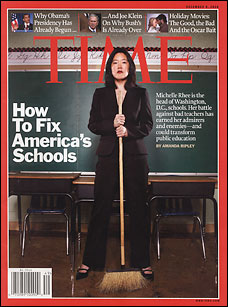
Michelle Rhee Makes Time Magazine cover
As for this incident, it will definitely make the Darts and Laurels column features about egregious errors (and great jobs) in journalism, if someone submits it. (When I worked at the Center for Science in the Public Interest, I got an item in the D&L column, over a magazine that was soliciting advertising to support an issue that was going to include an article criticizing the organization's position on focused programs marketing alcohol to minority groups. CSPI was against this type of marketing. The magazine preferred the advertising revenues.)

In the late 1980s, one of the first things Michael Moore did that had national exposure was write a piece for CJR on the Flint (Michigan) Journal and its ultra-cozy relationship with General Motors and the Mott Foundation, and on projects they espoused (a number of which failed miserably) for the city.

CJR influences the media and has a national position of authority that far exceeds its paid circulation.

Labels: ,

Monday, September 21, 2009

Bruce Robey, a friend and colleague

Bruce Robey
Bruce Robey.

Upon the sad news that Bruce Robey has died, Mark Segraves, now of WTOP radio, has a nice tribute. Bruce was a co-founder with his wife Adele of the Voice of the Hill community newspaper--they created it because at the time the Hill Rag was a truly a rag and at the time a stooge for the H Street Community Development Corporation and other interests (the competition truly made the Hill Rag better)--and the H Street Playhouse.

I got to know Bruce and Adele around H Street revitalization issues. They agreed to let me distribute the Voice of the Hill north of H Street, to help tie the neighborhood more closely to Capitol Hill. I did it for a few years and when they sold the paper a couple years ago (to the Current Newspapers) the paper continued to be distributed in the H Street neighborhood.

They helped lead a community effort to revive the Atlas Theater, which at the time was mothballed and derelict, owned by the H Street Community Development Corporation, and while the effort was "unsuccessful," it did bring about change and the sale of the theater building to the group that became the Atlas Performing Arts Center.

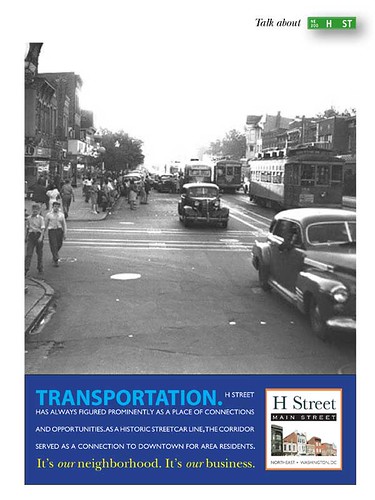
Bruce and Adele were staunch supporters of H Street Main Street when I was first involved, and they agreed to run a monthly article about the program (provided we/I wrote it and it didn't need much editing), and free "image development" ads every two months like this one.
Talk about H Street campaign: Transportation
This ad was produced by Kevin Palmer, based on a concept we developed jointly, and it ran in the Voice of the Hill, gratis.

I ran the first phase of a neighborhood historic preservation survey in 2001-2002 (the second phase of the survey was conducted this year), and they ran the final report in six or seven installments of the paper, telling the history of the neighborhood (which was written by architectural historian Nancy Schwartz).

And when I did the first H Street alley tour two years ago, they agreed to let me show their alley rowhouse (for a time they lived behind the Atlas Theater on Linden Court, a short alley mews). See "Alley Homes Fight for Respect -- and Trash Pickup" from the Washington Post for more about alley living.
Alley dwelling chic #1
Washington Post photo by Nikki Khan.

Bruce was involved in many many other projects and initiatives, things that I wasn't involved in, including the Capitol Hill Merchants and Professionals Association, and helping to launch the Capitol Hill Business Improvement District, the Theater Alliance, probably the Capitol Hill Arts Workshop and much more.

His and Adele's efforts on H Street helped pave the way for others, including Joe Englert.

And he was a friend.

My condolences to Adele, Julia, and the rest of the family.

Labels: , , , ,

Wednesday, September 02, 2009

Back to (K-12) School

1. In "Parent Smart: Green school supplies" the USA Weekend magazine supplement to Sunday newspapers gives three back to school lessons. From the article:

Doing small things helps the environment
. When picking up or dropping off your child at school, don't idle your car. Idling for more than 10 seconds uses more fuel and produces more pollution than restarting the engine, according to the Consumer Energy Center.

Of course, driving your child to school is not a green behavior, regardless of whether or not you idle your car engine.

Walking or bicycling to school (see the National Center for Safe Routes to School for more information) or taking the school bus, which transports far more many students using less oil overall than if the children were all driven separately, is a far more green choice.

Although you do need sidewalks, sometimes chaperones, and practical bicycle racks (see "New Cooke school bike racks too close together, too close to wall" from Greater Greater Washington).

And better policies focused on keeping schools in neighborhoods. See the report Why Johnny Can't Walk to School from the National Trust for Historic Preservation.

2. Of course, many school districts are cutting back on school bus services, because of the cost, and pressing budgets. See "School districts in the red cut yellow bus services from USA Today.

Students unload from the first bus on the first day of school on the first day of a new school.
Students unload from the first bus on the first day of school on the first day of a new school. The first day of school at Milton's new Birmingham Falls Elementary School. It is the first new public school to open since Milton became a city. It has 54 classrooms and has a capacity of 850 students. Mon, Aug. 10, 2009. Bob Andres, Atlanta Journal-Constitution.

On the other hand, why do we have a separated transit system, one for children and one for everyone else. Part of the way that the transit system in Rochester, New York is "profitable" is because it transports local school children. See "Creativity Helps Rochester’s Transit System Turn a Profit" from the New York Times. From the article:

It has, for instance, reached agreements with the local public school district, colleges and private businesses to help subsidize its operations, warning in some cases that certain routes might be cut if ridership did not increase or a local business did not help cover the cost. In recent years, income from these agreements has equaled or exceeded the income from regular passenger fares. ...

The Rochester authority has also helped itself by working out subsidy agreements with local businesses and educational institutions. One of the most important is with the Rochester City School District, which uses the Regional Transit Service as the primary bus system for nearly all of its students in the 7th through 12th grades. Several years ago, the school district paid the equivalent of a regular fare for each student rider, according to Mr. Aesch. But about three years ago, with the transit system facing a financial crisis, he began discussions with the district about radically altering the arrangement.

Mr. Aesch told school officials that the money they were paying to transport students only partly covered the cost and that the system could no longer afford the service without a significant increase in payments. The school district agreed to an increase, and it now pays about $2.22 for each student ride.

Even by paying a premium, the school district believes it is getting a good deal, said Jean-Claude Brizard, the superintendent. He said that during the current school year, the district will pay the Regional Transit Service about $10 million for student bus travel. But the district estimated that it if it contracted with a private company for the same service, the cost would be more than $2 million higher.

Some local school districts in the Washington region, due to budget cutbacks, are cutting subsidies for students using public transit. See "Students Fret Over Loss of Free Ride" from the Washington Post.

3. The Washington Post didn't publish a back to school special section this year, although seemingly the Education Page on the page 2 of the Monday Metro section is supposed to being expanded. I think the local newspaper should publish a special back to school section.

4. I am pretty sure that since Mayor Fenty has been pushing back and reducing the scope of the State Board of Education, that this year, there was no "First Day" of school expo.

I have mentioned this idea for a few years, and last year, under State Superintendent of Education Deborah Gist, DC held a First Day expo. The way that Mayor of Joseph Riley of Charleston, SC attends the expo there truly communicates that the city and community values education. From an article in the Charleston Post & Courier (no longer online):

to encourage community involvement in children's education, said Charleston County School District Superintendent Maria Goodloe-Johnson. "We encourage it year-round, but this is the big kick-off."

The event had more than 70 freebie booths frequented by thousands of visitors. Children and a few adults played soccer and baseball in a large grassy area. An inflatable jumping booth was well used, and some children sought a break from the heat in a water fountain beneath a towering American flag. A band played cool music on this extremely hot day. There was even a guy in a Piggly Wiggly pig costume giving out school supplies under the relentless sun....

Mayor Joe Riley, posted under a festival tent, smiled and waved at children, busying himself with other festival volunteers passing out water, school supplies and bags of goodies. Several large tanks pumped cold cupfuls of water for thirsty people. Despite the heat, almost everybody was smiling as though they were having a really cool time. Perhaps gearing up for the first day of school has that effect on some people.


According to an article on this year's festival, last year's Charleston First Day Festival had over 9,000 attendees. See "First Day Festival to be held today."

Also see the blog entry from last year, "Proposed DC Parent Education Expo a step in the right direction," as well as "Involving the community in school improvement" and "A thought or two on public assets and public schools."

Maybe the Post could be a major sponsor...

(The website for the First Day Foundation seems to be down. I am not sure if this is a permanent condition. This link is through archive.org so it works.)

5. It turns out that the U.S. Department of Education publishes a number of handbooks in the "Helping Your Child" series.

I printed off this one, Helping Your Child Become a Responsible Citizen but I haven't read it yet...

6. Even if the Post hasn't published much about back to school, the Louisville Courier-Journal has, and I found these articles interesting and/or relevant to "back to school."

- THE FUTURE / NEW APPROACHES: Can we keep pace?

- Visual arts magnet attracts new students to Rutherford Elementary

- Lincoln to use creative arts to help kids learn

- 25 elementary schools getting new programs

- Tips for getting to and from school safely

- First-day fears: Parents, teachers offer soothing advice

- STANDARDS / KINDERGARTEN: First year's not just for playtime anymore

7. Especially this one, "Here's how to help your child succeed in school." From the article:

• Make learning a priority — have your child prepared to learn each day.
• Encourage your child to always do his or her “personal best.”
• Show interest in school work and activities — ask questions each day about his/her classes, activities, and homework; show appreciation for good efforts.
• Schedule a study time and provide a quiet environment for your child to complete his/her homework.
• Limit television, video games and movies by encouraging more reading time and reading along with your child.
• Communicate with your child's teacher. Contact his/her school when you have a question or concern.
• Check the school's Web site regularly.
• Support school rules for student discipline.
• Volunteer at your child's school by joining the PTA, attending school activities, open houses or parent-teacher conferences.
• Encourage participation in school activities.
• Advocate for public education in your community and state.

Also see "TEACHERS / ELEMENTARY SCHOOL TIPS: Laying the groundwork for success" and "STANDARDS / ELEMENTARY SCHOOL: Kentucky has its list of grade expectations."

8. And that Middletown Elementary School in Louisville has a "back to school" breakfast on the first day of school for parents and children on their very first day of school, is great. I remember my first day of school still, with all the children (except for me and my best friend) at the windows of our portables (trailers for the kindergardeners at a very large school in Detroit--still in operation, Cerveny), crying their eyes out, screaming for their parents.

A breakfast "handoff" seems like a better idea. See "Boo Hoo Breakfast helps parents say goodbye on first day of kindergarten."
photo
Middletown Elementary parent Wendy Duke dropped her twin sons off to their kindergarten class and then enjoyed the school's annual Boo Hoo Breakfast. (by Sara Cunningham, The Courier-Journal)

9. The Christian Science Monitor has what might be the definitive article about charter schools, "Grade for charter schools? 'Needs improvement'" as the article is factual, not ideological. From the article:

With the start of the fall semester upon us, President Obama has made charter schools the mainstay of his education reform movement. Although such schools are heavily promoted, concerns need to be addressed before their potential to shape a new course in US education can be fairly evaluated.

Charter schools represent a compromise for taxpayers who are frustrated over the glacial pace of improvement by public schools despite the expenditure of $667 billion on K-12 education last school year, up from $553 billion the prior year.

Publicly financed but operating free of many of the regulations applying to traditional public schools, they have grown in popularity since the first charter school began in Minnesota in 1991. They now total 4,600 nationwide and educate some 1.4 million of the nation's 50 million public school students.

Yet despite the claims made by supporters, a study released in June by the Center for Research on Education Outcomes at Stanford University in Palo Alto, Calif., casts doubt on whether the academic performance of students in charter schools is any better overall than that of their peers in regular public schools.

Though some states did have better overall results than others, researchers found nearly half of the 2,403 charter schools across the country involved in the study have results no different from regular public schools. In fact, more than a third of the charter schools posted results significantly worse. Only 17 percent provided superior educational outcomes. Advocates of charter schools assert that the study was slanted, but offer no convincing supporting evidence.

10. Oh, and in Britain, "celebrity" chef Jamie Oliver's campaign to improve the quality of school meals has led to regulatory changes in the nutritional standards for school meals. See "Jamie's school dinners for all: New rules on healthy canteen menus inspired by TV chef come into force in secondary schools across the country" from the Independent and his campaign website, Jamie Oliver - School Dinners, not to mention his tv show website, Jamie At Home Food Channel4.com.

Just to show that the process of change is difficult, also see these articles from the Guardian, "Children find Jamie Oliver's school food hard to swallow, say swallow, say inspectors: Pupils just want to eat chips, reports Ofsted, Healthy options cause fall in demand for lunches" and "Social change isn't won by lone heroes."

Even though social change isn't won by lone heroes, it helps to have a clear message, advocates, attention, and a campaign, which ought to be a lesson for those interested in urban education improvement...

Jamie Oliver's school meals campaign
Jamie Oliver "articulated public concerns about school nutrition in a way that an academic tract never could". Photograph: Peter Dench/Corbis.

11. There are efforts in the U.S. to improve school lunches as well. See "Stars Are Aligning Over School Lunch Programs" from the New York Times and the Time for Lunch campaign website.

12. From the Urbanite, a monthly publication in Baltimore, "Education researcher Robert Balfanz on the art of keeping city kids in school."

Labels: , , ,

Monday, July 20, 2009

One thing that bugs me about newspapers: a failure to connect today's events to yesterday...

The joke is that newspapers are the first draft of history. And each day, a newspaper prints fresh, as the lyrics in the song "Goodbye" by the Psychedelic Furs make clear:

today's news is yesterday's news
you don't remember you forget
that's the way the stories all go.

That's how I feel about Jay Mathews' column in today's paper, "6 Lessons From Montgomery County Public Schools That Mostly Missed the Point," which discusses a book published by the Harvard Business School, about the success of the Montgomery County Maryland Public School System in addressing what are otherwise considered to be "normal" disparities in educational attainment between children from families with household income vs. children from families with low household income.

Mathews is distressed by the 6 lessons:

- Lesson 1. Implementing a strategy of common, rigorous standards with differentiated resources and instruction can create excellence and equity for all students.
- Lesson 2. Adopting a 'value chain' approach to the K-12 continuum increases quality and provides a logical frame for strategic choices.
- Lesson 3. Blurring the lines between governance, management, staff and community increases capacity and accountability.
- Lesson 4. Creating systems and structures that change behaviors is a way to shift beliefs and leads to student learning gains.

- Lesson 5. Breaking the link between race, ethnicity, and student outcomes is difficult without confronting the effect that beliefs about race and ethnicity have on student learning.
- Lesson 6. Leading for equity matters.

asking "where are the teachers?"

He misses the point.

Teachers focus on individual students and a class. Principals on teachers and a school.

But leaders of a school system focus on building a strong system that yields success for every student, every teacher, every class, and every school.

The best teachers in the world can't really function in a dysfunctional system.

This has been discussed by Education Week, in "When 'Unequal' Is Fair Treatment," far better than it has ever been covered by the Post.

See the ideas behind Herzberg's Motivation-Hygiene Theory. Hertzberg posited that without what he calls hygeine factors--or the basic structural conditions--people won't function well in the workplace.

Newspapers exalt the individual without focusing the underlying factors that support failure or success.

So it is Mathews and the newspapers that miss the point, not the Harvard professors...

And therefore, our understandings about where to focus and why systems fail rarely improves.

Labels: , , ,

Monday, June 01, 2009

Stupid is as stupid does

both from the perspective of gaps in DC historic preservation and demolition laws, and the writing in the local press about this, as evidenced in the City Paper blog post, "Anything Worth Saving Here?: H St. Rowhouses Edition."

I have various comments in the response, but then, why do I bother?

This is an extract from an email I wrote a couple days ago after the hearing:

The average untrained preservationist, and I suppose that includes me at times, doesn't always distinguish between the level of significance necessary for the creation of a district vs. a landmarking of a single or group of buildings. The issue of integrity--all four original buildings being intact and in this case, one glaring omission--made it a difficult case. Tim Dennee's staff report on the landmarking issue was well argued, with a surprising hint of sympathy on the complexity of the matter.

Those pursuing the application knew it was a long shot, but knew that it had to be pursued in order to try to deal with the property owners in a substantive way. I know that HPO and probably the Board doesn't like the landmark application process being used in this way, but the lack of other remedies in DC law forces this type of action.

Most of my writings about the need for more robust processes and systems in DC planning, zoning, and building regulation come from dealing with these kinds of issues and getting crushed by the gaps between platitudes and the dearth of substantive ways to deal with problems that come up. E.g., I asked Muriel Bowser why the hell she is pursuing placarding for raze permits without adding any additional remedies to the law? She said notice is important. I said why?, when you can't do anything in response...

The only possible remedy that exists in DC law currently to stop a demolition is the landmarking of the building/or the inclusion of a building within a historic district as a contributing resource.

What frustrates me about other people who testify about these kinds of issues, is that they aren't making the connections between the Comprehensive Land Use Plan and processes all the time, and that they don't know how to articulate the problems in a useful way. They end up being scolds and because they can't see why the problem exists, they come off as testy.

The real problem is that the Comp. Plan is mostly platitudes--in the context of law it is a bunch of shoulds and "mays" not "shalls"--and that there isn't a desire to put into place focus and protections on things that matter because that would interfere with the real estate development process in substantive ways.

I am still angry about the technical amendments bill from a few years ago because--as the blog entry from the other day indicated--I testified for years about dealing with putting into place demolition protections whether or not buildings are designated. In the technical amendments legislation, a provision on this was included. But it didn't stay in the bill. I suppose it was probably put it in knowing it would have to be given up, but that by giving it up the rest of the bill would sail through. So the building industry assn. is still happy about getting Chairman Cropp to take that section out of the bill. I'm still pissed.

But we needed to organize more and better, and as I keep writing and agitating, I don't think we (preservationists) have been very good at articulating the links between preservation and the quality of life and attractiveness of the city that people want to consume as residents and visitors, and how this is the foundation of the city's competitive advantage.

As far as the Board being frustrated, I am frustrated too, because the classic tome on preservation revolving funds was published in 1976, but in all that time, the preservation community in DC hasn't managed to create such a fund. Had one been in place, that's how we could deal with this particular matter, if only to stabilize the building to prevent the leakage between that building and the Atlas, which is driving the Atlas crazy--they have been pushing the matter via the Condemnation Board, because of the damage to their own property.

Labels: , , , , ,

Friday, May 22, 2009

Why SNAFU and FUBAR are SOP

A week or two ago someone wrote a letter to the Post objecting to the use of the term "fubar" in a Doonesbury comic strip, because they believe that the F word used in the term is an expletive. Actually, the original term was "fouled up beyond all recognition," and similar to the term "snafu," situation normal, all fouled up. Although yes, people use the other F word interchangeably in either of these terms.
Extract from the book cover, The F Word: How we learned to swear by feminism
Extract from the cover image of the book The F Word: How we learned to swear by feminism.

Although I used to joke when I was the Main Street Manager in Brookland that "flawed" was the other F word.

Anyway, close readers of this blog know that I focus incessantly on structures, processes, and systems rather than personalization and the heroic savior to guide urbanism and good and sound government. My thinking about systems gets stronger and stronger--about the need to build robust but flexible processes, rather than focus on individualistic thinking, to ensure better hopefully robust and resilient outcomes.

I find the Washington Post frustrating because it--remember that it is a fresh edition every day, and that seemingly cancels out everything else that had been written before--does not focus on systems but for the most part, treats today as if nothing else had happened before, and that if negative results occurred yesterday, they won't occur today because the incorrect behavior was an aberration and won't be repeated.

This is particularly true with the columnists such as Marc Fisher. His column yesterday, "Getting Through to Kids, If Council Stays Out of Way," exhibits why both the newspaper and local municipal government are "fubar," because they don't really understand the process of change.

I came across this book, Change: Principles of Problem Formation and Problem Formation in the late 1970s or early 1980s, and together with The Social Psychology of Organizations, and other readings in organization behavior and civic engagement (especially publications produced by the Citizenship Involvement Training Project at the University of Massachusetts Amherst), my approach to change and innovation was set. (Along with working for a consumer group that had Nader lineage in the late 1980s and other involvements.)

The issue that Marc Fisher writes about is pretty simple. City Council wants a new "problem student resolution" program that is now managed separately from the school system to be rolled into the DC Public School System. The Deputy Mayor for Education, Victor Reinoso, does not believe in doing this, because:

Council members want the school system to take over START, but Reinoso argues that in government and business alike, innovation tends to come from outside core structures -- from Bell Labs, not the phone company. "This is moving forward in large part because it's apart from the school system," Reinoso argues.

While Victor is right that this occurs, rather than figure out why the DCPS system is dysfunctional and correct that, he would rather develop an innovative program outside of the system.

I have written plenty about dysfunctional government agencies, the dearth of a transformational thinking framework towards the reconceptualization of programs and service delivery, and so much about the schools specifically, including insights from the field of "positive deviance," which works to identify highly functioning sections of otherwise dysfunctional organizations and work to migrate and expand those clusters of excellence.

Neither seems to be too concerned about the lack of focus on identifying why dysfunction occurs within the school system and how to rectify the dysfunction.

In short, this is the fundamental issue, one that most of the stakeholders including the Executive and Legislative Branches of DC Government, parent, and other educational advocacy organizations, seem to be ignoring and/or otherwise missing.

Fisher writes:

D.C. START is intended to attack the too-common belief among teachers that many kids who come from troubled homes cannot be held to high standards. "The hope is that we will chip away at the wall that some teachers have built around themselves in terms of low expectations," Reinoso says. "As they start to see troubled kids become better-behaved, teachers will regain their faith that kids can change and succeed."

BUT THE ISSUE ISN'T the "belief among teachers that many kids who come from troubled homes cannot be held to high standards".

THE ISSUE IS FOCUSING ON THE PROBLEM BEHAVIOR, WHY IT OCCURS, AND HOW TO CHANGE IT, SO THE PROBLEMS DON'T CONTINUE TO OCCUR.

It's a systems approach, but neither Marc Fisher nor Victor Reinoso seem to recognize this.

A failure to focus on organizational behavior and culture overall, but from the standpoint of organizations behave (social psychology of organizations) and how culture is maintained, created, and improved (change and how problems are formulated and resolved) leads to the all too common result of expecting things to change while performing the same kinds of activities. Also see the work of Chris Argyris, such as Knowledge for Action: A Guide to Overcoming Barriers to Organizational Change. And I frequently mention the work of Everett Rogers on innovation, something I also read in college, but not for a class.

By focusing on systems, why problems occur, and focusing on changing the conditions that lead to the problems, beneficial and systematic change will occur.

But not understanding this means that SNAFU and FUBAR are SOP (Standard Operating Procedure), and that any positive change is likely to be a fluke.

It's important to learn the right lesson from positive change. Too often, and this is a perfect example, practitioners lack the perspective to formulate hypotheses and theories, thereby generating meta-learning which can be applied in other settings.

In short, I am a big fan of Otto Bismarck's quote:

Fools learn from experience. I prefer to profit from the experience of others.

Instead, most "learning" is running in place, and systems are substantively improved, and things remain the same, despite all the time, money, and effort expended. And in
159679418v5_350x350_Front

it remains

oval%20snafu
DC image from Cafe Press.

Labels: , , ,

Wednesday, May 06, 2009

Evidence-based editorial writing

Earns Washington Post
AP photo.

Harry Travis, on the concerned4dcps e-list writes:

The Washington Post would be a better paper and public education in DC would be improved if the editorial board followed the same constraint the Letters to the Editor puts on readers: Only comment on stories and facts put into evidence in the paper.

Washington Post news editors have not put much before the public on the improvements in DCPS under Ms. Rhee, or on progress to the creation of a solid system of coordinated services, opportunities and programs for the health and education of children and families under Mr. Reinoso.

So, to what does the Post editorial refer to when it writes, in "Backward on School Reform: The D.C. Council wants to score points, and never mind the city's children":

"Mr. Reinoso['s ......] fledgling operation has been cited as a model for how cities can coordinate and integrate services for youth"?

Where, by whom, on what evidence, and with what comment and other appraisal? Mayor Fenty's summer youth jobs program?

Labels: , , , , ,

Friday, April 17, 2009

Mayor Fenty's chief enabler blinks, on baseball tickets for City Councilmembers

Phillies Nationals Baseball
The Washington Nationals stand for a moment of silence for legendary Philadelphia Phillies broadcaster Harry Kalas who passed away before their baseball game on Monday, April 13, 2009 in Washington.(AP Photo/Evan Vucci)

I don't have enough fingers and toes to count the number of times the Washington Post has editorialized in favor of Mayor Fenty's frequent disregard of civic or legislative engagement and/or oversight in the affairs of the Executive Branch of the DC Government. For a newspaper that fought the Executive Branch of the Federal Government--uh, remember President Nixon and his transgressions--it always comes as an unpleasant shock that for the most part, as long as they like who the mayor is, the Post editorial page is fine with autocracy within the District of Columbia.

Ahh, but baseball tickets. That's serious.

See "Ticket Snub," "Adrian Fenty Plays Games With Washington Nationals Tickets"). From the editorial:

MAYOR ADRIAN M. Fenty is being roundly criticized for his infantile refusal to share the District's allotment of baseball tickets with members of the D.C. Council. Critics are right about the mayor's poor manners, as well as the absurdity of grown-ups squabbling over something so silly. Our concern, though, centers on what the dispute says about Mr. Fenty's relationship with the council and the implications that this could have for important work awaiting the mayor and his administration.

Generally, when you do bad things and don't get called on it, it makes things worse. The Post now has 2+ years to atone for.

Labels: , , , , ,

Friday, January 30, 2009

Urban Paradoxes e-zine

From Frank Mills:

I thought you might be interested in checking out the newest endeavor from Urban Paradoxes, the URBAN PARADOXES E-ZINE. Revitalizing our urban neighborhoods takes a community effort.

There is also a new local magazine for Philadelphia devoted to sustainability, see Grid Magazine and "Get on the Grid" from the Philadelphia City Paper.

Labels: ,

Transit and economic development

An indirect example of the link between transit and economic development and the link between population density and economic development comes from Baltimore, and the soon to be closed Baltimore Examiner.

Plans for closure of the paper in a couple weeks has been reported by the Baltimore Business Journal, the Baltimore Sun, and the Washington Examiner. Since the search function for the Washington Examiner is pretty weak, I can't find the article from today's paper in the online edition. Here's the article from the Sun, "The Examiner in Baltimore to close Feb. 15."

The phenomenon of free daily newspaper tabloids in North America has occurred in cities with strong transit systems and population density, because rather than spend money on home delivery systems, the papers are distributed through vending racks and at transit stations, allowing for a fair number of copies to be distributed at a relatively low cost.
Baltimore Examiner Saturday distribution
Baltimore has a pretty lousy fixed rail transit system. Washington and San Francisco, the home of the other two Examiner newspapers, does not.

Now there were other problems with the expansion to Baltimore. In the current environment, newspapers are reliant on local advertising. There were few synergies from the standpoint of selling advertising between Washington and Baltimore, because the base of potential advertisers is different, and there is little value from cross-over sales--people from DC aren't likely to go buy products from Baltimore businesses advertising in the DC edition and vice versa. The closure of Boscov's Department stores, and the loss of a large advertising account was another, etc.

(Note that the Current Newspapers, with a variety of editions in Northwest DC + Capitol Hill, and the Capital Community Newspapers, with three editions covering most of the city, do cross-sell ads, although my sense is that people in NW aren't likely to patronize businesses in other parts of the city, and vice versa.)

Transit systems + newspapers = good business.

Note that in the 1990s, I wrote something somewhere suggesting that the Washington Times should convert to tabloid format and focus more attention on marketing through the transit system.

Labels: , ,

Saturday, January 03, 2009

The Giant supermarket independence sham...

When Giant Supermarkets announced a new logo (press release), the local press reported it duly, such as in "Giant Puts on a Fresh Face For Its Supermarket Upgrades" from the Washington Post.

The reality is that it's the same new logo used by parent and controlling organization Stop and Shop, which is based in Boston. Stop and Shop runs Giant as part of the overall company just as Hechts ran Strawbridges as Hechts branches even though the stores had Strawbridge logos, names, etc.

So the press missed the story.

Labels: , ,

Friday, January 02, 2009

Happy New Year Crime and Murder

Today's Post editorializes about the need to deal with "Losing Youths to Homicide." (Also see the story in today's paper, "Rise in Young Killers Vexes D.C.")

The subhead of the editorial is:

A comprehensive approach is needed to a crime trend that resists solutions.

-------------
This is so frustrating. Of course that's what's needed. Why is it that DC continues to ignore the best practice example on how to deal with this: Boston!?

Boston's Operation Ceasefire was an effort (described in the article "Straight Outta Boston" from Mother Jones Magazine, but written up in many many places over the years) to interdict youth violence with a multi-pronged approach of dealing with gangs, guns, and with far closer supervision of criminals after release. See this case study "Boston Strategy To Prevent Youth Violence -- Boston, MA" from the National Institute of Justice, for more information.

Operation Ceasefire seems to be a much broader approach than DC's easier and looser focus on rehabilitation with mimimal structure. See "Teen Offenders Spared the Rod" from the Post. Post columnist Colbert King has written many many aggravated columns over the past couple years about what he sees as the failures of this approach. (E.g., "Rehabilitation. Just a Bygone Word?")

It is heartening that DC is using the somewhat counter-intuitive model of shifting the service of homelessness from temporary shelter to permanent housing combined with wraparound services, because it is more cost-effective and successful from the human services standpoint. See "million-dollar murray" by Malcolm Gladwell from the New Yorker, about why it is best to shift to the permanent housing model, even if it seems to reward negative behavior.

Instead of giving lots of money to favored DC nonprofit organizations, why not develop a truly integrated and comprehensive approach to reducing youth crime in substantive ways, comparable to the "Boston Miracle" and comparable to how DC is now addressing homelessness?

Labels: , , ,

Wednesday, December 31, 2008

Breaking news...

1. Raw Video: Car stuck in Washington street hole AP It's not exciting but there are pictures. (I don't watch tv "news" very much, terming it little more than "murders, fires, accidents, sports and weather.")

2. The "new" Loose Lips Daily blog entry as part of the Washington City Paper City Desk blog is a nice culling of "all the news that fits" and a good way to keep up.

Labels:

Tuesday, December 16, 2008

Changing economic paradigms

I have been thinking with the economic downturn that at least four industries are totally screwed, because their economic models are based on factors that are now changed.

1. Professional Sports. Recently I read something in a paper about how sports teams are relatively insulated economically. This might be true for the major leagues, but minor sports are at risk, such as the announcement that the Arena Football League will suspend the 2009 season. And NASCAR is having a hard time retaining sponsors as well.

Longer term I think we will have to see major changes. High salaries for players have been supported by sponsorship agreements (i.e., $100 million for naming rights for stadiums) and high-value television broadcasting agreements. These monies will dry up as businesses consolidate and as advertising revenues for television and radio decline.

And will economically strapped cities, counties, and states really be able to justify massive financial support of sports teams through the financing of new stadiums and arenas?

2. Newspapers. Today in my e-box I got a notice that the Detroit News will move to home delivery of the newspaper only two days/week. (The Detroit Free Press, which I used to deliver as a child from 7th to 11th grades, will be delivered three days/week, including Sunday.) And the papers will shift to mostly digital. Newspapers cost more to create content, print and deliver than the per issue price. They were subsidized by advertisers, mostly locally-based, who bought ads to reach subscribers.

In fact, the first sentence of a typical media economics textbook is "the business of media is to provide audiences to advertisers."

Many industries that newspapers have relied up for advertising have become national rather than local, and many businesses have been consolidated (department stores, banks, supermarkets, office supply, other clothing and retail stores, appliance stores, car dealerships, stock brokerages), leaving far fewer potential advertisers available to spend money on local advertising.

And this doesn't even consider the impact of the Internet on readership of the print edition, and the difficulty of raising significant revenues from online advertising sales.

The Post announced a price increase to 75 cents for a daily copy yesterday...

3. Television. It has the same problem with loss of advertising and viewers that newspapers have, but it's a bit different. Automobile advertising is one of the most significant sources of revenue for national broadcasting companies as well as local television stations. That money is drying up. Already it has impacted early afternoon daily serial programming "soaps," which has relied on local television advertising support from car dealers, the same businesses that are now closing across the country.
Closed automobile dealership available for lease
AP photo.

4. Museums, arts organizations, and other nonprofits. Again, such organizations rely on the largesse of big companies--which are consolidating and/or going out of business--and rich people, who are losing money, even if they aren't victims of fraud.

Business models that rely on forms of sponsorship are going to face major dislocation over the next couple years. It's going to be ugly. We call this exogenous shock.

Labels: , , ,

Monday, December 15, 2008

Getting it Backwards (#2)

Speaking of the Washington Post, our friends at Washington City Paper have a cover story proposing how the Post can deal with the massive decline in paid-copy circulation (I won't say readership) and the rise of Internet-based information delivery, and the thing that they don't mention, the massive consolidation of businesses including department stores, banks, supermarkets, car dealerships, stock brokerages, and other retail, which has decimated their ability to sell advertising. See "This Bag Is Too Heavy: How to Downsize the Washington Post."

Note that (1) the Christian Science Monitor is going to cease publishing a print edition; (2) the Portland Press-Herald has threatened this and has cut back massively the number of journalists and beats covered, i.e., dropping a DC journalist reporting on the Maine congressional delegation; (3) the Tribune Company (Chicago Tribune, LA Times, Newsday, Baltimore Sun, Orlando Sentinel, Ft. Lauderdale Sun-Sentinel and others) is in bankruptcy; and (4) tomorrow the Detroit Free Press and Detroit News are going to announce massive reductions in circulation, perhaps only delivering the newspaper to households 2 or 3 days/week!

Meanwhile, newspapers in London, UK have moved to a free distribution model and to the tabloid format away from the broadsheet format, which is an extension of the idea of how the Examiner and Express are delivered in the DC region, but the advertising base is stronger in London. (Long story about this, as well as the rise of free distribution daily papers in the U.S., that isn't fully relevant to this blog... but you can ask me about it sometime if you meet me in person.)

But the City Paper didn't make the one of the better suggestions it could have made, a piece of which I have been pushing for awhile, which is based on the importance of local news coverage, and building readership within younger segments (note that speaking of younger segments, National Public Radio has announced that it is dropping radio programs created to attract new, younger audiences to its services)...

1. I have been suggesting for years that rather than reduce the amount of news and editorial coverage in the weekly sections of the Post (such as District Extra) expand it, and not just on the Internet, as was done on a test basis with the Loudoun edition.
Loudoun_540x420.png
Enhanced online version of the Loudoun Extra.

2. AND DISTRIBUTE MANY ADDITIONAL COPIES OF THIS SECTION FREE, JUST LIKE THE CITY PAPER, THROUGHOUT THEIR SERVICE AREAS.

3. But now I would make an additional suggestion, which could destroy the City Paper... The Post should do this in combination with an expanded Weekend Section, including more local content for each county, more local advertising sold at a reduced rate, as well as slightly expanded regional content, combine this with the Weekly section, and deliver to subscribers an expanded Extra Section + Weekend Section on Thursdays, including a fair amount of free distribution of this section, just like the Examiner does, delivering their newspaper to highly coveted readers (based on household income) as well as free distribution at subway stations and other locations.

I love newspapers and read many (Post, NYT, Financial Times, Wall Street Journal, Washington Times, Baltimore Sun). And I prefer print to digital. (It's a faster way to read.) Newspapers are essential to civic action and shedding light on local issues. In that vein, the Washington City Paper is an important media vehicle too, I just don't know what to suggest for them. (They are also in bankruptcy.)

Labels: ,