Rebuilding Place in the Urban Space

"A community’s physical form, rather than its land uses, is its most intrinsic and enduring characteristic." [Katz, EPA] This blog focuses on place and placemaking and all that makes it work--historic preservation, urban design, transportation, asset-based community development, arts & cultural development, commercial district revitalization, tourism & destination development, and quality of life advocacy--along with doses of civic engagement and good governance watchdogging.

Monday, February 28, 2022

Backwardness of transportation and land use planning: National Harbor, Prince George's County, Maryland | Why isn't high capacity transit access required from the outset?

In 2007, I took a class on transportation and land use planning, and my term paper laid out an agenda for linking transportation and land use planning within DC proper, although the concepts were extendable to the metropolitan area.

Some blog entries reflect the various conclusions in the paper, including whether or not DC should move to "free transit," which is relevant again as DC Council is proposing $100/month in free transit benefits to all residents ("D.C. Council Ponders Bill to Give Residents $100 Monthly to Ride Metro," Washington Informer).

-- "Comments on Proposed EYA Development at Takoma Metro Station," 2006
-- "Not being able to build your way out of congestion," 2007
-- "A 2008 Transit/Transportation Planning Wish List for DC," 2008 (updated 2015, part 1, part 2)
-- "Is making surface transit free the best transit investment DC can make?," 2016

Predating the paper, the 2006 entry discusses the "Transit First" agenda laid out in the San Francisco City Charter, which prioritizes sustainable mobility, while the 2007 entry discusses "Transit First" as well as how Utrecht, The Netherlands links land use approvals to the capacity of the transportation system to accommodate the number of trips generated ("Utrecht: 'ABC' Planning as a planning instrument in urban transport policy"). These provide the foundation for the paper's argument.

PG: no substantive link between transportation and land use planning, especially for big projects.  Unlike what they do in Utrecht, it is amazing how in Prince George's County in particular, they approve large scale developments -- FedEx Stadium, Konterra, and the National Harbor development on the Potomac River alongside an outlet shopping center and the MGM Grand Casino -- WITHOUT ANY REQUIREMENTS FOR HIGH CAPACITY TRANSIT SERVICE.  Even though they claim to be proponents of what is called "transit oriented development."

Konterra is still a long way from substantive development, but it's completely car dependent.  

FedEx Stadium is about 1.5 miles from the Largo Town Center Metrorail Station, and National Harbor has zero substantive transit connections--it was hard to even get bus transit.

It's why I argue that Prince George's County planners don't really understand what transit oriented development and transit centricity even mean:

-- "The future of mixed use development/urbanization: Part 3, Prince George's County, where's the there?," 2011
-- "A recommended new planning direction for Prince George's County," 2011
-- "Another lesson that Prince George's County has a three to five year window to reposition based on visionary transportation planning," 2011
-- "Frustration #3: the talk about transit oriented development and Prince George's County," 2013
-- "Prince George's County still doesn't get "transit oriented development" and walkable communities: Greenbelt edition," 2012

National Harbor.  And wrt National Harbor specifically, there are limited bus connections only, which came with a struggle ("Eight years and one casino later, a bus line from Alexandria to National Harbor," Post, 2016), even though the Sierra Club Metro DC Chapter advocated for a circumferential transit line connecting all the legs of the Metrorail system c. 2000.  This proposal included a station at National Harbor.

This comes up because the Washington Post has an article, "In growing National Harbor, eyes are once again set on a future Metro station," about the possibility of Metrorail expansion, the long discussed separated blue line, that would provide service both to Georgetown and National Harbor as a kind of inner circumferential line for the subway system. 


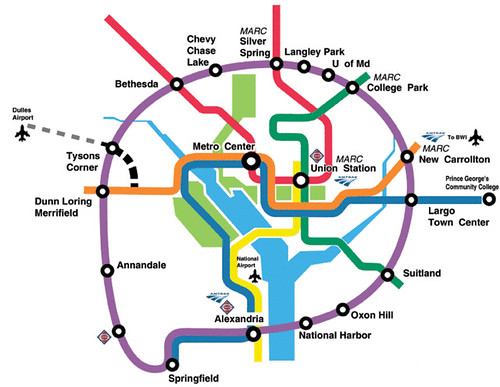
WMATA's proposed separated blue line makes it sort of circular.

Purple Line.  FWIW, the first time I ever heard of the Purple Line was in a cover story in the Washington City Paper in December 1987.  And now, "only" 39 years later, the first leg will be operational ("Maryland approves revised contracts for Purple Line, now set to open in 2026," NPR).

Ironically, when the first column for what became the Dr. Gridlock feature in the Washington Post was written in 1989 or 1990, I sent a long letter to the writer about how he was advocating for car commuters, not for transportation, and that by not advocating for transit expansion then, it would take decades to happen.  

This Purple Line was originally conceptualized as heavy rail but is now being constructed--a portion anyway--as light rail.

Separated Blue line/Separated Silver Line.  The separated blue line was a WMATA concept from 2001, but after a recession around 2003, Metrorail junked expansion planning entirely, devolving authority for expansion to the separate jurisdictions, and it fired most of its long range engineering and construction staff.  The original blue line proposal called for service to Georgetown, Union Station and H Street NE.  

But the key element was the additional platforms at Rosslyn Station, as the present setup is a key chokepoint in the system, made only worse by the addition of the Silver Line.

The only expansion plan underway at the time that continued was the Silver Line, by the State of Virginia.  The second phase will open this year -- 20+ years later ("Silver Line opening pushed back again, MWAA says, as new issue arises. But hiring is underway," Washington Business Journal).

Graphic: Washington Post, 2001
(The online article never included the graphic.)

The separated blue line concept died for the most part, except as mentioned in the Arlington County Master Transportation Plan.  Instead of advocating for it, DC shifted into streetcar planning, which since the original process, has been pretty much abandoned to one line on H Street NE, ending at Union Station.

A proposed streetcar network for DC.

Starting in 2006, I wrote tons about the concept of a separated blue line, including the missed opportunity by DC to use the creation of the Silver Line as a way to create that line.

-- "The "Downtown" Circulator and Rosslyn, Virginia," 2006
-- "Blinking on urban design means you limit your chance for success," 2006
-- "Winners and losers with the Dulles subway project," 2007
-- "Silver Line Metro expansion a classic example of the need to have true regional transportation planning," 2011
-- "Ultimately, WMATA blue line riders have been dissed by the State of Virginia, not WMATA," 2013
-- "The Silver Line WMATA story that WJLA-TV missed," 2014
-- "If DC had visionary elected officials and planners it could use the new WMATA "BOS" study to push through the development of a separated Silver Line in DC (and Northern Virginia)," 2019 recap

Although now I think it could be a separated Silver Line and the Blue Line, in Virginia could have its own expansion plan.

-- "A "Transformational Projects Action Plan" for the Metrorail Blue Line," 2020

Separately Paul Meissner and I created a "fantasy map" for Metrorail expansion, which did include Metrorail service to National Harbor, but should have included other suggestions for Blue Line extension in Virginia.

Design by Paul Meissner
Concept by Paul Meissner and Richard Layman

Note that this map has a southwestern leg of the Green Line from Suitland, serving National Harbor as the terminus.  This map didn't call for a completion of the Purple Line circumferential line.  

Now, I'd probably drop the southwestern Green Line leg in favor of an extension of the Purple Line from New Carrollton to Alexandria, with service to National Harbor, albeit at a distance of 7 miles from the Suitland Metrorail station.

The new separated blue line proposal.  So far, I am not enamored with the Metrorail blue line proposal, although it does provide:

I'd rather see the Separated Silver Line, and extension of service east of Union Station rather than southward from Union Station to National Harbor, although the issue of enhanced special event coverage to Nationals Stadium and Audi Field is a plus.

To me, planning an extension of the Purple Line from New Carrollton to Alexandria makes more sense, based on the likelihood of ridership demand to National Harbor, which can't be particularly high.

According to the Post article:
The route would add 180,000 new weekday trips, according to pre-pandemic Metro estimates made when the existing rail system was serving four times the passengers it does now. The route would bring rail service to lower-income communities in the District and Prince George’s, as well as to areas where development is booming, such as Buzzard Point and National Harbor. ...

Proponents of the proposed National Harbor line take a much longer-term view. It’s the preferred of six options the Metro board is considering to deal with crowded stations on the Blue, Orange and Silver lines. Trains and stations on the three lines, which share one set of tracks through much of the District, frequently exceeded capacity before the pandemic during peak hours, according to Metro. 

The Blue Line route would connect an area of Prince George’s with few transit options — limited to a handful of bus routes — to the greater Washington area. It also would create an alternative to car travel in an area that suffers from frequent traffic congestion. 

“It would be a tremendous amount of relief if folks were able to depend on mass transit,” said Malcolm Augustine, a former member of Metro’s board who represented Prince George’s and is now a state senator. 

The down side? It would come with a hefty price tag, costing between $20 billion and $25 billion to build and between $175 million and $200 million annually to operate, according to a Metro report last fall. It’s not clear how the extension would be funded.
Bang for the buck.  The thing is that extending the Blue or Silver Line eastward into DC and even Prince George's County would serve areas that are more intensely developed or could be, thereby generating more ridership and greater likelihood of transit oriented development.  Metrorail service on H Street and potentially up Bladensburg Road would have huge impacts, greater than what is likely south of Buzzard Point (Audi Field).

Transit planning and transit operations need to be separated.  It's also an illustration of the failure to not have integrated transportation and land use planning in the Washington Metropolitan Area.  I argue for the creation of a German style transport association, which integrates transit planning and operations regardless of mode.


WMATA is the heavy rail (and regional bus) operator and by default it is the lead transit planner, even though it has to make recommendations designed to assuage all three jurisdictions rather than optimality, and often makes decisions that are budget constrained.  

WMATA is also biased.  It doesn't see itself as a "transit operator" but as the Metrorail operator.  It wasn't interested in taking on light rail, which is why the Purple Line is being developed under the authority of the Maryland Mass Transit Administration.  It doesn't care about railroad passenger service, which is why 

Instead, there should be a regional transportation association, planning should be separated from operations, and decisions should be made in terms of the best mode, regardeless of who operates it.

What should happen.

1.  WMATA should study a separated blue line and a separated silver line, with broader cost-benefit calculations including land use intensification.  Obviously new platforms at Rosslyn are a top priority.

So is connection to Georgetown, redundancy in the center city, and an additional connection to Union Station, to support growth plans for the station.


At the same time, DC needs to consider the height limit restrictions (2010 blog entry, "More discussion of the height limit #2: Without adding high capacity transit service, there should be no increase in allowable heights," 2012) because taller development would help pay for the cost of the subway extension.

And DC needs to decide if it prefers eastward expansion of the Silver/Blue Lines, or better connections to Nationals Stadium and Audi Field, which then means extension southward into Prince George's County and to National Harbor.

2.  Immediately, the metropolitan area and Maryland MTA should begin studying the extension of the Purple Line from New Carrollton to Alexandria, with the aim of implementing it so much faster than the current process.

A caveat concerning the pandemic's effect on transit ("After Massive Transit Losses during the Pandemic, Agencies Are Planning a Comeback," Urban Institute, "Steep ridership losses will force changes to Metro service after pandemic, transit leaders say," Washington Post).  We don't know if Downtown DC (and Downtowns elsewhere) is dead forever, that the pandemic ushers in a world where people no longer go work in offices and clusters.  

I don't think that's the case, but I can't be absolutely sure.  If that's the case, high capacity transit is no longer necessary, at least from the suburban to city standpoint.

Then it becomes more of a place enhancement and intensifier, and still makes sense, but even then only if people are still working "downtown."

Labels: , , , , , ,

Thursday, June 20, 2019

If DC had visionary elected officials and planners it could use the new WMATA "BOS" study to push through the development of a separated Silver Line in DC (and Northern Virginia)

Charlie comments on an earlier blog entry, writing:
As I keep harping on, DC could have built a separated blue line for what it wasted on various projects over the past 10 years. But that is politics, and other things come first.
===========

Pre-2003, WMATA did its own expansion planning, and proposed the creation of what was then called the "Separated Blue Line."

Proposed changes for the WMATA system, 2001 (separated blue line)
Proposed changes for the WMATA system, 2001 (separated blue line), Washington Post graphic. (This graphic was never put online, but when I was a source for a couple stories by Post reporter Lyndsay Layton she tracked it down for me.)

This was when it was expected ridership would grow, reaching 1 million daily riders in the early 2020s.  Instead, these days, ridership has dropped by about 1/6 to about 500,000.

-- "Coming to a Curve: Region's Subway System Begins to Show Its Age, Limits" By Lyndsey Layton, Washington Post, March 25, 2001; Page A01
-- "Crowds Could Derail Decades of Progress," By Lyndsey Layton, Washington Post, March 26, 2001; Page A01.

This was back when the H Street revitalization effort ("360 Apartment building + Giant Supermarket vs. a BP gas station, which would you choose?," 2013) was just starting and we advocates found tantalizing the vision of a separated Blue Line with two stations on H Street NE--I still remember reading the article and seeing the graphic!

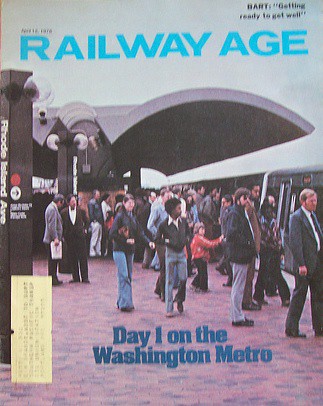
Day 1 on the Washington Metro, Railway AgeBut in 2003, in response to a regional economic downturn this proposal was junked, and was kept alive only in regional planning only within the Arlington County Master Transportation Plan, because the County understood the need for a second crossing from Virginia to DC in Rosslyn.

-- "Metro Construction Projects Creak to Halt; Economic, Political Changes Cancel Expansion Plans, Spur Job Cuts, Early Retirements," Lyndsey Layton. Washington Post, July 13, 2003. pg. C.01.

In 2006, I wrote about how DC should use Virginia's creation of the Silver Line in Fairfax and Loudoun Counties, in part to serve Dulles Airport, to bootstrap the creation of the Separated Blue Line.

-- "Blinking on urban design means you limit your chance for success"

And that without adding crossing capacity into DC, this expansion was going to create service problems within the existing system, something that Virginia elected officials finally figured out in 2014, a few months before the Silver Line opened.

-- "The Silver Line WMATA story that WJLA-TV missed"

Over the years, I kept writing about the Separated Blue Line as a concept, as something DC should do.

Although one DDOT planner made the point that without the ability to add height, and because a goodly portion of a separated line going through the core would not add development capacity, it would be difficult to justify the expense.  Hence, increase the height limit...

In 2016, I wrote about it again, in terms of improving system reliability in the face of the serious degradation that came from the addition of the Silver Line.

The thing about "interlining," when two or more lines share a section of track is that problems on one line don't stay contained on one line. Instead, they spread to the other lines like a virus. The addition of the Silver Line has stressed the equilibrium of the original system considerably.

-- "More on Redundancy, engineered resilience, and subway systems: Metrorail failures will increase without adding capacity in the core," 2016

Later that year, a comment in Greater Greater Washington made me realize that the Silver Line could be fully separated from the Orange Line with a different alignment in Arlington County.

(A couple years ago at a meeting I talked with WMATA's planning director Shyam Kannam about these issues and then he said "we have figured out the problems that derive at Rosslyn, but we still can't figure out why the problems happen coming from the east.")

In 2017, expanding on this and other concepts, Paul Meissner and I developed a "conceptual map for fixed rail expansion" and it included a Separated Silver Line fully separate from the Orange Line.
Conceptual Future integrated rail transit service network for the Washington DC National Capitol Region. Design by Paul J. Meissner.  Concept by Richard Layman and Paul Meissner.

(Although the Silver Line section hasn't been updated to reflect my more recent thinking.)

WMATA has just announced the launch of the "BOS" -- Blue, Orange, Silver -- Line Study to figure out how to fix these problems ("WMATA to study 3 rail lines to address region's future needs," Metro Magazine). From the article:
With a goal of identifying long-term options to improve reliability, meet future ridership demand, and better serve customers, the Washington Metropolitan Area Transit Authority (WMATA) launched a two-year study of its Blue, Orange, and Silver rail lines

Today, the Blue, Orange and Silver (BOS) lines all share a single set of tracks between the Rosslyn tunnel and the Anacostia River, creating a bottleneck that limits the number of trains that can cross between Virginia, Maryland, and the District of Columbia. The limited capacity means WMATA cannot easily add more trains and has limited ability to work around service disruptions. With the current configuration, a disruption on one line can have a ripple effect on all three lines.

The BOS Study will identify potential infrastructure improvements and service alternatives to resolve these issues.
… Not quite 13 years after I first suggested that these kinds of problems would occur.

While WMATA will be focused on short and intermediate term fixes, and these days given the massive fall off in ridership, I don't expect that they are thinking about expansion or separating one or more of the lines.

But separating and extending the Silver Line should be on the table, especially for DC.

If only DC officials were up to the opportunity and challenge.

Here's what I suggested in 2016, with some updates.

Concept for a fully Separated Silver Line  

Instead of what used to be called the separated Blue Line, I now term it a separated Silver Line. It could also be thought of as a "Downtown Relief Line."

1.  Instead of merging onto the Orange Line at East Falls Church Station, instead treat that station as a transfer station and continue the Silver Line south on a new alignment to Route 50/Arlington Boulevard then east to Rosslyn, crossing to Georgetown, continuing eastward to Union Station (this adds capacity to serve Amtrak's plans for expansion), and then further east to H Street NE. (The Arlington Boulevard alignment was suggested by commenter Ryan in a thread at GGW.)

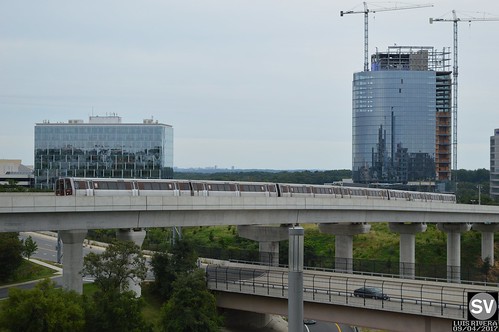
WMATA Mix Series Silver LineSilver Line in Fairfax County.

2. This would add six stations in Northern Virginia and service to a heavily used corridor.

For DC, it would add one crossing under the Potomac River, at least 9 new stations in DC, redundancy service for Downtown (and potentially 3-4 more stations if an additional Silver Line leg was constructed up Bladensburg Road).

It would serve key activity centers not currently served in Virginia (Arlington Boulevard/Seven Corners) and DC (Georgetown especially), providing additional capacity Downtown and at Union Station, which will be needed to service Amtrak expansion of Union Station.

3.  Paul indicated 8 Silver Line stations in DC.  I would say a ninth should be added at Connecticut Avenue, to connect (indirectly) to the Red Line.  I wouldn't provide a Red Line platform, because the station would be so close to both Farragut North and Dupont Circle.  Instead underground walkways could connect the Separated Silver Line to those stations.

4. In the vicinity of RFK Stadium, (and presuming the truncation of the Blue Line, see below) I would route the Separated Silver Line onto the Blue Line alignment from RFK Stadium to Largo Town Center.  That would put the new Oklahoma Avenue Station on the Silver Line.

5. At RFK, (presuming the truncation of the Blue Line) the Orange Line alignment would remain the same from Vienna to New Carrollton. But by crossing the Silver Line at this point, this would be a transfer point between the two lines, just as it is currently.

The Oklahoma Avenue station, at the western edge of the RFK site, was the only station in the original plan that ended up not being built, in face of neighborhood opposition fearing the station would be the equivalent of a "park and ride."

Rather than the aerial alignment from RFK Station to Minnesota Avenue for the Orange Line, it would be replaced by a tunnelized alignment.

The cost would be justified economically by the ability to enable superior redevelopment of the RFK Stadium site.

… speaking of lack of vision, "Mendelson aims to block DC from purchasing RFK stadium site," Washington Business Journal.  

6. Not indicated on the Meissner-Layman map, an infill Orange Line station could be built at the old Pepco generating site, providing additional service for the RFK area on the northeast.  This would be a 10th station for DC deriving from a "Separated Silver Line"."

(Controversially, because the Park Service has more golf courses than demand, the Langston Golf Course could be redeveloped.  Although the course is particularly important to local African[-American history and likely such a move would be opposed, and would also require approval of Congress and the Executive Branch, separate from the RFK situation, which is equally complicated.)

7. The proposed separate intra-city leg along Bladensburg Road from H Street to New York Avenue and Fort Lincoln could be extended further into Prince George's County if Maryland is interested.

This would provide Metrorail service to the New York Avenue corridor, if somewhat circuitous, and could also connect to a new infill New York Avenue station on the MARC passenger rail system ("One big idea: Getting MARC and Metrorail to integrate fares, stations, and marketing systems, using London Overground as an example," 2015).

DC economic development benefits.  As mentioned, the economic development benefits for DC of a Separated Silver Line would be incredible, especially if the Height Limit were tweaked.  But even if not, offhand I see incredible potential.

Central DC.  First, it would strengthen Georgetown so it can remain competitive as a regional entertainment and retail destination (starting a couple blocks up from M Street, Wisconsin Avenue's retail offer is weak)--although it would obviate the need for a gondola connection between Rosslyn station and DC.  Second, it would help Golden Triangle and Dupont Circle for both office and multiunit residential.  It would allow for intensification around Mount Vernon Triangle.  It would provide additional service to a growing Union Station.

Eastern DC.  It would add Metrorail service to the H Street corridor, one of the city's hottest entertainment districts.  It would provide the ability to do world class redevelopment of the RFK Campus, would revive and drive interest in the Minnesota Avenue-Benning Road corridor and Ward 7, and would move the redevelopment of the Pepco site forward.

Similarly, if a secondary Silver Line leg went up Bladensburg Road, the same thing, especially at the intersection of New York Avenue, which is grim now but full of potential.  It could also provide the impetus for additional development and necessary redevelopment at Fort Lincoln (although so many of the buildings are tied up as condominiums).

And if people would make the hard choice about Langston Golf Course, something no one seems to be willing to come out for ("The Langston Initiative: A New Vision for the District's Public Golf Courses," DC Federal City Council), that would be great too, although would come at the loss of some underutilized open space.

But it should be acknowledged that demand for golf courses has been dropping for some time ("Golf's challenges have country clubs in the rough. Here's how courses are fairing in the U.S.," Sports Business; "The Decline of Golf in 2018 – The Perfect Storm Continues For Most Golf Clubs," Golf Operator Magazine; "Dead Golf Courses Are the New NIMBY Battlefield," CityLab).

All told, this addition to economic capacity for the city, along with the improvement to the city's transit system and the addition of 10 new stations in DC (+ 6 in Northern Virginia) ought to make this a no brainer.

=======
Orange and Blue Line changes

The Meissner-Layman conceptual map proposes extending the Orange Line on both ends, in Virginia and Maryland.  Note that the I-66 toll concession agreement puts a time delay on possible Orange Line extensions westward.

Also, Paul and I "tussled" over ideas for the Blue Line ("Update to the Paul J. Meissner produced integrated high capacity transit map for the Washington metropolitan area," 2017).

 I wanted to end it in Rosslyn/Georgetown.  He came up with a separate Pink Line to serve the Columbia Pike corridor as well as continued it into DC and Maryland.  After he was done "designing," I realized that my truncated Blue Line could be joined with his Pink Line.

While it's true that people don't like transferring, and research finds that transfers decrease ridership, at the same time research finds that if service is frequent and transfer connections are reliable, people can deal.

Otherwise, the Blue and Orange Lines would remain interlined.

Or given the change in service on the Yellow Line, which will now go to Greenbelt all the time, again, the Blue Line could truncate and end in Rosslyn, and people could either transfer to the Orange line there for service to Northern Virginia or DC, to the Yellow Line to get into DC, or at a new Separated Silver Line to either Virginia or DC.

==========
This is also an example of what I call Transformational Projects Action Planning.

Vision plans to accomplish quantum change: Transformational Projects Action Planning.  Separately, over time, I've developed an approach to master or comprehensive planning that I now call transformational projects action planning. As part of master plans, I propose setting up a key set of big projects to focus on, projects with multiplicative and scalar benefits.
These are the most recent expressions:

-- "(Big Hairy) Projects Action Plan(s) as an element of Comprehensive/Master Plans," 2017
-- "Why can't the "Bilbao Effect" be reproduced? | Bilbao as an example of Transformational Projects Action Planning," 2017
-- "Downtown Edmonton cultural facilities development as an example of "Transformational Projects Action Planning" 2018
-- "Minneapolis Super Bowl: Urban Revitalization and Transformational Projects Action Planning," 2018

The basic idea is that a master plan should include a set of big, hairy audacious projects (like "big hairy audacious goals") to spur revitalization and community improvement in a substantive way.
TPAPs should be implemented at multiple scales:

(1) city/county wide as part of a master plan;

(2) within functional elements of a master plan such as transportation, housing, or economic development; and

(3) within a specific project (e.g., how do we make this particular library or transit station or park or neighborhood "great"?).

Labels: , , , , ,

Saturday, April 20, 2019

Learning the wrong lessons from risk management: GFC, Boeing (+ deregulation)

The piece, "Town-City Management: We are all asset managers now," discusses how elected officials and other community stakeholders need to take a longer term view of their actions in terms of asset management.

The flip side of asset management is risk management, which is discussed here, "DC EMS Medical Director/Assistant Fire Chief resigns with blistering resignation letter" and in terms of reputation management, "Public entities ought to be more careful of whom they do business with" and "Been to Largo lately? Sports teams often aren't very good partners...."

This piece "DC's fire department is in the same situation as WMATA in terms of the necessity of a redesign of culture and behavior through a human factors approach," describes risk analysis, which until the Boeing debacle, has been exemplified by practices in the airline industry designed to limit failure (although it's the same basic approach of engineering).

=====

Over the past couple weeks there have been two interesting articles on what we might call risk management.

The first, by John Gapper of the Financial Times, was on Boeing's failure with the 737 Max plane ("Boeing’s hubris brought failure to the 737 Max," the first plane in the last 30 years or so to have been released with significant design failures.

The second, "What really caused the financial crisis?," by Washington Post economics writer Robert Samuelson, responds to a new book, Firefighting: The Financial Crisis and its Lessons, by Ben Bernanke, Tim Geithner and Henry Paulson, the government officials who responded to the crisis, and which they see as a definitive tome on why the Global Financial Crisis happened. Samuelson disagrees.

Boeing

Gapper argues that the plane's failure came down to three reasons.

1.  Boeing's safety record had been superlative.

2.  It was "riding high commercially," having made the right decisions about what types of planes to focus on vis-a-vis it's primary competitor, Airbus, and these decisions paid off in high stock values.

3.  The changes to the 737 plane to create the Max version, including the anti-stall software needed to counter the impact of the larger engines, didn't seem particularly new or different from past systems.

The reality is that the software was different, how pilots had to respond to the plane was different, and inexplicably, the procedure could be triggered by faulty readings, because unlike most every other element of airplane engineering, where systems are designed to be redundant, with one or two other backups, the 737 Max plane was designed with only one sensor for upward pitch.

Not only were pilots not re-trained--which would have cost airlines money--but the system was faulty and could be wrongly triggered, with catastrophic effects.

Boeing learned the wrong lesson from past success:  it wasn't to take excellence and safety for granted, and reduce oversight and redundancy, it was to maintain those practices. 

Wall Street

According to Samuelson:
... theories abound [to explain the crisis]. Liberals blame Wall Street greed and lax government oversight. The conservatives’ villain is the government’s aggressive promotion of homeownership, which flooded the economy with bad mortgages.

Although these ideological explanations have some merit, the real story is more complicated and perverse. What ultimately caused the financial crisis was the economy’s very success. We had, it seemed, entered a new era of less risk. Believing this, Americans embraced more-risky behaviors which, once shunned, suddenly seemed justified by widespread optimism.

The paradox is plain: The faith that economic risk had declined inspired more risk-taking, because it seemed safe.  ...

Here’s one passage, “The story of how the crisis happened is ... about risky leverage, runnable funding, shadow banking, rampant securitization and outdated regulation.” A rough translation: Lenders lent too much; borrowers borrowed too much; and arcane financial instruments stymied regulators from stopping the process.

This is the conventional wisdom. It’s also wrong, because it mistakes the crisis’ consequences for its underlying cause. The cause lay in the delusional beliefs that the economy had changed so much that practices that in the past would have been considered risky were no longer so.
Again, the wrong lesson was learned from relative financial system stability.  Instead of maintaining risk management practices and processes that fostered stability, the choice was to stress the system by introducing much more risk into the system.

This is comparable to the situation faced by many retailers today.  Under the ownership of private equity the companies have been loaded up with debt, use cash flow for dividends to the owners, have sold off real estate, and have little money to invest in improving store facilities and systems.

As a result, many companies are bankrupt and are shutting down, because financialization made them vastly more vulnerable to the least bit of change in economic conditions.

Risk overreach

What we might call "risk overreach" happens when things have been going well and this leads to the belief that underlying conditions, systems, and structures have changed so much that a new set of system conditions has been achieved.

Deregulation

The same process is underway with deregulation of industry.  This has been going on a long time, since the onset of the neoliberal paradigm, which venerates markets and private industry, and denigrates government.

Granted, there was regulatory overreach in some sectors, and deregulation of certain industries, such as in the US, freight railroads, trucking, and airlines, has resulted in significant improvements.

But there have been major setbacks too.

The way that the Trump Administration is systematically cutting back on regulation of polluters, banks and other financial institutions, food processing, automobile efficiency, energy standards, etc., is more likely to result in less protection of consumers, not more.

And death ("US plan for coal power deregulation could cause more deaths," Associated Press).

And like with the financial crisis and the failure of the Boeing 737 Max, it's likely to push many businesses past a line where the consequences could end up being catastrophic, forcing government intervention to assuage crises and business failures.

Labels: , , , , , ,

Friday, December 09, 2016

Jay Forrester, Urban Dynamics, and unacknowledged tradeoffs between economic stability and social justice

While I knew already that Jay Forrester, a professor at MIT, was a founder of the field of systems dynamics ("Jay W. Forrester Dies at 98; a Pioneer in Computer Models," New York Times), I didn't know that he published a text, Urban Dynamics, applying system dynamics to cities, the focus being on complex systems being immune to simplistic approaches ("The beginnings of system dynamics," McKinsey Quarterly, 1995).

In Forrester's speech, he has this to say about what we now call affordable housing:
Urban Dynamics was the first of my modeling work to produce strong emotional reactions. It suggested that all of the major urban policies being pursued by the United States lay somewhere between neutral and highly detrimental in their impact, whether from the viewpoint of the city as an institution or from the perspective of unemployed, low-income residents. More, it argued that the most damaging policy of all was to build low-cost housing. At that time, this policy was thought essential to reviving the inner cities.

The conclusions of our work were not easily accepted. It took people several hours to come to an understanding of what urban dynamics was about. City officials and members of local communities would become more and more negative and emotional until they could see and accept the way in which low-cost housing was a double-edged sword for making urban conditions worse. Such housing used up space where jobs could have been created, while drawing in people who needed jobs. Building low-cost housing was a powerful process for producing poverty, not alleviating it.
That is very controversial, but there is no question that there is a lot of truth to it from a strict economic standpoint.

I am not saying don't build affordable housing, but if you want affordable housing to not overly impact negatively a community's revenue stream and costs, then you have to recognize the opportunity costs involved with affordable housing need to be countered with other actions that smooth over the economic impacts.

That's "development," and development that generates greater revenue than costs.  In most communities, residents believe that single family housing generates more net revenue when it actually costs money, while multiunit housing generates more net revenue than costs.  In DC, which collects income taxes, the average household without children generates net revenue for the city while households with children attending public schools are money sinks.

To deal with such costs, be it for affordable housing, great schools, or other public facilities and parks and transit that make the city livable, it means that the opportunity costs of "lopping a floor or two from a building, not having reasonable density bonuses near Metrorail stations, and not taking full advantage of the full capacity of build out in redevelopment opportunities have serious, persistent, and long term economic consequences that are not favorable.

Interestingly, a paper ("Urban Dynamics: the first fifty years,"System Dynamics Review, 1995) on five examples of application of the Urban Dynamics model has some model assumptions that don't necessarily pertain today, such as that all old housing becomes undesirable over time or that buildings as they age aren't able to be reused for higher value applications (Jane Jacobs' point that cities need a large stock of old buildings to seed innovation).

I found this discussion interesting, about a project in Concord, Massachusetts, because it is exactly the issue faced by the City of Washington today, in terms of the failure to acknowledge complex tradeoffs are required to fund the city and to pay for things people say they want, such as "affordable housing." In this particular case, people were concerned about Concord "becoming too popular," and losing the characteristics that made the community special and desirable.
Town goals and tradeoffs

The first models exhibited S-shaped growth patterns, with population equilibrium reached after exhausting whatever resource fueled community attractiveness. Instead of the “Land Fraction Occupied” hypothesis, we substituted housing costs, open space, schools, commuter access, town services and utility use as potential resource constraints. All proved initially attractive, only to ultimately turn negative when population grew to high levels. Little by little, the participants in the “Concord Project” recognized that they faced a very difficult choice: what to sacrifice and what to preserve?

In most communities, such tradeoffs go unrecognized, much less openly debated. Although the simple models did not pretend to forecast future growth, they did get across the point that growth was not inevitable. The town could control its own destiny. It had only to agree which problems to live with, which counterpressures to inflate, and it could lower its attractiveness as a target for developers and a magnet for regional population growth.

In a pluralistic society, such choices are virtually impossible to make. Each group, in seeking its own goals, unwittingly blocks others from achieving theirs. ... After mastering the dynamics of the simpler models, we plunged ahead with several larger models. One combined all of the attractiveness factors in order to examine their interrelationships. Another sought to disaggregate the single population level by age and income.

The models suggested that the tradeoffs would not be enough. The town could not supply affordable housing without fueling rapid growth. Nor could the town purchase sufficient open land for conservation without driving up the price of remaining land. High land prices coupled with restrictive zoning guaranteed high housing costs. Every option led back to the same conclusion: limiting the amount of housing effectively stopped further growth. Yet limiting the housing supply would drive prices sky-high.
Sounds like DC in a nutshell.

I guess I need to track down that book.

Labels: , , , , , , ,

Wednesday, November 02, 2016

More on Redundancy, engineered resilience, and subway systems: Metrorail failures will increase without adding capacity in the core

In response to the calls for more transparency from WMATA about why they want to reduce the service hours the system operates in order to have more time for maintenance (see "Re: Docket B16-03, Proposed changes to Metrorail operating hours," October 2016), WMATA did an interview with Greater Greater Washington ("Metro is being more transparent (and persuasive) about late-night closures... and weekend track work"). In response to the article and people's comments, which generally, are skeptical because they wonder why WMATA needs so much more time than peer systems, I wrote some comments myself (edited).

First, interestingly, the Bay Area Rapid Transit system is going through the same problems with significant financial needs for maintenance. They already have local sales taxes for transit, something not the case for WMATA. On next week's ballot in SF is Measure RR, which calls for spending $3.5 Billion on infrastructure improvement--for fixing only, not expansion ("Measure RR: BART asks voters to fund a major rebuild, KALW-FM/NPR).

Separately the MUNI system, which only serves San Francisco (BART does provide some intra-city service, but more functions like a commuter railroad) has two propositions on the ballot for system improvement there ("2016 Transit Propositions," SF Transit Riders Union).

It's instructive and relevant to our situation (as are the problems at MBTA).

2. People discussed the four tracks in NYC's subway system, some argued that it is for capacity not redundancy. But regardless, redundancy is provided by additional tracks. They also use the extra tracks for dealing with problems, which WMATA can't do because they don't have the option. No one in the NYC Subway system would argue that the additional tracks don't provide redundancy as well as more capacity.

Also inter-connections between NYC subway lines provide alternatives and capacity and redundancy as well. WMATA can't really benefit from such connections because in most cases the lines aren't proximate--it wouldn't help to shift riders to another line in the WMATA system for the most part because they would be delivered to stations many miles away from where they intended to go.

3. I've argued many times that additional tracks, even one, would provide redundancy and the ability to "staunch" service problems instead of spread them like a virus.

The same goes with interlining. Interlining between the blue, orange, silver, green and yellow spreads out problems across lines, it doesn't contain them.

I do think the points people made about separating lines (now I would do it with yellow and silver for sure, blue by continuing from Rosslyn and up Wisconsin Ave., and some branches such as for the green line) are important because long term it will provide more service, more uptime, and more reliability given the reality that no system can be maintained to the level of 100% SGR, especially because as trains age, they break down more.

All these issues were discussed in "More on Redundancy, engineered resilience, and subway systems: Metrorail failures will increase without adding capacity in the core," in March 2016.

4. As pointed out by others, London't Crossrail program doesn't really improve the Underground, theoretically, because it is a railroad program, but in reality it does, big time. It provides another mode, more connections, more capacity, just as repositioning these intra-metropolitan railroad services as complementary to the Underground by branding them as "London Overground" made the transit system more robust ("One big idea: Getting MARC and Metrorail to integrate fares, stations, and marketing systems, using London Overground as an example," May 2015).

MARC and VRE have more opportunity to play this role than they do currently. E.g., the Brunswick Line could provide bidirectional service and more service during the day were it used to shift travel between DC, Montgomery and Frederick Counties in both directions. VRE could provide more train service in the I-95 corridor.

5. I also argue that the Purple Line, not as big a deal as Crossrail sure, but it will have similar positive effects on Metrorail too, in terms of adding capacity indirectly, by providing options to transfer between subway and rail lines in the suburbs rather than forcing people to go to the center city first ("Maybe the Purple Line light rail project in Suburban Maryland is a lot bigger deal than is recognized (It's our Crossrail)," October 2016).

Expanding the Purple Line beyond the current project into Virginia will only strengthen these effects.

=================
Further refinements to creating separated subway lines for Metrorail

In "More on Redundancy, engineered resilience, and subway systems: Metrorail failures will increase without adding capacity in the core" I discussed a number of ideas for separating the lines.  I have a couple more refinements and additions.  Below is the same section from the original piece, but with edits and expansions.

Extension vs. intensification.  We need to distinguish between extending the system outward, or intensifying the system by adding capacity in the core, because these types of extensions have different impact.  It's the type of expansion that matters, not expansion generally.

Adding capacity in the core improves reliability while extending service outward, especially without increasing core capacity, degrades service.  Eliminating expansion in general limits the opportunity to improve system reliability.

Note that in some instances, system extension serves important purposes (e.g., such as to Fair Oaks in Fairfax County, extending the Orange Line, or to Fort Belvoir, which could be reached by extending the Yellow Line) but it shouldn't occur without simultaneously addressing how extension impacts the core system.

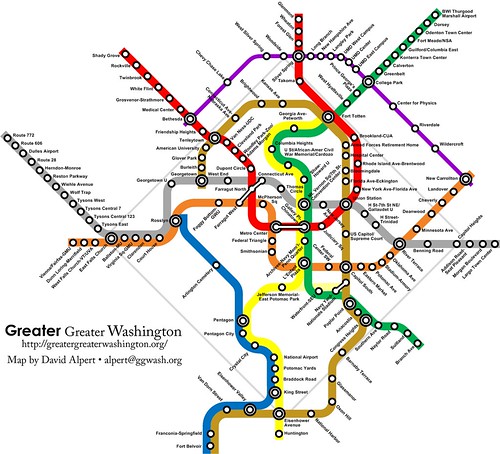
Conclusion: One of the best ways to improve reliability and safety in the Metrorail system is to create the Separated Silver Line within DC.   Sadly, this is where my lack of ability with graphic design software shows.  Many years ago David Alpert of Greater Greater Washington was kind enough to create a graphic of an idealized Metrorail system based on my thinking at that time.
Conceptual map for transit expansion in the DC region with a focus on subway service expansion within the District of Columbia.

But my thinking has continued to evolve and this is what I would propose now:

Separated Silver Line and Separated Orange Line

1.  Instead of what used to be called the separated Blue Line, I would now term it a separated Silver Line.  It could also be thought of as a "Downtown Relief Line."

Instead of joining the Orange Line at East Falls Church Station, instead treating it as a transfer station, the Silver Line could continue south to Route 50/Arlington Boulevard then east to Rosslyn, crossing to Georgetown, continuing eastward to Union Station (this adds capacity to serve Amtrak's plans for expansion), and then further east to H Street NE.  (The Arlington Boulevard alignment was suggested by commenter Ryan in a thread at GGW.)

2.  This would add stations in Northern Virginia and DC.  At the very least it would add one crossing and at least 9 new stations in DC, with 3-4 more stations if an additional Silver Line leg was constructed up Bladensburg Avenue.  It would serve key activity centers not currently served in Virginia (Arlington Boulevard/Seven Corners) and DC (Georgetown especially), providing additional capacity Downtown and at Union Station.

3.  The map above shows a separated silver line and a separated orange line with a transfer station at "River Terrace"/in the vicinity of RFK Stadium, I would route the Separated Silver Line onto the Blue Line alignment from RFK Stadium to New Carrollton (this is a change) and keep the current Orange Line routing.  This would allow transfers between the two lines.

4.  A separate intra-city leg of the Silver Line could be added along Bladensburg Road from H Street to New York Avenue and Fort Lincoln.

5.  The current bridge alignment of the Orange Line from Stadium-Armory over the parking lots to the Minnesota Avenue station would be eliminated, replaced by a tunnelized alignment along Benning Road from H Street and Bladensburg.  This would enable superior redevelopment of the RFK Stadium site.

Separated Blue Line/Brown Line

1.  The map above shows a truncated Blue Line ending in Rosslyn, and a "Brown Line" starting in Georgetown, extending south to National Harbor in Prince George's County and then west to Alexandria.

2.  I would merge the two lines so that the Blue Line continues from Rosslyn across to Georgetown and then up Wisconsin Avenue, connecting to the western leg of the Red Line, and turning east at some point in Upper Northwest, providing an east-west high capacity transit connection in the upper city.

3.  The Brown Line concept merges some of my ideas with Internet blogger MV Jantzen.  While the map above shows a southern alignment along North Capitol Street to Union Station and south into Prince George's County and then west to Alexandria, now I would probably have it go out New Hampshire Avenue into Montgomery and Prince George's Counties.  Before I thought that could be a more western leg of a separated Green Line.  It would have a transfer connection at Fort Totten.

The DC justification of extension out New Hampshire Avenue is to interdict commuter traffic to and from DC.  Montgomery and Prince George's Counties would see additional intensification benefits as well as an additional Metrorail connection to the Purple Line at University Boulevard.

4.  This would add a number of stations within DC serving areas currently not served by high capacity transit, plus an east-west connection in Upper Northwest, which has only one major east-west connection currently (Military Road-Missouri Avenue-Riggs Road).

Separated Green Line

Some of the visualization is difficult because I don't have a map of all these ideas.  The map that David Alpert did shows a brown line.  Now I suggest that the blue and brown line be combined, and the blue line should continue across the Potomac River to Georgetown and up Wisconsin, turning east and some point and providing an east-west connection across Upper Northwest Washington, connecting the east and west legs of the Red Line, plus the option of continuation out New Hampshire Avenue.

1. The Green Line could be separated and merely limited to its current footprint, without sharing stations with the yellow line.

2.  Alternatively, on the southern end it could be extended from its terminus at Branch Avenue to National Harbor and then across to Alexandria.  This change would serve National Harbor, one of the area's leading new activity centers in Prince George's County, and would provide more transit stations in Prince George's County and an east-west connection to Alexandria, Virginia.

3.  However, extending the Purple Line from New Carrollton to Alexandria with a connection to National Harbor could do the same thing and that probably makes more sense financially.

MetroForward 2040 Network concept map, WMATA.  I am not a fan of this proposal for a 
new 2040 Metrorail Network because it doesn't add service east of Union Station.

Separated Yellow Line

A separated Yellow Line within DC was first proposed in a blog entry by Dave Murphy and it could be extended to Montgomery County.

At first I wasn't supportive because of the low density nature of Georgia Avenue within DC, but long term the zoning could be changed and the area intensified, justifying the cost of creating a Metrorail line there.

1.  DC north.  Within DC, from the 7th Street-Shaw station the line could go north on Georgia Avenue from Howard University and extend outward into Montgomery County, either along Colesville Road or Georgia Avenue.

2.  Connecticut Avenue leg.  Based on a comment by Tom Quinn in the original post about the need for higher capacity transit service in the Connecticut Avenue corridor, in part as a way to interdict the heavy commuting traffic from Maryland, perhaps on the north a separated yellow line could have two branches.

In addition to the leg proposed above, extended in Montgomery County out either Georgia Avenue or Colesville Road, another leg could go up Connecticut Avenue, providing high capacity transit service in between the Wisconsin/Rockville Pike and Georgia Avenue corridors.

Benefits.  By separating the Silver and Orange Lines, each line would have the maximum capacity for 30 trains/hour, which is more than can be accommodated sharing the lines currently.  At least one additional crossing between Rosslyn and DC would be added.

Many more stations would be added in DC, as well as redundancy and more capacity in the core, increasing system reliability.  New areas would be served in all three jurisdictions, increasingly the ability to capture automobile trips and shift them to transit.

Note that adding legs, such as up Bladensburg Road on a separated Silver Line or both up Georgia Avenue and Connecticut Avenue on a separated Yellow Line would reduce capacity from the theoretical maximum because of time required to switch from the branch to the main line.  But there would still be more service and more reliability compared to how interlining works now.

A new alignment for a Blue Line across the Potomac and out Wisconsin Avenue would add service to areas underserved by high capacity lines now, a crucial east-west connection in Upper Northwest, and would add redundancy to the Red Line.  Extending the out New Hampshire Avenue into Maryland would add service there as well as enable the interdiction of commuter traffic into DC.

A separated Yellow Line extended on the south would add service to important parts of Virginia.  On the north, new alignments into two legs would provide service out Connecticut Avenue and Georgia Avenue in DC and on either Georgia Avenue or Colesville Road in Maryland as well as Connecticut Avenue.  (In fact, a Connecticut Avenue leg would probably mean that extending the east leg in Montgomery ought to be out Colesville Road.)

Extending the Purple Line on the south west from New Carrollton to Alexandria would provide other redundancy and access benefits, and provide a higher capacity transit connection to National Harbor which will soon be home to an MGM Casino and hotel complex.

Paying for it.  As I have discussed before, by increasing the allowable height at which buildings can be constructed in Downtown, DC's property tax base would increase significantly and become large enough to fund this kind of bold expansion and intensification of the transit system within DC.

Ideally, a "transit withholding payroll tax" could also be assessed, but for this to be worthwhile, the the federal government has to be willing to pay it (unlikely in the current economic environment), therefore this revenue source may not be worth pursuing.  In the US, certain jurisdictions in Oregon and in Greater New York have such a tax.  In France, this type of tax, called the versement transport, provides a preponderance of funding for transit service in most cities.

Funding for additions within Maryland and Virginia would be provided by those jurisdictions. But planning, design, engineering, construction, and financing should be coordinated, rather than discoordinated, as occurs at present.

=====
Purple Line impact on Metrorail system reliability.  The Purple Line will be a light rail line serving Montgomery and Prince George's Counties in Suburban Maryland.  Its western terminus will be at Bethesda Station on the western leg of the Red Line, and it will connect to the Red Line western leg at Silver Spring, to the Green Line at College Park, and to the Orange Line at New Carrollton, which is the eastern terminus for the line.
Purple Line Map  DC Metro
The original concept of the Purple Line.

The system won't interline with Metrorail so it won't impact system reliability in the way that the addition of the Silver Line has degraded service on the Orange and Blue Lines.

You could argue that by adding riders to the current system, it could add stress because of the failure to add capacity in the core.

However, by providing a missing east-west connection between the subway lines outside of Downtown DC, likely the Purple Line will "add capacity" by providing four new transfer points between subway lines, facilitating transfer between lines without requiring riders to go all the way to Downtown DC to do so, as is required today.
Purple Line routing and station map

Labels: , , , ,

Friday, March 18, 2016

Transit notes from elsewhere #1: system degradation and improvement

System rebuilding. At the streetcar launch in DC a few weeks back, I was talking to a former DC transportation official now working for the federal government, and he commented that it seems like every 30 years or so, rail transit systems need to be reconstructed, and he wondered if that were factored into the cost of transit, whether or not it would be worth it.

Without redundancy, lines have to be closed in their entirety, so that they can be rebuilt, taking transit lines out of service for months or years.  Alternatively, the system can be closed in fits and starts, wrecking service for years and pushing customers away.

I think that this reality ought to reshape--although it's too late--how we think about building transit systems in terms of station density, the number of tracks, the number of lines, and redundancy.

1.  Substantive improvements on the Metro-North Commuter Railroad/Connecticut Division.  Apparently the New Haven division of the Metro-North commuter railroad is back on track after a few years of systematic failure.

This part of the commuter railroad is owned by the State of Connecticut but contracted out to New York State's MTA as the operator.  Things were so bad people had been calling for a different operator ("DOT: Kicking Out Metro-North Isn't Practical," Hartford Courant).   From the article:
Despite continuing frustration by some commuters and many Fairfield County lawmakers, the state can't simply replace Metro-North as its commuter train operator, state Transportation Commissioner James Redeker said Wednesday.

"The New Haven Line is the busiest rail line in the country," Redeker told the General Assembly's transportation committee. "It's probably the most complex [commuter rail] service in the whole country. We have to be very cautious and careful."

Numerous legislators from southwestern Connecticut communities say their constituents are unhappy with slow, unreliable service from Metro-North, and are eager to see the state look for a different contractor to run the New Haven Line and its three branches.
Photo: Michael Sisak/AP.

The renewed success--about 180,000 people ride the New Haven Line daily and the lines set a record last year of more than 40 million passengers transportated--is attributed to the railroad's new president, Joseph Giulietti, and his success at refocusing the organization ("Connecticut lawmakers applaud Metro-North turnaround," "Metro-North Climbing Back Uphill Under Joseph Giulietti," and "Metro-North's 40.3 Million Ridership Sets New Record," Courant).  From the last article:
Still, the railroad suffered by far its worst years in 2012 and 2013 when it was dogged by a seemingly endless run of embarrassing errors and operational blunders that shut down service, in one case for days. Near-crashes became more common and devastating wrecks in Bridgeport and the Bronx further tarnished the railroad's previously excellent reputation.

That ridership rose so soon after all of that is impressive, commuter advocates say. It comes at a time when fuel prices have plummeted, which usually works against mass transit since driving becomes cheaper, noted Jim Cameron, who was a longtime leader of a Metro-North commuter watchdog organization. ...

"The so-called 'inner portion' of the New Haven Line — between Stamford and Grand Central Terminal — had ridership growth of 3.6 percent," Malloy's administration reported. "Commuter trips were up 3.2 percent and discretionary travel was up 4.3 percent."
The system is now focused on reliability and safety over speed ("Metro-North President: Expect Trains To Be More Reliable, Not Faster," Courant).
MacArthur BART station, Oakland.  Photos: Michael Short for the San Francisco Chronicle.

2. Bay Area Rapid Transit (BART)/SF Bay--Usage increases and the system is degrading. BART is the first of the new generation of subway systems built in the US starting in the 1960s, along with the Metrorail system in DC, MARTA in Atlanta, and Metrorail in Miami.

Like the WMATA system, it charges fares based on distance and it functions more like a commuter railroad than an intra-city subway system, although San Francisco has 8 stations and Oakland 4--3 in its core.  Unlike WMATA, BART charges a surcharge for travel to and from the San Francisco Airport. The system is also being extended south to San Jose, both from the west and east sides of the Bay.

San Francisco's intra-city transit system, MUNI, offers an interesting contrast to BART in that it provides a tight set of city-focused services comprised of light rail, streetcars, and buses, while BART serves the long distance inter-city trips. Belmont in Cities in Full contrasts the systems as polycentric (BART) and monocentric (SF).

Ridership nearing capacity.  The BART system is experiencing ridership increases, now around 430,000 riders/day. They experienced some of their highest ridership days during the Super Bowl in February ("BART set ridership record in February amid Super Bowl," San Francisco Chronicle) . BART has 669 railcars, while the DC system has more than 1,100.

BART doesn't charge higher fares during peak hours, unlike WMATA, and in the face of ridership gains they are looking to get riders to move some of their trips to off-peak times, by providing "perks" ("BART offers ‘perks’ in bid to spread out jammed commute crowds"), although it's basic economics-- the quickest way to reshape this would be to put in peak fare pricing. From the article:
As BART trains and station platforms keep getting more and more crowded, the transit system is going to try to use fun and games — and money — to persuade some riders to take trains that are a little less packed.

Beginning this spring, commuters will be encouraged to enlist in BART Perks, a program that rewards passengers who agree to shift their trips from the busiest time of day with points.

Those points, which can also be earned by referring friends, may be redeemed for small cash rewards — or allow participants to play games like spin-the-wheel or Snakes and Ladders for a chance at cash prizes of up to $100.
While the DC system has many more riders, more than 700,000/day, at least two BART stations have significantly more daily users than the highest used Metrorail stations ("These are the most - and least - crowded BART stops," Chronicle).  While Union Station in DC has about 30,000 riders using the station daily, the Montgomery Street and Embarcadero stations in SF have more than 40,000 daily riders--that on a system with about 60% of the ridership of the Metrorail system.

Electrical problems put trains, stations out of service.  In the past few days an electrical problem put trains out of service and service to some stations was suspended ("Down at least 50 cars, BART chaos expected to spill into Friday," SF Chronicle).  The problems are expected to last for months ("BART chaos expected to go on indefinitely") and are the same problem that put cars out of service last month in a different section of the system. From the article:
BART mechanics said Thursday that they were closer to pinning down the problem. They said 50 train cars that failed Wednesday were hit with a power spike as they moved through a track crossover north of the North Concord station. On that stretch of track the power is reaching up to 2,000 volts — twice what BART expects for normal operations.

On each of the broken-down cars, the surge caused a semiconductor device called a thyristor to fail. BART said the parts — which are critical to each car’s propulsion system — cost $1,000 to replace and must be specially manufactured. That will take months, and riders should expect delays and shorter, more crowded trains in the meantime. BART has 669 total train cars and is supposed to be running 570 at any given time. But it is now down 58 cars.
PR Directness by BART atypical for a transit agency.  Interestingly, in response to negative tweets about the problem, BART tweeted back that the system is in decline. Later tweets discussed plans to purchase 500 more cars and other system improvements ("BART admits much of system is at 'end of its useful life' in shockingly honest Tweet," Chronicle).
Various publications have picked up on the story including Wired ("BART’s Righteous Tweetstorm Reminds Us Its Problems Are Our Fault"), commenting on the directness of the thread, which is atypical of government and transit agency communications more generally.  The kinds of issues they have with BART--capacity, system design, redundancy--are similar to those marking WMATA. From the article:
BART’s change in attitude wasn’t based on a policy change, or the recommendation of a public relations consultant. It was the work of 27-year-old Taylor Huckaby, one of the agency’s communications officers, who was helming the agency’s Twitter account on Wednesday night. Huckaby has experience in crisis communications. He was a public affairs liaison for the British consulate in Los Angeles, and the new media director for Bobby Jindal’s gubernatorial re-election campaign in Louisiana (before switching political parties, he notes).

In the year he’s worked for BART, Huckaby has sat in countless meetings discussing criticisms leveled at the system for its inefficiencies. “We would go, ‘Oh my God, look at all these people that are saying XYZ, these horrible things about BART. If only they knew, if only they knew,'” he says. “My attitude every time I came to work here was, ‘Why shouldn’t they know? Why don’t we tell them?'”
Sounds familiar.  Note that many of the comments on the Washington Post editorial, "It’s official: Metro is a national embarrassment," are equally informative and direct, albeit not offered by people affiliated with WMATA, making the kinds of points I make about system design, redundancy, etc.

Today's Chronicle  has another story about BART's structural problems, "BART Shutdown Underscores Aging System's Overwhelming Problems":
But the core of the system, the part that's been operating since 1972 or 1973, is well into middle age and in need of major repairs or replacement. BART officials are planning to place on the November ballot a $3.5 billion bond measure to pay for fixing tracks, power systems, stations and other structures and mechanical systems.

BART's 10-year capital improvement program, which covers maintenance and construction, identifies $9.6 billion in needs but only $4.8 billion in anticipated revenues. In the budget year that starts July 1, BART is tentatively expected to spend $120 million from its $1 billion operating budget on capital projects.

"It's clear that for BART, as a system, many elements have reached the end of their useful life or way beyond and it's become a patchwork approach just to keep it running," said Jim Wunderman, head of the Bay Area Council, a business-oriented group. "This underscores the absolute need for a bond measure this November to bring the system back into a state of good repair so BART, the lifeblood of the region's mobility, can become reliable again."
3.  New York City subways reaching maximum capacity.  Obviously, the NYC Subway system is old, with portions dating to 1904.  Because the system is so vast, the cost for rebuilding portions that need to be upgraded is so vast that it is almost impossible to do so.

Because the system is redundant in its heaviest use sections--much of Manhattan, and parts of Queens and Brooklyn--service failures can be countered quickly, usually, through rerouting of trains because part of the system has four tracks to accommodate express service, and because of interconnections created between lines.

But as the system ages and ridership increases, the ability to keep the system running is becoming inceasingly diminished.  There is a great article in New York Magazine, "One Day, 625 Delays," about the operational challenges faced by the system and its riders each day.

The system has reached the point where its capacity enabled by redundancy is outspanned by the age of the system and the increased ridership demands made on it.

4.  MBTA/Boston not proceeding with late night service.  In 2015, the MBTA system in Greater Boston ground to a halt in the face of record snowfall.  The system, long underfunded with a big backlog of maintenance needs, was finally stressed to the point of no return and was forced to shut down for long periods.

Since then there have been many reports, studies, and new administrative relationships created, although not much in the way of new monies seems to be part of the new agenda.  In response to financial needs, the MBTA Board decided not to continue a special late night subway service program, saying that financial needs elsewhere are more important ("Late-night MBTA service looks like a goner," "MBTA to end late-night service by mid-March," and "Late-night MBTA service ends on Friday," Boston Globe).

Labels: , , ,