Rebuilding Place in the Urban Space

"A community’s physical form, rather than its land uses, is its most intrinsic and enduring characteristic." [Katz, EPA] This blog focuses on place and placemaking and all that makes it work--historic preservation, urban design, transportation, asset-based community development, arts & cultural development, commercial district revitalization, tourism & destination development, and quality of life advocacy--along with doses of civic engagement and good governance watchdogging.

Saturday, February 15, 2025

Disturbing event cancellation at Pike Place Market in Seattle | versus public art in PortlandA

 According to the Seattle Times, "Pike Place Market backs out of event on incarceration of Japanese Americans."  The internment of Japanese-Americans during WWII mostly affected people on the West Coast.  Plenty of people at the time were favorable to the deportation.  From the article:

An event commemorating the incarceration of Japanese Americans during World War II and calling attention to President Donald Trump’s immigration policies was canceled by Pike Place Market less than two weeks before the scheduled event.

The Pike Place Market Foundation determined the event’s “resistance” messaging did not align with its purpose as a social service organization, philanthropy director Patricia Gray said in a statement Monday.

-- Tsuru for Solidarity

For me, as a past board member of a public market in DC this is disturbing, because a public market is a public space and a legitimate place to hold protests and have discourse on public issues of all types.

Which is why I've always been amazed by the Tri-Met transit agency in Portland, which hasn't avoided controversy in its public art program.  I was there for a historic preservation conference in 2005, and one of the tours I registered for was of the light rail.  There were a bunch of issues related to getting it approved, funded, and built, and ancillary issues like public art.

At the Exposition Station, when the Expo Center was used as a staging center for Japanese internment and the public art on the transit station site reflected that, presenting a with "dog tags" like those issued to the internees ("Speak Now – Vocabulary of Memory," Ultra Portland).  

Expo Gates, Valerie Otani, Expo Center, Portland, Oregon.

Valerie Otani addresses the theme of Japanese relocation during World War II at the site of the 1942 Portland Assembly Center. Traditional Japanese timber gates strung with metal "internee ID tags" mark station entrances. Vintage news articles are etched in steel and wrapped around the gate legs.  (The artist spoke to us on our tour.  And the headlines of the newspapers included in the work were vicious and racist. )

The other amazing thing about the installation is that there were metal copies of Portland newspaper front pages from that time, and they were amazing racist and virulent wrt the Japanese-Americans.

It certainly puts the decision of Pike Place Market in perspective.  From the article:

Tsuru for Solidarity, a social justice and immigrant rights organization led by Japanese Americans, planned to hold a “Day of Remembrance and Resistance” event at the market on Feb. 19. The foundation notified the group of the cancellation Feb. 7. The Day of Remembrance commemorates President Franklin D. Roosevelt’s signing of Executive Order 9066 on Feb. 19, 1942, which authorized the forced removal and incarceration of more than 110,000 people of Japanese descent from the West Coast.

Pike Place Market had seemed like a poignant location for the event, said Stanley Shikuma, a member of Tsuru for Solidarity’s leadership council.

Despite discriminatory practices in daily stall assignments, Japanese American vendors were the primary driver of the market’s success in the decades after it opened in 1907. Before World War II, Japanese American farmers occupied more than 75% of the produce stalls at the market.

Later the Market apologized for the cancellation but it's not clear if the event will still go forward-TV) ("Pike Place Market apologizes for withdrawing from nonprofit's Day of Remembrance event," KING5).  They said the event isn't congruent with their values.  

I can understand self-censorship.  I think public spaces like markets, excepting Nazi demonstrations, need to be hands off in terms of content.  Either approve almost everything, or don't approve anything.  Although I don't see how the Trump Administration would attack the Market.  Especially in a highly Democratic city like Seattle.

In any case, Portland's Tri-Met is a definite outlier.  Cf when DC cancelled an art installation proposed for the Anacostia River, installing a gas station pump canopy in the River, challenging fossil fuels and their effect on the environment, and for a time aimed to squelch dissent in art ("Public art, environment, history, and the locals all collide in the Anacostia River" Grist, ""After outcry, D.C. commission backs down on censoring art," Washington Post).

Antediluvian by Mia Feuer

Art and dissent has a long tradition, longer than that of the collision of public art, dissent and public funding.  Art in places of contestation is equally problematic ("Monuments as public art, historiography, and change," 2020).

Labels: , , ,

Saturday, March 30, 2024

Alcohol regulations against licensing due to proximity to schools, churches, and parks are dumb

 1.  Alcohol is mostly served in the evening.  Schools close around 3pm and aren't open on weekends, when most alcohol is sold.

2.  Besides the First Amendment separating church and state, churches are mostly only active Saturday or Sunday morning.  The establishments that serve alcohol tend not to be open when churches are.

3.  With parks, plenty of parks serve alcohol at restaurants within the parks.  Cities like Philadelphia and Milwaukee use beer gardens as an amenity in parks in the summer ("Traveling Beer Gardens, Milwaukee").  Having establishments on the perimeter of parks selling alcohol in a managed way shouldn't be seen as a bad thing.

4.  Mixed use commercial districts may include park spaces, schools, and churches.  So you can't have restaurants or taverns there?  Surprisingly, DC doesn't have the church exclusion, so this isn't an issue on that dimension, but does have the school and park exclusion.

This comes up because the Forty Three Bakery in the Poplar Park neighborhood wants a liquor license so it can get more customers and make more money ("Why a pyramid is keeping this SLC bakery from obtaining a liquor license," Salt Lake Tribune), but it's too close to a church.

The owner of a west-side Salt Lake City bakery said he is struggling to stay in business, and he believes getting a liquor license would help with that. But the problem, according to the state’s Department of Alcoholic Beverage Services (DABS) and Utah law, is that his business is too close to a church.

Pastry chef Andrew Corrao, who opened Forty Three Bakery in Poplar Grove last fall, said his business is financially “not in a great spot.”

It’s been a slow winter for the bakery, which is located in a renovated warehouse that required an extensive buildout to open. Corrao is still trying to pay off construction debts, and just had to finance the installation of a $25,000 drop-down ceiling over his kitchen. He also got new insurance in anticipation of starting to sell alcohol, which raised his yearly rate from $1,200 to $12,000.

Given how much the state is controlled by the Mormon Church, it's likely this law will change anytime soon.

Funny because people on the West Side complain that they are underserved by retail and amenities.  This is where antiquated laws get in the way.

And restaurants are important elements for reviving commercial districts (""Richard's Rules for Restaurant-Based Revitalization," 2005, subsequently revised).

Labels: , , ,

Thursday, March 02, 2023

The Toronto Public Library has launched a new collection featuring books banned, challenged or censored across North America.


-- "It’s never been more important to protect the right to read," Toronto Star

Labels: , , , , ,

Friday, September 24, 2021

High school student activism in York County, Pennsylvania reverses book ban

This week's Philadelphia Inquirer columnist Will Bunch's e-letter has a bunch of great content including on how Joe Manchin totally fails to represent West Virginia when it comes to the state's great needs--it's got the fifth worst level of poverty in the country.

Students, parents and educators gather outside the Central York School District Educational Service Center to protest the district's banned resources list on Monday, Sept. 20, 2021, in Springettsbury Township. 

Organizers of the protest brought along some of the books that are currently on the district's banned resources list.  Photos: Dan Rainville, York Daily Record.

Bunch writes about how school boards are capitulating to conservative parents angry about mask mandates and "critical race theory." 

He calls our attention to how high school students in the Central York School District in York County, Pennsylvania successfully organized against a school board "freeze" on books about the country's difficult history with race, racism and segregation ("Central York students speak out against book ban," WGAL-TV).  

Actions included protests and a campaign to stock Little Free Libraries with the banned books.

More than 200 pro-expression parents, as well as the author of two of the "frozen" books, came to Monday night's board meeting, where the school board then reversed its decision ("Central York school board votes unanimously to rescind book ban: 'It has taken far too long'," York Daily Record).

Organizing matters.

Rather than capitulate to the loony right wing, organize [fight] back.

=====

Elsewhere in Pennsylvania, other "organizing" efforts against the "Big Lie" include the PBS station in Harrisburg--the state's capital--mentioning the participation of elected officials complicit in the Big Lie, when reporting on them ("Countering the big lie: WITF newsroom’s coverage will connect lawmakers with their election-fraud actions," WITF-TV/PBS).   

The Legislature fought back by cutting its small appropriation to state public television and radio services ("State funding for Pa. public broadcasting eliminated in new budget," Pennsylvania Capital-Star).

Similarly, the Philadelphia Inquirer refuses to call what conservative legislators are doing wrt election reviews an "audit" because what they are doing doesn't meet the basic definition of what an audit is ("Words matter. So these journalists refuse to call GOP election meddling an ‘audit’," Washington Post).

Labels: , , , , , ,

Tuesday, August 29, 2017

National Freeway Free Speech Weekend Scheduled for Sept 2nd-4th

Press release:

National Freeway Free Speech Weekend Scheduled for Sept 2nd-4th
Signs with Political Messages to be affixed inside Freeway Overpasses nationwide

This Labor Day weekend, Americans will be posting signs with political messages on the inside of freeway fences.

Since people travel on freeways and highways in numbers larger than ever, this simple act allows their voices to be heard, or at least seen, by thousands.

A form of local, meaningful action, people will be flexing their free speech by making signs that abide by our First Amendment (non-commercial, non-threatening, and cannot advocate for violence, political or otherwise) and securing them across America.

· WHO: The American Public, expressing their political opinions en masse

· WHAT: A free speech event wherein people will create large political signs, and safely hang them along freeway fences and overpasses

· WHERE: Communities across America

· WHEN: Labor Day weekend, September 2-4, 2017

· WHY: With the heated rhetoric happening among our politicians, media, and even family and friends, many feel unheard. But, National Freeway Free Speech Weekend gives people the opportunity to easily, quickly, and effectively make a statement.

Signs along highways and freeways reach thousands (sometimes hundreds of thousands) in an effective, safe way. Now, more than ever, it is our duty to use free speech responsibly and be empowered by this constitutional right.

Participants must ensure they create and affix signs safely (DIRECTIONS).

Examples of signs that have been posted in the past.

If you plan on participating, please respond with what city you will be representing and forward photos of your sign(s) to freewayblogger@yahoo.com or post on Facebook to be featured in the Freeway Blogger Blog.

Labels: , , ,

Tuesday, April 28, 2015

Historic Preservation Tuesday: Saving buildings vs. "the right to petition to redress grievances"

I joke sometimes that one of the problems of the rights enumerated within the First Amendment of the US Constitution:
Congress shall make no law respecting an establishment of religion, or prohibiting the free exercise thereof; or abridging the freedom of speech, or of the press; or the right of the people peaceably to assemble, and to petition the Government for a redress of grievances.
is that when people learn of "the right to redress grievances" they believe that a petition in and of itself is action, and that signing a petition is action.

But it depends.

A petition is a call to action, but it isn't necessarily an action because many issues are addressable only through defined processes, when laws and regulations provide for "remedies" depending on the nature of issue.

With historic preservation, if you have the right laws and regulations in place, you can work to prevent a building from being demolished.  You may not win, but you have the chance.  But you must follow a specific process, it's not a matter of signing a change.org petition,

Image from the Ghosts of DC blog.

In the case of DC, to prevent a building that is not located in a historic district from being demolished, the only remedy under DC law is to prepare and file an application to designate the building as a historic landmark.

I bring this up because the Ghosts of DC website is promoting a petition to save the house at 3400 Massachusetts Avenue NW from being demolished ("Save this historic DC home").  But instead, they ought to be preparing a landmark nomination.  A petition has no legal standing in the matter.

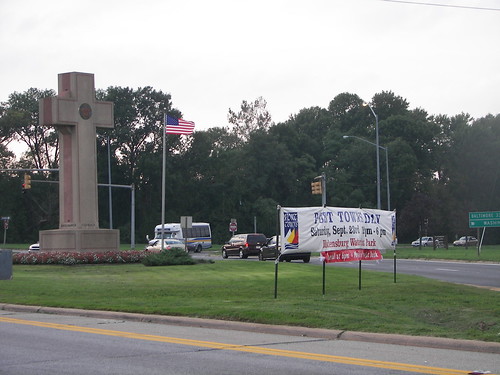
Port Towns Day banner and the Peace Cross2.  Preservation laws are complicated.

For one thing, people think that a building listed on "the National Register of Historic Places" protects the building from any and all circumstances.  

That isn't the case.  Listing on the NRHP only protects buildings from "federal undertakings" and requires a review, which could still end up with loss of the resource.  (Federal laws concerning preservation include the National Historic Preservation Act and the National Environmental Policy Act.)

This comes up with Peace Cross in Prince George's County.  According to the Gazette ("Woman fights to save Bladensburg Peace Cross through film"):
[Renee] Green, 52, of Annapolis is producing a documentary called “Save the Peace Cross,” and is the sponsor for the World War I memorial’s nomination to the National Register of Historic Places. Green grew up in Prince George’s County and visits Bladensburg regularly as a board member of the Elizabeth Seton High School alumni association.

The documentary is a direct response to a lawsuit by the American Humanist Association, which argues the Peace Cross is a religious symbol on government land that appears to only honor Christian servicemen. ...

With assistance from the Maryland Historic Trust and the county’s Historic Preservation Commission, Green completed the National Registry paperwork for the Peace Cross. She said the memorial’s age, integrity and significance meet all of the registry’s qualifications — the Peace Cross is more than 50 years old, it looks fairly the same as it did when it was erected, it is associated with a historic event and it is significant to architectural history, as it was designed by craftsman John J. Earley, who developed a process for producing exposed aggregate concrete.

“If it had been in there before, you can’t have it removed. You can’t have it destroyed,” Green said. “I don’t think this lawsuit would have gone anywhere.”
but that isn't really the case as it depends on the local laws and whether they provide protections for local undertakings.  If the County wants to get rid of the memorial, it could.

In fact, the realization that listing on the National Register didn't protect buildings from local undertakings, and the demolition by a church of buildings it owned in the Capitol Hill Historic District for a parking lot, led to the creation of a strong local law.

3.  The point is that to protect resources in most instances, there need to be local laws addressing the actions of local property owners, and local governments.  Most jurisdictions have preservation laws and processes, but they vary in how strong they are.

4.  Most jurisdictions provide elected officials with either or both the privilege of final approval or withdrawing recognition.  In those places, it's pretty common that economic and political choices contravene historic preservation considerations.  And the preservation board will often make decisions based on those considerations as well, trying to keep decision making within the bounds of the expectations of the "higher authorities."

Image from Preservation Arlington.  Note that judging by the photo, there are definitely integrity issues that militate against a hardcore decision on saving this building as is.

This has come up in Arlington County and the decision to demolish the historic Wilson School building, because of the cost of preservation and the desire for economic growth in a county that is increasingly pressed economically.

According to the Washington Post story "Arlington won't call 105-year-old Wilson School historic":
More than a dozen residents, including an 85-year-old woman who attended the school between 1936 and 1942, pleaded with the board to designate the building a local historic district as a way of forcing the school board to incorporate the red-brick structure into its plans for a new 775-student school. But opponents argued that the distinctive portico, columns and cupola were removed from the school in 1963 and that it would cost millions to retrofit the structure to meet today’s building codes.

“It would cost a fortune to do it right . . . and we have a lot of needs in this county,” said board member Libby Garvey (D), pointing out that the county has saved several other historic schools. “There’s a time in life when you have to let go of things.”
5.  By contrast, DC's preservation laws are significantly stronger than other jurisdictions in the US.  (a.)  Owners don't have to approve designation for it to occur.  (b.) Organizations with appropriate standing can submit landmark nominations on properties they do not own.  (c.) the Historic Preservation Review Board makes decisions on whether or not resources are worthy of historic designation.  (d.) while the decisions are subject to certain levels of review, the Mayor or City Council cannot intervene in the process* or overturn decisions.

(* The Mayor does have some powers of suasion and can ask board members to resign or decide to not reappoint members if displeased by certain decisions..  But otherwise, the Executive Branch and the Legislative Branch can submit testimony just like anyone else.)

6.  But with this level of strength in the law also comes heightened responsibility.  There is a process for overturning decisions, through administrative law procedures and the courts, but such decisions require a high bar.

Also, given the strength of the actions they take, the HPRB is forced to be clear about its decision-making processes.  They follow the law and regulations very closely, making determinations on architectural, archaeological, and historic grounds, and so, in the case of "landmarks," which have to meet a higher level of significance than "contributing buildings" in a historic district, the HPRB is not likely to rule favorably on designating an average building with limited architectural or historical significance.

7.  To summarize, to save a building from demolition--if it is even possible--you have to follow the rules specific to your jurisdiction.  In most cases, National Register listing is immaterial to the threats typically faced by historic buildings and sites.

Labels: , , , , , ,

Wednesday, June 19, 2013

Holding on DC historic preservation matter concerning a church schools us on both RLUIPA and "economic hardship" claims

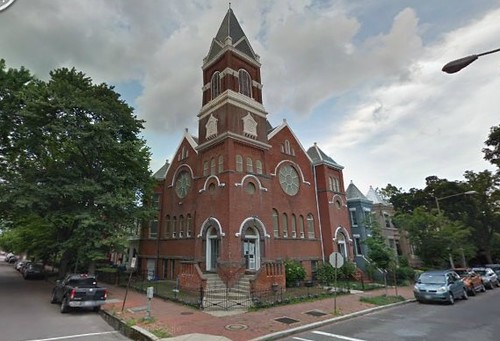
church, 700 A Street NE, DCA church denomination, World Mission Society, bought a "used" church present in the Capitol Hill Historic District, located at 700 A Street NE, in Washington, DC (building pictured above, from Google Street View), to start a congregation in the DC metropolitan area.

The church building has "graven images," that is to say, stained glass windows depicting religious figures and stories, and so the church wanted to remove the windows.  No said the DC Historic Preservation Review Board.

The church appealed, on two grounds.  First, that not allowing the windows to be removed is an unreasonable restriction on their First Amendment rights to practice religion and the separation of church and state clause. The RLUIPA--Religious Land Use and Institutionalized Persons Act--is a federal law designed to provide "equal treatment" to religious institutions with regard to local building regulations, and this act was referenced in the appeal.  Second, they made the claim that the restriction created an "economic hardship."

The opinion by the Mayor's Agent (in effect a "Court of Appeals" vis-a-vis the Historic Preservation Review Board, although the plaintiff could still appeal the decision to local or federal courts) is a very careful application of the relevant laws and regulations.

The foundation of the ruling has to do with the fact that the Capitol Hill Historic District is what we might call a "pre-existing condition," and it is then incumbent on any property purchaser to do due diligence concerning how the historic preservation regulations may impact on the plans a purchaser might have for a property.

So, while many jurisdictions end up interpreting RLUIPA to mean that churches get to pierce local building regulations for just about anything they say that has to do with practicing religion, the opinion takes an opposite stance.  Since the preservation regulations regulate facades present to the street and windows for all properties within a historic district, the holding argues that a church is not treated any different from any other property, when such regulations are applied.

And with regard to claims of economic hardship with regard to historic preservation regulations, the denial of the claim was based on the fact that applying the building regulations equally to a church, regardless of the  intent of the owner, does not create a hardship.  Therefore, there is no justification for not applying historic preservation/other building regulations to a building, regardless of the use, even if that use is religious.

As a non-lawyer, the opinion is an important read as well, because it makes very clear on how such narrow grounds and interpretations legal arguments are made.

Note that if the historic district designation hadn't been a pre-existing condition, the findings may have been different, although it would have been impossible to have the same fact pattern.  (Meaning that the church would have already removed the windows.  I don't see how an action would have been brought against the church to put them back in, upon the creation of a historic district.)

Labels: , , , , ,

Tuesday, October 16, 2012

What is it about the first amendment and government that special interests don't understand?: transit advertising edition

Astrid Riecken/FOR THE WASHINGTON POST. Controversial posters on the Israel-Palestinian conflict are up at the Georgia Avenue Metro stop and three other Metro stations after a court battle.

With regard to the Post article "Faith groups demand Metro donate ad proceeds to charity," apparently many people don't understand the Constitution of the United States governs the relationship between the "people" and "government."  So the Bill of Rights (and all the amendments to the Constitution) applies to the relationship between the government and the people, not between people and say, where they work (i.e., you don't have freedom of speech in the workplace, usually, unless you work for government, and even then...).


Anyway, as units of local or state government (and taking funds from the federal government), transit authorities like WMATA are bound by the law, starting with the Constitution, and including the First Amendment.

This means that if the agency allows paid advertising on trains, buses, bus shelters, and in subway stations, it can't make decisions to bar advertising because it is political or distasteful, unless it reaches the point of being inflammatory to the point that it incites "imminent lawless action" Brandenburg v. Ohio (1969).  The choice is either to take all advertising (subject to other relevant laws or policies, such as the barring of categories such as tobacco) or none.  They can't choose.

Although WMATA did make the argument, unsuccessfully, that the ad could be inciteful to the point of lawless action (see "Federal Court Hearing Scheduled in AFLC’s Challenge to D.C. Transit Authority’s Refusal to Run Anti-Jihad Advertisement" from the American Freedom Law Center).

And despite such calls from opposing groups, the agency has no obligation to provide free counter-advertising to organizations that have opposing positions to those stated in particular advertisements placed in the transit system, or to donate the money it received for the ads to other groups.

Groups with opposing positions can buy advertising, just like any other organization.  And they are.  See "New Metro Ads Protest 'Hate Speech'" from NBC4.

Labels: ,

Wednesday, September 12, 2012

Beyond Zuccotti Park: book and exhibit (through (9/22/2012, New York City)

New Village Press, an initiative of the organization Architects/Designers/Planners for Social Responsibility, has just published the book Beyond Zuccotti Park: Freedom of Assembly and the Occupation of Public Space, which is a collection of chapters about various issues touched off by the Occupy Wall Street movement, particularly in New York City and the occupation of and eventual removal of protestors from Zuccotti Park, a "privately owned public space" in the vicinity of Wall Street.

I intended to read the book last week when I was on vacation and I didn't get through enough of the book (it's about 400 pages) to be able to do a full-scale review as of yet.

Suffice it to say that the book is an important contribution to the literature in terms of public assembly, First Amendment, and public space issues.

It's important to call attention to the book now, because for people in the New York City region, there is a companion exhibit at the AIA Center for Architecture, that runs through September 22nd.

On Sunday September 16th there will be a panel discussion at the Center, Freedom of Assembly: Public Space Today, featuring a number of the chapter authors as presenters.  It's the third presentation of a series on the subject.

----
With regard to the book, I have to say there is a lot to think about through points raised in the various chapters.  It's sparked more thinking by me in terms of planning for public space and spaces for contestation and rules and regulations for demonstrations as opposed to other kinds of uses and events in the public space.

A demonstration or protest isn't the same as a street festival, and deserves a higher level of protection in terms of public expression.  Typical rules for street festivals aren't relevant to and shouldn't be enforced against protests.

(While I might not agree to the extent of how law was interpreted, in NYC local judges have ruled that the sale of books is a first amendment right, and so NYC's regular vending laws in terms of licensing and other provisions are held to not fully apply--book sales rules are different.  I think the same type of treatment needs to be applied to demonstrations and protests for certain rules and regulations, such as amplification.  See "The regulation of street vendors" testimony from the New York Civil Liberties Union and the "Street Vending" fact sheet from the City of New York.)

For example, I was derisive of the "public telephone" aspect of the demonstration in Zuccotti Park, where people didn't speak continuously, but spoke a sentence or two, which was repeated by people in the audience so everyone could hear what was being said.

The reality is that the City Government in New York City denied the protestors a permit for amplification.

To me that is a huge violation of freedom of assembly protections in the First Amendment.

My review of the book will extend some of the ideas discussed in "Community cleanups and other activities as community building and civic engagement activities," which is somewhat misnamed as it discusses various types of spaces that support community building and the right to challenge government inherent within the governed, "Ground up (guerrilla) art #2: community halls and music (among other things)," and "The layering effect: how the building blocks of an integrated public realm set the stage for community building and Silver Spring, Maryland as an example."
NYPD Police Bus, OWS Occupy Wall Street Movement, Zuccotti Park, New York City
NYPD Police Bus, OWS Occupy Wall Street Movement, Zuccotti Park, New York City by jag9889, on Flickr.

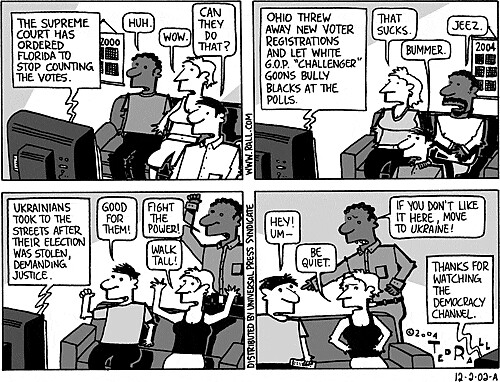
Ted Rall editorial cartoon, 12/2/2004 

Ted Rall editorial cartoon, 12/2/2004

Labels: , , , , ,

Monday, January 16, 2012

Democracy is fine when it's 9,000 kilometers away, not 2 blocks away: two editorials in the Washington Post

Excuse our mess democracy in progress, in the Occupy DC encampment in McPherson Square
A sign posted January 8, 2012 in the Occupy DC encampment in McPherson Square in Washington, DC. Today marks the 100th day of occupation in DC. AFP PHOTO/Karen BLEIER (Photo credit should read KAREN BLEIER/AFP/Getty Images).

The Washington Post is okay with civil society and the role of protest in Egypt, based on this editorial, "Harassment in Egypt," but not in the U.S. and specifically DC, and not at McPherson Square, which is 2 blocks away from the Washington Post offices, and is probably not so pretty to look at up close, based on this editorial, " It may be time for Occupy D.C. to leave McPherson Square."

From the second editorial:

NATIONAL PARK SERVICE officials have bent over backwards to accommodate the First Amendment rights of the Occupy D.C. protesters at McPherson Square. Those rights, though, must be carefully balanced against other public interests. That’s why federal officials are right to take seriously the warning from D.C. officials about the health and safety risks posed by the increasingly unseemly encampment. The time may well have come to reclaim this public space.

From the first editorial:

ON DEC. 29, Egyptian security forces and troops launched an unprecedented raid on 17 offices of American and U.S.-funded civil-society groups ... Egyptian officials seeded local media with stories that portrayed the nongovernmental organizations (NGOs) as part of an international conspiracy to interfere in the country’s politics.

... the U.S. NGO offices as well as those of several Egyptian groups remain closed. Their computers have not been returned, and staff members are still being summoned for interviews with prosecutors who say that they are conducting a criminal investigation. In short, the Egyptian government is openly flouting the administration’s demand for a quick reversal of its harassment.

U.S. officials say that they are still pressing the issue hard. But in public, the administration’s rhetoric has been softening.


If the problem with the protest encampment in McPherson Square is rats, deal with the rats and other public health issues. Don't use public health concerns as an excuse to suppress democratic expression.

Don't shut the encampment down out of some mealy-mounted concern about public health, unless you also argue that the same kind of false messages being spread by pro-government groups in Egypt are equally accurate.

You can't have it both ways.

Protest and opposition and social movements aren't always pretty. And they don't follow a convenient, straightforward, linear narrative.

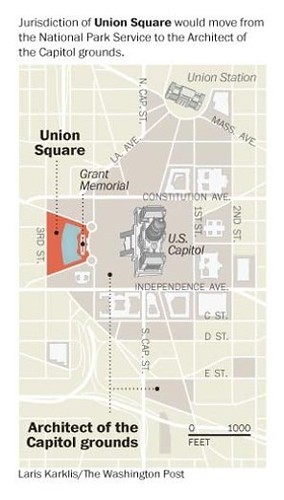
Ironically, the Post did editorialize in favor of democracy in DC, in the piece, "Fortress Washington," about the transferring of a part of the National Mall, Union Square, between the Capitol Grounds and 3rd Street, from the jurisdiction of the National Park Service to that of the Architect of the Capitol. (Also see "Capitol claims control of part of Mall.")

From the editorial:

“IN THE NAME of security.” It’s a phrase to which residents of the District have become wearily accustomed, as streets have been closed to traffic, ugly barriers and bollards erected and historic views blocked. Now comes word of the surreptitious decision to strip part of the Mall from National Park Service jurisdiction for security reasons. It’s only natural to worry that the public will be further restricted in what can be seen and done in the capital. ...

Because of Washington’s fortress mentality, numerous streets around the Capitol have been closed, the landscape has been littered with unsightly barriers and visitor flow has been restricted. Now it seems that national protests and other events will be moved farther from one of the great symbols of America’s open society. That’s wrong, and unnecessary.

296unionSquare--300x529
Union Square on the map. Washington Post graphic.

The NPS should not be more bound than Congress by the Constitution in terms of the First Amendment, which reads:

Congress shall make no law respecting an establishment of religion, or prohibiting the free exercise thereof; or abridging the freedom of speech, or of the press; or the right of the people peaceably to assemble, and to petition the government for a redress of grievances

but there are legitimate concerns that under the Architect of the Capitol's control, this space will be excised in significant ways from public access and demonstration. (Also see the letter to the editor "Assessing the Union Square shift.")

The Post needs to be consistent in recognizing that expressions of democracy need to be supported, whether they take place "overseas" or in the U.S., even Washington, DC.

Statements about "security" aren't any different that statements about the state of "public health" at McPherson Square with the Occupy DC encampment or that civil society groups in Cairo are not really Egyptian but controlled by foreign agents.

This photo ran with the Post editorial on the McPherson Square encampment.
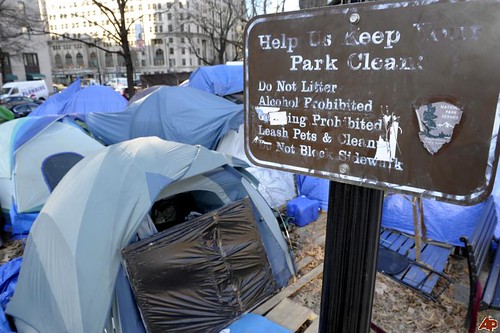
Do not litter sign, in the Occupy DC encampment in McPherson Square
A battered U.S. Park Service sign sits among Occupy DC protestors tents in McPherson Square Park in Washington, Friday, Jan. 13, 2012. Washington Mayor Vincent Gray has called on the National Park Service to remove Occupy D.C. protesters from McPherson Square, citing rat infestation and other health issues. (AP Photo/Cliff Owen)

Labels: , , , , , , ,

Wednesday, October 26, 2011

Protest in the U.S.: challenging the system is not generally tolerated

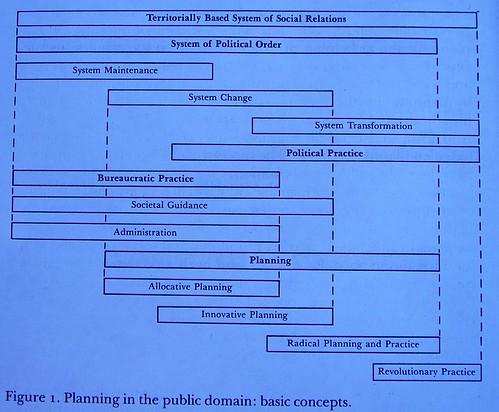
John Friedmann's Planning in the Public Domain is an interesting book because he outlines how to do "radical" planning in the context of existing system of government and political action. He distinguishes radical from "revolutionary" planning, as the latter challenges the precepts and existence of the political system.
Basic Concepts, Planning in the Public Domain

Government, especially the police/coercive power of the state function, is focused on system maintenance.
USA-WALLSTREET/
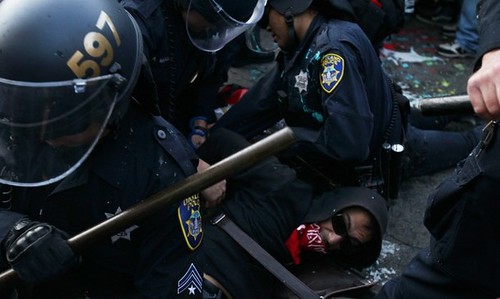
An "Occupy Wall Street" demonstrator is arrested during a demonstration in response to an early morning police raid which displaced Occupy Oakland's tent city in Oakland, California October 25, 2011. REUTERS/Stephen Lam.

Protest, such as the Occupy Wall Street movement, in places including Oakland, California ("Ousted protestors marching back to Frank Ogawa Plaza" from the Oakland Tribune), Chicago, Illinois, Richmond, Virginia, Atlanta ("Atlanta police clear protesters from Woodruff Park" from the Atlanta Journal-Constitution), and New York City, has been challenged in terms of the ability to stay overnight--24/7 protest, to the extent where in Oakland, people were driven out by tear gas.

Focusing on the "rules"--parks are closed at night, etc.--is a classic bureaucratic perspective towards maintaining the system, rather than allowing for flexible spaces where challenge can be accommodated.

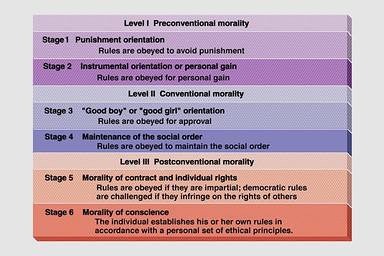
In college I was very much interested in cognitive, affective, and moral development theory. The "police function" of government is very much a function of Kohlberg's stage 4, with the focus on following the rules and maintaining social order. So the police oriented reaction is not a surprise.
Kohlberg's stages of moral development
Although it's ironic, given the support of political elites for challenges to government overseas, such as the Arab Spring movement.

This Ted Rall editorial cartoon from 2004 is still apt today.
Ted Rall editorial cartoon, 12/2/2004

Labels: , , , , , ,

Thursday, October 20, 2011

Private spaces as public spaces: legal rights of property owners vs. legal rights of citizens to use the space

popslogo
Privately Owned Public Spaces logo/indicator used in New York City to denote privately owned spaces that are open to the public.

Years ago on the urbanists e-list we were discussing issues arising from the private management of a public street, such as Ellsworth Avenue in Silver Spring, Maryland--the property manager, Peterson Companies, told people they were not allowed to take photographs, and a lawyer on the list, Chris Brewster, pointed to an older Supreme Court case, Marsh v. Alabama (1946), and wrote:

I do not know if it has been overturned or substantially distinguished by other more recent cases, but it seems to be directly on point to Silver Spring and Ave Maria issues, with only the contemporary parallel of company towns of the 30's and 40's to HOA/Property Management Towns of the 80's, 90's (or "Catholic Church towns" of the 00's??) - very easy parallel for me, anyway.

Ultimately, the very fuzzy rule of this case is: "The more an owner, for his advantage, opens up his property for use by the public in general, the more do his rights become circumscribed by the statutory and constitutional rights of those who use it."


This comes up because of the Occupy Wall Street movement's use of Zuccotti Park in Manhattan, which is a privately owned "public" park where public access was provided to the space in return for zoning relief and/or benefits by the original developer of the building.

Given the tension between capital and capital's vanguard, Tea Party protesters, and democracy as represented by the Occupy Wall Street movement, it will be interesting to see how this plays out.
----

In New York City and San Francisco especially, this has been a common practice, because the amount of relief awarded could be considerable (e.g., in NYC, 10 s.f. of additional developable space for each s.f. of "public access space" provided).

In NYC, Jerold Kayden did a study (and book, Privately Owned Public Space: The New York City Experience) evaluating the impact of the law, the quality, level of access, and the use of the spaces.

-- Privately Owned Public Spaces webpage, New York City Department of City Planning
-- article, Places Journal

He has an op-ed in the New York Times about this, "Meet Me at the Plaza," because as a result of the Occupy Wall Street protest, developers are asking for more specific rules governing their management and the use of the space, including restricting access with regard to protest.

From the article:

Since 1961, the City Planning Commission has used zoning laws to give developers the right to build over 20 million square feet of extra residential and office floor space in return for providing more than 500 public plazas, arcades and indoor spaces. On paper, it reads like a great deal that, at little cost to the city, has given it enough additional public space to cover 10 percent of Central Park.

But the comparison between privately owned public spaces and Central Park stops there. Too many of them — roughly 40 percent, according to a 2000 study I conducted with the Department of City Planning and the Municipal Art Society and that still holds today — were and are practically useless, with austere designs, no amenities and little or no direct sunlight. Roughly half of the buildings surveyed had spaces that were illegally closed or otherwise privatized. ...

Nevertheless, the events at Zuccotti Park highlight the continued inadequacy of the laws regarding privately owned public spaces. Other than the requirement that this space remain open 24 hours a day, the owners were left to promulgate their own rules; the only limit is that they be “reasonable.” ...

Given the drama downtown, it’s unlikely that this vagueness will last much longer. In fact, the Real Estate Board of New York is reportedly preparing to ask the city to endorse universally applicable rules prohibiting future Occupy Wall Street-style use of public space, along with the automatic right to close all spaces at night.

[See "Park Rules Scrutinized" from the Wall Street Journal and "Privately Owned Park, Open to the Public, May Make Its Own Rule" from the New York Times.]

Such proposals raise important questions. Should owners be allowed to prohibit use by organized large groups, whether for political rallies or spontaneous gatherings? Are passive activities like quiet conversation or lunchtime eating to become the only approved conduct? Should all owners have the right to close their spaces at night?
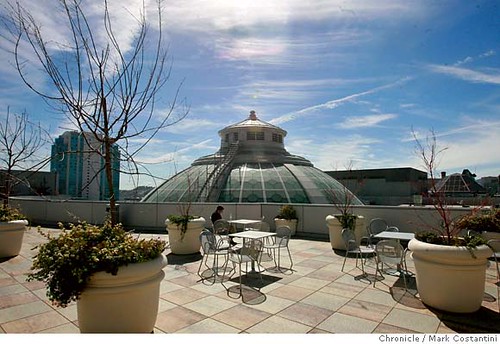
Rooftop open space at Westfield San Francisco Centre at Market and Fifth streets.
Room rates at the new Intercontinental Hotel in San Francisco start at $259. Two spacious terraces, however, are free to anyone who walks in from the street. They're perched off the fourth and sixth floors, and each is drenched in sun during the afternoon. But they aren't as stylish as the hotel bar, where vintage glass is on display and a hamburger costs $16. As of last week, the terraces' decor consisted of stone pavers, sickly bamboo in planters, and a grand total of 19 chairs. San Francisco Chronicle photo by Mark Constantini.

Note that, following in the footsteps of Jerold Kayden, San Francisco's public space advocacy group Re:bar did a similar survey there, which John King of the San Francisco Chronicle wrote about in "Little-known open spaces enhance downtown S.F."

From the article:

Corporate plazas have been part of the downtown landscape since 1959, when the Crown Zellerbach Building at Bush and Market streets opened with a sunken plaza that opened up views. Time magazine praised it as spectacular. Soon after, the planning code was loosened to allow developers to build larger towers if they cleared away space on the ground.

The result was corporate plateaus that often were no more than widened sidewalks. So in 1985, officials changed such spaces from a perk to a requirement. Builders had to provide 1 square foot of public space per 50 square feet of commercial space. Additional formulas spelled out the required seating and made it obligatory to have an informational plaque at street level stating the public hours. Buildings also had to "provide toilet spaces open to the public." ... But once the spaces exist, they're controlled by building owners who may not want the public to put them to use. ...

We've achieved a variety of open spaces. What is deficient is a rigorous enforcement of the guidelines that are in place," said Eva Liebermann, a retired city planner who worked on the 1985 plan. "These are required public spaces, in return for the privilege of building in downtown San Francisco."

At the Intercontinental, planners notified the developer this month that the public seating was deficient. Additional tables and chairs are now on order.


-- Re:bar webpage on Commonspace
-- San Francisco Planning and Urban Research Association report on privately owned public open spaces
-- map of privately owned public open spaces, Downtown San Francisco, San Francisco Chronicle

Labels: , , , , ,