Rebuilding Place in the Urban Space

"A community’s physical form, rather than its land uses, is its most intrinsic and enduring characteristic." [Katz, EPA] This blog focuses on place and placemaking and all that makes it work--historic preservation, urban design, transportation, asset-based community development, arts & cultural development, commercial district revitalization, tourism & destination development, and quality of life advocacy--along with doses of civic engagement and good governance watchdogging.

Monday, February 03, 2025

African American History Month and Transportation: February 4th | Transit Equity Day

Janis Scott smiles as the Route 68 bus leaves her on the Texas Southern University campus while on her way to an exhibit at the University Museum on Feb. 2, 2012, in Houston. Scott, familiar to many Houston residents as the "bus lady," died Monday, Dec. 9, in Houston. Photo: Johnny Hanson/Houston Chronicle

The battles over transportation access were central to the Civil Rights movement.  Transit Equity Day, set by the American Public Transportation Association as February 4th, during African American/Black History Month, is one way to acknowledge this.  Also see Labor Network for Sustainability.

Trump Administration derides equity as an analytical construct.  It's great that transit agencies are taking this step to link African-American and transportation history.  It's a sad but necessary story. 

-- U.S. DOT’s Updated Equity Action Plan: Key Takeaways and Recommendations by the Transportation Equity Caucus, NRDC (2024)

Especially as the Trump Administration demonizes "diversity, equity and inclusion" matters ("US DOT New Head Announces End To Diversity, Equity & Inclusion Policies," Simple Flying).  The fact is, racism happened/happens.  It's a fundamental part of the American story too.

-- Diversity, Equity and Inclusion, American Public Transportation Association

Advocates are figures of today, not merely historical figures.  While we're more familiar with Rosa Parks and Montgomery, Alabama, she wasn't the first black activist fighting transportation discrimination and she won't be the last.  Last fall, the Houston Chronicle ran an obituary on one of Houston's foremost transit advocates, "Janis Scott, Houston's 'bus lady,' arts patron and tireless advocate for public transit, dies at 73."  She was a leading member of the area transit advocacy group, LINK Houston.

An earlier interview is one of the links in a four part series on transit equity by the Rice University Kinder Institute for Urban Research:

Part 1: “Racism has shaped public transit, and it’s riddled with inequities” 
Part 2: “What transit agencies get wrong about equity, and how to get it right” 
Part 3: “What transit equity means to a transit-dependent rider in a car-centric city” 
Part 4: “To tackle pandemic racism, we need to take action, not just take to social media

Hillsborough Area Regional Transit (Florida) does a nice job with wraps celebrating black transportation history.

======

Some agencies are providing free transit access for the day, such as in Santa Monica.  In the DC area, that includes Montgomery County.

The Boston Globe has a localized feature, "Legacy of the Green Book travel guide in New England," on the Green Book.  Today though, transit equity isn't just an issue of race ("Transit Equity Day highlights the need for transit in rural communities," Transportation for America).

Below reprints the entry from last year.  There are some edits and expansions to the original text.

Transit Equity Day in honor of Rosa Parks.  Many transit authorities are providing free transit service on Sunday February 4th, in honor of the Montgomery Bus Boycott, spearheaded by Rosa Parks, which led to the desegregation of bus service in that city and led to changes throughout the South, through a process that sadly took many years.  

Parks' birthday is the date chosen for Transit Equity Day.

Interestingly, like a lot of history, Rosa Parks wasn't the first to do this, not even in Montgomery, Alabama ("Before Rosa Parks, There Was Claudette Colvin," NPR).  But when a concerted organizing campaign was developed, she was chosen to be the face.

Sometime ago, I came across some journal articles about boycotts against streetcar segregation around the turn of the century in the South, including Richmond ("Right to Ride: Streetcar Boycotts and African-American Citizenship in the Age of Plessy v. Ferguson," book review).

DC.  Despite DC being run by the federal government, mostly under the oversight of racist Southern Congressman, the city's transit system was not segregated ("Black activists' post-emancipation battle for D.C.'s city streetcars," book excerpt) as a result of post-Civil War organizing, when Congress still leaned pro-emancipation.  Hiring remained segregated ("The Fight Against Capital Transit's Jim Crow Hiring: 1941-55," Washington Area Spark).

Bus Fare Boycott, 1965/1966.  A future Mayor of DC, Marion Barry intended to get a PhD but instead  came to DC to set up a chapter on civil rights organizing for the Student Nonviolent Coordinating Committee.  One of his campaigns was a bus boycott in response to a fare increase ("Marion Barry Leads Bus Boycott," WETA/PBS).  From the article:

... Barry saw the bus company’s raised rates as a direct hit to low income people in the District, who were mostly African American. On November 8, 1965, D.C. Transit appealed to the Washington Metro Area Transit Commission to increase fares from 20 cents to 25 cents a ride. 

The hearing was held in the Interstate Commerce Commercial Building (now one of the Environmental Protection Agency buildings) at 12th St. and Constitution Ave NW. The small room in which the meeting took place must have soon felt even smaller as uninvited guests showed up; SNCC crashed the party, bringing around 100 colleagues and associates. Speakers from SNCC made it clear that if the fare increase were to occur, a boycott would follow. 

... The main focus was on the Benning Road routes, which served mostly African-Americans. Organizers arranged a transportation system for boycotters: “[R]iders will be offered free volunteer car-pool and bus service to and from their jobs under an extensive plan utilizing four major car assembly points: 45 neighborhood rider substations in stores and churches; 200 volunteer cars and drivers; 20 church donated ‘freedom busses’ and more than 250 neighborhood workers” Barry explained.

... the boycott made a strong impression. Causing a loss of about $30,000 in a single day, it served as a harsh warning to D.C. Transit about the financial impacts a longer demonstration could have on the company. Officials backed down and the fare increase did not go into effect. Barry celebrated the victory, saying that the boycott showed “the people have power.  

Greyhound bus cultural interpretation "board" on the side of the Freedom Rides Museum, Montgomery, Alabama. Photo by Michael Harding

Inter-city bus segregation.  There's a terrible story of the beating of soldier Isaac Woolard returning home from military service, on an inter-city bus in 1946 for not sitting in the back, he was blinded, beaten by a police officer.  

While President Truman was no integrationist he was appalled by how this man who served his country was treated and it led him to take on more of a civil rights agenda, including desegregation of the military ("The Blinding of Isaac Woolard," American Experience, PBS).

The history of the Civil Rights Movement is intimately linked to transportation access, segregation on transit and in transit stations, Bus Boycotts not just in Montgomery, the Freedom Riders quest to desegregate inter-city bus service, violence associated with these protests, etc. 

PBS has programs on the Freedom Riders. It'd be nice to do repeat showings during Black History Month. 

A lens on transit equity.  There is the rise in the number of communities taking an equity lens to government policies and programs, including urban and transportation planning ("Baltimore transit equity study spotlights racial disparities around neighborhoods," Washington Post, "Boston’s fare-free bus pilot program sets the stage for transit equity, advocates say," WGBH/NPR).

Although for some time, transit agencies receiving federal monies were already supposed to be doing this, and they weren't.  

That's changing.  

Former DC planner-engineer and now transit official in Houston, Victoria O. Davis, authored a book, Inclusive Transportation: A Manifesto for Repairing Divided Communities. published by Island Press, on these issues.

I've written a bunch of pieces about certain elements of this over the past decade.  For example,  "Making bus service sexy and more equitable" (2012) discusses how investment in bus systems, network breadth and depth, and streetcars is a benefit for the transit dependent.  

Low income fare discounts ("WMATA to consider lower cost/free transit pass for low income riders," 2020) and incremental pass payment systems, which more transit agencies are starting to implement now too ("13 Reasons Why Transit Agencies Around the World are Choosing Fare Payments-as-a-Service (FPaaS) Platforms for Fare Collection," Masabi).

From Ride On Zero & Reduced Fare Study (Montgomery County Maryland):

... it is not uncommon for low-income users to pay single-trip fares despite the existence of a monthly pass that may provide a more cost-effective means. This can often be the result of limited financial flexibility to afford the up-front cost of the monthly pass. Under this alternative, such users may become even more disinclined to pursue the monthly pass product.

Transportation Equity Day versus Transit Equity Day.   I'd actually honor a broader "Transportation Equity Day," if it were up to me, to address transportation issues beyond transit.  Here are some other topics vitally important to the intertwined story of transportation history and African-American history.

John Lewis (right) with fellow protesters at the Edmund Pettus Bridge in Selma, Ala., 1965. Credit: Alabama Department of Archives and History. Donated by Alabama Media Group. Photo by Tom Lankford, Birmingham News. Photo courtesy of Magnolia Pictures.

Protest in the public space.  It goes without saying that public protest was often held in public spaces, on streets and bridges, through public marches.  

A march on the Pettus Bridge in Selma, Alabama ending in police violence is considered a watershed moment in the Civil Rights movement as parts of it were televised and justice minded people couldn't ignore the reality of segregation.

From "Thousands rally in downtown Los Angeles, shut down 101 Freeway to protest Trump’s immigration policies," Los Angeles Times.  Thousands of people gathered Sunday in downtown Los Angeles to demonstrate for immigration rights, blocking lanes on the 101 Freeway at times.

That transportation infrastructure is still being used in this way in today's protests, like shutting down freeways for George Floyd and anti-Trump Administration marches should not be a surprise.  Unlike today's protestors, those in Selma stayed on the sidewalk!

The expressway was built directly on top of Claiborne Avenue in the late 1960s – ripping up the oak trees and tearing apart a street sometimes called the ‘Main Street of Black New Orleans’. Photograph: Gerald Herbert/AP

Freeway placement divides black communities. An element is how urban freeways were often built through minority neighborhoods ("America's Highway System Is a Monument to Environmental Racism and a History of Inequity," KQED/PBS, "A Brief History Of How Racism Shaped Interstate Highways," NPR, "The racist history of America's interstate highway boom," LA Times, "Could the US highways that split communities on racial lines finally fall?," Guardian).  Other urban renewal initiatives didn't help.

More recently the Biden Administration developed an initiative to fund measures to rebuild connections and address manufactured disparities within disconnected communities ("Transit projects receive more than $1 billion in federal grants designed to reconnect communities," Mass Transit).

Urban design and minority communities.  Traditionally, minority communities face all types of disinvestment, in housing, community amenities, and in mobility infrastructure--streets, sidewalks ("Socioeconomic and racial disparities of sidewalk quality in a traditional rust belt city," SSM Population Health, 2021) including access to transit ("It's not just sidewalks and money, spatial form and density influence the propensity to walk," 2009).

Angie Schmitt writes about this in terms of pedestrian safety, Right of Way: Race, Class and the Silent Crisis of Pedestrian Deaths in America, also published by the great Island Press.

Transit access is more complicated even because "choice riders"--people with cars--see transit more as a social service, not a vital community service.

Another indicator is tree cover, which significantly lags ("Since When Have Trees Existed Only for Rich Americans?," New York Times).  Urban forestry is usually a responsibility for city transportation agencies.

I have thoughts on this in "What is an inclusive city?" (2013) but I can't say it's super specific.  

When I worked on issues in DC I used to say that I wanted every block to be great, and I've made advances in thinking about planning for equity

-- "An outline for integrated equity planning: concepts and programs," 2017
-- "Equity planning: an update," 2020
-- "Social urbanism and equity planning as a way to address crime, violence, and persistent poverty: (not in) DC," 2021

In South America, a foundational element of "social urbanism," a planning approach to public investment that improves communities is in enhancing transportation in transformational ways.  For example, gondolas and escalators to better reach neighborhoods with challenging topographical issues, and bike sharing to enhance first mile/last mile access.  For example, in Bogota, transit users can end their trip on a free bike sharing ride.

David Barth's diagram on the public realm as an interconnected system is great.  But could do better on indicating how the realm is linked through mobility networks.

My more recent writings that communities need urban design and walkable community plans ("Planning for place/urban design/neighborhoods versus planning for transportation modes: new 17th Street NW bike lanes | Walkable community planning versus "pedestrian" planning") and investment in placemaking elements

-- "Extending the "Signature Streets" concept to "Signature Streets and Spaces"," 2020
-- "From more space to socially distance to a systematic program for pedestrian districts (Park City (Utah) Main Street Car Free on Sundays)," 2020
-- "Why doesn't every big city in North America have its own Las Ramblas?," 2020
-- "Diversity Plaza, Queens, a pedestrian exclusive block," 2020
;--"Bus stops as neighborhood focal points and opportunities for placemaking," ) 

are most applicable to these issues.

Driving While Black: African American Travel and the Road to Civil Rights

Individual car ownership as freedom.  For people with the means, privately owned cars were a step towards a kind of freedom from segregated transit ("How Automobiles Helped Power the Civil Rights Movement," Smithsonian, "How Cars Changed Black Life In America," KERA-FM/NPR).  

OTOH, the freedom was circumscribed as black motor vehicle operators had to wend their way through racist traffic enforcement and segregated public accommodations.

Negro Motorist Green Book and public accommodations laws and enforcement.  This book was a guide to safe places for services, gas, eating and overnight stays for African-Americans traveling on the roads in segregated places.  

Negro Travelers' Green Book, 1956. Digital collections, University of South Carolina. Complete scan.

-- "Lighting the Way | When the Way is Dark," Exhibit, Smithsonian Institution
-- "Navigating the Green Book," New York Public Library
-- "An atlas of self-reliance: The Negro Motorist's Green Book (1937-1964)," National Museum of American History).

It wasn't until the mid-1950s when significant gains began to be made in laws concerning the desegregation of public accommodations beyond transit--co-equal access to restaurants, motels, stores, etc.--which led to the Green Book no longer being as necessary. It ceased publication in the late 1960s.

I hate to admit, given all the gas station road maps I've collected over the years, that I am just now realizing that all of the images of people, gas station attendants, etc., only feature whites.

In an interview with travel historian Gretchen Sorin, Spencer Crew recalled traveling in his parents’ car in the 1950s: “that big old car was like a cocoon,” he remembered. “We didn’t know anything except what we saw out the side windows. We could hardly see over the back of the front seat. Our parents protected us from all the racist stuff along the road." Photo titled "Mr. Lifsey presenting Oldsmobile to raffle winner, April 1955." Scurlock Studio Records, ca. 1905-1994, Archives Center, National Museum of American History.

Traffic safety and the black community ("Racial disparities in traffic fatalities much wider than previously known," Harvard).

A new study by Boston University School of Public Health (BUSPH) and Harvard T.H. Chan School of Public Health has found that Black and Hispanic Americans are disproportionately affected by traffic-related deaths—and that these disparities in fatalities are larger than previous estimates show. 

Published in the American Journal of Preventive Medicine on Tuesday, June 7, 2022, the study found that travel distances vary among racial/ethnic groups when walking, cycling, or driving—and when these differences in activity levels are taken into account, Black Americans had the highest traffic fatality rate per mile traveled and across all modes, followed by Hispanics, Whites, and Asians. 

An out of control vehicle crashed into a gas station on Florida Avenue NE in Washington, DC, killing a patron.  Photo: Fox5DC

These disparities were particularly stark for walking and cycling, and during evening hours. The study provides a more accurate assessment of racial/ethnic disparities in traffic deaths than previous traffic mortality studies, which have not accounted for these differences in travel distances, and thus, underestimated both the traffic-related risks and deaths that Black and Hispanic Americans experience. 

These findings may also point to structural racism within the US transportation system, the researchers say.

Disparities in enforcement.  Researchers like Gregory Shill ("Should law subsidize driving?," "Reckless Driving Isn't Just a Design Problem," Atlantic) state that social justice initiatives limiting enforcement against POC ("If Black Lives Really Matter, We Must End Traffic Stops!," William & Mary Institute of Race, Gender and Social Justice, "What Traffic Enforcement Without Police Could Look Like," The Appeal, "Traffic Without the Police," Stanford Law Review) actually hurt the same communities more, because of the deleterious impact of crashes, deaths, and reckless driving. 

There is no question though that there is structural racism embodied in traffic enforcement ("The racial composition of road users, traffic citations, and police stops," Proceedings of the National Academies of of Sciences).

School busing and desegregation is yet another issue.  I was just a bit too young to be conscious of bombing of buses in Pontiac, Michigan in 1971 ("On this day in 1971: KKK bombs empty Pontiac buses set to racially integrate schools," Michigan Advance).  

African American Boycott in favor of the desegregation of Boston Schools, February 26, 1964. (Photo James Fraser photograph collection, Northeastern University, Boston.)

I lived in Detroit at the time, but in 6th and 7th grade I did attend Pontiac Schools, after desegregation.  In Detroit, I attended schools that were segregated based on demographically homogeneous neighborhoods.

PBS has a great documentary of the battles over "busing" focusing on Boston.  

-- "The Busing Battleground: The Decades-Long Road to School Desegregation," American Experience, PBS

-- "It was a war zone: Busing in Boston," WBUR/NPR

I really need to read Common Ground, by J. Anthony Lukacs, about the battle over busing in Boston.

Transportation History interpretation and presentation.  FWIW, I think transit agencies should have a public history interpretation program, including on issues of race, that is displayed at stations, on transit vehicles, etc., 24/7/365.  

This guidebook published by the National Park Service, is useful for selecting sites that interpret this history.

-- Civil Rights in America: Racial Desegregation of Public AccommodationsAfrican-American Theme Studies, National Park Service

US Civil Rights Trail.  Is a broad heritage trail of significant sites and events in civil rights history.  Encompassing 15 states in the Southeast, it could be worth considering creating a sub-trail that is transportation specific.

Brotherhood of Sleeping Car Porters.  The members of this union worked as attendants on the sleeper cars for overnight train service.  These cars weren't owned by the railroads, but by the Pullman Company of Chicago (Pullman Porters, NPS).  

National A. Philip Randolph Pullman Porter Museum, located at the corner of 104th and Maryland Ave. NPS Photo/Ve'Amber D. Miller

Many ended up being civil rights organizers indirectly protected by the travel within their job.  Many ensured that black newspapers like the Baltimore Afro-American, Chicago Defender, and the Pittsburgh Courier were distributed throughout the South.

To push civil rights forward during WWII, the Brotherhood planned a "March on Washington", which was cancelled at the behest of FDR in return for concessions.  The Brotherhood later took part in the 1963 March on Washington ("The Brotherhood of Sleeping Car Porters: The Civil Rights Movement," masters thesis). 

Labels: , , , , , , , ,

Friday, February 02, 2024

Transit equity day, Sunday 2/4/24, in honor of Black History Month, Rosa Parks, and the significance of transportation history to African-American History

-- "Transit equity day, Sunday 2/4/24, in honor of Black History Month, Rosa Parks, and the significance of transportation history to African-American History," 2024
-- "Three ideas about presentation of African American History in the context of Black History Month | reprint with an addition about the US Civil Rights Trail (versus the Dixieland Trail)," 2024

February is Black History Month, and over the years I've written some pieces about the nexus of black history and urban and transportation planning. 

-- "Black History Month and the New Jim Crow," 2020
-- "Two ideas about presentation of African American History in the context of Black History Month," 2020
-- "African American History Month and Urban Planning," 2019

National Archives photo of a pretty much empty bus during the Montgomery Bus Boycott.

Transit Equity Day in honor of Rosa Parks.  Many transit authorities are providing free transit service on Sunday February 4th, in honor of the Montgomery Bus Boycott, spearheaded by Rosa Parks, which led to the desegregation of bus service in that city and led to changes throughout the South, through a process that sadly took many years.  

Parks' birthday is the date chosen for Transit Equity Day.

It's great that transit agencies are taking this step to link African-American and transportation history.  It's a sad story but a necessary one.

-- Diversity, Equity and Inclusion, American Public Transportation Association

Interestingly, like a lot of history, Rosa Parks wasn't the first to do this, not even in Montgomery, Alabama ("Before Rosa Parks, There Was Claudette Colvin," NPR).  But when a concerted organizing campaign was developed, she was chosen to be the face and spearhead out front.

Sometime ago, I came across some journal articles about boycotts against streetcar segregation around the turn of the century in the South, including Richmond ("Right to Ride: Streetcar Boycotts and African-American Citizenship in the Age of Plessy v. Ferguson," book review).

DC.  Despite DC being run by the federal government, mostly under the oversight of racist Southern Congressman in the 20th Century, the city's transit system was not segregated ("Black activists' post-emancipation battle for D.C.'s city streetcars," book excerpt) as a result of post-Civil War organizing, when Congress still leaned pro-emancipation.  Hiring remained segregated ("The Fight Against Capital Transit's Jim Crow Hiring: 1941-55," Washington Area Spark).

Bus Fare Boycott, 1965/1966.  A future Mayor of DC, Marion Barry intended to get a PhD but instead  came to DC to set up a chapter on civil rights organizing for the Student Nonviolent Coordinating Committee.  One of his campaigns was a bus boycott in response to a fare increase ("Marion Barry Leads Bus Boycott," WETA/PBS).  From the article:

... Barry saw the bus company’s raised rates as a direct hit to low income people in the District, who were mostly African American. On November 8, 1965, D.C. Transit appealed to the Washington Metro Area Transit Commission to increase fares from 20 cents to 25 cents a ride. 

The hearing was held in the Interstate Commerce Commercial Building (now one of the Environmental Protection Agency buildings) at 12th St. and Constitution Ave NW. The small room in which the meeting took place must have soon felt even smaller as uninvited guests showed up; SNCC crashed the party, bringing around 100 colleagues and associates. Speakers from SNCC made it clear that if the fare increase were to occur, a boycott would follow. 

... The main focus was on the Benning Road routes, which served mostly African-Americans. Organizers arranged a transportation system for boycotters: “[R]iders will be offered free volunteer car-pool and bus service to and from their jobs under an extensive plan utilizing four major car assembly points: 45 neighborhood rider substations in stores and churches; 200 volunteer cars and drivers; 20 church donated ‘freedom busses’ and more than 250 neighborhood workers” Barry explained.

... the boycott made a strong impression. Causing a loss of about $30,000 in a single day, it served as a harsh warning to D.C. Transit about the financial impacts a longer demonstration could have on the company. Officials backed down and the fare increase did not go into effect. Barry celebrated the victory, saying that the boycott showed “the people have power.  

Greyhound bus cultural interpretation "board" on the side of the Freedom Rides Museum, Montgomery, Alabama. Photo by Michael Harding

Inter-city bus segregation.  There's a terrible story of the beating of soldier Isaac Woolard returning home from military service, on an inter-city bus in 1946 for not sitting in the back, he was blinded, beaten by a police officer.  

While President Truman was no integrationist he was appalled by how this man who served his country was treated and it led him to take on more of a civil rights agenda, including desegregation of the military ("The Blinding of Isaac Woolard," American Experience, PBS).

The history of the Civil Rights Movement is intimately linked to transportation access, segregation on transit and in transit stations, Bus Boycotts no just in Montgomery, the Freedom Riders quest to desegregate inter-city bus service, violence associated with these protests, etc. 

PBS has programs on the Freedom Riders. It'd be nice to do repeat showings during Black History Month. 

A lens on transit equity.  There is the rise in the number of communities taking an equity lens to government policies and programs, including urban and transportation planning ("Baltimore transit equity study spotlights racial disparities around neighborhoods," Washington Post, "Boston’s fare-free bus pilot program sets the stage for transit equity, advocates say," WGBH/NPR).

Although for some time, transit agencies receiving federal monies were already supposed to be doing this, and they weren't.  

That's changing.  

Former DC planner-engineer and now transit official in Houston, Victoria O. Davis, authored a book, Inclusive Transportation: A Manifesto for Repairing Divided Communities. published by Island Press, on these issues.

I've written a bunch of pieces about certain elements of this over the past decade.  For example,  "Making bus service sexy and more equitable" (2012) discusses how investment in bus systems, network breadth and depth, and streetcars is a benefit for the transit dependent.  

Low income fare discounts ("WMATA to consider lower cost/free transit pass for low income riders," 2020) and incremental pass payment systems, which more transit agencies are starting to implement now too ("13 Reasons Why Transit Agencies Around the World are Choosing Fare Payments-as-a-Service (FPaaS) Platforms for Fare Collection," Masabi).

From Ride On Zero & Reduced Fare Study (Montgomery County Maryland):

... it is not uncommon for low-income users to pay single-trip fares despite the existence of a monthly pass that may provide a more cost-effective means. This can often be the result of limited financial flexibility to afford the up-front cost of the monthly pass. Under this alternative, such users may become even more disinclined to pursue the monthly pass product.

Transportation Equity Day versus Transit Equity Day.   I'd actually honor "Transportation Equity Day," if it were up to me, to address these issues more broadly.  Here are some other topics vitally important to the intertwined story of transportation history and African-American history.

The expressway was built directly on top of Claiborne Avenue in the late 1960s – ripping up the oak trees and tearing apart a street sometimes called the ‘Main Street of Black New Orleans’. Photograph: Gerald Herbert/AP

Freeway placement divides black communities. An element is how urban freeways were often built through minority neighborhoods ("America's Highway System Is a Monument to Environmental Racism and a History of Inequity," KQED/PBS, "A Brief History Of How Racism Shaped Interstate Highways," NPR, "The racist history of America's interstate highway boom," LA Times, "Could the US highways that split communities on racial lines finally fall?," Guardian).  Other urban renewal initiatives didn't help.

Urban design and minority communities.  Traditionally, minority communities face all types of disinvestment, in housing, community amenities, and in mobility infrastructure--streets, sidewalks ("Socioeconomic and racial disparities of sidewalk quality in a traditional rust belt city," SSM Population Health, 2021) including access to transit ("It's not just sidewalks and money, spatial form and density influence the propensity to walk," 2009).

Angie Schmitt writes about this in terms of pedestrian safety, Right of Way: Race, Class and the Silent Crisis of Pedestrian Deaths in America, also published by the great Island Press.

Transit access is more complicated even because "choice riders"--people with cars--see transit more as a social service, not a vital community service.

Another indicator is tree cover, which significantly lags ("Since When Have Trees Existed Only for Rich Americans?," New York Times).  

I have thoughts on this in "What is an inclusive city?" (2013) but I can't say it's super specific.  

When I worked on issues in DC I used to say that I wanted every block to be great, and I've made advances in thinking about planning for equity

-- "An outline for integrated equity planning: concepts and programs," 2017
-- "Equity planning: an update," 2020
-- "Social urbanism and equity planning as a way to address crime, violence, and persistent poverty: (not in) DC," 2021

David Barth's diagram on the public realm as an interconnected system is great.  But could do better on indicating how the realm is linked through mobility networks.

My more recent writings that communities need urban design and walkable community plans ("Planning for place/urban design/neighborhoods versus planning for transportation modes: new 17th Street NW bike lanes | Walkable community planning versus "pedestrian" planning") and investment in placemaking elements

-- "Extending the "Signature Streets" concept to "Signature Streets and Spaces"," 2020
-- "From more space to socially distance to a systematic program for pedestrian districts (Park City (Utah) Main Street Car Free on Sundays)," 2020
-- "Why doesn't every big city in North America have its own Las Ramblas?," 2020
-- "Diversity Plaza, Queens, a pedestrian exclusive block," 2020
;--"Bus stops as neighborhood focal points and opportunities for placemaking," ) 

are most applicable to these issues.

Traffic safety and the black community. Is yet another issue ("Racial disparities in traffic fatalities much wider than previously known," Harvard).

A new study by Boston University School of Public Health (BUSPH) and Harvard T.H. Chan School of Public Health has found that Black and Hispanic Americans are disproportionately affected by traffic-related deaths—and that these disparities in fatalities are larger than previous estimates show. 

Published in the American Journal of Preventive Medicine on Tuesday, June 7, 2022, the study found that travel distances vary among racial/ethnic groups when walking, cycling, or driving—and when these differences in activity levels are taken into account, Black Americans had the highest traffic fatality rate per mile traveled and across all modes, followed by Hispanics, Whites, and Asians. 

An out of control vehicle crashed into a gas station on Florida Avenue NE in Washington, DC, killing a patron.  Photo: Fox5DC

These disparities were particularly stark for walking and cycling, and during evening hours. The study provides a more accurate assessment of racial/ethnic disparities in traffic deaths than previous traffic mortality studies, which have not accounted for these differences in travel distances, and thus, underestimated both the traffic-related risks and deaths that Black and Hispanic Americans experience. 

These findings may also point to structural racism within the US transportation system, the researchers say.

Negro Travelers' Green Book, 1956. Digital collections, University of South Carolina. Complete scan.

Negro Motorist Green Book and public accommodations laws and enforcement.  This book was published as a guide to safe places for services, gas, eating and overnight stays for African-Americans traveling on the roads in segregated places.  

-- "Lighting the Way | When the Way is Dark," Exhibit, Smithsonian Institution

-- "Navigating the Green Book," New York Public Library

-- "An atlas of self-reliance: The Negro Motorist's Green Book (1937-1964)," National Museum of American History).

It wasn't til the mid-1950s when significant gains began to be made in laws concerning the desegregation of public accommodations beyond transit--co-equal access to restaurants, motels, stores, etc.--which led to the Green Book no longer being as necessary.

I hate to admit, given all the gas station road maps I've collected over the years, that I am just now realizing that all of the images of people, gas station attendants, etc., only feature white people.

In an interview with travel historian Gretchen Sorin, Spencer Crew recalled traveling in his parents’ car in the 1950s: “that big old car was like a cocoon,” he remembered. “We didn’t know anything except what we saw out the side windows. We could hardly see over the back of the front seat. Our parents protected us from all the racist stuff along the road." Photo titled "Mr. Lifsey presenting Oldsmobile to raffle winner, April 1955." Scurlock Studio Records, ca. 1905-1994, Archives Center, National Museum of American History.

This guidebook for the National Park Service, and other organizations, in selecting sites that interpret this history.

-- Civil Rights in America: Racial Desegregation of Public AccommodationsAfrican-American Theme Studies, National Park Service

School busing and desegregation is yet another issue.  I was just a bit too young to be conscious of bombing of buses in Pontiac, Michigan in 1971 ("On this day in 1971: KKK bombs empty Pontiac buses set to racially integrate schools," Michigan Advance).  

African American Boycott in favor of the desegregation of Boston Schools, February 26, 1964. (Photo James Fraser photograph collection, Northeastern University, Boston.)

I lived in Detroit at the time, but in 6th and 7th grade I did attend Pontiac Schools, after desegregation.  In Detroit, I attended "segregated schools.

PBS has a great documentary of the battles over "busing" focusing on Boston.  

-- "The Busing Battleground: The Decades-Long Road to School Desegregation," American Experience, PBS

-- "It was a war zone: Busing in Boston," WBUR/NPR

I really need to read Common Ground, by J. Anthony Lukacs, about the battle over busing in Boston.

Bicycling as transportation and the black community.  This will come in a separate entry.

Labels: , , , , , , , ,

Thursday, October 06, 2022

La Manplesa: documentary on the Latino "riots" in the Mount Pleasant neighborhood of DC, 1991

It's being broadcast now.  In the DC area, PBS World Channel isn't available although some of its programming is broadcast on Maryland Public Television secondary channel, MPT2.  But not tonight..

-- "La Manplesa: An Uprising Remembered," PBS World Channel, "America ReFramed" documentary series

On May 5th, 1991, people took to the streets of Washington D.C.’s Mount Pleasant neighborhood to protest the police shooting of a young Salvadoran man, Daniel Gomez. Through testimony, song, poetry, and street theater, LA MANPLESA: An Uprising Remembered weaves together the collective memory of one of D.C.’s first barrios and dives into the roots of the '91 rebellion.

-- "Mount Pleasant Riots," WETA-TV "Washington in the 90s" 
-- "1991: Mount Pleasant," Patrick Scallen,Washington History,Vol. 32, No. 1/2, Meeting the Moment: SPECIAL ISSUE (FALL 2020), pp. 35-37 (3 pages)

Latino emigration to DC was tied to unrest in Central and South America.  The Latino population in Mount Pleasant tracks to the 1940s, and it continued with each round of unrest, especially in and from El Salvador.

I had only lived in DC for about 4 years when this happened.  I was struck by the irony of the "oppression" of people of color by other people of color.

-- "Black on brown racism," 2009

From "The Painful Lessons of Mount Pleasant: Alienation Felt by Hispanics Caught Mayor and City Off Guard," by Christine Spolar, Washington Post, May 12, 1991, A1:

But the sudden spotlight on the Hispanic community has irritated some black leaders, opening a window on the politics of the 1990s in this majority-black city. Poor blacks and poor Hispanics could find themselves in competition for city help as the District's fiscal crisis deepens. ... The clearest challenge to the fledging efforts by Hispanics came from council member H.R. Crawford (D-Ward 7).

"If they don't appreciate our country, get out," he said Thursday. he also said he did not want violence to be rewarded with city programs, and added that the city needed to be concerned with "legitimate members of the community."

At the time, I shook my head, because that sounded like an almost verbatim quote from White racists opposed to equal rights for African-Americans, during the time of the Civil Rights Movement. It made me reflect on how far the nation had come, and how at the same time, as a people we had not moved forward far at all. .

Interestingly, later then Mayor Sharon Pratt Dixon said she mishandled the response ("Former D.C. Mayor: Ferguson Pols Should ‘Own Up To The Concerns’ Of Community," NPR). From the article:

Ultimately, as with Ferguson, we recognized that we had a deeper problem and we had to be more aggressive in owning up to the problem. And the leadership of the city had to say, ‘We understand why you’re angry, this isn’t an appropriate behavior for your anger but we’re going to do something about it.’ So we did let them know in a more personal way that we heard them and we’d address their concerns,” she said.

In the wake of the riots, the U.S. Commission on Civil Rights produced a 173-page report (Racial and Ethnic Tensions in American Communities: Poverty, Inequality, and Discrimination. Volume I: The Mount Pleasant Report) highlighting the causes of the disturbances in Mt. Pleasant, among which was a police department that did not reflect or understand the city’s growing Latino population, said Pratt.

“I don’t think we had been aggressive enough in embracing this new population that was developing in the city. We did not have enough officers who could speak Spanish, not enough officers who we’re attuned to the cultural differences that may exist. And we had fallen behind in that regard,” she said.

The commission also proposed a number of solutions, including police reforms and increased Latino representation within the city’s government.

The city did create a number of outreach initiatives and directed more funding to various Latino organizations.  But the 2009 blog entry indicates that the problem continues.

Labels: , , , ,

Friday, February 04, 2022

Black/African-American History Month and Urban Planning

 Over the years, I've written entries during African American/Black History Month, about the nexus of black history and urban and transportation planning. 

-- "Black History Month and the New Jim Crow," 2020
-- "Two ideas about presentation of African American History in the context of Black History Month," 2020
-- "African American History Month and Urban Planning," 2019

While those pieces hold up well, there's definitely new material.

The boogeyman of critical race theory/"race books"/school boards.  CRT started out as an academic approach to the study of law and American legal institutions, although you can use the same term to refer to the study of racism and segregation as an element of American society ("Before you rage against critical race theory, it might be helpful to know what it is," Seattle Times).

Conservatives have made this a huge issue, and making it out to be something reshaping K-12 education.  There are dozens of efforts in State Legislatures across the country to ban the teaching of CRT ("Why are states banning critical race theory?," Brookings).

There are related efforts to ban books ("Read the Books That Schools Want to Ban," The Atlantic).

And the ability of parents to influence school boards, get books banned (and masking) has been a successful wedge issue, which contributed to the success of Glenn Youngkin winning the Governorship in Virginia last November ("How will fights about race and suburban schools change education politics?," Chalkbeat).

The history of federally imposed housing segregation.  Last year I read  The Color of Law: A Forgotten History of How Our Government Segregated America.

It's a damning overview of how segregation and discrimination has been "baked in" to US housing policy. 

Reading it, no one can deny the reality of structural racism.

Transit equity.  There is the rise in the number of communities taking an equity lens to government policies and programs, including urban and transportation planning ("Baltimore transit equity study spotlights racial disparities around neighborhoods," Washington Post, "Boston’s fare-free bus pilot program sets the stage for transit equity, advocates say," WGBH/NPR).

Although for some time, transit agencies receiving federal monies were already supposed to be doing this, and they weren't.  That's changed.

Free and discounted transit pricing isa related response.

Team Henry Enterprises is contracted to dismantle the pedestals throughout the city that once held Confederate monuments. The first pedestal, where Matthew F. Maury stood on Monument Avenue, came down Tuesday. Photo by Regina H. Boone

Confederate monuments.  The push to remove Confederate monuments continues ("Monuments as public art, historiography, and change," 2020).  

This has been ongoing, and was discussed in the 2019 entry, but it's more pronounced, including the removal of monuments even of the Robert E. Lee statue on Monument Avenue in Richmond, Virginia ("Confederate pedestals out," Richmond Free Press).  

And the renaming of streets that have been named after prominent Confederate figures ("3 Charlotte streets officially drop names tied to slavery, Confederacy," WSOC-TV), 

Energy and the environment.  Energy equity is another relevant to Black history and urban planning too.  

-- "Local neighborhood stabilization programs: Part 5 | Adding energy conservation programs, with the PUSH Buffalo Green Development Zone as a model," 2021

The comments thread includes links to a number of relevant aspects of the issue.

====

Philadelphia has just created an equity advisory commission ("Philly names Environmental Justice Advisory Commission to address ‘racially biased and discriminatory policies’," Philadelphia Inquirer).

Labels: , , , , , , , , ,

Monday, October 12, 2020

PBS Documentary: Driving While Black, Tuesday October 13th, 9pm EDT

 -- "Driving While Black: Race, Space, and mobility in America"  From the website:

Chronicling the riveting history and personal experiences – at once liberating and challenging, harrowing and inspiring, deeply revealing and profoundly transforming – of African Americans on the road from the advent of the automobile through the seismic changes of the 1960s and beyond – "Driving While Black" explores the deep background of a recent phrase rooted in realities that have been an indelible part of the African American experience for hundreds of years – told in large part through the stories of the men, women and children who lived through it. 

Drawing on a wealth of recent scholarship – and based on and inspired in large part by Gretchen Sorin’s recently published study of the way the automobile and highways transformed African American life across the 20th century (Driving While Black: African American Travel and the Road to Civil Rights (W.W. Norton, 2020)) – the film examines the history of African Americans on the road from the depths of the Depression to the height of the Civil Rights movement and beyond, exploring along the way the deeply embedded dynamics of race, space and mobility in America during one of the most turbulent and transformative periods in American history.

Civil rights history is intertwined with transportation, because services were segregated throughout the South, with occasional exceptions such as in DC. 

The Montgomery Bus Boycott, the Freedom Riders, protests we don't know about in the early 1900s (Richmond Streetcar Boycott, 1904) are key elements in the fight for African-American Civil Rights in the United States.  A bus strike over fare raises was a key event in the political ascension of Marion Barry, who became a school board member and then mayor of DC.

"Driving While Black" remains an issue today in terms of racialized social control and policing in urban communities. Many police killings of civilians have involved African-Americans being stopped for infractions that might have been ignored had they been white.  See "Philando Castile killing: Officer charged with manslaughter," CNN; "Photo contradicts key claim made by Tulsa police in unarmed black man's fatal shooting," Denver Post.

Labels: , , , ,

Wednesday, June 17, 2020

Monuments as public art, historiography, and change

Decades ago, in college, a group of us came to DC for a summer march, and we stayed with people who lived in Baltimore, near Memorial Stadium.  We walked in to a Baltimore Orioles game late in the game so we didn't have to pay.

While I know that naming stadiums and other facilities in honor of people who died in wars is supposed to be the right thing to do, at the same time we overlook calling attention to the monumental pain and waste and ever since then, I joke to myself that such facilities should be named "War Dead Stadium" etc.

Pulling down the statue of Edward Colston, slave trader and Member of Parliament, Bristol, UK (England)
Pulling down the statue of Edward Colston, slave trader and Member of Parliament, Bristol, UK (England).

Given the ongoing toppling of statues of people associated with various forms of subjugation (Confederate memorials, Christopher Columbus, slave trader Edward Colston in Bristol, England, etc.) that is spilling out from the George Floyd protests, it's worth reprinting these couple of posts from a combined entry in 2017.

While for the most part I do believe that it's right to remove statues designed to engender fear, others like of Thomas Jefferson or Christopher Columbus, are more complicated ("What to do when the Confederate statues come down? Leave the pedestals empty," Washington Post).

In any case, imagine if the historiography of Monument Avenue in Richmond ("Along historic Richmond street, residents grapple with Confederate legacy," Washington Post) had been recast as a discussion of slavery, the Civil War, and Jim Crow, instead of a memorial to the "Lost Cause" and State's Rights.

Kehinde Wiley, Rumors of War (2019). © 2019 Kehinde Wiley. Courtesy of the Virginia Museum of Fine Arts, Times Square Arts, and Sean Kelly. Photos: Ka-Man Tse for Times Square Arts.

Note that I meant to but didn't get to writing a piece about Kehinde Wiley's statue, "Rumors of War."

The statue, 29 feet tall and weighing 8 tons, was first displayed in New York City ("Kehinde Wiley's Times Square Monument: That's No Robert E. Lee," New York Times) by the Times Square Arts organization before being moved to its permanent site in Richmond ("Installation begins for Kehinde Wiley's 'Rumors of War' at VMFA; street closures, shuttle buses for Tuesday's unveiling," Richmond Times-Dispatch).

It's Wiley's response to a Confederate monument a few blocks away from the Virginia Museum of Fine Arts (nearby, there is a Confederate War Memorial structure, and occasionally self-appointed pro-Confederate guides will approach you, at least years ago when we wandered in; if you didn't know better, because of the proximity, you might think the Memorial is part of the Museum).

Imagine a modern historiography for Monument Avenue, with new monuments like Wiley's which challenge convention and what people thought was "settled history."

There's a lot of important Civil Rights history within Virginia (Civil Rights Movement in Virginia, Virginia Museum of History and Culture) that could be mined to create a reinterpreted Monument Avenue Historic District, such as:
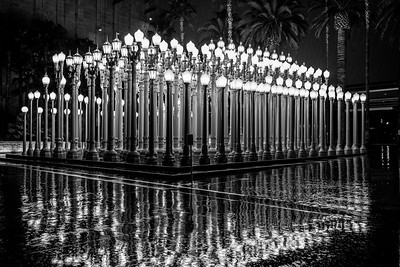
Or the removed statues could be made into a new kind of installation and reinterpretation, along the lines of Chris Burden's "Urban Light" outside of the Los Angeles County Museum of Art.
Urban Light

A related issue are proposals to rename military bases named after Confederate military personages.  The military is ok with the change, President Trump not ("GOP senator: Proposal to remove Confederate names from military bases 'picks on South unfairly'," CNN).  It's but another element in creating an institutional culture of racism.

Can you imagine the US military having a base named after Hitler or Goebbels?  Or King George III or Prime Minister Tojo.  Or Osama Bin-Laden, etc.?

This image could be used to make a great outdoor art installation.
Lunch counter sit in at the F.W. Woolworth on Granby Street in Norfolk, Virginia
Some of the young African Americans taking part in a sit-in at the Woolworth store on Granby Street in Norfolk were Norfolk Division of Virginia State College students dressed in ROTC uniforms. (Virginian-Pilot File photo)

=============================
A brief comment about Confederate monuments
8/20/2017


It's hard to disagree with people arguing that such monuments weren't erected to call attention to history as much as they were to sow fear with regard to black-white relations.

But removing all of the "sculptures" from the public space makes it that much harder to provide the greatest possible opportunity for interpretation, reinterpretation, challenge and contestation.


I can see changing the name of streets--e.g., Alexandria, Virginia ("Alexandria wants your help in renaming Jeff Davis Highway," WTOP-Radio) is renaming its segment of Route 1 so that it will no longer be named for Jefferson Davis, the president of the Confederacy.

Richmond, Virginia has chosen to keep the monuments on its prominent boulevard, Monument Avenue, where all but one of the statues and monuments venerate Confederate personages. From the Wikipedia entry:
Monument Avenue is an avenue in Richmond, Virginia with a tree-lined grassy mall dividing the east- and westbound traffic and is punctuated by statues memorializing Virginian Confederate participants of the American Civil War, including Robert E. Lee, J.E.B. Stuart, Jefferson Davis, Thomas "Stonewall" Jackson, and Matthew Fontaine Maury. There is also a monument to Arthur Ashe, a Richmond native and international tennis star who was African-American. The first monument, a statue of Robert E. Lee, was erected in 1890. 
But I would argue it is reasonable to consider removing such prominently located statues and sculptures because their position in highly visible and centrally located places of prominence in the public realm framework imply acceptance and veneration more than they do the opportunity to provoke rethinking. 

Certainly, as a historic district, Monument Avenue hasn't been utilized as a place to discuss how statuary and monuments can be used to project a way of thinking and subjugation, based on the description of the district by the National Park Service.

But a piece, "Bring bigger picture of history to Monument Avenue," in the Norfolk Virginian-Pilot argues that Monument Avenue presents such an opportunity:
Monument Avenue should become the place where we see and feel our national shame. The statues along it, many artistically splendid, should be accentuated with extensive historical connotations so that they might provide a justifiable sense of societal advancement. Let them celebrate our significant and, yes, ongoing efforts to reject our past failings.

And add more monuments. Surely some of our nation’s corporations and foundations would step forward to support the building of new, glorious statues recognizing the sacrifices and achievements of those who fought to defeat racism and bigotry.

Imagine a grand marble representation of the Underground Railroad, which guided former slaves to safety and freedom. How about another marking the 10 greatest contributions to sciences, arts, athletics, industry and public service by African Americans since the Civil War? Perhaps another saluting the Tuskegee Airmen?

How about individual statues as well to recognize those who are seldom celebrated? ...
By contrast, moving all of these monuments to museums obscures what they represent.  Sure, they will be viewable and accessible, but will require deliberate action in order to engage with them and the history they represent.  But not having such objects out in the open, an opportunity to confront more directly the nation's negative history is also lost.

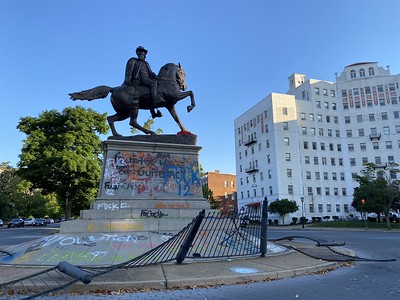
Richmond protest, graffiti on Confederate monuments[added] Certainly, tagging the statues is a form of reinterpretation and expanding the didactics describing them, when otherwise no alternative interpretation is provided.

This came up in a conversation at Thanksgiving Dinner, shared with our next door neighbors and their family, who hail from South America.

We were talking about US Imperialism and the impact on Latin America, and how they experienced it first hand, which is why they have such a complicated relationship with the US.

But also how the average American knows very little about this.

I explained that it isn't until college--and only certain colleges at that--when the average American has the opportunity to be exposed to alternatives to the typical mythology about the US and its place in the world, especially as a force only for good, as is presented in K-12 history and social studies textbooks.

The reality is that as a country, our external relations aren't always "a force for good," and internally as a nation we have many faults too, in race relations, economic opportunity, and politics.

Certainly, an identification and consideration of the power of whiteness isn't something that most people are willing to do nor are they willing to examine their sense of privilege and power that results from it.  People want to maintain their power and prefer to label people who disagree as "the other."

Ironically, the process is comparable to how motor vehicle operators treat other modes as usurpers ("Criminal Bicyclists," "Streets as places versus 'Motordom'," "Societal change (and sustainable transportation)," and "This gets tiresome: an automobile driver insists that automobiles are efficient users of precious road space while transit vehicles are inefficient," and "Bicyclists as the other (continued).")

Of course, my other point about this would be to reinterpret the Smithsonian National Museum of American History in terms of American Imperialism.  I don't think that would go over very well ("Dancing with the one that brung ya and challenging the dominant narrative").

Below is a reprint of a piece from 2014.  (Also see "Slavery museum in/and Richmond," 2013.)

=================
Tuesday, October 28, 2014
(Public) History/Historic Preservation Tuesday: Museums and Modern Historiography

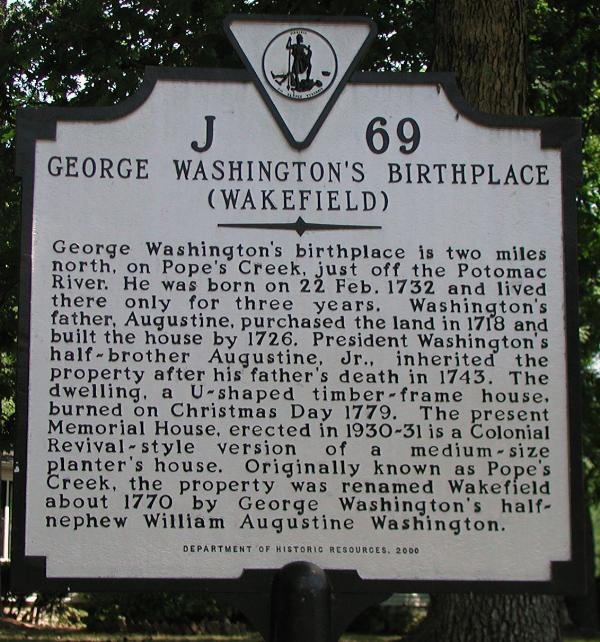
Last weekend we went to the George Washington Birthplace National Monument, in Westmoreland County, Virginia.

Interestingly, it is a re-created place, not unlike Colonial Williamsburg, and both places share John D. Rockefeller Jr. as a donor.  Rockefeller gave money to the Birthplace a few years before he was enticed to fund the preservation and re-creation of Virginia's original state capital.

It was interesting that the bookshop had a couple of titles that challenged the mythology around George Washington, and the exhibit, while very simple, started off with a section on "myth vs. fact" about George Washington.

The books, Here, George Washington Was Born: Memory, Material Culture, and the Public History of a National Monument and Inventing George Washington: America's Founder, in Myth and Memory, discuss the role of George Washington as an element of nation building and the national "story" and mythology around the founding of the United States of America, and the promotion of patriotism.

Last year, visiting Gettysburg, I was spurred to read a bunch of books about the Civil War, having been  primed a few years before by the Valentine Richmond History Center in Richmond, Virginia, and their exhibit on the historical themes of the city, which pointed out that at the outset of the Civil War, Richmonders--remember that their city was the capital of the Confederacy--voted against entering into war with the Union.

Modern historiography of the Confederacy makes hash of the "Lost Cause" myth.   Even I remember reading one of the chapters of Barrington Moore's Social Origins of Dictatorship and Democracy: Lord and Peasant in the Making of the Modern World in my sophomore year in college, and how "the Civil War was necessary to make over the US into a modern industrial economy."

[Added -- But even then I don't think the book made clear how central was to the US economy, not just for plantation agriculture in the South, but in international trade, the country's balance of payments, and as a big business for NYC-based financiers.]

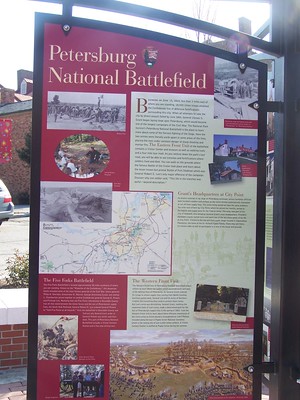
Petersburg National Battlefield panel, Tourism-Historic Narrative Kiosk, Downtown Petersburg, VABut that interpretation still hasn't percolated down much within the South more generally.  One example is the City of Petersburg, Virginia and its presentation of various Civil War sites under the control of the city [through its department of museums].  They pretty much take a pro-Confederate position.

Interpretation panel at the Petersburg, Virginia Visitor Center.

Confederate flag.  Given that a nation's flag is very much a symbol, the ongoing controversy over display of the Confederate flag is another example of the clash between reflexive "patriotism" and an unwillingness to consider all relevant elements of said symbol vs. considered reflection.

How can the flag of the Confederate States of America not be seen as a relic of racism and slavery?

More recently, the Danville Museum of Fine Arts and History has gotten caught up in this controversy.  Danville was the last "capital" of the Confederacy, and the Confederate flag flies on the Museum's grounds.

The Museum's strategic plan calls for presentation of an inclusive history and so the display of the flag is seen as incongruent with their goals and objectives and they requested from the city permission to take it down.  That has touched off great controversy and the local newspaper has a great number of articles about it (e.g., "Museum marches on with upcoming sesquicentennial commemoration," Danville Register-Bee ).

From the article:
The newly adopted strategic plan includes a vision “to be the Dan River Region’s leader for integrated awareness of history, culture and community,” according to a Sept. 30 letter from Board of Directors President Jane Murray to museum members. ...

Burton, in a Sept. 30 letter to the city, asked Danville City Council to remove the flag from outside the building to inside for an upcoming exhibit of the history of Confederate flags. The museum’s board of directors had voted Sept. 25 to make the request as part of its new three-year strategic plan.

The request caused an uproar among Confederate heritage organizations and other supporters of keeping the flag on display outside the museum. The move re-ignited a debate between flag supporters and those who see the flag as a racist reminder of past enslavement of African-Americans.

During an interview Friday, Burton said the Confederate flag exhibit that will be part of the sesquicentennial will go on as planned. People have “politicized the flag,” she said, but the museum’s board is merely trying to be inclusive and welcoming to everyone.
The comment threads are particularly interesting and there have been a number of pro- and con- letters to the editor as well (e.g., "Confederate flag must come down").

Right:  Georgia II by Leo Twiggs.

By contrast, there is an exhibit of paintings by an African-American artist at the Greenville (South Carolina) County Museum of Art ("SC artist sees heritage, hate in Confederate battle flags," Greenville News).

From the article:
Some see heritage. Some see hate.  When artist Leo Twiggs looks at the Confederate battle flag, he sees both of those things — but also a vision for a more harmonious future. 
Twiggs' 11 large depictions of the flag at the Greenville County Art Museum are at once beautiful and tattered, reflecting a shared Southern history of pride and pain. 
"In our state, I think the flag is something that many black people would like to forget and many white people would love to remember," Twiggs said. ... 
Through the repeated image of a torn and tattered flag, Twiggs addresses subtle issues about the shared Southern history of African Americans and whites, and the continued complexity of race relations.
History curriculum not patriotic:  Colorado. While interrogational historical interpretation is accepted in the academic world, it is still controversial in the K-12 educational arena, as witnessed by the recent proposal by a local school board in Colorado to make over the district's AP history curriculum because they didn't believe it is "patriotic" ("Changes in AP history trigger a culture clash in Colorado." Washington Post ).

The Board backed down after widespread protest led by students.  Image from the AP story "Colorado students walk out to protest censorship,"

Of course, the dichotomy between patriotism and "revisionism" or a broader interpretational framework for history and "social studies" is a major thread in national discourse

Personal history.  Speaking of rocking my world, and personal historiography, because of my tragic childhood, I don't have a lot of details about my own ethnicity, although I have some clues, stuff I remembered, which Suzanne decided to follow up.  So while I thought half my heritage was German/Russian, it turns out that I am Polish-Russian/Belorussian on my father's side of the family.

And looking at old records of the family, while I thought always that Hamtramck, Michigan, a Polish enclave surrounded by Detroit, was 100% Catholic, the reality is that the area also attracted, at least for a time, Polish Jewish immigrants also, in all likelihood because they spoke a common language.

Some of my relatives likely lived for a time in or near the "Poletown" neighborhood in Detroit that was eradicated in the 1980s for a GM manufacturing plant.

On that note, the Polin Museum of the History of Polish Jews has opened today in Warsaw  ("A new Warsaw museum devoted to Jewish-Polish history," Financial Times). The museum's core galleries address the place of Jews in Poland's history, focusing on integration but acknowledging anti-Semitism, recovering memory that was eradicated finally by the Holocaust.

Crowdsourcing museum curation/the public in public history. The Wall Street Journal has a piece on crowdsourcing art exhibits, "Everybody's an Art Curator," which can be controversial when familiarity can trump artistic evaluation and merit.

On the other hand some museums have experienced a significant uptick in visitation, membership, and funding when they increase public engagement through such methods.

In terms of community history, I have had problems with the "everyone's a historian" focus of some of these kinds of initiatives.  Much of the time, it's a way to dumb down history and seize on memes rather than depth.

I do think that historians need to step in when it is warranted and provide greater context, and acknowledge developments in history at multiple scales (community, metropolitan area, region, state, nation, globe) so that important events aren't lost at the expense of the familiar and popular. See the past blog entry "Thinking about local history."

Labels: , , , , , , , , , ,