Rebuilding Place in the Urban Space

"A community’s physical form, rather than its land uses, is its most intrinsic and enduring characteristic." [Katz, EPA] This blog focuses on place and placemaking and all that makes it work--historic preservation, urban design, transportation, asset-based community development, arts & cultural development, commercial district revitalization, tourism & destination development, and quality of life advocacy--along with doses of civic engagement and good governance watchdogging.

Thursday, February 20, 2025

Celebrating the 250th anniversary of the Declaration of Independence/start of the Revolutionary War | We aren't doing very well

In 2007, Virginia spent a lot of time and money promoting the 400th anniversary of the founding of Jamestown as the first successful British settlement on US soil.  

They especially focused on Jamestown, Williamsburg, and Yorktown, but had investment programs that supported historic interpretation and tourism elsewhere in the site.  They got the Smithsonian Folklife Festival to feature the anniversary as one of their threads, etc.

-- Official site of America's 400th anniversary
-- "Every American Should Stand Here Once": Jamestown's 400th Anniversary Commemoration and the Creation of an American Origin Narrative," William and Mary master's thesis
-- "T he Jamestown Commemoration of 2007: Remembering Our Diversity in the Past and Present," Southern Anthropological Association
-- "One nation, two founding stories: A study of public history at Jamestown and Plymouth," University of Massachusetts Boston master's thesis

1976 was big for the US Bicentennial founding and for federal government involvement (Report to the Congress: Planning For America’s Bicentennial Celebration- A Progress Report, 1975).  Theoretically, 2026, the 250th anniversary would be an equally good opportunity to focus on American's founding and national memory and historiography.  

Philadelphia has been known for promoting this anniversary every 50 years ("Late for the Party: Philly’s preparations for America’s 250th anniversary lost momentum amid COVID and other challenges. Is it too late to pull off a great party in the nation’s birthplace?").  A series of articles in the Philadelphia Inquirer focused on this wrt Independence Mall, which has suffered from under-investment for years ("A Much-Needed Makeover: How Philadelphia’s Independence National Historical Park is getting ready for America’s 250th birthday") totaling about $200 million as of 2024.

“This is really an opportunity to build the profile of the city and, certainly, of Independence National Historical Park,” said Kathryn Ott Lovell, president and CEO of the Philadelphia Visitor Center Corp., which cooperates with the National Park Service to operate the Independence Visitor Center — where tens of thousands start their journey to the park.

The park has an annual budget of about $27 million. But more than $85 million, a mix of funds from the federal government and private donations, is targeted this year to begin tackling the maintenance backlog in time for 2026.

Renovations of the First Bank of the United States are the most ambitious projects facing Independence National Historical Park ahead of 2026 celebrations. The work is projected to cost $27 million. Tom Gralish / Staff Photographer
People “think the park should be able to just pay for everything. But those extra things that enhance the visitor experience might not be in the budget,” said Jonathan Burton, director of development for Independence Historical Trust, a nonprofit organization that raises philanthropic funds for the park. Private funds are necessary, he says.

Also see "Philly 250," an ongoing articles collection, "Independence Park is ‘woefully behind’ for 2026 and in ‘grave need of resources,’ stakeholders say" and "Boston’s Freedom Trail is annoyingly great. Could Philly do the same by 2026?."

Plus, the Park Service has an excellent interpretative plan for the Independence Mall, even if it doesn't have the money to execute it.

-- Independence National Historical Park Long-Range Interpretive Plan

Similarly, the Boston Globe reports, "The plans by Massachusetts for the Revolution’s 250th anniversary are being questioned," that only $2 million has been allocated for support for programming there.  From the article:

Massachusetts proudly calls itself the birthplace of the American Revolution, but critics say the state’s plans for its 250th anniversary might be too little, too late for a celebration that begins in only two months at the Lexington and Concord battlefields. 

Less than $2 million in local grants for the 250th has been awarded so far in Massachusetts for this once-in-a-generation commemoration, and a mix of historians, lawmakers, and nonprofit officials are concerned that Massachusetts has fallen behind compared with other key Revolutionary states in its grass-roots programming.

Time is running short, the critics say. Nearly all of the remaining major 250th anniversaries in Massachusetts will occur over the next 13 months, coinciding with the evacuation of British troops from Boston in March 1776. Afterward, the fighting moved elsewhere.

"On a misty morning in Lexington, muskets ring out, recalling first shots of Revolutionary War," Boston Globe

 “We’ve prepared poorly. It’s never really been seen as a Massachusetts priority,” said state Senator Michael Barrett, a Democrat whose district includes Concord and parts of Lexington. “Random grants are being handed out now, but there doesn’t seem to be a plan other than making people happy with small amounts of money.” 

By contrast, legislators in Virginia have appropriated $27 million to date, primarily for hundreds of local grants. New Jersey has allocated nearly $30 million for the 250th, including $25 million for improvements at battlefield sites. And South Carolina lawmakers have set aside about $12 million, mostly for site preservation. 


 "Thousands of dollars for the 250th anniversary of battles of Lexington and Concord fail to pass Legislature, frustrating organizers," Boston Globe

Pennsylvania has raised $9.4 million, a sum that officials there expect to double, including funding for a major celebration of the Declaration of Independence in 2026. Governor Josh Shapiro has proposed an additional $10 million to market the state and attract tourists next year.

Interestingly, the Trump Administration has created a commission to address the anniversary, but most of the efforts thus far, unlike the Bicentennial, have been at the state and local level.  

And one year is hardly enough time ("Trump signs order to plan nation’s 250th anniversary celebration, punish those who vandalize statues," AP).  Although according to Politico, "Trump’s latest policy pitch: A massive birthday party for the nation," he put the concept forward in 2023.

Especially if you fire lots of NPS personnel ("US Forest Service and National Park Service to fire thousands of workers" and "‘The greatest propaganda op in history’: Trump’s reshaping of US culture evokes past antidemocratic regimes," Guardian).

Planning is key.  Philadelphia started but didn't finish.  From ("Late for the Party: Philly’s preparations for America’s 250th anniversary lost momentum amid COVID and other challenges. Is it too late to pull off a great party in the nation’s birthplace?"):

USA250 eventually floated heady plans to spur billion-dollar infrastructure improvements that would last the city until the next party in 50 years. By 2018, the dignitaries of the United States Semiquincentennial Commission, a congressionally appointed body established after lobbying by Hohns, were holding ceremonial sessions in Independence Hall.

But the efforts of the commission — and its affiliated nonprofit, the America250 foundation — fizzled in 2022 after a lawsuit alleged sexism, cronyism, and corruption in the organization.

It's an example of the need for long term planning, and the Transformational Projects Action Planning approach.

Labels: , , ,

Monday, February 17, 2025

February is African-American History Month: Art History and Prominent Black Artists

Typically, African American or Black History Month is about "regular" history and how Black Americans have experienced the US.  I take it a little further in my piece on transportation history ("African American History Month and Transportation: February 4th | Transit Equity Day," 2025), and have written about creating "history trails" in systematic ways ("Four points about presentation of African American History in the context of Black History Month | reprint with an addition about the US Civil Rights Trail (versus the Dixieland Trail)," 2024).

I'm the last person to be able to write about art history generally, or in terms of African-Americans specifically, but that seems like a great topic area to celebrate during the month as well.  I don't recall a lot of art presentation in the context of Black History Month.  

Although yes, we see exhibitions all the time of Jacob Lawrence, Sam Gilliam, and contemporary artists Kehinde Wiley and Kara Walker.

For example, the Boston Globe has an article, "Art Review: Has John Wilson’s time arrived? He’s been here all along," on a retrospective at the Museum of Fine Arts on the sculptor John Wilson.  Who I hadn't heard of, but hell, I can pretty much only identify Rodin and Wiley as sculptors generally, given my lack of knowledge

“Eternal Presence” (1987), sculpture by SMFA alumnus John Wilson at the Museum of the National Center of Afro American Artists in Roxbury. Photo: Alonso Nichols

“Father and Child Reading” by John Wilson. PHOTO: COURTESY OF ROXBURY COMMUNITY COLLEGE

Also see, "Sculpting a Legacy: The Art and Impact of John Wilson," Tufts Now.

Labels: , , , , , , , ,

Wednesday, June 17, 2020

Monuments as public art, historiography, and change

Decades ago, in college, a group of us came to DC for a summer march, and we stayed with people who lived in Baltimore, near Memorial Stadium.  We walked in to a Baltimore Orioles game late in the game so we didn't have to pay.

While I know that naming stadiums and other facilities in honor of people who died in wars is supposed to be the right thing to do, at the same time we overlook calling attention to the monumental pain and waste and ever since then, I joke to myself that such facilities should be named "War Dead Stadium" etc.

Pulling down the statue of Edward Colston, slave trader and Member of Parliament, Bristol, UK (England)
Pulling down the statue of Edward Colston, slave trader and Member of Parliament, Bristol, UK (England).

Given the ongoing toppling of statues of people associated with various forms of subjugation (Confederate memorials, Christopher Columbus, slave trader Edward Colston in Bristol, England, etc.) that is spilling out from the George Floyd protests, it's worth reprinting these couple of posts from a combined entry in 2017.

While for the most part I do believe that it's right to remove statues designed to engender fear, others like of Thomas Jefferson or Christopher Columbus, are more complicated ("What to do when the Confederate statues come down? Leave the pedestals empty," Washington Post).

In any case, imagine if the historiography of Monument Avenue in Richmond ("Along historic Richmond street, residents grapple with Confederate legacy," Washington Post) had been recast as a discussion of slavery, the Civil War, and Jim Crow, instead of a memorial to the "Lost Cause" and State's Rights.

Kehinde Wiley, Rumors of War (2019). © 2019 Kehinde Wiley. Courtesy of the Virginia Museum of Fine Arts, Times Square Arts, and Sean Kelly. Photos: Ka-Man Tse for Times Square Arts.

Note that I meant to but didn't get to writing a piece about Kehinde Wiley's statue, "Rumors of War."

The statue, 29 feet tall and weighing 8 tons, was first displayed in New York City ("Kehinde Wiley's Times Square Monument: That's No Robert E. Lee," New York Times) by the Times Square Arts organization before being moved to its permanent site in Richmond ("Installation begins for Kehinde Wiley's 'Rumors of War' at VMFA; street closures, shuttle buses for Tuesday's unveiling," Richmond Times-Dispatch).

It's Wiley's response to a Confederate monument a few blocks away from the Virginia Museum of Fine Arts (nearby, there is a Confederate War Memorial structure, and occasionally self-appointed pro-Confederate guides will approach you, at least years ago when we wandered in; if you didn't know better, because of the proximity, you might think the Memorial is part of the Museum).

Imagine a modern historiography for Monument Avenue, with new monuments like Wiley's which challenge convention and what people thought was "settled history."

There's a lot of important Civil Rights history within Virginia (Civil Rights Movement in Virginia, Virginia Museum of History and Culture) that could be mined to create a reinterpreted Monument Avenue Historic District, such as:
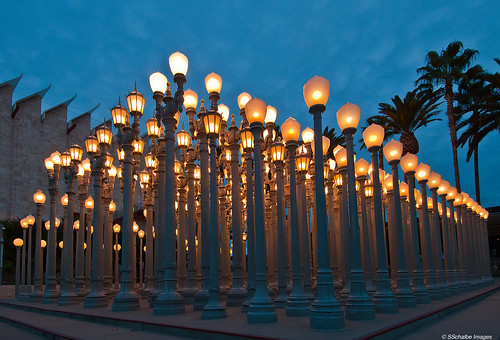
Or the removed statues could be made into a new kind of installation and reinterpretation, along the lines of Chris Burden's "Urban Light" outside of the Los Angeles County Museum of Art.
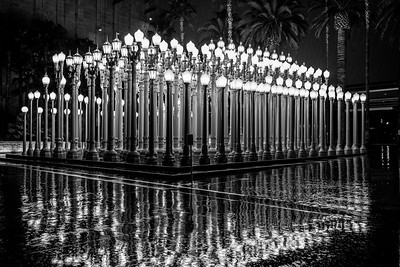
Urban Light

A related issue are proposals to rename military bases named after Confederate military personages.  The military is ok with the change, President Trump not ("GOP senator: Proposal to remove Confederate names from military bases 'picks on South unfairly'," CNN).  It's but another element in creating an institutional culture of racism.

Can you imagine the US military having a base named after Hitler or Goebbels?  Or King George III or Prime Minister Tojo.  Or Osama Bin-Laden, etc.?

This image could be used to make a great outdoor art installation.
Lunch counter sit in at the F.W. Woolworth on Granby Street in Norfolk, Virginia
Some of the young African Americans taking part in a sit-in at the Woolworth store on Granby Street in Norfolk were Norfolk Division of Virginia State College students dressed in ROTC uniforms. (Virginian-Pilot File photo)

=============================
A brief comment about Confederate monuments
8/20/2017


It's hard to disagree with people arguing that such monuments weren't erected to call attention to history as much as they were to sow fear with regard to black-white relations.

But removing all of the "sculptures" from the public space makes it that much harder to provide the greatest possible opportunity for interpretation, reinterpretation, challenge and contestation.


I can see changing the name of streets--e.g., Alexandria, Virginia ("Alexandria wants your help in renaming Jeff Davis Highway," WTOP-Radio) is renaming its segment of Route 1 so that it will no longer be named for Jefferson Davis, the president of the Confederacy.

Richmond, Virginia has chosen to keep the monuments on its prominent boulevard, Monument Avenue, where all but one of the statues and monuments venerate Confederate personages. From the Wikipedia entry:
Monument Avenue is an avenue in Richmond, Virginia with a tree-lined grassy mall dividing the east- and westbound traffic and is punctuated by statues memorializing Virginian Confederate participants of the American Civil War, including Robert E. Lee, J.E.B. Stuart, Jefferson Davis, Thomas "Stonewall" Jackson, and Matthew Fontaine Maury. There is also a monument to Arthur Ashe, a Richmond native and international tennis star who was African-American. The first monument, a statue of Robert E. Lee, was erected in 1890. 
But I would argue it is reasonable to consider removing such prominently located statues and sculptures because their position in highly visible and centrally located places of prominence in the public realm framework imply acceptance and veneration more than they do the opportunity to provoke rethinking. 

Certainly, as a historic district, Monument Avenue hasn't been utilized as a place to discuss how statuary and monuments can be used to project a way of thinking and subjugation, based on the description of the district by the National Park Service.

But a piece, "Bring bigger picture of history to Monument Avenue," in the Norfolk Virginian-Pilot argues that Monument Avenue presents such an opportunity:
Monument Avenue should become the place where we see and feel our national shame. The statues along it, many artistically splendid, should be accentuated with extensive historical connotations so that they might provide a justifiable sense of societal advancement. Let them celebrate our significant and, yes, ongoing efforts to reject our past failings.

And add more monuments. Surely some of our nation’s corporations and foundations would step forward to support the building of new, glorious statues recognizing the sacrifices and achievements of those who fought to defeat racism and bigotry.

Imagine a grand marble representation of the Underground Railroad, which guided former slaves to safety and freedom. How about another marking the 10 greatest contributions to sciences, arts, athletics, industry and public service by African Americans since the Civil War? Perhaps another saluting the Tuskegee Airmen?

How about individual statues as well to recognize those who are seldom celebrated? ...
By contrast, moving all of these monuments to museums obscures what they represent.  Sure, they will be viewable and accessible, but will require deliberate action in order to engage with them and the history they represent.  But not having such objects out in the open, an opportunity to confront more directly the nation's negative history is also lost.
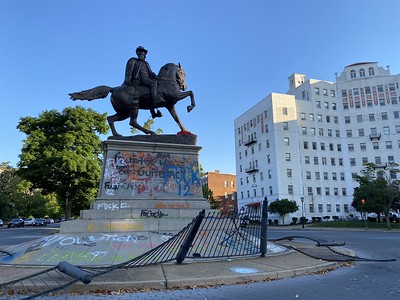
Richmond protest, graffiti on Confederate monuments[added] Certainly, tagging the statues is a form of reinterpretation and expanding the didactics describing them, when otherwise no alternative interpretation is provided.

This came up in a conversation at Thanksgiving Dinner, shared with our next door neighbors and their family, who hail from South America.

We were talking about US Imperialism and the impact on Latin America, and how they experienced it first hand, which is why they have such a complicated relationship with the US.

But also how the average American knows very little about this.

I explained that it isn't until college--and only certain colleges at that--when the average American has the opportunity to be exposed to alternatives to the typical mythology about the US and its place in the world, especially as a force only for good, as is presented in K-12 history and social studies textbooks.

The reality is that as a country, our external relations aren't always "a force for good," and internally as a nation we have many faults too, in race relations, economic opportunity, and politics.

Certainly, an identification and consideration of the power of whiteness isn't something that most people are willing to do nor are they willing to examine their sense of privilege and power that results from it.  People want to maintain their power and prefer to label people who disagree as "the other."

Ironically, the process is comparable to how motor vehicle operators treat other modes as usurpers ("Criminal Bicyclists," "Streets as places versus 'Motordom'," "Societal change (and sustainable transportation)," and "This gets tiresome: an automobile driver insists that automobiles are efficient users of precious road space while transit vehicles are inefficient," and "Bicyclists as the other (continued).")

Of course, my other point about this would be to reinterpret the Smithsonian National Museum of American History in terms of American Imperialism.  I don't think that would go over very well ("Dancing with the one that brung ya and challenging the dominant narrative").

Below is a reprint of a piece from 2014.  (Also see "Slavery museum in/and Richmond," 2013.)

=================
Tuesday, October 28, 2014
(Public) History/Historic Preservation Tuesday: Museums and Modern Historiography

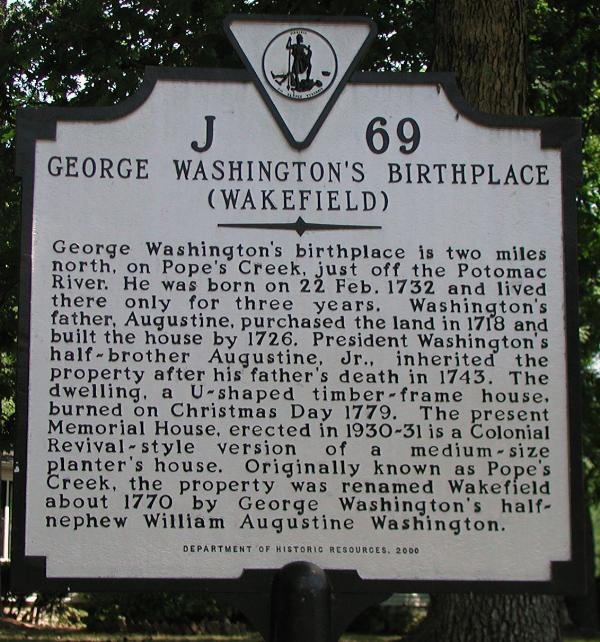
Last weekend we went to the George Washington Birthplace National Monument, in Westmoreland County, Virginia.

Interestingly, it is a re-created place, not unlike Colonial Williamsburg, and both places share John D. Rockefeller Jr. as a donor.  Rockefeller gave money to the Birthplace a few years before he was enticed to fund the preservation and re-creation of Virginia's original state capital.

It was interesting that the bookshop had a couple of titles that challenged the mythology around George Washington, and the exhibit, while very simple, started off with a section on "myth vs. fact" about George Washington.

The books, Here, George Washington Was Born: Memory, Material Culture, and the Public History of a National Monument and Inventing George Washington: America's Founder, in Myth and Memory, discuss the role of George Washington as an element of nation building and the national "story" and mythology around the founding of the United States of America, and the promotion of patriotism.

Last year, visiting Gettysburg, I was spurred to read a bunch of books about the Civil War, having been  primed a few years before by the Valentine Richmond History Center in Richmond, Virginia, and their exhibit on the historical themes of the city, which pointed out that at the outset of the Civil War, Richmonders--remember that their city was the capital of the Confederacy--voted against entering into war with the Union.

Modern historiography of the Confederacy makes hash of the "Lost Cause" myth.   Even I remember reading one of the chapters of Barrington Moore's Social Origins of Dictatorship and Democracy: Lord and Peasant in the Making of the Modern World in my sophomore year in college, and how "the Civil War was necessary to make over the US into a modern industrial economy."

[Added -- But even then I don't think the book made clear how central was to the US economy, not just for plantation agriculture in the South, but in international trade, the country's balance of payments, and as a big business for NYC-based financiers.]
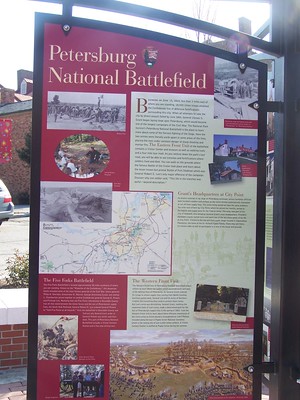
Petersburg National Battlefield panel, Tourism-Historic Narrative Kiosk, Downtown Petersburg, VABut that interpretation still hasn't percolated down much within the South more generally.  One example is the City of Petersburg, Virginia and its presentation of various Civil War sites under the control of the city [through its department of museums].  They pretty much take a pro-Confederate position.

Interpretation panel at the Petersburg, Virginia Visitor Center.

Confederate flag.  Given that a nation's flag is very much a symbol, the ongoing controversy over display of the Confederate flag is another example of the clash between reflexive "patriotism" and an unwillingness to consider all relevant elements of said symbol vs. considered reflection.

How can the flag of the Confederate States of America not be seen as a relic of racism and slavery?

More recently, the Danville Museum of Fine Arts and History has gotten caught up in this controversy.  Danville was the last "capital" of the Confederacy, and the Confederate flag flies on the Museum's grounds.

The Museum's strategic plan calls for presentation of an inclusive history and so the display of the flag is seen as incongruent with their goals and objectives and they requested from the city permission to take it down.  That has touched off great controversy and the local newspaper has a great number of articles about it (e.g., "Museum marches on with upcoming sesquicentennial commemoration," Danville Register-Bee ).

From the article:
The newly adopted strategic plan includes a vision “to be the Dan River Region’s leader for integrated awareness of history, culture and community,” according to a Sept. 30 letter from Board of Directors President Jane Murray to museum members. ...

Burton, in a Sept. 30 letter to the city, asked Danville City Council to remove the flag from outside the building to inside for an upcoming exhibit of the history of Confederate flags. The museum’s board of directors had voted Sept. 25 to make the request as part of its new three-year strategic plan.

The request caused an uproar among Confederate heritage organizations and other supporters of keeping the flag on display outside the museum. The move re-ignited a debate between flag supporters and those who see the flag as a racist reminder of past enslavement of African-Americans.

During an interview Friday, Burton said the Confederate flag exhibit that will be part of the sesquicentennial will go on as planned. People have “politicized the flag,” she said, but the museum’s board is merely trying to be inclusive and welcoming to everyone.
The comment threads are particularly interesting and there have been a number of pro- and con- letters to the editor as well (e.g., "Confederate flag must come down").

Right:  Georgia II by Leo Twiggs.

By contrast, there is an exhibit of paintings by an African-American artist at the Greenville (South Carolina) County Museum of Art ("SC artist sees heritage, hate in Confederate battle flags," Greenville News).

From the article:
Some see heritage. Some see hate.  When artist Leo Twiggs looks at the Confederate battle flag, he sees both of those things — but also a vision for a more harmonious future. 
Twiggs' 11 large depictions of the flag at the Greenville County Art Museum are at once beautiful and tattered, reflecting a shared Southern history of pride and pain. 
"In our state, I think the flag is something that many black people would like to forget and many white people would love to remember," Twiggs said. ... 
Through the repeated image of a torn and tattered flag, Twiggs addresses subtle issues about the shared Southern history of African Americans and whites, and the continued complexity of race relations.
History curriculum not patriotic:  Colorado. While interrogational historical interpretation is accepted in the academic world, it is still controversial in the K-12 educational arena, as witnessed by the recent proposal by a local school board in Colorado to make over the district's AP history curriculum because they didn't believe it is "patriotic" ("Changes in AP history trigger a culture clash in Colorado." Washington Post ).

The Board backed down after widespread protest led by students.  Image from the AP story "Colorado students walk out to protest censorship,"

Of course, the dichotomy between patriotism and "revisionism" or a broader interpretational framework for history and "social studies" is a major thread in national discourse

Personal history.  Speaking of rocking my world, and personal historiography, because of my tragic childhood, I don't have a lot of details about my own ethnicity, although I have some clues, stuff I remembered, which Suzanne decided to follow up.  So while I thought half my heritage was German/Russian, it turns out that I am Polish-Russian/Belorussian on my father's side of the family.

And looking at old records of the family, while I thought always that Hamtramck, Michigan, a Polish enclave surrounded by Detroit, was 100% Catholic, the reality is that the area also attracted, at least for a time, Polish Jewish immigrants also, in all likelihood because they spoke a common language.

Some of my relatives likely lived for a time in or near the "Poletown" neighborhood in Detroit that was eradicated in the 1980s for a GM manufacturing plant.

On that note, the Polin Museum of the History of Polish Jews has opened today in Warsaw  ("A new Warsaw museum devoted to Jewish-Polish history," Financial Times). The museum's core galleries address the place of Jews in Poland's history, focusing on integration but acknowledging anti-Semitism, recovering memory that was eradicated finally by the Holocaust.

Crowdsourcing museum curation/the public in public history. The Wall Street Journal has a piece on crowdsourcing art exhibits, "Everybody's an Art Curator," which can be controversial when familiarity can trump artistic evaluation and merit.

On the other hand some museums have experienced a significant uptick in visitation, membership, and funding when they increase public engagement through such methods.

In terms of community history, I have had problems with the "everyone's a historian" focus of some of these kinds of initiatives.  Much of the time, it's a way to dumb down history and seize on memes rather than depth.

I do think that historians need to step in when it is warranted and provide greater context, and acknowledge developments in history at multiple scales (community, metropolitan area, region, state, nation, globe) so that important events aren't lost at the expense of the familiar and popular. See the past blog entry "Thinking about local history."

Labels: , , , , , , , , , ,

Tuesday, January 21, 2020

International Spy Museum: Counter-example concerning elected official involvement in historiography

Given that the most important college course I ever took was about Latin America--I say the course started me on the path of learning to think for myself, as it challenged my basic "good American" beliefs in military intervention, multinationals, and the inherent "goodness" of US foreign policy; one of my jokes about the National Museum of American History is that it could be restaged around the interpretation of the history of American Imperialism.

But I don't think that would go over that well with Congress and the Executive Office of the President.

The previous entry, "National Archives photo "retouching" is another example of the tension between National Ideology and Memory and Inquiry in the funding of national museums, archives," discusses the recent incident with accurate interpretation of history and events at the National Archives.

The word "Trump" was blurred out in this retouched image used as part of an exhibit at the National Archives. Original image by Mario Tama, Getty Images.

But I was primed to write about that incident because early last week I came across a different and surprisingly article about the International Spy Museum, and criticism of its exhibits on the CIA and torture ("Spy Museum will revamp torture exhibit after Congressional backlash," Washington Business Journal, as originally reported on by BuzzFeed News, "The Spy Museum Is Now Planning To Overhaul Its Controversial Torture Exhibit").

The Spy Museum is a private museum--originally it was a for profit venture but now it's a nonprofit.  It recently relocated to a site at L'Enfant Plaza ("Will Tourists Follow the International Spy Museum to L'Enfant Plaza," Washington City Paper), and it is one of the only admissions-based museums in DC that seems to be able to compete with the free museums ("D.C.'s paid museums retool to boost attendance," WBJ).

But in this case, (Democratic) members of the Senate Intelligence Committee:
... in December wrote that the the exhibit “misrepresents the CIA’s torture program, sanitizing depictions of how techniques were applied and suggesting that torture is effective in terrorist attacks,” the senators wrote on Dec. 18, according to a letter published by BuzzFeed. The letter went on to point out that the 6,700-page Senate Intelligence Committee investigation on the program showed that it was not effective.
It's a rare instance of an action by Congressmembers calling for a more accurate representation of  history, events, and evidence-based research, rather than to sanitize it.


Labels: ,

Monday, January 20, 2020

National Archives photo "retouching" is another example of the tension between National Ideology and Memory and Inquiry in the funding of national museums, archives

Banner at the National Archives.

The Washington Post reported that a photograph used to promote an exhibit on the 100th anniversary of Women's Suffrage at the National Archives has been "retouched" to eliminate specific references to President Trump and "offensive" words describing female anatomy ("National Archives exhibit blurs images critical of President Trump").

In the controversy after the article, the National Archives backed down and apologized ("National Archives apologizes and removes altered photo of 2017 Women's March: 'We made a mistake'," CNN).

Original photo by Mario Tama, Getty Images.

The Post's art critic, Philip Kennicott wrote a piece "The National Archives used to stand for independence. That mission has been compromised" about the issue, but to me it was more of a one-off piece, not recognizing that this is but one more incident in a line of incidents involving museums (and archives) although he did discuss a bunch of similar incidents involving Executive Branch agencies being ordered to obscure the truth.

And then there is the issue of the agencies de-emphasizing scientific research and findings in order to rollback environmental regulations ("E.P.A. to Limit Science Used to Write Public Health Rules<" New York Times).

Grashping the World: The Idea of the MuseumOver the years, I've written a bunch of pieces about how the federal museums, particularly the constituent units of the Smithsonian Institution, and institutions in Washington, like the no longer extant Corcoran Gallery, frequently have to heel to ideologically driven elected officials--usually in Congress but at times in the Executive Branch too, because that's where they get their funding.

I argue that the Smithsonian has a tough time being great because its mission as a repository of "national memory" and its role as a federal government entity often means that its overseers--members of Congress and parts of the Executive Branch--believe that its job is project American "greatness" rather than to be an institution that also questions and reinterprets the dominant narrative,

The Smithsonian is caught between this tension and as a result, its ability to be edgy or serious gets compromised.

-- "Dancing with the one that brung ya and challenging the dominant narrative," 2008
-- "You don't gotta have art," 2010

The Corcoran story is a little different, but their caving to the pressure of a Congressman to not show the photos of Robert Mapplethorpe ended up in the long run leading to that institution's demise.

The examples that have come up in the past:

-- Robert Mapplethorpe photographs at the Corcoran ("Corcoran, to Foil Dispute, Drops Mapplethorpe Show," New York Times, 1989)

- a somewhat critical exhibit label on the Enola Gay airplane at the National Museum of Air and Space which was opposed by WWII veterans groups (see "The Enola Gay Controversy" website from Lehigh University)

- criticism, ironically led by then Washington Post columnist Marc Fisher, of a culturally-specific narrative paradigm at the National Museum of the American Indian (see "A Museum of the Indian, Not for the Indian" The American Indian Quarterly; "The National Museum of the American Indian as cultural sovereignty," American Quarterly).

- Plus, you could argue that Marc Fisher's criticism that the National Museum of American History's "renovation" didn't do much in the way of change and challenge is also relevant to the discussion. See "German-American Heritage Museum promotes culture, doesn't tell whole story."

I am distinguishing a bit the general arguments over culture, commonly referred to as "The Culture Wars."

Like the Culture Wars, this is about (1) National Mythology/The Story of the Nation -- e.g., that the US always does the right thing, has superior moral authority, George Washington and the cherry tree which is a made up story -- (2) versus independent fact-based or framework-based interpretation (3) but also intertwined with reliance on federal funding.

When you allow ideology to trump knowledge, this is what happens.

Especially when a President gets much more involved in what agencies do, especially when it comes to challenging the conservative narrative.

The power of art to challenge the dominant narrative remains ("How a Museum Cancelling a Controversial Mapplethorpe Exhibition Changed My Life," Smithsonian Magazine).

But it's increasingly difficult for national institutions, at least in the US, to present this kind of challenge.

Also see:

-- "Parochialism and historiography," 2011
-- "Local history museums and critical analysis opportunities for communities," 2014
-- "A brief comment about Confederate monuments," 2017, which includes as a reprint
-- "Museums and Modern Historiography," 2014

2.  I have not tracked down and read either of these books, Capital Culture: J. Carter Brown, the National Gallery of Art, and the Reinvention of the Museum Experience and Who Owns America's Past?: The Smithsonian and the Problem of History, but I'd argue that both should be required reading for members of the local and national cultural community.

After such a reading, we'd be in a better place for making recommendations to Secretary Skorton about what he should be focusing on.

From the description of Who Owns America's Past?:
Never before has a book about the Smithsonian detailed the recent and dramatic shift from collection-driven shows, with artifacts meant to speak for themselves, to concept-driven exhibitions, in which objects aim to tell a story, displayed like illustrations in a book. Even more recently, the trend is to show artifacts along with props, sound effects, and interactive elements in order to create an immersive environment. Rather than looking at history, visitors are invited to experience it.

Who Owns America’s Past? examines the different ways that the Smithsonian’s exhibitions have been conceived and designed—whether to educate visitors, celebrate an important historical moment, or satisfy donor demands or partisan agendas. Post gives the reader a behind-the-scenes view of internal tempests as they brewed and how different personalities and experts passionately argued about the best way to present the story of America.

Labels: , , , , ,

Tuesday, December 05, 2017

Art and inquiry and moving Confederate memorials

(Other stuff, and being sick seems to get in the way of writing.)

-- "(Public) History/Historic Preservation Tuesday: Museums and Modern Historiography," 2014
-- "Battle Scars: The Fight Over Virginia's Confederate Monuments," New Yorker Magazine
-- "Mayor Stoney: Commission to consider removal of Confederate monuments," Richmond Times-Dispatch
-- Monument Avenue Commission, Richmond
-- "Charlottesville rally: Report faults police over planning, failure to protect public," CNN

WRT the issue of Confederate monuments, something I have been thinking about for awhile but am reminded by this article, "Confederate monument in Decatur can be moved but not hidden," from the Atlanta Journal-Constitution, I can't help but think of how removing them for "art museums" brings up the opportunity to create a Chris Burden-like installation, comparable to the streetlights at LACMA in Los Angeles ("Chris Burden's roundabout route of bringing 'Urban Light' to L.A.," Los Angeles Times), called Urban Light.

From the AJC article:
A 30-foot Confederate monument in downtown Decatur could be relocated to another visible site or placed in historical context, but it can’t be destroyed or concealed, according to a DeKalb County legal opinion released Tuesday.

The DeKalb Board of Commissioners will now consider what to do about the monument after passing a resolution in October condemning the monument for glorifying the Confederacy.

The legal opinion by County Attorney O.V. Brantley concludes that the county government owns the monument and is prohibited by state law from removing it from public view. But the opinion says the monument could be moved to a cemetery, museum or other property.

Vintage lamps
Urban Light"
A street lamp installation at the Los Angeles County Museum of Art (LACMA) by Chris Burden. These are a collection of 202 restored cast-iron vintage street lamps that are fully operational. The lights are from the 1920's and 1930's.

Labels: , , , , , ,

Sunday, August 20, 2017

A brief comment about Confederate monuments

It's hard to disagree with people arguing that such monuments weren't erected to call attention to history as much as they were to sow fear with regard to black-white relations.

But removing all of the "sculptures" from the public space makes it that much harder to provide the greatest possible opportunity for interpretation, reinterpretation, and challenge.


I can see changing the name of streets--e.g., Alexandria, Virginia ("Alexandria wants your help in renaming Jeff Davis Highway," WTOP-Radio) is renaming its segment of Route 1 so that it will no longer be named for Jefferson Davis, the president of the Confederacy.

Richmond, Virginia has chosen to keep the monuments on its prominent boulevard, Monument Avenue, where all but one of the statues and monuments venerate Confederate personages. From the Wikipedia entry:
Monument Avenue is an avenue in Richmond, Virginia with a tree-lined grassy mall dividing the east- and westbound traffic and is punctuated by statues memorializing Virginian Confederate participants of the American Civil War, including Robert E. Lee, J.E.B. Stuart, Jefferson Davis, Thomas "Stonewall" Jackson, and Matthew Fontaine Maury. There is also a monument to Arthur Ashe, a Richmond native and international tennis star who was African-American. The first monument, a statue of Robert E. Lee, was erected in 1890. 
But I would argue it is reasonable to consider removing such prominently located statues and sculptures because their position in highly visible and centrally located places of prominence in the public realm framework imply acceptance and veneration more than they do the opportunity to provoke rethinking. 

Certainly, as a historic district, Monument Avenue hasn't been utilized as a place to discuss how statuary and monuments can be used to project a way of thinking and subjugation, based on the description of the district by the National Park Service.

But a piece, "Bring bigger picture of history to Monument Avenue," in the Norfolk Virginian-Pilot argues that Monument Avenue presents such an opportunity:
Monument Avenue should become the place where we see and feel our national shame. The statues along it, many artistically splendid, should be accentuated with extensive historical connotations so that they might provide a justifiable sense of societal advancement. Let them celebrate our significant and, yes, ongoing efforts to reject our past failings.

And add more monuments. Surely some of our nation’s corporations and foundations would step forward to support the building of new, glorious statues recognizing the sacrifices and achievements of those who fought to defeat racism and bigotry.

Imagine a grand marble representation of the Underground Railroad, which guided former slaves to safety and freedom. How about another marking the 10 greatest contributions to sciences, arts, athletics, industry and public service by African Americans since the Civil War? Perhaps another saluting the Tuskegee Airmen?

How about individual statues as well to recognize those who are seldom celebrated? ...
By contrast, moving all of these monuments to museums obscures what they represent.  Sure, they will be viewable and accessible, but will require deliberate action in order to engage with them and the history they represent.  But not having such objects out in the open, an opportunity to confront more directly the nation's negative history is also lost.

This came up in a conversation at Thanksgiving Dinner, shared with our next door neighbors and their family, who hail from South America.  We were talking about US Imperialism and the impact on Latin America, and how they experienced it first hand, which is why they have such a complicated relationship with the US.  But also how the average American knows very little about this.

I explained that it isn't until college--and only certain colleges at that--when the average American has the opportunity to be exposed to alternatives to the typical mythology about the US and its place in the world, especially as a force only for good.

The reality is that as a country, our external relations aren't always "a force for good," and internally as a nation we have many faults too, in race relations, economic opportunity, and politics.  Certainly, an identification and consideration of the power of whiteness isn't something that most people are willing to do nor are they willing to examine their sense of privilege and power that results from it.  People want to maintain their power and prefer to label people who disagree as "the other."

Ironically, the process is comparable to how motor vehicle operators treat other modes as usurpers ("Criminal Bicyclists," "Streets as places versus 'Motordom'," "Societal change (and sustainable transportation)," and "This gets tiresome: an automobile driver insists that automobiles are efficient users of precious road space while transit vehicles are inefficient," and "Bicyclists as the other (continued).")

Of course, my other point about this would be to reinterpret the Smithsonian National Museum of American History in terms of American Imperialism.  I don't think that would go over very well ("Dancing with the one that brung ya and challenging the dominant narrative").

Below is a reprint of a piece from 2014.  (Also see "Slavery museum in/and Richmond," 2013.)

=================
Tuesday, October 28, 2014
(Public) History/Historic Preservation Tuesday: Museums and Modern Historiography

Last weekend we went to the George Washington Birthplace National Monument, in Westmoreland County, Virginia.

Interestingly, it is a re-created place, not unlike Colonial Williamsburg, and both places share John D. Rockefeller Jr. as a donor.  Rockefeller gave money to the Birthplace a few years before he was enticed to fund the preservation and re-creation of Virginia's original state capital.

It was interesting that the bookshop had a couple of titles that challenged the mythology around George Washington, and the exhibit, while very simple, started off with a section on "myth vs. fact" about George Washington.

The books, Here, George Washington Was Born: Memory, Material Culture, and the Public History of a National Monument and Inventing George Washington: America's Founder, in Myth and Memory, discuss the role of George Washington as an element of nation building and the national "story" and mythology around the founding of the United States of America, and the promotion of patriotism.

Last year, visiting Gettysburg, I was spurred to read a bunch of books about the Civil War, having been first primed a few years before by the Valentine Richmond History Center in Richmond, Virginia, and their exhibit on the historical themes of the city, which pointed out that during the Civil War era, Richmonders--remember that their city was the capital of the Confederacy--voted against entering into war with the Union.

Modern historiography of the Confederacy makes hash of the "Lost Cause" myth.   Even I remember reading one of the chapters of Barrington Moore's Social Origins of Dictatorship and Democracy: Lord and Peasant in the Making of the Modern World in my sophomore year in college, and how "the Civil War was necessary to make over the US as a modern industrial economy."

But that interpretation still hasn't percolated down much within the South more generally.  One example is the City of Petersburg, Virginia and its presentation of various Civil War sites under the control of the city [through its department of museums].

Confederate flag.  Given that a nation's flag is very much a symbol, the ongoing controversy over display of the Confederate flag is another example of the clash between reflexive "patriotism" and an unwillingness to consider all relevant elements of said symbol vs. considered reflection.  How can the flag of the Confederate States of America not be seen as a relic of racism and slavery?

More recently, the Danville Museum of Fine Arts and History has gotten caught up in this controversy.  Danville was the last "capital" of the Confederacy, and the Confederate flag flies on the Museum's grounds.

The Museum's strategic plan calls for presentation of an inclusive history and so the display of the flag is seen as incongruent with their goals and objectives and they requested from the city permission to take it down.  That has touched off great controversy and the local newspaper has a great number of articles about it (e.g., "Museum marches on with upcoming sesquicentennial commemoration," Danville Register-Bee ).

From the article:
The newly adopted strategic plan includes a vision “to be the Dan River Region’s leader for integrated awareness of history, culture and community,” according to a Sept. 30 letter from Board of Directors President Jane Murray to museum members. ...

Burton, in a Sept. 30 letter to the city, asked Danville City Council to remove the flag from outside the building to inside for an upcoming exhibit of the history of Confederate flags. The museum’s board of directors had voted Sept. 25 to make the request as part of its new three-year strategic plan.

The request caused an uproar among Confederate heritage organizations and other supporters of keeping the flag on display outside the museum. The move re-ignited a debate between flag supporters and those who see the flag as a racist reminder of past enslavement of African-Americans.

During an interview Friday, Burton said the Confederate flag exhibit that will be part of the sesquicentennial will go on as planned. People have “politicized the flag,” she said, but the museum’s board is merely trying to be inclusive and welcoming to everyone.
The comment threads are particularly interesting and there have been a number of pro- and con- letters to the editor as well (e.g., "Confederate flag must come down").

Right:  Georgia II by Leo Twiggs.

By contrast, there is an exhibit of paintings by an African-American artist at the Greenville (South Carolina) County Museum of Art ("SC artist sees heritage, hate in Confederate battle flags," Greenville News).

From the article:
Some see heritage. Some see hate.  When artist Leo Twiggs looks at the Confederate battle flag, he sees both of those things — but also a vision for a more harmonious future. 
Twiggs' 11 large depictions of the flag at the Greenville County Art Museum are at once beautiful and tattered, reflecting a shared Southern history of pride and pain. 
"In our state, I think the flag is something that many black people would like to forget and many white people would love to remember," Twiggs said. ... 
Through the repeated image of a torn and tattered flag, Twiggs addresses subtle issues about the shared Southern history of African Americans and whites, and the continued complexity of race relations.
History curriculum not patriotic:  Colorado. While interrogational historical interpretation is accepted in the academic world, it is still controversial in the K-12 educational arena, as witnessed by the recent proposal by a local school board in Colorado to make over the district's AP history curriculum because they didn't believe it is "patriotic" ("Changes in AP history trigger a culture clash in Colorado." Washington Post ).

The Board backed down after widespread protest led by students.  Image from the AP story "Colorado students walk out in protest,"

Of course, the dichotomy between patriotism and "revisionism" or a broader interpretational framework for history and "social studies" is a major thread in national discourse

Personal history.  Speaking of rocking my world, and personal historiography, because of my tragic childhood, I don't have a lot of details about my own ethnicity, although I have some clues, stuff I remembered, which Suzanne decided to follow up.  So while I thought half my heritage was German/Russian, it turns out that I am Polish-Russian/Belorussian on my father's side of the family.

And looking at old records of the family, while I thought always that Hamtramack, Michigan, a Polish enclave surrounded by Detroit, was 100% Catholic, the reality is that the area also attracted, at least for a time, Polish Jewish immigrants also.  Some of my relatives likely lived for a time in the "Poletown" neighborhood in Detroit that was eradicated in the 1980s for a GM manufacturing plant.

On that note, the Polin Museum of the History of Polish Jews has opened today in Warsaw  ("A new Warsaw museum devoted to Jewish-Polish history," Financial Times). The museum's core galleries address the place of Jews in Poland's history, focusing on integration but acknowledging anti-Semitism, recovering memory that was eradicated finally by the Holocaust.

Crowdsourcing museum curation/the public in public history. The Wall Street Journal has a piece on crowdsourcing art exhibits, "Everybody's an Art Curator," which can be controversial when familiarity can trump artistic evaluation and merit. On the other hand some museums have experienced a significant uptick in visitation, membership, and funding when they increase public engagement through such methods.

In terms of community history, I have had some problems with the "everyone's a historian" focus of some of these kinds of initiatives. I do think that historians need to step in when it is warranted and provide greater context, and acknowledge developments in history at multiple scales (commmunity, metropolitan area, region, state, nation, globe) so that important events aren't lost at the expense of the familiar and popular. See the past blog entry "Thinking about local history."

Labels: , , , , ,

Tuesday, October 28, 2014

(Public) History/Historic Preservation Tuesday: Museums and Modern Historiography

Last weekend we went to the George Washington Birthplace National Monument, in Westmoreland County, Virginia.

Interestingly, it is a re-created place, not unlike Colonial Williamsburg, and both places share John D. Rockefeller Jr. as a donor.  Rockefeller gave money to the Birthplace a few years before he was enticed to fund the preservation and re-creation of Virginia's original state capital.

It was interesting that the bookshop had a couple of titles that challenged the mythology around George Washington, and the exhibit, while very simple, started off with a section on "myth vs. fact" about George Washington.

The books, Here, George Washington Was Born: Memory, Material Culture, and the Public History of a National Monument and Inventing George Washington: America's Founder, in Myth and Memory, discuss the role of George Washington as an element of nation building and the national "story" and mythology around the founding of the United States of America, and the promotion of patriotism.

Last year, visiting Gettysburg, I was spurred to read a bunch of books about the Civil War, having been first primed a few years before by the Valentine Richmond History Center in Richmond, Virginia, and their exhibit on the historical themes of the city, which pointed out that during the Civil War era, Richmonders--remember that their city was the capital of the Confederacy--voted against entering into war with the Union.

Modern historiography of the Confederacy makes hash of the "Lost Cause" myth.   Even I remember reading one of the chapters of Barrington Moore's Social Origins of Dictatorship and Democracy: Lord and Peasant in the Making of the Modern World in my sophomore year in college, and how "the Civil War was necessary to make over the US as a modern industrial economy."

But that interpretation still hasn't  percolated down much within the South more generally.  One example is the City of Petersburg, Virginia and its presentation of various Civil War sites under the control of the city.

Confederate flag.  Given that a nation's flag is very much a symbol, the ongoing controversy over display of the Confederate flag is another example of the clash between reflexive "patriotism" and an unwillingness to consider all relevant elements of said symbol vs. considered reflection.  How can the flag of the Confederate States of America not be seen as a relic of racism and slavery?

More recently, the Danville Museum of Fine Arts and History has gotten caught up in this controversy.  Danville was the last "capital" of the Confederacy, and the Confederate flag flies on the Museum's grounds.

The Museum's strategic plan calls for presentation of an inclusive history and so the display of the flag is seen as incongruent with their goals and objectives and they requested from the city permission to take it down.  That has touched off great controversy and the local newspaper has a great number of articles about it (e.g., "Museum marches on with upcoming sesquicentennial commemoration," Danville Register-Bee ).

From the article:
The newly adopted strategic plan includes a vision “to be the Dan River Region’s leader for integrated awareness of history, culture and community,” according to a Sept. 30 letter from Board of Directors President Jane Murray to museum members. ...

Burton, in a Sept. 30 letter to the city, asked Danville City Council to remove the flag from outside the building to inside for an upcoming exhibit of the history of Confederate flags. The museum’s board of directors had voted Sept. 25 to make the request as part of its new three-year strategic plan.

The request caused an uproar among Confederate heritage organizations and other supporters of keeping the flag on display outside the museum. The move re-ignited a debate between flag supporters and those who see the flag as a racist reminder of past enslavement of African-Americans.

During an interview Friday, Burton said the Confederate flag exhibit that will be part of the sesquicentennial will go on as planned. People have “politicized the flag,” she said, but the museum’s board is merely trying to be inclusive and welcoming to everyone.
The comment threads are particularly interesting and there have been a number of pro- and con- letters to the editor as well (e.g., "Confederate flag must come down").

Right:  Georgia II by Leo Twiggs.

By contrast, there is an exhibit of paintings by an African-American artist at the Greenville (South Carolina) County Museum of Art ("SC artist sees heritage, hate in Confederate battle flags," Greenville News).

From the article:
Some see heritage. Some see hate.  When artist Leo Twiggs looks at the Confederate battle flag, he sees both of those things — but also a vision for a more harmonious future. 
Twiggs' 11 large depictions of the flag at the Greenville County Art Museum are at once beautiful and tattered, reflecting a shared Southern history of pride and pain. 
"In our state, I think the flag is something that many black people would like to forget and many white people would love to remember," Twiggs said. ... 
Through the repeated image of a torn and tattered flag, Twiggs addresses subtle issues about the shared Southern history of African Americans and whites, and the continued complexity of race relations.
History curriculum not patriotic:  Colorado. While interrogational historical interpretation is accepted in the academic world, it is still controversial in the K-12 educational arena, as witnessed by the recent proposal by a local school board in Colorado to make over the district's AP history curriculum because they didn't believe it is "patriotic" ("Changes in AP history trigger a culture clash in Colorado." Washington Post ).

The Board backed down after widespread protest led by students.  Image from the AP story "Colorado students walk out in protest,"

Of course, the dichotomy between patriotism and "revisionism" or a broader interpretational framework for history and "social studies" is a major thread in national discourse

Personal history.  Speaking of rocking my world, and personal historiography, because of my tragic childhood, I don't have a lot of details about my own ethnicity, although I have some clues, stuff I remembered, which Suzanne decided to follow up.  So while I thought half my heritage was German/Russian, it turns out that I am Polish-Russian/Belorussian on my father's side of the family.

And looking at old records of the family, while I thought always that Hamtramack, Michigan, a Polish enclave surrounded by Detroit, was 100% Catholic, the reality is that the area also attracted, at least for a time, Polish Jewish immigrants also.  Some of my relatives likely lived for a time in the "Poletown" neighborhood in Detroit that was eradicated in the 1980s for a GM manufacturing plant.

On that note, the Polin Museum of the History of Polish Jews has opened today in Warsaw  ("A new Warsaw museum devoted to Jewish-Polish history," Financial Times). The museum's core galleries address the place of Jews in Poland's history, focusing on integration but acknowledging anti-Semitism, recovering memory that was eradicated finally by the Holocaust.

Crowdsourcing museum curation/the public in public history. The Wall Street Journal has a piece on crowdsourcing art exhibits, "Everybody's an Art Curator," which can be controversial when familiarity can trump artistic evaluation and merit. On the other hand some museums have experienced a significant uptick in visitation, membership, and funding when they increase public engagement through such methods.

In terms of community history, I have had some problems with the "everyone's a historian" focus of some of these kinds of initiatives. I do think that historians need to step in when it is warranted and provide greater context, and acknowledge developments in history at multiple scales (commmunity, metropolitan area, region, state, nation, globe) so that important events aren't lost at the expense of the familiar and popular. See the past blog entry "Thinking about local history."

Labels: , , , , ,