Rebuilding Place in the Urban Space

"A community’s physical form, rather than its land uses, is its most intrinsic and enduring characteristic." [Katz, EPA] This blog focuses on place and placemaking and all that makes it work--historic preservation, urban design, transportation, asset-based community development, arts & cultural development, commercial district revitalization, tourism & destination development, and quality of life advocacy--along with doses of civic engagement and good governance watchdogging.

Wednesday, June 17, 2020

Monuments as public art, historiography, and change

Decades ago, in college, a group of us came to DC for a summer march, and we stayed with people who lived in Baltimore, near Memorial Stadium.  We walked in to a Baltimore Orioles game late in the game so we didn't have to pay.

While I know that naming stadiums and other facilities in honor of people who died in wars is supposed to be the right thing to do, at the same time we overlook calling attention to the monumental pain and waste and ever since then, I joke to myself that such facilities should be named "War Dead Stadium" etc.

Pulling down the statue of Edward Colston, slave trader and Member of Parliament, Bristol, UK (England)
Pulling down the statue of Edward Colston, slave trader and Member of Parliament, Bristol, UK (England).

Given the ongoing toppling of statues of people associated with various forms of subjugation (Confederate memorials, Christopher Columbus, slave trader Edward Colston in Bristol, England, etc.) that is spilling out from the George Floyd protests, it's worth reprinting these couple of posts from a combined entry in 2017.

While for the most part I do believe that it's right to remove statues designed to engender fear, others like of Thomas Jefferson or Christopher Columbus, are more complicated ("What to do when the Confederate statues come down? Leave the pedestals empty," Washington Post).

In any case, imagine if the historiography of Monument Avenue in Richmond ("Along historic Richmond street, residents grapple with Confederate legacy," Washington Post) had been recast as a discussion of slavery, the Civil War, and Jim Crow, instead of a memorial to the "Lost Cause" and State's Rights.

Kehinde Wiley, Rumors of War (2019). © 2019 Kehinde Wiley. Courtesy of the Virginia Museum of Fine Arts, Times Square Arts, and Sean Kelly. Photos: Ka-Man Tse for Times Square Arts.

Note that I meant to but didn't get to writing a piece about Kehinde Wiley's statue, "Rumors of War."

The statue, 29 feet tall and weighing 8 tons, was first displayed in New York City ("Kehinde Wiley's Times Square Monument: That's No Robert E. Lee," New York Times) by the Times Square Arts organization before being moved to its permanent site in Richmond ("Installation begins for Kehinde Wiley's 'Rumors of War' at VMFA; street closures, shuttle buses for Tuesday's unveiling," Richmond Times-Dispatch).

It's Wiley's response to a Confederate monument a few blocks away from the Virginia Museum of Fine Arts (nearby, there is a Confederate War Memorial structure, and occasionally self-appointed pro-Confederate guides will approach you, at least years ago when we wandered in; if you didn't know better, because of the proximity, you might think the Memorial is part of the Museum).

Imagine a modern historiography for Monument Avenue, with new monuments like Wiley's which challenge convention and what people thought was "settled history."

There's a lot of important Civil Rights history within Virginia (Civil Rights Movement in Virginia, Virginia Museum of History and Culture) that could be mined to create a reinterpreted Monument Avenue Historic District, such as:
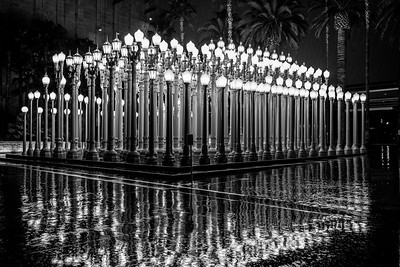
Or the removed statues could be made into a new kind of installation and reinterpretation, along the lines of Chris Burden's "Urban Light" outside of the Los Angeles County Museum of Art.
Urban Light

A related issue are proposals to rename military bases named after Confederate military personages.  The military is ok with the change, President Trump not ("GOP senator: Proposal to remove Confederate names from military bases 'picks on South unfairly'," CNN).  It's but another element in creating an institutional culture of racism.

Can you imagine the US military having a base named after Hitler or Goebbels?  Or King George III or Prime Minister Tojo.  Or Osama Bin-Laden, etc.?

This image could be used to make a great outdoor art installation.
Lunch counter sit in at the F.W. Woolworth on Granby Street in Norfolk, Virginia
Some of the young African Americans taking part in a sit-in at the Woolworth store on Granby Street in Norfolk were Norfolk Division of Virginia State College students dressed in ROTC uniforms. (Virginian-Pilot File photo)

=============================
A brief comment about Confederate monuments
8/20/2017


It's hard to disagree with people arguing that such monuments weren't erected to call attention to history as much as they were to sow fear with regard to black-white relations.

But removing all of the "sculptures" from the public space makes it that much harder to provide the greatest possible opportunity for interpretation, reinterpretation, challenge and contestation.


I can see changing the name of streets--e.g., Alexandria, Virginia ("Alexandria wants your help in renaming Jeff Davis Highway," WTOP-Radio) is renaming its segment of Route 1 so that it will no longer be named for Jefferson Davis, the president of the Confederacy.

Richmond, Virginia has chosen to keep the monuments on its prominent boulevard, Monument Avenue, where all but one of the statues and monuments venerate Confederate personages. From the Wikipedia entry:
Monument Avenue is an avenue in Richmond, Virginia with a tree-lined grassy mall dividing the east- and westbound traffic and is punctuated by statues memorializing Virginian Confederate participants of the American Civil War, including Robert E. Lee, J.E.B. Stuart, Jefferson Davis, Thomas "Stonewall" Jackson, and Matthew Fontaine Maury. There is also a monument to Arthur Ashe, a Richmond native and international tennis star who was African-American. The first monument, a statue of Robert E. Lee, was erected in 1890. 
But I would argue it is reasonable to consider removing such prominently located statues and sculptures because their position in highly visible and centrally located places of prominence in the public realm framework imply acceptance and veneration more than they do the opportunity to provoke rethinking. 

Certainly, as a historic district, Monument Avenue hasn't been utilized as a place to discuss how statuary and monuments can be used to project a way of thinking and subjugation, based on the description of the district by the National Park Service.

But a piece, "Bring bigger picture of history to Monument Avenue," in the Norfolk Virginian-Pilot argues that Monument Avenue presents such an opportunity:
Monument Avenue should become the place where we see and feel our national shame. The statues along it, many artistically splendid, should be accentuated with extensive historical connotations so that they might provide a justifiable sense of societal advancement. Let them celebrate our significant and, yes, ongoing efforts to reject our past failings.

And add more monuments. Surely some of our nation’s corporations and foundations would step forward to support the building of new, glorious statues recognizing the sacrifices and achievements of those who fought to defeat racism and bigotry.

Imagine a grand marble representation of the Underground Railroad, which guided former slaves to safety and freedom. How about another marking the 10 greatest contributions to sciences, arts, athletics, industry and public service by African Americans since the Civil War? Perhaps another saluting the Tuskegee Airmen?

How about individual statues as well to recognize those who are seldom celebrated? ...
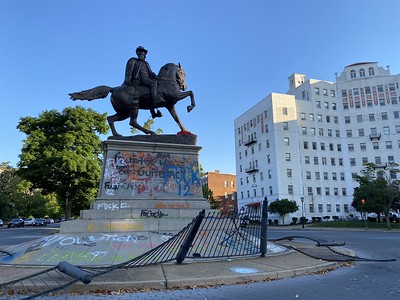
By contrast, moving all of these monuments to museums obscures what they represent.  Sure, they will be viewable and accessible, but will require deliberate action in order to engage with them and the history they represent.  But not having such objects out in the open, an opportunity to confront more directly the nation's negative history is also lost.

Richmond protest, graffiti on Confederate monuments[added] Certainly, tagging the statues is a form of reinterpretation and expanding the didactics describing them, when otherwise no alternative interpretation is provided.

This came up in a conversation at Thanksgiving Dinner, shared with our next door neighbors and their family, who hail from South America.

We were talking about US Imperialism and the impact on Latin America, and how they experienced it first hand, which is why they have such a complicated relationship with the US.

But also how the average American knows very little about this.

I explained that it isn't until college--and only certain colleges at that--when the average American has the opportunity to be exposed to alternatives to the typical mythology about the US and its place in the world, especially as a force only for good, as is presented in K-12 history and social studies textbooks.

The reality is that as a country, our external relations aren't always "a force for good," and internally as a nation we have many faults too, in race relations, economic opportunity, and politics.

Certainly, an identification and consideration of the power of whiteness isn't something that most people are willing to do nor are they willing to examine their sense of privilege and power that results from it.  People want to maintain their power and prefer to label people who disagree as "the other."

Ironically, the process is comparable to how motor vehicle operators treat other modes as usurpers ("Criminal Bicyclists," "Streets as places versus 'Motordom'," "Societal change (and sustainable transportation)," and "This gets tiresome: an automobile driver insists that automobiles are efficient users of precious road space while transit vehicles are inefficient," and "Bicyclists as the other (continued).")

Of course, my other point about this would be to reinterpret the Smithsonian National Museum of American History in terms of American Imperialism.  I don't think that would go over very well ("Dancing with the one that brung ya and challenging the dominant narrative").

Below is a reprint of a piece from 2014.  (Also see "Slavery museum in/and Richmond," 2013.)

=================
Tuesday, October 28, 2014
(Public) History/Historic Preservation Tuesday: Museums and Modern Historiography

Last weekend we went to the George Washington Birthplace National Monument, in Westmoreland County, Virginia.

Interestingly, it is a re-created place, not unlike Colonial Williamsburg, and both places share John D. Rockefeller Jr. as a donor.  Rockefeller gave money to the Birthplace a few years before he was enticed to fund the preservation and re-creation of Virginia's original state capital.
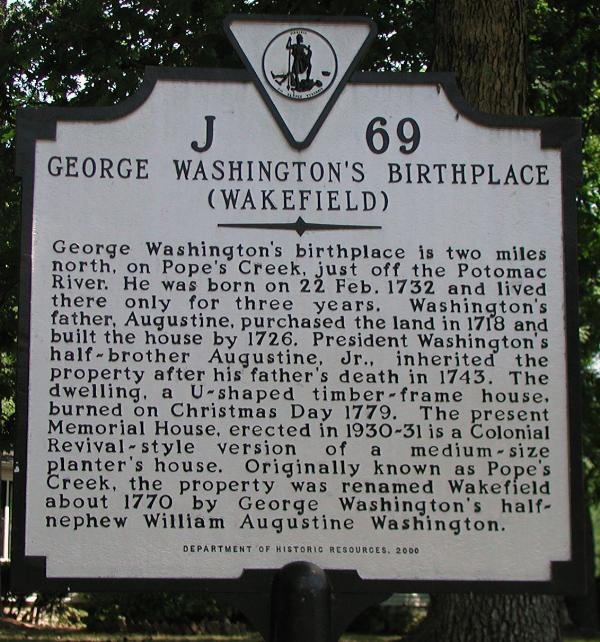
It was interesting that the bookshop had a couple of titles that challenged the mythology around George Washington, and the exhibit, while very simple, started off with a section on "myth vs. fact" about George Washington.

The books, Here, George Washington Was Born: Memory, Material Culture, and the Public History of a National Monument and Inventing George Washington: America's Founder, in Myth and Memory, discuss the role of George Washington as an element of nation building and the national "story" and mythology around the founding of the United States of America, and the promotion of patriotism.

Last year, visiting Gettysburg, I was spurred to read a bunch of books about the Civil War, having been  primed a few years before by the Valentine Richmond History Center in Richmond, Virginia, and their exhibit on the historical themes of the city, which pointed out that at the outset of the Civil War, Richmonders--remember that their city was the capital of the Confederacy--voted against entering into war with the Union.

Modern historiography of the Confederacy makes hash of the "Lost Cause" myth.   Even I remember reading one of the chapters of Barrington Moore's Social Origins of Dictatorship and Democracy: Lord and Peasant in the Making of the Modern World in my sophomore year in college, and how "the Civil War was necessary to make over the US into a modern industrial economy."

[Added -- But even then I don't think the book made clear how central was to the US economy, not just for plantation agriculture in the South, but in international trade, the country's balance of payments, and as a big business for NYC-based financiers.]
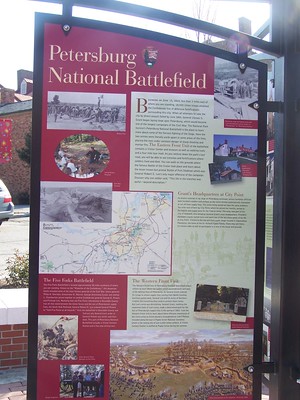
Petersburg National Battlefield panel, Tourism-Historic Narrative Kiosk, Downtown Petersburg, VABut that interpretation still hasn't percolated down much within the South more generally.  One example is the City of Petersburg, Virginia and its presentation of various Civil War sites under the control of the city [through its department of museums].  They pretty much take a pro-Confederate position.

Interpretation panel at the Petersburg, Virginia Visitor Center.

Confederate flag.  Given that a nation's flag is very much a symbol, the ongoing controversy over display of the Confederate flag is another example of the clash between reflexive "patriotism" and an unwillingness to consider all relevant elements of said symbol vs. considered reflection.

How can the flag of the Confederate States of America not be seen as a relic of racism and slavery?

More recently, the Danville Museum of Fine Arts and History has gotten caught up in this controversy.  Danville was the last "capital" of the Confederacy, and the Confederate flag flies on the Museum's grounds.

The Museum's strategic plan calls for presentation of an inclusive history and so the display of the flag is seen as incongruent with their goals and objectives and they requested from the city permission to take it down.  That has touched off great controversy and the local newspaper has a great number of articles about it (e.g., "Museum marches on with upcoming sesquicentennial commemoration," Danville Register-Bee ).

From the article:
The newly adopted strategic plan includes a vision “to be the Dan River Region’s leader for integrated awareness of history, culture and community,” according to a Sept. 30 letter from Board of Directors President Jane Murray to museum members. ...

Burton, in a Sept. 30 letter to the city, asked Danville City Council to remove the flag from outside the building to inside for an upcoming exhibit of the history of Confederate flags. The museum’s board of directors had voted Sept. 25 to make the request as part of its new three-year strategic plan.

The request caused an uproar among Confederate heritage organizations and other supporters of keeping the flag on display outside the museum. The move re-ignited a debate between flag supporters and those who see the flag as a racist reminder of past enslavement of African-Americans.

During an interview Friday, Burton said the Confederate flag exhibit that will be part of the sesquicentennial will go on as planned. People have “politicized the flag,” she said, but the museum’s board is merely trying to be inclusive and welcoming to everyone.
The comment threads are particularly interesting and there have been a number of pro- and con- letters to the editor as well (e.g., "Confederate flag must come down").

Right:  Georgia II by Leo Twiggs.

By contrast, there is an exhibit of paintings by an African-American artist at the Greenville (South Carolina) County Museum of Art ("SC artist sees heritage, hate in Confederate battle flags," Greenville News).

From the article:
Some see heritage. Some see hate.  When artist Leo Twiggs looks at the Confederate battle flag, he sees both of those things — but also a vision for a more harmonious future. 
Twiggs' 11 large depictions of the flag at the Greenville County Art Museum are at once beautiful and tattered, reflecting a shared Southern history of pride and pain. 
"In our state, I think the flag is something that many black people would like to forget and many white people would love to remember," Twiggs said. ... 
Through the repeated image of a torn and tattered flag, Twiggs addresses subtle issues about the shared Southern history of African Americans and whites, and the continued complexity of race relations.
History curriculum not patriotic:  Colorado. While interrogational historical interpretation is accepted in the academic world, it is still controversial in the K-12 educational arena, as witnessed by the recent proposal by a local school board in Colorado to make over the district's AP history curriculum because they didn't believe it is "patriotic" ("Changes in AP history trigger a culture clash in Colorado." Washington Post ).

The Board backed down after widespread protest led by students.  Image from the AP story "Colorado students walk out to protest censorship,"

Of course, the dichotomy between patriotism and "revisionism" or a broader interpretational framework for history and "social studies" is a major thread in national discourse

Personal history.  Speaking of rocking my world, and personal historiography, because of my tragic childhood, I don't have a lot of details about my own ethnicity, although I have some clues, stuff I remembered, which Suzanne decided to follow up.  So while I thought half my heritage was German/Russian, it turns out that I am Polish-Russian/Belorussian on my father's side of the family.

And looking at old records of the family, while I thought always that Hamtramck, Michigan, a Polish enclave surrounded by Detroit, was 100% Catholic, the reality is that the area also attracted, at least for a time, Polish Jewish immigrants also, in all likelihood because they spoke a common language.

Some of my relatives likely lived for a time in or near the "Poletown" neighborhood in Detroit that was eradicated in the 1980s for a GM manufacturing plant.

On that note, the Polin Museum of the History of Polish Jews has opened today in Warsaw  ("A new Warsaw museum devoted to Jewish-Polish history," Financial Times). The museum's core galleries address the place of Jews in Poland's history, focusing on integration but acknowledging anti-Semitism, recovering memory that was eradicated finally by the Holocaust.

Crowdsourcing museum curation/the public in public history. The Wall Street Journal has a piece on crowdsourcing art exhibits, "Everybody's an Art Curator," which can be controversial when familiarity can trump artistic evaluation and merit.

On the other hand some museums have experienced a significant uptick in visitation, membership, and funding when they increase public engagement through such methods.

In terms of community history, I have had problems with the "everyone's a historian" focus of some of these kinds of initiatives.  Much of the time, it's a way to dumb down history and seize on memes rather than depth.

I do think that historians need to step in when it is warranted and provide greater context, and acknowledge developments in history at multiple scales (community, metropolitan area, region, state, nation, globe) so that important events aren't lost at the expense of the familiar and popular. See the past blog entry "Thinking about local history."

Labels: , , , , , , , , , ,

Friday, October 11, 2019

Reopening of Anacostia Community Museum: Sunday October 13th

Why this is important is not so much a chance to meet the new director, but to see the fabulous "Right to the City" exhibit, which I think is a great model for showing how to present community history at the neighborhood scale.

The neighborhoods it covers are Adams-Morgan, Anacostia, Brookland, Chinatown, Shaw, and Southwest.

It takes 3-4 hours to go through the exhibit. It is rich and deep. One of the great scores is footage from ABC-TV featuring Dr. Martin Luther King, Jr. riding in a parade and his speech to the group, a Shaw neighborhood improvement initiative led by civil rights activist Walter Fauntroy, Jr., who later became DC's Congressional Delegate.

====
For me, having been in DC since 1987, I feel like civil society today here is pretty weak. The exhibit shows that in the 1960s and 1970s especially that was decidedly not the case.


Labels: , , , , ,

Friday, August 25, 2017

Postcard exhibit at DC Chapter of American Institute of Architects

The Post columnist John Kelly writes about the current postcard exhibit at the DC chapter of the American Institute of Architects, Wish You Were Here! Vintage Postcards from Washington, D.C. which is up through Friday September 8th  ("Postcards from paradise — or at least from Washington, D.C.").

On Thursday August 31st, there will be a talk, "Greetings from Hometown Washington, DC," about the exhibit, by Jerry McCoy, a DCPL librarian, avid postcard collector, and chair of the Silver Spring Historical Society.

The exhibit is cool and worth looking at.  One neat element is that the exhibit includes items from a number of DC institutions and private collectors.

I saw a bunch of postcards I hadn't seen before--but I found it somewhat disappointing because while the didactics discuss how postcards were used to send messages and communicate, no backs of postcards/no messages are displayed.

In their own right, backs of postcards are also interesting in how the printed text communicates about the value of what is displayed on the front. 

Backs of the postcards may include text and logos from "sponsors" be it a local motel or a railroad line, which made postcards available on signature passenger trains.

Besides the great images depicted on the fronts of postcards, I like postcards because of the text of the message, where people describe their impressions of the city, what they did and where they visited, etc.

When I picked up this card in Seattle (left), because the front is nondescript (a 1960s era card), my partner asked me why I bothered. I said, read it.

The writer-sender described being in the city to attend a conference and the inconveniences posed by there being a massive anti-war demonstration at the same time.


Finally, backs of postcards can be interesting because of the postmarks. Some individual post offices cancelled their own mail. I have postmarked cards from Brookland, Takoma Park, and Union Station in DC, and Ballston, in Arlington County.  (I might have one from Silver Spring, Maryland too.)

It would have been interesting to show such cards also--Georgetown had its own cancellation pre-1900, but I haven't been able to find one after that time frame.  But I keep looking...

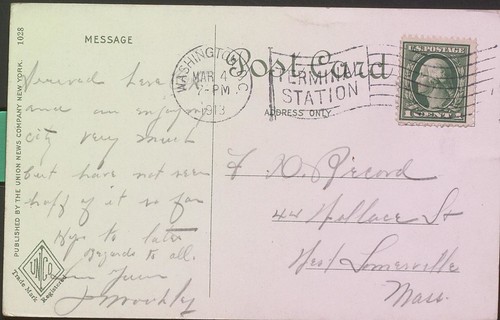
This postcard back (an image from the Internet, not in my possession) shows both this kind of message as well as a localized postmark from "Terminal (Union) Station."
Washington Union Station postcard, postmarked 1913, with "Terminal Station" indicia

In terms of the mounting of the exhibit as pointed out in the Kelly column, part of the show is displayed behind a table under the stairs making it extremely difficult to view the postcards shown in that section of the exhibit.  Although it is nice that each original card was scanned and is shown at a size larger than real life.

For people interested in postcards and urbanism, the great book by Alison Isenberg, Downtown America: a history of the place and the people who made it (commentary), which analyzes the impact of the Depression on downtowns and the real estate industry, uses the postcard archives of the former Curt Teich Company to illustrate and discuss how communities portrayed and marketed themselves.

Finally, one of the great things about collecting postcards of "Washington" is that because of people visiting here and communicating with people "back home," you can find great Washington ephemera all over the country.

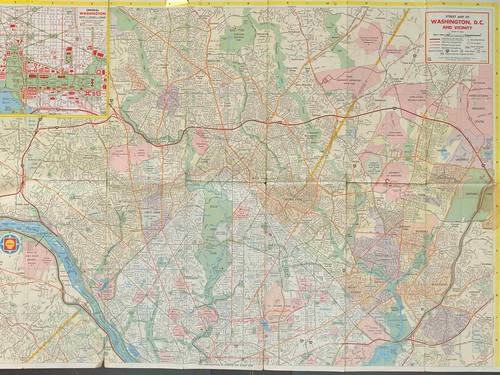
E.g., a Shell gas station road map of DC dated 1966 that I picked up in Richmond shows the then proposed freeway routes that were successfully fought off later in response to a citizen campaign against the freeways.
Washington DC Shell Oil map, 1966

Labels: ,

Sunday, August 20, 2017

A brief comment about Confederate monuments

It's hard to disagree with people arguing that such monuments weren't erected to call attention to history as much as they were to sow fear with regard to black-white relations.

But removing all of the "sculptures" from the public space makes it that much harder to provide the greatest possible opportunity for interpretation, reinterpretation, and challenge.


I can see changing the name of streets--e.g., Alexandria, Virginia ("Alexandria wants your help in renaming Jeff Davis Highway," WTOP-Radio) is renaming its segment of Route 1 so that it will no longer be named for Jefferson Davis, the president of the Confederacy.

Richmond, Virginia has chosen to keep the monuments on its prominent boulevard, Monument Avenue, where all but one of the statues and monuments venerate Confederate personages. From the Wikipedia entry:
Monument Avenue is an avenue in Richmond, Virginia with a tree-lined grassy mall dividing the east- and westbound traffic and is punctuated by statues memorializing Virginian Confederate participants of the American Civil War, including Robert E. Lee, J.E.B. Stuart, Jefferson Davis, Thomas "Stonewall" Jackson, and Matthew Fontaine Maury. There is also a monument to Arthur Ashe, a Richmond native and international tennis star who was African-American. The first monument, a statue of Robert E. Lee, was erected in 1890. 
But I would argue it is reasonable to consider removing such prominently located statues and sculptures because their position in highly visible and centrally located places of prominence in the public realm framework imply acceptance and veneration more than they do the opportunity to provoke rethinking. 

Certainly, as a historic district, Monument Avenue hasn't been utilized as a place to discuss how statuary and monuments can be used to project a way of thinking and subjugation, based on the description of the district by the National Park Service.

But a piece, "Bring bigger picture of history to Monument Avenue," in the Norfolk Virginian-Pilot argues that Monument Avenue presents such an opportunity:
Monument Avenue should become the place where we see and feel our national shame. The statues along it, many artistically splendid, should be accentuated with extensive historical connotations so that they might provide a justifiable sense of societal advancement. Let them celebrate our significant and, yes, ongoing efforts to reject our past failings.

And add more monuments. Surely some of our nation’s corporations and foundations would step forward to support the building of new, glorious statues recognizing the sacrifices and achievements of those who fought to defeat racism and bigotry.

Imagine a grand marble representation of the Underground Railroad, which guided former slaves to safety and freedom. How about another marking the 10 greatest contributions to sciences, arts, athletics, industry and public service by African Americans since the Civil War? Perhaps another saluting the Tuskegee Airmen?

How about individual statues as well to recognize those who are seldom celebrated? ...
By contrast, moving all of these monuments to museums obscures what they represent.  Sure, they will be viewable and accessible, but will require deliberate action in order to engage with them and the history they represent.  But not having such objects out in the open, an opportunity to confront more directly the nation's negative history is also lost.

This came up in a conversation at Thanksgiving Dinner, shared with our next door neighbors and their family, who hail from South America.  We were talking about US Imperialism and the impact on Latin America, and how they experienced it first hand, which is why they have such a complicated relationship with the US.  But also how the average American knows very little about this.

I explained that it isn't until college--and only certain colleges at that--when the average American has the opportunity to be exposed to alternatives to the typical mythology about the US and its place in the world, especially as a force only for good.

The reality is that as a country, our external relations aren't always "a force for good," and internally as a nation we have many faults too, in race relations, economic opportunity, and politics.  Certainly, an identification and consideration of the power of whiteness isn't something that most people are willing to do nor are they willing to examine their sense of privilege and power that results from it.  People want to maintain their power and prefer to label people who disagree as "the other."

Ironically, the process is comparable to how motor vehicle operators treat other modes as usurpers ("Criminal Bicyclists," "Streets as places versus 'Motordom'," "Societal change (and sustainable transportation)," and "This gets tiresome: an automobile driver insists that automobiles are efficient users of precious road space while transit vehicles are inefficient," and "Bicyclists as the other (continued).")

Of course, my other point about this would be to reinterpret the Smithsonian National Museum of American History in terms of American Imperialism.  I don't think that would go over very well ("Dancing with the one that brung ya and challenging the dominant narrative").

Below is a reprint of a piece from 2014.  (Also see "Slavery museum in/and Richmond," 2013.)

=================
Tuesday, October 28, 2014
(Public) History/Historic Preservation Tuesday: Museums and Modern Historiography

Last weekend we went to the George Washington Birthplace National Monument, in Westmoreland County, Virginia.

Interestingly, it is a re-created place, not unlike Colonial Williamsburg, and both places share John D. Rockefeller Jr. as a donor.  Rockefeller gave money to the Birthplace a few years before he was enticed to fund the preservation and re-creation of Virginia's original state capital.

It was interesting that the bookshop had a couple of titles that challenged the mythology around George Washington, and the exhibit, while very simple, started off with a section on "myth vs. fact" about George Washington.

The books, Here, George Washington Was Born: Memory, Material Culture, and the Public History of a National Monument and Inventing George Washington: America's Founder, in Myth and Memory, discuss the role of George Washington as an element of nation building and the national "story" and mythology around the founding of the United States of America, and the promotion of patriotism.

Last year, visiting Gettysburg, I was spurred to read a bunch of books about the Civil War, having been first primed a few years before by the Valentine Richmond History Center in Richmond, Virginia, and their exhibit on the historical themes of the city, which pointed out that during the Civil War era, Richmonders--remember that their city was the capital of the Confederacy--voted against entering into war with the Union.

Modern historiography of the Confederacy makes hash of the "Lost Cause" myth.   Even I remember reading one of the chapters of Barrington Moore's Social Origins of Dictatorship and Democracy: Lord and Peasant in the Making of the Modern World in my sophomore year in college, and how "the Civil War was necessary to make over the US as a modern industrial economy."

But that interpretation still hasn't percolated down much within the South more generally.  One example is the City of Petersburg, Virginia and its presentation of various Civil War sites under the control of the city [through its department of museums].

Confederate flag.  Given that a nation's flag is very much a symbol, the ongoing controversy over display of the Confederate flag is another example of the clash between reflexive "patriotism" and an unwillingness to consider all relevant elements of said symbol vs. considered reflection.  How can the flag of the Confederate States of America not be seen as a relic of racism and slavery?

More recently, the Danville Museum of Fine Arts and History has gotten caught up in this controversy.  Danville was the last "capital" of the Confederacy, and the Confederate flag flies on the Museum's grounds.

The Museum's strategic plan calls for presentation of an inclusive history and so the display of the flag is seen as incongruent with their goals and objectives and they requested from the city permission to take it down.  That has touched off great controversy and the local newspaper has a great number of articles about it (e.g., "Museum marches on with upcoming sesquicentennial commemoration," Danville Register-Bee ).

From the article:
The newly adopted strategic plan includes a vision “to be the Dan River Region’s leader for integrated awareness of history, culture and community,” according to a Sept. 30 letter from Board of Directors President Jane Murray to museum members. ...

Burton, in a Sept. 30 letter to the city, asked Danville City Council to remove the flag from outside the building to inside for an upcoming exhibit of the history of Confederate flags. The museum’s board of directors had voted Sept. 25 to make the request as part of its new three-year strategic plan.

The request caused an uproar among Confederate heritage organizations and other supporters of keeping the flag on display outside the museum. The move re-ignited a debate between flag supporters and those who see the flag as a racist reminder of past enslavement of African-Americans.

During an interview Friday, Burton said the Confederate flag exhibit that will be part of the sesquicentennial will go on as planned. People have “politicized the flag,” she said, but the museum’s board is merely trying to be inclusive and welcoming to everyone.
The comment threads are particularly interesting and there have been a number of pro- and con- letters to the editor as well (e.g., "Confederate flag must come down").

Right:  Georgia II by Leo Twiggs.

By contrast, there is an exhibit of paintings by an African-American artist at the Greenville (South Carolina) County Museum of Art ("SC artist sees heritage, hate in Confederate battle flags," Greenville News).

From the article:
Some see heritage. Some see hate.  When artist Leo Twiggs looks at the Confederate battle flag, he sees both of those things — but also a vision for a more harmonious future. 
Twiggs' 11 large depictions of the flag at the Greenville County Art Museum are at once beautiful and tattered, reflecting a shared Southern history of pride and pain. 
"In our state, I think the flag is something that many black people would like to forget and many white people would love to remember," Twiggs said. ... 
Through the repeated image of a torn and tattered flag, Twiggs addresses subtle issues about the shared Southern history of African Americans and whites, and the continued complexity of race relations.
History curriculum not patriotic:  Colorado. While interrogational historical interpretation is accepted in the academic world, it is still controversial in the K-12 educational arena, as witnessed by the recent proposal by a local school board in Colorado to make over the district's AP history curriculum because they didn't believe it is "patriotic" ("Changes in AP history trigger a culture clash in Colorado." Washington Post ).

The Board backed down after widespread protest led by students.  Image from the AP story "Colorado students walk out in protest,"

Of course, the dichotomy between patriotism and "revisionism" or a broader interpretational framework for history and "social studies" is a major thread in national discourse

Personal history.  Speaking of rocking my world, and personal historiography, because of my tragic childhood, I don't have a lot of details about my own ethnicity, although I have some clues, stuff I remembered, which Suzanne decided to follow up.  So while I thought half my heritage was German/Russian, it turns out that I am Polish-Russian/Belorussian on my father's side of the family.

And looking at old records of the family, while I thought always that Hamtramack, Michigan, a Polish enclave surrounded by Detroit, was 100% Catholic, the reality is that the area also attracted, at least for a time, Polish Jewish immigrants also.  Some of my relatives likely lived for a time in the "Poletown" neighborhood in Detroit that was eradicated in the 1980s for a GM manufacturing plant.

On that note, the Polin Museum of the History of Polish Jews has opened today in Warsaw  ("A new Warsaw museum devoted to Jewish-Polish history," Financial Times). The museum's core galleries address the place of Jews in Poland's history, focusing on integration but acknowledging anti-Semitism, recovering memory that was eradicated finally by the Holocaust.

Crowdsourcing museum curation/the public in public history. The Wall Street Journal has a piece on crowdsourcing art exhibits, "Everybody's an Art Curator," which can be controversial when familiarity can trump artistic evaluation and merit. On the other hand some museums have experienced a significant uptick in visitation, membership, and funding when they increase public engagement through such methods.

In terms of community history, I have had some problems with the "everyone's a historian" focus of some of these kinds of initiatives. I do think that historians need to step in when it is warranted and provide greater context, and acknowledge developments in history at multiple scales (commmunity, metropolitan area, region, state, nation, globe) so that important events aren't lost at the expense of the familiar and popular. See the past blog entry "Thinking about local history."

Labels: , , , , ,

Tuesday, March 03, 2015

Historic Preservation Tuesday: Adaptive Reuse and the Uline Arena

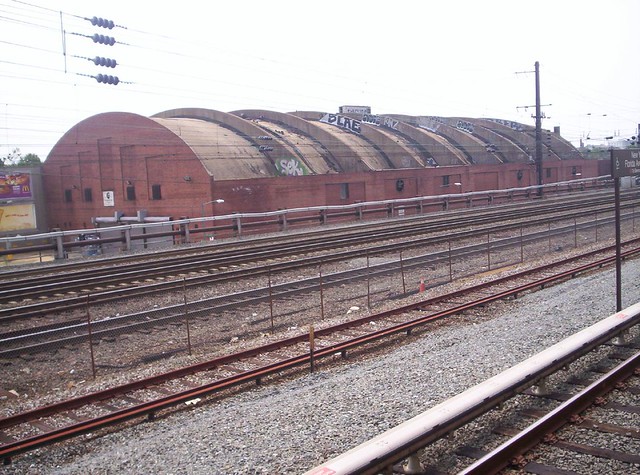
The Uline Arena is a vaguely industrial building located just east of the NoMA Metrorail station, between 2nd and 3rd and M Streets NE. The building has gone through a number of iterations--as a concert, events and sports arena, church, and a trash transfer station. In 2003, in face of a proposal by the then land owner to demolish the building, I led an eventually successful effort to get the building designated as a historic landmark.

Uline Arena and the Union Station railyardI thought the building was important to save because it represented a variety of themes in DC's history, with both local and national ramifications.

The building was an event site that when I first looked into it, was only relevant to me because it was the site of the first public Beatles concert in the US.

But it had been home to professional sports teams, the Ringling Bros. circus, the Ice Capades and a wide range of concerts.

It was built by Migiel Uline, an impresario of ice making, who thought he could extend his prowess to professional hockey, which was the main tenant of the building when it first opened in the early 1940s.

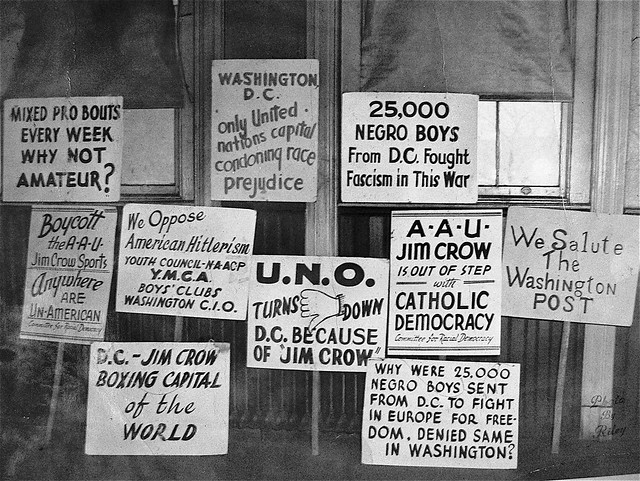
Protest Signs, Campaign to integrate Uline Arena, (1948-49)Right: protest signs from the Campaign to Integrate Uline Arena, 1948-1949.  From the collection of Edwin B. Henderson II.

The Uline is very interesting because of how it relates to the local and national civil rights history.

It was a segregated events facilitly--although Mr. Uline claimed that the policy was up to the sponsor of individual events.  But after a steady year of protests at every event, in 1949 the building was integrated.

This was about 4 years before the courts ruled that DC public accommodations had to be integrated in the Thompson Restaurant case and 5 years before the ruling in Brown v. Board of Education.

Later Earl Lloyd, one of the first black players for what has become the NBA, played for the Washington Capitols basketball team.  He died last week ("Earl Lloyd, first African American player in the NBA, dies at 86," Post).  Elijah Muhammed and Malcolm X spoke at rallies there, the Poor People's Campaign rented the facility to use while they protested on the National Mall.

But it is also important for how it demonstrates industrial architecture and the reality that DC isn't just monumental civic architecture, and it is a significant example of advances in concrete technology and truss systems, which allowed for the construction of the interior without pillars allowing unobstructed views.

Sadly, while the company that owns 9:30 Club was after the owner for many years to allow them to lease or buy the building to bring it back as a concert facility, he was never interested.

The building is now slated to become an REI store ("National Outdoor Retailer REI to Open Flagship in Historic Uline Arena," press release), one of five extra special flagship stores.

Interestingly, I still remember how angry H Street Main Street co-founder Kevin Palmer was when he saw REI signs on Metrobuses announcing that with their new store in Tysons Corner Virginia, REI was now in "Washington."

Now they will be.

But I can't claim that was the outcome I was capable of envisioning back in 2003.

Labels: , , , , ,

Thursday, October 30, 2014

November 5th is #lovelocalsf (San Francisco) Day


The San Francisco Chronicle newspaper has partnered with the Mayor's Office to sponsor "the first ever city-wide celebration of San Francisco on #LoveLocalSF day, November 5, 2014!"

 According to the website:
#LoveLocalSF is a city-wide celebration of San Francisco on Wednesday, November 5, 2014. This will be a day to honor all of the things that make our great city so unique -- be it our diverse communities, our eclectic history, our trendsetting nature or our commitment to innovation. Everyone is invited to show their San Francisco pride through events, art, music, special promotions, parties, and, of course, by wearing our signature color, red.

SFGate is helping to organize this citywide celebration, which includes over 120 businesses and organizations. Non-profits like 826 Valencia and SF-Marin Food Bank, renowned restaurants like State Bird Provisions, iconic shops like Goorin Bros., cultural institutions like the SF Zoo and SFJAZZ and many, many more will all be taking part in this special day.

YOU'RE INVITED to the GRAND FINALE celebration of SF at the Presidio Main Lawn on November 5th from 6 - 8 PM. Join us for live entertainment, music, food and drink provided by Off The Grid and many more fun surprises!

See the full list of celebrations here.  To host an event, sign up here.

Labels: , , , , ,

Tuesday, October 28, 2014

(Public) History/Historic Preservation Tuesday: Museums and Modern Historiography

Last weekend we went to the George Washington Birthplace National Monument, in Westmoreland County, Virginia.

Interestingly, it is a re-created place, not unlike Colonial Williamsburg, and both places share John D. Rockefeller Jr. as a donor.  Rockefeller gave money to the Birthplace a few years before he was enticed to fund the preservation and re-creation of Virginia's original state capital.

It was interesting that the bookshop had a couple of titles that challenged the mythology around George Washington, and the exhibit, while very simple, started off with a section on "myth vs. fact" about George Washington.

The books, Here, George Washington Was Born: Memory, Material Culture, and the Public History of a National Monument and Inventing George Washington: America's Founder, in Myth and Memory, discuss the role of George Washington as an element of nation building and the national "story" and mythology around the founding of the United States of America, and the promotion of patriotism.

Last year, visiting Gettysburg, I was spurred to read a bunch of books about the Civil War, having been first primed a few years before by the Valentine Richmond History Center in Richmond, Virginia, and their exhibit on the historical themes of the city, which pointed out that during the Civil War era, Richmonders--remember that their city was the capital of the Confederacy--voted against entering into war with the Union.

Modern historiography of the Confederacy makes hash of the "Lost Cause" myth.   Even I remember reading one of the chapters of Barrington Moore's Social Origins of Dictatorship and Democracy: Lord and Peasant in the Making of the Modern World in my sophomore year in college, and how "the Civil War was necessary to make over the US as a modern industrial economy."

But that interpretation still hasn't  percolated down much within the South more generally.  One example is the City of Petersburg, Virginia and its presentation of various Civil War sites under the control of the city.

Confederate flag.  Given that a nation's flag is very much a symbol, the ongoing controversy over display of the Confederate flag is another example of the clash between reflexive "patriotism" and an unwillingness to consider all relevant elements of said symbol vs. considered reflection.  How can the flag of the Confederate States of America not be seen as a relic of racism and slavery?

More recently, the Danville Museum of Fine Arts and History has gotten caught up in this controversy.  Danville was the last "capital" of the Confederacy, and the Confederate flag flies on the Museum's grounds.

The Museum's strategic plan calls for presentation of an inclusive history and so the display of the flag is seen as incongruent with their goals and objectives and they requested from the city permission to take it down.  That has touched off great controversy and the local newspaper has a great number of articles about it (e.g., "Museum marches on with upcoming sesquicentennial commemoration," Danville Register-Bee ).

From the article:
The newly adopted strategic plan includes a vision “to be the Dan River Region’s leader for integrated awareness of history, culture and community,” according to a Sept. 30 letter from Board of Directors President Jane Murray to museum members. ...

Burton, in a Sept. 30 letter to the city, asked Danville City Council to remove the flag from outside the building to inside for an upcoming exhibit of the history of Confederate flags. The museum’s board of directors had voted Sept. 25 to make the request as part of its new three-year strategic plan.

The request caused an uproar among Confederate heritage organizations and other supporters of keeping the flag on display outside the museum. The move re-ignited a debate between flag supporters and those who see the flag as a racist reminder of past enslavement of African-Americans.

During an interview Friday, Burton said the Confederate flag exhibit that will be part of the sesquicentennial will go on as planned. People have “politicized the flag,” she said, but the museum’s board is merely trying to be inclusive and welcoming to everyone.
The comment threads are particularly interesting and there have been a number of pro- and con- letters to the editor as well (e.g., "Confederate flag must come down").

Right:  Georgia II by Leo Twiggs.

By contrast, there is an exhibit of paintings by an African-American artist at the Greenville (South Carolina) County Museum of Art ("SC artist sees heritage, hate in Confederate battle flags," Greenville News).

From the article:
Some see heritage. Some see hate.  When artist Leo Twiggs looks at the Confederate battle flag, he sees both of those things — but also a vision for a more harmonious future. 
Twiggs' 11 large depictions of the flag at the Greenville County Art Museum are at once beautiful and tattered, reflecting a shared Southern history of pride and pain. 
"In our state, I think the flag is something that many black people would like to forget and many white people would love to remember," Twiggs said. ... 
Through the repeated image of a torn and tattered flag, Twiggs addresses subtle issues about the shared Southern history of African Americans and whites, and the continued complexity of race relations.
History curriculum not patriotic:  Colorado. While interrogational historical interpretation is accepted in the academic world, it is still controversial in the K-12 educational arena, as witnessed by the recent proposal by a local school board in Colorado to make over the district's AP history curriculum because they didn't believe it is "patriotic" ("Changes in AP history trigger a culture clash in Colorado." Washington Post ).

The Board backed down after widespread protest led by students.  Image from the AP story "Colorado students walk out in protest,"

Of course, the dichotomy between patriotism and "revisionism" or a broader interpretational framework for history and "social studies" is a major thread in national discourse

Personal history.  Speaking of rocking my world, and personal historiography, because of my tragic childhood, I don't have a lot of details about my own ethnicity, although I have some clues, stuff I remembered, which Suzanne decided to follow up.  So while I thought half my heritage was German/Russian, it turns out that I am Polish-Russian/Belorussian on my father's side of the family.

And looking at old records of the family, while I thought always that Hamtramack, Michigan, a Polish enclave surrounded by Detroit, was 100% Catholic, the reality is that the area also attracted, at least for a time, Polish Jewish immigrants also.  Some of my relatives likely lived for a time in the "Poletown" neighborhood in Detroit that was eradicated in the 1980s for a GM manufacturing plant.

On that note, the Polin Museum of the History of Polish Jews has opened today in Warsaw  ("A new Warsaw museum devoted to Jewish-Polish history," Financial Times). The museum's core galleries address the place of Jews in Poland's history, focusing on integration but acknowledging anti-Semitism, recovering memory that was eradicated finally by the Holocaust.

Crowdsourcing museum curation/the public in public history. The Wall Street Journal has a piece on crowdsourcing art exhibits, "Everybody's an Art Curator," which can be controversial when familiarity can trump artistic evaluation and merit. On the other hand some museums have experienced a significant uptick in visitation, membership, and funding when they increase public engagement through such methods.

In terms of community history, I have had some problems with the "everyone's a historian" focus of some of these kinds of initiatives. I do think that historians need to step in when it is warranted and provide greater context, and acknowledge developments in history at multiple scales (commmunity, metropolitan area, region, state, nation, globe) so that important events aren't lost at the expense of the familiar and popular. See the past blog entry "Thinking about local history."

Labels: , , , , ,

Sunday, October 19, 2014

Local history museums and critical analysis opportunities for communities

Local history museums generally can be pretty good places to be exposed to a richer, deeper, and more analytical framework for considering the history of a community.  Standouts include the Valentine Richmond History Center in Richmond, Virginia; the Pittsburgh History Center; and the Montreal History Center.

The best of these museums present a thematic and timeline-based framework to help people understand the major events within a community in local, national, and international contexts.  Note that the Museum of the City of New York presents this type of framework through a movie rather than exhibits.

Of course, not all museums do this--still being somewhat parochial--while some other museums, notably the Museum of London, stake out a greater role for the museum in providing a forum for reflection on current events.  (See the past entry, "Parochialism and historiography.")

In terms of this theme of the lack of critical analysis within communities, in 2012, the Museum of the City of New York opened the Activist New York exhibit, as the inaugural exhibit in the Puffin Foundation Gallery, called the Puffin Gallery for Social Activism.  It's a long term exhibit with no set end date.

It is a fabulous exhibit, in a not very big gallery, that packs in incredible insights into "local" history by presenting social and political changes in New York City (and society more generally) through the lens of the role of activists and protest in making those changes.

Because New York City plays such an oversize role in the nation--it's the biggest city, home of the nation's national news media and publishing firms, is the financial capital, etc.--"local" protest there also shapes national trends, making the exhibit relevant far beyond what it says about NYC specifically.

The exhibit is special, even remarkable, because it also covers present day issues that continue to rile certain segments of the population.  (Although I was surprised that Occupy Wall Street wasn't included, probably because it was happening while the creation of the exhibit was wrapping up.)

Part of the exhibit on biking.

It is to be expected that such an exhibit would include religious freedom, civil rights, workplace rights and labor organizing, and the Settlement House movement, it's particularly distinguished by the inclusion of intellectually-driven initiatives such as protest publishing or the New Deal era Federal Theatre Project, New York City strains of Conservative Activism as a response to the rise of postwar liberalism and the city's historic preservation movement, as well as contemporary issues including community development, Gay Rights, the attempt to create a Mosque near the site of the World Trade Towers destroyed on 9/11, the place of biking in the mobility paradigm of the city, and artist activism.

Each of the 14 movements covered provides an opportunity for serious reflection and critical analysis that contemporary action too rarely affords.

I can't remember the extent of the coverage of immigration, although that could be an exhibit of its own, from both historical and contemporary perspectives.  Similarly, the African-American protests with regard to local control of schools and the school system is another topic deserving of more attention.

I don't know if the Museum developed and presented programs and lectures in conjunction with the exhibit's opening.

It would be interesting to offer such programs in association with the exhibit, as well as to feature books and other media on the various topics, in the gift shop or elsewhere in the museum as further resources, e.g., a bibliography-resource list for each of the subject areas.

While it's not part of the purview of a local history museum, the exhibit could be the jumping off point for more general programming on the process and practice of community organizing and the development of social movements as well, especially given the great number of NYC-based academic researchers studying the field.

----------------
Reprint from a past blog entry on issues relating to the presentation of local history
----------------

House museums.  The Engaging Places blog has a "Recap of Historic House Museum Symposium at Gunston Hall." A big issue in "the trade" is that there are lots of historic house museums and many are underfunded and neglected, and that most such properties need to reposition and rethink what they are trying to accomplish and how they organize, package, and present their story.

A couple of related articles on the topic include:

-- "The Future of Local Historical Societies," American Historical Association
-- "Historic houses take note: innovate or die," Art Newspaper

Historical societies.  I found the historical societies article interesting because the problem with historic house museums is more widespread and goes beyond house museums. The problem more generally is a lack of interest in or concern about history.  This affects historic preservation and local history museums too, something I have written about enough to not repeat myself here, but it's important to think about comprehensively.

One way to do so would be to deal with the History Channel, Smithsonian Channel (run by Fox), Travel Channel, AWE, and other programming networks in a similar fashion as it relates to their programs.


City museums.  Museums professional Rainey Tisdale has a number of publications on the topic of making local history and city museums more interesting and was guest editor of a special section of articles on the topic of City Museums and Urban Learning in a special issue of the Journal of Museum Education and is co-author of Creativity in Museum Practice.

Buildings and sites owned by governments and nonprofits.  And related to underfunding house museums,  properties owned by local governments and other institutions typically are neglected as well.

This has come up locally with regard to the Mary Terrell House in LeDroit Park, which is owned by Howard University ("Once home to civil rights pioneer, historic house is now worst on the block in LeDroit," Washington Post) and is a problem in Greater Los Angeles too, according to the Los Angeles Times article, "Most L.A. County cities failing to protect historic sites, study says."

I mentioned a couple more recent examples in DC within the last couple weeks, buildings on the DC Preservation League's 2014 list of endangered places, St. Elizabeths East Agricultural Complex, which is owned by DC Government, and the Washington Canoe Club, which is privately controlled, but located on National Park Service land.

Labels: , , , , ,

Tuesday, March 18, 2014

Historic preservation-local history roundup

Right:  Protest signs at 3823 Morrison St. NW. (WTOP/Kate Ryan)

Shockingly, the Washington Post covered a neighborhood historic preservation issue in a reasonably positive manner, in the article, "Chevy Chase residents call on developer to give century-old house new life," about an issue in Chevy Chase, where a developer purchased a 1910s house with the intent to tear it down, which some neighbors are protesting.

WTOP covered the story first, "Neighborhood organizes against home 'tear-down'."
  • Had the original owner sold the house to a non-a**hole this never would have been an issue. 
  • Baring that, if the neighborhood had been a historic district, there would be protections and it's extremely likely that the building wouldn't be in the position of being demolished.  But the neighborhood isn't designated and
  • DC should, but doesn't, have basic demolition protections in place for houses that are at least 75 years old, whether or not they are located in a historic district.
One problem with the article was the extended quote from a Realtor who opined the building wasn't worth preserving.  From the article:
Reid Butterfield, a real estate agent, pulled up in his car. Butterfield said he had had his eye on the house for years and had written to the previous owner’s family inquiring if they would sell but had never gotten a reply.

Butterfield said he thought it would cost more to restore the house than to replace it, and that a new house would probably sell for more than a restored historic one.  Although he said he sympathized with the protesters, he added, “What about property rights? He bought it; it’s his.”
But the guy doesn't know any of that for a fact and the article didn't include necessary cost information to be able to make a judicious comparison.

A teardown at this location makes little sense, because a new house will have to sell for more than $2 million to break even--purchasing the house and running costs so far are at least $900,000, it will cost about $50,000 to tear the house down, it will cost $65,000 or so to build a new foundation, and $200/s.f. or about $1 million to build a new house at 5,000 s.f., plus Realtor commission, carrying costs, and profit.

Houses don't sell for that in Chevy Chase DC, at least not right now, making this a likely debacle.  Not to mention that the developer isn't known for constructing houses of a quality equivalent to that of turn of the 20th century houses.

2.  It's worth watching the DIY Network/HGTV show "Rehab Addict," featuring Nicole Curtis, who grew up in Metropolitan Detroit and now does architecturally-sensitive rehabs of problem properties in the Minneapolis and Detroit areas, which are featured on her show  ("Nicole Curtis of 'Rehab Addict' no ordinary house flipper," LaCrosse Tribune; "DIY Network's new 'Rehab Addict' tackles burned-out Detroit home," Detroit Free Press).

I like the show because most of the others on those networks are all about new construction and ripping the guts out of houses (although "Property Brothers" and "Income Property" do a decent enough job on that dimension).

.. yes, I know that there is the "This Old House" program on PBS and the companion magazine (which is great), but that show is a lot more hoity-toity in that they do projects that cost many hundreds of thousands of dollars, while the projects that Nicole Curtis does are much more typical of a normal person's budget and capability.

It amazes me to no end that the National Trust for Historic Preservation isn't a program sponsor and doesn't work to "utilize" Nicole Curtis and the Rehab Addict show as a way to increase the awareness of the value of historic preservation-based approaches to housing improvement and community revitalization. 

This comes up because Nicole has a Facebook page, which sometimes unfortunately for her, isn't run by a publicist, but she writes it herself.

And as a person in business, but with a tv show, she gets lots of plaintive contacts from people asking her to fix up problem properties in their communities.  Her response was you've got to do it yourselves.

I agree of course but I would say three or four things.

a.  While it's not her responsibility to lay out the process or information sources people need, DIY Network could do a better job providing support material on its website--for the most part it doesn't--for this show (and others) giving people more in depth information or at the very least a link list of resources.

E.g., I did a search for the term "National Trust for Historic Preservation" on the DIY Network website and it returned only one hit and seven hits on the HGTV website.

b.  Of course, as mentioned, the National Trust for Historic Preservation should step up and offer to do it or at least work with them in helping to provide information.  For example, on this webpage in the right sidebar I have a few hundred historic preservation links, although none specifically lay out the process on how to fix and old building, create a historic district, etc.

HGTV and NTHP used to work together a few years back before I started watching the channel, but it appears that this relationship has run its course. 

c.  DIY Network/HGTV Network could work out a couple of special episodes for "Rehab Addict," in association with preservation organizations and building materials salvage groups, that aren't the normal "how to" shows that she does for each episode on a specific part of the house, but are more about the "back story" about how preservation works in terms of taking a project on and rehabilitating the house (e.g., with manuals like the now out-of-print "Rehab Rochester" and similar publications as good resources), how the historic designation process works at the state, local, and national levels, how to create a historic district and what it means, short features on different historic preservation organizations, projects, and resources, etc.

Left:  25 West Strawberry Street before it was renovated in Lancaster, PA.  Lancaster Newspapers photo.

For example, in Lancaster, PA, the Lancaster Housing Opportunities Partnership does the same kind of work that Nicole does.  See "Nonprofits work to rejuvenate a Lancaster city neighborhood one home at a time."   In Cleveland, both the Cleveland Restoration Society and the Famicos Foundation--a Catholic charity--do amazing work.  In Pittsburgh, the Pittsburgh History and Landmarks Foundation is amazing as is Design Center Pittsburgh, which provides assistance to homeowners seeking to do quality renovations, etc.

d.  DIY Network/HGTV ought to create a form of "public service commercials", switching out an occasional network promotion spot (called a "bumper") in favor of spots that promote historic preservation organizations, projects, resources, etc.

Right: 25 West Strawberry Street after it was renovated.  Lancaster Newspapers photo.

3.  On the same thread of rehabilitating historic houses, Lancaster, Pennsylvania has a large number of historically designated properties, and one section of the city asked that the protections be removed, because it made it too expensive to renovate, so instead of renovating many people just let their properties deteriorate.

The city did not accede to their request ("Cabbage Hill blocks to stay in historic district" and "Retaining city's historic district," Lancaster Intelligencer Journal) but the obvious response is to create assistance programs, including revolving funds, to help the people who need help in maintaining their properties to architecturally and historically accurate conditions.

4.  The Engaging Places blog has a "Recap of Historic House Museum Symposium at Gunston Hall." A big issue in "the trade" is that there are lots of historic house museums and many are underfunded and neglected, and that most such properties need to reposition and rethink what they are trying to accomplish.

A couple of related articles on the topic include:

-- "The Future of Local Historical Societies," American Historical Association
-- "Historic houses take note: innovate or die," Art Newspaper

5.  I found the historical societies article interesting because the problem with historic house museums is more  widespread than just about house museums. The problem more generally is a lack of interest or concern about history.  This affects historic preservation and local history museums too, something I have written about enough to not repeat myself here, but it's important to think about comprehensively.

One way to do so would be to deal with the History Channel, Smithsonian Channel (run by Fox), Travel Channel, AWE, and other programming networks in a similar fashion as it relates to their program as suggested in section 2 above with regard to HGTV and DIY Network.

6.  Museums professional Rainey Tisdale has a number of publications on the topic of making local history and city museums more interesting and was guest editor of a special section of articles on the topic of City Museums and Urban Learning in the Journal of Museum Education and is co-author of Creativity in Museum Practice.

7.  And related to underfunding house museums,  properties owned by local governments and other institutions typically are neglected as well.  This has come up locally with regard to the Mary Terrell House in LeDroit Park, which is owned by Howard University ("Once home to civil rights pioneer, historic house is now worst on the block in LeDroit," Washington Post) and is a problem in Greater Los Angeles too, according to the Los Angeles Times article, "Most L.A. County cities failing to protect historic sites, study says."

Labels: , , , , , , , ,