Rebuilding Place in the Urban Space

"A community’s physical form, rather than its land uses, is its most intrinsic and enduring characteristic." [Katz, EPA] This blog focuses on place and placemaking and all that makes it work--historic preservation, urban design, transportation, asset-based community development, arts & cultural development, commercial district revitalization, tourism & destination development, and quality of life advocacy--along with doses of civic engagement and good governance watchdogging.

Tuesday, May 26, 2015

Changing times for US arts museums
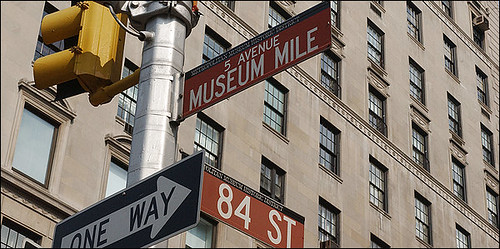
Museum Mile street sign, New York City Museum Mile street sign, New York City. Photo Credit: Helayne Seidman For The Washington Post.

The Economist reports in "Onwards and upwards" that more than 33% of the directors of major arts museums are at retirement age, and opines that there are three major issues facing museums that the next generation of directors should address.

 From the article:
The impending influx of new blood at the top offers museums an opportunity to rethink the job and question many of the assumptions that underlie traditional museum operations: the emphasis on splendid buildings, the primacy of curatorial authority and the balance between rich donors, for whom museums are often personal vanity projects, and the public, who see museums as shared common goods. ...

Refashioning museums to appeal to future generations means devising a new vision. Up-and-coming directors face three major challenges: engaging more imaginatively with audiences, addressing America’s changing demographics and negotiating the ever more delicate balance between rich donors and the public.

Audience engagement has to do with a museum’s relevance and its impact on its community. The simplest measure is attendance figures. Engaging younger audiences is key, though; the National Endowment for the Arts reports that in the decade to 2012 the only age group that saw a marked growth in attendance was those aged 75 and older. his must change. ...

If museums are to make any headway in engaging with audiences they must also work on broadening their appeal. Last month the AAM annual conference was told that the three Ws of traditional museums are white, Western and “womanless”. ...

The biggest challenge facing new directors, though, will be keeping true to the idea of what a museum should be: a plaything for rich collectors whose philanthropy comes with an increasing number of conditions, or a precious centre of public education. In her speech Ms Cole reminded AAM delegates that baby-boomers still control 70% of the nation’s disposable income, and that wealth is being concentrated in fewer and fewer hands. Navigating successfully between these competing visions will separate the best art-museum director from the rest.
------
I do think that a kind of community history-art museum hybrid has a better chance at dealing with some of these issues.  There was a lot of hand wringing on the part of the next generation of museum professionals about art and protest in the face of Black Lives Matters protests, starting in Ferguson, Missouri.

I had made a similar point in "Local history museums and critical analysis opportunities for communities."

But there is a tension in museums, as art was probably the first sector ever truly "globalized," between the collection and presentation of art by the great artists and civilizations vs. the presentation and collection of historical and contemporary work by local and regional artists. This can make it difficult for locally-based museums (as opposed to "national" museums like the big ones in New York City) to accomplish what The Economist suggests they must focus on.

The Museum of the City of New York addresses the concerns expressed by The Economist, although they could probably do a better job on diversity elements (although the city also has the Museum of El Barrio and one of the nation's premier collections of African-American materials at the Schomburg Center for Research in Black Culture of the New York Public Library system.

MCNY presents historical and artistic works in the context of the city's history and contemporary issues.  Recent exhibits featured Mac Conner, an illustrator for magazines and ads during the heyday of illustrations (versus photography) and contemporary digital composite photographs by Jeff Chien-Hsing Liao's New York.

 An earlier exhibition on "the decorative arts" presented the development of Colonial Revival as a style of architecture and interior design as well as an element of building national identity. Plus that great exhibit on "local" protest in New York City mentioned in the above-cited blog entry.

I seem to recall that the Montreal Fine Arts Museum successfully works the balance between presentation of globally- and regionally-relevant art.

In line with the challenge posted by The Economist, the Brooklyn Museum of Arts has appointed a new director ("Brooklyn Museum Picks Anne Pasternak as New Director," New York Times), who has been president and artistic director of Creative Time, NYC's leading force for public art and for visual and performing arts presented in the public realm.

In addition to the thousands of works commissioned and presented, Creative Time sponsors an annual conference, the Creative Time Summit, addressing key issues in public art. While most of the events have been held in NYC, last year's was in Stockholm and this year it's being held in association with the Venice Biennale, in August.

Labels: , , , ,

Thursday, November 20, 2014

Boston arts-culture policy

One of the commitments made by Martin Walsh during his 2013 campaign for Mayor of Boston was the creation of a dedicated Commissioner for Arts and Cultural Affairs.  After a search, the Mayor chose Julie Barros, who was working for the City of Chicago and ran the Chicago Cultural Plan creation process in 2012 ("Walsh Names Chicagoan To Be Boston's Arts Czar," WBUR).

She starts this week.

In advance of her arrival, the Boston Globe ran a special section on Sunday, "Growing Boston’s arts scene," leading with an editorial ("Making arts policy a priority") and bolstered by 12 follow up articles authored by arts, creative, culture workers and advocates, about various elements of the culture scene in the city, providing advice on where Commissioner and the city should focus their efforts.

From the article:
... [arts are] an essential component of the state’s quality of life. The Massachusetts arts community encompasses roughly 6,000 arts and cultural organizations that support more than 45,000 jobs. A report last summer by ArtsBoston showed that nonprofit arts and cultural organizations boost the Boston economy alone by $1 billion every year. Arts education has been shown to improve student performance across the disciplines and to transform troubled schools. And it is impossible to imagine the turnarounds in economically distressed cities like Pittsfield, North Adams, and Lowell without investment in the arts.

As Boston welcomes its new arts czar, the creative community weighs in on Massachusetts’ potential.
Note that the above-cited WBUR article provides a good overview of the state of the city's involvement in arts and culture. And their follow up piece, "Who Should Be The Mayor's Arts Czar? Our Nominees," outlining particularly outstanding leaders of area arts organizations and initiatives is useful background too.

As mentioned in the editorial, arts-based revitalization has been key to the improvement of former industrial towns in Western Massachusetts that have been bypassed by the shift to the post-industrial economy and the offshoring of manufacturing jobs. Pittsfield and North Adams are best practice examples--the Massachusetts Museum of Contemporary Art is in North Adams. MassMOCA has been in the news ("Mass MoCA Partners With Major Contemporary Artists," New York Times) based on an announcement of coming expansions of an already large facility that reuses an old factory complex ("Gov. Deval Patrick heralds final phase of Mass MoCA renovation," Berkshire Eagle).

This story has also been told in an now older documentary (Downside UP: How art can change the spirit of a place).

Pittsfield was an early innovator in creating a storefront revival program by engaging artists and displaying art--although the program shut down a few years ago after a 10 year run and many great successes, and the Massachusetts College of Liberal Arts was one of the first colleges to open an off campus art gallery (Gallery 51) in a community downtown, which tightens the connection between the college and the town in terms of activation.

This 2007 blog entry linked to a couple important articles about Mass MOCA, how it came about and its impact (although the CNN article seems to be lost to the ether).

The Center for Creative Community Development in Williamstown, Mass. does research and publishing on the economic impact of the arts in smaller communities.  It looks like they have some interesting publications, including on the impact of clustering arts organizations and the impact of museums on their neighborhoods.

-------
These are good examples for DC, in terms of the local paper covering important local matters, especially in arts and culture, having a high level "cabinet" position for arts and culture, and the need for a comprehensive city cultural plan, something that I raised yesterday in a meeting about the rehabilitation and redevelopment of the city's central library.

Labels: , ,

Sunday, October 19, 2014

Local history museums and critical analysis opportunities for communities

Local history museums generally can be pretty good places to be exposed to a richer, deeper, and more analytical framework for considering the history of a community.  Standouts include the Valentine Richmond History Center in Richmond, Virginia; the Pittsburgh History Center; and the Montreal History Center.

The best of these museums present a thematic and timeline-based framework to help people understand the major events within a community in local, national, and international contexts.  Note that the Museum of the City of New York presents this type of framework through a movie rather than exhibits.

Of course, not all museums do this--still being somewhat parochial--while some other museums, notably the Museum of London, stake out a greater role for the museum in providing a forum for reflection on current events.  (See the past entry, "Parochialism and historiography.")

In terms of this theme of the lack of critical analysis within communities, in 2012, the Museum of the City of New York opened the Activist New York exhibit, as the inaugural exhibit in the Puffin Foundation Gallery, called the Puffin Gallery for Social Activism.  It's a long term exhibit with no set end date.

It is a fabulous exhibit, in a not very big gallery, that packs in incredible insights into "local" history by presenting social and political changes in New York City (and society more generally) through the lens of the role of activists and protest in making those changes.

Because New York City plays such an oversize role in the nation--it's the biggest city, home of the nation's national news media and publishing firms, is the financial capital, etc.--"local" protest there also shapes national trends, making the exhibit relevant far beyond what it says about NYC specifically.

The exhibit is special, even remarkable, because it also covers present day issues that continue to rile certain segments of the population.  (Although I was surprised that Occupy Wall Street wasn't included, probably because it was happening while the creation of the exhibit was wrapping up.)

Part of the exhibit on biking.

It is to be expected that such an exhibit would include religious freedom, civil rights, workplace rights and labor organizing, and the Settlement House movement, it's particularly distinguished by the inclusion of intellectually-driven initiatives such as protest publishing or the New Deal era Federal Theatre Project, New York City strains of Conservative Activism as a response to the rise of postwar liberalism and the city's historic preservation movement, as well as contemporary issues including community development, Gay Rights, the attempt to create a Mosque near the site of the World Trade Towers destroyed on 9/11, the place of biking in the mobility paradigm of the city, and artist activism.

Each of the 14 movements covered provides an opportunity for serious reflection and critical analysis that contemporary action too rarely affords.

I can't remember the extent of the coverage of immigration, although that could be an exhibit of its own, from both historical and contemporary perspectives.  Similarly, the African-American protests with regard to local control of schools and the school system is another topic deserving of more attention.

I don't know if the Museum developed and presented programs and lectures in conjunction with the exhibit's opening.

It would be interesting to offer such programs in association with the exhibit, as well as to feature books and other media on the various topics, in the gift shop or elsewhere in the museum as further resources, e.g., a bibliography-resource list for each of the subject areas.

While it's not part of the purview of a local history museum, the exhibit could be the jumping off point for more general programming on the process and practice of community organizing and the development of social movements as well, especially given the great number of NYC-based academic researchers studying the field.

----------------
Reprint from a past blog entry on issues relating to the presentation of local history
----------------

House museums.  The Engaging Places blog has a "Recap of Historic House Museum Symposium at Gunston Hall." A big issue in "the trade" is that there are lots of historic house museums and many are underfunded and neglected, and that most such properties need to reposition and rethink what they are trying to accomplish and how they organize, package, and present their story.

A couple of related articles on the topic include:

-- "The Future of Local Historical Societies," American Historical Association
-- "Historic houses take note: innovate or die," Art Newspaper

Historical societies.  I found the historical societies article interesting because the problem with historic house museums is more widespread and goes beyond house museums. The problem more generally is a lack of interest in or concern about history.  This affects historic preservation and local history museums too, something I have written about enough to not repeat myself here, but it's important to think about comprehensively.

One way to do so would be to deal with the History Channel, Smithsonian Channel (run by Fox), Travel Channel, AWE, and other programming networks in a similar fashion as it relates to their programs.


City museums.  Museums professional Rainey Tisdale has a number of publications on the topic of making local history and city museums more interesting and was guest editor of a special section of articles on the topic of City Museums and Urban Learning in a special issue of the Journal of Museum Education and is co-author of Creativity in Museum Practice.

Buildings and sites owned by governments and nonprofits.  And related to underfunding house museums,  properties owned by local governments and other institutions typically are neglected as well.

This has come up locally with regard to the Mary Terrell House in LeDroit Park, which is owned by Howard University ("Once home to civil rights pioneer, historic house is now worst on the block in LeDroit," Washington Post) and is a problem in Greater Los Angeles too, according to the Los Angeles Times article, "Most L.A. County cities failing to protect historic sites, study says."

I mentioned a couple more recent examples in DC within the last couple weeks, buildings on the DC Preservation League's 2014 list of endangered places, St. Elizabeths East Agricultural Complex, which is owned by DC Government, and the Washington Canoe Club, which is privately controlled, but located on National Park Service land.

Labels: , , , , ,




