Rebuilding Place in the Urban Space

"A community’s physical form, rather than its land uses, is its most intrinsic and enduring characteristic." [Katz, EPA] This blog focuses on place and placemaking and all that makes it work--historic preservation, urban design, transportation, asset-based community development, arts & cultural development, commercial district revitalization, tourism & destination development, and quality of life advocacy--along with doses of civic engagement and good governance watchdogging.

Wednesday, November 12, 2025

Community revitalization initiatives for smaller communities | marginal attraction of people and commerce even in small amounts makes a difference

Sometimes I'm quick to judge revitalization initiatives as not particularly wide ranging.  But the fact of the matter is that many commercial districts can benefit positively from marginal increases in demand, visitorship and spending even from small projects.

For example Fargo North Dakota has doubled its downtown population over the past 25 years ("St. Cloud aims to revitalize downtown by ‘copying what Fargo did’," Minneapolis Star-Tribune) and Winona, Minnesota, by refocusing its use of its riverfront, has created an arts district ("How an industrial city along the Mississippi River transformed itself into an arts town," MST)

1.  "Glenview buying former Signode campus to control redevelopment," Crain's Chicago Business.  I've often made the point that an RFP isn't a plan, that it is a solicitation for proposals from organizations which may or may not have good ideas.  

Starting with a plan is better than an RFP, it shapes the proposals and what is acceptable, based on an already developed community consensus.

Glenview takes this a step further--maybe a plan would have been enough?--and bought a large vacant industrial property, totaling 56-acres, to be able to shape how it is developed.

Similarly, Monroeville, Pennsylvania considered buying the local failed shopping mall.  Instead, Walmart bought it and is likely to build a retail facility there.

en Sjaaheim, Silas Dingman and Brady Skahen, members of the pop-punk band F-18, perform at B-Side Indie Music Cafe in downtown St. Cloud last month. The performance was part of a night of punk music put on through Project 37, an all-ages and sober music program. (Alex Kormann/The Minnesota Star Tribune)

2.  "This central Minnesota city is taking a true punk-rock approach to revive its downtown," Minneapolis Star-Tribune.  It probably won't spur the creation of the next Prince, or the ground up punk rock movement in DC in the 1970s sparked by the teen band, which morphed into Fugazi, but if cities like Austin, Chicago and Seattle have developed programs to support their music industry and the presentation of like music, why not St. Cloud?  From the article:

For years, officials here have been trying to enliven a lackluster downtown beset with empty storefronts, hollowed-out offices and nearly empty sidewalks.

Now some punk rockers are striking a chord. They, along with other musicians and artists, are stepping up in ways beyond what officials have done, adding cultural attractions and events. A new all-ages music venue that opened this past summer — the B-Side Indie Music Cafe — has already established itself as a gathering spot, jumping with punk rock kids one night, with singer-songwriters another.

In the works next door is a community arts space run by the Wirth Center for the Performing Arts. And in the future? Leaders dream of an arts magnet school or art museum.

“I have a three-part plan to revitalize downtown into an arts district,” said James Newman, executive director of the Wirth Center, which has provided music lessons in central Minnesota for more than four decades. “Downtown has so much potential, and I think an arts focus would be a great thing to bring people in.”

... Already sprinkled throughout downtown St. Cloud are several arts spots, including the Paramount Center for the Arts — which hosts musicals, plays and concerts, as well as art classes — and Pioneer Place on Fifth, which offers music and local radio theater. There are also stages at the Red Carpet Nightclub and an intimate venue at Gnarly Bard Theater, which opened last year.

The question is how much of this ends up being focused on people in-market, shifting their interests from something else to music, versus could St. Cloud, 65 miles from Minneapolis, develop as a destination on music?   From the article:

The planned hub is part of a trend playing out across the state as cities work to revamp downtowns with arts and experiences as retail stores struggle to stay open and offices shutter as more employees work from home.

In Winona, leaders have turned the southeastern river city into an arts destination with a concert hall and art gallery expected to open in the next year, as well as prominent festivals celebrating Shakespeare and Beethoven. In Detroit Lakes, an installation of giant wooden trolls brings people to its downtown and then sends them on an adventure to nearby parks and trails. And in Anoka, folks are invited to explore its downtown’s concerts, farmers markets and businesses with a drink in hand as part of the state’s first social district.

It's a reverse of the more typical flow of rural-suburban residents to the city to join a music ecosystem.

-- "Arts as production: The rock music ecosystem in West Seattle," 2022
-- "Ground up (guerrilla) art #2: community halls and music (among other things)," 2011
-- "Under threat: Austin's music industry as an element of the city's cultural ecosystem and economy," 2016 
-- "Leveraging music for cultural and economic development: part one, opera," 2017
-- "Leveraging music as cultural heritage for economic development: part two, popular music," 2017
-- "NBC4 asks if DC can become a concert capital like Nashville, Austin, and New Orleans?," 2019
-- ""Arts district planning" in Arlington County | Many communities don't know the difference between arts as production and arts as consumption," 2021 
-- "Another example of why local culture plans need to include an element on retail/dealing with for profit elements of the cultural ecosystem: Nashville's Tubb Record Shop," 2022

Baek Jae-ho, head coach of the Sangdong High School baseball team.Photographer: SeongJoon Cho for Bloomberg

3.  "High School Baseball Brought a Dying Korean Town Back to Life," Bloomberg.  The rural declining mining town of Sangdong came up with a program to attract new residents, by creating a first-in-class high school baseball program.  From the article:

That passion for the game inspired Cho Yun-hee and Kim Kyung-soo, 1986 graduates of Sangdong High. As part of a group discussing the future of their alma mater, they spearheaded an effort to attract students, mulling and rejecting proposals such as creating a training program for the energy and mining industries. Then in 2022, they hit upon an ambitious plan. The school would offer free baseball training, plus lodging and food for out-of-area students.

But with an estimated cost of 500 million won ($350,000) a year, the proposal wasn’t an easy sell. Opponents viewed the expense as ludicrous for a decaying community, and even supporters questioned whether a ghost town like Sangdong could lure transplants from dynamic parts of the country.

... Baek had his reputation and a straightforward pitch to prospective students: Get top-level training and a chance at the pro leagues for free. That’s a strong combination in a country where team membership fees and private coaching can cost more than 3 million won a month. The school provides equipment, free lunches and helps pay for other meals. There are now 38 students in the program, two short of a full roster after two players were expelled for smoking (the school has a strict one-strike-and-out policy).

Since the program started, population has inched up over 1,000, new businesses are opening and new housing is being constructed.

The long-vacant Palace Theater in downtown Gary. A blueprint for reversing the city’s fortunes proposes using the restored theater as the heart of a new arts district. Photographer: Zach Mortice/Bloomberg CityLab

4.  Smaller but better?  "Can Anyone Save Gary, Indiana?," Bloomberg.  Gary is about 30 miles from Chicago, and has transit service to and from the South Shore Line, the last US interurban commuter railroad service.

Gary was a steel town.  As US Steel faltered but also reduced employment through capital investment, so did the city--US Steel once had 30,000 employees, now 4,000 (remember too the job multiplier effect which is between 3x and 4x, so that's potentially a loss of 104,000 jobs total.  The city has over 7,000 abandoned buildings.

From the article:

The city’s population also peaked in the ’60s, at about 170,000; today fewer than 70,000 live there. Roughly 80% of Gary residents are Black and a third live below the poverty line — about three times the state average.

Especially downtown, the impact of the exodus is shocking. Most of the land within a several-block radius of City Hall — 5th and Broadway, the center of town — is a bleak patchwork of cleared lots and abandoned commercial buildings. It’s the kind of decay only seen when there was once a rapid and focused public investment in infrastructure, followed by immediate wholesale neglect.

But according to a new study by Notre Dame’s Housing and Community Regeneration Initiative, the failure of mega-scaled landmark buildings like the Genesis Center — a typical gambit for struggling cities — isn’t just an indicator of flailing industrial economies. Instead, the size and form of these developments are themselves the primary culprits.

“When you’re in a state of physical collapse, it doesn’t make any sense to build one big building, because what you need to do is take whatever demand exists and spread it out in smaller buildings, so you can actually find a way to illustrate to people that this change has come,” says Stefanos Polyzoides, dean of Notre Dame’s architecture school, which houses the Housing and Community Regeneration Initiative. “One building accommodating a change is not urbanism. It’s architecture.”

This is an excellent point about many small projects having more impact than a single large project.  So Gary is working to engage multiple small developers, and focusing on rebuilding the public realm in the core of the city, and focusing development on the commercial core, and in neighborhoods that are somewhat stabilized but have vacant lots perfect for infill buildings, zoning changes and some money from the state, which seriously restricted the city's ability to generate property tax revenues through various legislative initiatives.  From the article:

But if the city is going to depend on small business owners for its downtown renaissance, there are resources it needs to offer, he says, like business management training. “A lot of times, mom-and-pop business owners jump in the water and learn how to swim while we’re in the water,” he says. “If we’d had avenues for training, then a lot of businesses that had not made it might be able to make it.”

Jane Jacobs was not in favor of large projects at the expense of smaller, which is discussed in the book Cities: Back from the Edge

Elkhart still has a thriving downtown.

5.  Elkhart, Indiana.  The Notre Dame program is also working with Elkhart, and the article contrasts revitalization there versus Gary.  

Elkhart has had more success because of a strong philanthropic community, a lesser problem in terms of abandoned buildings, better capitalized locally-based businesses, and a stronger industrial base, centered on RV manufacturing.  From the article:

Working with other family-owned businesses, as well as the public sector and philanthropic support, Weaver has seen $250 million invested over the last six years in Elkhart’s River District, a mixed-use live-work neighborhood at the confluence of the Elkhart and St. Joseph Rivers. 

So far, the effort has produced hundreds of new residents, a 1.5-mile riverwalk, five parks, and 40 new businesses; a new and lively urban place. “The only way I’ve seen this successfully executed is to slowly build confidence by incremental development,” Weaver says. “I think what Notre Dame has set up is a playbook for communities to think about redevelopment in a way that’s hyperlocal to them.”

Notably, the equity invested is from the community itself, he says. “Nobody is coming to save Elkhart,” says Weaver.

"Hotel Elkhart Named Top Restoration Project in Indiana," HospitalityNet.

Investing in yourself, rather than seeking a savior from outside pushing a large project is key.  From the article:

In some ways, Elkhart is in a different boat than Gary: It has a strong philanthropic community and an intact industrial base.

It’s home to Patrick Industries, which is the leading manufacturer of the ever popular RVs.

Weaver’s ability to finance urban development is closely tied into this dynamic. His firm also develops industrial facilities, and Weaver says the returns for building a “a big dumb box” can be 20%. For his civic work in the River District, it’s paltry 3%.

And he’s not sure building quality urban places outside of major metropolitan areas is going to be an attractive investment for investors any time soon. “I don’t know that we’ll ever be in a situation where the best outcome for the community is the best outcome for the developer in the short term,” he says. “There’s a conflict. I think it’s very difficult to build buildings that enhance civic pride, that put the community first, and provide a short-term superior return.”

While the article discusses structural racism as an issue in Gary, which is majority black at 72% of the population, it doesn't discuss how Elkhart is 62% white.  

This gives the city an easier path forward than Gary ("Elkhart looks to spark downtown revitalization with $40M amphitheater," Inside Indiana Business, "Elkhart officials approve 2 development projects to reimagine city," WNDU TV," "Elkhart," BusinessView). 

Gary's waterfront.  Despite the decline of the steel industry generally, and the reduction in workforce at the US Steelworks in Gary by 70%+, the Gary Steelworks is still the largest steel plant in the world.

Another advantage is that while Gary has the shore of Lake Michigan as an asset, it's occupied in part by US Steel, while Elkhart is able to leverage its riverfront ("Revitalization of the Elkhart River District," Landscape Architecture). 

In a way the comparison between the cities is unfair, in that Elkhart never really crashed the way that Gary did.  According to the Advisory Council on Historic Preservation, most of Elkhart's downtown is historically intact, and designated.   

Elkhart County is the number-one tourist destination in the state, primarily because of the Heritage Trail, a 90-mile journey through Amish farms, shops, small towns, and urban areas. Free CDs guide visitors past Elkhart’s 1924 Elco Theatre, the Midwest Museum of American Art, and the RV Hall of Fame and Museum.

Elkhart River

 Another attraction in Elkhart is the National New York Central Railroad Museum, which highlights the importance of railroads to the city’s and the country’s development. Elkhart was a vital link between East and West during the country’s growth, and the city is a natural home for this museum, since its rail yard is among America’s largest. The museum includes a replicated stationmaster’s office and a restored 100-year-old freight house complex containing displays and hands-on exhibits.

That makes a difference.  It reminds me of Pontiac Michigan, a majority black city in a county, Oakland that is majority white.  But the County didn't realize it had an obligation to assist the city in substantive revitalization.

-- "Pontiac Michigan: a lagging African American city in one of the nation's wealthiest counties," 2022

Marginal increases in population can have an extranormal impact.  

6.  The above-mentioned downtown residential development program in Fargo, North Dakota (Downtown in Focus Action PlanFargo Core Neighborhoods Master Plan).

Block 6 Apartments, Campbell Properties, Fargo, North Dakota.

7.  Tulsa's Remote program to attract "work from home" tech workers by providing small relocation grants ("The economic benefits of paying workers to move," Bloomberg).

8.  Paducah's artist recruitment program, which has helped to revitalize neighborhoods near downtown, attracting artists and businesses, in part because of Paducah's Interstate highway connections to other Midwestern cities with summer art fairs where artists sell their goods ("In Paducah, Artists Create Something From Nothing," NPR). 

The Mississippi Crossings development on the Mississippi River in Champlin. (Leila Navidi/The Minnesota Star Tribune)

9.  Champlin Minnesota's riverfront revitalization ("Twin Cities suburb turns forgotten Mississippi riverfront into a key attraction," MST).  The city has worked to leverage its riverfront since the late 1990s and it has taken 20+ years of steady effort to come to fruition.

(Stillwater, in the far suburbs of Minneapolis worries about overtourism, "Scenic Stillwater draws festive crowds. How much tourism is too much?," "Remade Stillwater riverfront could bring new parks, boat launch, picnic space and fishing piers," MST).

10. "A mountain-bike boom brought growing pains. But these mining towns now embrace their new identity," Crosby and Ironton, on the decline with the close of mines, shift their economies to outdoor recreation and tourism ("Iron Range to spend $5 million on mountain biking trails," MST, 2018).

James Brainard, the mayor of Carmel, Ind., poses before the last of the buildings filling up City Center.Alan Greenblatt/Governing

11.  Creating a center in suburban towns.  Not revitalization per se, but "vitalization" of otherwise residentially focused communities ("Twin Cities suburbs seek destination status with new downtown plans," "St. Louis Park’s West End bucks the trend with one of area’s lowest vacancy rates," MST).

Carmel, Indiana, a traditional suburb of Indianapolis, realized it needed to create a downtown to spur growth ("Meet the Mayor Who Totally Transformed His City," Governing Magazine, "‘How Did I End Up in Indiana?’ Welcome to the Internet’s Favorite Small City," Wall Street Journal).  From the WSJ:

“What I heard when I went door to door in May 1995 for my first election was this yearn for a traditional city,” he said.

At the time, zoning laws prevented the integration of residential and commercial development. Over the next three decades, Brainard said, Carmel has been revitalized in large part through zoning changes and tax increment financing, which allowed the city to build infrastructure with bonds backed by the projected tax revenue of future real estate. 

Carmel has built several multimillion-dollar, mixed-use developments along its central corridor with townhomes, apartments, boutique shops and restaurants. An Arts & Design district with galleries and showrooms now sits in place of the city’s original downtown area. 

It connects to the City Center development, which is home to a 151,000-square-foot concert hall and the Carmel Christkindlmarkt holiday market. These developments are connected by the Monon Greenway, which can be walked or cycled and is part of the 27-mile Monon Trail that runs to downtown Indianapolis, according to Brainard. He has also implemented a network of over 150 roundabouts as an alternative to signal lights, in an attempt to move traffic more efficiently, increase walkability and minimize car accidents.

It's been very successful, so another suburb, Fishers, is doing the same thing ("How Fishers is bringing people out of cul-de-sacs," "New 'urban village' is the latest development in Nickel Plate District south of 116th Street," Indianapolis Star), "Fishers announces plans for $122.5M in new downtown developments," Indianapolis Business Journal).

12. Rural "company" towns invest locally to attract workers.  The Wall Street Journal reports on Pella, Iowa, the home of Pella Windows ("Facing Labor Shortages, Pella Reinvents the Company Town in Rural Iowa").  

Pella Corp. has offices and manufacturing plants in more than 30 cities across the U.S. and Canada. But one of the toughest jobs, say executives at this closely held maker of windows and doors, is convincing workers to locate here in its hometown, a rural city of about 10,000 residents 45 miles southeast of Des Moines.

The company and its controlling shareholders—members of the founding Kuyper family and its descendants—set out to change that. They have spent tens of millions of dollars in the past three years on housing, child-care centers, restaurants and an indoor entertainment center, among other things, to retain and attract new workers. More spending is on the way.

“We just didn’t have the amenities that people we were trying to recruit would expect,” says Chief Executive Tim Yaggi, noting that the manufacturer competes with major cities for talent.

I think that Kohler in Wisconsin is another example.  And ironically, Andersen Windows in Wisconsin.

Somalis in Minneapolis.  

13.  Immigrants moving to languishing communities ("Immigrants as in-migrants and community revitalization") such as 

Threat to immigration as a revitalization augur.  This is under threat though because of the Trump Administration's anti-immigrant agenda ("The Bay Area’s ‘Little Kabul’ once welcomed Afghan refugees. Federal cuts are changing that," San Francisco Chronicle, "'Now, there is fear everywhere’: How Trump’s immigration crackdown has permeated R.I.’s smallest city, home to a big Latino population," Boston Globe, "Chicago ICE Raids Keep Customers at Home in City’s Latino Retail District," Bloomberg, "Minnesota’s Ecuadorian community is flourishing, but its future is uncertain," Sahan Journal).  From Bloomberg:

For Marco Rodriguez of Dulcelandia (Spanish for “candy land”), the raids are a double whammy. Costs for the family business he runs had already gone up by at least 25% due to tariffs, he said, and now the raids are keeping shoppers away during a peak season. Sales across his four shops in Chicago are down more than 50% this year. 

“On the corridor itself, all businesses have been affected, everyone’s feeling it,” Rodriguez said in an interview Wednesday at the chain’s shop in Little Village. “We’ve seen a drop, especially during these times, these last couple weeks, with what’s going on.”

... Fear of raids in Little Village’s two-mile retail corridor led to foot traffic falling by as much as 30% compared with the prior weekend, according to Jennifer Aguilar, who heads the local chamber of commerce. That’s exacerbating financial troubles for the 400 or so businesses in the area, she said.

Labels: , , , , ,

Monday, May 22, 2023

Economic impact of big name concert tours: Taylor Swift in Philadelphia


In line before the concert, "Taylor Swift and 69,000 of Her Closest Friends Descend on Philadelphia," Philadelphia Magazine.

According to the urbanism blog Billy Penn ("Taylor Swift’s tour stop was a boom weekend for Philly, with hotel rooms nearly selling out — at $450 a night"), Taylor Swift's concert contributed to a hotel booking rate of over 90% in Philadelphia's Center City, and a significant increase in pricing.  Although other events also contributed to this, including the University of Pennsylvania graduation.

SEPTA ridership was higher, and some food establishments had stronger business.

Again, I'd say a lot of hotel revenue and transportation (airline, rental cars, for out of area visitors) are captured by non local entities.

Still, it's interesting to think about concert attendance in terms of in-area and out of area visitors, and the differentiated economic impact.

========

More entries about music performance as an element of cultural planning

-- "Song remains the same," 2011 
-- "Ground up (guerrilla) art #2: community halls and music (among other things)," 2011
-- "Leveraging music for cultural and economic development: part one, opera," 2017
-- "Leveraging music as cultural heritage for economic development: part two, popular music," 2017
-- "Culture planning and radio: local music, local content vs. delivery nodes for a national network," 2019
-- "Under threat: Austin's music industry as an element of the city's cultural ecosystem and economy," 2016
-- "Revisiting cultural plans having elements for retail: music instrument stores," 2020
-- "DC's music venues ask for government support," 2020
-- "Thinking anew about supporting community radio," 2019
-- "Revisiting community radio," 2020

Labels: , , , , ,

Wednesday, October 19, 2022

Arts as production: The rock music ecosystem in West Seattle

I've written a bunch of articles on music as an element of the local arts ecosystem:

-- "Ground up (guerrilla) art #2: community halls and music (among other things)," 2011
-- "Under threat: Austin's music industry as an element of the city's cultural ecosystem and economy," 2016 
-- "Leveraging music for cultural and economic development: part one, opera," 2017
-- "Leveraging music as cultural heritage for economic development: part two, popular music," 2017
-- "NBC4 asks if DC can become a concert capital like Nashville, Austin, and New Orleans?," 2019
-- ""Arts district planning" in Arlington County | Many communities don't know the difference between arts as production and arts as consumption," 2021 
-- "Another example of why local culture plans need to include an element on retail/dealing with for profit elements of the cultural ecosystem: Nashville's Tubb Record Shop," 2022

and I think that you could apply the principles listed in John Montgomery's 2003 article, "Cultural Quarters as Mechanisms for Urban Regeneration. Part 1: Conceptualising Cultural Quarters" (Planning, Practice & Research, 18:4)," to music as a performing art in terms of developing "music as production" as opposed to "music as consumption."

Owner Matt Vaughan founded West Seattle’s Easy Street Records during what he terms the “slacker era” of the late ’80s. (Kylie Cooper / The Seattle Times).

This Seattle Times article, "Is West Seattle the rock ’n’ roll capital of Seattle?," illustrates those ideas--record stores, clubs, artists living there, record labels, the KEXP-FM rock radio station, practice spaces, recording studios, music education programs in Seattle Public Schools, etc., alongside affordable housing and commercial space, and adaptable buildings--in how it discusses the primacy of West Seattle as the anchor of the rock music ecosystem in Seattle.

From the article:

On the surface, a budget-proposing government suit doesn’t exactly scream “rock ’n’ roll.” But during his decade-plus as King County executive, lifelong West Seattleite Dow Constantine has been the local music and arts community’s biggest champion in local government. The county authorized what was believed to be among the first local-level COVID-19 relief grants earmarked for arts venues and turned an old Harbor Island flour warehouse into a film studio last year. More recently, King County and Visit Seattle teamed up for what they’re billing as Cloudbreak, “Seattle’s ReviveLive Music Fest.” The program gives guests at roughly 70 Seattle hotels a free pass to 60-plus shows throughout the month of November.  

What has developed in West Seattle for rock music is like the Penn Avenue Arts Initiative in Pittsburgh, in how two adjoining neighborhood organizations recognized that artists were locating to their communities, and they could leverage their presence by repositioning Penn Avenue as an arts-focused commercial district, by developing and recruiting anchors, developing programming and special events, creating public art, etc. ("Artists bring flourish to Penn Avenue," Pittsburgh Post-Gazette, "A Transformed Penn Avenue," Pittsburgh Magazine, Vacancy to Vitality in Pittsburgh’s East End: Penn Avenue Arts Initiative, case study, Metris Arts Consulting).

We would call these "naturally occurring arts districts" in the vein of "naturally occurring retirement communities" and what I call "naturally occurring innovation districts" ("Naturally occurring innovation districts | Technology districts and the tech sector," 2014).

Although the Penn Avenue district is being further "developed" through the Penn Avenue Arts Initiative while West Seattle's "music ecosystem" is still self-developing.

Labels: , , ,

Sunday, February 09, 2020

Revisiting "community radio"

-- "Culture planning and radio: local music, local content vs. delivery nodes for a national network," 2019

This piece outlined in England what has been happening in the US for the last few decades.

Consolidation of radio ownership. Over the past 35 years radio as an industry has shifted from a system of local ownership linked through radio affiliation agreements to an industry where a few station groups control the bulk of the stations across the country, especially in terms of listenership. (Latino-oriented radio is still an exception.

De-localization of radio. Radio, because it is a function of physics and the distance that waves can be propagated, typically was a local phenomenon, local stations with DJs familiar with the local community, with followings, etc.

But the creation of satellite radio (Sirius and XM which later merged), people could subscribe to music channels independent of a local connection.  Later, the ability to stream stations on the Internet as well as the ability to listen to music via YouTube and other applications like Pandora and Spotify furthered this trend.

This allowed for two different things:

(1) a focus on music as the formats and range of music played on traditional radio stations narrowed and homogenized, while satellite and Internet channels can offer narrow formats but marketed to the entire country as they are not limited the distance a normal radio wave can travel (+ big data allows for music recommendations based on what you've listened too, with the opportunity to be exposed to music you wouldn't have otherwise come across);

(2) delivery of top DJs/personalities nationally, independent of radio stations. This wasn't too different from before, where such personalities like Don Imus or Howard Stern were syndicated to stations across the country. But it did allow the personalities to take a greater proportion of the revenue stream they generated.

De-localization is even worse today, because a couple weeks ago, the massive radio station chain, iHeartRadio, fired large numbers of locally-situated station hosts (DJs) in favor of creating more automated formats and reducing the amount and availability of locally-focused content on seemingly locally-based radio stations ("iHeartMedia laid off hundreds of radio DJs. Is AI to blame," Washington Post).

What it comes down to is the classic labor vs. capital argument.  When music broadcasting can pretty much be automated, labor becomes comparatively expensive.

Community radio. The second piece discussed creating mechanisms for continued support of local or micro-radio.

I suggested that statewide public radio networks could open themselves up beyond being National Public Radio affiliates to support more grassroots radio efforts across a state, integrating such stations into a community radio network that is a mix of NPR and non-NPR stations.

-- "Thinking anew about supporting community radio," 2019

But I glossed over the difficulty of successfully maintaining "community radio" stations that are based in "the grassroots" as opposed to locally produced radio stations that are "much more professional," specifically National Public Radio stations, which tend to be affiliated with universities and similar kinds of institutions.

For example, a progressive oriented group of stations run by the Pacifica Foundation has had problems over the decades with tension between local supporters and the national organization in both DC (WPFW) and New York City (WBAI).

A couple of stories I've come across in the past few weeks illustrate this continued tension within local community-embedded radio stations, even without the presence of a national coordinating organization .

KOOP-FM, Austin, Texas.  A few weeks ago in the Austin America-Statesman ("Forged by fights and fires, KOOP Radio at 25 is stronger than ever") there was a story about the 25th anniversary of KOOP-FM, a thriving station that has had ups and downs, including surviving not just one fire, but a later arson touched off by a disgruntled volunteer who resented music he wanted to hear on the station wasn't broadcast.

WBGO-FM, Newark, New Jersey. The New York Times just wrote about WBGO in Newark ("Behind the Racial Uproar at One of the World's Best Jazz Sattions"), a "local" station intricately intertwined with the local Black community (comparable to the position of WPFW-FM in DC), and the intra-station tensions there.

It's a station that has been revived because of its ability to stream music via the Internet, but this has led to a perception of disconnection from the local community.  At the same time, more than 90% of the station's donations now come from outside the Newark area, where the station's terrestrial signal is broadcast.

Can satisfaction of the needs and preferences of both communities be satisfied? Should they?  But if the station was left to be completely reliant on the financial support of the local community, likely it would go under.

From the standpoint of social organization theory, it's an interesting example of the changes organizations go through as they mature, and professionalize (Katz and Kahn, Social Psychology of Organizations).

From the standpoint of the argument laid out in Strategic Marketing for Not for Profit Organizations (Lauffer), it's a dispute within the "throughput public" -- the input public provides resources, the throughput public does the work, the output public is to whom the organization's work and efforts are directed.

This tension between input, throughput, and output publics is something that I see especially in the political campaign process.

Labels: , , , ,

Monday, January 14, 2019

NBC4 asks if DC can become a concert capital like Nashville, Austin, and New Orleans?

Photo: Destination DC.

-- "Concert Capital: Can DC Become America's Next Big Music Town?"

From the article:
It may be years before D.C. has the reputation of a music city like Austin, Texas, Chicago, Nashville, Tennessee, New Orleans, New York or Los Angeles. Yet the foundation has been laid with a rich history, from the jazz of Duke Ellington to the go-go of Chuck Brown, the R&B of Screamin' Joe Neal to the telecasters of Link Wray, and the punk scene of Dischord Records.

Today, the D.C. music landscape is as vibrant as it has ever been. From big stadium shows to a variety of intimate venues popping up all over town, this buffet of options paints a stark artistic contrast to tired Beltway stereotypes of stuffy lobbyists and pretentious politicians.

"The DMV is exploding with music," Wolf Trap President Arvind Manocha told WTOP.

The creative economy means booming business. Marketing company Destination D.C. said the city saw a record 22.8 million visitors in 2017, spending $7.5 billion and supporting 75,000 jobs. Of the "eclectic cultural travelers" surveyed, 86 percent were interested in "music in nationally known venues," while 68 percent noted "headliner entertainment" as important.
Probably not.

Although technically, I'm arguing a different point, about a being a center for music creation (arts as production) versus being a center for music presentation (arts as consumption).

But it's a fact that Austin, Nashville, and New Orleans, among others are "music cities" because they are a home to performing artists, and there is a creative ecosystem that supports music development and production, as well as venues of all types and sizes to see music performed.

(The same issue of arts as production vs. arts as production is key to understanding DC in terms of the visual arts ecosystem and as a home to working artists.)

Not to mention Austin has its own problems in maintaining its positioning as "live music capital of the US" because (1) there are lots of places that offer music and the audience isn't necessarily growing; (2) the rise in the cost of commercial space means that venues are closing; (3) the reduction in the sales of music through CDs etc. reduces artist income; and (4) the increase in rents and cost to buy a house make it harder for cultural professionals not making a lot of money to afford to live in Austin.

-- "Under threat: Austin's music industry as an element of the city's cultural ecosystem and economy"

And Nashville has its problems, losing many of the original music studios to new development, although housing is still comparatively cheap.


And there have been many issues in New Orleans post-Katrina  

-- "Veteran musicians note changes in New Orleans music scene since Hurricane Katrina," New Orleans Advocate

DC has these same issues.  While it doesn't have tons of venues, it has some, and new ones are being added, which is what has triggered the NBC piece.  The audience isn't necessarily growing and the rising cost of commercial space makes it harder for venues to open and remain open.  Not to mention that the limited amount of Class B and Class C commercial space means that cheap rehearsal and studio space is hard to come by ("Ground up (guerrilla) art #2: community halls and music (among other things)").  And the cost of housing makes it hard for young musicians to come and live in the city and stay here while they develop their chops.

Some other recent articles that are related:

-- "Hip-Hop Museum Preserves Rap Music History in D.C.," Washington Afro-American
-- "The In Series’ Latest Musical Traces A History Of Black Music And Migration On U Street," DCist

and this from a past blog entry, "The song remains the same: DC's continued failures in cultural planning as evidenced by failures with Bohemian Caverns, Howard Theatre, Union Arts, Takoma Theatre..." among others

=======

There is an interesting exhibit, "Twisted Teenage Plot," at American University's Katzen Arts Center on the artist-driven art rock movement in the city in the late 1970s and early 1980s, and how it was facilitated by the availability of cheap studio space in post-riot Washington and supported by various arts institutions (the Phillips, the Corcoran, galleries, arts organizations) that at the time were open and available to new ideas, programs, and ways of doing things, and a tight spatial footprint centered around 7th Street NW, Downtown.

Actually, the exhibit on the art produced by the artist-musicians isn't that exciting, but the collection catalog is excellent, featuring the artists, their stories, and their stories of the scene at the time.

This period is an element of the city's recent music history that has been overshadowed by the city's punk movement, which developed a little later in the mid-1980s.  Had bands like the Urban Verbs made it (albeit in my opinion the music isn't quite at the level of Television, Talking Heads, Velvet Underground, etc.), the story would be more prominently remembered.

Labels: , , ,

Thursday, March 09, 2017

Leveraging music for cultural and economic development: part one, opera

The Elbphilharmonie building was designed to look like the prow of a ship, in honor of its location on the city's waterfront.  Photo: Marcelo Hernandez / Hamburg Abendblatt.

 1.  Hamburg.  After many many years of construction and setbacks--partly because the opera building was constructed on top of an existing historic building, the new Elbphilharmonie, finally opened in January, after having first been promised for 2009.  The cost ended up as much as ten times the initial estimate, and was paid in its entirety by the local government.

Besides primary and secondary halls and related facilities, the building, located in the redeveloping waterfront district of HafenCity, includes a hotel, luxury condominiums, restaurants, and a viewing terrace overlooking the waterfront.

Photo: Mark Swed, Los Angeles Times.

Hamburg is already a major destination for the presentation of  musicals ("'Tarzan' and 'Lion King' Make Hamburg a Theater City," New York Times), and the Elbphilharmonie further broadens the appeal of the city as a destination for the performing arts ("In Hamburg, a New Musical Landmark for a City With Plans, NYT).

According to Mark Swed's review ("What does this critic hear at the new Elbphilharmonie concert hall? The sound of the future") in the Los Angeles Times, the building is a big attraction already, and presents concerts daily, all of which have sold out:
More than a million visitors have already taken the 2½-minute ride on a curved escalator through the “launching pad” (a tube) that leads to the main public area, a plaza with a terrace where you can walk the perimeter outdoors with stunning views of the harbor and the city, have a bite to eat and hit the ample souvenir shop. ...

There are concerts most days, all sold out through August, including a large summer festival. People are preparing to pounce the moment seats for the second season go on sale, and it doesn’t seem to matter what is being performed, be it a symphony, a string quartet, new music, early music, world music, pop or anything in between.

The vast majority of the music is classical, which has excited Hamburg’s classical community no end.
The Philharmonie de Paris is accessed via an imposing staircase. Photograph: CHARLES PLATIAU/REUTERS

2.  Paris.  As part of the trend of the construction of new modern concert halls in European cities such as Helsinki and Hamburg, a new concert hall opened in 2015 ("Philharmonie de Paris: Jean Nouvel's €390m spaceship crash-lands in France," Guardian).

As interestingly, a new concert complex is about to open in the Paris suburbs.  Called La Seine Musicale, it's built on an island on a site that had been an automobile manufacturing plant.

What La Seine Musicale will look like on completion (Baudin Chateauneuf/Shiger Ban Architect).

There will be a large auditorium (6,000 seats) and a smaller concert hall (1.150 seats), along with recording studios, a public garden, and retail and restaurants.

The music program won't be limited to classical music--Bob Dylan will open the auditorium with an inaugural concert on April 22nd.

In the US, suburban music halls have had some difficulties maintaining interest, in part reflecting perhaps less interest in high culture, although many universities maintain active performing arts programs,  Still, the opening of high quality concert facilities in suburbs in part is an indicator of the maturation of suburban communities as "complete places."

3.  Chicago. Since the Great Recession, a number of opera companies shut down (San Diego, New York City, etc.), and audiences have been declining. Unlike in Europe, there appears to be less demand in the US for classical music-related programming.

And local opera companies face competition from the digital broadcasts of the New York City-based Metropolitan Opera, shown in a network of theaters across the country. Likely this cuts into the local audience for live performances, since they can see very high quality productions on the screen for less than the cost of a ticket to a local production.

Crain's Chicago Business writes about the Lyric Opera ("Can Lyric Opera survive the 21st century?," on the challenges faced by the opera company. From the article:
It's showering subscribers, who long ago stopped packing the house season after season, with thank-you notes, more efficient valet parking and other perks. Operagoers will now find a sushi kiosk in the lobby on some nights and also reusable lidded beverage cups, the better to enjoy one's cocktail during a performance of "Carmen."

Lyric's product, grand opera, employs singing, acting, visual arts and sometimes dancing to tell stories in a powerful way. It is also old-fashioned and costly.

To keep operations sustainable through the 21st century, Lyric has to court new subscribers and ticket buyers in a changing arts world that values casualness and flexibility.​

That's why Lyric's to-do list is almost as long as "Tristan und Isolde": Court single-ticket buyers, hang on to subscribers, cut costs, update the stage and systems, and modernize marketing.

It's doing all that in "a business environment that is less predictable and more volatile than any of us can ever remember," says Anthony Freud, Lyric's general director and CEO.
The article mentions how the Company hasn't had a sold out season since 2001-2, and discusses the various initiatives Lyric Opera is taking to maintain interest, increase ticket sales, and generate other sources of income.

Berlin's Pierre Boulez Hall is a new auditorium for chamber music designed by Frank Gehry. Glass acoustical "sails" attached to the underside of the balcony are just barely visible here. (Volker Kreidler)

4.  Berlin.  The Frank Gehry designed Pierre Boulez Concert Hall opened last Saturday. From the Atavist piece, "Music for the thinking ear":
... Frank Gehry’s oval design, with no stage, merely a center, genuinely seems to open up, in the spirit of Boulez’s long-held desire for a flexible salle modulable, the possibility of the “thinking ear”: to engage, to reflect, to make itself part of the performance. The greatest possible distance between the conductor and the most distant member of the audience (682 seats in total) is just 14 meters. There is intimacy—the intimacy, its initiators hope, of collaborative endeavor.
Also see "Frank Gehry's new jewel-box concert hall in the heart of Berlin," Los Angeles Times. From the article:
The 682-seat hall is tucked into one corner of a four-story building from 1955 that was designed by architect Richard Paulick to store sets for the Berlin State Opera, where Barenboim is music director. The building, which sits rather anonymously on a corner in the Mitte district, in the heart of Berlin, backing up to an important civic plaza called Bebelplatz, is now the headquarters for the Barenboim-Said Academy, a conservatory that includes young Israeli and Arab musicians.
Conclusion. An email comment I received on this article originally made the point that the average US city is fine with funding facilities for professional sports, less so for the arts.

Labels: , ,

Tuesday, March 03, 2015

Historic Preservation Tuesday: Adaptive Reuse and the Uline Arena

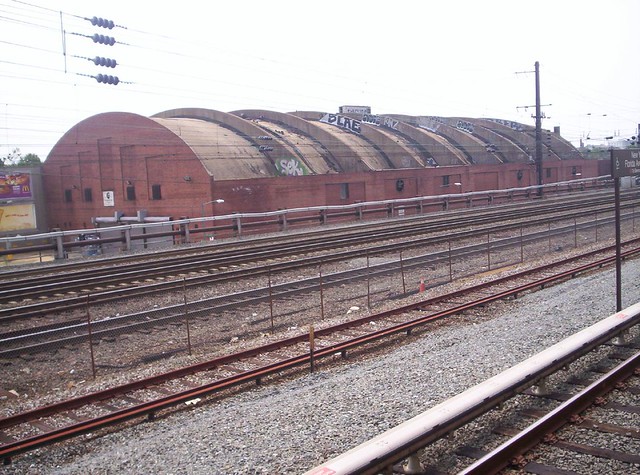
The Uline Arena is a vaguely industrial building located just east of the NoMA Metrorail station, between 2nd and 3rd and M Streets NE. The building has gone through a number of iterations--as a concert, events and sports arena, church, and a trash transfer station. In 2003, in face of a proposal by the then land owner to demolish the building, I led an eventually successful effort to get the building designated as a historic landmark.

Uline Arena and the Union Station railyardI thought the building was important to save because it represented a variety of themes in DC's history, with both local and national ramifications.

The building was an event site that when I first looked into it, was only relevant to me because it was the site of the first public Beatles concert in the US.

But it had been home to professional sports teams, the Ringling Bros. circus, the Ice Capades and a wide range of concerts.

It was built by Migiel Uline, an impresario of ice making, who thought he could extend his prowess to professional hockey, which was the main tenant of the building when it first opened in the early 1940s.

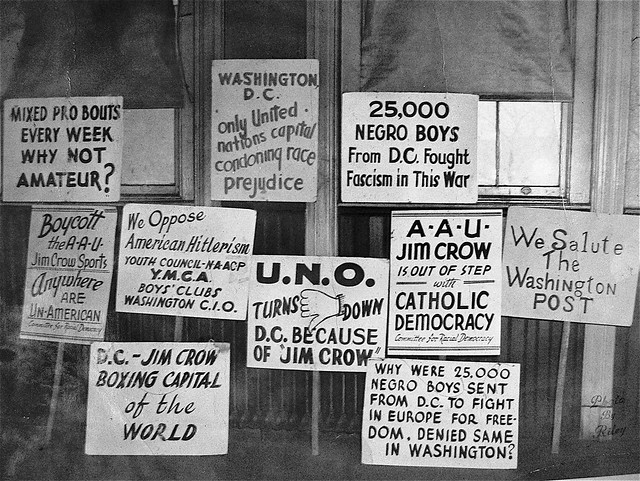
Protest Signs, Campaign to integrate Uline Arena, (1948-49)Right: protest signs from the Campaign to Integrate Uline Arena, 1948-1949.  From the collection of Edwin B. Henderson II.

The Uline is very interesting because of how it relates to the local and national civil rights history.

It was a segregated events facilitly--although Mr. Uline claimed that the policy was up to the sponsor of individual events.  But after a steady year of protests at every event, in 1949 the building was integrated.

This was about 4 years before the courts ruled that DC public accommodations had to be integrated in the Thompson Restaurant case and 5 years before the ruling in Brown v. Board of Education.

Later Earl Lloyd, one of the first black players for what has become the NBA, played for the Washington Capitols basketball team.  He died last week ("Earl Lloyd, first African American player in the NBA, dies at 86," Post).  Elijah Muhammed and Malcolm X spoke at rallies there, the Poor People's Campaign rented the facility to use while they protested on the National Mall.

But it is also important for how it demonstrates industrial architecture and the reality that DC isn't just monumental civic architecture, and it is a significant example of advances in concrete technology and truss systems, which allowed for the construction of the interior without pillars allowing unobstructed views.

Sadly, while the company that owns 9:30 Club was after the owner for many years to allow them to lease or buy the building to bring it back as a concert facility, he was never interested.

The building is now slated to become an REI store ("National Outdoor Retailer REI to Open Flagship in Historic Uline Arena," press release), one of five extra special flagship stores.

Interestingly, I still remember how angry H Street Main Street co-founder Kevin Palmer was when he saw REI signs on Metrobuses announcing that with their new store in Tysons Corner Virginia, REI was now in "Washington."

Now they will be.

But I can't claim that was the outcome I was capable of envisioning back in 2003.

Labels: , , , , ,