Rebuilding Place in the Urban Space

"A community’s physical form, rather than its land uses, is its most intrinsic and enduring characteristic." [Katz, EPA] This blog focuses on place and placemaking and all that makes it work--historic preservation, urban design, transportation, asset-based community development, arts & cultural development, commercial district revitalization, tourism & destination development, and quality of life advocacy--along with doses of civic engagement and good governance watchdogging.

Monday, May 22, 2023

Economic impact of big name concert tours: Taylor Swift in Philadelphia


In line before the concert, "Taylor Swift and 69,000 of Her Closest Friends Descend on Philadelphia," Philadelphia Magazine.

According to the urbanism blog Billy Penn ("Taylor Swift’s tour stop was a boom weekend for Philly, with hotel rooms nearly selling out — at $450 a night"), Taylor Swift's concert contributed to a hotel booking rate of over 90% in Philadelphia's Center City, and a significant increase in pricing.  Although other events also contributed to this, including the University of Pennsylvania graduation.

SEPTA ridership was higher, and some food establishments had stronger business.

Again, I'd say a lot of hotel revenue and transportation (airline, rental cars, for out of area visitors) are captured by non local entities.

Still, it's interesting to think about concert attendance in terms of in-area and out of area visitors, and the differentiated economic impact.

========

More entries about music performance as an element of cultural planning

-- "Song remains the same," 2011 
-- "Ground up (guerrilla) art #2: community halls and music (among other things)," 2011
-- "Leveraging music for cultural and economic development: part one, opera," 2017
-- "Leveraging music as cultural heritage for economic development: part two, popular music," 2017
-- "Culture planning and radio: local music, local content vs. delivery nodes for a national network," 2019
-- "Under threat: Austin's music industry as an element of the city's cultural ecosystem and economy," 2016
-- "Revisiting cultural plans having elements for retail: music instrument stores," 2020
-- "DC's music venues ask for government support," 2020
-- "Thinking anew about supporting community radio," 2019
-- "Revisiting community radio," 2020

Labels: , , , , ,

Thursday, April 16, 2020

Arts and culture economically screwed by pandemic closures

Just like other "consumer facing" sectors, the arts and culture sector is being crushed by the closure of facilities.

Seattle.  Photo: Jason Raymond, Reuters.

There is tons of coverage (in the US and elsewhere) on the closing of museums and other cultural facilities, employee layoffs and pay cuts for those who remain, cancellation of events, exhibits, and seasons (like for symphonies), concerts, television and film production, cinemas, etc. ("Museums Across the US Are Furloughing and Laying Off Workers—But Hopeful They’ll Get Help From the Federal Government," Artnet; "At least 170,000 lose jobs as film industry grinds to a halt due to coronavirus," Guardian).

For profit cinema chains face bankruptcy.  Etc.

And coverage about how individual artists often cobble together a living from multiple gigs, all of which have disappeared ("She Had 3 Jobs to Support Her Music. Now All Are Gone," New York Times), and it doesn't place them well to get income support from various government programs that may offer help to businesses generally and large firms specifically.  Although some arts organizations are organizing grant initiatives both nationally ("National arts groups establish $10 million fund to provide $5,000 emergency relief grants to artists needing help during pandemic," Cleveland Plain Dealer) and locally.

Some stories I found particularly interesting include:

-- "Meow Wolf, the Art Collective That Became a Multimillion-Dollar Symbol of the Booming Experience Economy, Just Laid Off More Than Half Its Staff," Artnet. 

One of the "culture experiences" that the Meow Wolf Collective had planned to open was slated for DC.  It appears that plans for facilities in Las Vegas and Denver are still on the table.  Not DC or Phoenix.

-- "Arts were ‘the catalyst’ for economic renewal in the Berkshires. What now with a summer of closures and cancellations?," Boston Globe.

Western Massachusetts had a significant manufacturing-based economy at one time especially around textiles and industrial products.

By the end of the 1980s, most of those firms shut down, either to relocate elsewhere in the US or in other countries, or to close altogether. That area has been a textbook example of how to leverage the arts and culture as economic development in the post-industrial economy.  The documentary "Downside UP" discusses the program developed in Western Mass.

(I didn't know until a couple years ago, that Thomas Krens, who went on to expand the Guggenheim Museum across the globe, was one of the key visionaries there.)

#massmocaThe Massachusetts Museum of Contemporary Art is an adaptive reuse of the Sprague Electric complex.  (Frank Sprague developed the electric streetcar; but he eventually was forced to sell out to Edison.)

Now it's under threat. The article states that 70% of the income for MassMOCA in North Adams comes from ticket sales and related revenues. And like most museums outside of the majors, it has a minimal endowment.

But given the centrality of the culture-based economy, the economic privation will go far beyond the museums, to hotels, restaurants, and other service businesses. In turn, the reduction in sales tax revenues threatens local government budgets. Etc.

-- "After the crisis – a new model for the arts?," Arts Professional (UK).

The article suggests more marketing initiatives and "wringing out more value from assets" will be key. That's true.

But the likelihood of it being enough is remote (see the discussion about arts organizations and revenue here: "What would be a "Transformational Projects Action Plan" for DC's cultural ecosystem" and "A comprehensive list of funding sources for arts and culture"). In part this comes down to philosophies around the market/neoliberalism and public goods and how to fund them.

In any case, a handful of arts institutions are able to generate a fair amount of income from space rentals, real estate development, and other activities, but overall, it's pretty rare and the average arts organization tends to not possess that kind of skill set.

For example, MassMOCA has been incredibly successful, with annual attendance rising to about 300,000, which is far greater than the average cultural facility.  And yet, they face big problems.

But even so it hasn't been able to generate "excess revenues" to create an endowment.

Labels: , , , , ,

Thursday, July 02, 2015

Wow. DC's local cultural community is more myopic than I realized

Last Sunday's Post had a piece ("Advice for the Smithsonian Institution's new leader") interviewing local arts leaders with their suggestions for the incoming Secretary of the Smithsonian Institution, David Skorton, a medical doctor and formerly president of Cornell University.

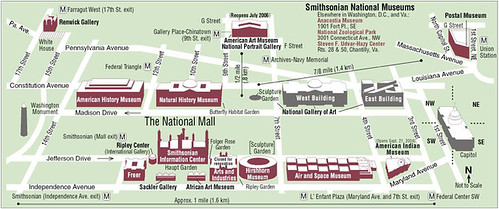
The Smithsonian is a grouping of museums and science research facilities, mostly located on the National Mall.  They are national museums, and with a couple of exceptions, don't focus on "serving" the local community in terms of cultural interpretation, other than residents having access to the facilities, just as anyone else.
Map of the Smithsonian Museums on the National Mall
(Note this map is somewhat out of date.)  Map of the Smithsonian Museums on the National Mall/in Downtown DC.

My discussion of this general issue is that DC needs to focus on developing its own set of cultural institutions, not out of a desire to duplicate the array of museums provided by the Smithsonian, but out of a recognition that we shouldn't expect the national museums or other national cultural facilities (Library of Congress, Kennedy Center for the Performing Arts, National Gallery of Art) to substitute for facilities of our own.

And out of a recognition that the "national" mission of the federal cultural assets can never adequately serve to meet local cultural needs.  The relative failure of the Anacostia Community Museum, a Smithsonian "eco-museum" is a case in point.

-- Proposal to build a Museum Park, including the Anacostia Community Museum, at Poplar Point

Assessing the Smithsonian in the context of other nationally pre-eminent museums and the national museums in other countries, I'd say in general, they don't measure up.  See the past blog entries:

-- "Dancing with the one that brung ya and challenging the dominant narrative""
-- "You don't gotta have art," about the controversy when then Secretary Clough acceded to complaints by the Catholic Church and ordered the removal of a video art piece from the Hide/Seek exhibition at the Smithsonian American Art Museum
-- "Museum of Censored Art, adjacent to the Smithsonian American Art Museum"

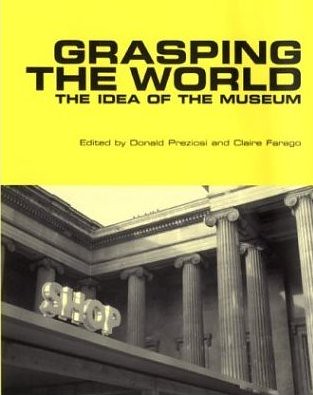
Grashping the World: The Idea of the MuseumI argue that the Smithsonian has a tough time being great because its mission as a repository of "national memory" and its role as a federal government entity often means that its overseers--members of Congress--believe that its job is project American "greatness" rather than to be an institution that also questions and reinterprets the dominant narrative,

The Smithsonian is caught between this tension and as a result, its ability to be edgy or serious gets compromised.

This is not unlike the current controversy over the AP American History test ("Here's how AP US History became controversial," Business Insider) where many elected officials are concerned that the curriculum for the class is too focused on "questioning" and not enough on extolling American exceptionalism and greatness.

And if the Smithsonian doesn't measure up being compared to MoMA or the Metropolitan Museum of Art, let alone national museums in the UK, France, Italy, and Spain, what could Secretary Skorton possibly learn from the 11th Street Bridge Park, as suggested by  Dorothy Kosinski of the Phillips Collection or DC neighborhoods like Petworth, as suggested by Molly Smith of the Arena Stage or "Advisory Neighborhood Commissions," the local community boards that weigh in on city matters, as suggested by Edmund Fleet of THEARC.

(And hey, I am on the Design Oversight Committee for the Bridge Park and I think it is a great project.  But it isn't particularly unique on a national or global scale.  There are many similar examples of parks having great impact on cities, dating to Central Park in the late 1800s, and with more unique infrastructure related parks from Emscher Park in the Ruhr to of course, the High Line, but parks similar to the High Line pre-date that example as well.  THEARC is an amazing cultural space too.  And Arena Stage is a great regional theater.)

It makes sense that the two people interviewed who represent national institutions, William Adams, chairman of the National Endowment of the Humanities, and Deborah Rutter, president of the Kennedy Center, had more relevant advice, focusing on connecting with equals at peer institutions and looking beyond the footprint of the US.

Be that as it may, many years ago, the then Under Secretary of Art, Ned Rifkin, convened an outside peer review study of the Smithsonian art museums.  The study said there was a great deal of room for improvement.  (While technically a part of the Smithsonian, the National Gallery of Art is independent.)  The museum directors revolted, not cottoning to any criticism at all, and Rifkin was eased out (although this was also a result of other changes in top leadership and scandals around the same time).

2.  I have not had the time to track down either of these books, Capital Culture: J. Carter Brown, the National Gallery of Art, and the Reinvention of the Museum Experience and Who Owns America's Past?: The Smithsonian and the Problem of History, but I'd argue that both should be required reading for members of the local and national cultural community.

After such a reading, we'd be in a better place for making recommendations to Secretary Skorton about what he should be focusing on.

From the description of Who Owns America's Past?:
Never before has a book about the Smithsonian detailed the recent and dramatic shift from collection-driven shows, with artifacts meant to speak for themselves, to concept-driven exhibitions, in which objects aim to tell a story, displayed like illustrations in a book. Even more recently, the trend is to show artifacts along with props, sound effects, and interactive elements in order to create an immersive environment. Rather than looking at history, visitors are invited to experience it.

Who Owns America’s Past? examines the different ways that the Smithsonian’s exhibitions have been conceived and designed—whether to educate visitors, celebrate an important historical moment, or satisfy donor demands or partisan agendas. Post gives the reader a behind-the-scenes view of internal tempests as they brewed and how different personalities and experts passionately argued about the best way to present the story of America.

Labels: , , , , , , ,

Monday, September 29, 2014

11th Street Bridge Park presentations today and tomorrow

Final submissions by the four teams:
  • Balmori Associates/Cooper, Robertson & Partners
  • Olin/Office of Metropolitan Architecture
  • Stoss Landscape Urbanism/Höweler + Yoon Architecture
  • Wallace Roberts & Todd/ NEXT Architects/ Magnusson Klemencic Associates
are online here:  11th Street Bridge Park Competition

Seeing the presentations (click for calendar)

1.  Online
2.  At exhibits at TheARC in Ward 7, the District Architecture Center, and the Smithsonian Anacostia Community Museum
3.  In public presentations by the teams on September 29th and 30th at TheARC.

The site presents "some issues" given that the Navy Yard is still in use and presents serious security restrictions, which at time, close certain areas of the Riverwalk on the north (west) bank.

The decision process.  The Jury will be seeing presentations from the four teams today and tomorrow and the selection will be announced on October 16th at a press conference at TheARC in Ward 7.

The finalists will be presenting to the public this afternoon and tomorrow morning at TheARC as well.

Design oversight committee.  I am on the design oversight committee, which is a mix of representatives from various stakeholders (like the Navy Yard and the National Park Service), knowledge experts, and members of the community.

The committee participated in site visits and other information sharing with the teams after they were selected in June.  And in July and August the teams presented their in-process work to the committee for their response.

The committee wasn't supposed to say "we like this" or "we don't like that" and it wasn't a critique either, but a reaction with responses to questions posed by the teams.
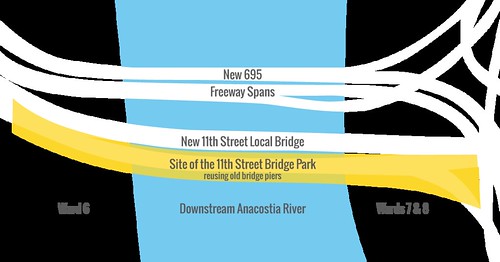
11th Street Bridge Park project, Washington, DC
Me.  After the final submissions, based more on a reaction to the renderings, I had a preference, but because I am on the the design advisory committee (we react, we don't select, that's up to the jury) so I am not at liberty to express a public opinion.  In any case, I'm glad I'm not on the jury because selecting a winner will be difficult.

(More than 200 teams expressed interest, more than 80 teams submitted a response to the competition notice, and 4 teams were selected from this group to make proposals.  Each received just under $30,000 to cover the cost of preparing responses.)

Interestingly, the committee met last week and evaluated the four proposals (based on the more complete response document submitted by each team, which haven't been made public), as an analysis provided to the Jury.

At this stage, the task of the committee was to weigh each proposal against the design principles and evaluate whether or not the proposal as submitted would do a superior job creating a great park that is flexible, that will help to knit the two sides of the river together, and is "iconic."

But iconic is an interesting word with many meanings.  Does it mean a visual stunner, something that is "known around the world" not unlike the Frank Gehry designed Guggenheim Museum Bilbao, but not a great park?

In the end, I ended up changing my preference from my initial reaction, after a more careful and systematic evaluation of each proposal.  Iconic has different meanings and in the end, I decided that the "visual stunner" didn't follow through and also create the framework for a great park.

My reaction to the process.  The design review iterations and the ideas that were engendered led me to write four entries touched off by the interaction:

-- "The Anacostia River and considering the bridges as a unit and as a premier element of public art and civic architecture
-- "DC has a big "Garden Festival" opportunity in the Anacostia River""
-- "A world class water/environmental education center at Poplar Point as another opportunity for Anacostia River programming (+ move the Anacostia Community Museum next door)"
-- "Saving the South Capitol Bridge as an exclusive pedestrian and and bicycle bridge"

which could be considered an extension of various posts I've written about the area including:

-- "Wanted: A comprehensive plan for the "Anacostia River East" corridor"

Rather than considering the teams not selected as "losers," I'd prefer that we consider utilizing elements of their work  on other sites in the city, and continuing to work with all the teams.

Interestingly, the two firms that impressed me the most at the initial presentations by the finalists in June were the ones that impressed me at the end of last month's "review" meetings. It was interesting how the teams each looked at the project, and which elements.

(But in the end, I wasn't as impressed with those proposals, as I was with the one that in August I thought was the least interesting.)

Some of the elements that really surprised me and opened up my thinking included a recognition of the importance of wildlife sustenance as an element of "nutrition"/urban agriculture and how to program the space on a day-to-day basis (one of the firms ideas lays out a framework that I think is a substantive advance in parks planning, although maybe some business improvement districts are doing a form of this).

All the teams stepped delicately around the fact that there was more to the preferred program than can actually be accommodated on the bridge, and they made various proposals to extend programming on and along the banks of the Anacostia River.

Frankly, if I had been on one of the teams I would have advocated for an evaluation of the scope as part of the response, and pointed out the difficulty of realizing all of the program in the space available, just as each team evaluated the structural engineering elements of the bridge piers to determine what type of span could be accommodated and the constraints the bearing loads imposed on what could be achieved.

No swimming barge.  And in the end, no team suggested an in-river swimming barge.  See "From lidos to plunge pools: urban swim projects around the world" from the Financial Times.  What's up with that?

Labels: , , , , ,

Wednesday, May 21, 2014

Thessaloniki: regeneration as an ongoing process

Is the latest piece in the series of articles I have been doing for the "Europe in Baltimore" project of the EU National Institutes of Culture Washington Cluster on creative placemaking in Baltimore, linking the arts, creative industries, and transit in terms of Baltimore's three arts districts in Station North, Highlandtown and the newest in the Westside, called the Bromo Tower Arts and Entertainment District.

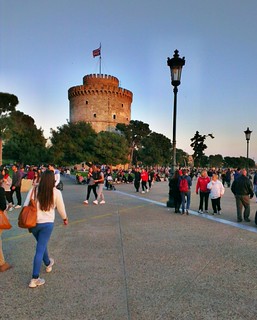
White TowerThessaloniki is Greece's second largest city, about 320 miles north of Athens, and is the unofficial capital of the Balkan nations in Southeastern Europe.

The White Tower of Thessaloniki dates to the 1400s and includes a display of city history.  Flickr photo by Aris P.

This piece was tougher to write because there are fewer resources in English and I don't read Greek and at times it was a struggle to be "positive" because Greece's cities have been dealing with the fallout from the Global Recession, which has crushed Greece particularly hard, with a 30% drop in economic activity and a concomitant rise in unemployment, and because Greater Thessaloniki has political issues--a different fallout from the re-integration of former Soviet Block Balkan nations into Europe--and because their hosting of the Capital of Culture program was back in 1997.

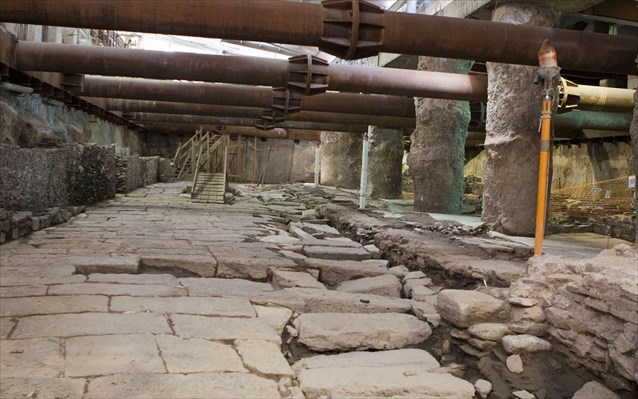
At the same time, there are very exciting things happening in Thessaloniki, in part as a civic response to the economic crisis. And the city and region have a lot of assets in the natural, built, and maritime environments.  Historic buildings and archaeological sites date back as much as 2000 years.  (Excavations for the subway have turned up over 100,000 artifacts including part of the original Roman road, the Via Egnatia.)

Thessaloniki Otherwise is a fascinating civic involvement initiative spearheaded by Parallax, the local alternative magazine (comparable to DC's City Paper or the Chicago Reader or LA Weekly). Their big focus is on public space and planning.

Yiannis Boutaris, independent of the major political parties, progressive, and retired vintner is the Mayor, and he is working to rebuild and improve the city's operation and finances and has a great commitment to civic involvement. It looks like he will win re-election--the runoff election is next Sunday and he had the most votes in the primary, held last Sunday.

The city has been continuing to invest in public space improvements, especially in the waterfront. For example, it now holds a monthly "car free" event on the waterfront.

Separately, the EU is helping to fund the construction of a new subway system, which aims to help improve brutal traffic issues. The subway system is expected to open late in 2016.

There are a variety of knowledge industry development initiatives.

Railroad passenger services to Balkan nations were shut down in 2011 in response to the economic crisis, but were restored earlier this month to Macedonia, Serbia, and Bulgaria.

But it is still a struggle for the city government to build support for various economic development, tourism promotion, and government improvement initiatives. Cooperation at the Metropolitan scale is still difficult between the various municipalities.

I suggested that they use the opening of the subway system in 2016 as a milestone event around which to organize new more integrated initiatives to take the city to the next stage in its regeneration program, using planning and implementation models from Liverpool and Bilbao.

------
I learn a lot of new stuff with each piece I write and it has been a privilege to do the series.

Labels: , , , ,