Wow. DC's local cultural community is more myopic than I realized
Last Sunday's Post had a piece ("Advice for the Smithsonian Institution's new leader") interviewing local arts leaders with their suggestions for the incoming Secretary of the Smithsonian Institution, David Skorton, a medical doctor and formerly president of Cornell University.
The Smithsonian is a grouping of museums and science research facilities, mostly located on the National Mall. They are national museums, and with a couple of exceptions, don't focus on "serving" the local community in terms of cultural interpretation, other than residents having access to the facilities, just as anyone else.
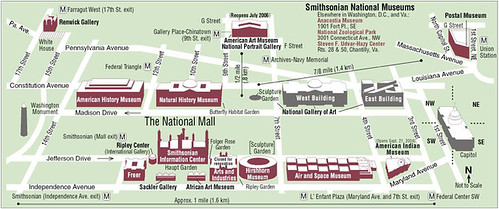
(Note this map is somewhat out of date.) Map of the Smithsonian Museums on the National Mall/in Downtown DC.
My discussion of this general issue is that DC needs to focus on developing its own set of cultural institutions, not out of a desire to duplicate the array of museums provided by the Smithsonian, but out of a recognition that we shouldn't expect the national museums or other national cultural facilities (Library of Congress, Kennedy Center for the Performing Arts, National Gallery of Art) to substitute for facilities of our own.
And out of a recognition that the "national" mission of the federal cultural assets can never adequately serve to meet local cultural needs. The relative failure of the Anacostia Community Museum, a Smithsonian "eco-museum" is a case in point.
-- Proposal to build a Museum Park, including the Anacostia Community Museum, at Poplar Point
Assessing the Smithsonian in the context of other nationally pre-eminent museums and the national museums in other countries, I'd say in general, they don't measure up. See the past blog entries:
-- "Dancing with the one that brung ya and challenging the dominant narrative""
-- "You don't gotta have art," about the controversy when then Secretary Clough acceded to complaints by the Catholic Church and ordered the removal of a video art piece from the Hide/Seek exhibition at the Smithsonian American Art Museum
-- "Museum of Censored Art, adjacent to the Smithsonian American Art Museum"
 I argue that the Smithsonian has a tough time being great because its mission as a repository of "national memory" and its role as a federal government entity often means that its overseers--members of Congress--believe that its job is project American "greatness" rather than to be an institution that also questions and reinterprets the dominant narrative,
The Smithsonian is caught between this tension and as a result, its ability to be edgy or serious gets compromised.
This is not unlike the current controversy over the AP American History test ("Here's how AP US History became controversial," Business Insider) where many elected officials are concerned that the curriculum for the class is too focused on "questioning" and not enough on extolling American exceptionalism and greatness.
And if the Smithsonian doesn't measure up being compared to MoMA or the Metropolitan Museum of Art, let alone national museums in the UK, France, Italy, and Spain, what could Secretary Skorton possibly learn from the 11th Street Bridge Park, as suggested by Dorothy Kosinski of the Phillips Collection or DC neighborhoods like Petworth, as suggested by Molly Smith of the Arena Stage or "Advisory Neighborhood Commissions," the local community boards that weigh in on city matters, as suggested by Edmund Fleet of THEARC.
(And hey, I am on the Design Oversight Committee for the Bridge Park and I think it is a great project. But it isn't particularly unique on a national or global scale. There are many similar examples of parks having great impact on cities, dating to Central Park in the late 1800s, and with more unique infrastructure related parks from Emscher Park in the Ruhr to of course, the High Line, but parks similar to the High Line pre-date that example as well. THEARC is an amazing cultural space too. And Arena Stage is a great regional theater.)
It makes sense that the two people interviewed who represent national institutions, William Adams, chairman of the National Endowment of the Humanities, and Deborah Rutter, president of the Kennedy Center, had more relevant advice, focusing on connecting with equals at peer institutions and looking beyond the footprint of the US.
Be that as it may, many years ago, the then Under Secretary of Art, Ned Rifkin, convened an outside peer review study of the Smithsonian art museums. The study said there was a great deal of room for improvement. (While technically a part of the Smithsonian, the National Gallery of Art is independent.) The museum directors revolted, not cottoning to any criticism at all, and Rifkin was eased out (although this was also a result of other changes in top leadership and scandals around the same time).
 2. I have not had the time to track down either of these books, Capital Culture: J. Carter Brown, the National Gallery of Art, and the Reinvention of the Museum Experience and Who Owns America's Past?: The Smithsonian and the Problem of History, but I'd argue that both should be required reading for members of the local and national cultural community.
After such a reading, we'd be in a better place for making recommendations to Secretary Skorton about what he should be focusing on.
From the description of Who Owns America's Past?:
Never before has a book about the Smithsonian detailed the recent and dramatic shift from collection-driven shows, with artifacts meant to speak for themselves, to concept-driven exhibitions, in which objects aim to tell a story, displayed like illustrations in a book. Even more recently, the trend is to show artifacts along with props, sound effects, and interactive elements in order to create an immersive environment. Rather than looking at history, visitors are invited to experience it.
Who Owns America’s Past? examines the different ways that the Smithsonian’s exhibitions have been conceived and designed—whether to educate visitors, celebrate an important historical moment, or satisfy donor demands or partisan agendas. Post gives the reader a behind-the-scenes view of internal tempests as they brewed and how different personalities and experts passionately argued about the best way to present the story of America.
Labels: civic assets, cultural heritage/tourism, cultural planning, culture and economic development, culture districts, museums, public realm framework, urban design/placemaking
posted by Richard Layman @ 12:20 PM&Permanent Link
Follow this blog
1 comments