Rebuilding Place in the Urban Space

"A community’s physical form, rather than its land uses, is its most intrinsic and enduring characteristic." [Katz, EPA] This blog focuses on place and placemaking and all that makes it work--historic preservation, urban design, transportation, asset-based community development, arts & cultural development, commercial district revitalization, tourism & destination development, and quality of life advocacy--along with doses of civic engagement and good governance watchdogging.

Thursday, February 20, 2025

Celebrating the 250th anniversary of the Declaration of Independence/start of the Revolutionary War | We aren't doing very well

In 2007, Virginia spent a lot of time and money promoting the 400th anniversary of the founding of Jamestown as the first successful British settlement on US soil.  

They especially focused on Jamestown, Williamsburg, and Yorktown, but had investment programs that supported historic interpretation and tourism elsewhere in the site.  They got the Smithsonian Folklife Festival to feature the anniversary as one of their threads, etc.

-- Official site of America's 400th anniversary
-- "Every American Should Stand Here Once": Jamestown's 400th Anniversary Commemoration and the Creation of an American Origin Narrative," William and Mary master's thesis
-- "T he Jamestown Commemoration of 2007: Remembering Our Diversity in the Past and Present," Southern Anthropological Association
-- "One nation, two founding stories: A study of public history at Jamestown and Plymouth," University of Massachusetts Boston master's thesis

1976 was big for the US Bicentennial founding and for federal government involvement (Report to the Congress: Planning For America’s Bicentennial Celebration- A Progress Report, 1975).  Theoretically, 2026, the 250th anniversary would be an equally good opportunity to focus on American's founding and national memory and historiography.  

Philadelphia has been known for promoting this anniversary every 50 years ("Late for the Party: Philly’s preparations for America’s 250th anniversary lost momentum amid COVID and other challenges. Is it too late to pull off a great party in the nation’s birthplace?").  A series of articles in the Philadelphia Inquirer focused on this wrt Independence Mall, which has suffered from under-investment for years ("A Much-Needed Makeover: How Philadelphia’s Independence National Historical Park is getting ready for America’s 250th birthday") totaling about $200 million as of 2024.

“This is really an opportunity to build the profile of the city and, certainly, of Independence National Historical Park,” said Kathryn Ott Lovell, president and CEO of the Philadelphia Visitor Center Corp., which cooperates with the National Park Service to operate the Independence Visitor Center — where tens of thousands start their journey to the park.

The park has an annual budget of about $27 million. But more than $85 million, a mix of funds from the federal government and private donations, is targeted this year to begin tackling the maintenance backlog in time for 2026.

Renovations of the First Bank of the United States are the most ambitious projects facing Independence National Historical Park ahead of 2026 celebrations. The work is projected to cost $27 million. Tom Gralish / Staff Photographer
People “think the park should be able to just pay for everything. But those extra things that enhance the visitor experience might not be in the budget,” said Jonathan Burton, director of development for Independence Historical Trust, a nonprofit organization that raises philanthropic funds for the park. Private funds are necessary, he says.

Also see "Philly 250," an ongoing articles collection, "Independence Park is ‘woefully behind’ for 2026 and in ‘grave need of resources,’ stakeholders say" and "Boston’s Freedom Trail is annoyingly great. Could Philly do the same by 2026?."

Plus, the Park Service has an excellent interpretative plan for the Independence Mall, even if it doesn't have the money to execute it.

-- Independence National Historical Park Long-Range Interpretive Plan

Similarly, the Boston Globe reports, "The plans by Massachusetts for the Revolution’s 250th anniversary are being questioned," that only $2 million has been allocated for support for programming there.  From the article:

Massachusetts proudly calls itself the birthplace of the American Revolution, but critics say the state’s plans for its 250th anniversary might be too little, too late for a celebration that begins in only two months at the Lexington and Concord battlefields. 

Less than $2 million in local grants for the 250th has been awarded so far in Massachusetts for this once-in-a-generation commemoration, and a mix of historians, lawmakers, and nonprofit officials are concerned that Massachusetts has fallen behind compared with other key Revolutionary states in its grass-roots programming.

Time is running short, the critics say. Nearly all of the remaining major 250th anniversaries in Massachusetts will occur over the next 13 months, coinciding with the evacuation of British troops from Boston in March 1776. Afterward, the fighting moved elsewhere.

"On a misty morning in Lexington, muskets ring out, recalling first shots of Revolutionary War," Boston Globe

 “We’ve prepared poorly. It’s never really been seen as a Massachusetts priority,” said state Senator Michael Barrett, a Democrat whose district includes Concord and parts of Lexington. “Random grants are being handed out now, but there doesn’t seem to be a plan other than making people happy with small amounts of money.” 

By contrast, legislators in Virginia have appropriated $27 million to date, primarily for hundreds of local grants. New Jersey has allocated nearly $30 million for the 250th, including $25 million for improvements at battlefield sites. And South Carolina lawmakers have set aside about $12 million, mostly for site preservation. 


 "Thousands of dollars for the 250th anniversary of battles of Lexington and Concord fail to pass Legislature, frustrating organizers," Boston Globe

Pennsylvania has raised $9.4 million, a sum that officials there expect to double, including funding for a major celebration of the Declaration of Independence in 2026. Governor Josh Shapiro has proposed an additional $10 million to market the state and attract tourists next year.

Interestingly, the Trump Administration has created a commission to address the anniversary, but most of the efforts thus far, unlike the Bicentennial, have been at the state and local level.  

And one year is hardly enough time ("Trump signs order to plan nation’s 250th anniversary celebration, punish those who vandalize statues," AP).  Although according to Politico, "Trump’s latest policy pitch: A massive birthday party for the nation," he put the concept forward in 2023.

Especially if you fire lots of NPS personnel ("US Forest Service and National Park Service to fire thousands of workers" and "‘The greatest propaganda op in history’: Trump’s reshaping of US culture evokes past antidemocratic regimes," Guardian).

Planning is key.  Philadelphia started but didn't finish.  From ("Late for the Party: Philly’s preparations for America’s 250th anniversary lost momentum amid COVID and other challenges. Is it too late to pull off a great party in the nation’s birthplace?"):

USA250 eventually floated heady plans to spur billion-dollar infrastructure improvements that would last the city until the next party in 50 years. By 2018, the dignitaries of the United States Semiquincentennial Commission, a congressionally appointed body established after lobbying by Hohns, were holding ceremonial sessions in Independence Hall.

But the efforts of the commission — and its affiliated nonprofit, the America250 foundation — fizzled in 2022 after a lawsuit alleged sexism, cronyism, and corruption in the organization.

It's an example of the need for long term planning, and the Transformational Projects Action Planning approach.

Labels: , , ,

Thursday, April 23, 2020

Things are way worse in the US than I can imagine

(Except for the UK.

They're likely to have more deaths per capita than the US, for the same reasons, an inept government pretty much unfocused. "How did Britain get its coronavirus response so wrong," Guardian)

I've mentioned Simon Anholt's book Brand America: The Mother of All Brands, co-authored with Jeremy Hildreth. More recently, I was joking with him that the new Brand America is:

Can't do.  Won't do.  You do.  F*** you.

This article by Simon appeared even before he became president: "Is Trump tarnishing the American brand?," Guardian. It's much worse now.

First you have the June cover story by George Packer in The Atlantic, "We are living in a failed state."

From the article:
When the virus came here, it found a country with serious underlying conditions, and it exploited them ruthlessly. Chronic ills—a corrupt political class, a sclerotic bureaucracy, a heartless economy, a divided and distracted public—had gone untreated for years. We had learned to live, uncomfortably, with the symptoms. It took the scale and intimacy of a pandemic to expose their severity—to shock Americans with the recognition that we are in the high-risk category.

The crisis demanded a response that was swift, rational, and collective. The United States reacted instead like Pakistan or Belarus—like a country with shoddy infrastructure and a dysfunctional government whose leaders were too corrupt or stupid to head off mass suffering. The administration squandered two irretrievable months to prepare. From the president came willful blindness, scapegoating, boasts, and lies. From his mouthpieces, conspiracy theories and miracle cures. A few senators and corporate executives acted quickly—not to prevent the coming disaster, but to profit from it. When a government doctor tried to warn the public of the danger, the White House took the mic and politicized the message.

Every morning in the endless month of March, Americans woke up to find themselves citizens of a failed state. With no national plan—no coherent instructions at all—families, schools, and offices were left to decide on their own whether to shut down and take shelter. When test kits, masks, gowns, and ventilators were found to be in desperately short supply, governors pleaded for them from the White House, which stalled, then called on private enterprise, which couldn’t deliver. States and cities were forced into bidding wars that left them prey to price gouging and corporate profiteering. Civilians took out their sewing machines to try to keep ill-equipped hospital workers healthy and their patients alive. Russia, Taiwan, and the United Nations sent humanitarian aid to the world’s richest power—a beggar nation in utter chaos. ...

Despite countless examples around the U.S. of individual courage and sacrifice, the failure is national. And it should force a question that most Americans have never had to ask: Do we trust our leaders and one another enough to summon a collective response to a mortal threat? Are we still capable of self-government?
An anti-Trump protester at a rally in Sacramento on April 20. Josh Edelson, AFP.

Second, economist Jeffrey Sachs calling the Trump Administration's response to the pandemic "shambolic"  ("Jeffrey Sachs on the Catastrophic American Response to the Coronavirus," New Yorker). 

From the article:
There are many aspects of any major crisis that are similar in character, in that they require governments to assess the situation with sophistication, to identify options, to come up with strategies, and to implement them. Crisis management has a lot of common points. The nature of the crisis could be geopolitical. It could be a climate-related shock or a disease.

I would say the core issues are the capacity of political leaders and their inner team, and the capacity of the institutions of governance—agencies, departments, and ministries—to be able to process information in a timely way and to be able to harness expert advice and evidence in a timely way. We live in a complicated world. If you try to wing it, as Trump does, you end up with more than forty thousand deaths. If you want to solve a problem, you have to be systematic about it, and know whom to turn to and how to listen and amass evidence. For politicians, that doesn’t necessarily come naturally, and for our President it doesn’t come at all.
Third, economist Joseph Stiglitz avers that the catastrophic response by the Trump Administration is leading us to another Great Depression ("Top economist: US coronavirus response is like 'third world' country," Guardian).

Fourth, incredibly disturbing interview with psychiatrist Bandy Lee, about the potential for serious violence on the part of Trump and his supporters ("Yale psychiatrist Bandy Lee: Lockdown protesters resemble “child soldiers” and “urban gangs”," Salon).


Notes

1. Sweden's touted response of no stay at home orders has led to a much higher per capita death rate than neighboring countries ("The Grim Truth About the “Swedish Model”," Project Syndicate).

2. Fox News is starting to backtrack on hydroxycloroquine, which doesn't seem to be having the effect that was touted.

3. President Trump says Georgia Governor Brian Kemp is moving too fast on reversing restrictions ("Georgia’s reopening plan gets thrown a curve as Trump criticizes Kemp," Atlanta Journal-Constitution), after Trump spent the weekend promoting protests around the country against stay at home orders--conveniently in states run by Democratic Governors.

Labels: , , , , , , ,

Friday, April 03, 2020

A net assessment from New Statesman is pretty bracing

"Why this crisis is a turning point in history," by John Gray
The era of peak globalisation is over. An economic system that relied on worldwide production and long supply chains is morphing into one that will be less interconnected. A way of life driven by unceasing mobility is shuddering to a stop. Our lives are going to be more physically constrained and more virtual than they were. A more fragmented world is coming into being that in some ways may be more resilient. ...

The task ahead is to build economies and societies that are more durable, and more humanly habitable, than those that were exposed to the anarchy of the global market.

[This] does not mean a shift to small-scale localism. Human numbers are too large for local self-sufficiency to be viable, and most of humankind is not willing to return to the small, closed communities of a more distant past. But the hyperglobalisation of the last few decades is not coming back either. The virus has exposed fatal weaknesses in the economic system that was patched up after the 2008 financial crisis. Liberal capitalism is bust.

With all its talk of freedom and choice, liberalism was in practice the experiment of dissolving traditional sources of social cohesion and political legitimacy and replacing them with the promise of rising material living standards. ...

The pandemic has abruptly accelerated geopolitical change.

In contrast, the advance of East Asia will surely continue. The most successful responses to the epidemic thus far have been in Taiwan, South Korea and Singapore. It is hard to believe their cultural traditions, which focus on collective well-being more than personal autonomy, have not played a role in their success. They have also resisted the cult of the minimal state. It will not be surprising if they adjust to de-globalisation better than many Western countries.
=======
Among others, quite a term, the era of "the minimal state."

Labels: , , ,

Friday, August 05, 2016

Rio Olympics

The Orange County Register has a great piece, "As Games nearly ready to begin, Rio's success or troubles may shape future Olympics," on the issues surrounding the Rio Olympics, which are occurring in the face of major economic deprivation, social and political unrest, the Zika virus public health crisis, and ever present crime. From the article:

A study of Olympic Games over the past 50 years by Oxford’s Saïd Business School found that the Games had an average cost overrun of 179 percent. An inflation rate of 11 percent has been a leading factor in Olympic costs rising $99.3 million from August 2015 to this past January.
“As with all Olympic bids since 1984, there are interested parties who are deeply invested for personal reasons, the principal one being financial gain, another being political advancement,” said Cashmore, author of “Studying Football.” “I have no doubt it occurred to some that a city might experience some benefit, but strictly as a byproduct rather than a direct effect of hosting the Games.
“The risks are colossal, too colossal for any individual or corporation to want to gamble. If you consider the security costs alone for London 2012 exceeded 1 billion pounds ($1.33 billion), you can’t imagine a corporation that operates for profit wanting to take a chance. In any case, even the most cursory examination of all the Summer Games since Sydney in 2000 alerts you to the fact that cities themselves, more specifically, their taxpaying residents, end up with enormous bills that take decades to settle.”
While some cities like Barcelona in particular have been successful at leveraging the Olympics as part of a larger and comprehensive land use and economic development plan and program, most cities have not been equally successful, being saddled with expensive buildings that take decades to pay off.

Also see "Much is at stake for Brazil as it takes center stage  in the Olympics," Los Angeles Times.and "Rio 2016: The high price of Olympic glory," Financial Times.

When I wrote about the fallout over Olympics bids and other mega sports events ("Not enough time for a) 2024 DC-Baltimore Olympic Bid (to make sense)" and "Big sporting events (World Cup/Olympics), economic development and trickle down economics") a key point was by the time the host city is chosen, such as with the Olympics they have only seven years before the event, and that isn't nearly enough time to build significant new infrastructure, irrespective of the issue that many of the buildings required for events are specialized with limited alternative uses, and the way that the International Olympics Committee has the majority of power, hosts are on the hook for overruns, which tend to be considerable.

Some simplification of requirements for host cities.  Even though the IOC revised the requirements for successful bids to allow for use of existing buildings rather than requiring new construction ("Olympic bid process to be simplified to allay fears over hosting games," Guardian), the reality is that especially for countries outside of the First World, the Olympics could be uplifting for communities but aren't, because of how asymmetric the power is between the IOC and the host community.

-- Olympic Games Framework for host city, 2024 Olympics bidding process, International Olympic Committee

Note that while I have not written favorably about a bid from the City of Washington, I did suggest when Chicago was bidding, back in 2009, that it would be possible to leverage the Olympics for intra-city, neighborhood, revitalization, in "Chicago Neighborhood Revitalization and the Opportunity presented by the 2016 Olympics." But the processes tend to be very top-down, and the Growth Machine types pushing for sports tourism aren't particularly interested in how a neighborhood might be able to be improved as part of the pre-Olympics development process.

Cities on the hook for cost overruns.  According to the New York Times ("The Backlash") it was the issue of seen paying for the privilege of the Olympics, and being on the hook for cost overruns, in the face of what was seen as limited economic returns, plus the realization that if Boston were selected the Olympics would take up the majority of political and economic energy within the state, regional, and local governments at the expense of being able to address housing, equity, and other issues, that led to the No Olympics 2024 campaign, which led to the city scuttling its bid.

IOC should share some of the cost of overruns.

Cities need more time.  To make the infrastructure development process more realistic and realizable, the IOC would have to change the timeline for the bidding process.  I'd add four more years to the time between being picked and holding the event--11 years instead of 7 years.

Instead, the Olympics could be augurs for local improvement if the IOC would use proceeds from television rights and sponsorship to help fund local infrastructure and other improvements as part of the selection and hosting process.

But that's not how it works.

Interestingly, the Guardian just ran a piece, "London's Olympic legacy: a suburb on steroids, a cacophony of luxury stumps," on post-Olympics revitalization in London.  It's taking a long time there too, even though London has been one of the world's strongest real estate markets for the last 15 years.

Proposals for the development of affordable housing haven't been realized and aren't likely to be.

Rio.  All those issues have come to a head in Rio de Janeiro, which hasn't been able to follow through on various commitments that were made, including ensuring that the water in Guanabara Bay was relatively clean ("Who is Polluting Rio's Bay?," New York Times; and "Rio Promised to Clean Up Guanabara Bay Before the Olympics:
Priscila Pereira was murdered while trying to make that happen
," Bloomberg Businessweek) for sailing.

Complaints are rife about failures in construction of the Olympic Village, and the new subway line, Line 4, will be running for the Olympics, but only for Olympics events, and it will close for awhile, open again for the Para Olympics, but not be fully operational until next year.

Plus there are allegations of corruption in how the subway contractors have been paid ("SUBWAY EXPANSION BUILT FOR RIO OLYMPICS OVERBILLED," Associated Press), etc.


Olympic Village

Line 4 Metro Station and Train (Image from Railway Gazette)

Labels: , , , , ,

Wednesday, November 20, 2013

One way to pilot a fee per mile vs. gasoline taxes: institute it now, for alternative fuel vehicles


Personally, I think a gas tax is easiest to collect, but a belief that somehow people will be more willing to pay a higher "use fee" on a mileage basis versus paying more in gas taxes is pushing the concept of a Vehicle Miles Traveled fee forward.

Tesla Model S.  Photographer unknown.

As part of a larger study, Oregon has been testing the concept for a number of years ("Oregon Nears Completion of Latest VMT Pilot," Governing Magazine) and recently introduced a larger test for 5,000 volunteers of alternative fuel vehicles ("Ten Questions (and Answers) About Oregon's New VMT Charge" Streetsblog DC).

There is no question that an unchanging gasoline tax will not raise enough money to pay for road and infrastructure repair and maintenance, let alone expansion and replacement, not to mention retrofitting of sustainable transportation infrastructure, take care of new placemaking elements, and throw some funding towards transit.

Charging a miles traveled fee is a way to raise the rates (not unlike how royalties were raised for performing artists simultaneously with the introduction of CD "records" so even though CDs were cheaper to produce than LPs, the price went up, not down) and collect more of the money necessary to maintain the road system.

Because alternative fuel vehicles powered by electricity, natural gas, and certain forms of biodiesel don't use fuels that are subject to the "gasoline" excise tax, they don't pay road taxes.

While Oregon continues to do testing, why not move from test to practice by instituting a VMT "fee" now, for alternative fuel vehicles--the vehicles that aren't paying taxes because they aren't using fuels that are taxed for road use.

There is a precedent for differentiated treatment of different elements of the same industry in "radio broadcasting."

In the 1990s, the music recording industry got Congress to pass as part of the Digital Millennium Copyright Act (DMCA) a royalty for recording companies on top of the royalties already due song writers and performers for songs "played" that was being extended to  Internet and satellite radio broadcasting.

It was a wrong-headed move.  First, traditional radio stations did not have to pay such a fee.  So this created an unlevel playing field between different segments of the same industry.  Second, Internet radio has less opportunity for revenue than traditional over-the-air broadcasters, not more, so this increased their costs and the likelihood of station failure.  Third, it stifles innovation.

But the impact of charging a VMT fee to all alternative fuel vehicles while slightly unfair and certainly unequal won't have the kind of stifling impact of the DMCA, even if hybrid vehicle owners were up in arms about the flat fee of $64 they are supposed to pay in Virginia as part of the change to gas taxes there earlier this year ("Repeal of Va. hybrid vehicle tax in the works," Richmond Times-Dispatch), "Hybrid drivers may save on gas but new tax gotcha," USA Today).

Banner at a Propel Clean Mobility Station (fuel station that still sells gasoline) in Fullerton, California.

From the USA Today article:
John Kraus has a new Toyota Prius V hybrid wagon that he's very fond of. He's also got a new Virginia tax on it that he's none too happy about.

Virginia Gov. Bob McDonnell, a Republican, signed a new law last month that lowers the gas tax for everyone, but slaps a $64-per-year fee on hybrid and electric car owners to help make up for what those drivers aren't paying at the pump.

"What's not to like about getting better than 40 miles per gallon of gas?" asks Kraus. "Oh, wait — less revenue for Virginia. Well, excuse us for helping to reduce the nation's oil dependency."
Or from the Los Angeles Times article "New alternative fuels station opens in Fullerton: The Propel Clean Mobility Center on Chapman Avenue offers gasoline as well as E85 ethanol and biodiesel":
Jamie Caissie, a 35-year-old flooring contractor, decided to try something new and filled up his GMC Sierra truck with E85 at the Fullerton station.  "My truck says it can take flex fuel, and it's 70 cents cheaper," said Caissie, who lives in Fullerton and often travels to San Diego and Northern California for work.
It's very important to differentiate between the "environmental benefits" and "trade benefits" of alternative fuel vehicles compared to traditional vehicles versus the "economic costs" involved in building, operating, and maintaining the road system, which are the same for all vehicles regardless of fuel source.

Regardless of the benefits to "society" from the use of alternative fuels, drivers of such vehicles still use the roads and shouldn't get a free ride while doing so.

Why not further the innovative impact of these vehicles by utilizing them to pilot a different and "better" way to pay for roads?

As a sweetener, authorizing VMT-based car insurance could be rolled into the program.  From "VMT fees, per-mile insurance make headway" by the State Smart Transportation Initiative:
While use of a mileage-based tax to replace or supplement the gas tax is still in the discussion stages, one company has begun to offer insurance on a pay-as-you-drive basis. Instead of a flat fee, or discounts for driving fewer miles than average or being a good driver, Metromile offers true per-mile insurance. In addition to a base monthly fee, drivers pay for each mile they drive. The company estimates that this offers savings in particular for urban drivers, who use transit, walk, or bike for many trips. Although the insurance is currently only available in Oregon, the Redwood City, CA-based company hopes to expand to other states soon.

Labels: , , , , , ,

Tuesday, November 19, 2013

Why is it so hard to just raise the federal (and state) gasoline excise tax?

Greater Greater Washington has an entry, "Topic of the week: No more federal gas tax?," about a legislative proposal to eliminate mostly the role of the Federal Government in managing and funding a national surface transportation system.  From the entry:
The Transportation Empowerment Act (TEA), by Senator Mike Lee (R-Utah) and Representative Tom Graves (R-Georgia), would virtually eliminate the federal gasoline tax over a 5-year period and devolve the responsibility of funding roads and transit to the states.
Given the difficulty of Congress doing anything (and sometimes that's a good thing, since the status quo is often better than ideologically-fueled "improvements") this isn't likely to go anywhere.

This kind of proposal scares me because at its root it is anti-federalist and anti-nation and pro-devolution, pro-state and pro-Balkanization that should be opposed by people who believe in an integrated nation.  Although that is a topic for another blog entry.

Why is funding roads a problem?

The federal gasoline excise tax hasn't been raised in over 20 years, so it has lost a significant amount of its purchasing power.  Meanwhile costs for maintaining the system go up, especially as sections of the federally supported road network (Interstate Highways and the US highway road system) get old and need to be rehabilitated.

Note that I didn't do a write up of a seminar I went to featuring transportation finance scholar Martin Wachs. When he was asked about what the fed. excise gas tax should be to cover the needs, he said that he considers credible estimates of 60 cents/gallon. No one asked and it would have to be done at the state level to figure out what state and local gas taxes should be.

He agreed with me that the excise tax or taxes on wholesalers is a lot easier to collect than a vehicle miles traveled tax (note that it would need to be around 3 cents/mile at an average fuel economy of 23 mpg for a typical automobile).  But he made a good point that a VMT-based system could include other "value added services" such as charging for insurance by the mile.

Some argue that devolving authority to the states would improve things, because the US DOT is a brake on innovation

While this seems true in some respects*, the fundamental problem is that the "highway" industry is dominated by suburban and rural interests at both the federal and state level, and even if the Federal Government were to cede its role to the states, the likelihood of most states--many are dominated legislatively by rural interests too, because of political district gerrymandering--all of a sudden taking up a pro-urban pro-city transportation agenda is remote.

So it won't change anything in terms of cities, except maybe make things a little worse, because cities won't be able to play off the Federal DOT against State DOTs, as a way to push forward change.

*  The Federal Highway Administration is actually an incredible resource on all things road, including biking, walking, and to some extent transit (that's handled by a different agency, the Federal Transit Administration).  They have amazing pro-bike and pro-walking resources, fund information and resource centers, etc.  But the decision-making structure is dominated by mobility agenda that favors motor vehicles.  And that agenda is set by Congress in large part, which is dominated by road building interests.

Most states find it just as difficult to raise taxes and gas taxes as Congress

Although earlier this year both Virginia and Maryland (and DC) did raise the state gas tax.  Virginia did it in a weird way that makes it less profitable vis-a-vis sales to through drivers on Federal Interstates.  Both Virginia and Maryland will be funding a number of projects as a result.

Last year Georgia failed for the most part to create locally funded transportation districts--a couple were approved, most failed (past blog entry, "Failure of the transit-roads sales tax measure in Metro Atlanta").

However, at the local level, many bond funding and sales tax initiatives, especially to fund transit, succeed.

Relatedly, there is a new effort ("California transportation leaders seek car tax hike for road repairs," Sacramento Bee) to put on the California ballot a referendum to increase the car registration tax to pay for road improvements.

California is very progressive politically, but I just can't see this being approved by the voters.

Note that since Washington State has allowed local jurisdictions to put a car registration tax increase on the ballot for funding local transportation infrastructure and operations, according to the Municipal and Research Services Center of Washington website, not one has been approved.

Apparently, Washington State had a car registration tax more comparable to other states but it was eliminated in the 1990s.  See "Car-Tab Tax, Rejected Twice by Voters, is Being Eyed Once Again by Lawmakers," from Washington State Wire.

Conclusion: Why not just do the right thing, and raise the gas tax?

It sucks when you pay at the pump, but considering what we get in return, a national road network that functions reasonably well, I'd say it's worth it in terms of being able to function as a nation with a mass market and relatively unhindered mobility.

P.S. at the local level, it's almost impossible to charge higher rates for residential parking permits...

But I've discussed that ad infinitum.

Labels: , , , , , ,

Thursday, September 22, 2011

Britain's impressive tourism promotion campaign

It is only in the last year or so that the US Government has committed to doing focused promotion of the US as a tourist destination for international travellers, after a great deal of lobbying by the tourism-related industry, including advocacy by Jonathan Tisch of Loews Hotels ("Jonathan Tisch: Promoting America" from Huffington Post).

Britain is rolling out a great set of tourism promotional posters in advance of next year's Olympics in London. See "Is Britain Great or Broken? Critics accuse Cameron of delivering mixed messages as £500,000 tourism poster campaign is rolled out" from the Daily Mail.

Of course, it's controversial and not everyone believes it's a good thing. I'm impressed though...
Heritage is Great: Britain Promotional campaign

The article shows 10 images in all.

Labels: , , ,

Wednesday, January 19, 2011

Museum of Censored Art, adjacent to Smithsonian American Art Museum

This past weekend, I was shocked to discover a form of protest art outside the Smithsonian American Art Museum on F Street NW.

In response to the removal of the video "A Fire in My Belly," by David Wojnarowicz, because it contained a few seconds of a crucifix crawling with ants, from the Hide/Seek exhibition, a group of local organizations formed the Museum of Censored Art in a corrugated metal container, got DC DDOT to give them a public space permit, and they are showing the banned video, just outside the Reynolds Center on F Street NW.

I was impressed that they decided to do this, to raise the money to do it, and to be open for the rest of the run of the exhibit, and that they were able to get a public space permit to begin with...

Today's Post has an article, "Clough defends removal of video‎," about how the Secretary of the Smithsonian Institution continues to justify the decision.

The removal of the video demonstrates how hard it is for government funded institutions too be daring, that they have to toe the line and be ready to cower at the lowest common denominator of challenge, and suck up independence and suppress innovative thinking. Basically, government museums are about socialization and the development and maintenance of the idea of national identity.

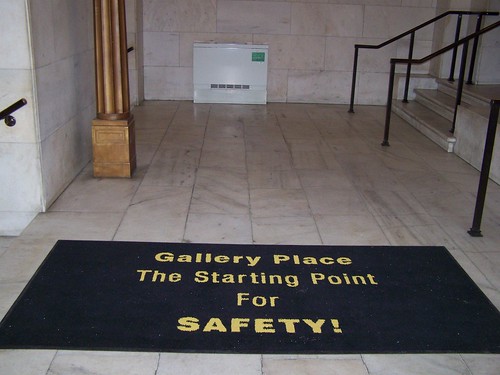
I like the double meaning of this rug's safety message, which was "on display" at the F Street entrance to the Museum last Saturday.
Gallery Place: The Starting Point for Safety (carpet in the Reynolds Center)

Labels: , , , ,

Friday, December 10, 2010

Activating public spaces: monuments and public art

Mounted
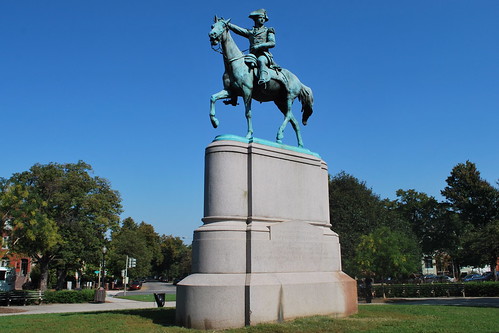
Photo of the sculpture of Gen. Nathaniel Greene in Stanton Park, DC, by M.V. Jantzen. Creating sculptures such as this was a big part of the City Beautiful Movement, and the creation of monuments and sculptures as part of a system of socialization of recent immigrants, and introducing them to the nation's history.

DC Metro Urban Diary, in "What Makes a Monument?," covered a roundtable, "Approaches to Public Art, Placemaking, and National Commemoration" sponsored by the National Capital Planning Commission.

Artists discussed how a sculpture or building isn't enough, that programming to engage the public in the meaning and purpose of the monument must be offered. Another artist, proposed what we would call nontraditional monuments. From the article:

Julian LaVerdiere, artist and designer of the World Trade Center Tribute in Light, expressed his wish to see monuments not become celebrated for a singular statue or brick, but derive meaning through their ability to offer a "transformative experience" to the visitor. He cited a potato famine memorial in New York City at which the artist had simply picked up an acre of a fallow Irish farm and plopped it in the middle of a city square. Both LaVerdiere and Justine Simons, Director London's Cultural Agenda and Programming for the Fourth Plinth in Trafalgar Square, voiced their support of temporary public art instillation as a substitute for monuments.

The article wrapped up with some important questions:

How do we wake up the landscape with interactive, meaningful public art and memorials? How do we keep monuments alive? What is the future of place making in a fractious culture, and a divisive climate? And how do we sneak some interesting public art past the NCPC, ANC's, District Council, and the Committee of 100?

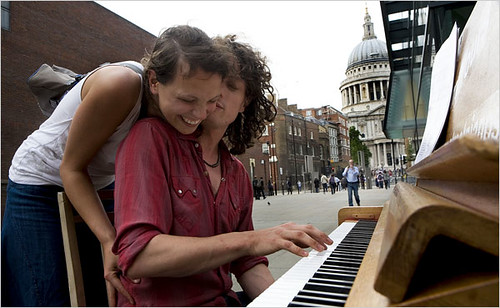
I think the answer is to start doing temporary public art programming in a superior, serious, ongoing fashion. If London (and Bristol) can do temporary interactive exhibits of pianos in the public space ("Art project puts pianos on street" from the BBC and "All Around London, an Invitation to Make Music" from the New York Times) and Sioux Falls, South Dakota can have an annual public sculpture exhibiting program why can't we do something comparably interesting and more significant than fiberglass donkeys and elephants?
Trying out one of the 30 pianos placed around London, this one at the Millennium Bridge.
This photo: Hazel Thompson for The New York Times. Trying out one of the 30 pianos placed around London, this one at the Millennium Bridge. Below 1: Flickr photo by M.V. Jantzen of "Party Animals" at the Convention Center. Below 2: "Pas de deux," Shari Hamilton, Westhope, ND, Sioux Falls Sculpture Walk. Photo by Paul Schiller.
Donkey and Elephant

"Pas de deux," Shari Hamilton, Westhope, ND, Sioux Falls Sculpture Walk
Traditional monuments and sculptures aren't so much about engaging people as they are elements in constructing national memory, myth, and narrative.

Public art is supposed to be about engaging the public and offering up the opportunity for questioning and thinking (unless it has to do with fiberglass cows, etc.) rather than adding to a relatively static historical narrative.

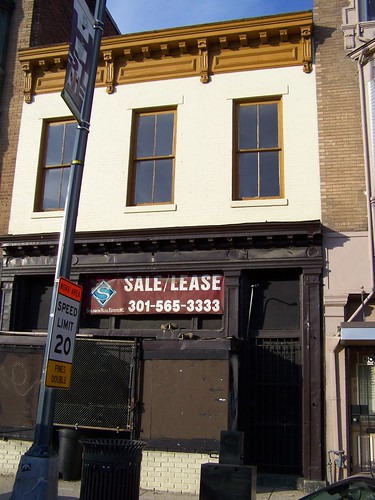
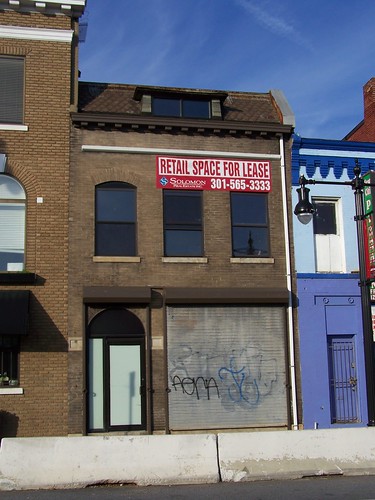
Similarly, all the various boarded up vacant nuisance properties on DC's commercial corridors, that aren't being taxed at the vacant property rate because the owners put in some new windows (taking off boards) and a for lease sign, even though the building is likely to be uninhabitable, ought to be "forced" ("strongly encouraged") to participate in storefront art exhibiting programs.

Bridget Murray Law at 406 H Street NE, Washington, DC
406 H Street NE in 2005. Washington Post photo. Below: 406 H Street NE in November, 2010. This building has been vacant for 23+ years and is owned by the realtor/investor somewhat slumlord John Formant.

Vacant building allegedly for lease, 406 H Street NE

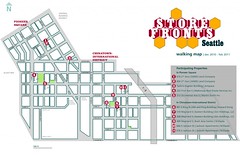
Many communities have such programs. The one in Pittsfield, Massachusetts is probably the oldest and most consistent. Seattle launched such a program, Storefronts Seattle. See "Artists take to empty storefronts: Idea is to put unused space to use" from the Seattle Post-Intelligencer.

Because of the city's role as a national capital, which for better or worse, makes us a world city, much of the art and monumental focus is on permanence and what we might call "art of the past", rather than experimentation and support of live practicing artists and the "art of today."

Maybe by expanding what we do to be more playful and engaging when it comes to public art, it will be possible to be more engaged in monuments and memorials in real time.
Storefronts Seattle map

This H Street NE building has been vacant for at least 10 years. It's not being charged at the vacant property rate. It has an exception because it is being "actively marketed."
Vacant building allegedly for lease, H Street NE

Labels: , , , , , , ,