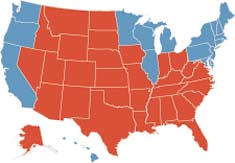
DC is the nation's only city-state, except that it's not a state.
Although in this case, Congress still has oversight, but for the most part except in areas of policy where political points can be scored, it's benign. Except for the restriction on the city's ability to tax non-residents, which even prevents the city from taxing professional athletes.
What this means in practical terms is that a State Legislature doesn't control what the city can do, often at the benefit of exurban and rural areas, and the city keeps all of its income and sales tax revenues, thereby having a more balanced set of revenue streams, compared to most other local jurisdictions which are reliant on property taxes.
There are city-states in other countries such as Mexico City and Paris, which are national capitals, and Hamburg in Germany which is an urban state, but not a national capital.
In those cases, these states are no different than other states/departments in the rest of the country.
Generally a city-state is predominately urban, so it doesn't have bifurcated policy and representation divvied up, often in unfair ways, between cities, suburbs, and rural areas.
The
Metropolitan Studies Center at Brookings Institution argues that "metropolitan areas" should be the primary way to organize the country at the sub-federal scale, and city-states are one of the best expressions of this idea ("
Metropolitan Revolution book review," 2013).
DC is about 60 square miles (1/3 of that is federal land), with more than 700,000 residents. While it has more residents than some states, it doesn't have voting representation in Congress.
It has an elected mayor and an elected City Council with 13 members -- 4 at large members, a Chairman elected at large, and 8 members each representing a ward. (And an elected "state" school board which has limited oversight of actual schools.)
By comparison in a typical state, you have a lot more opportunity for holding elected office including seats on local town, city, and county councils, judges and prosecutors, school boards, state representatives and senators, statewide officials like Governor, and federal Representatives and Senators.
The set of
Post articles on the primary elections in Ward 2 ("
The eight Democratic hopefuls running for Ward 2"), Ward 4 ("
In Ward 4 council race, incumbent Brandon T. Todd faces a progressive challenger"), Ward 7 ("
Vincent Gray in Ward 7 D.C. Council race faces a long list of challengers"), and Ward 8 ("article to come") where this year even incumbents are facing a fair number of opponents, a number of which whom are worthy of consideration, makes me think of the lost opportunities in having such a restricted number of political representatives.
It could be worth having more Councilmembers, as a way to make politics somewhat more competitive, to provide more opportunities for minority party representation such as Green, Working Families, Socialist Alternative (like in Seattle and Minneapolis) or even Republican.
(Note that many commentators lament that DC lacks political competition. That's true. But what they mean is that there aren't Republicans holding office. But that's not really DC's fault. The Republican Party has changed and because the city is pretty progressive politically, that doesn't fit with the kinds of Republicans that tend to run these days, who are more out of the wack job side, which is less appealing to urban residents.)
Making DC Council bigger. The past entry, "
Continued musing on restructuring DC's City Council (mostly)" (2013) lists a number of transformational measures for DC City Council and elections.
Summary recommendations
1. Increase the number of wards [or]
2. Increase the number of councilmembers
3. Move the legislature to part-time service and reduced pay
4. Reduce the size of councilmember staff
5. Increase the research capacity of local government
6. Institute term limits for elected officials.
7. Change the date of the primary election to extend the electioneering period.
8. Institute ranked choice voting for local elected officials.
9. Institute additional campaign finance limits for local elections.
10. Create an elected public advocate/ombudsperson.
11. Reconstitute a school board with oversight over pre-K to 12 public education, traditional and charter schools.
12. Build civic capacity and infrastructure.
Such changes are even more relevant today because at the time it was written, DC's population was about 620,000. Now it's 706,000. So each ward councilmember today represents 88,000+ residents, when before it was 77,000.
Council districts will be redrawn after this year's Census. As population has increased in the western side of the city, those districts will shrink in size, while eastern districts will continue to expand westward.
Statehood proposal. The proposed "
Constitution for the State of New Columbia" created in 2016 proposes a 21 member House of Delegates. It basically proposes a structure comparable to that in my 2013 piece. 8 Legislative districts each with two members, one elected in each two year election cycle, with 4 at large members, two elected in each cycle, and a Speaker of the House elected at large.
There's something to be said for having a unicameral legislature in a small place like DC. But in the current form with 13 members,i t's too easy to pass legislation when you only need 7 votes.
More councilmembers per ward. One problem with monopoly representation within a ward is that it allows the Councilmember to control much of the political discourse and activity within a ward.
That's why I suggest that each ward have two councilmembers, each serving a four year term, with a two year overlap. This allows for intra-ward competition and polycentric politics.
If DC went to this format, then I'd recommend an increase in the number of at-large representatives too, from two per election cycle to three for a total of six.
That could be as many 23 Councilmembers including the Chair who generally only votes where there is a tie, which is a lot, but instead of 7 votes you'd need 12 to pass major legislation, and that would be a good thing. Salaries could be reduced some to save a bit of money, which would of course be redirected to having more Council staff.
More wards? As the city increases in population, shrinking the population of wards by adding to the number could help keep wards more intimate and accessible.
An alternative would be to still have monopoly representation within wards, but to have say 11 or 13 Wards instead of 8.
By adding one more at large representative to each election cycle simultaneously, that would be a Council size of 18 with 11 wards and 20 with 13 wards.
In an 11 ward structure, each Councilmember would represent about 64,000 residents; a 13 ward structure, 54,000 residents.
 Ranked choice voting
. So many candidates in the ward primary elections is an argument for ranked choice voting ("
D.C. Council?s Ward 2 election is a great argument for ranked choice voting,"
Post).
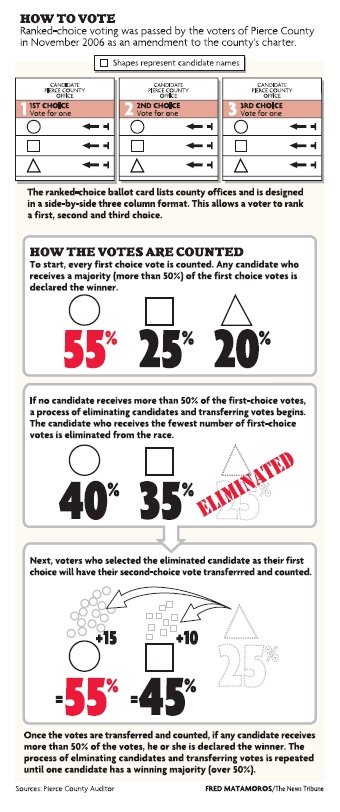
It's more complicated, but it allows people to indicate first, second, third, etc. choices, and as candidates are eliminated, a more diverse set of candidates can be elected--note that it's possible, not probable.
DC is most likely to elect Democrats to elected office, but the fact is that the candidates vary considerably in terms of their progressiveness, ethics- ness, raceness, etc.
So the ability to rank candidates would help more progressive candidates get elected when a typical election has multiple "good" candidates running and just one "bad" candidate, and the bad candidate has a built in advantage because his/her supporters don't split their votes.
Peirce County, Washington used ranked choice voting for a couple of elections, but it was repealed in 2009. This diagram is from the
Tacoma News-Tribune circa 2008 and is used with permission.
San Francisco started using ranked choice for local elections in 2005.
Civic infrastructure improvements will be the subject of a separate entry.
Labels: elections and campaigns, electoral politics and influence, ethics, governance, government organization, government oversight, participatory democracy and empowered participation