Rebuilding Place in the Urban Space

"A community’s physical form, rather than its land uses, is its most intrinsic and enduring characteristic." [Katz, EPA] This blog focuses on place and placemaking and all that makes it work--historic preservation, urban design, transportation, asset-based community development, arts & cultural development, commercial district revitalization, tourism & destination development, and quality of life advocacy--along with doses of civic engagement and good governance watchdogging.

Saturday, December 28, 2024

Breaking free of neoliberalism

Jordan Himelfarb, Opinions editor for the Toronto Star interviews ("My dad used to run Canada’s public service. As the Star’s opinion editor, I asked him what he got wrong, how he turned left — and why he keeps needling me about my work") his father Alex, on his new book, Breaking Free of Neoliberalism: Canada’s Challenge.

Neoliberalism is not unique to the United States or the UK, it is a world-wide phenomenon.

AH: You’re right that we are living in an age of crisis which itself ought to suggest there’s something very wrong about how we have organized ourselves. Add to that our collective tool kit to address those crises has rarely been weaker. The 1980s neo-liberal counterrevolution, when governments focused single-mindedly on growth and came to see their primary role as creating the conditions for business to prosper, stripping away as many barriers to profit as politics allowed, changed not just government but the country and for that matter us. 

Freedom — economic freedom and freedom from government — became a core value. Competition would sort out the winners and losers. Inequality was not only inevitable but right. Unsurprisingly, decades of flattened taxes, deregulation, privatization, offshoring and financialization — the neo-liberal policy suite — have led to increased inequality and insecurity — and a loss of trust in our public institutions. Just look at how few people vote irrespective of the stakes and how many seem ready to burn it all down.

JH: Your book is premised on the idea that neo-liberalism has created deep inequalities, constrained our collective capacity to meet big challenges and generally spread misery and anger by undermining solidarity and turning us against one another. If it’s so terrible, why does it persist? 

AH: Not that hate, exploitation and misery — even globalization — somehow didn’t exist “before neo-liberalism.” But neo-liberalism did upend the post-war settlement, when it seemed that capitalism and democracy could nourish each other, that high profits and high wages could coexist, that growth would benefit everybody. Instead we have corporate concentration and extreme economic inequality and insecurity. 

And so finally to your question, I argue that neo-liberalism contains the seeds of its own perpetuation because it has undermined our collective tool kit — taxes have come to be seen as a burden or punishment, regulations as red tape and a drag on the economy, so too unions, while trust in government, in political parties, even in democracy continues to decline. Most significantly trust in one another — essential if we are to solve problems together — has been in sharp decline. So even as many have lost faith in how things are they have also, it seems, lost faith in the idea of the collective, in the possibility of doing big things together.

JH: So then, how, as you say, do we break free? 

AH: Ha. Big change is hard. But the stakes are high. (Italian political theorist Antonio) Gramsci recognized that in these in-between times when there’s a “war for position” the outcome is uncertain, things could flip this way or that. When asked if he was optimistic Gramsci responded with “pessimism of the mind, optimism of the will” — optimism is a choice, despair is not an option. But there are many reasons for hope. Big change usually starts outside of government, outside of conventional politics — in civil society. And there are many people out there fighting for better. If they were to link up and find some common ground, see how their issues link together and to the larger public issues, who knows what’s possible. Research out of Harvard suggests that if 3.5 per cent of the population join together to fight — peacefully — for change, they almost always succeed. There’s no shortage of ideas and energy.

Labels: , , , , , ,

Thursday, December 05, 2024

Brand America 2025

During the first Trump Administration, I wrote to Simon Anholt, the author of Brand America: Mother of All Brands, stating that Trump's brand for America was:

Can't Do.  Won't Do. You Do.  Fuck You.

It will get worse this go around.

An interesting story in the Financial Times, "What makes the US truly exceptional: Are American pathologies the necessary price of economic dynamism?."  From the article:

It is the best of countries, it is the worst of countries, or at least of the high-income ones. The US stands out for its prosperity and its brutality. 

This is how I have felt about it since I visited in 1966 and lived there throughout the 1970s. The sustained prosperity of the US is astounding. A few western countries have even higher real incomes per head: Switzerland is one. But real GDP per head in the larger high-income countries is below the US average. 

... Not surprisingly, the US economy also remains far more innovative than other large high-income economies. Just look at its leading companies. These are not only far more valuable than those in Europe, but far more concentrated in the digital economy... 

... The US then is an economic powerhouse, so much so that it has persistently run a large deficit in its capital account. Donald Trump protests. Yet this is a powerful vote of confidence. 

... So, how can such an economic marvel also be “the worst of countries”? Well, its homicide rate of 6.8 per 100,000 inhabitants in 2021 was almost six times as high as that of the UK and 30 times that of Japan. 

... More broadly, what does US prosperity mean when combined with such potent indicators of low welfare? These outcomes are the result of high inequality, poor personal choices and crazy social ones. Some 400mn guns are apparently in circulation. This surely is insane. 

... Then there is a related question, which is whether the relatively high inequality of the US and the insecurity of those in the bottom and middle of the income distribution inevitably lead to what I called “pluto-populism” in 2006: the political marriage of the ultra-rich, seeking deregulation and low taxes, with the insecure and angry middle and lower middle, seeking people to blame for what is going wrong for them. If so, what made the US dynamic, at least in this age of deindustrialisation and unbridled finance, led to the rise of Trump and so to a shift to a dangerous new demagogic autocracy. A big question for non-Americans, notably Europeans, is whether these pathologies are the necessary price of economic dynamism? Logically, it is not clear why an innovative economy cannot be combined with a more harmonious and healthier society. Denmark would suggest so. One might hope that the scale of the US market, its relatively light regulation, the quality of its science and its attractions to high-quality immigrants are the explanations. But there is this lingering fear that the technologically dynamic society Draghi and other Europeans now seek might require the rugged, nay dog-eats-dog, individualism of the US. It is a sobering possibility.

FWIW, I don't think pathology is necessary to economic dynamism.  We have a super conflicting element in American society, rank individualism ("Toward the Land of Self-Defeat," New York Times) versus a more communitarian approach.

But individualism is the side for people who want it all, don't want to share, don't believe in mutually beneficial outcomes.  And too much has changed in the economy, from neoliberalism to financialization, a winner take all economy, oligopoly, and the belief by Republicans that taxes are bad.

This extends to the social sphere by denying the value of the safety net, government action of any kind, building the wealth of of the nation by investing in people, etc.

It was pointed out that Reagan's plan was a form of austerity comparable to that of UK's Tories.  For a couple decades, because the US had previously overinvested in government and public goods, that could be withstanded.

It ended with the multiple failures of the Bush Administration.

It's amazing that the Trump posse is so focused on the destruction of America, not building its public investment ("Capital shallowing: the effect of disinvestment on government functioning").

We're in for it.

Labels: , , , , , , , ,

Thursday, May 13, 2021

Another example of the need to invest in public infrastructure: Crack in the Hernando de Soto Bridge shuts down I-40 over the Mississippi River

A crack in a steel beam on the Interstate 40 bridge, near Memphis, Tennessee, connecting to Arkansas and Tennessee over the Mississippi River.  Photo: Tennessee Department of Transportation ("Memphis' cracked I-40 bridge creates headache for traffic, shipping," AP).

The Biden Administration has big plans for public investment in infrastructure ("Biden Details $2 Trillion Plan to Rebuild Infrastructure and Reshape the Economy," New York Times).  

The Republicans aren't much interested and are criticizing Biden for having a more expansive definition of what infrastructure is.

The Republicans are definitely uninterested in raising corporate tax rates to pay for public goods ("Republicans draw 'red line' in negotiations with Joe Biden on infrastructure package," USA Today).

There are two issues with infrastructure.  One is maintaining what we have.  The other is investing in new infrastructure.

So much of US infrastructure was built 40-100 years ago, and is at the end of its useful life, necessitating improvements, especially in response to changes in regulatory requirements, etc.

Photo by Josiah Persad.

The failure in the structural integrity of the Hernando de Soto Bridge in Memphis, which has shut down the bridge, which connects Tennessee and Arkansas via I-40, is an example of the former problem.  It is expected that repair will take months.

President Biden's desire to invest in social care and child care infrastructure, an expanded rail network, etc., is about an expanded view of what infrastructure is.

Some of the earliest criticism by the Republicans in response to the proposal is that infrastructure is only for cars.


Labels: , , , ,

Sunday, March 22, 2020

Today is World Water Day

-- "Poor water infrastructure is greater risk than coronavirus, says UN," Guardian
-- World Water Day
-- "The United Nations World Water Development Report, World Water Assessment Programme, UNESCO


I came across the Ontario Clean Water Agency which is a provincial authority that provides various types of technical assistance to local governments.

US states need to develop equivalent kinds of support agencies, in part by repositioning and redefining existing agencies.

Some government agencies in the waste sector are repositioning along these lines such as SLC Green in Salt Lake City, the Lancaster County (PA) Solid Waste Authority, Recology in San Francisco, and Seattle Public Utilities, which has water and electricity functions.

I haven't come across examples at the state scale in the water sector. DC Water is an example at the local scale (

My short agenda:

1. Funding for local infrastructure needs for water distribution and sewage and stormwater capture systems. EPA mandates have imposed significant costs on local systems, which is why over the past 10+ years, water rates have risen so much ("Waster as a utility," 2016).

We need many billions. The amount made available from federal grant programs is minimal. Rural communities ("King George paying a price for years of neglect of water and sewer systems," Fredericksburg Free Lance Star) and shrinking cities are particularly vulnerable.

Republican governments have cut back on EPA authority, delegating it to the states, with the presumption that state water authorities will reduce oversight and regulations.

With the lead pipe problem, more water authorities are stepping up with replacement programs (Recognizing efforts to replace lead service lines, Environmental Defense Fund).

More recently, PFOA contamination has become an issue although it's not a new issue ("The Lawyer Who Became DuPont's Worst Nightmare," New York Times Magazine).

2. Requirements on agriculture concerning water runoff, which tends to be full of fertilizers and pesticides that overwhelm water systems ("A Movement Grows to Help Farmers Reduce Pollution and Turn a Profit," Yale

3. Reversal of the Trump Administration's severe back sliding on the Clean Water Act ("Trump Administration Rolling Back Federal Water Protections," NPR).

A big issue is the campaign against protections of intermittent water sources, such as so called "dry creeks" which don't have water 24/7/365 ("Trump Removes Pollution Controls on Streams and Wetlands," NYT).

4. Restrictions on the ability of bottled water companies to bottle water. Water should be considered a public good and resource, not something that can be privately owned, at least as it relates to bottling water ("Opinion | Bottled Water Is Sucking Florida Dry," New York Times).

A customer purchases water at a Watermill Express water dispensary location in the Clairemont neighborhood of San Diego. Photograph: John Francis Peters/The Guardian

5. Limitations on the sale and distribution of bottled water ("Californians are turning to vending machines for safer water. Are they being swindled?," Guardian).

6. Development of grey water systems in new construction to capture and reuse waste water on site to the extent possible.

-- Greywater Codes and Policy, Greywater Action

======
Flooding and the impact of climate change on coastal waterfront properties is another issue.

I do agree that more places need to do what Tulsa did, and stop developing in flood plains ("Some innovative disaster planning initiatives in Tulsa, Santa Fe, San Francisco, and Davenport Iowa," 2015), which surprisingly, is being pushed by the Trump Administration, although in a very heavy handed way ("Trump Administration Presses Cities to Evict Homeowners from Flood Zones," NYT).

Labels: , , , , ,

Saturday, October 06, 2018

Commodification of the public realm: when does incorporating advertising into government/public spaces and programs cross the line?

======
Update: Over the weekend, riding past the old Carnegie Library in DC, which is being converted to an Apple Store on the ground floor, although public uses will remain on the second floor, is another example of a community ceding control of a premier civic asset and element of the public realm to the private sector.

-- "Apple offers first peek at plans to convert D.C.’s Carnegie Library into new store," Washington Post

Washington Public Library
======

I was going to write something about this last month, hearing that NASA was looking at advertising and other forms of sponsorship around the space program ( "Corporate Sponsors for NASA? Agency to Study Making Space for Advertising," New York Times and"Commentary: Should NASA Sell Ads?," Air & Space Magazine)

Alongside the campaign of Dominos Pizza to fill road potholes "so the pizza in your won't get bumped by a poor quality ride" ("Why Domino’s Pizza Is Fixing Potholes Now," CityLab).

While the ad campaign shows the company doing the work, it's actually a grant program offering $5,000 to as many as 20 locations. They're getting a lot of press for $100,000.

-- Domino's Paving for Pizza

It reminds me of the old line during the Vietnam anti-war campaign: "t will be a great day when our schools get all the money they need and the air force has to hold a bake sale to buy a bomber."

Both are indicators of failure to support through taxes and programmatic priorities public programs and priorities.

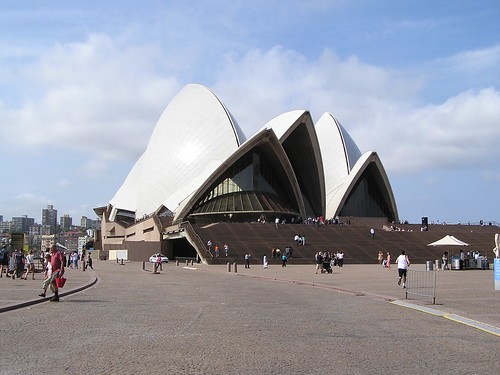
But the Sydney Opera House being forced as the result of a campaign by a radio shockjock DJ and the local newspaper which publishes a newspaper on horse racing to display promotions on the facade of the building might take commercialization and commodification of the public space to a new level ("'It's not a billboard': anger at use of Sydney Opera House for horse racing ads" and "Sydney Opera House ordered to display horse racing advertising on its sails," Guardian). From the second article:
The NSW government has ordered the Sydney Opera House to display a racing trophy with the word Everest on it and jockey numbers and colours on its sails in contravention of a policy to prevent the commercialisation of the building.

The decision by premier Gladys Berejiklian came late on Friday afternoon after intense pressure from the Daily Telegraph and 2GB’s Alan Jones to accept a plan by Racing NSW to promote the Everest Cup on the iconic landmark.

Racing NSW applied to the Opera House to use it as a venue to promote a horse race on Saturday 13 October, but Sydney Opera House chief executive Louise Herron drew the line at projecting horses’ names, the name of the race and the numbers of the barriers onto the Opera House sails.
The building is an architecture icon of the brutalism style and is a UNESCO designated heritage site.

The building
Sydney Opera House

With an artistic projection
Sydney Opera House, "77 Million Paintings," by Brian Eno, projection as part of vivid Sydney Festival
SYDNEY, AUSTRALIA - MAY 27: The Sydney Opera House sails are illuminated on opening night of the 2011 Vivid Sydney Festival on May 27, 2011 in Sydney, Australia. The annual festival offers many free and ticketed events as port of it's program and runs until June 13. (Photo by Mark Nolan/Getty Images)


rendering of the racing promotion
Sydney Opera House with renderings showing horse racing promotion displayed on its sails

The commentary about NASA by Bob Garfield, a journalist covering the ad industry, makes the point that "we should admit how much we allow commercials to intrude in our lives."

Ad at a bus shelter on Queens Chapel Road in MarylandBut that isn't the point. It's not about all the different places that "commercials intrude" it's about actively inserting commercial messages on public property and public goods.

I argue there is a difference between an ad in a bus shelter--which is a public facility installed in public space--and an ad projected on a rocket being shot off into space, or an advertising message being projected on one of the world's most iconic buildings, one that is publicly owned.

-- Adbusters Media Foundation
-- "Creating Sense of Community: The role of public space," Jacinta Francis, Billie Giles-Corti, Lisa Wood and Matthew Knuiman, Journal_of_Environmental_Psychology 32(4):401-409 (2012)

I made similar arguments when for a fair amount of time, the city argued that the only way we could pay for a full rehabilitation and improvement of the central library was to build market rate space on top of it.

A city's central library, city hall, and a handful of other buildings are the premier facilities defining the public realm and public goods and shouldn't be seen as merely another building nor as an opportunity to make a buck.

That being said, there are plenty of ways to "make a buck" integrating commercial space and activities, when appropriate, when it complements and extends the mission of the program, as I suggested in expanding beyond a straight up library to a major library, media, and cultural center ("Civic assets and mixed use").

Kaid Benfield's CityLab article, "The Important Difference Between a Public Space and a 'Common'," discusses these issues in terms of "the commons." He distinguishes between different types including environmental commons (lakes, rivers, natural spaces, etc.) and urban commons, writing:
By definition, the commons of people habitat is mostly found in urban areas – cities, towns, and suburbs – where about half the world and over four-fifths of Americans reside. Its most visible manifestation is in our shared public spaces: streets, parks and plazas, libraries, schools, waterways, public transportation, public markets, courthouses, and so on. I would certainly include some privately owned and managed sites of public significance such as places of worship, private museums, sports and cultural venues, and university campuses open to the public.
While there is no question that "commerce is the engine of urbanism," and that commercial spaces often comprise our network of "third places" (Ray Oldenburg), there is a hierarchy of spaces in the public realm where "the intrusion of commercials" are seen as intrusions and costs, not benefits.

Labels: , , ,

Tuesday, January 30, 2018

Tonight's State of the Union address expected to include a significant discussion on infrastructure

Although I wrote a couple pieces:

-- "Trump Administration Infrastructure Program Priority List: Part One, the list," January 2017
-- "Time Magazine focused coverage on US Infrastructure needs: Cover date, April 10, 2017," March 2017

I still haven't finished my follow up to earlier pieces about the Trump infrastructure plan.
Spread on ideal highway construction, Fortune Magazine, August 1936
Spread on ideal methods for highway design, Fortune Magazine, August 1936

Partly this is because at least in the sustainable transportation arena (transit mostly, but other projects too) there are so many "ideal" projects that if realized would have extra-normal positive economic impact, but these projects aren't in the "constrained long range transportation plans" already approved at the regional scale.

Projects I'd put on such a list might include:

-- the Gateway project building new tunnels between New Jersey and Penn Station, New York City
-- connecting North and South Stations in Boston ("Massachusetts awards $1.5M contract to study North South Rail Link," Boston Business Journal
-- expanding the Long Bridge railroad bridge between DC and Virginia and merging the MARC Penn and VRE Fredericksburg lines ("A new backbone for the regional transit system: merging the MARC Penn and VRE Fredericksburg Lines")
-- extending the 7 Subway line from NYC to Secaucus, New Jersey ("New York subway extension to N.J. may not be dead after all," Newark Star-Ledger)
-- adding a third track to the Brunswick Line between DC and West Virginia to enable 7 day/week bi-directional service on the MARC railroad line
-- facilitating the extension of the MARC Perryville line to Newark, Delaware
-- railroad service from Baltimore to Annapolis and from DC to Annapolis
-- a national program to install high quality bike parking hubs at airports, railroad, and other transit stations
-- adding intra-city train service on the LIRR and Metro-North in New York City as discussed in the Transport Politic blog
-- expansion and realization of various Connecticut and Massachusetts rail programs ("CTrail: How New Haven to Springfield line will work, cost to build it," Springfield Republican; "East-west passenger service urged among state rail priorities," Worcester Telegram)
-- remaking the Metra Electric line in Chicago as a form of intra-city rapid rail transit ("Idea to convert Metra Electric to rapid-transit line draws mayor's interest," Chicago Tribune)
-- developing a 21st century bus transit system for the Detroit metropolitan area (I've been meaning to write about this)
-- new 21st century design forward light rail vehicles for the Baltimore Light Rail line along with a subway and light rail expansion program
-- more funding to realize more quickly California High Speed Rail and other HSR initiatives across the country
-- expansion of MARTA subway in Greater Atlanta
-- accelerated signal upgrades for the NYC Subway ("Key to Improving Subway Service in New York? Modern Signals," New York Times)
-- rail transit in Orange County, California
-- the gondola between Rosslyn and Georgetown ("Here’s the latest with the Georgetown-Rosslyn gondola," Washington Business Journal)
-- proposals to provide rail transit connections between Staten Island and New Jersey ("MTA plans to study New Jersey rail service to Staten Island," AP)
-- massive investment and improvement in New Jersey Transit
-- etc.

And it would be easy to come up with a list five times longer, not even getting into waterway and ports projects, utility projects, or broadband.

The model for transit expansion at the center city and metropolitan scale would be France, as well as Bilbao, and the tight integration between railroad and subway services in London, Paris, and many German cities.

Amtrak.  And a specific program to fund investment and expansion in Amtrak nationally not limited to the Northeast corridor, a real 21st century railroad program.  The Spanish and Chinese HSR programs and rail in Japan would be models.

-- The Case for Business Investment in High-Speed and Intercity Passenger Rail

Parks, public lands, museums, federal facilities.  A separate funding initiative could invest in national parks and public lands ("Everglades National Park falling apart with $88 million maintenance backlog," Miami Herald), national museums--including the development of national museums outside of DC, and certain federal facilities such as a new headquarters for the FBI ("GSA may keep FBI headquarters at Hoover Building site," Washington Business Journal). 

National parks face a maintenance backlog of many billions of dollars.  From the Miami Herald article:
The massive repair backlog is nothing new — the Everglades’ to-do list totaled $58 million under the Obama administration. But the Trump administration’s approach to the nation’s wild lands, from shrinking monuments and clearing the way for drilling and mining, to slashing spending in a proposed budget, is setting off alarms. Interior Secretary Ryan Zinke wants to cut the National Parks Service budget by nearly $300 million and eliminate more than 1,200 jobs — meaning 90 percent of the nation’s parks would lose staff.

Rather than ask Congress to address the $11.3 billion national maintenance backlog, the administration is also proposing doubling entrance fees at 17 popular parks during their five busiest months, angering park advocates who say the plan could backfire if higher costs drive away visitors. The administration has also ditched the nation’s efforts to address climate change, an issue especially critical to South Florida’s parks. ...

It’s been more than a half century since the U.S. gave its national parks a facelift with the $1 billion Mission 66 project. ... With more than a half century since the last makeover — triggered by public outrage over deteriorating conditions — Pew’s Director for the Restore America's Parks project, Marcia Argust, said the problem is caused mostly by unreliable funding.
State of the Union address.  Tonight's State of the Union "Presidential" Address is supposed to tout infrastructure investment quite heavily, in advance of a more formal proposal expected to be released next month.

According to various reports ("Trump expected to tout infrastructure plan this week, but funding remains murky," Chicago Tribune; "White House plan would reduce environmental requirements for infrastructure projects," Washington Post) and a leaked document ("Scoop: Read the draft White House infrastructure ," Axios)

-- the proposal calls for $1 trillion in spending
-- but with a maximum of 20% of the cost being borne by the federal government, with heavy reliance on the private sector and local sources
-- reductions in environmental and other regulatory review requirements
-- 25% directed to rural projects
-- no more than 10% of the total spent in any one state
-- a possible increase in the federal gas tax
-- expansion in the ability to toll existing roads.

The Trump Administration doesn't favor federal investment in local transit.  In this year's budget discussions, the Trump Administration has already argued that transit should be a local funding responsibility, even though projects typically exceed the capacity of local jurisdictions and states to fund.

From the Chicago Tribune:
The office of U.S. Senator Tammy Duckworth, D-Illinois, said if Trump’s proposed cuts to other transportation programs over the next 10 years are added onto the proposed $200 billion in the infrastructure plan, the result is a negative $144.9 billion.

“It’s a bit of a scam,” said Dan Cantor, national chair of the Working Families Party, a third party allied with progressive Democrats. “It’s not a real plan to directly invest public money into worthwhile projects that create good jobs. Instead, it will hand over infrastructure to private interests and make believe that’s the cheap way to do it. You pay later with tolls and fees.”
Gas tax.  Generally, the Republican Party has been against raising the gas tax, and that is likely to be the case even if now the US Chamber of Commerce is calling for an increase ("U.S. Chamber of Commerce to push Trump, Congress to raise the gas tax," Washington Post). California raised the state gas tax to fund projects across the state and the State Republican Party there is gearing up to make that a 2018 election issue ("Group aims to repeal California gas tax hike on November 2018 ballot," Los Angeles Times). It seems unlikely that the Republican controlled House and Senate will be willing to increase the federal tax in advance of this year's elections, where trends so far seem to be against the incumbents.

Environmental review.  The program also calls for relaxing of environmental and other regulatory review. While I agree that the current processes are too long and can be onerous, there is still significant value in such review, although I can see the need for significant changes.

From the Post:
Keith Benes, an environmental consultant who played a key role in overseeing TransCanada's permit application for the Keystone XL pipeline as a State Department attorney-adviser, said in an interview that the document highlights some significant problems in the current system. But in almost every instance, he noted, it simply eliminates a legal requirement that delays federal approval for projects.

Trump Administration urban bias. Another problem with the current government is that it appears to be biased against center cities and robust metropolitan areas, at least in terms of transportation policy and changes in federal tax law, which significantly reduce the value of the deduction for state and local taxes.

But as Brookings Institution ("Metropolitan Revolution book review") and others point out, metropolitan areas drive the US economy.

The International Downtown Association just released a report on the value of investing in the central cores of metropolitan areas, The Value of U.S. Downtowns and Center Cities (Executive Summary).

Labels: , , , , ,

Thursday, September 28, 2017

September 30th is National Public Lands Day

(Family health emergencies make it very difficult to stay up to date with the blog.)

I have thought for some time that these special events: (1) National Parks Week, the last week of April; (2) National Trails Day, the first Saturday in June; and (3) National Public Lands Day, the last Saturday in September; could be better leveraged by parks and trails systems as days to call extra-normal attention to parks, trails, and public lands, although National Parks Week is sponsored by the National Park Service to call attention specifically to national parks. But "National" has two meetings -- the entire nation as well as the National Parks system.

Alternatively, why couldn't the last week of April also be "State Parks Week."


This Saturday, on National Public Lands Day, all national public lands -- parks under the National Park Service, recreation areas run by the Army Corps of Engineers, lands run by the Bureau of Land Management, forests run by the US Department of Agriculture; and wildlife preserves run by the US Department of Fish and Wildlife -- are free to enter.  Many state park systems will provide free access as well.

A clickable map on the NPLD webpage allows you to identify events in your state.

Given the various controversies surrounding the US Department of Interior under the Trump Administration, in terms of the appointment of Ryan Zinke as Secretary ("Zinke says a third of Interior’s staff is disloyal to Trump and promises huge changes," Washington Post) and various policy steps such as rescinding the ban on sales of bottled water in national parks ("National park ban saved 2m plastic bottles – and still Trump reversed it," Guardian ); the review of boundaries of National Monuments, which has resulted in recommendations to downsize certain parks ("Interior secretary recommends shrinking 6 national monuments according to leaked memo," Associated Press); the increased access to public lands for oil and gas production ("Interior Secretary orders faster permitting of oil and gas drilling on public land," Casper Star-Tribune), as well as state actions such as the State Legislature of Utah voting to take control of federal lands ("Public lands are not the states’ to “take back,” but they may get them after all" St. George Independent; "Denver snags vast outdoor show from Utah over public lands politics," Colorado Springs Gazette), National Public Lands Day is a good time to discuss the concept and value of "public goods" such as public lands.

I haven't had time to pick up and read the book Our Common Wealth: The Hidden Economy That Makes Everything Else Work by Jonathan Rowe and Peter Barnes, but it's on my list.

-- first chapter
-- "The Glory of the Commons," Washington Monthly

Labels: , , , , , ,

Friday, March 31, 2017

Time Magazine focused coverage on US Infrastructure needs: Cover date, April 10, 2017 (on sale now)

I still haven't published the follow up piece to "Trump Administration Infrastructure Program Priority List: Part One, the list" although the outline and notes for the piece are constantly being tweaked.

Therefore, it's very timely (no pun intended) that Time Magazine has published a set of articles in their just published issue (April 10, 2017) on the issue.

Interestingly, over the decades their sister magazine Fortune has published many important articles on the broad topic--I've picked up issues from the 1930s, 1940s, and 1950s with pathbreaking articles, especially on highways.

I definitely plan to pick up a copy of this issue.

From email:

DEAR WASHINGTON, WE NEED TO REBUILD. CAN YOU GET YOUR ACT TOGETHER?
25 Smart Ways to Fix Our Infrastructure
(registration required)

Watch an animation of the cover

This week’s issue features a special report on rebuilding and modernizing America’s ailing infrastructure. After President Donald Trump pledged to unlock $1 trillion in infrastructure investments,

TIME reports on the state of his promise—and whether he can persuade Congress to go along with it. TIME writers break down the critical projects we need to invest in now, from air traffic control to internet access, and leading experts share their big ideas.

TIME Editor-at-Large David Von Drehle writes: “When President Trump declared, in his first speech to Congress,
‘The time has come for a new program of national rebuilding,’ the applause was loud and long.

This pledge to spend what it takes to fix roads and bridges, rails and broadband, dams and airports—a staple of his campaign speeches—struck a chord with public opinion. The legacy of past generations that sustained the world’s largest economy is aging and needs repair…..

So if everyone agrees, if the need is great and the will is there, if America’s very quality of life is at stake, as well as safety, jobs and economic competitiveness, then one would think that this is where all of Washington has a chance to step up. An embattled President could prove whether his record as a developer is relevant; Republicans in Congress could practice governing; Democrats could deliver long-promised results….

After the failure by Trump and congressional Republicans to deliver on their pledge to repeal Obamacare, the questions were written across Washington in neon. Does the President actually have a plan, and can he persuade even people who may agree with him to go along with it?”

-- Inside the White House’s infrastructure plan
-- TIME asked leading experts to share their big infrastructure ideas
-- TIME’s Josh Sanburn on why detangling Chicago’s rail mess would benefit the entire nation
-- TIME’s Karl Vick on the need to close America’s digital divide
-- TIME’s Zeke Miller on revolutionizing air traffic control
-- TIME’s Sean Gregory on a plan to fix a critical Hudson River rail passage
-- The state of bridges
-- A safer, smarter electrical grid
-- Guarding coastal cities against the threat of climate change
-- Water and wastewater treatment systems across the nation
-- Fixing outmoded locks and dams to unclog the water highway
-- Improving batteries that could transform clean power
-- A timeline of history of American infrastructure
-- McKinsey & Company proposes four steps on how to get infrastructure investment right

With regard to the infrastructure timeline, it would have been very cool had they linked back file articles and photos from Time, Fortune, Life, and Architectural Forum (a magazine that Time Inc. stopped publishing in 1964, but Jane Jacobs had worked there) to various points on the timeline.

... I've never systematically searched the backfile of these magazines, but I occasionally find back issues of interest.
Spread on ideal highway construction, Fortune Magazine, August 1936
Spread on the ideal design for a network of highways, Fortune Magazine, August 1936

Labels: , , , , , ,

Sunday, January 29, 2017

Trump Administration Infrastructure Program Priority List: Part One, the list

The McClatchy Newspapers Group, led by the Kansas City Star ("List of 50 infrastructure projects used by Trump transition team came from consulting firm") and the Tacoma News-Tribune, uncovered a document listing as priorities 50 different projects.  Later reporting determined that the list was compiled by CG/LA Infrastructure, an infrastructure consulting firm that organizes conferences and conducts other activities promoting a focus on and investment in infrastructure of all types.

(Note that I attended the CG/LA 7th Annual North American Infrastructure Leadership Forum in 2015, which I found very useful, and it led to my writing the post, "Town-city management: "We are all asset managers now"," which discusses at great length how elected officials, "governments," certain categories of stakeholders and definitely citizens need to take responsibility for the long term in terms of infrastructure, civic assets, and "capital budgeting.")

While many of the articles posted the original document, they did not include a graphic of the projects in order of importance, which I have done below. Also most of the coverage focused not on the entire list or what priorities the grouping indicates, but on projects in their community, region, or state, such as the Washington Post reporting on DC-area projects.

Problems with the list as presented.  As someone focused on master frameworks, to me the list has plenty of gaps, and no one seems to be asking "bigger questions," such as the need for a formal capital budgeting process. From the WSJ article "Trump's Infrastructure Mistake":
Infrastructure projects selected in the traditional way, by governments, are chosen based on public benefits, the community’s ability to pay—and sometimes crass political favoritism. It would be nice to get rid of the latter, which is the main argument for a public infrastructure bank.

Under the Trump plan, project selection would be left to profit-seeking investors, using the same criteria they use to decide which hotels to build, for example. Ironically, Messrs. Navarro and Ross criticize President Obama’s modest 2015 infrastructure proposals because, “These will not fix the 237,600 water mains that break each year. Nor will they stop the 46 billion gallons of water lost each day from pipe leaks.” Does the Trump team really think private-equity investors will swoon over repairing plumbing?
Another interesting thing is that some of these projects are already funded and underway.

This list can't be considered to be definitive, in terms of need and impact. And many of the projects are private, such as utility-related, not necessarily requiring public funding, although permitting and access issues could be considerable.

(Separately, there is the issue of the difficulty of complex environmental assessment requirements, which add years to the evaluation process.  There is a need to reduce the complexity and length of these processes.)

Not to mention that one of the reasons that there are a preponderance of certain types of projects here, waterways in particular, is because of the failure for many years of Congress to fund needed projects, although that isn't limited to the Army Corps of Engineers, but includes most federal agencies, especially the National Park Service, and housing programs supported by the Department of Housing and Urban Development.

Priorities.  For example, at #14 the Cotton Belt line, a commuter rail line proposed for Dallas and Fort Worth, is estimated to have a daily ridership of about 16,000 people by 2035.  Given that level of impact, is it really the fourteenth most important infrastructure project we could do in the US?  It certainly doesn't rise to the level of a determination of a federal emergency or national security need.

For example, if the #7 Subway Line in NYC were extended into New Jersey, it would add capacity and redundancy in Manhattan, improved traffic capacity by reducing bus traffic, and simpler commutes for hundreds of thousands of people every day ("7 things to know about the proposed No. 7 subway extension into Secaucus" and "Could extending a NYC subway line to NJ help ease traffic?," Newark Star-Ledger). The estimated cost in 2014 was $5 Billion.

Compiled by CG/LA Infrastructure and shared with the Trump Administration:

Project Location Value
1. Amtrak NY Gateway New York/New Jersey $12 Billion
2. Brent Spence Bridge, I-75 Ohio/Kentucky $2B
3. Nat. Research Lab. for InfrastructureOhio $2B
4. Locks/Dams on the Ohio RiverIllinois $3B
5. I-95 Improvements, NCNorth Carolina $1.5B
6. I-95 Bridges in Philadelphia Pennsylvania $8B
7. Mississippi River Dredging Louisiana $1B
8. New Air Traffic Control System National $10B
9. Plains/Eastern Electric Transmission Lines Oklahoma/Mid-South $2B
10. Cleveland Water Tunnels Ohio $3B
11. South Carolina Dams RepairSouth Carolina $850 Million
12. Hydroelectric Dams Repair/ImprovementNational $4B
13. Texas Central Railway HSR Texas $13B
14. Cotton Belt Commuter Rail Texas$1.1-$2.8B*
15. Cadiz Valley Water Storage California $250MM
16. Trans West Express Elec. Transmission CA/AZ/NV/WY/UT/CO $3B
17. Chokecherry/Sierra Madre Wind Energy Wyoming $5B
18. Second Avenue Subway, Phases 2 and 3 New York City $14.2B
19. Savannah Harbor Expansion Georgia $706MM
20. Atlantic Coast Gas Pipeline WV/VA/NC $5B
21. Champlain Hudson Power Express (Transmission) New York $2.2B
22. DC Union Station Expansion & Rehab DC $8.7B
23. Maryland Purple Line light railMaryland $5.6B
24. Detroit M-1 Rail (light rail)Michigan $528MM
25. Gordie Howe International BridgeMichigan/Ontario $5B
26. Kansas City Airport Missouri $972MM
27. Peace Bridge/New York-Ontario New York/Ontario $700MM
28. MBTA Green Line Extension, Boston Massachusetts $3B
29. Augustin Plains Ranch Power Project New Mexico $600MM
30. I-93 Rebuild, New Hampshire New Hampshire $800MM
31. Lake Pontchartrain Bridge/CausewayLouisiana $125MM
32. Port Newark Container TerminalNew Jersey $500MM
33. Howard Street Tunnel (railroad) Maryland $425MM
34. Red and Purple Line Modernization, Chicago Illinois$2.1B*
35. I-395/I-95 Reconstruction, Miami Florida $800MM
36. Chicago Union Station Redevelopment Illinois $1B
37. Upper Mississippi Locks 20-25 Illinois $1.8B
38. Illinois River Locks - Lagrange and Peoria Illinois $640MM
39. Colorado I-70 Mountain Corridor Colorado $640MM
40. Colorado I-25 Improvements Colorado $1B
41. IHNC Lock Replacement, New Orleans Louisiana $893MM
42. Chickamauga Lock Tennessee $383MM
43. Soo Locks ReconstructionMichigan $580
44. Huntington Beach Desalination PlantCalifornia $350MM
45. Upper Ohio Navigation ImprovementsPennsylvania $1.7B
46. Monongahela River Locks-and-Dams Pennsylvania $900MM
47. Seattle Airport Expansion Washington $2B
48. Arlington Memorial Bridge DC-Virginia $250MM
49. Statewide Energy Storage and Grid Modernization California ?
50. St. Louis Airport MIssouri $1.8B

* The $1.1 Billion figure for the Cotton Belt Line is for single tracking.

Waterway/Port projects
Project Location Value
4. Locks/Dams on the Ohio RiverIllinois $3B
7. Mississippi River Dredging Louisiana $1B
11. South Carolina Dams RepairSouth Carolina $850 Million
12. Hydroelectric Dams Repair/ImprovementNational $4B
19. Savannah Harbor Expansion Georgia $706MM
32. Port Newark Container TerminalNew Jersey $500MM
37. Upper Mississippi Locks 20-25 Illinois $1.8B
38. Illinois River Locks - Lagrange and Peoria Illinois $640MM
41. IHNC Lock Replacement, New Orleans Louisiana $893MM
42. Chickamauga Lock Tennessee $383MM
43. Soo Locks ReconstructionMichigan $580
45. Upper Ohio Navigation ImprovementsPennsylvania $1.7B
46. Monongahela River Locks-and-Dams Pennsylvania $900MM

Roads/Bridges.  Granted, highway agencies can never have enough money for roads and related infrastructure.  But there are many important projects that aren't pursued because of a general reticence to raise gasoline excise taxes.  That's why more state transportation departments are expanding freeways through the creation of High Occupancy Toll lanes.

The list misses some important projects that need to be under consideration despite political issues such as the I-5 Columbia River bridge connecting Oregon and Washington ("Failed Columbia River Crossing in 'rear view,' new I-5 bridge idea," KATU-TV, while listing others that aren't in process either, like the Peace Bridge, which aren't anywhere near being underway ("Despite being on Trump 'infrastructure list,' no new Peace Bridge in works," Buffalo News).  (Definitely, improved connections between the US and Canada are on the list, but not improved connections between the US and Mexico.)
.
Project Location Value
2. Brent Spence Bridge, I-75 Ohio/Kentucky $2B
5. I-95 Improvements, NCNorth Carolina $1.5B
6. I-95 Bridges in Philadelphia Pennsylvania $8B
25. Gordie Howe International BridgeMichigan/Ontario $5B
27. Peace Bridge/New York-Ontario New York/Ontario $700MM
30. I-93 Rebuild, New Hampshire New Hampshire $800MM
31. Lake Pontchartrain Bridge/CausewayLouisiana $125MM
35. I-395/I-95 Reconstruction, Miami Florida $800MM
39. Colorado I-70 Mountain Corridor Colorado $640MM
40. Colorado I-25 Improvements Colorado $1B
48. Arlington Memorial Bridge DC-Virginia $250MM

Rail projects.  Umm, what about high speed rail in Florida ("All Aboard Florida key financing information made public," Treasure Coast Palm)") or California ("California board approves high-speed rail funding as new lawsuit filed," San Jose Mercury News"), not just Texas?

Penn Station? ("Penn Station Reborn," New York Times), the East Side Access Project in New York City to connect Penn Station and Grand Central Station ("$10B East Side Access project falling further behind schedule," Newsday), electrification from Harrisburg to Pittsburgh ("Pittsburgh to Harrisburg Electrification," Pennsylvania HSR blog), electrification from DC to Richmond, the general program for improving Amtrak's Northeast Corridor ("FRA unveils recommendations for faster rail travel in the Northeast," Washington Post," ), the concept out there to expand Metra service in Chicago and to electrify one of the lines ("Revamped Metra Electric could put South Side on the fast track," Chicago Reporter; speaking of which the discussions to do more intra-NYC service via LIRR and Metro-North, "New York Regional Rail: The Central Segments," Pedestrian Observations) not to mention my transformation concept for integrating the VRE Fredericksburg Line and the MARC Penn Line, and extending the Penn Line north to Wilmington (I will be blogging about this in the next few months), and I am sure other projects around the country.

And additional financial support could speed up projects in other cities such as the rehabilitation subway systems in DC and the San Francisco Bay ("After 40 Years of Service — Reinvestment Needed for Major BART Rehabilitation," press release), more subways in San Francisco for the MUNI system ("SFMTA to study Central Subway extension to Fisherman's Wharf," San Francisco Examiner), and the building and expansion of growing systems in Los Angeles, Seattle, Denver, Dallas, Minneapolis, and elsewhere.

Frankly, why not start the planning process to build the entire Purple Line?  Or Maglev maybe?
Project Location Value
1. Amtrak NY Gateway New York/New Jersey $12 Billion
13. Texas Central Railway HSR Texas $13B
14. Cotton Belt Commuter Rail Texas$1.1-$2.8B*
18. Second Avenue Subway, Phases 2 and 3 New York City $14.2B
22. DC Union Station Expansion & Rehab DC $8.7B
23. Maryland Purple Line light railMaryland $5.6B
24. Detroit M-1 Rail (light rail)Michigan $528MM
28. MBTA Green Line Elaxtension, Boston Massachusetts $3B
33. Howard Street Tunnel (railroad) Maryland $425MM
34. Red and Purple Line Modernization, Chicago Illinois$2.1B*
36. Chicago Union Station Redevelopment Illinois $1B

One public water system improvement project. The Deloitte Consulting Group estimates the cost to fully rehabilitate the water utility infrastructure (including water piping, sewer, stormwater capture, and treatment) exceeds $1 Trillion ! ("The aging water infrastructure: Out of sight, out of mind?"). Can we say Flint, or how most major cities and metropolitan areas face massive funding needs to upgrade this infrastructure. (And what about improving the water quality of urban rivers?

Technically, there are two related projects that address water supply issues, the Cadiz Water Storage Project (#15), and the Huntington Beach Desalination Project (#44), which arguably should be included but that muddies the point about not addressing in a substantive way the massive financial need for rehabilitating"aging water infrastructure."

Project Location Value
10. Cleveland Water Tunnels Ohio $3B

Airport projects. What about LaGuardia ("$4B LaGuardia Airport Renovation Plan Wins Go Ahead From Port Authority," DNAInfo), not to mention how FAA funding restrictions prevent use of airport related funding streams to fund projects that integrate airports into the local transit system, which makes it that much harder to improve public transit options at LAX ("Here's the mindblowing plan to unf* LAX transportation," Curbed), a $4 Billion project, etc.  O'Hare too ("Airlines, City Hall are setting a crucial flight plan for O'Hare," Crain's Chicago Business).

Not being discussed is how various stakeholders propose privatizing the air traffic control system because of the failure of Congress to fund improvements ("Don't Privatize Air Traffic Control," New York Times).

Let alone, ideally, a high speed rail program could shift short distance trips from the air to the ground.
Project Location Value
8. New Air Traffic Control System National $10B
26. Kansas City Airport Missouri $972MM
47. Seattle Airport Expansion Washington $2B
50. St. Louis Airport MIssouri $1.8B

Power generation and transmission, including hydroelectric projects already listed above. But not mentioned outside of California's statewide project is the need to invest and improve the national transmission and distribution system for electicity ("Transmission and Distribution Infrastructure," Harris Williams Co.)and investing in new technologies and processes to support distributed power systems "at the edge" ("The Grid Edge 100: Deployment and Opportunity at the Grid Edge).
Project Location Value
9. Plains/Eastern Electric Transmission Lines Oklahoma/Mid-South $2B
11. South Carolina Dams RepairSouth Carolina $850 Million
12. Hydroelectric Dams Repair/ImprovementNational $4B
15. Cadiz Valley Water Storage California $250MM
16. Trans West Express Elec. Transmission CA/AZ/NV/WY/UT/CO $3B
17. Chokecherry/Sierra Madre Wind Energy Wyoming $5B
20. Atlantic Coast Gas Pipeline WV/VA/NC $5B
21. Champlain Hudson Power Express (Transmission) New York $2.2B
29. Augustin Plains Ranch Power Project New Mexico $600MM
49. Statewide Energy Storage and Grid Modernization California ?

Labels: , , , , , ,