Rebuilding Place in the Urban Space

"A community’s physical form, rather than its land uses, is its most intrinsic and enduring characteristic." [Katz, EPA] This blog focuses on place and placemaking and all that makes it work--historic preservation, urban design, transportation, asset-based community development, arts & cultural development, commercial district revitalization, tourism & destination development, and quality of life advocacy--along with doses of civic engagement and good governance watchdogging.

Friday, February 28, 2025

Our federal deficit needs a dose of reality

This is actually a letter to the editor published in the Toronto Star.  But it makes the argument that many of us have.  The budget deficit is primarily a function of tax cuts.  The recent vote by the House of Representatives extends Trump tax cuts which will lead to massive budget cuts in areas where people really need the services currently provided ("House Passes G.O.P. Budget Teeing Up Enormous Tax and Spending Cuts," New York Times).  From the NYT:

The House on Tuesday narrowly passed a Republican budget resolution that calls for $4.5 trillion in tax cuts and a $2 trillion reduction in federal spending over a decade, clearing the way for major elements of President Trump’s domestic agenda.

The nearly party-line vote of 217 to 215 teed up a bitter fight within the G.O.P. over which federal programs to slash to partially finance a huge tax cut that would provide its biggest benefits to rich Americans.

The blueprint sets the contours for the legislation that House Republicans will now turn to writing. It puts a $4.5 trillion upper limit on the size of any tax cuts over the next 10 years, but does not dictate which taxes should be reduced, a complex and politically tricky question of its own that could take months to sort out.

It also calls for slashing $2 trillion in spending over the same period, without specifying which programs should be cut, though top Republicans have targeted Medicaid and food aid programs for poor Americans. And it directs increases of about $300 billion for border enforcement and defense programs, alongside a $4 trillion increase in the debt limit.

The letter

The government should implement a moratorium on any and all tax cuts. They are economically senseless and politically expedient. The budget deficit issues we have are never going to be solved with tax cuts. That’s all we have done for a long time and deficits have only increased. It’s a bad habit politicians have normalized and they know it. A moratorium on tax cuts in a healthy economy would increase government revenue as the economy grows and expands. To supplement the increase in government revenues — taxes on the rich should be increased moderately. Why some will ask? Because they can afford it and it will not change their lot in life. They will still be rich. They have been the main beneficiaries of past tax cuts which only increased our deficits. 

-- Tom Colson, Toronto

This is also an issue in Utah.  The Republican Legislature may be the most in lock step with Trump of any of the legislatures in the U.S.  E.g., looks like they're going to make adding fluoride to the water illegal ("Utah close to fully banning fluoride in water, stripping cities’ ability to decide," CNN), the Governor is big on supporting immigration crackdowns, the Legislature is cutting the higher education budget some, to focus on degrees that are all about getting jobs, etc. 

The state is growing.  And growing places need more investment in infrastructure, not less.  But the Legislature is focused on tax cuts ("Utah Legislature poised to cut taxes for 5th year in a row," Utah News Dispatch)..  So much for funding education and other priorities.

Labels: , , , ,

Saturday, December 28, 2024

Breaking free of neoliberalism

Jordan Himelfarb, Opinions editor for the Toronto Star interviews ("My dad used to run Canada’s public service. As the Star’s opinion editor, I asked him what he got wrong, how he turned left — and why he keeps needling me about my work") his father Alex, on his new book, Breaking Free of Neoliberalism: Canada’s Challenge.

Neoliberalism is not unique to the United States or the UK, it is a world-wide phenomenon.

AH: You’re right that we are living in an age of crisis which itself ought to suggest there’s something very wrong about how we have organized ourselves. Add to that our collective tool kit to address those crises has rarely been weaker. The 1980s neo-liberal counterrevolution, when governments focused single-mindedly on growth and came to see their primary role as creating the conditions for business to prosper, stripping away as many barriers to profit as politics allowed, changed not just government but the country and for that matter us. 

Freedom — economic freedom and freedom from government — became a core value. Competition would sort out the winners and losers. Inequality was not only inevitable but right. Unsurprisingly, decades of flattened taxes, deregulation, privatization, offshoring and financialization — the neo-liberal policy suite — have led to increased inequality and insecurity — and a loss of trust in our public institutions. Just look at how few people vote irrespective of the stakes and how many seem ready to burn it all down.

JH: Your book is premised on the idea that neo-liberalism has created deep inequalities, constrained our collective capacity to meet big challenges and generally spread misery and anger by undermining solidarity and turning us against one another. If it’s so terrible, why does it persist? 

AH: Not that hate, exploitation and misery — even globalization — somehow didn’t exist “before neo-liberalism.” But neo-liberalism did upend the post-war settlement, when it seemed that capitalism and democracy could nourish each other, that high profits and high wages could coexist, that growth would benefit everybody. Instead we have corporate concentration and extreme economic inequality and insecurity. 

And so finally to your question, I argue that neo-liberalism contains the seeds of its own perpetuation because it has undermined our collective tool kit — taxes have come to be seen as a burden or punishment, regulations as red tape and a drag on the economy, so too unions, while trust in government, in political parties, even in democracy continues to decline. Most significantly trust in one another — essential if we are to solve problems together — has been in sharp decline. So even as many have lost faith in how things are they have also, it seems, lost faith in the idea of the collective, in the possibility of doing big things together.

JH: So then, how, as you say, do we break free? 

AH: Ha. Big change is hard. But the stakes are high. (Italian political theorist Antonio) Gramsci recognized that in these in-between times when there’s a “war for position” the outcome is uncertain, things could flip this way or that. When asked if he was optimistic Gramsci responded with “pessimism of the mind, optimism of the will” — optimism is a choice, despair is not an option. But there are many reasons for hope. Big change usually starts outside of government, outside of conventional politics — in civil society. And there are many people out there fighting for better. If they were to link up and find some common ground, see how their issues link together and to the larger public issues, who knows what’s possible. Research out of Harvard suggests that if 3.5 per cent of the population join together to fight — peacefully — for change, they almost always succeed. There’s no shortage of ideas and energy.

Labels: , , , , , ,

Monday, June 19, 2023

Revisiting what I wrote about in 2010/2012 back to the fore: regional cultural funding in Greater Detroit

The Detroit News has an article, "2 Detroit museums seek same financial lifeline DIA, zoo got," about how two cultural institutions based in Detroit, but serving the metropolitan area, The Charles H. Wright Museum of African American History and the Detroit Historical Museum, are asking the state to put on the ballot a county millages in Wayne and Oakland Counties (they are avoiding Macomb County because of its continued animus towards the city; animus in Oakland County has declined as it has shifted Democratic, and L. Brooks Patterson ("The rise of Oakland County is built on Detroit's Fall") died).

In 2010 and 2012 I wrote about such initiatives for the Detroit Zoo (actually located in Oakland County) and the Detroit Institute of Arts, which were caught up in the city's bankruptcy.  Back in the days when center cities were preeminent, typically they provided the bulk of and the funding for cultural institutions.  As center cities have declined, they no longer have the financial resources to do so.

This is another side of the argument in "The real lesson from Flint Michigan is about municipal finance" (2016) in how the funding systems for local governments were created when cities were growing and successful, and we don't have new funding systems focused on the reality of current conditions.

In the writings on Detroit and arts funding, I said that it made more sense to pursue a master approach to fund cultural institutions more generally, rather than one at a time, as the political and organizational cost of the one at a time approach is wasteful and really really hard. 

The Detroit area has a long standing multi-county "tax" to fund the Huron-Clinton Metropolitan Parks Authority, which was a New Deal era initiative.  The area is also having an impossible time creating a regional transit system based on a similar kind of funding system.

I mentioned the Regional Asset District in Pittsburgh as the primary example.  I don't think I was aware at the time of the Denver Scientific and Cultural Facilities District, which operates at a multicounty scale.

There are other forms too ("A comprehensive list of funding sources for arts and culture," 2019), like New York City's and the Zoo, Arts, Parks sales tax in Salt Lake County.  Hamilton County, Ohio tried to create one but failed.  Etc.

But these are the basic ones.

Conclusion.  One of the things that amazes me about the EU Commission is how it sets up various initiatives to capture and communicate best practices across the entire membership.  

One of the things that amazes me about the US is how we don't capture and communicate best practices in a systematic way across the states and cities ("4 cultural organizations/structural support initiatives that need wider replication," 2019).

It's no wonder that system improvement takes decades and incredible perseverance.

========

This is what I wrote in 2012 [links not re-checked]:

I haven't kept up with the issue.  I am not sure it passed, because there is a vote in August on a property tax levy for the Detroit Institute of Arts.  Also see "As millage vote looms, lawmaker and DIA spar over finances" from the Detroit Free Press.

I still think the best approach is regional, although it's hard to pull off.

Tom Murphy, first a legislator in Pennsylvania, and later long-time Mayor of Pittsburgh, created the infrastructure for the "Regional Asset District" in Allegheny County, Pennsylvania, which supports the big cultural institutions in the  city (museums, libraries, parks, etc.) but also cultural institutions throughout the county, through a county-wide levy.

That's what should be done in places like Detroit and Cleveland (in Cleveland they have a local levy on cigarette sales, "Cuyahoga County cigarette tax helping arts groups even as fewer people smoke" from the Cleveland Plain Dealer, which isn't a very equitable way to fund the arts, even though I hate smoking...).

This ought to become a much bigger issue going forward, as local governments are going to be continually hard pressed financially and will have to make hard choices on what to fund.

Parks-related tax and bonding initiatives tend to pass at high rates, greater than 70%, so if you build the basis of support properly, despite the difficulties of working across multiple taxing jurisdictions, I think it's possible to do this for the arts, or to combine such initiatives.

A way for a metropolitan area to support arts institutions based in the center city (2010)

It will be a cold day in hell before most metropolitan areas are willing to merge the taxation streams into one funding stream that supports municipalities throughout a region, as Myron Orfield suggests in the book Metropolitics: A Regional Agenda for Community and Stability.

On the other hand, there are more examples of center cities merging with the adjoining county for the provision of a significant number of services, and the tax revenue stream, such as in Indianapolis-Marion County, Indiana, Nashville-Davidson County, Tennessee, or Louisville-Jefferson County, Kentucky.

(And there are a number of examples of merged county-cities, such as San Francisco and Philadelphia, although this happened, at least for Philadelphia, more than 100 years ago.)

The Detroit Free Press has a story, "DSO could benefit from plan similar to DIA, zoo plan," about how there is a proposal to create a couple of regional taxes in Wayne, Oakland, and Macomb Counties in Michigan, to support the Detroit Institute of Arts, which is an institution based in the center city, but providing services to the entire region, and the Detroit Zoo (although the Zoo is located in Oakland County but owned by the city), and how a local representative, Rep. Vicki Barnett of Farmington/ Farmington Hills is suggesting that this concept be extended, and also provide support for the Detroit Symphony Orchestra, which faces significant budgetary problems and a strike by its musicians as a result of proposed changes in compensation and work requirements.

From the article:
Democrat Rep. Vicki Barnett said she hopes to muster support to add the DSO to a bill that would allow voters in Wayne, Oakland and Macomb counties to vote for a tax of up to 0.2 mills to help pay for the Detroit Institute of Arts.

That bill is before the House for final approval next week. Another bill would allow the tri-county voters to double the 0.1-mill tax for the Detroit Zoo they approved in 2008.
This is a good effort, but instead of creating a bunch of separate taxes, how about supporting cultural institutions more systematically, just as how the Regional Asset District was created in Allegheny County, Pennsylvania to support cultural and civic institutions, primarily those located in Pittsburgh, which also serve regional audiences, but also to support institutions located in the county, not just the center city. (This helps strengthen support from jurisdictions other than the center city.) From the RAD website:

Allegheny Regional Asset District (RAD) supports and finances regional assets in the areas of libraries, parks, cultural, sports and civic facilities and programs

In the Detroit area, there is a multi-jurisdictional parks district covering five counties, the Huron-Clinton Metropolitan (Parks) Authority, which has functioned on a similar basis for 70 years, although this authority does not support all parks in the region, only certain designated parks under its purview and control. The authority was set up by the State.

And there are many examples of these kinds of taxing and/or operating districts across the U.S., from the Chicago Park District, which only receives monies from the City of Chicago, but which supports museums and facilities other than parks, to transit authorities.

Labels: , , , ,

Thursday, May 13, 2021

Another example of the need to invest in public infrastructure: Crack in the Hernando de Soto Bridge shuts down I-40 over the Mississippi River

A crack in a steel beam on the Interstate 40 bridge, near Memphis, Tennessee, connecting to Arkansas and Tennessee over the Mississippi River.  Photo: Tennessee Department of Transportation ("Memphis' cracked I-40 bridge creates headache for traffic, shipping," AP).

The Biden Administration has big plans for public investment in infrastructure ("Biden Details $2 Trillion Plan to Rebuild Infrastructure and Reshape the Economy," New York Times).  

The Republicans aren't much interested and are criticizing Biden for having a more expansive definition of what infrastructure is.

The Republicans are definitely uninterested in raising corporate tax rates to pay for public goods ("Republicans draw 'red line' in negotiations with Joe Biden on infrastructure package," USA Today).

There are two issues with infrastructure.  One is maintaining what we have.  The other is investing in new infrastructure.

So much of US infrastructure was built 40-100 years ago, and is at the end of its useful life, necessitating improvements, especially in response to changes in regulatory requirements, etc.

Photo by Josiah Persad.

The failure in the structural integrity of the Hernando de Soto Bridge in Memphis, which has shut down the bridge, which connects Tennessee and Arkansas via I-40, is an example of the former problem.  It is expected that repair will take months.

President Biden's desire to invest in social care and child care infrastructure, an expanded rail network, etc., is about an expanded view of what infrastructure is.

Some of the earliest criticism by the Republicans in response to the proposal is that infrastructure is only for cars.


Labels: , , , ,

Wednesday, September 30, 2020

Commercial real estate market decline and central city business districts in the face of the pandemic

The Financial Times reports ("Destruction of value in US real estate revealed") that properties severely affected by a decline in business as a result of the pandemic are seeing a minimum 25% reduction in value.  

Even signature properties like the Palmer House Hotel in Chicago are going into foreclosure ("Palmer House foreclosure points to industry's trouble," Chicago Sun-Times), and well-funded property firms like Brookfield are letting weak properties go into foreclosure, and they have no interest in trying to fix them ("Brookfield and Namdar plan to hand over keys to struggling malls," The Real Deal), preferring to spend their money and attention on stronger sites.

Disney has laid off 28,000 employees at Disneyland in California and Disney World in Florida.

The Washington Post ("The pandemic has devastated downtown D.C. Some fear the damage is permanent") and the New York Times ("We're at War: New York City Faces a Financial Abyss") have articles about the difficulties faced by central business districts, how many of the service businesses located there will fail before people are able to return--presuming that a vaccine will make it possible for people to go back to the office in large numbers, and the economic fallout that this will have on local governments, facing a drop off in property, sales, and income tax revenues.

Relatedly, most transit systems are in dire financial straits, because of the loss of ridership ("Public Transit Officials Fear Virus Could Send Systems Into Death Spiral," New York Times).

Labels: , , , , , ,

Thursday, November 07, 2019

Why does change take so long?: retail business rents

WAMU/NPR reports ("Small Business Owners Press D.C. Lawmakers For Financial Relief") on a City Council hearing on a spate of bills introduced to address the issue, although some of the proposed legislation is still way more focused on "legacy businesses" rather than the problem in general.

But considering I have been bringing this up for more than 15 years, it's very hard to be excited about it.

I used to testify about this issue a lot from 2004 to maybe 2007, before I got the message that the DC City Council was not interested in addressing the problem in a systematic way.

- "Avoiding the real problem with DC's property tax assessment methodologies," 2007
- "Testimony -- Historic Neighborhood Retail Business Property Tax Relief Act," 2006
- "Forcing Displacement by the disconnection of tax assessment models from public policy goals," 2005
- "Displacement of retail businesses through increasing property tax assessments," 2005

The basic problem is that because DC is an international real estate market, property prices are bid up on various criteria, many of which push up rents beyond the value of the property based on the revenue capacity of the space.

- "Commercial retail rents #2," 2009
- "Cleveland Park Retail: My off-hand evaluation, the rents are too high," 2009

I had a letter to the editor in the Post about it in 2007.
Tax Policy Hurts D.C.'s Local Businesses, Richard Layman

A July 20 Metro Article ["Feeling the Pinch of D.C.'s Prosperity: Small Businesses Cry Out for Relief From Rapid Rise in Property Taxes"] inadequately explained why tax assessments are rising for small commercial property owners in the District.

Regardless of buildings' locations and use, the D.C. Office of Tax and Revenue values commercial buildings as if they could be converted into downtown office buildings. If the purpose is to turn the entire city over to office buildings and retail chains, then this property tax assessment methodology is working.

The market for downtown property is not local; it involves national and international developers, lenders, and portfolio investors. The market for small-footprint buildings in neighborhood commercial districts is local--in terms of property owners, investors, tenants, sales potential and rents. The solution is simple: differentiated tax assessment methods.

The legislative focus on property tax abatements or tax caps fails to address this fact.

As a result, locally owned businesses will continue to close or relocate to the suburbs, while more and more of the retail identity and uniqueness of the District is lost and the city's retail landscape becomes reshaped into yet another mall, albeit outdoors, featuring national brands.
One of the things that bugs me about politicians is that they focus on individual, somewhat idiosyncratic examples -- Ben's Chili Bowl -- and not structural conditions. That's why I was disappointed in 2013, when then Councilmember Wells testified about this issue to a tax revision commission, but about individual businesses, not the structural problem.

-- "Revisiting the issue of neighborhood commercial district property tax methodologies"

A big "new" problem: the need for more coordinated planning in small commercial districts.  While it's not a new problem, the velocity of real estate intensification has increased significantly and therefore, because commercial district zoning allows for housing and up to 5 story buildings, retail is being displaced in small districts like Upshur Street NW, in favor of condominiums.

There's no attention being paid for that, and the need for "thumbnail" development plans for small commercial districts, to coordinate change.

Since 2002, I've suggested Cleveland's Business Revitalization District Overlay zoning as a model for what DC ought to be doing... It requires an extra level of coordination and review for new projects.

A newer problem: people go out to eat, not to buy goods.  A related problem that is even newer is that people when they go out, tend to be interested in eating and experiences, not in buying goods. 

So asking prices for rent are probably too high for retailers based on their ability to sell goods, even beyond the revenue capacity of a store based on more traditional metrics.

Labels: , ,

Thursday, July 11, 2019

Should the Federal Reserve purchase bonds of state and local governments during a recession? (Yes)

In a hearing yesterday, Democratic Party Representative Rashida Tlaib asked Federal Reserve Chairman Jerome Powell about extending counter-cyclical anti-Recession responses of purchasing of debt of corporations and the federal government to debt issued by local and state governments ("AOC Is Making Monetary Policy Cool (and Political) Again;," New York Magazine).

Powell responded that it isn't legal, but apparently it is.

A big problem during recessions is that even if there is new federal spending aimed at stoking demand during a recession, along with increases for unemployment funding and sometimes other types of social support payments, states and local governments and related agencies tend to contract significantly for two reasons:

1.  Property, income, and sales tax revenues contract
2.  By law, state and local governments can't run deficits.

This cancels out many of the benefits of increased federal spending during recessions and in fact, extends by multiple years recessionary pressures.

Apparently, the Roosevelt Institute released a report, A NEW DIRECTION FOR THE FEDERAL RESERVE: Expanding the Monetary Policy Toolkit, a couple years ago that included this point:
3. PURCHASING STATE AND LOCAL DEBT
Unlike the federal government, state and local governments do face meaningful financial constraints. Perhaps the single most powerful tool the Fed has to support aggregate demand and direct credit in socially useful directions is to purchase the liabilities of states, cities, and other subnational governments. This would greatly reduce the pressure for pro-cyclical cuts in public spending during recessions.

The balance sheets of state and local governments are complex—unlike the federal government, most have substantial financial assets, as well as liabilities, and the sector as a whole is a net creditor (Mason, Jayadev, and Page Hoongrajok 2017). But many individual governments do face acute limits on their access to credit, and concerns over credit are a constraint on spending and revenue decisions, even if their access to bond markets is currently unimpaired. These concerns become especially serious during downturns—exactly the period when, from a macroeconomic perspective, state and local governments should be increasing spending and avoiding tax increases.

From a social standpoint, public investment is less costly during a downturn, when a larger fraction of labor and other resources are unemployed. So it is perverse that borrowing constraints cause many governments to cut back investment spending in recessions.

Financial constraints on state and local governments impart a substantial pro-cyclical component to their budget positions, acting as a kind of “automatic destabilizer” that offsets countercyclical fiscal policy at the federal level.

Labels: , , , , ,

Taxes as an investment concept: funding public goods versus tax reduction

I've been meaning to write about tax policy because there has been a fair amount of writing about the 2017 tax cuts, and the benefits mostly being directed to corporations and the extremely wealthy, and the purported big rise in economic growth that proponents said would come about because the changes hasn't happened.

-- "A New Congressional Study Finds Little Economic Benefit From 2017 Tax Cuts," Tax Policy Center

A big thread in neoliberal policy is reducing the size of government, privatizing government functions, and reducing taxes.

At the same time, the counter argument is that collective action and providing public goods requires a reasonable rate of taxation, and that lower taxation comes at the cost of investing in infrastructure and other public goods.

1. One example that comes to mind to me is how Norway and the UK took oppositional actions in response to the new revenues they received from oil production in the North Sea.

Norway didn't cut taxes, and retained ownership of the resource, directing royalty revenues to a state investment corporation, which has invested in various projects, increasing the return on investment in multiple ways.

The UK used the new revenues to justify tax cuts for the wealthy, did not retain ownership interests in the resource, and reduced corporate tax rates as well.  And while it isn't the only reason that the UK is seriously challenged financially and lacks the money to invest in revitalization and other government functions, it is a good example of how short term thinking has deleterious consequences in the long term.

-- "Did the U.K. Miss Out on £400 Billion Worth of Oil Revenue? ," Resource Extraction
-- "Why UK's oil and gas revenues are dwarfed by Norway's," Business for Scotland

2.  I have been thinking about the tax cuts issue in terms of positive return on investment.  There is a lot of discussion about how the US is running higher deficits, even though the economy is growing relatively well, because of the tax cuts, and how this is counter to general expectation, but also bad policy and bad practice.  That today's deficits are being financed by future generations.

-- "Robert J. Samuelson: Trump's fantasy budget worsens deficit"  (Washington Post syndicated columnist)
-- "Robert J. Samuelson: Shrink the budget deficit? Not a vote-getter"

There's no need to have a discussion here about Keynesian fiscal theory, recessions, counter-cyclical spending, etc.

A simpler way to think about might be, does your deficit financing "today" increase return on investment in the future or not?  If deficits don't or aren't intended to increase overall return on investment, it's bad policy and shouldn't be countenanced.

3.  Of course, what's happening with the federal deficit shows the hypocrisy of Republicans.  They "fight" deficits if the spending is for public good projects like infrastructure, or various federal programs generally as a matter of course, but not if it is for tax cuts for the wealthy.

-- "The Republicans Are Deficit Hypocrites. The Democrats Should Be Too," New Republic
-- "Charles Lane: A country at war with itself over debt" (Washington Post syndicated columnist)

4. Alaska proposes to cut university budgets 40%.  In the vein of whether or not tax cuts add or subtract value, the proposal by Alaska's Governor to fund an increase in payments to Alaska citizens by cutting university budgets is a good example.

Similarly to how the UK has let the benefits of oil production flow away from the National Treasury, instead of enacting state income and sales taxes, Alaska uses oil revenues to pay for the cost of state government as well as an annual payment to citizens. Theoretically, the Alaska Permanent Fund is not unlike what Norway did. But Norway doesn't pay out annual payments to every Norway citizen, instead it invests the revenues.

The Governor ran on a campaign plank of increasing the payment. In the face of declining oil revenues ("No longer rich on oil, Alaska may ax money to universities. Lawmakers are 800 miles apart," USA Today), the only way to do that is to cut the budget, and universities offer an opportunity to provide a significant portion of the cuts to state government necessary to fund an increase in the payments from the Alaska Permanent Fund.

But the question is whether or not that's the best possible way to "spend" such revenues. Likely the long term investment benefit from such an action is nil.

Therefore, it's bad policy and shouldn't be countenanced.

Labels: , , , ,

US federal tax code as a political weapon

=====
Revised 7/12:  I forgot the changes to the historic preservation and low income housing tax credit programs, which are negative.
=====

Yes, the tax law changes passed when Congress was fully under control of the Republican Party favored the wealthy and the growth promised has not materialized.

And yes, various tax code provisions, not just in this particular version, represent political choices and the interests of various groups that are able to influence the bill drafting process.

But this bill took weaponization to a new dimension by including a number of provisions specifically targeting "blue states" and "progressive interests."

1. Reductions in deductibility on SALT, "state and local taxes."  This specifically targets high cost states like California and New York, which tend to support Democrats ("
It's over: States lose fight against SALT deduction cap in tax law," Accounting Today; "Democrats said a GOP tax law provision would devastate blue states: that's not happening," Washington Post).

As Paul Krugman points out in a recent column ("The Moochers of Middle America"), the net beneficiaries are actually red states like Kentucky, who get back way more money in federal spending than they pay in taxes, while for blue states like New York and California, they are paying more out than they are receiving.

2.  Massive reductions in the corporate tax rate make historic preservation and affordable housing tax credits less attractive.  Cities tend to benefit "disproportionately" from the use of historic preservation and affordable housing tax credits.  Cities tend to vote Democratic.

3.  Changes to the historic preservation and affordable housing tax credit programs make participation more difficult and less attractive ("Understanding the New Historic Tax Credit," Architecture Resources Group; "How the Tax Cuts and Jobs Act puts affordable housing production at risk," Urban Institute).

Cities tend to benefit "disproportionately" from the use of historic preservation and affordable housing tax credits.  Cities tend to vote Democratic.

(I suppose you can argue that the Opportunity Zone program created in the new tax law is supposed to help cities.  But it is really focused on helping investors avoid capital gains taxes.  See "I figured out why Opportunity Zones won't amount to much: no planning.")

4.  Endowment tax on universities.  … universities being the bastion of academics who question things, aren't hospitable to conservatives, etc. ("Feds release long-awaited rules on college endowment tax," Washington Post; "Endowment Tax Picture Becomes Modestly Clearer," Inside Higher Education).

5.  Taxes on benefits and other changes making nonprofits pay federal taxes.  … while all nonprofits are not "left" or progressive, imposing such taxes to fund tax cuts for the wealthy and corporations hurts such groups ("The New Tax Law and Its Impact on Nonprofits – Part 2," Nonprofit Law blog).

6.  Limitations on charitable tax deductions.  New reporting ("Americans slashed their charitable deductions by $54 billion after Republican tax-code overhaul," MarketWatch) says the changes in deductibility for charitable contributions has led to a $54 billion decrease in contributions.  I'm sure the Republicans figured that good conservatives would still donate to their churches and causes despite the changes, but intended for charities to be hurt by the change.

Labels: , , , ,

Tuesday, March 05, 2019

Bryce Harper's move to Philly will generate at least $5 million in wages taxes for the city, more if he lives there, compared to zero for DC when he played for the Washington Nationals

Bryce HarperAs I age, I become even more nuanced in my thinking -- what you can call "yes, but..." and I am weakening a bit on tax subsidies for sports teams and facilities--especially because in many situations, despite local opposition unless funding requires a public vote, the money will be provided to the team regardless.

I don't think there should be a blank check and there should be a cost benefit analysis in favor of reducing costs and maximizing benefits, and the application of a planning framework ("(Post Super Bowl) Towards a framework for maximizing community return on investment from professional sports venues," 2019) with the aim of maximizing benefits.

Game day income tax revenues from professional sports...  One of the benefits that every city and state has in the US EXCEPT DC wrt taxing professional sports players  is the ability to apply wage taxes on home and away players on the day of game.

What that means is that if you're the LA Lakers playing in Philadelphia, you end up getting taxed.  Or the Washington Capitals playing in Detroit, they get taxed.

exclude DC.  But in DC, because the city is banned by Congress from assessing nonresident income taxes--the primary aim is to protect the 70% of the people who work in the city but live elsewhere mostly in Virginia and Maryland--this also ends up restricting DC from taxing athletes on game day income.

The baseball player Bryce Harper will generate lots of wage tax revenue for Philadelphia. The Philadelphia Inquirer has an article ("How Bryce Harper’s Phillies contract could be a hit for Philly — in wage taxes alone") about how much Bryce Harper will pay in taxes to the city over the life of his contract, which is even more than it would be in DC, because the Washington Nationals proposed deferring 1/3 of the stated income, and not paying it out fully for more than 20 years.
Bryce Harper's Wage Tax in Philadelphia
Philadelphia Inquirer graphic.

From the article:
Outfielder Bryce Harper got a record-breaking $330 million, 13-year contract this week to leave the Washington Nationals and join the Phillies.

But there’s another number that’s almost as eye-popping: $12.6 million.

That’s the amount Harper could expect to pay in wage taxes if he made Philadelphia his primary residence for the duration of his contract, according to an Inquirer analysis.

Harper could save millions, however, if he lived outside the city, paying just $5.1 million in Philadelphia wage taxes in the next 13 years, the Inquirer estimated.
Advertisement

Philadelphia’s wage tax, long among the highest in the nation, claims close to 4 percent of income earned by Philadelphia residents, and just under 3.5 percent for those who live elsewhere but work in the city.

Why the large difference between Harper’s tax burden if he lived in Philadelphia or elsewhere? Athletes who live outside the city have to pay wage taxes only for days that they work in Philadelphia. They don’t pay the tax for working days spent at spring training and away games — and that adds up for Phillies players.

If Harper decided to live in Philadelphia, however, 100 percent of his wages would be subject to the resident rate.
The article also discusses the "jock tax" on nonresident players:
Philadelphia also taxes visiting teams’ players for any time spent here — even if it’s just one game.

Harper, therefore, has already paid thousands of dollars to Philadelphia while playing for the Nationals. Last season, he played 10 games at Citizens Bank Park. Kidder said most baseball players have an average of 220 working “duty days” per year, meaning that about 4.5 percent of his salary could be taxed in Philadelphia for the time he spent here. He made $21.65 million in 2018, according to mlb.com, so Philadelphia would have collected nearly $34,000 in taxes.

Cities’ and states’ practice of taxing visiting athletes is known as a “jock tax.” In December alone, Philadelphia raised more than $2 million in wage taxes paid by sports teams, according to city revenue reports. It’s not the sector with the largest wage tax collections — workers in the health and social services sector paid more than $32 million in wage taxes that month — but large athlete salaries add up quickly when it comes to tax collections.

Labels: , , , ,

Friday, March 09, 2018

Further evidence of DC being an international/national real estate market

At a City Council hearing maybe 13 or 14 years ago, when people were complaining about property taxes "forcing" legacy businesses out of business, I had a realization that the problem had to do with the nature of the DC commercial real estate market being shaped by extra-normal market forces.

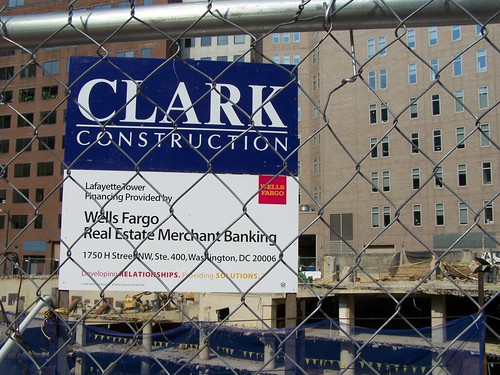
Skanska Construction SignSkansa is a Swedish firm active in constructing, financing, and owning buildings in major US real estate markets.

Foreign firms invest in the DC real estate market for many reasons, not strictly on the basis of direct economic returns. To wit, the market involved international and national developers and financiers, and their business calculations were not made strictly on the basis of local market conditions, but to park capital safely overseas, because economic returns were better than in own-country markets, for diversification, etc.

Significant foreign presence in the Central Business District real estate market reshapes the taxation of all commercial properties.  What this did though is reshape the local property tax assessment regime, so that in effect, at least within DC, most commercial real estate, regardless of location, is valued as if it could become a big office building owned by a pension fund or insurance company. This is the case whether or not most neighborhood commercial real estate markets were decidedly local, with local owners and locally-owned businesses.

And large actors trickle down and reshape "local" submarkets serving regional audiences as they expand their reach.  Increasingly, what were once "neighborhood" real estate markets like Dupont Circle, Cleveland Park, and Friendship Heights have been "reproduced" because of the presence of national and international firms ("Problematic outcomes as real estate investment trusts buy more "high street" retail real estate," 2015) like Acacia, Federal Realty, and Grosvenor--a British company for whom real estate ownership has made the family the wealthiest in Britain.

Even local submarkets (as opposed to regionally relevant submarkets) are not immune.  Plus, as larger regionally active firms run out of properties to develop in larger submarkets, they shift downward to the next ladder on the commercial district/town center scale, in the process reproducing the market conditions in those places.  Think Takoma (Rock Creek Property) or Fort Totten (JBG).

The ability to build housing and bigger buildings is another stressor on valuation.  This is further exacerbated in the smaller sub markets like Petworth, by the fact that commercially zoned property can be taller (65 feet) and mixed use with housing, so this puts property under pressure too, and because most of the neighborhood districts don't have requirements for first floor retail use, the commercial and retail nature of the districts is threatened with serious change.

Testimonies.  I testified about this for a few years running, and in 2007 was quoted in an article by Post writer Paul Schwartzman on the subject, "Feeling the Pinch Of D.C.'s Prosperity," and had a letter to the editor in response to the article, "Tax Policy Hurts D.C.'s Local Businesses."

These entries are representative of the argument:

- "Avoiding the real problem with DC's property tax assessment methodologies," 2007
- "Testimony -- Historic Neighborhood Retail Business Property Tax Relief Act," 2006
- "Forcing Displacement by the disconnection of tax assessment models from public policy goals," 2005
- "Displacement of retail businesses through increasing property tax assessments," 2005

I stopped testifying when I figured out that the City Council/City Government wasn't interested in addressing this in a systematic way, but was more enthralled about helping "legacy businesses" ("Revisiting the issue of neighborhood commercial district property tax methodologies," 2013) and failing to recognize that this was and is a systemic problem equally problematic for new and existing businesses that aren't decades old.

DC real estate promoted at MIPEM international property exhibition.  The Capitalize DC real estate promotion organization sent out a press release about how they are promoting the Greater DC real estate market at the world's leading international property marketing exhibition, called MIPEM, in Cannes, France.  From the press release:
Capitalize DC, a collaborative regional consortium formed by the Northern Virginia Association of Realtors®, Greater Capital Area Association of Realtors® and District of Columbia Association of Realtors®, will be part of the growing USA pavilion, hosted by the National Association of Realtors®, the United States' largest real estate trade organization. NAR and Capitalize DC will be among the 3,100 exhibiting companies at the 2018 event. ...

"MIPIM provides a unique opportunity to showcase local property markets on a global scale," continued Mendenhall. "While Class A asset prices in many large markets have surpassed pre-crisis levels, Realtors® in many middle- and smaller-tier markets stand to benefit from the increased interest from foreign commercial property investors. Further, the current interest in industrial and logistics properties due to the growth of online shopping, creates opportunities in markets not traditionally identified as a destination for foreign investment."

The Washington, DC /Northern Virginia/Montgomery County (MD) markets will be featured in the USA pavilion along with Arizona, Illinois, Missouri, Nevada, North Carolina, Rhode Island and Washington State, as well as other metro areas such as Beverly Hills/Greater Los Angeles, Coastal Carolina/Myrtle Beach and San Antonio. Markets participating in the USA "zone."
I guarantee you, the actors that matter already know about the value of and the opportunities within the Greater DC commercial real estate market.

And as discussed above, increased participation by national and international actors in local markets can have negative consequences, unless a city's planners and taxation officials take forward steps to mitigate them.

One more effect: the cost of property/rents for nonprofits and arts groups.  As discussed in a number of entries including "BTMFBA: the best way to ward off artist or retail displacement is to buy the building," in a highly charged real estate market, "nonmarket" actors can't compete/afford property.  The solution is community development corporations focused on buying and holding properties for these kinds of uses.

Labels: , , , , , ,

Thursday, December 28, 2017

DC United proposes moving its headquarters to Loudoun County after DC spends millions for its new DC-based stadium

There are a bunch of interesting things that are happening in the business of sports that I haven't written about such as:

-- people aren't warming to the new super hockey complex in Downtown Detroit ("Empty seats at Pistons and Wings games draw questions," Detroit News) whereas the moving of the "Washington Bullets" in the late 1990s from Suburban Maryland to DC ended up being an important signal to suburban residents about the new relevance of the center city

-- College football bowl games increasingly play to television with lesser local economic development effects ("How college football bowl game system mixes socialism, capitalism," USA Today)

-- the Carolina Panthers football team is for sale and I didn't realize that the team's creation spurred the development of "Personal seat licenses" as a form of financing ("In Charlotte, the Jerry Richardson scandal causes deeper tremors," Washington Post

-- the tax law changes reduce the benefits of "donating" to college sports programs and put an excessive income charge on highly-paid coaches ("Alabama, other top college programs will see rising costs in tax bill," USA Today)

-- on the day of the game of the upcoming Super Bowl in Minneapolis the light rail system will only be usable by people with game tickets ("Super Bowl will limit light-rail use to ticket holders on game day," Minneapolis Star-Tribune)

-- maybe that the Chargers and Rams are doing well will pay off for the teams and their moving to Los Angeles

-- Las Vegas is looking at the role of public transit as an element of game day transportation vis a vis the development of a football stadium for the team now in Oakland, the Raiders ("Officials test US public transit options for Raiders stadium," Las Vegas Review-Journal)

-- the moving to the city (Brooklyn) doesn't seem to have worked out for the New York Islanders hockey team, which is moving back to Nassau County, Long Island ("New York Islanders may be returning from city to suburbs," ABC News)

etc.

But today's article ("The numbers behind D.C. United's proposed Loudoun soccer complex") in the Washington Business Journal about the DC United soccer team") makes me realize once again that contractually, cities need to protect themselves way better when it comes to development deals for stadiums and arenas.

DC is already at a disadvantage compared to other jurisdictions because it can't do game-day taxation on players income when events are played in DC--something that most other jurisdictions do. The restriction emanates from how Congress prevents DC from taxing the in-city income of nonresidents.

Anyway, DC is spending upwards of $150 million on the stadium, for land acquisition and other costs, which is matched by the team. Additionally, the city is providing other tax breaks.

Not being a commercial tax maven, I can't begin to figure out how not having the team headquarters located in DC will reduce income taxes paid to the city, but I imagine there is some effect.

Just as I believe cities need to include transportation demand management requirements in such contracts ("Sports events and the transit city: participation in transportation demand management shouldn't be an option") it looks as if such contracts should include provisions on team headquarters and related items.

Labels: , , , , ,

Monday, July 17, 2017

Local elections in Seattle, 2017

Local elections are underway in Seattle/King County Washington. The state has mail-in ballots, and the primary election date is August 1st.  Seattle is one of the nation's leading cities--the other is San Francisco--pushing a significantly progressive political agenda.  (Cities like DC vie for a similar title, but aren't really in the same league.)

Much to the consternation of the center-right Seattle Times newspaper, the city tends to be  supportive of local taxing initiatives to support transit and other endeavors, even when such measures fail at the scale of the entire county.

A couple elections ago, Seattle switched from an nine seat at-large Council system to seven districts and two at-large seats.  Just before the switch, the city elected Kshama Sawant, affiliated with Socialist Alternative, to Council.  With the switch to districts, she was re-elected as a representative for the Capitol Hill district.

The Seattle Port Commission, which runs the airport and the seaport, is publicly elected too.

In this year's election, 21 people, including former mayor Mike McGinn, are running for mayor.  The incumbent, Ed Murray, declined to run after being accused of non-work related improprieties.

The Stranger is Seattle's leading alternative weekly (although compared to most other cities, the second alternative paper, the Seattle Weekly, holds its own).  It's endorsement articles are always a great read, as is the one for this election, "The Stranger's Endorsements for the August 1, 2017, Primary Election."

Reading their endorsements of Jon Grant for an at-large seat and Cary Moon for Mayor make me feel conservative, although I have to admit that my progressivism is mediated by pragmatism and acceptance of the status quo shaped by the Growth Machine/neoliberalism.

Grant is affiliated with Socialist Alternative.  Moon co-wrote a series of articles in The Stranger on Seattle's housing crisis of high velocity in pricing appreciation, and the loss of lower priced housing to redevelopment:

-- "Hot Money and Seattle's Growing Housing Crisis: Part One"
-- "Parasitical Finance and Seattle's Growing Housing Crisis: Part Two"
-- "Why NIMBYs And Their Haters Can't Offer a Deep Solution to Seattle's Growing Housing Crisis: Part Three
-- "Solutions to Seattle's Growing Housing Crisis: Part Four"

It would be unheard of for a candidate for election in DC to produce the equivalent.

The Seattle Times concurs that the field of Mayoral candidates is surprisingly deep ("Election shocker: This is the best field of Seattle mayoral candidates in decades." While the Municipal League didn't rank highest the most radical candidates, the columnist Danny Westneat called Cary Moon and Nikkita Oliver the smartest. From the article:
The Municipal League of King County has been using citizen volunteers to interview and rate candidates for a century. This year’s Seattle mayoral field got by far the highest rankings in the past 50 years (that’s as far back as I looked).

The Muni League approaches it as a job interview: Do the candidates have the background and the skills to be mayor? This time, three earned the top grade of “outstanding.”

No Seattle mayoral field going back to 1977 has had more than one “outstanding” candidate. And in four elections — 2001, 1989, 1985 and 1981 — the medal-deserving volunteers couldn’t find a single candidate that earned an A grade.

The A grades this time went to former state Rep. Jessyn Farrell, state Sen. Bob Hasegawa and former U.S. Attorney Jenny Durkan. ...

I haven’t even mentioned the two smartest candidates. Urban planner Cary Moon and educator Nikkita Oliver often drive the mayoral debates with their ideas. Neither has much experience for the job, especially on the managerial side, yet both still earned “very good” ratings from the Muni League.
An interesting tax measure on the ballot applies to King County's entirety, not just Seattle, King County Proposition No. 1 (Sales Tax for Cultural Access Program). The proposed sales tax increase would fund (1) cultural programming in schools; (2) transportation to cultural programs for public school students; and (3) an expansion of programming by cultural organizations to serve underreached, low income, populations.

Labels: , , , ,

Thursday, June 08, 2017

Thinking narrowly, not bigly: San Diego's tourism tax revenue stream debacle

Tourism taxes are a tried and true revenue source for cities to pay for stadiums and convention facilities, as well as tourism marketing efforts and visitor centers, and landing large conventions and meetings.

The taxes are usually a combination of fees on hotel rooms and rental cars primarily, and sometimes with an add-on meals tax. 

Often such fees are used to help fund large hotels proximate to a convention center, to serve as "the headquarters" for meetings.  It's not uncommon for such hotels to lose money ("City-owned Hilton Baltimore lost $5.5 million in 2016," Baltimore Business Journal), which means they require ongoing subsidy.

Local officials like tourism taxes because tourists don't vote.  But the hotel and restaurant community often has mixed feelings because they see "too high" taxes as a discouragement to potential visitors and making it more difficult to land conventions.

Most communities don't require that such taxes be approved by the citizens in a referendum, because for the most part, such taxes aren't paid by the residents (excepting meals taxes, and local use of rental cars).  

San Diego does require such votes, and there has been a lot of controversy, for years, over increasing the hotel tax, and what it should be used for.  More recently, citizens voted against funding a combined new stadium for the San Diego Chargers football team and an expanded convention center ("Stadium measures lose badly," San Diego Union-Tribune).

It was an ersatz proposal because the convention center element was satisficed in favor of the stadium.

With the defeat of that proposal, the city's convention center is proposing a referendum on funding improvements and an expansion.  But Balboa Park Heritage Association--Balboa Park is an awesome multi-facility park and cultural destination--plans to put forth a competing proposal. (There are also other proposals for the stadium, involving a local university, soccer interests, and others.)

The San Diego Union-Tribune's headline, "Convention center or Balboa Park: Where should tourist taxes go?," puts it best, "where should tourist taxes go?" except that I believe both the Convention Center and Balboa Park are getting it wrong.

It's not either/or: San Diego needs a comprehensive tourism management plan. The issue is something I bring up a lot in DC, that there needs to be better "tourism management and development planning."

Cities where tourism comprises a significant segment of the local economy are irresponsible if they don't have a tourism element in Comprehensive/Master Plans.  These plans should discuss and make recommendations about how to use the tourism tax revenue stream "more broadly" so that a wide range of cultural destinations and attractions are supported, serving more segments of the local community.

Charleston, SC is the best example nationally of a Tourism Management Plan although separately, the city's historic preservation program and urban design initiatives have broadened the benefits of tourism for the wider community.

"We are all destination managers now" | c. 2005.  In fact, one of my earliest posts from 2005, "Town-City branding or 'We are all destination managers now'," makes the point that "commercial district revitalization" professionals and stakeholders need to think of what they are doing more broadly, that they need to think of themselves as "destination managers," and be less parochial.

Relatedly, by making places great for residents, they also become attractive for visitors.

Clearly, given the competing proposals San Diego (and DC) needs a broader plan for how to use tourism taxes. 

Metropolitan approaches to funding cultural facilities are an example of how to do this.  While not hotel taxes per se, Denver and Allegheny County, Pennsylvania provide good examples of a comprehensive broader approach. 

Denver has a regional sales tax to fund cultural assets mostly located in Denver termed the Scientific and Cultural Facilities District ("Denver metro’s arts and cultural tax, 4B, passes easily, extends to 2030," Denver Post).

The Regional Asset District in Allegheny County funds cultural institutions across the entire county, recognizing that the bulk of the area's cultural institutions are based in Pittsburgh, serving the region, but had only been funded by the City of Pittsburgh, and this was unsustainable. 

Other counties across the country has a similar approach to Allegheny's, such as Salt Lake County's Zoo, Arts & Parks (ZAP) Tax and the Great Parks of Hamilton County park tax district in Ohio.

Public Improvement Districts are another tool for sub-districts in a community.  Colorado also allows the creation of add on sales taxes for "micro-districts" to fund local urban design and other improvements such as for the Larimer Square district of Denver.

Labels: , , , , ,

Thursday, May 01, 2014

Multinational corporate tax management and "localness"

Recently there were Congressional hearings about how Caterpillar Corporation negotiated a special tax relationship with Switzerland, and created a paper company domiciled there for the purpose of managing transactions for the sale of replacement parts ("Caterpillar Escaped $2.4 Billion Tax With Swiss Maneuver ," Bloomberg).  While the transactions were mostly conducted in the US, for the purpose of taxes, they ran through Switzerland, at a tax rate less than one-fifth of the rate that would be in the US.

And a few weeks ago, it was suggested that Walgreen's, the nation's largest pharmacy chain, which a couple years ago merged with a British company, Boots, should relocate its corporate headquarters to Europe, to reduce its taxes.  See "Should Walgreen Move to Europe for Leaner  Taxes?" from Businessweek Magazine and "If  Walgreen Co. moves its HQ to Europe, blame Washington's tax failure" from the Chicago Tribune (Walgreen's is based in Greater Chicago). From the Tribune article:
A group of shareholders reportedly is pressuring the giant retail chain for a move to the land of cuckoo clocks. The reason: lower taxes. Much lower taxes:
If Walgreen changes its legal domicile to Switzerland, where it recently acquired a stake in European drugstore chain Alliance Boots, the company could save big bucks on its corporate income-tax bill. The effective U.S. income-tax rate for Walgreen, according to analysts at Swiss Bank UBS: 37 percent. For Alliance Boots: about 20 percent.

We hope Walgreen doesn't relocate. Would company executives be smart to do so in order to best serve their shareholders? Hmm. We'd rather not say. So we'll respond to that question with another, broader but similarly urgent question:

How many companies have to turn refugee before Congress and the White House stop their bipartisan talking — but only talking — about the need to reform the federal tax code in general, and the corporate income tax in particular?
This week, Pfizer, a pharmaceutical firm based in New Jersey, announced that it will merge with a British corporation and will move its domicile to the UK, to reduce its corporate taxes ("Pfizer's Move Poses Challenge. Here's a Solution," New York Times) while last week Starbucks announced it will move its European headquarters to the UK, because of new lower corporate tax rates ("Starbucks moves Europe HQ to London," Financial Times).

Apparently the effective US corporate tax rate is about 27% while in Europe it is 21% and the UK has just announced a tax cut so that the UK corporate tax rate will be about 20%.

The NYT article suggests shifting taxes from corporations to shareholders.  From the article:
It’s counterintuitive, but Congress could avoid this problem by abolishing the tax on corporations’ profits and much more aggressively taxing their American shareholders — who are unlikely to flee to London along with Pfizer’s incorporation documents.
I don't know what is a "fair" corporate tax rate, but as long as corporations can play one nation against another, the likely scenario is a race to the bottom.

It's a long way from the "good corporate citizen" discussed in the recent Urbanophile post ("Portrait of a Change Agent") about J. Irwin Miller, a banker and leader of Cummins Engine, which is still based in the comparatively small town of Columbus, Indiana and the various "corporate citizenship" initiatives he undertook which have made the city a great success or how SC Johnson in Racine, Wisconsin is restoring its old research center, designed by Frank Lloyd Wright, and how it has exhibit facilities and gives tours of its campus ("A Corporate Paean to Frank Lloyd Wright," New York Times).

Labels: , , ,

Thursday, March 13, 2014

DC commercial real estate news

Aerial photo of Downtown DC with the Rosslyn-Ballston corridor in Arlington, Virginia in the middle left upper section of the photo.

1.  Long term, the market for commercial office space is likely to decline because of the turmoil in the law firm market as firms merge, go bankrupt, and close.  See "Shrinking law firms leave gap in DC real estate market" from the Washington Post.

This could lead to a decline in rent prices, which would allow a broader range of tenants being able to rent space in the Central Business District, rather than the market being dominated by those firms most likely to bid up space seen as valuable because of its proximity to federal government agencies and offices.

One example of this potential trend is how the Washington Design Center is moving to a Downtown DC location on 14th Street NW, which not too long ago, would have been out of the question.  See "The Washington Design Center is Moving to Franklin Court" from the DC by Design blog.

2.  On the other hand, after criticism of how the DC Office of Tax and Revenue handled commercial property tax assessments and appeals and an audit, the agency is basing property assessments on market value primarily, rather than tenancy, vacancy and other criteria.  See "D.C. property owners facing sticker shock over new assessment method" from the Washington Business Journal.

From the article:
Under a system that has been rife with controversy and rampant appeals, those assessors embarked on an annual effort to evaluate buildings’ rent rolls, occupancy rates and other key data to come up with an assessable value for those properties. But starting in 2015, the District will switch to a new method based on market value, putting less emphasis on what’s going on inside those buildings and more on how similar properties are valued on the open market, bought and sold by deep-pocketed investors.

The switch comes at a tense time for many D.C. landlords, as I’ve reported on numerous times over the past year, since federal agencies and private companies alike are significantly reducing the amount of space they lease in the District. That has forced many landlords to offer free rent, tenant improvement costs and other amenities to get and keep new tenants, amenities the new assessment method will not be able to take into account.
It will be interesting to see what happens with this change.

It makes sense to systematize the process for valuing properties rather than having a more idiosyncratic process (e.g., see the report from 2012, EVALUATION OF THE DISTRICT'S MANAGEMENT AND VALUATION OF COMMERCIAL REAL PROPERTY ASSESSMENTS, from the DC Inspector General's Office).

At the same time, with increased competition from Tysons Corner because of its expanded access to the Metrorail system via the soon to be opened Silver Line, and the decline in demand from law firms, except for foreign participation in the market ("Foreign Investors Snap Up D.C. Real Estate," WAMU Radio), which is likely to remain high because of comparatively higher turmoil in their home markets, it seems like property values are likely to decline or stabilize in DC's Central Business District.

Labels: , , ,

Wednesday, July 03, 2013

Yes, much of DC's commercial real estate market is comprised of national and international actors

So the Washington Post reports, in "Foreign investors snap up Washington real estate at an accelerating clip." From the article:

Rather than waning as sequestration cuts began to hit Washington in March, interest from abroad appears to be strengthening. Foreign sales account for 75 percent of all investments in Washington commercial real estate this year, after not topping 30 percent in the previous three years and registering just 1 percent in 2006. On average, foreign firms accounted for 17 percent of all sales since 2001.

Companies from countries such as Korea, China, Germany and Saudi Arabia have been scouring the Washington market for fully leased downtown office buildings, said Bill Prutting, managing director at Jones Lang LaSalle.

In years past, when a building went up for sale, “the investor used to be the local family or the domestic pension fund,” Prutting said. “Now, we have a lot more exotic investors from overseas who are coming into especially our market and other markets as well.”

I have made this point for awhile, most recently here, "Revisiting the issue of neighborhood commercial district tax methodologies."

Like any city, DC is actually comprised of a variety of "submarkets" like Downtown or Takoma or Fort Totten or H Street NE, Capitol Hill, etc.

The reason the nature of the market is important is that the participation of global actors reshapes the market for commercial property across the city, even in submarkets that don't normally have international or national actors.

And if they buy in part on the basis of other criteria (such as a safe haven for investment vis-a-vis their home country), they bid higher and the prices rise beyond the normal vicissitudes of the market.  Which is why the "lede" of the story misses the point:

Foreign investors are pouring money into downtown D.C. office buildings even as many properties in the Washington suburbs struggle with stagnant leasing and growing vacancy.

Of course, foreign investors are buying properties in DC and not the suburbs, DC's central business district is recognized within the global market, while the suburban submarkets are not (Grosvenor, a British company, is active in the suburbs and likely Tysons will become a submarket with increasing global interest).

The submarkets comprising the Central Business District are decidedly global real estate markets, with nationally and internationally active developers, financing, and property owners.

Typically, the non-CBD markets in the city have been very much local, with small properties, local/regional owners with ties to the city, local developers, local tenants, and local patrons.

But because of the participation of global actors and how the city doesn't weight "global" vs. "local" property markets in terms of property tax assessment methods, prices in the non-global submarkets are higher than they would be on the basis of what the properties are worth as going businesses.

Left: a building up for lease on the main commercial street in Downtown Staunton, Virginia has an asking price of $10/s.f.  Not one building on this stretch of Beverley Street is substandard.  An equivalent price in a DC neighborhood commercial district would be $35 or more/s.f., for buildings that may in fact require many thousands of dollars for rehab, which the owner isn't usually willing to pay for.

This is why a lot of the property has been vacant or in sub-optimal use (storefront churches, office, etc.), because it is overvalued tax-wise compared to the revenue prospects for the space.

But now there is a second stage of development and change for submarkets in the city that hadn't before attracted global/national players.

As the Central Business District is built out, in order to stay active, some developers are taking on projects in secondary submarkets in the city, especially at sites near subway stations, mostly residential multiunit housing, often with retail on the ground floor, so it qualifies as mixed use.  Typically these locations aren't attractive for office use.

Typically the financing for these new projects in these districts is national.  For example, Pritzker family interests financed the construction of the Monroe and Market development in Brookland, adjacent to the subway station there as well as to the Catholic University of America campus.

And that will end up reshaping these secondary submarkets in other ways, because the retail space in these projects ends up getting plugged into national credit markets, likely this will lead to more chain and franchise outlets, and fewer independents.

So once your central business district is part of the global real estate market, expect other changes in other submarkets.  Better yet, anticipate the changes and take steps to ward off the negatives.

Labels: , , , , ,

Thursday, May 23, 2013

Revisiting the issue of neighborhood commercial district property tax methodologies

According to a post on the Chevy Chase listserv (I don't subscribe but it was re-posted to the Takoma listserv--the entry is reprinted at the end of this post), Councilmember Tommy Wells testified to the City Tax Revision Commission, suggesting that a commercial property tax discount be offered to long time "independent" retailers.

It's a worthwhile gesture and good and populist to suggest providing tax discounts to "long time" "independent" retailers, but such an initiative misses the most important point, which is that the commercial property tax assessment methodology that the city employs "overprices" neighborhood commercial real estate more generally.

This matters to new businesses as much as it does old ones, and is why for decades neighborhood commercial districts have lagged in comparison to Downtown and regional districts like Georgetown and Dupont Circle.

Skanska Construction SignHad the proposal been outlined in this manner, likely Commission members wouldn't have been able to express as much skepticism, and pointed commentary about some of the more arbitrary elements of the proposal.

It happens that I used to testify about commercial property tax assessment methodologies in the city and the negative impact on neighborhood commercial districts quite regularly from say 2005-2007 (and was quoted in an article by Post writer Paul Schwartzman on the subject, "Feeling the Pinch Of D.C.'s Prosperity," and had a letter to the editor in response to the article, "Tax Policy Hurts D.C.'s Local Businesses") but given that the points I made were systematically ignored by CM Evans and then Chairman Cropp, I stopped. These entries are representative of the argument:

- Avoiding the real problem with DC's property tax assessment methodologies
- Testimony -- Historic Neighborhood Retail Business Property Tax Relief Act
- Forcing Displacement by the disconnection of tax assessment models from public policy goals
- Displacement of retail businesses through increasing property tax assessments

Office building under construction, 17th and H Streets NWThe basic problem (speaking of "Growth Machine" theory) is that the real estate market in the Central Business District is not a local market, but a market comprised of national and international actors as developers, financiers, and owners. This tends to shape the method for how commercial property is valued and assessed across the entire city, not just downtown.

Some national actors get involved in other submarkets where they might not ordinarily (e.g., Federal Realty owns property in Dupont Circle and Cleveland Park, among other places) which raises prices, but generally, all of the commercial property tends to be valued as if it could be a downtown office building owned by a German pension fund. This makes the property more pricey.

So in DC, even in lagging areas, the minimum asking price for retail space in a neighborhood commercial district is at least $35/s.f., and often for a building that needs lots of rehab, which the tenant is expected to pay for as well.

 By comparison, rents in thriving traditional commercial districts in places like Carytown in Richmond, Downtown Frederick, or Hampden in Baltimore is $25/s.f. or less. (In lagging commercial districts in other cities, including Richmond and Philadelphia, rent can be closer to $15/s.f., which is what touches off innovation in those places.)

In short, it's all about the rents, which are set in large part by the carrying costs of the building. The rents metric is explained in this entry about Cleveland Park:

- Commercial retail rents #2, which was a follow up to this post, Cleveland Park Retail: My off-hand evaluation, the rents are too high.

But politics is more about helping individuals and using individual stories to justify a particular policy, rather than to systematically assess a problem and figure out how to address it systemically. I guess I will submit some testimony to the Tax Revision Commission...

----------
My letter in the Post from July 25, 2007

Tax Policy Hurts D.C.'s Local Businesses, Richard Layman

A July 20 Metro Article ["Feeling the Pinch of D.C.'s Prosperity: Small Businesses Cry Out for Relief From Rapid Rise in Property Taxes"] inadequately explained why tax assessments are rising for small commercial property owners in the District.

Regardless of buildings' locations and use, the D.C. Office of Tax and Revenue values commercial buildings as if they could be converted into downtown office buildings. If the purpose is to turn the entire city over to office buildings and retail chains, then this property tax assessment methodology is working.

The market for downtown property is not local; it involves national and international developers, lenders, and portfolio investors. The market for small-footprint buildings in neighborhood commercial districts is local--in terms of property owners, investors, tenants, sales potential and rents. The solution is simple: differentiated tax assessment methods.

The legislative focus on property tax abatements or tax caps fails to address this fact.

As a result, locally owned businesses will continue to close or relocate to the suburbs, while more and more of the retail identity and uniqueness of the District is lost and the city's retail landscape becomes reshaped into yet another mall, albeit outdoors, featuring national brands.

----------
The Chevy Chase listserv piece

From: Edward Cowan
To: chevychasecommunity listserv@ yahoogroups. com
Sent: Tuesday, May 21, 2013 9:12 PM
Subject: [ChevyChase] Neigborhood Tax Incentives Pose Issues

Council member Tommy Wells (Ward 6) encouraged the Tax Revision Commission on Monday to recommend the adoption of reduced real property taxes for independent, neighborhood businesses, especially in turnaround neighborhoods.

Wells announced last weekend that he will run for mayor in the 2014 Democratic primary. That made him the second declared candidate from the council' s ranks, in addition to Muriel Bowser (Ward 4).

Arguing for tax discrimination in favor of locally owned, nonchain businesses, Wells put this rhetorical question to the 11-member commission: should a smaller neighborhood- based business pay the same tax rate as retail on K Street downtown?

Acknowledging that DC law now levies a lower rate on the >first $3 million of assessed value of commercial properties, Wells urged the commission to favor an even lower tax for "neighborhood- based retail business and job creators."Wells said that commercial renters, not the property owners, effectively pay the property tax under standard lease terms.

This populist tilt sounded like a harbinger of a campaign theme.

Real Property Taxes Now

Nonresidential property is taxed now at $1.65 per $100 of assessed valuation (1.65%) up to $3 million of assessed value, and at $1.85 (1.85%) on value above $3 million.

Residential property is taxed at $0.85 (less than 1 percent) for each $100 of assessed value after the homestead exemption, 69,350 in 2013, has been subtracted from assessed value.

The effect of the exemption is to make effective tax rates (taxes divided by assessed value) vary inversely with the value of the property--a form of "progressive" taxation.

Whether such classification distinction between categories of property is a good idea was the topic of expert testimony given later in Monday's session. "I'm not wild about classification," said Daphne A. Kenyon, an expert witness from Windham, NH.

She observed that taxing commercial property at a higher >rate "can drive business away."That elicited a rebuttal from Ed Lazere, who heads the DC Fiscal Policy Institute. He argued that DC business has thrived. Lazere generally opposes tax relief for business and upper-income people.

Commissioners Question Disparate Treatment

Wells ran into resistance from economists on the commission, notably David Brunori, a research professor at George Washington University. He invoked the bedrock principle of public finance that the primary purpose of taxes is to raise necessary revenue--and to raise it as efficiently as possible, causing the fewest distortions in the economy.

Fitzroy Lee, who heads the District' s Office of Revenue Analysis, also asked Wells about inequities that arise from tax preferences, that is taxing similarly valued properties, sometimes side-by-side, differently. Taxing them roughly equally is called "horizontal equity," and it is deemed a virtue among public finance experts.

When Brunori asked Wells whether his strategy was to have government "pick winners and losers,"� Wells avoided a direct yes-no answer.

Later, as Brunori pressed him on a technical tax question, he replied--dismissively, it seemed, "As I said, I'm a social worker, not an economist."

Cites NoMa as Success

In arguing for the efficacy of tax incentives, Wells cited tax concessions offered under former mayor Anthony Williams (who heads the Tax Revision Commission and presided on Monday) for the development of the bustling NoMa neighborhood north of Union Station.

He said tax concessions might be time limited, and he acknowledged that sometimes tough choices presented themselves, such as denying a break to a liquor store and awarding one to a grocery, when both are locally owned. Wells said that he thought incentives might be offered not only in recovering neighborhoods, such as H Street NE, but even in "built- out" neighborhoods, such as Ward 3." He did not address the fairness of giving a tax concession to a new enterprise which is challenging one that is well established and doesn't qualify for preferential treatment.

Wells opened his presentation by recounting in glowing terms the commercial renaissance of H Street NE in the past few years. He did not mention that the new "corner markets, fitness studios, pharmacies, restaurants and hardware and furniture stores" that have "created nearly 1,000 jobs" and made the neighborhood "walkable" had sprung up without the tax incentive he advocated.

However, his staff later pointed out that the District government had given "grants and loans" to H Street enterprises, assessment reductions and extensions of time to pay taxes.

Two Points of View

Wells argued that even in "built- out neighborhoods, ">encouraging local retail of necessary goods and services--groceries , hardware, dry cleaning, pharmacies-- serves the whole city by diminishing the need for residents to use their cars to do their shopping. In this he aligned himself with the Administration, which has stressed walking and bicycles over cars--and whose leader, Mayor Vincent Gray, may run against Wells and Bowser in the 2014 primary.

As several questions by commission members indicated, economists who specialize in public finance shy away from using the tax code for "targeted"; social and economic purposes, what conservatives disapprovingly call "social engineering. "One reason is the desirability of simplicity. Keeping the tax code relatively simple makes it easier for people to pay their taxes without hiring an expert, and reduces friction between taxpayers and the tax collection authority.

Other reasons include treating similarly situated taxpayers equally, avoiding situations-- such as applications for preferences and extensions of them--that invite corruption. A third argument against "targeted" preferences is that they may outlive the facts that justified awarding them.

In addition to avoiding tax complexity, some economists favor subsidies that the legislature must vote for annually, which keeps debate alive and audible. Conversely, beneficiaries favor tax breaks that are embedded in the law.

This is one of the issues the commission is expected to address in its report, due by the end of the year: whether the District's present taxes are tilted against business and discourage new enterprises from coming to the District.

Edward Cowan
Editor, Reports to DC Voters

Labels: , , , , ,