Rebuilding Place in the Urban Space

"A community’s physical form, rather than its land uses, is its most intrinsic and enduring characteristic." [Katz, EPA] This blog focuses on place and placemaking and all that makes it work--historic preservation, urban design, transportation, asset-based community development, arts & cultural development, commercial district revitalization, tourism & destination development, and quality of life advocacy--along with doses of civic engagement and good governance watchdogging.

Monday, March 16, 2026

Austerity versus rot: Government capacity

The austerity neoliberal policy introduced into the US by Ronald Reagan took a long while to show serious repercussions.  I argued that impact of reducing government workers and capacity didn't show so much because the US had overinvested in capacity previously.

The failure of FEMA in dealing with the post-Katrina aftermath in New Orleans under George W. Bush was to me, the first glaring example of the impact of austerity.  Although this was accentuated by the agency having poor leadership as well.  (Since then FEMA has performed badly under Republican administrations, specifically Trump, "A Post-Katrina Law Guards FEMA Resources. Why Hasn’t It Stopped Noem?," New York Times.)

Writing in The Atlantic, "U.S. Capabilities Are Showing Signs of Rot," military historian Phillips O'Brien makes the point that firing capable officials, and installing ideologically acceptable but less skilled people in their place creates "Rot."  And that Rot is now very apparent in the US military, as shown by the performance in the current War against Iran.

Also in DHS under Noem, ICE ("Leaked Documents Show a Border Patrol Remade in the Image of Gregory Bovino," American Prospect), and the FBI, "How Kash Patel Wrecked FBI’s Ability to Stop an Espionage Attack," New Republic, among others. Tulsi Gabbard as Director of National Intelligence during war time is another example of rot.  Richard Grenell at the Kennedy Center, most of the Secretaries in the Cabinet, etc.

The first Trump Administration's response to covid is another example of rot.  This rot has been deepened by appointing anti-medicine people in high positions at the FDA and CDC, and with RFK Jr.--who believes his voice dysphonia was caused by the flu vaccine--the Secretary of HHS!

WRT to war, sure the US and Israel can pummel Iran at will, but expending million dollar missiles to shoot down $50,000 drones is a cost-benefit ratio that is unsustainable.  Trump, who treats Ukraine like s***, has reached out to them for technical advice on dealing with drones.  In effect, Ukraine has provided more aid in dollar value to the US than Trump's Administration has provided to Ukraine as it fights Russia's invasion of the country.  (Fortunately, the US still shares intelligence with Iran.  But in general it does everything in its power to promote Russia.)

From the article:

On multiple occasions after President Trump launched a massive air campaign against Iran this past weekend, retaliatory attacks by simply constructed Iranian drones have penetrated American defenses with serious results. For example, at least six U.S. soldiers died, and others were wounded, in an Iranian strike Sunday on a command facility in Kuwait. CNN reported that the Americans received no warning of the incoming drone. According to CBS News, the fortifications around the facility protected it from car bombs but not from a direct overhead strike. “We basically had no drone defeat capability,” an unnamed military official told the network.

... When a complex system starts to decay, the first signs are usually subtle. In the third century, after the Roman empire had reached its geographic maximum, literacy began to decline across Roman society. Education levels fell not only among soldiers, but among officers, aristocrats, and even emperors. The Roman army still looked formidable for years afterward. It had good equipment and could march well. Yet it was no longer as advanced relative to Rome’s enemies as it had once been. It fought as hard as ever, but less effectively.

... The U.S. military’s supremacy over foreign rivals is built on intensive training and the manipulation of advanced technology. By contrast, Hegseth has been stressing lethality and a warrior ethos instead of learning and reflection, to the point of blocking U.S. military personnel from taking courses at the most elite American universities. Yet the events of the past week underscore how shows of force alone may not defeat even militarily inferior enemies.

In Bahrain, a lone Iranian drone penetrated the headquarters of the U.S. Fifth Fleet, which oversees 2.5 million square miles of the world’s oceans. The incoming weapon destroyed an AN/TPS-59 radar unit intended to provide 360-degree air surveillance for U.S. forces. In a moment, Iranian equipment that cost perhaps $30,000 devastated a piece of U.S. military hardware estimated to be worth tens of millions of dollars.

Another term for this is "capital shallowing" or disinvestment.  It's the opposite of "capital deepening" or investing ("Capital shallowing: the effect of disinvestment on government functioning").

Labels: , , , , , , , ,

Thursday, December 05, 2024

Brand America 2025

During the first Trump Administration, I wrote to Simon Anholt, the author of Brand America: Mother of All Brands, stating that Trump's brand for America was:

Can't Do.  Won't Do. You Do.  Fuck You.

It will get worse this go around.

An interesting story in the Financial Times, "What makes the US truly exceptional: Are American pathologies the necessary price of economic dynamism?."  From the article:

It is the best of countries, it is the worst of countries, or at least of the high-income ones. The US stands out for its prosperity and its brutality. 

This is how I have felt about it since I visited in 1966 and lived there throughout the 1970s. The sustained prosperity of the US is astounding. A few western countries have even higher real incomes per head: Switzerland is one. But real GDP per head in the larger high-income countries is below the US average. 

... Not surprisingly, the US economy also remains far more innovative than other large high-income economies. Just look at its leading companies. These are not only far more valuable than those in Europe, but far more concentrated in the digital economy... 

... The US then is an economic powerhouse, so much so that it has persistently run a large deficit in its capital account. Donald Trump protests. Yet this is a powerful vote of confidence. 

... So, how can such an economic marvel also be “the worst of countries”? Well, its homicide rate of 6.8 per 100,000 inhabitants in 2021 was almost six times as high as that of the UK and 30 times that of Japan. 

... More broadly, what does US prosperity mean when combined with such potent indicators of low welfare? These outcomes are the result of high inequality, poor personal choices and crazy social ones. Some 400mn guns are apparently in circulation. This surely is insane. 

... Then there is a related question, which is whether the relatively high inequality of the US and the insecurity of those in the bottom and middle of the income distribution inevitably lead to what I called “pluto-populism” in 2006: the political marriage of the ultra-rich, seeking deregulation and low taxes, with the insecure and angry middle and lower middle, seeking people to blame for what is going wrong for them. If so, what made the US dynamic, at least in this age of deindustrialisation and unbridled finance, led to the rise of Trump and so to a shift to a dangerous new demagogic autocracy. A big question for non-Americans, notably Europeans, is whether these pathologies are the necessary price of economic dynamism? Logically, it is not clear why an innovative economy cannot be combined with a more harmonious and healthier society. Denmark would suggest so. One might hope that the scale of the US market, its relatively light regulation, the quality of its science and its attractions to high-quality immigrants are the explanations. But there is this lingering fear that the technologically dynamic society Draghi and other Europeans now seek might require the rugged, nay dog-eats-dog, individualism of the US. It is a sobering possibility.

FWIW, I don't think pathology is necessary to economic dynamism.  We have a super conflicting element in American society, rank individualism ("Toward the Land of Self-Defeat," New York Times) versus a more communitarian approach.

But individualism is the side for people who want it all, don't want to share, don't believe in mutually beneficial outcomes.  And too much has changed in the economy, from neoliberalism to financialization, a winner take all economy, oligopoly, and the belief by Republicans that taxes are bad.

This extends to the social sphere by denying the value of the safety net, government action of any kind, building the wealth of of the nation by investing in people, etc.

It was pointed out that Reagan's plan was a form of austerity comparable to that of UK's Tories.  For a couple decades, because the US had previously overinvested in government and public goods, that could be withstanded.

It ended with the multiple failures of the Bush Administration.

It's amazing that the Trump posse is so focused on the destruction of America, not building its public investment ("Capital shallowing: the effect of disinvestment on government functioning").

We're in for it.

Labels: , , , , , , , ,

Saturday, August 19, 2023

Capital shallowing: the effect of disinvestment on government functioning

Is a term that I am sad to say that I haven't come across.  (Although I have seen the term "capital deepening" applied to the increased income of neighborhoods as demographics change and the neighborhood becomes more attractive at the scale of the metropolitan residential landscape.)

It has so much explanatory power.

It's used in a Financial Times article about the National Health Service in Britain, how with decreased funding and investment, the amount of capital to support each worker, and each facility, declines in systematic ways that often reduce the ability to provide proper care ("NHS capital investment cuts leave England’s hospitals crumbling").

The article argues that while the facilities are declining and the waitlists lengthening, care is still okay.

In the basement pharmacy at St Mary’s Hospital in London, part of the world-renowned Imperial College Healthcare NHS Trust, senior pharmacist Michele Garwood has placed plastic trays beneath the ceiling in an attempt to protect her stock of medicines from regular flooding. 

Elsewhere, on Albert ward, one of five lavatories has been out of use for three months after a hole opened up in the floor, exposing it to the car park below, and rotted floor joists in patient bays, temporarily taped over, represent a constant trip hazard. 

We “still provide the best care we can” but some patients are so horrified by their surroundings that they discharge themselves, said matron Marta Calvo Hernandez. St Mary’s is one example of how a longstanding lack of capital spending is being felt across the NHS. The service is struggling with an accumulated maintenance backlog estimated to be worth more than £10bn, the highest since records began. 

Stephen Rocks, an economist with the Health Foundation, a research organisation, said there had been “a very sustained under-investment in capital” over the austerity years of the 2010s, which had “left the NHS with insufficient capital investment to deliver the care patients need”.  

Rocks suggested this was part of the reason that a growth in staffing levels in the health service did not seem to have translated into a corresponding increase in activity. “We’ve seen a ‘capital shallowing’, with less capital per worker, and that does have a very direct read across to productivity,” he said. 

As a term, apparently it was coined in development economics, making the point that as countries grow in population, there is less money invested in per capita ("Population Pressures, Saving, and Investment in the Third World: Some Puzzles," Economic Development and Cultural Change, 1988).

I wish I had known this concept earlier, because it explains points I've made in various areas.

First, the impact of neoliberal induced disinvestment in government--the US could "slide" for a long time with denigration and disinvestment in government because in the decades before it overinvested. 

But the failures with FEMA and disaster response after Hurricane Katrina and under Trump with Puerto Rico and Houston are a good example.  But I don't know if the failure of the Army Corps of Engineers and levees was about capital shallowing or just politics, failure to adequately address risk, budget shortfalls, etc.

And the failure of the Trump Administration to properly respond to covid.  And the serious problems of the US public health infrastructure to respond to covid after decades of declining budgets ("COVID-19 and Underinvestment in the Public Health Infrastructure of the United States," Milbank Quarterly, 2020).

Of course, the Conservative Party austerity agenda in the UK for the last ten years has had the same kind of debilitating effect ("Austerity urbanism in England: the 'regressive redistribution' of local government services and the impact on the poor and marginalised," Environment and Planning A, 2017).  With covid, policing, transit, health care as mentioned above, care for the aging, defunding of local government, parks, libraries, etc.

Second, with the tax cutting fervor in growing places like Utah--"let's share the benefits of growth"--when growth imposes more costs, not fewer, and by cutting taxes you have less revenue to invest, or a capital shallowing ("A Robust Economy, State of Utah press release).

A third example would be the impact on local governments of declining budgets.  This has been particularly pronounced in Toronto, where the previous mayor refused to raise taxes beyond the inflation rate, even though costs increased at a greater percentage than inflation, with serious negative impact on the quality of municipal services ("Brutal performance art criticism of Toronto's Mayor, John Tory, and his "austerity" agenda").

It can be difficult to separate the effects of neoliberalism, say with the water quality failures in the UK ("Water companies are playing dirty over sewage. That’s why 20 million of us are taking them to court" Guardian) from capital shallowing--the budget of the UK Department of Environment is only £11.47 million FOR THE ENTIRE COUNTRY--and capital shallowing.  

I think they are mutually reinforcing, especially when it comes to "advanced economies" as opposed to developing economies for which the concept was coined.

Labels: , , , , , , , ,

Thursday, July 11, 2019

Taxes as an investment concept: funding public goods versus tax reduction

I've been meaning to write about tax policy because there has been a fair amount of writing about the 2017 tax cuts, and the benefits mostly being directed to corporations and the extremely wealthy, and the purported big rise in economic growth that proponents said would come about because the changes hasn't happened.

-- "A New Congressional Study Finds Little Economic Benefit From 2017 Tax Cuts," Tax Policy Center

A big thread in neoliberal policy is reducing the size of government, privatizing government functions, and reducing taxes.

At the same time, the counter argument is that collective action and providing public goods requires a reasonable rate of taxation, and that lower taxation comes at the cost of investing in infrastructure and other public goods.

1. One example that comes to mind to me is how Norway and the UK took oppositional actions in response to the new revenues they received from oil production in the North Sea.

Norway didn't cut taxes, and retained ownership of the resource, directing royalty revenues to a state investment corporation, which has invested in various projects, increasing the return on investment in multiple ways.

The UK used the new revenues to justify tax cuts for the wealthy, did not retain ownership interests in the resource, and reduced corporate tax rates as well.  And while it isn't the only reason that the UK is seriously challenged financially and lacks the money to invest in revitalization and other government functions, it is a good example of how short term thinking has deleterious consequences in the long term.

-- "Did the U.K. Miss Out on £400 Billion Worth of Oil Revenue? ," Resource Extraction
-- "Why UK's oil and gas revenues are dwarfed by Norway's," Business for Scotland

2.  I have been thinking about the tax cuts issue in terms of positive return on investment.  There is a lot of discussion about how the US is running higher deficits, even though the economy is growing relatively well, because of the tax cuts, and how this is counter to general expectation, but also bad policy and bad practice.  That today's deficits are being financed by future generations.

-- "Robert J. Samuelson: Trump's fantasy budget worsens deficit (Washington Post syndicated columnist)
-- "Robert J. Samuelson: Shrink the budget deficit? Not a vote-getter"

There's no need to have a discussion here about Keynesian fiscal theory, recessions, counter-cyclical spending, etc.

A simpler way to think about might be, does your deficit financing "today" increase return on investment in the future or not?  If deficits don't or aren't intended to increase overall return on investment, it's bad policy and shouldn't be countenanced.

3.  Of course, what's happening with the federal deficit shows the hypocrisy of Republicans.  They "fight" deficits if the spending is for public good projects like infrastructure, or various federal programs generally as a matter of course, but not if it is for tax cuts for the wealthy.

-- "The Republicans Are Deficit Hypocrites. The Democrats Should Be Too," New Republic
-- "Charles Lane: A country at war with itself over debt" (Washington Post syndicated columnist)

4. Alaska proposes to cut university budgets 40%.  In the vein of whether or not tax cuts add or subtract value, the proposal by Alaska's Governor to fund an increase in payments to Alaska citizens by cutting university budgets is a good example.

Similarly to how the UK has let the benefits of oil production flow away from the National Treasury, instead of enacting state income and sales taxes, Alaska uses oil revenues to pay for the cost of state government as well as an annual payment to citizens. Theoretically, the Alaska Permanent Fund is not unlike what Norway did. But Norway doesn't pay out annual payments to every Norway citizen, instead it invests the revenues.

The Governor ran on a campaign plank of increasing the payment. In the face of declining oil revenues ("No longer rich on oil, Alaska may ax money to universities. Lawmakers are 800 miles apart," USA Today), the only way to do that is to cut the budget, and universities offer an opportunity to provide a significant portion of the cuts to state government necessary to fund an increase in the payments from the Alaska Permanent Fund.

But the question is whether or not that's the best possible way to "spend" such revenues. Likely the long term investment benefit from such an action is nil.

Therefore, it's bad policy and shouldn't be countenanced.

Labels: , , , ,

Tuesday, June 26, 2018

To accelerate commercial district improvement you have to do more than build the one shiny new thing

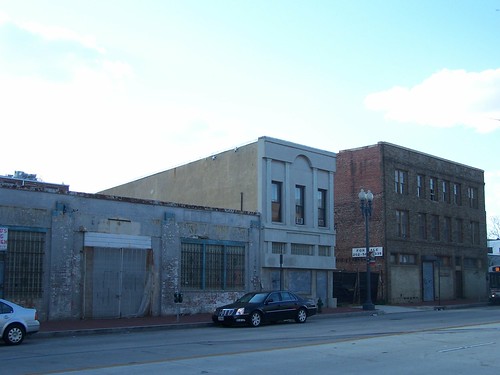
1200 block 9th Street NW, west side1200 block of 9th Street NW, three years after the DC Convention Center opened.

The DC Convention Center opened in 2003 and c. 2005, I wrote a couple pieces about how while building the Convention Center was important, if they wanted the neighborhood commercial district around the center "to show well" simultaneous with the opening, there needed to have been a specific program created to invest in the storefronts and businesses located in the adjacent commercial district (on 9th Street mostly).

Otherwise the process is "trickle down" improvement and it can take decades.

That didn't occur, and it took 8 or more years before you finally started seeing a difference on 9th Street, and part of that was facilitated by the addition of a convention center hotel, a Marriott, at Massachusetts Avenue and 9th Street as well as the redevelopment of the O Street Market as a mixed use project spanning from 7th to 9th Streets ("O Street Market: Symbol of violence becomes a marker for D.C.'s resurgence," Washington Post)--so that's three projects not one.

This piece from 2015 references the earlier blog entries, "The time to plan for retail in and around the Convention Center was long before it opened in 2003 and certainly before 2015."

Kennedy Street streetscape project.  Last summer, I meant to write about Kennedy Street NW where the city has been doing a streetscape reconstruction project, but instead of calling it a streetscape project, they called it a revitalization project.  But merely renaming the process didn't make it so.
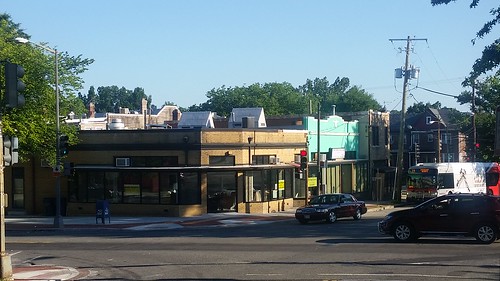
Facade improvement program, 300 block of Kennedy Street NWThe façade improvement program for these buildings was coordinated by the Emory Beacon of Light (Church) Community Development Corporation.

During part of the reconstruction, a set of buildings at 3rd Street underwent a façade renovation and for the most part looked much better afterwards. I figured it was a deliberate, simultaneous project to increase the velocity and economic return on the streetscape project, but it happened to be coincidental.
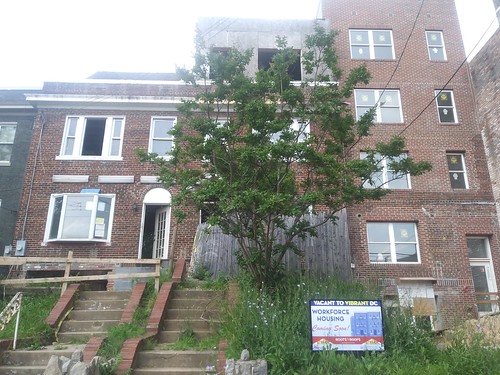
Disinvested buildings on Kennedy Street NWBuildings languishing on Kennedy Street, 2018.

But it made me realize how much more success would come about from such projects -- which are investments -- if there were wrap around or complementary investment-improvement programs designed to facilitate and accelerate overall improvement in a purposeful manner, rather than a trickle down approach.

This was around the time I was writing the series of articles about the Purple Line light rail project in Suburban Maryland, and how a "complementary transit network improvement program" is in order not only to make the Purple Line more successful, but to make the transit network more successful.

-- "Setting the stage for the Purple Line light rail line to be an overwhelming success: Part 2 | proposed parallel improvements across the transit network," March 2017

Transformational Projects Action Planning.  Now I call this approach "Transformational Projects Action Planning," and I argue that with specific big projects, the TPAP approach needs to be undertaken so that a "complementary" investment program is formed to increase the likelihood and speed of success of the big project, such as for the Purple Line light rail program.

-- "Minneapolis Super Bowl: Urban Revitalization and Transformational Projects Action Planning," February 2018

Cities Back from the Edge by Roberta GratzIf you have only time to read one book on urban revitalization, Cities Back from the Edge might be the best, clearest, and most straightforward.

Note that Jane Jacobs, and what I think of as a primer based on her writings, Cities Back from the Edge by Roberta Gratz, called this program of expecting one big splashy building to totally revitalize a place "projects planning," and she criticized the belief that one big project, such as a convention center, stadium etc. was in and of itself enough to spark a broad and deep revitalization of a community.

Barracks Row, 8th Street SE, Capitol Hill.  Unlike Kennedy Street, although technically the project has just finished, the streetscape reconstruction of 8th Street SE in Capitol Hill around 2002 is a rare successful example of property and business owners responding independently to a streetscape project by investing in their businesses and accelerating  significant and visible positive improvement in the commercial district.

In trying to figure out why the streetscape program worked so well, whereas in many other cases that doesn't happen, I figured out it was because while the commercial district had been lagging economically, it was embedded in a very successful residential neighborhood--Capitol Hill--and the business people understood they could get more business by investing simultaneously with the street improvement projects.

Languishing commercial districts with residential neighborhoods that also are lagging need a deeper and broader revitalization investment program in order to succeed.  A one shot project like a streetscape program isn't usually enough.

The Bolling Building on Dudley Square incorporates the facades of three historic buildings and is the headquarters for the school system.  Photo by Anton Stassl for the Architectural Record.

Bolling Municipal Building, Dudley Square, Roxbury, Boston.  This comes up in today's Boston Globe, "In Dudley Square, battered storefronts undermine the progress," which discusses Dudley Square and how despite the $100 million new city building, the commercial district still lags because of disinvested buildings and empty storefronts.  From the article:
Directly across from Boston’s new Bolling Municipal Building is an ugly rebuttal to the years of hard work and the $100 million-plus that activists and city officials have poured into Dudley Square: a grim row of vacant stores.

Out front is one long unbroken run of rusting metal grates, beat-up signs, and decaying paint, while the area around back is littered with crushed beer cans, pillows, women’s lingerie, and signs of squatters. Down Washington Street are several more vacant storefronts.

“It’s depressing to see,” Annette Hill Green, head attorney at the Donald E. Green law offices in a neighboring, well-kept building. “It doesn’t create the vibrancy you would like to see in a commercial district.”

Long a busy crossroads, Dudley Square received a boost when the city’s school department relocated to the Bolling Building. Officials are now trying to woo restaurants and other businesses to add more life to the area after work hours, and a developer is pushing to build a tower there.
Had some other monies been allocated for investing in nearby properties during the construction period for the new building, likely the results would be different.  But instead of doing a focused building by building approach to revitalizing the Square, Councilmembers are pushing a special tax on vacant properties.

Typically, over time such taxes do end up getting the properties sold to more motivated developers, but that too is a long process that can take a decade or more.
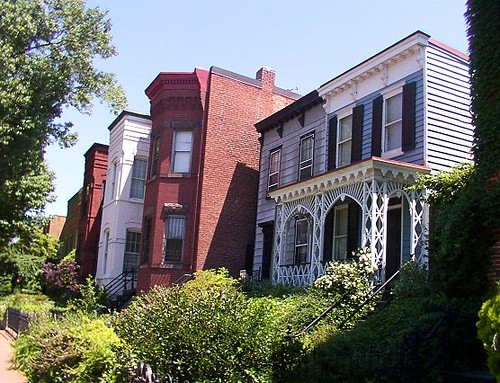
Capitol Hill Rowhouses, Washington, DCThe average price for a house in much of the Capitol Hill residential district exceeds $1 million.

Lessons from Barracks Row.  In "Systematic Neighborhood Engagement" (2007), I wrote about what I figured out from the successful results on Barracks Row (slightly edited):

An approach I use is based on work done for HUD in the 1970s, and used by most jurisdictions around the country. It's pretty basic, you assess neighborhoods based on whether the neighborhoods are:

1. Healthy
2. Transitioning
3. Emerging
4. Distressed.

based on a set of evaluative criteria.

I think this works for communities with at least 30-50,000 population and higher. (I think the researchers contracted by HUD came up with 5 categories. Philadelphia uses 6. DC 4--although they don't necessarily use the same terms to classify neighborhoods. Charles Buki uses 3 categories. But I think 6-8 is probably the best, because you can have high or low sub-stages within each stage.)

But, you need to do three other things when conducting the analysis, which most places (including DC) don't do:

1. Evaluate separately and simultaneously the commercial district and the residential parts of the neighborhood -- your ability to move the commercial district up the ladder is dependent on the density and economic capacity of the residential district. (And with regard to traditional community development strategies-- building more housing doesn't usually work because more housing for lower income people, while laudable, doesn't build the economic capacity of the neighborhood.  You need both a broader range of housing as well as a strengthening of the base of microenterprises employing neighborhood residents and the commercial district, see the Community Economic Development Handbook by Temali.)

2. You can also use the general criteria to evaluate places block-by-block as well, to help develop more focused strategies for specific needs, to move individual properties and blocks forward in a concerted way.

3. Overall, cities should develop differentiated policies for "different" places based on this approach, applied to a categorization of subdistricts and separately for the blocks and buildings within the subdistrict.

Point (3) is crucial and the cause of most failures in government policies and programs. By creating one size fits all programs, and not really understanding the nuances and details of a place and the levers at your disposal, failure is much more likely or at least, success takes two or three times longer.

E.g., emerging and distressed commercial districts aren't likely ready for street furniture given a preponderance of vandalism, and need more assistance in developing community and organizational capacity compared to healthy districts, or those in later stages of transition.

Similarly, even with large investments, it's much harder to move distressed commercial districts up the ladder when the residential neighborhood is also distressed.

… speaking of credit, Rachel MacCleery, the then Ward 6 Transportation Planner now at ULI, and I figured this out together, that commercial districts and residential areas need to be separately and simultaneously evaluated, in order to figure out the likelihood of success.

We were trying to figure out why the investment in streetscape improvement "worked so quickly" on Barracks Row -- 8th Street SE.

Most people don't really understand that the success there isn't merely a function of the investment, but in the overall condition and economic capacity of the greater neighborhood.
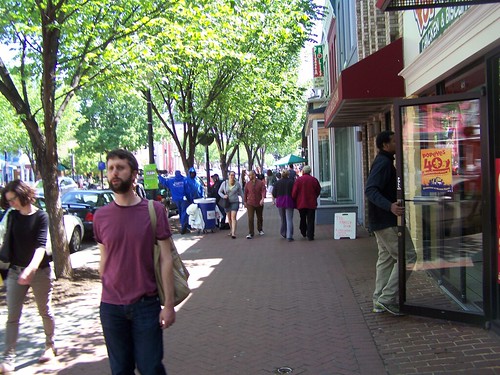
People out on a Sunday on 8th Street SE, Barracks RowBecause much of the property in our commercial districts has absentee ownership, improvement in commercial districts tends to lag improving residential areas, unlike the impact of residential improvement on other building owners (see Building Neighborhood Confidence and Understanding Neighborhood Change both by Rolf Goetze, for more insight into this process).

While the Barracks Row commercial district was "emerging," it was embedded in a residential district that is "Healthy."  

The streetscape investment was the cue to the business and property owners to reposition and invest so that the commercial district could catch up to the economic conditions of the healthy residential district within which it is embedded.

In such a situation not a lot of additional public investment is needed.  Along the lines of Goetze, the public investment in the streetscape was enough of a cue to spur "neighborhood confidence" on the part of the business owners to invest, and they did.

But when both the residential and commercial districts are lagging, e.g., Emerging/Emerging, etc., more complementary investment needs to be made simultaneous with the big projects otherwise it can take a decade or two to see the results from "trickle down" improvements.  And that's even the case in cities like Boston or Washington where the overall economic health is quite high.

Reeves Center.  The Boston situation reminds me of what I call "The Reeves Center Myth."

Many people in DC argue that the Reeves Center government building at 14th and U Streets NW is an example of a successful revitalization effort.

While it's true the building replaced an open air drug market that developed on the site after the buildings there had been destroyed in the 1968 riots, the building was constructed in 1986, and revitalization didn't become noticeable until 20 years.  In the meantime and afterwards, retail in the building mostly failed and tenants failed to pay their rent to the city.

And the area immediately around the center continued to languish until other new developments elsewhere in the district came about, driving improvements to the blocks at the intersection.

The lesson is that connection to a block and a district is necessary in order to foster improvements across the district.  Inwardly-focused developments don't trigger ancillary revitalization.

One building isn't enough.

Urban design and the Waterfront Metrorail buildings.  Another example, but positive, is the redevelopment at the Waterfront Metrorail station.  Around the station, a large office building and inwardly focused shopping mall had been constructed during the urban renewal era, and as part of the project they cut off 4th Street SW so that it was no longer a through street connecting directly to the Northwest Quadrant, the largest section of the city.

Southwest Waterfront Metro Station plaza, Washington, DCPlaza around the Waterfront Metrorail station.  The building at the upper left of the photo is the side elevation of the Safeway supermarket.

When the site was redeveloped, the street was reconnected, smaller footprint buildings with a more mixed use character (including housing) were constructed in their place, and the ground floor plane was specifically designed to engage and activate the street.

It's an example of the essentiality of connection as opposed to disconnection when investing in revitalization.

Here, local government agencies did lease a goodly amount of office space, to help seed the success of the new development.  But unlike Reeves Center or other examples elsewhere in the city, the buildings were designed to connect to, extend and activate the street, rather than to reject it.

Conclusion.  First, subdistricts need to be evaluated in a detailed and nuanced fashion in order to craft successful revitalization plans. These examples demonstrate that a more detailed approach is required, focused on the characteristics of what the real estate industry calls submarkets.

So the Capitol Hill submarket is different from the Anacostia submarket or the Kennedy Street submarket. Lessons can still be shared across districts with different conditions, but it is only knowing about those difference that commonalities can be discerned.

Second, new buildings that are supposed to be augurs of revitalization need to be designed in ways that connect to and activate the street, rather than disconnect from it. The Reeves Building is an example of disconnection. Boston's Bolling Building is better than urban renewal, but still isn't enough.

Third, most often a single building or a streetscape reconstruction on its own isn't enough to spark broader revitalization, unless the conditions of the commercial and residential districts are highly favorable.

Generally, complementary "transformational projects action plans" need to be developed façade improvement programs, business development grants, technical assistance, and other initiatives are usually needed to foster allied investment in private properties and to facilitate improvement across the district beyond the new project.

And surprisingly even seemingly very successful submarkets like Dupont Circle need "intervention" and support in the face of competition from other districts within the city and the metropolitan area ("Dupont Circle, a place steeped in history, gets a new look and new investment," Washington Post). Again, this comes down to a subdistrict approach focused on fundamentals. While Dupont Circle is more successful than Kennedy Street, it faces a different set of competitors that provide different challenges.

Just because a place like Dupont Circle is better off comparatively speaking to an impoverished area doesn't mean that plans, implementation organizations, and investment programs aren't required.

Other districts in the same situation include Alexandria ("Alexandria businesses discuss opportunity, competition at The Wharf," Alexandria Times), Takoma Park vis a vis Silver Spring, etc.

Labels: , , , ,

Friday, August 28, 2009

Revisiting the idea of a national infrastructure bank

In the run up to the Presidential election in 2008, there were a number of proposals for a "National Infrastructure Bank," that would sell bonds and use the monies raised to fund federal infrastructure improvements. (See the press release, "Dodd, Hagel Introduce Bill to Revitalize America's Infrastructure," the Slate article by Michael Lind, "Obama's single most important reform," this column from the New York Times, "Investing in America, and this not unfavorable response from the Reason Foundation, "A National Infrastructure Bank?")

This makes a lot of sense. Investment in the future requires big bucks, and for the most part the federal government is funded as "pay as you go."

Michael Lind writes:

Here the states can show the federal government the way. Most states, counties and cities, directly or through their agencies, issue municipal bonds to fund long-term, large-scale capital improvement projects like power plants, highways and school buildings. Usually these municipal bonds are tax-free. Most are either "general obligation" bonds, repayable from future general taxation, or "revenue bonds," repayable from a specific stream of income, like highway tolls.

When paying for expensive projects with long-term payoffs, it makes sense for governments, like corporations and nonprofits and ordinary individuals, to borrow the money rather than to pay the entire cost upfront out of current revenues. Raising money by means of tax-exempt bonds that are paid back over years or decades permits a government to spread the costs of roads, schools and energy grids among the beneficiaries over many years, instead of forcing today's taxpayers to pay the entire cost of a project that will mostly benefit future taxpayers.

He's right. But at the same time he overstates the case. States and localities have just as much difficulty funding infrastructure improvements as the federal government, even though they can sell bonds. At the same time, improvements require a lot of upfront investment that even large reasonably well functioning governments like the City of Chicago can't afford.

That's why state and local governments are doing these deals with the private sector, where they basically lease the infrastructure to the private sector in return for a payment, and an agreement for improvements to be paid for by the private firm.

This is the case with parking meter deals, bus shelters and public space improvements including bicycle sharing systems funded through advertising sales in the public space, speed cameras, and even "selling" toll roads and/or the creation of high occupancy toll lanes constructed by the private sector. The Macquarie Bank of Australia is one of the major participants in this field. (See "Toll Road Firms Continue to Lose Millions" from the Driving Newspaper and "Mayors Business Council Recognizes Best Practices in Public-Private Partnerships" from the U.S. Conference of Mayors, about Lockheed Martin's prowess in parking meter deals, and "Highway Upgrade Goes Private" from the Wall Street Journal.)

But as the fierce outcry to massive increases in parking meter prices in Chicago shows (see "Mayor Daley is sorry that we don't like the parking meter deal" from the Chicago Reader and the AP story "Daley to apologize for parking meter problems") this can come at a great cost.

And the reality is that there is no free lunch. The private sector does this because they can make money. The local governments do this only because they can't raise the upfront capital necessary to fund the improvements--disproving Michael Lind's point about the difference between state/local and the federal governments and their ability to fund infrastructure improvements). They leave money on the table--the profit made by the private sector--only because they can't otherwise raise the money to do the improvements themselves.

I think we need a National Infrastructure Bank not just for the federal government, but a bank that also lends monies to local and state governments, solely for infrastructure construction and improvement projects.

This isn't a stretch from what the WPA and PWA and other government agencies did during the Depression. Many of the public works projects created by the Federal Government in part as employment projects were in fact local projects, which contributed to the well-being and economic success of local and state governments for many decades after their construction. In fact, it is not a stretch to argue that part of the post-War success enjoyed by the U.S. was in fact partially a result of these Depression era investments, ranging from local roads and sidewalks to dormitories at state universities, public buildings, etc.

Labels: , , , , ,