"A community’s physical form, rather than its land uses, is its most intrinsic and enduring characteristic." [Katz, EPA] This blog focuses on place and placemaking and all that makes it work--historic preservation, urban design, transportation, asset-based community development, arts & cultural development, commercial district revitalization, tourism & destination development, and quality of life advocacy--along with doses of civic engagement and good governance watchdogging.
Wednesday, February 15, 2023
Brookfield Properties defaults on two properties in Los Angeles
Brookfield Properties is one of the largest US commercial property owners, with large holdings in major cities including NYC and Washington.
With the impact of covid on working in central business districts--most cities have at best 50% of employees back in the office--the value of commercial property is taking a big hit. Most companies are reducing their office footprint in favor of work from home, and this is devaluing property.
Another way to see the impact is whether or not there is an increase in loan defaults, because the revenue from leasing isn't enough to cover the loan, especially as mortgage rates rise.
The two properties in default, part of a portfolio called Brookfield DTLA Fund Office Trust Investor,
are the Gas Company Tower, with $465 million in loans, and the 777
Tower, with about $290 million in debt, according to a filing. The fund
manager had warned in November that it may face foreclosure on
properties.
The company had the option to extend the maturity on the loans tied
to the Gas Company Tower, but elected not to, according to its latest
filing. It also elected not to get interest-rate protection that was
required for loans for the 777 Tower property, which amounts to an event
of default, the filing said.
“We believe DTLA’s decision to default on these two assets increases the risk for the remaining loans in their portfolio,” Barclays Plc research analysts Lea Overby and Anuj Jain wrote in a note Tuesday. Brookfield declined to comment.
The values of comparable office buildings have broadly dropped,
according to the Barclays analysts. Office vacancies have increased
across the country since the pandemic made working remotely more
routine. The vacancy rate in the Los Angeles central business district
vacancy rate was 22.7% in the fourth quarter of 2022, according to a Jones Lang LaSalle Inc. report.
21st century underhousing, 20th century zoning, and the controversy over changing the DC Comprehensive Land Use Plan
The Toronto Globe and Mail article, "Toronto’s low-rise neighbourhoods losing density as ‘overhousing’ spreads," mentions a report, published last year by the Ryerson University City Building Institute, called "Protecting Vibrancy of Residential Neighbourhoods," although it doesn't seem to be publicly available. Cheryl Case, co-author of the report, was quoted in the TGM article too:
She argues the city has not adopted zoning that reflects the smaller family sizes prevalent in the city today, but acknowledges the solution is tougher and more political: "The city needs to develop policies that would develop more housing in neighbourhoods."
The existing zoning rules make that difficult, she says. About two-thirds of the city's residential land permits only one household per structure, and the city's official plan specifies that it hopes to maintain "stable" neighbourhoods by paying attention to "character."
DC: if you're not a high earner, but you bought more than 10 years ago, you're "okay." DC is similarly divided between property owners and renters, and between higher income and lower income households, and between people who bought their houses sometime, often decades, before 2008.
This date is somewhat arbitrary and was the date of the most recent housing crash, different neighborhoods are/were at different points in terms of attractiveness vis a vis housing choice and the regional residential property landscape.
I wrote about this a few years ago ("Exogenous market forces impact DC's housing market"), but I could have done a better job. I accorded some of the rise to the presence of nonresident buyers. But the reality is that doesn't make that much difference.
More importantly, more people want to live in the city. And as they are priced out of the most attractive neighborhoods, they choose other neighborhoods. In any case, this ends up raising prices more broadly.
"One-over neighborhood" is a concept put forth by the Live Baltimore residential recruitment initiative, where people who can't afford to live in the neighborhood they really want to, say Federal Hill, Canton, or Bolton Hill, choose other neighborhoods nearby, that have similar housing stock, but limited commercial and other amenities, and therefore, much lower housing prices, with the aim that the neighborhood will improve and they can still "consume" the amenities already present in the neighborhood next door.
The real estate market in most DC neighborhoods have long since recovered, and because demand for urban living has increased while housing supply has not increased fast enough, more DC neighborhoods are going through price escalation (for example, on my block, high quality renovated houses are selling for more than double what we paid 10 years ago--although our house wasn't renovated).
Revising the DC Comprehensive Land Use Plan. It's a great lead in to the discussion now about proposed changes in the DC Comprehensive Plan, which activists deride as pro-development ("D.C. mayor seeks to stop costly legal delays to development projects," Washington Post; "Dozens of developers will testify next week before the D.C. Council. Here's why they are upset," Washington Business Journal), while other pro-urban advocates like myself argue a more nuanced position.
Still, because the impetus of the changes is to reduce the success of legal challenges to development projects, activists have the upper hand in their argument. From the Post article:
District officials say that the changes would end nuisance legal challenges, reduce the cost of doing business in Washington, and expedite the construction of housing units that the city needs. ...
But activists counter that the city is making it more difficult to stave off gentrification. They say their ability to turn to the D.C. Court of Appeals is necessary to prevent District officials from violating their own policies to accommodate luxury projects that drive up housing prices in exchange for minimal benefits for neighborhoods.
Since 2016, 25 appeals have been filed against projects approved by the District, three times the number lodged between 2013 and 2015, according to the District’s Zoning Commission. Members of one community group, Union Market Neighbors, have filed appeals against eight projects in the blocks adjoining Gallaudet University in Northeast, including one that was recently dismissed after the group reached a settlement with a developer.
In short, there need to be changes to the comprehensive plan, that by definition all development isn't "bad," but the Office of Planning has truncated the process to revise the plan--calling it a new round for approving and extending the plan for 20 more years, without having gone through a set of public processes and hearings before moving the changes forward for City Council approval.
It definitely sets up the Office of Planning and the process for criticism and charges that they are tools of the developers.
Note that for years I've argued that there needed to be a "campaign" after the approval of the Comp Plan in 2006, a road show, to build a common understanding and consensus for what the plan means.
Plus a lot of the reason for the court cases--besides the anti-development fervor--is because of sloppiness and under-definition in the plan language, which I argue was deliberate from the standpoint of "having and eating cake," and facilitating pro-density changes without being direct.
It's complicated. But I will repeat what I wrote a couple weeks ago.
Today, interestingly, the DC Grassroots Coalition for Planning sees adding population as a zero sum game, with the presumption that adding population by definition comes at the expense of those of lesser means, diminishes neighborhoods, etc.
One of their complaints is the planning for achieving a greater population, of one million being touted in the current comprehensive planning process. (Note that this number was expected to be achieved in 1980, according to the city's 1950 comprehensive plan.)
Is the right to the city only possessed by those who already live in it?
Is only capital afforded the right to shape the city? Obviously not, as pointed out by Foglesong in Planning the Capitalist City (Prezi precis; intro).
I think back to what the city was like in September 1987 when I first moved here, and I prefer to live in a community that is growing. Even if I believe that the planning and governance functions could be a lot better, there is no question that the added population supports a better and wider range of amenities, public safety, etc., which contribute to improved communities.
Right to the City discussion. While those who laid out the tenets of this argument, including LeFebreve and Harvey likely would be surprised to have to consider the rights of the better off to be part of the discussion about who can live in the city, I don't think they would entertain the idea that cities only belong to the people who already live there, that new entrants not only have no rights but are banned The solution to housing price escalation and gentrification is more housing, not less. The one thing we can be assured of is that if more housing isn't built, people of lesser means will be displaced, as people with more income and wealth have greater ability to buy housing, especially as prices escalate.
That's something that most of DC's activists refuse to acknowledge. Not adding to housing supply doesn't change the reality of market economics and that people with more money will continue to bid up prices and capture assets. That they'll be more advantaged, not less, if housing supply stagnates in the face of increased demand.
And despite the fact that the DC Court of Appeals agreed with the argument as discussed in the Post article:
But activists counter that the city is making it more difficult to stave off gentrification. They say their ability to turn to the D.C. Court of Appeals is necessary to prevent District officials from violating their own policies to accommodate luxury projects that drive up housing prices in exchange for minimal benefits for neighborhoods. ...
The number of legal challenges in the District surged after the appeals court in 2016 overturned the Zoning Commission’s approval of a project to redevelop McMillan Park in Northwest into a complex of residential units, offices, a new park and a supermarket.
The development’s opponents successfully argued that zoning officials failed to consider the project’s potential to intensify gentrification. The opponents also contended that the officials had violated the city’s own regulations by permitting buildings denser than allowed under the D.C. Comprehensive Plan. The plan is the District’s compendium of policies that guide its evolution in housing, transportation, economic development and the environment.
the reality is that you can't forbid development merely because it attracts higher income residents.
At the same time, how do we deal with the changes that come with new residents who are wealthier and attracted to urban living for reasons different than what attracted those of us "who are already here"?
While I am not sure what the answer is to that question, it definitely isn't "don't build more housing."
Housing and generational inequity. The TGM also has an article ("Even house-rich homeowners agree: Vancouver has an affordability problem") about the Vancouver housing market and how some residential property owners who have benefited from the pricing escalation acknowledge that it works for them but not others.
From the article:
Vancouver homeowners, after years of focusing on their growing equity and ignoring the housing inequality around them – have come to a new awareness: high home prices are crippling the region. The city is now divided according to those who got into the housing market early enough that they could afford to buy and those who feel as if they've been shut out.
Inter-generational coalition in DC joins in opposition to new residents. But a goodly number of long time residents also see any type of new development as anathema by definition, even when most such housing is not constructed in the place of existing housing, but as an addition to housing supply.
In Canada an organization called Generation Squeeze has been created to address the issue of wealth disparity between generations, and acknowledges class differences.
OTOH, the people leading the fight against changes to the DC Comp Plan -- and I am first to state that the process by which the proposed changes are moving forward is seriously flawed -- seem to believe they have common economic interests, although one group is younger and tends to not own property, while the older residents do own property.
Here the inter-generational coalition has been created not out of a desire to address how wealth and income disparities shape the local housing market and unfair outcomes, but to create a common front against new residents and new housing, even though the older resident property owners benefit from price escalation and may share household wealth characteristics with some of the "new residents" or potential new residents.
The group seems to see new development as only benefiting the well off and "new" residents, although I would argue that older residents already owning property advocate this position merely to ward off potential changes to their neighborhoods, mouthing concern for "affordable housing."
Both generations fail to acknowledge the realities of the DC housing market or public finance, in that if you want the local government to intervene in the housing market and pay towards construction of lower cost housing, it needs money to be able to do so, and city revenue streams are almost wholly dependent on property, income, and sales tax revenues.
Effect on PUDs. Many of the changes have to do with what are called "planned unit developments," which in return for "community benefits," provide a density bonus. Because of the threat of challenge, many developers are choosing to forego the PUD process.
This facilitates their project, but has catastrophic opportunity costs because projects are smaller with fewer units, thereby not making a meaningful difference in additions to housing supply and helping to slacken price escalation.
From the WBJ article:
David Alpert, founder and president of Greater Greater Washington and an organizer of the D.C. Housing Priorities Coalition, said his group is pushing the city to change language in the comprehensive plan that will allow the "PUD process be able function well."
Alpert's coalition includes the support of organizations that, on occasion, do not see eye to eye — multiple developers like Menkiti, MRP Realty and Ditto Residential, numerous advisory neighborhood commissions, the Coalition for Smarter Growth, D.C. Fiscal Policy Institute and SEIU 32BJ.
"We want it to be able to function where the Zoning Commission can hear from the community, they can hear from the neighborhood advisory commission, it can determine what community benefits are possible in a project and then it can make a decision saying that the community benefits are sufficient to approve that project and have every project move forward," Alpert said.
Alpert said the legal challenges have become so pervasive that many developers are no longer pursuing PUDs.
"They are building smaller projects. There are no community benefits," he said. "There is less housing being created. There's less affordable housing being created."
He also said there needs to be clearer language in the comp plan about preserving and creating affordable housing.
"It's possible to avoid displacement in a way that is in partnership with the development community," he said.
The crazy thing about this is for the most part, PUDs are being employed in places that weren't housing to begin with. So they aren't reducing the amount of existing housing--with a couple of high profile exceptions.
Although previously discussed, the best way to deal with affordable housing production will be discussed in another entry.
The concept of overhousing explains the stagnation of neighborhoods and neighborhood commercial districts as they age
As neighborhoods age and housing turnover declines, neighborhoods tend to stagnate. A few years ago, I was against the idea of giving DC seniors a bye from property taxes ("Councilmember Anita Bonds Proposes No Property Taxes for Senior Citizens," Washington Afro-American)) because of my observation that a lot of a neighborhood's lagging properties are owned by families that have paid off the property and are likely waiting for the property to move into an estate situation before doing anything. Eliminating property taxes merely extends the period for which houses can moulder.
(That being said, the fact that property taxes are based on current values, which is divorced from the ability to pay, is a problem for senior households and needs to addressed, as needed.)
And it's obvious why many commercial areas in the city stagnated in the 1980s and 1990s, it was because there was little housing turnover and as households age they buy and "go out" less, providing an ever smaller customer base.
Housing turnover and additions to housing supply energize neighborhoods. A neighborhood and neighborhood commercial districts need to draw on a mix of demographic segments to remain economically healthy and resilient.
This has been confirmed by how the increase in population in many neighborhoods--from both housing turnover and the addition of housing--in the 2000s was followed by a revival of local commercial districts in places like Capitol Hill, H Street, Petworth, Columbia Heights, and others, although granted the mix tends to favor restaurants over retail ("Obsolete and underperforming buildings: is it the building or the micro-economy of the retail trade area?").
Because many of the low-density neighbourhoods losing population are predominantly single-family dwellings, an urban planner says the City of Toronto’s official plan’s definition is essentially a one-way ratchet that will rule out new multiunit dwellings in any area where they don’t already ‘prevail.’ Photo: Deborah Baic/The Globe and Mail.
The extra bedrooms Mr. Smetanin has identified aren't about to be rented out. Most are owned by seniors living in empty-nest neighbourhoods (70 per cent of the overhoused population is 65 years old and up). But they illustrate the strange predicament of a city booming in population but where many neighbourhoods are actually losing density. "If you could return those areas back to 2001 density levels, you'd create about 80,000 homes straight-away," he says.
The rate of depopulation that created the spare bedrooms in Toronto's low-rise neighbourhoods is stark: "Since 2001, about 52 per cent of the land mass of Toronto has reduced in density of population by about 201,000 people," Mr. Smetanin says. "Other parts of Toronto have grown by 492,000."
This is a description of what happens as "neighborhoods age out" and before housing starts to turn over.
But it's also complicated by a mismatch in the size of properties constructed back when households were much larger, and the average size of households today.
Declining household size. For example, in DC today, the average household size is 2.24. While I don't have access at the moment to the exact data for 1930, nationally, average household size was 4.11.
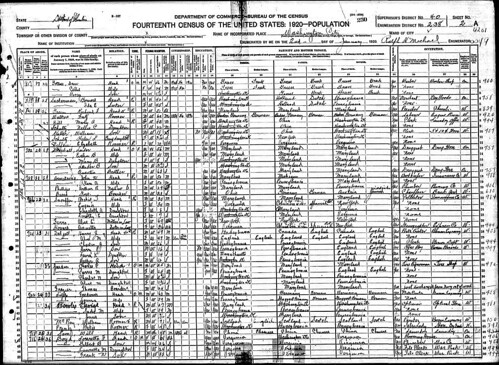
Of course, looking at old Census enumeration sheets finds that even small rowhouses had triple the number of residents compared to today's average.
1920 Census data, H and 9th Streets NE, Washington, DC.
How to address the mismatch between house size and household size: smaller housing units. With new construction, a greater variety of unit sizes allows a wider range of household sizes to be accommodated. One way to address the mismatch between the size of properties built early in the 20th century to the household sizes of today is to break up larger houses into smaller units. From the TGM article:
... [Cheryl Case] argues the city has not adopted zoning that reflects the smaller family sizes prevelant in the city today, but acknowledges the solution is tougher and more political: "The city needs to develop policies that would develop more housing in neighbourhoods."
The existing zoning rules make that difficult, she says. About two-thirds of the city's residential land permits only one household per structure, and the city's official plan specifies that it hopes to maintain "stable" neighbourhoods by paying attention to "character."
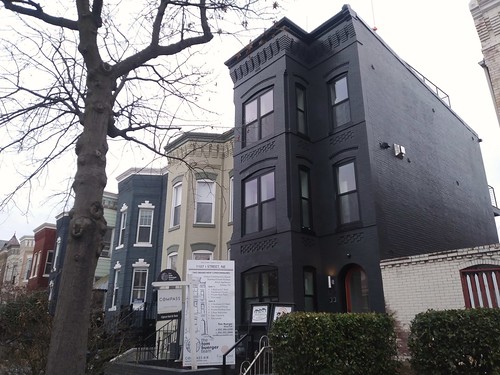
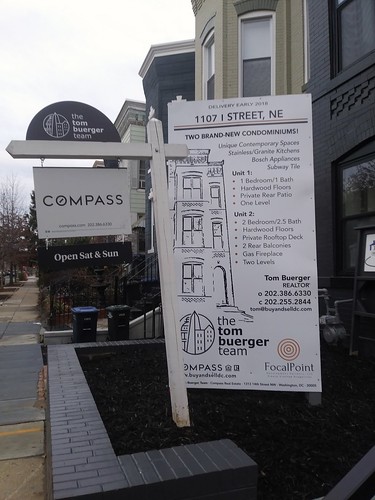
This rowhouse on I Street NE is being converted into two units, a ground floor single story apartment, and a two story upper apartment. The asking price for the two units is about $1.2 million. While it might not be happening in Toronto, and not in traditional single family neighborhoods in DC, it is happening in DC's rowhouse neighborhoods, where larger rowhouses are being converted from single family houses to multiple, smaller units, and medium sized rowhouses are being expanded somewhat to yield two units instead of one.
Note too that in those rare instances where new rowhouses are being constructed on an infill basis, almost as a matter of course each building is two to three units, including a separate basement apartment.
Making over houses as smaller units isn't driven not so much by a conscious application of 21st century housing policy but more as an expression of 21st century real estate economics, demand, and demographics.
It's the result of a kind of real estate arbitrage of building and lot sizes that enables property redevelopers maximize income while responding to a significantly increased demand for urban living and a relative inability to produce more single family type housing, because most of those sites have already been developed.
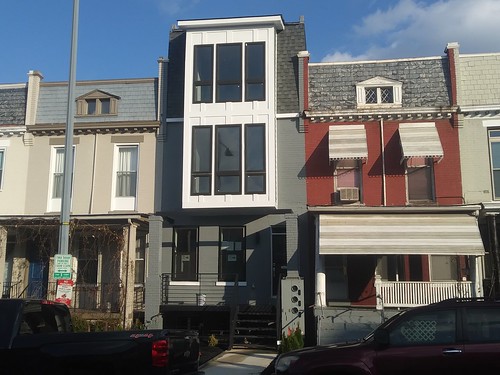
This house is on 13th Street in Columbia Heights. Note that the electric box indicates the building will have two households. (One meter for each household, plus a separate meter for common areas.) A great many neighborhood activists protest these changes as an unreasonable change in neighborhood character.
There is some truth to their claims, because often the additions and popups are aesthetically challenged.
Also see the Toronto Star article, "Toronto has too much housing despite overall population growth: report." Note that a report referenced in both articles, "Promoting Vibrancy in Residential Neighbourhoods," from the Ryerson University City Building Institute, does not appear to be online.
Does the creation of more units on the same number of lots challenge infrastructure? Some people raise a concern that making houses over into smaller units increases demand for utilities and other infrastructure beyod what we might call neighborhood carrying capacity.
The reality is that given the typically much larger household sizes back when these houses were originally constructed, with one exception, likely the present infrastructure is capacious enough.
The exception is parking capacity and road capacity. For the most part, DC's street network and street parking capacity is fixed. So as more households are added, if the new households maintain more suburban-oriented automobile dominated mobility behaviors, this creates problems in terms of demand for parking and more road congestion.
The proper response is to significantly increase the cost to register cars, the cost of residential parking permits (now$35/year), to encourage wider use of car sharing, to invest in transit quality and frequency and a broader array of transit options, and in transportation demand management programming to assist people in transitioning to other modes.
Car sharing is fractional use or "time sharing" use of cars. "Sharing" is a form of collaborative consumption, facilitated mostly by for profit firms, although some cities like San Francisco and Montreal have nonprofit car share programs.
A number of elements make it different from traditional car rental. Cars are distributed in various locations in a community and drivers access the cars through telecommunications systems, smart cards, and/or mobile phones, not through an office-based check out and return process.
1. Festival promotion. Last year Enterprise Car Share (probably by overbidding) took over the car sharing contract to put car share vehicles on Metro station sites. A few weeks ago, not particularly aggressively, a street team was out at the Takoma Metro Station promoting the service.
It seems like the companies haven't been as visible in street team and festival promotions, but maybe I am not getting out as much.
2. Zipcar now has 1 million members, which is a lot, although I don't know if that number includes European and Canadian affiliates, or just the US. It's still a big deal.
In the article over the weekend "about Ford" I mentioned the rise in car share use and decline in automobile purchases by millennials, although the Financlal Times just ran an article ("Millennial Americans still aspire to be behind wheel of their own car") based on a survey which found that millennials have the same interest in buying cars as other groups.
Regardless, there is still a marked shift at least in some segments as more households than before choose to not buy a car in favor of car use through car share and other means. This segment will continue to grow, although it is likely to plateau. Before advances in telecommunications and software systems it wasn't possible to serve such a market economically and profitably.
Zipcar is rolling out "one-way" car share, but compared to Car2Go it's clunky, you can't put the car anywhere in a "home zone." You can leave it only in a very limited number of places.
3. With the introduction of the newest car model, Car2Go has upgraded their electronics and software systems, shifting to a mobile phone-based access and exit system, obviating the need to include more complicated electronic systems and screens in the vehicles. The car is wider and has a better engine and transmission.
A few months ago, the company finalized negotiations with DC and Arlington so that car trips can start in one jurisdiction and end in the other. This is great for people in DC traveling to National Airport, although the car has to be dropped off in Crystal City, which is some distance away.
They've shifted to a price per minute model, with various ceiling rates at 3 hours, 12 hours, and 24 hours, and compared to the other services, charge less when the car is parked but still held by the user. Still, the price to the user is much higher than competitive services.
Airport access is a plus. Unlike most other car sharing services (except Car2Go in Montreal), they have an agreement with the Seattle Airport to have cars parked there.
By adding Minis to the mix, they are able to lower prices, and according to Geekwire, they intend to add services and "quirks" to the program to expand its appeal:
Banfield told GeekWire ... that the vision for BMW is much more than just the free-floating car-sharing program. There are plans to launch a number of other services, including a concierge option where BMW brings you a vehicle, instead of you having to find one yourself; an Uber and Lyft competitor that will allow people to earn revenue by driving other users around in ReachNow cars; a way for people to drop off ReachNow vehicles at Seattle-Tacoma International Airport before boarding a flight, or to pick one up after they get off the plane; or a way for BMW owners to lease their own cars within the ReachNow network.
5. GM's Maven car sharing service is expanding from its test markets to DC, Boston, Chicago, and Baltimore . GM, which invested in Lyft, is already leasing cars to Lyft drivers in Chicago as part of the program. In Chicago, they are testing a delivery option, although that seems like an unnecessary expense since drivers are unlikely to be willing to pay the true cost. Remember that the secret to the supermarket is making the customer pick and deliver the order. Taking on such an expense is costly.
Considering that the GM service entered the market a couple months ago ("GM’s car-sharing service hits the gas in the District," Washington Business Journal) and I had no idea, clearly they need to do some marketing, sponsor festivals, etc.
6. Peugeot and Los Angeles. Reuters reports that Peugeot, the French car company, will be launching an electric car sharing service in Los Angeles. They will be working with Bolloré, the company that runs the Auto'Lib program in Paris and the BlueIndy program in Indianapolis, although it uses a car manufactured by Pininfarina, an Italian company. If they switch to a Peugeot manufactured car, it could be a good way to rebuild awareness of the Peugeot brand in the US, just as Car2Go has increased the visibility of the SmartCar in urban markets.
Note that Car2Go uses electric cars in some markets, including San Diego.
This shouldn't be a surprise because Indianapolis lacks the right set of urban design and mobility characteristics which support the adoption of a sustainable mobility-centric lifestyle. For example, the city has minimal transit infrastructure and transit isn't used much by "choice riders." From the Indianapolis Star:
Historically, the Circle City been one of the most drive-centric in the nation. The U.S. Census Bureau's most recent survey of commuters found that just 1 percent of Indianapolis residents take public transportation to work, compared to 11.5 percent in Chicago, 3.8 percent in Cleveland and 2.4 percent in Louisville.
The city also ranks near the bottom in the number of people who bike or walk to their jobs.
The new code allows developers of multi-family homes to reduce the number of required parking spaces by 30 percent if they build within 1/4 mile of a sheltered bus stop or main mass transit corridor. If they are 1/4 to 1/2 mile away, they can reduce the number of parking spaces by 10 percent.
Builders also get to reduce parking spaces if they replace them with bike racks, carpool parking or electric car charging stations.
Note that density and proximity between residential areas and activity centers and other prime destinations shape the take up of sustainable mobility more than zoning regulations. (But the right zoning regulations help when you're working with a "Walking City" and "Transit City" urban form. See "Transportation and Urban Form" by Peter Muller.)
8. Metropolitan area deployment challenges: multiple jurisdictions. WRT Peugeot and "Los Angeles," another challenge, like with bike share there, is that there are multiple cities and entities. Parts of Los Angeles City and Los Angeles County cities like Pasadena and Santa Monica have the right antecedents, other parts don't, as Car2Go discovered in Minneapolis.
But having to negotiate separate agreements for each city as well as cross-jurisdictional privileges (like with DC and Arlington County and Car2Go) is difficult and expensive and will make it harder for car sharing to expand in areas with multiple jurisdictions.
This is an issue with airport access too. Usually, airports are separately run from cities or counties and may be more or less willing to negotiate complementary agreements.
9. A focus on fee, tax, and franchise revenues from car shares comes out of the pocket of city residents, while car owners get a free pass. There is some question about the deployment and expansion of the BlueIndy program, and the city is looking for franchise fees which haven't been charged up to now ("City rethinking spots for BlueIndy stations" and "Hospital rail has franchise deal, why not BlueIndy?," Star).
With regard to the quest for franchise fees, as I have written about this in the past (Another example of DC's failures in transportation planning: carsharing"), it is a challenge for cities to look at this as a question of supporting innovation and transportation demand management versus a revenue venture.
I will admit when I first considered car sharing, back in 2003, I thought that it was important to charge commercial proprietors of such services for their use of the public space to conduct business.
But late in 2005, I changed my tune ("High Cost of Free* Parking Revisited and Car Sharing in DC"), recognizing two things. First, that car-using residents who are car share members shouldn't have to pay significantly more for using street space when compared to car-owning residents, regardless of who owns the service.
Second, the point of car sharing is to reduce the total number of cars attempting to park in the public space--it's a form of demand management, since research shows that 10-30 households use each car share vehicle, and they own fewer cars compared to similar households that aren't members of car share.
The more fees that are paid, the more it cost to use the service for the end user.
Because communities are dominated by car owners who don't care much about fairness when it comes to payments by non-car owning residents, "members" of car sharing services pay cities much more money per trip than do car owners.
• The availability of car sharing allowed 30 percent of students who lived on campus to leave their personal cars at home.
• Forty-two percent of Zipcar users on campuses said that they are less likely to buy a car in the next few years.
• Thirty percent said they would have bought a car were it not for car sharing.
Campus car sharing has the same transportation demand management impact as in cities, such as in Hoboken ("Hoboken, N.J., Sets Up Low-Cost Car-Sharing Program," New York Times) where they found a significant reduction in demand for residential parking permits after the program was launched, which should be expected.
As Jane Jacobs said when she was asked "why aren't there enough roads? (or parking lots)," she countered "you're asking the wrong question; the right question is 'why are there so many cars?'"
As a TDM measure, car sharing should be encouraged, and users shouldn't be taxed and charged disproportionately compared to car owners.
11. Car sharing and transportation equity. A few years ago, the DC Housing Authority set up an arrangement with Zipcar, to serve their usually lower income residents, ("Zipcar Brings Car Sharing to DC Housing Authority," press release) but we haven't heard much about the program since although the program still operates. It's not clear if other public housing authorities have developed similar relationships.
The Chicago Reporter ran an article ("Pilot program aims to bring car sharing to low income neighborhoods") about an initiative in Chicago that aims to serve low income neighborhoods, using the peer-to-peer Getaround car sharing program. In that program, rather than buying and maintaining a fleet of vehicles, an IT and telecommunications platform and system links individual users and independent car owners (comparable to ride hailing services).
12. Nonprofit car sharing. The problem with nonprofit car sharing is that the services are geographically bound and lightly capitalized.
Limited service areas make them less useful to people as they travel (for example I've used Zipcar or Car2Go in Seattle, San Diego, and San Francisco, as well as in DC).
But from a business model standpoint, it means the service is smaller, costs more to operate, and has reduced access to capital. Insurance is usually more expensive too. For members, it often costs more to join and use too, compared to the for profit services.
Most importantly, when it comes time to replace cars, nonprofits don't usually have the money to do it. Nonprofits in Philadelphia and Chicago sold themselves to for profits when they couldn't maintain the capital spending for their fleet.
Nonetheless, nonprofit car sharing programs in San Francisco, Boulder, Montreal and elsewhere continue to operate in the face of competition from for profit firms. Governing Magazine reported on a nonprofit car share program in Buffalo ("A Zipcar that people can afford") which faces these issues.
Just as there are business cooperatives or "buying groups" that support independent retailers such as hardware or supermarket co-ops, probably the nonprofit car sharing organizations need to organize a similar arrangement to negotiate less costly relationships for purchasing cars and insurance and better access to capital (such as loans from the National Co-operative Bank).
A friend's uncle was a high level government official in a capital city government in Central America. They were dealing with a landfill contract and they got technical assistance from an international organization.
One of the provisions the group suggested including was about restricting radioactive waste. They reacted, saying, "we don't have any nuclear facilities in our country."
The reply was "nothing prevents an international firm from depositing such waste in a facility in your country without your restricting it."
They realized it made a lot of sense to seek help from people with a lot more experiencing negotiating such contracts.
I am not party to high level government agency decisionmaking, but I often wonder whether or not similar levels of technical assistance are available within the US, since so many local governments get on the wrong side of contracts with business interests.
It doesn't seem like it.
Because small and very large governments seem to be on the wrong side of such contracts more often than not.
A small city example is Richmond, Virginia, which so far finds that the economic benefits from sponsoring and subsidizing the Washington Redskins summer training camp are one-sided--although had they specified the number of training sessions open to the public, when they are held--morning sessions have less economic impact than afternoon sessions, etc., the city could have better protected their interests.
But it's also large cities like Chicago, which got its clock cleaned in the contract where in return for upfront payments--to be used to cover budget problems--they leased city owned parking structures and parking meters to a Wall Street group--giving up hundreds of millions of dollars in favor of private interests ("Revisited: Private financing of public infrastructure is good business for business").
But somehow there must be a lot of pressure to not protect a government's interest in these kinds of contracts.
Amore, head of security at Boston’s Isabella Stewart Gardner Museum,
provides chastening examples of people ignoring each of these warning
signs and others nearly as blatant. The sad fact, as he writes in his
introduction, is that the art market’s con artists never have any
trouble finding marks who “believe, against all indications to the
contrary, that they have actually stumbled on the rare deal that is both
too good and true.”
I think the same goes on when it comes to many municipal-private sector deals, because except in the case of minor league baseball stadiums, there aren't many examples of local, regional, and state governments benefiting significantly from providing stadiums, arenas, and practice facilities to professional sports teams.
(DC area) Stadium talk a/k/a "football stadiums are a bad 'investment' for (big) cities
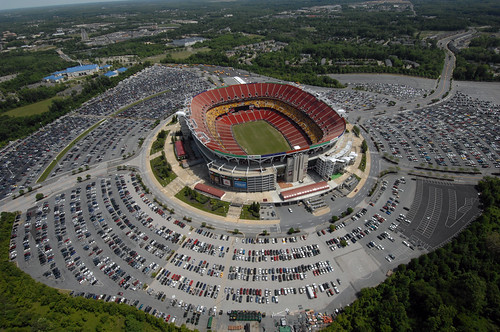
Visitors park at FedEx Field, home of the NFL Washington Redskins. (U.S. Air Force photo by Staff Sgt. Christopher A. Marasky) I was impressed a couple weeks ago to read in the Washington Post ("Parris Glendening helped the Redskins move to FedEx Field. Now he wonders if that was a mistake") about how the former Governor of Maryland believes every time he drives past Redskins Stadium (FedEx Field) in Prince George's County, Maryland, that the final product was a signature failure in how the stadium fails to integrate into and improve the community around it. From the article:
So with another stadium battle looming, Glendening has a message for fans, team officials, and local politicians: that FedEx Field was doomed to mediocrity from the start. That there are fundamental issues with that stadium’s placement that cannot be erased, no matter what the team attempts to do. And that the next choice must be better.
“This is the mea culpa; I was actually part of the problem,” Glendening said. “It was just the wrong location.”
2. However, even a good location for a football stadium doesn't have such a great outcome either.
Glendening pointed out how the team owner owned the property and was committed to that site, regardless of its lack of connection and transit access--the Metrorail system was extended by two stations in part to add transit system access to the stadium, which is 1.3 miles from the Largo Metro Station.
If there were regional land use regulations requiring that such uses (stadiums and arenas) be sited to minimize transportation demand impact, then communities would have some leverage in addressing sprawl.
This came up because of the recent finalization of an agreement between the city and DC United for a new soccer stadium at Buzzards Point ("D.C. United stadium takes a key step forward," Washington Business Journal).
... Which arguably will serve as a linchpin along the waterfront, better linking the area around the Nationals Stadium--called the Capitol Riverfront district--to the Southwest Waterfront, where the multi-billion dollar Wharf redevelopment project is underway.
I have come around somewhat on this general issue, but it is very much dependent on having the right plan and program in place from the outset to ensure spillover economic benefit. I came up with a framework for considering such decisions in a past blog entry.
The following characteristics are the start of such a framework, based on what shapes the ability to generate ancillary economic development as funding a stadium in and of itself doesn't provide enough public benefit to justify public funding:
isolation versus connection of the facility to the urban fabric/built environment beyond the stadium site;
size of the facility and its ability to be integrated into the urban fabric;
frequency of events held by the primary tenants;
the number of teams using the facility, maximizing use and utility of the building;
whether or not events are scheduled in a manner that facilitates attendee patronage of off-site businesses;
use of the facility for non-game events drawing additional patrons;
how people travel to events: automobiles vs. transit.
4. But to make public investment in sports facilities pay off, I argue that public authorities paying for stadiums should get a hypothecated interest in the stadium or arena which is paid out as a percentage of the sales price when a team is sold. See "Stadiums and arenas as the enabling infrastructure for "money-making" platforms."
5. Meanwhile, there continues to be a great push to plan for the return of the Redskins football team to the RFK Stadium site in DC, to a new stadium.
While such a location would be better in terms of transit access and would be in the city, I do not favor this idea at all, because for the most part, football stadiums don't generate very much in the way of additional economic development.
The point of public spending on such a facility is to promote additional economic benefits, not to merely support a particular form of consumption and entertainment. If additional benefits don't obtain, then there isn't a justification for public "investment."
"Community pride" -- the reason usually touted for public funding of sports facilities -- isn't enough.
There are some in-city locations where areas proximate to the football stadium seem to be doing okay, like Charlotte, NC or Seattle, but for the most part I argue the success of proximate areas is independent of any effect from the stadium.
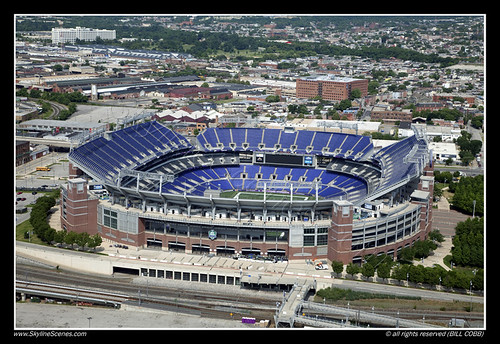
The Glendening article makes the assertion that the M&T Stadium for the Baltimore Ravens, located proximate to the Camden Yards baseball stadium does provide ancillary economic benefits. I don't think it does, but the game day experience is likely different and there is some additional benefit to local business. But otherwise, the big stadium is mostly empty every day of the year. M&T Bank Stadium, Baltimore by Bill Cobb, on Flickr.
It is because of minimal use that I think it's better for cities to let football stadiums go to the suburbs, while focusing on keeping-attracting baseball stadiums and arenas for basketball and hockey because these types of facilities are smaller and can be better integrated in the built environment with positive economic spillover effects and experience much greater use.
Interestingly, in the biggest market in the US, New York City, there is a shared stadium for the Jets and Giants, which "doubles" the use and spreads out the cost.
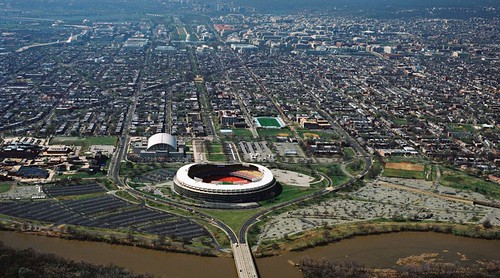
And the likely movement of football teams to the Los Angeles market will yield a stadium shared by two teams ("Analysis: 2 teams needed to make Carson stadium profitable," Associated Press). The economic impact for the city is projected be about $3.5 million/year--not a huge return on a $1.8 billion facility. RFK Stadium site, aerial view.
6. But because mayors don't like to lose out on such big projects, especially to the suburbs, Mayor Bowser of DC continues to angle for the Redskins facility. I'm happy for the stadium to shift from the Maryland suburbs to Virginia's suburbs ("Let it go: Washington Redskins and Virginia") because the economic tradeoffs between supporting urbanism in the city vs. reducing suburban sprawl are too great.
7. Because Richmond, Virginia is the home of the summer camp for the Redskins team and because the team is headquartered in Prince William County, Virginia already, the Richmond Times-Dispatch is covering the stadium issue almost more than is the Washington Post.
The issue is that the city's use of the land is required to be "recreation oriented" and the stadium qualifies. In fact, for DC to use the site for other purposes NPS would have to agree to extinguish the recreation easement on the land, and the city would have to pay a big fee for its extinguishment--just as it did wrt McMillan Reservoir and the sand filtration site. The city could have received the land for free if it committed to recreational uses. Instead, the city paid $9.3 million in the late 1980s, to be able to have unfettered use.
In the meantime, I am happy to let the NPS issue cloud the desire to bring the Redskins back to DC.
Today the Post published the first of three pieces on how the sales of tax liens as a revenue generating device for DC ends up displacing homeowners, sometimes for a debt as little as $134.
For decades, the District placed liens on properties when homeowners failed to pay their bills, then sold those liens at public auctions to mom-and-pop investors who drew a profit by charging owners interest on top of the tax debt until the money was repaid. But under the watch of local leaders, the program has morphed into a predatory system of debt collection for well-financed, out-of-town companies that turned $500 delinquencies into $5,000 debts — then foreclosed on homes when families couldn’t pay. As the housing market soared, the investors scooped up liens in every corner of the city, then started charging homeowners thousands in legal fees and other costs that far exceeded their original tax bills, with rates for attorneys reaching $450 an hour. Families have been forced to borrow or strike payment plans to save their homes.
Two more articles will run on Monday and Tuesday:
&bull: "As federal agents investigated a sweeping bid-rigging scheme at Maryland’s tax auctions, some of those same suspects were in the District, engaging in dozens of rounds of unusual bidding."
&bull: "District tax officials have made hundreds of mistakes in recent years by declaring property owners delinquent even after they paid their taxes, forcing them to fight for their homes."
---------
Note that such problems with property taxes and related issues aren't unique to DC.
The issue is why are "things" so fouled up and how to change them.
Of course, with the tax lien process, the problem is that the Government is not a disinterested party. They just want the money and don't have to take responsibility either for their mistakes or for the consequences to individuals--many of whom aren't mendacious but perhaps have diminished capacities, and aren't able to make sound decisions. In these kinds of situations, we expect government to step in and first attempt to "help" rather than merely be punitive.
And while the Post series is to applauded, it's not necessarily uncovering new stuff, even as it makes the point that the scale of the "game" of the tax lien and tax foreclosure process has changed considerably, and the problems for seniors ("The elderly at risk," Post)
I remember coming across a similar case back when I lived in Ann Arbor in the mid-1980s. A very aged person stopped paying his taxes. He couldn't take care of himself. Rather than trigger involvement from the County Human Services Department, instead the City of Ann Arbor sold the guy's house at a tax foreclosure auction, and the guy was left to die on the streets.
But as the first article states, the government's position is clear:
Officials at the D.C. Office of Tax and Revenue said that without tax sales, property owners wouldn’t feel compelled to pay their bills. “The tax sale is the last resort. It’s also the first resort — it’s the only way in the statute to collect debt,” said deputy chief financial officer Stephen Cordi.
But the District, a hotbed for the tax lien industry, has done little
to shield its most vulnerable homeowners from unscrupulous operators.
Foreclosures have upended families in some of the city’s most
distressed neighborhoods. Houses were taken from a housekeeper, a
department store clerk, a seamstress and even the estates of dead
people. The hardest hit: elderly homeowners, who were often sick or
dying when tax lien purchasers seized their houses.
Rather than waning as sequestration cuts began to hit Washington in March, interest from abroad appears to be strengthening. Foreign sales account for 75 percent of all investments in Washington commercial real estate this year, after not topping 30 percent in the previous three years and registering just 1 percent in 2006. On average, foreign firms accounted for 17 percent of all sales since 2001. Companies from countries such as Korea, China, Germany and Saudi Arabia have been scouring the Washington market for fully leased downtown office buildings, said Bill Prutting, managing director at Jones Lang LaSalle. In years past, when a building went up for sale, “the investor used to be the local family or the domestic pension fund,” Prutting said. “Now, we have a lot more exotic investors from overseas who are coming into especially our market and other markets as well.”
Like any city, DC is actually comprised of a variety of "submarkets" like Downtown or Takoma or Fort Totten or H Street NE, Capitol Hill, etc.
The reason the nature of the market is important is that the participation of global actors reshapes the market for commercial property across the city, even in submarkets that don't normally have international or national actors.
And if they buy in part on the basis of other criteria (such as a safe haven for investment vis-a-vis their home country), they bid higher and the prices rise beyond the normal vicissitudes of the market. Which is why the "lede" of the story misses the point:
Foreign investors are pouring money into downtown D.C. office buildings even as many properties in the Washington suburbs struggle with stagnant leasing and growing vacancy.
Of course, foreign investors are buying properties in DC and not the suburbs, DC's central business district is recognized within the global market, while the suburban submarkets are not (Grosvenor, a British company, is active in the suburbs and likely Tysons will become a submarket with increasing global interest).
The submarkets comprising the Central Business District are decidedly global real estate markets, with nationally and internationally active developers, financing, and property owners.
Typically, the non-CBD markets in the city have been very much local, with small properties, local/regional owners with ties to the city, local developers, local tenants, and local patrons.
But because of the participation of global actors and how the city doesn't weight "global" vs. "local" property markets in terms of property tax assessment methods, prices in the non-global submarkets are higher than they would be on the basis of what the properties are worth as going businesses.
Left: a building up for lease on the main commercial street in Downtown Staunton, Virginia has an asking price of $10/s.f. Not one building on this stretch of Beverley Street is substandard. An equivalent price in a DC neighborhood commercial district would be $35 or more/s.f., for buildings that may in fact require many thousands of dollars for rehab, which the owner isn't usually willing to pay for.
This is why a lot of the property has been vacant or in sub-optimal use (storefront churches, office, etc.), because it is overvalued tax-wise compared to the revenue prospects for the space.
But now there is a second stage of development and change for submarkets in the city that hadn't before attracted global/national players.
As the Central Business District is built out, in order to stay active, some developers are taking on projects in secondary submarkets in the city, especially at sites near subway stations, mostly residential multiunit housing, often with retail on the ground floor, so it qualifies as mixed use. Typically these locations aren't attractive for office use.
Typically the financing for these new projects in these districts is national. For example, Pritzker family interests financed the construction of the Monroe and Market development in Brookland, adjacent to the subway station there as well as to the Catholic University of America campus.
And that will end up reshaping these secondary submarkets in other ways, because the retail space in these projects ends up getting plugged into national credit markets, likely this will lead to more chain and franchise outlets, and fewer independents.
So once your central business district is part of the global real estate market, expect other changes in other submarkets. Better yet, anticipate the changes and take steps to ward off the negatives.
Revisiting the issue of neighborhood commercial district property tax methodologies
According to a post on the Chevy Chase listserv (I don't subscribe but it was re-posted to the Takoma listserv--the entry is reprinted at the end of this post), Councilmember Tommy Wells testified to the City Tax Revision Commission, suggesting that a commercial property tax discount be offered to long time "independent" retailers.
It's a worthwhile gesture and good and populist to suggest providing tax discounts to "long time" "independent" retailers, but such an initiative misses the most important point, which is that the commercial property tax assessment methodology that the city employs "overprices" neighborhood commercial real estate more generally.
This matters to new businesses as much as it does old ones, and is why for decades neighborhood commercial districts have lagged in comparison to Downtown and regional districts like Georgetown and Dupont Circle.
Had the proposal been outlined in this manner, likely Commission members wouldn't have been able to express as much skepticism, and pointed commentary about some of the more arbitrary elements of the proposal.
It happens that I used to testify about commercial property tax assessment methodologies in the city and the negative impact on neighborhood commercial districts quite regularly from say 2005-2007 (and was quoted in an article by Post writer Paul Schwartzman on the subject, "Feeling the Pinch Of D.C.'s Prosperity," and had a letter to the editor in response to the article, "Tax Policy Hurts D.C.'s Local Businesses") but given that the points I made were systematically ignored by CM Evans and then Chairman Cropp, I stopped. These entries are representative of the argument:
The basic problem (speaking of "Growth Machine" theory) is that the real estate market in the Central Business District is not a local market, but a market comprised of national and international actors as developers, financiers, and owners. This tends to shape the method for how commercial property is valued and assessed across the entire city, not just downtown.
Some national actors get involved in other submarkets where they might not ordinarily (e.g., Federal Realty owns property in Dupont Circle and Cleveland Park, among other places) which raises prices, but generally, all of the commercial property tends to be valued as if it could be a downtown office building owned by a German pension fund. This makes the property more pricey.
So in DC, even in lagging areas, the minimum asking price for retail space in a neighborhood commercial district is at least $35/s.f., and often for a building that needs lots of rehab, which the tenant is expected to pay for as well.
By comparison, rents in thriving traditional commercial districts in places like Carytown in Richmond, Downtown Frederick, or Hampden in Baltimore is $25/s.f. or less. (In lagging commercial districts in other cities, including Richmond and Philadelphia, rent can be closer to $15/s.f., which is what touches off innovation in those places.)
In short, it's all about the rents, which are set in large part by the carrying costs of the building. The rents metric is explained in this entry about Cleveland Park:
But politics is more about helping individuals and using individual stories to justify a particular policy, rather than to systematically assess a problem and figure out how to address it systemically. I guess I will submit some testimony to the Tax Revision Commission...
----------
My letter in the Post from July 25, 2007
Tax Policy Hurts D.C.'s Local Businesses, Richard Layman
A July 20 Metro Article ["Feeling the Pinch of D.C.'s Prosperity: Small Businesses Cry Out for Relief From Rapid Rise in Property Taxes"] inadequately explained why tax assessments are rising for small commercial property owners in the District.
Regardless of buildings' locations and use, the D.C. Office of Tax and Revenue values commercial buildings as if they could be converted into downtown office buildings. If the purpose is to turn the entire city over to office buildings and retail chains, then this property tax assessment methodology is working.
The market for downtown property is not local; it involves national and international developers, lenders, and portfolio investors. The market for small-footprint buildings in neighborhood commercial districts is local--in terms of property owners, investors, tenants, sales potential and rents. The solution is simple: differentiated tax assessment methods.
The legislative focus on property tax abatements or tax caps fails to address this fact.
As a result, locally owned businesses will continue to close or relocate to the suburbs, while more and more of the retail identity and uniqueness of the District is lost and the city's retail landscape becomes reshaped into yet another mall, albeit outdoors, featuring national brands.
---------- The Chevy Chase listserv piece
From: Edward Cowan
To: chevychasecommunity listserv@ yahoogroups. com
Sent: Tuesday, May 21, 2013 9:12 PM
Subject: [ChevyChase] Neigborhood Tax Incentives Pose Issues
Council member Tommy Wells (Ward 6) encouraged the Tax Revision Commission on Monday to recommend the adoption of reduced real property taxes for independent, neighborhood businesses, especially in turnaround neighborhoods.
Wells announced last weekend that he will run for mayor in the 2014 Democratic primary. That made him the second declared candidate from the council' s ranks, in addition to Muriel Bowser (Ward 4).
Arguing for tax discrimination in favor of locally owned, nonchain businesses, Wells put this rhetorical question to the 11-member commission: should a smaller neighborhood- based business pay the same tax rate as retail on K Street downtown?
Acknowledging that DC law now levies a lower rate on the >first $3 million of assessed value of commercial properties, Wells urged the commission to favor an even lower tax for "neighborhood- based retail business and job creators."Wells said that commercial renters, not the property owners, effectively pay the property tax under standard lease terms.
This populist tilt sounded like a harbinger of a campaign theme.
Real Property Taxes Now
Nonresidential property is taxed now at $1.65 per $100 of assessed valuation (1.65%) up to $3 million of assessed value, and at $1.85 (1.85%) on value above $3 million.
Residential property is taxed at $0.85 (less than 1 percent) for each $100 of assessed value after the homestead exemption, 69,350 in 2013, has been subtracted from assessed value.
The effect of the exemption is to make effective tax rates (taxes divided by assessed value) vary inversely with the value of the property--a form of "progressive" taxation.
Whether such classification distinction between categories of property is a good idea was the topic of expert testimony given later in Monday's session. "I'm not wild about classification," said Daphne A. Kenyon, an expert witness from Windham, NH.
She observed that taxing commercial property at a higher >rate "can drive business away."That elicited a rebuttal from Ed Lazere, who heads the DC Fiscal Policy Institute. He argued that DC business has thrived. Lazere generally opposes tax relief for business and upper-income people.
Commissioners Question Disparate Treatment
Wells ran into resistance from economists on the commission, notably David Brunori, a research professor at George Washington University. He invoked the bedrock principle of public finance that the primary purpose of taxes is to raise necessary revenue--and to raise it as efficiently as possible, causing the fewest distortions in the economy.
Fitzroy Lee, who heads the District' s Office of Revenue Analysis, also asked Wells about inequities that arise from tax preferences, that is taxing similarly valued properties, sometimes side-by-side, differently. Taxing them roughly equally is called "horizontal equity," and it is deemed a virtue among public finance experts.
When Brunori asked Wells whether his strategy was to have government "pick winners and losers,"� Wells avoided a direct yes-no answer.
Later, as Brunori pressed him on a technical tax question, he replied--dismissively, it seemed, "As I said, I'm a social worker, not an economist."
Cites NoMa as Success
In arguing for the efficacy of tax incentives, Wells cited tax concessions offered under former mayor Anthony Williams (who heads the Tax Revision Commission and presided on Monday) for the development of the bustling NoMa neighborhood north of Union Station.
He said tax concessions might be time limited, and he acknowledged that sometimes tough choices presented themselves, such as denying a break to a liquor store and awarding one to a grocery, when both are locally owned. Wells said that he thought incentives might be offered not only in recovering neighborhoods, such as H Street NE, but even in "built- out" neighborhoods, such as Ward 3." He did not address the fairness of giving a tax concession to a new enterprise which is challenging one that is well established and doesn't qualify for preferential treatment.
Wells opened his presentation by recounting in glowing terms the commercial renaissance of H Street NE in the past few years. He did not mention that the new "corner markets, fitness studios, pharmacies, restaurants and hardware and furniture stores" that have "created nearly 1,000 jobs" and made the neighborhood "walkable" had sprung up without the tax incentive he advocated.
However, his staff later pointed out that the District government had given "grants and loans" to H Street enterprises, assessment reductions and extensions of time to pay taxes.
Two Points of View
Wells argued that even in "built- out neighborhoods, ">encouraging local retail of necessary goods and services--groceries , hardware, dry cleaning, pharmacies-- serves the whole city by diminishing the need for residents to use their cars to do their shopping. In this he aligned himself with the Administration, which has stressed walking and bicycles over cars--and whose leader, Mayor Vincent Gray, may run against Wells and Bowser in the 2014 primary.
As several questions by commission members indicated, economists who specialize in public finance shy away from using the tax code for "targeted"; social and economic purposes, what conservatives disapprovingly call "social engineering. "One reason is the desirability of simplicity. Keeping the tax code relatively simple makes it easier for people to pay their taxes without hiring an expert, and reduces friction between taxpayers and the tax collection authority.
Other reasons include treating similarly situated taxpayers equally, avoiding situations-- such as applications for preferences and extensions of them--that invite corruption. A third argument against "targeted" preferences is that they may outlive the facts that justified awarding them.
In addition to avoiding tax complexity, some economists favor subsidies that the legislature must vote for annually, which keeps debate alive and audible. Conversely, beneficiaries favor tax breaks that are embedded in the law.
This is one of the issues the commission is expected to address in its report, due by the end of the year: whether the District's present taxes are tilted against business and discourage new enterprises from coming to the District.
The 106 taxable D.C. properties with the highest assessed values in tax year 2011 generated nearly 22 percent of the city's property tax revenue in fiscal 2010 — $407.7 million of the $1.88 billion collected. Their total assessed value in 2011 is $19.7 billion, down from $22.2 billion last year. ...
The vast majority, 95, are commercial office buildings. Five are hotels — the Grand Hyatt at 10th and H is the most valuable of that group — and four are primarily residential.
The city's assessment is supposed to represent the estimated market value of a property, that is, "the most probable price for which you can sell your property given normal terms and conditions of sale." But the assessed value, especially in the commercial office market, is often a far cry from the sales price.
Invesco Real Estate, for example, bought 1111 Pennsylvania Ave. NW last year for $220 million. The property's 2011 value, according to the city, is $154.2 million.
The article includes a list of the 105 buildings.
The point being is that people who advocate X and Y and Z need to be conscious that programs cost money and somehow, the revenues need to come from somewhere.
DC is lucky in that unlike any other jurisdiction in the U.S., it keeps all of the income tax revenue it collects. But even so, commercial property taxes generate the bulk of the city's income, even though a goodly portion of the city's real estate isn't taxed (properties of the federal government and many nonprofits, including colleges and universities).
Location: Salt Lake City, UTAH (UT), United States
I am an urban/commercial district revitalization and transportation/mobility advocate and consultant. I was a principal in BicyclePASS, a bicycle facilities systems integration firm, based in Washington, DC. Now I'm in Salt Lake City for family reasons. Urban economic competitiveness is dependent on efficient transit and mixed use, compact places. Therefore, I end up writing a lot about mobility and urban design. I still own a house in DC, so I write a lot about Washington, DC issues. I try to write so that "universal lessons" are evident in the entries, regardless of the place.